



Abstract
Our performative contribution to the 2019 Special Interest Group in autoethnography provided an opportunity to consider the materiality of absence and presence. Using the film These Things and the research-inspired song that underpins the film, we explore how a 5-min multimedia performative act opened possibilities for solidarity and resistance, offering ways to include the absent other.
Introduction
Our performative contribution to the 2019 Special Interest Group (SIG) in autoethnography was inspired by a number of happenings, challenges, concerns, and interests. Looming large among these was Stacy Holman Jones and Anne Harris’s keynote at the 2019 European Congress of Qualitative Inquiry (ECQI). Their keynote moved and stimulated our thinking about materiality and resistance—it was as much what is missing as what is present.
To explain: Stacy had been unable to travel with Anne from Australia to Edinburgh to co-present their keynote in person, but through technology she was brought to us via the internet. “We,” as audience members, watched as Stacy’s face appeared beside Anne who was performing “live.” On the huge screen, Stacy’s face dwarfed Anne’s physical being. While technically Stacy was absent, she was ‘there’ and we heard her voice and we saw her face (Frank, 2004). She was absent but she was present. Their performance, a co-created and co-performed piece, appeared (from where we were sat) as seamless and as powerful as if Stacy had been physically in Edinburgh. Perhaps more so. Anne (who was technically alone on the stage) did not appear so alone. For a few moments perhaps, their union in performance provided the audience with a sense of the alchemy that exists between audience and performer and between co-performers where what is materially absent can still have “matter.” Matter is something that is vital and important, but it is also a physical presence that occupies space and possesses mass. But here, Stacy’s virtual form both occupied space and possessed mass.
This moment provided us with an emotional catalyst to reconsider participants bodies: their presence and absence in our research representations and communications. In our research more generally, and specifically with textual representations, we are frequently challenged by who or what we render absent. For example, if we present our research findings in written form, what do we render absent? Or when we perform (“standing in” for participant’s bodies), what becomes material and what becomes immaterial? Which aspect(s) loom large, and which lose space and mass?
These musings were not just philosophical. Questions arose for us as we considered what we would contribute to our community at the 2019 SIG, when for health reasons, David was unable to attend. Given so much of our research is a collaborative process, to remove one of us from the frame would fracture a constant, simultaneously creating an illusion about the nature of our work.
One response to this dilemma—and dilemmas around the materiality of participants’ lives in our research more broadly—has been to incorporate films and recorded songs into our presentations/performances. These have the potential to recover some of what is rendered absent when we present through written text. Perhaps the most obvious song and film that aligned with the call for “technologies of representation help us foreground, interrogate, and imagine a politics of resistance” was These Things (Carless & Douglas, 2010; Douglas & Carless, 2015, 2020). In what follows we describe and reflect on some of the artistic processes that led to and underscored our performance in May 2019.
Creating a Song: These Things
In polyphony the competing voices create a harmony that never unifies them but holds them in mutual dependence. The voices are parts of a whole in which they remain distinct but are interdependent. (Frank, 2004, p. 110)
It’s 2009 and we’ve withdrawn to a little cottage on the south Cornish coast where we hope to “write up” our findings. The research we need to communicate was commissioned by the Addiction Recovery Agency to explore and understand the lives of individuals living in inner city, council owned, housing schemes. One particular scheme—housing 25 people aged 55 or more—was selected by the funders for study because (according to a local council official) it had “problems”—several residents had antisocial behavior orders (ASBOs) served on them, some were believed to be problem alcoholics, and the majority had, at some point in their lives, been homeless. We used an ethnographic approach, which left us with notebooks bulging and pages and pages of transcribed tape recordings of interviews. But these fell into insignificance compared to what was stored in our bodies, in sensory traces, fragments, a touch, a sigh, a lowering of the head, a tear, things that needed a voice but had no words.
We worked steadily writing the official report, using first-person narratives and individual case studies. But there was too much missing.
Thoughts flash across both of our minds:
Listen to the body
Feel what was locked away
Kitrina takes a transcript and moves to the kitchen. David retreats to the front room with his sunburst Gibson guitar, a powerful instrument, large in size and full in tone. The sparrow sitting on the window ledge hears a riff for the first time; it’s like the train passing from Penzance to Bristol—it is pensive, has a story to tell, but the lyrics are yet to be written. David is fishing.
The rhythm of the piece, I stumbled upon it by playing. There was no plan, never is. I found it, it found me. It was an accident. When I am into a great rhythm I just don’t want to stop, feel like I could keep playing it all day long, going round and round the chords. A groove. And a repetition that can fast become addictive, a soothing trance, a place of safety and familiarity. Before the song exists, I am already finding this rhythm infectious, it is relentless, it makes me want to get up and out of my chair. It makes me want to stand up. It makes me want to take a stand. It makes me want to move. It incites me to get going. It gives me a reason to keep going. This is significant: the rhythm, on its own, is provoking me to act.
I’ve been around David when he’s writing songs a few times and recognise the signs. But still, from the kitchen, I’m wondering what is coming next? I hear a chord progression strummed again and again. Words. Then an extended repetition of the chorus chords and music, but this time without words, with a different melody, with revised phrasing. But these points are all detail, academic, theory. The essential point is that this is A SHOUT. It is, at its simplest, a guttural noise from the belly of the beast.
“The Shout” is born of frustration. And anger. Frustration and anger at seeing the same thing happening over and over again. It is about power and the absence of power. We ask the most of those who have the fewest resources to support the giving. The residents: struggling under the weight of health crises or deprivation or crime or addiction or bereavements or just very bad luck. The support staff: denied the time they need to care, to do the job of helping others, the reason they got into this work in the first place.
“The Shout” is about making a noise. It stems from having no answers, no solutions, maybe no hope … but committing to “speak” regardless. Refusing to be silent. Refusing to fade away. Not fade away! It’s rock’n’roll. When I shout like this, I get a sore throat. And I take perverse satisfaction from this. I feel the pain, physically. It becomes embodied, present, it is given voice. A material embodiment of frustration and anger. John Lennon gave us many eviscerating shouts. Screams, even. One of his most famous shouts is toward the end of “Twist and Shout.” In their early shows in Hamburg, The Beatles had to place the song last in their set—because Lennon’s voice was shot afterwards. He could sing no more. He had given everything. The one time I saw Springsteen live (in London in 1988), he covered “Twist and Shout.” It was his final encore. Perhaps he gave everything, too.
“The Shout” in These Things matters to me. It is an important component of the song and the recording. It cannot be written down here, or anywhere else. You had to be there.
Two hours later, David asks Kitrina to come in and he performs the song for the first time:
Train ride out of the dark into the light
Cause my guy was no good
A punch, a kick, a say goodbye
Ten long years had passed me by
Now it’s my time, for good
Alone there on the intercity, you sat and listened to me
It’s these things …
Some weed, some bud, a drink, a drop
brought a little color into my lot
It was high times and warm nights
Until a doctor said it’s time to stop,
put the bottle down before you drop
It was my time, for a change of mind
Now I need a sanctuary and an arm around me
It’s these things …
A house, a job, two kids, a dog,
a family man is what I was
It’s these things that brought me back
From the precipice when illness hits,
turning, spinning, blown to bits
Was it my time? Who knows?
Now I need a sense of safety and you to stand beside me
It’s these things …
I don’t need to be told or shown where these lyrics came from, I know the individuals and their “distinct” stories (Frank, 2004). But, as a song, the lives represented in it have taken on an embodied form that unites them while also giving them an added dimension to the flat case study I had written earlier. Each note, melody line, pause, riff, and strum pulls at an embodied connection. And this song is calling me to join in: there is space to add voices, harmonies, noises. Polyphony made real. But I also recognize a voice that is missing, a voice that has no voice … yet. “I have something!” I say and dash to the kitchen to search for something I remember one of the housing support officers said to us. I walk through and begin reading the extract while David continues strumming the now familiar chord progression:
It’s not our fault; it’s cause of the so say management that changes have come in. The residents feel we haven’t got the time for them now, it’s like we’re not paid to care anymore. Going back it was more caring, but not now. Now it’s paperwork and I don’t like it. All the girls feel the same—too much paperwork. And to me, it seems like now we’re there for the building, not for the people. It’s almost as if as long as the building gets checked, it’s okay. You know, fire alarm, intercom system, blah, blah, blah. But me? I’d rather be there for the people. I care about people. Obviously there’s nothing we can do about it, they’ve stressed it time and time again: it’s not going back to that system.
By continuing to play, David has woven this woman’s voice, and the feelings of the other housing officers and their disempowerment and frustration, into the song. I get a chill across my body. We pause, look at each other. No words are necessary.
We are both profoundly moved in the act of performing These Things. It is not really us writing and singing this song—we are being called …
We finish the song, and a few weeks later give a performance (see Douglas & Carless, 2020) to participants, then at conferences and community events. The main problem with these is we have to be there, in person, every time. Without us, there is no performance, no opportunity for inclusion or recognition. We wonder: Is this where the research ends? What more might be done?
The Promise of Film
The first “music video” appeared in the 1920s but the arrival of MTV heralded a massive change of pace for the genre when it was launched in 1981. For some, the music video has been a vehicle to illustrate the song. It’s now become equally important as a way to promote a particular song from an album ahead of its release. For us, our research-based films have become a political act that makes research accessible to a wider audience. Added to this, films placed on accessible platforms (such as Vimeo and YouTube) provide a “material artifact,” which exists in its own right.
Central to our interest in reinstating materiality of everyday life, visual images tell their own stories about place, space, and embodied manifestations. They open space for deeper connections and understandings, they bring color and a recognition of the place that shapes the body. However, as Frank (2004, p. 63) reminds us, “The task of representation is both ethical and esthetic. What we think counts for ethical consideration depends on how it is represented, and representations necessarily have an esthetic dimension.”
Cinematography recognizes a visual esthetic, but less so the ethical and moral negotiations of the researcher: how to negotiate anonymity, or what and whose story might, should or could be told? Neither does it, on the surface at least, consider who are we to tell these stories? At the same time, a film provides a means for viewers to consider material context—in this case, the historical backdrop to the city. This is important in terms of “political consciousness” in an era of extreme financial cuts and changes to social policy and community provision.
Set on a world stage, the UK is sometimes presented as homogeneous. But there is diversity across England, Ireland, Scotland, and Wales. And within England there are significant differences too—a north/south divide, regional attitudes, and accents—which at times make it difficult to understand each other.
Bristol, like some other cities in the UK, has a dark and shameful past around slavery. Yet the city has undergone many “rebirths.” Its current cosmopolitan feel offers a home to street artists and political activists like Bansky and their presence has left an important mark on the city. Our film was not intended to be a historical commentary, but neither was it a tourist promotion drawing on the usual iconic backdrops (the suspension bridge, balloon festival). We weren’t interested in Isambard Kingdom Brunel, or other icons that get cited when Bristol is shown in film. Rather, our footage joined participants on their journeys in their back yards. A common theme among participants was arrival and departure. Some arrived from the Caribbean, others had departed an abusive relationship. We used the backdrop of these experiences, along with the emotions evoked by the music, to portray cinematographically some of the things that were impossible to communicate through words.
Images from the film
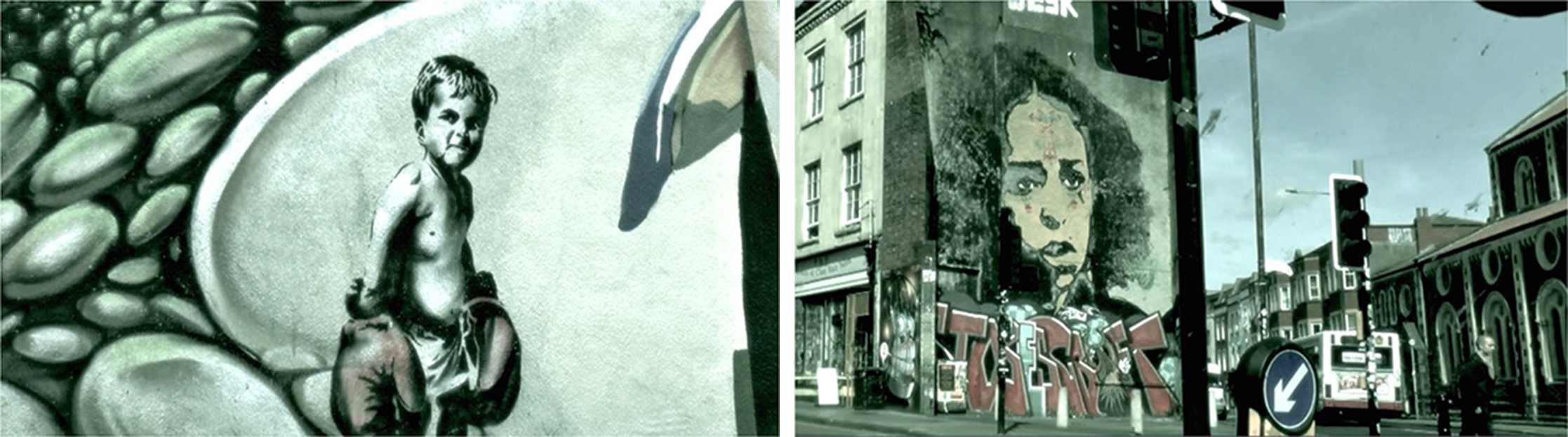
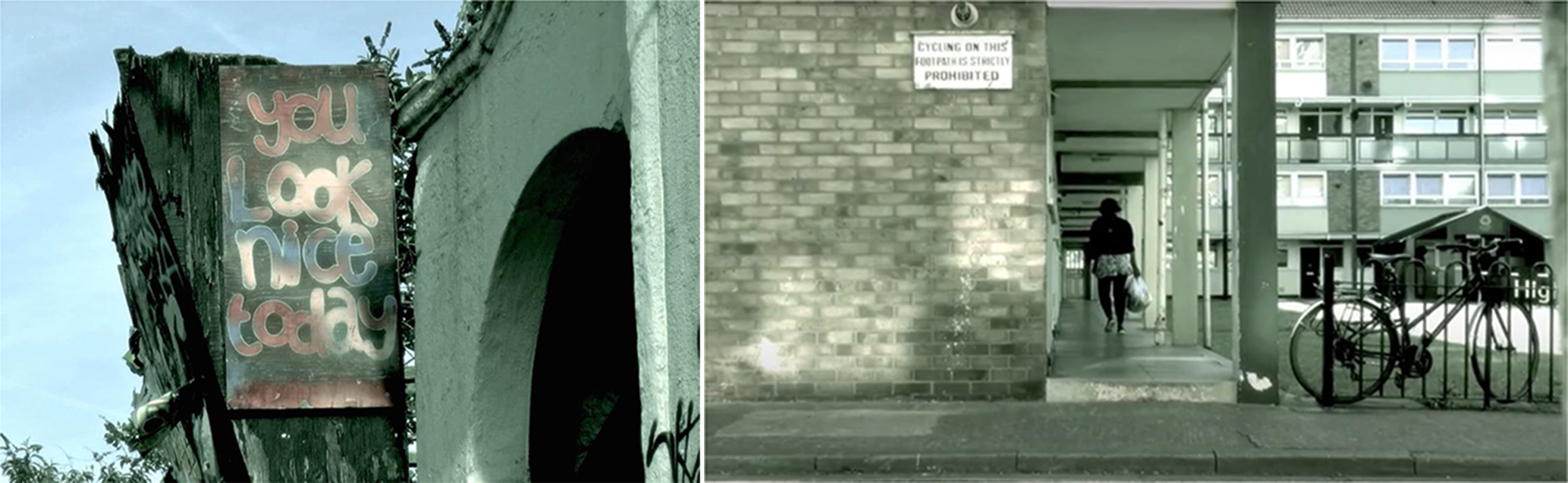
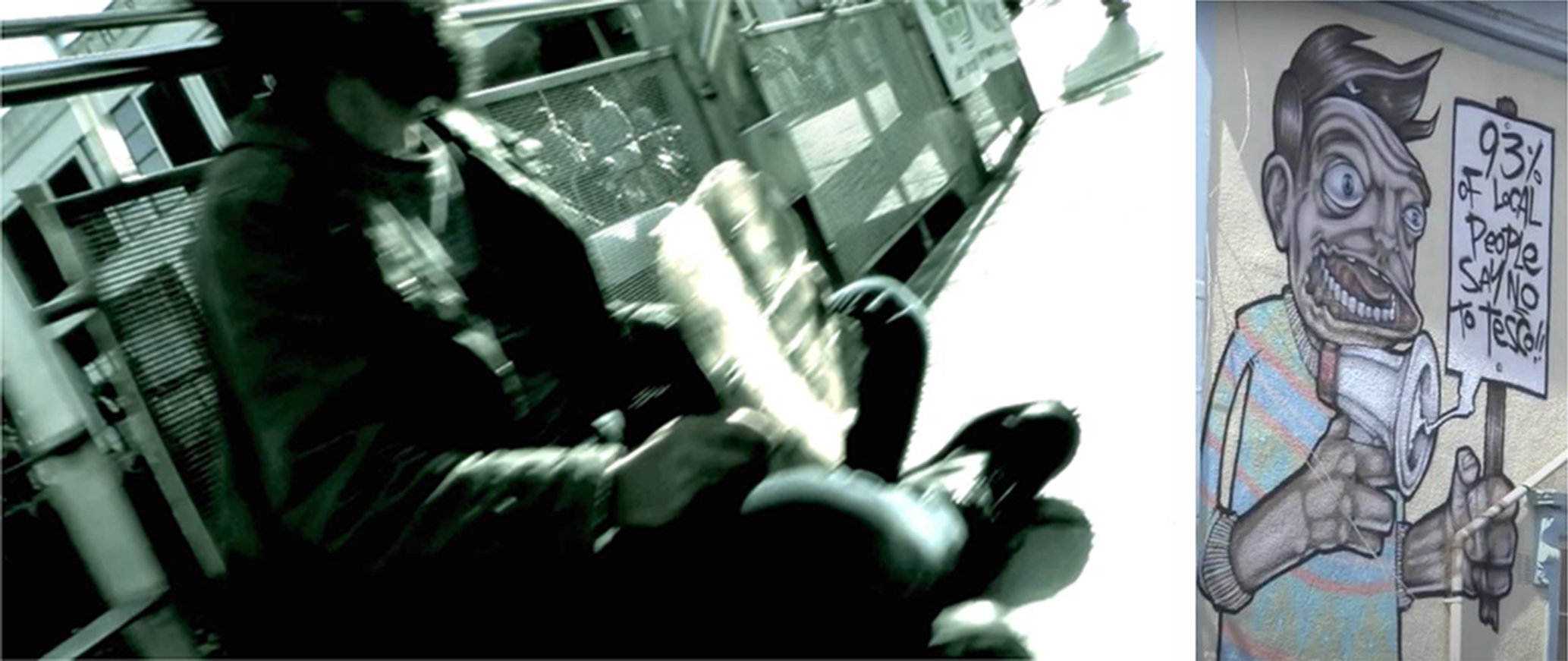
And Then We Borrowed From Bob
Public education and civic, participatory social science are in jeopardy. Academics and pacifists critical of the war on terrorism are branded traitors. More and more restraints are being applied to qualitative, interpretivist research, as conservative federal administrators refine what constitutes acceptable inquiry … These are the troubled spaces that radial performance ethnography must enter. (Denzin, 2003, p. 223)
Bob Dylan is regarded as one of the foremost songwriters of his time. His early work contained protest songs inspired by Woodie Guthrie. While acknowledging the diverse topics and genres of his songs, his commitment to civil rights and an antiwar stance have played an important role in his work. So too has his counter-culture attitude, which led the Rolling Stone magazine to remark about the song “Like a Rolling Stone”: “No other pop song has so thoroughly challenged and transformed the commercial laws and artistic conventions of its time, for all time” (Rolling Stone, 2011).
If, as a community, we are to rise to Denzin’s challenge to enter the troubled spaces, then we share a responsibility to move in ways that achieve these aims. The second inspiration behind our offering at the 2019 conference, then, was Bob Dylan’s performance in the music video of “Subterranean Homesick Blues” (Dylon, 2015). In 1965 Dylan had been on tour in the UK and had agreed to be part of a documentary being made by a Donn Alen Pennebaker. Making the most of the available film crew, Dylan decided to make a Scopitone. 1 Having tried unsuccessfully to film the song/performance on a rooftop and in a park, they set the camera up in a nondescript alley behind the Savoy Hotel. Using techniques more akin to cinéma vérité, Allen Ginsberg and road manager Bob Neuwirth were positioned in the background (having an animated conversation), while Dylan took front stage with a pack of large correspondence cards in his hands. The cards were scrawled in hand, some with lyrics matching the song, others with inconsistencies, purposeful spelling errors, “in jokes” provoking a political critique. During the 2 min 19 s in which the song takes, Dylan discards the cards one-by-one in quick succession with an increasing miscuing of song lyrics to card caption, resulting in a music video that is a mix of political resistance, humor, and artistic expression. The film has gone on to become one of the iconic moments of music TV.
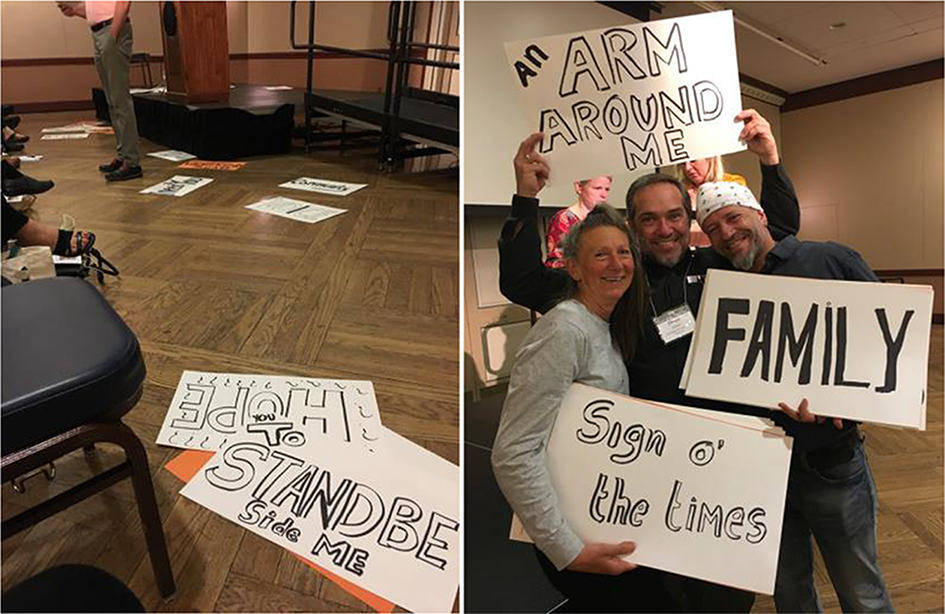
Our intention was not to try to reproduce what Dylan had achieved (we never could), but rather embrace the political activism behind the film and use it to recreate a new “live” performance using the film These Things and cue cards. An act that not only provides an opportunity to stand with us, but also with our participants and other people who find themselves in similar situations. An act that brings troubled spaces into a performance space through layering music, film and live performance.
To this end, Kitrina created 50 one-meter cards, handwritten with a wide felt-tip pen, that included lyrics and words that seemed to speak to the theme of These Things:
These things, STAND BESIDE ME, HOPE, Community, We’re not paid to care, I need You, An arm around me, THESE THINGS, family, Safety, Community, Inclusion, Sanctuary, these things, High time and warm nights, Life, Stop! Put the bottle down, These things brought me back, a Home a Job, Kids, Family, Time, a dog, THESE THINGS, Touch, I need you, Stand beside me, Sign o’ the times, VOICE
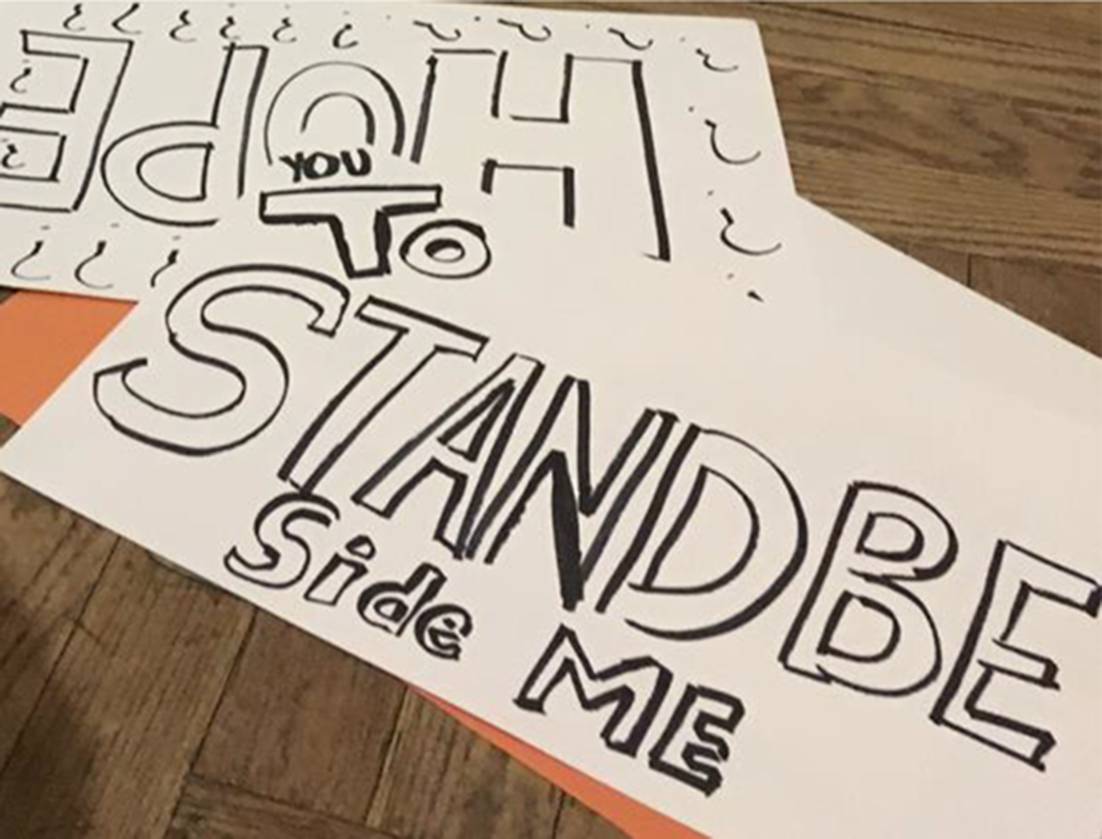
An Invitation
Representation is the problem of converting absence into presence and restoring persons to moral recognition (Frank, 2004, p. 61)
As I took to the stage with the placards under my arm, I felt very much the absence of a friend. But I was not alone in experiencing absence. Before me Jonathan Wyatt, Marcelo Diversi, and Claudio Moriera had spoken about their friend Ken Gale, with whom they were intending to present but who was also unable to be with them. They marked his absence by leaving a physical space between them. Our community, in response, recognized their act and attempt to include a missing friend and colleague. Those of us who know Ken were able to imagine him being with us; we recognized the way his part of the “script” was performed and interpreted by the others. This in turn, in some small way, allowed a little of Ken to be present, and this in Frank’s terms is one way we convert absence into presence.
As an introduction to our contribution, we decided it would also be fitting to share with the community that David was unable to participate physically but could be here through the recorded performance of his song. His words, his music, his voice, his playing would, for a few minutes, render him present.
The audience seemed to understand the reason behind the cards and recognize David’s voice singing, along with his cameo appearance in the film. Together, the music and the physical performance seemed to bring, for some at least, a heightened connection and recognition. Those in the audience communicated a great deal through movements, raised voices, smiles, head nods and, remarkably, a standing ovation at the end.
Up until the housing support advisor’s speech, the mood in the room seemed upbeat. But it took on a different dynamic when the music quietened and Kitrina spoke, in time with her recorded voice, the words of the housing support advisor, which began: “It’s not our fault, it’s because of the so-say government that changes have come in …” At this point, it seemed as if “together” the audience reflected a moral awareness of the current climate within academia as well as more broadly across diverse political backdrops. “… It’s like we not paid to care anymore.”
As the extract finished, the song lifted and provided an opportunity for those present to participate—to join in with “The Shout,” to sing, make noise, but without any requirement for words. Responding to Kitrina’s physical invitation, our community raised their voices to respond as one. No words, just melody, and sounds drawn up from hearts.
Unbeknown to us at the time, two of our doctoral students (Andrew Gillott and Matt Staples) recorded and photographed the event on their phones. Matt wrote:
I had viewed the These Things film before on YouTube, so I thought I knew what to expect as Kitrina went up to play the video to the audience. I didn’t. Kitrina stood silently and displayed various powerful phrases and words to complement the video. In her silence, Kitrina gave me the opportunity to listen to these words in my own voice as she held up each word and phrase. I pulled out my mobile phone and began recording. It simply caught me by surprise. It was an instinctive reaction. Kitrina, without saying anything, didn’t need to say anything. She allowed me to live her performance through the sounds of her and David’s film, but also my own voice.
Looking back at Matt and Andrew’s footage now, cards strewn across the floor, and hearing our community raise their voices with us, sharpens our awareness of the type of support and material connection that is so important for political activity and change … but is missing when you are the one who is absent.
Footnotes
Authors’ note
David Carless is now University of the West of Scotland and a Visiting Research Professor in the Centre for Creative Relational Inquiry at the University of Edinburgh.
Declaration of Conflicting Interests
The author(s) declared no potential conflicts of interest with respect to the research, authorship, and/or publication of this article.
Funding
The author(s) received no financial support for the research, authorship, and/or publication of this article.
Note
Author Biographies
