




Abstract
A panel convened around the idea of intersubjectivation, loosely conceived as a process of actively, consciously, and reciprocally adjusting the structures and power dynamics of our social relations, thereby mutually (and consensually) reconfiguring our subjectivities and, over time, our wider cultures. Through a series of explorations of how one may elicit, reach, or realize a shared sense of intersubjectivity, the panel reflected on and challenged conceptions of the human subject as unitary, discretely embodied, economically accountable, and objectively measurable by a proscribed set of validating criteria. Speakers invited, allowed, or insisted upon the (re)presentation of hidden, unrecognized, or misconstrued aspects of subjectivities: their own or other people’s. While considering varied examples, variously presented, of the process we came to call intersubjectivation, something happened in the room: feeling intensified… shifted… becoming more… an enhanced sense of intimacy perhaps… affectively charged empathic stillness … sensations of interconnection. And we became. Using recollections and reflections from those present, this paper attempts a representation of what happened in the room, intangible yet perceptible—precious and alive—in hope of building understanding of how intersubjectivation may be conceptualized and achieved, whether actively intended or obliquely manifested through some peripheral, perhaps-parallel perhaps-integral, process.
Keywords
Introducing Intersubjectivation: Mark’s Tears
On the last morning of the Conference we convened—yes, another panel … more, same, same …. and yet we came. Thoughts flowed divergent, some in the past, some in the present, some directed silently toward others there—or elsewhere—while some shape-shifted, abstracted, floating in the sun. We thought our own ways—differently—round and through, toward and away from one another. This is hard to say … I can only try to tell you when … how … something became—us. Mark’s tears alerted me to the presence in our shared space of more than I was aware of from within my own perspective. And as I grasped hold of this knowing-feeling, I felt equally sure I was not, or no longer, alone in the sensation … that mine was part of a wider experiencing … of heightening … electrical-thrill-enlivening-intimacy … (be)coming into awareness as mutually co-present: profoundly human—together. Something happened in the room … feeling focused, found a way, captured the space and we … touched in a moment of our mutual creation, were momentarily more than … one.
By exploring, what happened in the room that morning, I, Melissa, seek to clarify and deepen our mutual understanding and use of the term “intersubjectivation,” which I initially introduced to the conference as a panel theme with the idea of re-presenting intersubjectivity in verb form—a reminder that intersubjectivity is not an object (thing), but exists through its enactment between people. As we open ourselves to the idea conceptually, so we open experientially—in an embodied sense, finding the meaning through performative action (Manning, 2013); when intersubjectivation happens—things change.
The term intersubjectivity is variously described and understood; as a relationally oriented psychotherapist, I locate it as both aim and means in therapeutic dialog—the therapist strives (though it’s not easy) to maintain awareness and recognition of the presence of more than one subjectivity—their own and that of the client(s). When therapist and client each simultaneously enter into this awareness, a feeling of encountering the other, a state of intimacy, comes into transient existence, through which it is possible to meet what Buber (1958) called “the longing for relation.” This longing echoes our earliest need to be seen, be recognized by others as a condition for life itself, since we are born dependent on the caring impulses of others; from this vulnerable beginning, we develop a sense of ourselves, our subjectivity, always and only through relationally configured developmental processes (Stern, 1985).
Foucault (1994) used the term “subjectivation” to describe how one is simultaneously made subject, or subjugated, by the social and cultural power relations inherent in the context in which one’s subjectivity is situated when thus constituted. Butler (1997, p. 116) recalls Althusser and simultaneous processes of mastery and submission as the condition for possibility of the subject. The price of a sense of being existent is acceptance of the limitations of the social context in which we are recognized as such.
In blending the terms “intersubjectivity” and “subjectivation,” I proposed the idea of “intersubjectivation” as an active(ist) position—in which facilitating experiences of mutuality with others could be understood as a powerful, perhaps essential, means of enacting social change (Figure 1). In cultures centered around discourses that objectify certain beings, while privileging the subjectivity of others, the capacity to retain, rediscover, or reassert a sense of our shared humanity acts to soften the psychological impact of repression, isolation (both psychic and social), and dehumanization of both marginalized and selectively privileged beings. As a way of feeling with, being with others in the world, intersubjective awareness invites collaborative and cooperative social strategies that are sensitive to positions of difference and attentive to affectively charged inter- and intra-connectivities. Cultivating the possibility of intersubjective awareness, so that more people may experience it more frequently and more consistently, may then, act as a counter-measure to social structures that serve to isolate bodies and minds, to the detriment of both individuals themselves and the wider common good.
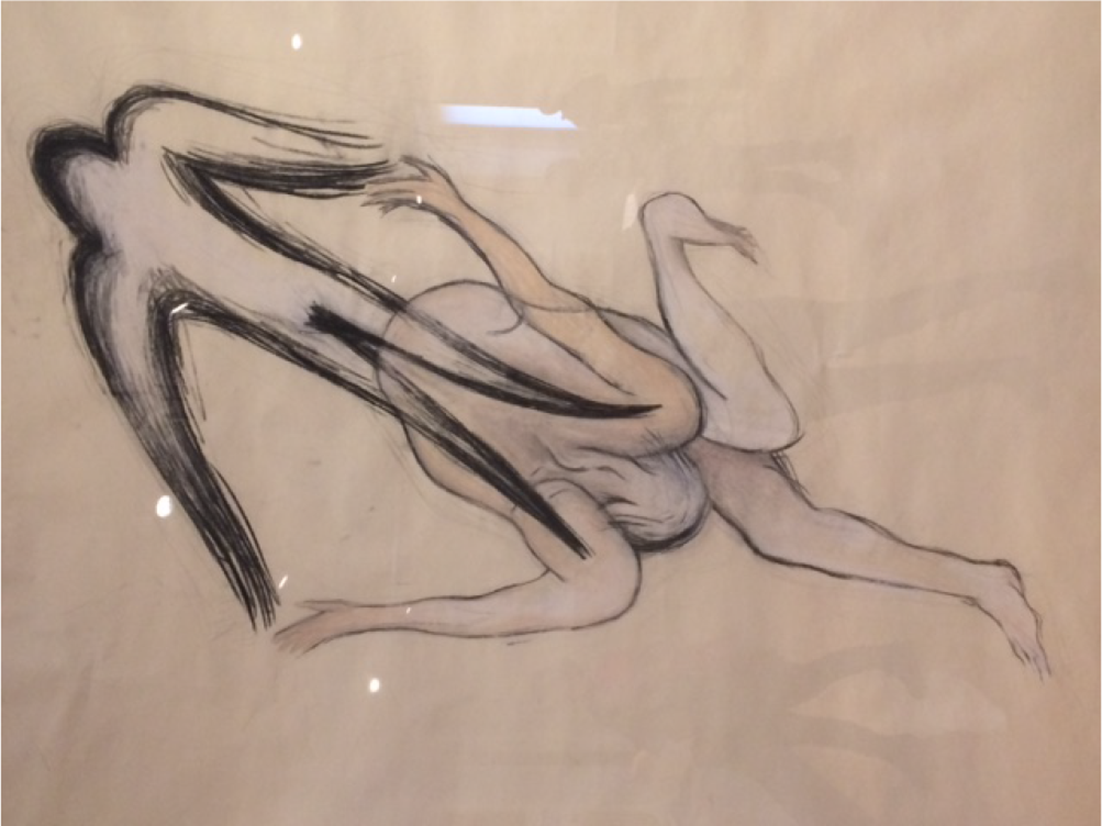
Photograph by Gaia Del Negro of drawing by Birgit Jürgenssen, (thought to be Untitled, 1983) at I AM exhibition in Bergamo, 5 visited March 19, 2019.
Wittgenstein (1921) says “Whereof one cannot speak, thereof one must be silent.” To tell this story, I find myself attempting expression of more than one can say. Yet I cannot (longer) remain silent. What follows mingles recollections, kindly given, of others presenting and watching that morning—the plurality of voices reminding us of our different positionings and perhaps hinting at how we arrived into a state of mutual awareness. I have tried to work others’ experiences into this whole with respect for their difference(s), though in bringing distinct voices alongside in any fixed shape, inevitably I restrict, isolate and corrupt their fuller meaning, imposing upon words of others the lens of my own limited understanding. How to frame that which operates beyond frames and which is moving, evolving, always becoming? Knowing these words can only ever offer an incomplete interpretation, nevertheless, I try, to bring more than myself, reaching for the place between beings, where intersubjectivation can arise.
.… Before: We Are Present … Before … We … Are … Present …
I don’t have a very vivid memory of the panel…
When I remember
I am struck by a discord,
a contradiction between the impact of details of the physical room, and the presentations
which f l i c k e r less resolute.
There is a slight hum of strip lights … pallor inducing tint .…
That Friday morning in a conference room in Edinburgh …
I draw lines between dots to make sense, to form a picture …
A very rectangular space: lines and rows and right angles.
Windows fall ceiling to floor, punctuating magnolia walls.
A fully fitted carpet, air - conditioned, warm and dry…
Institutional chairs, maybe blue pads, metallic? People settle into the space.
Coffee breath. Water bottles. Paper rustles.
An awkward ricochet of words spoken too loud, bodies shifting in chairs.
… a sign on the table with my name on it.
People are filing in and all the technology needs sorting. A flurry of uploads.
I don’t know how this works but it seems it does, regardless of my understanding.
A faint hum of someone’s anxiety buzzing in my stomach.
I was quite stressed at the time.
To describe how I felt in that room, I almost need to describe how I entered. But that’s difficult… My ground was shaken terribly.
Tiredness, maybe my own, fights into and with anticipation.
I was present … out of my daily place.
As I entered the room I heard Artemi talking in rapid fire Greek to an elderly lady … that must be her mum’s friend I thought.
I remember a warm feeling of seeing my mother’s friend in the audience, who came to listen to my presentation….
All our colleagues … showed up … I wondered if it was out of solidarity? (which is always a bit difficult to receive…)
I remember sitting alert, expectantly. You were occupied with orchestration. People, technology - in the right order, in the right place. Your words and images on the screen. Your movement and poise.
There is a process here. Machines and the humans perform their parts, move as expected. I am slotted into position, a literal Chair.
I place myself behind this table
and inhale
—I must press the right button inside myself—
go
I see Melissa lean forward then back, glance at some papers, move them, then check the time followed with an upwards glance.
Uncomfortable seats, a slight lurch forward, emulating attention.
There is static: a silent pitch from the computer.
Bodies in rows. Listening.
… we are unmoving, settled, sitting on blue foam, metal frame chairs.
Maybe zoning out.
… we are here …
As I settle into the memory, the contradiction resolves and I remember
details from the presentations, flickers of sensations…
Words and images drift in and through me. Accents twist words into interesting sounds.
Presenters search for a gaze, confirmation,
we are here with you.
The front of the room
… falls to me.
… we started…
Melissa introduces the topic: intersubjectivation.
I like the word.
I came to the session because of the title…
I start thinking about how it converts the intersubjective field into an action, a practice
Not a given: something to work for.
Taking Notice—Making Notice
Artemi is up first and I feel her. 1
A painful sensation, unbroken tears.
When Artemi started, I felt a vivid (memoried but still present and real) frustration in myself…
- I think Geert felt some similar feeling -
… of the time in which I learned to know Artemi, as an ally in troubled fields of power and injustice…
Artemi and her story threw me to back then and I couldn’t really think of intersubjectivity….
Because the power, resistance and injustice are massively destructive, to me, to it…
The words sometimes falter because she speaks something … real?
I feel her feel
… the pain and frustration of what she has to express … the lack of recognition of some people’s subjectivity, this casual disregard-ance a normalized response for many, who seem unaware of the power of their (in)action.
Why is the world designed for some people and not for others?
Why is it made so difficult for some to have their experience recognized
- to be thought about at all?
I can … feel the helplessness of the student … now. In my stomach, in clenched tears. Hours of study - heavy work - slung to the side by the easy ignorance of a forgetful key holder.
Artemi makes caring radical. She stands before people and expects better from them, from institutions. She is lost for words at them. Requires them to see. Requires us to see too, the experiences of those deemed - not like us – yet - just like us.
I look at stairs differently now.
Hands flatten against each other - we have such formal indicators of appreciation.
But the scattered applause creates punctuation marks.
Like a breath in before the next word enunciated from dry lips.
In the pause of the punctuation, people shift their bodies.
… tension released.
Focus broken.
Thoughts wander.
Painting Humanity Into Presence
Geert and Katrien 2 come to the front and I introduce them.
I have no idea what will happen next.
… they inject warmth, confidence, into the air … their smiling feels contagious.
I think: Who are the people presenting? They seem sweet.
Like they have a very alive relationship.
Playful, difficult.
Their relationship moves.
When starting with our presentation, I felt such a mixture of things…
Absurdity
(what am I doing here?
Why am I sharing this?
Does it make sense at all?…),
Confidence
(always surprised at finding
lost work on my PC and
discovering that we
worked hard), and
Joy
for having such a partner in one another
and in our life and work-strategy
to lean on, play with,
ifferent legs, roles, positions
and to keep on
smiling and joking,
even when
this is
real
☺
We are listening to an edited vastness; thoughts, work, time spent in the field,
sitting behind a computer at a desk, reading, searching, compiling.
Frustration and inspiration.
Intersubjectivity, researching and living with others, increasingly implies to me conflict in relationship, being personal and vulnerable, betrayal of expectations, élan, letting the arts speak, humor, music and pleasure, and offering others vital unclean/nonglossy work.
They report on a requirement to report on their work.
They report with portraits: Look! They say - people!
Art: It is impossible, unknown, ambiguous, exposing.
Exceeding words. And of course, a counter narrative to knowledge.
Words: Complexity. People.
Here is what we have to report, they say. These images … are the data.
Here is the evidence.
Clearly, what we can see here are in fact: human beings!
… something … [had] unconsciously slipped in our presentation.
We were… defending ourselves towards the resistance to our work that we had experienced before (that resistance not being in the room, but in our memories) … we framed our way of working [as] learning, knowledge construction … even ‘Professional Development’…
A subversive kind of conformity then.
Does that tick your box?
Dancing Into Connection
Then…
I stand up. 3 I am going to do something now.
Play with and before you.
Perhaps it’s not the done thing.
But I am serious about life’s dance.
I will do it…
We close the curtains on Edinburgh’s pale-bright winter light, bring clarity to citrus shine of smiley face, let black and white circles of flight-like wanderings come alive in digital light. In this way, I enact the liveliness of space between, existing across time, through absence, without words. Yet I speak, time pressing, bodily present—performing some ritual … It’s hard to say … it is between me and they: those watching, capturing my mood and giving me—zing.
… we are moving. Dancing. Somewhere a rhythm lifts me. Out of the chair. Words lulling me turning me, spinning me toward an encounter with Deleuze on a sofa.
I remember dancing. Dancing with the sun in a field. I am (in) a kaleidoscope conjured by pulsing words.
It is about being more than oneself – about experiencing being in connection with others – about experiencing oneself that way … part of more.
Ideas and work … spin behind the words falling into this room now.
… through your connections, images and your voice and words, I felt I was with you, in your moments, and with my own too.
Tenderness and laughter.
I don’t always ’understand’ the words or ’get’ the references… but the meaning in my body my heart
… back of my neck…
… always certain.
I have been looking for other ways of knowing as a researcher and enquirer. This is driving me toward collaborative/inter-professional work, the arts, feminism, and to desire to move out of/toward the fringes of academia …. So, I loved how your video, Melissa, interacted with the performance.
And welling up … like the first ‘coming up’… 20 mins in
… the sense of connection, beyond and outside.
Of being with you (and without my own self)
- of being ‘through’ and ‘inter’.
Intimate and intense.
I think again of people not present in the room—the cut that separates us here in this space now from those in my mind that I also speak for—and to. For me it’s a kind of longing…
- Geert felt reminded of Nick Cave -
And somewhere in another room - Nick Cave had been writing:
‘… the performative act, for me, is a process of peeling away one’s ego and self-importance, of letting go and laying oneself open to the audience, in a mutual acknowledgment of each other’s humanity. In doing so, a simple but profound connection is made. This connection is the responsibility of both the audience and the performer – we take each other’s hands and move beyond ourselves to a higher place of spiritual reciprocity in order to restore each other. If we can do this together, we have achieved something sublime’ (Cave, 2019)
“I hope” Geert said to me later “this helps… since you were missing … someone … not there.”
In musical terms, we might talk about ‘harmonic resonance’—the way that strings, membranes vibrate when the note is right … this amplifies something beyond the clamor … I yearn for this I think, especially when I feel diminished … but I also recognize it’s unreasonable to expect this in the ‘every day’ … isn’t it?
And then, and now, a backward gaze – pleasure-pain of performance prepared for and in another instant - over. And always in that moment I was mourning moment passing and nothing for it but to let it go.
Being—As We Are
… we settle again. Two seats back to back.
Images swirl. Words enunciated.
Where is the touching point?
The balance countering one way, then the next.
A story unravels, twisting in and out.
Away and towards.
I had read Jane’s book: 4 Staring at the Park (Speedy, 2015). It expresses a relational action. As did the dialog between Jane and Ken. The two, however, did not stare at each other. They spoke sitting with their back at each other. Sustaining and poking into each other.
Looking from the back eye, indirectly, self-reflexively maybe? The position embodied for me time to receive, feel, reflect, respond.
Ken and Jane are sitting back to back, reading stories of their relationship.
Intersubjectivating.
Making an assemblage between the two.
I remember the stillness of the room. As in a performative space, I was listening intensely with my whole body to the dialog and the beautiful video behind the bodies of Ken and Jane.
The whole presentation struck a chord in me.
I felt a “yes!”
… when I saw the mix of abstract paintings, photo superimpositions, photos of Ken or Jane having drinks in their gardens, lyrics of Patti Smith and PJ Harvey, and pictures of the theoreticians most significant to the presenters.
Yes! Yes!
This is knowing as living, bringing everything in, intersubjectivation with others, objects, sensation, all mediated by culture … and desire?
As Umberto Eco (1964) said, integrated intellectuals play with “high” and “low, or as Belenky et al. (1986) said, with inner and outer sources of knowledge.
I appreciated conflict and disagreement between Jane and Ken’s life worlds and epistemologies. And yet the love unfolding and binding them together. Self as patchwork can thrive in friendship. Scary work! Exposing the self to an audience, and it is no theater, is it no stiff “science,” but embodied relational knowing.
Ah! Fun!
And laughing too—especially at Ken and Jane’s fun and tenderness for each other. Lives become intermingled. We are not one anymore. We become intersubjective or always were. Those shared stories—this telling back to back - keeps pushing us to find new facets of who we are.
Sometimes my thoughts roam away from the room, drift out the large windows with blinds which hold back the enormity of the sun.
In reverie, we enter another eye:
Bodies
The room, the time of day, voices speaking in tongues, heteroglossia, chairs, tables, the glowing image from the laptop shining, dancing on the wall, people, walking, sitting, nervous, hesitant, rearranging always looking to the next movement, moving toward not-yet-ness always fragile in flow, every thing in vibrancy, every thing more than simply human, every thing pulsing, in-action, relations always shifting, becoming made, becoming broken, on the move, moving toward, moments of movement;
bodies flowing, touching, not touching, knowing, not knowing, knowing in process, never fixed;
bodies of capaciousness, full of potential, ready to erupt/irrupt in the constant transmutational flexing of the opening and closing of relationality, subjectivity always in play;
bodies with power in the movement and moments of contingent and heterogeneous in-formation, always composing, composting, making, re-making, always affecting and becoming in affectedness;
bodies leaking, knowing, not residing in the a priori confines and solitary metaphysical individualism of Being in Cartesian thought, always becoming in the knowing that resides outside the individual and within the ever shifting individuating connectivity and relations of the assemblage;
bodies not interacting;
bodies intra-acting, not different bodies coming into contact, more in flow with other bodies, in asignifying rupture, the elision of human/nonhuman bodies, on the move;
bodies of matter, of words, of people, of thought, of animals, of religion, of prejudice, of knowledge … cosmological bodies, naked bodies, entangled bodies, intangible bodies, terrestrial bodies, any body’s(?) bodies not ending with skin, leaking, flowing in, through and beyond, in synaesthesia words touching, ideas breathing, gestures dreaming, smells illuminating, colors echoing;
bodies always emergent in the anarchy and immediacy of processualism; bodies always knowing that subjectivity is of the event, not of the individual, is of the creative relationality of lines of molecularity and lines of rupture that break through the constraints and boundedness of those lines of segmentarity that work to identify, signify and represent within the caging confines of the fixities of categorisation, codification and classification;
bodies finding selves through speculation and fabulation in fields of relation, where each new occasion of experience is a new life, where the rush of creativity enables the durability of eventfulness;
bodies lost and found in the pulsing vibrational force, energy and agential cutting of assemblage; bodies talking, smiling, crying, dissolving in the comings together of emergent selves and nonidentifiable, nonfixed subjectivity, intra-actively creating difference in the eventful multiplicity of each vibrant new encounter;
bodies always on the move, as bodies, as bodies-without-organs, never fully made, never fully organized, never subject and/or object;
bodies-becoming, as wasp-orchid, each and always becoming the other, becoming one in always vibrating reciprocality, one with the other, the other with the one;
bodies living in the life expectancy of the not-quite, of the always-not-yet-known, the enthusiastic experimental experiencing of the turn, the turn around the corner, the confounding moment of the surprise in the always crafting of new experiences;
bodies that are always forming concepts as events, bodies that never place concepts on pedestals or take them up to heaven and that create concepts that trouble confining hierarchies in established institutions and live in the associational excitement of possibilities of the ‘and’;
bodies, becoming-animal that always experiment, that are always on their toes, that always try something new, that are always alert to the new event, that spot the peregrine stoop, that catch the wink of an eye, that sense the changing of the wind coming in from the west, that detect the wry humor in the innocence of a smile and dance and laugh lovingly in to the night, that cry when heart strings are plucked and that sense the tentative glow in the eastern sky as the sun comes to life and ends the night.
Interval—Breathing Space
And then the release.
After we finished there was a silence…
What happens in silence shared?
Do thoughts drift to the past, to recollections, to the abstract… sparks of reflection perhaps touching one another in the unspoken? As in:
‘Is this your work? To meet friends, go to conferences and read books?’ Asked Melissa’s daughter, while we stayed at hers for a Conference last summer. ‘Looks like a party – only it’s work’.
I wanted you to stay with me, yes … for my family to meet you… each to see the other and know the … more than … of my life … interweaving worlds I inhabit. I don’t like to separate parts that matter … I’m in you … in them … in all these relations.
Intersubjective. Moving between the personal and the collective. Moving between, because we’re not the same anymore.
… trust—the art of relinquishing power in/to relationship, allowing others their autonomy, to form views on us which are and aren’t part of us… surrender to the… ?
Intersubjectivation: an activist means of challenging social power relations, one in which participants choose to give one another recognition, including in ways not sanctioned in hegemonic social structures. I start by opening – letting you see - me.
Performative acts—giving or allowing, intervening or stepping out, according to what is needed by the other … perhaps these acts build connection…
Melissa used to come once a week….
She would arrive with a bottle of Prosecco. and
She would say ‘… do you want this?’ and
I would reply ‘yes, of course’, and
‘I will keep it in my locker’….
I opened those bottles …. to celebrate the end of workshops … where people came together to create, to explore and experience something new.
Those bottles of Prosecco became new presents, new offerings…
… an intersubjectivation.
Back in the Room…
… and then everybody began speaking at once: a hubbub.
… we moved our chairs … we presenters … closer to the audience … sat facing, among, within all others present in the room. I think Jane’s feeling led us there. And were they questions or… comments … reflections … coming out of the analytic and into the simply curious – about the relationships presented, movements represented, and closer … closer … the connections, bonds present—or becoming so—there and then. one by one …
… we become…
… quieter and quieter … until one questioner sobbed quietly.
Mark’s tears alerted me … we were no longer talking about presentations that had happened … we had come into a moment together, embodied perhaps, the essence of the papers…
Tears flowing - joy and sadness; love and intimacy .… expression beyond the contained self … and letting go of needing to be contained and being ’enough’, and even ’good enough’.
The process feels … one of being supported, encouraged, enabled to receive, submit, surrender, embrace, enjoy, enter into a place of “without”-ness.
By “letting go” we open up to a new place of being, discovery, connectedness, and intimacy.
Just to be … with you and everyone.
It feels a little trite to say “lose ourselves to find ourselves” … but that’s what I experienced …. an immediate loss of self … replaced by an expanded communal sense of self. “I become me through we”—we find and become ourselves through and within those moments.
In seeking to identify conditions through which we intersubjectivate, it seems we created those conditions. And in creating those conditions … we realized, or remembered, something: action is intrinsic—understanding intersubjectivity happens in the becoming.
… the essence is much further reaching than any attempt at ‘Professional Development’… So it sunk, the more Melissa, Ken and Jane shared … dared. I felt lighter …. happier and more normal than the usual odd ones out, or ‘the activists from Ghent’.
Moment’s Diffraction … Catching Meaning’s Passing
Our enactment of that which we sought to identify was not deliberate—not consciously so. But in retrospect, perhaps it was inevitable that by engaging, and inviting engagement, we came into contact with intersubjectivation’s fuller meaning, as an intentional, embodied co-experiencing. Was there purposefulness to this drift? Was it an activist endeavor, a willful use of vulnerability, self-exposure, surrender even? Questions of agency arise …. can one actively create an experience of mutuality with another? Rogers (1961) would have it that one can create the conditions. Yet, intersubjectivation involves more than one subject giving… their free agency, participation, openness, capacity, and willingness to move with, another. Never a given, one may invite or allow for the possibility of intersubjectivity, but it is for the other(s) to notice, and move in response.
… there was a generosity about this event … space to think … pauses … ruptures and silences … the audience were with us … very engaged.
Sabsay notes that for Butler:
… vulnerability emerges from subjects’ relationality, and … is constitutive of our capacity for action …. The inescapable capacity to be affected, which amounts to our responsiveness, is … inextricably enmeshed with our capacity to “act” (Butler, 2005). This intertwining is at the basis of her critique of the dichotomy between activity and passivity, or, in other terms, between agency and vulnerability. There is neither an opposition nor a necessary causal sequential logic between them. (Sabsay, 2016, p. 205)
Notwithstanding the many reasons people cannot or will not intersubjectivate, we can decide—vulnerable-agents—to orient awareness and action to the affective flows that underlie dialogs and discourses, opening ourselves up to the more than…
My strongest memory is of the person being moved to tears, and feeling perplexed in the moment (because as far as I was concerned nothing out of the ordinary– that is, what is ordinary for me – happened in that panel…) and later thinking, in conversation with others, that maybe he sensed… a permission to feel, and to be human, while working in academia.
For me, what was powerful and almost overwhelming was the realization that I’m so lucky, so blessed, so emotionally connected to the moment and the presence and something that I might call ‘intimacy’ … and at the same time the realization that I crave this emotional connection and acceptance and belonging … to be and to be with and in that moment and the acceptance that goes with that … and how incredibly powerful and seismic that was/is.
Intersubjective jobs: living-with others.
In the research, in our practices as counselors. When we tutor. When we sit in the office to write … and we laugh a little, trying to not make too much noise stashing bottles of prosecco in a locker.
To work and live in the intersubjective makes life more meaningful. It becomes a way of living: enjoining the nuances of being-with. Each person becomes a potential of exploration, of sensing myself in assemblage.
There is a politics of the intersubjective. A politics of meeting with friends, going to conferences and reading good books, as Melissa’s daughter could catch. A politics of what being an intersubjective human means. What is important. Where we want to go in life…
This collaboratively engendered means of embodying and enacting social change may potentially be found at the heart of all forms of socially engaged activism.
Coda
I enjoyed the cocoon the room felt like.
I still felt small … and supported and connected at the same time.
This intimacy … shared … brought with it a veil of hush.
Nobody wanted to leave. We hung around.
I hugged the speakers from Belgium, whom I had never met before, with intensity.
People started arriving for the next session. We lingered in the space … repelling their arrivals. Then we gradually dispersed … leaking out of the room across the conference and our intensity of experience dispersed with us.
I leave quickly. My own discomfort. A need to move, to leave, to be alone.
I took with me the courage to explore and speak in a different language. To risk not being understood.
After leaving the room, it worked further … unexpected movements of trust and connectedness … new layers … never (before) discussed or touched.
I don’t have words to express what the panel did to me, but I feel it. I terribly needed the reminder, proof, support that intra-action is the essence, the only need we all have in life (and work is life). We don’t need to prove, search (or research?) anything else.
Later in the day I saw the people from the back row. We smiled. Gossamer threads of connexion.
It’s only now I can remember and let the connections, the room, the memories, the chairs, and the sun shift through me (Figure 2).
Is this helpful?
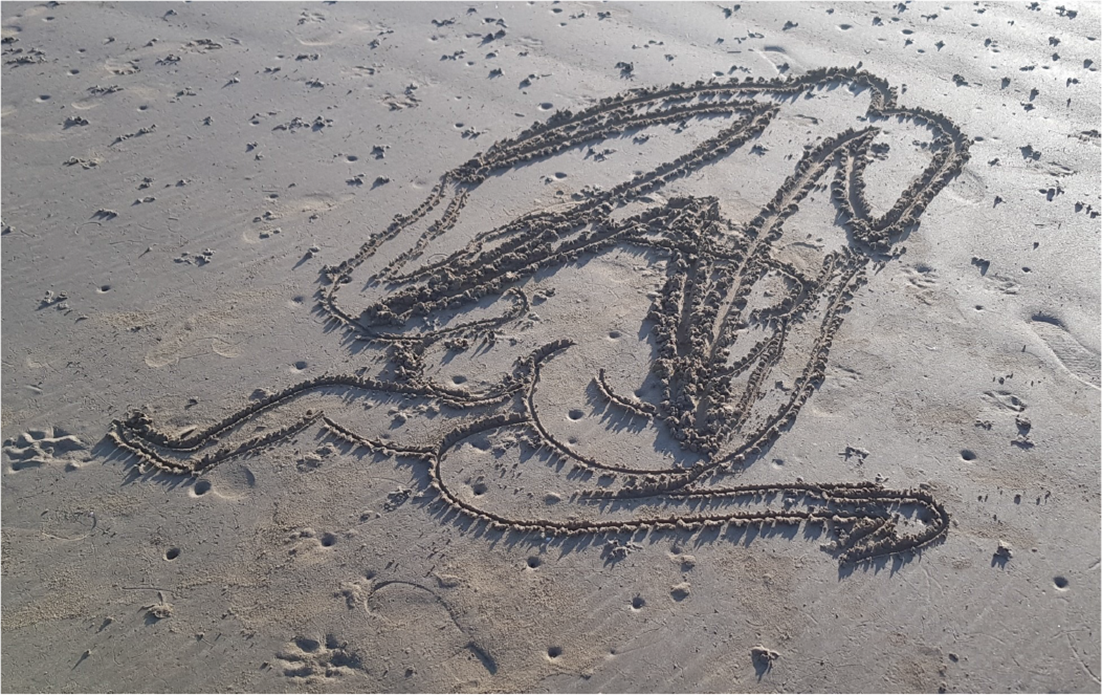
Looking back: recalling Birgit Jürgenssen in the sand at Weston-Super-Mare, UK, August 23, 2019 (by Artemi Sakelliaradis and Melissa Dunlop).
Footnotes
Declaration of Conflicting Interests
The author(s) declared no potential conflicts of interest with respect to the research, authorship, and/or publication of this article.
Funding
The author(s) received no financial support for the research, authorship, and/or publication of this article.

Notes
Author Biographies