



Abstract
Freedom of speech is an essential pillar of democracy. Despite constitutional protections, citizens in some liberal democracies increasingly feel the “bulwark of liberty” under pressure. While the underlying causes of these developments remain largely ambiguous, a fundamental question persists: What exactly do citizens have in mind when assessing the concept of “freedom of speech” – and who do they believe is restricting it? Clarifying this is essential for interpreting survey data, understanding underlying causes, and developing effective strategies to counter this trend. A quota-representative national survey of German citizens (N = 1,490) reveals (1) that most respondents perceive free speech in both legal and social terms. Additionally, (2) a notable portion perceives freedom of speech as too restricted, driven by both dimensions, slightly emphasizing the legal aspect. Finally, (3) perceptions of the general status quo and both dimensions are – at least partly – shaped by different actors, underscoring the need to distinguish the social and the legal dimensions of freedom of speech.
Keywords
Introduction
Freedom of speech is a fundamental principle of democracies, often regarded as the most critical “bulwark” of liberty (Garton Ash 2016; Howard 2024; Mchangama 2022). Because of its vast importance, freedom of speech is enshrined in international conventions and treaties as well as in the constitutions of liberal democracies. After struggles that often took centuries to succeed (Mchangama 2022), citizens across different political systems today regard free speech as highly important and rank it among the most essential human rights (Kellner 2016; Skaaning and Krishnarajan 2021). Nevertheless, the status of freedom of speech has become a contentious issue of public debate that not only revolves around, for example, “political correctness,” “cancel culture,” or nondiscriminatory speech (Norris 2023; Petersen 2021; Vogels et al. 2021) but also concerns the regulation of hate speech and disinformation on social media (e.g., Theocharis et al. 2025). In addition, populist political actors have long claimed that mainstream politics and the media deliberately subjugate free speech (Jacobs and van Spanje 2019). Such narratives have increasingly entered broader public debates and may also shape individual perceptions of free speech as being under threat (Rothut et al. 2023).
In fact, survey findings show that in some Western democracies, citizens increasingly perceive freedom of speech as endangered. In the United States, the number of citizens saying they cannot speak their minds “as they used to” increased from 20 percent in 1973 to 46 percent in 2020 (Gibson and Sutherland 2023; see also Chopik et al. 2024). Quite similarly, in Germany, those saying political opinions can be voiced freely decreased from 83 percent in 1971 to 45 percent in 2021, with the sharpest decline apparent between 2011 and 2021 (Petersen 2021). This growing sense of constraint may have far-reaching implications, as research suggests that perceived threats to freedom of speech can fuel the rise of right-wing populist actors in elections and even contribute to radicalization processes (Eskildsen and Bjørnskov 2022; Jacobs and van Spanje 2019).
Until now, research investigating the reasons for and correlates of these perceptions is scarce. First studies show that political disenchantment, dissatisfaction with democracy, and preferences for right-wing populist politicians foster the perception that free speech is restricted (Menzner and Traunmüller 2023; Rothut et al. 2023; Vogels et al. 2021). However, the feeling that freedom of speech is in danger is not limited to the political right but seems to cut across the political spectrum, at least to a certain extent and in specific contexts (Norris 2023; Petersen 2021; Rothut et al. 2023). But despite these initial findings, several fundamental questions remain unresolved, and this article seeks to address some of these key issues.
Most importantly, we ask: How do citizens understand the concept of free speech? This is hardly a trivial matter, as the literature reveals that “freedom of speech” encompasses at least two distinct yet likely interrelated dimensions: legal and social. How citizens define “freedom of speech” in legal and social dimensions is crucial for interpreting survey results, understanding citizens’ perceptions of restrictions on free speech and developing proper strategies to improve its state. Second, we examine how citizens assess freedom of speech across legal and social dimensions and how these evaluations shape their overall perception. Third, we examine which actors (such as the government, traditional news media, social media platforms) are perceived as restricting free speech in general and regarding the two dimensions. We analyze data from a quota-based survey of voting-age citizens (N = 1,490) to address this gap, using Germany as a compelling case study.
Known for its strong constitutional protections for free speech, Germany nonetheless presents a paradox: nearly half of the citizens surveyed here perceive their freedom of speech as overly restricted. This discrepancy between institutional safeguards and perceived restricted freedom highlights the noticeable gap between legal protections and individuals’ sense of their ability to speak freely. Consequently, a German sample offers an opportunity to explore these two distinct yet interconnected dimensions of free speech.
Freedom of Speech as the Bulwark of Liberty and a Contested Political Issue
Democracy is based on the principle of communicative, nonviolent negotiation and balancing varying interests (Ferree et al. 2002). These processes require that citizens, interest groups, and other political actors can freely express their views and that others can freely listen (Howard 2024; Rawls 2005). Thus, freedom of speech is seen as a cornerstone of democracy and a bulwark against threats to civil liberties (Garton Ash 2016; Howard 2024; Mchangama 2022). Due to its key role, free speech protections in Western democracies have been far-reaching, though countries differ in balancing it against other principles and rights (Garton Ash 2016; Mchangama 2022).
Despite its vital role in democracy and far-reaching constitutional, legal protections, freedom of speech has become a contested issue of political debate in many Western democracies. One reason is the rise of right-wing populism (Aalberg et al. 2017). Arguably, the narrative of increasing restrictions on free speech attacked by “political correctness,” “wokeness,” or “cancel culture” has become part of the key narrative, especially not only among right-wing populists but also among traditional conservatives and extremists of various shades to a certain degree (Lanius 2020; Norris 2023; Scott-Baumann and Perfect 2021). Among the most vocal voices are right-wing populist and extremist actors who use the narrative of freedom of speech that is curtailed by “the allegedly left-wing liberal opinion cartel of ‘old parties’ and the ‘lying press’” (Cremer 2020: 146), leading to a “free speech crisis” (Hughson and Dragos 2025). Studies indicate that the recourse to free speech and its alleged restriction is firmly anchored in rightwing populist communication (Lanius 2020; Martinico and Monti 2024; Scott-Baumann and Perfect 2021). In this view, elites restrict speech by spreading fake news as “political correctness,” ultimately preventing the “true will of the people” from being realized (Lanius 2020; Scott-Baumann and Perfect 2021). In right-wing populist communication, free speech is often portrayed as suppressed, and its current state as denounced (Gadinger 2019; Moffitt 2017). Given the importance of party cues for opinion formation, especially among rightwing populist voters (Gensheimer and Frankenberger 2019), these narratives likely impact their perceptions (see also Conway et al. 2017).
Conceptualizing Perceived Freedom of Speech
Against this backdrop, citizens’ perceptions of restricted free speech present a significant cause for concern. The legitimacy of democracy hinges on the perception that all views can be voiced in political debates (Cohen 1997: 72). Therefore, the perception that speech is not free can signal challenges to open discourse and democracy and may also be linked to the success of rightwing populist actors and processes of radicalization (Eskildsen and Bjornskov 2020; Jacobs and van Spanje 2019).
Despite empirical studies on citizens’ perceptions of free speech, its theoretical conceptualization remains largely unexplored. In this context, previous literature often focuses on a behavioral level and the concept of self-censorship, which is defined as withholding one’s opinion to avoid negative consequences (Bar-Tal 2017; Gibson 1992; Gibson and Sutherland 2023; Kuran 1997). However, as Menzner and Traunmüller (2023: 159) emphasize, self-censorship is conceptually distinct from perceived or subjective freedom of speech, as perceiving restrictions on free speech is not equivalent to withholding one’s opinions. While the former pertains to the perception of freedom of speech as a social reality, the latter concerns the behaviors that may result from this perception. Citizens may choose to express their opinions even if they perceive free speech to be restricted, thus performing an act of defiance. Accordingly, before addressing the resulting behaviors, we first aim to conceptualize the underlying perception.
Rothut et al. (2023) define the perception of free speech as a subjective belief regarding social reality. Perceptions of reality serve as a foundation for emotions, attitudes, and actions (Flynn et al. 2017), and an erosion of shared perceptions is often considered a threat to democracy (Neuberger et al. 2023; Van Aelst et al. 2017). In communication studies, reality perceptions play a key role, for example, in research on opinion climate perceptions (Norris 2023; Zerback et al. 2015). Building on these traditions, Rothut et al. (2023) argue that perceptions of free speech can stem from direct or mediated experiences, such as media coverage or cases attributed to cancel culture. Moreover, similar to other perceptions of political reality (Bartels 2002), perceptions of freedom of speech and resulting self-censorship are influenced by individual characteristics, such as political attitudes (Menzner and Traunmüller 2023; Rothut et al. 2023).
Building upon this framework by Rothut et al. (2023), we aim to understand these perceptions better and clarify what citizens are actually referring to when they assess “freedom of speech.” What precisely do they have in mind? Are they concerned about government censorship, potential legal repercussions, or the prospect of condemnation, criticism, or ostracism from peers, social media users, friends, or family for voicing dissenting opinions? As this issue has not been addressed before, we examine it in this study. Drawing on historical and conceptual literature on free speech (Garton Ash 2016; Mchangama 2022) and public opinion (Noelle-Neumann 1974), along with recent conceptual attempts (Lanius 2020), we distinguish between legal and social understandings of free speech.
The Legal Dimension of Freedom of Speech
The first dimension defines freedom of speech as a legal norm pertaining to legal restrictions on speech acts. It concerns citizens’ freedom not to be prevented by the state from expressing an opinion on legal grounds (Lanius 2020). In that sense, freedom of speech signifies that expressing an opinion is legally permissible, free from state-imposed restrictions (i.e., censorship) and penalties. A legal perspective implies balancing free speech with other fundamental rights, such as tolerance, to prevent discrimination and hate speech (Garton Ash 2016). This balancing of fundamental rights represents a “democratic dilemma” (Krotoszynski 2006). Understood in terms of legal norms, freedom of speech in liberal democracies typically refers to constitutional and other legal guarantees that prevent citizens from being restricted from freely expressing themselves (Lanius 2020; Krotoszynski 2006). Changes to established laws or new regulations restricting freedom of speech in offline and online settings fall under this legal dimension (Mchangama 2022).
The Socionormative Dimension of Freedom of Speech
A purely legal understanding cannot capture current debates and citizens’ perspectives. Contemporary scholars and politicians connect free speech to phenomena such as “political correctness,” “taboo subjects,” “cancel culture,” and “unwritten laws” (Norris 2023; Quiring et al. 2020; Petersen 2021; Rothut et al. 2023). Therefore, it is evident that freedom of speech also encompasses a nonlegal, social dimension, which refers to the freedom not to be prevented by society from expressing an opinion for socionormative reasons. In this sense, freedom of speech is given when expressing an opinion is socially permitted, with minimal or at least acceptable social sanctions.
This perspective aligns with long-standing theories of public opinion, as Locke (1825 [1690]) and Rousseau (1782 [1762]) emphasized the pivotal role of customs, traditions, and social reputation, often surpassing the influence of criminal laws. Similarly, the literature on social conformity underscores the profound impact of social influence in shaping opinions, perceived norms, and behaviors – extending far beyond the effects of codified norms such as legal frameworks (Mill 1857; Tocqueville 2003 [1835–1841]). It also resonates with psychological research on the human need to belong (Baumeister and Leary 1995; Cialdini and Goldstein 2004), political science studies on tolerance (Gibson 1992), communication research on public opinion and the spiral of silence (Noelle-Neumann 1974), and more recent studies on opinion expression in offline and online environments, which examine the barriers to willingness to speak in digital contexts (Liu et al. 2017; Neubaum and Krämer 2018). Experiences with and anticipating others’ adverse reactions to publicly voiced opinions have already been assumed to be connected to the perception of free speech (Menzner and Traunmüller 2023; Quiring et al. 2020). However, only Rothut et al. (2023) empirically demonstrate that fear of and experiences with social sanctions foster the impression of restricted free speech.
Drawing from this theoretical distinction, empirical studies on citizens’ understanding and interpretation of “freedom of speech” are scarce. Although previous studies have addressed freedom of speech from different perspectives, they have not explicitly distinguished between the different dimensions of the concept. To gain foundational insights into individuals’ understanding of the term in light of these conceptual considerations, we pose our first research question:
Moreover, we are interested not only in this conceptual meaning but also in how individuals perceive the current state of freedom of speech in relation to its legal and social dimensions. We also aim to understand how these perceptions are connected to their overall view of freedom of speech. This leads to our second and third research questions:
Perceptions of Restricting Actors
Another question that has been implicitly present in our discussion and in public debates, is who is actually imposing restrictions on free speech? As mentioned above, both in the literature and public debates, several potential sources of (perceived) restrictions are discussed (Garton Ash 2016; Mchangama and Alkiviadou 2020): the government or “mainstream politics,” the judiciary, political activists, journalistic legacy media, social media platforms, and even fellow citizens. For example, in an influential article presenting survey data on the decline of perceived free speech in Germany, Petersen (2021) suspected that this development was linked to activities of a suppressing left minority, the social environment and the news media (without presenting evidence for this).
Petersen’s assumptions are in line with a conservative and especially rightwing populist narrative that portrays governments run by “mainstream parties” and “the elites” as deliberately suppressing the will of the people (Lanius 2020; Scott-Baumann and Perfect 2021). In this narrative, “mainstream” news media are framed as part of this alleged dominance (Cremer 2020), and Social Media content moderation may also be regarded as “part of the problem” (Waisbord 2025). However, actor-specific attributions regarding the responsibility for restrictions on freedom of speech have not yet been systematically investigated, bringing us to our fourth research question:
Furthermore, we examine how these perceptions relate to the legal and socionormative dimensions. We assume that perceptions of the restrictive character of different actors will relate to the dimensions in specific ways. Concerning the legal dimension, we assume that its perception will be influenced by perceptions of the government and judiciary as drivers of restrictions. Social media platforms could further influence perceptions of the legal dimension as they apply laws and community guidelines in their moderation (Theocharis et al. 2025) and banning practices (Rogers 2020). Some citizens may even view them as quasi-governmental, equating moderation with “censorship.”
Concerning the socionormative dimension, assigning responsibility for threats to free speech is a key issue in debates about social norms and pressures in public discourse: For example, when it comes to “cancel culture” and “political correctness,” perceptions of who restricts free speech diverge. For some, a “restrictive left-wing minority” is viewed as curtailing speech, while others point toward conservative or right-wing groups (Falk and Nielsen 2018; Norris 2023; Petersen 2021). Moreover, Social Media platforms may be perceived to be detrimental to the culture of public debate and thus free speech, as they provide a space for hate that may lead to chilling effects pushing hate victims out of the public sphere (Theocharis et al. 2025). Finally, along the same lines, perceptions of fellow citizens likely shape views of the social dimension of free speech, as they are rooted in personal experiences both offline and online.
As no study so far has investigated perceptions of restricting actors concerning the different dimensions of perceived free speech, we do not, however, put forward specific hypotheses, but formulate our last research question:
The Case of Germany
This article examines the case of Germany, where debates about the current state of freedom of speech have intensified. At first glance, the status of freedom of speech in Germany appears secure. The German constitution enshrines freedom of speech in its fifth article, and comparative studies often rank Germany among the most democratic societies worldwide (Freedom House 2024; V-Dem 2024). Although Germany is seen as a model case of a “militant democracy” (Laumond 2023), even extremist and antidemocratic statements are initially protected. The German Supreme Court has established case law that generally favors free speech when balancing human rights (Krotoszynski 2006). In addition to legal provisions, freedom of speech ranks high among German citizens (Skaaning and Krishnarajan 2021) and is considered a fundamental democratic right (Kellner 2016).
At the same time, the constitutional protection of free speech is not without limits: Insults, defamation, and certain statements such as Holocaust denial, specific forms of hate speech that endanger public order, or incitement to violence, are prohibited by law (Klausmann 2019; Struth 2018). Determining whether a statement falls under protected speech or violates legal boundaries depends heavily on context and is resolved individually in each case (Koreng 2015). Germany has faced criticism for introducing new regulations in 2019 that applied offline speech regulation to the Internet, raising concerns about a surveillance infrastructure (Freedom House 2024; Mchangama and Alkiviadou 2020). Moreover, opinion polls reveal that nearly half of the population feels that free speech is too restricted, with this assessment increasing over time (Köcher 2019; Petersen 2021; Rothut et al. 2023).
Method
Sample
To answer our RQs, we conducted a quantitative online survey using a commercial access panel (Respondi) between July 20 and August 9, 2021. A quota sample of the German voting population between eighteen and sixty-nine years was drawn based on age, gender, education, and distribution across the sixteen German federal states (independent quotas), producing an initial sample of 1.704 respondents. To ensure data quality, speeders were identified based on average fill-out time (M = 16.01 minutes, standard deviation [SD] = 7.38 minutes) and excluded if they finished in less than 6.58 minutes (bottom 10 percent). In addition, all respondents who chose a “don’t know” option for more than 50 percent of all question items were excluded. Based on these criteria, 13 percent of respondents were excluded, resulting in a final sample size of N = 1,490, which still fit the quotas given.
Measures
Given the scarcity of prior research on this topic, most questions were either newly developed or adapted from existing studies. However, no systematic validation was conducted.
Understanding of the Concept of “Freedom of Speech.”
The subjective understanding of freedom of speech in its legal and social dimensions was examined with a newly developed question including six items using a seven-point agreement scale (1 = “strongly disagree,” 7 = “strongly agree,” and “don’t know”) (e.g., “To me, freedom of speech is being able to say what you want without being censored by the state.” or “. . . not being criticized immediately when you honestly say what you think.”). The operationalization was inspired mainly by Petersen (2021), Rothut et al. (2023), and Köcher (2019). Although the items were developed to capture two dimensions, exploratory factor analysis suggested a unidimensional structure. Therefore, a reliable mean index could be formed from all six items (M = 5.82; SD = 1.06, α = .79). However, because of the strong theoretical rationale for distinguishing legal and social aspects, we additionally calculated separate indices to explore whether the two dimensions differ empirically, with three items representing each the legal (M = 6.04, SD = 1.11, α = .72) and social dimension (M = 5.60, SD = 1.28, α = .68).
Overall Perception of Freedom of Speech
To assess how respondents perceive the situation of free speech in general, they were presented with a newly developed item regarding their current perception of the status quo in Germany: “When it comes to freedom of speech in Germany, some people believe it is too restricted, while others wish for more restrictions. What is your view? How do you currently assess the state of freedom of speech in Germany? Freedom of speech in Germany is currently . . .” Respondents answered on a seven-point scale ranging from 1 = “restricted too little” to 7 = “too restricted.” In addition, the midpoint of the scale was marked as “just right” and we included a “don’t know”-option. In asking this question, we build on previous research (Köcher 2019; Petersen 2021; Gibson and Sutherland 2023), but extend earlier approaches by also considering the possibility that some individuals perceive free speech as insufficiently restricted.
Perception of the Legal Dimension of Freedom of Speech
Perceptions of the status quo regarding the legal dimension were measured with four items using seven-point agreement scales (1 = “strongly disagree,” 7 = “strongly agree,” and “don’t know”). This new question was inspired by prior studies (Knight Foundation 2020; Petersen 2013; Rothut et al. 2023). The items referred to the legal dimension in general (e.g., “The state interferes too much in what you are allowed to say and what not.”) or concerning hate speech (“Current laws do not protect people enough from hate speech.”). A mean value index could be calculated from the four items (M = 4.00; SD = 1.33, α = .57).
Perception of the Socionormative Dimension of Freedom of Speech
Because of the greater complexity of the social dimension, perceptions of the respective status quo were measured with six items, also using seven-point agreement scales (1 = “strongly disagree,” 7 = “strongly agree,” and “don’t know”). This new question was inspired by Lanius’ (2020) discussion of the understanding of freedom of speech in public discourse and other prior studies (Conway et al. 2017; Ekins 2017; Knight Foundation 2020; Petersen 2021). In addition to a general item reflecting the overarching context (“There are many unwritten laws about which opinions are socially acceptable and permissible, and which are taboo.”), five statements addressed various facets of the social dimension, primarily drawing on Lanius (2020), including aspects such as freedom from criticism (e.g., “It gets on my nerves that you are criticized so much when you honestly say what you think.”). A reliable composite index was calculated from these six items (M = 4.54, SD = 1.19, α = .70).
Perception of Restricting Actors
To measure the perceived restriction of free speech by various actors, respondents were presented with an exploratory list of eleven actors from the political, institutional and social spheres (e.g., “federal government,” “traditional news media,” “left-wing populist and left-wing extremist groups and parties,” or “friends and family”), and were asked the following question: “Freedom of speech can be endangered in different ways. When you think about the current state of freedom of speech in Germany, to what extent do you think freedom of speech is restricted by the following groups, organizations, and institutions?” (1 = “not restricted at all,” 7 = “very strongly restricted”; −1 = “don’t know”).
Controls
We used gender, age, and formal education as controls in the analyses of individual predictors of perceived freedom of speech.
Results
To answer our research questions, we used descriptive statistics to examine understanding and assessment of freedom of speech (RQ1, RQ2, RQ4), Pearson correlations to explore relationships between dimensions (RQ3), and blockwise linear regressions to test associations between perceived restricting actors and freedom of speech perceptions, controlling for sociodemographic variables (RQ5). Statistical significance was set at p < .05.
Understanding of the Concept “Freedom of Speech”
In our RQ1, we examine how citizens conceptualize the meaning of freedom of speech, taking into account its legal and socionormative dimensions. Across all items, there was a notably high level of agreement (M = 5.82; SD = 1.06, α = .79), with the legal dimension emerging with a slightly higher mean score (M = 6.04, SD = 1.11, α = .72). The statement, “Freedom of speech means that the government is not allowed to dictate my opinions,” garnered the highest level of agreement at 90 percent. Similarly, 87 percent of respondents affirmed that freedom of speech entails protection from government censorship, and 83 percent agreed that it includes the freedom to express controversial opinions without fear of legal sanctions (Figure 1).
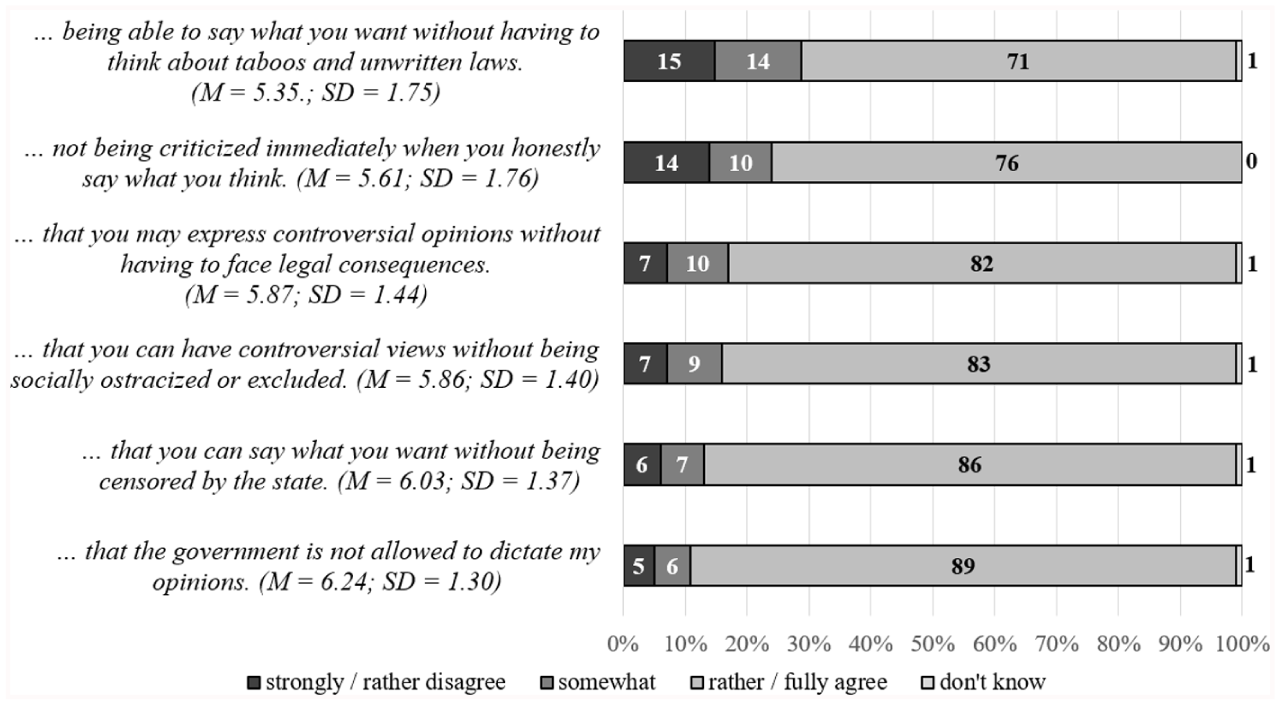
Understanding of freedom of speech as a legal and social norm.
As anticipated from the overall mean, agreement with the conceptualization of freedom of speech in relation to social norms is similarly high (M = 5.60, SD = 1.28, α = .68). Although the ratings exhibit slightly more variability than those of the legal dimension, these differences remain minor. The mean values suggest a strong association between freedom of speech and its socionormative interpretation. The statement with the highest level of agreement (83 percent) pertained to the freedom from social exclusion when expressing opinions (M = 5.86, SD = 1.40). Overall, these findings indicate that freedom of speech is perceived not only as protection from state interference but also as freedom from social barriers that restrict the expression of opinions (Figure 1).
Perceptions of the Current State of Freedom of Speech
In RQ2, we ask how citizens assess the status quo of free speech in general and concerning its legal and social dimensions. Starting with the single-item measure regarding the general perception of the status quo of free speech in Germany, our findings largely corroborate previous research despite variations in operationalizations. On average, respondents perceived the status quo of freedom of speech as “just right,” with a slight inclination toward viewing it as “too restricted” (M = 4.71; SD = 1.28). Approximately, 40 percent of respondents consider the state of free speech in Germany appropriate, while 47 percent view it as somewhat to very restricted. These results align with other findings (Petersen 2021; Rothut et al. 2023). In contrast, only 12 percent believe more restrictions on freedom of speech should exist.
Building on this, RQ2 also examines citizens’ current perceptions of freedom of speech along its legal and socionormative dimensions using newly developed exploratory measures. In terms of the legal situation of freedom of speech in Germany, respondents, on average, chose the middle of the scale (M = 4.00; SD = 1.33). A closer look reveals that only 17 percent of respondents think there are too few legal restrictions in Germany, while the majority (63 percent) believe the current legal restrictions are adequate. In contrast, a significant 58 percent nonetheless believe that the current legal framework in Germany fails to provide adequate protection against hate speech. Simultaneously, 46 percent of respondents rejected the idea that, in principle, no expression of opinion should be legally prohibited, even if it involves attacking or discriminating against others. Legal restrictions appear justified for them, particularly in protecting against hate speech. It is striking, however, that 40 percent of respondents see the state patronizing them – according to them, the state would interfere too much with what one could say these days (Figure 2).
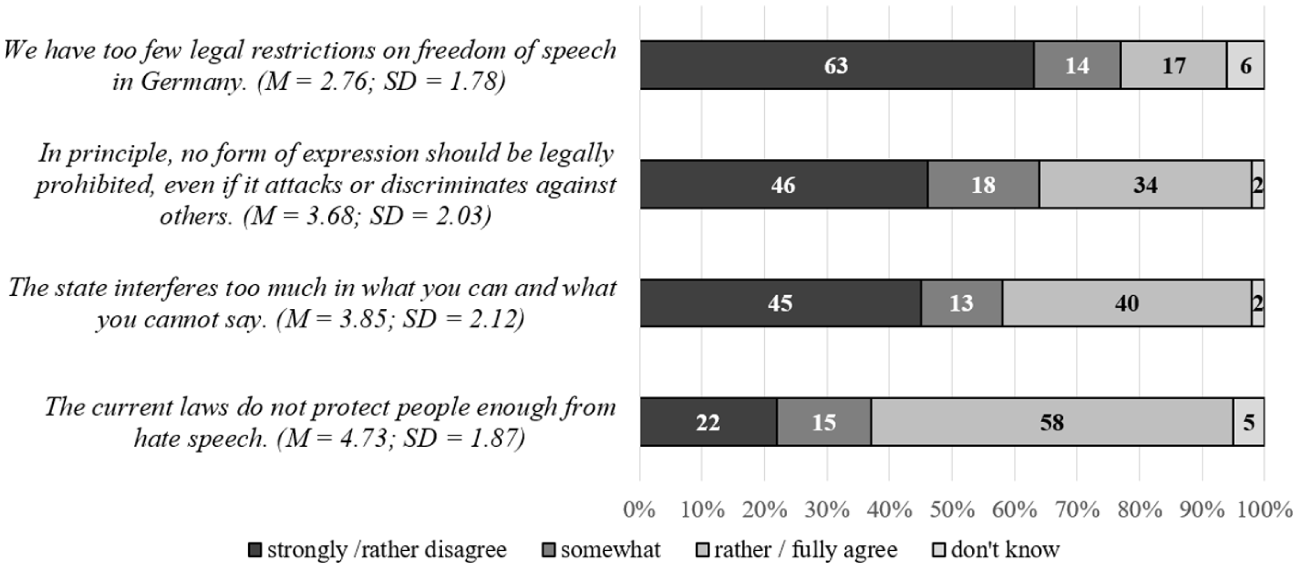
Perception of freedom of speech as a legal norm.
In terms of the social norm, over two-thirds of respondents (68 percent) stated that there are many unwritten laws about which opinions are socially acceptable and which are taboo. This statement received the highest level of approval within this dimension of freedom of speech, replicating the findings of Köcher (2019).
As Figure 3 illustrates, responses vary considerably across the different items capturing perceptions of social norms. Respondents generally perceived free speech as somewhat limited by social norms, leaning toward the middle of the scale (M = 4.37; SD = 1.16).
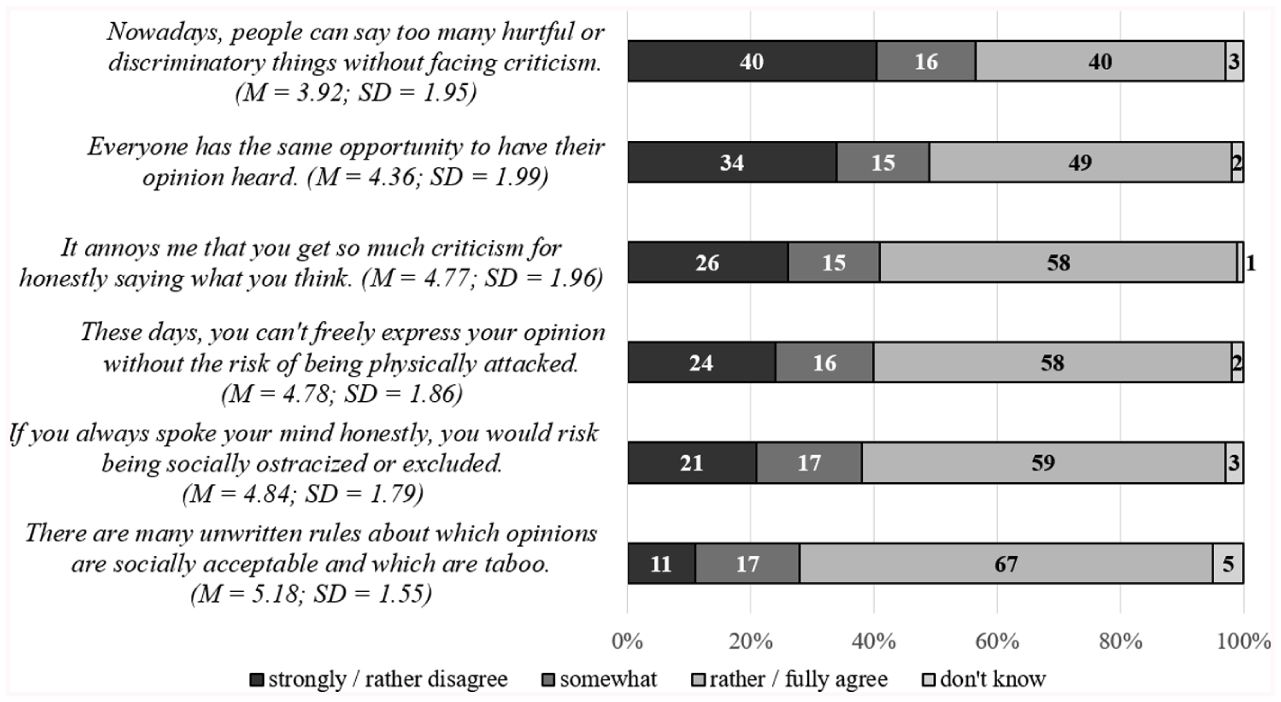
Perception of freedom of speech as a social norm.
Regarding a general assessment of social norms, the results closely mirror those of Köcher (2019): Over two-thirds of respondents believe numerous unwritten laws dictate which opinions are socially acceptable and which are considered taboo. This item garnered the highest level of approval. Conversely, the item with the lowest level of agreement showed a divided picture rather than a clear one. Forty percent of respondents concurred that people can say too many hurtful comments without facing criticism, while an equal 40 percent rejected this assertion.
The Impact of the Legal and Social Dimension on Overall Free Speech Perception
To address RQ3 on how the legal and social dimensions of free speech relate to its overall assessment, we conducted a correlation analysis. The analysis revealed significant positive correlations between the general perception and both sub-dimensions. Notably, the legal dimension demonstrated a stronger correlation with the general perception (r = .643, p < .001) compared to the social dimension (r = .552, p < .001). These findings suggest that the more respondents perceive freedom of speech as restricted in either a legal or a social-normative sense, the more likely they are to perceive freedom of speech in Germany as restricted overall – and vice versa.
Perception of Restricting Actors
RQ4 asked which actors are perceived as restricting free speech. Overall, the results reveal striking differences in how respondents evaluate most actors: except family and friends, responses rarely converge. Instead, opinions tend to divide into roughly three groups – those who perceive strong restrictions by certain actors, those who perceive none, and those who position themselves somewhere in between (see Figure 4).
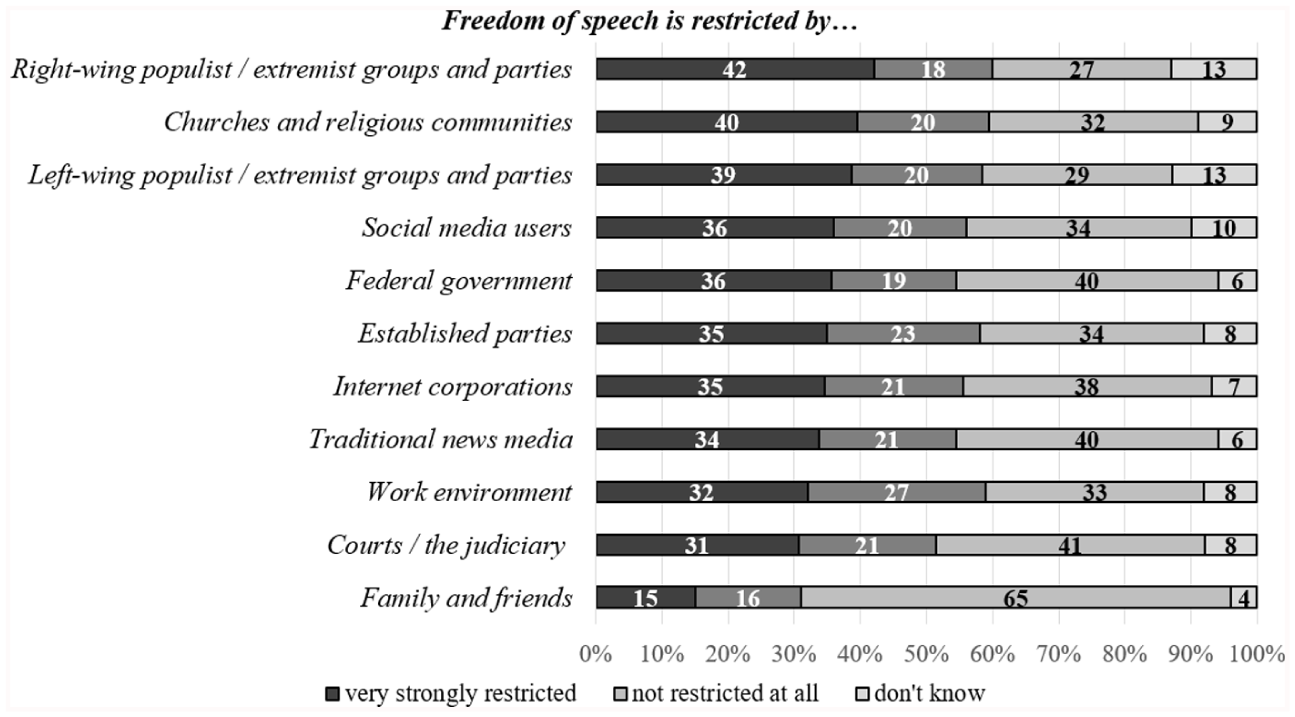
Perceived restrictions of free speech across actors.
Among political actors, both right- and leftwing populist or extremist groups stand out: around four in ten respondents consider them to restrict free speech strongly. The government and established parties are also considered restrictive by notable shares of respondents, although opinions here are more divided. When it comes to institutional actors, churches and religious communities are most prominently regarded as limiting free speech, followed by internet companies and traditional news media. Notably, courts and the judiciary are perceived as among the least restrictive actors, despite their formal authority over legal definitions of free speech, even though the differences are not significant. Looking at the social environment, respondents point primarily to other social media users as sources of restriction, followed – though to a lesser extent – by their professional environment. Family and friends, however, form a striking counterpoint: most respondents emphasize they feel no constraints in this close personal sphere.
Restricting Actors and Their Relation to Perceptions of Free Speech
Our final research question (RQ5) asked how perceptions of the restrictive character of actors are associated with the general perception of freedom of speech and its legal and socionormative dimensions. We conducted three blockwise regression analyses, all of which reached statistical significance (Table 1). The coefficients reported stem from the full models, including both controls and actors; including the actors in the models substantially increased explanatory power with changes in the adjusted R2 of 31–37 percent, pointing to a strong predictive power of actor-related perceptions.
Predictors of Perceived Restrictions on Freedom of Speech.
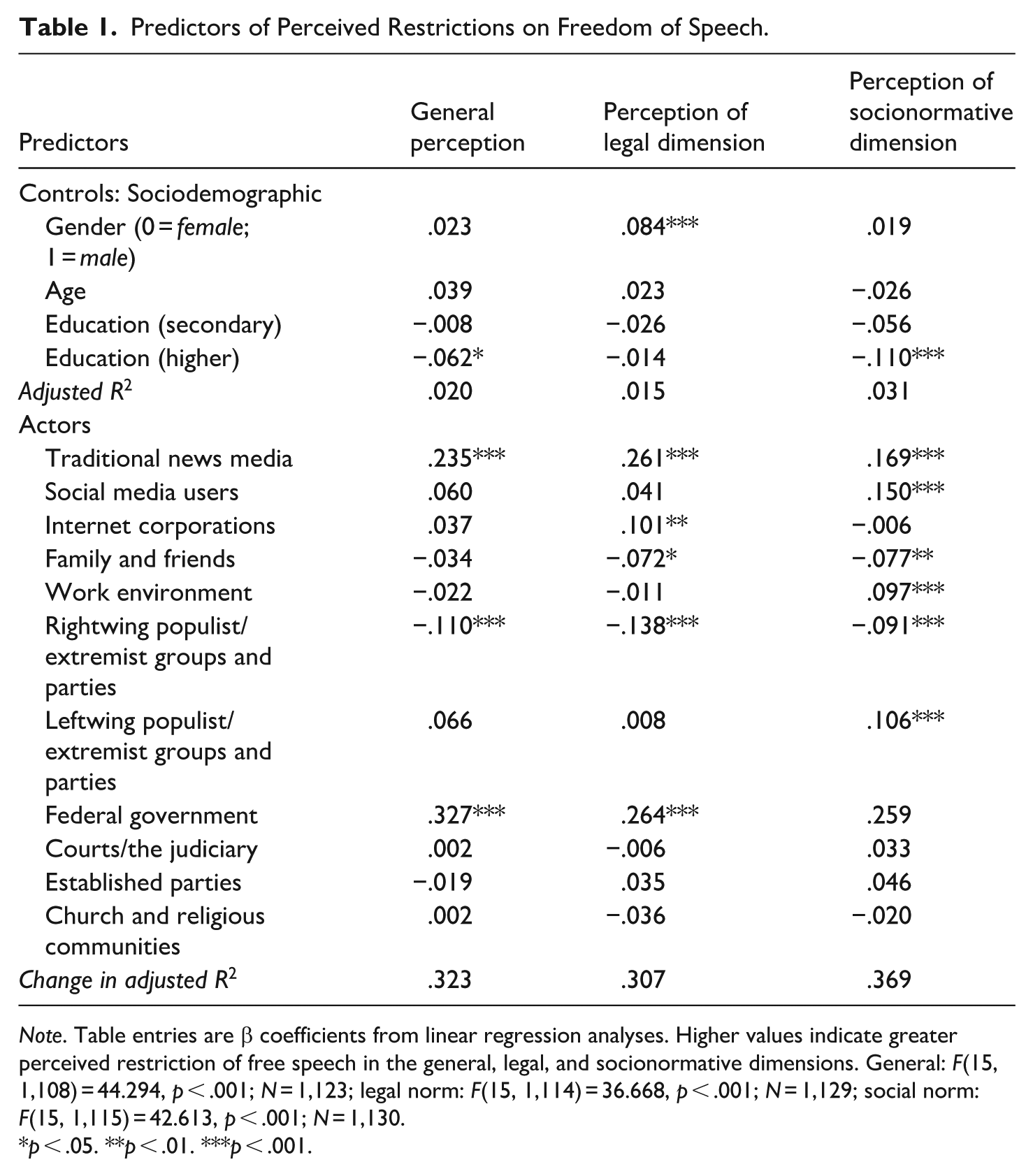
Note. Table entries are β coefficients from linear regression analyses. Higher values indicate greater perceived restriction of free speech in the general, legal, and socionormative dimensions. General: F(15, 1,108) = 44.294, p < .001; N = 1,123; legal norm: F(15, 1,114) = 36.668, p < .001; N = 1,129; social norm: F(15, 1,115) = 42.613, p < .001; N = 1,130.
p < .05. **p < .01. ***p < .001.
Two consistent patterns can be identified in all dimensions. First, there is a strong positive link between the perception of restrictive traditional news media and the perception of all measures of free speech. Second, the opposite is true for rightwing populist and extremist groups: respondents who perceive them as restrictive are significantly less likely to perceive freedom of speech as restricted.
Furthermore, the federal government proves to be the most influential factor in the general perception of free speech. Respondents who perceive it as restrictive are much more likely to perceive freedom of speech as curtailed overall. The same applies to the legal dimension, where the federal government has the strongest influence, ahead of traditional news media and internet companies.
Several additional influences emerge regarding the socionormative dimension. Social media users, the work environment, and leftwing populist/extremist groups are significant positive predictors of perceived restriction. Conversely, family and friends have a negative influence on the perception of free speech.
Controls
Regarding the control variables, we find minor effects: Men were more likely than women to perceive free speech concerning legal norms as restricted. Moreover, higher levels of education are associated with perceptions of fewer restrictions on free speech regarding the general and socionormative perception. However, the overall effects were minimal, accounting for only a small portion of variance.
Discussion
Concerns over perceived threats to freedom of speech have increased in Western democracies (Gibson and Sutherland 2023; Petersen 2021). Our findings similarly indicate that nearly half of Germans view free speech as too restricted. However, what does this sentiment imply? Before looking for potential reasons and distributing blame, it is essential to clarify what citizens understand by “freedom of speech.” To achieve this, we conducted a quota-based survey in Germany to explore the conceptualization, public interpretation, and perceived status of free speech. The apparent contradiction – broad legal guarantees for free speech, high positions in international rankings of civic liberties and a widespread perception of restricted expression – provides a suitable context for examining potential discrepancies between the perceptions of two dimensions of freedom of speech. Conceptually, we distinguished freedom of speech as (1) a legal norm (freedom from state restrictions) and (2) a social norm (freedom from socionormative restrictions).
Regarding the understanding of freedom of speech, respondents expressed, as anticipated, almost equal agreement with both definitions. In addition to freedom from state restrictions, respondents’ broader interpretation includes freedom from social sanctions such as social exclusion, criticism, and taboos. Therefore, we found that citizens’ interpretation of the term “freedom of speech” broadly encompasses legal and socionormative dimensions, warranting equal consideration in future research. In fact, acknowledging that most people have a rather broad understanding of “freedom of speech” is likely crucial for both understanding the causes of its perception and searching for ways to counter the decline in the perception that freedom of speech is increasingly in danger.
Furthermore, we examined perceptions of freedom of speech across both dimensions. Regarding free speech as a legal norm, a majority opposed further legal restrictions beyond those currently in place in Germany. This aligns with the democratic importance of freedom of speech, with legal limits carefully balanced against individual freedoms (Garton Ash 2016; Mchangama 2022). However, perceptions of existing legal restrictions were split: while nearly half felt unrestricted by state regulations, a significant portion perceived a degree of state paternalism.
In addition, many participants felt that current laws are insufficient to prevent hate speech, while fewer participants favored further legal restrictions. Although this may initially seem contradictory, it could be due to the specific phrasing of the statements in the survey. The degree of support may vary depending on how the statement is framed. People tend to call for more significant state intervention when confronted with the limitations of current protections, yet resist additional restrictions when the emphasis is placed on further limitations, as they seek to protect free speech. This democratic dilemma and balancing fundamental rights (Krotoszynski 2006) may reflect the divergent priorities within society. Therefore, these apparent contradictions highlight the need for future research – ideally also through qualitative approaches – to disentangle whether they reflect perceptions of governmental overreach or merely a framing effect in the operationalization, that is, whether the focus is on state intervention or protection from offensive speech, as for instance also suggested by Munzert et al. (2025).
Regarding the socionormative level, echoing Köcher (2019), over two-thirds of respondents perceived numerous unwritten rules defining acceptable and taboo opinions. This is somewhat unsurprising, given the essential role of social norms in group interaction and cohesion. These findings suggest that individuals adjust their behavior based on environmental cues and expectations for social affiliation (Quiring et al. 2020). Responses to other items, such as views on criticism and structural equality in expression opportunities, showed considerable variance. The perception of freedom of speech presents itself as a complex landscape without a clear societal consensus.
Finally, our analyses of the actors responsible for these perceptions underscore that perceptions of free speech are not only shaped by general dissatisfaction or abstract perceptions of legal and social dimensions but are also strongly related to who is subjectively held responsible for these perceived restrictions. The explanatory power of the actor variables suggests that blame attribution to certain groups and institutions is of central importance for how citizens assess the state of freedom of speech. Moreover, the significant predictors appear to correspond with the highly politicized nature of current debates: Traditional news media and the government stood out across all dimensions as the strongest positive predictors. At the same time, media pundits and (rightwing) populist narratives often portray these actors as the central danger to free speech (Jacobs and van Spanje 2019; Lanius 2020; Scott-Baumann and Perfect 2021; Waisbord 2025). This raises the question of whether citizens’ perceptions point to genuine restrictions or whether they are largely the product of discursive frames and populist narratives that present these actors as the main threat, as previous literature has also suggested (Rothut et al. 2023). In contrast, we consistently find negative effects for rightwing populist actors. While studies have shown that the support for these actors is a strong positive predictor of perceiving free speech as restricted (Rothut et al. 2023), our findings highlight the flip side: When citizens perceive rightwing populist or extremist groups as a threat to free speech, they seem to be less likely to adopt these groups’ narratives and cues – leading them to feel less restricted overall, or even to believe that stronger restrictions are necessary. This reinforces our presumption that debates on free speech are deeply politicized.
Beyond these findings, the overall pattern of the predictors supports our distinction between the two dimensions: socionormative perceptions are linked above all to social media users and the workplace, while legal perceptions are tied more strongly to institutions such as the media and courts.
By establishing a foundational understanding of the multifaceted nature of free speech, this article contributes to the existing literature and yields practical implications in at least three respects. First, whether citizens perceive restrictions on freedom of speech as a result of state intervention or stemming from social sanctions may have very different consequences. As described, references to state intervention touch on the constitutional core of liberal democracy and the protection of civil liberties, while references to social pressure are linked to highly political debates about, for example, “cancel culture” and “political correctness,” which play a central role in contemporary political discourse. Distinguishing between these interpretations is therefore essential to understanding both democratic stability and the potential of free speech as a controversial mobilizing issue for populist actors. Second, although the two dimensions are strongly correlated in our data, this may not be the case in other contexts, countries, or time periods. The framework presented enables future research to identify when and why the two dimensions diverge and what such divergences mean for attitudes toward democracy, tolerance, and conflict. Third, our findings show that citizens attribute different perceived restrictions to specific actors such as political groups, institutions, and their social environment. This suggests that debates about freedom of speech are not merely abstract but are closely linked to questions of responsibility. Practical efforts to strengthen free speech must therefore take into account how these actor-specific perceptions influence trust in institutions and political mobilization.
However, the findings must be considered in light of several limitations. The most significant limitation is the reliance on self-constructed, unvalidated scales due to the absence of established measurement tools, necessitating an exploratory approach. While the study drew on preliminary empirical works (e.g., Köcher 2019; Rothut et al. 2023), future research should prioritize developing and validating scales reliably measuring the relevant dimensions.
In addition, it must be emphasized that the present cross-sectional analysis cannot definitively establish a clear causal direction. Consequently, it remains uncertain whether the restriction attribution influence the perception of free speech or whether such perceptions might, in turn, influence how citizen view particular actors and institutions. It is equally conceivable that a strong sense of restriction contributes to broader processes such as political radicalization (Eskildsen and Bjørnskov 2022; Jacobs and van Spanje 2019). Future longitudinal studies could explore this unresolved question in greater depth. Nevertheless, our findings underscore that the attribution of restrictions to specific actors plays a central role in this dynamic.
How can citizens and policymakers navigate the conceptual ambiguity surrounding freedom of speech and ensure that it remains a fundamental pillar of a democratic society? Our findings suggest that focusing solely on legal protection may be insufficient, as they highlight the critical role that social interactions and norms play in shaping perceptions of freedom of speech. In order to safeguard this fundamental right, democratic societies must address the underlying social and political dynamics that contribute to these perceptions of restriction. Given the current limitations in the body of research, it is evident that further studies are needed to explore these dynamics and their underlying causes more deeply.
Footnotes

Ethical Considerations
Under current German legislation and institutional practices, ethical approval from a formal institutional review board (IRB) is not legally mandated for noninterventional studies of this kind. In light of the study design and ethical considerations, we concluded that seeking formal IRB approval was not necessary in this case. Participants were fully informed about the nature and purpose of the research, data protection procedures, and their rights, including the voluntary nature of participation and the option to withdraw at any time without consequence. Informed consent was obtained from all participants. The study posed no more than minimal risk to participants, and any potential risks were not greater than those encountered in daily media use.
Funding
The authors received no financial support for the research, authorship, and/or publication of this article.
Declaration of Conflicting Interests
The authors declared no potential conflicts of interest with respect to the research, authorship, and/or publication of this article.
Data Availability Statement
Data available on request from the authors.