



Abstract
This article explores the interplay between negativity in news coverage and interpersonal communication in shaping individuals’ beliefs, using the case of the COVID-19 pandemic. While existing research has examined the direct effects of these factors on beliefs, two overlooked key aspects are addressed in this article. First, I investigate how interpersonal communication interacts with the impact of negativity in news on shaping beliefs. Second, building upon media system dependency theory, I accounted for the temporal dynamics of media effects since the pandemic evolved and progressed in phases with shifting societal contexts. By relying on a linkage approach consisting of a five-wave panel survey and a quantitative media content analysis conducted in Sweden, the findings indicate that interpersonal communication serves as an amplifying moderator for exposure to negativity in forming beliefs about the negative societal impact of COVID-19. Furthermore, I find evidence supporting the temporally varying nature of media effects, with the influence of negativity decreasing as the crisis dragged on.
The ubiquity of negativity in news coverage, the negativity bias in selecting news, and the effect of negative news on individuals’ thinking, feeling, and behavior are well documented (Soroka and McAdams 2015). Research on the effect of negativity indicates that higher exposure to negatively framed news leads to more negative attitudes and perceptions of societal issues (e.g., Damstra and Boukes 2021; de Vreese and Boomgaarden 2003; Eberl et al. 2018). Recently, Soroka and Krupnikov (2021) wondered if such findings suggested that people were doomed to the mercy of negative news—and rejected this suggestion in the same breath. They argue that prior “work is most often focused on the central tendency—the average—across humans and over time” (Soroka and Krupnikov 2021: 3). In other words, research on the effects of negativity needs to account for individual and contextual moderators to get a better understanding of this central characteristic of news coverage. This study aims to contribute to this necessity.
This article zooms in on interpersonal communication as the individual factor that conditions the effect of negativity in news coverage. The assumption that “engagement with mass media does not occur in a vacuum free of interpersonal networks” (Southwell and Yzer 2007: 420) has been present since the beginnings of media effects research (e.g., Katz and Lazarsfeld 1955). Yet, less is known about how interpersonal communication conditions how negativity in news influences perceptions. Research on the moderating role of interpersonal communication in media effects examines whether it weakens or amplifies media influence: Antagonistic effects describe that interpersonal communication counteracts media exposure; synergetic effects, in contrast, strengthen the media influence (Andersen and Hopmann 2018; Gehrau et al. 2014). Prior studies present mixed evidence: Some suggest that interpersonal communication counteracts media influence in contexts of disagreement (Druckman and Nelson 2003; Feldman and Price 2008), while others show that discussion can reinforce media effects (e.g., Schäfer 2015). This study seeks to clarify these inconsistent findings by examining interpersonal communication’s role in shaping beliefs.
Media effects also unfold within a broader temporal context. The media system dependency (MSD) theory suggests that media effects are more likely to occur in certain times that are characterized by social distress, uncertainty, and crisis (Ball-Rokeach and DeFleur 1976). While past research acknowledges that media effects may shift over time against this theoretical backdrop (e.g., Boomgaarden et al. 2011; Damstra and Boukes 2021), empirical studies have yet to systematically examine how negativity in news coverage fluctuates during a period of extended crisis. In this article, I focus on the COVID-19 pandemic, which presents an exemplary case: the pandemic was a period of economic, physical, and psychological uncertainties (McCracken et al. 2020). Yet, trajectories of infection cases, virus variants, and measures against the pandemic did not follow linear trends but changed in waves, characterized by different degrees of severity (Carroll et al. 2020).
In light of these considerations, this study aims to address the questions of (1) how exposure to negativity in news coverage influences beliefs about the negative societal impact of COVID-19, (2) how interpersonal communication functions as a moderator, and (3) if these effects are subject to temporal variation. Relying on a linkage study consisting of a quantitative media content analysis and a five-wave panel study conducted in Sweden, I compare the effect of exposure to negativity in news coverage and the moderating effect of interpersonal communication over the course of the pandemic.
How Negativity in News Coverage Shapes Societal Beliefs
The formation, maintenance, and evolution of beliefs about society result from an interplay of various factors (Mutz 1998; Shehata, et al. 2021). Alongside direct personal experiences and interpersonal discussions, news media play a crucial role in shaping these beliefs—particularly through the way societal issues are covered. Among the many characteristics of news content, negativity, or a negative tone, is one of the most prevalent. Negativity in news coverage can take different forms, such as pessimistic portrayals of societal problems or critical perspectives on political actors (Lengauer et al. 2012). This study specifically focuses on valence framing, a common and broadly applicable form of negativity in news coverage. Valence framing assumes that “frames are indicative of ‘good and bad’ and (implicitly) carry positive and/or negative elements” (de Vreese and Boomgaarden 2003: 363).
Effect studies based on valence framing assume that a more negative tone in news coverage affects individuals’ beliefs about a societal issue in such a way that these perceptions also become more negative. For example, being exposed to a negative tone in economic news resulted in more negative perceptions of the economy (e.g., Boomgaarden et al. 2011; Boukes et al. 2021; Damstra and Boukes 2021). Similarly, de Vreese et al. (2011) found that the negative frames in coverage of Turkey becoming a member of the EU had a negative impact on the public’s support of this proposal. Using immigration as an issue, studies underline the relationship between exposure to negative news and respective attitudes: For example, Jacobs and van der Linden (2018) found that reading negatively valenced news about immigrants from North Africa resulted in more negative attitudes toward this group (for an overview, see also Eberl et al. 2018).
The Moderating Role of Interpersonal Communication and Temporal Dynamics in Media Effects
The assumption that media use does not exert universal effects but rather is conditional upon many factors has been supported by media effects research (in the context of societal beliefs, see Shehata et al. 2021). One of these factors is interpersonal communication—an individual’s discussion about a societal issue with others. During the pandemic, interpersonal communication was a crucial source of information, helped validate media messages, and assisted in coping with negative emotions (Friemel et al. 2020; Wagner and Reifegerste 2023).
The relationship between exposure to news media coverage and interpersonal communication has been a central topic in media and communication research since the early days of the discipline, particularly in studies of media effects, opinion formation, and information flows (for an overview, see Southwell and Yzer 2007). Here, the role of interpersonal communication is modelled as a consequence, mediator, or moderator of media exposure (Eveland and Cooper 2013; Southwell and Yzer 2007). This study focuses on the moderating role of interpersonal communication—that is, how discussions with others influence the extent to which negativity in news coverage shapes societal beliefs. Chaffee (1982) proposed one of the first theoretical frameworks to challenge linear models of media influence, arguing that the process of information acquisition is interactive. Instead of a simple transmission of information from mass media to individuals, he suggested that “communication breeds further communication” (Schäfer 2015: 511). During crises like the COVID-19 pandemic, the context of this study, interpersonal communication did not simply follow media exposure as a secondary process; rather, it occurred alongside or even shaped the effects of media consumption (Friemel et al. 2020; Wagner and Reifegerste 2023). In times of heightened uncertainty, individuals engaged in discussions to validate or reinterpret media messages, particularly when news content is dominated by negativity. Eveland (2004) describes two cognitive elaboration mechanisms that help to explain why media effects might be affected by these processes of validation and reinterpretation. Anticipatory elaboration occurs when individuals expect to discuss a topic, leading them to process media content more carefully; discussion-generated elaboration requires individuals to retrieve, articulate, and refine their understanding of media content, reinforcing cognitive connections made.
Research on the moderating effect of interpersonal communication on media effects has, so far, mostly focused on whether interpersonal communication weakens or strengthens the effects of media use. Gehrau et al. (2014) provide a categorization of potential interaction effects: Antagonist effects assume that interpersonal communication and media use operate as competitors due to providing contradictory information. Synergetic moderating effects are understood as effects that affect the influence of media use positively. In this context, some also speak of “amplifier effects” (e.g., Andersen and Hopmann 2018).
Results on this moderating role of interpersonal communication are mixed. Concerning antagonist effects Druckman and Nelson (2003), for example, described an attenuating influence of conversations on framing effects—but only if the discussions were characterized by conflicting positions. Similar results were found in the context of political knowledge: interpersonal communication hampered the positive effect of watching televised debates on learning when the discussion with others was characterized by a high degree of disagreement (Feldman and Price 2008). Synergetic effects of interpersonal communication were found for several dependent variables, such as economic sophistication (Kalogeropoulos et al. 2015), recall of media content (Gehrau et al. 2014), or political knowledge and participation (Schäfer 2015; Scheufele 2002). Relying on a simulation study and taking the selective media use processes into account, Song and Boomgaarden (2017) conclude that the “attitudinal composition of one’s network amplifies the effect of consonant media while diminishing the effect of counterattitudinal media” (p. 274). Others could not find any influence of interpersonal communication on media effects on different outcomes. Desmet et al. (2015) addressed a potential synergetic moderating effect of interpersonal communication on media use influence on attitudes toward the EU; yet, no significant moderating effect of interpersonal communication was found. Similarly, talking to others after watching TV news did not influence people’s attitudes toward immigrants (Sommer 2013).
Another factor that may influence the effect of negativity in news coverage on beliefs is time—the progression of the COVID-19 pandemic (Soroka and Krupnikov 2021). So far, I have argued that exposure to negativity in media content can shape beliefs about COVID-19 and that interpersonal communication about the pandemic might amplify or dampen this effect. That media effects in general can also be dependent on temporal aspects is specified by the MSD theory. It proposes that media effects are more likely to occur in times of social distress (Ball-Rokeach and DeFleur 1976; for an overview, see Jung 2017): in times of crisis, people not only increasingly turn toward the news media to fulfill their needs and goals, such as to comprehend not only the societal world around them but also the probability of media messages affecting individuals increases. In other words, in times of crises, such as the COVID-19 pandemic, individuals become more dependent on the news media, and “the greater the media dependency, the greater the level of attention during exposure . . . and the greater the probability of message effects, intended or unintended” (Ball-Rokeach et al. 1984: 13). The predictive value of the MSD theory has been demonstrated in the context of various crises, such as economic (Boomgaarden et al. 2011; Damstra and Boukes 2021) or public health crises (Hu and Zhang 2014).
The COVID-19 pandemic might be a crisis in which similar effects could be observed since it was a situation that posed economic and social strain on citizens. For example, experiencing COVID-19-related worries contributed to being depressed, anxious, and insomniac (McCracken et al. 2020). Yet, in comparison to many other crises, the COVID-19 pandemic was particularly nonlinear, affecting societies in waves, with trajectories of cases, deaths, and virus variants (Carroll et al. 2020) and strategic responses (Olofsson and Vilhelmsson 2022). Co-evolving with the pandemic situation, media coverage of COVID-19 unfolded and changed dynamically, characterized by phases that differed in salience or content features (Degen 2021; Müller-Spitzer et al. 2021; Soroka and Krupnikov 2021). Moreover, people reported that the importance of media coverage in conversations with others decreased as the pandemic dragged on (Wagner and Reifegerste 2023). Research conducted in the initial stage of the pandemic not only indicates that individuals increased their media consumption (Ohme et al. 2020; Van Aelst et al. 2021)but also an increased media effect on individuals’ risk perception was found (Muñiz 2020). Analyzing the media coverage on Swedish TV and print between February and September 2020, Ghersetti et al. (2023) found that the amount of news items increased dramatically at the beginning of the first wave of the pandemic in the country. However, with dropping infection and death numbers, the volume of news coverage also decreased. The temporal dependency of media effects was, for example, described in the context of trust during the pandemic: the longer the pandemic dragged on, the less the people’s trust in the government was influenced by news coverage (Johansson et al. 2021).
Building upon the assumptions of the MSD theory, it seems plausible that (1) media effects are strongest during specific times (Ball-Rokeach and DeFleur 1976) and that (2) these effects are best understood to be temporally varying during the COVID-19 pandemic. In other words, studying media effects during a long but dynamic period requires accounting for fluctuations in the social setting of the study.
The Case: The COVID-19 Pandemic in Sweden
Sweden’s handling of the COVID-19 pandemic has gained worldwide attention and was often labeled as “the Swedish way” due to the uniqueness of the approach (Shehata, Glogger, and Andersen 2021). While many other countries established national lockdowns, closed down social life, business, or schools, Swedes experienced significantly fewer restrictions in their daily lives (for an overview, see Kuhlmann et al. 2021).
Especially during the first phases of the pandemic, Sweden was more affected in terms of COVID-19 cases and related deaths than, for example, other Nordic countries. This also held true during the second wave of the pandemic, starting in the fall of 2020 (Claeson and Hanson 2021). As all over the world, the development of the COVID-19 pandemic in Sweden did not follow a linear trend: under the first wave of infections, Sweden saw a steady increase in the number of cases and deaths. The first confirmed case of COVID-19 in Sweden was reported on January 31, 2020. By the end of March 2020, Sweden had several hundred confirmed cases. After the significant surge in the spring, the country of Sweden saw a decrease in the number of new COVID-19 cases in the summer of 2020, only to experience a rise in cases toward the fall, peaking in November with over 7,000 new cases reported in a single day. During this time, Sweden also saw a significant increase in deaths, with the highest of over 100 deaths reported in a single day in December 2020 (Public Health Agency of Sweden 2023). Figure 1 displays the development of registered deaths due to COVID-19 during the first year of the pandemic and the dates when the five waves of the panel conducted in this study were issued.
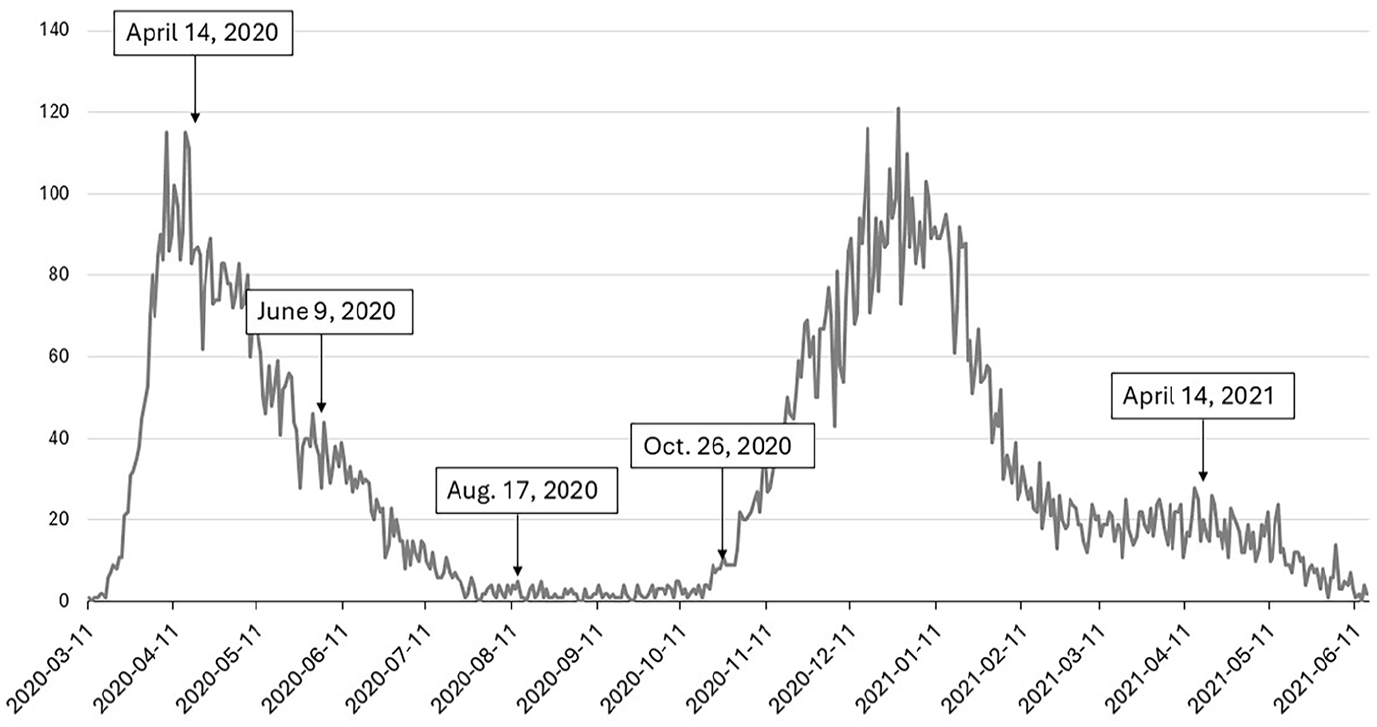
Number of COVID-19-related deaths in Sweden and points of data collection.
Similarly, public opinion about the pandemic and measurements, as well as news coverage, were subject to fluctuations: For example, after an initial period of unified support, trust in the government to handle the crisis began to dwindle (Glogger et al., in print) and support aligned more along partisan lines (Johansson et al. 2021). Perceptions of how the crisis evolved, was managed, and affected societies changed over time following real-time developments of the pandemic (Shehata, Glogger, and Andersen 2021).
Research Questions and Hypothesis
Against the theoretical and empirical backdrops, I suggest a hypothesis and several research questions. First, I focus on the effect of exposure to negativity in news coverage on beliefs about the negative societal impact of COVID-19. Based on studies that found that more exposure to negativity results in more negative beliefs (e.g., de Vreese et al. 2011; Eberl et al. 2018; Jacobs and van der Linden 2018), I pose the following hypothesis:
H1: The more individuals are exposed to negativity in the news, the more negative their beliefs about the societal impact of COVID-19 will be.
Second, I focus on interpersonal communication as a moderator of the assumed relationship between media exposure and beliefs about COVID-19. Based on the mixed findings on the effect of interpersonal communication, though (e.g., Andersen and Hopmann 2018; Gehrau et al. 2014), I ask a research question:
RQ1: How does interpersonal communication moderate the effect of exposure to negativity in news coverage on beliefs about the negative societal impact of the COVID-19 pandemic?
Finally, building upon the MSD theory and the dynamic development of the COVID-19 pandemic in Sweden, I ask the last research question:
RQ2: How does (1) the effect of exposure to negativity in news coverage, as well as (2) the moderating effect of interpersonal communication on negativity exposure, on beliefs about the negative societal impact of COVID-19 develop over the course of the pandemic?
Method
To answer the research questions and test the hypotheses, I rely on a five-wave panel survey and a manual content analysis of the COVID-19 news coverage in Sweden, combined through a linkage approach. While the panel survey allowed us to assess individuals’ beliefs about the pandemic and media use over time, the content analysis enabled us to measure the content characteristics of six leading news outlets.
Content Analysis
In total, news coverage of six Swedish outlets was included in the content analysis: one radio and one TV news show produced by the Swedish public service broadcasting (Ekot on Sveriges Radio (SR) and Rapport on Sverige Television (TV)), one news show on commercial TV (TV4 Nyheterna), two tabloid newspapers (Aftonbladet and Expressen), and one broadsheet newspaper (Dagens Nyheter). These outlets reflect the most widely used traditional media outlets in the country (Martinsson and Andersson 2021). The media archive Mediearkivet was used to collect items that covered COVID-19 in the four weeks leading up to the start of each panel wave fielding, using “Corona” and “COVID” as search strings. The media archive comprised news items published by the six outlets online and offline. I defined an item as a newspaper article (newspapers) or as a thematically closed item in the context of the radio or TV news shows. Items that included either or both of these search terms in the headline or lead paragraph comprised the sample. To reduce the number of items for the manual coding process, I included news items in the coding published every second day, leading to a final sample of n = 2,087.
Each item was coded for the overall tone toward the development of COVID-19, distinguishing between −1 = “negative,” 0 = “neutral,” and 1 = “positive” (for exact coding instructions, see Table A1 in Supplemental Material). A professionally trained coder coded the material. Coder-researcher reliability was assessed and reached acceptable values after two training sessions comprising 99 items (overall tone: Krippendorff’s α = 0.74). I aggregated the overall tone of coverage per wave and outlet to link it later to the participants’ individual news media use (de Vreese et al. 2017) (Table A2 in Supplemental Material).
Panel Survey
I make use of a five-wave panel survey conducted in Sweden between April 2020 and May 2021. Data was collected online by Laboratory of Opinion Research (LORE) at the University of Gothenburg, using a standing probability-based panel of web survey participants eighteen years and older. Out of this standing panel, a sample of 4,000 participants, which were stratified by gender, age, and education, was recruited for this study. Wave 1 was carried out from April 14, 2020, to May 8, 2020; wave 2 from June 9, 2020, to July 1, 2020; wave 3 from August 17, 2020, to September 9, 2020; wave 4 from October 26, 2020, to November 16, 2020; and wave 5 from April 14, 2021, to May 10, 2021. To minimize attrition bias and maintain a robust sample, participants who missed a wave were reinvited in subsequent waves; only those panelists whose invitation could not be delivered due to technical problems were excluded from the study. In Wave 1, questionnaires were sent to 4,000 panelists, of which 2,486 started the survey, and 2,387 made a complete response (Gross participation rate: 60.1%). In Wave 2, questionnaires were sent to 3,870 panelists–2,208 started the survey and 2,154 made a complete response (Gross participation rate: 55.9%). In Wave 3, 3,808 individuals were invited to participate, of which 2,131 started the survey and 2,031 submitted a complete response (Gross participation rate: 53.7%). In Wave 4, the questionnaire was sent to 3,706; here, 1,994 started the survey and 1,923 completed it (Gross participation rate: 52.2%). Finally, 3,540 individuals were invited to participate in Wave 5: 1,748 started the survey, and 1,696 sent in a complete response (Gross participation rate: 48.1%).
The sample is characterized as follows: 49% stated to be male. Age was assessed with six age groups: “18–30 years” (12%), “30 to 39 years” (15%), “40 to 49 years” (16%), “50 to 59 years” (19%), “60 to 69 years” (20%), and “70 years or older” (19%). Education was measured in four categories (0 = “up to 9 years of schooling” (4%), 1 = “up to 12 years of schooling” (33%), 2 = “12 years and vocational training” (18%), 3 = “12 years and university degree” (46%)). Table A3 in Supplemental Material compares this sample composition to the Swedish population, indicating a close match in terms of gender, though with a slightly higher proportion of older participants and participants holding post-secondary degrees which can be seen as a common pattern in volunteer-based survey panels.
Additionally, political interest was assessed using a four-point scale, ranging from 0 = “not interested at all” to 3 “very interested.” The participants in the sample had just below average interest in politics (M = 1.96; SD = 0.74). Finally, participants stated to be neither very left nor very right-leaning on a political ideology self-placement scale (0 = “clearly to the left” to 10 = “clearly to the right”; M = 4.96; SD = 2.71).
Measures
The main outcome of interest—beliefs about the negative societal impact of COVID-19—was operationalized as individuals’ perception about the pandemic’s impact on various aspects of Swedish society: (1) health care system, (2) the economy, (3) unemployment, (4) businesses, and (5) schools. Answers were provided on a seven-point scale (0 = “positive impact” to 6 = “negative impact”) and combined into a mean index (W1: α = 0.70; W2: α = 0.72; W3: α = 0.74; W4: α = 0.74; W5: α = 0.71).
I measured the news media use of six outlets included in the content analysis (Ekot, Rapport, TV4 Nyheterna, Dagens Nyheter, Aftonbladet, and Expressen). I asked the participants to state their use of these outlets during the four weeks before each panel wave, assessed on a scale from 0 to 5 (0 = “Never”; 1 = “less often”; 2 = “1–2 days a week”; 3 = “3–4 days a week”; 4 = “5–6 days a week”; 5 = “daily”) (Table A4 in Supplemental Material). I used a single item to assess interpersonal communication, asking the participants to state how often they had discussed COVID-19 with family members in the four weeks before each wave, assessed on a scale from 1 to 6 (1 = “Never”; 2 = “less often”; 3 = “1–2 days a week”; 4 = “3–4 days a week”; 5 = “5–6 days a week”; 6 = “daily”).
The following time-variant control variables were additionally assessed: Trust in the news media to handle the pandemic was measured with one item, asking the participants how much trust they had in how the news media managed the outbreak of the coronavirus (1 = “very little trust” to 7 = “very high trust”). Similarly, I used one item to assess the importance of the news media for keeping oneself updated about the pandemic (1 = “very important” to 4 = “not important at all”. Table 1 shows the descriptive values for all variables. Time-invariant control variables, such as age, gender, or education, were not required in the analysis. The chosen analytical approach of fixed-effects regression isolates within-individual change over time, thereby removing any potential confounding influence from stable individual traits (Allison 2009).
Descriptive Statistics of Variables Across Waves, Including Between- and Within-Person Variation.
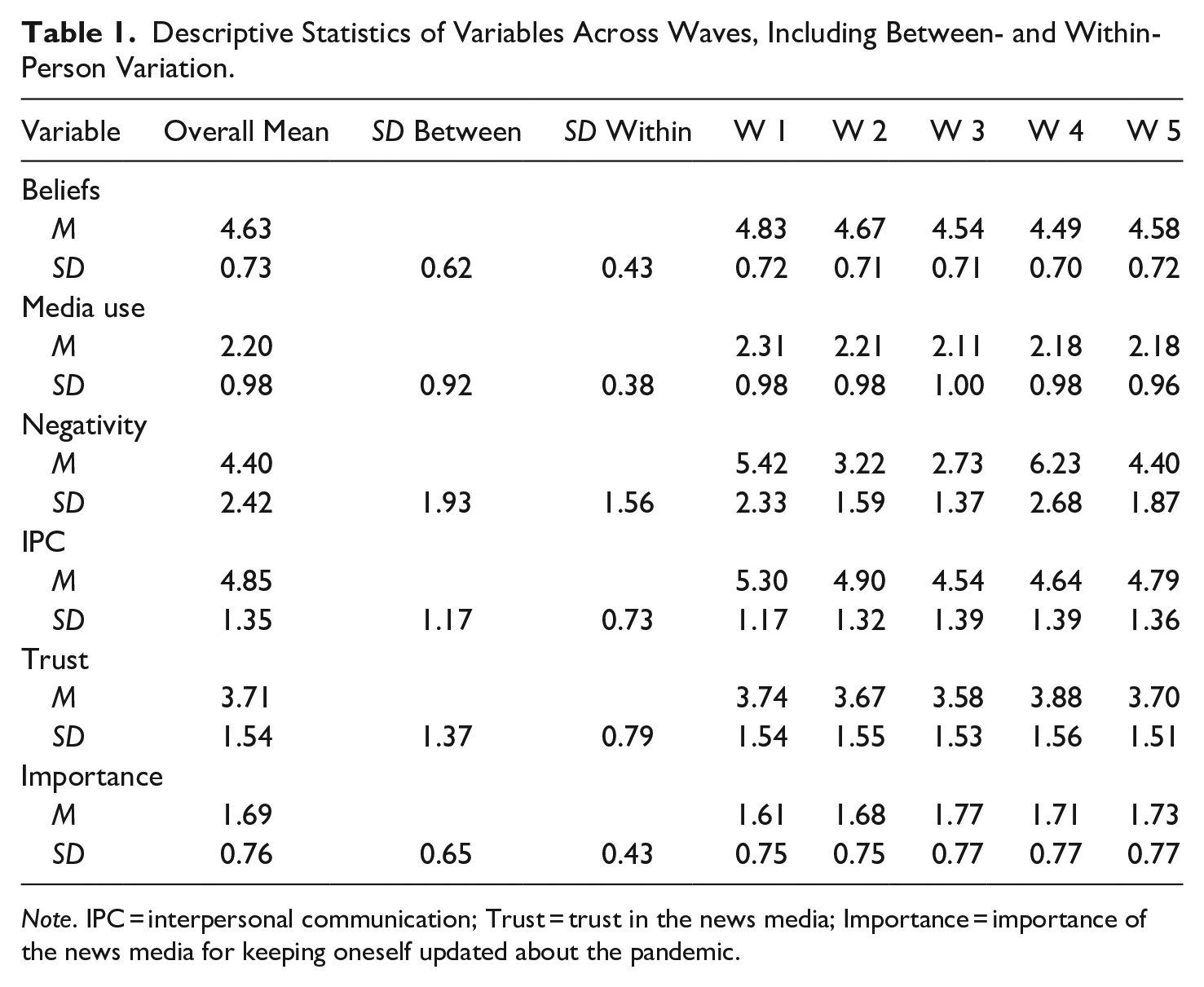
Note. IPC = interpersonal communication; Trust = trust in the news media; Importance = importance of the news media for keeping oneself updated about the pandemic.
Linkage Approach
I assessed participants’ exposure to negative news coverage using a linkage approach, following the approach suggested by de Vreese et al. (2017). 1 First, I calculated negativity scores for each of the six outlets in each wave, reflecting the average negativity in reporting over the four weeks prior. Next, I multiplied these outlet-specific negativity scores by each participant’s self-reported use of the respective outlet. This resulted in a set of exposure-weighted negativity scores, one per outlet per participant per wave. Finally, I summed these exposure-weighted negativity scores to create an overall exposure measure and reversed the measure so that higher values reflected stronger exposure to negative evaluation of the COVID-19 pandemic in Sweden (see Table 1 for descriptive values).
Data Analysis
To analyze the data, I estimated several fixed-effects models with clustered standard errors. The models explicitly include wave dummies to estimate the effects of different time periods while controlling for individual heterogeneity. The fixed-effects approach relies on within-individual variation, meaning that it removes all time-invariant individual characteristics, such as education, gender, and political leaning, that could otherwise bias the estimates (Allison 2009). This focus on within-individual variation strengthens the possibility of making causal interpretations of the estimated relationships.
Addressing RQ1 and RQ2.2 requires examining the interactions between the time-varying predictors of exposure to negativity and interpersonal communication. Although the fixed-effect estimator automatically de-means all time-varying variables, simply interacting with the raw variables may still allow some between-individual variation to influence the main effects (Giesselmann and Schmidt-Catran 2022; Quintana 2021). To address this, I followed the recommendation of Giesselmann and Schmidt-Catran (2022) to double-demean the interaction term: I first subtracted each individual’s mean from the relevant predictors and then constructed the interaction term from these demeaned variables. This procedure ensures that the interaction term reflects only within-individual deviations.
Results
Hypothesis H1 stated that greater exposure to negativity in news coverage would be associated with stronger beliefs about the negative societal impact of COVID-19. To test this hypothesis, I first report the results from a fixed-effects regression analysis. As can be seen in Table 2, the findings indicate that a one-unit increase in negativity exposure was associated with a .01 unit increase in the beliefs about the negative societal impact of COVID-19 (p = .04). This finding supports H1. Next to this finding, the results also suggest a statistically significant decline in beliefs about the negative societal impact of COVID-19 over time. Compared to Wave 1, beliefs about COVID-19’s negative impact were lower in Wave 2 (b = −0.14, p < .001). This trend continued in Wave 3 (b = −0.25, p < .001). The largest decline occurred in Wave 4 (b = −0.35, p < .001). In Wave 5, beliefs remained lower than in Wave 1 but increased slightly compared to Wave 4 (b = −0.24, p < .001).
Fixed-Effects Regression of Beliefs About the Negative Societal Impact of COVID-19 on Negativity Exposure.
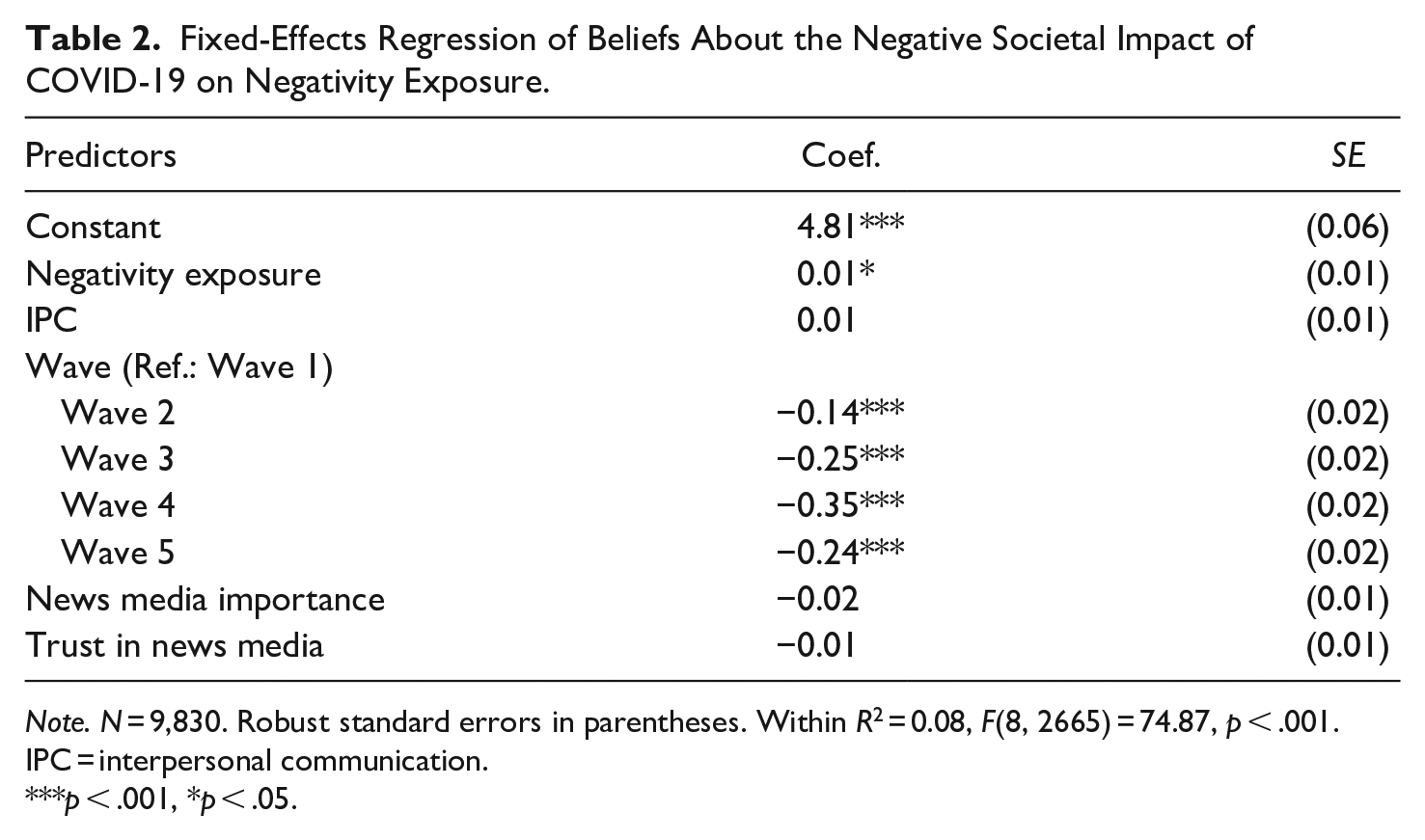
Note. N = 9,830. Robust standard errors in parentheses. Within R2 = 0.08, F(8, 2665) = 74.87, p < .001. IPC = interpersonal communication.
p < .001, *p < .05.
The first research question RQ1 asked how interpersonal communication influenced the relationship between negativity exposure and the belief that COVID-19 had a negative impact on various aspects of Swedish society. The interaction between negativity exposure and interpersonal communication is positive and significant (b = 0.01, p < .001). Figure 2 displays the interaction (see also, Table A5 in Supplemental Material).
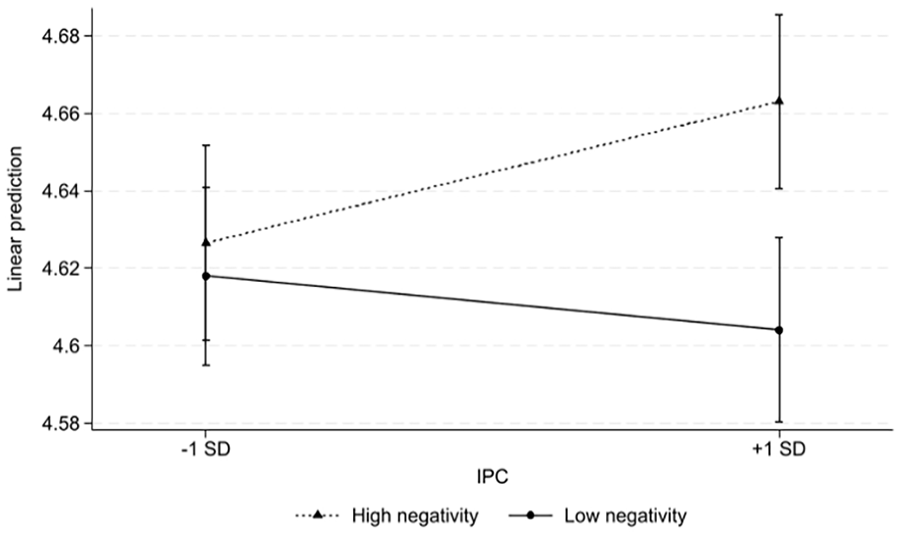
Interaction plot between negativity exposure and interpersonal communication.
A Wald test probing the interaction between negativity and interpersonal communication showed that the effect of negativity exposure on beliefs about the negative societal impact of COVID-19 was statistically significant at higher levels of interpersonal communication (+1 SD; b = 0.02, SE = 0.01, p = .005), but not significant at lower levels (–1 SD; b = 0.003, SE = 0.07, p = .70). This pattern indicates that interpersonal communication amplifies the belief-shaping influence of negative media content, whereas in its absence negativity exposure has little effect.
The last step of the analysis concerns the question of the temporally varying nature of the effect of exposure to negativity (RQ2.1), as well as the interaction between negativity exposure and interpersonal communication (RQ2.2). To examine whether the effect of negativity exposure on COVID-19 beliefs varied over time, first, a fixed effects regression model with an interaction between negativity exposure and wave was estimated. Table 3 shows the interaction terms between negativity exposure and wave, revealing that this effect was not constant over time but instead varied across different times of the pandemic. Specifically, the interaction between negativity exposure and Wave 3 was negative and statistically significant (b = −0.04, p < .001), indicating that by the third wave, the effect of negativity exposure on beliefs about the negative societal impact of COVID-19 seemed to have significantly weakened compared to Wave 1. Similarly, a negative interaction effect was observed in Wave 5 (b = −0.03, p = .004), suggesting a further decline in the influence of negativity on beliefs of the pandemic’s negative impact later in the crisis.
Fixed-Effects Regression of Beliefs About the Negative Societal Impact of COVID-19 on Negativity Exposure Over Time.
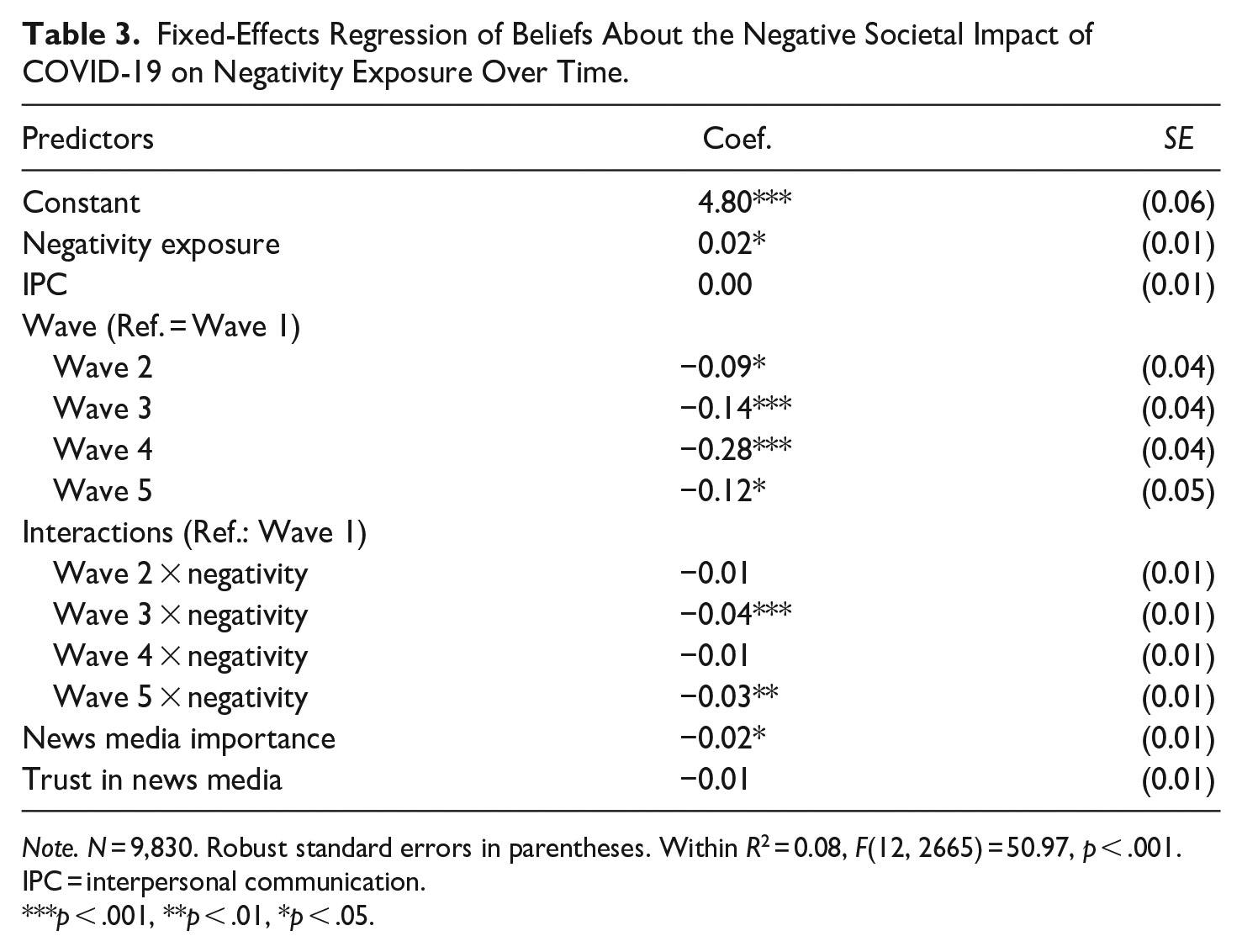
Note. N = 9,830. Robust standard errors in parentheses. Within R2 = 0.08, F(12, 2665) = 50.97, p < .001. IPC = interpersonal communication.
p < .001, **p < .01, *p < .05.
To examine how the relationship between media negativity exposure, interpersonal communication, and beliefs evolved over time, I estimated a fixed effects regression model with three-way interactions between negativity exposure, interpersonal communication, and waves. No significant three-way interaction was observed (Table A6 in Supplemental Material).
Discussion
Against the backdrop of the omnipresence of negativity in news coverage, this study explored the potential impact of negativity in news on individuals’ beliefs about the negative societal impact of COVID-19, with a focus on how this relationship may be influenced by interpersonal communication and the dynamic development of the pandemic. The results suggest (1) that greater exposure to negative news coverage about the pandemic was associated with stronger beliefs about the negative societal impact of COVID-19 in Sweden. This effect appeared to be moderated by (2) interpersonal communication, in the sense that more frequent discussions about the pandemic amplified the influence of media negativity. Taking the (3) dynamic development of the pandemic into account, the analysis indicates that the effect of exposure to negativity, but not the interaction with interpersonal communication, varied across time.
These findings provide tentative but meaningful insights into how media negativity and interpersonal discussion may interact in shaping public beliefs during crises. First, they contribute to the literature about the effect of the negativity of news coverage. In line with prior findings, the study indicates that exposure to negativity represents a factor in the shaping of beliefs (Soroka and Krupnikov 2021), to be more precise, beliefs of the impact of COVID-19 on Swedish society. Second, this effect appears to be influenced by the extent to which individuals talked about the pandemic, as well as by the progression of the crisis itself. On the one hand, the amplifying effect of interpersonal communication on the effect of exposure to negativity can be regarded as what Gehrau et al. (2014) describe as the synergetic relationship between interpersonal communication and media effects. This suggests that media influence is not limited to direct exposure but extends into social contexts where conversations can reinforce media effects. One possible explanation for this pattern lies in the nature of interpersonal communication as measured in this study—as discussions about COVID-19 with family members. Discussions within such strong ties are typically homogeneous rather than marked by opposing viewpoints, and like-minded social environments can further strengthen the perceived validity of one’s beliefs (Levitan and Visser 2009).
On the other hand, prior research emphasized that media effects are not static but fluctuate based on real-world events (Ball-Rokeach and DeFleur 1976; Soroka and Krupnikov 2021; Thomas et al. 2021). The findings of this study appear to support that view: The interaction effect between negativity exposure and time indicates that the influence of media negativity on beliefs about the negative societal impact of COVID-19 varied over time, with weaker effects observed during certain waves. During Wave 3, Sweden experienced a decrease in COVID-related cases and a reduced urgency of the crisis (Public Health Agency of Sweden 2023); Wave 5 was characterized by the start of the roll-out of the vaccination program. In sum, negativity exposure had a weaker impact on beliefs during periods of relative stability, whereas in earlier crisis phases or times of uncertainty, its influence was stronger. At the same time, the interaction between interpersonal communication and negativity exposure remains stable over time, indicating that talking more about the pandemic consistently amplified the effect of media negativity—regardless of when it occurred. This suggests that the mechanism through which interpersonal communication reinforces media effects may be a relatively stable social process and less contingent on external developments.
At this point, some limitations need to be addressed. The first concerns the measurement of interpersonal communication. Only a single item was used to assess discussions about COVID-19 with others, which limits the reliability of the measure (Allen et al. 2022). While this item captures how frequently participants discussed COVID-19 as a general issue, it does not provide insight into which specific aspects of the pandemic were discussed, such as those addressed in the items measuring beliefs about the negative societal impact of the crisis (e.g., effects on health care, the economy, or education). As a result, the measure may only partially reflect the interpersonal processes relevant to shaping those specific beliefs; this limitation may also affect the internal validity of the moderation analysis. Additionally, the used item did not account for tone. Studies in the context of cultivation theory, for example, underline that the resonance between media coverage and interpersonal communication can lead to stronger reinforcement of beliefs (Gerbner et al. 1980; Shrum and Bischak 2001). Future research should thus consider assessing the content and valence of interpersonal communication, while using multi-item measures, to further explore the exact mechanism behind the effects described in this study. Second, the direction of influence between media exposure and interpersonal communication remains unclear, as individuals may discuss media content as a reaction to exposure, or interpersonal conversations might themselves influence subsequent media consumption patterns (Southwell and Yzer 2007). Third, I did not assess whether the changes in, for example, COVID-19 cases or behavioral recommendations were the predictors for the observed differences in the media effects at different points in time. Future studies will need to add real-world indicators to the analysis to explore the temporally varying nature of media effects further. Fourth, the content analysis relied on news items collected and coded every second day. Since this might have introduced systematic errors, a full or random sampling strategy would have been better. In this context, it should also be noted that the intercoder reliability for the content analysis was slightly below the recommended threshold of α = 0.80 (Krippendorff 2018). This warrants caution in the interpretation of the findings involving the tonality measure. Although the results remain meaningful, they should be viewed as tentative given this methodological limitation. Lastly, the reliance on self-reported media use, as well as interpersonal communication, limits the findings of this study since self-reported media use correlates only moderately with observed media use (e.g., Parry et al. 2021; Scharkow 2019). Even if this study assessed media use by asking about the use of specific outlets which have been shown to more reliable than general media use (Scharkow 2019), the risk of measurement error remains.
Building on Soroka and Krupnikov’s (2021) argument, this study underscores that individuals are not simply at the mercy of negative news coverage. Instead, the influence of negativity on societal beliefs is shaped by interpersonal communication and fluctuates over time, highlighting the need to move beyond static assumptions and consider the dynamic interplay between media exposure, social interactions, and contextual change.
Supplemental Material
sj-docx-1-hij-10.1177_19401612251348045 – Supplemental material for The Dynamic Interplay of Negativity in News and Interpersonal Communication in Shaping Beliefs
Supplemental material, sj-docx-1-hij-10.1177_19401612251348045 for The Dynamic Interplay of Negativity in News and Interpersonal Communication in Shaping Beliefs by Isabella Glogger in The International Journal of Press/Politics
Footnotes
Author Contributions
Sole author; responsible for conceptualization, methodology, analysis, writing (original draft preparation, and review and editing of the manuscript) (data was collected within a larger project the author was part of).
Consent to Participate
Written consent to participate was acquired before data collection.
Consent for Publication
Not applicable
Data Availability
Data cannot be made available due to data protection reasons to ensure compliance with privacy laws and to safeguard the confidentiality of personal information in the country of data collection.
Declaration of Conflicting Interests
The author declared no potential conflicts of interest with respect to the research, authorship, and/or publication of this article.
Funding
The author disclosed receipt of the following financial support for the research, authorship, and/or publication of this article: This work was supported by the European Research Council (ERC) under the European Union’s Horizon 2020 research and innovation program under Grant number 804662.
Ethical Considerations
This study was approved by the Swedish Ethical Review Authority under case number 2019–04079.

Supplemental Material
Supplemental material for this article is available online.
Notes
Author Biography
References
Supplementary Material
Please find the following supplemental material available below.
For Open Access articles published under a Creative Commons License, all supplemental material carries the same license as the article it is associated with.
For non-Open Access articles published, all supplemental material carries a non-exclusive license, and permission requests for re-use of supplemental material or any part of supplemental material shall be sent directly to the copyright owner as specified in the copyright notice associated with the article.
