



Abstract
The COVID-19 pandemic was accompanied by an unprecedented influx of misinformation often with adverse impact on the effectiveness of institutional responses to the health crisis. However, relatively little is still known about the factors that may have facilitated the proliferation and public acceptance of misinformation related to the virus or to the government’s anti-pandemic measures, particularly in comparative perspective. Utilizing data collected by a representative cross-country survey (N = 5,000) in four countries led by populist leaders during the pandemic—Brazil, Poland, Serbia, and the United States—this study explores the links between three mutually interrelated factors, namely media usage across different platforms, affinity to populism, and trust in scientific expertise, and people’s beliefs in selected COVID-related misinformation. The findings show that preexisting attitudes, especially affinity to populism and mistrust of experts, are generally stronger predictors of people’s likelihood to endorse misinformation related to the pandemic than their news consumption patterns. Nevertheless, the analysis also indicates an important role played by exposure to specific media brands, particularly those promoting a skeptical stance toward preventive measures and COVID-19 vaccines, as well as messaging apps, which display a stronger relationship with misinformation beliefs than social networking sites. The article concludes by discussing implications for practical efforts to combat misinformation, especially during a health crisis.
Introduction
It is widely accepted that the COVID-19 pandemic was accompanied by the proliferation of a previously unseen volume of misinformation, rumors, and conspiracy theories, which spread across the globe with a velocity higher than in any prior healthcare crisis (Brennen et al. 2020; Larson 2018; Zarocostas 2020). Multiple studies have documented a negative effect of misinformation on people’s willingness to comply with public health guidance during the pandemic (Barua et al. 2020; Meppelink et al. 2022; Roozenbeek et al. 2020), on vaccine hesitancy (Kricorian et al. 2022; Lee et al. 2022), as well as on institutional trust (Frischlich and Humprecht 2021). While social media platforms have been commonly treated as the main villains, given their well-proven role in enabling and amplifying the spreading of misinformation (Allcott et al. 2019; Chou et al. 2020; Wang et al. 2019), false and misleading claims concerning the pandemic have also been disseminated via other channels, including mainstream media (Lwin et al. 2023; Popiołek et al. 2021).
Political context and especially political elites’ responses to the pandemic arguably also played an important role in facilitating the dissemination of misinformation. In some countries, attempts to halt the virus and implement effective pandemic response policies were hampered by populist leaders, who have openly questioned or even dismissed advice by expert bodies and promoted unscientific and unsafe methods of handling the virus, often in conjunction with sharing misinformation about the virus and various mitigation measures (Bayerlein et al. 2021; Williams et al. 2020). Data from across the world show that populist political leadership has been associated with slower response against COVID-19 and faster spreading of the virus (McKee et al. 2021), as well as with higher excess mortality (Charron et al. 2023; Naushirvanov et al. 2022) compared with countries which have not been led by populists during the pandemic. Although we might not know to what extent this was a result of misinformation amplified by populist actors, it is reasonable to assume it played an important role, especially considering the well-documented aversion of populists toward scientific expertise and institutions (cf. Mede and Schäfer 2020).
At the same time, it is not just the “supply side” of populism but also its “demand side” (Zulianello and Guasti 2023), or “populism from below” (Tsatsanis et al. 2018), that has been shown to create fertile grounds for the spreading of COVID-19 misinformation. Research has shown that populist views and attitudes are associated with susceptibility to pandemic-related conspiracies (Eberl et al. 2021; Oana and Bojar 2023) as well as with negative stances toward COVID-19 vaccines (Juen et al. 2023; Kohler and Koinig 2023) and with lower willingness to comply with pandemic measures (Ehrke et al. 2023). It is therefore clear that attempts at comprehensive understanding of the relationship between populism and pandemic misinformation need to consider both the influence of populist leaders and other elite actors (i.e., populism from above) and populist attitudes among citizens (populism from below).
While there has been a growing amount of scholarship examining the impact of either news consumption (via social or mainstream media) or populism (its supply or demand side) on people’s beliefs in misinformation about COVID-19, these factors have mostly been explored separately from each other, and without adequately accounting for the complexities of both the contemporary information environment and people’s affinity toward populist actors and attitudes—including those that relate to the epistemic aspects of populism, characterized by distrust toward experts and scientific institutions. Such deeper understanding of the relationship between misinformation, populism, and (dis)trust in experts is particularly relevant from a comparative perspective, considering the known differences between varieties of populism (Caiani and Graziano 2021) as well as differences among populist responses to the pandemic (Ringe and Rennó 2023), which could have further affected people’s amenability to COVID-19 misinformation.
Attempting to fill this research gap, this article examines factors that increase the likelihood of believing in COVID-19 misinformation in countries with populist governments during the pandemic, with a particular focus on people’s news consumption habits, and affinity toward populism. The article utilizes data collected between November and December 2022 by nationally representative surveys (N = 5,000) in four countries—Brazil, Poland, Serbia, and the United States—led by populist leaders during (a substantial part of) the pandemic. The four countries represent different types of populist responses to the pandemic (cf. Meyer 2020). While Presidents Donald Trump in the United States and Jair Bolsonaro in Brazil acted in a way that promoted science populism (Barberia and Gómez 2020; Daniels 2021; Hatcher 2020; Ortega and Orsini 2020; Peci et al. 2023; Rutledge 2020), the governments in Poland and in Serbia initially supported preventive proposed by healthcare authorities, but later abandoned them when such measures became politically inconvenient, and also faced criticism for allegedly abusing the emergency situation to propose initiatives that threatened civil liberties and even democratic institutions (Guasti 2020; Petrović 2020).
The design of our study is informed by Zaller’s (1992) Receive-Accept-Sample theory of how individuals form and express public opinion, in a process influenced by exposure to elite discourse. Being one of the key theories of public opinion which incorporates both psychological and social factors in understanding how citizens engage with political information and form political attitudes, this model is particularly expedient as a framework for analyzing (individual-level) attitudinal predispositions and media diets (i.e., populism from below) within the (macro-level) context of the country’s political environment which nurtures particular political attitudes and shapes the character of the information system (i.e., populism from above). Accordingly, this study proposes that beliefs in pandemic-related misinformation are affected by (1) the affordances and quality of news sources which either facilitate or hinder exposure to misinformation; (2) existing beliefs shape attitudes toward the pandemic, especially adherence to populist views and trust in scientific expertise; (3) the country-level context of the pandemic, namely the impact of different political (populist) responses to the pandemic, including the extent to which populist leaders contributed to the spreading of misinformation.
News Consumption and COVID-19 Misinformation Beliefs
Misinformation—commonly understood as false or inaccurate information which is produced and/or disseminated without the intention to deceive (Wardle and Derakhshan 2017)—became rampant on social media and personal messaging platforms during the COVID-19 pandemic, prompting the WHO to declare an “infodemic” (The Lancet 2020). It has been pointed out that misinformation spread through social media traveled faster than the coronavirus itself (Barua et al. 2020; Depoux et al. 2020), and social media platforms have been repeatedly accused of not doing enough to stem the flood of misinformation, especially in the early phases of the pandemic (Bellemare and Ho 2020; Wong 2021). Systematic reviews of research attempting to quantify the proportion of misinformation on various social media platforms concluded that up to 29 percent of posts associated with COVID-19 contained misinformation (Do Nascimento et al. 2022; Gabarron et al. 2021), with Twitter, Facebook, YouTube and Instagram having been explicitly singled out as being “critical in disseminating the rapid and far-reaching information” (Do Nascimento et al. 2022: 544).
Extant research has identified a positive link between social media use and believing in misinformation and conspiracy theories, both during the COVID-19 pandemic and beyond (Allington et al. 2021; Enders et al. 2021; Theocharis et al. 2021). In addition, multiple studies have documented the impact of misinformation beliefs among social media users on their vaccine hesitancy and uptake (see Skafle et al. 2022, for review) or on their low compliance with public health guidance about COVID-19 (Roozenbeek et al. 2020). However, research also suggests that the effects of social media use on COVID-19 misinformation beliefs are not homogeneous across platforms (Cinelli et al. 2020; Meppelink et al. 2022; Theocharis et al. 2021). In particular, recent scholarship has been pointing to the growing role of closed/encrypted platforms tailored to strong-tie network communication—especially messaging applications—as hotbeds of misinformation (Valenzuela et al. 2019; Vermeer et al. 2021). Analyzing how rumors spread through WhatsApp led to cases of mob violence in India, studies have highlighted that WhatsApp users share ideological, family, and communal ties, making it more likely for a user to forward messages, even when the user has a reason to suspect that the information is inaccurate or false (Arun 2019; Banaji et al. 2019). Multiple studies have documented these kinds of affordances of messaging platforms—and with that, their potential to serve as particularly effective channels of misinformation—in the context of the COVID-19 pandemic, including in Brazil (Rossini and Kalogeropoulos 2023; Vijaykumar et al. 2022), Zimbabwe (Bowles et al. 2020), Portugal (Cardoso et al. 2022), or India (Bapaye and Bapaye 2021).
In line with this, our first hypothesis follows the prevailing direction of research in this area, and proposes that
H1a: People who use social media (both social networking sites and messaging apps) for news will be more likely to believe in pandemic misinformation,
While the second hypothesis acknowledges differences between social networking sites and messaging apps, and predicts that
H1b: The use of messaging apps as sources of news will be more strongly associated with misinformation beliefs than the use of social networking sites.
While the bulk of research on COVID-19 misinformation and conspiracy beliefs focuses on the role of digital platforms, mainstream news media can also be a vector of misinformation, especially in media systems characterized by low pluralism and high political parallelism. Analyzing the U.S. newspapers’ coverage of three previous epidemics (Zika, H1N1 and Ebola), Ophir (2018) found that news articles on that subject contained framed information, capable of spreading misinformation and increasing uncertainty among readers exposed to them. In Brazil, Soares and Recuero (2021) found that Facebook users—especially those supporting President Bolsonaro—shared mainstream media links with headlines that reinforced COVID-19 misinformation discourses. It has also been repeatedly pointed out that even if mainstream media might not be promoting misinformation intentionally, they often engage in its amplification as part of their news routines (Bruns et al. 2021).
On the other hand, Allington et al. (2021) showed that the use of broadcast media was associated with health-protective behaviors (Allington et al. 2021), while a comparative study in Brazil, India, and the United Kingdom gave support to the idea that news from mainstream media helps people become more informed and resilient to COVID-19 misinformation (Altay et al. 2024). In a five-wave panel survey conducted in the Netherlands, the use of mass media—covering both offline and online outlets known for focusing on “hard news”—resulted in reduced misperceptions about coronavirus, while exposure to most social media platforms increased them (Meppelink et al. 2022).
In light of the inconclusive evidence on the role of mainstream media in either fostering or stemming the infodemic, we refrain from formulating a directional hypothesis, and pose instead a research question, namely:
RQ1: What is the relationship between traditional news media use and pandemic misinformation beliefs?
The inconclusive nature of the findings concerning the impact of mainstream media use on misinformation clearly points toward the need to consider not just the media type but also actual media content. Following Douglas-Durham’s (2023) assertion that belief in public health misinformation during the COVID-19 pandemic could have been moderated by factors like politicization and volume of media coverage, we believe it is important to highlight the role of specific media outlets that had more skeptical coverage of preventive measures and COVID-19 vaccines, or even actively promoted conspiracy beliefs. In this respect, plenty of evidence has been gathered on the U.S. cable TV network Fox News, which is known for its COVID-skeptical editorial stance, and whose audiences have been found to be particularly vulnerable to misinformation, and reluctant to comply with preventive measures during the COVID-19 pandemic (Ash et al. 2020; Bursztyn et al. 2020; Gollwitzer et al. 2020; Jamieson and Albarracín 2020; Mheidly and Fares 2020). Fox News also had an impact on previous healthcare crises; during the Sars-Cov-2 pandemic, use of Fox News correlated with believing in misinformation and conspiracy theories (Jamieson and Albarracín 2020). However, while Fox News has been in the global spotlight, we are still lacking sufficient understanding of the impact of COVID-skeptical media on people’s susceptibility to misinformation from a comparative cross-national perspective.
Our next hypothesis therefore is
H2: People who are more exposed to media brands that disseminate COVID-19 misinformation and are skeptical about pandemic measures [hereafter COVID-skeptical media] will be more likely to believe in misinformation.
Populism, Trust in Experts and Misinformation
Existing scholarship has investigated the link between populism and partisan disinformation (Humprecht et al. 2020), showing that populists have negative attitudes toward news media and hostile media perceptions, with the press perceived as part of a detached elite that neglects citizens’ interests (Fawzi 2019; Krämer 2017; Schulz et al. 2020). The polarizing aspect of populism can also further the spread of misinformation, making it harder to identify accurate and inaccurate information (Swire et al. 2017). Citizens with populist attitudes are less reliant on legacy press outlets and consume more partisan news (Stier et al. 2020), where they can encounter misinformation more frequently. It is therefore not surprising that the literature points to a positive correlation between populist attitudes and conspiracy beliefs (Castanho Silva et al. 2017), as well as to the tendency for people with conspiracy beliefs to vote for populist parties (Christner 2022). This general tendency has also been confirmed in the specific context of the pandemic. As Eberl et al. (2021) have found, displaying populist attitudes is highly correlated with believing in conspiracy theories about COVID-19. Research in Germany by Juen et al. (2023) showed that populist attitudes are linked with low support for compulsory vaccination, akin to the outcomes of studies from Australia (Edwards et al. 2021) and Indonesia (Sujarwoto et al. 2023), both demonstrating a correlation between vaccine hesitancy and populist views.
Building on these arguments, we postulate the following:
H3a: Populist voters will be more likely to believe in pandemic misinformation.
H3b: Respondents with higher levels of populist attitudes will be more likely to believe in pandemic misinformation.
However, while existing scholarship has mostly explored links between susceptibility toward misinformation and political populism, commonly understood as a “thin” ideology centered on the opposition between the people and the (corrupt) elite (Mudde 2021), increasing attention has been devoted to a parallel phenomenon of science-related populism, which is manifested (among other traits) in the rejection of scientific institutions and academic elites as legitimate possessors of truth, and in the emphasis on “common sense” and ordinary people’s personal experience as superior sources of epistemic authority (Mede and Schäfer 2020). Based on survey data from Austria, Eberl et al. (2021) confirmed that science-related populism (“science populism”, in their words) is positively correlated with COVID-19 conspiracy beliefs and negatively correlated with trust in science—and in both cases, correlations for science populism are stronger than for political populism. Promoting anti-science sentiments and fostering distrust in experts has been a known tactic used by (some) populist actors already long before the pandemic, particularly with regards to issues such as climate change (cf. Reinemann et al. 2022), but the pandemic has arguably further intensified it, with populist leaders such as Trump and Bolsonaro explicitly dismissing expert advice and standing in the way of science-based pandemic responses (Barberia and Gómez 2020; Hatcher 2020). It is therefore reasonable to assume that, while science populism contributes to the erosion of trust in science and experts, and increases susceptibility to misinformation, trust in experts can serve as an antidote against science populism, and by extension to misinformation. A previous study found that trust in medical experts affects the likelihood that a person accepts correction and becomes less misinformed (Stecula et al. 2020). In another comparative analysis of five countries, higher trust in scientists was associated with lower susceptibility to coronavirus-related misinformation (Roozenbeek et al. 2020).
Based on this evidence, we expect that
H4: Trust in experts will be associated with a lower tendency to believe in pandemic misinformation.
Comparative Context: Populist Pandemic Responses and News Media Independence
Having reviewed the selected individual-level factors that, according to literature, may impact on susceptibility to pandemic-related misinformation—that is, news consumption patterns, attitudinal affinity toward populism, and trust in experts and science—we now turn to the country-level context of this study, which is characterized by different types of political responses to the pandemic in countries headed by populist governments, as well as by differences in their media systems, particularly with regards to news media independence.
Comparative scholarship on populism and the pandemic suggests that, contrary to common assumptions, populist actors displayed a notable variety of reactions to the pandemic, and not just when comparing populist parties in opposition versus those in power but also among incumbent ones (Kaltwasser and Taggart 2022; Meyer 2020; Ringe and Rennó 2023; Zulianello and Guasti 2023). The responses by populists in power varied based on a number of factors, including regime type (presidential vs. parliamentary system) and whether or not they were facing elections (Zulianello and Guasti 2023). Nevertheless, following the analysis by Meyer (2020), it is possible to distinguish two basic types of initial reactions by populist leaders worldwide—the first one involved downplaying the virus and sidelining scientific advice (represented by the United States, Brazil, Nicaragua, or Mexico), and the second involved taking the pandemic seriously and implementing more stringent mitigation measures (as in the Czech Republic, Hungary, Poland, India, Serbia, or the Philippines).
Both types are represented in the sample of countries selected for our study, which includes Brazil, the United States, Poland, and Serbia.
In Brazil, the approach by President Jair Bolsonaro (in office between 2019 and 2022) was characterized by scientific denialism and reluctance to implement mitigation measures, all in the name of protecting individual liberties and economic growth (Fonseca et al. 2021). Bolsonaro’s stance has led to repeated conflicts with federal public health officials as well as with state and local governments (Meyer 2020), and has been commonly blamed for one of the world’s highest rates of COVID-19 cases as well as deaths (Knaul et al. 2021). The United States under President Donald Trump (2017–2020) followed a similar path, as Trump was effectively striving to sabotage the efforts by key institutions and officials managing the health response (most notably Dr Anthony Fauci) and has publicly—often via Twitter—endorsed bogus or outright dangerous methods of curing COVID-19, such as drinking disinfectant or bleach (Skonieczny and Boggio 2023).
In contrast, populist leaders in Poland and Serbia adhered to scientific expertise in their initial pandemic responses. In Poland, both the government led by the conservative-populist party Law and Justice and President Andrzej Duda from the same party acted in unison to impose some of the strictest mitigation measures in Europe (Meyer 2020), including a quick travel ban, social distancing rules, and mask wearing. The Serbian President Aleksandar Vučić likewise embraced a very strict, expert-led approach toward containing the pandemic, which involved, for example, closing off all nonessential businesses and curfews (Todorović 2020). While these measures helped contain the spread of the virus, at least during the first wave (Sirotnikova et al. 2020), populist incumbents in both countries were accused of politicizing the pandemic and abusing emergency measures to enhance their political power (Mihelj et al. 2024).
It is possible to assume that the above summarized differences in the way the leaders and governments of the four countries in our sample approached scientific expertise, handled the pandemic, and actively contributed to the spreading of misinformation, constitutes an additional, macrolevel factor which needs to be taken into account when interpreting the individual-level variables potentially affecting people’s likelihood to believe in pandemic misinformation, as discussed previously. Considering this, our study asks:
RQ2: Are the individual-level predictors of believing in pandemic misinformation in the U.S. and Brazil different from those observed in Poland and Serbia?
Specifically, we expect that:
H5: In Brazil and the United States, populist vote will be a stronger predictor of misinformation beliefs than in Serbia and Poland
A closely related dimension of the country-level context relevant for this study is the level of media independence. While some other studies have looked at a broader range of media-system variables when testing country-level resilience to online disinformation (cf. Humprecht et al. 2020), we are focusing on a single variable, namely political independence of news media. This choice is driven by the well-documented tendency of populist actors to seek to undermine media independence, particularly once they assume executive power—typically by attacking, intimidating and harassing independent journalists, or by capturing news outlets, either directly (such as public service media) or indirectly, via government-allied owners (Dragomir 2024; Holtz-Bacha 2020; Kenny 2020). At the same time, media independence—the ability of journalists to work freely from political constraints and interference—has been considered a vital condition for countries’ resilience against disinformation (Dragomir et al. 2024), including in the context of the infodemic (Frischlich and Humprecht 2021). It is therefore reasonable to assume that news media characterized by relatively higher level of political independence will be less likely to reproduce pandemic misinformation, and their audiences will be less likely to believe in those.
With regards to the four countries in our sample, the level of political independence of media has been the highest in the United States, ranking 36th on the Reporters without Borders’ World Press Freedom Index for the “Political Indicator” (RSF 2023), followed by Brazil (82nd), Poland (112th), and Serbia (133rd). 1 While Brazil’s position has been affected mostly by hostile rhetoric and violence against journalists (online or physical) during the Bolsonaro rule, the ranking of Poland and Serbia reflects the fact that both countries had a significant portion of their media ecosystems controlled by the government at the time of the data collection, including (but not limited to) public service media (Dragomir et al. 2024; Gajlewicz-Korab and Szurmiński 2022; Milojević and Kleut 2023; Steele 2023). This does not necessarily imply that the government was directly responsible for the spreading of misinformation through the captured news outlets; after all, the leaders of both Poland and Serbia mostly embraced scientific expertise when adopting mitigation policies, at least in the first phases of the pandemic, as described above (Mihelj et al. 2024). However, as highlighted in our research mapping communication approaches during the pandemic (Hallin et al. 2024), the government’s pandemic communication in these countries was often contradictory and lacking coherence, especially with regards to misinformation, which flourished both online and in pro-government outlets, without being effectively countered—in some cases to avoid alienating minor coalition parties or supporters of the government. 2 It can be therefore argued that those media have enabled for the spreading of misinformation not because of the government’s direct interference on that subject, but rather because their editorial policies and journalistic integrity have already been compromised due to long-term decline of professionalism and editorial autonomy, resulting from their politicization and instrumentalization by both the populist government and affiliated political actors (some of whom have played active part in spreading pandemic-related misinformation).
Following this line of argumentation, we expect that:
H6: Mainstream media consumption in the United States and in Brazil will be associated with a lower tendency to believe in pandemic misinformation than in Serbia and Poland.
Data and Measures
To explore the factors that contribute to people’s vulnerability to misinformation during the healthcare crisis in populist political context, we conducted a representative cross-national survey in four countries—Brazil, Poland, Serbia, and the United States. They were all governed by populist right-wing presidents who were running for re-election, which makes them a perfect case to test the effects of preexisting attitudes on receiving and accepting misinformation.
The surveys were conducted online in all four countries by the same polling agency, Kantar, between November and December 2022. Nationally representative samples included 5,000 adult respondents (in Brazil, N = 1,500; in Poland, N = 1,000; in Serbia, N = 1,000; in the United States, N = 1,500), stratified according to the distribution of sex, age, geographic regions, and income (see Supplemental Appendices B and D for information on the descriptives of the sociodemographic variables). We did not have to use weights as the data had a strong match with the census profiles. Questionnaires were back translated by area specialists from English to Portuguese, Polish and Serbian. The study has received an approval from the Ethics Review Sub-Committee of Loughborough University (reference number 2022-8439-9153).
Independent Variables
Frequency of news consumption was measured separately for specific media types/platforms, namely (a) television, (b) radio, (c) print newspaper or magazine, (d) website of a news organization, (e) social networking sites (e.g., Facebook, Twitter, Instagram, TikTok, YouTube), (f) messaging platforms (e.g., WhatsApp, Viber, Snapchat, Facebook Messenger, Telegram), and (g) podcast. The frequency scale in the questionnaire had six different options: (1) never; (2) less often than once a month; (3) less often but at least once a month; (4) once a week; (5) several times a week; (6) daily. The sample mean for news access in each media type and country is presented in Figure 1, which also includes the standard deviations in parenthesis. As expected, television was the main access of news in all countries, though social networking sites also had a large audience.
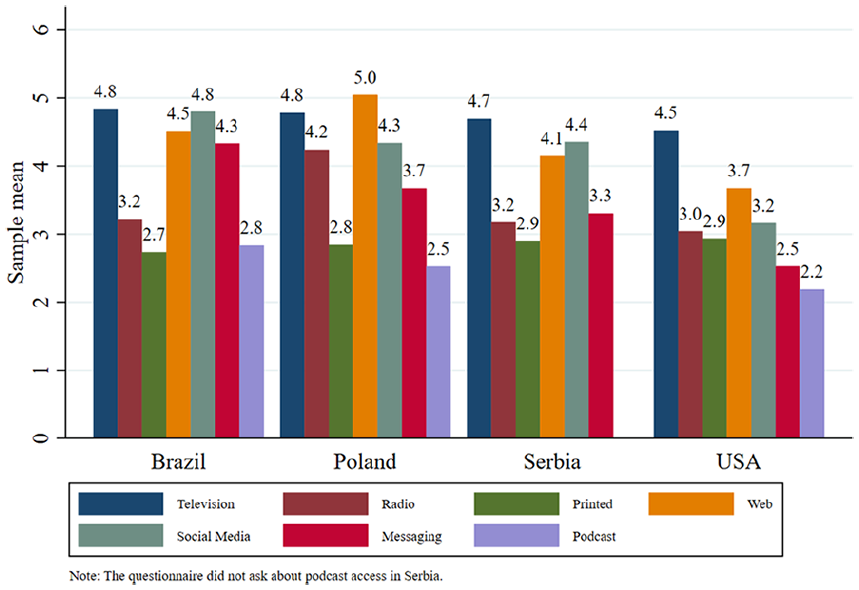
Sample mean of news access by media platforms.
People also answered questions about their access to news via specific media brands from each country. In this case, the scale had only four options: (1) less than once a week or never; (2) once a week; (3) several times a week; (4) at least once per day. The reason for providing fewer options for the frequency of news brands consumption was the fact that people are less likely to remember the precise details of their news habits for individual brands as opposed to media types. The questionnaires presented thirteen to sixteen media brands, from television, radio, printed, and online platforms, including a combination of most widely used brands, as well as brands representing different political stances toward the populist government in each of the countries. Based on the answers, our second independent variable was constructed, namely consumption of COVID-skeptical media, representing exposure to specific media channels with a reputation of presenting a distinctly skeptical coverage of preventive measures and COVID-19 vaccines. Those channels were: in Brazil, Jovem Pan (national commercial TV and radio station which assumed a pro-government coverage during Jair Bolsonaro’s term) and public channels TV Brasil and Radio Nacional (which are editorially controlled by the government); in Poland, printed or online versions of three political weeklies with close ties to the governing party Law and Justice and other conservative right-wing actors, Tygodnik Do Rzeczy, Sieci, and Gazeta Polska; in Serbia, the pro-government commercial TV channel Happy; and in the United States, the TV network Fox News (see Supplemental Appendix A for further information on these outlets’ editorial position vis-à-vis the pandemic).
Populist vote was a dummy variable in which 1 is equivalent to voting in the last election for presidents Jair Bolsonaro, in Brazil (37% of populist vote, 43% of challenger vote and 19% of abstainers); Andrzej Duda, in Poland (populist vote = 30%, challenger vote = 47%, abstainers = 23%); Aleksandar Vučić, in Serbia (populist vote = 29%, challenger vote = 43%, abstainers = 28%); and Donald Trump, in the United States (populist vote = 33%, challenger vote = 50%, abstainers = 17%).
To measure populist attitudes, we used a list of eight questions based on Van Hauwaert and Van Kessel (2018) and Van Hauwaert et al. (2020), which was drawn originally from Akkerman et al. (2014). The results presented a high level of agreement with populist attitudes, as we should expect to find in countries under populist rule. However, some of the questions did not have a lot of variability in the answers, while disagreement with populist attitudes scored very low, even close to the margin of error in one case. A Comparative Factor Analysis showed a discrepancy between some of the observed data and the predicted values. To improve the model fitness, we dropped three questions and instead used five questions: “Can you tell us to what extent do you agree or disagree with the following statements: (1) The people, not the politicians, should make our most important policy decisions; (2) The political differences between the people and the elite are larger than the differences among the people; (3) Elected officials talk too much and take too little action; (4) What people call “compromise” in politics is really just selling out on one’s principles; (5) The particular interests of the political class negatively affect the welfare of the people.” Answers were coded on a 5-point response scale on how much one agreed with each statement. “Fully agree” was coded as 1; “rather agree” = 0.5; “fully disagree” = −1; “rather disagree” = −0.5; “neither agree nor disagree” = 0. Answers were aggregated in an index from −1 to 1, in which values greater than zero demonstrate a respondent has stronger populist attitudes while values lower than zero are weaker (Cronbach’s α = 0.84 to ALL; 0.78 to BR; 0.86 to PL; 0.85 to RS; 0.85 to US).
Trust in experts was a composite variable constructed from three items, as a response to the question: “If there is a new pandemic in the future, to which extent would you trust the following institutions to handle it? (1) Public health authorities; (2) scientists; (3) medical professionals.” As evident from the question, prospective trust was measured, which was more appropriate given that the survey was conducted toward the end of the pandemic. Responses were aggregated in average of a 1–10 scale, in which 1 means “I would not trust at all” and 10 represents “I would definitely trust” (BR: M = 4.9, SD = 2.9; PL: M = 4.7, SD = 2.5; RS: M = 3.2, SD = 2.2; US: M = 4.9, SD = 2.9; ALL: M = 4.5, SD = 2.8).
Dependent Variable
Individual misinformation beliefs were measured as a function of nine selected claims about the disease or the vaccines, known to be either false, inaccurate, or unsupported by scientific consensus at the time of the survey. In constructing the list, we drew upon information produced by local fact-checking websites or healthcare authorities, and sought to include examples of misinformation that were (a) recorded in all four countries at or before the time when the survey was conducted, and (b) that varied in the level of their believability. Our approach followed a broader, more inclusive conceptualization of misinformation, which goes beyond the true/false or correct/incorrect dichotomies and accounts for claims that are characterized by a certain level of ambiguity, where scientific evidence has not (yet) been fully settled (Toepfl et al. 2023; Valenzuela et al. 2019). 3 In the context of our study, this concerns particularly the claim about the artificial origin of the virus, which was overwhelmingly dismissed by the expert community in the earlier phases of the pandemic (BBC 2021; Calisher et al. 2020), but which has been gaining more legitimacy in recent years (see, e.g., Dewan 2024). 4
Answers were coded on a 5-point Likert scale. The nine statements were aggregated in a count variable in which individuals marked they “fully agree” or “rather agree” with statements = 1, resulting in a 0–9 scale (M = 2.70, SD = 1.36 ; VIF for all indicators <1.6). 5
Looking at the distribution of endorsements in Figure 2, it is apparent that certain claims were accepted across the sample, while others were more popular specific countries. Among claims showing more variance is “natural immunity from COVID-19 is better than vaccines.” In Serbia, 54 percent of respondents endorsed this belief, which is the single largest endorsement for all misinformation in the sample. In contrast, only 27 percent of Brazilian respondents agreed with this statement, followed by 38 percent of Americans and 45 percent of Polish. On average, the misinformation with more acceptance in all countries was that “COVID-19 vaccines are experimental, and their health risks are not properly known.” This statement was endorsed by 43 percent of respondents on the pooled data (40% in Brazil, 45% in Poland, 51% in Serbia, and 40% in the United States). Several false claims about vaccines were more widely accepted in the United States in comparison with other countries—namely, statements that the COVID-19 vaccines “can change people’s DNA,” that they “have been developed using human embryos,” or that they “contain microchips.”
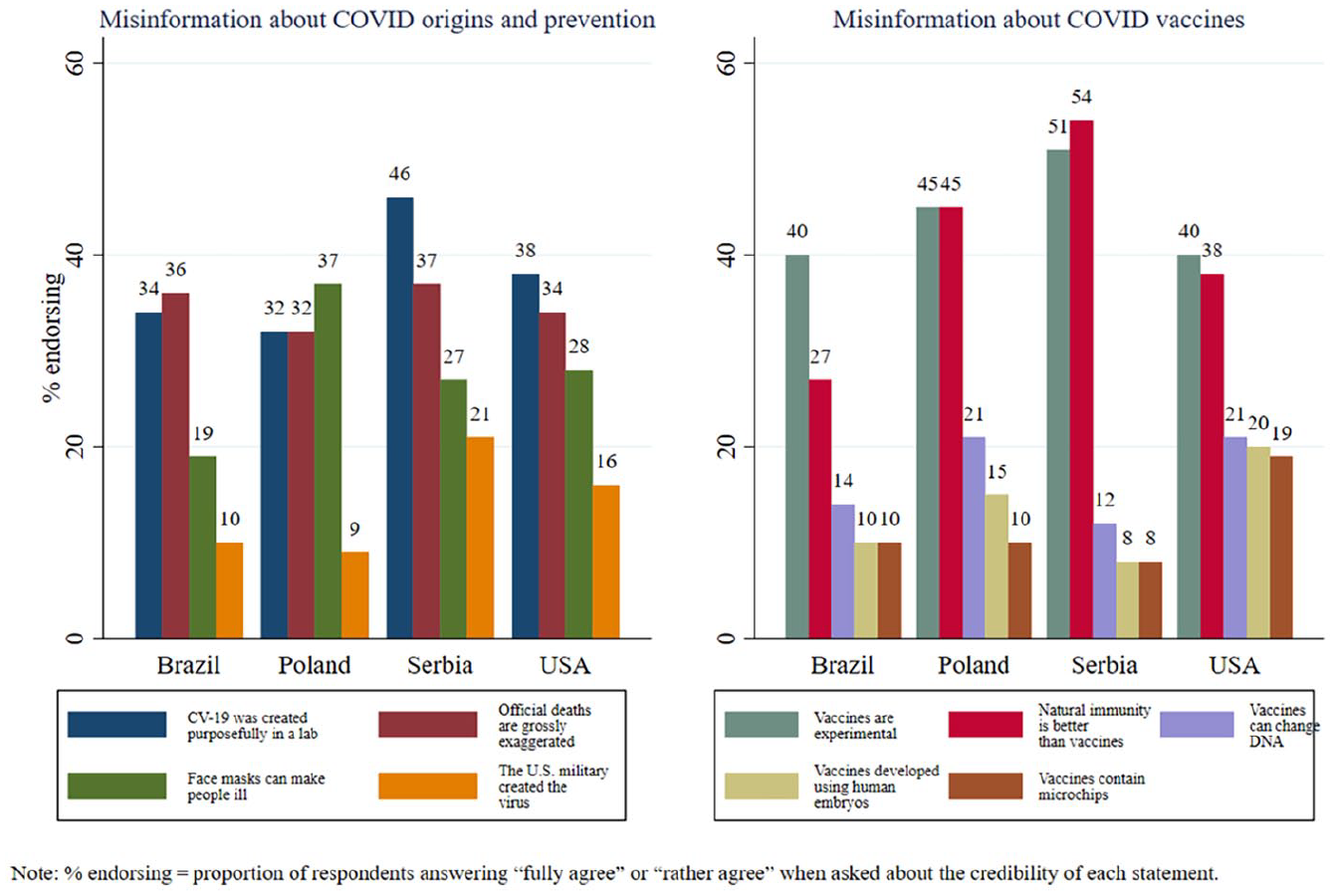
Beliefs in COVID-19 misinformation, percent of their endorsement.
Findings
Given that misinformation belief count was our dependent variable, we chose a Negative Binomial Generalized Linear Model to test our hypotheses and answer the research question (Cameron and Trivedi 2013). This model is appropriate because (1) it presented a lower Akaike information criterion and Schwarz’s Bayesian information criterion, when compared to other common count models, such as Poisson regression, zero-inflated Poisson, and Hurdle; (2) the Cameron–Trivedi test and the Pearson’s chi-square test indicated overdispersion (Dispersion = 2.3 and Pearson’s chi-square = 2.5 for the dataset with all countries), which violates the assumptions of a Poisson regression model for equal mean and variance; (3) the data had a significant number of respondents with zero false beliefs (BR = 36%, PL = 29%, RS = 21%, US = 35%, ALL = 31%); (4) the excess zeros are related to the same process that generates the nonzero counts, which means that the same set of predictors influence both the probability of zero counts and the count values. In this sense, a Negative Binomial model can accommodate data with both structural zeros and excess zeros without the need to explicitly specify a separate process for zero counts, like in a zero-inflated Poisson model.
We performed a likelihood ratio test (LRT) to compare the fit of the full model in relation to two reduced models: (1) one without the predictors of media exposure; (2) another without the predictors “Populist Vote,” “Populist Attitudes,” and “Expert Trust.” All models were controlled with Sex, Age, Education, and Income.
The first LRT without media predictors had a test statistic (χ2) of 408.64 with −6 degrees of freedom (df), resulting in a p-value of p < 2.2e-16. In the test with the reduced model without populist votes, populist attitudes and expert trust, test statistic (χ2) was 618.88 with −3 df and similar significant p-value (p < 2.2e-16).
The p-value in the LRTs indicates that the full model provides a significantly better fit than the reduced models, suggesting that all additional predictors of the two different dimensions forming public opinion according to Zaller’s model (Receive and Accept) are important for explaining the variation in misinformation beliefs. Furthermore, the test with the reduced model without preexisting beliefs (Accept) shows that Populist Vote, Populist Attitudes, and Trust in Experts are the predictors that most improve the fit when included in the full model, as it presents the highest difference in the log-likelihoods of χ2 = 618.88. The LRT statistic for media access (Receive) also demonstrates that this dimension has a high impact on the model’s performance and contributes to a better fit compared to the reduced model (χ2 = 408.64). However, in the end, preexisting beliefs have a greater impact on misinformation than media access.
The results of the analysis, summarized in Table 1, only partially support hypothesis 1a. More frequent usage of social networking sites increases the likelihood of believing in false information in the United States, with the opposite effect in Brazil and no significant coefficients in Poland and Serbia. At the same time, messaging platforms are associated with believing in more misinformation in all countries but Poland. This, in turn, supports our hypothesis 1b, which predicted that the use of messaging apps will more strongly associated with misinformation beliefs than the use of social networking sites.
Negative Binomial Models Predicting Misinformation Beliefs.
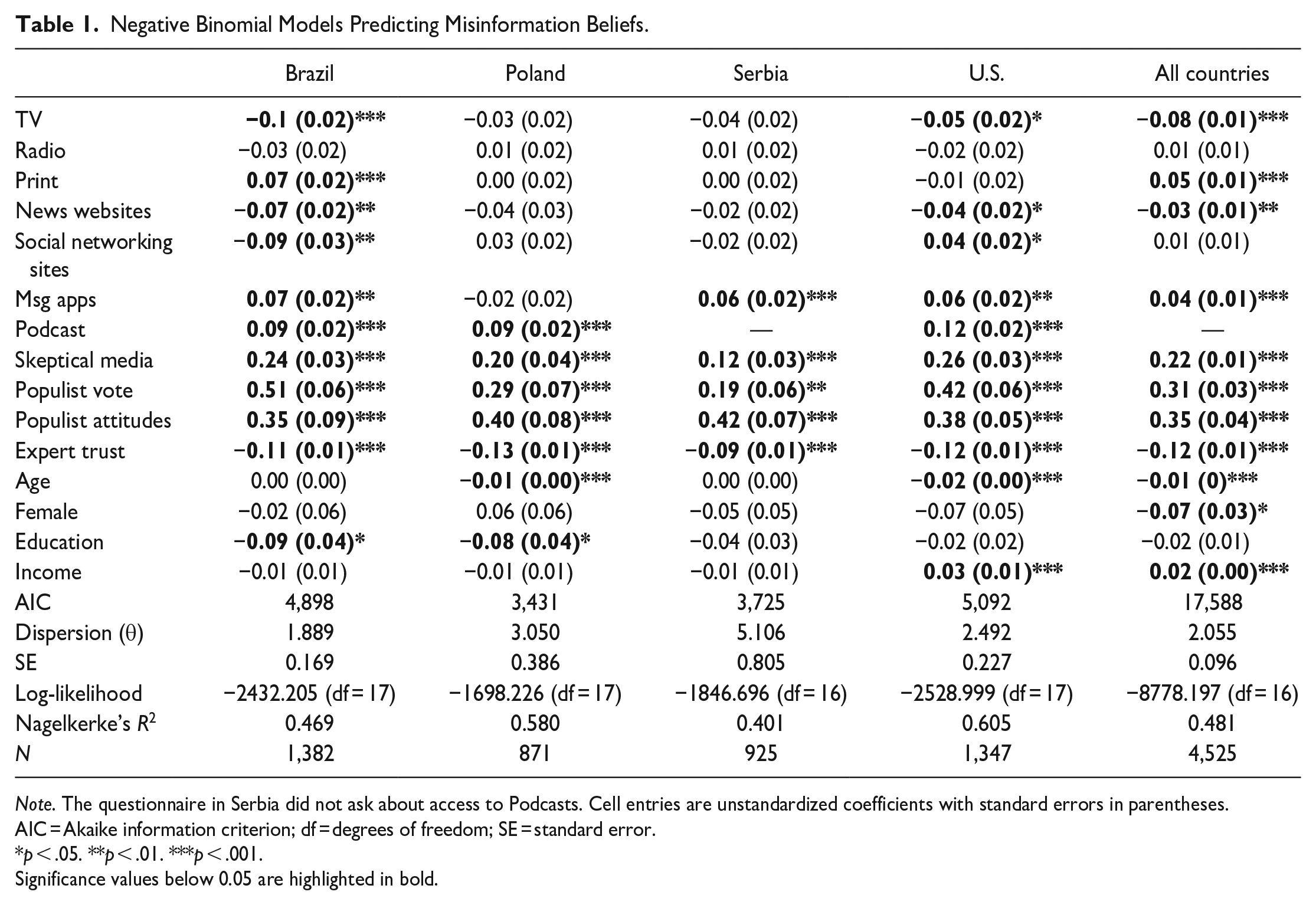
Note. The questionnaire in Serbia did not ask about access to Podcasts. Cell entries are unstandardized coefficients with standard errors in parentheses. AIC = Akaike information criterion; df = degrees of freedom; SE = standard error.
p < .05. **p < .01. ***p < .001.
Significance values below 0.05 are highlighted in bold.
The data provide contrasting evidence with regards to our research question RQ1, asking about the links between traditional news media (which for the purpose of our study comprised television, radio, print, and news websites) and misinformation beliefs. The usage of traditional media was only associated with displaying less misinformation beliefs in Brazil and the United States, and for respondents who got more news from television and news websites. There was no significant effect from radio and printed media on decreasing false beliefs. In Poland and Serbia, none of the mainstream media variables were significant. While the data are not completely unambiguous (as evidenced by the positive association between print media use and misinformation beliefs in Brazil), overall, they still point in the direction that provides support for our hypothesis H6 predicting that mainstream media use in Brazil and the United States will be linked with comparatively lower tendency to believe in false or inaccurate information than in Poland and Serbia. In fact, none of the four countries displayed a positive association between mainstream media use and misinformation beliefs, and it appears plausible to assume that in Brazil and the United States—the two countries displaying comparatively higher levels of political independence of the press—mainstream media organizations took on a more active role in rebuking and disavowing misinformation disseminated by the countries’ respective presidents, Jair Bolsonaro and Donald Trump.
The analysis provides strong support for the assertion that the content associated with specific media brands is more important than the media type itself. Conforming hypothesis H2, our research finds that skeptical media brands had a strong impact on misinformation beliefs in all four countries. For each one-unit increase in the frequency people access the news through these media channels, there is a 25 percent increase in the expected number of misinformation they believe. In Brazil, the audience of Jovem Pan, Radio Nacional, or TV Brasil would believe in 27 percent more misinformation when there was a one-unit increase in access. Likewise, the level of misinformation beliefs is 22 percent higher in Poland for users who follow Tygodnik Do Rzeczy, Sieci, or Gazeta Polska. Similar effects were found among frequent watchers of TV channels Happy in Serbia (12% increase in false information) and Fox News in the United States (29% increase).
In accordance with hypotheses H3a and H3b, populism—measured via both electoral behavior and populist attitudes—is the strongest predictor of misinformation beliefs. In the model with all countries, voting for a populist candidate increases the expected count for misinformation beliefs by 36 percent, while populist attitudes are responsible for a 42 percent increase. Voting for Jair Bolsonaro, in Brazil, represents believing in 67 percent more misinformation than nonvoters; for Donald Trump in the United States, 52 percent; for Andrzej Duda in Poland, 33 percent; for Aleksandar Vučić in Serbia 20 percent. The observed differences between Brazil and the United States, on the one hand, and Poland and Serbia, on the other, can be explained with reference to different approaches to misinformation among the political elites in the four countries. While Trump and Bolsonaro were themselves actively spreading COVID-19 misinformation, Duda and Vučić (and their respective governments) largely abstained from doing so—albeit without actively countering false information—which helps explain why the populist vote is a stronger predictor of misinformation beliefs in Brazil and the United States compared to Poland and Serbia, in line with our hypothesis H5.
Trust in experts was responsible for a decrease in misinformation beliefs in all four countries, as predicted by our hypothesis H4. Each one-unit increase in the trust scale is overall responsible for believing in 11 percent less falsehoods on average—reducing 12 percent in Poland, 11 percent in the United States, 10 percent in Brazil, and 8 percent in Serbia.
In the pooled data model, a hypothetical male individual with the average age of 45 years old, average education and income, who is also a populist voter, with the highest populist attitudes and distrustful of experts, would believe in 5.6 false statements if he never follows the news on COVID-skeptical media, but would believe in 10.9 falsehoods when accessing such media daily. In Brazil, the effect is even greater: the difference goes from believing in 6.0 falsehoods, when not accessing the news on Jovem Pan and other COVID-skeptical media, to believing in 12.4 falsehoods, with daily access. In the United States, the level of misinformation beliefs ranges from 5.6 among those who never watch Fox News, to 12.0 among those with daily access. In Poland and especially Serbia, the impact of following COVID-19-skceptical media is smaller; in Poland, 5.0 among those who do not follow Tygodnik Do Rzeczy, Sieci, and Gazeta Polska and 9.1 for daily followers, and in Serbia, 5.3 for those not watching Happy and 5.4 for daily watchers.
If this same individual watches or listens to COVID-skeptical media daily, but did not vote to re-elect a populist president, the expected count of misinformation drops from 10.9 to 8.0 in the pooled data. The difference for predicted falsehood beliefs between populist voters and challengers/abstainers is 12.4 to 7.4 in Brazil; 12.0 versus 7.9 in the United States; 9.1 to 6.8 in Poland; and 7.4 against 6.2 in Serbia. However, if a populist voter declares he “definitely trusts” in experts, the expected value in the pooled model decreases from 10.9 to 3.8. The hypothetical individual with higher confidence in experts would only believe in 4.8 falsehoods, in Brazil; 4.2 in the United States; 2.7 in Poland; and 3.3 in Serbia.
In the pooled data, a hypothetical individual who does not vote populist, has the lowest populist attitudes, trusts in experts and does not access news on skeptical media would have an expected value of only 0.7 misinformation belief.
Conclusions
Our findings unpack the complexity of the contemporary information ecosystems when assessing the role of specific media types and brands in disseminating misinformation, as well as identify other salient contextual factors—trust in experts, populist attitudes, and populist vote—that affect citizens’ vulnerability to misinformation. Thereby, the results contribute to a more context-sensitive understanding of the circulation of misinformation in contemporary societies, and provide a basis for a more informed discussion on improving the resilience of our societies and media in the face of future pandemics.
With regards to the role of media types, our results caution against the widespread tendency to blame social media for spreading misinformation. Contrary to previous findings, we did not detect a significant role of social media (in general) in increasing people’s belief in misinformation. Rather, only one subtype of social media—namely, messaging apps—proved to be associated with greater exposure to and beliefs in misinformation. Furthermore, the use of COVID-skeptical media brands, such as Fox News in the United States, proved to have been an even more significant predictor of misinformation beliefs than access to messaging platforms. Finally, the results also pointed to podcasts as an additional—hitherto unrecognized—influential source of misinformation in three out of four countries. Taken together, these results call for a much more differentiated approach to assessing the role of ‘social media’ in the spreading of misinformation, and underline the importance of established legacy news brands and mainstream news media as impactful channels of misinformation.
The differences between the four countries also suggest that different media types may play different roles in the circulation of misinformation, depending on national responses to health threats and the nature of national media systems. This is particularly evident with regards to the role of mainstream media, where greater frequency of television and website news consumption was associated with lower levels of misinformation beliefs in Brazil and the United States, while no significant link was found for any of the mainstream media types in either Poland or Serbia. We offered two potential explanations for these differences. First, they may be related to differences in national responses to the COVID-19 pandemic: while populist leaders in Brazil and the United States refused to take the health threat seriously and disseminated false information, populist in Poland and Serbia at least initially cooperated with public health authorities and experts and abstained from spreading misinformation. In this context, mainstream media in the USA and Brazil (with exceptions, such as Fox TV and other COVID-skeptical media) arguably took an active role in challenging the misinformation and the actions of political leaders. As the same time, it is also worth noting that Brazilian and U.S. mainstream media were able to assume a more active role vis-à-vis misinformation because they enjoy a greater level of freedom from government interference than their counterparts in Poland and especially in Serbia. In fact, even though Polish and Serbian authorities did not actively spread misinformation about COVID-19, they were also increasingly reluctant to debunk it, especially during the vaccination stage (see, e.g., Wanat 2021, August 11; Stevanovic et al. 2021, March 2; Mihelj et al. 2024)—a fact that can help explain the low levels of vaccination in both countries, which remained lower than in Brazil and the USA despite the initial elite support for preventive measures in the early stages of the pandemic. 6 Key mainstream media in Serbia and Poland, then—especially those under populist control—largely mimicked the elite approach to COVID-19 misinformation—neither supporting it nor actively debunking it, thereby allowing it to circulate freely through messaging platforms.
Although our findings confirm the existence of significant correlation between news media consumption and misinformation beliefs—both positive and negative—, it is also important to acknowledge that the relative strength of the relationship is rather limited, especially when compared to the (negative) impact of populist voting preferences, preexisting populist beliefs, and the positive impact of trust in experts. In Brazil, Bolsonaro’s voters believe in 67 percent more falsehoods than challenger voters or abstainers, while in the USA, Trump’s voters believe in 52 percent more misinformation than nonvoters. The impact of the populist vote was particularly noticeable in Brazil and in the USA, where populist leaders actively engaged in spreading misinformation and challenging expert guidance. However, populism can also be an ideology which generally makes people more gullible to falsehoods, independently from how populist leaders behave. Polish and Serbian populist presidents and governments did not actively promote COVID misinformation and, at least at the start of the pandemic, supported preventive measures recommended by public health authorities and experts. Nevertheless, populist voters in Poland and Serbia were more likely to believe in more false statements, albeit to a lesser degree than Brazilian and American populist voters. Finally, trust in experts was linked with similarly lower vulnerability to COVID-19 misinformation in all four countries, regardless of whether the political elites established a largely cooperative relationship with public health authorities and experts (as in Serbia and Poland, at least initially) or openly contested their advice (as in Brazil and the USA). This is arguably an encouraging finding, suggesting that despite the proliferation of science populism, trust in expert institutions remains a vital element of building resilience against misinformation.
Despite these insightful findings, as with all research, our study is not without its limitations. These include, for example, the reliance on self-reported media consumption data, which can produce inflated results that are not necessarily a reflection of true exposure. Additionally, though cross-sectional data allows us to understand and draw conclusions on the prevalence of misinformation beliefs among the population, our findings could have been strengthened by expanding the data analyzed by including content analysis of publications in the media outlets or by conducting multiple surveys over time, which would have provided longitudinal data more useful for determining causal relationships. Similarly, a larger selection of countries, including those governed by nonpopulist leaders, would have allowed us to draw more specific deductions on the features of populist leadership that impact the success of the spread of misinformation. Future research could address these shortcomings by including more direct measurements of news consumption, such as digital tracking, as well as expanding the temporal and geographical scope. Other avenues that could be fruitfully explored in future research include a move beyond the focus on social media, and consideration of the potential of different media types, including mainstream news brands, to counter misinformation, especially within an environment that respects and protects their political independence. When looking at social media, such research should adopt a more differentiated approach, and look at the relative impact of different subtypes of social media (e.g., social networking sites vs. messaging platform). Greater attention should also be paid to the impact of contextual factors, including the presence of populist leaders, levels of populist attitudes and levels of trust in expert institutions, as well as the state of media independence—which determines the extent to which governing elites can appropriate mainstream media channels to suit their own ends, including using them to spread health misinformation. To put it differently, future research on misinformation should avoid focusing solely on the media, and instead situate the relative impact of (different types of) media on misinformation believes vis-à-vis other determinants of vulnerability to (health) misinformation.
Beyond suggestions for future research, our findings also have implications for practical efforts to combat misinformation, especially during a health crisis. First, given the variety of media types that can act as influential sources of misinformation, measures should be taken to detect and counter health misinformation circulating in a range of media channels, with a particular focus on messaging platforms and selected mainstream news brands that are known for spreading misinformation. Particular attention should be paid to political elites, and especially politicians in positions of power, as sources of (mis)information about health. Journalists should avoid conveying statements from key political representatives without context, especially when they might contain misinformation. Individuals in positions of authority who engage in spreading misinformation—whether intentionally or not—should be made accountable for it. Second, taking into account the notable impact of between populist attitudes and populist voting preferences on vulnerability to misinformation, it is advisable for any campaigns aimed at combating misinformation to pay particular attention to (health) information sources used among segments of the population where populist attitudes are higher. Third, given the ability of trust in experts to enhance resistance to misinformation, it is advisable to ensure that suitable expert institutions—in this case, public health authorities—set the agenda for public debates on health, and that their representatives are foregrounded in government-led health crisis communication, rather than being overshadowed by politicians.
Supplemental Material
sj-doc-1-hij-10.1177_19401612241302755 – Supplemental material for Beyond Social Media: The Influence of News Consumption, Populism, and Expert Trust on Belief in COVID-19 Misinformation
Supplemental material, sj-doc-1-hij-10.1177_19401612241302755 for Beyond Social Media: The Influence of News Consumption, Populism, and Expert Trust on Belief in COVID-19 Misinformation by Václav Štětka, Francisco Brandao, Fanni Tóth, Sabina Mihelj, Danilo Rothberg, Daniel Hallin, Beata Klimkiewicz and Paulo Ferracioli in The International Journal of Press/Politics
Footnotes
Declaration of Conflicting Interests
The author(s) declared no potential conflicts of interest with respect to the research, authorship, and/or publication of this article.
Funding
The author(s) disclosed receipt of the following financial support for the research, authorship, and/or publication of this article: This research was funded in whole or in part by UK Research and Innovation—Economic and Social Research Council, UK [grant reference ES/X000702/1), São Paulo Research Foundation, Brazil [grant reference 2021/07344-3], National Science Foundation, USA [grant reference 2223914], and National Science Centre, Poland [grant number 2021/03/Y/HS6/00163], under the Trans-Atlantic Platform RRR Call 2021. We would also like to thank the Institute for Advanced Studies and the Centre for Research in Communication and Culture, Loughborough University, for their support of the research project which this article stemmed from. All opinions, conclusions, and recommendations included in this material are the responsibility of the authors and do not necessarily reflect the opinions of the funding bodies.

Supplemental Material
Supplemental material for this article is available online.
Notes
Author Biographies
References
Supplementary Material
Please find the following supplemental material available below.
For Open Access articles published under a Creative Commons License, all supplemental material carries the same license as the article it is associated with.
For non-Open Access articles published, all supplemental material carries a non-exclusive license, and permission requests for re-use of supplemental material or any part of supplemental material shall be sent directly to the copyright owner as specified in the copyright notice associated with the article.
