



Abstract
How do leaders communicate during domestic crises? We provide the first global analysis of world leader communication on social media during social unrest. We develop a theory of leaders’ digital communication strategies, building on the diversionary theory of foreign policy, as well as research on the role of democratic institutions in explaining elite responsiveness. To test our theory, we construct a new dataset that characterizes leader communication through social media posts published by any head of state or government on Twitter or Facebook, employing a combination of automated translation and supervised machine learning methods. Our findings show that leaders increase their social media activity and shift the topic from domestic to foreign policy issues during moments of social unrest, which is consistent with a conscious strategy to divert public attention when their position could be at risk. These effects are larger in democracies and in particular in the run-up to elections, which we attribute to incentives created by democratic institutions. Our results demonstrate how social media provide meaningful comparative insight into leaders’ political behavior in the digital age.
Motivation
On September 25-26, 2018 Argentina’s president, Mauricio Macri, sent out a series of tweets containing pictures and videos of his meeting with various foreign dignitaries, and his speech at the U.N. General Assembly. 1 Communications surrounding a president’s foreign policy trip are not unusual. But what is noteworthy is a topic that was not contained in President Macri’s tweets: the widespread labor protests and 24-hour strike across Argentina in protest of the I.M.F. and Macri-backed austerity measures (Otaola and Squires 2018). Why do leaders such as Macri choose to communicate and emphasize certain topics and not others? How does domestic unrest influence these decisions? These are crucial questions for scholars of comparative politics and international relations.
President Macri is not alone in his use of social media to communicate to domestic and international audiences. U.S. President Donald Trump notably utilized Twitter throughout his presidential campaign, and continued to do so while in office (Barbaro 2015). He solidified his hawkish rhetorical stance towards North Korea and its nascent nuclear missile program, warning that the United States was “locked and loaded” in an August 11, 2017 tweet (Baker 2017). Indian Prime Minister Narendra Modi has also been active on Twitter as well. With over 75 million followers and popular Instagram and Facebook accounts, Modi has been singled out as one of the most prolific and influential social media users (Taylor 2017). In late February 2020, deadly riots broke out in Dehli over the controversial Citizenship Amendment Act that was passed in 2019, which has been heavily criticized for its targeting of Muslim Indians (Slater 2019). The worst periods of the riots overlapped with President Donald Trump’s two-day visit to India (February 24-25, 2020). During the period of February 23-26, 2020 PM Modi sent twenty-two total tweets, seventeen of which were about President Trump’s visit, and only two of which commented on the violence in Delhi.
Macri, Trump, and Modi are far from the exception. Leaders around the world use social media to broadcast messages to both domestic and international audiences. Although the adoption of social media as communication tools took place earlier in democratic countries, and in response to large episodes of social unrest, such as the Arab Spring, we show below that by 2021, over 95 percent of governments have an active presence on social media sites. Government and leader use of social media is largely unexplored compared to the well-developed research on how social networking sites are transforming democratic politics, which has focused its attention on dependent variables related to public opinion and mobilization. Previous work has examined how social media reflects salient foreign policy cleavages (Zeitzoff et al. 2015), domestic partisanship (Barberá 2015), its effect on popular mobilization (Tufekci and Wilson 2012; Steinert-Threlkeld 2017; Larson et al. 2019) and how leaders and governments try to stymie protest and popular uprisings by engaging in censorship (King et al. 2013; Zhuravskaya et al. 2020) or cutting Internet access during mass repression (Gohdes 2020).
The popular interest in how leaders use social media accounts has focused on a select number of highly visible politicians, such as current U.S. President Donald Trump. Yet the use of social media sites by President Trump and many other heads of state and government also highlights an important component of leadership that has been recognized by political theorists stretching back to Aristotle (Garver 1994). It demonstrates that the rhetoric that leaders use to communicate with their constituents and with other leaders is central to politics (e.g. Conger 1988; Krebs and Jackson 2007; Mukunda 2012; Wedeen 2015). Much of the previous work in political science on leaders has focused on institutional and biographical factors to explain leader behavior in office (Horowitz et al. 2015). A large literature has demonstrated that autocratic and democratic leaders differ in their willingness to invest in public goods (Olson 1993; De Mesquita and Smith 2011), to engage in repression to stifle dissent (Davenport 2007; Carey 2010), and to escalate conflicts (Chiozza and Goemans 2004).
In this paper, we show that world leaders’ use of social media represents a new source of information that can advance our understanding of leader behavior. Most previous research on leader communication has analyzed speeches and other public statements, and many studies have been more qualitative in nature (Lasswell 1948; Krebs 2015; Mercieca 2020). There have been several recent papers that have explored how leaders and politicians use social media, but these have been within the context of individual elections, countries, or types of leaders, such as populists (Engesser et al. 2017; Bene 2017; Zulianello et al. 2018; Larsson 2019). This is in part due to the difficulty of establishing valid cross-national measures of leader communication that allow the comparison of leaders across countries and over time. The advent of social media, and its adoption by world leaders, provides a common platform to examine variation in leaders’ communication. We leverage advances in computational methods and new data on world leaders to provide a broader view of different leaders’ communication styles. We expect leaders to be strategic in their public communication, and we now are able to measure those strategies from a comparative perspective through social media.
We argue that leaders make two key decisions regarding their communication tactics on social media: (1) which policy area they want to emphasize and discuss, and (2) how often to communicate with the public. Policy areas might include domestic issues, foreign issues, non-political messages, and others. The frequency of content shared may signal a particular emphasis on a topic, as well as general level of visibility and responsiveness towards a leader’s constituency. The incentives created by the contemporary social media ecosystem are likely to exacerbate the need for frequent content to stay relevant and hold users’ attention. Choices regarding the topic and frequency of leader communication, therefore provide important insights into understanding their behavior. Our main set of hypotheses focus on the effects of social unrest on social media usage as a tool to potentially divert attention and distract from domestic political crises, and how political institutions accentuate or attenuate this tendency. We show that leaders respond strategically to the constraints of the context in which they are embedded. Though we use social media data to test our hypotheses, we understand their messages on Twitter and Facebook to be one important element of their overall communication strategies. Consequently, we expect our findings to provide important lessons for leaders’ general public behavior, and not only on social media.
To test our hypotheses, we collected and coded a new dataset comprising of all social media posts (on Twitter and Facebook) by all world leaders that were active on at least one of these platforms as of August 2016. We rely on automated translation and supervised machine learning methods to identify content related to domestic or foreign policy. Our results offer evidence in support of two key patterns in leader communication. First, we find that leaders shift their communication to focus on foreign policy issues and increase the amount of content they post after increases in social unrest, in what we characterize as an attempt to divert their constituents’ attention and distract from domestic crises. Second, we identify key differences in how democratic leaders communicate vis-à-vis non-democratic leaders. Democratic leaders are more likely to change the topic and increase their levels of social media activity in response to social unrest; particularly so in the run-up to elections. These findings provide important insights into the factors that affect leaders’ crisis communication strategies, and suggest new paths for future comparative research at the intersection of political communication and international relations.
Elite Communication During Social Unrest
How do leaders communicate during crises sparked by social unrest? Do they engage with the crisis? Do they attempt to divert attention, or do they disengage completely? By social unrest, we refer to challenges by non-state actors to the current government. 2 Scholars in political science, communication, and leadership studies have explored how leaders use speeches and communication to frame issues and persuade audiences. Communication technology has been closely tied to periods of conflict and leaders’ own survival. Consequently, understanding how and when leaders communicate provide important clues to key questions in political science.
The choice of language that elites use can also influence other attitudes and behavior. Part of a leader’s appeal lies in their ability to motivate followers, set an agenda, and build a sustainable coalition (Van Vugt et al. 2008; Lakoff and Johnson 2008). Leaders in democracies try to create narratives that persuade voters (Krebs and Jackson 2007; Krebs 2015). In the context of foreign policy, elites have the capacity to use rhetoric and cues to shape attitudes towards foreign policy (Berinsky 2007; Baum and Potter 2008; Krebs 2015; Guisinger and Saunders 2017). While this research suggests that elite rhetoric matters, it is less clear when and why elites use certain rhetorical strategies. There is only limited evidence that charismatic leaders may be able to change people’s minds on the basis of their words alone (see Selb and Munzert 2018).
In this paper, we focus on understanding how leaders respond to domestic challenges, such as whether they occur when mass protests or other forms of social unrest erupt. Social media platforms such as Twitter and Facebook have upended the traditional, top-down communication of past mass communication channels (e.g., television and radio). By allowing users to directly produce their own content, this affords new opportunities for mobilization, particularly in times of conflict. Importantly, messaging on social media is not siloed from other forms of communication occurring in a given country. Research on social media sourcing in traditional news outlets has shown a massive increase in content sourced from social media in highly reputable newspapers such as the New York Times and the Guardian (von Nordheim et al. 2018). The strong connection between content produced on social media and the traditional news media highlights the importance of being present and active in this digital sphere. Precisely because the early adopters of social media platforms transformed them into mobilization tools for anti-government protest (Earl and Kimport 2011; Tucker et al. 2017), state actors have caught up to the necessity of both controlling and directly engaging in online spaces (Gunitsky 2015; Roberts 2018).
In the next section, we discuss the motives of world leaders to divert and distract attention away from domestic crises, building on the classic diversionary theory of war, as well as more recent work discussing the dynamics of messaging on social media.
Diversion, Distraction, and Social Media
We assume that leaders, once in power, aim to increase, or at least maintain their political power (De Mesquita et al. 2005). When and where leaders are faced with contentious political events in their own country, such as in the form of political protests, they will be motivated to take action that will restore or improve their power balance (Most and Starr 1989). We build on the diversionary theory of war, but update our empirical predictions in the realm of leader communication, furthermore drawing on recent work on state control of social media.
Research on the diversionary theory of war argues that leaders who are facing domestic turmoil, and who do not have immediate solutions to pressing domestic problems, might attempt to divert the public’s attention away from domestic problems through the use of force abroad (Sobek 2007; Russett 1990). Diversionary tactics can have a positive effect for the leader in two key ways. First, international conflict might simply divert the public’s attention away from the issues that cause dissatisfaction. Second, a conflict with another country or international actors may rally support for the regime by emphasizing nationalism and ingroup solidarity (Simmel 1955; Kam and Ramos 2008). A number of studies provide support for this diversionary logic, and show that leaders use diversionary tactics when they face low popularity and unrest at home. For example, Morgan and Anderson (1999) find that a lower level of support for the prime minister’s party in the United Kingdom is associated with an increased probability of the threat, display, or use of force. Similarly, Sprecher and DeRouen (2002) show that Israeli political protests led to an increase in the use of force by Israel. Several cross-national studies also demonstrate that the domestic economic decline positively relates with the probability of crisis escalation (Russett 1990; James 1988).
While the original version of the diversionary theory investigates the motivations of leaders only when they use force against another external entity, a more recent, revised approach posits that leaders may sometimes resort to other distractions short of the use of force in order to divert the attention of the domestic public. As Lichbach (1987) and Davenport (1995) argue, leaders must manage the challenges from domestic dissent and protesters and they have many tools to do so. Under such broader interpretation, leaders could use the mere threat of force or engage in other forms of escalatory discourse instead of engaging in an actual conflict (Hagan 1986; Morgan and Bickers 1992; Kanat 2014). Further work suggests that escalatory rhetoric and aggressive foreign policy speeches can play an important role in increasing domestic support for a leader and uniting the people behind them (Marra et al. 1990; Brace and Hinckley 1992; Carter 2020).
Instead of threatening the use of force through aggressive rhetoric, leaders may engage in other forms of diversion. For example, outside actors and forces can make a welcome scape-goat for underperforming governments. Evidence from Russian state television highlights that leaders may seek to distract or deemphasize news such as poor economic growth by blaming external factors (Rozenas and Stukal 2019). Alrababa’h and Blaydes (2020) show that the Syrian government under Assad increasingly pushedconspiracy theories about foreign plots in government-controlled newspapers following the outbreak of the civil war in Syria.
Leaders may even chose to engage in a benevolent intervention to distract from domestic problems (Kisangani and Pickering 2007). For instance, in 2016, following domestic unrest related to a July 2016 coup attempt, Turkish president Recep Tayyip Erdogan used Turkey’s hosting of a large number of Syrian refugees as a bargaining chip with the European Union, who wanted a halt to further migration across the Mediterranean (see BBC 2016). President Erdogan was able to use his country’s policy towards Syrian refugees as means to extract foreign policy concessions, increase his popularity by criticizing Europe and the West, and also shift the conversation from domestic unrest (see Tasch 2016).
What should we expect with regards to the effects that may be specific to the ecosystem of social media? Recent research on government behavior on social media platforms suggests that government actors tend to be highly responsive to domestic turmoil (or the threat thereof). Research on China suggests that state mandated manual censoring of social media posts tends to focus on content related to collective mobilization, thereby largely ignoring content that only criticizes the government without calls to offline action (King et al. 2013). Even more pertinent for the objective of our study is the finding that pro-government commentators on Chinese social media tend to focus on producing content that supports the government, oftentimes through clickbait (King et al. 2017; Lu and Pan 2020). The focus on posting appealing content with a high frequency has been interpreted as the attempt to gain digital followers and distract from contentious domestic issues. 3 Analyzing the Venezuelan government’s response to the 2014 anti-Maduro protests, Munger et al. (2018) show how the government attempted to ‘drown out’ pro-protest social media information with irrelevant information to stifle opposition voices. Other research by Richey (2018) and Ricard and Medeiros (2020) show how leaders and governments may engage in systematic disinformation campaign to “Dismiss/Deny, Distort, Distract, Dismay” their targets. And, Sinpeng et al. (2020) show how Philippines President Rodrigo Duterte used his social media fans to attack and intimidate opponents when faced with criticism. Leaders themselves don’t have to lead the way, but they can stir up outrage and allow their supporters to go after their opponents.
We formulate our empirical expectations based on theoretical understandings of how leaders are likely to react to domestic unrest, as well as incentives provided by modern social media ecosystems where the politics of attention are frequently manipulated through the “flooding” and “drowning out” of opposition content. First,
Although in our analysis we cannot directly observe the motive behind these changes, we rely on the past work described here to expect these strategies to be aimed at diverting attention to a different topic and distracting the public from domestic contentious issues. As we discuss next, we also anticipate variation in social media usage by leaders to be related to institutional arrangements, and in particular the presence of democratic institutions.
The Role of Democratic Institutions
Previous research has found that democratic leaders are quicker to adopt social media (Barberá and Zeitzoff 2017). This result is consistent with the well-established finding that democratic leaders are forced to be more transparent, more responsive to constituents, and more willing to provide public goods because of their need to satisfy voters’ demands in order to be reelected (De Mesquita et al. 2005; Cheibub et al. 2010). Conversely, leaders in autocracies are less responsive to citizens because they have alternative means to control social media and other channels of communication (Bueno de Mesquita and Downs 2005; Gunitsky 2015).
We expect institutions to shape the differential electoral and institutional pressures and communication patterns of elites. Democratic leaders have a stronger incentive to communicate to a broader set of constituents, as compared to autocrats. Autocratic leaders are mostly occupied with consolidating and maintaining power, due to their different institutional set-up as compared to democratic leaders (Geddes et al. 2018). 4 While autocratic leaders have other tools to broadcast messages to the population—such as state-run media outlets—and to stifle dissent—such as through harassment, arrests, and censorship (Way and Levitsky 2006; Gunitsky 2015)—democratic leaders generally have to rely more on the powers of persuasion, given their dependance on electoral support for staying in power. We therefore expect democratic leaders to be more responsive towards social unrest in their usage of social media, particularly before elections, when they face greater risk of losing their position.
Previous research on diversionary theory has indicated that diversion plays a larger role in democratic polities (Gelpi 1997; Miller 1999). Democratic leaders, due to their vulnerability to domestic opposition and electoral concerns, are more likely to search for alternatives to distract public attention from domestic problems. Autocrats have more tools available to them to suppress opposition, or control information so that citizens do not blame the government for poor domestic conditions. Democratic leaders hold fewer options for dealing with unhappy publics (see Clark et al. 2011, but Kanat 2014 for a counterargument). Gelpi (1997) even goes so far as to call diversionary strategy a “pathology of democratic systems.” Diversion is one of the key tools available to democratic leaders.
For example, in October of 2021 Turkish President Recep Tayyip Erdoğan threatened to expel ambassadors from ten NATO countries. 5 As one veteran Turkish journalist observed, “This is an effort to distract from domestic politics. Turkey is still in the middle of a massive financial crisis over the Turkish lira…. And Erdoğan has historically picked fights with the West to rally his base when he feels like he’s under attack” (Folkenflik 2021). This use of provocation to distract is in line with findings from Lewandowsky et al. (2020) that shows that President Trump used his social media feed to distract and divert from unfavorable news coverage, including focusing on US–China relations.
We therefore expect that during episodes of social unrest, democratic leaders will be more likely than leaders in non-democratic countries to change their communication strategies in the ways we hypothesized in the previous section. Furthermore, given the electoral pressures that democratic leaders face, we expect the incentives to shift their communication strategies to be particularly relevant in the run up to national-level elections. As a consequence, we hypothesize that:
Research Design
Measuring World Leaders’ Communication on Social Media
To test our predictions, we built a new dataset that includes the social media accounts of the heads of state and heads of government of all 193 U.N. member countries. For each country, we identified a list of relevant names and institutions using the publicly available list from the United Nations Protocol and Liaison Service website (www.un.it/protocol) as of August 2016. For every name, we manually searched the corresponding social media accounts (Twitter and Facebook). We include both personal and institutional accounts. We also include accounts maintained in the country’s official language, as well as official English accounts, and code whether an account shares messages predominantly in the country’s own language or not. 6 When searching for accounts, we were careful to exclude parody or fake accounts. Overall, we found that 184 out of 193 governments (95.3 percent) have at least one active social media account. 7 Our dataset spans a total of 587 different accounts: 278 institutional accounts and 309 personal accounts.
The second step of the data collection process was to compile a dataset of all the social media communication that leaders engaged in from January 1, 2012 to June 1, 2017, or during their tenure (if it started after or ended before these dates), which we captured through Twitter’s REST API and Facebook’s Graph API. The final outcome is a dataset of 285,414 Facebook posts and 609,224 tweets, which encompasses all social media communication of the world leaders for our period of analysis. This total excludes retweets in the Twitter data (around 15.2 percent of all tweets), which we exclude to ensure that we only consider original content produced by the leaders and that we analyze a set of social media posts that is equivalent to that on their Facebook pages, for which a similar feature is not available.
A key challenge for our automated content analysis is that the social media posts in our dataset were written in eighty different languages. This makes it impractical to build different classifiers or dictionaries to classify posts in all different languages. To avoid this problem, we followed the set of recommendations outlined by Lucas et al. (2015) and De Vries et al. (2018), who show that machine translation to a single “bridge” language makes it possible to apply automated text analysis methods to documents in multiple languages. We therefore translated all non-English social media posts in our dataset to English, the most common language in our dataset (36.7 percent of tweets and 17.4 percent of Facebook posts were written in English). To facilitate language identification, we pre-processed the data by removing urls, Twitter handles, and emojis from all posts. We then used the Google Translate API through the Google API client library for Python to predict the language, and translated all the posts in our dataset into English. To ensure that the automated translation does not affect our main results, we recorded whether the account posting the messages generally writes in English or in the native language of the country, and used it as a control variable in our analysis (own language). We also graded the translations of a random sample of translated posts (220 Tweets and 220 Facebook posts) through human review (with an overlap of twenty posts by platform), by comparing both the original and the translated post with each other and assessing the accuracy of content and tone. We find that overall our classification performs well and that in almost all cases the general meaning of the post remains the same. 8
Classifying Domestic and Foreign Policy Issues
Given the size of the dataset containing all social media posts by world leaders, we relied on automated text analysis methods to measure content type (domestic or foreign policy). 9 We then combined this dataset with a set of additional independent variables that measure the degree of social unrest, institutional characteristics, and level of development.
We relied on supervised machine learning methods to measure attention to domestic vs foreign policy. This technique, originally developed by computer scientists (Hastie, Tibshirani, and Friedman 2009), takes a corpus of documents manually classified by humans into different categories (training dataset) to then learn the specific features of each text source that best predict their association with each class. For example, if we want to identify documents about domestic policy issues versus foreign policy issues, we may find that words such as “election,” “health,” or “education” tend to appear more among the first group, whereas words such as “diplomatic,” “treaty,” or “visit” may appear more frequently among the second. We then used this information to predict whether new documents (not labeled by human coders, the test dataset) belong to one category or the other. For similar applications of machine learning in political communication research, see, for example, Barbera et al. (2021).
Our training dataset was constructed with the help of undergraduate students at two of the authors’ institutions. After multiple iterations and revisions, our final coding scheme included four main categories: domestic policy, foreign policy, personal updates, and others/news (see Supplemental Information file, Section C). In cases when several of these categories appeared in the post, we asked our coders to try to capture the key content of the post.
To evaluate the quality of the annotation process, we selected a random sample of posts to be coded by multiple annotators. Using this dataset we obtained an average pairwise agreement between coders of 87 percent and a Krippendorff’s intercoder reliability score of
The process to automatically classify social media posts was divided into three different steps. First, we applied standard text pre-processing techniques to both our (translated) training and test datasets (see Supplemental Information file, Section B). After pre-processing, our training dataset was reduced to a document-feature matrix that contains 4,204 social media posts (in the rows) and 37,455 unique n-grams (in the columns).
In the second step, we trained our multinomial classifier; that is, the method to estimate what features better predict our four categories of interest. We used xgboost (Chen and Guestrin 2016), a state-of-the-art machine classification method that relies on gradient boosting (an ensemble of decision trees), and which has been found to maximize classification accuracy in most tasks (Olson et al. 2017). The intuition for this method is as follows: the classifier tries to partition the documents in the dataset multiple times and into multiple groups based on whether they mention specific combinations of n-grams; the goal is to find the specific partition that maximizes the proportion of documents that are classified correctly. We trained this classifier using five-fold cross-validation to identify the parameters that maximize in-sample performance, and then measured how well it performs on a random 20 percent of the training dataset that was left out of the estimation. Table A2 in the Supplemental Information file reports the out-of-sample performance of this classifier, showing we were able to distinguish with confidence between domestic and foreign policy.
Another way to evaluate the performance of our classifiers is to estimate the n-grams with the highest feature importance, that is, those that more clearly segment the data into categories (see Table A1 in the Supplemental Information file). Among the words that best predict domestic policy we found “government,” “national,” “health,” “employment,” “education”; whereas among the equivalent words for foreign policy we found “foreign,” “fm” (foreign minister), “meeting,” “summit,” “cooperation,” “visit,” “relations,” “ambassador,” etc. We take this to be strong evidence that we have indeed captured our latent construct of interest—the policy area to which the social media post refers.
The third and final step in our analysis was to use our classifier to predict the probability that each individual tweet or Facebook post in our dataset refers to domestic or foreign policy issues. In our analysis, we aggregated these quantities at the account-month level, which also helped alleviate any concerns about measurement bias. Table A5 in the Supplemental Information file offers descriptive statistics for the number of posts per account and month, as well as the proportion of posts classified in each of our two main categories.
Measuring Social Unrest
We measure social unrest by constructing a month-level index of social unrest for every country in our sample. Social unrest is coded using data from the International Crisis Early Warning System (ICEWS) Project. ICEWS is a project maintained by the Defense Advanced Research Projects Agency (DARPA) grant and is intended as an early-warning system for the U.S. military (see Metternich et al. 2013; D’Orazio and Yonamine 2015). The data collected through the ICEWS project includes several million daily events that are coded from a range of news sources, using a “who did what to whom” structure. As a result, each event identifies a source actor, an event type (using the CAMEO codebook developed by Schrodt 2012), and a target actor. While the ICEWS dataset presents some well-known limitations in terms of its reliability and validity (Wang et al. 2016), it is the highest-quality dataset currently available with the required temporal and geographic coverage for our analysis. In addition, our use of aggregated counts instead of analyses of specific events should help minimize any source of error.
We define social unrest as the log count of hostile events of domestic non-state actors directed against the government. Non-state actors include protestors, opposition groups, civilians, social groups, dissidents, as well as rebels. We include events that fall under the CAMEO event codes: make public statement, appeal, disapprove, reject, threaten, protest, assault, and fight. Government actors include government, military, policy, legislative, judicial, and elite. 10
To help us explore whether the effect of social unrest on leaders’ communication choices depends on its severity, we additionally refine our measure of social unrest into two subcomponents. Our first metric is low-level unrest, which corresponds to events that include public statements or appeals, or to disapprove or reject a statement by the government. Our second component is high-level unrest, which consists of events in which actors issue threats or protest, use coercion, assault, or fight. 11 The sum of both components is our overall metric of social unrest, which corresponds to our main independent variable of interest. Lastly, we also account for a non-linear relationship between unrest and social media behavior by including a squared measure of overall unrest (Tables A10 and A11 in the Supplemental Information file).
Additional Independent Variables
We use the revised Polity IV scores (Marshall et al. 2017) to classify countries as either democratic (Polity 2: 8-10) or not democratic (Polity2 < 8). We interact our regime type measure with our social unrest indicator to account for different levels of responsiveness during social unrest in different institutional settings. We also test whether democratic governments will be more responsive in the context of elections. To do so, we collect data on all presidential and legislative election dates from the IFES ElectionGuide (http://www.electionguide.org/) to measure whether responsiveness increases as elections draw close. Since our analysis is at the account level, we include the number of days until the next election (logged) where the respective account is up for election. We also include a term that interacts days until election (logged) with our social unrest measure, to account for increased responsiveness in the context of social unrest prior to elections.
To measure economic and population development, we include year-level World Bank data on GDP per capita and GDP growth, as well as population size. As a proxy for the proportion of the population with access to social media (which is not available), we also include the percentage of population with Internet access from the International Telecommunication Union (ITU). Table A5 in the Supplemental Information file describes all our variables. Given that some of our key variables (such as the metric for regime type) are time-invariant because many countries retain a constant value during our period of analysis, the results presented in the next section includes year- and region-fixed effects to account for possible unobserved heterogeneity. 12
Results
Descriptive Results
To get a first idea of the distribution of issues addressed in social media posts, we plot the monthly proportion of tweets by topic area for both social media platforms from 2012 to August 2016. 13 Overall, the majority of topics discussed by world leaders on social media are concerned with domestic issues. Almost half of all social media posts in our dataset (49 percent) are related to domestic policy, whereas only 28 percent focuses on foreign policy. More domestic content is posted on Facebook than on Twitter, and over time, the proportion of foreign policy content has increased on Twitter, thereby slightly reducing the gap between domestic and foreign policy content. Note that this may in part be due to a change the number of countries included in our sample. On Facebook, world leaders post little content classified as “other,” while around 20 percent of all Tweets fall into that category, which may be an indication of more general news being shared on Twitter. On both platforms, personal posts only constitute a small minority of leaders’ social media communication.
Figure 2 plots the proportion of social media posts by leaders in each country (both Facebook on Twitter) that are devoted to domestic issues. The world map reveals that leaders in different countries have quite different priorities in terms of their social media communication. Leaders in South America, the United States, Spain, South Africa, and parts of Southeast Asia spend well over half of their time talking about domestic issues on social media. In large parts of Europe, Asia and Africa, domestic issues have a less important role in social media communication. In a select number of countries, social media is hardly used for domestic purposes at all, including Canada or Germany. Leaders seem to primarily use Twitter and Facebook for foreign policy in these countries. Finally, the map shows the countries where leaders had no official Twitter or Facebook accounts between 2012 and 2016. These include China, Myanmar, parts of Central Africa, as well as Turkmenistan and Uzbekistan.
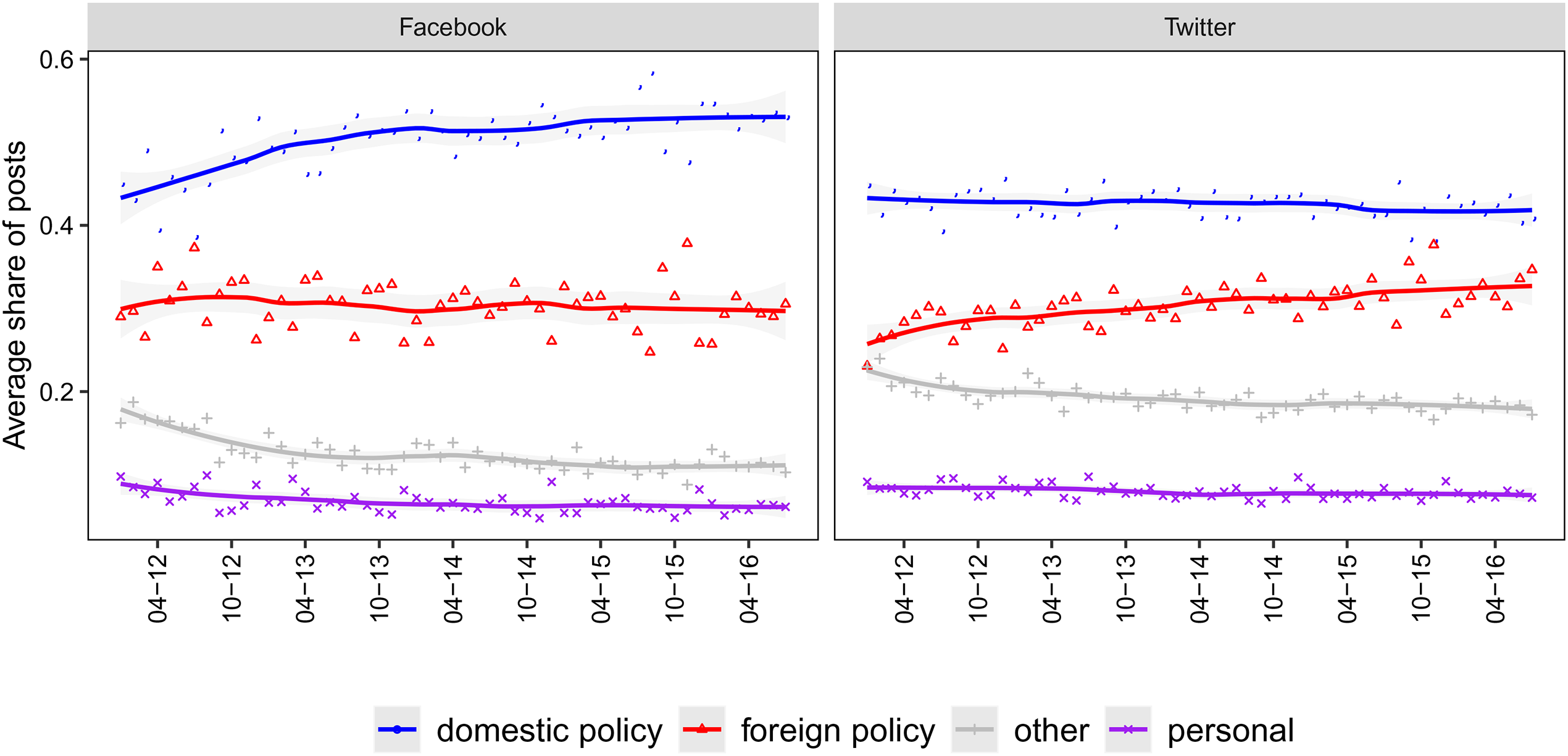
Monthly posts (%).
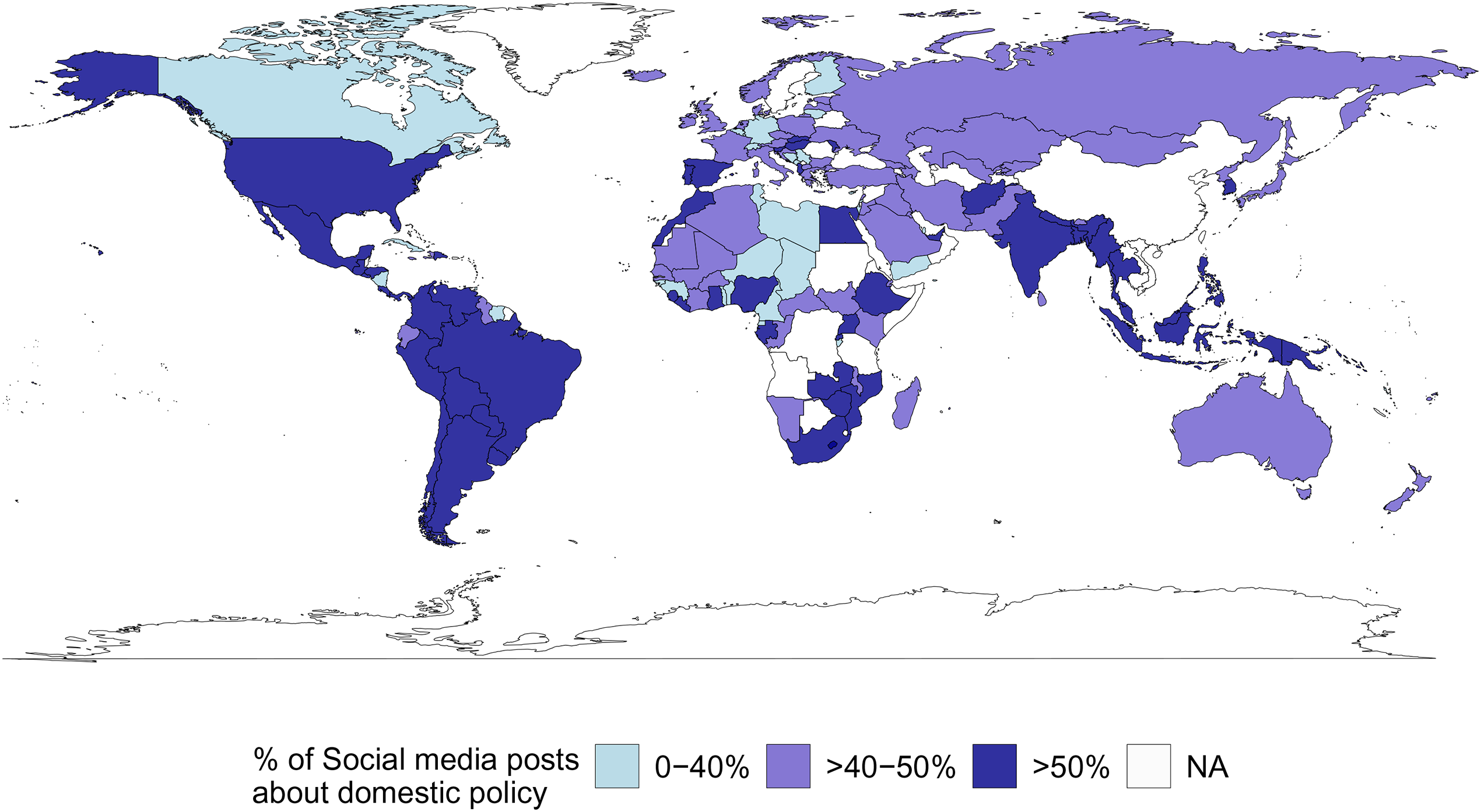
Percent of posts that deal with domestic issues.
Predictors of Content Choice
As a first step in our empirical analysis, we examine social media content. Table 1 presents our main results regarding attention to domestic versus foreign policy issues. Here, the sample is the same across columns but the dependent variable changes: the proportion of posts related to domestic policy in column one and the proportion related to foreign policy in columns two to four. As earlier, we find differences across platforms and account types: there is less discussion of foreign and (especially) domestic policy on Twitter, which means it is considered a place to share news and personal updates; personal accounts are less likely to discuss policy issues; heads of state are more likely to emphasize foreign policy, and accounts posting in the country’s own language discuss domestic policy more often.
Content Choice: OLS Regression of Content Type, Aggregated by Account and Month.
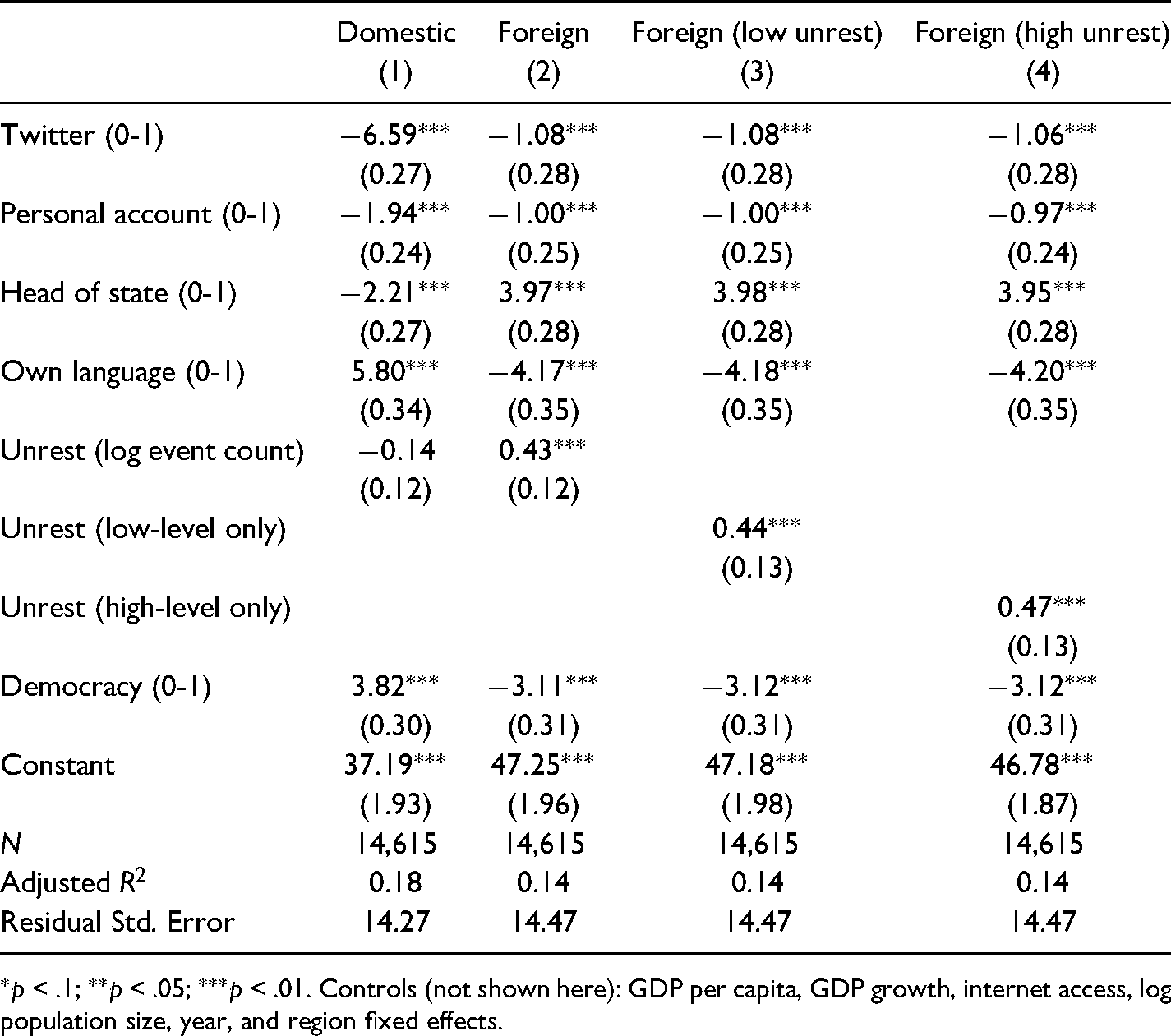
Our analysis provides support for our first hypothesis. Holding all else constant, leaders spend nearly half a percentage point more of their posts discussing foreign policy for each one-unit increase in social unrest. If we were to take Poland and Venezuela as two examples of low and high levels of social unrest in our dataset, our model would predict that Poland would increase the percentage of posts on foreign policy by around 1.5 percentage points if its levels of unrest were to increase to those found in Venezuela in 2016. When we disaggregate across types of unrest (columns three and four), we find evidence that both low and high levels of unrest lead to an increase in attention to foreign policy.
Table 1 also shows signifiant variation in content choice between democracies and non-democracies. The magnitude of this effect is even larger: the size of the total predicted gap between the two sets of countries is ove seven points, which corresponds to 50 percent of a standard deviation in the dependent variable.
To further analyze these differences, in Table A9 in the Supplemental Information file, we report results from additional regression models where we add an interaction term between the democracy indicator and our measure of social unrest. Figure 3 summarizes the key insight of these models by plotting the estimated marginal effect of a one-unit increase in social unrest on attention to domestic or foreing policy, depending on whether the leader is in a democratic or non-democratic country.
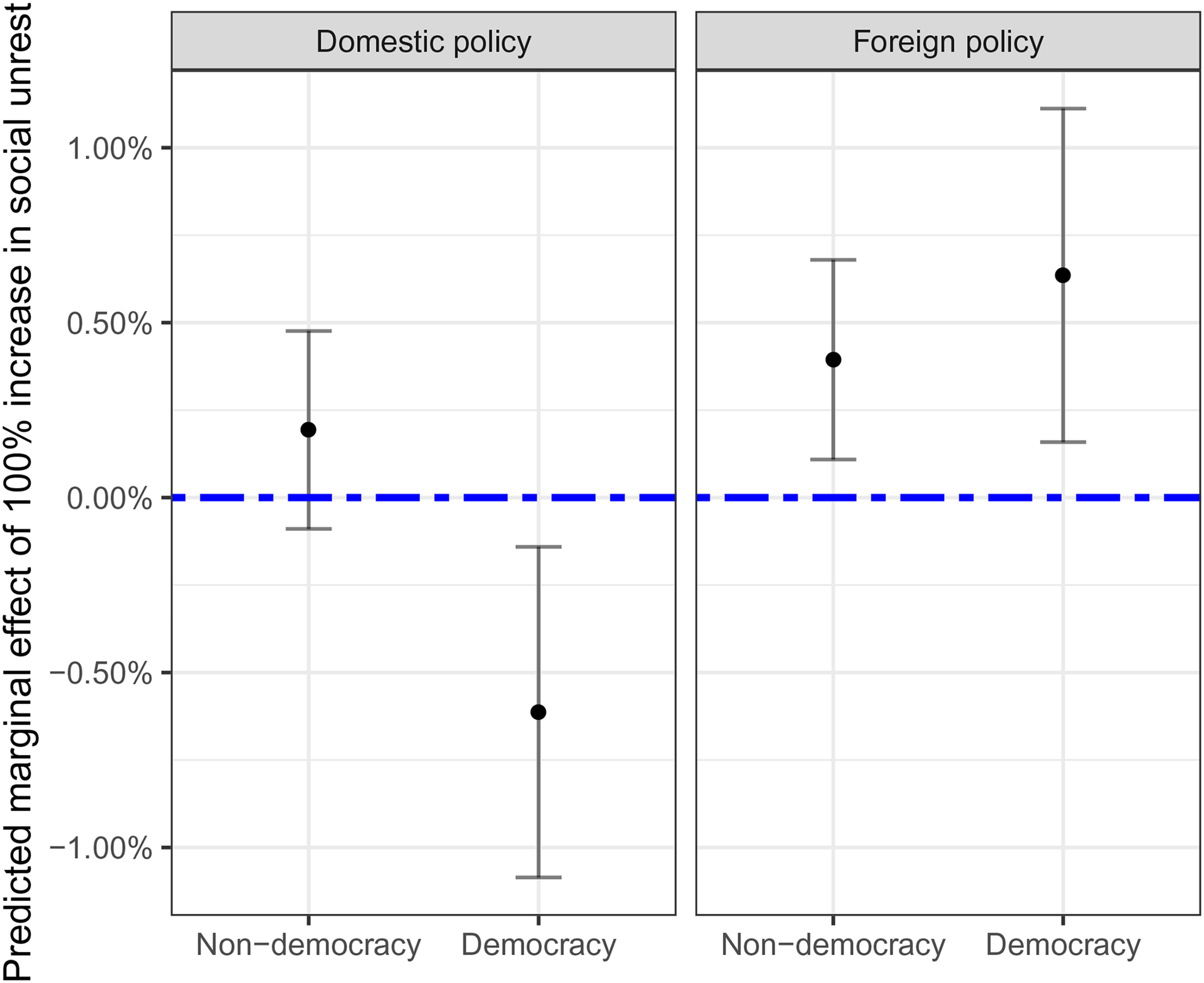
Marginal effect of social unrest on social media content type by month.
Consistent with our expectations, Figure 3 shows that an increase in social unrest is associated with more attention to foreign policy and less to domestic policy in democracies. While these effects may seem small, they can accumulate during volatile periods: for example, in a country like France our model would predict that a change from the tenth to the ninetieth percentile in the number of social unrest events observed during our period of analysis would be associated an increase of nearly 20 percent of a standard deviation in attention to foreign policy and a similar reduction in attention to domestic policy.
This figure also shows that in non-democratic countries we find an increase in foreign policy content, but no decrease in attention to domestic policy. We therefore only find evidence that fully supports our first hypothesis in democratic countries.
Predictors of Social Media Activity
Next, we examine the factors that predict world leaders’ level of social media activity, measured as the logged number of social media posts (in each platform) at the month level for each account. Table 2 displays the coefficient estimates for a set of multivariate regressions of social media activity on each of our main covariates of interest. Each column shows results for a different model specification or subsample of our dataset: the full sample, including social unrest measured as low-level actions or high-level actions, only Twitter, only Facebook, and only (semi-)democracies (where Polity2 > 0).
Activity: OLS Regression of Monthly Post Counts.
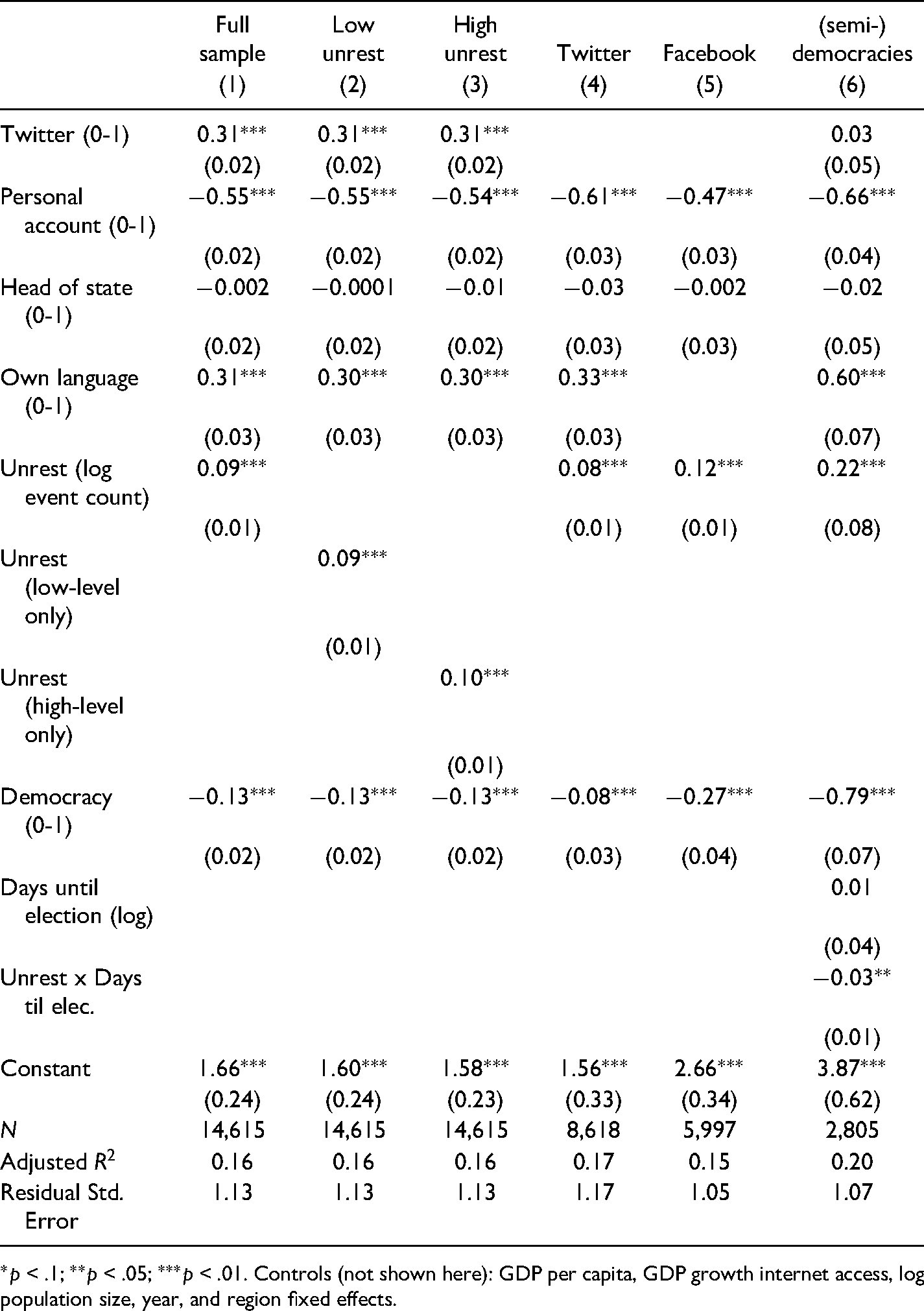
Table 2 offers evidence in support of hypothesis 2. We find that leaders post significantly more content on social media during periods of higher social unrest. A one-unit increase in our measure of unrest (i.e., a 100% increase) is associated with an increase in the number of social media posts of around 9 percent. To put this finding into perspective, note that the model predicts that the leader of a country such as Poland, with an average of ten social unrest events per month in 2016, would increase the number of social media posts it shares each month from twenty to thirty eight (+30%), if the levels of social unrest were to increase to those in a country such as Ukraine, where the average number of unrest events were thirty during the same period. This finding is robust regardless of whether we look at low-level or high-level types of unrest and whether we focus only on Twitter or only on Facebook.
More generally speaking, we find that leaders tend to be around 31 percent more active on Twitter than on Facebook. This result is consistent with the descriptive statistics in Table A5 in the Supplemental Information file: the average leader shares around twenty six posts on Facebook per month, and sends thirty five tweets per month. The type of account also matters: institutional accounts tend to be more active than personal accounts and accounts sharing messages on the country’s native language post more frequently. We do not find any significant differences between accounts that belong to a head of state and accounts that belong to a head of government.
To account for differences between democracies and non-democracies, we examine whether the magnitude of the effect of social unrest on social media activity varies as a function of proximity to competitive elections. The last column in Table 2 estimates a model that includes an interaction effect between our measure of social unrest and the proximity to an election, measured in (logged) days. The negative sign for the coefficient of the interaction offers support for our hypothesis. To facilitate the interpretation of this result, we also show a marginal effect plot in Figure 4. Our results show that the level of social media activity is predicted to increase by around 20 percent after a one-unit increase in social unrest if such change happens within the last month before an election. However, if the election is more than 100 to 200 days away, the effect becomes virtually zero.
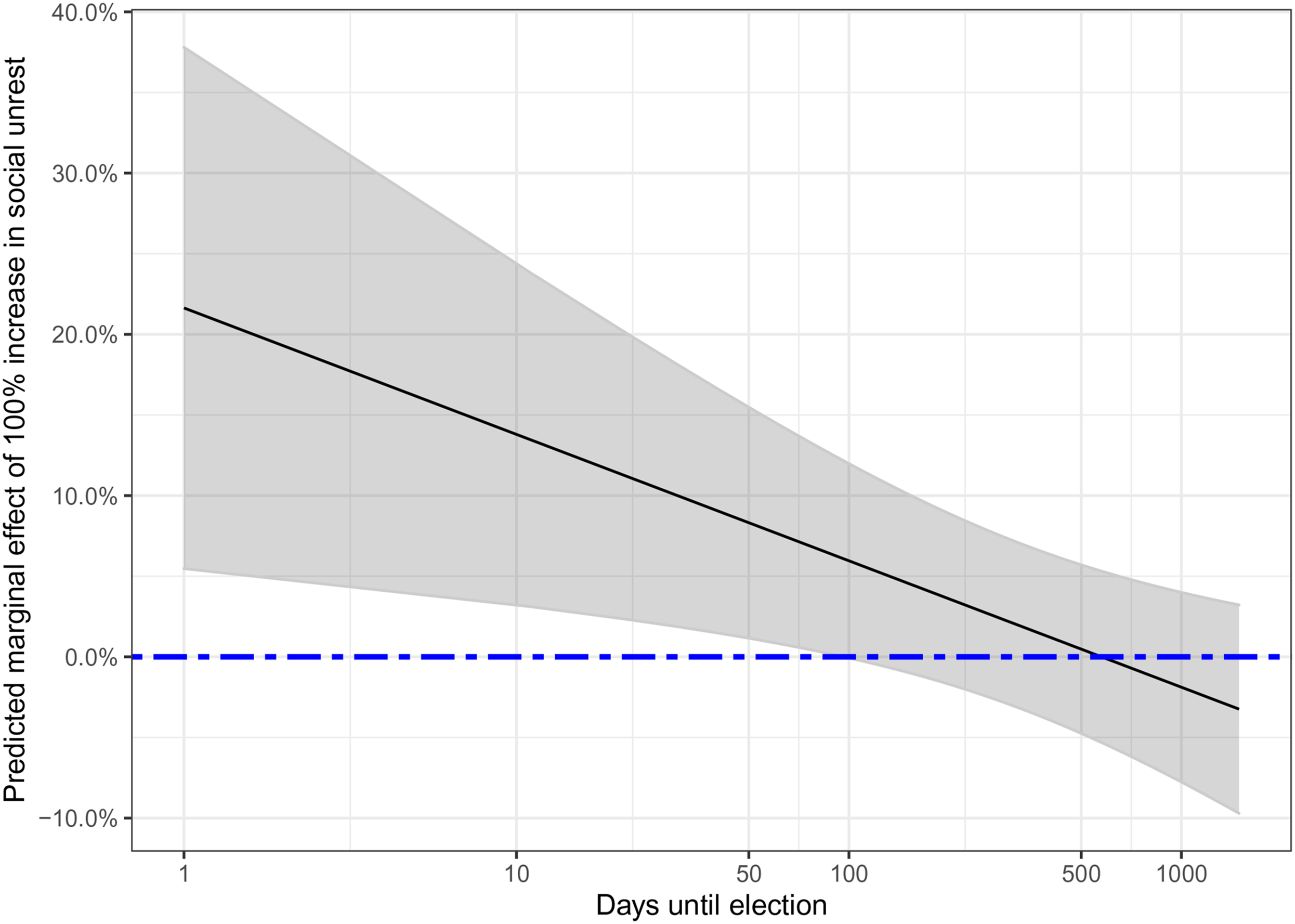
Marginal effect of social unrest on number of social media posts, as competitive elections draw close.
Overall, the results presented here provide evidence for our theoretical expectations that during times of social unrest, world leaders increasingly focus on foreign policy issues in their social media communication, while also increasing their overall social media activity. These patterns are far more pronounced in democratic countries than in non-democratic countries. While further research is needed to understand the motives behind these shifts, these results are consistent with our theoretical argument regarding leaders’ diversionary tactics in the face of potential crises.
Robustness Tests
We conducted a series of additional analyses to test the robustness of our findings, which we report in the Supplemental Information file. Tables A7 and A8 replicate our main analysis for different subsets of accounts (e.g., institutional or personal social media accounts; Head of State vs. Head of Government). These results reveal that our main conclusions generally hold across these subsets. The only exception is the shift in attention to foreign policy, which appears to be largely driven by personal accounts and Heads of Government accounts.
In Table A13, we explore our hypothesis by adding a lagged dependent variable as well as lags and leads of our index of social unrest. We find that the largest coefficient corresponds to the one-month lag. In other words, our results suggest that leaders respond with some delay to unrest. We also estimate time-series cross-sectional models for both media activity and content choice that include a lagged dependent variable to solely account for changes in the dependent variable (Tables A12 and A13). The results demonstrate a robust relationship between social unrest (either at t or t
We also investigate the relationship between different forms of social unrest, social media activity and content choice more closely. Table A10 shows that the effect of social unrest appears to be curvilinear: it increases in magnitude for large-scale social unrest events, as evidenced by the positive sign of the coefficient when we square it. When we disaggregate unrest into four smaller event types, we also find that the magnitude increases for unrest that involves violence. Table A11 shows that the unrest that involves violence leads to a larger increase in attention to foreign policy.
World leader activity might change in the run-up to elections, independent of levels of social unrest. Our analysis of content choice should not be affected by this as we analyze the percentage of domestic and foreign policy content, which is not affected by the number of posts. In the Supplemental Information file (Section E.1) we investigate whether and how world leader activity changes during this period and find that while more accounts are active in the run-up to elections on both Facebook and Twitter, the number of posts by individual accounts does not change substantially as elections draw close.
In order to investigate more fine-grained temporal dynamics, we disaggregate our analyses of social media activity and content choice to the weekly and daily (Supplemental Information file, Section F.7) levels. The results demonstrate a significant and substantial increase in social media activity with the onset of social unrest at both the weekly and the daily level. Social unrest is significantly and substantially associated with an increase in attention to foreign policy issues at the weekly and daily levels.
Lastly, we account for unobserved heterogeneity by including both unit- and temporal (twoway) fixed effects in the analysis, as presented in Table A16. In this very restrictive model, unrest (overall, lower forms of unrest, and higher forms of unrest) remains positively and significantly associated with increased social media activity. This suggests that world leaders tend to react strategically to social unrest within their respective countries, and we are not merely picking up broad cross-sectional differences.
Discussion and Conclusion
Social media has become a key part of the communication repertoire of world leaders (Rogers and Fandos 2019; Economist 2019). Its value as a tool for digital diplomacy, to broadcast messages, issue rapid responses to crises, and to manipulate the political and media agenda is widely recognized. However, systematic empirical evidence about these new communication practices—and what motivates world leaders to engage in them—is still scarce.
Our paper fills this gap by providing the first cross-national, comprehensive evaluation of how world leaders communicate on social media during social unrest. We have provided evidence that supports two empirical regularities about leaders communication. First, during the domestic political unrest, leaders increasingly emphasize foreign policy issues, which is consistent with theories about diversionary communication strategies. We also find support for the importance of social media activity in the context of contentious politics, as our findings show a robust relationship between domestic unrest and increased messaging frequencies. Although a more in-depth qualitative analysis may be required to fully understand the logic behind this empirical pattern, these results do provide important and novel cross-national evidence that is remarkably consistent with case studies that suggest a core tactic by governments on social media is to “crowd out” challenging voices (Munger et al. 2018; King et al. 2017). Considering that diversionary studies have been largely focused on the United States and threats of force by U.S. presidents (Kanat 2014), this study contributes to a more comprehensive understanding of the domestic-foreign policy nexus on a large cross-national sample.
Second, we identified important differences in leader communication as a function of regime type: democratic leaders are more likely to shift their communication strategies in response to social unrest, particularly so before an election, when compared to non-democratic regimes. We interpret this result within the context of how democratic institutions create incentives for leaders to be accountable to their entire population, whereas non-democratic leaders use social media as a tool to increase their standing in the international arena.
The breadth of the data collection and the computational methods we employed provide a unique look into the communication strategies of governments all around the world. Our findings yield new insights on how social media is used by government actors in times of crises, and have important implications for our understanding of the impact of new technologies on how leaders communicate and interact both with the public and other international leaders. Future research should also examine new and growing social media platforms for leaders and politicians to communicate to their followers, including Instagram, TikTok, and WhatApp. Another fruitful path for future research would be to connect our data on leaders’ communication with the literature on leader-specific characteristics (age, childhood experiences, etc.) (Horowitz et al. 2015).
The growing use of new communication technologies provides new tools for leaders to communicate to their various audiences. It also provides more data for researchers to understand the strategies and choices leaders make. Yet our research is simply the first step. As world leaders increasingly use more sophisticated tools to try to shape public opinion online (Roberts 2018; Rozenas and Stukal 2019), understanding their strategies for shaping the news cycle and public opinion will become even more important.
Supplemental Material
sj-pdf-1-hij-10.1177_19401612221102030 - Supplemental material for Distract and Divert: How World Leaders Use Social Media During Contentious Politics
Supplemental material, sj-pdf-1-hij-10.1177_19401612221102030 for Distract and Divert: How World Leaders Use Social Media During Contentious Politics by Pablo Barberá, Anita R. Gohdes, Evgeniia Iakhnis and Thomas Zeitzoff in The International Journal of Press/Politics
Footnotes
Acknowledgements
For excellent research assistance, we are grateful to former USC undergraduate students Sophia Benavides, Rudia Kim, Alma Velázquez, Haley Schusterman, Diana Ciocan, Lindsay Lauder, Megan Thompson, and Julia Thorne; and former University of Zurich undergraduate students Alina Gäumann and Shuting Ling. We thank Adam Badawy, Adam Harris, Jason Lyall, Nils Metternich, Megan Metzger, Sebastian Stier, Denis Stukal, Joshua Tucker and audiences at UCL, Oxford, NYU, Universidad Carlos III de Madrid, USC, Exeter, Konstanz, St Gallen, Bern, Essex, Birmingham, Basel, Bilkent, Hebrew University, and Hertie for helpful comments and suggestions to previous versions of the paper. We also gratefully acknowledge financial support from the Center for International Studies at USC and the USC Undergraduate Research Associates Program.
Declaration of Conflicting Interests
The authors declared no potential conflicts of interest with respect to the research, authorship and/or publication of this article.
Funding
The authors received no financial support for the research, authorship and/or publication of this article.

Supplemental Material
Supplemental material for this article is available online.
Notes
Author Biographies
References
Supplementary Material
Please find the following supplemental material available below.
For Open Access articles published under a Creative Commons License, all supplemental material carries the same license as the article it is associated with.
For non-Open Access articles published, all supplemental material carries a non-exclusive license, and permission requests for re-use of supplemental material or any part of supplemental material shall be sent directly to the copyright owner as specified in the copyright notice associated with the article.
