




Abstract
This article studies determinants of political actors’ visibility in the news, and their stability over time, observing the press coverage received by Chilean politicians in the elite press since the beginning of the democratic transition in 1991 and until 2019. In dialogue with theories of news values, we test how political positions in a markedly presidential system, the belonging to a government coalition, gender, and the association to conflict frames behave as determinants of the presence and prominence of politicians in the news in the three decades following the recovery of democracy in Chile. We have three key findings. Firstly, the visibility of political actors in the news follows a clear institutional hierarchy led by the president and cabinet members. Secondly, female politicians are less likely to be mentioned or have speaking space in newspapers than male politicians. Lastly, although an association with conflict-framed news boosts politicians’ visibility, such association is unable to disturb structural power hierarchies, and the value of conflict does not increase over time.
Keywords
Introduction
Important as it is for attaining and maintaining political office, not all political actors have the same media coverage options. Whereas access to places of visibility is a fundamental political question in contemporary democracies (Brighenti 2007; Thompson 2005), and a measure of power inside politics (Ban et al. 2019), the question of which politicians appear in the news and why has propelled a substantial body of research aiming to explain the rationales behind hierarchies of media visibility among political actors (Tresch 2009; Van Aelst, Sehata, and Van Dalen 2010; Vos 2014; Vos and Van Aelst 2018).
This paper discusses predictors of politicians’ media visibility in connection with theories of news values. These theories contend that elite actors are more newsworthy for journalists (Galtung and Ruge 1965; Harcup and O’Neill 2001, 2017), based on the assumption that their actions have significant consequences for audiences. Who exactly are at the top, however, depends on specific hierarchies of political power, in association with features of political systems (Vos and Van Aelst 2018) and journalistic cultures (Van Dalen 2012). Also, theories of news values recognize that conflict acts as an entry to the news for less prominent individuals (Galtung and Ruge 1965), to the point that conflict and negativity counteract the newsworthiness of elite status and power (Green-Pedersen, Mortensen, and Thesen 2017).
We put theories of news values to test and aim to establish the relevance that variables such as political positions and association with conflict frames have on the visibility of politicians in a political setting that has been understudied in this body of literature: a Latin American presidential system. We compare the visibility of the president, cabinet, and Congress members with that of other politicians featured in the news who do not hold these positions, controlling for gender and political affiliation, also treated as measures of power distribution in a political system. The paper addresses three research gaps. First, research on politicians’ visibility has shown that association with conflictive narratives counteracts the absence of elite positions in political coverage. This avenue to media visibility is particularly effective for non-government officials (Korthagen 2015) and challengers (Green-Pedersen, Mortensen, and Thesen 2017). Also, the media's structural tendency to reflect the power balance inside a political system is moderated by journalistic inclinations to frame politics in terms of conflict (Van Dalen 2012). In this study, we want to understand if and whether the association with conflict frames interacts with political positions in the case of politicians who act within the scope of institutional politics in non-electoral contexts, eventually favouring political actors who are down the ladder in the political hierarchy. Secondly, since our data includes observations ranging from 1991 to 2019 –a nearly 30 years-long period of democratization after a dictatorship– we aim to understand whether these predictors of political actors’ visibility in the news remain stable or react to changes over such period, especially regarding reporting styles. As such, we respond to previous calls in the field to incorporate longitudinal observations when exploring political actors’ visibility in the news (Van Dalen 2012; Vos and Van Aelst 2018). Finally, previous research has predominantly focused on modelling predictors of politicians’ visibility in Europe and the United States. In contrast, our study probes how these determinants of visibility behave in a Latin American presidential system, in which arrangements of power distribution are characterised by strong executive actors and relatively weak legislatures (Basabe-Serrano, 2017), while legacy media has been described as active political actors (Albuqerque, 2019), strongly oriented towards elites (Waisbord 2012).
The visibility of individual political actors is operationalised and observed as media presence (being in the news) and media prominence (having a voice in the news) in an original dataset built from a multi-year sample of political news published in three newspapers: La Tercera, El Mercurio and La Segunda. These newspapers embody the “captured-liberal” features of Latin American post-transitory media systems as they have developed near political and corporate elites (Guerrero 2014). Although criticised for alleged political biases, these publications have for long delimited the space of what is politically relevant (Couso 2012).
Chile was for decades considered the poster child of the region, having peacefully transitioned to democracy while consolidating a stable economy. This narrative of success, however, has been called into question because of widespread social mobilizations that occurred in 2019–2020, when people voiced frustrations towards elites in the face of unfulfilled promises of social mobility and distrust towards institutions, the media included. For that reason, spaces of elite communication deserve inspection concerning their representations of politics and the visibility of political actors.
Visibility and the Trail of Power
Political hierarchies help to understand which politicians are more likely to attain frequent and sustained visibility in the news. Elite theories recognise that political elites are groups whose actions and decisions profoundly impact the rest of society. Moreover, theories of news values recognise inherent newsworthiness in such groups (Galtung and Ruge 1965). Reporting about elite people respond to efficiency in the news-making process and is resonant with other news values like magnitude and relevance (Harcup and O’Neill 2017). Since journalists choose sources that possess resources and authority, political coverage has explanatory potential regarding power differentials within and between elite groups (Ban et al. 2019; Hopmann, De Vreese, and Albæk 2011; Van Dalen 2012).
This perspective, which suggests that journalists are naturally attracted to the powerful, has been criticised as reductive in its depiction of political journalism as a passive conduit, reduced to act as a reflection of power (Green-Pedersen, Mortensen, and Thesen 2017). Indeed, the idea that journalists limit themselves to the reproduction of the status quo might be over-simplistic if taken as a blanket answer to assess journalistic choices. Nevertheless, the idea that journalists follow “the trail of power” derives from whom journalists perceive to be key institutional players in a political system (Bennett 1996). Arguably, these perceptions may diverge depending on media outlets, events, or periods (Vos 2014).
To establish a relationship between visibility and power, we must consider how to measure power. Conventionally, political positions and party affiliation have been used to this end. This, as well as the variable of gender, is the focus of our subsequent discussion.
Political Position and Party Affiliation
At an individual level, the political position is usually the strongest predictor of media visibility in the news (Vos 2014) since this indicator is a straightforward measure of a politician's weight in the political arena. Studies focused on observing variations among politicians holding different positions have found that actors in executive functions attain higher visibility in the news than politicians in legislative functions only, as figures who concentrate a high decision-making capacity (Sheafer and Wolfsfeld 2009; Vos and Van Aelst 2018). Since we are interested in explaining visibility among different types of politicians in Chile, we must consider the main power-sharing arrangements of this political system, a presidential democracy in which the executive interacts with a bicameral Congress. Executive actors’ power is similar regardless of government systems, but power balances between presidents and legislatures are more challenging to establish in presidential systems (Lijphart 2012). In Chile, however, the executive's advantage over the legislative branch is a staple feature of the post-authoritarian period, deemed an “exaggerated presidentialism” (Fuentes 2015). The president not only plays executive roles but also has a stronghold on legislative functions, including broad veto powers and exclusive initiative in a wide scope of legislative matters (Aninat et al. 2010), locating the Chilean presidency among those with a considerable influence in the legislative agenda in Latin America (Santos, Pérez-Liñán, and Montero 2014). Since the power hierarchy, in this case, preponderantly favours the presidency, we expect such influential individuals to be highly visible in the news and extend some media attention to cabinet members; ministers and undersecretaries who are next in the executive hierarchy.
Congressional members are elected to a Chamber of Deputies and a Senate. Because they have limited opportunities to initiate legislative bills, they mainly facilitate, delay, or block the policy-making process for the government in office (Aninat et al. 2010). Since the recovery of democracy, most presidents secured majority support in one of the congressional chambers but not both. Consequently, some confrontation between powers is expected. As actors positioned on the second rung of power, we expect them to be on the second rung of newsworthiness.
In addition to political positions, party affiliation is another measure of power inside politics. Political parties’ performance in elections is followed by proportional media attention: the winners assume greater responsibilities and attract greater coverage (Van Aelst et al. 2008).
The Chilean party system has been primarily organised around two major coalitions. For the first two decades of the transition, these were known as the centre-left Concertación and the centre-right Alianza por Chile. Until recently, these coalitions managed most power-sharing arrangements in Chilean politics. From 2010 onwards, however, they increasingly came under pressure while the party scenario became more atomised.
Is it reasonable to expect higher visibility because of party affiliation? The “incumbency bonus” means that party affiliation acts as a predictor of the share members of a political party achieve in the media (Green-Pedersen, Mortensen, and Thesen 2017; Hopmann, De Vreese, and Albæk 2011), yet the question remains whether belonging to a party or coalition could behave as a predictor of media visibility at an individual level. Vos (2014) notes that studies focused on such levels have failed to detect a significant correlation between party affiliation and media visibility. Hence, the political position appears to be a more reliable predictor of how much media attention a given politician is likely to get, and the incumbency bonus seems to disproportionately benefit those already holding top positions. Therefore, we formulate the following hypothesis:
Gender
Gender media biases are also a matter of power differentials inside politics. Male dominance in high-level positions has been a global norm, and female politicians’ participation rates are slowly improving (UN Women 2020).
The so-called gender bias in news production refers to the quantity and quality of media coverage received by women politicians. Politics’ news coverage has been overwhelmingly male-dominated in quantity, a natural consequence of politics being a male-dominated space. Quality-wise, existing research suggests that the tone, frames, and attributes with which female politicians are presented in the news usually differ from their male counterparts (Aaldering and Van Der Pas 2020; Hooghe, Jacobs, and Claes 2015).
Chilean voters elected a female president twice (Michelle Bachelet; 2006–2010 and 2014–2018), yet this does not prevent a generalised problem of women's participation in politics. Between 1989 and 2013, only 15.4% of congressional candidates were female (Morales, Díaz, and Marambio 2014). After introducing gender quotas by an electoral reform promulgated in 2015, congresswomen increased by 7% (González Mahan 2018), but the imbalance remains. Accordingly, we expect female politicians to be less visible than male politicians at an aggregate level. Yet, a different question is whether female politicians are less likely to get media coverage than male politicians because of their gender. Previous research has yielded mixed findings. Some studies have not found a detriment in female politicians’ visibility because of their gender (Rohrbach et al. 2020; Valenzuela and Correa 2009). However, others have found that female politicians do receive less media attention (Midtbø 2011; Vos 2013), even in contexts when the representation of women in politics has improved (Hooghe, Jacobs, and Claes 2015; Van Der Pas and Aaldering 2020).
Thus, we elaborate the following hypotheses:
Visibility and the News Value of Conflict
A critical news value to consider in the construction of political news is conflict. This element refers to news stories about controversies, arguments, and fights (Harcup and O’Neill 2017). News of conflicting nature related to elite people are news about power struggles at the top of society (Galtung and Ruge 1965), therefore, political news is frequently presented as a conflict (Semetko and Valkenburg 2000). Analyses of Chilean newspapers also confirm this finding (Gronemeyer and Porath 2017; Gronemeyer, del Pino, and Porath 2020).
Crucially, conflict is recognised as a news value that counteracts powerful decision-makers natural advantage in accessing the media. Events of conflicting nature increase their newsworthiness, giving conflict an intrinsic (and instrumental) value in the dispute for media attention. Conflict-focused stories conventionally feature parties in dispute or confrontation, which may stimulate interest for audiences (Lengauer, Esser, and Berganza 2012; Semetko and Valkenburg 2000).
Journalists’ disposition to adopt conflict frames in the coverage of politics moderates the effect of political positions when predicting politicians’ visibility (Green-Pedersen, Mortensen, and Thesen 2017; Van Dalen 2012). Challengers and non-incumbent actors’ access to the media may benefit from conflictive narratives, compensating for their lack of elite positions (Korthagen 2015; Van Dalen 2012). Also, association with controversial matters increases the visibility of traditional political actors (Ireri and Ochieng 2020). Thus, we pose our subsequent hypotheses:
Transitional Democracy and Journalism
Did a Chilean politician at the beginning of the transition have the same chances of accessing the media as a politician today regarding the variables described above? Based on the literature, we expect variations, especially in response to changes in reporting styles.
“Sacerdotal” approaches to political reporting feature conflict less prominently than “pragmatic” approaches (Hopmann, De Vreese, and Albæk 2011). Sacerdotal approaches consider certain political institutions intrinsically important and, therefore, worthy of coverage (Blumler and Gurevitch 1995). Meanwhile, pragmatic approaches weigh the newsworthiness of events with greater distance from political logics, introducing conflict and competition to the news by including oppositional voices, therefore weakening the dominance of government actors (Van Dalen 2012).
In Chile, the reporting styles that emerged after the recovery of democracy were aligned with the transitional political climate. The press played a crucial role in supporting a consensus around the basic tenets of liberal democracy and the market economy, pillars upon which agreements among ruling elites were built. Chilean transitional journalism has been depicted as elite-oriented and officialist, with little ability to challenge authorities (Leon-Dermota 2003), therefore, closer to Blumer's sacerdotal approach. To what extent has this changed? From the perspective of journalistic practices, available research shows both signs of change and stagnation.
On the one hand, accountability-oriented watchdog roles remain low in Chilean newspapers (Mellado and Van Dalen 2017), and politicians retain significant influence in shaping news content (Mellado and Rafter 2014; Orchard 2018). On the other hand, conflict frames are prevalent in newspapers (Gronemeyer, del Pino, and Porath 2020), and the political press acquired an interpretative quality and higher degrees of autonomy (Mellado and Rafter 2014). The inclusion of citizen voices in the news also increased (Mellado and Van Dalen 2017). Taken together, these findings suggest a movement towards a more pragmatic approach to news reporting. From the perspective of the media market, greater competition and a markedly commercial vocation could push journalists to privilege politicians associated with conflictual narratives rather than strictly respecting institutional hierarchies.
Therefore, we expect actors’ association with conflict to increase its efficacy for triggering visibility in the media during the transitional process, damaging the visibility of actors located in the political centre:
Methods
Observations regarding political actors’ presence and prominence in the news come from a content analysis conducted in a multi-year sample of news from newspapers El Mercurio, La Tercera, and La Segunda. El Mercurio is one of the most traditional Latin American newspapers, which together with the likes of Argentina's La Nación, Brazil's Estado de São Paulo and Peru's El Comercio were born in the oligarchic republics of the 19th century as partisan projects associated with powerful families, and later became market-oriented, remaining dominant among elites (Waisbord 2012). La Segunda is a politics-oriented evening newspaper that belongs to the same group (El Mercurio SAP), and La Tercera is the flagship newspaper of Copesa, a media conglomerate owned by investor Alvaro Saieh. Newspapers as news sources have decreased their centrality over the past 30 years in Chile. According to Latinbarómetro, the share of the population who read a newspaper last week went from 67% in 1995 to 61% in 2000. The Reuters Institute Digital News Report situated that number in 33% by 2019. Nevertheless, the newspapers included in this analysis are widely considered reference publications, particularly among political elites (Couso 2012). The companies behind them have an 80% market share of the print press (Becerra and Mastrini 2017), and for that reason, they are commonly referred to as a duopoly.
As noted elsewhere (Van Remoortere, Walgrave, and Vliegenthart 2021), newspapers often provide detailed and extensive coverage of politics; they include a wider range of political actors in their coverage than other media such as television, usually focused on top politicians only. For this reason, this is a suitable communication space to explore differences in the visibility of politicians holding a variety of political positions.
The sample was constructed using the second year for each of the seven governments since the recovery of democracy as a systematic data collection point (i.e., 1991, 1995, 2001, 2007, 2011, 2015, 2019). For each chosen year, two constructed weeks were generated using days of the week as stratification criteria, a sampling strategy that offers reliable estimates for the media coverage of a whole year (Riffe, Lacy, and Fico 2014). While this sampling strategy is not sensitive to all potential yearly fluctuations along the time studied, it is appropriate to capture trends regarding the media presence of politicians over an extended period (Lacy et al. 2001). Additionally, it allowed building measures of visibility in non-electoral contexts. Most of these newspapers are not digitised, therefore, copies were manually reviewed on paper and microfilm.
Two distinct stages of data collection followed. Firstly, four trained coders identified all news in the politics section for each randomly selected date, an operation that yielded a news-story sample (n = 1,999). From these news stories, the coders extracted observations about the publication (headline, subheading, and date) and information about up to seven actors in each story (type of actor, name, political position, political affiliation, gender and whether they were directly quoted). Inter-coder reliability tests (ICR) were applied in a pilot study (n = 300 for media presence and prominence and n = 200 for conflict) for relevant variables using Krippendorff´s α with a bootstrap of 1,000 iterations: the identification of actors in the news conducive to the variable of media presence (α = 0.86 and CI 95%: 0.84 to 0.89); the identification of direct quotations in the news conducive to the variable of media prominence (α = 0.65 and CI 95%: 0.60 to 0.72); and the presence or absence of conflict frames in the stories (α = 0.72 and CI 95%: 0.62 to 0.82).
In the second stage, we extracted a raw actor data set from the news story set. After filtering by type of actor, we obtained a time-varying data set with political actors as the unit of analysis (n = 1,583). Since published information about political positions and political affiliations were not always explicitly stated in news stories, these additional variables -together with gender- were subsequently checked, collated, and completed, based on available political elites’ datasets from González-Bustamante and Cisternas (2016) and González-Bustamante and Olivares (2018). This actor-based dataset was used to elaborate the econometric models and is structured to consider unique observations as yearly time-varying cases based on media presence and prominence dependent variables.
Dependent Variables: Media Presence and Prominence
Media visibility, the dependent variable, is operationalised as presence and prominence in the news, adopting a modified version of Tresch (2009) and Wagner et al. (2017). This distinction aims to approach the concept of visibility using two measurements that allow for distinctions between media attention levels. Following Wagner et al. (2017), media presence is the number of times a politician is named in a news item per year. We denote media prominence as the number of times a politician has a direct quotation in a story per year. Both measurements were converted to counting variables and registered for each politician included in the sample per year (note that some politicians are visible throughout the period studied, so they have separate entries per period, characterised according to positions and/or party affiliations held at the time).
Media presence is unevenly distributed among politicians, taking values ranging from 1 to 136. In absolute numbers, presidents are in the first bracket of media presence, each with 68–136 appearances/year, a second group of 24 politicians is in the range of 20–45 appearances, a third group of 75 politicians has 10–19 appearances, a fourth group of 142 politicians has 5–9 appearances, and a more extensive group of 830 politicians has 1–4 appearances.
Media prominence is also unequally distributed, taking values ranging from 0 to 29, and 684 politicians in the sampled news were never directly quoted.
Independent Variables
For political positions, we distinguish between presidents, cabinet members (ministers and undersecretaries), Congress members (senators and deputies) and other politicians. In this latter referential category, we group other national-level politicians who did not hold positions in the executive or legislative branches (political parties’ members, including party leaders, former authorities, and candidates).
For party affiliation, party membership at the time of publication was registered. This information was supplemented with the abovementioned secondary data sets. Because of the large number of parties registered over the period, this data was only used for descriptive analysis. Two categories were included in the models for the econometric analysis: belonging to the government coalition and the opposition coalition. Gender was registered as a binary variable for each actor, and years since transition as the number of years passed from the recovery of democracy for each actor/year entry.
The association of actors to conflict frames was constructed in two steps. First, conflict frames in the news were assessed based on Semetko and Valkenburg (2000). They identify as conflict-framed stories those pieces that feature disagreement between parties-individuals-groups-countries, mutual or unilateral reproaches, blaming or criticism, or emphasise the two-sided nature of a problem. This assessment was based on each story's heading and subheading and registered as a binary variable (presence or absence of conflict). Conflict is a powerful news value, and belligerent politicians might access the news more than conciliatory politicians; however, as noted by Van Aelst et al. (2008), it is not straightforward to establish a potential-for-conflict at an individual level. This paper proposes a proxy measure by extending an association to conflict to all actors included in a story where a conflict frame was present. For the second step, each actor was assigned a value depending on whether they featured in conflict-framed news or not at all. Therefore, it was treated as a binary variable with a cut-off point of one. This distinction roughly divided the sample into halves: 53.6% of actors were at least once associated with conflict, and 46.4% were never associated with conflict. This operationalisation allows for a broad analysis, which does not account for intensity in the association to conflict. A robustness check with an alternative measure of this variable is provided in the Supplementary Information file.
Data Analysis
The empirical strategy is based on count models, specifically Negative Binomial Regression Models (NBRM), since media presence and prominence tend to show overdispersion. Both dependent variables are considered random ones that indicate the number of opportunities a specific event occurs over a period (Long 1997). In this case, we employ the number of mentions and quotations. NBRM are used to control overdispersion, tested with theta measures and the residual deviance from Poisson regressions (see Supplementary Information file).
In our NBRM, statistically significant positive beta coefficients show a one-unit increase in presence or prominence depending on the model. In contrast, negative coefficients are associated with a decrease in the rate of the modelled event. We regress each dependent variable (i.e., media presence and prominence) on coalition government (X1) and political position (X2 = president, Congress member, cabinet member), and we also control for our sample year fixed effects. Then, we extend the baseline model to include variables considering that Xk denotes k-th variables for each i-th observation.

Results
Before focusing on individual-level explanations, an inspection of the relationship between media visibility and party affiliation was conducted. We calculated the proportion of political actors by party affiliation included in the coverage for each data collection point between 1990–2015. This information was compared to the proportion of seats secured for each party in the precedent election. An OLS regression was conducted to observe the relationship between the proportion of party media presence and their number of seats in the Chamber of Deputies (n = 96; Adjusted R2 = 0.568; F(1, 94) = 125.8; p = 0.000; β = 0.723; SD = 0.065). The scatterplot (Figure 1) shows a positive relationship between these elements. The parties that led the main government coalitions since the return to democracy not only have greater representation in Congress (and executive positions) but also concentrate most media appearances in national newspapers. In contrast, smaller political parties with marginal representation in Congress have minimal media attention. The visibility of independent political actors seems to behave differently, as they consistently obtain media attention above the expected according to their share of seats in Congress.
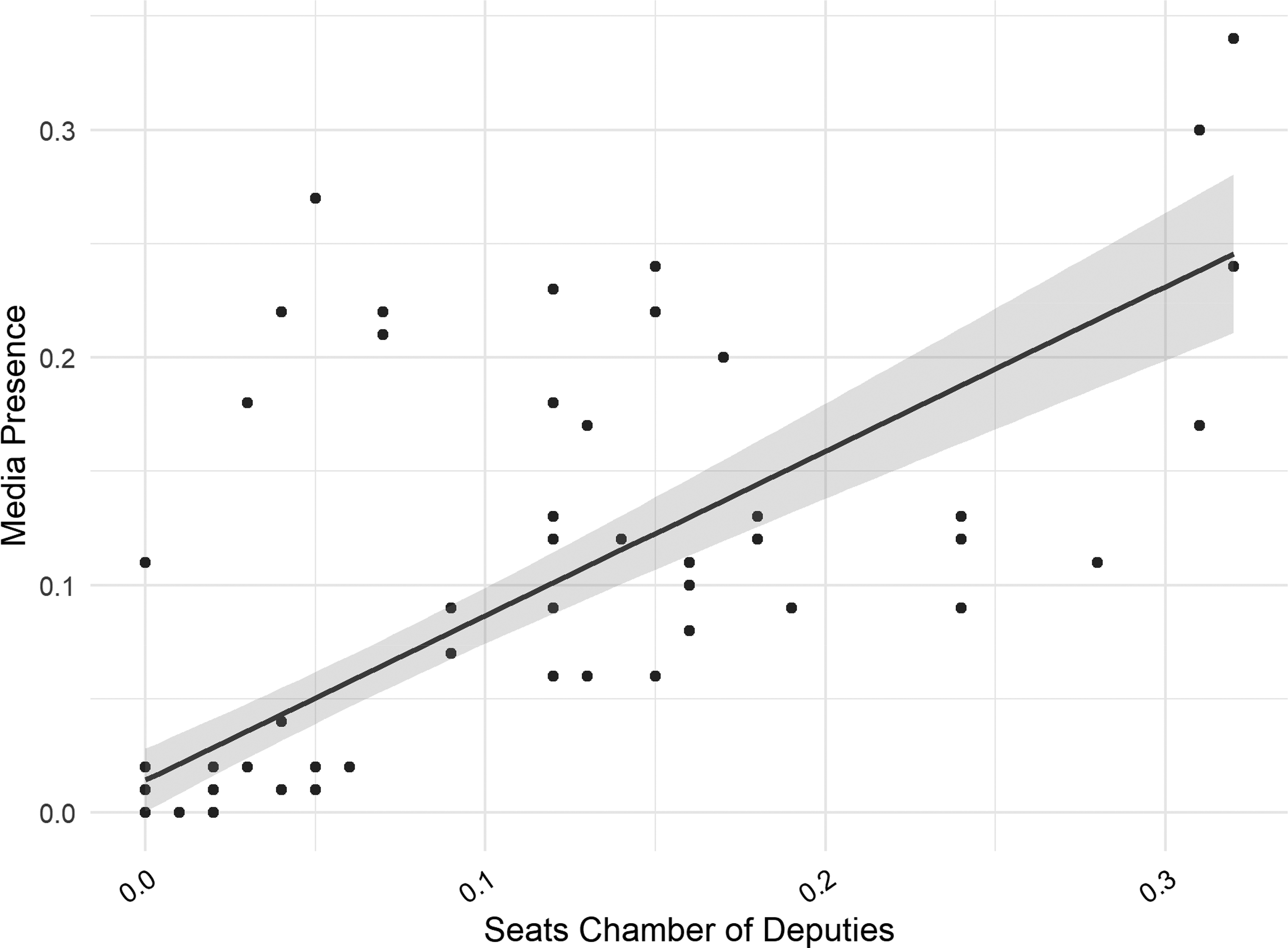
Presence of political parties in the media and the Chamber of Deputies (1990–2015). Source: Media presence compiled by the authors. Number of seats in Congress from González-Bustamante and Cisternas (2016).
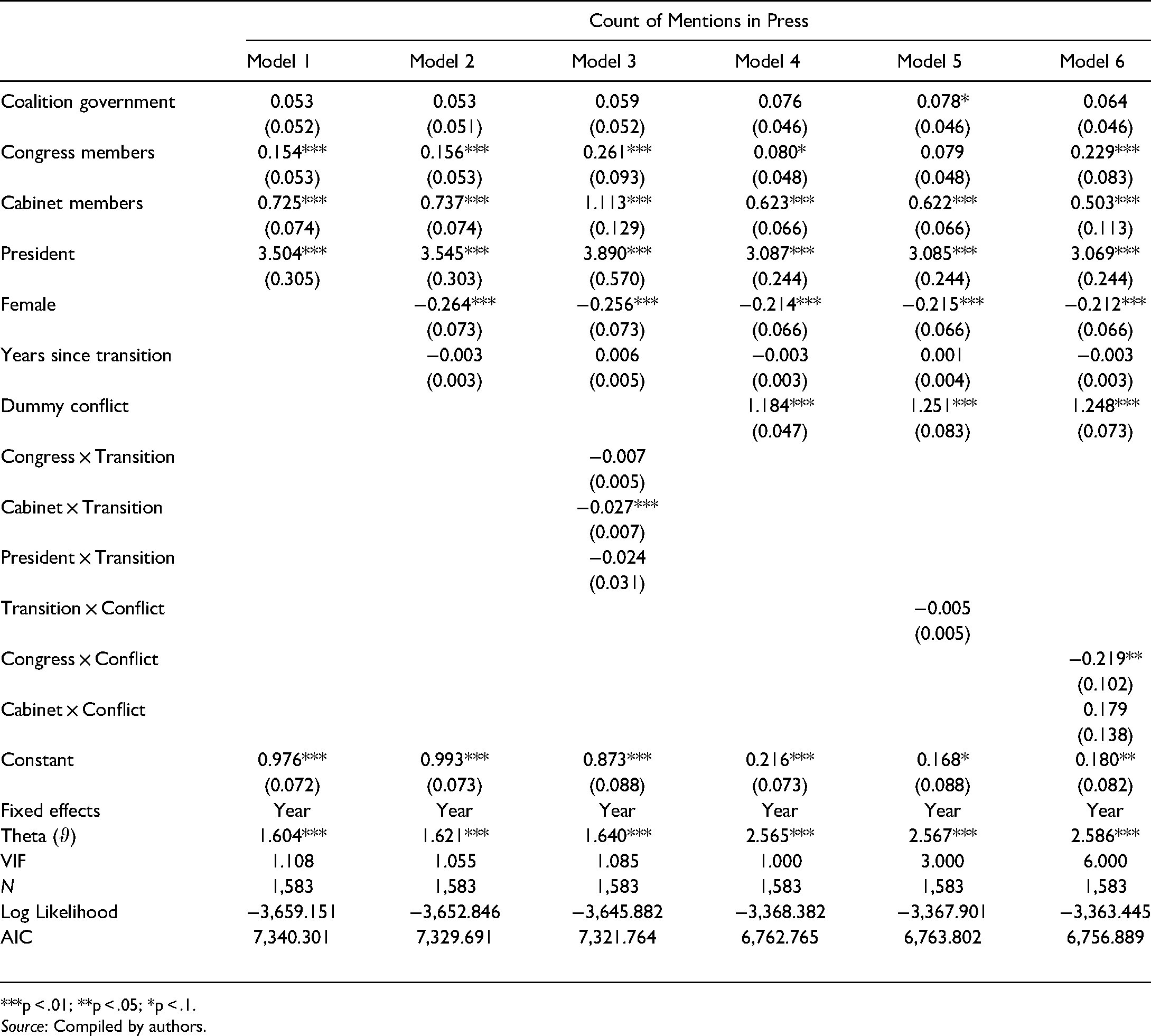
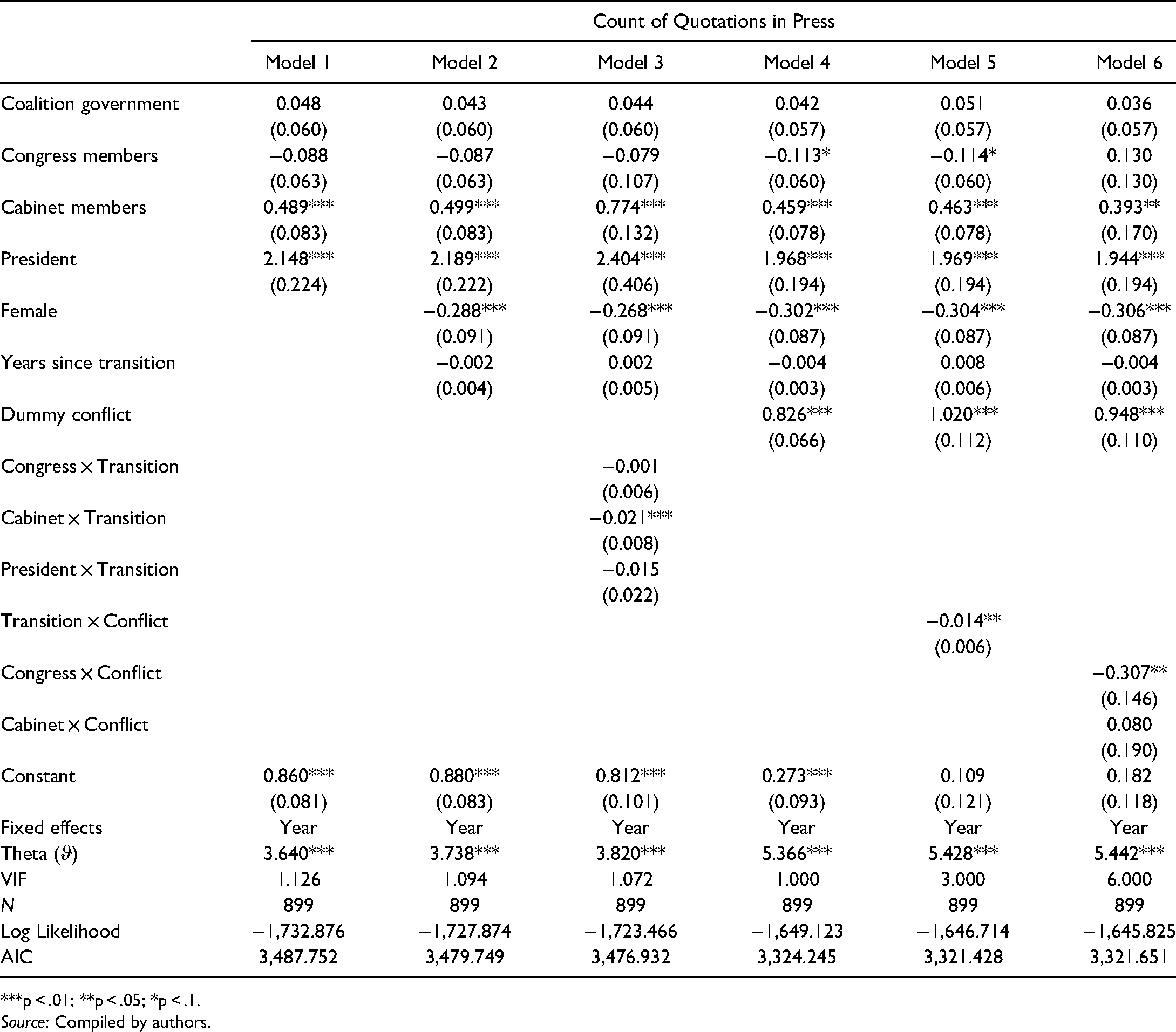
Turning next to the econometric analysis, we found a significant and positive association between political positions and media presence, which is consistent across the models for both presidents and cabinet members. These individuals are naturally newsworthy and concentrate media attention. This positive association is also found for Congress members, yet its significance decreases in some of the models (models 4 and 5 for media presence, and models 3, 4 and 5 for media prominence), suggesting that although congressional representatives are more visible in the news than other politicians, there is a difference in the intensity of media coverage they receive, compared to actors in executive roles. The media presence and prominence models are similar, indicating that actors with more frequent mentions also have more speaking space in newspapers (Tables 1 and 2).
Negative Binomial Regression Models for Media Presence in Chile, 1991–2019.
***p < .01; **p < .05; *p < .1.
Source: Compiled by authors.
Negative Binomial Regression Models for Media Prominence in Chile, 1991–2019.
***p < .01; **p < .05; *p < .1.
Source: Compiled by authors.
Because coefficients in NBRM cannot be interpreted directly, except for the significance and direction of the effects, we plotted predicted values for media presence and prominence according to political positions. Presidents’ media presence greatly outweighs other political actors, signalling that much of the political discussion is built around them. Farther behind, cabinet members follow the president in terms of visibility, while members of Congress are in a third tier, regardless of whether they belong to the opposition or the government coalition. The hierarchy of media visibility observed confirms H1 (Figure 2).
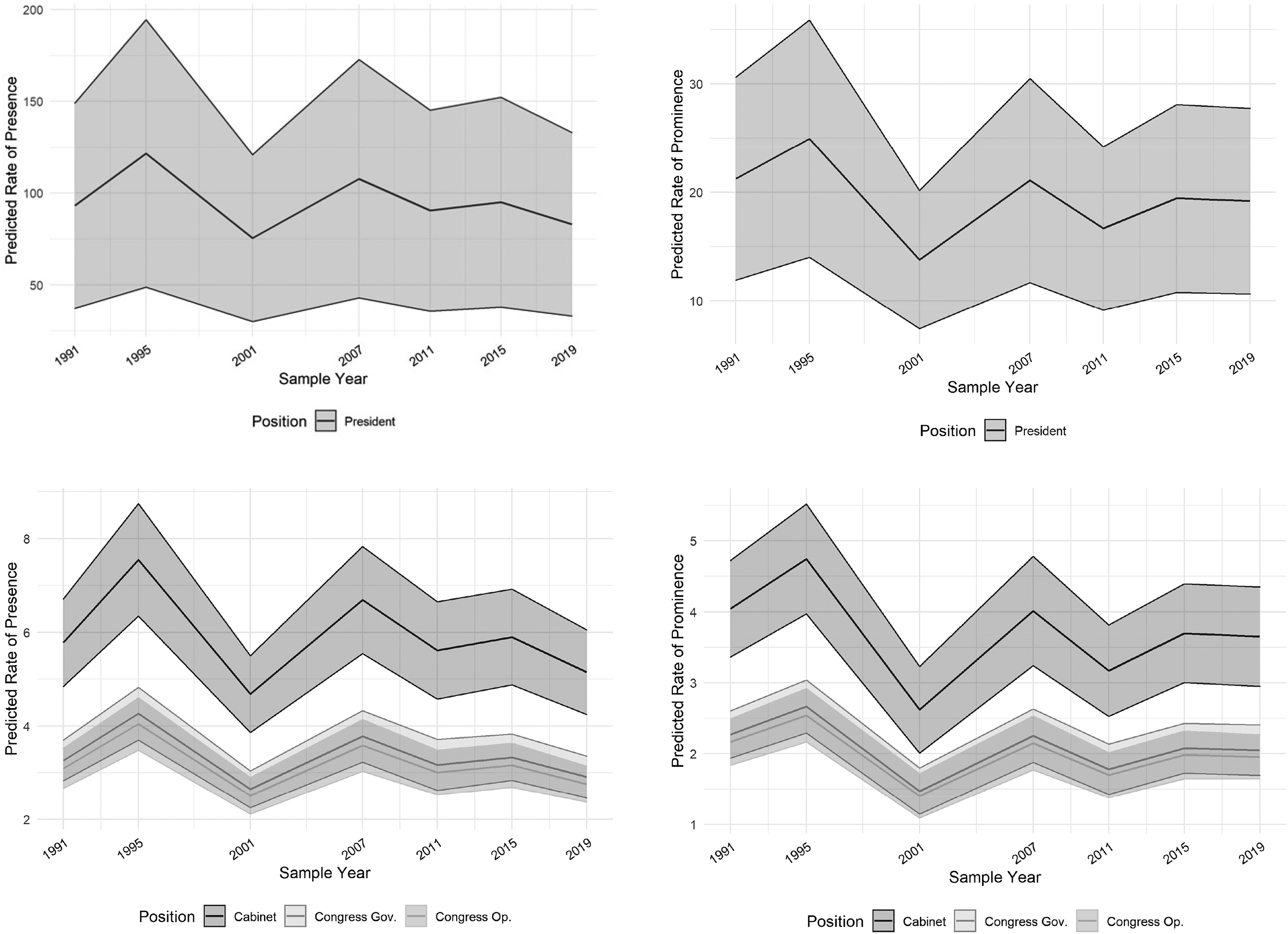
Predicted rates of media presence and prominence: for presidents by year (top); for cabinet and Congress members according to coalitions by year (bottom). Source: Compiled by authors.
The models confirm that belonging to the government coalition appears insufficient to secure media presence or prominence in Chilean newspapers. The relationship between this control variable and media visibility is not significant in all tested models.
Gender, conversely, appears to be a significant variable for both presence and prominence in the news. With equal conditions, female politicians have fewer mentions and less voice in elite's newspapers. This result is consistent in all five models where the variable was tested, which is consistent with H2.
The dummy variable of association to conflict-framed news was introduced in models 4, 5 and 6. There is a significant and positive relation between media presence and association to conflict in all of them, and the same happens with media prominence. Therefore, association to conflict appears as an avenue for politicians to become visible in newspapers, confirming H3a.
To explore relations between conflict and political positions, some two-way interactions were tested in model 6. A measure of the interaction for presidents was used as a reference category because there was no significant variation in this variable, which means that presidents were consistently associated with at least one (and commonly more) conflict-framed story. This suggests that conflict is routinely created around presidents, the most visible actor in Chilean politics. In the descriptive data, it is possible to observe that usually a few cabinet members, among them the Home Office and other political ministers, tend to concentrate the most associations to conflict, presumably because they act as proxies to build or deflect conflict around the government. The interaction is not significant for cabinet members, which means that ministers or undersecretaries do not seem to increase their presence or prominence due to their association to conflict. More striking is that the association of Congress members to conflict-framed stories shows a significant negative coefficient. H3b is therefore partially supported: as expected, we do not observe an increase in the visibility of executive actors because of their association to conflict, but legislative actors do not increase their visibility through this avenue either. These results suggest that although conflict positively impacts the media visibility of specific political actors, it is unable to disturb hierarchical positions in the space of institutional politics.
The variable years since transition shows a negative coefficient in 4 out of 5 models, yet it is not significant in any of them. This supports the idea that news values behind political coverage have not significantly changed regarding the variables tested. The interactions between years since transition and specific political positions all take a negative coefficient, although they are not significant for presidents and Congress members. However, the media presence and prominence of cabinet members appear significantly reduced. As such, H4 is partially supported: as executive branch members, cabinet members appear to lose news value (or political power) over time, yet the president remains unaffected. The interaction between years since transition and the conflict frames also takes a negative yet not significant sign, therefore, H5 is rejected. The association of political actors with conflict frames has not gained traction to access the news.
Our zero-inflated NBRM, used as a complementary analysis for media prominence, show similar trends except for model 6, where two-way interactions between political positions and conflict were tested. This model did not converge with the zero-inflated specification. In the robustness checks and OLS regressions conducted for confirmatory purposes, some differences in the two-way interactions between conflict and political positions are observed. All these models, however, confirm a positive coefficient for media visibility and prominence regarding executive positions and conflict, in addition to a negative coefficient for gender.
Discussion
This study sought to understand how power hierarchies within a Latin American presidential system relate to political actors’ visibility in the press. In dialogue with theories of news values, we were also interested in assessing whether an association with conflict-framed stories interferes with politicians’ expected visibility according to their political positions. Additionally, we wanted to observe whether predictors of visibility remained stable over time or were reactive to change.
First, the findings confirm our expectations regarding the relationship between media presence and prominence and those power-sharing arrangements that characterise a given country (Vos and Van Aelst 2018). In a reinforced presidential system such as the Chilean, presidents’ media presence and prominence overshadow all other political actors, defining a clear newsworthiness hierarchy. Other individuals holding positions in the executive -ministers and undersecretaries- come second in the newsworthiness hierarchy, while members of Congress possess a lower news value. Other individual attributes, such as belonging to the government coalition, appear largely inconsequential to attract a more significant media visibility and are subordinated to the political office a particular individual might hold. However, gender stands out as an individual attribute that has held women politicians back in media presence and prominence. This result suggests the existence of a gender bias in Chilean political reporting that deserves further research, for example, in terms of how gender interacts with political positions. Although we did not include such interactions in our main models, some of the robustness checks provided suggest such bias could particularly affect female cabinet members (A4 and A5 in Supplementary Information file). Gender media biases are not only threatening to the possibilities of women in politics but also reinforce stereotypes of politics being a male-dominated realm; and yet, we lack a systematic understanding of why and how gender media biases happen (Van Der Pas and Aaldering 2020). Our results confirm that being a woman politician in Chile has been a predictor of lower media presence and prominence in political coverage, yet this could be as much a reflection of the way journalists have judged the newsworthiness of women politicians as it could be a mirror of patriarchal communication dynamics coming from the political sphere. Although we cannot directly extrapolate these findings to other Latin-American countries, they suggest that the chances of media visibility mirror structural power differentials; in this case, the political distance between executive actors and legislatures and between male and female politicians. These findings could be further explored in a comparative perspective.
Secondly, we found that political actors’ association with conflict-framed stories increases their media presence and prominence, acting as a predictor of media visibility. While orientation to conflict in political reporting has been found to moderate the power balance among political positions in cross-national (Van Dalen, 2012) and electoral research (Green-Pedersen, Mortensen, and Thesen 2017), we do not see the introduction of this variable as disturbing the hierarchies of visibility derived from political positions. Subsequently, within the domain of institutional politics, association to conflict seems unable to significantly counterbalance the inherent news value some political offices have over others, which does not preclude specific actors could strategically benefit from it. Notwithstanding, a note of caution is needed regarding this finding considering that the interactions between conflict and political positions varied in some robustness checks. Future studies could test this result using alternative operationalisations to evaluate differences in the association to conflict and visibility, according to positions.
Thirdly, regarding time-sensitive variations, we expected a move towards less officialist reporting styles, which could reflect changes in politicians’ visibility. Such expectations were weakly supported by the data, which we interpret as a sign of stability in the criteria of newsworthiness applied to political coverage. There is no movement towards greater decentralisation regarding which politicians obtain higher media presence or prominence. Additionally, the relationship between media presence and association with conflict remains stable over time, while media prominence (given direct quotation space) seems more effectively associated with conflict in the early years of the transition than it is now. This counterintuitive finding does not support a trend towards more pragmatic approaches in political coverage. This finding is coherent with the characterisation of Latin American media systems as elite-oriented and aligned to the interest of power before other considerations (Albuquerque, 2019; Waisbord 2012).
The decrease in cabinet members’ visibility over time reflects changes inside politics rather than inside the media. From 2000 onwards, cabinets in Chile have become more unstable, with higher turnover rates (González-Bustamante and Olivares 2018), while presidents have moved certain functions from the cabinet to the centre of the government, arguably making ministers less independent. If anything, these findings suggest greater centralisation and fewer counterweights to the president as the most visible individual in newspaper coverage.
We acknowledge some limitations that should be tackled in future research. First, we gathered our data from elite newspapers, all known as politically conservative, a decision based on the vast space devoted to the coverage of politics in these publications and their status as reference press along the period studied. However, it would be valuable to explore potential differences according to media characteristics. Secondly, because of the longitudinal structure of our data and the fact that we focused on inspecting differences among political positions, we explored a relevant but limited set of variables. Studies focused on a smaller population could be more suitable for exploring connections between media visibility and individual attributes related to politicians’ performances. From a broader perspective, our findings reaffirm the explanatory power of news value theories to better understand which political actors become prominent in the media and how closely news coverage reflects power differentials inside political systems, being highly reactive to changes inside this institutional space. Further study of these relationships remains relevant since media representations of politics greatly define how audiences experience, understand, and engage with political affairs.
Supplemental Material
sj-pdf-1-hij-10.1177_19401612221089482 - Supplemental material for Power Hierarchies and Visibility in the News: Exploring Determinants of Politicians’ Presence and Prominence in the Chilean Press (1991–2019)
Supplemental material, sj-pdf-1-hij-10.1177_19401612221089482 for Power Hierarchies and Visibility in the News: Exploring Determinants of Politicians’ Presence and Prominence in the Chilean Press (1991–2019) by Ximena Orchard and Bastián González-Bustamante in The International Journal of Press/Politics
Footnotes
Acknowledgments
The authors want to thank Magdalena Saldaña and Francisco Pino for their comments on early versions of this manuscript. Likewise, we truly appreciate the constructive comments and suggestions made by the anonymous reviewers and editors.
Declaration of Conflicting Interests
The author(s) declared no potential conflicts of interest with respect to the research, authorship, and/or publication of this article.
Funding
This project was supported by a Research Promotion Fund (DIP2019-9), granted by Universidad Alberto Hurtado.

Supplemental material
Supplemental material for this article is available online.
Author Biographies
References
Supplementary Material
Please find the following supplemental material available below.
For Open Access articles published under a Creative Commons License, all supplemental material carries the same license as the article it is associated with.
For non-Open Access articles published, all supplemental material carries a non-exclusive license, and permission requests for re-use of supplemental material or any part of supplemental material shall be sent directly to the copyright owner as specified in the copyright notice associated with the article.
