



Abstract
United Nations Peacekeeping Operations (UNPKOs) have incorporated a Public Information (PI) component to communicate with the public. This component has shifted from public outreach towards media reports on current events, including violent incidents. Few studies have assessed the contribution of the PI components of UN-led media. This article assesses the framing of Radio Okapi (RO) online newspaper articles to understand RO’s contribution to peacebuilding processes in the Eastern Democratic Republic of Congo (DRC), an ethnically highly polarized region where many sites are difficult to access. By analysing how RO reports on violent incidents in this region, the study identifies some shortfalls in RO’s PI role. Its framing of reporting can obscure the causes of conflict, for example, by equating ethnic communities with their armed actors and giving secondary importance to the direct victims of armed violence. Moreover, much RO reporting relies on uncorroborated and questionable sources of information, mostly provided by security services. Its framing is unlikely to contribute to sustainable peacebuilding processes and thus does not meet the PI aspirations of UNPKOs. This article suggests that journalists should be empowered with background skills and knowledge relevant to peace journalism, framing news reports in ways that help tackle the root causes and drivers of violent conflict.
Radio Okapi and media framing
United Nations Peacekeeping Operations (UNPKOs) were once conceived to support mediation, negotiation and conciliation among belligerents within a given conflict (Goulding, 1993; Kenkel, 2013). Since the creation of the United Nations, its peacekeeping operations have evolved from being primarily military to more hybrid constructs, including civil police and human rights structures, and have incorporated communication and civic education components (Hoffmann, 2014: 105; Kenkel, 2013: 125). UNPKOs have further incorporated ambitious and complex mandates supported by public information (PI) structures that include media relations units (Betz and Papper, 2015; Kenkel, 2013: 34). These PI structures communicate with the general public to improve its perceptions of the UN mandate (Goulding, 1993: 457; Holguin, 1998; Metzl, 1997: 17). Therefore, UNPKOs have increasingly initiated their own media channels, including radio stations.
In the 1990s, the first UN-led radio station was established under the United Nations Transition Authority (UNTAC) in Cambodia (Ledgerwood, 1994). It aimed to inform the general public about UNTAC’s mission so as to counter the local media’s hostility to the mission (Betz and Papper, 2015: 164; Holguin, 1998: 641). Holguin (1998: 642) notes that Eastern Slovenia, Bosnia and Herzegovina, Liberia, Haiti and Angola are additional examples of conflict zones where radios were the preferred media to support UNPKOs. According to Myers (2010: 1), radio broadcasts are a widespread mass medium in developing countries as they are affordable and accessible to the poorest as well as illiterate populations. Because of electiricity shortages, the radio is a highly valued medium in rural areas. Radio Okapi (hereafter RO) was founded to support the UN mission in the Democratic Republic of Congo (DRC). Rural areas in the DRC lack electricity and radios are among the most widely accessed forms of media (Betz, 2004; Myers, 2010; Renard, 2008; Target Research Consulting [TRC], 2018).
In 1999, the UN established a peacekeeping mission in the DRC following the Lusaka ceasefire agreement. The peacekeeping mission is known and commonly referred to in French as Mission de l’Organisation des Nations Unies pour la Stabilisation du Congo (hereafter MONUSCO). Created during the Second Congo War (1998–2003), MONUSCO incorporated a PI component to communicate with the public about its mission and its efforts to stabilize the country. RO, a radio station with an online newspaper component, was initiated to support the mission’s outreach (Betz, 2004; Hoffmann, 2014: 106). RO started in February 2002 and was co-managed by MONUSCO and Fondation Hirondelle (FH). It aimed to support MONUSCO’s activities by providing (accurate) information, educating the general public about the mission and supporting other peacebuilding initiatives (Hoffmann, 2014; Radio-Okapi, 2014a).
RO covers several aspects of the DRC’s socio-economic and political landscape, and broadcasts in the national languages Kiswahili, Tshiluba, Kikongo and Lingala, as well as in French (Betz, 2004; Faye, 2019; Renard, 2008). This enlarges its audience, as the national languages are spoken across different ethnic groups. Additionally, it enables RO to reach different social groups, including illiterate ones. Thus, RO entertains and interacts with Congolese citizens beyond those seemingly categorized as the elite (Hoffmann, 2014).
RO was initially co-managed by MONUSCO and the FH but has partnered with 20 local radio stations. It needs to comply with rigorous information screening and ‘report only facts as experienced, accurately, objectively and balanced’ (Kifinda Ngoy, 2022: 1159). It currently operates with 42 FM transmitters, with an estimated weekly audience of 42 million listeners across the DRC and more in the rest of the African Great Lakes region (MONUSCO, 2022; Myers, 2010: 3). Its management has gradually become independent from MONUSCO and FH.
A radio broadcast is a form of popular media that can enhance strategic communication with a wider public (Betz and Papper, 2015; Holguin, 1998). Back in 2002, radio broadcasting was the appropriate means to reach out to many Congolese, especially those in rural areas. Radios are cheap and use batteries that the local population can access and afford. Besides its cost efficiency, radio also targets listeners who have difficulties in reading and writing, who may constitute the majority in the DRC’s rural areas. RO also founded an online newspaper that publishes in French and largely shares the same content as the radio broadcast. 1 Compared to other local newspapers (7sur7.cd, actualité.cd and politico.cd), RO has the highest number of online followers among DRC-based media, with its Twitter and Facebook accounts having 1.2 and 1.5 million followers, respectively. 2 RO navigates between traditional and mass media (Betz, 2018: 2).
In contrast to media that propagated ‘hate speech’, such as the Rwandan Radio-Television Libre de Milles Collines (Li, 2004; Renard, 2008: 146; Straus, 2007), RO was explicitly designed to support peace initiatives and serve as a tool of ‘peace journalism’ and peace communication (Galtung, 2003; Hoffmann, 2014; Metzl, 1997). In recent years, the expansion of mobile telecommunication companies has enabled access to the internet, the use of smartphones and the incremental usage of social media platforms. This probably prompted RO to adapt its strategies to communicate and maintain its influence in the DRC’s media sector. The use of social media platforms enables RO to engage in news scooping and an online competition of sorts, which may undermine its efforts to crosscheck its sources.
This article uses ‘framing’ as a theoretical concept to assess how violent incidents in a socio-culturally fragmented setting in the DRC are reported. One crucial aspect of media, and specifically newspaper reporting, is how stories are presented, which is commonly known as ‘framing’ (Papacharissi and De Fatima Oliveira, 2008; Scheufele, 1999). Framing involves strong and emotive rhetoric that conveys a reporter’s stance and serves to categorize issues (Andsager, 2000). Framing selects and emphasizes aspects that attract the audience’s attention (Andsager, 2000; Entman, 1993). Succinctly, framing involves selection and salience within a complex reality (Entman, 1993: 52). Papacharissi and De Fatima Oliveira (2008: 54) argue that ‘frames present a central part of how individuals cognitively comprehend and file events, and as such, are an important determinant of how a news story is told, especially in times of conflicting accounts and factual uncertainty.’
Media framing happens in any domain, including world politics, state relations, voting, terrorism and violence (Papacharissi and De Fatima Oliveira, 2008; Robinson, 2021). According to Seaton (1999: 49), media can alert audiences and raise awareness about an event. It can even frame how audiences perceive violent events. Entman (2007: 164) notes that framing brings together ‘a few elements of perceived reality and . . . assembles a narrative that highlights connections among them to promote a particular interpretation.’ Allen and Seaton (1999: 3) stipulate that ‘wars are partly what the media makes them.’
Aware of the complex debate on media framing, mass communication and media effects (Scheufele, 1999), this article conceives framing as ‘the power of communicating a text’ and its impact on human consciousness (Entman, 1993: 51). According to Meijer (1993: 377), texts can sometimes be violent acts. Additionally, as repeated discourse, they can influence cultural attitudes and the way reality is understood (p. 378). Since media associated with UNPKOs can be susceptible to this, Hoffmann (2014) argues that they require regular scholarly attention to assess their contribution to peace.
However, Tayeebwa (2014) states that there has been limited research assessing UNPKO-affiliated media. As Hoffmann (2014: 107) stresses: ‘there are few formal evaluations and assessment models to investigate just how exactly such [UNPKO] media projects contribute to efforts of reconstruction, peacebuilding and “good governance”, which they are usually linked with.’
Limited assessments of UNPKOs from Cambodia to Central and West Africa have focused on the importance and role of PI (Hoffmann, 2014; Hunt, 2006; Ledgerwood, 1994). For the DRC, Kifinda Ngoy (2022: 1160) calls RO the ‘frequency of peace’ that ‘should develop conflict-sensitive journalism in order to promote peace and development’. RO is highly applauded for its impartial editorial line and the know-how of its journalists (Frère, 2011: 23; Udo-Udo Jacob, 2017). This credit is given from the perspective of its management or partners such as FH. However, Renard (2008: 145), a media expert who has worked with RO, states that the environment in which it operates lacks serious competition.
In her master’s thesis, Faye (2019) argues that RO faces pressure to meet international media standards while also trying to fulfil the Congolese government’s – and, one could add, MONUSCO’s – expectations. Following Entman’s (1993: 53) argument, these conflicting pressures can help explain how RO selects, emphasizes and highlights specific news elements to present the problems of violence and their causes, and point to proposed solutions.
This article contributes to this debate by analysing how RO reports on conflicts in the Eastern DRC, namely in South Kivu. It assesses the framing and presentation of conflict events by capturing RO’s contribution to understanding causes of the conflicts. A few studies have considered RO’s socio-political and developmental impact (Betz, 2004), while Myers (2010:3) sums up the background of the radio station in a single paragraph. I argue that my article is one of the first detailed assessments of RO’s framing that sheds light on its contribution to building peace.
This article is organized as follows: the second section discusses the background of conflict in South Kivu and the third outlines the methodology used. The fourth section elaborates on the findings, examining how RO presents the causes of violence looking at its main sources of information, the categorization of armed groups and the representation of victims. Finally, a conclusion recaps my findings and answers the research questions.
Background of violent conflict in South Kivu
The South Kivu region is one of the DRC’s 26 provinces. Located in Central Africa, the DRC is the second largest African country, and its Eastern part has experienced decades of violence. The Eastern DRC refers commonly to South Kivu, North Kivu and Ituri provinces, which border South Sudan, Uganda, Rwanda, Burundi and Tanzania. This article focuses mostly on the southern part of South Kivu (here defined as comprising the Uvira, Mwenga and Fizi territories).
Southern South Kivu is inhabited by the Babembe, Banyindu, Bafuliro, Bavira, Bazoba, Babwari, Masandje, Babuyu, Barundi and Banyamulenge ethnic groups. Since the colonial period, these groups have been dichotomized into ‘natives’ and ‘foreigners’. The first four ethnic groups mentioned here are the largest and self-styled ‘natives’, as they have their own ethnic territories and customary chieftaincies. The Bazoba, Babwari, Masandje and Babuyu are small in numbers but also seen as ‘native’. On the other hand, the Barundi and Banyamulenge are smaller contested groups and are generally viewed as ‘foreigners’.
Ethnic classification is malleable and can sometimes incorporate mega-categorizations, such as cattle herders versus farmers or Tutsi or Nilotic/Hamites versus Bantu (Eltringham, 2006; Jackson, 2006). The Banyamulenge and Barundi are cattle herders, although they also farm. It is believed that the other groups are mainly agricultural farmers, although they may have cattle. Hence, there tend to be local confrontations between armed groups affiliated with the Banyamulenge and Barundi communities, and those claiming to belong to the ‘native’ Babembe, Bafuliro, Banyindu and Bavira communities.
Causes of violence in South Kivu are numerous, stemming from colonial racial categorizations and the quest to get rid of those viewed as ‘foreigners’ and allegedly associated with Rwanda or Burundi (Muchukiwa, 2006; Verweijen and Vlassenroot, 2015). As has been extensively documented, ethnic classification is linked to colonial misrepresentations of local communities in the African Great Lakes region. Southern South Kivu has been characterized by inter-group antagonism largely associated with ‘nativist discourses’ (Jackson, 2006; Verweijen, 2015). Since the 1990s, local armed groups and self-defence groups have been formed (see Table 1), claiming to protect their respective communities.
The landscape of key armed groups in southern South Kivu.
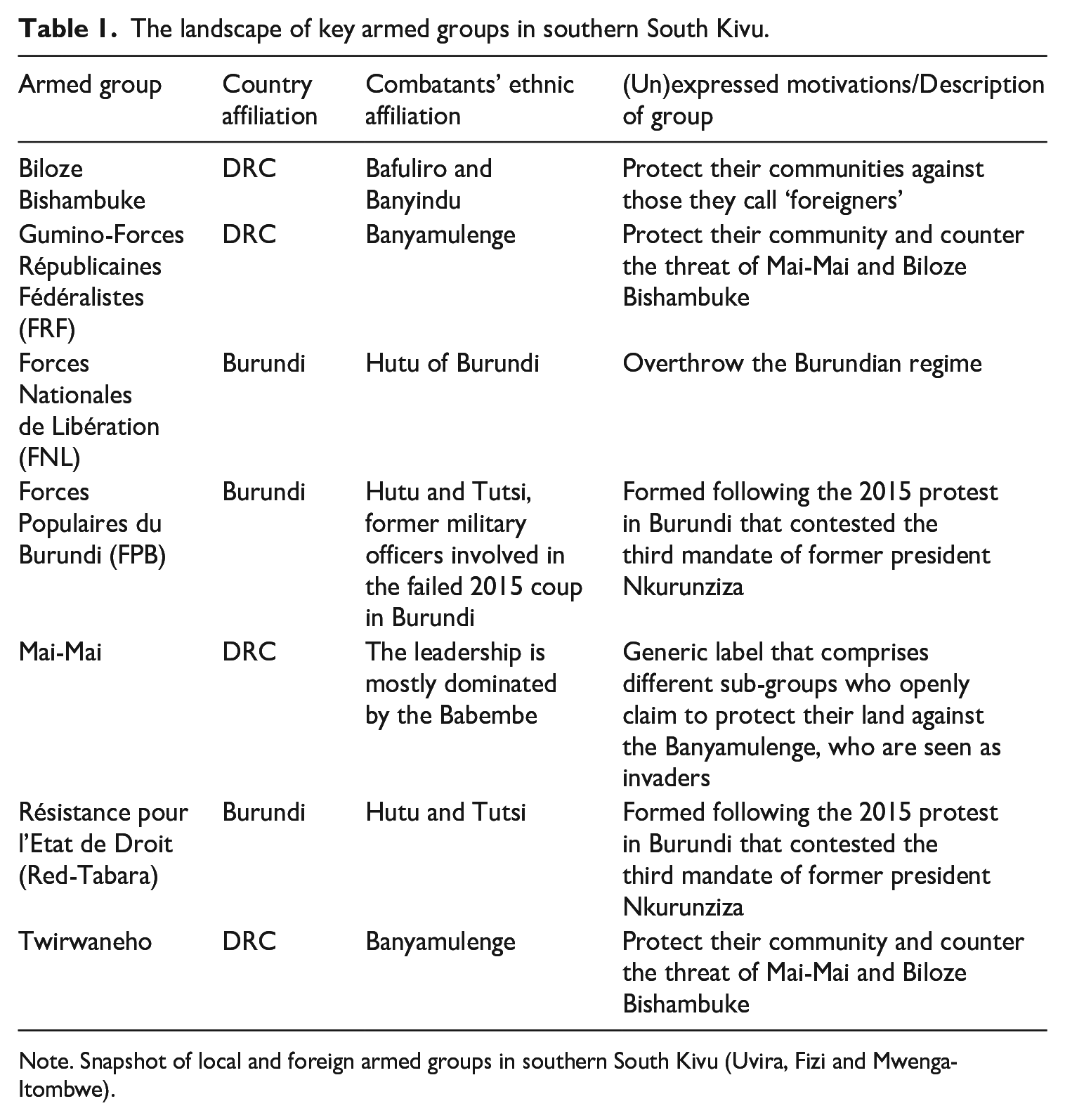
Note. Snapshot of local and foreign armed groups in southern South Kivu (Uvira, Fizi and Mwenga-Itombwe).
The current socio-security setting shows that Mai-Mai (a generic name for hundreds of local armed groups across South Kivu, North Kivu and beyond) and Biloze Bishambuke armed groups are affiliated with and claim to defend the Babembe, Banyindu, Bafuliro and Bavira communities. The Gumino and Twirwaneho groups are affiliated with the Banyamulenge and claim to protect their own community. Some of these local armed groups, including Biloze Bishambuke and Twirwaneho, have emerged recently due to a persistent security vacuum (Brabant and Nzweve, 2013; Verweijen and Brabant, 2017). Verweijen et al. (2021: 50) and Ntanyoma and Hintjens (2022: 391) outline the local security setting regarding ethnic communities and armed groups. In 2011, the year this article takes as a benchmark, the majority of armed groups affiliated with the Banyamulenge – Gumino and Forces Républicaines Fédéralistes (FRF) – were integrated into the Congolese national army (Verweijen and Vlassenroot, 2015: 18). This exposed Banyamulenge civilians to attacks, as other armed groups probably continued to operate (Verweijen et al., 2021; Stearns and Verweijen, 2013).
From 2017 to the present, southern South Kivu has experienced another wave of violence involving Burundian rebels – Red-Tabara, the Forces Nationales de Libération (FNL) and the Forces Populaires du Burundi (FPB, which have allied with Mai-Mai and Biloze Bishambuke). Among other triggers of violence, the belief that the Banyamulenge are not ‘real Congolese’ has played a significant role (Court, 2013; Jackson, 2007; Ntanyoma and Hintjens, 2022). Ntanyoma and Hintjens (2022: 388) note that the Banyamulenge have historically been targeted in attacks that can be categorized as genocidal violence, including sieges, the burning of villages and settlements, looting and the destruction of cattle (a source of income), all leading to starvation. Access to social media platforms has exacerbated hate speech calling for the elimination of those seen as ‘foreigners’ (Ndahinda and Mugabe, 2022).
Methodology
This study seeks to understand how RO presents violent events within a fragile and fragmented socio-cultural context. It analyses the framing of 133 out of 156 online newspaper articles by RO that a search yielded. 3 Online newspaper articles are largely similar to news reported by radio broadcasting services. These articles were selected using tags connected to armed conflicts in the southern part of South Kivu.
The search used four tag categories: localities (Minembwe and Bijombo); local and foreign armed groups (Gumino or Ngumino, Twirwaneho or Twigwaneho, Biloze Bishambuke, Yakutumba or Yakotumba, Red-Tabara, FNL, Forces Républicaines du Burundi (FOREBU); ethnic communities (Banyamulenge, Babembe or Bembe, Banyindu or Nyindu, Bafulero, Bafuliro or Fuliiro); and local leaders (Tete Dete Amisi, Kabarure, Sebasonera, Gady Mukiza). The tag ‘Mai-Mai’ or ‘MaiMai’ was associated with Yakutumba or Yakotumba to restrict the search to the region of interest. Yakutumba is one of the prominent Mai-Mai commanders in Fizi who has spearheaded a large coalition of local groups (Verweijen et al., 2021: 52). Separate searches were performed to check whether there were any unrecorded articles.
The tags are representative of southern South Kivu’s socio-cultural context. My familiarity with local media and experience as a researcher from the region helped in selecting specific tags. 4 For reasons discussed in the background section and the dynamics that emerged in 2011, the selected articles date from January 2011 to August 2019 and are accessible on RO’s website. 5
I read all 156 articles, checked their cited sources of information and looked at how victims and perpetrators of violence were represented. Through this back-and-forth process, I later decided to omit 23 articles whose contents were not strictly linked to the focus of this article (see the transcripts attached to this article). This systematic approach resolved any selection bias (Giles and Shaw, 2009: 388). The following themes emerged from RO news transcripts (in French, with English translation in brackets): sources locales (local sources), sources sécuritaires (security sources), société civile (civil society), affrontements (military clashes), victimes (victims), civiles (civilians), commandants FARDC 6 (FARDC commanders), Général (military general), administrateurs de secteurs, territoires, groupements (administrators of local entities), local (auto-)défense (local defence), bergers (cattle-keepers), and the two most referenced officials: Dieudonné Kasereka and Gady Mukiza. 7
RO’s articles were selected to respond to the following research question: to what extent does the framing and reporting of Radio Okapi enhance the understanding of the causes of violent conflicts in the Eastern DRC? This research question was divided into three sub-questions:
(1) How profoundly does RO examine causes of violence in South Kivu and what are the challenges it encounters?
(2) To what extent is the local socio-cultural fragmentation reflected in RO’s reporting about local and foreign armed groups?
(3) What role do the accounts of direct victims of violence play in RO’s reporting?
RO’s framing was assessed using qualitative news frame analysis, which is similar to qualitative content analysis (Linström and Marais, 2012: 25; Mayring, 2000). Lecheler and De Vreese (2019: 4) suggest that news framing analysis requires inductive reasoning, ‘describing communication content, comparing media content to the “real world” and establishing a starting point for studies of media effects’. An inductive approach aims to make sense of news content through qualitative interpretation (Mayring, 2000: 853). From selecting tags to coding and categorizing, this study compared RO newspaper articles to carefully examine their contents and their intended meaning.
Research findings
My assessment shows that RO’s framing presents three main flaws preventing it from contributing to sustainable peacebuilding. These flaws are separately detailed in three sub-sections below.
Causes of violence, sources of information and media independence
Peace media can contribute to sustainable peacebuilding when it helps the audience and mostly decision-makers to deeply understand the origins and perpetuation of conflicts as well as their contradictions. However, my analysis shows that RO presents violent incidents as ahistorical and disconnected, and its dominant sources of information are state and security officials.
Reporting of disjointed violent events
The causes and motives of violence remain largely outside RO’s framing. Although armed violence in southern South Kivu revolves particularly around the ‘native’ versus ‘immigrant/foreigner’ dichotomy (Court, 2013; Jackson, 2007; Stearns and Verweijen, 2013), RO’s reporting largely fails to refer to this cause. The causes of violence frequently reported are disputes over local resources (taxation and roadblocks), incompatibility between cattle herders and agricultural farmers, mineral extraction and competition for local authority (Radio-Okapi, 2014b, 2016a, 2019a, 2019b). The reporting disconnects disputes over local authority from the ‘native’ versus ‘foreigner’ dichotomy from which they emerge.
RO tends to isolate violent incidents, reporting triggers (immediate causes) while disregarding root causes. For example, when quoting a community representative attending an intercommunity dialogue between the Babembe and the Banyamulenge in Fizi, Radio-Okapi (2011b) stated, ‘il est difficile pour l’heure de donner les causes de ces conflits’
Violent events are disjointed while root causes are overshadowed; thus, readers unfamiliar with the context will fail to grasp their origins. There are limited clues as to why events are defined as intercommunity clashes or clashes between affiliated armed groups. Research has found that cattle-looting and the killings of cattle owners, the Banyamulenge (‘foreigners’), are highly intertwined (Brabant and Nzweve, 2013; Verweijen and Brabant, 2017). Nonetheless, my analysis shows that 1 out of 17 articles on cattle-looting refers to the Banyamulenge being seen as foreigners as a possible cause of violence. Again, the reporting fails to clearly state why cattle-looting is a regular and consistent occurrence.
State officials as the dominant source of information
My assessment suggests that RO’s sources of information remain one of the major reasons it does not cover different and interrelated facets of conflicts and thus fails to thoroughly grasp the causes of and connections between violent events. The sources of RO news found in this assessment are classified in Table 2.
Sources and number of times they are cited in newspaper articles.
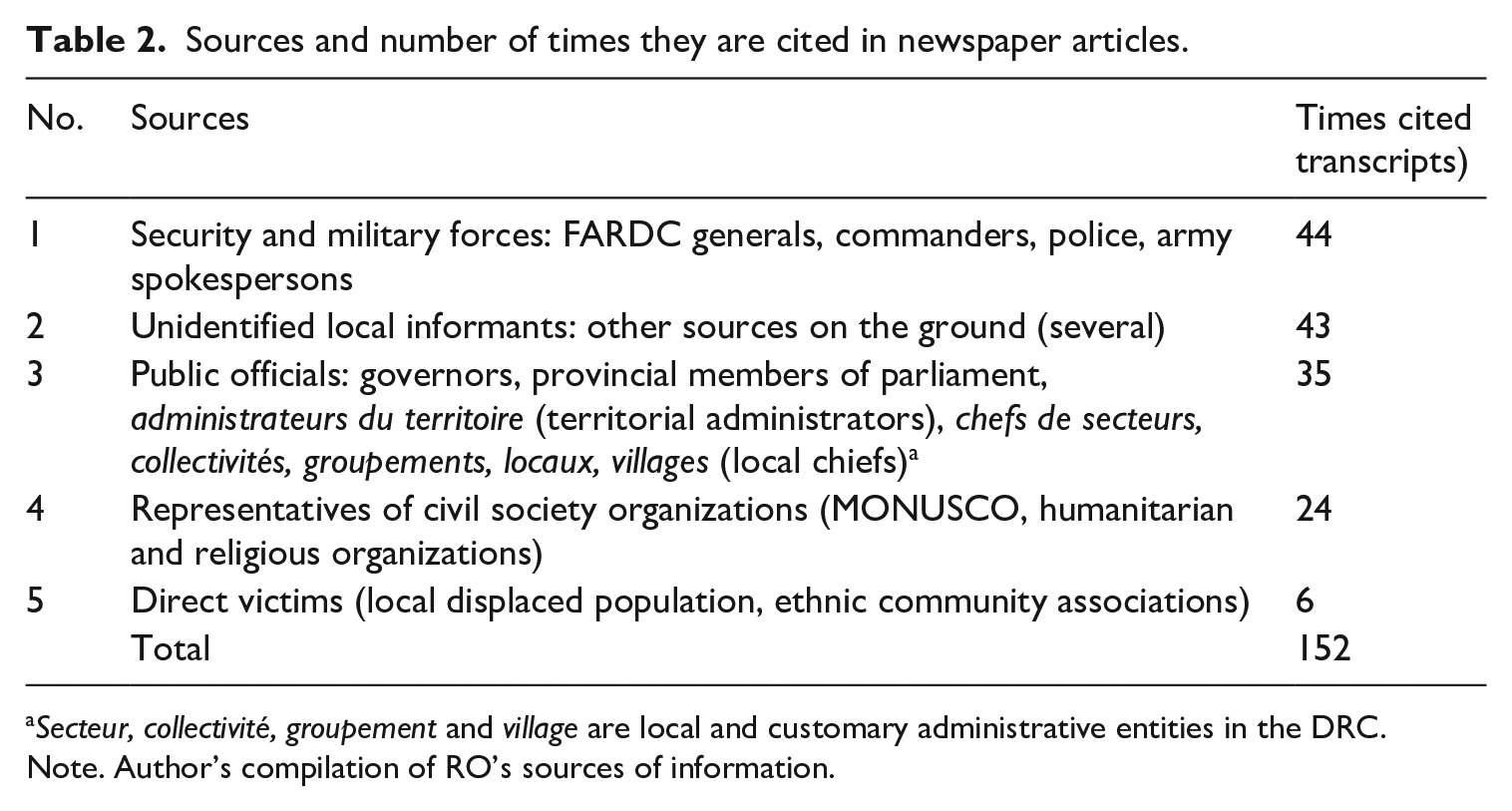
Secteur, collectivité, groupement and village are local and customary administrative entities in the DRC.
Note. Author’s compilation of RO’s sources of information.
As Table 2 shows, RO’s main sources of information are security and military forces, followed by unidentified local informants, categorized as sources locales (local sources). These two categories make up 58 percent of all cited RO news media information sources.
The findings suggest that RO relies on questionable sources of information for its news reporting. It relies heavily on FARDC’s sources to report clashes between the latter and local or foreign militias. For instance, RO quotes FARDC commanders when reporting that 55 Yakutumba combatants were captured in one event and 83 were killed in another (Radio-Okapi, 2013b, 2018a). This reporting of huge numbers of victims and hostages is entirely based on the account of one army commander.
When reporting on violent incidents in Minembwe, RO relied similarly on the narrow and questionable perspective of Colonel Katembo Honoré (Radio-Okapi, 2019f, 2019g). In this reporting, RO claims that cattle herders and farmers were fighting because the former intended to expand their grazing zones. During this period, civilian cattle herders were under constant attack, with villages burnt down in violence that erupted following the contestation of Minembwe rural municipality (Muchukiwa and Kasagwe, 2019; Radio-Okapi, 2019b; Verweijen et al., 2021: 59). The security context did not allow for the ‘expansion’ of grazing zones.
Colonel Katembo’s personal position raises questions. He was later rejected by the population in Minembwe due to his complicity in attacks against the Banyamulenge (Radio-Okapi, 2019h). This complicity went beyond individuals such as Katembo: it was a widespread phenomenon in which militias who attacked the Banyamulenge, their villages and their cattle were backed (Kivu Security Tracker [KST], 2020). The FARDC is well known for operating like other non-state armed groups (Robinson, 2021). An overreliance on security services as sources of information can distort the reality on the ground, compromising the media’s objectivity and independence. It easily diverts the attention of decision-makers from preventing attacks against civilians.
RO sources do not invest in crosschecking or corroborating such information with other sources. In Yakutumba’s case, for instance, only two out of 49 articles balance sources of information by interviewing armed groups’ spokespersons. A balanced news broadcast should provide at least some version of the rebels’ accounts of events (Radio-Okapi, 2014c). Additionally, this article questions the use of unidentified local sources. Though it may cover the need for confidentiality, too often ‘local sources’ are not directly quoted. They stand as generic labels indicating that a reporter has talked to someone. There are ways of being confidential, but RO simply refers to ‘local’, ‘other’ or ‘several sources’.
Table 2 shows that public officials represent a further 22 percent of sources of information. These are unlikely to challenge the government or military versions of events (Radio-Okapi, 2011a, 2012a). A peace-oriented media should treat state officials’ accounts with caution when reporting on conflict events in which state security services participate.
Media independence and neutrality
The dominance of state and security officials as sources of RO affects its neutrality. RO’s reporting is relatively independent in providing representatives of civil society organizations (CSOs) with some (albeit limited) space to voice their concerns. Table 2 shows they represent 16 percent of sources cited. However, CSOs are referred to as ‘la société civile’ (civil society) without further specification (Radio-Okapi, 2013a, 2019a). 8 It appears that CSO representatives may even reinforce the official line and unwillingly support the FARDC’s narratives. For example, a CSO representative stated that ‘Jusque-là les militaires FARDC se sont comportés correctement vis-à-vis de la population civile’ (‘up to now, FARDC soldiers have behaved properly towards the civilian population’) (Radio-Okapi, 2011a). Depending on their experience with FARDC operations, it is possible that CSOs accommodate the official version because of fears for their safety.
The assessment shows that RO counts on a single source to report on ‘belligerent’ ethnic communities. For instance, Radio-Okapi (2018a) relied solely on Freddy Mwambi Kashngwa (Kashangwa), a Banyindu local leader (a notable in French), to ascertain that Twirwaneho attacked members of his own community in Bijombo. There was no corroboration to establish the accuracy of this information. Similarly, Radio-Okapi (2012d, 2018c) referred undoubtedly to Dete (also Tete) Amisi as the chief of Bijombo’s groupement and relied on his accounts to incriminate Banyamulenge-affiliated armed groups in attacking Tete’s community. Tete Amisi, a member of the Bavira community, contends to lead the Bijombo Groupement by contesting Kabarure Sebasonera, a member of the Banyamulenge, because of the latter’s Banyamulenge ethnic affiliation (Kivu Security Tracker [KST], 2018; Muchukiwa, 2006; Verweijen and Vlassenroot, 2015). The Banyamulenge in turn contest Tete Amisi’s legitimacy.
RO’s framing seems to question Kabarure’s leadership as it does not refer to him from 2011 to September 2019. The confrontation between Amisi Tete and Kabarure Sebasonera is largely known in the region and has been raised in several peace dialogue settings. However, records show that RO referred to Kabarure for the first time in 2019 as a ‘chef de groupement’ and in 2020 as a ‘chef local’ (Radio-Okapi, 2019j, 2020). It seems that, in 2019, RO responded to criticism by the Eastern Congo Tribune, although it likely chose to ignore Kabarure. This explains why, in 2020, Kabarure is cited as a ‘chef local’. In this socio-cultural context, a chef de groupement has a powerful meaning and more consideration than a local chief. As peacebuilding-oriented media, RO should be neutral and consider who is given a voice in their news reporting.
Stereotyping of armed groups
Besides causes, the classification of armed groups also provides insights into conflict dynamics. Giles and Shaw (2009: 383) suggest that framing encourages readers to categorize others, sympathize (or not) and generalize described stories. This assessment notes that RO’s reporting reflects commonsense local narratives that constantly associate ethnic communities with armed groups (self-defence) while stereotyping some groups as warmongers. This framing may lead the reader to sympathize with armed groups portrayed as peaceful. The Twirwaneho and Gumino armed groups are mostly associated with their ethnic group, while Mai-Mai Yakutumba is rarely represented with reference to the Babembe, from whom it largely recruits. For instance, RO states that ‘au cours d’une attaque attribuée aux miliciens Twigwaneho Banyamulenge sur le village des déplacés Bafuliro et Banyindu’ (‘in the course of an attack on a village of displaced Bafuliro and Banyindu, allegedly perpetrated by Twigwaneho Banyamulenge militia’) (Radio-Okapi, 2018b). The framing identifies and dichotomizes assailants and victims along collective lines of ethnic identities.
‘Cunning’ Twirwaneho and Gumino
Though armed groups tend to use similar modi operandi, independent of their ethnic affiliation, RO tends to stereotype the Banyamulenge-affiliated groups as ‘warlike invaders’. The Gumino and Twirwaneho groups are represented as organized criminals who can attack ruthlessly and rapidly retaliate (Radio-Okapi, 2019a). 9 They attack during the night and target villages hosting internally displaced people (Radio-Okapi, 2018a). They are portrayed as groups that respond angrily and are prepared to kill and burn homes to avenge even a small number of looted cattle. For instance, Radio-Okapi (2019b) reported that Banyamulenge armed men killed a civilian and a cow in retaliation for seven cows allegedly stolen by Mai-Mai. During my analysis, I failed to find an article explaining what happened when Mai-Mai stole the seven cows. The reader guesses this without an idea of the event’s intensity. The reporting provides a picture that falls within the commonsense belief that Banyamulenge are warmongers and care more about cattle than human lives.
Feeding into stereotypes, RO similarly labels Gumino and Twirwaneho as ‘cunning’, strong and militarily organized (Radio-Okapi, 2017c, 2019j). In one example, it was reported that, at around 10 pm, a Banyamulenge militia attacked a Bafuliro and Banyindu village known as Ishenge (in the Bijombo Groupement) and burnt down 60 houses (Radio-Okapi, 2017c). The report frames the attack as having taken place when residents had fallen asleep. Given that construction materials in rural areas are vulnerable to fire, one deduces that the attackers intended to kill many residents.
Additionally, RO portrays Gumino and Twirwaneho as almost invincible on the battleground compared with other local armed groups (Radio-Okapi, 2016b). It claims, for instance, that Twirwaneho fighters ‘ont réussi à contourner un campement des FARDC basé à Ruhuha avant d’attaquer par surprise le village Nambindu’ (Twirwaneho dodged a unit of the DRC army, deployed nearby, surprising residents in the Nambindu locality around 6 pm) (Radio-Okapi, 2018b). The framing suggests that the group maliciously operated in the dark to attack unprotected villagers. Such details of when and how attacks were carried out are hardly presented when Mai-Mai and other local groups attack the Banyamulenge.
‘Moderate’ Mai-Mai and Biloze Bishambuke
Conversely, RO understates the military capabilities of the Mai-Mai and Biloze Bishambuke armed groups. They are portrayed as relatively weak, moderate and less warrior-like. Mostly, Mai-Mai and Biloze Bishambuke are represented as ‘local or popular self-defence’ groups that exist to protect civilians (Radio-Okapi, 2012b, 2013a, 2014a, 2017a, 2019f). RO paints a picture of the Mai-Mai and Biloze Bishambuke failing to launch timely counterattacks or responding by shooting in the air when attacked by Banyamulenge-affiliated groups (Radio-Okapi, 2017e, 2018b). Mai-Mai Yakutumba’s attacks are largely framed as confrontations or ‘military clashes’ with the FARDC. Roughly 49 articles have a similar tendency to make it hard to capture who attacked first, even when incidents involve the hijacking of boats across Tanganyika Lake.
RO’s framing downplays the organizational character of Mai-Mai and Biloze Bishambuke. For instance, in mid-May 2019, RO reported that ‘un autre groupe armé d’un certain Bilozo Shambuke [Biloze Bishambuke] a lancé une attaque contre une position de l’armée régulière à Minembwe dans les hauts plateaux d’Uvira’ (another armed group of a certain Biloze Bishambuke, attacked FARDC deployments in Minembwe, Uvira High Plateau) (Radio-Okapi, 2019d). First, the reporting refers to Biloze Bishambuke as a ‘certain’, unknown armed group commander. However, Biloze Bishambuke was an organized group that had been operating since 2016 (Muchukiwa and Kasagwe, 2019; Verweijen and Brabant, 2017; Verweijen et al., 2021), and RO reported on its attacks in Minembwe in early March 2019 (Radio-Okapi, 2018b, 2019b). Second, between 10 and 15 May 2019, Biloze Bishambuke and other Mai-Mai groups launched a coordinated attack against the Banyamulenge villages (not the army) in Minembwe from four directions. 10 In terms of peacebuilding, the framing diverts readers’ attention and hides the true nature of the attacks.
Specifically, RO’s reporting fails to explain why Yakutumba and other groups affiliated with the Babembe, Banyindu and Bafuliro have been active for many years. Instead, it describes Mai-Mai and Biloze Bishambuke as willing to lay down their weapons if their security is guaranteed (Radio-Okapi, 2019e). Besides economic interests, Mai-Mai and Biloze Bishambuke struggles are linked to a declared intention to expel Banyamulenge ‘invaders’, although this hostility is largely omitted in RO reports (Stearns and Verweijen, 2013; Verweijen, 2015; Verweijen and Brabant, 2017). The reporting remains unbalanced, for it says nothing about whether the Banyamulenge-affiliated armed groups are willing to lay down their guns. Therefore, it implicitly suggests that these groups are more war-happy than others.
Unnoticed Burundian rebels: Red-Tabara
RO glosses over the presence of foreign armed groups. From 2011 to 2016, military actions of the Forces Démocratiques pour la Libération du Rwanda (FDLR) and the Burundian FNL were widely subsumed under Mai-Mai Yakutumba’s attacks (Radio-Okapi, 2011b, 2013a). Failing to pinpoint the role of foreign armed actors makes RO’s audience believe that the conflict is an entirely local problem. Specifically, the reporting disregards the close collaboration of Burundian rebels (Red-Tabara, FOREBU, FNL) with Mai-Mai and Biloze Bishambuke (Kivu Security Tracker[KST], 2018; Ntanyoma and Hintjens, 2022; Verweijen et al., 2021). Following the failed military coup in Burundi, Radio-Okapi (2016a) reported an infiltration of armed combatants into Uvira. Verweijen et al. (2021: 56) note that FOREBU and Red-Tabara actively participated in local armed clashes in Bijombo in early 2017.
However, RO omitted this active presence till early 2019, sometimes misplacing alliances of local armed groups and Burundian rebels. In March 2019, it reported that the Banyamulenge militia Twirwaneho received military support from Gumino, allied with Burundian and Rwandan rebels (Radio-Okapi, 2019b). However, during this period, Burundian rebels coalesced with local Mai-Mai and Biloze Bishambuke, not Gumino (Radio-Okapi, 2019a). While misleading, the framing is clear in terms of who is allied to whom. However, when RO reported an alliance between Burundian rebels and local Mai-Mai and Biloze Bishambuke, it used a conditional statement: ‘Maï-Maï seraient coalisés aux rebelles burundais pour envahir Minembwe’ (Radio-Okapi, 2019c). The use of ‘seraient’ (‘might have been’) makes readers sceptical about claims that Mai-Mai groups attacking Banyamulenge in Minembwe received support from foreign groups. As RO is a broadly trusted media organization, such reporting can misdirect efforts to find a lasting solution to local conflicts and regional interferences.
Victim representations: Humans and cattle
In responding to the third sub-question, this analysis assessed victims’ voices in RO’s reporting. Table 2 shows that only 4 percent (6/152) of RO’s sources of information were direct victims (displaced people and representatives of ethnic community associations). This shows that RO is unlikely to be a victim-centred form of media.
Accounting for victims’ voices
With RO, direct victims have limited opportunities to express themselves, even when they can easily be accessed. On 4 November 2011, combatants affiliated with Mai-Mai Yakutumba intercepted NGO Eben Ezer’s staff in their vehicle around Fizi (Radio-Okapi, 2011c). Passengers were divided according to their ethnic affiliation, with only the Banyamulenge group shot. Assailants killed six men and one woman and injured three others. The killing was intended to harm Eben Ezer and mostly the Banyamulenge. On the night of 6–7 June 2014, unknown assailants killed more than 30 Bafuliro civilians, mostly women and children, in Mutarule (Radio-Okapi, 2014a). Conflict over local authority between the Barundi and Bafuliro communities was one of the motives behind the attack. Ten months earlier, 11 civilians had been killed in Mutarule; the assailants were probably members of the FARDC (Radio-Okapi, 2013b). In all the three events, RO did not report victims’ experience.
The three incidents show the trend of RO disregarding direct victims’ voices. The reporting on these attacks focuses mostly on combat outcomes, such as the number of combatants killed and civilians displaced. There are limited clues about civilian casualties (Radio-Okapi, 2011b, 2011d). My assessment shows this trend when RO reports on FARDC attacks against armed groups. Civilians are mainly referred to as victims when RO reports on inter-ethnic confrontations.
Disagregated data of victims
There is an imbalance in how Babembe, Banyindu and Bafuliro victims are described compared to victims who happen to be Banyamulenge. The former are sometimes pooled together as a homogeneous group, recalling the Bantu–Tutsi/Hamitic dichotomy (Radio-Okapi, 2017e, 2018b, 2019j). By grouping these communities together as one category of victims, RO reinforces a sense of solidarity among members of some ethnic communities. RO usually identifies these victims through sub-categories: civilians, men, women, children or armed actors (Radio-Okapi, 2012b, 2018a, 2018c, 2019i). Conversely, the Banyamulenge victims are mostly reported as combatants or cattle herders or as an indistinct estimate of casualties (Radio-Okapi, 2011b, 2019j).
Banyamulenge cattle herders killed are described as allegedly Gumino combatants (Radio-Okapi, 2017b). In March 2019, RO claimed that Twirwaneho attacked villages and burnt seven houses, and they found their ‘colleagues’ assassinated. The framing conflated civilian cattle herders and combatants who were killed, as well as others assassinated from February to March 2019. Similarly, Radio-Okapi (2017d) established a direct link between an attack in Kabambare and the mass presence of cattle from Minembwe. It was reported that a large herd of cattle was being driven to markets in Kindu. Some cattle herders were killed during an attack on the herd. The report focuses on the large size of the herd but almost ignores the number of human victims.
Cattle-looting phenomenon
RO tends to understate the severity of attacks against Banyamulenge civilians and their livelihoods. In many cases, the looting of Banyamulenge’s cattle is coupled with attacks on civilians (Verweijen and Brabant, 2017: 11). Although cattle are the main source of Banyamulenge income and livelihood, most of their cows were recently looted or killed, leading to their impoverishment (Ntanyoma and Hintjens, 2022). However, pillaged livestock are rarely included in RO’s reporting (Radio-Okapi, 2012c, 2018b, 2019a, 2019b, 2019g, 2019j). The title and content of articles can be contradictory, for example when the former refers to 300 cattle pillaged and the latter refers to 3,000 cows and sometimes 1,000 cattle (Radio-Okapi, 2011b). This raises questions about how seriously RO’s reporting takes cattle looting. Based on contrasting information received from ‘several sources’, RO finally claims that it lacks precise numbers on the cattle looted. More specifically, the civilians murdered during the same attack are relegated to secondary importance because of the space given to the debate about the number of cattle.
Similarly, Radio-Okapi (2012a) reports 40 goats in an article title when cows were looted. This reflects an indifference to detail that suggests a lack of attention for the issue of pillaged livestock. When RO reported on an attack on a Banyamulenge village called Kanono, it states: ‘des vaches et des chèvres avaient été aussi emportées’ (cattle and goats were also looted) (Radio-Okapi, 2018b). Human victims during the Kanono attack are omitted but included when Twirwaneho attacked Nambindu (Bafuliro’s village), for instance. RO repeatedly states that the whereabouts of pillaged cattle are unknown; they just vanish (Radio-Okapi, 2011b, 2012a, 2019i). Moreover, it pays little attention to other forms of economic violence that affect vulnerable communities including the Banyamulenge, such as sieges and the blocking of humanitarian relief, resulting in starvation. The effects of hate speech targeting the Banyamulenge are also largely ignored. By failing to account for these forms of non-physical violence, the reporting renders the suffering of vulnerable communities largely invisible.
Conclusion
Hoffmann (2014) suggests that news media reporting from socio-culturally fragmented and war-ravaged contexts should consider the sensitivity of information collected and shared with audiences. RO was initiated to support peacebuilding efforts in a divided (post-)conflict socio-political and cultural context. Its contribution to peacebuilding has not been extensively assessed. This article fills this gap by focusing on how violent incidents in South Kivu are reported. This debate is relevant because of RO’s position as a trusted source, meaning that leading researchers, MONUSCO, the DRC’s international partners and local media rely on its publications (Kifinda Ngoy, 2022: 1160).
In relation to the first sub-question, the findings show that RO fails to educate readers about root causes or long-term dynamics of violent attacks in South Kivu. Most RO newspaper articles refer to immediate triggers of armed clashes. They do not explain why armed violence persists as they provide little context about the background of conflicts. An unfamiliar reader struggles to grasp even the immediate logic of the reported violence. RO’s newspapers are primarily based on state-affiliated sources of information – security services, military officers and public administrative officials – and (undetermined) local sources. Kuele and Cepik (2017: 50–51) question MONUSCO’s over-reliance on the DRC’s security services as part of its intelligence gathering. These security services are among the key violent actors (Robinson, 2021; Stearns et al., 2013). Such overreliance, together with imbalanced sources of information, casts doubt on RO’s neutrality and independence.
Regarding the second sub-question, the analysis shows that RO incorporates common beliefs, discourses and local narratives in its framing. It dichotomizes the population into deserving ‘natives’ and undeserving ‘foreigners’ and their affiliated groups. Armed actors and victims are sometimes (mis)represented through the racial lens of the Bantu–Tutsi/Hamitic dichotomy. For instance, Babembe, Banyindu and Bafuliro are presented as a homogeneous group, reinforcing a sense of collective victimization among self-styled ‘natives’. Such a dichotomizing perspective is likely to trigger armed retaliation and collective revenge attacks by those who believe they have something in common. In contrast, there is a pattern of stereotyping the Banyamulenge-affiliated armed (self-defence) groups as warmongers, militarily strong, cunning and invincible.
Findings related to the third sub-question reveal that RO can be categorized as an urban and desk-based media. It neither balances its sources nor gives a voice to direct victims of violence. There is limited information from local sources and representatives of CSOs. This constitutes a big loophole in terms of supporting peace processes. Ethnic communities are amalgamated and violence at the local level is largely oversimplified as ‘inter-ethnic violence’, regardless of local socio-security complexities. The framing overlooks the role played by other violence instigators and brokers, including FARDC officers and foreign combatants. The framing displays a bias against the Banyamulenge by sometimes contesting local authorities affiliated with this community. Failing to consider the voice of direct victims tends to cover up diverse forms of violence targeting groups portrayed as ‘foreigners’, such as sieges, impoverishment and the hindering of humanitarian assistance.
Overall, this assessment suggests that RO is unlikely to shed light on the root causes of violence and conflicts in the Eastern DRC. Beyond the media’s framing, the assessment casts doubt on how well MONUSCO understands the causes and dynamics of conflicts. Based on findings in Ntanyoma et al. (2022), there seem to be large similarities between RO’s framing and MONUSCO’s reporting. In terms of policy prospects, I note that the critique of Autesserre (2012) is still relevant. I suggest that media affiliated with peacekeeping missions should strengthen their peace journalism and enhance their knowledge about reporting from conflict-prone and socially fragmented settings. I argue that media editors should reassess their capacity to capture journalists’ individual biases and understand the localities covered by their journalists.
Footnotes
Acknowledgements
I owe gratitude to friends who helped in proofreading and gave extensive advice on how to strengthen the article’s argument. I am so thankful to Michelle Betz who has extensively advised me on how to strengthen this article’s argument. Thanks to Helen Hintjens and Judith Verweijen for their proofreading support and advice.
Funding
The author received no financial support for the research, authorship and publication of this article.
Notes
Author biography
 ).
).