



Abstract
The degree to which civility norms are upheld or violated is an important criterion in evaluating the democratic quality of public debates. We investigate civility across media types, political systems, and levels of socio-cultural division, offering a comparative perspective on how these factors shape levels of civility in public debates around a key question for societies around the world: What is the proper role of religion in public life? Capturing both positive and negative forms of civility (i.e., recognition and outrage) on multiple levels of analysis, we compile and analyze an original large-scale dataset of news items published during August 2015 until July 2016 in six democracies (Australia, Germany, Lebanon, Switzerland, Turkey, and the USA) across three types of media (printed newspapers, news websites, and political blogs). We find that mediated discourse was heavier on outrage in mixed political systems (Germany and Turkey) than in ‘purely’ majoritarian and consensus systems. Public debate in deeply divided countries contained more outrage but also more recognition compared to less divided countries, with newspapers and news websites mitigating outrage discourse compared to political blogs. Blogs also emerged as less nurturing of recognition than newspapers and news websites.
Violations of civility norms have long been a subject of public concern (Boatright 2019) and, over time, researchers have produced a sizable body of work on the issue. Various normative democratic theories emphasize the value of civility in public communication for democratic societies. This includes deliberative democratic theory, which has developed a more clearly defined concept of civility than liberal, republican, or agonistic theories (Baker 2002; Ferree et al. 2002) that has been variously brought to bear on empirical studies of civility in mediated discourses. Such studies have shown that, depending on context, incivility can decrease political participation (Van ‘t Riet and Van Stekelenburg 2021) and increase or decrease polarization (Druckman et al. 2019), while it has been shown to generally decrease citizens’ efficacy and trust in political actors (Borah 2013; Van ‘t Riet and Van Stekelenburg 2021), and affect their appraisal of political arguments (Mutz 2007) and perception of news as credible (Thorson et al. 2010).
Yet, in spite of the rich discussions around the civility of public debate, there is no consensus definition of the concept. While researchers may be interested in the same phenomenon, they often investigate different aspects of it. Based on a deliberative democracy perspective, we propose two concepts that capture the core aspects of civility: outrage and recognition. In doing so, we not only cover the negative side of civility that many studies refer to: symbolic outrage aimed at political opponents. We also consider the positive side of civility: respectful mutual address, even across lines of differences.
Previous research on civility in mediated discourse offers insights into how it manifests in specific national contexts (e.g., Berry and Sobieraj 2014; Maia 2009) or media types in different countries (e.g., Ferree et al. 2002; Wessler and Rinke 2014). However, we know little about the systemic determinants of civility in public discourse. In this study, we study three types of media in six democratic countries with different political systems and different levels of socio-cultural conflict. We explore how civility unfolds in different media, political systems, and in socio-cultural conflicts of varying magnitude, offering a comparative perspective on how these three aspects determine levels of civility in mediated debates. Our analysis is unified by a focus on a single matter of public debate: What role should religion play in public life? This question has sparked public conflict around the world throughout human history. Given its universal nature, it constitutes an ideal test case for the comparative goals of this study.
The Discursive Style of Mediated Debates: Outrage and Recognition
Researchers have defined civility and its opposite, incivility, in many different ways and attempts have also been made to consolidate and systematize the different definitions and specifications of the concepts in a single definition of civility (see Bormann et al. 2021; Gervais 2014; Hopp 2019; Muddiman 2017; Stryker et al. 2016). In this article, we propose a different approach: Instead of merging existing definitions into a holistic concept, we suggest two separate concepts capturing the positive and negative extremes of civility. These concepts speak to the key questions around civility in public deliberation: The question of which communication styles are at odds with constructive democratic discourse, and the question of which communication styles are of particular value for such discourse. To this end, we focus on the concepts of outrage and recognition.
Outrage refers to a “particular form of political discourse involving efforts to provoke visceral responses (e.g., anger, righteousness, fear, moral indignation) from the audience through the use of overgeneralizations, sensationalism, misleading or patently inaccurate information, ad hominem attacks, and partial truths about opponents” (Sobieraj and Berry 2011: 20).
Our definition of outrage connects to existing conceptualizations of civility: Outrage relates to the incivility dimension Hopp (2019) refers to as “violation of speech-related norms” and the three dimensions of incivility suggested by Gervais (2014). In their discussion of incivility, Bormann et al. (2021) define five communication norms which can either be violated or endorsed. Our definition of outrage captures several types of norm violations (e.g., relation norms, process norm, modality norm). It also captures common conceptualizations of incivility used in empirical studies (see Coe et al. 2014; Ferree et al. 2002; Mutz 2007; Wessler and Rinke 2014). At the same time, outrage describes a communication style that is at odds with the communication style deliberative theorists see as conducive to public discourse. While in some situations outrage can also serve a positive democratic function, for example, to highlight social injustices (e.g., the Black Lives Matter movement), public discourse that is dominated by outrage is problematic: It erodes the differentiation between criticizing ideas and those holding these ideas and may undermine the foundational social respect that is at the heart of democratic politics. Therefore, we suggest that outrage, as the negative extreme of civility, denotes a communication style that is generally undesirable and harmful for public discourse.
Recognition on the other hand constitutes the positive counterpart to outrage. This positive notion of civility remains largely neglected in studies of public discourse, although some suggestions have been made, including tolerance (Rossini 2019) and respect (Papacharissi 2004). However, these concepts often lack a wider theoretical foundation. We redress this by introducing recognition as a rich concept to capture the positive side of civility. In doing so, we follow Honneth’s (1996) argument about the importance of recognition for democratic public discourse. Recognition is defined as a communication style that treats others “as beings with particular needs, as beings with equal respect and autonomy comparable to all other in a political community, and as beings with unique contributions to society” (Maia 2014: 17). In this view, recognizing others within public discourse is generally valuable and desirable for democratic public discourse. Importantly, recognition may not only be valuable when shown towards outgroups but also towards ingroups, for example, where it empowers its members (Karpowitz et al. 2009) and serves as a role model for broader forms of recognition.
Political, Socio-Cultural, and News Production Antecedents of Outrage and Recognition
The factors shaping media content reside on several levels (Esser et al. 2017). Here, we focus on the systemic, “country” level as the primary context of public discourse. This context is encompassing that changes on lower levels are conditional on conditions on the system level. We concentrate on two systemic factors: the political system and the degree of socio-cultural division. Political systems matter because mediated discourses are a product of exchanges between politics and media (Esser et al. 2017: 30). Public discourse generally reflects wider political conditions shaped by the system of political institutions. Socio-cultural division matters because it, too, determines patterns of public discourse (Alexander 1997, 2006).
In addition to these main factors of interest, we also examine how different forms of news production (bottom-up vs. top-down) affect levels of outrage and recognition in public discourse.
Political System: Majoritarian versus Consensus Systems
Lijphart (2012) distinguishes between two ideal types of political system: majoritarian systems and consensus systems. Consensus systems are characterized by a greater power sharing between groups in society and focus on political compromise. In contrast, majoritarian systems are dominated by two competing parties and executive power is concentrated in the majority party, which makes political compromise less important. Political actors in consensus systems need to accommodate different political perspectives in public discourse in order to govern while in majoritarian systems they do not (Steiner et al. 2004). These patterns of accommodation and dissociation in the different political systems are likely to affect communication styles adopted in various arenas of public discourse (Levendusky 2009), from professional legacy media to user-generated content on political blogs. Levels of outrageous communicative actions have been shown to be higher in majoritarian systems than consensus systems (e.g., Papp and Patkós 2018; Wessler and Rinke 2014). We hence expect that majoritarian systems will encourage more outrage in public discourse than consensus systems (H1a). Conversely, the need for political compromise in consensus systems tends to generate more moderate speech in the sense of “conciliatory attitudes and dispositions” (O’Flynn 2007: 735). Recognizing others as legitimate discussion partners is a precondition for finding compromise and civilizing conflict and therefore can be seen as a basic requirement in a political system necessitating such compromise. Hence, we expect recognition in public discourse to be higher in consensus than majoritarian systems (H1b).
Socio-Cultural Divides: Contested Secularism versus Non-Contested Secularism
Next, we consider the degree of socio-cultural division as a factor in the production of public outrage and recognition. National societies are rarely homogenous but often characterized by divisions along geographical, economic, religious, ethnic, or cultural lines that result in competing identity concepts (O’Flynn 2007). Societies characterized by high levels of contestation across these potential fault lines are divided in that “mutually contradictory assertions of identity” (Dryzek 2005: 219) are highly salient in social and political life and shape public discourse. In this study, we focus on attitudes towards the separation of religion from civic affairs and the state as a socio-cultural divide for two reasons: First, questions around secularism carry a particular potential for social conflict and have been the source of such conflicts across human history, with long-lasting effects on people's lives (e.g., their voting behavior). Second, conflicts around secularism have shaped history in many countries around the world. They are a classical divide studied in the literature on social cleavages (Göle 2010; Lipset and Rokkan 1967) and remain salient in many places today.
Socio-cultural divides often shape political parties, which may gain their political power mainly from one side of the division. This usually leads to more polarized stances across the party system as each of the parties seek “to portray itself as the true defender of the group while at the same time portraying its rivals as weak or as selling out” (O’Flynn and Caluwaerts 2018: 742). These aspirations are transmitted through public discourse and, as Berry (1999) shows, segmentation and social distance across lines of conflict fuel outrage in mediated public debates. Therefore, we expect public discourse in divided societies to contain more outrage than non-divided societies (H2a). Greater societal division also makes public commitments to compromise (O’Flynn and Caluwaerts 2018: 742) and constructive engagement across lines of difference less likely. We therefore expect that public discourse in divided societies will contain lower levels of recognition than in non-divided societies (H2b).
Media Types: Bottom-Up versus Top-Down News Production
While news reporting has been in the hand of professional journalists for a long time, the advent of the Internet has opened up this domain. Political blogs, specifically, act as sources of information and influence public debates (Johnson and Kaye 2004; Leccese 2009; Sánchez-Villar 2019). However, news production in political blogs differs from traditional journalism: While bloggers often work independently, journalists are mostly part of a news organization with formal and informal hierarchies and professional standards. These different types of news production, which we refer to as bottom-up (political blogs) versus top-down (professional journalism), have implications for public discourse. One is that the traditional gatekeeping function of journalism is less important to bloggers. Bloggers may be less likely than professional journalists providing civically relevant content and may instead be more focused on attracting the largest audience possible (Bruns 2018; Bruns and Highfield 2015).
Bloggers may also value professional norms and ethical principles less than professional journalists, who generally feel responsible for the quality of their content, including for ensuring high levels of civility and respect (Meltzer 2014). In contrast, bloggers have been shown to see ‘accountability’ and ‘minimizing harm to others’ as relatively unimportant norms in their work (Cenite et al. 2009). This may affect the civility of the content they produce, especially given that uncivil news tends to produce a larger number of the clicks that bloggers depend on economically as well as for raising attention to issues neglected in mainstream media (Ekdale et al. 2010). Indeed, studies on the U.S. context show that outrageous communicative acts are a mainstay of the political blogosphere (e.g., Borah 2014; Hwang et al. 2008; Sobieraj and Berry 2011) whereas traditional journalistic media such as newspapers produce relatively little outrage content (Ferree et al. 2002).
Considering the lack of professional gatekeeping mechanisms, the greater need to produce clicks, and the lower importance of ‘positive’ civic communication norms, we expect that media characterized by bottom-up news production will produce more outrage content than those characterized by top-down news production routines (H3a). In contrast, especially because journalists seem to fly the flag for respect and are controlled by the organization, they work in recognition should be higher in media following a top-down model news production than those following a bottom-up model (H3b).
Method
Our data was collected in a carefully validated multi-step process. An extensive documentation including all data, code, and additional materials required to reproduce our results is made available in an Online Appendix (https://medcon-doc.github.io/).
Measures
Outrage is a communication style that aims at “visceral responses … from the audience through the use of overgeneralizations, sensationalism, misleading or patently inaccurate information, ad hominem attacks, and partial truths about opponents” (Sobieraj and Berry 2011: 20). First, we measured outrage on the level of individual news items using the approach by Berry and Sobieraj (2014), a five-level ordinal measure we named “tone” (values 0–4; 0 = “No outrage”, 1 = “Light intensity outrage”, 2 = “Moderate intensity outrage”, 3 = “Intense outrage”, 4 = “Very intense outrage”). Because this captures only the holistic impression that an article creates, we decided to also include a more fine-grained level to capture the specific communicative acts containing outrage. News items contain actor statements in which individual actors address other actors. These actor-to-actor references were our second level of analysis. Here, we used a binary variable coding whether one of the different manifestations identified by Berry and Sobieraj (2014) was present or not.
Recognition means that actors treat other actors in a respectful and appreciative way (Maia 2014: 17) and was measured on the actor-to-actor reference level only. We coded whether the reference contained explicit communicative acts (including the description of gestures, such as applause or greeting) that served to express recognition and/or respect towards other actors and/or to legitimize them as participants in the debate. This can take different forms, for example, an actor is characterized as an individual or group with special needs or granted the same rights and scopes of freedom as other members of society. Analogous to outrage on the actor-to-actor reference level, we used a binary variable to code whether recognition was present or not.
A detailed description of each variable and coding procedure is provided in the codebook in the Online Appendix.
Selection of Countries and Media Outlets
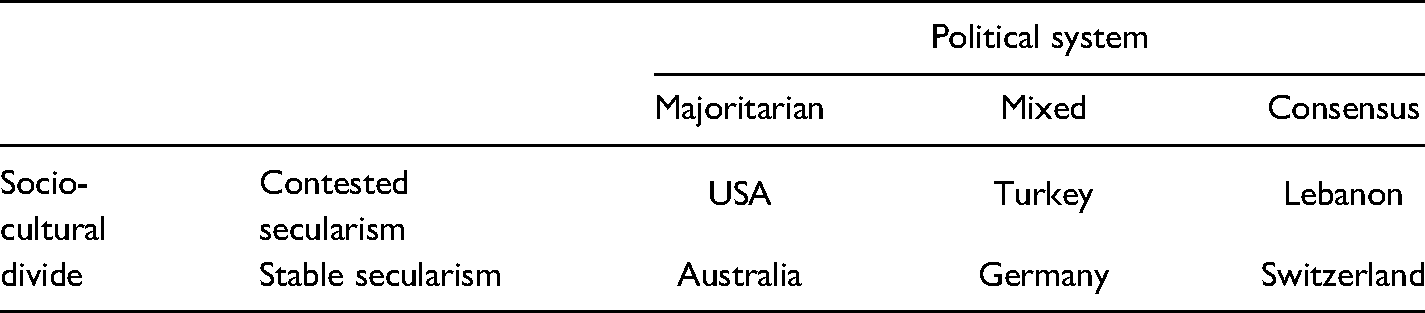
Our country selection (Table 1) allows for a test of the independent consequences of the two factors political system and socio-cultural divide (Inglehart et al. 2014, variables V153, V194–V197) by allowing us to make two key comparisons: For H1a/b the key comparison is between countries with different political systems yet similar levels of societal division (such that division is ‘controlled’ for); for H2a/b the key comparison is between countries with different levels of societal division yet similar political systems (such that political system is ‘controlled’ for).
Country Selection.
Further, we included daily newspapers and online news websites as representatives for top-down news production and, as explained above, political blogs as a representative for bottom-up news production. To ensure a reliable selection of media outlets we conducted an expert survey within all six countries. Each expert was presented with our initial selection of media outlets and asked to rate the media outlets according to their reach (audience size/circulation) and relevance within the national political discourse (i.e., opinion leadership). We contacted 467 experts of which 136 completed the questionnaire (Australia: n = 18, Germany: n = 16, Lebanon: n = 12, Switzerland: n = 17, Turkey: n = 44, USA: n = 29). The field period was from January 15 until March 15, 2015. Based on the expert rankings of media outlets we included at least two daily newspapers, five news websites, and five political blogs for each country (See section ‘Source Selection’ in the Online Appendix for the final selection).
Next, we collected all media content published in the political, societal, and economic sections provided in these outlets form August 2015 until July 2016. Depending on the available access to the content of the media outlet we bought or crawled all published content. A detailed documentation of this collection process is provided in the section ‘Text Data Collection’ in the Online Appendix.
Article Selection and Coding Procedure
In order to draw a representative sample from the Mannheim International News Discourse Data Set (MIND; Rinke et al. 2019) for manual content analysis we used the approach of expert-informed topic modeling (EITM; Rinke et al. 2021) to identify the population of relevant articles available in a text format. EITM is an efficient approach combining expert domain knowledge and automated classification algorithms to identify and rank articles belonging to a specific master topic in unstructured text corpora. For an article to be identified as relevant it needed to address our master topic: the present or future, actual or desirable public role of religion in the country's societal life, which was to include any reference to the significance of religion or religious practices and ideas for public, especially political, activities and decisions. This resulted in a list of articles ranked according to their fit to our master topic.
All articles ranked by the EITM were validated manually, starting with the articles ranked most relevant until the desired number of articles per media outlet type and country was reached.
The final sample of N = 1,700 articles/blog posts was coded using the coding tool Angrist (Wettstein 2016). All coders participating in the relevance coding or the final content analysis received extensive training and were (close to) native speakers in German and one of the three other source languages (English, Turkish, or Arabic). The coding protocols are provided in the Online Appendix in the sections ‘Selection Protocol’ and ‘Codebook’. Even though the initial intercoder reliabilities were satisfactory (Krippendorf's α >.71) given the complexity of our variables, we double-coded the entire material with two independent coders to improve our data quality further. Coder disagreement was then adjudicated by consensus decisions, which is a procedure to reduce error in the data and to improve data quality (Orwin and Vevea 2009: 184). To avoid systematic errors, we rotated the student coders among their language group and across the coding material. This final step ensured that the reliability of our coding was even higher than the reliability coefficients indicate. Therefore, we are confident that all major systematic errors that might occur in cross-national studies have been accounted for, and our data quality can be considered high. The results of the reliability calculations are provided in the Online Appendix in the section ‘Reliabilities’.
Analytic Procedures
To test the hypotheses, we first explored descriptive statistics of our three measures of civility on the news item and actor reference levels. We then used ordered logistic regression (for the item-level outcome tone) and mixed-effect logistic regression models (for the actor reference level outcomes recognition and outrage) to estimate how the political system, the socio-cultural divide, and the different types of media predicted levels of civility in media content. With respect to the different types of media it is important to note that we compare two forms of top-down news production (“professional” newspapers and news websites) with a single form of bottom-up news production (“non- or semi-professional” political blogs). In addition to allowing us to test H3a and H3b, this also allows us to have a more fine-grained look at potential differences in the patterns of civility produced on news websites and newspapers.
Results
We started by looking at the item level summary indicator for outrage developed by Berry and Sobieraj (2014). Table 2 provides a summary overview of outrage levels in each of the three media types across the six countries. We found low average levels of outrage across the board. Without exception, levels of outrage across all media types in all countries ranged from zero outrage in Australian newspapers to a maximum of 46% of Turkish blog posts being at least somewhat outrageous. There was some variation in levels of outrage across the three different media types. Blogs consistently stood out as the most outrage-prone media type, with higher levels in each of the six countries, with the exception of Lebanon, where newspapers contained slightly more outrage content than blogs (20% vs. 14% of articles being at least slightly outrageous). Newspapers (91% non-outrage articles) and news websites (95% non-outrage articles) tended to be more similar to each other with regard to low levels of outrage coverage and are recognizable as distinct from blogs (75% non-outrage blog posts).
Item Level Tone for Different Media Types, by Country.
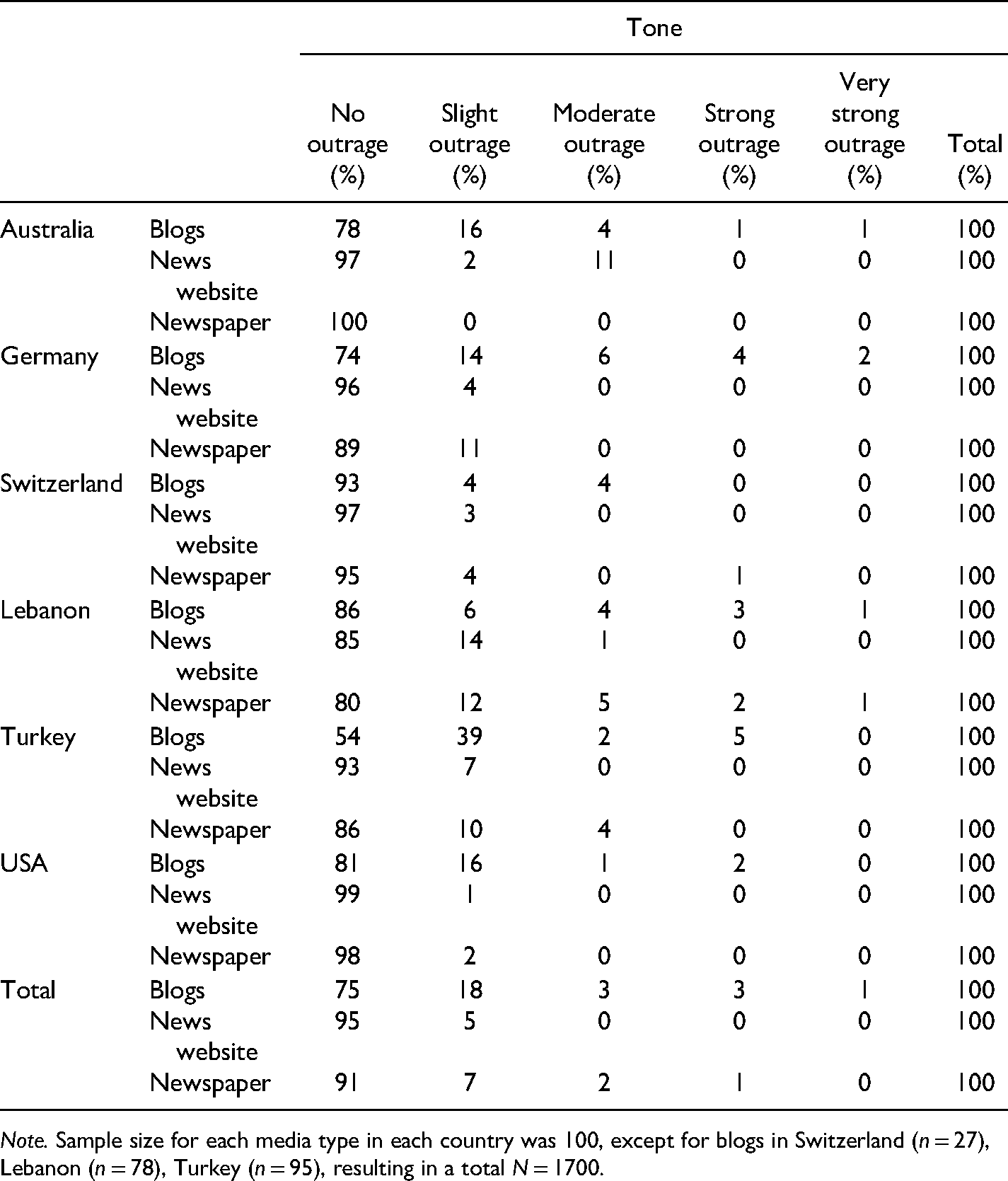
Note. Sample size for each media type in each country was 100, except for blogs in Switzerland (n = 27), Lebanon (n = 78), Turkey (n = 95), resulting in a total N = 1700.
Comparing these differences in item level outrage between media types to those between countries, we found that the latter were slightly less pronounced, with Turkey (22% at least slight outrage), Lebanon (15%), and Germany (14%) clustering together on slightly elevated outrage levels, whereas Switzerland (4%), the United States (7%), and Australia (8%) formed a cluster with very low levels of outrage items in newspapers, news websites, and political blogs.
Going beyond descriptive analysis, we estimated the independent effects of political system, socio-cultural divide, and media types on item level outrage using a regression model. Since the outcome variable is the ordinal classification of news item tone into different levels of outrage, we used a proportional odds ordinal regression model. 1 This model was specified using a logit link. 2 It indicated that the three focal predictors alone accounted for a significant portion of the variance in outrage on the news item level (Nagelkerke R2 = .09). The estimates in Table 3 indicate that, contrary to H1a, controlling for all other predictors, the odds of being beyond a particular outrage category were 49% higher for a news article in mixed systems compared to consensus systems (OR = 1.49, 95% CI = [1.03, 2.14]) and the odds of news articles in majoritarian democracies of being beyond a given outrage category were only 0.54 times the odds for articles in consensus democracies (OR = 0.54, 95% CI = [0.35, 0.83]).
Effects of Political System, Socio-Cultural Division, and Media Type on Tone (News Item Level).
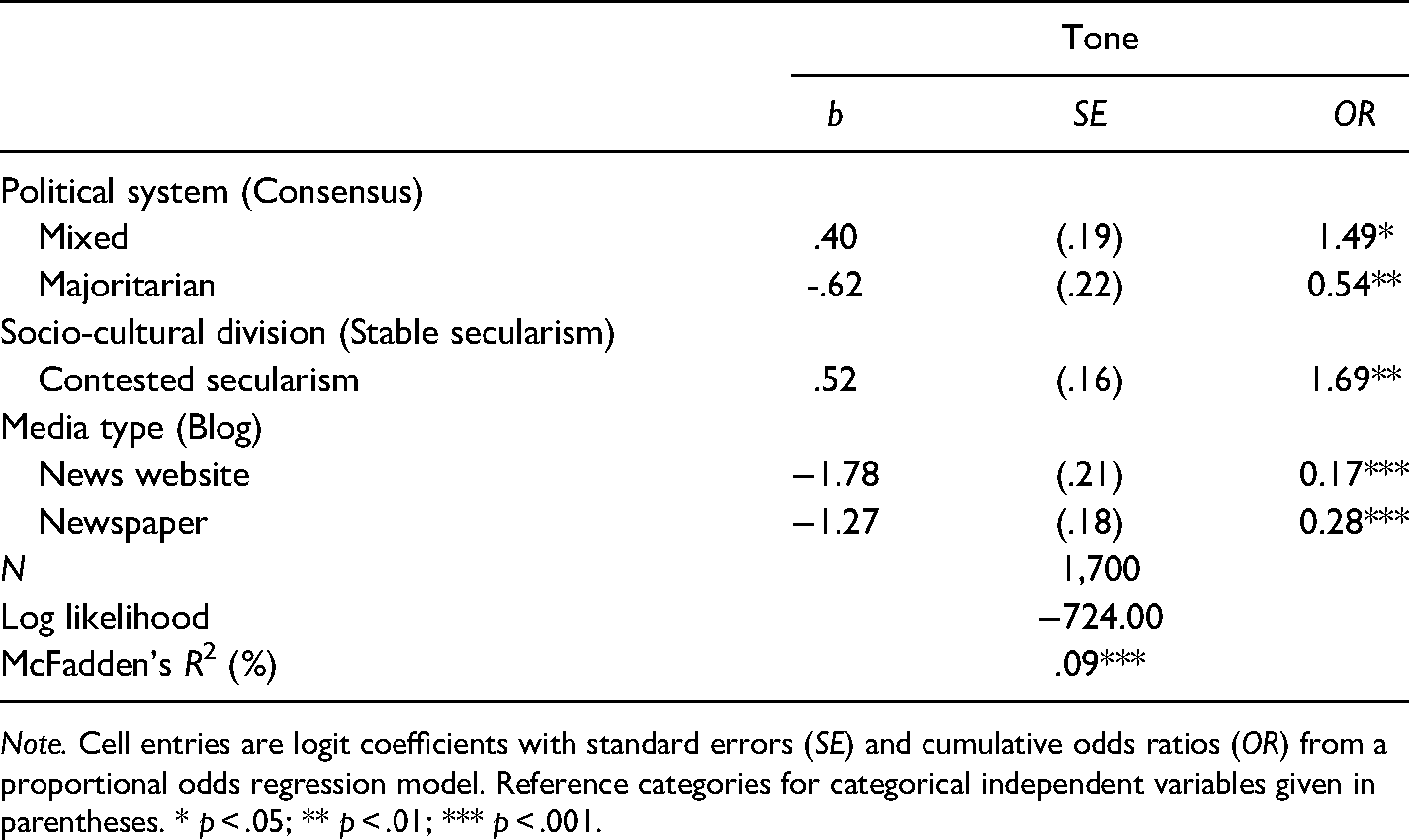
Note. Cell entries are logit coefficients with standard errors (SE) and cumulative odds ratios (OR) from a proportional odds regression model. Reference categories for categorical independent variables given in parentheses. * p < .05; ** p < .01; *** p < .001.
H2a expected that mediated discourse in societies in which secularism is contested contain more outrage than in non-divided societies characterized by a stable secular consensus. Table 3 shows that the odds of being beyond a particular outrage category (i.e., of containing more outrage) were 69% higher for news items published in countries characterized by contested secularism compared to items published in countries with a stable secular consensus (OR = 1.69, 95% CI = [1.24, 2.31]). Thus, on the news item level H2a is supported.
Finally, H3a predicted that mediated debates will contain less outrage in top-down news production media such as newspapers or news websites compared to bottom-up news production media, such as political blogs. Table 3 shows that this holds true in our model while controlling for country-level differences in political system and socio-cultural division. The odds of news items to be beyond a given outrage category were 83% lower when they appeared on news websites (OR = .17, 95% CI = [0.11, 0.25]) and 72% lower in newspapers (OR = .28, 95% CI = [0.20, 0.40]) compared to items published on political blogs.
Figure 1 provides an overview of the predictive margins for news item level outrage for each of the three predictor variables based on the model. Inspecting the predictive margins in addition to the coefficient estimates illustrates that the vast majority of news items across all levels of our independent variables tended to show either no or only a slight tendency towards outrage reporting. However, there was nontrivial variation in the probability with which a news item will lean towards outrage, with the most notable cases being blogs, which were more than twice as likely to be outrage-focused than news websites and newspapers.
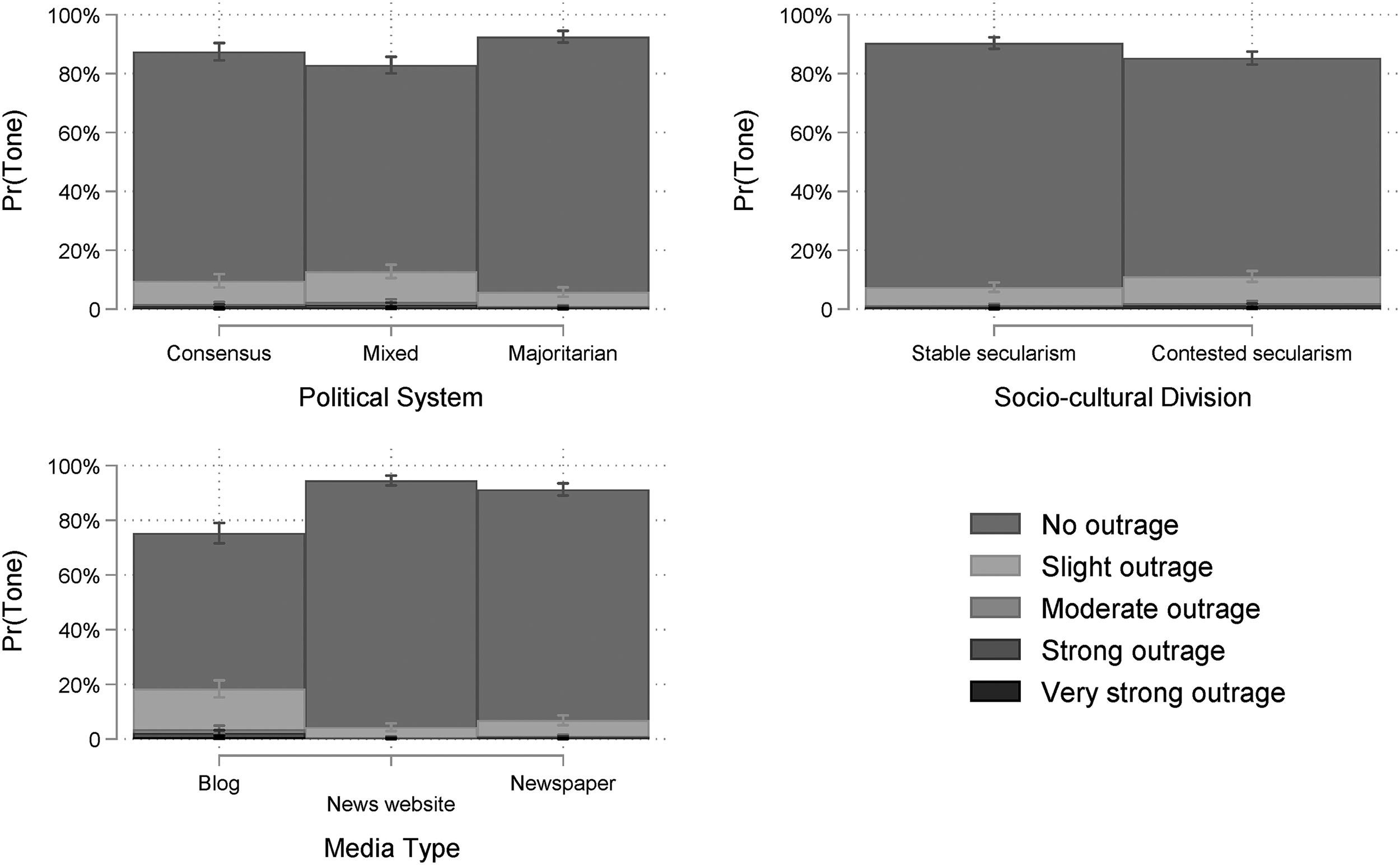
Predictive margins for outrage (news item level tone variable) for types of political system, degree of socio-cultural division, and media type.
In addition, the average marginal effects model of all independent variables (controlling for all other variables) showed that the largest differences in the expected probability of outrage occurred in the lower two categories. The main difference across political systems, socio-cultural divides, and especially media types occurred with respect to whether “no outrage” or “slight outrage” occurs. Average effects for political system, socio-cultural divide, and media types were essentially nil for the higher outrage categories (i.e., “moderate” to “very strong” outrage). The corresponding table is provided in the section ‘Additional Analyses’ in the Online Appendix.
In the next step, we zeroed in on our outcomes of interest and moved from assessing the overall amount of outrage contained in news articles or blog posts to the more fine-grained analysis of individual references between actors featured in these items. Specifically, we looked at the proportion of between-actor references that were characterized by (positive) recognition and (negative) outrage. Figure 2 displays the percentage of actor references that contained recognition and outrage for each media type in each country. The figure shows that overall, a low but nontrivial portion of references between actors featured in news items contains explicit outrage (5.1%) and recognition (5.2%). Contrary to findings using the item level measure of outrage reported in Table 2, there was much more variation in both recognition and outrage between media types and countries.
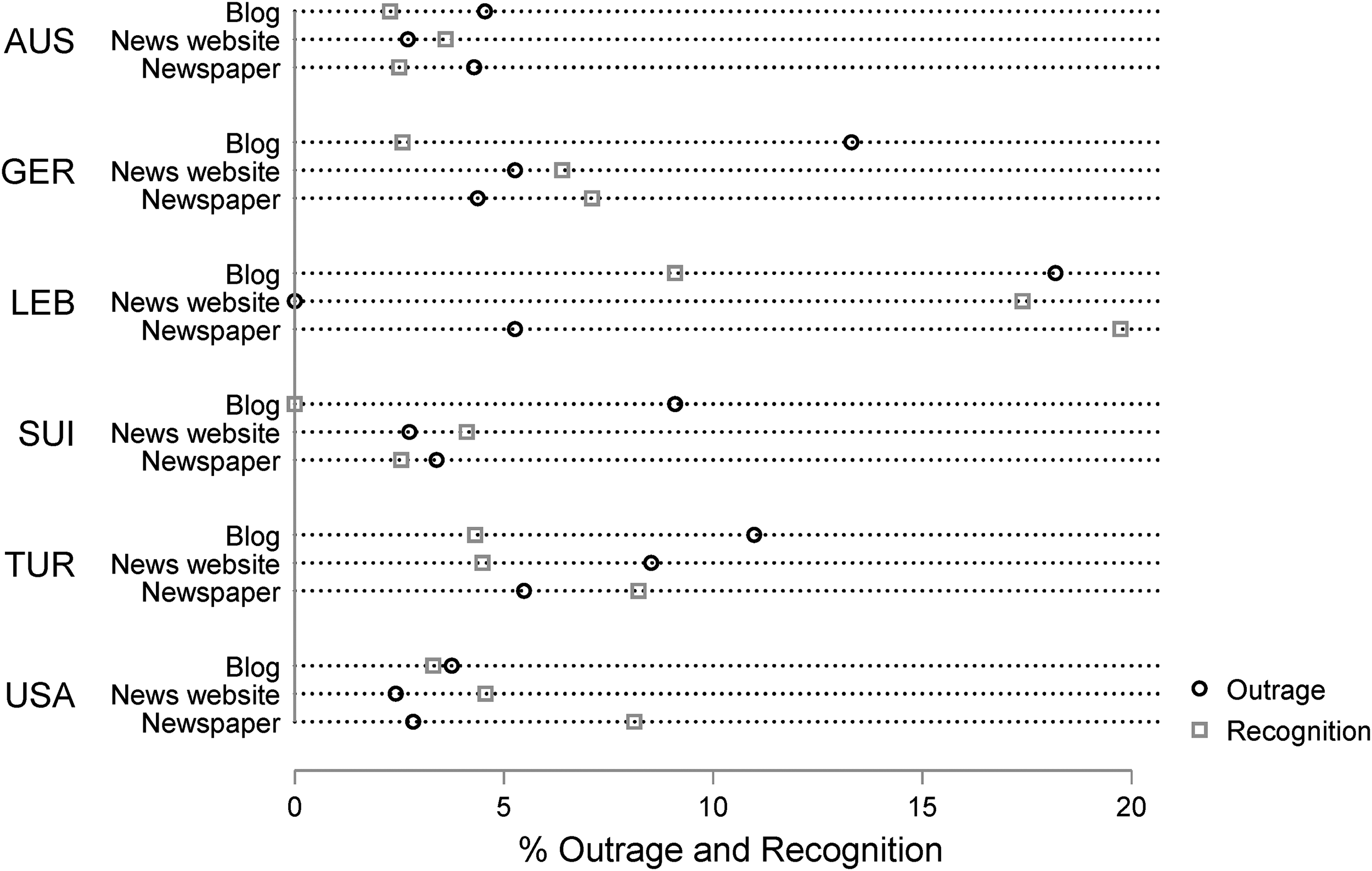
Percent outrage and recognition (actor reference level) for different media types, by country.
Moving on to descriptive differences in outrage levels between different media types, we found that, similar to the item level, blogs again stood out consistently as the most outrage-prone media type, with higher proportions of outrage-including references between actors in each of the six countries (overall proportion: 7.7%). Newspapers (3.8%) and news websites (4.1%) again tended to be more similar to each other with regard to low levels of explicit outrage content. Conversely, we found that blogs consistently featured the lowest proportion of explicit recognition in actor references in each of the six countries (overall proportion: 3.2%). Newspapers (7.0%) and news websites (5.2%) again were closer to each other in their proportions of explicit recognition in actor references.
When we looked at the descriptive differences between countries we found a similar distribution, with Turkey (overall proportion: 8.8%) and Germany (7.8%) exhibiting slightly higher outrage levels, whereas the United States (3.0%), Switzerland (3.7%), Australia (3.8%) and Lebanon (4.5%) formed a cluster with very low levels of outrage in actor-to-actor references. Looking at recognition across countries, we again found that Australia (overall proportion: 2.8%) and Switzerland (3.0%) showed the lowest proportions of explicit recognition in actor references, followed by Germany (5.3%), Turkey (5.3%), and the United States (5.5%). Lebanon clearly stood out with almost one fifth (18.0%) of all actor references containing some form of explicit recognition, driven mostly by newspaper and news website coverage in the country.
We estimated the independent effects of political system, socio-cultural divide, and media types on actor reference level recognition and outrage using regression analysis. The actor reference data have a hierarchical structure, with individual references to other actors nested in individual actor statements, which in turn are nested in news items. Given that this clustered data structure violates the assumption of independent observations in single-level regression models and given that our hypotheses are framed in universal terms, we estimated three-level mixed-effects regression models with random intercepts to allow for different levels of recognition and outrage between actors and news items. 3 While controlling for between-cluster differences in intercepts, these random intercept logistic regression models assume common coefficients across actors and news items.
Table 4 reports the mixed-effects estimates for both actor reference level outcomes. The outrage model confirms the descriptive analysis in that no statistically significant differences in reference level outrage occurred between different political systems (H1a). Contrary to H2a, the socio-cultural divide does not predict the proportion of actor references containing outrage. The largest variation with regard to outrage in actor references occurred between different media types: References between actors in both newspapers and news website were significantly less likely to contain explicit outrage than in blogs, confirming H3a further.
Effects of Political System, Socio-Cultural Division, and Media Type on Outrage and Recognition (Actor Reference Level).
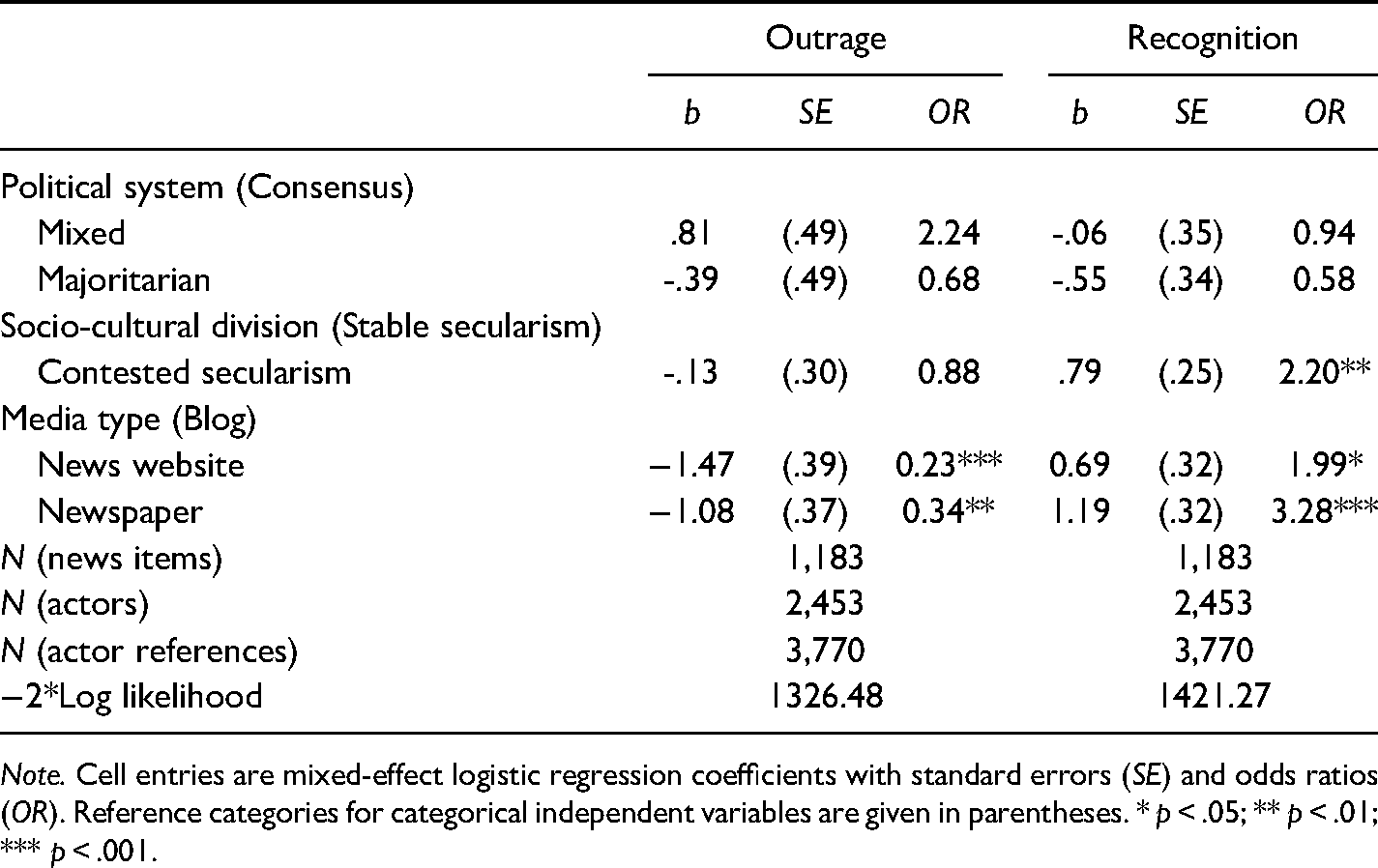
Note. Cell entries are mixed-effect logistic regression coefficients with standard errors (SE) and odds ratios (OR). Reference categories for categorical independent variables are given in parentheses. * p < .05; ** p < .01; *** p < .001.
The model estimates for recognition in actor references are similar to those for the outrage model in that political systems also did not vary considerably with regard to the likelihood of recognition in references between actors, rejecting H1b on this level, too. Contrary to H2b, actor references in societies characterized by contested secularism were more likely to contain explicit recognition. The greatest differences again occurred across media types, however in a reversed direction compared to the outrage model: Whereas references in newspapers and news websites were significantly less likely to contain outrage, they conversely were also significantly more likely to contain explicit recognition, which confirms H3b on this third measure.
Next, we looked at the predicted mean probabilities for actor references to contain outrage or recognition. These probabilities imply the average treatment effect (AME) of each independent variable relative to the relevant reference category (see Figure 3). In regard to outrage the type of political system did not matter for outrage on the actor reference level, with neither mixed (AME = .03, 95% CI = [−.00,.06]) nor majoritarian systems (AME = −.01, 95% CI = [−.04,.02]) exhibiting a significant deviation from their consensus counterparts. This was also true for the contrast between mediated actors in non-divided versus divided countries (middle plot, AME = −.00, 95% CI = [−.02,.01]). However, both news websites (AME = −.05, 95% CI = [−.07, −.02]) and newspapers (AME = −.04, 95% CI = [−.06, −.01]) are significantly less likely to present actor reference level outrage than blogs. While the proportion of outrage-containing actor references was low overall as expected, contrasting the marginal predicted probabilities of outrage across categories of our independent variables showed that the difference between non-professional and professional media was considerable, with newspapers and news websites significantly less likely to feature actors engaging in acts of outrage than blogs.
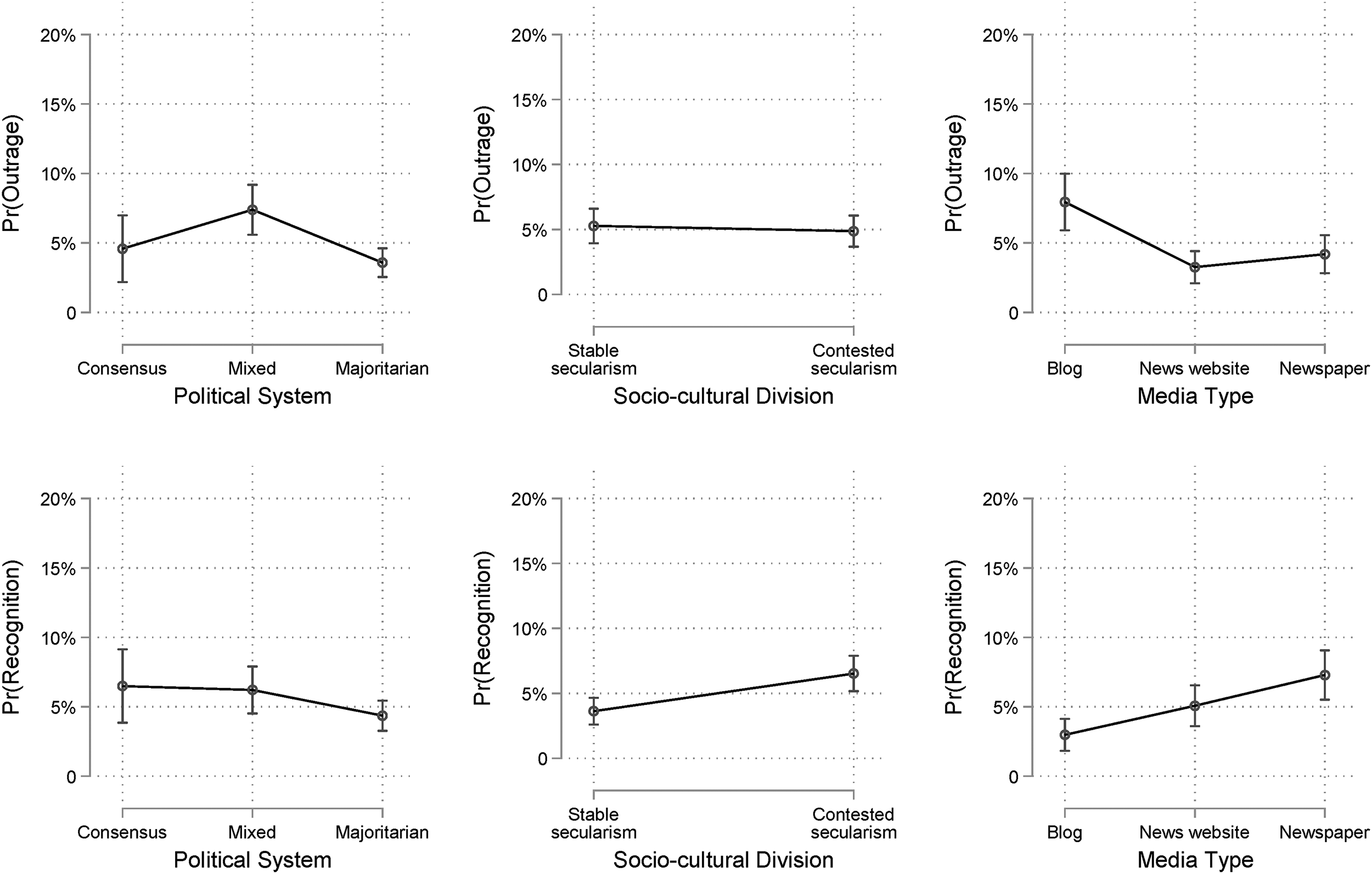
Predictive margins for outrage and recognition (actor reference level) for types of political system, degree of socio-cultural division, and media type.
The political system did not have an effect on the average probability of actor references to contain explicit recognition, with neither mixed (AME = −.00, 95% CI = [−.03,.03]) nor majoritarian systems (AME = -.02, 95% CI = [-.05,.01]) differing from the consensus systems. Conversely, actors in countries divided about public secularism were slightly more likely to engage in acts of explicit recognition than in countries characterized by a stable secular consensus (middle plot, AME = .03, 95% CI = [.01,.05]) as were articles published on news websites (AME = .02, 95% CI = [.00,.04]) and newspapers (AME = .04, 95% CI = [.02,.06]) compared to blogs. Just as with outrage, the proportion of recognition-containing between-actor references was low overall, but the contrasts of marginal recognition probabilities between divided and non-divided societies and between non-professional and professional media were statistically significant.
Discussion
This study provides systematic and nuanced insights on how different political and socio-cultural settings, and top-down versus bottom-up news production influence the two notions of civility in public discourse: outrage and recognition. Regarding the political system, mediated discourse contained more outrage in Germany and Turkey — countries that combine features of majoritarian and consensus systems — compared to media debates in countries with “pure” types of these political systems. Regarding recognition, the results showed the highest levels in Lebanon and Switzerland (consensus systems) and the lowest levels in Australia and USA (majoritarian systems). However, these differences were not statistically significant, suggesting that within our sample of six countries civility in mediated discourses did not vary systematically across political system types. Instead of considering political systems as a bundle of criteria, we therefore suggest that future research differentiate the influence of different features within political system “packages”.
Deep socio-cultural divides seemed to incite a mediated discourse that was characterized by more outrage along with more recognition. Such higher levels of outrage might be a worrisome result because they might fuel social conflict. However, we also submit that overall, levels of outrage were rather low in the media under study here. At the same time levels of recognition on the actor reference level was significantly higher in Lebanon, Turkey, and the U.S. than in the other three countries. The simultaneous volume of outrage on the item level and recognition on the utterance level suggests that socio-cultural divides may lead to more intense mediated exchanges between individual actors and societal groups, irrespective of their valence and direction. In divided societies, media coverage focused more on how groups relate to each other across the divide (through outrage or outgroup recognition) and how members of such groups relate to each other internally (through ingroup recognition). Even though we did not differentiate to whom recognition was directed, it is noteworthy that group relations and identities were generally more salient in divided societies, both in news items as a whole (in the form of outrage) and individual utterances (as ingroup or outgroup recognition). By contrast, in less divided societies there seemed to be a greater sense of indifference for group identity and group relations, possibly hinting to a stronger sense of tacitly presumed commonality. It would appear, then, that weaker intergroup conflicts and less salient group identities can explain why actor-to-actor recognition is less needed in less divided societies. While our study shows that including a socio-cultural comparative category can generate valuable insights, further differentiation is needed with respect to this factor as well. In times of increasing political polarization questions regarding intergroup relations, patterns of social division, and social integration become more important for fully understanding civility in mediated discourse. Future comparative research would benefit greatly from including such cultural and societal factors in their research designs to ascertain the degree to which group relations are mediated at all and to disentangle their complicated structure.
In regard to top-down versus bottom-up news production, we showed that mediated discourse in newspapers and news websites contained significantly less outrage and more recognition than content published on political blogs. Compared to newspapers and news websites, blogs were twice as likely to be outrage-focused. Hence, traditional journalistic news production clearly seems to mitigate outrage in mediated discourses (see also Borah 2014; Hwang et al. 2008). While top-down news providers produce content partly shaped by a set of professional rules and norms, bloggers adhere more strongly to economic forces (Bruns 2018; Bruns and Highfield 2015), which seem to favor the use of outrageous communication. Furthermore, top-down news production also seems to foster actor-to-actor recognition. Articles published in newspapers or on news websites were more than twice as likely to contain recognition than blog posts. This finding is in line with the growing empirical literature on incivility in non-professional mediated discourses such as comment sections (e.g., Coe et al. 2014) or discussions on social media (e.g., Esau et al. 2017).
Our study has limitations that need to be acknowledged. First, our country sample is quite small and therefore our findings concerning country differences need to be interpreted with caution. With every cell of our selection matrix being occupied by only one case each (see Table 1), unobserved country-specific confounding factors are not being controlled for. Second, we included articles on the public role of religion only, and therefore cannot generalize our findings to all types of issues. However, this topic is one of the most relevant current issues and we are confident that it is a good proxy for difficult issues that concern mutually contradictive notions of social identity. Third, our period of investigation was characterized by political events—such as the U.S. presidential election campaign in 2016 or the so-called coup attempt by the Gülen movement in Turkey on 15 July 2016—that have sparked debates on the role of religion in political affairs that would otherwise not have gained as much media attention (e.g., Evangelical Christian support for Donald Trump). This might have boosted outrage in the respective countries. However, because our period of investigation included a whole calendar year, we are confident that the impact of these events is not severe.
This study makes several important contributions to our understanding of civility in mediated debates. First, we introduce and apply two independent concepts capturing the normative extremes of civility from a deliberative perspective: outrage as the least favorable communication style in mediated discourse and recognition as the positive counterpart. Both concepts are theoretically grounded within the deliberative framework and a allow for a more comprehensive and theoretically valid measurement. Second, by including three explanatory factors for the level of outrage and recognition in media debates and varying them systematically across countries and media types, this study contributes to theory-building by working towards a more complete contingency model of outrage and recognition in media discourse and contributes to existing research on the factors influencing incivility in mediated discourses such as the characteristics of different news platforms (see Esau et al. 2017; Esau et al. 2021). Third, we included two levels of analysis (news item level and actor reference level). This did not only allow us to cross-validate our findings for outrage, it also allows a deconstruction of how journalists or bloggers handle outrage in their work: If for example, low levels of outrage on the news item level are accompanied by high levels of outrage on the actor reference level the capacity of how journalists and bloggers contain outrage in their construction of news becomes evident. However, this was not the focus of our study and we did not investigate these relations further. Lastly, our findings are cause for cautious optimism regarding the magnitude of outrage as we did not find exceedingly high levels across the media types analyzed here. Media coverage that is not dominated by outrage has greater deliberative democratic value as it gives room for a mediated discourse in which participants do not construct and perceive each other as vicious enemies. In contrast to the more sobering findings of Berry and Sobieraj (2014) on the already high and still rising levels of outrage in specific media in the U.S. (i.e., talk radio and cable news), we were able to show that outrage seems to be a rather uncommon phenomenon across countries in leading news media such as newspapers, news websites, and political blogs. Of course, outrage may have migrated to other arenas, particularly to social media, and that may be reason for concern. But at the same time, it is important to note that there are segments of today's political information environments that inhibit the unabashed exercise of incivility even in more divided societies. In the end, and considering the high levels of recognition and low levels of outrage in newspapers and news websites compared to political blogs, our findings make a strong argument for the continued deliberative value of traditional journalism in modern democratic societies.
Footnotes
Declaration of Conflicting Interests
The author(s) declared no potential conflicts of interest with respect to the research, authorship, and/or publication of this article.
Funding
The author(s) disclosed receipt of the following financial support for the research, authorship, and/or publication of this article: This work was supported by the Deutsche Forschungsgemeinschaft (DFG), (grant number WE 2888/6-1).
