



Abstract
In this study, we offer a novel approach to research on migration reporting by focusing on the argumentative substance prevalent in different online outlets. Taking German refugee policy as our case in point we map the role that moral, ethical–cultural, legal, and pragmatic argumentations play within journalistic, partisan, and activist outlets; and how these coincide with incivility and impoliteness. Using dictionary-based content analysis on a data set of 34,819 articles from thirty online news outlets published between April 10, 2017, and April 10, 2018, we find that legacy mainstream media, partisan media, and activist media perform vastly different functions for the larger public sphere. We observe that human rights activist media perform an advocatory function by making the moral case for refugees, whereas corrosive partisan media at the fringe—particularly within the contra-refugee camp—often present opponents as inherently illegitimate enemies. Implications for public sphere theory and directions for future research on emerging and legacy media are discussed.
Keywords
In recent years, traditional journalism’s role in public discourse on immigration and refugee policy in Western democracies has enjoyed increased attention within communication research (Eberl et al. 2018). This is due to nations' differing reactions during the massive refugee movement in 2015 (Berry et al. 2016). Overall, the effect of news reporting on migration appears to favor contra-refugee positions, with portrayals of migration focusing on the crime and potential negative effects of migration and furthering stereotypical portrayals of migrants.
At the same time, legacy news outlets now compete with less professional alternative outlets for readers' attention (Van Aelst et al. 2017). Although these alternatives potentially offer space for dissenting views, critics warn that well-organized networks of bad-faith actors from the right do not enrich public discourse, but rather threaten the fabric of Western democracies by spreading disinformation (Bennett and Livingston 2018) and far-right ideologies that further marginalize minorities (Larson and McHendry Jr. 2019).
It is, therefore, necessary to investigate the exact functions that different emerging online outlets perform within the larger public sphere: Do they supplement mainstream discourse with an increased dose of moral argumentation focusing on questions of justice? Or do they primarily inject group-based ethical–cultural arguments? How prevalent are pragmatic and legal arguments concerning the feasibility of different courses of action in a crisis? Finally, how are the varying types of arguments related to the level of civility and politeness and how do outlets thus promote the integration of citizens within democratic society?
Using a multiperspectival normative assessment approach (Althaus 2012), we deploy a systemic investigation into the contribution of a broad and differentiated sample of outlets. Using dictionary-based content analysis on thirty outlets from the field of German online news, we map their contributions to different forms of public discourse and ascertain whether these contributions come at the cost of spreading incivility.
Refugee Policy Discourse in a Diversifying Public Sphere
Previous research assessed factors that increase multiperspectiveness within mainstream news—with media targeting elite audiences, public broadcasting and politically pluralistic media systems favoring a broader coverage of issues, and tabloid media offering a more one-sided, negative portrayal of migration (Benson 2013; Berry et al. 2016; Jacobs et al. 2016; Masini et al. 2018). At the same time, mainstream coverage overall appears to focus on negative aspects of migration, with crime as well as cultural and economic disruption, gaining larger attention, strengthening negative stereotypes and fears (Eberl et al. 2018). This might explain why media attention on immigration alone can be sufficient to further negative attitudes towards immigrants (van Klingeren et al. 2015) and support for antiimmigrant parties (Burscher et al. 2015).
To understand the inherent divisiveness of immigration and refugee policy discourse, it is helpful to see the issue as a case of what Fraser (2009) calls “abnormal justice.” Normal justice discourse takes place within the framework of a nation-state, with those subjected to a particular decision arguing on relatively equal footing as citizens of the same polity. Potential immigrants and refugees, meanwhile, strive to make their case without being an accepted part of the community that makes the decision, leading to stark asymmetries of power. And since migrants aim to become part of the host community, the boundaries of who gets to decide—bounded by citizenship rights—are themselves disputed (Benhabib 2002).
As Bennett and Pfetsch (2018) have noted, this abnormalization of justice and the resulting legitimacy crises within Western democracies coincide and interact with disrupted public spheres, in which a “diversification of content, voices, and audiences shapes public communication” (p. 244). In countries like Germany with moderate political parallelism (Hallin and Mancini 2004), where journalistic media traditionally diverge into different political camps (Peters 2008: 91), we would already expect journalistic media coverage of refugee policy to diverge along political lines to some degree. With the rise of alt-right online media on one hand (Kaiser et al. 2019), and pro-refugee activists giving voice to refugees' and migrants' concerns not usually heard in mainstream reporting (Gemi et al. 2013; Masini et al. 2018), traditional journalistic outlets now compete with alternative information sources by partisan actors and activist groups (Bennett and Livingston 2018). The normative question, then, is how democratic societies should process this abnormalization of justice and how they should integrate the voices of diverse journalistic and partisan organizations. Present political communication research is concerned with increased polarization and fragmentation of media content and media use online, which many authors fear lead to lower respect for opposing positions (Van Aelst et al. 2017). Although the backlash against liberal refugee policies is a normal process within the broader public sphere and not in itself antidemocratic, decreased respect for opposing positions does threaten liberal democracies' ability to process conflicts democratically (Alexander 2019). This corrosive potential should motivate communication researchers to assess precisely how the conflicts between diverging political camps are enacted within online outlets.
Four Types of Arguments in Public Discourse and Their Democratic Functions
Preventing the disintegration of democratic society into incompatible camps, which view each other not as legitimate democratic opponents but as enemies who must be fought through violence, is a core concern of most democratic theories. This concern has two empirical components: First, how civil or uncivil is the exchange between the opposing camps, and second, what types of argumentative resources are mustered by the opponents to support their claims? Although recent communication research has extensively focused on (in)civility (see, e.g., Boatright et al. 2019), the types of arguments used in public discourse have rarely been scrutinized in depth (but see Peters et al. 2008a: 153–59, 2008b).
Following Habermas (1996), we distinguish four types of argument particularly relevant for migration discourse. These argument types correspond to different functions of public discourse, with different theoretical traditions emphasizing or de-emphasizing particular functions.
Arguments regarding the efficiency and feasibility of policies are part of pragmatic discourses (Habermas 1996: 159–60): When we talk about what means best achieve agreed-upon ends when we weigh the aptness of policies and their positive and negative outcomes, we make pragmatic arguments. When everyone agrees on the goals of policies, pragmatic discourses suffice. Assessing the pragmatic feasibility of policies can therefore be considered the pragmatic function of public discourse. Liberal theorists fear that if political discourse strays from pragmatic discourse there is a danger of vilifying one's opponents. To avoid this danger, liberal theorists argue for what Ackerman (1989) calls “conversational restraint”: When citizens find causes for deep moral disagreement, they should “simply say nothing at all about this disagreement and put the moral ideals that divide us off the conversational agenda of the liberal state” (Ackerman 1989: 16).
But often citizens and their representatives disagree about goals, based on diverging values. If we try to convince people belonging to the same political group as we do, or people sharing our cultural values, we enter ethical–cultural discourses. For example, if actors invoke Christian values, German interests or worker solidarity, they argue from a shared identity, and arguments that rest on such values will be convincing only to people who share this identity (Habermas 1996: 160–61). Agonistic democrats emphasize this function. Mouffe (2013: 7–9) argues that the core of democratic politics is to motivate voters through offering starkly different political alternatives to not leave the field open to fundamentalist and extremist antidemocratic and illiberal parties which are able to appeal to primordial group identities (Mouffe 2000: 113–16). Backlash against progressive policies, especially liberal immigration policies, often takes an agonistic, cultural–ethical form (Alexander 2019). Analogously, pro-immigration activists may emphasize their identity as members of both the host community and as immigrants, or they may form an identity around their marginalized status (Glover 2011). This contestatory appeal to ethical–cultural identities can therefore be understood as the agonistic function of public discourse.
But in a pluralistic democracy, we do not always agree on cultural values. Therefore, Habermas (1996: 161–62) argues that citizens should engage in moral discourses—aiming to find universal principles of justice that are legitimate across cultural contexts. Human rights and civil rights are commonly understood as expressions of such universal principles, and arguments for justice and nondiscrimination also appeal to universal, rather than culture-specific values (Young 2000: 112–15). For Habermas, most societal conflicts must be translated into moral discourses in order to be properly understood and resolved, since pragmatic concerns and ethical–cultural values alone cannot motivate agreement across different groups. Therefore, deliberative democrats argue for a focus on moral discourse (Habermas 1996: 168). Marginalized groups often have no power but the power of moral argument to represent their interests (Habermas 1994: 140–42; Huspek 2007). This pertains especially to refugees who can only appeal to the morally bonding force of universal human rights to make their case. Therefore, deliberative democrats emphasize the moral-deliberative function within public discourse. Admitting moral argument into the public arena might make politics more controversial, but, from the deliberative perspective, constitutes a necessary condition for processing deep disagreements (Gutmann and Thompson 2004).
Lastly, since democratic states follow the rule of law, the legality of policies must be evaluated, and moral discourses must be translated into legal discourses to be socially effective (Habermas 1996: 168). This is also important since political groups often appeal to existing laws—for example, debating the issue of legal and illegal forms of migration. We consider this linking of other discourses with legal questions the legal-evaluative function of public discourse.
Fostering Respect—Civility and Politeness
In the previous section, we argued that different democratic traditions emphasize different functions of public discourse that are manifested in different types of argument. We argue that this disagreement is rooted in possible trade-offs between the moral-deliberative and agonistic functions of public discourses on the one hand and the integrative function of public discourses on the other: Public discourses should not just allow an exchange of opinions and a demarcation of positions and identities but should foster respect for opposing positions.
This integrative function can take two forms (Papacharissi 2004; Rossini 2020): Politeness, that is, showing interpersonal respect between actors by avoiding insulting language and accusations of lying, can make opponents more open for diverging ideas and allow participants to accept policy outcomes even if they do not agree with them. Civility, meanwhile, is concerned not with interpersonal respect, but with accepting the democratic legitimacy of your opponent. As an example of public-level incivility, Peters (2008: 104–05) referred to the strategy of calling your opponent totalitarian, fascist, or communist to delegitimize them or accusing them of being irrational: This is not just impolite, it aims at fundamentally delegitimizing the accused and excluding them from democratic discourse (Mouffe 2013; Peters 2008: 59–61). Opponents who are not just impolite, but uncivil, therefore no longer see each other as opponents that can process their disagreement with democratic means.
Liberal democrats, as previously argued, fear that there is a trade-off between moral-deliberative and agonistic functions on one hand and the integrative function, and therefore argue for focusing on the pragmatic and legal-evaluative functions of public discourse: “The hope is that, by this method of avoidance, as we might call it, existing differences between contending political views can at least be moderated, even if not entirely removed, so that social cooperation on the basis of mutual respect can be maintained” (Rawls 1985: 231).
Deliberative democrats, meanwhile, argue that we should “open up the political agenda to more moral disagreement than liberal theorists usually allow” (Gutmann and Thompson 2004: 65), to process moral disagreement rather than bracket it from public concern. Although they would allow for the moderate trade-off between impoliteness and the moral-deliberative function (Estlund 2008: 186–201), this should not lead to incivility.
Agonistic theorists, lastly, argue that the integrative function of public spheres can be best performed by focusing on the agonistic function of public discourse. This struggle is not necessarily polite; in fact, impolite language can be a valuable rhetorical tool to appeal to citizens' passions (Papacharissi 2004; Young 2000: 63–70). However, confrontation should foster “agonistic respect”: Through contestatory engagement political camps learn to see opposing political groups not as enemies, but as adversaries that struggle within a shared democratic arena (Mouffe 2013: 5–9), maintaining civility (but not necessarily politeness) and therefore furthering the integrative function.
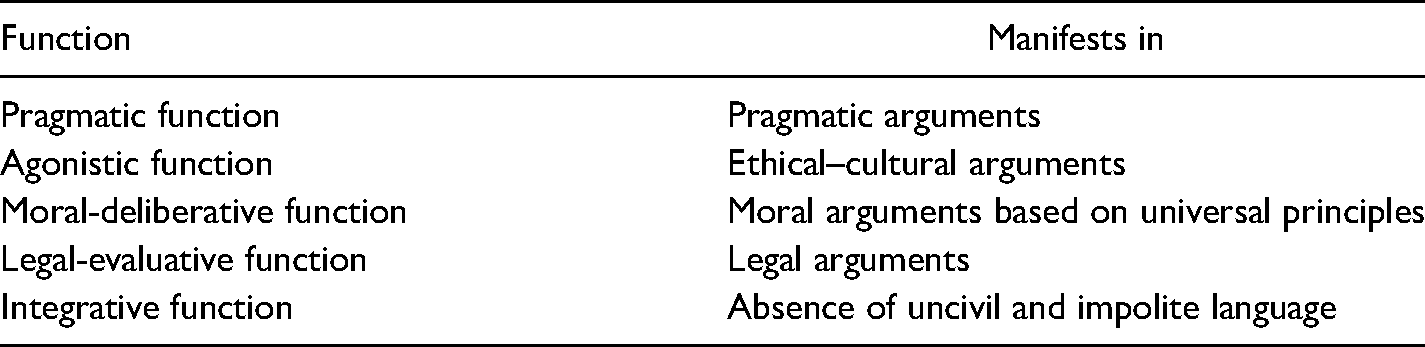
By defining the wider democratic functions of different forms of arguments, we are able to assess the performance of outlets on the basis of both the arguments they focus on and the more or less polite and civil form of their public speech. The relationship between the democratic functions we identified and how they manifest within these outlets is summarized in Table 1. The empirical study described below thus goes beyond extant research by directly drawing on categories and traditions of normative reasoning still often neglected in empirical political communication research. Through this, the empirical results obtained can then also be used for the ensuing normative assessment of the actual performance of outlets, to which we will return in the concluding section.
Argument Types, Incivility, Impoliteness, and their Democratic Function.
Method
Sample
To compare German media discourses on refugee policy within different types of online outlets, we scraped the RSS (Really Simple Syndication) feeds of thirty online outlets over a period of one year, starting on April 10, 2017 and ending on April 10, 2018.
Our goal was to capture a broad spectrum of outlets that represent both the coverage of mainstream journalistic outlets as well as partisan and activist media that contributed to the mediated debate about refugee policy. To do so, we expand on our own previous research about public groups on Facebook that discussed the issue (Freudenthaler 2020) where we found different pro- and contra-refugee camps. We also build on extant research about alternative media linked to the far-right populist party AfD (Alternative für Deutschland) (Bachl 2018). In studying these outlets, it turns out that both pro- and contra-refugee groups cite legacy news media outlets and supplement their content with partisan or activist reporting sympathetic to their respective views. The rationale for including the outlets in each category is described in greater detail in Section A of the Supplemental Information file—we used public data on the number of website visits, counts of social media likes and shares, and the data analyzed in Freudenthaler (2020).
To assess the performance of journalistic legacy media, we included the largest online tabloid outlets (Bild, t-online) and online versions of national quality news outlets (Die Welt, Frankfurter Allgemeine Zeitung (FAZ), Focus, Spiegel, Süddeutsche Zeitung, Die Zeit, and Tagesschau). We also included regional online media outlets representative of large markets in East and West Germany (Der Westen and Tag24) and the largest online news outlets from Berlin, Munich, and Leipzig (Tagesspiegel, Merkur, and Leipziger Volkszeitung (LVZ)).
Among contra-refugee groups online, we found that mainstream media were supplemented by legacy media with a strong partisan bent (Junge Freiheit) and online-only outlets ranging from conservative (Achse des Guten, Tichy’s Einblick) to far-right (Compact Online, Contra Magazin, Ein Prozent Blog, PI-News). Additionally, contra-refugee groups cited journalistic outlets with foreign national ties (Epoch Online, Russia Today) and Deutsche Wirtschafts Nachrichten, an outlet with no clear partisan orientation but a tendency to spread scandalizing news and disinformation. These observations are in line with extant research that suggests populist right-wing actors within Germany can draw on a distinct alternative media sphere (Bachl 2018).
Among the pro-refugee groups, we also found different types of outlets: Some of them are established partisan news outlets (the left-leaning Tageszeitung (taz) and the socialist Neues Deutschland). Others belong to activist group outlets (human rights organizations: Pro Asyl, Amnesty International and Sea Watch, and within far-left groups, activists like Klasse gegen Klasse).
Assessing such a comprehensive set of diverse types of outlets allows us to assess the functions that legacy media as well as partisan and activist media perform within the German online public sphere while at the same time going beyond the mere description of their prevalence (Bachl 2018).
We downloaded 1,001,719 articles from the thirty outlets across the entire sampling period. We only included articles that cover refugee policy and chose those articles by using keywords related to refugee or migration policy. 1 The search terms were manually validated. We found that articles that mentioned at least two of the keywords, with the distance between those keywords covering at least a quarter of the overall length of the article, covered refugee or migration policy as their main topic. This selection criterion led to a final sample of 34,819 articles. All articles where then cleaned up of html code as well as page elements like comments and links to related articles before they were subjected to the dictionary-based content analysis.
To measure whether statements contained in the articles sampled referred to pragmatic, ethical–cultural, moral, or legal standards, we first manually coded these four categories on a sub-sample of 1,172 articles from twelve outlets as reference coding for the ensuing dictionary-based analysis. Two coders, one researcher and one student recruited from our university’s communication program, after in-depth training with the codebook, each coded a random subsample of half of the articles, stratified over the twelve outlets, with a subsample of 120 articles (10 percent of the sample) being coded by both coders to measure intercoder reliability (Neuendorf 2017: 187). We decided to measure the number of occurrences for each argument type on the article level.
For the main argument categories we expanded on the operationalization of previous research (Mitman et al. 2012) into moral, ethical–cultural, legal, and pragmatic argumentation within news outlets. Pragmatic arguments were coded when statements mentioned costs or utility, practical or political chances for realizing a solution (e.g., “realistic,” “pragmatic,” “impossible”) or positive or negative effects of a policy. Ethical–cultural arguments were manually coded when a statement contained an appeal to group-based unity or a bemoaning of division, an appeal to cultural values or traditions or to group interests. For moral arguments, manual coders were instructed to code statements referring to civil or human rights or international law, to nondiscrimination or the equal treatment of people or human dignity. Legal arguments were counted when statements referred to the (il)legality of migration or policies related to migration or when they called people criminal.
Additionally, from previous research on migration news and a qualitative assessment of our sample we found that two types of argument were particularly salient and should thus be added as relevant content categories: Morally outrageous crimes, as a specific type of moral argumentation that played a special role in immigration reporting (Burscher et al. 2015), so we also coded as “crime” any mention of crimes that violate human rights (e.g., sexual assaults, murder, and torture) in order not to miss important parts of the moralizing language. And since catastrophic language—an extreme variation of pragmatic concerns—plays both an important role in mainstream reporting on migration (El Refaie 2001) and warning of “floods” of migrants or migration leading to civil war are common tropes within far-right discourse, we coded catastrophic effects when statements mentioned society falling apart, invasions, civil war, dramatic effects, catastrophes, or comparisons with natural disasters.
Impoliteness and incivility were coded independently from the other coding categories and from each other, as early codebook tests showed that coders confounded variables when they were advised to code argument type variables and incivility/impoliteness in one go. One pair of coders (one researcher and one student) coded a random subsample of half of all articles each, with a subsample of 120 articles (10 percent of the sample) being coded by both coders to measure intercoder reliability (Neuendorf 2017: 187) for incivility; for impoliteness, the sample was split over three coders (two students and one researcher), again using a subsample of 120 articles to assess intercoder reliability.
Impoliteness is understood here as disrespect directed at others, expressed through name-calling, accusing others of lying, or vulgarity. Coders were advised to code as impolite all verbal abuse, insults, vulgar language, insulting nicknames, and all synonyms for liar or lying.
As a measure for incivility, we were interested in the varying ways in which actors were delegitimized from participating in the democratic public. Coders classified as uncivil: calls for removing people's rights and calls for removing democratic institutions (following the operationalization of Papacharissi 2004), accusations of an unsound mind (“insane,” “hysterical,” etc.), accusations of propaganda, conspiracy, foreign control, or infiltration; accusations of being a bigot or antidemocratic, that is, when individual people or groups were described as extremists or despots (e.g., “totalitarian”), or when they were called ideologues/demagogues. All codebooks can be found in Section B of Supplemental Information file.
After acquiring human coded reference data, we used dictionary-based automated coding—in some cases supplemented by search-string based sentence coding—to analyze the whole sample. The dictionaries were created by surveying a list of the 15,000 most prominent words in our sample, excluding stopwords, for terms associated with our categories, following Muddiman et al. (2019). We manually chose dictionary terms without statistical evaluation at that stage but did use keyword-in-context search to check the face validity of coded terms within their sentences. The German dictionary Duden was used to supplement synonyms for dictionary terms we selected. Dictionary reliability was then tested against the human coded reference data, comparing the number of human coded occurrences of each category with the number of terms coded by our dictionary at the article level. For a description of the dictionaries see Section C of the Supplemental Information file.
Table 2 contains reliability scores both for our manual reference coding and for the dictionaries we created. All categories achieved a Krippendorff’s α of >0.66, showing that our codings are well suited for a descriptive overview of our sample. For moral arguments, catastrophic effects, pragmatic arguments, and incivility our dictionaries proved to be very reliable, with a Krippendorff’s α >0.8, while ethical–cultural and legal arguments were the hardest to measure, with α values of 0.70. We applied the dictionaries to all 34,819 texts of our sample of thirty online outlets. We also standardized our results against the overall word count of each article—otherwise, differences in the measured occurrence of the dictionary terms might just reflect differences in article-length between outlets. Table 3, therefore, shows occurrences of dictionary terms per 1,000 words.
Reliability for Human Coders and Dictionaries.
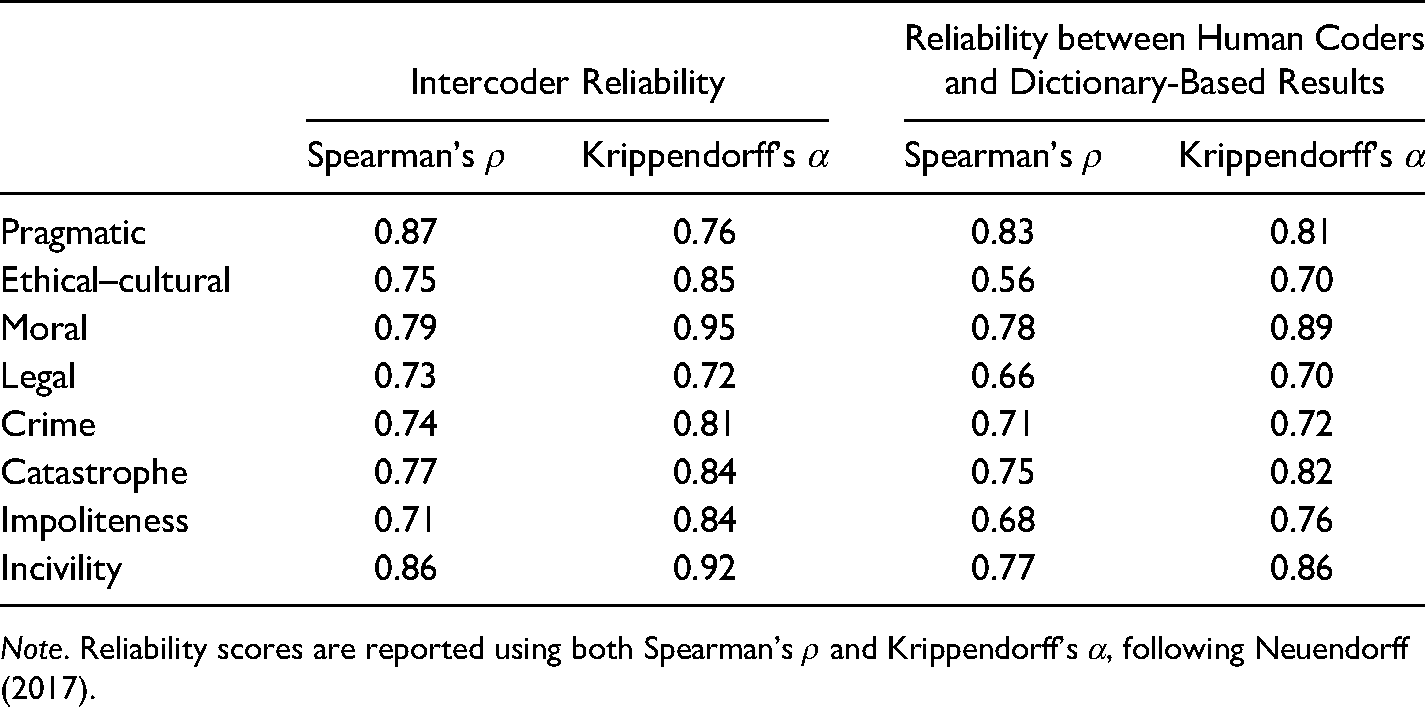
Note. Reliability scores are reported using both Spearman’s ρ and Krippendorff’s α, following Neuendorff (2017).
Occurrence of Arguments, Impoliteness, and Incivility in Individual Outlets.
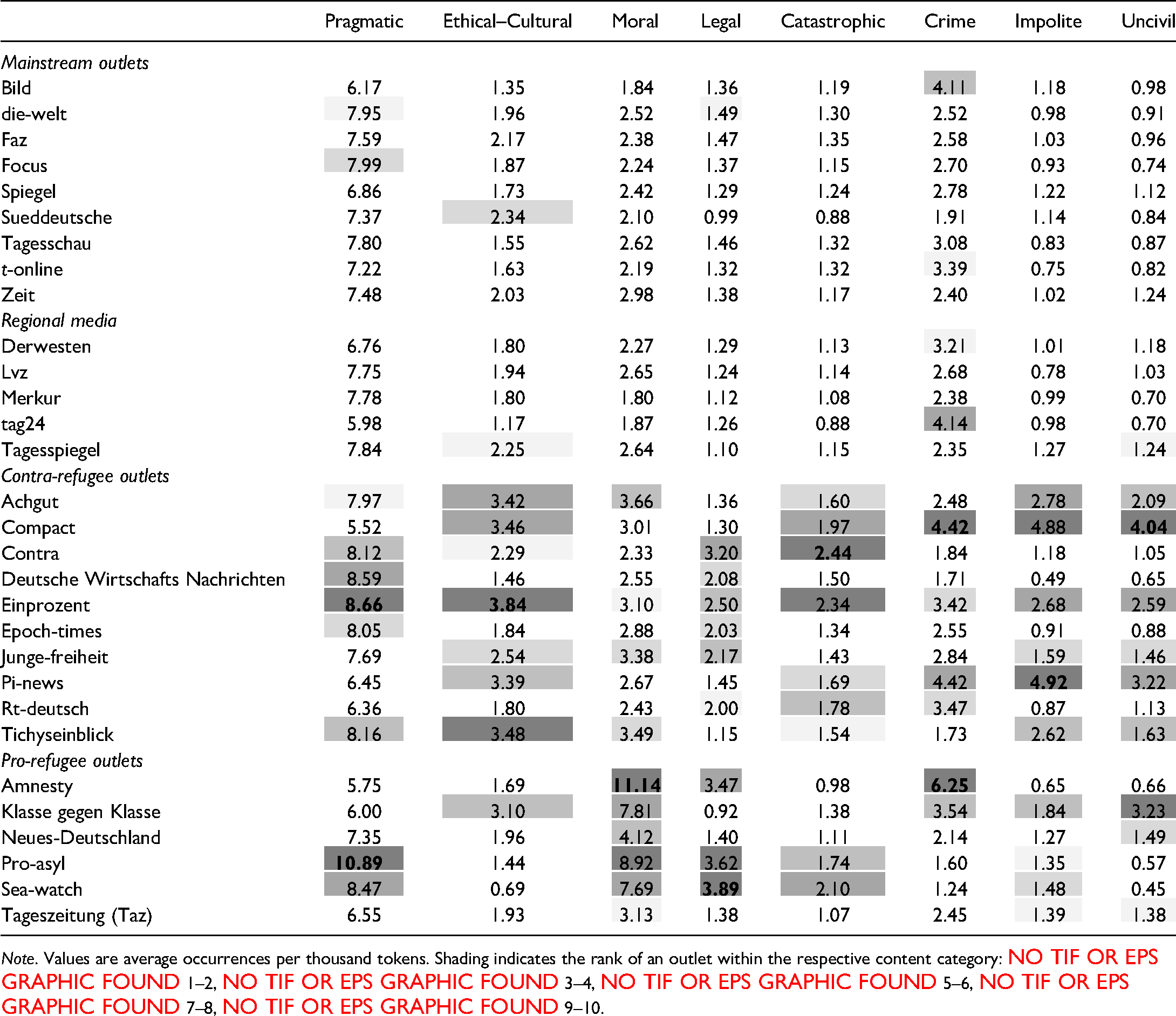
Note. Values are average occurrences per thousand tokens. Shading indicates the rank of an outlet within the respective content category:  1–2,
1–2,  3–4,
3–4,  5–6,
5–6,  7–8,
7–8,  9–10.
9–10.
Results
To assess the discursive profile of different outlets, we compare the occurrence of ethical–cultural, moral, legal, and pragmatic arguments, mentions of crime and catastrophe as well as incivility and impoliteness as the average occurrence of dictionary terms per 1,000 words on the article level (Table 3).
We then performed a principal component analysis on these data to assess how our variables relate to one another. This allows us to visualize in a two-dimensional space how the outlets perform on the seven variables measured. The resulting dimensions describe 39 and 27.9 percent of the variation on our underlying variables. Within Figure 1, therefore, arrows indicate the direction of underlying variables: The closer two-dimensional arrows are, the higher the underlying variables correlate. The closer outlets are to an arrow's tip, the larger their value on that dimension.
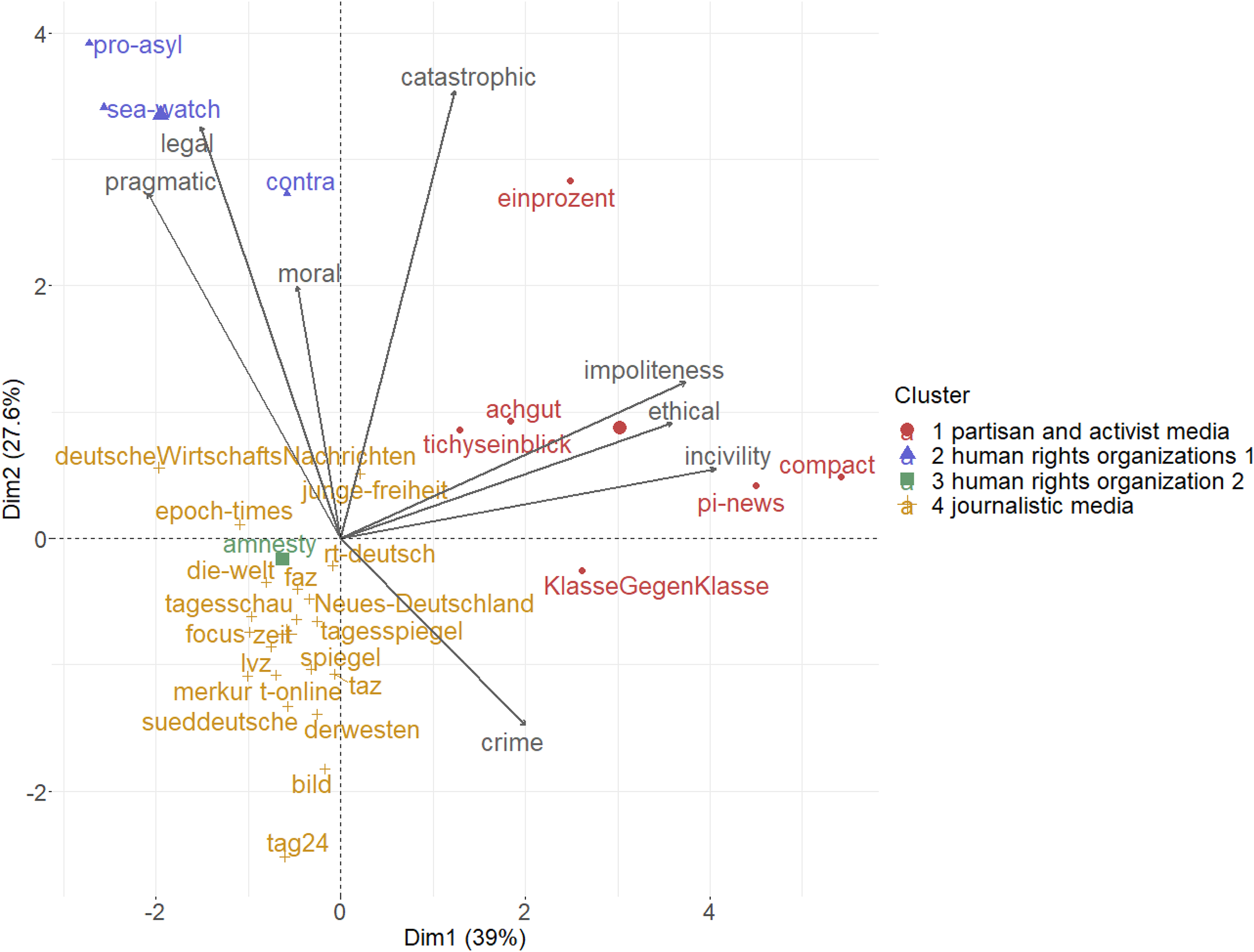
Mapping argument types, incivility, and impoliteness over all outlets. Principal component analysis of argument type and incivility/impoliteness variables. Arrows indicate the direction of individual variables; outlet position indicates their profile over all variables. Color of outlets is determined by hierarchical cluster analysis.
We further used hierarchical cluster analysis to assess which outlets are similar in their content profile. Using the Euclidian distance as our dissimilarity measure and Ward's method, we found that the outlets fell into four main clusters (for the elbow test and dendrogram see Section D of the Supplemental Information file). The results of both analyses are visualized in Figure 1.
Partisan and Activist Media
The first cluster we found within our sample is characterized by high volumes of both ethical arguments and incivility and impoliteness. Among the right-wing outlets (Achse des Guten, Compact, Ein Prozent, PINews, and Tichys Einblick), cultural values are invoked to present German culture as under threat and to draw a boundary against both cultural foreigners and politicians who do not share right-wing values. Political opponents are consistently compared to dictators in order to portray every policy that does not conform to the far-right as illegitimate, and to tie that threat to a perceived assault on an alleged homogeneous German culture. The threat of immigration is presented as apocalyptic—cultural heterogeneity is presented as leading to civil war and invasion by a homogeneous Muslim culture. Interestingly, the far-left pro-refugee outlet Klasse gegen Klasse mirrors these discourses in a similarly high share of incivility and impoliteness, and a focus on both ethical–cultural arguments and moral discourse. They counter the far-right arguments for cultural homogeneity with calls for a working-class identity that includes refugees. At the same time, they also mirror the far-right's antipluralism, by presenting moderate, and even left-wing politicians who are critical of unregulated immigration as reactionary and racist, leaving little room for legitimate democratic dissent.
Human Rights Organizations and a Right-wing Response
Cluster 2 contains two out of three Human rights organizations within our cluster (ProAsyl and Seawatch). These organizations focus on the humanitarian concerns guiding refugee policy, making a legal case for refugee rights, and highlighting pragmatic and what they consider catastrophic effects of refugee policies. Two of those outlets also emphasize catastrophic conditions within refugee camps to present further migration to the West as the only humane alternative (Table 3). At the same time, human rights groups avoid incivility and impoliteness: Opponents of a welcoming refugee policy are mostly treated with respect despite substantial disagreements. These outlets present the strongest case against Ackerman’s (1989) argument for communicative restraint: They are able to provide morally contested arguments without resorting to delegitimizing their opponents as enemies. Again, we find one outlier within this cluster: The far-right Contra Magazin mirrors human rights organizations' focus on legal and pragmatic discourses (Table 3) as well as low incivility and impoliteness while at the same time countering the human-rights narrative by emphasizing what they consider the catastrophic effects of taking in refugees. Amnesty International, lastly, is in its own cluster since it combines the features of other human rights organizations with a larger focus on crime: Due to their international focus, the crimes committed against refugees make up a larger share of their output. This leads to Amnesty International seemingly being close to the center of Figure 1, despite having the largest volume of moral arguments within their output (Table 3).
Mainstream Media and Alternative Journalistic Outlets
Within the last cluster, we find both legacy media and outlets we considered alternative news outlets. Compared to partisan media and activist outlets in the other clusters, these outlets are comparatively similar: They contain a lower share of moral and ethical arguments, mention catastrophic effects less often and display little incivility and impoliteness. Thus, one could argue they all, generally, follow the standard of detached reporting and would probably be viewed as journalistic outlets by readers.
Still, we were interested if the variance within this large cluster could be analyzed further. To do so, we conducted a principal component analysis only considering outlets from this cluster. Here, the resulting dimensions explain 36.9 and 27.5 percent of the variation on our underlying variables. We again used hierarchical cluster analysis to assess which outlets are similar in their content profile, finding that the remaining outlets again fell into four main clusters. The results are visualized in Figure 2.
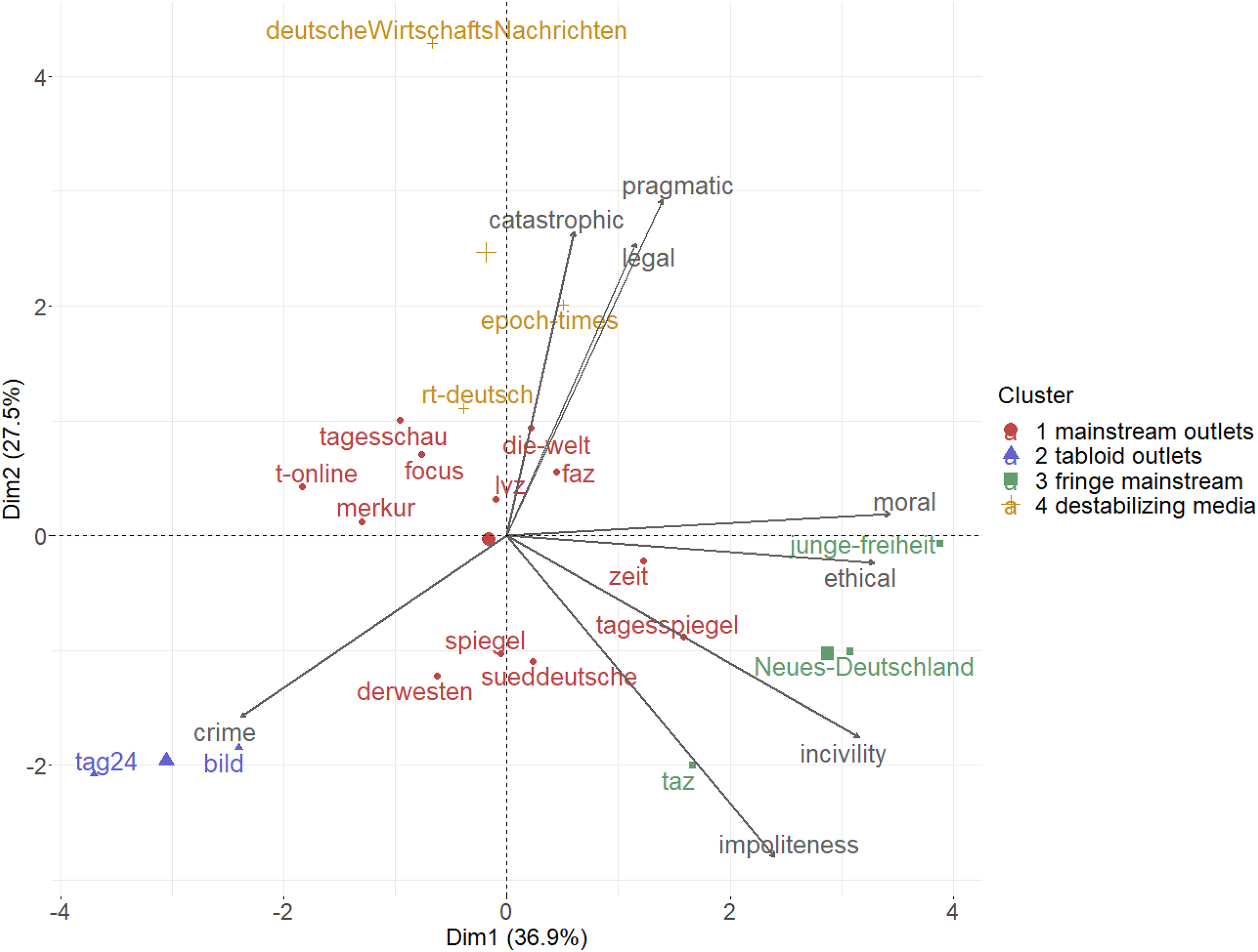
Mapping argument types, incivility, and impoliteness over journalistic outlets. Principal component analysis of argument type and incivility/impoliteness variables. Arrows indicate the direction of individual variables; outlet position indicates their profile over all variables. Color of outlets is determined by hierarchical cluster analysis.
Mainstream Outlets
Next, we observe that the largest cluster (Figure 2) contains all legacy media of both regional and national news outlets. It appears that mainstream media differ from all other clusters in their lower share of moral, ethical, legal, and even pragmatic arguments and lower incivility and impoliteness. At the same time, we find one interesting pattern within this cluster: The traditionally more left-leaning outlets Zeit and Sueddeutsche show a slightly increased share of moral and ethical-cultural arguments, respectively, while the more conservative outlets Welt and FAZ show a slightly increased share of pragmatic and legal arguments—suggesting that the political leanings of newspapers weakly influence the prevalence of argument types within their reporting.
Tabloid Media
The smallest cluster within the journalistic outlets is made up of tag24 and bild.de, which diverge from mainstream news coverage mainly in their larger focus on crime. Since bild.de is the online version of Germany’s largest tabloid, and tag24 is a regional outlet that seems to mirror bild.de in style (even copying the online tabloid’s layout), we can interpret this as a result of tabloid reporting’s focus on scandalization (Lawlor 2015).
Fringe Mainstream Media
The third cluster within the journalistic outlets (see Figure 2) contains legacy media of outlets that have somewhat established themselves within the German journalistic mainstream while having ties to either the left or the right fringe. TAZ, an originally left-wing alternative news outlet that today is considered left-liberal, and Neues Deutschland, a newspaper with financial ties to the Left Party, differ from mainstream reporting by a larger focus on moral arguments and slightly larger shares of incivility and impoliteness. Junge Freiheit, a conservative outlet with right-wing populist leanings, also falls into this cluster, with a higher share of ethical–cultural and moral arguments and similarly increased shares of incivility and impoliteness. These results suggest that the three fringe outlets function as a link between mainstream journalism and far-right and far-left actors—maintaining a journalistic style similar to professional news outlets, but with a slightly increased focus on ethical–cultural and moral arguments favored by the political fringes, and with slightly increased levels of incivility and impoliteness.
Destabilizing Media
Lastly, and interestingly, cluster 4 within Figure 2 contains Russia Today, Epoch Times, and Deutsche Wirtschafts Nachrichten. These media play a prominent role within right-wing populist media spheres (Bachl 2018), but we find that they interestingly do not diverge much from mainstream reporting. In fact, during the coding process we observed that these outlets contain a lot of content adopted from mainstream news agencies. Future research, therefore, should consider the possibility that these pages water down questionable reporting by integrating it into traditional factual news, which might serve to legitimize these outlets in the eyes of potential readers. At the same time, these outlets differ from mainstream reporting due to their larger focus on legality and a larger share of catastrophic effects (Table 3)—citing both fears of catastrophic effects of migration, but also reports of catastrophic conditions within refugee camps. This might indicate a strategy of opportunistically feeding general societal dissatisfaction—which is consistent with previous research into Russia Today's editorial strategy (Elswah and Howard 2020; Yablokov 2015).
Discussion
In this study, our aim was to assess the performance of legacy and emerging online outlets under conditions of both an abnormalization of political discourses and increasing diversification of journalistic, partisan, and activist media within the online public sphere. With populist right-wing alternative media (Bachl 2018; Heiss and Matthes 2020) and left-wing activist media working alongside traditional news outlets, critics fear the disintegrative potential of a growing “disinformation order” (Bennett and Livingston 2018). At the same time, both promotion of and backlash against progressive policies are normal features of a democratic society. What should worry us is not the expansion of spaces of public contestation, but whether these discourses are conducted “in such a manner that enemies become frenemies, that sharp antagonism is moderated and agonism thrives” (Alexander 2019: 6).
By focusing on what types of arguments are promoted within different information sources, and whether they maintain civility and politeness, we assess the functions that particular groups of outlets serve within the broader public sphere. Liberal theorists argue that these actors best focus on the pragmatic- and legal-evaluative function of public discourses and otherwise practice conversational restraint in order not to threaten the integrative function through incivility and impoliteness. Deliberative democrats, meanwhile, argue that public debate can also perform a moral-deliberative function without contradicting the integrative function. Agonistic democrats, in turn, argue that by strengthening group-identities, alternative media should perform an agonistic function while at least maintaining civility so that the integrative function is not threatened.
Against the backdrop of these normative expectations it is interesting to note that the traditional and alternative media outlets we observed in this case study appear to serve vastly different functions that play to competing normative ideals, and that our observed variables allowed us to map diverging outlet types by exactly the functions they perform.
We find that within the journalistic field, legacy media appear to practice conversational restraint, concentrating on the integrative function of public discourse by maintaining low levels of incivility. Mainstream journalism appears to be supplemented by established fringe mainstream outlets with slightly increased incivility as well as moral and ethical–cultural argumentation.
The question, then, is whether activist and partisan media supplement this internally differentiated mainstream by outperforming them on the moral-deliberative and agonistic functions.
It is striking that in our case study we did not find instances of ideal-typical agonistic group-based alternative media, that is, media that focus on ethical–cultural argumentation while at the same time maintaining agonistic respect, which has been observed in activist forums under different circumstances (Milioni 2009), Instead, the partisan outlets that did concentrate on ethical–cultural, group-based argumentation also exhibited high levels of incivility. This was true for one of the observed activist outlets representative of the far-left (Klasse gegen Klasse), but mainly for partisan outlets from the contra-refugee camp. As Uldam and Askanius (2013) have noted, civility can be contested within activist spaces, and political identities can also form around a common identity that is decidedly antipluralist: By portraying opponents as illegitimate, far-right and far-left groups strive to mobilize supporters for their causes. However, instead of turning political antagonism into agonistic relations of respect within a shared democratic framework (Mouffe 2013), such movements undermine the democratic consensus, which is why we wish to call them corrosive partisan media. Our results, therefore, are in line with other research that tentatively warns of the potentially detrimental roles that hyper-partisan media play within the larger public sphere (Boberg et al. 2020; Heiss and Matthes 2020). Although a focus on cultural values and opposition to liberal refugee policies is a normal feature within a democratic society, it is the organized disruption and spread of delegitimizing language within these networks that risks corroding healthy democratic contestation.
Finally, in our case study we did find advocatory activist media which maintain high levels of civility and simultaneously concentrate on arguing based on universal human rights and standards of justice, thus supplementing both the moral-deliberative and integrative functions of mainstream outlets—a feature previously only explored within traditional news media (Mitman et al. 2012). Interestingly, by focusing on legal arguments and the efficiency of refugee policies, they also strengthen the legal-evaluative and pragmatic functions of the public sphere at large. The presence of advocatory activist media can be explained by the lack of direct access to the publicity that marginalized groups (such as refugees) themselves enjoy in the German public sphere (Berry et al. 2016). Their focus, therefore, is less on mobilizing migrants, but instead, on influencing opinion-formation among Germans. In doing so they largely follow deliberative standards of moral argumentation and low incivility and impoliteness, not the agonistic ideals associated with self-mobilizing media.
Conclusion
Our focus on the substantive focus of discourses allows us to point out normatively positive and negative contributions of different online outlets: While some might mobilize marginalized actors (agonistic alternative media) or allow for the introduction of moral arguments into the broader public sphere (advocatory activist media), we should be careful not to underestimate potential negative effects that corrosive partisan media can have (Bennett and Livingston 2018).
In this paper, we have focused on the general character of pragmatic, ethical–cultural, moral, and legal argument. Our identification of advocatory activist and corrosive partisan media based on these argument types, as theoretically important as they are, might be somewhat specific to the case we have studied. A more generalizing approach in assessing emerging online media seems therefore warranted.
Similarly, our focus on German online outlets opens avenues for comparison with other countries where the interplay between polarizing camps of media actors and the mainstream might look different. As we noted, the absence of migrant-based agonistic alternative media in the German case might be due to the lack of access opportunities for migrants in this country. Future research should thus investigate migrant outlets in terms of their argument types and impoliteness/incivility to assess their unique contribution to refugee policy discourses.
Finally, the investigation of incivility and impoliteness in public discourse could be made more fine-grained. Our measurement tools did not distinguish against whom the uncivil and impolite statements were directed. Our results can therefore be supplemented by qualitative research that investigates how exactly particular groups are constructed as illegitimate enemies within different outlets and online spaces (Freudenthaler 2020).
Supplemental Material
sj-docx-1-hij-10.1177_19401612211015077 - Supplemental material for Mapping Emerging and Legacy Outlets Online by Their Democratic Functions—Agonistic, Deliberative, or Corrosive?
Supplemental material, sj-docx-1-hij-10.1177_19401612211015077 for Mapping Emerging and Legacy Outlets Online by Their Democratic Functions—Agonistic, Deliberative, or Corrosive? by Rainer Freudenthaler and Hartmut Wessler in The International Journal of Press/Politics
Footnotes
Declaration of Conflicting Interests
The authors declared no potential conflicts of interest with respect to the research, authorship, and/or publication of this article.
Funding
The authors received no financial support for the research, authorship, and/or publication of this article.

Supplemental Materials
Notes
Author Biographies
References
Supplementary Material
Please find the following supplemental material available below.
For Open Access articles published under a Creative Commons License, all supplemental material carries the same license as the article it is associated with.
For non-Open Access articles published, all supplemental material carries a non-exclusive license, and permission requests for re-use of supplemental material or any part of supplemental material shall be sent directly to the copyright owner as specified in the copyright notice associated with the article.
