




Abstract
Facebook meme pages in the Middle East and North Africa (MENA) have flared-up in the past decade. Since 2017, some Moroccan pages have started sharing exclusively patriarchal, ultra- and ethnonationalist, misogynist, and racist content shaped to look in line with “alt-right” online aesthetics. Self-identifying as right-wing, these pages have memetized an entire ecosystem of scapegoats as enemies of the nation. Furthermore, they have rescued symbols from the past, such as the late King Hassan II or the Marinid flag, to formally establish the Moroccan Right. In view of this trend, this paper examines Moroccan Facebook meme pages that share ultranationalist content and build on a scapegoating strategy to understand how Far-Right ideologies have been adapted in the MENA. Through multimodal discourse analysis of memes posted since 2017 until April 2020, this paper studies the ways in which the revival of Far-Right tropes is contributing to reshaping local digital political landscapes and pushing toward an Arab Right. By examining a collection of over 1,600 memes, our paper argues that this new online Moroccan Far-Right discourse is adapting Far-Right views, particularly in terms of gender and race, to local politics. This research contends that internet memes are effectively acting as an entry point in the creation of a Moroccan Far-Right. As a newly formed trend, however, the Moroccan Far Right is still negotiating its main tenets.
Keywords
In recent years in Morocco, Facebook meme pages reproducing ultranationalist, antifeminist, and antimigration themes have been blooming. Paralleling what has happened in other countries with the rise of an “alt-right” culture on the internet, Morocco is witnessing the rise of reactionary digital cultures. These combine populist and nationalist narratives while employing racist and misogynist language. These online discourses assert the superiority of the Arab, light-skinned, heterosexual, and male conservative Moroccan and antagonize minorities and leftists who are accused of endangering the nation. This phenomenon deserves close scrutiny to understand the parallel development of online politics and the nationalist Right in the Middle East and North Africa (MENA) region.
Formally, a populist Far-Right 1 political party has yet to set foot in the Moroccan political spectrum. Since independence in 1956, Moroccan politics have been dominated by moderate nationalist royalists parties—mainly Istiqlal (Independence Party), National Rally of Independents (RNI), and the more recent Authenticity and Modernity Party (PAM); socialists from the Socialist Union of Popular Forces (USFP) and Unified Socialist Party (PSU); and Islamists from the Justice and Development Party (PJD), with no strong right-wing party. Over the last decades the Makhzen—the central political establishment surrounding the monarchy formed by political and economic ruling elites which provides the country's administrative structure, legal framework, and military manpower to increase the monarchy's authority—has promoted neoliberal economic policies together with a discourse of democratization and openness informed by liberal values, despite the ongoing persecution of journalists and leaders of social movements. Yet, this neoliberal consensus is now challenged by the rise of a different ultranationalist sentiment.
Since the so-called Arab Spring, scholars have paid more attention to informal forms of participation and its potential to build larger national movements (Volpi and Clark 2019: 4). Examples of this work in Morocco include analyses of the role of urban independent networks as the genesis of the Moroccan nationalist movement (Ait Mous 2013); studies on how the remembrance of past revolutionary moments affect contemporary social movements (Aouragh 2017); and discussions of the impact of youth networks such as unemployed graduates (Emperador Badimon 2019) and football ultras (Banaji and Moreno-Almeida 2020) on political participation.
With a growing number of online Facebook meme pages proudly claiming to represent the Moroccan Right, this paper calls for an investigation of the role of memes in the penetration of the Far-Right and the discourse it has developed by exploring how Moroccan trends are related to the rise of the Far-Right globally and the similarity and differences in their related online communication practices. How Far-Right groups in Morocco use Facebook pages and groups to spread their propaganda? What kind of tropes and language are used in self-declared right-wing memes Facebook pages? What are the main targets of these memes, and how do they contribute to the scapegoating culture pursued by the Far-Right? And finally, to what extent are these altogether new phenomena or rather the evolution of conservative views already present in the political arena?
This article proceeds through a number of steps. First, it introduces the emergence of Far-Right politics in Morocco and its specificity as compared with the global “alt-right” problematizing the concept of the Arab Right. 2 It discusses the way social media has become a fertile space for the diffusion of Far-Right hate speech globally and in the MENA and Moroccan context specifically. Then, after discussing methodology and data collection, it delves into the two main contents of Moroccan Far-Right Facebook meme pages: (1) symbols of superiority: tracing how Facebook memes pages revive the late King Hassan II as the strong leader and the old Marinid flag as a symbol of the Moroccan Right capitalizing also on well-known “alt-right” memes; (2) scapegoating: investigating scapegoating as a strategy to create a new right-wing identity fighting against internal enemies such as minoritized communities, activists, and left-wing groups. Finally, we discuss in detail the implications of the rise of Far-Right groups on social media in Morocco and in the MENA region.
The Far-Right and Online Propaganda
In the past decade, a global wave of Far-Right has gained momentum. The coming to power in India of the Hindutva movement in 2014, UK's Brexit and Donald Trump's victories in 2016, the election of Jair Bolsonaro in Brazil, and the growing presence of Far-Right parties in Europe such as VOX in Spain or the Sweden Democrats (Sverigedemokraterna) are all examples of this impelling force. Finding one common term or definition for these heterogeneous parties and movements especially considering their diverse geopolitical contexts is, however, not a simple task. In recent years, the new wave of Far-Right culture has earned the name of “alt-right” strongly developing online and supported by youth. The term “alt-right,” from alternative right, reflects the influence of digital cultures developing of online forums such as 4Chan, the origin of the famous Trumpist Pepe the Frog memes. Yet, it says little about the actual ideological content, and its nationalist, racist, and misogynist connotations (Marwick and Lewis 2017).
Some scholars suggest employing the term “digital fascism” claiming there is no significant difference between traditional forms of fascism and a renewed Far-Right (Fielitz and Marcks 2019). However, this term seems to overlook the broader range of positions that are represented with the online Far-Right, and the fact that the success of the new Far-Right is partly premised on its ability to be perceived as different from traditional fascism (Traverso 2019). Despite this complexity, the new Far-Right shares some common traits. First, the Far-Right adopts a nationalist discourse often tied to ideas of racial or civilizational superiority and accompanied by an aggressive stance in international politics and enmity toward migrants. The Right typically exploits the “fear of an other” (Albrecht et al. 2019: 8) casting certain categories of people as enemies of the nation. Second, the Far-Right adopts a populist antiestablishment discourse that presents the elites and intellectuals as far from the views and interests of ordinary people and tied to international interests. Third, Far-Right discourse is infused with a strong social conservatism, which comprises a reassertion of patriarchal norms vis-à-vis women’s rights and the LGBTQIA+ community. These illiberal stances (Pappas 2016) are tied to a monoculturalism (namely the belief that only one culture should dominate the public sphere) and antipluralism, which carry strong reactionary connotations. We define the groups considered in this article as “Far-Right” rather than “Right” for the following number of reasons. First, these groups openly and publicly champion homophobia, sexism, and chauvinism that are typical of the Far-Right worldwide, rather than of the traditional conservative right. Second, these groups explicitly embrace symbols and language such as the Pepe the Frog meme and the Make America Great Again (MAGA) red cap that have been popularized by the US “alt-right.” The “alt-right” is a Far-Right movement and has been recognized as such by the Southern Poverty Law Centre. The groups we analyze in this article can be considered as the Moroccan version of this ideology. Third, if we were to look for a local equivalent to a center-right nationalists or Islamists parties that adopt conservative positions whether on social and cultural rights do not exhibit the level of hate speech as the groups we analyze in our article. Accordingly, we summarize renewed Far-Right discourses as racist and antimigration, antisemitic and Islamophobic, antifeminist and anti-LGBTQIA+, antileftist, and antiestablishment as well as reactionary and ethno- and ultranationalist.
This global resurgence of the Far-Right is paralleled by recent developments in the MENA region. However, to date efforts to conceptualize an Arab Right have been scant. Said (1994 [1979]) briefly attempted to conceptualize an Arab Right concluding, however, that the term was useless and inadequate to define Arab political parties. Recently, Bardawil (2020: 74–75) concurs with Said stating that a neat division of the world into two camps, Left and Right, is no longer applicable. However, the emergence of online right-wing groups in Morocco and the MENA area calls for a conceptualization effort of what the Arab Right constitutes in this day and age. In the Arab Region, it can be said that the political Right stems from two largely contradictory sources: Islamist fundamentalism and Arab Nationalism.
Some scholars in the United States have theorized the Far-Right in the MENA region writing of an Islamofascism to speak of the actions of terrorist groups as Al-Qaeda (Wild 2012) but also of the Muslim Brotherhood and Hezbollah. These catch-all definitions often reflect a lack of understanding of the complexity of political Islam. The latter ranges from groups such as the Muslim Brotherhood, which while espousing conservative themes accepts the framework of liberal democracy, and extremist groups such arch-traditionalist Salafis, who call for the installment of a theocracy. Imposing ideas of fascism developed in European countries does not seem able to capture the specificity of Islamist ideology (Zuckermann 2012). There is a longstanding tradition of Arab nationalism pursued by the likes of Gamal Abdel Nasser in Egypt and the Ba’ath parties in Iraq and Syria (Dawisha 2016). This ideology promoting Arab civilization had a strong pan-Arab element, emphasizing the cooperation of all Arab nations. However, it was always paralleled by strong local nationalism in each nation state (e.g., Egyptian nationalism or Moroccan nationalism) which was often in contradiction with the universalism of pan-Arab identities (Tibi 1997). What both streams of pan-Arab and local nationalism share are an enmity toward radical Islamist groups, accompanied by an embrace of institutional Islam, and typical elements associated with nationalism such as national pride, a cult of the state and leaders, and a suspicion toward internal dissent and pluralism.
Moroccan politics has been marked by—and marketed as—an exceptional landscape of relative stability as compared with other Arab countries (such as Egypt, Tunisia, Libya, and Syria) that in the post-war period have been engulfed by Arab nationalist revolutions and coup d’états. Nationalism in this context has not been identified with Arab nationalist regimes but with the Alaouite monarchy embedded in the country's motto “Allah, Al-Watan, Al-Malik” (God, the Nation, and the King) and the King's role as guarantor of the unity of the country. This official nationalism has been accompanied by a neoliberal promarket consensus to the benefit of the country's bourgeoisie and the King who became Morocco's most important businessman (Sater 2010: 98–106). In this context nationalism, Left or Right positions propelled by the policy of “Alternance” starting in 1998 with left-wing and right-wing coalitions taking turns in governing the country, appeared to be marginal and with limited consequences for national political equilibrium. In recent years, we have seen an ultranationalist turn in Morocco that has become more evident at the start of the COVID-19 crisis as, in times of insecurity, nationalism “yields the ability to reinstate a renewed and shared understanding of the nation” (Zarhloule 2020). This trend, as we shall see, has been paralleled by the emergence of Far-Right online activity that appears to be different in character from this official nationalism. Key to this emerging online nationalism is the use of social media as a terrain of propaganda and an enthusiastic use of new languages such as internet memes.
From a global standpoint, the internet has been pivotal to the resurfacing and growth of the Far-Right (Banaji et al. 2019; Marwick and Lewis 2017; Merrill 2020). In the 2010s, Far-Right trolls have thrived on the internet by capitalizing on digital cultures (Fielitz and Marcks 2019; Fielitz and Thurston 2019), developing “attention hacking” techniques (Marwick and Lewis 2017), and maximizing the power of memes to spread their beliefs (Fielitz and Thurston 2019; Merrill 2020). Shared by multiple participants on popular social media platforms, internet memes are cocreated digital artifacts. They comprise such media objects as images, image-macros, videos, GIFs, phrases, or emojis that emerge from popular culture’s practice of remixing and remaking (Mina 2019: 18). While memes were initially associated with fringe message boards such as 4Chan or Reddit within secluded online subcultures, they are now part of the internet mainstream (Phillips 2015).
Memes are well fitted to build collective identity (Nissenbaum and Shifman 2017: 485). They are one of the Far-Right favorite forms of communication, thanks to their power of conveying in simplified terms an antagonism vis-à-vis the norms of liberal politically correct, or PC culture (Marwick and Lewis 2017). But this antipathy is often based on the exclusion of the other (Miltner 2014). Often, this hostility is expressed through sarcastic messages aiming at producing an aggressive laughter reaction in the audience as expressed in the digital culture term the “lulz.” This is the case with so-called “dank memes” that are “ironic expression[s] used to describe online viral media and in-jokes that are intentionally bizarre or have exhausted their comedic value to the point of being trite or cliché.” 3 On the opposite side are mainstream, recognizable, and known memes that everyone understands known as normie memes. Normie “is a slang pejorative label for an individual who is deemed to be boringly conventional or mainstream by those who identify themselves as nonconformists.” 4 Dank memes often involve a strong element of sarcasm bordering on open offense, which can be perfectly fitted to the exclusionary and reactionary politics of the Right, in which derision of the Other can serve as a means of reinforcing self-pride. But how does this construction of self-identity through derision and scapegoating play out in practice? What is the content of memes circulated by the online Far-Right in Morocco? And what does it tell us about the relationship between social media and the global resurgence of Far-Right politics?
Methodology
This paper looks at memes through the lenses of digital discourse analysis (Bou-Franch and Garcés-Conejos Blitvich 2019; Jones et al. 2015) and multimodal discourse analysis (MDA) (Kress and van Leeuwen 2006; van Leeuwen 2015). These two methodologies explore digital media's affordances and constraints as another layer of analysis allowing us to redefine terms such as text, context, interaction, and power (Jones et al. 2015). Through MDA, we analyze memes as integrated multimodal texts that include language, picture, sound, and moving images. Because memes are often multimodal, MDA considers meaning in memes as a combination of partial meanings of text and pictures (Yus 2019: 107) in written texts, still images, and GIFs.
Data Collection and Analysis
During data collection (2017–2020), one of the pages that stood out was Moroccan Nationalist Memes (MNM) due to the change in political narratives from previous meme pages. MNM added an ideologically different discourse into our mapping of Moroccan meme pages. We followed the page closely collecting significant posts for close analysis. In addition to observation, we took field notes of main themes and important discussions. We collected one-year (April 2019–April 2020) worth of images–macros shared on the MNM page whether anonymous or attributed to a user. These added up to 1,639 memes. We coded each meme using NVIVO grouping them by themes, people, symbols, and languages to identify main nationalist themes (Figure 1).
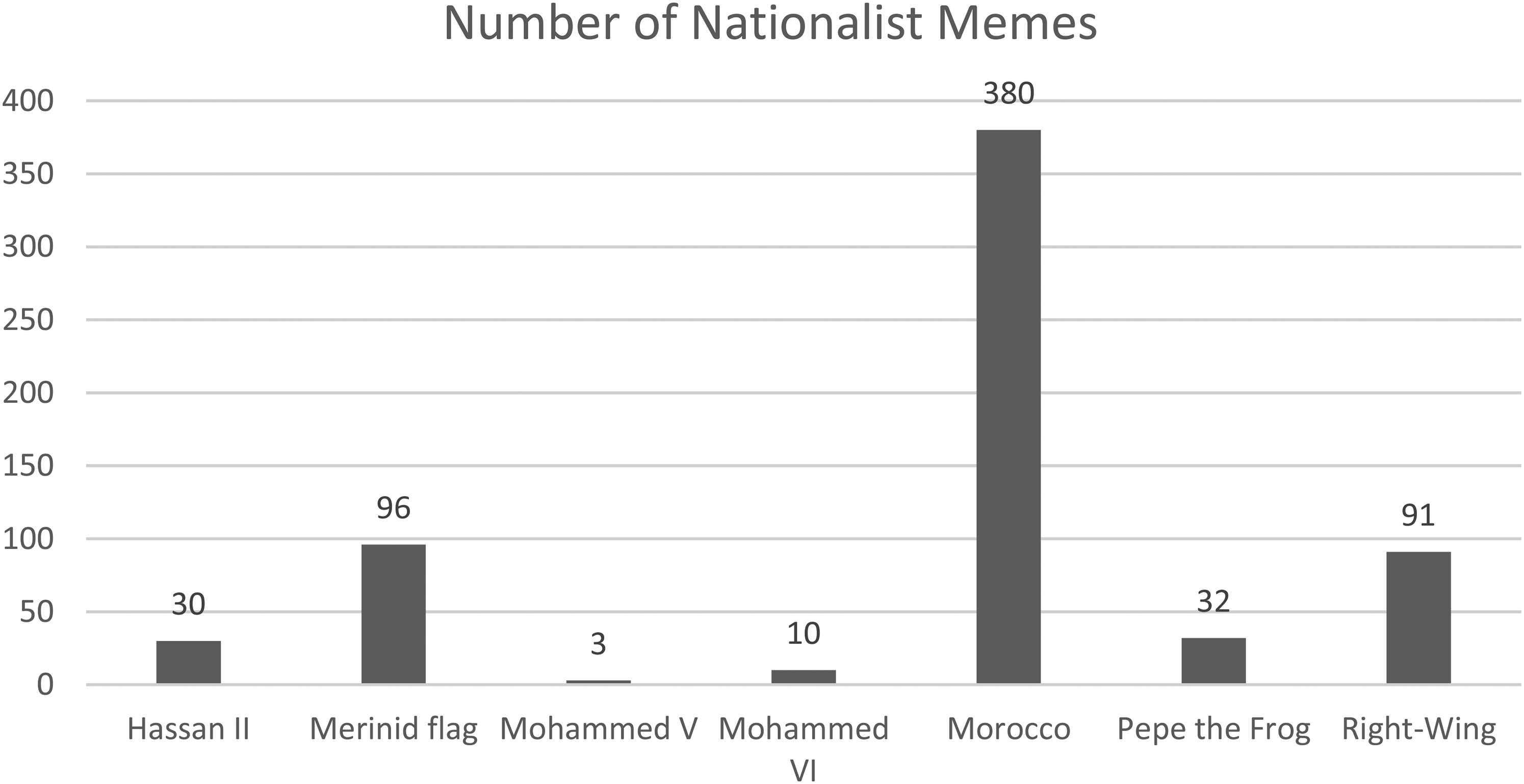
Number of nationalist memes.
We then broadened our research to other related Facebook pages centered using a snowball sampling approach from the “Related Pages” suggested pages by Facebook. The pages we found all contain multimodal data mainly in the form of image macros. These pages range from historical content and serious memes to anti-Marxist and racist satirical memes. For our analysis, we combined the result of coding MNM memes, together with the observation of ten other Facebook pages (see Table 1).
Moroccan Nationalist Facebook Meme Pages Featuring the Marinid Flag or Far-Right Memes.
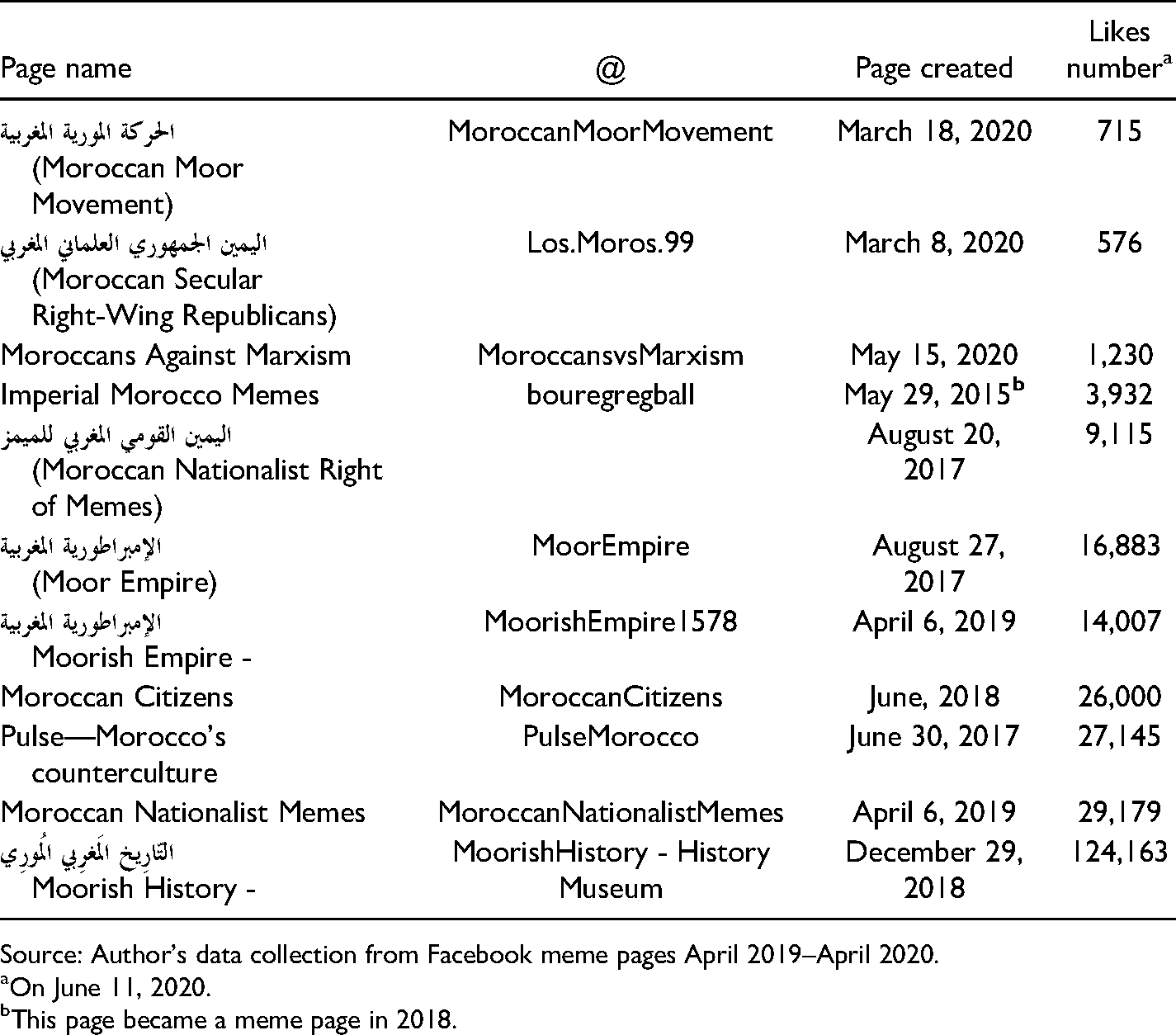
Source: Author's data collection from Facebook meme pages April 2019–April 2020.
On June 11, 2020.
This page became a meme page in 2018.
In the analysis section, we map out some of the key traits of the online Moroccan Far-Right based on the results of our coding (Figures 1 and 2) and observations. The memes we chose for our analysis represent those that best communicate three of the main tenets that characterize the Moroccan Far-Right: (1) the aim to build a distinctive Moroccan Right as is the case with the Marinid Flag meme (Figure 3 and 4); (2) those that symbolize an allegiance to the “alt-right” such as Pepe the Frog (Figure 5) as well as the highly recurrent Yes Chad Meme (Figure 6) which is clear in its manifestation of hate against groups we highlight in the following sections and that align with the renewed Far-Right.
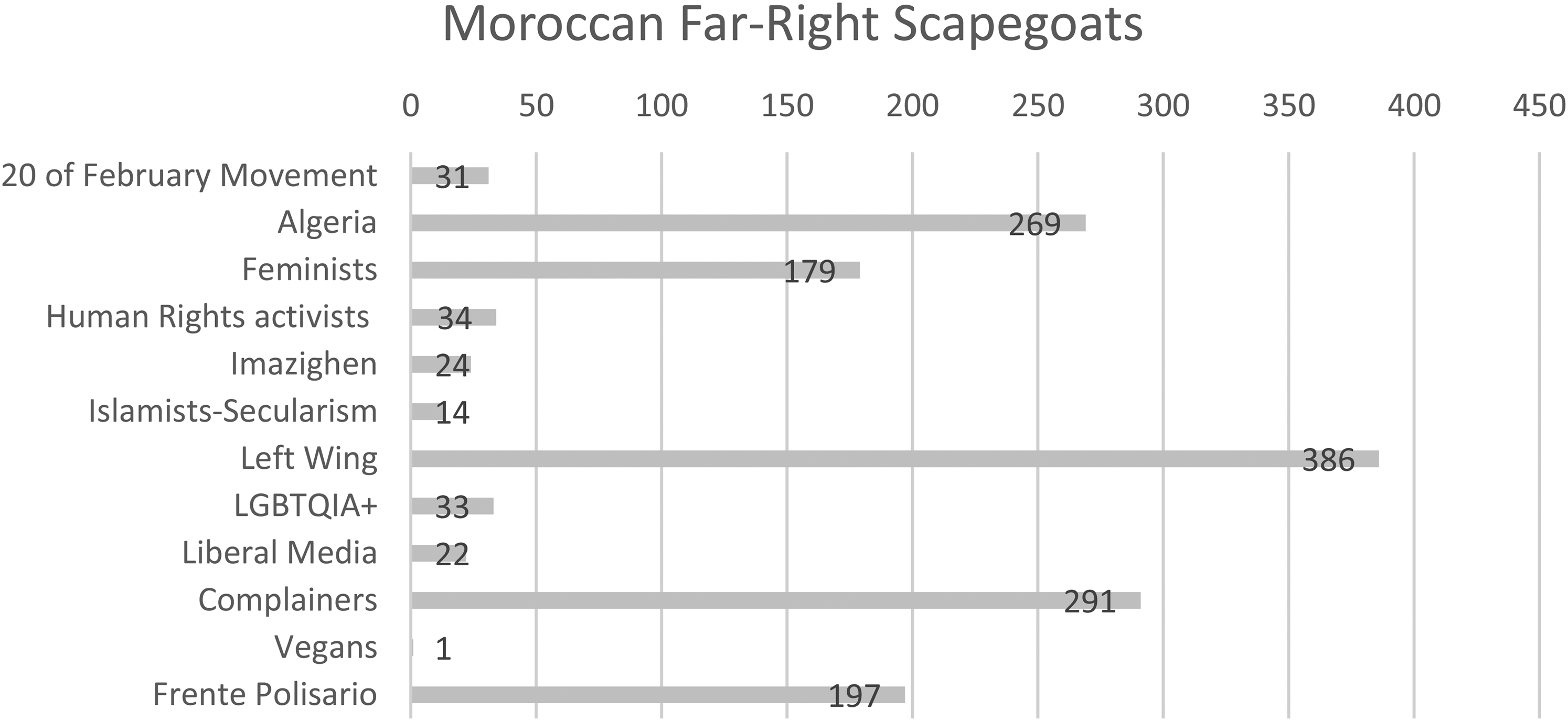
Moroccan Far-Right scapegoats.
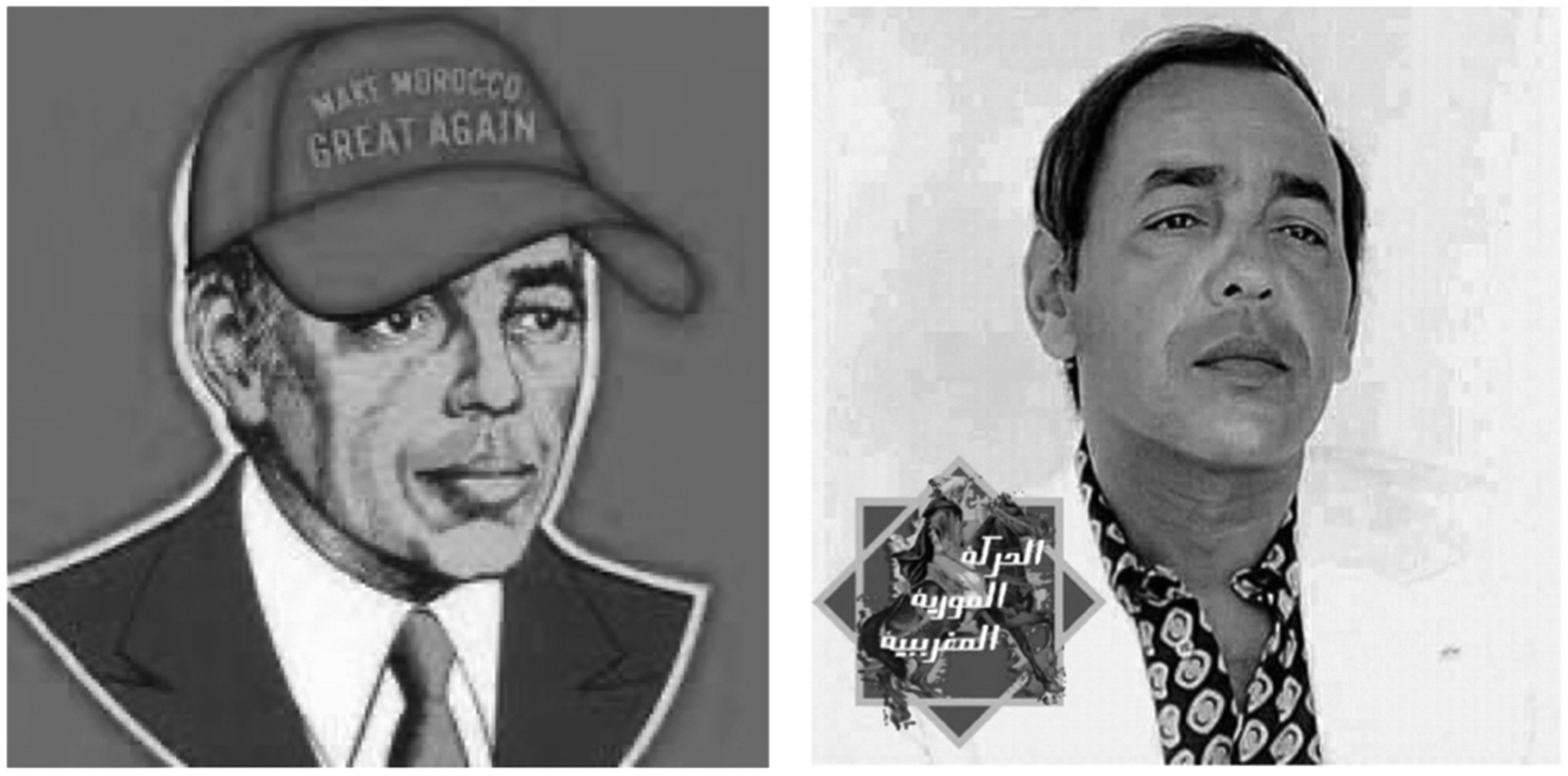
Profile pictures featuring King Hassan II posted in April 2019 and April 2020, respectively.
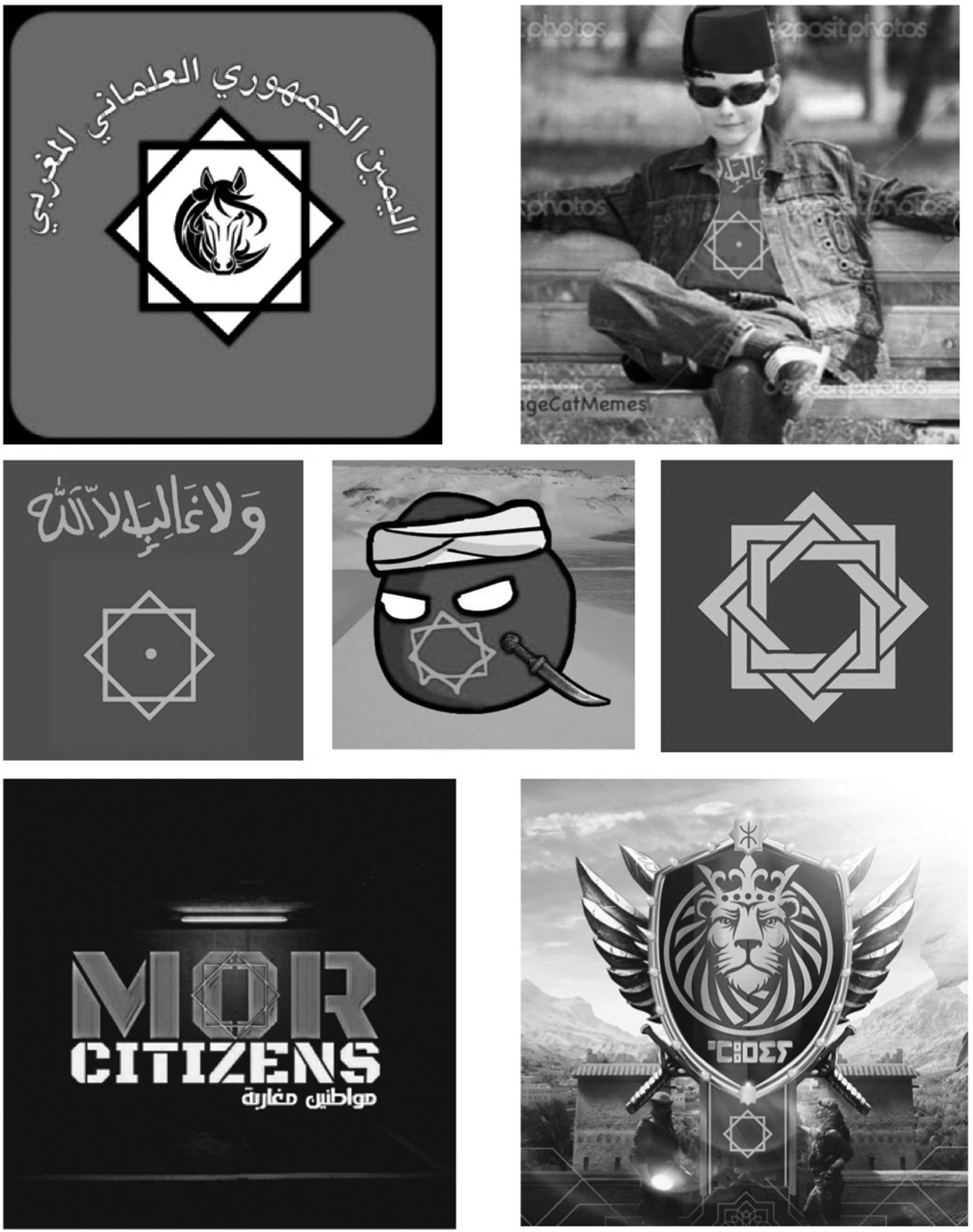
Facebook meme pages profile pictures featuring the Marinid flag posted between April 2019 and April 2020.
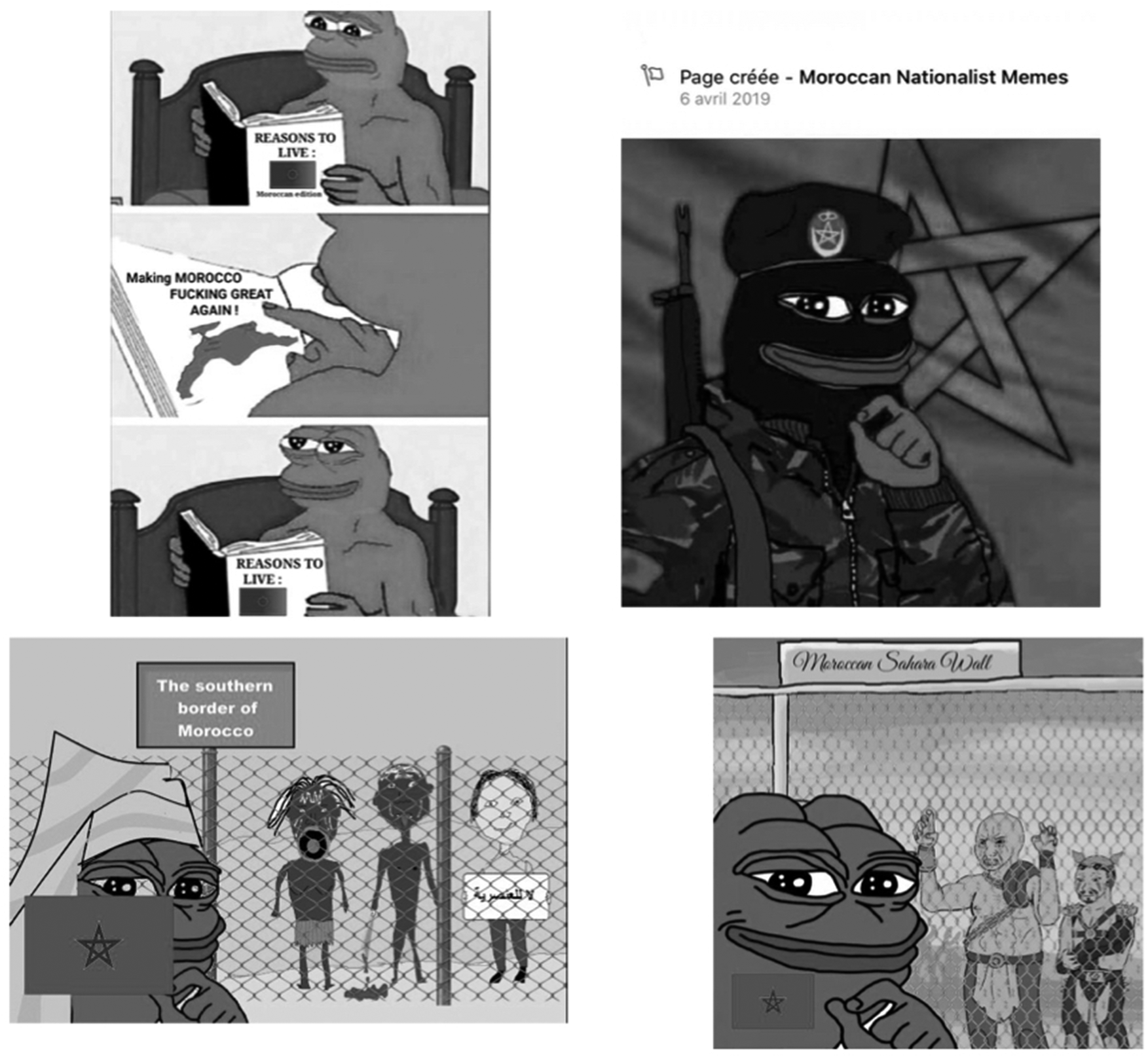
Moroccan Pepe the Frog in Moroccan Nationalist memes posted between April 2019 and April 2020.
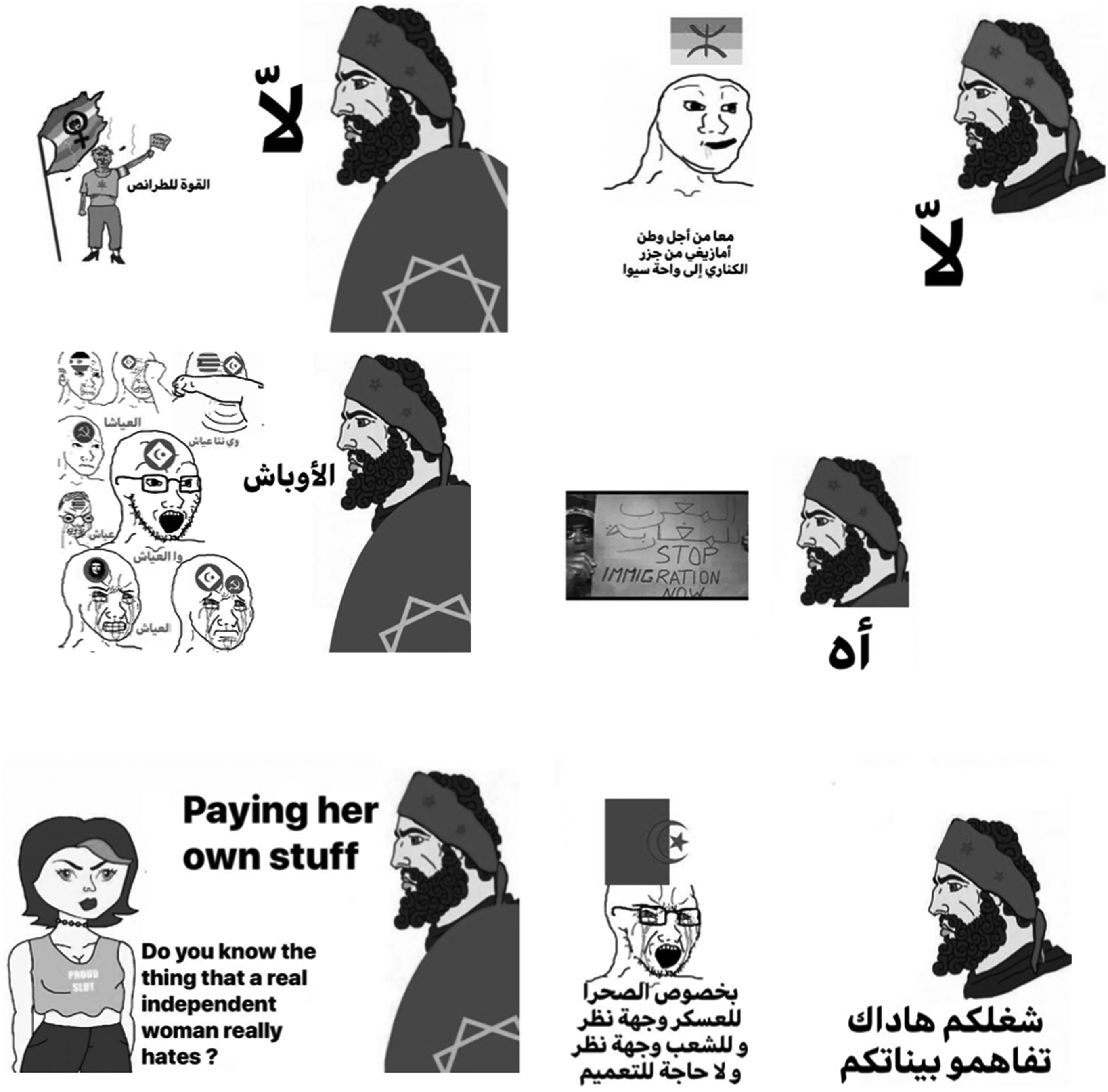
Moroccan Yes Chad meme in Moroccan Nationalist memes posted between April 2019 and April 2020.
Making Morocco Great Again
One of the key motives of the online Far-Right in Morocco is the celebration of the glories of its national history. For their commemoration of national military victories, these pages have recuperated the figure of late King Hassan II as a national hero and an old Moroccan flag as symbol of an authentic nation that has been lost. The MNM Facebook page has adopted Donald Trump's 2016 MAGA now turned into Make Morocco Great Again written on a red cap sported by late King Hassan II (1965–1999) (Figure 3). With over 30 memes devoted to Hassan II (Figure 1) MNM joins other nationalist pages (Table 1) in exhibiting a preference for a bygone era, glaringly overlooking many of its unsavory elements such as the extreme repression of the Years of Lead. 5 The nostalgic tone of these memes is seen in numerous images portraying Hassan II in black and white or adding glitched effects. These images are often accompanied by triumphalist phrases such as “If they attack the march, we will eat them” which the late King pronounced before the Green March in 1975. Rather than eliciting lulz, these memes glorify the past, brandishing it against what the creators of these pages consider as the corruption of contemporary political reality, due to concessions made to the Left, and prodemocracy activists, feminists and ethnocultural minorities such as Imazighen (pl. Amazigh) (Berbers). Proof of changing nationalist symbols is the fact that the present monarch Mohammed VI is much less celebrated (only six memes were dedicated to him in one year as Figure 1 shows), at least until the COVID-19 pandemic. In this line, the Moroccan meme culture of different social and political leanings has often mocked and criticized Mohammed VI (Moreno-Almeida 2020). In comparison, these pages present a distinct and respectful depiction in memes of late Hassan II (see Figure 3 for two examples).
Another key image recurring in these online Far-Right Facebook pages is the Marinid flag (Figures 3 and 4) to symbolize the difference of their political and ideological agenda with regard to the official establishment. Traditional histories of Morocco favor the Idrisids (788–974) as the first leaders of the country or Almoravids (1060–1147) and Almohads (1147–1248) as rulers of Al-Andalus. The Far-Right, however, has chosen the Marinid dynasty (1248–1465) as the golden Moroccan era because of their territorial expansion throughout North Africa. Consisting of an eight-point yellow star formed by two interlaced squares over a red background, the Marinid flag serves as an alternate form of national identification to the official flag. The latter, a green pentagram over a plain red field adopted in 1915 during the French Rule (1912–1956) is after all a product of colonialism. By recuperating the Marinid flag, the Far-Right expresses not only pride in Moroccan identity but a longing for the aggressive expansionism of the Moorish Empire.
This is the case for other pages that specifically adhere to Right-Wing views such as Moroccan Right-Wing Secular Republicans, Moroccan Nationalist Right of Memes, and Moroccans Against Marxism, or exhibit misogynist and racist messages together with the Marinid flag-like Imperial Morocco Memes and Moorish Empire. Only three pages from Table 1 (Moroccan Moorish Movement, Moor Empire, and Moorish History) explore the multiple layers of Moroccan history and identity relinquishing hate speech.
A further motive in these online Far-Right pages is the use of memetic characters and figures that have already been popularized globally by Far-Right groups starting from the United States such as Pepe the Frog and Yes Chad Meme. As exemplified by Figures 5 and 6, Pepe and Chad appear in memes that express the superiority of Morocco as opposed to other countries and other cultures. The “Other” in this context is represented by the so-called “brainlet” memetic figures, a disfigured human-like characters that signify timidity, stupidity, and lack of moral resolve. These brainlets are used to represent all sorts of enemies picked by the Moroccan Right including Leftists, feminists, trans people, Imazighen, Black African migrants, prodemocracy activists, and so forth.
The assertion of the supremacy of the Moroccan nation is thereby achieved by contrasting the boldness of Pepe and Chad to the pusillanimity of their adversaries in condensed one-sentence dialogues. For example, in some of these memes, Chad is represented with dark hair and light skin and Pepe as a green frog with a Spanish name as superior to Black sub-Saharan African migrants or feminists. The disdain of Chad's monosyllabic answer—often an “eh” (yes) or a “lā” (no) in Arabic—or Pepe's smirk communicate their superiority with regard to the caricatural weakness and dishonesty of the characters which oppose them. These memes clearly manifest the use of scapegoating strategies to define who are patriots and who are not as we will discuss in the following section.
The Art of Scapegoating
Scapegoating is a key motive of ideologies based on white male supremacy and authoritarianism (Fuchs 2020). It serves to restore a sense of self-pride by shifting blame for present ills to a minoritized group or other nations (Searle-White 2001: 30). In Morocco, the Makhzen has long mastered scapegoating as a form to deflect criticisms of the regime (see Mifdal 2016). It has done so by discursively constructing scapegoats along political and religious lines. Typical enemies are groups or nations that oppose territorial unity such as the Polisario Front 6 and Algeria. Furthermore, the regime has used religious conservative motive to smear activists and political opponents by presenting them as deviants who eat in Ramadan and drink alcohol, Seculars, but also to discredit radical Islamists accused of impiety for wanting to overthrow the sacred figure of the King (Bennani-Chraïbi and Jeghllaly 2012). The logic behind these state-sponsored campaigns is only exacerbated in the context of online Far-Right pages such as MNM (Figure 2).
Unsurprisingly, Algeria and Polisario are the most popular topics, as shown in Figure 2, being only surpassed by memes against the Left. Contrary to state-sponsored campaigns against leftist activists, MNM does not turn to defamation tactics arguing activists’ lack of religious morals. Instead, in these memes, leftists take the role of a discursive other following the populist strategy, as Laclau (2005: 47) describes it, of organizing the “people,” against a common enemy. In this context, the Moroccan nation from a right-wing perspective finds its coherence in the opposition against the alleged threat posed by Leftist activists.
Slandering leftists and the rest of MNM's political opponents is also carried out by painting them as “complainers.” In their memes, MNM uses a number of demeaning terms to smear those who complain about the status quo which include riʿāʿ (rabble) and ʿawbāsh (riffraff); simple insults such as lḥmrdek (fool) and būgarn (horn headed person); l-ḥās l-barrānī and al-inbiṭāḥī specifically alluding to those who say that Morocco is a backward country while glorifying the superiority of the Global North; lā muntamī (lit. not belonging) naming those without a specific ideology or politics; weld al-shāb (son of the people) referring to unprivileged ordinary people; ʿaqfāq (the woke); and khāwa khāwa (lit. brothers brothers) denoting those who celebrate the comradeship between Morocco and Algeria and perceived as a betrayal of nationalist sentiments.
Strong targets of these attacks are feminists and Imazighen. These categories are portrayed as complainers that continuously rant about their social condition and are not contented with the advances that have been achieved such as a new family code in 2004 or the officialization of the Amazigh language in 2011. MNM memes against these groups defy the divide and rule strategy whereby the Makhzen champions liberal feminists versus Islamist women's groups (see Salime 2011) and Amazigh movements to curb Islamist opposition (Cavatorta 2009). Support to these groups was intended to frame King Mohammed VI as a reformer ending Hassan II's authoritarian rule, to promote the country in tune with Western concepts of “democracy” and “modernity” (Kozma 2003: 127). Contrary to this discourse, feminists and to a lesser extent in a number of memes the LGBTQIA+ collective is accused of tearing down the Moroccan traditional family and thus imperiling the very fundament of the Moroccan nation. As shown in Figure 6, MNM often employs stereotypical images of feminists (see the fifth meme) and trans people (see the first meme) wearing crop tops, smoking, and drinking wine to portray these collectives as foreign to Moroccan society.
MNM hostility toward Imazighen is motivated by the fact that a Berber-independent nation is seen as defying the domination of Arabness, the King, and Islam within traditional Moroccan nationalists. In the MNM page's memes, Imazighen are often divided into moderate, and therefore good, and radical, and therefore bad. MNM calls the latter Tamazighnazi, a portmanteau of Tamazigh and Nazi adapted form from feminazi, to insult Imazighen by association with a Far-Right dictatorship. Figure 7 shows two examples of hatred against Imazighen where the symbol of Amazighity “ⵣ” is vacuum cleaned off the Marinid flag and punched by profile pictures of Far-Right Facebook pages. In the written caption of the first meme, MNM clarifies that their opposition is to political demands and not to Amazigh culture and languages. In this affirmation, however, the admins of the page conveniently ignore the role of Amazigh activism in preserving their language and culture. This nuanced vilification of Imazighen responds to the fact that alongside the Makhzen—that inaugurated in 2002 the Royal Institute for Amazigh Culture and included Tamazigh as an official language in the 2011 Constitution—many Moroccans have embraced Amazighity as an essential trait of their national identity (Errihani 2013; Jay 2016). For this reason, despite MNM's antagonism, some meme pages devoted to Moorish culture also display Amazigh symbols. Such is the case with Moorish History's logo (last meme in Figure 4) which shows the Amazigh letter and symbol “ⵣ” and writes in Tifinagh alphabet “ⴰⵎⵓⵔⵉⵢ” (meaning Moorish) on the top of the Marinid flag. By choosing an Amazigh language and Arabic in its image macros, this page celebrates Morocco's superiority as multiethnic and multilingual. Such negotiation of what constitutes the Moroccan nation highlights that Amazighity is a contested territory within the Moroccan Right.
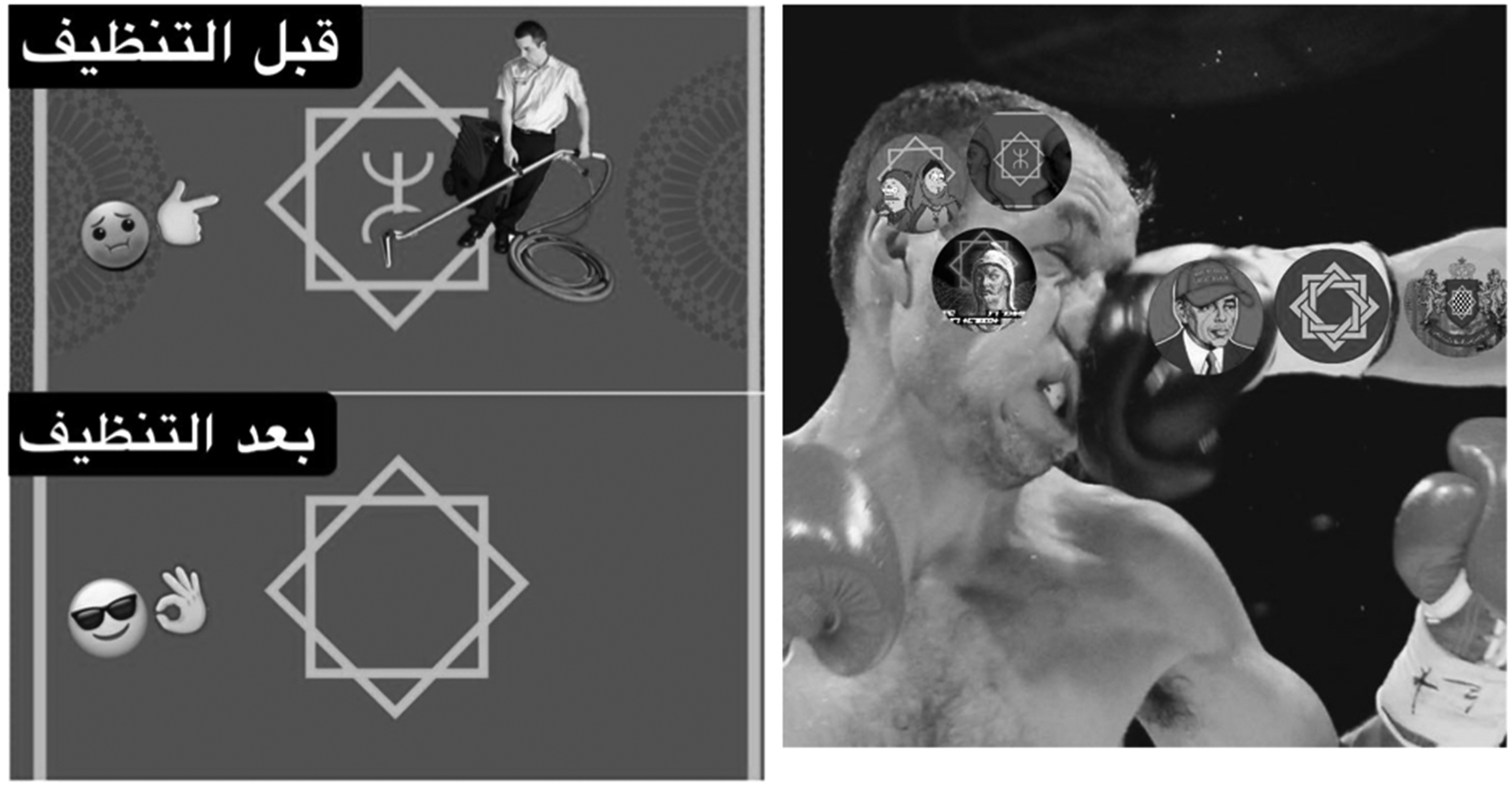
Amazigh symbol and the Marinid flag both posted on September 2019.
Right or Far-Right?
An important aspect of Moroccan Far-Right pages is the way in which they self-define and whether they consider themselves as Right, Far-Right, or both. The terms with which Arabic media references the Far-Right outside the MENA region, al-yamīn al-mutaṭarrif (and the less used terms yamīn muta’aṣṣib extreme-right), are absent from pages in Table 1 with the exception of one meme out of over 1,600. This meme posted by MNM employs the literal term ‘aqṣā al-yamīn (far right), but this word does not appear again in any other image-macro. The terminology in these pages includes for the most part right-wing language, for example, al-yamīniyīn al-waṭaniyīn (nationalist right-wingers), al-yamīniyīn al-waṭaniyīn al-malakiyīn (nationalist royalist right-wingers), yamīnī qawmī malakī (patriotic royalist right-winger), al-yamīniyīn al-qawmiyīn (patriotic right-wingers), al-yamīn al-maghrebī (Moroccan right-wing), or in English, the Moroccan Right-Wing.
The deliberate absence of Far-Right nomenclature reveals its pejorative connotations within MENA (Wild 2012: 229–30) as exemplified in the slur Tamazignazi and Far-Right groups’ hatred toward Islam. Islam is, after all, one of the key dominant pillars of Moroccan identity captured in the country's motto as stated above. Despite this, these pages rarely make explicit references to Islam, or any other religion with the exception of well-wishes messages in Muslim religious festivities. Distancing themselves from Far-Right's antisemitism, MNM does not have any meme concerning Jewish communities even considering that Judaism is an autochthonous religion in Morocco. The Makhzen has traditionally held strong ties with local Jewish communities. Contrary to Imazighen, these communities do not represent a threat to the Moroccan Right because they are nowadays small in number with an estimate of 2,150 Jews left in 2018, 7 usually conservative, and without demands for independence or changes to their status quo. Some of the pages here analyzed have directed criticisms toward the state of Israel, but do not display antisemitic discourses proving their interest in formal politics and not religious groups per se. The same is true for MNM's occasional slander of Islamists from PJD portraying them as antipatriotic, but as expected no attacks on Islam or Muslims. In their lack of interest in religion, memes in these pages evidence that the term Islamofascism does not work to uncover far-right beliefs in the MENA nor Arabic terms used to name Islamophobic foreign groups.
Since no group has appropriated the Moroccan or for that matter Arab Right, the term al-yamīn (right-wing) works well to capture a wider right-wing that includes tenets from the Far-Right. The meme page Pulse—Morocco's counterculture refers to the novelty of the right-wing within the Moroccan political sphere in their official website. Identifying as Moroccan right-wing liberals (al-yamīn al-liberalī al-maghrebī) the website claims that the Moroccan political sphere is only occupied by leftists and Islamists conveniently disregarding nationalist as right-wingers. In spelling out details of what this entails, pulsemorocco.org devotes articles to explain their economic principles which include refuting Marxist economic theory, arguing for low state intervention, lowering of taxes, and investment in private ownership, as well as discussing Moroccan history and nationalism. 8 Through a multiplatform approach, pulsemorocco.org provides a formal and palatable account of their right-wing political and economic principles, while their Facebook meme page capitalizes on the lulz to put across despotic messages exposing a racist and misogynist ideology.
Studies on the Far-Right have identified this performance as a frontstage–backstage dynamic (May and Feldman 2019: 27) whereby ideologies are communicated in politically correct and overt form for general audiences and in a concealed manner designed to satisfy those within the group. Referred to as “coded rhetoric” (Berlet 2014) or “ideological bifurcation” (Macklin 2014), this technic allows for “an ‘exoteric’ articulation of [post-war fascist] ideology for public consumption and an ‘esoteric’ truth understood by an initiated hardcore of political activists” (Macklin 2014: 123–124). This dynamic, however, also benefits the Makhzen by keeping radical content within the space of humor and entertainment. As these Far-Right Facebook meme pages exhibit their misogyny and vilification of minorities, the Makhzen can shape itself as moderate even when sponsoring right-wing policies, censuring journalists, or enforcing discriminatory laws against women. Furthermore, a new right-wing political contender, with the exception of the secular Republican branches, adds another political ally to the monarchy while seemingly playing the democratic game.
Arguably, despite this coded dynamic, racists, and misogynist messages in these memes are rather clear to any Moroccan participant. A comment on the Reddit community r/Morocco searching for Moroccan secular conservatives confirms the ease to decode Moroccan Far-Right Facebook meme pages in general terms:
I’ve seen a few Facebook pages like that, mostly alt-right wannabes but the Moroccan version, the theme is usually: Secular, Atheists but also anti-immigration, kinda racist, a bit antisemitic, against foreign influence (Western and Middle Easter), pro-Berber (history and language), respect Moroccan traditions and traditional holidays (Eid lKbir, etc.), Libertarian or right-neoliberal and anti-Communist. 9
A lack of distinction between normie (overused and easily decoded) and dank (innovative and coded) memes is, however, not exclusive to Moroccan memetic culture. Discussing the “alt-right,” Topinka (2019) argues that there is little to unmask when it comes to their racist discourse. In demystifying the obscurity of memes, Topinka claims that while Far-Right memes “rely on a relatively esoteric referential repertoire… the form in which this repertoire appears… is entirely familiar” (2019). In our examples in Figures 5 and 6, even if one does not fully comprehend Pepe's or Chad's context or Moroccan memes, their messages are unambiguously racist and misogynist.
Normie memes run the risk of becoming boring and therefore missing out on memetic culture's playfulness causing, in turn, a loss of engagement. Among our observations on MNM's comment section, some emerging debates were related to participants complaining about the overuse and repetition of memes. Different versions of the Yes Chad Meme, for example, have been shared in one year over 100 times. Moreover, their often-crowded image macros filled with text ruin the lulz failing to spark a laugh at a first glance. A lack of creativity fashion MNM far from the desired dank memes and close to the dreaded normies. In this case, what seems important to MNM is the fact that repetition works to spread a message and build a community with a common political aim at the expense of some bored participants.
The Moroccan Far-Right
Morocco and other countries in the MENA such as Tunisia, Lebanon, Israel, and Jordan have boosted an image of development toward democracy, modernity, and liberalism by promoting advances in women's and LGBTQIA+ rights (pinkwashing), recognition of other ethnic and religious identities, and lately environmentally conscious politics (greenwashing). Memes here analyzed show no interest in engaging with such an image of development. On the contrary, these memes are willingly antipolitically correct. Their use of Pepe the Frog and Yes Chad purposefully appropriates “alt-right” online culture to shape the language of the Moroccan Far-Right. After all, these memes have successfully generated effective networks in message boards such as 4Chan or Reddit growing into the mainstream and becoming part of presidential political campaigns. Therefore, even if in Arabic MNM and its acolytes abstain from calling themselves Far-Right because of reasons above detailed, unapologetically antileftists, racist and misogynist messages dressed in popular “alt-right” memes together with nostalgic nationalistic memetic symbols serve as a testament of a renewed form of ultranationalism. This renewed ultra- and ethnonationalism entails a deeper rapprochement to renewed Far-Right ideologies than these meme pages may explicitly disclose.
The threat of a local other corrupting traditional Moroccan identity is the strongest motivation driving Far-Right memes. If traditionally the state has depicted foreign nations and their religious and ethical views as deviant and responsible for contaminating national identity, discourses emanating from these meme pages expand the focus on enemies from within. Granted, some of the themes emerging predate the digital era. In Morocco, misogynist, homophobic, xenophobic, and racist attitudes and laws are not new, and are still in place and enforced. One example is Article 490 of the penal code that punishes sexual intercourse outside marriage used in 2019 to sentence Moroccan journalist Hajar Raissouni to one year of jail. In a similar fashion, racism against Black Moroccans and Black African migrants is historically well rooted in Morocco as shown in Chouki El Hamel's work (2008; 2012) and is present in today's media (Moreno-Almeida 2016). However, creating new categories of outcasts through memetic language demonizing an entire range of groups and minoritized communities threatens Morocco's desired balance between modernity and tradition and its status as an exceptional liberal country in the MENA.
Together with scapegoating, a nostalgic return to an imagined glorious past through memes of late Hassan II and the old Marinid flag enables the Moroccan Far-Right to focus on Moroccan greatness shifting the attention away from other more pressing matters such as the country's poor. Although elites have been de facto behind Trump and Brexit campaigns, renewed Far-Right's existence is partly validated by its attack on what it considers corrupt and accommodated traditional right-wingers. In Morocco, attacking the establishment would mean condemning the Makhzen and challenging the supreme power of the monarchy. This particularity renders ineffective and counterproductive the online Far-Right's antiestablishment strategy. Therefore, while Moroccan Far-Right Facebook meme pages discourse do not completely correspond with some of the general characteristics of renewed Far-Right (namely when it comes to Islamophobia, antisemitism, and antiestablishment), these indicate that a Moroccan Right/Far-Right is still negotiating its tenets and finding its place within national and global politics. Ongoing debates, over the meanings of the Marinid flag and ideological differences, as is the case with the secular Republican page now unsurprisingly removed from Facebook, exhibit competing discourses underscoring the fact that the Moroccan Right/Far-Right still needs to be understood as a work-in-progress project.
Conclusion
Our paper reveals the existence of a common memetic culture that shares content and language with a renewed form of Far-Right characterized by its savvy use of digital media. Returning to our research questions, the use of specific threads associated with the Far-Right such as ultranationalism and hate speech embodied in memes suggest the rise of a Far-Right in Morocco through Facebook meme pages. Regarding evidence of specific tropes and language used by self-declared right-wing meme groups, this paper finds that even if meme pages here examined represent a heterogeneous group—some being Republican, other royalists, and so forth—they share specific features that we have summed up into two main categories: (1) the adoption of specific nationalist symbolisms such as the Marinid flag and the endorsement of the late King Hassan II to establish a distinct and formal political ideology under the rubric of the Moroccan Right. (2) Scapegoating as a strategy to define an internal enemy threatening Moroccan traditional life and values.
Addressing our final question concerning whether these pages constitute a new phenomenon, our paper argues that while there is evidence of right-wing policies in postcolonial Morocco, these Facebook meme groups occupy a new political space. While Far-Right meme pages share common grounds with the Makhzen's agenda, the slandering and curbing of feminists, Imazighen, and prodemocracy activists together with an overtly racist depiction of Black migrants does not correspond with the image of progress and modernity contained within the narrative of exceptionalism. The Makhzen can use this to its advantage, but it can also become a dangerous path if secular Right-Wing Republicans gain supporters. Building on already prominent nationalist discourses and discriminatory policies, unapologetically hateful discourses are new in the Moroccan political spectrum, but contrary to countries such as Spain, Sweden, the United States, Brazil, or India, they have yet to turn into a political party and enter mainstream politics. In this regard, we found evidence suggesting that some of these meme pages such as Pulse—Morocco's counterculture employ a front and backstage dynamic in creating a strategy to formally create a Moroccan right-wing movement. We contend, however, that although there is evidence that there is an emergent Far-Right project breeding in Moroccan digital media as MNM recently made explicit by joining some of these pages into what they call the Moroccan National Unity Group, it is not yet fully formed.
Limitations to this study involve its focus on online content and, therefore, possibly missing important offline informal political actions. Moreover, due to the fact that meme pages are as easily set up as they are deleted, whether these Facebook meme pages are just a fad, become outdated with the incursion of new social media apps, or are able to engender powerful political actors, only time will tell. In moving forward, to fully understand the penetration of new forms of digital fascism in the MENA we suggest two main directions: first, mapping and naming contemporary states, political parties, and social movements showing signs of following Far-Right ideologies as is the case of Egypt in their recent crackdown of LGBTQIA+ and other minoritized groups; second, examining the presence of other online groups across the region and their evolution across different social media apps following similar anti-Black and misogynist discourses. Both studies would lead to developing a comprehensive definition of the Arab Right/Far-Right. This paper contributes to this endeavor by setting up an initial framework pointing out memes as key strategic digital items of communication in their use of antipolitically correctness from where to start such an ambitious research project.
Footnotes
Acknowledgments
The authors would like to thank the editor and guest editors as well as the anonymous reviewers for their constructive and insightful comments on this manuscript. Dr. Moreno-Almeida would also like to gratefully acknowledge the British Academy for funding the project this paper is based on.
Declaration of Conflicting Interests
The authors declared no potential conflicts of interest with respect to the research, authorship, and/or publication of this article.
Funding
Research for this paper possible thanks to the British Academy Postdoctoral Fellowship scheme. The authors received no financial suor publication /or publication of this article.
