



Abstract
Donald Trump frequently attacks foreign countries such as Germany (e.g., via Twitter). Drawing from social identity theory and intergroup threat theory, I theorized that exposure to news about Trump’s anti-German utterances indirectly increases anti-Americanism in Germany. First, I theorized that Trump’s utterances result in negative attitudes toward Trump and, in turn, increase anti-Americanism (spillover effect). Second, I theorized that Trump’s anti-German utterances indirectly affect anti-Americanism via increased European Union (EU) popularity. Furthermore, I assumed that effects would be stronger for individuals low in political interest. A quota-based online experiment (N = 428) revealed that Trump’s anti-German utterances increased EU’s popularity. This effect was moderated by political interest. EU’s popularity was increased for moderately interested individuals and individuals low in political interest. No effects were detected for highly interested individuals. EU popularity, in turn, increased anti-Americanism. Therefore, Trump’s anti-German utterances indirectly increased anti-Americanism burdening relations between Germany and the United States. Implications for journalistic news coverage are discussed.
Donald Trump’s 2016 election victory came as a surprise to many people around the world. For example, fourteen out of fifteen polls in the United States predicted a Clinton victory (FiveThirtyEight 2016). To many observers in Europe, Trump’s victory not only came as a surprise but also as a shock because Europeans feared that Donald Trump’s election would negatively impact transatlantic relations (Kreiss 2019; Stelzenmüller 2019). In his election campaign, Trump repeatedly emphasized that he would follow the catchphrase “America first,” for example, at the expense of international trade arrangements, thus threatening the financial well-being of European countries such as Germany. More importantly, Trump repeatedly attacked and threatened Germany directly (e.g., to impose tariffs on German cars and steel imports), and the German news media frequently report about his political statements, for example, disseminated online via Twitter (see Lecheler and Kruikemeier 2016). So far, it remains unclear how this type of media information affects citizens’ political attitudes (Lecheler and de Vreese 2012), and whether it promotes negative spillover effects (Lee 2018) increasing anti-Americanism 1 among their audience. That is, Germans recently assessed their country’s relationship with the United States (one of its closest allies) as increasingly “bad” (2017: 56 percent, 2018: 73 percent; Poushter and Castillo 2019). Notably, such negative perceptions may create a breeding ground for anti-Americanism in Germany (e.g., Blaydes and Linzer 2012; Gilmore et al. 2013; Jamal et al. 2015; Katzenstein and Keohane 2007; Nisbet and Myers 2011; Rubinstein and Smith 1988).
Donald Trump’s attacks and threatening utterances reported on in the news media are not limited to social groups (Newman et al. 2018) or institutions (Tamul et al. 2020) within the United States. Rather, in a globalized world, news coverage about Trump’s attacks may also affect people living abroad, for instance, in countries such as Iran and North Korea but also in Western societies such as Germany. That is, Germans may perceive Trump’s anti-German utterances as scandalous (Allern and von Sikorski 2018; von Sikorski 2018) and as a threat to their social identity (Brown 2020; Tajfel and Turner 1986) promoting ingroup–outgroup differentiation or “us” versus “them” perceptions. Perceived social identity threats may result in ingroup favoritism (i.e., feeling closer to the European Union [EU]) and may in turn increase in anti-Americanism in Germany (Nisbet and Myers 2011; see also Blaydes and Linzer 2012; Gilmore et al. 2013).
However, thus far, there is a paucity of research on how news coverage about Trump’s hostile statements influences citizens living in a country “under attack.” More precisely, three key research gaps persist. First, does news coverage about Trump’s anti-German utterances 2 increase anti-Americanism among German citizens? Second, if so, how can such effects be explained (i.e., mechanism)? Third, who is affected and what role does an individual’s level of political interest play in this context?
Drawing from social identity theory (SIT; Tajfel and Turner 1986) and intergroup threat theory (ITT; Stephan et al. 2009), I theorized that news coverage about Trump’s anti-German utterances will negatively affect German news consumers’ attitudes toward Donald Trump. Based on the inclusion/exclusion model (Schwarz and Bless 1992), I further assumed that negative evaluations of Trump—as a type of negative spillover effect (see Lee 2018)—will increase individuals’ level of anti-Americanism. Also, I expected that news coverage about Trump’s anti-German utterances will positively affect German news consumers’ perceived EU popularity (i.e., ingroup favoritism) and that EU popularity, in turn, results in an increase in anti-Americanism.
Furthermore, previous research suggested that political interest plays a key role when it comes to processing mediated political information (Kazee 1981; van Kempen 2007). Based on this, I theorized that effects of Trump’s negative utterances will be particularly strong for individuals with little political interest, compared with highly interested individuals. This is because individuals low in political interest are generally less knowledgeable about politics (Delli Carpini and Keeter 1996; Prior 2010), receive less political information from news media (Strömbäck and Shehata 2010), and are more susceptible to media effects compared with highly interested citizens (Kazee 1981; van Kempen 2007). I tested these assumptions with the help of an online experiment (N = 428) using a quota sample based on the demographic characteristics of the general population in Germany. Results revealed that news about Trump’s anti-German utterances indirectly increased anti-Americanism in German news consumers with low and moderate levels of political interest.
The present paper makes at least three important theoretical contributions to the literature. First, it furthers knowledge on how media coverage may (unintentionally) contribute to anti-Americanism in Western societies such as Germany. Also, it (for the first time) applies SIT to research on anti-Americanism and the role of the media. Second, it makes a theoretical contribution to the literature in political communication, highlighting the importance of accounting for the moderating role of political interest in media effects studies. Third, the paper has important theoretical implications for journalism practice and regarding the journalistic coverage of hostile statements by politicians like Donald Trump (see Heiss et al. 2019).
Anti-German Utterances as Social Identity Threat
When individuals (i.e., German citizens) learn that the President of the United States publicly attacks and threatens Germany (i.e., their own ingroup) via the news media, these situational cues or negative portrayals of their ingroup may be perceived as scandalous (von Sikorski 2018) and as a threat to one’s social identity (Major and O’Brien 2005). More generally, SIT (see Brown 2020; Tajfel and Turner 1986) posits that individuals “strive to maintain or enhance their self-esteem: they strive for a positive self-concept” (Tajfel and Turner 1986: 40). Previous research informed by SIT showed that negative portrayals of one’s own group represent threats to the self-concept of a group member, for example, in the context of ethnic or racial groups, religious groups, or one’s national identity (Brown 2020). In line with SIT, threats from an outgroup or an outgroup member (Branscombe and Wann 1994) may both undermine the perceived value of one’s group and may also negatively affect an individual’s self-concept (Branscombe et al. 1999a; Brown 2020; Tajfel and Turner 1986). To maintain or restore a positive self-concept, individuals may react to perceived social identity threats in different ways. That is, individuals typically react to social identity threat with ingroup favoritism and/or outgroup derogation in situations of rather high group identification and when group membership cannot be easily changed, as in the case of threats to one’s national identity (Branscombe et al. 1999a; Brown 2020).
Trump’s Anti-German Utterances: Effects on Attitudes toward Trump
Based on SIT and previous research results, it was theorized that exposure to news coverage about Donald Trump’s anti-German utterances will negatively affect German news consumers’ attitudes toward Trump. This is because Trump’s anti-German utterances—for example, public statements like Germany is a “total mess” (Chazan 2018) and Trump’s threat of imposing U.S. tariffs on imports of German cars and steel—may be perceived as an outgroup threat (Minkus et al. 2019) among Germans undermining the value of the ingroup (Branscombe et al. 1999; Major and O’Brien 2005). Media coverage consisting of anti-German cues may thus negatively affect German news consumers’ self-concept and—in an attempt to restore this negative self-concept—individuals may respond with outgroup derogation (Branscombe et al. 1999a; Major and O’Brien 2005). Outgroup derogation or the perception of the source of anti-German utterances (i.e., Trump) as threatening may in turn result in more negative attitudes toward Trump among German news consumers. That is, individuals may be motivated to “strike back” against the source representing the identity threat (Branscombe et al. 1999a). Previous research supports this assumption showing that threats to one’s ingroup result in hostility and more negative judgments of those who are responsible for an identity threat (Branscombe et al. 1999b; Schaafsma and Williams 2012). Furthermore, this theorizing is in line with ITT (Stephan et al. 2009) that predicts that perceived outgroup threats regularly result in negative evaluations of outgroup members and hostility toward the outgroup. According to the theory, ingroup individuals are likely to feel threatened (perceived realistic individual threat) when outgroup members (e.g., the President of the United States) are in a position to cause harm to one’s ingroup’s resources or general welfare (e.g., imposing tariffs on German car imports). Based on this theorizing, I expected that exposure to news about Trump’s anti-German utterances will negatively affect German news consumers’ evaluation of Trump, as was formally articulated in Hypothesis 1 (H1):
Negative Attitudes toward Trump: Spillover Effect on Anti-Americanism
The inclusion/exclusion model (Schwarz and Bless 1992) posits that exposure to negative information about a typical exemplar or group member may result in spillover or assimilation effects negatively affecting the group at large. An assimilation effect occurs when an exemplar can be included in the representation formed of a wider and superordinate category. In contrast, the model predicts a contrast effect the more narrow a target category is. Stated differently, when an individual is exposed to a negative exemplar (i.e., Trump), it is likely that negative attitudes toward the exemplar produce an assimilation effect when judging the target category (i.e., U.S. population more generally) because the exemplar can be included in the target category. Conversely, a contrast effect would be likely when an individual is exposed to a negative exemplar (i.e., Trump) and is then asked to judge another U.S. citizen (narrow category), for example, Barack Obama (see von Sikorski and Herbst 2020). The model predicts that Barack Obama would be judged more positively in this context because the exemplar (i.e., Trump) cannot be integrated in the representation formed of the target (after all, Barack Obama is not Donald Trump; but Donald Trump is a U.S. citizen). Transferred to the context of the present study, it was expected that Donald Trump—as elected representative of the American people—will be perceived as an exemplar of the U.S. population. Also, I theorized that negative attitudes toward Trump will spill over and result in an assimilation or generalization effect increasing anti-Americanism in German citizens, as was formally articulated in Hypothesis 2 (H2):
Trump’s Anti-German Utterances: Effects on EU’s Popularity
One key finding of previous research informed by SIT (Brown 2020; Tajfel and Turner 1986) is the result that social identity threats may not only lead to outgroup derogation and hostility but can increase ingroup favoritism (e.g., Moskalenko et al. 2006). That is, “a perceived external threat can bring members of a social entity to unite” (Minkus et al. 2019: 401). In this context, Jetten et al. (2001) showed that external threats to one’s ingroup increased ingroup identification. Moskalenko et al. (2006) examined effects of an external threat (i.e., terrorism) in university students before and after the 9/11 terrorist attacks showing that U.S. respondents’ identification with their country was significantly higher right after the attacks (compared with identification measured before the 9/11 attacks). Similarly, panel data from all 28 EU member states collected before and right after the election of Donald Trump as President of the United States revealed that Trump’s election resulted in a significant increase in EU’s popularity (Minkus et al. 2019). Minkus and colleagues (2019: 401) described this “Trump effect” as a particular type of rally effect in which Europeans (independently of their particular country of origin) “rallied around the European ‘flag.’” Based on this, I theorized that news about Trump’s anti-German utterances will have a similar and positive effect on ingroup identification with the EU increasing EU’s popularity among Germans, as was formally articulated in Hypothesis 3 (H3):
Effects of EU’s Popularity on Anti-Americanism
Furthermore, I theorized that ingroup identification and increases in EU’s popularity among German citizens would negatively affect outgroup perceptions resulting in an increase in anti-Americanism. This assumption is in line with seminal research by Allport (1954) and Brewer (1999), and the more recent work by Duckitt et al. (2005), indicating that the more an individual identifies with an ingroup, the more hostile he or she may react toward outgroups. According to Brewer (1999), ingroup identification is systematically connected to overt hostility toward outgroups. Also, this theorizing also blends in nicely with ITT (Stephan et al. 2009), as the model also predicts that ingroup identification results in more negative outgroup evaluations. Based on the model, Renfro et al.’s (2006) study (Experiment 1) showed that white U.S. males who identified strongly with their ingroup tended to feel threatened by affirmative action and directed their hostility against the beneficiaries of affirmative action (i.e., outgroup). They conclude, “Strong identity with in-groups leads to prejudice toward out-groups” (Renfro et al. 2006: 53). Similarly, Mummendey et al. (2001) examined the role of ingroup identification and effects on outgroup evaluation in a German context (i.e., attitudes toward foreigners in Germany) showing that ingroup identification (i.e., with their own country) significantly predicted more negative outgroup attitudes. Based on these results and in line with SIT and ITT, I therefore theorized that stronger identification with the EU and increases in perceived EU’s popularity will result in an increase in anti-Americanism, as was formally articulated in Hypothesis 4 (H4):
The Moderating Role of Political Interest on Attitudes toward Trump and EU’s Popularity
Previous research shows that political interest is a key variable when it comes to political evaluations and decision-making (Campbell et al. [1960] 1980; Delli Carpini and Keeter 1996; Lupia and Philpot 2005; Prior 2010). Prior (2010) showed that individuals’ level of political interest tends to be stable over the lifetime, and he pointed out that “politically interested people are more knowledgeable about politics, more likely to vote, and more likely to participate in politics” (p. 747). Also, it has been demonstrated that individuals high in political interest (compared with individuals low in political interest) are more likely to expose themselves to mediated political information (Strömbäck and Shehata 2010; see also Delli Carpini and Keeter 1996). However, in modern media environments, individuals with little political interest are still frequently exposed to key political issues incidentally (Heiss and Matthes 2019; Kim et al. 2013). That is, even if an individual with low levels of political interest uses a social media platform for, for example, entertainment purposes or to stay in contact with friends and family, exposure to political information (especially to heatedly debated issues like statements by Donald Trump) may occur incidentally, for example, while scrolling Facebook’s newsfeed.
Individuals with low levels of political interest also tend to be more susceptible to political information compared with highly interested individuals. In fact, Converse (1962)—more than fifty years ago—suggested that susceptibility to political information may increase as a function of the particular level of political interest and involvement. This is because an individual’s argument repertoire is smaller when he or she has a low level of political interest (Cappella et al. 2002), which makes these individuals more susceptible. Stated differently, politically interested individuals are less influenced by mediated political information and it is also more likely they have already formed an opinion regarding current political issues. Indeed, previous research revealed that individuals low in political interest (compared with highly interested individuals) are more susceptible to and more strongly influenced by mediated political information (e.g., Kazee 1981; van Kempen 2007). For example, Kazee examined how individuals’ attitudes toward former President Richard Nixon were affected in the context of the Watergate scandal using a three-wave panel study. Results revealed that the impact of media exposure on attitudes toward Nixon was significantly stronger (i.e., more negative) for individuals low in political interest compared with highly interested individuals. Based on this, political interest can be conceptualized as an important individual differences variable. Hypothesis 5a (H5a) reads as follows:
Furthermore, I theorized that political interest is an important moderator variable influencing the relationship of news about Trump’s anti-German utterances on EU’s popularity. That is, previous research repeatedly revealed that political interest is a positive and significant predictor of EU attitudes and EU support (e.g., Boomgaarden et al. 2011; Rohrschneider 2002). Boomgaarden et al. (2011) and Rohrschneider (2002) showed that political interest positively predicts EU identification and EU support. This is because highly interested individuals are also more knowledgeable about politics (Delli Carpini and Keeter 1996) and have a better understanding of the positive impact the EU can have on its member states (e.g., legal situation, trade, and the economy). Based on this, I theorized that individuals low in political interest are more susceptible to media messages (Kazee 1981; van Kempen 2007), and will, therefore, be more strongly affected regarding their EU evaluations (EU’s popularity), compared with highly interested individuals, whose EU evaluations are also generally more likely to be positive (Boomgaarden et al. 2011; Rohrschneider 2002). Based on this, Hypothesis 5b (H5b) reads as follows (Figure 1 shows the full theoretical model):
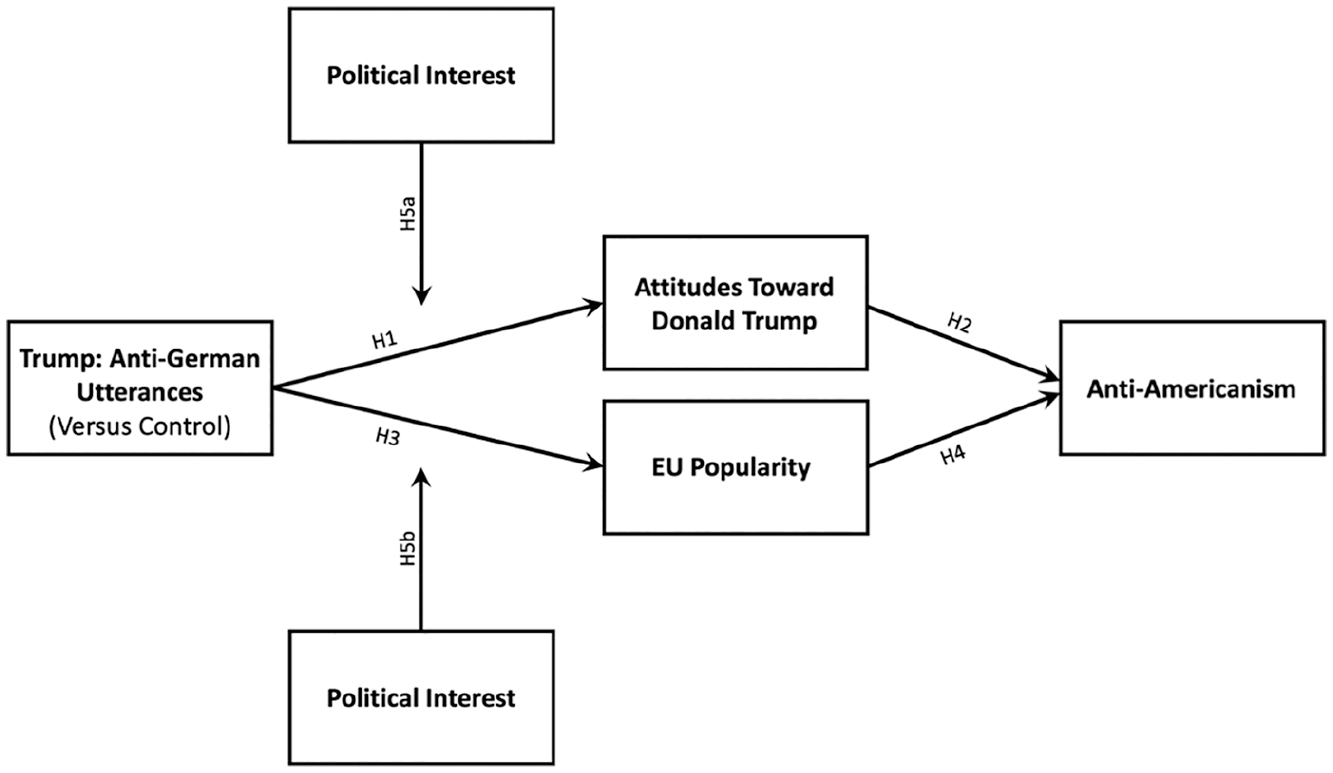
Hypothesized theoretical model.
Method
An online experiment (between-subjects design) was conducted to test the hypotheses. A quota sample (N = 428) based on the demographic characteristics (age, gender, education) of the general population in Germany was used. The experiment was part of a lager study unrelated to the purpose of the present paper and was conducted by the market research company Survey Sampling International (SSI).
Participants
In total, 428 individuals participated in the study (52 percent female; Mage = 46.55, SD = 14.80, ranging from eighteen to seventy years old; 0.9 percent no school degree; 32.9 percent compulsory school; 31.6 percent vocational school degree; 18 percent with a high school degree; 15.9 percent with an academic degree; 0.7 percent still in school). Participants with a high school degree were underrepresented in the study.
Procedure
First, after giving their informed consent, participants completed a survey containing demographic variables, control variables, and items regarding the moderator variable (political interest). Second, participants were then randomly assigned to an experimental or a CC and were exposed to the stimulus materials. Participants in the experimental condition (EC; n = 213) were exposed to a total of three different online news articles about Trump’s anti-German utterances. Control group participants (n = 215) were also exposed to three news articles (from the same online platforms). However, these control articles dealt with unrelated topics and had no connection to Trump’s anti-German utterances. A total of three articles were used (see “Method” section) to increase the external validity of the experiment (Reeves et al. 2015; see also Matthes et al. 2019). Survey software was programmed in a way that participants spend at least 20 seconds reading each news article before they were able to continue to the next page, for example, the next news article. Third, after stimulus exposure, individuals completed a questionnaire, including the mediator variables and the dependent variable. Participants were then thanked and debriefed.
Stimulus Material
Participants in both the EC and the CC were exposed to three news articles from different and well-known German news platforms (spiegel.de, bild.de, and welt.de). Spiegel.de is a rather left and liberal-oriented news outlet, bild.de is the online platform of the largest German tabloid newspaper, and welt.de is a rather conservative news outlet. Participants were exposed to three different news articles in a row to increase the external validity of the experiment (Reeves et al. 2015). The original layout of the three news outlets was used (see Supplementary Information file), and the language used was adjusted appropriately, for example, less elaborated for the tabloid news article (bild.de). Participants in the EC were exposed to three articles dealing with Donald Trump’s anti-German utterances. The first article portrayed Donald Trump’s attack on Germany stating that “Germany enriches itself with the US.” Also, in the article, Trump states that there is a trade surplus and that he is considering taxes and importing duties on vehicles from Germany. In the second article, Trump attacks the German government directly describing Germany as “total mess-big crime” (context: refugee issue) and that the German government has no control over the immigration situation and that this will have negative consequences for cooperation with the United States. In the third article, Trump calls Germany a “prisoner of Russia” referring to Germany’s gas and oil contracts with Russia. Trump is quoted stating that he is considering countermeasures (import duties), should Germany not import more U.S. raw materials. Control group participants were exposed to three news articles by the identical three news outlets. However, the articles dealt with unrelated topics (e.g., coral rescue) and had no connection to Trump’s anti-German utterances (see Supplementary Information file). All articles were based on real news articles. Yet, parts of the articles were changed for the purpose of the experiment.
Furthermore, it was also ensured that the participants perceived both the news coverage presented in the EC and in the CC as equivalent in terms of journalistic quality and credibility. That is, participants completed three items (semantic differential; 1 = negative and 7 = positive) and assessed whether they perceived the articles to be balanced (i.e., unbalanced–balanced; M = 4.74, SD = 1.43), informative (not informative–informative; M = 5.14, SD = 1.42), and credible (incredible–credible; M = 5.01, SD = 1.41). Independent-samples t tests revealed non-significant results showing that participants perceived the articles in the EC and the CC as equally balanced, EC: M = 4.69, SD = 1.47, CC: M = 4.79, SD = 1.37, t(426) = 0.730, p = .466, Cohen’s d = 0.07; informative, EC: M = 5.12, SD = 1.43, CC: M = 5.15, SD = 1.42, t(426) = 0.418, p = .676, Cohen’s d = 0.04; and credible, EC: M = 5.06, SD = 1.42, CC: M = 4.97, SD = 1.41, t(426) = −0.615, p < .001, Cohen’s d = −0.06. Thus, results indicate that participants perceived the news coverage in both groups as authentic and credible. Also, a manipulation check indicated a successful manipulation (see Supplementary Information file).
Measures
All items were measured with the help of 7-point scales, and all measures are depicted in the Supplementary Information file. First, political interest (moderator variable) was measured with the help of three questions based on Lupia and Philpot (2005) (Cronbach’s α = .97, M = 4.80, SD = 1.70). Second, demographics and control variables were measured (see “Data Analysis” section for more information). Participants’ prior attitudes toward Donald Trump were measured with one item (M = 1.69, SD = 1.24), political ideology was measured with one item (M = 3.85, SD = 1.19), and authoritarianism was measured with the help of five items based on Frindte et al. (2005; Cronbach’s α = .86, M = 4.31, SD = 1.38). Importantly, both the moderator and control variables were measured before stimulus exposure. Third, attitudes toward Donald Trump (mediator) were gauged with the help of a semantic differential (nine items) based on von Sikorski and Herbst (2020) and were combined to an additive index (Cronbach’s α = .97, M = 1.98, SD = 1.32). Next, EU’s popularity (mediator) was measured based on Minkus et al. (2019) and the Standard Eurobarometer 89 (2018) using seven Likert-type items (Cronbach’s α = .95, M = 4.87, SD = 1.62). Fourth, anti-Americanism (dependent variable) was measured with the help of seven questions based on Blaydes and Linzer (2012) and the Pew Global Attitudes Project (2007; Cronbach’s α = .89, M = 4.13, SD = 1.14; see Supplementary Information file).
Data Analysis
To test the hypotheses, an ordinary least squares path analysis was performed using the PROCESS macro (Hayes 2013) in Statistical Package for the Social Sciences (SPSS). A first-stage conditional process model (moderated mediation model) with two mediators and one moderator was used to test for conditional indirect effects on the outcome variable (i.e., anti-Americanism; see Figure 1). EC was dummy coded with the CC as reference group. Attitude toward Donald Trump and EU’s popularity served as mediator variables. Political interest was modeled as moderator variable to examine the conditional effect of Trump’s negative utterances on the mediators depending on participants’ particular level of political interest. Anti-Americanism was modeled as the dependent variable.
Also, four theoretically important control variables were entered as covariates, as suggested by Y. A. Wang et al. (2017). That is, the use of covariates may be beneficial in experimental studies when covariates are theoretically relevant. Thus, first, participants’ prior attitude toward Trump was modeled as a covariate because prior attitudes toward Trump are likely to affect attitudes toward Trump and anti-Americanism after stimulus exposure. Second, political ideology (i.e., left–right) was controlled for because I theorized that a participant’s ideology may affect attitudes toward Trump (i.e., Republican politician). Also, previous research revealed that EU’s popularity can be affected by individuals’ ideology; Boomgaarden et al. (2011) showed that politically right individuals had more negative attitudes toward the EU. Third, authoritarianism was controlled for because it positively predicts both attitudes toward Trump (MacWilliams 2016) and opposition to the EU (Tillman 2013). Thus, I controlled for authoritarianism to ensure effects were assessed independently participants’ level of authoritarianism. Fourth, I controlled for gender because previous research showed that gender may affect evaluations of controversial political candidates (e.g., Bhatti et al. 2013). As both male and female participants were exposed to a controversial male political candidate (Trump), I controlled for gender to ensure that effects were assessed independently of participants’ gender. Political interest was mean centered prior to computing the product (Hayes 2013), and 95 percent bias-corrected bootstrap confidence intervals based on 10,000 bootstrap samples were used for statistical inference of indirect effects.
Results
Conditional Effects on Attitudes toward Trump and Anti-Americanism
First, the effects of exposure to news about Trump’s anti-German utterances on attitudes toward Trump were examined (H1). Results revealed a negative and non-significant effect on attitudes toward Trump compared with the control group (b = −0.83, SE = 0.80, p = .296). This contradicts H1. Yet, the results showed a significant moderation effect between the EC and political interest on attitudes toward Trump (b = 0.39, SE = 0.08, p = .012). Next, this moderation effect was examined in more depth analyzing different levels of the moderator (the mean and ±1 SD from the mean). Findings showed that exposure to Trump’s anti-German utterances only resulted in more negative evaluations of Trump for individuals low in political interest, b = −2.83, SE = 1.13, p = .012, 95 percent confidence intervals (95 percent CIs) = [−5.04, −0.62]. However, no significant effects could be detected for individuals moderately (b = −0.83, SE = 0.80, p = .296, 95 percent CIs = [−2.40, 0.73]) and highly interested in politics (b = 1.17, SE = 1.13, p = .302, 95 percent CIs = [−1.05, 3.39]). This partially supports H5a (effects are stronger for individuals low in political interest; Figure 2).
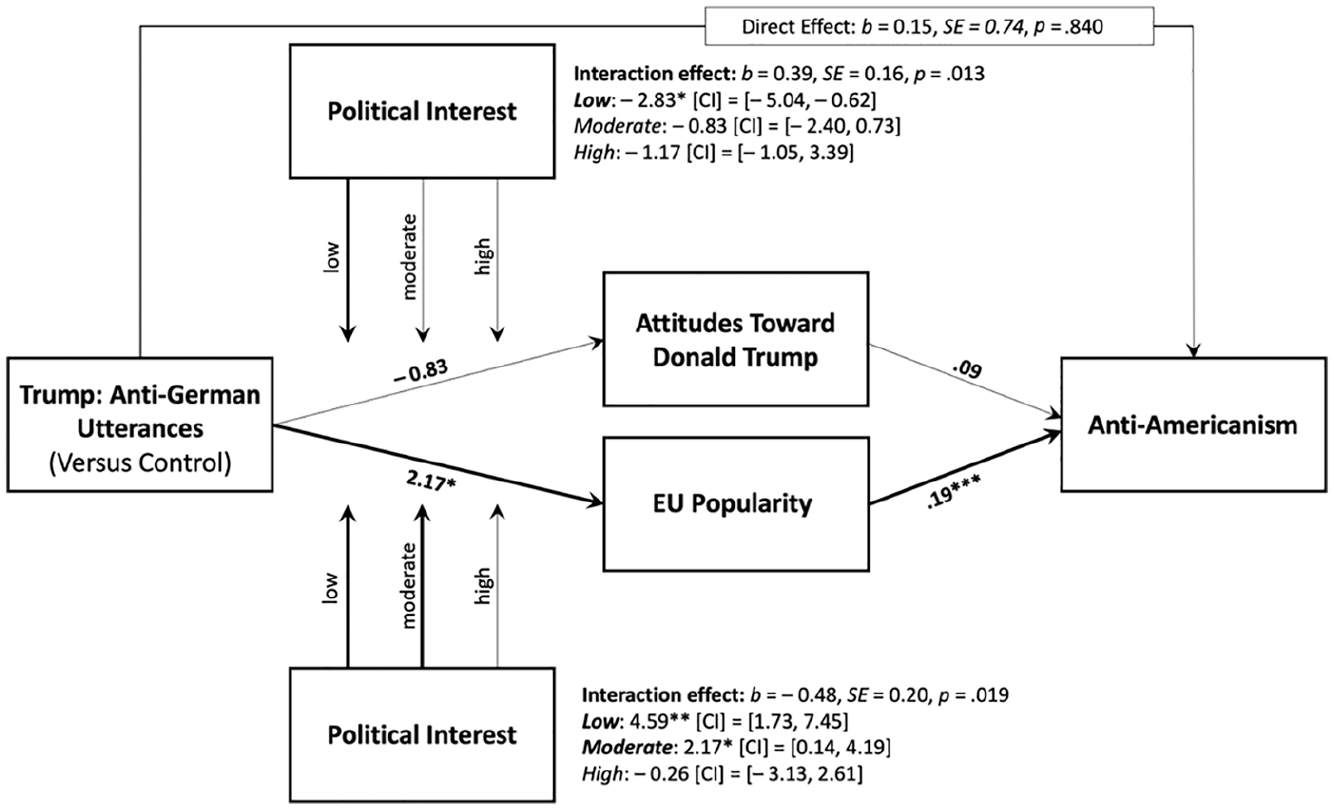
Moderated mediation model showing the conditional indirect effects of Trump’s anti-German utterances on anti-Americanism via attitudes toward Donald Trump and EU popularity.
Second, it was examined whether attitudes toward Trump affected anti-Americanism (H2). Results revealed a positive and close-to-significant effect (b = 0.09, SE = 0.05, p = .0504). That is, by trend, attitudes toward Trump positively predicted anti-Americanism. Yet, because the p value was slightly above the defined significance level (p < .05), H2 had to be rejected. Next, conditional indirect effects of the condition on anti-Americanism via attitudes toward Trump were examined and revealed a non-significant effect (index of moderated mediation: Index = 0.03, BootSE = 0.03, 95 percent CIs = [−0.01, 0.10]). Thus, attitudes toward Trump did not serve as a relevant mediator variable.
Conditional Effects on EU’s Popularity and Anti-Americanism
First, it was analyzed whether exposure to news about Trump’s anti-German utterances affected EU’s popularity (H3). This was the case. Results showed a significant and positive effect (b = 2.17, SE = 1.03, p = .036), indicating that news about Trump’s anti-German utterances significantly increased EU’s popularity. This supports H3. Next, it was examined whether political interest affected this relationship. This was also the case. Results showed a significant moderation effect between the EC and political interest on EU’s popularity (b = −0.48, SE = 0.20, p = .019). Furthermore, the moderation effect was examined in more detail (the mean and ±1 SD from the mean) showing that both individuals low in political interest (b = 4.59, SE = 1.46, p = .002, 95 percent CIs = [1.73, 7.45]) and moderately interested individuals (b = 2.17, SE = 1.03, p = .036, 95 percent CIs = [0.14, 4.19]) were positively affected regarding their perceptions of the EU’s popularity. However, no significant effect could be detected for individuals high in political interest (b = −0.26, SE = 1.46, p = .861). This partially supports H5b (stronger effects for individuals low in political interest).
Second, it was analyzed whether EU’s popularity affected anti-Americanism (H4). Findings showed that EU’s popularity significantly increased anti-Americanism (b = 0.19, SE = 0.03, p < .001). This supports H4. Next, conditional indirect effects of Trump’s anti-German utterances on anti-Americanism via EU’s popularity were examined. This moderated mediation analysis revealed a significant effect (index of moderated mediation: Index = −0.09, BootSE = 0.05, CIs = [−0.20, −0.01]). More precisely, the results revealed significant effects for individuals low in political interest (b = 0.88, SE = 0.37, 95 percent CIs = [0.26, 1.71]) and moderately interested individuals (b = 0.42, SE = 0.23, 95 percent CIs = [0.03, 0.92]), but no effect was detected for highly interested individuals (b = −0.49, SE = 0.31, 95 percent CIs = [−0.67, 0.57]). Thus, the results reveal that Trump’s anti-German utterances significantly increased EU’s popularity for individuals with low and moderate (but not with high) levels of political interest and that increases in EU’s popularity in these two subgroups in turn significantly increased anti-Americanism. Furthermore, results revealed that authoritarianism negatively predicted EU’s popularity and that men showed higher levels of EU popularity compared with women. Also, politically right individuals’ EU popularity scores were lower compared with politically left individuals. Finally, prior attitudes toward Trump positively predicted attitudes toward Trump after stimulus exposure, negatively predicted EU’s popularity, and positively predicted anti-Americanism (see Table 1). 3
Unstandardized Coefficients of Ordinary Least Squares Path Analysis (N = 428).
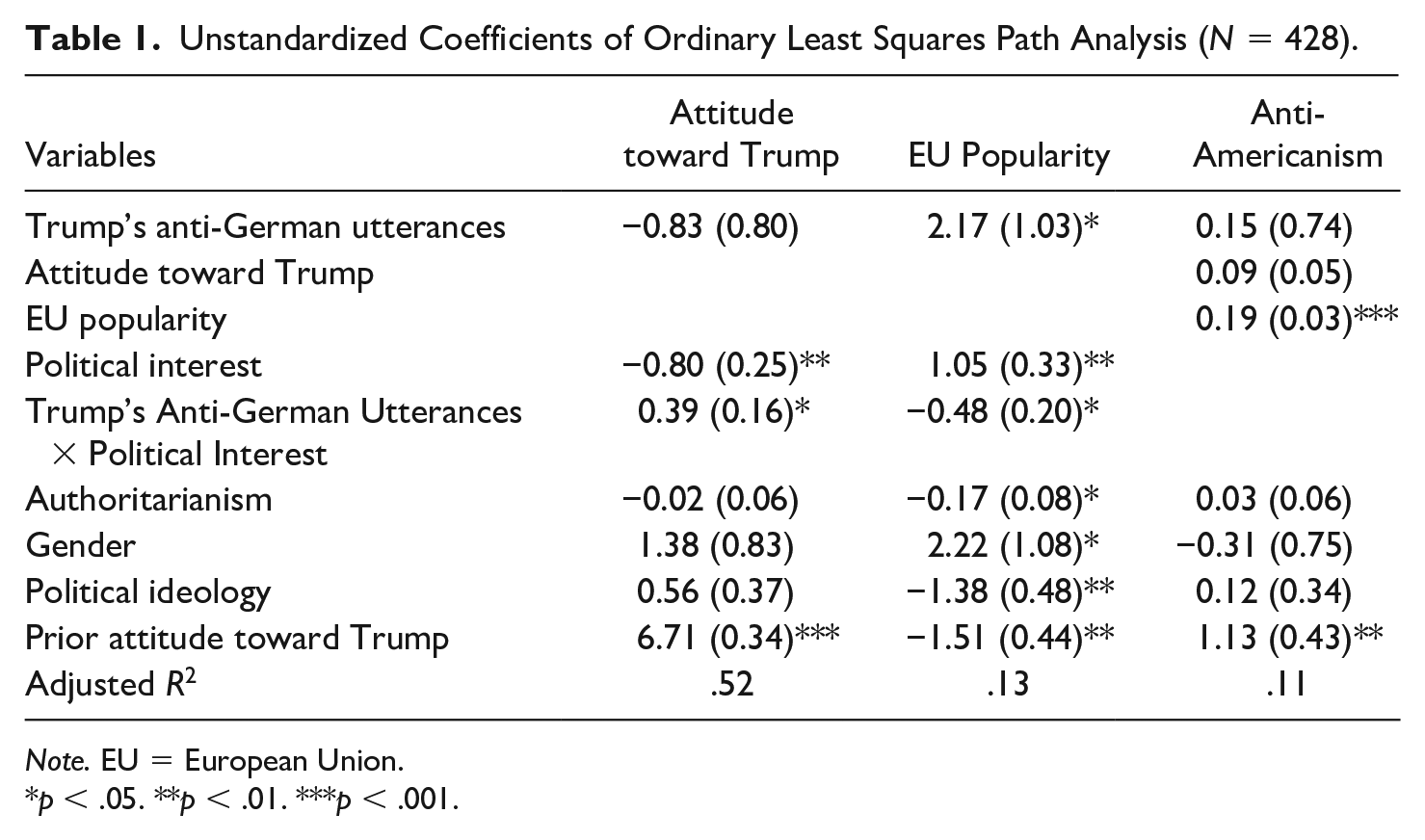
Note. EU = European Union.
p < .05. **p < .01. ***p < .001.
Discussion
Donald Trump regularly attacks social groups (Newman et al. 2018), institutions (Tamul et al. 2020), and foreign countries (e.g., via Twitter), including close allies such as Germany. So far, it remained unclear how citizens of countries “under attack” react to Trump’s negative utterances. Drawing from SIT (see Brown 2020; Tajfel and Turner 1986), ITT (Stephan et al. 2009), as well as the inclusion/exclusion model (Schwarz and Bless 1992), I theorized that Trump’s anti-German utterances will indirectly increase anti-Americanism among German news consumers. More specifically, I assumed that attitudes toward Trump and perceptions of EU’s popularity are important mediators in this context and that effects vary as a function of individuals’ level of political interest. Corroborating and extending previous results (Minkus et al. 2019), the findings, in part, support this theorizing showing that news about Trump’s anti-German utterances indirectly increases anti-Americanism for individuals with low and moderate levels of political interest. Also, EU’s popularity serves as a mediator in this regard.
However, not all of the hypotheses were supported. First, the results showed that attitudes toward Trump were more negative for individuals low in political interest after exposure to news about Trump’s anti-German utterances. In line with previous research (Kazee 1981; van Kempen 2007), individuals with low levels of political interest were therefore more susceptible for respective influences, whereas individuals with moderate levels of political interest or highly interested individuals were not affected. However, second, in contradiction with H2, more negative attitudes did not result in an increase in anti-Americanism. Quite the contrary, more negative attitudes toward Trump—by trend—decreased anti-Americanism in German news consumers (Figure 2). At first, this result (although the p value was slightly above the defined significance level of p < .05) was surprising. However, the inclusion/exclusion model (Schwarz and Bless 1992) offers an explanation. More precisely, this finding can be interpreted as a contrast effect. That is, after exposure to Trump’s anti-German utterances, Germans’ attitudes toward Trump were more negative for individuals with low levels of political interest. Yet, these individuals did obviously not perceive Trump as a “typical exemplar” of the target category (i.e., “Americans”) and no negative spillover effects on anti-Americanism (i.e., assimilation effect) could be detected. Conversely, by trend, a contrast effect emerged in which anti-Americanism decreased in light of Trump’s anti-German utterances. That is, the evaluation of Trump served as a type of anchor or (negative) standard of comparison against which “Americans” were compared. When compared with a negatively evaluated standard (i.e., Trump), a contrast effect emerged and by trend decreased anti-Americanism among individuals low in political interest.
Furthermore, in line with SIT (Tajfel and Turner 1986) and ITT (Stephan et al. 2009), Trump’s anti-German utterances improved Germans’ perceptions of the EU increasing EU’s popularity. Again, highly interested individuals were not affected. However, corroborating and extending previous findings (Kazee 1981; van Kempen 2007), individuals with low and moderate levels of political interest were positively affected regarding their perception of the EU (i.e., EU’s popularity). This suggests that individuals may have perceived Trump’s utterances as social identity threat (Jetten et al. 2001; Moskalenko et al. 2006) uniting members of a social entity or country (Minkus et al. 2019). But why were only individuals with low or moderate levels of political interest affected? First, those subgroups are particularly susceptible to mediated messages and are more easily persuaded by political information compared with highly interested individuals. Second, individuals low in political interest are generally less positive about the EU, for example, when it comes to EU identification and support (Boomgaarden et al. 2011; Rohrschneider 2002). Stated differently, individuals with low levels of political interest are generally more susceptible to media messages and there is a greater likelihood that those subgroups develop more positive views of the EU—in light of a social identity threat—due to a generally lower base level of positive EU attitudes. In contrast, highly interested individuals already have a rather high base level of positive EU attitudes, and further improvements may be harder to realize. At the same time, highly interested individuals are less easily persuaded by mediated political information (Kazee 1981; van Kempen 2007).
Seminal studies have proposed and repeatedly demonstrated that ingroup identification may increase outgroup hostility (Brewer 1999; Renfro et al. 2006). That is, in light of an outgroup threat, ingroup identification may increase. In turn, ingroup identification may contribute to intergroup differentiation, and perceived differences between one’s ingroup and an outgroup become more nuanced contributing to more negative outgroup evaluations, as proposed by SIT and ITT. The findings of the present study nicely blend in with this theorizing. Corroborating and extending previous findings, the results reveal that Trump’s anti-German utterances increased ingroup identification (i.e., EU’s popularity), which in turn increased anti-Americanism.
This research makes several important theoretical contributions to the literature. First, it theoretically furthers knowledge on anti-Americanism research integrating SIT and the role of the media, which has previously been largely neglected in this field. Second, it theoretically contributes to the political communication literature by highlighting the importance of accounting for political interest as a relevant moderator variable in media effects studies. Although the importance of political interest has previously been pointed out (Prior 2010), research in political communication does not regularly regard for this important moderator variable. Yet, not regarding for political interest may potentially lead to incomplete or even misleading results. In the present study, high levels of political interest proofed to be an indirect safeguard mechanism in preventing anti-Americanism. This finding theoretically adds to the literature in the field, and future research in political communication should regularly account for an individual’s level of political interest (Prior 2010; Strömbäck and Shehata 2010).
Furthermore, the paper has important theoretical implications for journalism practice and the coverage of hostile statements by foreign leaders. That is, the findings reveal that news about Trump’s anti-German utterances may—at least for a short time—positively contribute to EU’s popularity. This may be deemed positive from a normative perspective and in light of extensive discussions about Euroskepticism in Germany and other EU countries (e.g., Boomgaarden et al. 2011). Yet, Trump’s anti-German utterances may at the same time negatively (and unintentionally) affect relations between Germany and the United States due to increases in anti-Americanism in Germany (Poushter and Castillo 2019). In this regard, the theoretical question arises how journalists using certain styles of news reporting may prevent potential negative and unintended consequences for German–U.S. bilateral relations (or EU–U.S. relations more generally). It may be speculated that distinguishing Trump’s negative utterances from more positive views on Germany, which are—of course—also present in the United States, may be important in this context. That is, future studies may examine how news that explicitly differentiates between Trump’s anti-German utterances and more favorable U.S. views on Germany (Matthes et al. 2020; Poushter and Castillo 2019; von Sikorski et al. 2018) may positively affect German’s EU identity, while preventing negative outgroup effects on the United States more generally (anti-Americanism). Distinguishing Trump’s negative utterances from more positive U.S. sentiments may even reduce anti-Americanism in Germany due to contrast effects (Schwarz and Bless 1992). The results of the present study hint at such effects showing that anti-German utterances increase negative attitudes toward Trump (for individuals low in political interest) and, in turn, tend to reduce anti-Americanism by trend. When news coverage clearly distinguishes Trump’s utterances from more positive U.S. sentiments and also reports about Germany in more favorable ways (e.g., mentioning U.S. Liberals’ favorable views about Germany), Trump may rather serve as a negative standard of comparison against which “Americans” are positively compared to, potentially reducing anti-Americanism in Germany. Future research may examine this in depth.
Limitations
This study has some noteworthy limitations. First, the study design does not allow us to say anything about the duration of the effects (Baden and Lecheler 2012). Do increases in EU’s popularity and anti-Americanism fade away quickly or do the effects last for longer periods of time? Yet, it is important to differentiate between cumulation and duration in this context (Koch and Arendt 2017). Media effects can be rather short term (duration), but cumulation or the repeated exposure to certain media information (e.g., to Trump’s anti-German utterances) may result in an accumulation effect leading to substantial media effects over time (Koch and Arendt 2017). Future research should test both the duration and cumulation effects of Trump’s hostile utterances. Second, participants with a high school degree were underrepresented in the present study. Although I am confident that this did not affect the results, this aspect should be considered when interpreting the present findings. Third, I used a CC in which participants were exposed to unrelated and non-political topics to prevent for potential priming effects. For instance, exposing control group participants to Trump’s negative utterances, for example, about China or France (countries Trump has previously attacked as well) could have activated and reminded German participants about Trump’s attacks on their own country. This would have undermined the purpose of the present study. I therefore decided to use unrelated topics in the CC, while controlling for participants’ prior attitudes toward Donald Trump. However, future studies should consider the possibility that merely mentioning Donald Trump in news reports may activate anti-Americanism in German news consumers due to the fact that Trump is extremely unpopular in Germany. Future research should try to replicate the present findings using different methodological approaches like panel designs examining exposure to Trump’s anti-German utterances as a “natural event” between two or more panel waves (e.g., von Sikorski et al. 2020). Fourth, the present study focused on Germany. Although Germany seems to be the Western country that Trump attacked most frequently in the recent past (Chazan 2018), future studies may try to replicate the findings using other Western countries such as France. Fifth, Trump’s anti-German utterances may have effects on other outcome variables, for example, affecting individuals’ policy preferences and the demand for countermeasures such as taxes on imports from the United States. Future research may test this assumption. Yet, regardless of these limitations, the present study poses important theoretical and practical implications for understanding the effects on anti-Americanism triggered by Donald Trump’s anti-German utterances.
Conclusion
German news media frequently report about Donald Trump’s anti-German utterances. The present study shows that these attacks indirectly increase anti-Americanism in Germany. First, results of a quota-based online experiment in Germany revealed that Trump’s anti-German utterances significantly increased EU’s popularity among German news consumers with moderate and little political interest. No effects were detected for highly interested individuals. Second, EU’s popularity, in turn, resulted in an increase in anti-Americanism. Thus, Donald Trump’s anti-German utterances indirectly increase anti-Americanism in Germany and may burden relations between Germany and the United States.
Supplemental Material
online_supp_Trump_Against_Germany – Supplemental material for Trump against Germany: Examining How News about Donald Trump’s Anti-German Utterances Affect Anti-Americanism in Germany—A Moderated Mediation Model
Supplemental material, online_supp_Trump_Against_Germany for Trump against Germany: Examining How News about Donald Trump’s Anti-German Utterances Affect Anti-Americanism in Germany—A Moderated Mediation Model by Christian von Sikorski in The International Journal of Press/Politics
Footnotes
Declaration of Conflicting Interests
The author declared no potential conflicts of interest with respect to the research, authorship, and/or publication of this article.
Funding
The author received no financial support for the research, authorship, and/or publication of this article.

Supplemental Material
Supplemental material for this article is available online.
Notes
Author Biography
References
Supplementary Material
Please find the following supplemental material available below.
For Open Access articles published under a Creative Commons License, all supplemental material carries the same license as the article it is associated with.
For non-Open Access articles published, all supplemental material carries a non-exclusive license, and permission requests for re-use of supplemental material or any part of supplemental material shall be sent directly to the copyright owner as specified in the copyright notice associated with the article.
