




Abstract
Authenticity is a prominent concept in current political discourse. Its popularity in political communication has also inspired a growing but still fragmented body of research in communication science. Since this field lacks an integrative conceptualization, this article aims to clarify political authenticity for academic discourse and as a research object for communication science. The article provides a narrative review of research on authenticity in political communication and proposes an understanding of political authenticity as a social construction which is created and negotiated in complex communication processes among politicians, the media, and the audience. I propose performed, mediated, and perceived political authenticity as three analytic perspectives to deconstruct these complex processes and to link political authenticity with media and communication literature. Finally, I derive four dimensions of political authenticity (consistency, intimacy, ordinariness, and immediacy) and corresponding indicators that will help to operationalize it as a strategy by politicians, a product from mediation processes, and as an audience perception.
Keywords
The concept of authenticity is a popular term in various domains of society (Carroll 2015). Previous research indicates that people seek out experiences (e.g., tourism), products (e.g., coffee), and figures (e.g., influencers) that meet their demand for authenticity (Kovács et al. 2014; Newman and Smith 2016). For Potter (2010: 4), this “demand for the honest, the natural, the real—that is, the authentic—has become one of the most powerful movements in contemporary life.” The desire for authenticity also holds true for the political sphere, where it constitutes a prominent narrative in modern political communication. Politicians, the media, and the public refer to the concept of authenticity when they discuss if politicians are true to themselves (Fordahl 2018; Louden and McCauliff 2004; Manning et al. 2016; Pillow et al. 2018; Potter 2010). While some scholars interpret authenticity as a normative ideal to judge whether politicians are real or fake (Ferrara 1998; Jamieson and Waldman 2003; Jones 2016; Shane 2018), others contest this idealistic notion of authenticity and characterize it as a nostalgic delusion or an indicator of superficiality in the political discourse (Hardt 1993; Serazio 2015). In addition to ideological debates over political authenticity, empirical findings call for a closer look and substantive consideration of the concept. This applies in particular for a link that has been suggested between the success of populist politicians and their perceived authenticity (Enli and Rosenberg 2018).
The popularity of the concept of authenticity in political communication has inspired a growing but fragmented body of research in media and communication science, which often discusses the authenticity of presidential candidates (Becker 2018; Enli 2017; Hahl et al. 2018; Shane 2018; Theye and Melling 2018). However, empirical communication research on political authenticity is still fragmented and rarely integrative. Scholars often define authenticity from the communicator, media, or audience perspective and have neither agreed on a clear conceptualization of political authenticity in communication research nor on dimensions or indicators allowing for consistent empirical analysis across perspectives. As a result, it is difficult to compare and integrate findings from previous research and identify current desiderata in the field. Therefore, this article proposes a conceptualization of political authenticity which provides a basis for further research and aims to establish a nuanced discourse in political communication research.
First, I conceptualize political authenticity as a social construct which is created and negotiated in different communication processes among politicians, the media, and the audience. Second, I suggest performed, mediated, and perceived political authenticity as three analytical perspectives to deconstruct and examine the dynamic processes of constructing political authenticity. Third, I propose four dimensions of political authenticity which are derived from a narrative literature review on socially constructed authenticity. The dimensions specify how relevant actors construct and negotiate political authenticity.
Constructing Political Authenticity
Authenticity is a dynamic concept whose meaning changes over time and may not be captured in a single definition (Brewer et al. 2014; Enli 2015). Many scholars nonetheless agree that authenticity can be understood as a social construct encompassing the degree to which someone is and remains true to himself or herself (Gaden and Dumitrica 2015; Liu et al. 2015; Umbach and Humphrey 2018). This allows to distinguish authenticity from related but different concepts like sincerity and integrity (Stiers et al. 2019). While sincerity refers to politicians’ accurate presentation of general beliefs to others, authenticity in a narrower sense is about politicians’ accurate presentation of beliefs that define their own self (Jones 2016). Lying about a personal belief would make politicians appear insincere but may not necessarily harm their authenticity as long as neither being sincere nor the belief that they lied about are part of their perceived identity (Hahl et al. 2018). Integrity and authenticity both comprise the idea that individuals act according to their principles. While integrity refers to politicians’ commitment to morally right principles, Jones (2016) argues that “authenticity implies a firm commitment to one’s principles, whether right or wrong” (Jones 2016: 492). For example, if politicians do not act according to the moral principle of politeness, they would appear low in integrity, but could still be authentic as long as politeness is not a principle that is associated with their personality (Jongman-Sereno and Leary 2019).
Thus, across disciplines, conceptions of authenticity deal with the idea of a true self. Following a constructivist perspective, I assume that there is no such thing as a true self and that authenticity is always socially constructed (Iszatt-White et al. 2018). This notion is well summarized by Peterson (2005: 1086), who states that “authenticity is a claim that is made by or for someone, thing, or performance and either accepted or rejected by relevant others.” This leads to the apparent contradiction that the true self must be constructed (e.g., through performance) to be experienced. Authenticity thus is a construct that arises from social interactions (Carroll 2015; Enli 2015; Fordahl 2018; O’Connor et al. 2017; Shane 2018). This article emphasizes this interpersonal dimension of authenticity, which is not considered in approaches that view authenticity as an intra-subjective experience (Jongman-Sereno and Leary 2019; Kernis and Goldman 2006). Interpretations of authenticity as self-congruence or a subjective feeling do not account for the social facet of authenticity which I consider essential for understanding political authenticity.
A promising approach applying this social constructivist perspective on political authenticity in the field of communication science was presented by Parry-Giles (2001). She interprets authenticity as “a notable means by which political candidates of the twenty-first century are being measured” (Parry-Giles 2001: 211). Authenticity judgments are embedded in “a symbolic, mediated, interactional, and highly contested process by which political candidates attempt to ‘make real’ a vision of their selves and their political characters within the public sphere” (Parry-Giles 2001: 214). This supports an understanding of authenticity as a complex political communication process in which politicians construct an authentic persona for the public. Similarly, I argue that political authenticity is a social construction which is created and negotiated in various communication processes among politicians, the media, and the audience. These processes involve dynamics within and between each actors group which I will lay out in the context of modern election campaigns.
Candidates in political election campaigns need to construct an authentic image for different audiences in several media contexts (Parry-Giles 2001; Shane 2018). Their attempts to present themselves as authentic candidates are contested by other, competing constructions through political opponents, news coverage of their campaign and persona, or user content in social media. The media and the audience both evaluate politicians’ authenticity claims and place sometimes contradictory individual and socially evolved expectations on candidates and their role as politicians. Thus, conservative voters and media outlets may have a different notion of an authentic politician than liberal audiences. The audience forms candidate impressions mainly from a number of different mediated images, but also from direct experiences with politicians and interpersonal (online) communication with other members of the audience. This information from the media, resulting expectations of individuals, and a set of societal expectation toward candidates are the basis on which individuals form impressions of politicians to judge their authenticity. When people publicly communicate their perceptions and attribute authenticity to politicians (e.g., in online discussions), their individual opinions have the potential to affect others’ perceptions and might again shape authenticity constructions by politicians or the media.
In order to deconstruct these and further complex construction processes, political communication scholars often analyze political communication processes from communicator, media, or audience perspective (Norris 2015). This manuscript promotes a similar approach toward authenticity and suggests three perspectives for the analysis of political authenticity, which I refer to as performed, mediated, and perceived political authenticity. This analytic separation allows to anchor the concept in media and communication literature and to describe different conceptual understandings and findings on political authenticity in the field.
Performed Political Authenticity
Communicator research on political authenticity interprets the concept as a self-presentation by politicians. From this point of view, authenticity is a social performance in which politicians seek to construct an authentic self in the public sphere (Coleman and Firmstone 2017; Enli and Rosenberg 2018; Gaden and Dumitrica 2015; Iversen 2018; Liebes 2001; Liu et al. 2015; Salisbury and Pooley 2017; Shane 2018). Studies on performed political authenticity assume that politicians try to appear to others as consistent with their true selves (Enli 2015; Fordahl 2018).
The conceptual link between authenticity and performance is paradoxical (Enli 2016; Pillow et al. 2018). Some scholars associate the term “performance” with rather manipulative and persuasive actions and think of strategic performances as the opposite of authentic political messages (Louden and McCauliff 2004). However, others suggest a plausible synthesis of the two terms that allows the strategic aspects of authenticity to be captured. Alexander (2010), for example, observes that candidates need to have skills and an appropriate and thoughtful political message to perform authenticity. Following what he calls “the paradox of performative politics” (Alexander 2010: 167), I interpret performed political authenticity not as a sincere presentation of an inner self to the outside world, but as a specific type or mode of performance that aims to construct an authentic image for the audience. As a result, authenticity can be seen as the product of a successful performance in which politicians play the role of someone real and truthful for an audience (Jamieson and Waldman 2003; Peterson 2005).
Social performance theories serve as the theoretical basis for research on performed political authenticity. The dramaturgical theory of social interaction (Goffman 1959) claims that authentic performances involve particular relations between public and backstage performances: the less the intimate and the publicly staged persona differ from each other, the more authentic a politician is (Rosenblum et al. 2020; Shane 2018). Authenticity in this context is “a minimal difference between the frontstage persona presented to the public and the backstage persona presented to intimates” (Jamieson and Waldman 2003: 29). Consequently, discrepancies between politicians’ personal positions or beliefs and their public performance are a sign of an inauthentic performance.
The political impression management approach further refers to politicians’ motives and strategies and assumes that politicians try to control the impressions others form of them (Leary and Kowalski 1990). Accordingly, politicians are motivated to appeal to others and therefore intend to construct an authentic image through the use of different self-presentation strategies (Shane 2018). For some scholars, this implies that authentic politicians must continuously voice a political message that is consistent with their own principles and their self-image (Brewer et al. 2014; Enli 2015; Sheinheit and Bogard 2016). Conversely, it has also been argued that politicians are authentic “when they speak or behave in ways that violate role expectations, challenge the status quo, or take positions contrary to their own self-interests” (Pillow et al. 2018: 851).
Preliminary communicator research has identified some first strategies for authentic performances, ranging from tactics such as the general use of social media (Dumitrica 2014; Salisbury and Pooley 2017) to more specific self-presentation strategies (Enli 2015, 2016; Enli and Rosenberg 2018; Liebes 2001; Pillow et al. 2018; Shane 2018). Politicians’ use of social media is often associated with authenticity since it signals a candidate’s approachability (Dumitrica 2014). Other online or offline authenticity strategies intend to create an image of the politician as a normal person like you and me, whose actions appear spontaneous, intimate, and ordinary (Coleman and Firmstone 2017; Dumitrica 2014; Enli 2015; Gurevitch et al. 2009; Sheinheit and Bogard 2016). Most of these strategies have in common that they can help politicians to appear as non-strategic and non-performative as possible (Pillow et al. 2018; Sorensen 2018).
Mediated Political Authenticity
A second strand of research emphasizes the notion of political authenticity as a “media-driven social construction” (Pillow et al. 2018: 865) and examines how meanings of authenticity are shaped through processes of mediation. Couldry and Hepp (2013) define mediation as nonlinear, social processes of meaning construction “through technologically-based infrastructures of transmission and distribution” (Couldry and Hepp 2013: 197). Therefore, mediated political authenticity refers to processes of constructing authenticity through journalistic media and media technology (e.g., social media). This includes mediated performances of politicians (see previous chapter), journalists’ evaluation of these performances and related constructions of politicians’ authenticity by the media.
Media research has considered political authenticity as a product of journalistic practice and examined it as a narrative and media frame for specific politicians (Edwards 2009; Iszatt-White et al. 2018; Lilleker 2006; Mueller et al. 2019; Seifert 2012). News media report on politicians and take the role of “authenticating agents” (Parry-Giles 2001: 214) who evaluate politicians’ performances and authenticity claims. Institutionalized media not only “edit the politicians’ roles . . . and instruct the public on how the performance should be interpreted and judged” (Jamieson and Waldman 2003: 29), but they construct media and outlet-specific images of politicians’ authenticity as well.
Scholars have also examined the role of media technology cues and media practices for constructions of political authenticity (Enli 2015, 2016; Shane 2018). Mediated political authenticity refers to authenticity cues that go along with the use of information communication technology. Especially social media technologies provide politicians with “an environment where authenticity is simultaneously promised, demanded, and disputed” (Shane 2018: 3). Intrinsic technological features of social media (e.g., reply features) and related modes of communication (e.g., sharing of private information) can shape performances, create feelings of immediacy, or blur the lines between public and private communication (Dumitrica 2014; Manning et al. 2016).
Studies on authenticity as a media construct have relied on media framing approaches to explain how journalistic media portray politicians as more or less authentic. Parry-Giles (2014) argues that questions of authenticity are relevant for the framing and evaluation of politicians in the media (Parry-Giles 2014). Accordingly, mediated authenticity is reflected in specific narratives about politicians and in their visual representations by the media (Mueller et al. 2019; Parry-Giles 2014). Mueller et al. (2019) identify three crucial aspects for the journalistic construction of authenticity: consistency, atypicality, and a commitment to one’s beliefs. Similar aspects but also media technology are mentioned as criteria in Enli’s (2015) framework of mediated authenticity. Her “tentative theorisation of mediated authenticity” (Enli 2015: 136) describes the construction of authenticity as a discursive process of negotiation which is based on seven criteria to create authenticity: predictability, spontaneity, immediacy, confessions, ordinariness, ambivalence, and imperfection.
Previous research shows that journalists’ constructions of politicians’ authenticity are strongly biased by the ideological position of the media outlet (Parry-Giles 2014). This is not surprising given the observation that candidates are generally portrayed differently depending on media outlets’ ideological position (Peng 2018). Although authenticity is an ambivalent and controversial phenomenon in the media (Iszatt-White et al. 2018), scholars note a frequent display of inauthentic appearances and actions by politicians in media discourse, creating a negative tendency in news media’s constructions of political authenticity (Parry-Giles 2014; Seifert 2012; Sorensen 2018). Patterns of mediated construction of political authenticity can generally be explained with reference to influences on media at different levels, such as economic motives (Sorensen 2018) or political orientations (Hardt 1993). Research has also identified media technology features as crucial mechanisms in the mediation of political authenticity. This includes visual practices and production strategies in TV news (Parry-Giles 2001) or nonverbal cues in social media communication signifying authenticity (Shane 2018).
Perceived Political Authenticity
A third strand of research examines political authenticity from an audience or voter perspective. This perspective interprets authenticity as a perception of politicians’ authenticity and argues that authenticity is a subjective “attribution that individuals assign to certain objects and activities” (O’Connor et al. 2017: 2). Perceived political authenticity refers to processes by which people form impressions of politicians to judge whether they come across as authentic or not (Brewer et al. 2014; Enli and Rosenberg 2018).
Authenticity perceptions can be considered as political person perception. Social psychology generally defines social or person perceptions as processes “through which we use available information to form impressions of other people, to assess what they are like” (Camodeca and Goossens 2008: 82). These perceptual processes are based on external information (e.g., politicians’ mediated self-presentation) and on the perceivers’ internal features (e.g., existing knowledge about the politician) and result in cognitive inferences about a politician’s character (Feldman and Conover 1983; Hacker 2004). Thus, the audience is not just a passive observer of performed and mediated authenticity. People actively form impression depending on their individual information environment and personal attitudes (Enli 2015; Parry-Giles 2001; Seifert 2012).
Feldman and Conover (1983) describe two alternative perspectives in political perception research which explain how people form impressions of political candidates. According to cognitive consistency theory, people try to maintain cognitive balance and therefore construct perceptions of politicians that reinforce and support their own political beliefs (Feldman and Conover 1983; Granberg 1993). This mechanism has been assumed in previous studies on perceived political authenticity which relied on motivated reasoning (Hahl et al. 2018; Pillow et al. 2018). Whether individuals perceive a politician as authentic or not would therefore depend on pre-existing attitudes toward specific politicians (Pillow et al. 2018). Political cue theory argues that individuals’ inferences about politicians are not only based on their own position but also on cognitive shortcuts for candidate evaluations (Feldman and Conover 1983). Consequently, people rely on political cues (e.g., a politician’s party affiliation) which help perceivers to minimize information costs when they form impressions of a politician. Therefore, authenticity perception is also constructed from expectations toward candidate characteristics such as their sex or party affiliation (Feldman and Conover 1983).
Perceptions of politicians’ authenticity have been shown to be very audience-specific. Perceived political authenticity differs between individuals even when it is based on the same performance (Hahl et al. 2018). Scholars have identified political ideology and attitudes (Becker 2018; Brewer et al. 2014; Pillow et al. 2018; Rosenblum et al. 2020), candidate characteristics (Enli and Rosenberg 2018), and media use (Brewer et al. 2014) as reasons for intersubjective differences in perceived political authenticity. If people like a given politician, if they are members of the same party or have the same ideology, they are more likely to perceive him or her as authentic (Becker 2018; Brewer et al. 2014; Pillow et al. 2018; Rosenblum et al. 2020). Despite these individual differences in perceptions of politicians’ authenticity, political authenticity is still generally mentioned by people from different national contexts as an important factor in their voting decisions (Enli and Rosenberg 2018; Stiers et al. 2019).
Dimensions of Political Authenticity
Political authenticity is conceptualized as a multidimensional construct. This article proposes four concept dimensions. The four dimensions were derived from a narrative review of literature that deals with authenticity in political contexts and considers the concept as intersubjective construct. Throughout the different research perspectives in the literature, I identified recurring elements in scholars’ conceptions of authenticity, which they referred to as dimensions, cues, strategies, or aspects of authenticity. I first listed and sorted these elements and then grouped them into higher order dimensions. Each of the dimensions explains to some degree how political authenticity is constructed through processes of performance, mediation, or perception. The identification of dimensions and corresponding indicators is an important step toward a better understanding of the concept as well as its measurement as a strategy by politicians, construct from mediation, and social perception.
Consistency
Consistency has been discussed as an important aspect of political authenticity (Gaden and Dumitrica 2015; Jones 2016; Salisbury and Pooley 2017; Sheinheit and Bogard 2016; Theye and Melling 2018). I propose to distinguish between two aspects of consistency, which together constitute the first dimension of political authenticity.
First, consistency relates to politicians’ performance. Performed consistency describes the performance or perception of similar appearances and actions by politicians across time and space (Friedman and Kampf 2020). Political campaigns aim to establish a consistent political narrative, such as Get Brexit Done, 1 which helps candidates to perform their messages and actions consistent across time and contexts like social media posts, parliament speeches, and TV appearances. Research has shown that performed consistency increases perceived authenticity of politicians (Gaden and Dumitrica 2015; Gilpin et al. 2010; Hahl et al. 2018; Parry-Giles 2001; Pillow et al. 2018; Sheinheit and Bogard 2016; Theye and Melling 2018). Politicians are perceived as authentic if they perform a certain degree of consistency in their personality, opinions, or character (Enli 2015). Accordingly, the stability of politicians’ positions or a lack thereof are indicators of authenticity judgments in journalistic commentaries. This is well illustrated, for example, by press commentaries on U.S. Senator Bernie Sanders, explaining his aura of authenticity with his consistent political positions over the last years. 2 Indicators of performed consistency and its perception are consistently voicing one’s principles or morals (Pillow et al. 2018), consistent narratives in campaigns (Parry-Giles 2001; Sheinheit and Bogard 2016), and consistency between politicians’ current and former political positions (Brewer et al. 2014), between political messages (Hahl et al. 2018; Sheinheit and Bogard 2016), between values or principles and actions (Edwards 2009; Jones 2016; Liu et al. 2015; Pillow et al. 2018), and across different situations such as private and public settings (Salisbury and Pooley 2017; Theye and Melling 2018).
Second, consistency also concerns correspondence between politicians’ actions and others’ expectations (or presumed expectations) of them. This correspondence or lack thereof is also often labeled consistency or inconsistency (Seifert 2012; Sheinheit and Bogard 2016). If perceptions of a person and expectations for this person are consistent, one is more likely to perceive this person as authentic. I term this second kind of consistency expectation consistency. Therefore, one motive of politicians is to construct an image that appears as consistent with more general public expectations toward politicians’ sex or party affiliation. How (not) being in line with stereotypical gender norms affects media constructions of political authenticity has been discussed by Parry-Giles (2014). An analysis of the media coverage on Hillary Clinton shows how the political discourse on Clinton’s inauthenticity is reasoned with her inconsistency with notions of “authentic womanhood” (Parry-Giles 2014: 181).
This distinction between the two types of consistency helps to explain why in some cases even performed inconsistencies by politicians can lead to perceived authenticity. Contrary to the assumption that inconsistent action necessarily weakens perceptions of authenticity (Bossetta 2017), performed inconsistency can also be interpreted as authentic if it is something the audience expects from a politician. Therefore, even changing one’s standpoint on a political issue or a lie to the public can construct expectation consistency and result in perceived authenticity.
Intimacy
Barber (1972) assumes that people seek to learn about politicians’ real personality behind their public persona in order to understand how they might behave once elected. The second dimension of political authenticity is the concept of intimacy, which is associated with this belief that one really knows a politician.
Intimacy is a quality of social relationships that is traditionally associated with the distinction between a private and a public sphere (Ferrara 1993; Raun 2018). In line with this dichotomy, the intimacy dimension of political authenticity corresponds with the metaphor of a politician’s backstage persona (Goffman 1959; Pillow et al. 2018; Sheinheit and Bogard 2016). Performed or perceived intimacy construct authenticity because one is less subject to public expectations in private settings, making it more likely that people show their real and authentic self (Ferrara 1993; Hans 2017). Political authenticity as intimacy describes a performance or portrayal that involves the sharing or disclosure of personal details by politicians or the media (Enli 2015; Gaden and Dumitrica 2015; Lilleker 2006; Manning et al. 2016). This suggests a procedural understanding of intimacy as “a revelatory process which involves the publicizing of information and imagery from what we might ordinarily understand as a politician’s personal life” (Stanyer 2013: 14).
Relevant indicators of intimacy are the disclosure of politicians’ personal information, such as details about their life story (Pillow et al. 2018), personal and biographical information (Dumitrica 2014; Gaden and Dumitrica 2015), or private thoughts, opinions, and feelings (Liu et al. 2015; Manning et al. 2016). Disclosure relates to authenticity because it increases politicians’ emotional vulnerability, which is considered as one possible key to judge someone as authentic (Dumitrica 2014; Wood et al. 2016). Social media platforms are particularly important media contexts for the distribution of personal information and the construction of an authentic self (Dumitrica 2014; Manning et al. 2016; Shane 2018).
Another indicator of political intimacy are appearances in non-public contexts, as they are assumed to provide politicians with a space for moments of greater authenticity (Lilleker 2006; Sheinheit and Bogard 2016). A third indicator is a “confessional literary form” (Enli 2015: 114), which is common in politicians’ autobiographies. The confessional rhetoric used in these publications, as well as in interviews and video blogs, constructs an intimate and authentic persona for the electorate because it allows a glimpse of a politician’s real self. Enli (2015), for example, illustrates how disclosing his intimate life story in two autobiographies helped former U.S. President Barack Obama to construct an authentic image during his presidential election campaign.
Ordinariness
Another dimension of political authenticity refers to politicians’ ordinariness. Ordinariness here concerns the paradox that politicians are often expected to perform the role of a professional statesman or woman and a normal person like you and me at the same time (Wood et al. 2016). Politicians’ everyday- or usualness negates thoroughly calculated actions and signifies closeness to the people (Enli 2015; Frame 2016; Fuller et al. 2018; Gruber 2019). Wood and colleagues (2016) propose the ideal of everyday politicians who are authentic because they do not rely on their elite background but show their “down-to-earth similarity to the public” (Wood et al. 2016: 585). This is similar to the narrative of the outsider candidate, which frames certain politicians as authentic voices of the common people who are not part of the political elite (Edwards 2009; Theye and Melling 2018).
Indicators of ordinariness in the context of authenticity constructions are imperfection, a down-to-earth quality, and amateurism (Enli 2015; Gilpin et al. 2010; Lilleker 2006; Salisbury and Pooley 2017). Enli (2015) considers a certain degree of imperfection as an important facet of authenticity in politics. Because a politician’s smooth and flawless appearance can appear rehearsed and false, political gaffes (Sheinheit and Bogard 2016) and minor flaws like typographical errors (Shane 2018) indicate their perceived “realness.” Political gaffes, defined as politically unacceptable actions by politicians, can be interpreted as strategic mistakes. However, they also have the potential to be seen as authentic performances by an ordinary person who sometimes takes wrong steps, just like everybody else (Sheinheit and Bogard 2016). A second indicator is politicians’ down-to-earth quality, which makes it easier for others to identify with them (Lilleker 2006; Manning et al. 2016). A down-to-earth appearance creates a feeling of “this guy’s like me” (Westen 2007: 208) and satisfies people’s desire for authentic politicians who don’t change themselves when they come into power (Seifert 2012). Instead, they signal closeness to the people through a “one-of-us appeal” (Iversen 2018: 112). These indicators are present, for example, in the media coverage on German chancellor Angela Merkel who is portrayed as someone with “magnified ordinariness,” 3 because she remained down-to-earth, still queues in local supermarkets, and loves to hike with her husband. A third indicator of ordinariness in the context of authenticity is amateurism. Scholars refer to amateurism especially as a feature of politicians’ social media communication. For example, Manning and colleagues (2016) claim that politicians use social media to emphasize the ordinary dimension of their character. The use of amateurish styles like vlogs is a strategy to “reduce the separation between the producer and the viewer by presenting the self as documented rather than stylized, and thus more authentic” (Hall 2015: 132).
Immediacy
The immediacy dimension refers to the construction of authenticity as a direct translation of the inner self to others (Enli 2015; Fordahl 2018; Salisbury and Pooley 2017). In a temporal sense, immediacy in political communication is associated with real-time communication reflecting spontaneous thoughts from a politician’s mind without revision or reflection (Gershon and Smith 2020; Shane 2018; Valverde 2018). While over-preparation hinders constructions of authenticity (Gershon and Smith 2020), immediacy of communication is preferred to carefully planned actions, which are often seen as inauthentic. The construction of immediacy is mostly associated with the ability to instantly share information or reply to others when using online communication. Online communication also allows politicians to express their thoughts in ways that are not filtered by the news media (Dumitrica 2014; Enli and Rosenberg 2018; Theye and Melling 2018). This immediacy is attributed, for example, to Donald Trump’s early morning tweets, which, due to their timing and typographical structure, do not seem strategically planned or supervised and are deemed authentic (Shane 2018).
Scholars have discussed liveness, spontaneity, political correctness, and emotions as facets of immediacy. Accordingly, live situations are a first indicator of immediacy (Enli 2015; Rasmussen 2000). Enli (2015: 135) argues that “[t]he immediate is closely related to ‘liveness’ and imparts a sense of togetherness whereby the producers and the audiences are interconnected in a shared ‘now’ in which they construct meaning and authenticity together.” Spontaneity as an indicator of immediacy can be seen as the opposite of strategic or staged action (Enli 2015). An unscripted linguistic style in political speech is a direct expression of one’s true self (Pillow et al. 2018). This also refers to impoliteness and politically incorrect speech as a means of constructing political authenticity and revealing a politician’s true self. Particularly in the context of American politics and culture, politically correct speech is described as “a pure symptom of the inauthentic” (Fordahl 2018: 309). Empirical findings support this assumption and show that politically incorrect statements by politicians are seen as more authentic (Rosenblum et al. 2020). Politicians’ rejection of political correctness is an indicator of immediate communication, which contributes to an aura of authenticity. Political commentaries reflect this reasoning, for example, by arguing that supporters of Donald Trump interpret his political incorrect statements as indicators of his brave and undisguised nature. 4
The link between immediacy and authenticity lies for some scholars in the fact that spontaneous actions are often driven by emotions. Emotions are authentic causes of action that are hard to fake (Dubrofsky 2016) and “makes politicians appear . . . human” (Seifert 2012: 15). As a result, politicians are perceived as less authentic if their performances appear very controlled and unemotional (Gershon and Smith 2020).
Integrating Perspectives and Dimensions
Each dimension explains to some degree how processes of performance, mediation, and perception construct political authenticity. Accordingly, performing the role of an authentic politician is a self-presentation that aims to make politicians appear consistent, intimate, ordinary, and immediate. The modern media environment provides politicians with opportunities and challenges for this performed political authenticity. While social media are an alternative means of sharing private information and interacting spontaneously and immediately with the audience, the increasing number of media contexts makes it more difficult for candidates to appear consistent across space and time (Friedman and Kampf 2020). Audiences can rely on a growing number of sources to question whether politicians appear authentic and construct perceived political authenticity. This still includes mediated political authenticity in the news media, which, for example, refer to the (in)stability of political positions or the degree of (im-)perfection as ways to portray candidates as more or less authentic. People can also rely on direct channels to “follow” politicians online to private and non-public contexts or read their sometimes spontaneous and unscripted messages. The audience is not simply confronted with these messages but actively selects sources which may already be consistent with their ideological position and thus confirm and strengthen pre-existing impressions of politicians’ authenticity. Regardless of whether the audience derives their information on politicians through mediated performances or the news media, they form their own impressions to evaluate whether candidates appear approachable, show their real private self, and appear scripted or false. These processes are embedded in a system of socially grown, dynamic expectations and notions of candidate authenticity and their role as politicians, which influence how authenticity is constructed and negotiated (Figure 1).
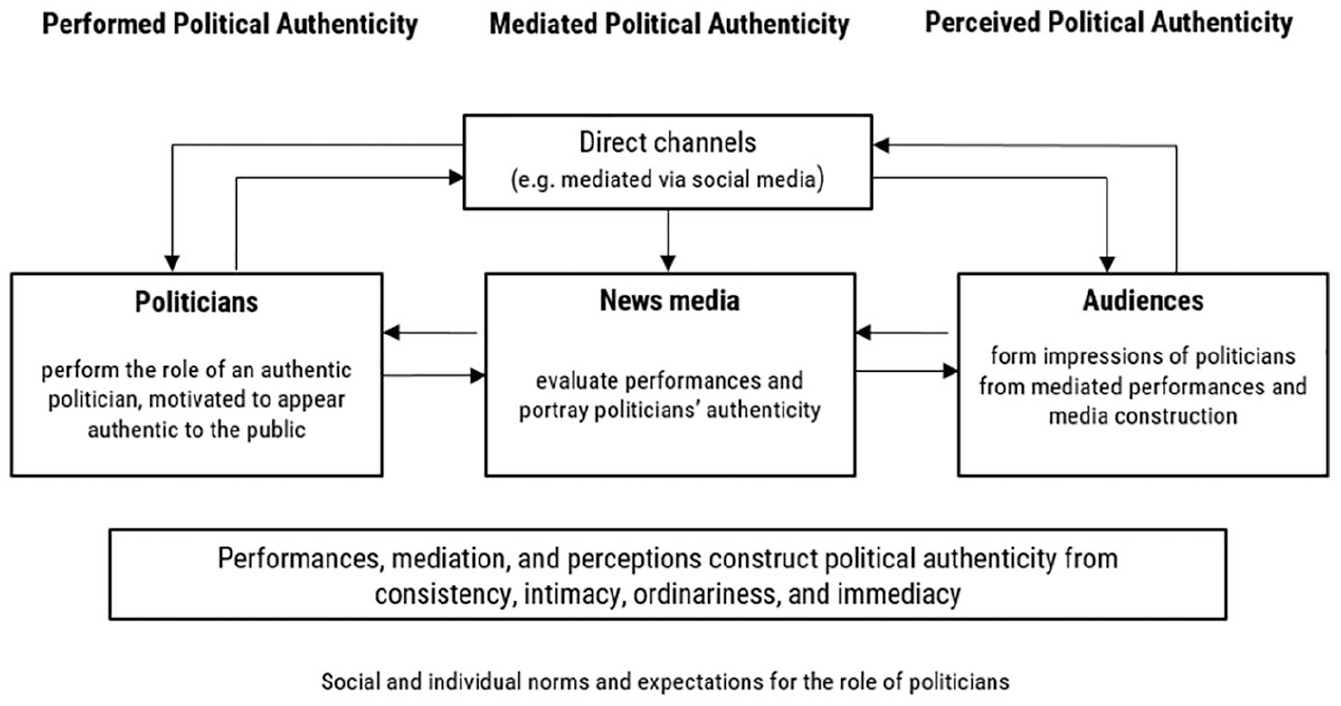
Model for the public construction of political authenticity (own figure inspired by Norris 2015).
Conclusion and Implications
The popularity of authenticity in recent political communication research has created a need for its conceptual clarification in the field. This article provides a communication science perspective on the concept of political authenticity and suggests three analytic perspectives for its systematic analysis. Political authenticity is described as the outcome of different construction processes and dynamics among politicians, journalistic media, and the audience, which are termed performed, mediated, and perceived political authenticity, respectively. I define political authenticity as a multi-dimensional construct consisting of four dimensions: consistency, intimacy, ordinariness, and immediacy.
This article makes a threefold contribution to the academic discourse on political authenticity and to further empirical research in the field. First, it provides a theoretical framework for different research perspectives on political authenticity, making it possible to compare and integrate findings from research on the concept. The paper conceptualizes political authenticity as a social construction which is created and negotiated in communication processes among politicians, the media, and the audience. Therefore, future research on political authenticity can rely on one of these perspectives to deconstruct the complex public construction of authenticity and combine different perspectives to analyze dynamics in processes of construction. Second, I propose four dimensions of political authenticity defining relevant facets and indicators of authenticity and helping to explain how it is constructed in political communication. These dimensions and associated indicators should guide further empirical analyses of the concept and serve as starting points for the operationalization of strategies of performed authenticity, mechanisms in mediated authenticity, perceptions of perceived authenticity, and related dynamics. Audience research, for example, would benefit from the development and validation of a perceived political authenticity scale that reflects all four concept dimensions equally and allows a more detailed analysis of authenticity perceptions, their causes, and effects.
Third, this article can inspire future research seeking to answer some of the most important questions concerning the role of authenticity in political communication. The proposed conceptualization can assist further research which examines perceived political authenticity as media effects and investigates the consequences of intersubjective differences in authenticity perceptions. Specifically, research should focus on the significance of perceived authenticity or inauthenticity and its antecedents in the context of people’s voting decisions (Stiers et al. 2019). In this way, the concept can be linked to other lines of research and contribute to questions concerning candidate preferences and the legitimacy of leadership (Iversen 2018). Taking political authenticity as an expression of character-driven politics (Parry-Giles 2001), public constructions of political authenticity are a potential issue in the discourse on the personalization of politics. Moreover, building upon first evidence, it is expected that a closer examination of political authenticity would help to describe and understand reasons for the current success of populist parties and politicians in many countries (Enli and Rosenberg 2018).
Finally, this article provides a constructivist perspective on a popular term and illustrates how the concept can be deconstructed for political communication research. Furthermore, the proposed conceptualization should inspire a nuanced academic discourse on authenticity in media and communication science that does not affirm authenticity as an inevitable ideal but rather critically questions the reasons for and social consequences of the ubiquity of authenticity demands in contemporary society.
Footnotes
Declaration of Conflicting Interests
The author declared no potential conflicts of interest with respect to the research, authorship, and/or publication of this article.
Funding
The author received no financial support for the research, authorship, and/or publication of this article.
