



Abstract
This paper analyses the presence of interest organizations in political news in the United Kingdom and the Netherlands between 1990 and 2017. Previous research on organized interests in the media revealed (1) a consistent overrepresentation of business interests across countries, but (2) also that this overrepresentation has decreased over time in a European context. However, these studies are snapshots of interest group patterns with either cross-country or longitudinal variation, and important players such as corporations have been largely excluded by European scholars. We argue that including corporations affects previous conclusions as it reveals substantial differences across countries and an increasing role of business interests in the news. We use a data set of Dutch and British news articles, in which we identified 34,657 interest organizations. This endeavor highlights that the distribution of organized interests in the media is skewed toward business interests and has not become more diverse. This suggests that the important insider role of business interests translates to outsider venues, which tells us something about how the news media maintain these patterns through the construction of news stories. These findings interfere with ideas of representativeness and flourishing democracies with a diverse public debate in which many different voices are expressed.
Introduction
The media has become a core intermediary between citizens and politics over the past decades (Mazzoleni and Schulz 1999). More than ever, the “political reality” of citizens is shaped by and based on what is covered by the media (Kepplinger 2002) and many issues debated in parliament are driven by news coverage. Political actors are therefore in a competitive battle to gain news coverage and, in doing so, have an impact on the political process. One type of such actors is organized interests, which represent a key source of information for journalists (e.g., Berkhout 2013; Gamson and Wolfsfeld 1993). Moreover, with the growing importance of the media, gaining access to this venue has become an increasingly relevant goal for organized interests, even if they already possess an established insider status in the political process (Kollman 1998; Kriesi et al. 2007).
Focusing on the media presence of organized interests is important as it indicates which voices are getting heard and to what extent there is a balance in the public debate. The latter is important as democracies thrive when criteria of representativeness, equal access, and diversity are met (Binderkrantz 2012; Danielian and Page 1994; Sartori 1987). When the public has access to different types of ideas, it can create a more informed opinion about politics and policy (see Danielian and Page 1994 for a discussion). According to some, “the role of the news media in any political process can best be understood by looking at competition over the media as part of a more general struggle for political control” (Sheafer and Wolfsfeld 2009: 147).
Given its increasing importance, a vast scholarship has emerged that analyzes patterns of interest group coverage in the media (Binderkrantz 2012; Binderkrantz et al. 2016; Binderkrantz et al. 2015; Danielian and Page 1994; De Bruycker and Beyers 2015; Kollman 1998; Trevor Thrall 2006; Van der Graaf et al. 2015; Woll 2012). This work shows that attention for interest groups in media channels is similarly skewed toward a select group of business actors in insider channels (i.e., channels in which organized interests interact directly with politicians or policy-makers), thereby impeding the representative nature of political news coverage (e.g., Binderkrantz et al. 2015; Danielian and Page 1994; De Bruycker and Beyers 2015). Unfortunately, these studies tend to offer snapshot insights into media appearances of interest groups, which does not allow us to see whether the bias toward business groups in news media has increased or decreased over time. To our knowledge, the only paper that analyzes the presence of various types of interest groups in the media over time is by Binderkrantz (2012), who analyzes Denmark. She finds, quite surprisingly, that business presence in political news media has decreased over time. While acknowledging the groundbreaking relevance of this study, in this paper, we challenge the finding that interest groups’ presence in the news has become more diverse over time.
Our first contribution to the literature relates to the inclusion of corporations in the analysis. Binderkrantz (2012) finds that business associations have lost ground to nongovernmental organizations (NGOs) in the political media discourse in Denmark, and the overall discourse has as a result become more diverse. We expect that, just as in insider channels, corporations will outnumber any other interest group (Baumgartner and Leech 2001; Berkhout et al. 2018; Chalmers 2013; Salisbury 1984; Schlozman 1984) and will have managed to have increased their media access the most (Gray et al. 2004). Consequently, we expect the combined relative presence of business groups—that is, business associations and corporations—in the political news discourse to be more prominent now than ever before.
Our second contribution to the literature is that we expect variation in interest group activity in the media over time to differ across types of countries. We therefore apply a comparative perspective, by comparing a corporatist country (the Netherlands) with a pluralist country (the United Kingdom). The two systems differ in terms of how state-interest group relations are organized. In corporatist arrangements, it is common that the state shares some of its power with selected umbrella groups such as labor and business associations (Streeck and Kenworthy 2005). In pluralist setups, a greater variety of organized interests is tolerated as long as these interests limit their activities to parliament (Streeck and Kenworthy 2005). We expect that corporations have increased their lobbying efforts over time in corporatist countries much more than in pluralist countries. With the declining political importance of traditional interest groups in corporatist countries (Aizenberg and Hanegraaff 2019; Lijphart 2012), we expect corporations to have swiftly seized this opportunity and sought to increase their grip on political news coverage. Moreover, journalists are willing to provide corporations more access as they tend to be more inclined to take up stories that involve powerful actors (Galtung and Ruge 1965; Harcup and O’Neill 2001). Consequently, we expect media coverage to be more biased in favor of business interests in the Netherlands than in the United Kingdom.
The hypotheses are tested on a data set of political news coverage of all organized interests in the United Kingdom and the Netherlands from 1990 until 2017, consisting of 150,136 Dutch and 200,577 British articles. To make sure our findings are robust, we include, for each country, one newspaper with a more right-wing and conservative alignment (The Times from the United Kingdom and Algemeen Dagblad from the Netherlands), and one newspaper with a more progressive and center-left orientation (The Guardian and NRC). The combination of variation of newspapers within and across countries allows us to identify broader patterns associated with interest group presence in the media, exceeding the narrower objectives of newspaper editorial boards such as the ideological position or world view these newspapers aim to convey. Using quantitative text collection and analysis methods, interest groups were identified, mapped, and compared over time in the political media discourse. During the period under study, 34,657 interest groups were identified in political news sections across the aforementioned newspapers in the United Kingdom (15,196) and in the Netherlands (19,461). We hereby link interest group presence in the media to actual political events addressed in the newspapers. This allows us to trace which groups increased their share in the news media over time and to make a comparison between the two countries.
Are Business Groups Overrepresented in Political News?
Analyzing the “biased” nature of interest representation—that is, a disproportional overrepresentation of certain groups in the political process—is one of the perennial and central concerns driving the study of interest groups and lobbying (e.g., Lowery et al. 2015; Schattschneider 1960). In such studies, the distribution among different types of groups—business organizations, NGOs, labor unions, and so on—is compared to see whether interests are equally represented. In a typical policy process, we will find larger numbers of organizations representing business interests than organizations representing citizens (e.g., Berkhout et al. 2018). This skewness can be observed in many organizational patterns present at political venues (Gray et al. 2004; Halpin et al. 2016) as well as in broader terms of direct political participation by interest groups (Rasmussen and Carroll 2014).
What is less common, however, is the mapping of the presence of organized interests in the media. Having said that, several important studies have been conducted in this regard (Binderkrantz 2012; Binderkrantz et al. 2016; Binderkrantz et al. 2015; Danielian and Page 1994; De Bruycker and Beyers 2015; Trevor Thrall 2006). These studies are important contributions because today the news media constitute a crucial part of politics; that is, in recent decades, politics has lost some of its autonomy and is increasingly dependent on and shaped by the news media (Mazzoleni and Schulz 1999). As a result, both political actors and journalists are dominant powers in the process of political communication and play a mediating role between citizens and those responsible for substantial political decisions and actions (Kepplinger 2002). Observers of the political process argue that the success of political actors often depends on their ability to shape the news-making process and to use other channels of mass media communication to influence public opinion, electoral outcomes, and the policy process (Kepplinger 2002; Lipsky 1965; Mazzoleni and Schulz 1999; Strömbäck 2008). Media strategies are therefore an increasingly important tool for interest groups to affect political decision-making processes.
Analyzing potential “biases” in the media presence of interest groups is particularly important, as it highlights whether particular venues confer advantages to specific groups or whether the same types of groups dominate all political arenas, so that losers in one arena have nowhere else to turn (Binderkrantz et al. 2015). Schattschneider (1960) differentiated between certain privileged insider groups that enjoy direct access to policy-makers and outsiders who are denied such access. In scholarly debates, outsider strategies are generally thought to be used by outsider groups to make up for their lack of direct access (see also Lipsky 1965; Wilson 1961). It is therefore important to know whether media outlets are dominated by business interests, just as the insider channels tend to be, or if they serve as alternative venues for marginalized groups to challenge the status quo.
Most empirical studies indicate that business interests are also more present in news coverage (Binderkrantz et al. 2015; Danielian and Page 1994; De Bruycker and Beyers 2015; Kollman 1998; Trevor Thrall 2006; Van der Graaf et al. 2015; Woll 2012). Yet, can we interpret these differences in media presence as bias or disproportionate? Indeed, the extent of interest group bias is notoriously difficult to identify, given that the real or actual distribution of interests in society is conceptually and empirically impossible to determine (Lowery and Gray 2004). As a minimal approach, the assessment of bias “should always entail comparison across venues, jurisdiction, or time” (Lowery and Gray 2004: 21). We can refer to only four studies including such a benchmark to assess interest presence in the media.
First, two studies compare distributions of interest groups across venues: De Bruycker and Beyers (2015) in the European Union (EU) and Binderkrantz et al. (2015) in Denmark. These studies highlight how outsider channels reveal remarkable consistency with insider channels. This does not mean that outsider channels are more biased toward business associations, yet they are also not necessarily more diverse across venues. Second, Binderkrantz et al. (2016) compare bias across three jurisdictions: Denmark, the United Kingdom, and Spain. The results, again, show much coherence across group types. In all countries, business is overrepresented in the media, yet there does not seem to be much variation across countries. The third and final comparison is over time. As discussed, Binderkrantz (2012) illustrates in corporatist Denmark that the proportion of business and labor groups’ presence in the media is in decline, and sectional and public interests groups (i.e., NGOs) have gained more presence in recent decades, indicating a trend toward a more diverse set of interests being expressed in the media. Other studies without a comparative design have identified the declining presence of labor unions in the media in other countries, such as Great Britain (e.g., Ward and Lusoli 2003) and Canada (e.g., Fowler and Hagar 2013). The growing role of NGOs in the news media has also been identified in several studies, such as in the United States (e.g., Bob 2005), and Belgium and the Netherlands (e.g., Vliegenthart and Walgrave 2012).
Overall, these studies represent a great step forward in assessing the changing role of interest groups in the media over time, yet two elements remain underexplored and we believe these are essential in assessing whether or not business presence in the media has indeed decreased, as Binderkrantz and others suggest. First, neither of these four benchmark studies includes corporations in the analysis. We believe this leads to erroneous conclusions about the actual business presence of business organizations in the media. In a nutshell, and explored further in the next section, we agree that business associations have lost ground in the media, but at the same time we also expect that corporations have taken up the space of business associations in the media in an exponential way. As a consequence, the system has not become more diverse, but more prone to business capture.
Our second contribution is that we compare interest group activity in the media over time across countries. We think that institutional differences across countries are critical to understand patterns of interest group activity in the news media over time. We expect that the decline of corporatism has led to a bigger gap between the visibility of business and civil society actors in the news media, compared to countries with a pluralist system of interest representation. The following section explores our hypotheses in more detail.
Business Presence in the News Media across Time and Countries
In this section, we develop two broad hypotheses: one for variation in business presence in political news over time and one for variation across countries. Our first focus is to explore whether there is a difference in the relative presence of business groups (compared to other types of organizations, most notably NGOs) across time. There are certainly good reasons to expect that corporations have substantially increased their share of coverage in the news media—that is, if inside lobbying is a good indication of media lobbying, which much of the literature seems to suggest (Binderkrantz et al. 2016; De Bruycker and Beyers 2015). Several studies report that corporations now constitute the largest part of interest group communities in most political systems. In the pluralist context of the United States, both Schlozman (1984) and Salisbury (1984) demonstrated back in the 1980s that of all organizations having a Washington presence, corporations constitute the largest part (according to the two studies, 45.7 and 33.5 percent of all interest groups, respectively). Gray et al. (2004) illustrated that this pattern has intensified even further since then, as the relative share of institutions (of which corporations constitute the largest share) registered to lobby increased from 39.55 percent in 1980 to 57.51 percent in 1997. In the EU, we see a similar trend: Berkhout et al. (2018) and Chalmers (2013) show that individual corporations now comprise the largest part of the lobbying community in the EU.
Assuming that there is at least some overlap between insider and outsider channels, it seems likely that business bias in the media has also increased. Importantly, this would contradict the study of Binderkrantz (2012), who has observed a decline in business presence in the media in Denmark and an increase in the presence of NGOs. Yet, as previously stated, this study does not include corporations, which we believe changes the picture dramatically. While we expect that business associations have lost ground in the political media discourse, and NGOs have to a certain extent taken up this space, we expect that corporations have managed to exponentially increase their presence in the media in recent decades. As a result, if one excludes corporations, one will observe a decrease in business presence in the media, but if one includes their share, the share of business groups increases over time. As a net result, we therefore expect that
While we expect an increase of business exposure in the media over time, what do we expect to find across jurisdictions? As mentioned, there is only one study that systematically analyzes the distribution of interest groups across various countries (Binderkrantz et al. 2016). The authors compare three countries—Denmark, Spain and the United Kingdom—and find that business groups are overrepresented in all news media outlets; however, the variation per country is not striking. The question therefore is whether this will still hold true once we include corporations in the equation. We expect it will not hold, and that there will be substantial variation across pluralist and corporatist countries. In pluralist systems, corporations are incentivized to lobby on their own behalf, as in such contexts the activity of organized interests is controlled by creating room for competition amongst organized interests which have “constitutional rights to lobby the democratically elected parliament” (Streeck and Kenworthy 2005: 445). In corporatist systems, it is more common that a government tempers the activity of organized interests by channeling it. In practice, this means that it shares authority with a selection of umbrella groups such as labor unions and business associations (Streeck and Kenworthy 2005).
Importantly, however, corporatism is experiencing a stark decline (e.g., Binderkrantz 2012; Crepaz 1994; Rommetvedt et al. 2013). The declining importance of traditional corporatist arrangements, as has occurred in the Netherlands, could lead to a more diverse distribution of organized interests’ presence in the media, as traditional umbrella groups have lost ground and NGOs have expanded their position (e.g., Binderkrantz 2012). As a result, one could expect a stronger business presence in the media in the United Kingdom than in the Netherlands (see Binderkrantz 2012). However, this reasoning negates the role of individual corporations, which have also profited from new political opportunities associated with the decline of corporatism. Indeed, actors that were previously represented by umbrella groups, that is, corporations, now seek to represent themselves in political processes (see Aizenberg and Hanegraaff 2019).
We expect this shift to individual corporate lobbying to be so severe in corporatist systems that such interest systems have now become even more biased in favor of business interests than pluralist systems (Aizenberg and Hanegraaff 2019). First, when new political opportunities arise, such as due to the decline of corporatism, corporations are more likely to take advantage of this situation than NGOs, given their more limited constraints for collective action and the greater resources that they possess compared to NGOs (Chalmers 2013; Offe and Wiesenthal 1980; Olson 1965). This allows corporations to make use of new opportunities, such as seeking access to media, more easily, which is something we have seen in other newly opened political venues as well (Gray and Lowery 1996). Second, the information that business associations and labor unions provide to the media is mostly of an economic nature. Even when these traditional economic actors become less important as the spokespeople of the economic sector, journalists and news editors still demand economic input. It seems plausible that predominantly corporations, rather than NGOs, would step in to fill this void. As there are so many more corporations than associations and unions in society, journalists will be flooded by input from corporations and this will likely lead to a much stronger dominance of business actors in the media over time (Aizenberg and Hanegraaff 2019; Lowery et al. 2016). Combined, we therefore expect that
Data and Method
This study relies on a newly collected data set of four important British and Dutch daily newspapers between 1990 and 2017 and the presence of organized interests in the political coverage of these newspapers. It is important to add that this study only includes print newspapers and no online news outlets, for example. Although this endeavor does not deliver results that can be generalized to all news media, it provides a useful approximation as there tends to be overlap between print media and their online counterparts (see, for example, Quandt 2008). Moreover, we include newspapers with a distinct ideological editorship to account for variation related to the type of news these newspapers prioritize and aim to convey. It does not fit within the scope of this paper to include all types of newspapers and/or news outlets, but creating variation within and across countries enables us to make some generalizations based on our findings. Moreover, in case of differences between types of newspapers, we can more directly analyze the sources of this variation.
The data include two components. First, it consists of the political newspaper coverage that appeared between 1990 and 2017 in The Guardian, The Times, Algemeen Dagblad, and NRC Handelsblad, which we obtained by downloading from LexisNexis and filtering for political news using a simple query. 1 The article selection filter includes important political venues and political parties that held at least four seats in the Dutch Parliament or British House of Commons during the full period under study. 2
The second component consists of a full list of corporations, with 250 employees or more, which have been active during the period under study in both the Netherlands and the United Kingdom. This component also includes a full list of business associations, labor unions, professional membership groups, membership groups, NGOs, groups of institutions and authorities, and research or think-tank groups that were active during the period under study and have fifty or more employees. 3 The lists were extracted from the databases of the Dutch Chamber of Commerce and the United Kingdom’s Companies House.
We established the proportion of groups being mentioned in the news media by running automated queries of the names of the organizations active over the chosen time period on the data set of political news coverage. Our unit of analysis is the presence of actors, in this case, organized interests in Dutch and British political newspaper coverage. 4 The used method is very similar to the one applied by Binderkrantz (2012) and Binderkrantz et al. (2016); here, however, it is used in an automated manner which enables us to analyze a large quantity of news articles. This specific method has been applied to parliamentary hearings as well (see Aizenberg and Hanegraaff 2019 for a discussion of the reliability of this method). As the nature of these data are different, a sample of 150 articles and therewith 387 organized interests were coded manually to ensure validity. 5 To ensure reliability of the manual coding, a set of fifty articles was coded by an external coder, yielding Krippendorff’s alphas of 1, .71, .62, and .89.
As the density of news and the number and distribution of organizations were not always equal over time, the dependent variable was constructed by calculating the relative share of corporations and business associations compared with other organized interests visible in the political media discourse. To ensure that the presence of corporations that were added to the analysis actually indicated involvement in the political media discourse, the context of the presence of the actors was manually coded using a method similar to the technique used by De Bruycker and Beyers (2015). Six hundred articles were coded: 150 per media outlet and fifty per decade. In total, 1,568 actors were coded. 6
To explain the relative share of business interests compared with other organized interests in the political media discourse, we relied on two types of variation, cross-country and time, and we controlled for media outlet. First, for our hypothesis on differences between the two countries, we relied on the observed variation of the relative share of business interests in the political media discourse in each country. As discussed, the countries vary in institutional arrangements and thus how state-interest group relations are managed: the United Kingdom is characterized by pluralism and the Netherlands by a neo-corporatist setup (Lindvall and Sebring 2005). This allows us to test whether the type of interest mediation system affects media presence, similar to insider lobbying efforts. The two cases under study also vary in terms of media systems, with the United Kingdom having a liberal media system and the Netherlands a democratic corporatist system (Hallin and Mancini 2004). This “most-different system design” allows us to meaningfully interpret the results in light of the differences across countries and type of newspaper, that is, to determine which of these two factors is more important for the results. Second, to test our hypothesis of change over time, we measured the trend of the relative share of business interests compared to other organized interests across the timeframe under investigation. Third, to ensure the robustness of our findings, we controlled for potential variation across different types of newspapers. Namely, The Guardian and NRC Handelsblad are characterized by a center-left and progressive alignment, while The Times and Algemeen Dagblad are rather right-wing and conservative.
Analysis
In this section, we analyze how the share of business groups varies across countries (the Netherlands and the United Kingdom) and time (1990–2017). 7 Because there is a limited number of studies analyzing the presence of interest groups in the media including corporations, our analysis is aimed at providing an overview of general trends. More specifically, during the period under study, 34,657 interest organizations were identified in political news coverage in the two countries: 19,461 in the Netherlands and 15,196 in the United Kingdom. 8 In the Netherlands, 1,331 business associations and 11,824 corporations were identified. In the United Kingdom, 1,473 business associations and 6,954 corporations appeared in political news coverage. In total, 8,427 business interests were identified in the United Kingdom and 13,155 in the Netherlands. To ensure the robustness of our findings, we manually coded a random sample of six hundred news items. In short, these results indicate that if business organizations are mentioned in the political news sections, they are quoted as the sources of information of either a journalist or a political actor also mentioned in the article, or because they are engaging in an activity within a political context. 9
We first provide a general overview of interest groups in the media without the inclusion of corporations. This allows us to compare our findings with those of other studies and highlight whether we observed similar trends (see Binderkrantz 2012; Binderkrantz et al. 2016). Figures 1 and 2 depict how the different organized interests appear in political newspaper coverage over time in the United Kingdom and the Netherlands, respectively. 10 For each country, they highlight the relative share of NGOs, (professional) membership organizations, business associations, and unions.
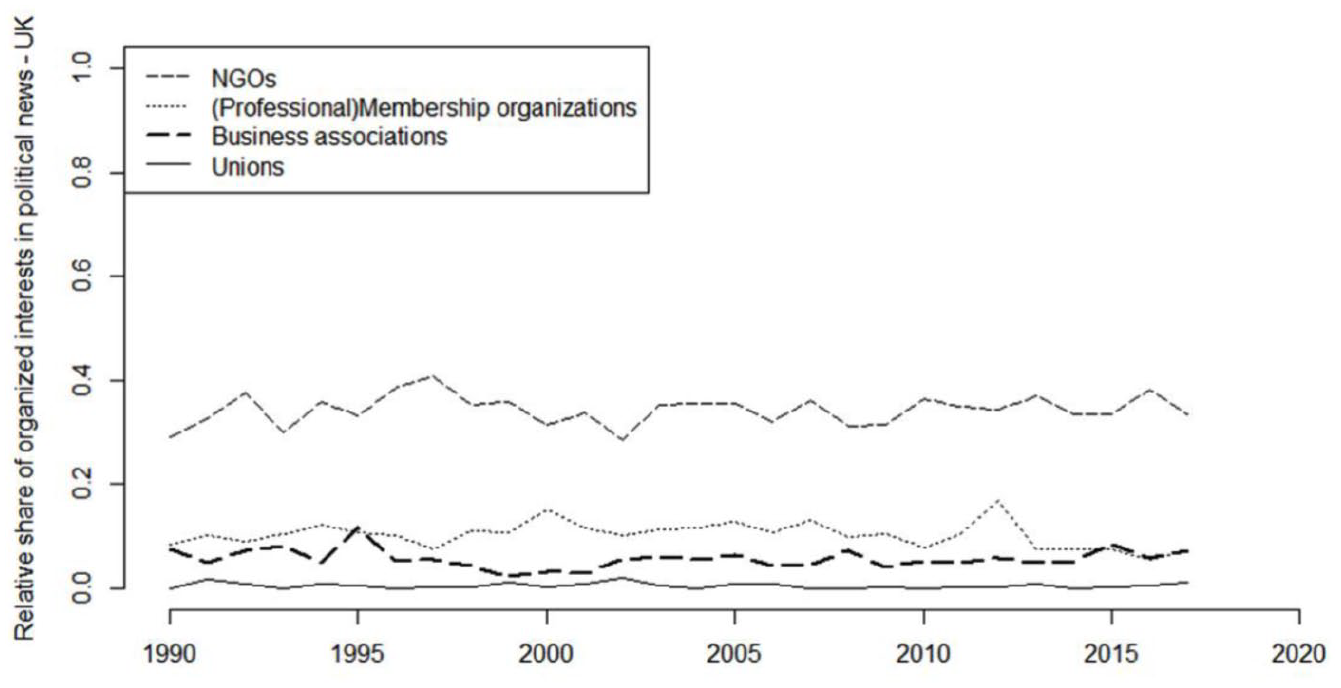
Relative share of presence of organized interests in political news in the United Kingdom.
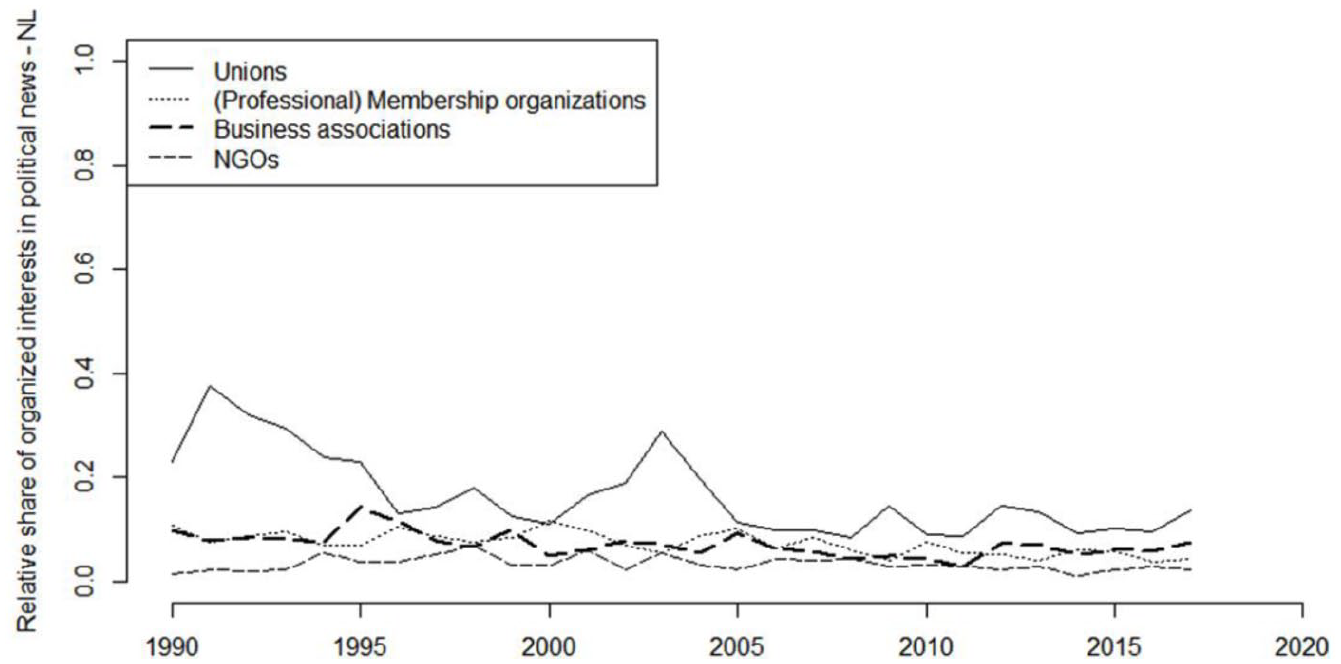
Relative share of presence of organized interests in political news in the Netherlands.
What are the main findings? First of all, in both countries, business associations do not have a substantial stake in the political media discourse. In the United Kingdom, NGOs are by far the actors most present in the newspapers, ranging between 30 and 40 percent over thirty years. Oxfam, an NGO that aims to battle poverty, is mentioned most often, the Campaign for Nuclear Disarmament comes second and the Fawcett Society, an organization that campaigns for gender equality and women’s rights, comes third. In the Netherlands, labor unions (although at a decreasing rate) comprise the largest part of organized interests in the political media discourse. The three most visible groups are the Netherlands Trade Union Confederation (FNV), the National Federation of Christian Trade Unions (CNV), and ABOP, which is the National Union for Education. In the early 1990s, labor unions comprised almost a quarter of all interest group mentions in political news, yet since the beginning of the new century, this has dropped to around 15 percent, with some fluctuations. A second point that stands out is that the presence of business associations is rather stable over time in the United Kingdom, r(26) = −.087, p = .65, with approximately 10 percent of the mentions. In the Netherlands, a modest, but significant, downward trend is visible, r(26) = −.59, p < .001. Their share has dropped from around 15 percent in the 1990s to less than 10 percent since 2000.
More broadly, the results highlight two key trends. First, in line with Binderkrantz (2012), we observe a vast decline in the presence of traditional business umbrella organizations in the media in the Netherlands. This illustrates the robustness of Binderkrantz’s (2012) study on the decline of traditional economic actors in the political news in Denmark, and the generalizability of her findings to other corporatist systems. The results are also in line with the ideas that institutionalized group access has declined in corporatist countries (see Binderkrantz 2012; Crepaz 1994) and that outsider channels mirror the distribution of insider channels (De Bruycker and Beyers 2015). At the same time, in the United Kingdom, we observe an entirely different pattern. In this context, we do not see much decline in the media presence of traditional business groups, yet their overall presence is rather limited. Rather, NGOs seem to be the most visible interest groups in British political news, and this seems to have been the case consistently since the early 1990s. Hence, institutional differences are quite stark, even if we exclude corporations.
These differences become even more pronounced once we include corporations in the analysis (see Figures 3 and 4). The figures display that in both countries, and during the entire period under study, corporations were in fact the most prominent actors. The companies that are mentioned most often are Shell, PricewaterhouseCoopers, and Philips. When looking at the development of the presence of corporations over time in the political discourse, one can observe a strong increasing trend in the Netherlands, r(26) = .88, p < .0001, and one that is slightly negative, yet far more stable in the United Kingdom, r(26) = −.34, p < .1. This finding indicates that interests that are not by default included in the policy-making process in a corporatist system (Binderkrantz 2012; Crepaz 1994) have gained ground not only as insiders but also as outsiders. This suggests that the important role of corporations as insiders in both pluralist and corporatist contexts (see Berkhout et al. 2018; Gray et al. 2004; Salisbury 1984; Schlozman 1984) also holds for outsider platforms.
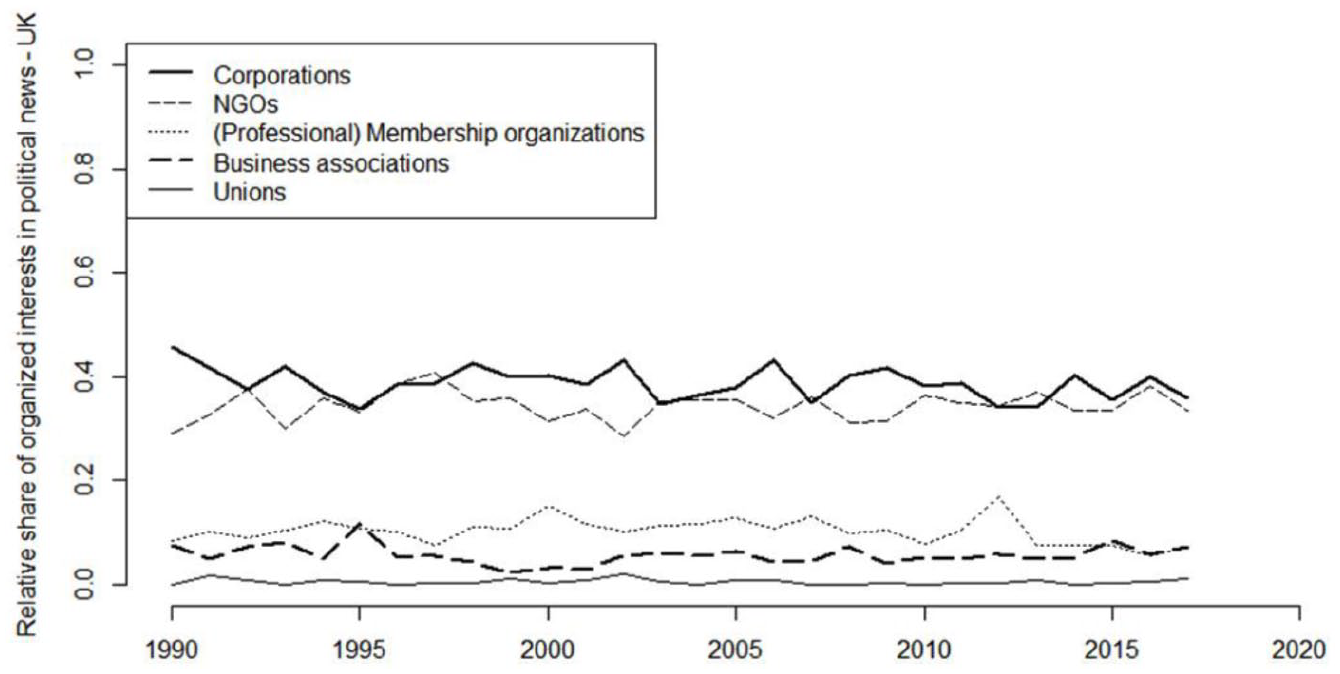
Relative share of presence of organized interests including corporations in political news in the United Kingdom.
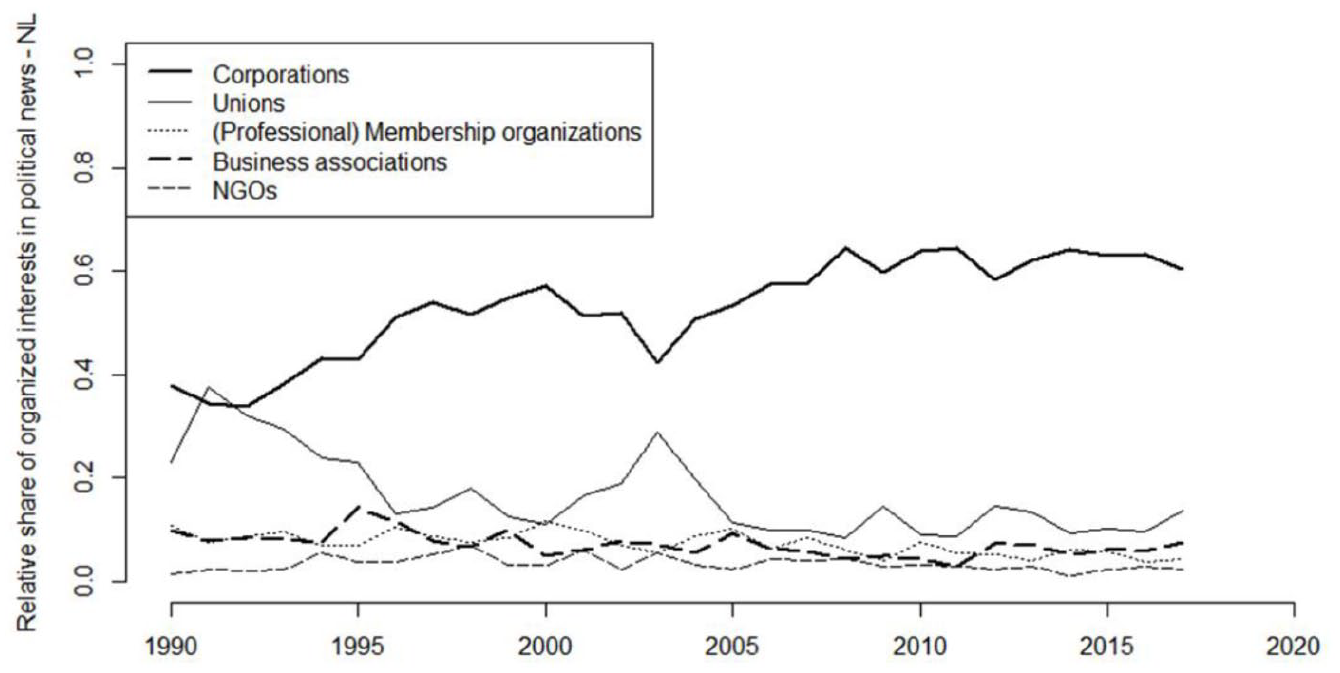
Relative share of presence of organized interests including corporations in political news in the Netherlands.
To highlight the differences in the visibility of business and nonbusiness actors more clearly, in Figure 5, corporations and business associations are combined into one category as business interests, and juxtaposed with all nonbusiness actors mentioned in the news media. The figure shows that the presence of business interests increased strongly in the Netherlands, r(26) = .85, p < .0001, while it remained more stable in the United Kingdom, with a slight negative trend, r(26) = −.38, p < .1.
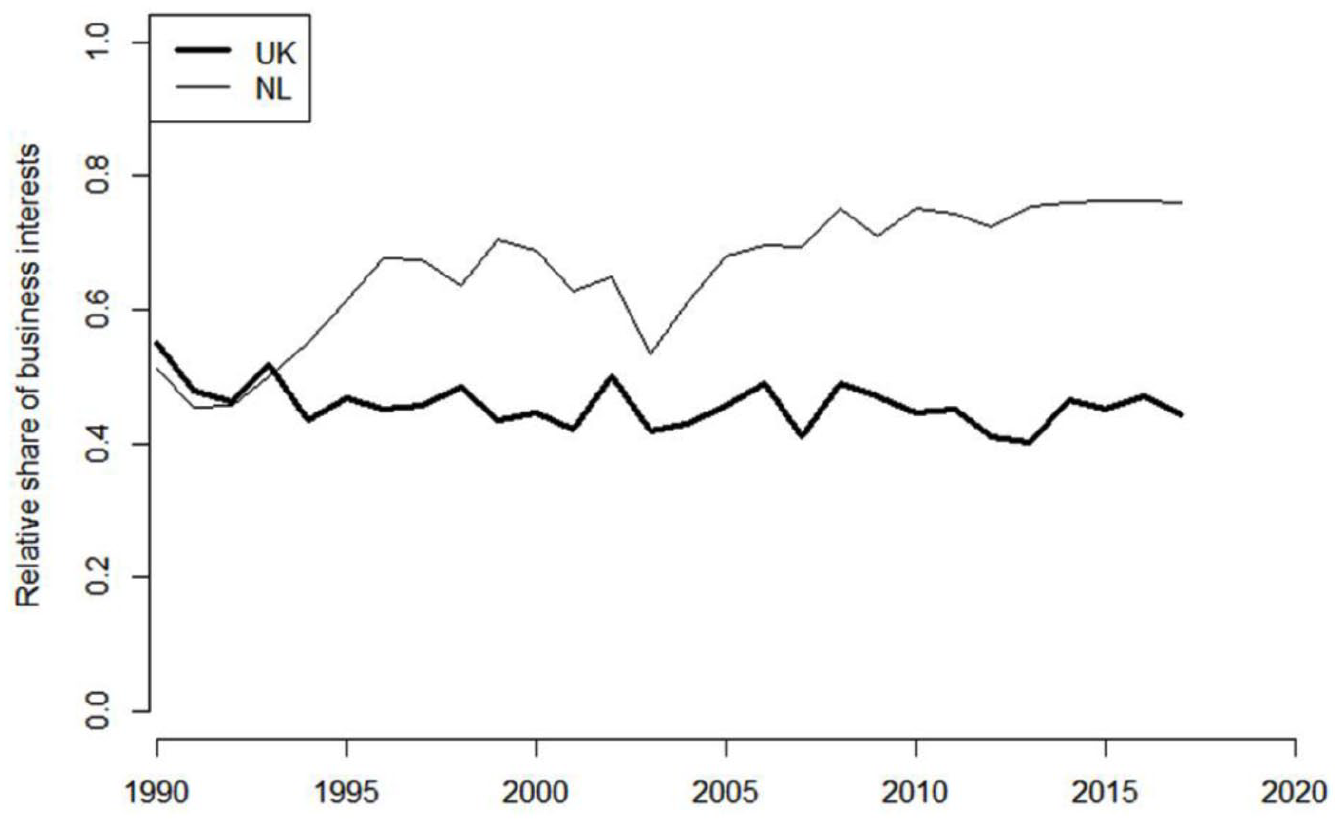
Relative share of presence of business interests in political news in the United Kingdom and the Netherlands.
In sum, the above analyses highlight an overall trend toward more relative business presence in the political news media, yet this is entirely driven by the country in which we study interest group presence in the media, as shown by the drastic increase of business presence in the Dutch media and its relative stability in the British case. This means that we can only understand variation in business presence over time (Hypothesis 1) if we consider variation in political systems (Hypothesis 2). In addition, the extent to which corporations have increased their relative share in the Netherlands is notable. When looking at organized interests in political news, we can observe that political news in the Netherlands is now almost entirely dominated by business groups in general and corporations specifically. This image contradicts any positive depictions about the plurality of news sources in corporatist settings (see Binderkrantz 2012). Rather, we see a system of news media that is dominated by business interests.
In the United Kingdom, where there have been no major shocks in the interest mediation system, we observe a state of relative equilibrium. Over a long period of time, almost thirty years, roughly the same types of organizations appear in political news media. Also, visibility appears to be rather evenly distributed, even though traditional business actors are not major players in this area. Rather, corporations and NGOs divide most of the space in political news, but do so in an equal manner. If anything, it seems that pluralist United Kingdom demonstrates more consistency with the system of plurality in political news coverage.
This brings us to the final question of the study, namely what could be potential causes for the trends we observe? While the trends may be clear, they do not tell us much about what explains these opposite trends in the two countries. The most likely explanation in our view, as argued, is the decline of corporatism in the Netherlands. In corporatist settings, business actors already had the advantage of privileged access to policy-makers and the news media; hence, there was a greater dependence on groups that could provide input on economic issues. With the decline of corporatism, corporations have now apparently filled this void. In light of the theories of collective action, this is not surprising. Indeed, when new venues open up, specialized interests face fewer obstacles to taking advantage of the situation (see Gray and Lowery 1996).
Yet, alternative explanations are possible, such as changes in economic trends (Bernhagen and Mitchell 2009; Lowery and Gray 1998) or political configurations and alignments (see Allern and Bale 2012 for a discussion). Unfortunately, there is no data on the exact decline of corporatism over time, so we cannot link this directly to shifts in corporate presence in the media. What we can do, however, is test several of the alternative explanations in a time series analysis. We conducted such an analysis, in which we controlled for economic trends, variation in government spending, the level of globalization of the economy, and the type of government in office. 11 As can be seen in Tables A2 and A3 (see Supplemental Appendix 2), these have almost no effect on the trends we observe. In fact, both for the Netherlands and the United Kingdom, the model fit of the time series regressions are better without these control variables. This is a clear indication that the rise of corporate lobbying in the media is not due to economic trends or changes in government. These results make it, at the very least, plausible that the changes we observe are indeed driven by the broader institutional structure of interest mediation in a country.
Conclusion
This study has assessed whether the increasing activity of interest groups in the media has led to a more balanced playing field among interest groups or whether certain groups have profited more than others. Most importantly, we analyzed the role of corporations, which was missing in earlier accounts. The results are striking. When corporations are not included, the data suggest a rather stable pattern of the presence of organized interests in the United Kingdom, where NGOs have the greatest share. In the Netherlands, we find a decrease of both business associations and labor unions. These observations highlight the robustness and generalizability of the findings of Binderkrantz (2012) and are aligned with the work of scholars who argue that the corporatist system is in decline (Binderkrantz 2012; Crepaz 1994; Rommetvedt et al. 2013). Yet, when corporations are included, the data indicate that this category has the greatest share of presence in the political media discourse in both the Netherlands and the United Kingdom. This suggests that the important insider role of business interests (Berkhout et al. 2018; Gray et al. 2004; Salisbury 1984; Schlozman 1984) also translates to outsider venues (Binderkrantz et al. 2016; Binderkrantz et al. 2015; Danielian and Page 1994; De Bruycker and Beyers 2015; Kollman 1998; Trevor Thrall 2006; Van der Graaf et al. 2015; Woll 2012). Moreover, this effect is so strong that, overall, news coverage has become more focused on business, and not more diverse, as former studies indicated. This in turn suggests that the news media may amplify existing imbalances between different types of interest groups. More broadly, it confirms the growing importance of corporations in political processes (Aizenberg and Hanegraaff 2019), as journalists tend to be keen to include stories on actors that are powerful (see Galtung and Ruge 1965; Harcup and O’Neill 2001).
While the main objective of this paper was to empirically highlight the increasingly important role of corporations in the media, we also provided a potential explanation for the variation we observed. Variation in time highlights that the presence of business interests indicates a stable trend in pluralist United Kingdom and a marked increase in the corporatist context of the Netherlands, where the presence of business interests has become more prominent over the years. Moreover, this holds once we include a set of plausible alternative explanations. This is an important finding, as corporatist systems functioned as buffers to prevent the capture of political processes by specialized interests (Lijphart 2012; Rommetvedt et al. 2013). Similar to insider channels, these buffers seem to have disappeared in the media.
While this leads us to conclude that the decline of corporatism probably accounts for most of the variation over time and across countries, we acknowledge that there may be other factors at play. Future research should therefore further disentangle the reasons why corporations are so prominent in the news. This can be done in a quantitative or qualitative way. For the former, an interesting path for future research would be to grasp the context in an automated manner by conducting clause analysis (e.g., Van Atteveldt et al. 2017). This method can automatically extract statements and actions of political actors in a text corpus. This in turn allows for analysis of their actions and positions on issues (Van Atteveldt et al. 2017). Interviews with journalists and interest groups may help unravel the exact causes of the changing nature of interest group presence in the media. While these have fallen beyond the possibilities of this paper, we see them as promising avenues for future studies. As such, we see our endeavor mostly as a starting point to explore new questions and certainly not as the final answer.
Another caveat of our findings is that interest groups in the Netherlands might be in a transition period. It could very well be that business interests have simply taken advantage more rapidly of the opportunities that arose with the decline of corporatism. This would mean that in the future we would see balancing effects and a relative decline of business presence in the media (see Gray and Lowery 1996). This could affect both the trend over time and across countries. For interest organizations, we have seen similar trends when a new venue opens up: while business organizations at first increasingly dominate the interest group populations at these new venues, over time a more balanced distribution is established (Hanegraaff 2015). If these balancing mechanisms are very strong, as they were for interest organizations, this could even mean that the Netherlands will become similar to the United Kingdom in terms of the number of groups present in political news. Future studies should therefore address these developments across time and countries.
To conclude, this paper has highlighted that the organized interests present in the media are becoming increasingly populated by corporations. Such imbalance in media presence interferes with “norms of equal access, representativeness, balances and diversity in the marketplace of ideas” (Danielian and Page 1994: 1056). What is more, it violates the idea that the more diverse a public debate is, the more democracies are able to thrive (Binderkrantz 2012; Danielian and Page 1994; Sartori 1987). Indeed, this optimistic idea that assumes a public debate in which many different voices are expressed seems further away than expected.
Supplemental Material
online_supp_-_Supplementary_file – Supplemental material for Time is of the Essence: A Longitudinal Study on Business Presence in Political News in the United Kingdom and the Netherlands
Supplemental material, online_supp_-_Supplementary_file for Time is of the Essence: A Longitudinal Study on Business Presence in Political News in the United Kingdom and the Netherlands by Ellis Aizenberg and Marcel Hanegraaff in The International Journal of Press/Politics
Footnotes
Acknowledgements
The authors are grateful to Anne Skorkjær Binderkrantz, Helene Helboe Pedersen, Henrik Bech Seeberg, Joost Berkhout, Ton Nijhuis, Juho Vesa, Linda Flöthe and Steven Eichenberger as well as the anonymous reviewers for providing excellent feedback on previous versions of the manuscript. The authors also thank Sarah Kalaï and Max Scheijen for their outstanding assistance in coding.
Declaration of Conflicting Interests
The author(s) declared no potential conflicts of interest with respect to the research, authorship, and/or publication of this article.
Funding
The author(s) received no financial support for the research, authorship, and/or publication of this article.

Supplemental Material
Supplemental material for this article is available online.
Notes
Author Biographies
References
Supplementary Material
Please find the following supplemental material available below.
For Open Access articles published under a Creative Commons License, all supplemental material carries the same license as the article it is associated with.
For non-Open Access articles published, all supplemental material carries a non-exclusive license, and permission requests for re-use of supplemental material or any part of supplemental material shall be sent directly to the copyright owner as specified in the copyright notice associated with the article.
