



Abstract
How does donor funding affect the independence, role perceptions, and ideology of the journalism it supports? We begin to answer this increasingly important but underresearched question with a year-long case study of the humanitarian news organistion IRIN as it transitioned from being funded by the United Nations to a private foundation, run by a Malaysian billionaire. Using content analysis, in-depth interviews, and ethnographic research, we document the changes that occurred in IRIN’s outputs, target audience, and public service values, and the complex interplay of influences that produced these changes. We find that, in this case, donor power operated entirely indirectly and always in concert with the dominant professional values within IRIN. In doing so, this case study highlights the importance of journalistic agency and contextual variables in the journalist–donor relationship, as well as the potential significance of contradictory dynamics. We also use this case to test whether Benson, Hessérus and Sedel’s model of media owner power can help to explain the workings of donor power.
Engaging in regular, detailed reporting of global crises such as conflicts, refugee flows, and food insecurity is not profitable. It rarely helps news outlets attract mass audiences, enter lucrative new media markets, or secure advertising from luxury brands (Aly 2017). It is also very expensive to fund a network of on-the-ground reporters and the kinds of time-consuming research and travel necessary to explain the complex causes and contexts of these crises (Sambrook 2010). For these reasons, this kind of news is generally produced by journalistic outlets with a strong commitment to public service values, including public education, deliberation, and democratic participation (Lowe and Stavitsky 2016).
Finding ways of sustaining loss making, international public service journalism is important because it has the potential to inform and (re)shape the relationships between publics, policymakers, and aid practitioners, albeit in complex and nonlinear ways (Cottle 2009). International public service journalism is particularly important at a time of escalating global need. A combination of climate change, economic globalization, and conflict means that nearly two-thirds of the world’s population are expected to be living in fragile situations by 2030 (Organisation for Economic Co-operation and Development [OECD] 2014).
The pursuit of such normative commitments within journalism has traditionally been enabled by state subsidies, as in the case of national public service broadcasters (PSBs). But at a time when many states are cutting back on this financial support and commercial revenues are falling, both established and newer digital news outlets with public service commitments have begun to accept funding from private foundations to subsidize their loss-making journalistic work (Browne 2010; Bunce 2016). For example, since 2009, the following news organizations have all received grants of at least $1 million from the Bill and Melinda Gates Foundation (BMGF) to support international public service journalism: ABC News, AllAfrica.com , Al Jazeera, El País, the Guardian, National Public Radio, PBS’ Newshour, and Public Radio International.
But does donor funding really enable journalists to pursue expensive and highly specialized forms of public service journalism, while protecting them from commercial and political pressures? Or do donors exert their own forms of political and economic influence by, for example, encouraging journalists to “channel . . . their energies into safe, legalistic, bureaucratic activities and mild reformism” (Feldman 2007: 427)? Despite its importance, we know remarkably little about the implications of donor funding for journalistic practices or outputs. Research about “philanthro-journalism” tends to be limited to theoretical critiques or discussion of anecdotal evidence.
What is needed are systematic studies of news organizations that explore how donor funding may affect the content and production of news. This is precisely what this article provides. It reports on the findings of a year-long research project about Integrated Regional Information Networks (IRIN), an online news agency, founded by the United Nation’s Office for the Coordination of Humanitarian Affairs (OCHA) after the Rwandan genocide in 1994 to “enhance the capacity of the humanitarian community to understand, respond to and avert emergencies”. On December 31, 2014, OCHA closed the project following a series of disputes over editorial freedom. On January 1, 2015, IRIN became funded primarily by the Jynwel Foundation—the philanthropic arm of the Hong Kong–based international private equity investment and advisory firm, Jynwel Capital. Using extensive ethnographic access, semistructured interviews, and content analysis, we interrogate how and why changes in IRIN’s journalism occurred during their transition to this new donor.
This research makes a number of contributions to our understanding of the potential power and influence of donors. First, we introduce and test a model for investigating the operation of donor power, Based on Benson, Hessérus and Sedel’s (forethcoming) framework for analyzing the power of media owners. Drawing on this model, we find that, central to the operation of donor power in this case was the interaction of the donor’s influence over revenue generation, resource allocation, and target audiences as well as their background in the field of philanthro-capitalism. In addition, our case study highlights the importance of both journalistic agency and contextual variables in the journalist–donor relationship, which have historically been underemphasized (see Browne 2010; Feldman 2007). Finally, our analysis leads us to conclude that the most appropriate paradigm of power in this case is that of “contradiction” (Freedman 2014).
In the first section of this article, we introduce Benson et al.’s (forthcoming) model of owner power and identify the most likely ways in which donor influences manifest themselves in journalistic practices. In the next section, we discuss our methodological strategies and the rationale for selecting this case. We then go on, in the findings sections, to describe the most significant changes that occurred in IRIN’s journalism before interrogating the principal causal factors that produced them. We conclude by considering what wider lessons this case has for our understanding of donor power and for future research in this area.
Modes of Donor and Owner Power
Previous studies of the influence of external stakeholders on the workings of not-for-profit organizations commonly make use of stakeholder theory (Freeman 1984). This theory draws attention to the potentially conflicting demands of multiple stakeholders (board members, donors, governments, beneficiaries) and how managers establish which stakeholder(s) to prioritize in any given situation. Seminal work by Mitchell et al. (1997) indicates that stakeholder salience involves three principal factors: power, legitimacy, and urgency, the successful combination of which leads to stakeholders becoming “definitive.” For a detailed exploration of IRIN’s management of multiple stakeholders on its board and at partner organizations, see Wright et al. (in preparation).
In this article, our concern is with the effects on IRIN’s journalism of the interaction of two particular groups of stakeholders—those working for IRIN (its managers, staff journalists and stringers) and the Jynwel Foundation (including Jho Low and other Foundation representatives). In this context, stakeholder analysis is useful for drawing attention to how IRIN managers’ strategic decision making emerged from a process of negotiation between their donors’ requirements, their own organizational aims and objectives, and the perspectives of journalists and other staff. However, to draw attention to causal mechanisms that are peculiar to news production, our analysis is also guided by a theoretical framework developed by Benson et al. (forthcoming) for analyzing the power of media owners. Informed by the third-way sociology of Pierre Bourdieu, Benson and his colleagues suggest that organizational values are produced and reproduced by interest-orientated journalists as they negotiate political and economic structures. This framework is, therefore, particularly useful for illuminating the ways in which stakeholders’ agency and struggles with one another are (at least partially) structured by their positioning within a particular organization and field of activity, with its own logics and forms of capital.
We hypothesize that the forms of owner power Benson, Hessérus, and Sedel highlight may also apply for donors, as they both often act as the ultimate gatekeeper of finances. Benson et al.’s (forthcoming) How Media Ownership Matters posits that there are four main ways in which owners exercise power within a news organization. The first is by shaping journalists’ conceptualization of their target audiences and audience-related objectives, as well as the ways in which they pursue them—through what they refer to as market adjustment (Benson et al. forthcoming). For example, media owners may press journalists at a commercial news outlet to generate more financial revenue by modifying the format of news stories to appeal to a demographic that is particularly attractive to advertisers.
The second and third modes of ownership power, according to Benson et al. (forthcoming) are political and business instrumentalism. This refers to the efforts of media owners to advance their political or economic interests through the news organization they support by influencing journalists to publicize (or avoid publicizing) events and topics related to the owners’ concerns. Benson (2016b) implies that such influences operate either by direct editorial control or through self-censorship. Given the frequent conflation of donor’s economic and political interests, we combine these into a single mode—political-economic instrumentalism.
The final dimension of ownership power is the ability to influence the nature and level of commitment to public service values within a news organization. Benson (2016b) suggests that this effect operates primarily through a combination of an owner’s influence over resource allocation and profit expectations. If owners expect or demand a high return to shareholders, for example, this may result in less resource for editorial production including expensive international reporting. It is these economic pressures that have been partly responsible for the general decline in foreign correspondents (Sambrook 2010).
Benson (2016b) describes these modes of ownership power as both “ideal types” that, in practice, usually work in tandem, and as operating according to “a field-linked logic.” Following Bourdieu, Benson (2016b: 32) defines a field as a “semi-autonomous social world with its own distinctive logic of action and standards of excellence and virtue.” According to Benson (2016b), ownership power is mediated primarily by (1) the logics of the field that the media owner comes from and (2) the logics of the journalistic field.
The Existing Literature on Donor-Funded Journalism
Having outlined a model for explaining how donor power might operate, it is useful to establish how these influences may manifest themselves in news organizations’ outputs and production practices. In line with Benson, Hessérus, and Sedel’s model, more optimistic writers tend to assume that donor funding allows news organizations to adopt a stronger public service commitment either by simply providing journalists with greater resources, or by alleviating, to some degree, profit expectations (Browne 2010). In one of the few empirical studies to begin to test this assumption, Nee (2011:116) finds that one of the most commonly cited benefits of donor funding among the leaders of the foundation-funded nonprofit news outlets she interviewed was that they had greater “freedom to choose stories based on merit and public impact rather than popularity” because they did not have to “pander to commercial interests to generate more traffic.”
There is some, albeit limited, evidence to suggest that if news organizations with a commitment to international public service journalism are able to “choose stories based on merit,” rather than commercial considerations, they are more likely to produce analytical or in-depth coverage and include the voices of local citizens. For example, based on a comparative analysis of the international news coverage within thirteen different countries, Chan and Lee (2013) found that, compared with commercial broadcasters, PSBs are more likely to include characteristics of “analytical depth,” such as longer soundbites and social conflicts. Moreover, numerous content analyses have confirmed that international news organizations with a public service commitment to serve as the “voice of the voiceless,” such as Inter Press Service and Al Jazeera, do indeed regularly cite a higher proportion of local citizens than other media (Figenschou 2013). Although none of this research actually isolates the effects of donor funding on international public service journalism, it does at least give some indication of the likely consequences for journalistic outputs.
It is also often assumed by academics, and asserted by news organizations and their respective funders, that philanthro-journalism is entirely independent from the direct editorial influence of donors. The need to safeguard journalists’ editorial independence was repeatedly stressed by IRIN journalists at the outset of this study, and by Jynwel’s founder, who stated that “they must maintain editorial integrity. That is going to be a core pillar of why people support IRIN” (Low, cited in Hatcher 2014). In one of the few studies to investigate this issue empirically, Edmonds (2002: 1) concludes, “it is extremely rare to find a non-profit funder who received the final say on news content, set specific ideological criteria . . . or demanded the inclusion or exclusion of a specific point of view.”
However, other work has highlighted a number of ways in which donor funding might indirectly affect a news organization’s editorial content. It is commonly claimed, for example, that donor funding is likely to constrain journalists’ criticality by promoting self-censorship in circumstances where there is a clear correspondence between the subject-matter being funded and the donors’ interests (Feldman 2007). For example, the BMGF is one of the largest nonstate donors in the field of international development but also one of the largest supporters of news coverage of this field. As a result, it has been accused of “operat[ing] a global patronage system whereby it is in effect buying the loyalty of influential actors . . . who might otherwise be expected to criticise it” (Curtis 2016: 10). This would be a clear case of political-economic instrumentalism.
It is also frequently speculated that donor funding may constrain the more general sphere of legitimate controversy adopted by philanthro-journalism. Bunce (2016), for example, argues that this is one of the likely outcomes of the common donor requirement for news organizations to generate “impacts,” such as instigating public deliberation, changing public opinion, and producing substantive policy change. According to Konieczna and Powers (2016: 6), an “orientation towards impact” at the International Consortium of Investigative Journalists was “encouraged, at least in part, by the organisation’s foundation funders” and helped to shape one of their principal story selection criteria: “are they going to get a reaction?” Such an orientation toward impact not only encourages journalists to adopt more outcome-focused role perceptions but also requires news organizations to engage in outreach to target audiences who can help them achieve impact, such as policymakers or practitioners. However, by encouraging journalists to engage in a closer, more symbiotic relationship with particular target audiences, this impact orientation may ultimately end up constraining the sphere of legitimate critique that journalists adopt, as they may not wish to offend the actors they hope to influence (Bunce 2016). According to Keller and Abelson (2015: 20), this tendency for donors to link resource allocation with impact is itself the result of an “inherited . . . monitoring and evaluation philosophy . . . [which many foundations] have brought with them . . . from their work with NGOs and the international development field.”
The final major proposition within the literature about the effects of donor funding is that journalists will be encouraged to reflect a worldview that aligns with their donor’s interests. Specifically, philanthro-journalism has been accused of adopting the ideology of “philanthro-capitalism,” characterized by the naturalization of pro-market ideologies, which are supportive of the current economic and political status quo of global capitalism from which most foundations have derived their wealth. For example, Wilkins and Enghel (2013: 166) argue that, within the Gates-funded “Living Proof” campaign, “the privileging of individual empowerment as an approach to social change . . . serves the agenda of privatised development within a neoliberal project.” In the case of humanitarian news, philanthro-journalism may adopt an elitist, technocratic approach to social change that legitimizes ameliorative rather than transformative forms of humanitarian action and fails to challenge power structures.
There is evidence to suggest that this particular manifestation of political-economic instrumentalism is a product, not of deliberate manipulation, but of the interaction of the prevailing professional norms of the journalistic and donor-origin’s field. Wright (2014: 195) has documented how managers at the Guardian argued that their editorial independence from the influence of donor funding could be guaranteed by finding, “a good match between sponsors” agendas and their “own editorial priorities.” As the Managing Editor explained, “well, it’s all around ‘fit’ between them and us . . . There is often common ground between our values and those of some foundations and companies” (ibid). Yet Edmonds (2002) has suggested that it is precisely via this search for “common ground” that political-economic instrumentalism operates. He argues that by subtly shifting the tone of coverage in ways that “fit” with perceived areas of consensus, journalistic outputs may align themselves with the worldview of funders. Unfortunately, the only evidence we have regarding such “subtle shifts” in the tone of the coverage of donor funded journalism involve anecdotal assessments of “before and after” changes in media coverage (see Feldman 2007). As Browne (2010: 890) puts it, “there has not, as yet, been any comprehensive content analysis of the work produced by foundation-funded journalists and it would be unfair to jump to critical conclusions via anecdote.”
In summary, the existing literature contains numerous, often conflicting ideas about the potential influences of donor funding on international public service journalism including constraining criticality, modifying role perceptions, and encouraging the adoption of a philanthro-capitalist ideology but also maintaining editorial independence and allowing for more in-depth, analytical coverage, which includes the voices of local citizens. At the same time, it also signals the importance of journalistic and ownership field logics and some of the forms of ownership power that Benson et al. (forthcoming) describe. However, this literature suffers from a number of limitations: it focuses almost entirely on U.S.-based, local and national news organizations and is based largely on either anecdotal evidence or individual journalist testimonies. As a result, we know very little about how different field logics and forms of donor power interact with one another and what the effects of this are, particularly for international public service journalism.
Methodology
To address this important research gap, we carried out an in-depth case study analysis of IRIN: an online news outlet that reports daily on humanitarian issues. IRIN’s content is disseminated digitally, through its website and social media channels. Its output tends to be used primarily by the humanitarian sector, but is also freely syndicated to partners including the Guardian and Al Jazeera.
Our study took place between November 2014 and November 2015. From January 1, 2015, onward, immediately after its involvement with the United Nations ended, IRIN’s general operating costs became funded primarily by installments of a $25 million pledge from the Jynwel Foundation. During this time, IRIN’s financial and legal affairs were administered by the London-based think tank—the Overseas Development Institute (ODI). Toward the end of 2015, IRIN’s financial and contractual arrangements with the Jynwel Foundation ended after the ODI became unwilling to transfer funds from Jynwel to IRIN. Since then, IRIN has established itself as an independent nonprofit association and continued operating, without Jynwel funding.
The Jynwel Foundation was established in 2012 by Low Taek Jho (Jho Low), who is also its co-director and the Chief Executive of Jynwel Capital. Jho Low allegedly has connections to politicians in Malaysia including the Prime Minister, Najib Razak, and several U.S.-based celebrities, such as Leonardo DiCaprio, Paris Hilton, and Alicia Keys. But since 2014, several organizations covering Malaysian news had alleged that Jho Low was involved in misappropriating funds from a Malaysian sovereign wealth fund—1MDB. These allegations received increasing international media attention throughout 2015, and in 2016, criminal investigations into the 1MDB case began in Australia, Hong Kong, Luxemburg, Malaysia, Singapore, Switzerland, Thailand, UAE, the United Kingdom, and the United States.
For several reasons, IRIN appears to be an unusual case of philanthro-journalism as it was not only funded by a relatively new, Hong Kong–based foundation but one that became mired in a corruption scandal. However, we explain elsewhere (see Wright et al., in preparation) that these fraud allegations were not a key causal factor in shaping IRIN’s content or strategy for most of 2015. It was only in December 2015, when these allegations led to the news organization parting company with the Jynwel Foundation, that IRIN’s journalism was affected by a significant decline in resourcing. Prior to this, it was via the Jynwel Foundation’s values, pursuit of symbolic capital and influence over profit expectations, resource allocation, and target audiences, that they exerted (indirect) influence over IRIN. We have suggested above that these influences are much more common within cases of international philanthro-journalism (see also Benson 2016a; Bunce 2016; Pew Research Centre 2013). In addition, IRIN’s small size, reliance on donors, and precarity of funding are typical of the subfield of international public service journalism. It is on this basis that we anticipate that the results of this analysis are likely to have some degree of wider relevance, at least within this subfield.
However, this case was chosen, not because it is necessarily representative but because it is “revelatory” (Yin 2003: 42). It offers a rare but favorable set of conditions for addressing previously underresearched questions concerning the influence of donors. IRIN’s discrete transition from the United Nations to Jynwel funding enables us to make direct comparisons between the content and production practices during each period. This is not possible in most circumstances. Moreover, the dominance of just one foundation, rather than multiple grants or donors, helps us to isolate and analyze the specific causal processes by which the influence of a single donor may have operated. It is also worth noting that, as the first in-depth case study of philanthro-journalism of its kind, “the descriptive information alone will be revelatory” (Yin 2003: 43). In summary, though the representativeness of this case can only be accurately revealed by further studies, the insights gained from this first, revelatory, case should inform the conduct and focus of those studies.
To generate credible inferences about the effects of donor funding, we adopted an integrative approach to causal analysis. This involves identifying both apparent causal effects and the processes that produced them (Rohlfing 2012). In this case, the potential effects of donor funding refers to changes in the form and focus of IRIN’s news outputs, the nature of their commitment to public service values, and their prioritization of them. These were investigated through a content analysis of all original, English-language outputs published by IRIN between November 1, 2014, and November 30, 2015. To establish if and how IRIN’s content changed over time, all qualifying items were coded according to the date, author, word length, format (1.0), topic (0.97), sources used (0.77), and the adoption of a “human interest” (0.85) or “economic consequences” (0.95) frame. These particular frames either “personalize . . . dramatize or ‘emotionalize’ the news” or focus on “the consequences . . . [events] will have economically” (Semetko and Valkenburg 2000: 96). The results of intercoder reliability calculations (Cohen’s kappa) between the two researchers who conducted this analysis are given in brackets. Outputs were also coded according to their “communicative frame” (0.92). Cottle and Rai (2006: 169) describe these as “conventionalized repertoires that routinely organize how news events and issues are publicly communicated and contested”. They identify twelve such frames including “contests” between opposing views, and “campaigns” in which articles actively advocate for particular causes.
Our investigation into the causal processes shaping IRIN’s content consisted of a combination of a newsroom ethnography, in-depth interviews, and a document analysis. A total of twenty-five semistructured interviews, lasting between thirty and ninety minutes, were conducted with all contracted IRIN staff, between January 1, 2015, and November 30, 2015. IRIN’s Chief Executive and Managing Editor were both interviewed twice. Despite repeated requests, we were unable to interview any representatives of the Jynwel Foundation. As a result, our interpretations of their motivations and values are, unfortunately, based solely on secondary sources. The Director of the Humanitarian Policy Group at ODI, who had multiple interactions with Jynwel, was also interviewed twice.
Our ethnographic research involved observing approximately four daily editorial meetings and one weekly planning meeting each month, between January 2015 and November 2015: amounting to a total of forty-seven meetings, lasting between twenty and sixty minutes each. As most of IRIN’s staff lived and worked in different countries, these meetings were held online, via Skype. IRIN’s newsroom was also virtual, consisting of a private discussion space on Slack—a cloud-based, team collaboration platform, which we also had access to. We also observed IRIN’s two-day annual strategy meeting in February 2015. All data concerning causal processes were collated in a case study database, alongside every public and internal document produced by IRIN and all news reports about either Jynwel or IRIN published during our sample period.
The first stage of our analysis involved producing a case description, validated by IRIN’s management, which showed the changes over time in IRIN’s content, each month, for every variable within our content analysis. The second stage involved a thematic analysis of the material within our case study database. This entailed identifying and examining all evidence that indicated the presence or absence of the modes of donor power and other intervening variables hypothesized by Benson et al.’s (forthcoming) work and their connection to the changes over time in IRIN’s content. What follows is a description of the three most significant shifts in IRIN’s journalism, followed by an account of the causal processes that appeared to produce them.
Results: Causal Effects
The Quantity, Length, and Format of Outputs
In early 2015, there were rapid and significant changes in the quantity, length, and format of IRIN’s outputs. Figure 1 shows that despite substantial declines in their budgets and staffing levels, the number of outputs IRIN produced each month increased significantly in the first few months of 2015—almost doubling from thirty-eight outputs in December 2014 to seventy-three outputs in March 2015. This was a direct consequence of the Managing Editor requiring each journalist to produce “one product, every day” (23.6.15), to help “build an audience” (Middle East Editor, 30.1.15). This target represented a dramatic shift from when IRIN was a UN-OCHA project, when the focus was on “quality . . . not volume” (former Editor-in-Chief, 20.3.15).
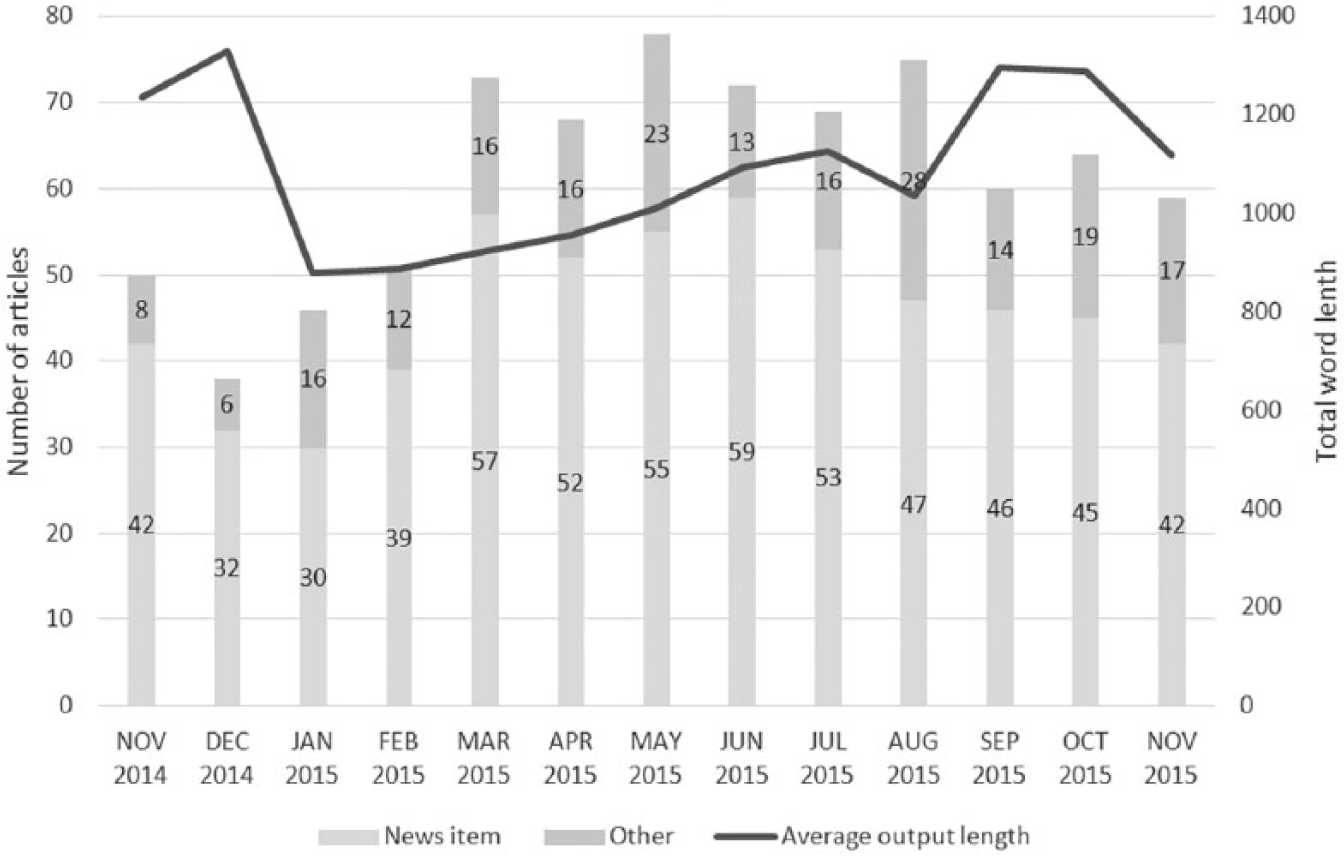
Change over time in the quantity, format, and average word length of IRIN outputs.
Alongside an increase in the quantity of outputs was a decrease in their average length. Prior to 2015, IRIN’s outputs were characterized by their Middle East Editor as “tend[ing] to be 500 words longer than they deserved” (30.1.15), because, as IRIN’s News Editor explained, “there wasn’t a really big incentive to cut them” (20.2.15). In contrast, the editorial guidelines issued by IRIN’s senior managers in January 2015 advised journalists that “we want to see more short pieces (300-400 words) and average size pieces (800 words).” So, as Figure 1 shows, the length of IRIN news items declined sharply in the first few months of 2015: from an average of 1,329 words in December 2014, to 888 words in January 2015.
From January 2015 onward, all IRIN journalists and editors were also required to post on social media channels at least once a day and a target was set for IRIN to increase average monthly users and social traffic by 100 percent in its first year. IRIN adopted a deliberate policy of recruiting new staff with, and training existing staff in, skills relevant to multimedia and digital design. Journalists were also repeatedly encouraged to produce content that was suitable for sharing and consumption via social media. IRIN’s Outreach Manager regularly made suggestions to editors and journalists regarding how to make their outputs more marketable.
Finally, during the first three months of 2015, IRIN staff were repeatedly encouraged on Slack and in editorial meetings to “experiment” and be “more creative” (Slack 19.3.15) in the format and presentation of their outputs. As the Middle East Editor explained, “for the first time since I’ve been at IRIN, I’m being encouraged just to try stuff out” (30.1.15). As a result, the average proportion of outputs not in the form of a conventional news item increased from 16 percent, in the last two months of 2014, to 28 percent of all outputs between January 2015 to November 2015. This included guest columns, editorials, briefings, and visual features—many of which were introduced for the first time.
The Nature of IRIN’s Public Service Commitments
Second, there were important changes in the forms of public service journalism that IRIN sought to provide. When IRIN was a UN-OCHA project, its principal form of public service was providing longer form, in-depth coverage. As the Managing Editor explained, “our selling point [was] that we were adding [value] to the quick news stories that tell you what’s happened and we try to explain why they’ve happened and the context in which they’ve happened” (22.1.15). In 2015, however, this was not emphasized as strongly. In contrast, the public purpose of reporting on humanitarian issues or crises neglected by mainstream media was not only retained but given seemingly greater emphasis. This purpose was foregrounded in internal documents, public statements by Jynwel and IRIN’s management, interviews with almost all IRIN staff, and even within some of IRIN’s outputs. In the draft of IRIN’s Statutes in March 2015, for example, IRIN’s charitable purpose was described as being “to improve understanding of natural or man-made humanitarian emergencies, particularly those less reported or overlooked.”
The most significant change in the nature of IRIN’s public service orientation, though, concerned its watchdog function. It has been widely reported that when IRIN was a UN-OCHA project, there were, as one interviewee put it, significant “limitations on IRIN’s editorial independence.” This resulted in what various interviewees described as a more general tendency to produce “softish leads on the story” and “not writ[e] . . . anything too provocative . . . [about] the UN.” By contrast, when IRIN left the United Nations, it repeatedly asserted in public statements that it would “be better positioned to critically examine the multi-billion dollar humanitarian aid industry” (Press Release, 20.11.2014). A new position covering the “aid policy” beat was created to produce “stories that push the industry forward by forcing it to confront critical issues” (Slack, 30.7.15). Most IRIN journalists also perceived their coverage to be more critical, with one describing himself as “less concerned about upsetting member states, because they’re not our member states any more.”
However, there were limits to the extent to which IRIN adopted this particular role. Figure 2 shows that the percentage of IRIN outputs that qualified as adopting either an “expose/investigation” or “campaigning” communicative frame increased only marginally in 2015, from an average of 4 percent of outputs in November and December 2014 to 6.5 percent between January 2015 and November 2015. Moreover, the form of critique that IRIN offered in 2015 was repeatedly described as “constructive,” rather than severely critical. In its 2015 Vision Statement, for example, IRIN describes its coverage as leading to “constructive dialogue, not scandalous headlines.”
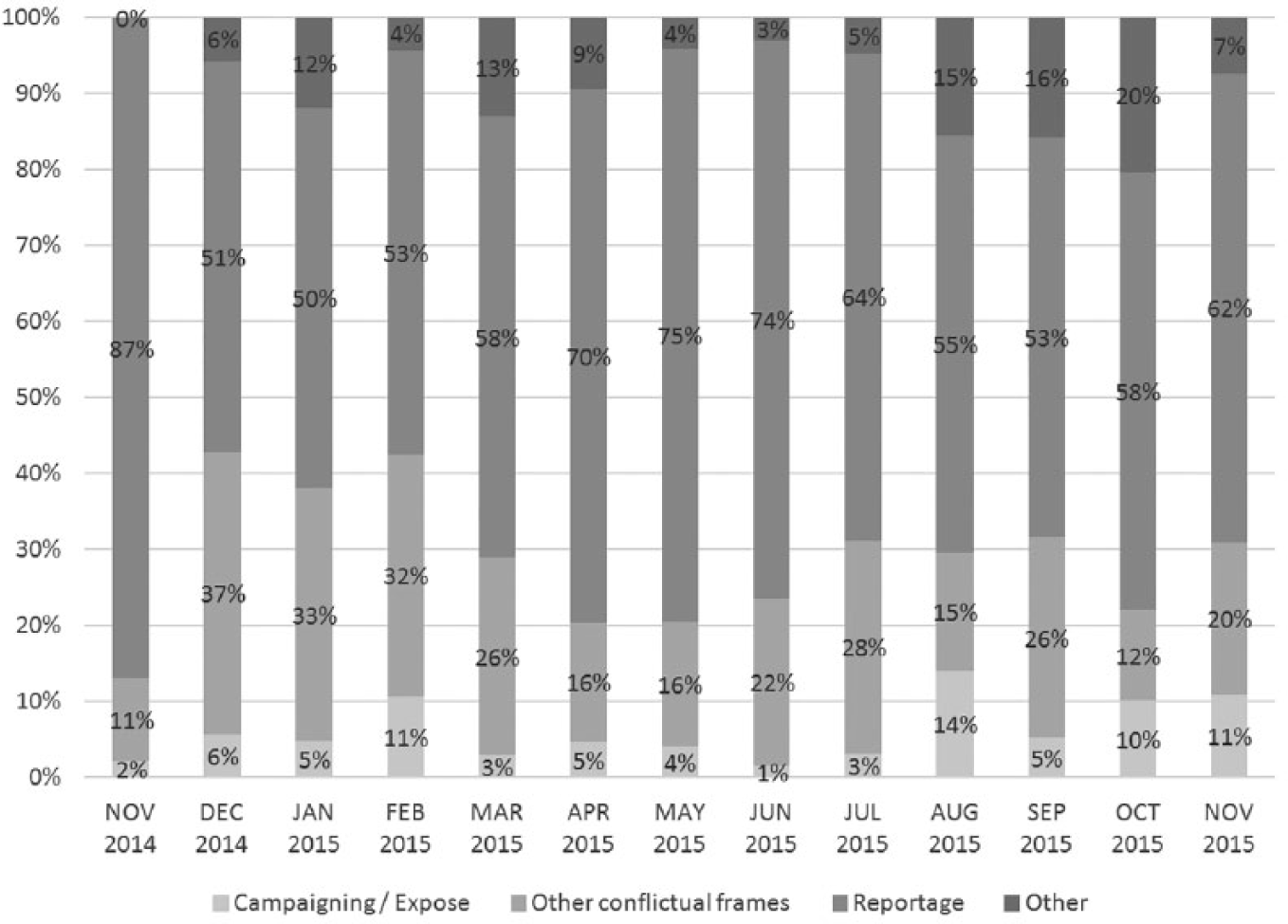
Proportion of IRIN outputs each month (excluding “top picks”) that adopted a particular “communicative frame.”
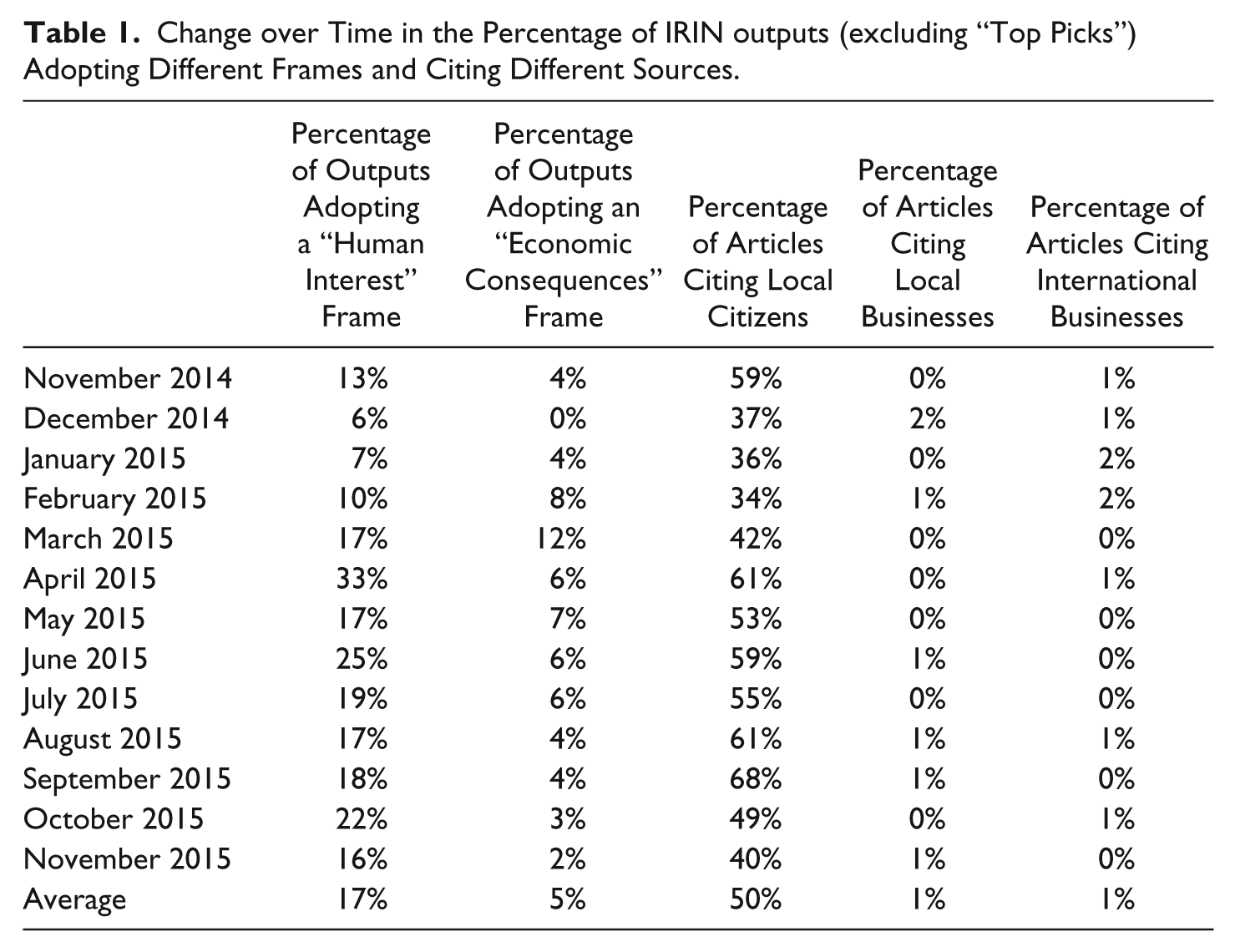
But although adopting the role of a constructive watchdog may have placed some ideological limits on IRIN’s content, there was no evidence to suggest that IRIN began to adopt a pro-market ideology. The data in Table 1 show that though the proportion of IRIN news items adopting an “economic consequences” frame did increase noticeably in the first three months of 2015 to a high of 12 percent, it subsequently declined to an average of just 5 percent in the following eight months. Table 1 also shows that at no point did representatives of either local or international businesses make up more than 2 percent of all sources cited within a single month.
Change over Time in the Percentage of IRIN outputs (excluding “Top Picks”) Adopting Different Frames and Citing Different Sources.
Alongside changes in their role perceptions, the journalists at IRIN had a new and more diverse understanding of their audience. In 2015, most staff described IRIN’s target audience as having expanded to include those “involved more broadly in the aid sector” (Managing Editor 23.6.15) or “people that are interested in the subject” (Middle East Editor, 30.1.15). However, the Jynwel Foundation frequently described IRIN’s audience as being the “general public” (cited in Hatcher 2014) and the draft IRIN Foundation statues in March 2015 referred to an ambition to “reach as many people as possible.” Further target audiences mentioned by different individuals included affected audiences, policymakers, other news organizations, and donors. IRIN’s “Editor-at-Large” (20.3.15), for example, stated that he, “want[ed] to be relevant to the people in the countries that we are reporting on,” while the Outreach Manager (29.5.15) said, “for us it’s important to still reach that kind of ‘impact’ audience, so decision-makers and policy-makers.”
The Prioritization of Some Public Service Values
The final significant change in IRIN’s journalism concerned an apparent temporary decline, between December 2014 and February 2015, in the prioritization of some public service values. Table 1 shows that, during this three-month period, the percentage of IRIN outputs adopting a “human interest” frame and those citing local citizens was significantly lower than for any other month during the sample period. Providing a “platform for the voices of the powerless” (Slack, 27.5.15) was understood to be a key public service value for every IRIN journalist.
Similarly, Figure 2 shows that, in the same three-month period, the proportion of IRIN outputs that were “reportage” declined significantly. Cottle and Rai (2006: 181) describe reportage as “a communicative frame that . . . [provides] detailed background, context and analysis; in situ observation, first-hand testimony and/or experiential accounts of events.” It is associated with public service because it “attempt[s] to generate deeper understanding and insights into current news events” (Cottle and Rai 2006: 179). Figure 2 also reveals that during these three months, more simplistic, “conflictual” communicative frames, including “dominant,” “contest,” and “contention” frames, reached their highest levels within the sample period—making up between 32 percent and 37 percent of all IRIN outputs.
In summary, the principal changes to IRIN’s content and professional norms in 2015 were as follows: an increase in the quantity, range of formats, and use of social media, and a decrease in the average length of articles; the foregrounding of the role of constructive watchdog and rectifier of media inattention; an increase in the breadth and diversity of their target audience, and a temporary decrease in the prioritization of some public service values. The following section explores the multiple factors that drove these changes.
Results: Causal Processes
Our analysis generated no evidence to suggest that the Jynwel Foundation had any direct influence over IRIN’s editorial decision making. Representatives of Jynwel had no direct contact with IRIN journalists, never suggested any specific investigations or stories, were never shown content prior to publication, and were very rarely mentioned on Slack or in editorial meetings. Furthermore, though IRIN did not cover any issues relevant to the activities and interests of the Jynwel Foundation or Jynwel Capital, there was no evidence to suggest that this was driven by a perceived conflict of interest, but rather by a view that such issues simply did not fall within IRIN’s remit.
However, Jynwel did exert some indirect influence over IRIN via a combination of its “insist[ence] on [IRIN’s] visibility” (Managing Editor, 23.6.15), influence over revenue expectations and particular professional values. As we reveal below, though, each of these influences operated in tandem with each other, as well as with other factors, to shape IRIN’s work. The interplay of these factors is reviewed through a discussion of (1) maximizing audience reach, (2) competing field logics, and (3) journalistic values.
Maximizing Audience Reach
The most significant factor behind many of the changes to IRIN’s work was new pressure to maximize audience reach. This included a considerable shift of resources toward activities intended to help IRIN reach its new target audiences more efficiently. Efforts to maximize audience reach included a greater emphasis on social media, as well as changes in the quantity, length, and format of IRIN’s outputs. The decline in average article length, for example, was said to be important for enhancing the “readability” (Editor-at-Large, 20.3.15) and “relevance” (Senior Sub-editor, 15.6.15) of IRIN’s outputs. New formats were introduced to help reach key audiences; these were described as being “a very clear expression of a brand” (Managing Editor, 23.6.15). This new focus on maximizing audience reach was also linked to a temporary decline in the prioritization of some public service values between December 2014 and February 2015. As the Managing Editor (23.6.15) explained, “in our attempt to be . . . more relevant on a day-to-day basis, I think we’ve swung a little too far in chasing after news stories of the day instead of doing our own original, unique stuff.”
This emphasis on audience reach was driven partly by the Jynwel Foundation’s political and economic interests, and by the logic of the field of philanthro-capitalism within which the donor appeared to operate. One of the conditions of Jynwel’s funding was that IRIN was required to aim to generate, at a minimum, a third of its budget from “earned revenues,” within five years. Although such commercial expectations are common for foundation-funded nonprofit news start-ups, most struggle to generate more than 25 percent of their revenue outside of donor grants (Pew 2013). As a result, achieving this degree of revenue diversification represented a significant challenge for IRIN and required it to invest heavily in new products and activities.
According to Benson (2016a: 15), requirements regarding commercial sustainability derive from the dominance of the economic market field within most foundations, which entails, “a fundamental ideological commitment to a market-led solution.” The accounts Jho Low gave journalists of his decision to invest in IRIN suggest that such a logic was also dominant at the Jynwel Foundation. Jho Low repeatedly emphasized his intention to “ensure IRIN’s financial viability,” asserting that this would only be possible if IRIN combined “the intensity of a business with the integrity of an NGO” (cited in Bond 2014).
The Jynwel Foundation also had self-interested reasons for wanting IRIN to expand its audience and visibility. At a time when Jho Low was facing increasing scrutiny for his apparent role in an unfolding corruption scandal in Malaysia, IRIN’s efforts to raise its profile had the potential to offer Jho Low some reputational benefits through the accrual of symbolic capital. Although Jho Low made no explicit public statements about this, several IRIN journalists speculated that Jynwel’s support for international public service journalism was motivated by “PR reasons as much as anything else” (Head of Special Projects, 22.5.15). Indeed, reputational enhancement was an important element of other organizations’ involvement with IRIN. For example, IRIN’s Chief Executive (16.1.15) suggested that UN-OCHA had gained “soft power . . . [or] a brand-enhancing equity value” from supporting IRIN. Similarly, the director of the Humanitarian Policy Group at ODI (10.4.15) said that the think tank had gained “gratitude from the sector, for keeping IRIN going.” In fact, one of the main reasons why the relationship between IRIN and Jynwel ultimately ended was that the ODI was no longer willing to be involved because of the growing potential reputational risks of being associated with Jho Low (see Wright et al., in preparation).
However, this heightened concern for expanding audiences was driven, not just by the donor’s interests and apparent professional values but by a desire expressed by all IRIN staff to “source different revenue streams as soon as possible” (Head of Special Projects 22.5.15) to establish their (actual and perceived) editorial independence. As the Managing Editor (22.1.15) put it, “it’s risky having most of your funding tied to one donor. It makes you very vulnerable—both financially and in terms of your editorial independence.” This strong adherence to the journalistic norm of independence and impartiality was reinforced by their previous experience as a UN-OCHA project, when IRIN staff perceived their editorial integrity to have been compromised. In summary, it was the confluence of multiple factors—stemming from both the donor and from within IRIN—that led to changes in IRIN’s work.
Competing Agendas and Field Logics
When IRIN was funded by the Jynwel Foundation, IRIN worked in, and engaged with, three fields: journalism, humanitarianism, and philanthro-capitalism. Each of these fields has its own dominant logic and ways of doing things. IRIN’s work needed to be compatible with all three. Many of the changes in IRIN’s work can be seen as the result of journalists’ efforts to negotiate these often competing logics, and the multiple agendas that stemmed from them.
The nature of IRIN’s public service commitment
IRIN journalists’ prioritization of in-depth coverage reduced somewhat in early 2015 because it was incompatible with the need to expand the audience and diversify revenue. In contrast, their public service commitment to report on neglected issues and crises was increasingly emphasized because it served multiple agendas simultaneously. For IRIN journalists, drawing attention to neglected crises corresponded with the humanitarian principle of human equivalence. As IRIN’s Chief Executive (16.1.2015) explained, “the humanitarian value I think behind our practice . . . is that we believe suffering is equal wherever and that . . . [it is] equally deserving of attention and response.” In addition, telling unreported stories helped IRIN achieve impact among multiple stakeholders, which made it more attractive to potential donors (Aly 2017), as well as helping the organization generate the symbolic capital sought by Jynwel.
The need to satisfy multiple agendas—and negotiate competing field logics—also helps to explain the increased emphasis on constructive watchdog journalism at IRIN. Some individual IRIN journalists were driven by the tradition of adversarial reporting in the journalistic field, which places a strong emphasis on “speaking truth to power.” One commented that they chose to work for IRIN because they were, “really genuinely excited about the possibility to kick up shit by ripping into one of the most unaccountable, unchallenged parts of the global economy.” In contrast, other journalists suggested that the experience of operating with “a kind of . . . self-censorship” as a UN-OCHA project continued to shape their role perceptions in 2015. As one relatively new IRIN staff member put it, “I think that’s something that . . . other . . . [staff] are still coming out of.” The adoption of the role of a constructive watchdog appears to have been, at least partly, a consequence of a compromise between these two competing values.
The role of a constructive watchdog may also have been a compromise between two contradictory pressures from the Jynwel Foundation. On one hand, there were Jho Low’s values; Low repeatedly referred to his philosophy of, “disruptive philanthropy,” which appeared to support IRIN’s efforts to promote accountability within the humanitarian sector. In an interview with the New York Times, for example, Jho Low stated that though IRIN’s new pursuit of “hard questions and critical reporting . . . may be painful short term for certain states . . . long term, we should be clear that it achieves the overarching agenda of saving human lives” (cited in Cumming-Bruce 2014). On the other hand, there was evidence to suggest that the Jynwel Foundation was reluctant for IRIN to be overly critical. A Jynwel representative reportedly expressed anxiety at the idea of IRIN performing a watchdog function. It is unclear whether this apparent anxiety stemmed from concerns over the potential implications for Jynwel’s reputation if IRIN pursued adversarial reporting, or from an incompatibility between IRIN’s and Jynwel’s beliefs about journalism’s role in promoting transparency and accountability. Either way, it appears that the contradictions between Jynwel’s interests and apparent values ultimately resulted in a preference for IRIN to adopt a constructive, rather than an especially critical, watchdog role.
Target audiences
The need to satisfy multiple agendas and negotiate competing field logics also helps to explain the shift in target audiences that occurred at IRIN. The Jynwel Foundations’ accrual of reputational benefits relied on IRIN generating symbolic capital, either by “impacting” policymakers, influencing the mainstream media agenda, raising their profile among the general public, or getting noticed by certain celebrities. At the same time, though, IRIN was also required to generate economic capital, by building its existing humanitarian audience, to meet the profit expectations introduced partly as a result of the donor’s field logic.
But again, these competing pressures were themselves mediated by the journalists, operating in accordance with their own norms and values. The norms of neutrality and impartiality within IRIN encouraged the pursuit of diverse revenue streams (as noted above). However, these same norms also constrained the forms of revenue generation IRIN staff felt able to pursue. For example, IRIN’s Chief Executive (Slack, 31.3.15) stated that none of the IRIN staff were “very comfortable with the idea [of] sponsored content.” As a result, IRIN was frequently described as being, “not quite there yet on the business model” (Outreach Manager, 29.5.5). The Head of Special Projects (22.5.15) admitted that she was, “still not a hundred per cent clear what our core businesses [is] and for which audience.”
Finally, the existence of multiple target audiences was a product of the competing visions of IRIN’s future held by both Jynwel and IRIN’s management. As the Director of the Humanitarian Policy Group at the ODI put it, “I’m not sure there is a particularly clear vision on either side . . . but they clearly want something different” (31.11.15). This divergence of opinion stemmed from a clear discrepancy between IRIN management’s adherence to journalistic field logics and what IRIN’s Chief Executive (16.1.15) described as the “culture [of] philanthro-capitalism [and] philanthro-entrepreneurialism” at the Jynwel Foundation. Indeed, in his public statements about IRIN, Jho Low repeatedly describes the organization, not in journalistic terms, but as, “an NGO . . . work[ing] hand-in-hand with the major media in the common objective of dealing with humanitarian crises” (cited in Bond 2014).
IRIN’s Managing Editor (23.6.15) described the numerous “cultural [shifts] in mindset” that were required to “straddle these very different universes” as being “very challenging”:
One day you’re dealing with a reporter in Guinea who might have Ebola and the next day you’re talking about how to get George Clooney to your event.
These “cultural differences” (Chief Executive, 3.11.15) also gradually led to a breakdown in trust and communication, which made it increasingly difficult to establish a common consensus on IRIN’s future. IRIN’s Chief Executive stated that this lack of communication meant that “it was really unclear whether we had the same vision or not” (Editorial meeting, 3.11.15).
Journalistic Values
The final key issue concerns the extent to which the personal values and role perceptions of the journalists who worked at IRIN were able to influence news content. There is evidence to suggest that at least two of the key changes we observed in IRIN’s journalism were driven primarily by decisions made by IRIN’s editorial management. First, IRIN managers’ pursuit of a more diverse audience (and funding base) exceeded the expectations and requirements of the Jynwel Foundation. Jho Low was quoted in the Financial Times as saying that IRIN “should kick-start with a strong enough capital base that they don’t need to worry about money [initially]” (Bond 2014). Despite this, the Managing Editor described herself as being “still hesitant to be so reliant on one donor” (23.6.15). This suggests that IRIN managements’ values may have been the key driver of its efforts to expand its audience and revenue.
Second, the “readjustment” in the prioritization of some public service values that occurred from March 2015 onward was the result of a deliberate shift in editorial strategy by IRIN’s management. As the Managing Editor explained, “chasing after news stories of the day” may have been “necessary” at the time, “now it’s time to kind of re-balance” (23.6.15). This editorial “rebalancing” suggests that IRIN’s management had sufficient autonomy to regulate the extent to which it prioritized public service values—at least in terms of the framing and focus of IRIN’s outputs. As the Head of Special Projects put it, “I think we are still grappling with what stories fit within our remit and what don’t. But there is no doubt at all that we can do any stories that we want to. . . . The debate is internal and not with an external fund-master” (12.3.15).
It is important to note, however, that the decline in the prioritization of some public service content from December 2014 to February 2015 was linked, not only to editorial strategy but also to significant organizational changes taking place at IRIN at this time. In particular, uncertainty over commissioning budgets and disruption to the stringer network meant that IRIN staff were producing a much higher proportion of outputs than usual. This is significant because, compared with stringers, staff were less likely to author longer news items, which included local citizens as sources and which adopted human interest and “reportage” frames.
It is also important to note that these changes introduced by individual journalists may only have been possible because they did not contradict the donors’ apparent interests or values. Furthermore, the apparent autonomy of IRIN’s management may be explained by the fact that the immediate interests of the Jynwel Foundation, like many donors, were served by encouraging IRIN to generate the symbolic capital associated with highly valued forms of public service journalism. Given that editorial independence is a key public service value, efforts to interfere with news production would ultimately be incompatible with the interests of the Jynwel Foundations. Put simply, it was in the interests of the donor not to interfere or to be seen to be interfering.
Conclusion
This study has sought to investigate how donor funding influences the journalism it supports. In the case of IRIN, our analysis suggests that donor power operated indirectly and always in concert (or conflict) with the dominant professional values within the news organization. This complex interaction of influences resulted in a focus on maximizing audience reach that led to an increase in the quantity, range of formats, and use of social media and a decrease in the average length of articles. Our results also show that although IRIN’s prioritization of some public service values was initially compromised by this concert of factors, this was subsequently reversed by a deliberate shift in editorial strategy. Perhaps the greatest influence of donor power was in helping to determine which forms of content were most highly valued: namely, rectifying media inattention and acting as a constructive watchdog.
As this is the first in-depth case study of philanthro-journalism it is not possible to ascertain precisely how common these features of donor power are. However, this study does allow us to make a number of more general observations about the operation of donor power, which can inform future research. First, our analysis highlights the importance of both journalistic agency and contextual variables, which are often underemphasized in the research literature in favor of macro-level factors, such as economic imperatives or political pressures (see Browne 2010; Feldman 2007). For example, though IRIN’s increased concern for generating impact may have placed some ideological limits on its content, IRIN certainly did not begin to adopt a pro-market ideology supportive of philanthro-capitalism. Indeed, perhaps the most striking feature of our analysis was the over-riding significance of historically formed, individual values and dispositions and national and transnational level journalistic field logics, in mediating all forms of donor power.
Second, this analysis has begun to support our contention that Benson et al.’s (forthcoming) framework can serve as an appropriate model for explaining the main processes by which donor influence operates, at least in the case of international public service journalism. However, the unanticipated influence of organizational changes within IRIN reminds us of the need to remain attentive to contrary explanations. In addition, though Benson, Hessérus, and Sedel’s model implies that power derives primarily from the agency of individual owners, as shaped by field logics, our analysis suggests that donor power can also stem from the need for funding more generally. IRIN’s concern for impact, for example, was informed as much by the anticipated desires of potential donors, as it was by its existing donor.
In which case, future research should seek to clarify where donor power comes from in different contexts, as well as whether donor funding works via similar causal chains for nationally and locally oriented public service journalism.
Finally, this analysis has highlighted how donor power and journalistic and donor field logics can interact in both complimentary and contradictory ways, with each other and also within themselves. For example, though the dominant journalistic field logics worked with both the donor’s field logic and political and economic interests to produce a clear focus on maximizing audience reach, they also created internal contradictions that led to differences of opinion over IRIN’s target audience. This complex interplay of influences suggests that the operation of donor power in this case can be understood through paradigm of “contradictions.” Freedman (2014: 118) contends that contradictions are a “basic operating principle” of capitalism and argues that the media are “fully implicated in this environment and suffused by contradictions between, for example, the desire for ‘consensus’ and the pursuit of difference, between a professional commitment to hold power to account and an institutional entanglement with power.” Indeed, these two particular contradictions help to explain the principal forms of public service commitment IRIN adopted—rectifying media inattention and acting as a constructive watchdog. Similarly, competing demands to generate both economic and symbolic capital are an expression of the contradiction within capitalism, “between socially useful production and production for exchange” (Freedman 2014: 26). This suggests that future research should also be attuned to the possibility that it is the contradictory dynamics of donor power that are central to both its operation and contestation.
Footnotes
Acknowledgements
We would like to thank our research assistant Jessie Hagen for her dedicated and thorough contribution to the content analysis. We are also extremely grateful to Florencia Enghel and the anonymous reviewers for their constructive feedback.
Declaration of Conflicting Interests
The author(s) declared no potential conflicts of interest with respect to the research, authorship, and/or publication of this article.
Funding
The author(s) disclosed receipt of the following financial support for the research, authorship and/or publication of this article: This work was supported by the Arts and Humanities Research Council (grant number AH/N00731X/1), the Independent Social Research Foundation (ISRF) (Flexible Grants for Small Groups Award 2015) and Santander (Overseas Research and Mobility Grant).