




Abstract
Keywords
Introduction
Latin America hosts a rich diversity of primates from the Platyrrhini clade, which includes around 117 species and ranges from southern Mexico to northern Uruguay (Bicca-Marques et al., 2021; Estrada et al., 2017; Jardim et al., 2019; Rosenberger, 2020). A significant portion of this diversity is found in Brazil, which harbors over 100 primate species, including 19 endemics to the Atlantic Forest domain (Culot et al., 2019; Graipel et al., 2017), where primates correspond to the largest mammalian biomass and the current megafauna of seed dispersers, playing a pivotal role in ecosystems services (Gardner et al., 2019; Strier, 2021).
The primate fauna of the Atlantic Forest in Paraná state, southern Brazil, comprises a handful of native species (Passos et al., 2006). This includes the black-and-gold howler monkey (Alouatta caraya) in the west (Aguiar et al., 2008; Bicca-Marques et al., 2021); the southern black-horned capuchin monkey (Sapajus cucullatus sensu Rylands et al., 2024) and the brown howler monkey (Alouatta guariba sensu Oklander et al., 2024) in several phytophysiognomies of the Atlantic Forest (Alfaya et al., 2020; Jerusalinsky et al., 2021; Ludwig et al., 2022; Passos et al., 2006). Other species are found in specific locations, such as the southern muriqui (Brachyteles arachnoides) at the Vale do Ribeira region, including records in Araucaria Pine Forest (Hack et al., 2022; Ingberman et al., 2016; Talebi et al., 2021), and the black-faced lion tamarin (Leontopithecus caissara) in Superagui National Park, at the coastal plain (Ludwig et al., 2021; Moro-Rios et al., 2018). In addition, non-native species such as the black-tufted marmoset (Callithrix penicillata) mainly from brazilian Cerrado, and the common marmoset (Callithrix jacchus) mainly from Caatinga, have been introduced in different regions of the state (Oliveira et al., 2017; Passos et al., 2006; Valle et al., 2021), establishing exotic populations in urban parks, raising concern about their potential ecological impacts in the native ecosystems (Culot et al., 2019; Malukiewicz et al., 2021). The distribution of these species can be observed in Figure 1. Geographic distribution of Primate species in the Paraná State, Brazil, highlighting the Araucaria Pine Forest Phytophysiognomy
The brown howler monkey, southern muriqui, and black-faced lion tamarin are considered critically endangered at a regional level (Paraná, 2025). Brown howler monkeys are particularly vulnerable, having been listed as one of the world’s 25 most endangered primates in 2023, largely due to habitat loss and susceptibility to sylvatic yellow fever outbreaks (Mittermeier et al., 2022; Possas et al., 2018).
Although there are many studies on primates in Paraná, they seem to focus primarily on behavioral ecology of brown howler monkeys and capuchin monkeys, and are concentrated in the western and northern regions of the state, in the inland Atlantic Forest, specifically, the Seasonal Semideciduos Forest (Aguiar et al., 2003, 2007, 2011; Gutierres et al., 2025; Ludwig et al., 2005, 2008), including the first record of tool use in free-ranging capuchin monkeys (Rocha et al., 1998). Specifically, there are surveys of relictual populations of southern muriquis (e.g. Hack et al., 2022), and studies of behavioral ecology of black-faced lion tamarins (e.g. Moro-Rios et al., 2018).
The Metropolitan Region of Curitiba (MRC), the capital of the state of Paraná, is situated within the domain of the Araucaria Pine Forest (APF), also known as Mixed Ombrophilous Forest, the most endangered Atlantic Forest phytophysiognomy (Roderjan et al., 2002; Zorek et al., 2024). Although there is information on primate occurrences in this ecosystem, as listed above, few studies have focused on primates in this region, and they seem to concentrate mainly on the behavior of brown howler monkeys (e.g. Miranda et al., 2005; Miranda & Passos, 2004), with a notable lack of studies on capuchin monkeys. This reflects the limited research efforts on primates in the APF, which limits the understanding of primates’ community ecology in this area. This represents a significant obstacle for ecological research and for the design of targeted conservation strategies to deal with endangered primate species and endangered Araucaria ecosystems. This issue becomes even more pressing in light of ongoing urban expansion of large cities, such as Curitiba, the largest in southern Brazil, which leads to increasing habitat disruption, and the establishment of non-native species (Thatcher et al., 2023).
Furthermore, epizootic outbreaks of yellow fever can act synergistically with urbanization to decimate local primate habitats and populations in the Atlantic Forest. This is evidenced by the massive die-offs observed in recent sylvatic yellow fever outbreaks, which severely affected species of Atelidae, such as brown howler monkeys and southern muriquis, and Cebidae, including capuchin monkeys and marmosets (Berthet et al., 2021; Possas et al., 2018; Strier, 2021), though capuchin monkeys show much more resistance to yellow fever infections than the others (Galindo & Srihongse, 1967).
Although the behavioral ecology of focal primate groups is well studied, detailed studies on the occurrence and distribution of individual species and communities remain scarce, which is a major challenge for conservation efforts (Estrada et al., 2017). A lack of research has also been observed regarding the integration of species distribution with environmental data (Osborne & Glew, 2011). In this context, there is a clear need for studies on the richness and composition of the Platyrrhini communities, particularly in landscapes which suffer deforestation pressures, such as the APF from the MRC.
This study aims to assess the most current occurrences of native and exotic free-ranging primates in the city of Curitiba, and its Metropolitan Region. Through the production of distribution maps, the study will analyze the presence of the species, particularly in APF fragments. The study surveyed native species such as brown howler monkeys, southern black-horned capuchin monkeys, southern muriquis and non-native species of marmosets. Except for the southern muriqui, the other primates were listed in the Faunal Inventory of Curitiba (Miretzki, 2023), but with no data about their occurrence localities. Our study also helps to expand the known distribution and specify the locations of primate records in the study region.
Methods
Study Area
Comprising 29 municipalities, the MRC includes the state capital, Curitiba, and its 28 neighboring cities. Its Central Urban Core is specifically defined as the capital city and its 13 adjacent municipalities (AMEP, n.d.). Geographically, the entire MRC is located within the vast Atlantic Forest domain. Based on the ecoregions proposed by Dinerstein et al. (2017), the study area was defined within the APF, extending from the Serra do Mar to the western boundary of the MRC (Figure 2). Study area location, displaying the Araucaria Pine Forest (Satellite Image) in the Metropolitan Region of Curitiba, with insets showing Paraná State and Brazil
The APF presents a structurally diverse vegetation, including tall trees, shrubs, and grassland formations (Roderjan et al., 2002; Scheer & Blum, 2011). In these forests, tree heights range from around 4 meters in the understory to over 16 meters in the canopy (Souza et al., 2012). In the MRC, the APF occurs mainly as alluvial forests along riverbanks and as montane forests between 400 and 1,000 meters in elevation. This phytophysiognomy is a landscape where 50% of the area is covered by the endemic conifer Araucaria angustifolia. This species can reach up to 30 meters and dominate the canopy, sharing the space with a variety of angiosperms and other conifers (Souza, 2021; Zorek et al., 2024).
Scheer and Blum (2011) noted that the MRC also includes Dense Ombrophilous Forest, which is known to harbor more primate species richness (Passos et al., 2006). However, this study focuses on the APF due to its worrying conservation status, with only 4% of its original cover and the majority of forest remnants are small (around 50 ha; Zorek et al., 2024).
Data Collection and Analysis
We collected records of free-ranging primate occurrences for this study from 2000 to 2025. We gathered the data by reviewing scientific literature in Zoology, Mammalogy, and Primatology using the Google Scholar platform. Additionally, we conducted visits to local scientific collections (Museu de História Natural do Capão da Imbuia – MHNCI; Coleção Científica de Mastozoologia da Universidade Federal do Paraná – DZUP/CCMZ; Museu de Zoologia da PUCPR – MZPUCPR), consulted environmental and health public agencies and the Information System on Wildlife Health (SISS-Geo), and accessed georeferenced citizen science web platforms and databases (iNaturalist, GBIF). We also used personal observations and communications from our lab research team, and technicians, biologists, veterinarians and academic colleagues.
The SISS-Geo is a collaborative, citizen science platform where users upload animal records with information about their taxon, status (alive or dead), geographic coordinates, and photographs (Chame et al., 2019, 2020). Although it is considered a citizen science platform, it is also officially used by public health agencies that upload data from their fieldwork. Non-human primates (NHP) are the most commonly recorded animals on the platform (Chame et al., 2019), and we used all available records — including both alive and dead individuals — since these data are recent and thus considered relevant for prospecting species distribution.
From iNaturalist, where users upload fauna and flora records and identify them (Boone & Basille, 2019), we used only records with a Research Grade — where 2/3 of users agree on the organism identification (Koo et al., 2022) — to ensure greater data reliability. We observed an overlap between Research Grade records from iNaturalist and data from the MHNCI museum with those found in the GBIF database, which indicates the GBIF’s reliability and its use as a valid source for our study. When necessary, we contacted the user or record owner for additional details regarding the primate record.
We obtained and verified geographical coordinates using Google Earth, based on the SIRGAS 2000 reference system, which is the official geodetic framework adopted by Brazil and several other countries in the Americas (Drewes, 2022). We performed spatial analyses using QGIS software, version 3.36-Maidenhead (QGIS Development Team, 2025). Shapefiles corresponding to the administrative boundaries of Brazil, the state of Paraná, and its municipalities were obtained from the IBGE Map Portal (IBGE, 2025). The delimitation of the APF was based on the ecoregion shapefile provided by Dinerstein et al. (2017).
We generated detailed maps of primate occurrences, which were stratified both by taxon and by decadal period (2000s, 2010s, and 2020-2025) using QGIS. We organized geographic coordinates in .xlsx spreadsheets, which were then converted to .csv and shapefile (.shp) formats. Each species was represented with a distinct color and a simple diamond marker.
To avoid overrepresentation of the same group of individuals, we filtered the occurrence points using a 1,000-meter grid, created with the “Create Grid” tool in QGIS. This value was chosen because it is close to the mean day range of the studied species: 620 m for brown howler monkeys (e.g. Fortes et al., 2015), 1,200 m for southern muriquis (e.g. Strier, 1987), 1,200 m for exotic black-tufted marmosets in southern Brazil (e.g. da Silva, 2012) and 1,500 m for southern black-horned capuchin monkeys (e.g. Rímoli et al., 2008).
We applied the Kernel Density Estimation (KDE) with a 1,000-meter search radius (bandwidth) to identify and visually represent areas of species concentration (Carvalho & Câmara, 2004). We generated heatmaps in QGIS using the Styled Heatmap tool, which allowed us to delimit occupied fragments and highlight core areas of occurrence with an inverted Spectral color gradient and taxon-specific intensity thresholds.
Results
We recorded 604 primate occurrences in the MRC, for three natives and two exotics species. The main source of these records was SISS-Geo (63.7%), followed by iNaturalist (23.1%), personal observations (8.6%), literature (3%), public agencies (1%), and the MHNCI (0.7%). Thus, among the different search methods employed, SISS-Geo provided the most comprehensive and reliable information for this study.
The majority of the records were for brown howler monkeys (58.3%), followed by the exotic black-tufted marmoset (35.8%), the southern black-horned capuchin monkey (4.4%), the southern muriqui (0.8%), and the other exotic species, the common marmoset, with the lowest number of records (0.7%). Over the decades, brown howler monkeys consistently accounted for the majority of records, while black-tufted marmosets exhibited a significant increase in the number of records over time (Figure 3). Percentage of occurrence records by Primate species in the MRC, Paraná, across three time periods (2000s, 2010s, and 2020–2025)
The municipality with the highest number of records was Curitiba (Figure 4), followed by São José dos Pinhais, Araucária, and Piên, while five other municipalities within the MRC (Adrianópolis, Almirante Tamandaré, Bocaiúva do Sul, Itaperuçu, and Rio Branco do Sul) had no records. The average number of records per municipality was 25.12 ± 44.44 S.D. Percentage of Primate occurrence records across 24 municipalities in the MRC, Paraná
The table with all occurrences, geographic coordinates, sources, dates, and links is available for consultation in the Supplemental materials.
Temporal Analysis
In the first decade of the 21st century (2000–2009), 22 primate occurrences were recorded, with all taxa represented (Figure 5(a)). Brown howler monkeys had the highest number of records (n = 13), followed by southern black-horned capuchins (n = 4) and exotic marmosets (n = 4, 2 for each species). Southern muriquis presented the lowest number of records (n = 1). The primary sources for this period were scientific publications (e.g. Ingberman et al., 2016; Moro-Rios et al., 2018; Passos et al., 2006). Geographic distribution of recorded Primate occurrences in the MRC, Paraná, over three time periods: (a) 2000s with 22 records; (b) 2010s with 107 records; and (c) 2020–2025 with 475 records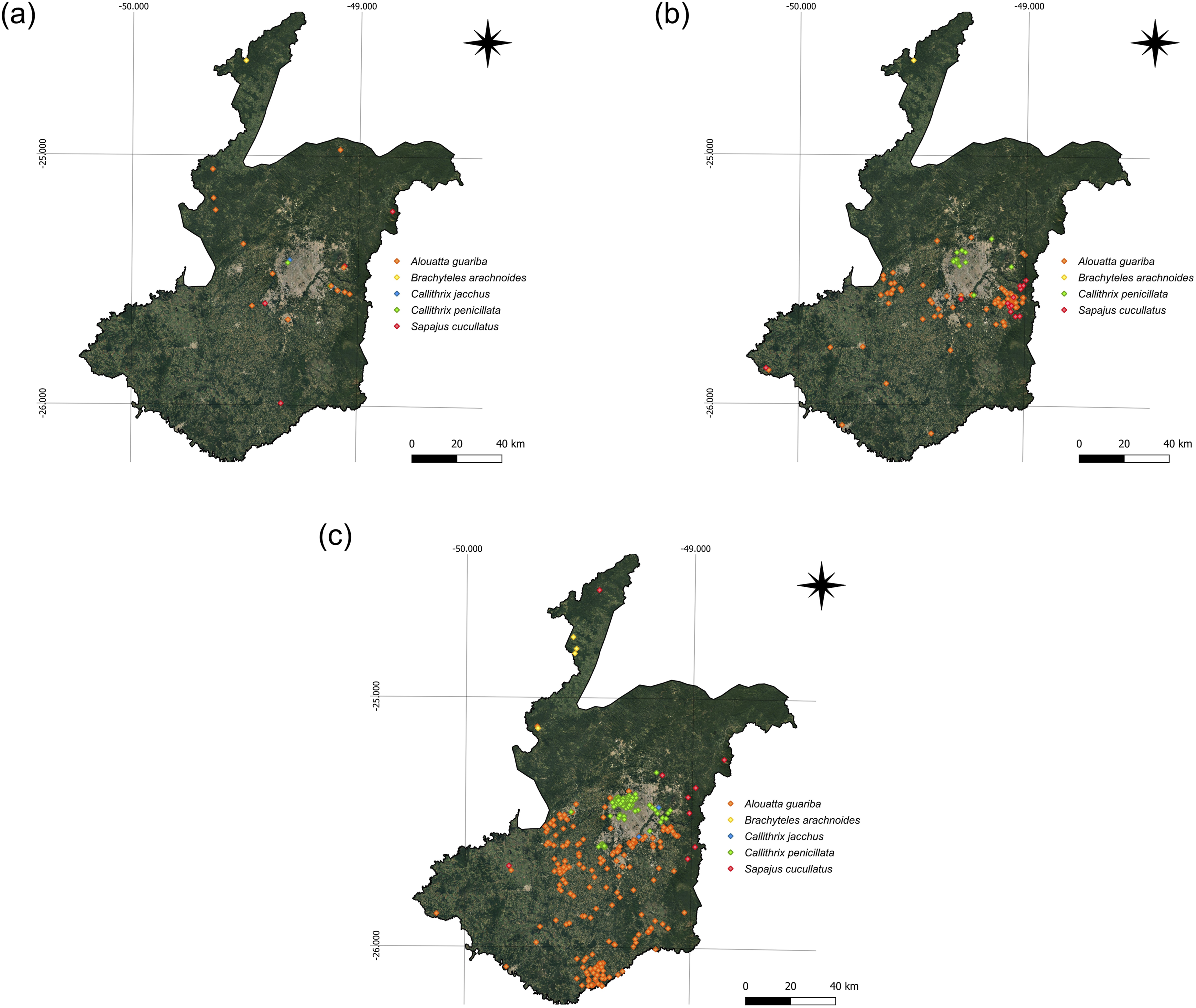
During the 2010s, a total of 107 primate occurrences were recorded (Figure 5(b)). Brown howler monkeys remained the most frequent species (n = 76), while black-tufted marmosets showed a significant increase to 17 records, and southern black-horned capuchin monkeys had 13. Southern muriquis were recorded once, in the same area where they had previously occurred, and common marmosets had no records, not even in areas where the species had previously been observed.
Finally, between 2020 and 2025, a total of 475 occurrences were recorded (Figure 5(c)), with the majority originating from the SISS-Geo and iNaturalist platforms. During this period, brown howler monkeys remained the most frequently recorded species (n = 259), while black-tufted marmosets showed a significant increase, with 201 records. Southern muriquis, southern black-horned capuchin monkeys, and the common marmoset had 4, 9, and 2 records, respectively, with the reemergence of the latter species observed through two new records from iNaturalist.
Taxon-Specific Occurrence Maps
Brown Howler Monkeys
Of the 604 occurrences, brown howler monkeys were the most widespread taxon, totaling 348 occurrences, most of which are concentrated in the southern region of the MRC, having few records from the northern region (Figure 6(a)). Distribution patterns of Brown Howler Monkeys in the MRC, Paraná, shown as Occurrence Points (a), Grid Map (b), and Kernel Density Estimation (c)
Brown howler monkeys were present in 243 grid cells (Figure 6(b)), a number significantly lower than the total of records, indicating that occurrences are concentrated in specific and in the same areas, probably representing the same populations. This is further supported by our KDE analysis, which found a high concentration of records in specific areas of the MRC, such as southern and southeastern Curitiba, as well as in the eastern, western, and southern parts, where the heatmap is more colored in red (Figure 6(c)).
Southern Muriquis
Southern muriquis are one of the taxa with the fewest records in this study, with a total of only six occurrences. Their range is currently limited to the municipalities of Doutor Ulysses and Cerro Azul in the northern MRC, and Campo Largo in the Central Urban Core (Figure 7(a)). Due to the scarce number of records, neither the grid analysis nor the KDE analysis showed a significant difference when compared to the raw occurrence data (Figures 7(b) and 7(c)). Distribution patterns of Southern Muriquis in the MRC, Paraná, shown as Occurrence Points (a), Grid Map (b), and Kernel Density Estimation (c)
Marmosets
For the exotic marmosets, we found 224 records, with 220 for the black-tufted marmoset and only four for the common marmoset. These records were predominantly concentrated in the northern urban area of Curitiba, with an additional notable presence in Cachoeira Park, in the municipality of Araucária. Additional occurrences were also noted in São José dos Pinhais, Piraquara, Pinhais, and Colombo (Figure 8(a)). This pattern of distribution shows that marmosets are primarily limited to the Central Urban Core of the MRC, with little to no presence recorded in the more northern or southern parts of the region. Distribution patterns of Exotic Marmosets in the MRC, Paraná, shown as Occurrence Points (a), Grid Map (b), and Kernel Density Estimation (c)
Even with a large number of occurrences, marmosets occupied only 77 grid cells (Figure 8(b)). This difference between the total records and the occupied grid cells suggests that multiple records likely came from the same populations, similar to what was observed with the brown howler monkey. This conclusion is further supported by the KDE analysis, which confirmed a high concentration of records in northern Curitiba (particularly in urban fragments) and in Araucária, reinforcing that the species’ distribution is not widespread but rather focused in a few specific urban areas (Figure 8(c)).
Southern Black-Horned Capuchin Monkeys
Southern black-horned capuchin monkeys had 26 occurrences in the region, mainly in the east, such as the areas with denser vegetation near the Serra do Mar in São José dos Pinhais, and farther from urban centers (Figure 9(a)). Similar to the muriqui, our grid analysis did not show a significant difference when compared to the raw occurrence data, with 25 grids occupied (Figure 9(b)). Although the KDE analysis did not yield an expressive result, it did indicate a concentration of occurrences in eastern APF remnants, particularly in the São José dos Pinhais municipality, with some records overlapping with those of brown howler monkeys near the boundaries of the Serra do Mar (Figure 9(c)). Distribution patterns of Southern Black-Horned Capuchin in the MRC, Paraná, shown as Occurrence Points (a), Grid Map (b), and Kernel Density Estimation (c)
Discussion
Our findings update the occurrences of primates and illustrate their distribution patterns in the Auracaria Pine Forest (APF) in the Metropolitan Region of Curitiba (MRC). Despite brown howler monkeys being very susceptible to yellow fever outbreaks, they were the most prevalent taxon — the other Atelidae, the southern muriquis, were very rare. The native Cebidae species, the southern black-horned capuchin monkeys, despite their greater resistance to the yellow fever virus, were remarkably rare in the region’s APF fragments, suggesting they are susceptible to other things, such as deforestation, for example. Southern muriquis and southern black-horned capuchin monkeys appear to be locally absent from the majority of the area. In contrast, the exotic Cebidae species, the marmosets, have several occurrences and appear to be concentrated in urban fragments, particularly the black-tufted marmoset — the common marmosets were the least prevalent species that we surveyed.
Three main distribution patterns were found: a high concentration of the exotic marmosets in the northern region of Curitiba city, a predominance of brown howler monkeys in the southern regions of both Curitiba and the MRC, and the eastern predominance of southern black-horned capuchin monkeys, particularly in São José dos Pinhais. This spatial segregation among these species (two natives and one exotic) can be explained by a combination of ecological and anthropogenic factors, which will be discussed in further detail.
Occurrences Per City in the MRC
Of the 29 municipalities in the MRC, we found primate records in 24. The majority of these records were concentrated in Curitiba, with three other cities – São José dos Pinhais, Araucária, and Piên – also showing a high number of records. This high concentration in the state capital may be explained by the numerous occurrences of black-tufted marmosets, which are easily observed in urban parks where people interact with them, facilitating frequent sightings (Leite et al., 2011; Teixeira et al., 2015). The other three cities still contain large areas of remnant APF (Zorek et al., 2024), which favors the occurrence of native species such as howler monkeys and capuchin monkeys in their original habitat. Furthermore, the prevalence of primate records from the cities mentioned was primarily due to SISS-Geo. Although this platform is used by the general public, the high volume of records from these areas points to an active epizootic vigilance by their respective municipal health departments.
Notably, sampling efforts were higher in the southern cities of the MRC, while the Vale do Ribeira, located in the northern region of the MRC (AMEP n.d.), was underrepresented in our data. The cities with few or no records do not necessarily reflect the current absence of primates. This is likely due to the fact that most environmental and public health agencies either did not respond to our inquiries or reported no occurrences. Therefore, it is possible that significant underreporting exists for these cities, which may lead to the false impression that primates do not occur in those areas (Löwenberg-Neto & Kirsch, 2024).
Data sources
Regarding the sources of records, SISS-Geo was the most significant, reflecting previous findings that NHP are the group with the highest number of records on the epizootic monitoring platform (Chame et al., 2020). Although most of the occurrence records in SISS-Geo were uploaded by municipal health departments — a valid source — it is important to acknowledge the potential biases. Chame et al. (2020) warned that the concentration of records, especially of dead animals, in areas close to human activity and in regions under intensified surveillance by health departments, may lead to an overrepresentation of these areas compared to others. Moreover, species misidentification can occur, mainly due to the condition of the carcasses found or the expertise of field technicians (Szynwelski et al., 2023). Given these factors, we emphasize the need for cautious use and interpretation of SISS-Geo records, while still recognizing the platform’s importance for primate prospecting.
Considering the rise of citizen science in biodiversity surveys over the last decade (Boone & Basille, 2019; Chandler et al., 2017), the iNaturalist platform was also an important source of primate records in the MRC. Similar to SISS-Geo, this platform presents certain biases, such as the concentration of records in areas with high human presence (Backstrom et al., 2024). To mitigate this, we adopted specific criteria, using only records with “Research Grade” status, which, according to Koo et al. (2022), increases data reliability. When necessary, we also contacted users to obtain further information about the reported primate occurrences. This approach helped improve data quality and allowed a more accurate understanding of primate distribution based on contributions from non-specialists.
Personal observations and communications from colleagues and ourselves were particularly important for understanding primate distribution in areas where other data sources are unavailable. This was especially true for the native southern black-horned capuchin monkey, a species that is present in the Faunal Inventory of Curitiba (Miretzki, 2023) but with an almost complete absence of studies and scientific publications in the APF. Scientific literature was also crucial, revealing past and present records, such as the former presence of common marmosets (Passos et al., 2006) in areas now occupied exclusively by black-tufted marmosets, as well as the occurrence of southern muriquis in the northernmost portion of the MRC (Hack et al., 2022; Ingberman et al., 2016). Finally, while visits to local scientific collections and consultations with environmental and public health agencies did not yield many records, the occurrences obtained were valuable for understanding the distribution of primates in the MRC.
Temporal Analysis
The temporal analysis revealed a significant increase in primate records in the region, with the number growing from 22 in the 2000s to 475 between 2020 and 2025. In the early years of the 21st century, few primatology studies were conducted in Paraná state (Passos et al., 2006), which may explain the low number of records. In the 2000s, both marmoset species were still cited in areas such as Barigui Park in Curitiba (Passos et al., 2006). The majority of the records from this period originated from scientific articles, reflecting the growing research effort in primatology studies in the region.
A noticeable rise in records was observed starting in 2010. This increase is likely associated with the heightened attention to disease outbreaks, such as yellow fever, which affects both humans and monkeys, particularly during the period from 2016 to 2021 (Andrade et al., 2022; Mares-Guia et al., 2020; Possas et al., 2018). The SISS-Geo system, implemented in 2014, was instrumental in this increase in primate records, particularly those associated with yellow fever outbreaks (Chame et al., 2019). The platform facilitated the reporting of primate deaths by health agencies, especially for howler monkeys, which are highly susceptible to the virus (Oklander et al., 2022). This vigilance initiative led to a substantial rise in data, contributing to a better understanding of primate distribution and the dynamics of yellow fever transmission (Chame et al., 2019; Possas et al., 2018). More specifically, Paraná is among the states with the highest number of primate records on the platform (Chame et al., 2020), which contributes to the 107 occurrences registered in our study during the 2010s. Additionally, iNaturalist has gained popularity and accessibility for citizen science since 2011, providing a valuable complement of data on primate occurrences in the region (Boone & Basille, 2019; Chandler et al., 2017; iNaturalist, n.d.). Important to note, during the 2010s, there were no more records of common marmosets, not even in areas where the species had been previously observed.
Between 2020 and 2025, SISS-Geo and iNaturalist continued to contribute the majority of records, which demonstrates that these platforms have become established as important sources for biodiversity and primate monitoring. During this five-year period, there were also two new records of common marmosets in the region, confirming the species’ current occurrence.
Taxon-Specific Occurrences
Brown Howler Monkeys
Brown howler monkeys had the highest number of occurrences and were the most widespread primate taxon in the MRC. Despite their yellow fever susceptibility, these presences are consistent with their status as a native species known for their dietary flexibility, with high degree of folivory, that enables them to survive in diverse-sized fragments (Jerusalinsky et al., 2021; Miranda & Passos, 2004). Additionally, these findings underscore the current presence of brown howler monkeys within the APF, after severe yellow fever outbreaks in the Atlantic Forest, highlighting the critical need to conserve these forest remnants, especially given the high threats facing both the species and its ecosystem (Mittermeier et al., 2022; Zorek et al., 2024).
Ensuring the continuity of brown howler monkey populations — which live in a variety of sites, as shown in the grid analysis — contributes not only to the local preservation of the species but also plays a key role in maintaining ecosystem balance by supporting seed dispersal fauna in these forest fragments (Chaves et al., 2019; Oklander et al., 2022). Our KDE analysis underscores this ecological significance by revealing hotspots of species’ presence, such as south Curitiba, near the Iguaçu River. Therefore, these areas should be prioritized in conservation planning by implementing stricter environmental regulations and reinforcing controlled protection zones, such as the Municipal Environmental Protection Area of Iguaçu River (APA do Iguaçu), where the species is still observed.
Southern Muriquis
Southern muriquis were recorded in six occurrences, all of which were documented in scientific literature (Hack et al., 2022; Ingberman et al., 2016). The majority of these records were identified within municipalities of the Vale do Ribeira region. A particularly significant record, located farther south in the MRC, establishes the southernmost known limit of the species’ free-ranging population (Hack et al., 2022). Due to the limited number of occurrences identified in our study, our grid and KDE analyses were less effective in illustrating distribution patterns for southern muriquis.
Given the Critically Endangered status of southern muriquis on the IUCN Red List (Talebi et al., 2021), the records presented in this study contribute to a better understanding of the species’ distribution. This also highlights the importance of conserving APF remnants in the MRC, since this habitat appears to be suitable for the species. Moreover, the limited number of occurrences emphasizes the urgent need for additional surveys to locate other potential populations and to monitor the known ones. This is especially critical in light of ongoing anthropogenic threats such as deforestation, habitat fragmentation, and hunting in Vale do Ribeira region (Hack et al., 2022; Talebi et al., 2021).
Marmosets
Introduced marmoset populations typically establish themselves close to their release sites, as human-primate interactions provide easy access to food, particularly in urban centers, which facilitates their persistence (Detogne et al., 2017; Leite et al., 2011; Rosa et al., 2017). Our findings confirm this pattern in the MRC, where the grid and KDE analysis reveals the highest concentration of records near introduction points, particularly in urban parks in northern Curitiba and Cachoeira Park in Araucária. The high number of marmoset records in Cachoeira Park, primarily from the SISS-Geo and iNaturalist platforms, strongly suggests an informal introduction event in Araucária municipality, separate from the event that occurred in Curitiba. This is further supported by the fact that no official records were found, and inquiries with the Municipal Environment Department of Araucária did not clarify any formal introduction.
Common marmosets were represented by just four occurrence records, only two of which are current. Although the species was previously reported in the 2000s in Barigui Park alongside black-tufted marmosets (Passos et al., 2006), current observations indicate only the presence of black-tufted marmoset phenotype at the site. These two species are phylogenetically very close, and hybridization between them is common in sympatric areas (Malukiewicz et al., 2015, 2021).
Therefore, we speculate that the apparent disappearance of common marmosets in the region could be explained by hybridization, a process which can lead to genetic swamping and the dilution of one species (Adavoudi & Pilot, 2022). We suggest that the marmosets currently found in Barigui Park may be partially hybrids. The two recent records of common marmosets were also located in areas already occupied by the other species, which could similarly lead to hybridization. To date, no studies have investigated hybridization between these species in the region, indicating a valuable opportunity for future research to clarify the status of these local populations.
Southern Black-Horned Capuchin Monkeys
Records of southern black-horned capuchin monkeys were surprisingly rare. Most of these records were based on personal field observations from our colleagues or ourselves, and the limited number of occurrences made our grid and KDE analyses less effective. Their distribution, concentrated in the eastern MRC, is consistent with the species’ occurrence in the more conserved Serra do Mar, which is very well documented (Passos et al., 2006). This scarcity of southern black-horned capuchin monkeys’ occurrences in the study area may indicate genuinely rare populations in APF, especially when compared to other regions in Paraná state, like the Semideciduous Seasonal Forest, where this species appears to be more abundant (Aguiar et al., 2011), even within urban zones (Gutierres et al., 2025; Rocha et al., 1998).
We believe the local status of southern black-horned capuchin monkeys may be neglected, as our survey suggested that these monkeys apparently cannot live in small to medium APF fragments, suggesting they may be locally threatened. It is possible that the reduced size and isolation of the remaining APF patches (Zorek et al., 2024) do not meet the ecological needs of these primates, particularly in terms of energy requirements and complex social structures. The ongoing conversion of native forests into urban or agricultural landscapes may be contributing to the species’ disappearance from these areas, as has already been reported in other parts of its distribution (Ludwig et al., 2022). Gaining a clearer picture of the native capuchin monkey distribution and population parameters in the APF of MRC will require expanded in situ research and broader sampling efforts.
Implications for Conservation
Amid increasing urban development, sylvatic diseases and climate changes, it is essential to identify the distribution patterns of primates in the Metropolitan Region of Curitiba, especially within the threatened Araucaria Pine Forest remnants. These insights are vital for designing effective conservation efforts that tackle the challenges posed by habitat fragmentation and the overlap between wildlife habitats and human presence.
The conservation of habitats occupied by native primates such as those surveyed here is essential not only for the long-term survival of these species but also for the preservation of the Araucaria Pine Forest as a whole, especially considering that this ecosystem has experienced some of the highest deforestation rates in Paraná state (Zorek et al., 2024). Furthermore, considering the recent yellow fever outbreaks that have severely impacted, at least, brown howler monkey populations, continuous monitoring and surveillance are crucial to assess the magnitude of losses and predict future impacts. By providing baseline data on the distribution of these primates, our study can help guide the implementation of more effective measures to decrease the impact of future outbreaks on these populations, including the establishment of stricter conservation areas where the species is consistently observed.
Regarding exotic species, it is crucial to investigate whether hybridization has occurred between the two marmoset species in the region, as we speculate, and to find ways to limit the spread of these animals beyond urban areas. While not a direct result of our study, it is important to note that introduced populations of common marmosets exist on the coastal plain of the Paraná state, near the distribution of threatened black-faced lion tamarins, where they could compete if they establish sympatry. Addressing these concerns will help to develop more effective management strategies to mitigate potential negative impacts on native primate populations.
With continuous urban growth and habitat loss, it becomes essential to study and safeguard the native biodiversity, especially primates. These efforts are crucial not only for preserving species but also for supporting harmonious interactions among wildlife, vegetation, and human communities, thus maintaining the region’s ecological balance.
Supplemental Material
Supplemental Material - Primates in the Endangered Araucaria Pine Forest of the Largest City of Southern Brazil: A Current Overview
Supplemental Material for Primates in the Endangered Araucaria Pine Forest of the Largest City of Southern Brazil: A Current Overview by Maria Augusta Sukow, Kauê Cachuba Abreu, Lucas M. Aguiar in Tropical Conservation Science.
Footnotes
Acknowledgements
We thank UFPR for academic support, as well as MHNCI, the DZUP/CCMZ, and the MZPUCPR for providing access to their collections. We are also grateful to our lab colleagues, especially Mário Retondo, and other researchers who provided primate occurrence data. We are particularly thankful to the Editors and reviewers of Tropical Conservation Science for their valuable suggestions that resulted in significant improvements to this article.
Funding
The authors received no financial support for the research, authorship, and/or publication of this article.
Declaration of Conflicting Interests
The authors declared no potential conflicts of interest with respect to the research, authorship, and/or publication of this article.
Supplemental Material
Supplemental material for this article is available online. All primate occurrence data used in this study, including geographic coordinates, dates, data sources and links (when available) are provided in the Supplementary Materials ( ) submitted with this manuscript. The dataset was compiled from multiple sources: citizen science platforms (iNaturalist, GBIF), the official epizootic monitoring system (SISS-Geo), scientific literature, museum collections, environmental and health agency records, and also from personal observations and direct communications.
References
Supplementary Material
Please find the following supplemental material available below.
For Open Access articles published under a Creative Commons License, all supplemental material carries the same license as the article it is associated with.
For non-Open Access articles published, all supplemental material carries a non-exclusive license, and permission requests for re-use of supplemental material or any part of supplemental material shall be sent directly to the copyright owner as specified in the copyright notice associated with the article.
