




Abstract
Background and Research Aims
Community Resource Management Areas (CREMAs) are Ghana’s decentralized approach to biodiversity conservation and sustainable natural resource governance. Despite their institutional legality and community support, CREMAs face persistent financial instability, largely due to donor dependency and the absence of sustainable internal funding mechanisms. In contrast, Village Savings and Loan Associations (VSLAs) have emerged as resilient, community-driven financial systems that promote local livelihoods. This study asks: Can communities sustainably finance their own conservation through grassroots mechanisms like VSLAs? Grounded in Community-Based Natural Resource Management (CBNRM), collective action theory, and informal rural finance systems, the aim is to explore the feasibility of integrating VSLAs into CREMA governance as a model for localized conservation finance.
Methods
A qualitative case study was employed across four CREMAs in Ghana’s Black Volta River and Western Wildlife corridors. Sixteen focus group discussions were conducted with CREMA executive members, community leaders, VSLA participants, and women and youth groups. Thematic analysis identified perceptions, challenges, and opportunities for financing CREMA activities through VSLAs.
Results
Findings indicate strong community acceptance of CREMAs, but significant underfunding limits their conservation impact. Conversely, VSLAs were described as trusted, inclusive, and capable of supporting household and community needs. Participants advocated integrating VSLAs into CREMA governance with transparency safeguards and shared control mechanisms. Women and youth, central to VSLA operations, were identified as key stakeholders for advancing inclusive conservation finance.
Conclusion
Integrating VSLAs into CREMA structures presents a promising model for bottom-up, sustainable financing of conservation activities in Ghana. It builds on existing community trust systems, enhances participation, and reduces reliance on external donors.
Implications for Conservation
This study contributes a novel community-based green financing framework that links informal rural finance with decentralized conservation governance. It offers replicable insights for scaling localized conservation finance in other resource-dependent, tropical contexts across Sub-Saharan Africa.
Introduction
Globally, Community-Based Natural Resource Management (CBNRM) has gained prominence as an alternative to centralized conservation models that often exclude local actors and fail to sustain ecological outcomes (Robinson et al., 2021; Stone & Nyaupane, 2014). Rooted in principles of decentralization, local participation, and equitable benefit-sharing, CBNRM approaches seek to empower communities to take ownership of the ecosystems on which their livelihoods depend (Berkes, 2004; Fabricius, 2004; Heffernan, 2022; Ostrom, 1990; Stone & Nyaupane, 2014). These approaches have been shown to improve agreement, stewardship, and the legitimacy of conservation efforts (Agrawal & Gibson, 1999; Cox et al., 2010; Leach et al., 1999). However, a persistent challenge across CBNRM initiatives is the absence of sustainable and community-driven financing mechanisms (Mahanty et al., 2009; Roe et al., 2009; World Bank, 2024).
In Africa, the uptake of CBNRM has been widespread, particularly in countries like Botswana, Tanzania, and Zambia (Adeyanju et al., 2021; Gaodirelwe et al., 2020; Pailler et al., 2015). While positive outcomes have been reported, such as increased wildlife populations and strengthened community governance, many initiatives remain heavily reliant on donor support, with limited internal revenue generation (Nelson & Agrawal, 2008; Rihoy & Maguranyanga, 2007). This financial fragility has undermined CBNRM continuity and limited local ownership, especially when external funding ceases (Chomba et al., 2015).
Financial autonomous community conservation models are urgently needed in sub-Saharan Africa (SSA), where fiscal constraints, land pressures, and climate risks intensify ecological stress. Studies across Uganda and elsewhere have explored eco-tourism revenues, reducing emissions from deforestation and forest degradation in developing countries (REDD+) schemes, and natural product value chains as financing strategies (Peskett et al., 2011; Reed et al., 2016, 2020). However, few have examined the potential of integrating grassroots financial institutions, such as Village Savings and Loan Associations (VSLAs), into environmental governance structures. VSLAs are community-based savings groups that enable members to save money, access loans, and collectively manage their financial resources (CARE International, 2018; Ksoll et al., 2016). Typically found in rural areas, VSLAs enable individuals, often women, to build savings and provide a source of microfinance among themselves. Members contribute to a common fund, making it possible to provide small loans with low interest rates, which helps to promote financial independence and entrepreneurship within the community. VSLAs also often include educational components that teach financial literacy and business skills. VSLAs have proven effective in promoting financial inclusion and household resilience (Brannen & Sheehan-Connor, 2016; Kwilasa, 2017; Marshall et al., 2023; Pienaah & Luginaah, 2024). Yet their role in conservation financing remains understudied.
In Ghana, the Community Resource Management Area (CREMA) approach is widely recognized as a legal and institutional innovation in participatory conservation. Established under the Wildlife Division of the Forestry Commission, CREMAs devolve resource management rights to communities, enabling them to protect forests and wildlife through locally designed governance structures. Several studies have documented the ecological benefits and governance effectiveness of CREMAs (Ahmed & Gasparatos, 2020; Asare et al., 2013; Baaweh et al., 2023; Bayala et al., 2025; Bempah et al., 2019; Dugasseh et al., 2021; Mawutor & Hajjar, 2024; Murray et al., 2019), while others have raised concerns about elite capture, weak enforcement, and limited funding (Agyare et al., 2024; World Bank, 2024).
The problem of financial sustainability is especially severe in northern Ghana, where communities operate CREMAs in ecologically sensitive but economically marginal areas. In the Upper West Region (UWR), communities along the Black Volta River and near the Mole National Park buffer zone (Western Wildlife corridor) are actively engaged in CREMA-based forest restoration and wildlife protection (Baaweh et al., 2023; Bayala et al., 2025; Pienaah, 2025). Yet many CREMAs operate without stable funding, relying on sporadic Non-Governmental Organizations (NGOs) support or short-term project funds. Despite the presence of strong VSLA networks in these communities, particularly among women and youth, there has been little empirical research on whether these grassroots financial systems can be harnessed to support conservation governance.
This study addresses this gap by exploring the feasibility of integrating VSLAs into CREMA governance in four sites across Ghana’s Upper West Region. It explores community perceptions, institutional readiness, and inclusive, community-driven conservation financing opportunities. By linking two locally trusted institutions, CREMA and VSLA, this study contributes to the emerging discourse on hybrid governance and offers a scalable model for enhancing financial autonomy and social equity in conservation initiatives.
Theoretical Framework
This study is underpinned by a complementary theoretical framework that integrates three interrelated concepts: CBNRM, collective action theory, and informal rural finance systems, with a focus on VSLAs. These frameworks together provide a robust lens through which the financial sustainability and participatory governance of CREMAs in Ghana can be understood and advanced.
CBNRM provides the foundational paradigm for understanding decentralized environmental governance (Berkes, 2004; Fabricius, 2004; Heffernan, 2022; Ostrom, 1990; Stone & Nyaupane, 2014). It posits that sustainable resource management can be achieved when local communities are granted decision-making authority and secure rights over the natural resources they depend on (Berkes, 2004; Robinson et al., 2021; Stone & Nyaupane, 2014). CBNRM shifts the locus of control from state agencies to community-based institutions, fostering local stewardship, cultural legitimacy, and adaptive governance (Agrawal & Gibson, 1999; Cox et al., 2010; Leach et al., 1999). In Ghana, the CREMA approach is a practical expression of CBNRM principles. CREMAs legally empower communities to manage forests and wildlife within defined territories (Bayala et al., 2025; Mawutor & Hajjar, 2024; World Bank, 2024). The CREMA approach aligns with international CBNRM principles by recognizing customary rights, fostering participatory governance, and enabling benefit-sharing. However, while institutional authority has been devolved, financial autonomy remains weak, creating a critical gap in the operational sustainability of CREMAs. This study builds on the CBNRM framework by investigating how community-driven financial mechanisms, such as VSLAs, can address this gap. By anchoring financial sustainability within local institutions, the CREMA model could achieve greater independence, effectiveness, and resilience.
The study is further informed by collective action theory, particularly as articulated by Elinor Ostrom (1990), who demonstrated that communities are capable of managing common-pool resources without external enforcement, provided certain institutional conditions are met (Ostrom, 1990). These include clearly defined boundaries, collective decision-making, monitoring, graduated sanctions, and conflict-resolution mechanisms. CREMAs and VSLAs both rely on collective action for their functionality. CREMAs require coordinated community engagement in conservation tasks, rule enforcement, and benefit-sharing (Ahmed & Gasparatos, 2020; Asare et al., 2013; Baaweh et al., 2023; Bayala et al., 2025; Bempah et al., 2019; Dugasseh et al., 2021; Mawutor & Hajjar, 2024; Murray et al., 2019). Similarly, VSLAs are built on group savings, trust, and reciprocal lending (Kwilasa, 2017; Marshall et al., 2023; Pienaah & Luginaah, 2024). The intersection of these two systems offers a unique opportunity to explore how social capital, shared norms, and institutional trust can be mobilized to finance environmental governance. Applying Ostrom’s principles, the study examines whether integrating VSLA structures into CREMA operations can reinforce rule compliance, increase transparency, and enhance participation among women and youth. The theory also informs the study’s attention to governance design features, including accountability mechanisms and community-driven rules.
The third theoretical pillar centers on informal rural finance systems, with a focus on VSLAs. VSLAs are self-managed, community-based financial groups that provide members with savings, credit, and insurance-like services. They have been widely promoted in development contexts for their capacity to reach excluded populations, especially in rural areas where formal banking services are limited (Allen & Panetta, 2010). VSLAs operate on principles of mutual trust, transparency, and collective responsibility (Allen & Panetta, 2010; CARE International, 2018). These attributes make them particularly suited to integration with local governance institutions (Kwilasa, 2017; Marshall et al., 2023; Pienaah & Luginaah, 2024). In Ghana, VSLAs are common among women and youth and have demonstrated success in improving household financial resilience, promoting entrepreneurship, and supporting social cohesion (Flynn & Sumberg, 2018; Pienaah et al., 2022). This study explores how these mechanisms can be scaled up to support communal goals such as conservation. This study characterizes the potential for VSLAs to provide a sustainable, locally governed financing stream for CREMA activities, including forest patrols, reforestation, and environmental education, if structured appropriately.
Moving towards a hybrid governance approach, Figure 1 demonstrates the conceptual integration of these theoretical domains. At the core of the framework lies the CREMA institution, rooted in CBNRM principles. It is supported by collective action dynamics that facilitate community cooperation and trust. Surrounding this structure is the VSLA model, which provides financial resources and reinforces inclusive participation. The intersection of these three components creates a hybrid institutional space where informal finance directly supports formal conservation governance. This integration is further reinforced by enabling factors, including institutional capacity, financial literacy, community trust, and effective leadership. Therefore, this theoretical framework positions the integration of VSLAs into CREMA governance not merely as a financial intervention but as an institutional innovation that enhances community ownership, inclusion, and sustainability in natural resource management. By anchoring conservation finance in localized, trust-based structures, the framework provides a pathway for reducing donor dependency and fostering long-term ecological and socio-economic resilience. The Intersection of CBNRM, Collective Action Theory, and VSLA Systems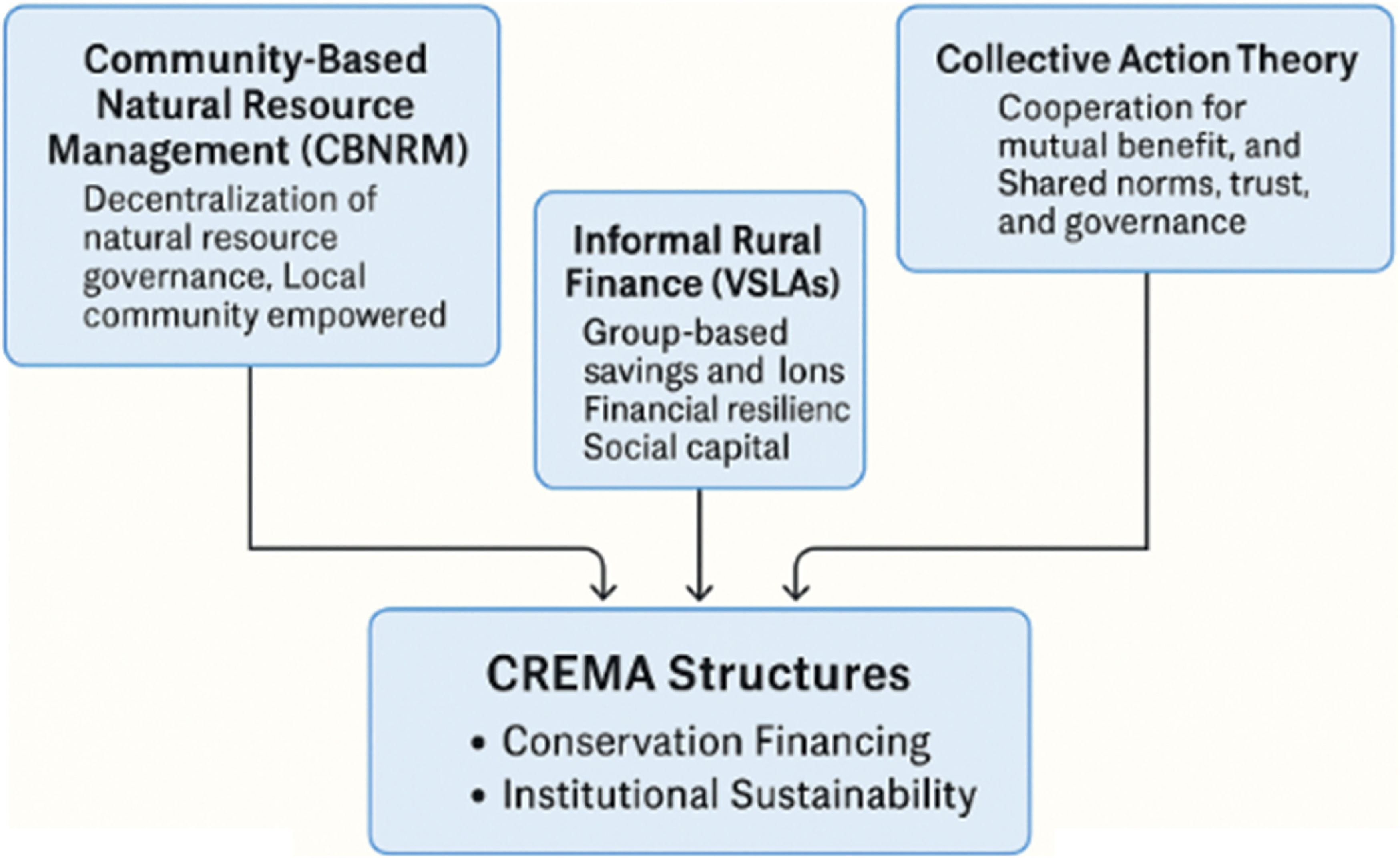
Methodology
Study Area and Context
This study was conducted in four CREMAs in Ghana’s Upper West Region (UWR) (Figure 2): Wechiau, Zukpiri, Dorimo Paramountcy, and Chakali-Sungmaalu. These CREMAs, situated across diverse ecological and cultural landscapes, exemplify community-based conservation efforts shaped by local priorities, traditional knowledge, and external environmental mandates (Bayala et al., 2025; Pienaah, 2025). While some border the ecologically significant Black Volta River, others are adjacent to key national ecological zones such as the Mole National Park. Wechiau CREMA is the region’s oldest and most established CREMA, internationally recognized for its success in linking biodiversity conservation with community development, like ecotourism. It encompasses the Wechiau Community Hippopotamus Sanctuary, a 2,400-hectare protected area that covers a 34-kilometre stretch of the Black Volta River and provides habitat for Hippopotamus amphibius (United Nations Development Programme [UNDP], 2012). This CREMA is often cited as a model of community-led ecotourism, combining strong traditional authority, conservation outcomes, and external partnerships (Bonye et al., 2022). However, despite its success, the CREMA continues to face difficulties sustaining its operations beyond donor cycles. Communities such as Dodoma, Kpanfa, Kantu, Talawonaa, and Wechiau formed the CREMA. Map of the Upper West Region Showing CREMAs Adapted from Pienaah (2025)
Zukpiri CREMA, situated roughly 30 kilometres from Nadowli town in the Nadowli-Kaleo District, spans approximately 420 square kilometres and also borders the Black Volta River (Baaweh et al., 2023; Pienaah, 2025). Its establishment was initiated by the Zintang Healers Association, a collective of traditional herbal medicine practitioners seeking to protect native flora used in healing practices (Baaweh et al., 2023). The CREMA reflects an innovative blend of traditional health systems and conservation, demonstrating how indigenous knowledge systems can inspire ecological stewardship and biodiversity protection (Baaweh et al., 2023; Pienaah, 2025). Communities such as Mantari, Puni, Namou, Gelmwama, Siiru, Meguo, Zukpiri, Guduori, Nanvilli, Takpo, Neyir, Kpaala, Kulipiene, Nabuba, Koorie, Saa, and Charipong established the CREMA.
Dorimo Paramountcy CREMA, located along the Black Volta corridor, was founded to integrate sustainable environmental practices with economic development through community mobilization (Pienaah, 2025; USAID, 2019). Leveraging the legitimacy and influence of the paramount chieftaincy, this CREMA focuses on participatory approaches to afforestation, communal farming, and environmental sensitization. It highlights how traditional governance institutions can play pivotal roles in galvanizing local resource governance and collective action. The CREMA is operated by communities such as Buka, Dorimo, Dabo, Olli, Kusale, and Sielaa.
Chakali-Sungmaalu CREMA, in contrast to the other three, does not border the Black Volta River but instead shares an ecological boundary with the Mole National Park along the Western Wildlife Corridor (Bayala et al., 2025). This CREMA was created in response to severe deforestation, forest degradation, and poaching in the Wa East District. It uniquely blends traditional ecological knowledge, such as the observance of taboos, sacred groves, and seasonal prohibitions, with formal conservation frameworks. Its hybrid governance structure offers insights into how culturally embedded conservation practices can be harmonized with national environmental regulations to create resilient, community-based forest management systems. This CREMA is made up of communities such as Gurumbelle, Yayoube, Jeyin, Ducie, Tuasa, Gbantala, Holomuni, Chaggu, Kulpong Kandasi, and Bisikom.
These four CREMAs offer a diverse and context-rich landscape for understanding the structural challenges of funding community-based conservation. Their differences in origin, ecological focus, and cultural integration make them ideal case studies for exploring how VSLAs could serve as grassroots financial mechanisms to strengthen CREMA governance and sustainability.
Research Design
A qualitative, exploratory case study design (Strauss & Corbin, 1990) was employed to understand local perceptions, experiences, and institutional realities regarding the financial sustainability of CREMAs and the feasibility of integrating VSLAs into their operational models. The case study approach enabled an in-depth exploration of CREMA’s governance structures, financial challenges, and socio-cultural dynamics that influence collective conservation action. This approach was well-suited for understanding the nuanced interactions between financial inclusion and environmental governance from the perspectives of different community actors.
As described in the “Study Area and Context” section, the four CREMAs (Wechiau, Zukpiri, Dorimo Paramountcy, and Chakali-Sungmaalu) were selected to capture a diverse range of conservation models, ecological zones, and community governance structures, providing rich contextual settings for comparative case analysis.
Sampling Strategy
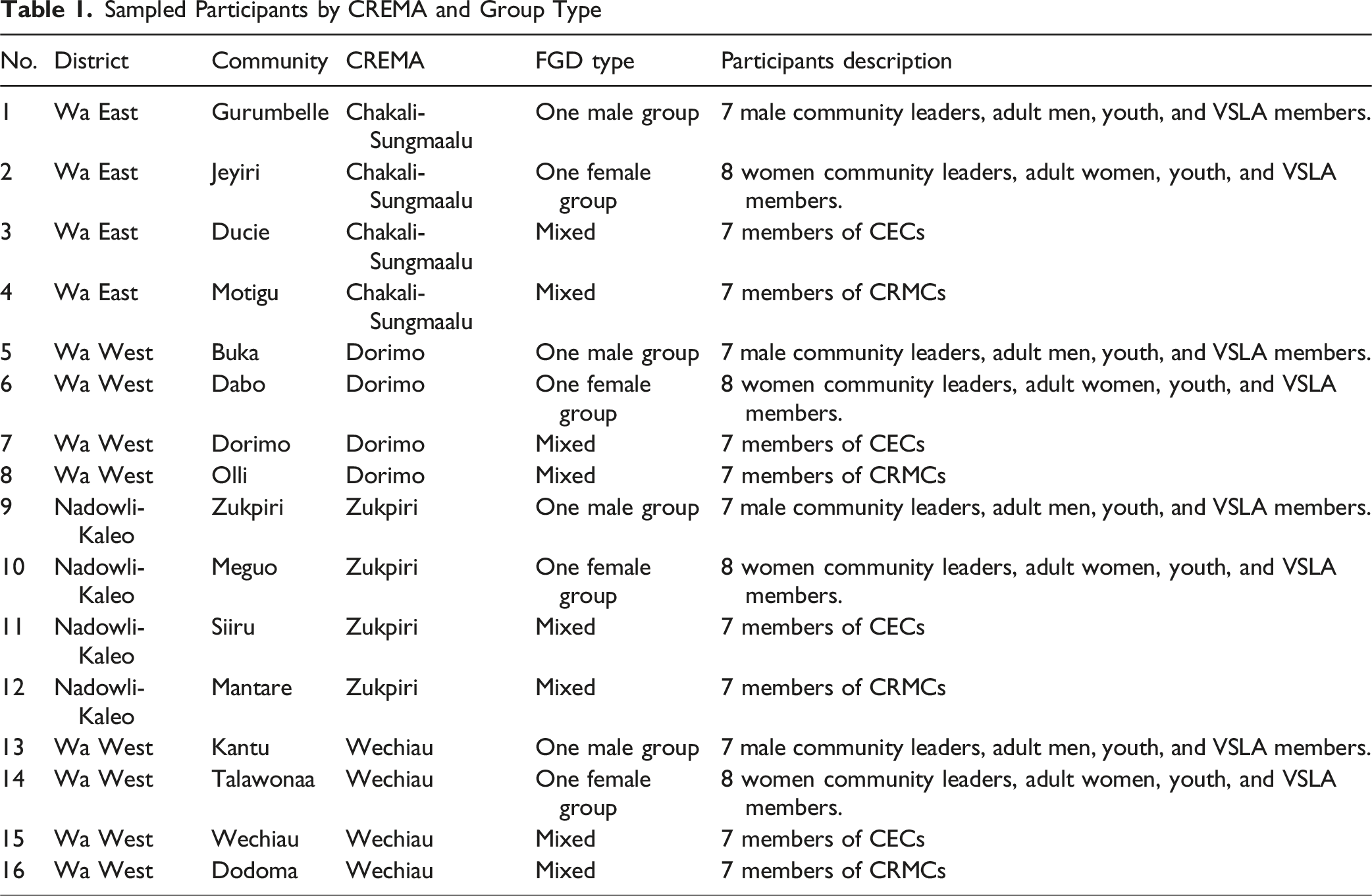
A purposive sampling strategy was adopted to select participants across the four CREMA zones. Participants were drawn from various stakeholder categories, including community leaders, CREMA Executive Committees (CECs), Community Resource Management Committees (CRMCs), women’s and youth groups, and other community members engaged in conservation, as well as VSLA members.
Participants were identified based on their roles in local governance, conservation activities, or involvement in community finance structures such as VSLAs. Inclusion criteria prioritized individuals with active knowledge or participation in CREMA operations or financial decision-making. To ensure representativeness and capture diverse viewpoints, local facilitators and CREMA leaders supported the identification and invitation of participants. There were no formal exclusion criteria; however, availability and consent to participate influenced the final composition of the group.
Sampled Participants by CREMA and Group Type
Data Collection Methods
Data were collected through FGDs using a semi-structured discussion guide (Morgan, 2012; Strauss & Corbin, 1990). The guide included open-ended questions that explored themes such as: the current funding landscape and financial needs of CREMAs, community savings and finance practices, awareness and participation in VSLAs, perceived benefits and risks of integrating VSLAs into CREMA governance, and gender and youth inclusion in financial decision-making. All FGDs were conducted in local languages (primarily Dagaare, Brifor, Waali, and Sisaale) with the assistance of trained Research Assistants (RAs). Each session lasted between 60 and 90 minutes and was audio-recorded with participant consent. Detailed field notes were also taken to capture non-verbal cues and contextual nuances. The FGDs were conducted in safe, familiar settings to encourage open and honest conversations.
Background Characteristics of Participants
Background Characteristics of FGD Participants

Data Analysis
The qualitative data were analyzed using thematic analysis, following the six-step approach outlined by Braun and Clarke (2006). After audio recordings were transcribed and translated into English, transcripts were read multiple times to ensure immersion in the data. Initial codes were generated inductively and deductively, drawing from participants’ narratives and the study’s conceptual framework. Codes were grouped into emerging themes and sub-themes, focusing on: financial constraints in CREMA operations, existing VSLA practices and models, institutional openness to integrating VSLAs into CREMA finance, gendered perceptions of financial leadership, and trust, accountability, and transparency mechanisms. Data were managed manually, supported by matrix development and content summaries for each FGD group. Triangulation was achieved by comparing responses across gendered groups, roles (e.g., CEC vs. CRMC), and CREMA zones to strengthen analytical rigor.
Ethical Considerations
This study obtained ethical clearance from the Non-Medical Research Ethics Board (NMREB) at Western University, Canada, for the project titled “The Impact of Community Resource Management Areas on Improving Livelihoods and Climate Change Resilience in UWR, Ghana” (Project ID: 121340). Official approval was granted on November 8, 2022, and remained valid until November 8, 2023. The approval encompassed all relevant data collection tools and procedures, including household surveys, focus group guides, consent scripts, recruitment posters, and participant forms. The research followed the Tri-Council Policy Statement on Ethical Conduct for Research Involving Humans (TCPS2), the Ontario Personal Health Information Protection Act, and institutional policies. Participants were fully informed of the study’s purpose, its voluntary nature, and their right to withdraw anytime without penalty. Verbal consent was obtained using ethics-approved scripts in the participants’ preferred local languages, facilitated by trained personnel. Anonymity and confidentiality were strictly upheld during the research. Audio recordings, transcripts, and data were securely stored, with identifying information excluded from analysis and reporting. There were no deviations from the approved protocol during data collection, and the research team respected local cultural norms, seeking permissions from traditional leaders and CREMA executives before engaging with participants.
Results
Four main themes emerged from participants’ narratives across different stakeholder groups and CREMA zones: persistent financial constraints in CREMA operations, community experience and perceptions of VSLAs, institutional willingness and design considerations for linking VSLAs to CREMAs, and gendered perspectives and inclusive participation in community financing. Each theme is discussed in detail, drawing on insights from male-only, female-only, and mixed groups. Representative quotes and a table of short responses are included to highlight community voices and support the interpretive analysis.
Persistent Financial Constraints in CREMA Operations
A cross-cutting concern across all study sites was the persistent lack of funding to support basic CREMA operations (see Table 3). Participants consistently identified inadequate financial resources as a primary barrier to sustaining conservation activities, including community patrolling, tree planting, education campaigns, and regular meetings. Despite their enthusiasm for local conservation and the legitimacy of CREMA structures, community members expressed frustration at the overdependence on external donors, which often led to intermittent activity and low motivation. In the male-only group from Wechiau CREMA, one community leader remarked: “After the last project ended, there has been no money to even buy fuel for patrol. We now just watch the forest but cannot do anything.” Short Responses Supporting Financial Constraints in CREMA Operations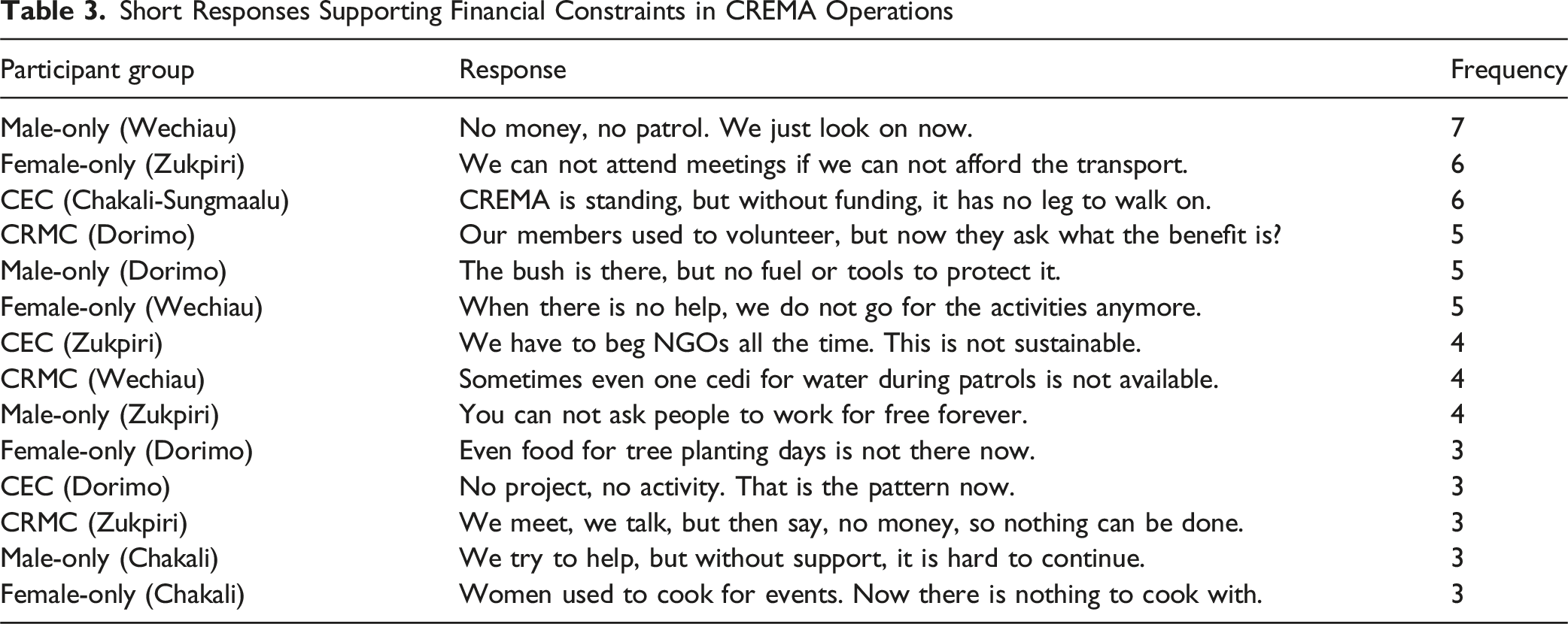
A female participant from Zukpiri CREMA added: “Sometimes we want to join activities like tree planting or community meetings, but when there is no transport or food, the women stay back because we have families to feed.”
Among CEC members in Chakali-Sungmaalu, the issue was framed more institutionally: “We have the structure and community willingness, but without funds, the CREMA cannot function effectively. People need at least some support for time and effort.”
Similarly, a CRMC member in Dorimo emphasized the challenge of volunteer fatigue: “At first, the spirit was high. But when nothing is coming to support the volunteers, people stop coming to meetings. We need something to keep the work going.”
These narratives reflect a widespread understanding that community commitment alone cannot sustain long-term conservation efforts without reliable, localized financial support.
Community Experience and Perceptions of VSLAs
VSLAs are not new to most CREMA communities. Across all four zones, participants, especially women and youth, reported either direct participation in VSLAs or knowledge of their operation in nearby communities (see Table 4). VSLAs were widely perceived as practical, trustworthy, and community-controlled financial systems that enhance savings discipline, promote mutual support, and provide small-scale credit for household needs or micro-enterprises. In the female-only group from Wechiau, one participant described the impact of VSLAs on women’s agency: “Since joining the savings group, I have been able to buy a goat and pay school fees. It gives us women a small power to decide things in the house.” Short Responses Supporting Community Perceptions of VSLAs
Among male-only participants in Dorimo, VSLAs were praised for reducing dependency on moneylenders: “The VSLA helps us avoid going to the town people who take too much interest. It is better when we support each other.”
CEC members in Zukpiri CREMA saw potential beyond individual use, suggesting a link with community development: “We see how VSLAs help families, but if structured well, they can also help the CREMA. We just need clear rules.”
A CRMC member in Chakali-Sungmaalu echoed the potential for integration with conservation goals: “If we can agree that a portion of the group’s savings goes to CREMA patrol or seedlings, that would help. But we must all trust the process.”
While enthusiasm was generally high, participants also raised concerns about limited financial literacy, poor record-keeping in some VSLAs, and the need for capacity building if such models were to be linked with formal CREMA governance. Nonetheless, the prevailing sentiment was that VSLAs are culturally accepted, economically useful, and potentially scalable to support collective environmental management.t
Institutional Willingness and Design Considerations for Linking VSLAs to CREMAs
Participants across the CREMAs expressed strong interest in linking VSLAs to CREMA governance, particularly as a way to support local conservation actions and reduce dependency on inconsistent external funding (see Table 5). However, this enthusiasm was accompanied by careful reflections on institutional requirements, trust mechanisms, and governance design that would make such integration feasible and sustainable. Among CREMA Executive Committee (CEC) members in Wechiau, the idea was welcomed, provided transparency and community buy-in were guaranteed: “We can try linking our VSLA to CREMA patrols, but it must be agreed upon by all members. People fear misuse, so there must be openness.” Short Responses Supporting Institutional Willingness and Design Preferences
A CRMC member from Zukpiri emphasized the need for a clear constitution and regular reporting: “We do not mind supporting the CREMA, but everything must be written and shared. Monthly updates will help us trust the process.”
In the male-only group from Chakali-Sungmaalu, one elder cautioned that VSLA-CREMA integration must not divert funds from urgent household needs: “It is a good idea, but people join VSLA to solve family problems. So if part is going to CREMA, we must agree and plan well.”
On the other hand, women participants in Dorimo CREMA viewed the idea as an opportunity for empowerment: “If our VSLA supports the forest, then we are also leaders. We want training to manage that well.”
A key institutional design suggestion from several groups was the establishment of a dual-account system, one for regular member savings and another for voluntary contributions toward CREMA-related expenses, overseen jointly by elected VSLA and CREMA representatives. Participants also emphasized the need for financial management capacity-building, community sensitization on the importance of shared environmental responsibility, and fair rotation of leadership roles to avoid elite capture. Overall, there was a high willingness to support the integration, provided it is voluntary, participatory, transparent, and adapted to community realities. These insights demonstrate a strong collective will to innovate at the intersection of local finance and environmental governance, while also highlighting the need for robust institutional safeguards.
Gendered Perspectives and Inclusive Participation in Community Financing
The integration of VSLAs into CREMA financing sparked rich discussions on gender roles and the importance of inclusive participation (see Table 6). While VSLAs were generally praised for fostering economic empowerment among women, especially in communities with limited formal financial access, participants also identified ongoing barriers to women’s and youth’s full involvement in CREMA governance and financial decision-making. Across all groups, there was recognition that meaningful participation must go beyond token inclusion to involve actual leadership roles, decision-making power, and recognition of women’s and youth’s unique contributions to conservation. In the female-only group in Chakali-Sungmaalu, one woman expressed her desire for greater voice and agency: “We have been saving and supporting our homes through VSLA. If the money is helping the CREMA, then we must also sit in the meetings and decide.” Short Responses Supporting Gendered and Inclusive Participation
A young man from the male-only group in Zukpiri noted: “The youth often do the work, tree planting, patrols, but when it comes to decisions, we are left out. This must change if you want us to commit money.”
Among CEC members in Dorimo, some acknowledged traditional norms but expressed openness to change: “Yes, in the past, men led everything. But now women are taking on leadership in the VSLAs. We should bring that energy into the CREMA side too.” A CRMC member in Wechiau emphasized how joint participation strengthens transparency: “When women are part of the committee, the money is safer. They ask questions and follow the rules better than some of us.”
Despite these affirmations, participants pointed to challenges such as limited literacy among women, traditional gender norms restricting female public engagement, and youth being undervalued despite their contributions. Recommendations included leadership training for women and youth, deliberate rotation of executive positions, and community education to shift gendered perceptions of competence and leadership. Overall, there was a clear recognition that financial inclusion through VSLAs must be matched by institutional inclusion in CREMA governance to ensure equity, transparency, and long-term sustainability. This theme reinforces the argument that gender-responsive and youth-inclusive financing models are fair and more effective in sustaining local conservation governance.
Discussion
This study explored the potential of integrating VSLAs into the governance and financing of CREMAs in Ghana’s UWR. The findings demonstrate that while CREMAs are widely accepted as community-based institutions for natural resource governance, their long-term viability is compromised by a persistent lack of sustainable financing. Conversely, VSLAs are well-established in the same communities and are perceived as credible, participatory, and effective tools for household resilience and economic empowerment.
Remarkably, the findings underscore a systemic funding gap across all four CREMAs studied. Despite strong community buy-in and institutional legitimacy, CREMA operations, such as forest patrols, sensitization activities, and reforestation, remain under-resourced. This constraint resonates with findings from Nelson and Agrawal (2008) and Rihoy and Maguranyanga (2007), who observed that externally funded community conservation models in Tanzania and Zimbabwe often collapse when donor support is withdrawn. Although innovative in its legal recognition of community governance, the CREMA approach in Ghana similarly lacks mechanisms for sustained local resource mobilization (World Bank, 2024). From a theoretical perspective, this reflects a limitation in current CBNRM practice: while communities are given responsibility, they are not adequately equipped with autonomous financing mechanisms. This contradicts Ostrom’s (1990) proposition that sustainable common-pool resource institutions require internally derived and locally controlled resources to support rule enforcement, monitoring, and conflict resolution. In this context, reliance on donor funding undermines institutional resilience and limits community motivation.
Importantly, participants across gender and age categories identified VSLAs as integral to local economic life. These informal institutions were described as transparent, socially embedded, and flexible enough to meet diverse needs, ranging from school fees to small agricultural investments. This aligns with the findings of Mark et al. (2019) in South Sudan and Maganga (2021) in Malawi, where VSLAs were found to improve financial inclusion and collective capacity for resilience among rural populations. The enthusiasm for VSLAs observed in this study highlights their compatibility with the principles of collective action (Ostrom, 1990): mutual trust, self-regulation, and benefit-sharing. Moreover, the flexibility of VSLAs, allowing groups to determine contribution amounts, interest rates, and redistribution rules, makes them contextually appropriate and adaptable for rural Ghanaian communities. As such, they offer a promising, culturally grounded foundation for financing communal environmental initiatives.
Another important finding of the study is that the integration of VSLAs into CREMA governance received widespread support from participants, as long as there are safeguards for transparency and collective decision-making. Suggestions such as dual-account systems and the co-management of funds by VSLA and CREMA representatives reflect a high level of institutional innovation and readiness. This finding echoes Nhantumbo et al. ’s (2013) work in Mozambique, where community groups have successfully linked savings mechanisms to forest co-management and biodiversity protection. Importantly, this study advances the conversation beyond feasibility to propose community-driven design features that could institutionalize the linkage between finance and conservation. These include constitutionally defined contribution limits, regular financial reporting, and periodic evaluation of ecological impacts. Such measures could strengthen accountability, build community trust, and avoid elite capture, concerns widely documented in community-based governance literature (Agrawal & Gibson, 1999). By enabling community financial autonomy, VSLAs could complement external conservation funding and improve the consistency and reliability of CREMA operations, especially in under-resourced settings.
One of the most compelling findings of this study is the recognition of women and youth as central actors in both VSLA operations and conservation activities. Women, in particular, were acknowledged for their financial discipline, trustworthiness, and leadership within VSLA structures. However, many still lack a voice and representation in CREMA decision-making. This pattern reflects gendered disproportionateness in community governance, highlighted in feminist political ecology literature (Nightingale, 2011; Rocheleau et al., 1996). Empirical studies in Senegal (Bandiaky, 2008), Ethiopia (Kahsay et al., 2021), and the Congo Basin (Pavageau & Tiani, 2014) have shown that institutional accountability and conservation outcomes improve when women are actively engaged in forest governance. Similarly, the marginalization of youth, despite their substantial labor contributions, was noted by participants and has been echoed in regional studies (Robson et al., 2020). This exclusion not only limits the pool of future environmental leaders but also weakens long-term community commitment to conservation. Therefore, integrating VSLAs into CREMA governance presents an opportunity not only for financial innovation but also for institutional transformation. By embedding gender and youth inclusion into the financial architecture of CREMAs, communities can advance more equitable and representative forms of environmental governance.
Study Limitations
While this study provides valuable insights into the potential for integrating VSLAs into CREMA governance frameworks in Ghana, several limitations should be acknowledged. Foremost, the study adopted a qualitative design with purposive sampling across four CREMAs in the Upper West Region. As such, the findings are context-specific and may not be generalizable to all CREMA communities across Ghana or other regions in sub-Saharan Africa, which have different ecological, institutional, and socio-political dynamics. Additionally, data collection relied on FGDs and participant self-reporting, which may have introduced social desirability bias, particularly in mixed-gender groups or in the presence of local leaders, where some participants may have moderated their views to conform to perceived norms or authority structures. Although segmentation by gender and governance role was employed to minimize this risk, it cannot be entirely ruled out. Moreover, while attention was given to gender and age balance, the study may have underrepresented certain marginalized groups, such as out-of-school youth, illiterate women, or individuals not actively involved in CREMA or VSLA structures. Language barriers and group dynamics could have further shaped whose voices were heard most prominently. Again, the study focused on perceptions, experiences, and willingness to integrate VSLAs into CREMA systems. It did not involve piloting or testing this integration in practice. As such, the findings provide indicative rather than conclusive evidence of feasibility, and future studies employing longitudinal, mixed-methods, or participatory action research designs would be valuable for assessing real-world implementation, effectiveness, risks, and sustainability. Lastly, the research was qualitative and lacked quantitative financial data on VSLA performance or CREMA budgets. The integration of financial metrics could have enhanced triangulation and allowed for stronger conclusions about financial viability. Despite these limitations, the study provides an important exploratory foundation for advancing community-based financing mechanisms within conservation governance in Ghana and similar contexts.
Conclusion
This study examined the feasibility of using VSLAs as a community-led financial mechanism to address the persistent funding challenges facing CREMAs in Ghana. Drawing on in-depth FGDs across four diverse CREMAs, the findings reveal a strong consensus that inadequate funding undermines the effectiveness and sustainability of community conservation efforts. However, the widespread presence and success of VSLAs in the same communities, particularly among women and youth, suggest a promising grassroots solution that is already trusted, socially embedded, and well-suited to support collective environmental action. Participants not only expressed willingness to explore the integration of VSLAs into CREMA financing but also offered thoughtful ideas on governance design, accountability, and inclusive leadership. Their perspectives underscore the importance of combining informal financial systems with formal conservation frameworks in a way that reinforces local ownership, enhances gender and generational inclusion, and builds institutional resilience. The study contributes to broader debates in environmental governance, demonstrating that financial innovation at the community level can play a critical role in strengthening the long-term viability of participatory conservation models like CREMAs. However, success will depend on building institutional capacity, fostering trust, and ensuring that integration processes are locally driven, transparent, and equitable.
Implications for Conservation
This study offers a novel contribution to the conservation finance literature by proposing a hybrid model that integrates Village Savings and Loan Associations (VSLAs) into the governance of Community Resource Management Areas (CREMAs) in Ghana. The findings underscore that while CREMAs are widely accepted as community-based institutions for managing forest and wildlife resources, their operational sustainability is undermined by chronic underfunding and donor dependency. The VSLA–CREMA integration model offers a pathway to build financial autonomy, institutional resilience, and inclusive participation in conservation governance.
Theoretically, this model advances the CBNRM paradigm by embedding a localized financial mechanism rooted in collective action and trust-based governance (Foyet, 2024; Gayo et al., 2024; Kachali et al., 2024). Practically, it resonates with empirical studies across Sub-Saharan Africa which emphasize the success of VSLAs in enhancing household resilience, financial literacy, and gender empowerment (Agyapong et al., 2024; CARE International, 2024; Maganga, 2021; Marshall et al., 2023). In conservation settings, similar community-led financial strategies have contributed to improved ecological outcomes and social cohesion (Cosma et al., 2023; Kelly, 2025). To scale this model, conservation policy should support pilot programs that are co-designed with community members and reflect local priorities. These pilots should test mechanisms such as voluntary ecological contributions, percentage-based levies from VSLA cycles, and forest-linked savings goals. Capacity-building initiatives are essential, including training in financial accountability, participatory budgeting, and integrated monitoring frameworks. Partnerships with NGOs, local governments, and financial cooperatives can help embed such training sustainably within community structures. Crucially, gender and youth inclusion must be institutionalized in the design of financial governance. The study’s findings reflect the significant role women and youth already play in VSLAs and recommend their formal recognition in CREMA decision-making structures through leadership quotas, rotational systems, and tailored training (Pienaah & Luginaah, 2024; Robson et al., 2020). To ensure equity and legitimacy in conservation governance, financial inclusion should be paralleled by representational inclusion. At the policy level, national CREMA implementation frameworks must be updated to recognize VSLAs and other community-led financial models as legitimate tools for conservation finance. The Wildlife Division and relevant ministries could develop national toolkits and technical guidelines to support VSLA–CREMA integration and institutionalization. Furthermore, peer-learning platforms should be established to allow CREMA communities to share innovations, challenges, and scalable practices in conservation finance. By embracing this model, Ghana and other tropical countries with similar decentralization frameworks can reduce dependency on external aid, increase financial and ecological resilience, and deepen community stewardship of biodiversity. This approach has the potential to shape a new era of conservation finance, one rooted in local institutions, responsive to community needs, and sustainable in the long term.
Footnotes
Acknowledgments
I appreciate the support from all participants, including farmers, women, youth, community leaders, CEC, CRMC, and research assistants, throughout the research process.

Funding
No funding was provided for the study.
Declaration of Conflicting Interests
The authors declared no potential conflicts of interest with respect to the research, authorship, and/or publication of this article.
Data Availability Statement
The paper includes all relevant data.