



Abstract
Background and Research Aims
Russia is a key source of bear parts in illegal trade but bear trade dynamics within the country is unknown. This study aims to address this gap by examining the legal and illegal international trade of bears in the Russian Far East.
Methods
Illegal trade of bears from the Russian Far East was analysed using seizure data from the Russian customs authorities from 2015 to 2019, while legal trade was analysed using CITES trade data.
Results
There were 116 seizures of bears involving the Russian Far East. Bear paws, claws and gall bladders were the main commodities seized revealing a demand for meat, trophies and medicine. During the same timeframe, Russia legally exported bear trophies, parts and derivatives to 55 countries and territories. Trophies were largely destined to the US and European countries whereas bear gall bladders, paws and derivates to Hong Kong.
Conclusion
This study shows that bears in Russia are threatened by poaching and illegal trade. They are killed for their gall bladders which are exported to Asian markets. They are also killed and exported as trophies predominantly to the US and European countries. As a game resource, Russia permits the hunting of Asiatic black bears and brown bears within established harvest quotas. Despite this, bears are being illegally killed and trafficked beyond Russia’s borders in violation of national laws and CITES trade regulations.
Implications for Conservation
Illegally sourced bear parts from Russia have been found in numerous countries across the globe. Further research is needed to quantify the overall illegal trade from Russia to understand the impact illegal offtake and trade has on wild bear populations in Russia. Further, the hunting of bears in Russia warrants greater regulation and monitoring to prevent the poaching of their parts for trade.
Keywords
Introduction
Wild plants and animals are harvested around the globe for a variety of purposes but most notably for commercial trade (Fukushima et al. 2020, Krishnasamy and Zavagli 2020, Morton et al. 2021). The high economic value of wildlife as commercial commodities has meant that legal and illegal markets flourish alongside each other impacting species on a global scale (Phelps et al. 2016, UNODC 2020, Van Uhm 2020, Wong 2019). Among the species sought after for the commercial trade are the bears (family Ursidae). There are eight species of bears in the world, all impacted by the wildlife trade industry, both legal and illegal. Demand for bears is high and fuels both legal and black-market trade in the different species, live and for their parts, with detrimental impacts on wild populations (Burgess et al. 2014). The gall bladder and bile are highly prized commodities in traditional Asian medicine (Feng et al. 2009, Gomez et al. 2020) and this demand has led to the depletion of bear populations especially in Asia (Crudge et al. 2018, Nijman et al. 2017, Scotson 2012). In response, bear farms were established in some countries in East and Southeast Asia in an attempt to fulfil the commercial demand for bear bile (Feng et al. 2009, Mills and Servheen 1991). However, these farms, of which many are illegal particularly in Southeast Asia, (BANCA 2016, Crudge et al. 2018, Livingstone et al. 2018, Willcox et al. 2016), are predominantly bear bile extracting facilities i.e., rather than breeding bears as the word ‘farm’ might imply. Wild bears are captured to replenish stock in these facilities, and it appears that these facilities have failed to have any conservation value (Livingstone and Shepherd 2014) but instead provide opportunities for the laundering of wild caught bears, their parts and derivatives (BANCA 2016, Crudge et al. 2018, Livingstone et al. 2018, Willcox et al. 2016). In addition to the bile and gallbladders, bear meat and paws are also coveted as exotic meat delicacies in many parts of the world. The paws are in greatest demand and are often illegally sourced from wild and from bear farms (WAP 2017, WWF 2020). Trophy hunting is another large market that results in the trade of bears for their skins, teeth, claws, heads, skulls, taxidermy mounts, etc (Gaius 2018, Shepherd et al. 2020). To a lesser extent, live bears are captured for the pet trade and for wildlife exhibitions and performances, including bear baiting (a bloodsport involving chained bears attacked by trained dogs) and dancing bears (D’Cruze et al. 2011, Gupta et al. 2007, Livingstone et al. 2018).
Russia is home to three bear species, the brown bear Ursus arctos, Asiatic black bear U. thibetanus and polar bear U. maritimus. Brown bears have the widest distribution of all bear species with the highest abundance (∼>100,000) found in Russia (McLellan et al. 2017). The species is assessed as Least Concern by the IUCN Red List of Threatened Species (hereafter the Red List) as it is widespread across three continents and has a relatively stable population overall, though a number of sub-populations and subspecies are in decline (McLellan et al. 2017). The Asiatic black bear also has a wide distribution though over hunting and the illegal wildlife trade have drastically reduced populations across its range. Persisting trade demands and loss of suitable habitat have caused their numbers to decline and for these reasons, it is assessed as Vulnerable by the Red List (Garshelis and Steinmetz 2020). Rough estimates in 2006 report 5000-7000 individuals occur in the Russian Far East (Garshelis and Steinmetz 2020). In Russia, polar bears are found in North European Russia, Siberia – Republic of Sakha (Yakutia) and Krasnoyarsk Krai, and also in Chukotka Autonomous Okrug, though current population dynamics are unknown (Wiig et al. 2015). Globally, they are assessed as Vulnerable by the Red List largely due to the increasing loss of Artic Sea ice caused by climate change.
Hunting of Asiatic black bears and brown bears is legally permitted in Russia as they are managed as game/sport animals with established harvest quotas in place (WWF 2020). Polar bears are a totally protected species in Russia and hunting has been prohibited since 1956 though the harvest of cubs is permitted for zoos and circuses under certain circumstances (IUCN 2005). However, illegal hunting and trade in all three bear species still occurs (Braden 2014, Garshelis and Steinmetz 2020, Stewart 2019, Wiig et al. 2015, WWF 2020). According to the Red List assessments, in Russia, approximately 500 Asiatic black bears and 100-200 polar bears are poached annually (Wiig et al. 2015, Garshelis and Steinmetz 2020), while thousands of brown bears are reportedly poached annually, estimated to be double the legal harvest (Chestin 1998). Illegal trade in bears, their parts and derivatives in Russia falls under Article 8.35 of the Code of Administrative Offences of the Russian Federation. It is punishable by a fine of 2,500-5,000 roubles (∼USD46-92) for private individuals, 15,000-20,000 roubles (∼USD 278-370) for state employees and 500,000-1,000,000 roubles (∼USD9,279-18,541) for legal persons, as well as confiscation of animals, their products and the tools with which the animals were sourced. In 2018, brown bears and black bears were also added to the list of strategically important resources and goods. This meant stiffer penalties for the smuggling of bear products i.e., to the value exceeding 100,000 roubles (∼USD1,854), under the Article 226.1 of the Criminal Code of the Russian Federation, is punishable by a fine no higher than one million roubles (∼USD18,541) or an equivalent of the defendants 5-year earnings, a conditional sentence of one year, or a prison term of 3 to 7 years.
Here we examine Russia’s role in the legal and illegal international trade of bears, with a focus on the Russian Far East (the highest density of bears in the country except for polar bears), to better understand the extent of the legal and illegal trade. We look at seizure and prosecution records to understand the scale of illegal trade and the penalties given for such crimes. The findings of this study are intended to inform conservation efforts and to support the effective implementation and enforcement of national and international regulations and policies.
Methods
This study examines bear seizure data over a five-year period, 2015 to 2019, with a focus on the Russian Far East as (1) it has the highest densities of Asiatic black bears and brown bears in the country and 2) it was a key source of bear parts in trade reported in Burgess et al. 2014. Seizure data for the Russian Far East were obtained from the Vladivostok branch of the Russian Customs Academy which involved a consolidation of information from the Educational Training Centre for Customs Control for Environmental Protection of the Vladivostok branch of the Russian Customs Academy, the Russian Far East Customs Directorate, the Russian Far East Operative Customs, the Major Directorate of the Russian Federation for Drugs Enforcement, the press services of the Federal Customs Service of Russia, the Federal Security Service, the Regional Police Directorates of the Russian Federation and WWF-Russia. We also searched for seizure data involving Russia in open-source media reports (e.g., On the Trail, Robin des Bois), the TRAFFIC wildlife trade database (https://www.wildlifetradeportal.org/#/login) and from peer-reviewed publications. Only incidents involving Russia either as a seizure location or source of seized bear parts outside Russia were collated in Excel and analysed.
From each seizure incident, we extracted, where available, information on date of seizure, species identify, commodity (live animals, parts, derivatives, etc), quantities of each commodity seized, location of seizures, source/origins of commodities seized and destination of seized commodities. Using this data, we mapped trade hubs and trafficking routes. We estimated a minimum number of bears recorded in these seizures from commodities seized, by either counting whole or near-whole specimens seized (e.g., live animals, skins, carcasses), or by tallying quantities of body parts seized (e.g., gall bladders, claws, teeth, paws) that form one whole individual per seizure record. In terms of tallying body parts, each bear (regardless of species) is assumed to have four paws, one gall bladder, 20 claws and 40 teeth (or four canines if this is specifically mentioned). For example, a seizure of an adult skull and skin would be counted as one, as these could potentially have been derived from the same individual and similarly a seizure of 300 teeth, 100 claws and 40 gall bladders would be counted as a minimum of 40 individuals. Where quantities of seized commodities were not provided, we conservatively estimated at minimum that one bear was involved. Due to inherent biases associated with seizure data (e.g., differing levels of enforcement across the country, not all seizures may be recorded or reported, incorrect species identification, misidentification of parts seized, low profile species receive less enforcement attention, etc) this dataset is interpreted with caution. Reported incidents are also likely to represent a fraction of the illegal trade and so under-estimate the full extent of poaching and illegal trade (Burgess et al. 2014, Nijman 2015).
To further assess the legal international trade of bears, their parts and derivatives from Russia, we extracted data from the Convention on International Trade in Endangered Species of Wild Fauna and Flora’s (CITES) Trade Database (trade.cites.org) in April 2021, for the period from 2015 to 2019 (most current available data at that time) on exports of all bears species from Russia, including live and parts, traded for all purposes. As we were only looking at bear exports from Russia, we did not include imports of bears or their parts into Russia. Note that the quantities of bear parts and derivatives in the CITES Trade Database are reported by both exporters and importers and in most cases reported quantities often differ between the two. Hence, we report both importer reported quantities (IRQ) and exporter reported quantities (ERQ).
Where we note a comparative value between Russian roubles (RUB) and US dollars (USD), a conversion rate of RUB 1 = USD 0.01854 (https://www.oanda.com/currency-converter/en/?from=RUB&to=USD&amount=1) was used.
Results
Seizure Data
Species and commodities seized
Bear seizures involving the Russian Far East from 2015 to 2019 including the different bear commodities confiscated and total quantities of each commodity confiscated, total number of seizures per year and estimated number of bears involved. Data was obtained from the Russian Customs authorities, TRAFFIC Wildlife Trade Database and Robin des Bois.
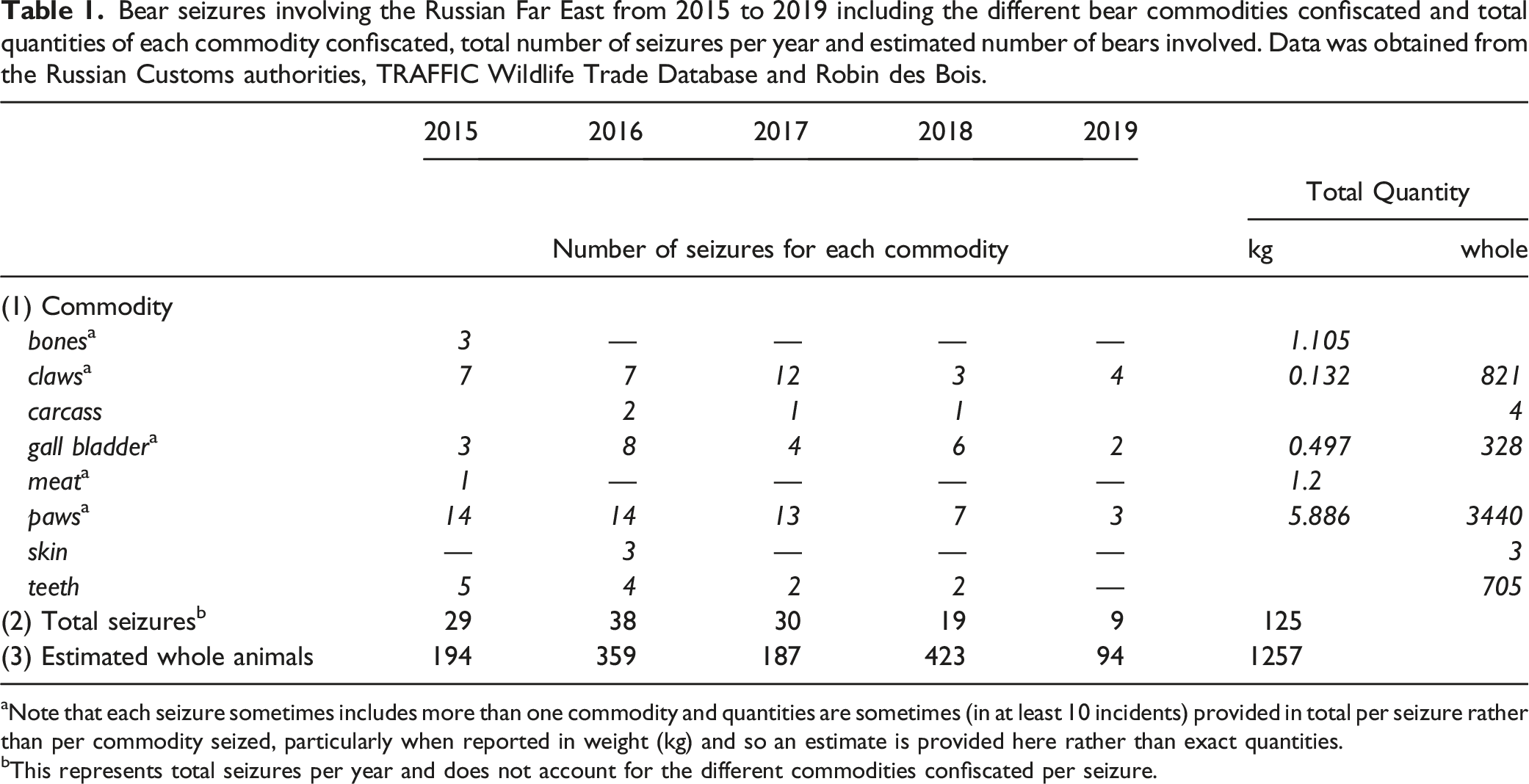
aNote that each seizure sometimes includes more than one commodity and quantities are sometimes (in at least 10 incidents) provided in total per seizure rather than per commodity seized, particularly when reported in weight (kg) and so an estimate is provided here rather than exact quantities.
bThis represents total seizures per year and does not account for the different commodities confiscated per seizure.
Bear paws accounted for the most common and abundant commodity confiscated (51 seizures, totalling 3440 + ∼5.886kg) (Table 1). This was followed by claws (33 seizures, totalling 821 + ∼0.132kg), gall bladders (23 seizures, totalling 328 + ∼0.497kg) and teeth (13 seizures, totalling 705). Bear skins were seized on three separate occasions in 2016 and were all from polar bears.
Seizure locations and trafficking routes
Of the 116 seizure incidents in the Russian Far East, most (38%) occurred in the Amur Province, followed by the territories of Primorsky (24%) and Zabaykalsky (16%), although the latter two locations constituted the greatest quantities of bear parts seized, amounting to an estimated 578 and 207 bears respectively (Figure 1). Of the nine seizures that occurred in China, with Russia as the source country of bear parts seized, six occurred in Inner Mongolia followed by one incident each in provinces of Heilongjiang, Jilin and Xinjiang (Figure 2). International trafficking of bears from Russia was obtained from 112 of the 116 seizure incidents and China was the reported destination in 92% of cases. South Korea was the only other country implicated, in nine incidents (Figure 2). The number of bear seizures in the Russian Far East by main region/province/territories from 2015 to 2019 and estimated number of bears involved based on commodities seized. Not included in the map are a further four seizures that occurred in China with origins from Russia. Reported international trade routes of bear products from the Russian Far East extracted from 112 seizures that occurred in Russia and China from 2015 to 2019.

CITES Trade Data
Russian export of bears, their parts and derivatives including commodities and importer and exporter reported quantities from 2015 to 2019 which has been extracted from the CITES Trade Database.

Note: IRQ = importer reported quantities; ERQ = exporter reported quantities.
Top 15 importing countries of bears and parts from Russia between 2015 and 2019 based on trade data extracted from the CITES Trade Database.

IR = importer reported quantities; ER = exporter reported quantities.
Discussion
Russia treats bears as a game resource, permitting the hunting of Asiatic black bears and brown bears within established harvest quotas and allows the trade in bear parts legally hunted (WWF 2020). Despite this, the poaching of Asiatic black bears and brown bears for trophies, traditional medicines and/or consumption still occurs. Bear paws and gall bladders were the main commodities observed in illegal trade, as seen from seizures, and appear to be mostly smuggled from Russia to China and South Korea. This is consistent with the findings of Foley et al. (2011) and Burgess et al. (2014) in their assessment of the bear trade in Asia. While China and South Korea were implicated as primary destinations of illicit gall bladders and paws in this study, Russian sourced bear parts and medicinal derivatives have also been seized in/ smuggled to Australia and New Zealand (Cassey et al. 2021), Czech Republic (Shepherd et al. 2020), Japan (Kumi and Sakamoto, 2002), Malaysia (Lee et al. 2015), Vietnam (Willcox et al. 2016) and Poland (Gomez et al. in prep), indicating the potential global nature of the illegal trade of bear parts from Russia (Figure 3). Of further interest, China is not only a key destination of bear parts in trade but also a key source of bear parts found in trade in Southeast Asia (Foley et al. 2011, WAP 2018). Chestin (1998) also attributed the dramatic increase in gall bladder trade from Russia, among others, to the increased buying power of Southeast Asian consumers. The global nature of the trade of bears originating from Russia encompassing legal trade extracted from the CITES Trade Database (2015-2019) and illegal trade observations based on data from this study and existing literature referenced.
Russia’s role as a source of illegal bear parts in trade in Asian countries has persistently been raised as a conservation concern (Burgess et al. 2014, Chestin 1998, Foley et al. 2011, WAP 2020). According to Burgess et al. (2014), there were at least 59 bear seizures in Russia from 2000 and 2011 estimated to involve 1252 bears. At that time, bear paws were also the main commodity seized involving large quantities, the most significant being a seizure of 1000 bear paws in a single shipment (Burgess et al. 2014). Most incidents occurred along the Russia-China border in the Far East (Burgess et al. 2014). Here, we report a notable rise in seizures (120 seizures) in the Far East but decrease in quantities being seized, i.e., on average 10 bears per incident in comparison to approximately 23 bears per incident for the period 2000-2011. A report by WWF suggests there has been a recent decline in the cross-border trade of wildlife including gall bladders and paws due to stricter customs control (WWF 2020). Other studies suggest that corruption in Russia enables criminal networks to move illicit wildlife goods across the border with ease (Burgess et al. 2014, Chestin 1998, Skidmore 2021, Van Uhm and Moreto 2018, Wyatt 2009). Burgess et al. (2014) indicated that large and organized networks operating in Russia were behind the trade and export of bear parts on a commercial scale. Perhaps larger consignments of illegal bear products are passing through the border unhindered. Presumably, as long as demand for bear gall bladders and paws exists, the illegal trade will persist. In China and South Korea, bear paws and gall bladders are highly valued commodities and consumed due to their perceived health benefits (Mills and Servheen 1991, Feng et al. 2009). In China, while it is illegal to kill and harvest parts from wild bears, a legal bear bile market exists through a well-established bear farming industry (Hinsley et al. 2021, WAP 2020). That said, illegal bear farms do exist in China and wild bears from neighbouring regions are known to be laundered through such facilities (WAP 2020). A consumer preference for wild sourced bear parts (Dutton et al. 2011, Liu et al. 2016) to some extent also drives the continued trafficking of bear parts into China (Livingstone et al. 2018, Nijman et al. 2017, WAP 2020). Similarly, in South Korea, a legal market in the consumption of bear parts exists alongside and an illegal market (WAP 2017). Since 2017, South Korea has sterilized all remaining captive bears in bile-extraction facilities in an effort to phase out the industry (WAP 2020) though evidently this has not dissipated consumer demand.
According to CITES Trade Data, the export of bear trophies from Russia were mostly of brown bears which is not surprising as they are listed in Appendix II of CITES whereby export is permitted with a valid permit. Nevertheless, brown bear trophies are illegally exported from Russia as well. A recent study on the illegal bear trade in the Czech Republic found that Russia was one of the largest exporters of bear trophies to the Czech Republic both legally and illegally (Shepherd et al. 2020). Similar findings were noted in Poland (Gomez et al., in prep). It is unclear why trophies that can be legally exported are instead smuggled out of the country, but this warrants further investigation. Possible reasons include illegal harvest, poaching for commercial trade, invalid/ lack of hunting permits, avoidance of permits fees or import duties as well as ignorance of legal requirements. For example, a hunting license for one brown bear costs 3,000 – 6,000 roubles (∼USD50 – 100) plus tax of 650 roubles (∼USD11). Private hunting reserves fix their own prices that can reach 100,000 –150,000 roubles (∼USD1,675 – 1,760) per bear, depending on the length of hunting period, size of the trophy etc. According to local media, in Khabarovsk Krai, local hunters shun buying licenses for black bears due to the high cost involved, low quality pelt and the fact that black bear meat is locally unpopular. Only 66 black bear licenses were bought in the province in 2018/2020 season and 48 in 2019/2020. A moose Alces alces licence costs half that of a bear and a moose yields a greater quantity of meat of perceived higher quality. Trophy hunting provisions are also often exploited by poachers and traders to launder products of threatened species (e.g., rhino horns, lion bones, elephant ivory) for commercial trade (Braden 2014, IFAW 2016). The current legislation in Russia only regulates the actual hunting and transport of killed animals - targeting poachers as they hunt or transport what they killed but fails to effectively address the trade of the products of hunting (WWF 2020). Hunters who have killed a bear legally have the right to sell the products such as meat, paws, pelt, bile, fat, teeth and claws. In order for the sale to be legal, the hunter must have a copy of the license for killing the bear, and also a veterinary-sanitary certificate issued by a certified laboratory that the product (meat, paws) is fit for human consumption. Bear products (teeth, claws, meat and paws) are widely available on Russian Internet platforms. For example, we found over 100 advertisements selling bear parts on one local website, Siberian Hunter, but only three of the advertisements mentioned that the sellers had certificates proving legal provenance of bear parts they were selling and, in case of meat products, veterinary-sanitary paperwork. Skidmore (2021) also revealed how hunting permits in Russia can be purchased for any legal game though there were no checks in place to make sure the permit correlated with the species hunted.
Fraudulent CITES permits are also a problem occurring in some countries and further compromise the conservation efforts in place for many species (Nijman and Shepherd 2015, Outhwaite 2020, Zain 2020), and this includes Russia. In August 2021, the CITES Management Authority of Russia raised concerns regarding invalid export and re-export permits accompanying trophies of various species such as birds and leopards from Russia (refer Notification to the Parties No. 2021/053: https://cites.org/sites/default/files/notifications/E-Notfi-2021-053.pdf).
Implications for Conservation
Bears face a multitude of threats not the least of which is poaching for the illegal wildlife trade (Burgess et al. 2014, Dharaiya et al., 2020, Garshelis and Steinmetz 2016, Gomez et al. 2020, Livingstone et al. 2018, Scotson et al. 2017, Shepherd and Nijman 2007). Trade driven demands have reduced bear populations across Asia, particularly Southeast Asia where demand for wild bear gall bladders, paws and medicinal derivatives in still prevalent (Crudge et al. 2018, Nijman et al. 2017, Scotson 2012, WAP 2018). The Russian Far East remains a stronghold for Asiatic black bears and brown bears with populations reported to be stable if not increasing (WWF 2020). That said, they are a game resource and illegal exploitation persists in most if not all places that permit hunting wildlife for sport e.g., Africa, Canada, Europe, US (Gaius 2018, IFAW 2016). Currently, legal harvest is described as low in Russia and even when combined with illegal take remains below established harvest quotas (WWF 2020), However, recognising the fact that seizures represent a mere fraction of the volumes in illegal trade and that the true scale of illegal trade is hard to determine, we argue caution against such statements. Further, it is plausible that depleted bear populations in Asia could potentially increase poaching levels and lead to local declines in Russia as well.
Regardless, the continued trafficking of bear parts from Russia needs to be addressed as it undermines national legislation and wildlife policies as well as international trade regulations such as CITES. It also undermines enforcement and conservation efforts in Asia to stem illegal trade and consumption for such products. Based on the findings of this study, we recommend continued monitoring and closer investigation of the illegal trade in bear parts and products from the Russian Far East encompassing intelligence led investigations into the trafficking of bear parts beyond Russia’s borders and the networks involved, as well as enhanced communication and strategic collaboration with these countries to counter illegal trade. Further, as Russia permits the hunting of bears which presents a potential opportunity that poachers can exploit to procure bear parts for trade, the industry warrants more stringent regulation, enforcement and monitoring (as recommended in CITES Resolution Conf.17.9 on trade in hunting trophies of species listed in Appendix I and II) to prevent illegal harvest and trafficking of bears. As seizures of bear products from Russia have occurred in other parts of the world as well, further research should be carried out to quantify the overall illegal trade from Russia and in doing so understand better the impact illegal offtake and trade has on wild bear populations in Russia.
Footnotes
Acknowledgements
We thank Professor Lyaputsin Sergey from the Vladivostok branch of the Russian Customs Academy and TRAFFIC International for bear seizure data. We thank Natalia Pervushina for her help in translating the data and Loretta Shepherd for her help in editing this paper.
Author contributions
Conceptualization, Lalita Gomez and Chris R. Shepherd; Formal analysis, Lalita Gomez; Funding acquisition, Chris R. Shepherd; Methodology, Lalita Gomez and Chris R. Shepherd; Writing – original draft, Lalita Gomez; Writing – review & editing, Lalita Gomez, Pavel Toropov and Chris R. Shepherd.
Declaration of Conflicting Interests
The author(s) declared no potential conflicts of interest with respect to the research, authorship, and/or publication of this article.
Funding
The author(s) disclosed receipt of the following financial support for the research, authorship, and/or publication of this article: This work was supported by Hauser Bears and the Riverbanks Zoo.
