



Abstract
Clarifying the relationship between public cognition and satisfaction with meteorological service is an important way to adapt to and mitigate climate change. This article first proposes an innovative concept on public meteorological cognition. Also, based on the survey data from 3,029 questionnaires on public cognition of meteorological disasters in Shenzhen city of China, the relationship among public cognition, perceived value, and meteorological service satisfaction is evaluated using a structural equation model. Research results demonstrate that (a) public cognition can significantly affect service satisfaction. (b) Shenzhen residents are generally satisfied with meteorological service, particularly during the typhoon season. However, the residents are dissatisfied with the availability of information on meteorological disaster warnings. (c) Both public meteorological cognition and perceived value of meteorological service significantly affect public satisfaction. (d) The public meteorological cognition can be improved by increasing the perceived value of meteorological service, which further enhances public satisfaction.
Keywords
Introduction
The rapid climate warming and the frequent occurrence of meteorological disasters have posed a serious challenge to the sustainable development of the world as well as the ecological environment (Intergovernmental Panel on Climate Change, 2013). Meteorological disasters approximately account for 71% of the total economic losses caused by natural disasters (UN Office for Disaster Risk Reduction in Advance of International Day for Disaster Reduction, 2018). And China is one of the countries that experience the most frequent and severest natural disasters. On the other hand, continual meteorological disasters have facilitated the advancement of meteorological service. To increase public satisfaction, the meteorological department in China has been committed to improving meteorological service. Then, what is the public satisfaction with meteorological service? What are the factors that affect public satisfaction with meteorological service? What measures should be taken to enhance public satisfaction effectively? These are important issues for the relevant governmental departments, the meteorological industry, and the public. However, relatively large-scale empirical research and data analysis is rare (Song & Du, 2017; Song, Peng, Wang, & Dong, 2018). To fill this gap, in the present situation and through an empirical study targeted at 3,029 Chinese residential families in Shenzhen city of China, this article intends to analyze the relationship among public cognition, perceived value, and meteorological service satisfaction and to provide reference materials from communities and the public so as to carry out effective environmental disaster management.
Evaluations of satisfaction with products and services have attracted increasing attention in China and around the world because of developments in service industries and of growing public attention to service quality. Cardozo (1965) introduced the concept of customer satisfaction into business services in 1965. As studies on service quality emerged gradually in Western countries, enterprises and public institutions became aware of the significance of service quality and evaluated their service satisfaction. Subsequently, Sweden established the first satisfaction index model named Sweden Customer Satisfaction Barometer (SCSB). Based on SCSB, American Customer Satisfaction Index model, Sweden Index of Customer Satisfaction, and European Customer Satisfaction Index were developed. These models are the existing mainstream satisfaction evaluation models in the world (Wang, Du, Cao, & Liu, 2011). At present, satisfaction evaluation models are widely applied in service industries. For example, Jiangming and Wei (2013) introduced a satisfaction evaluation model into government public service assessment and evaluated the satisfaction with public services in 34 cities of China by combining the model with TOPSIS of entropy weight and cluster analysis. They found that several eastern coastal cities, including Xiamen, Qingdao, Hangzhou, Ningbo, and Dalian, showed the highest satisfaction levels. Besides, Xie and Zhang (2013) evaluated the job satisfaction of new generation employees by a structural equation model (hereafter referred to as SEM) and found that encouraging new generation employees to participate in enterprise supervision, management, and decision-making can improve their participation intention and job satisfaction.
Currently, only a few empirical studies on the meteorological service satisfaction have been published. For illustration, Wang et al. (2011) established an SEM to evaluate public satisfaction with meteorological service. Moreover, Wu, Sun, and Chen (2012) analyzed the effect of meteorological service on Shanghai-Nanjing Expressway by combining the method of willingness-to-pay and SEM. However, existing studies have three limitations. First, they did not establish an SEM to evaluate meteorological service satisfaction. Second, most studies conducted questionnaire surveys to evaluate the satisfaction with meteorological service in inland cities, while few studies mounted a small-scale questionnaire or acquired a small amount of survey data concerning coastal regions where meteorological disasters are more frequent. Third, although the studies on public satisfaction evaluation are abundant in number, few scholars evaluated meteorological service satisfaction and its influencing factors from the perspective of public meteorological cognition.
Public knowledge of meteorological disasters and cognition of meteorological information can affect meteorological service satisfaction significantly. For instance, Getz (1978) reported that most respondents in New Jersey had a lower cognition of agrometeorological information because of the poor publicity and popularization of meteorological service, thereby resulting in the underuse of agrometeorological service in the state. In addition, Lellyett & Anaman (2010) observed that increasing public meteorological cognition and enhancing public self-protection capability could lead to a significant reduction in economic losses and casualties caused by meteorological disasters. Dubé and Menon (2000) divided the service cognition of customers into positive and negative types; positive cognition resulted in positive evaluation and reaction to services, whereas negative cognition resulted in negative evaluation and reaction to services. De Ruyter and Bloemer (1999) stated that positive emotions could contribute to higher customer service satisfaction. Anderson, Pearo, and Widener (2008) discovered a close relationship among customer service cognition, customer characteristics, and service satisfaction. Huang and Xu (2013) demonstrated that differences in personal cognition caused by different educational backgrounds could significantly affect the evaluation of public service satisfaction. Bayard and Jolly (2007) found that the awareness of farmers about environmental protection influenced their behavior and attitude; to be specific, higher cognition compelled farmers to participate in environmental improvement more positively and increased their satisfaction with environmental protection. Lu-jun (2012) conducted an empirical study on the loyalty and satisfaction of tourists based on the cognition-emotion-behavior theory and found that public service cognition had a significant effect on travel satisfaction of tourists; to go into detail, higher service cognition facilitated positive consumption emotion, higher service satisfaction, and loyalty. All research results have confirmed the close relationship among public cognition, public perceived service quality, and satisfaction evaluation. Higher public meteorological cognition is accompanied by more accurate evaluation of meteorological service and meteorological service satisfaction, which are beneficial to proposing specific policy suggestions. China, which has experienced frequent meteorological disasters, is committed to the development of technologies and methods for the defense, monitoring, and emergency management of meteorological disasters. Therefore, an innovative concept of public meteorological cognition is proposed in this article. Based on the survey data from 3,029 questionnaires on public cognition of meteorological security in Shenzhen, a quantitative analysis on the relationship among public meteorological cognition, perceived value, and meteorological service satisfaction will be conducted using SEM. This analysis hopes to provide substantial evidence for relevant theoretical research on meteorological disasters and operation services.
Method
Structural Equation Model
The SEM, known as covariance structural analysis model and linear structural relationship model, is an emerging statistical approach and research idea. SEM is a branch of applied statistics that has developed most rapidly over the past three decades. The model can search the intrinsic structural relationship among variables to verify the rationality of the structural relationship or model hypothesis. The model was suitable in this article because it can depict the characteristics of latent variables and their relationship with observational variables. Therefore, SEM is also known as a latent variable analysis model (Hou, Wen, Chen, & Zhang, 2004).
Compared with traditional regression analysis, SEM has the following advantages. (a) Multiple dependent variables can be simultaneously considered and processed in structural equation analysis. (b) Measurement errors are allowed in the independent and dependent variables. (c) Factor structure and factor relationship can be evaluated simultaneously. (d) A measurement model with greater elasticity is allowed. (e) The fitting degree of the whole model can be estimated (Hou et al., 2004). This article aims to investigate the relationship between multiple dependent and independent variables. Therefore, given the measurement errors existing in the data of each independent variable obtained by sampling survey, SEM model was suitable for the study.
SEM mainly studies two types of variables: observational and latent ones. SEM also involves exogenous and endogenous variables. The two SEM models here were measurement-related (a model between observational and latent variables) and structure-related (a model of latent variables).
The exogenous latent variables of SEM were represented by

SEM involved some basic hypotheses, such as (a)
Based on previous research results and practical characteristics of this study, a model of influencing factors of meteorological service was proposed in this article. The present model involved three latent variables, namely, public meteorological cognition, public perceived value of meteorological service (hereafter referred to as perceived value), and public satisfaction with meteorological service (hereafter referred to as satisfaction). Figure 1 presents the SEM framework.

A framework of the SEM.
Variables and Hypotheses
In this article, public meteorological cognition and perceived value were selected as two influencing factors of satisfaction to establish the corresponding SEM. Each latent variable was measured through several observational variables (Table 1).
Settings of Latent Variables and Observational Variables.

Satisfaction is the meteorological department’s ultimate service goal. The quality of meteorological service is determined via public evaluation and testing. The used questionnaire focused on six common meteorological disasters in Shenzhen (typhoon, storm, thunderstorm, heavy fog, high temperature, and cold wave), and their satisfaction scores were used as the observational variables of satisfaction in the model (Alam et al., 2018).
Public meteorological cognition
In a broad sense, satisfaction is determined by the quality of meteorological service and other factors. The receivers of meteorological service have different cognitions of the meteorological service due to their different backgrounds, which directly affect their satisfaction evaluations (Rahman, Islam, Khan, & Touhiduzzaman, 2018). Therefore, this article proposed the concept of an innovative latent variable public meteorological cognition.
According to cognitive psychology, public meteorological cognition depends on associated memories of meteorological disasters and services, including publicity of meteorological department, as well as paraphrasing and personal experiences of friends. These preconceived unique opinions and attitudes are known as public meteorological cognition. The cognitive competence of the public affects perception and behavior to a large extent. For example, Xu, Zhou, and Yu (2010) systematically analyzed the public cognition of seismic disasters in Nanzhen, Shanxi Province, and found that the public had an increased cognition of seismic disasters. Higher attention to disaster warning services provides the public with better self-protection skills and higher rationality to avoid disaster risks. Shan (2009) studied the effect of the new health policy of Shenzhen and found a significant impact of public medical cognition on public satisfaction with medical service. Based on the study of brand cognition, Li (2011) found that the cognitive competence of consumers could influence the perceived quality significantly, and that higher perceived quality led to higher perceived value, higher satisfaction with commodities, and greater purchase intention. These studies demonstrate the significant effect of public cognition on satisfaction evaluation.
Similarly, public meteorological cognition can significantly affect satisfaction. The satisfaction evaluation mainly involves two aspects: quality of meteorological service and public benefits (or losses) from meteorological service. These aspects are affected by different extents of public meteorological cognition. Public meteorological cognition includes attention, common meteorological knowledge, disaster risk perception, and self-protection. From the perspective of service quality, given the higher public meteorological cognition, the public is more aware of the necessity and importance of meteorological service and evaluates the service more objectively and reasonably. From the perspective of benefits, higher public meteorological cognition is equal to higher self-protection capability of the public. Losses caused by meteorological disasters are mainly determined by risk awareness and defensive measures of the public rather than the severity of disasters. Barnes, Gruntfest, Hayden, Schultz, and Benight (2007) pointed out that improvement in public meteorological cognition could significantly increase the efficiency and accuracy of defensive measures. Prevention and reduction of casualty losses can increase public satisfaction, which is the meteorological service’s ultimate goal. As a result, this article proposed an innovative variable, public meteorological cognition, and analyzed its significant effect on satisfaction through data.
2. Perceived value
Satisfaction depends on the meteorological cognition and the perceived value of the public. Public cognition of the risks of meteorological disasters, the significance of meteorological warning service, and the necessity of self-protection influence the public’s perceived value and satisfaction (Silva Rodríguez de San Miguel, 2018).
The public perceived value refers to an essential perception that the public generates after accepting and using the meteorological service (Taylor & Kumar, 2016). The practices of AT & T and Xerox confirm that the higher perceived value of customers has a significant role in their success. Reichheld and Sasser (1990) pointed out that improvement in the perceived value of customers on service quality could increase customer satisfaction, reduce customer defection, and increase business profits. Besides, Call (2009) declared that prompt and accurate meteorological disaster warnings were the major meteorological service provided by meteorological agencies to the public. In the present model, public perceived value included convenient access, promptness, and accuracy of meteorological warnings.
Based on the interpretations of SEM variables and their specific practical meanings, this article proposed the following hypotheses: H1: “Public meteorological cognition” significantly affects “satisfaction.” H2: “Public meteorological cognition” significantly affects “perceived value.” H3: “Perceived value” significantly affects “satisfaction.”
Samples and Data
Shenzhen is located on the east coast of the Pearl River Delta and is under the jurisdiction of Guangdong Province. At the end of 2017, Shenzhen has a total area of 1,997 km2 and a permanent population of 12,528.3 thousand. Shenzhen city has 11 regions, including Futian (with an area of 78.66 km2 and a permanent population of 1,561.2 thousand), Luohu (with an area of 78.75 km2 and a permanent population of 102.72 thousand), Nanshan (with an area of 187.53 km2 and a permanent population of 1,424.6 thousand), Yantian (with an area of 74.99 km2 and a permanent population of 237.2 thousand), Baoan (with an area of 396.61 km2 and a permanent population of 3,149 thousand), Longgang (with an area of 388.22 km2 and a permanent population of 2,278.9 thousand), Longhua(with an area of 175.58 km2 and a permanent population of 1,603.7 thousand), New Guangming (with an area of 155.44 km2 and a permanent population of 596.8 thousand), Pingshan (with an area of 166.31 km2 and a permanent population of 428 thousand), New Dapeng districts (with an area of 295.38 km2 and a permanent population of 146.1 thousand), and Shenshan Special Cooperation Zone (with a permanent population of 75.7 thousand). Figure 2 shows the location of Shenzhen city in China.

Location of Shenzhen city in China.
Shenzhen enjoys a subtropical oceanic climate but is frequently hit by meteorological disasters, such as storm, typhoon, thunderstorm, high temperature, cold wave, heavy fog, dust-haze, drought, and hail. Due to the complex climatic conditions and frequent occurrence of meteorological disasters there, Meteorological Bureau of Shenzhen Municipality has attached great importance to public meteorological service.
Shenzhen was chosen as the research object for two reasons. First, most meteorological bureaus at the provincial, municipal, and county level in China are under the vertical management of China Meteorological Administration. However, Meteorological Bureau of Shenzhen Municipality, as an exception, is directly managed by the local government, namely, the Shenzhen Municipal People’s Government. Subsequently, Meteorological Bureau of Shenzhen Municipality has laid more emphasis on providing high-quality meteorological service to the local citizens. There is no doubt that since the 1990s, Meteorological Bureau of Shenzhen Municipality, serving as an example, has outperformed other meteorological bureaus in terms of the service quality and content. Therefore, its management system and service level have led to a higher level of local meteorological service in China. This is one of the reasons why the meteorological service of Shenzhen was selected.
Second, Meteorological Bureau of Shenzhen Municipality provided abundant research data. To obtain a comprehensive understanding on public meteorological cognition, public satisfaction, and shortcomings of existing meteorological service, Shenzhen Meteorological Bureau conducted an “Investigation and Evaluation of Public Meteorological Cognition in Shenzhen” at the end of September 2012. The investigation covered 57 streets and 10 districts of Shenzhen City. In specific districts, the respondents received face-to-face interviews, read and recorded by investigators. A total of 3,109 questionnaires were sent. Collected survey data were processed using SPSS 25 and AMOS 25. Abnormal data were deleted and default values were corrected. Finally, 3,029 valid samples were collected, accounting for 97.42% of the sent questionnaires.
This investigation covered the entire Shenzhen City, including Futian, Luohu, Nanshan, Yantian, Baoan, Longgang, Longhua, New Guangming, Pingshan, and New Dapeng districts. These areas provided good representativeness because of the abundant and large-scale survey samples.
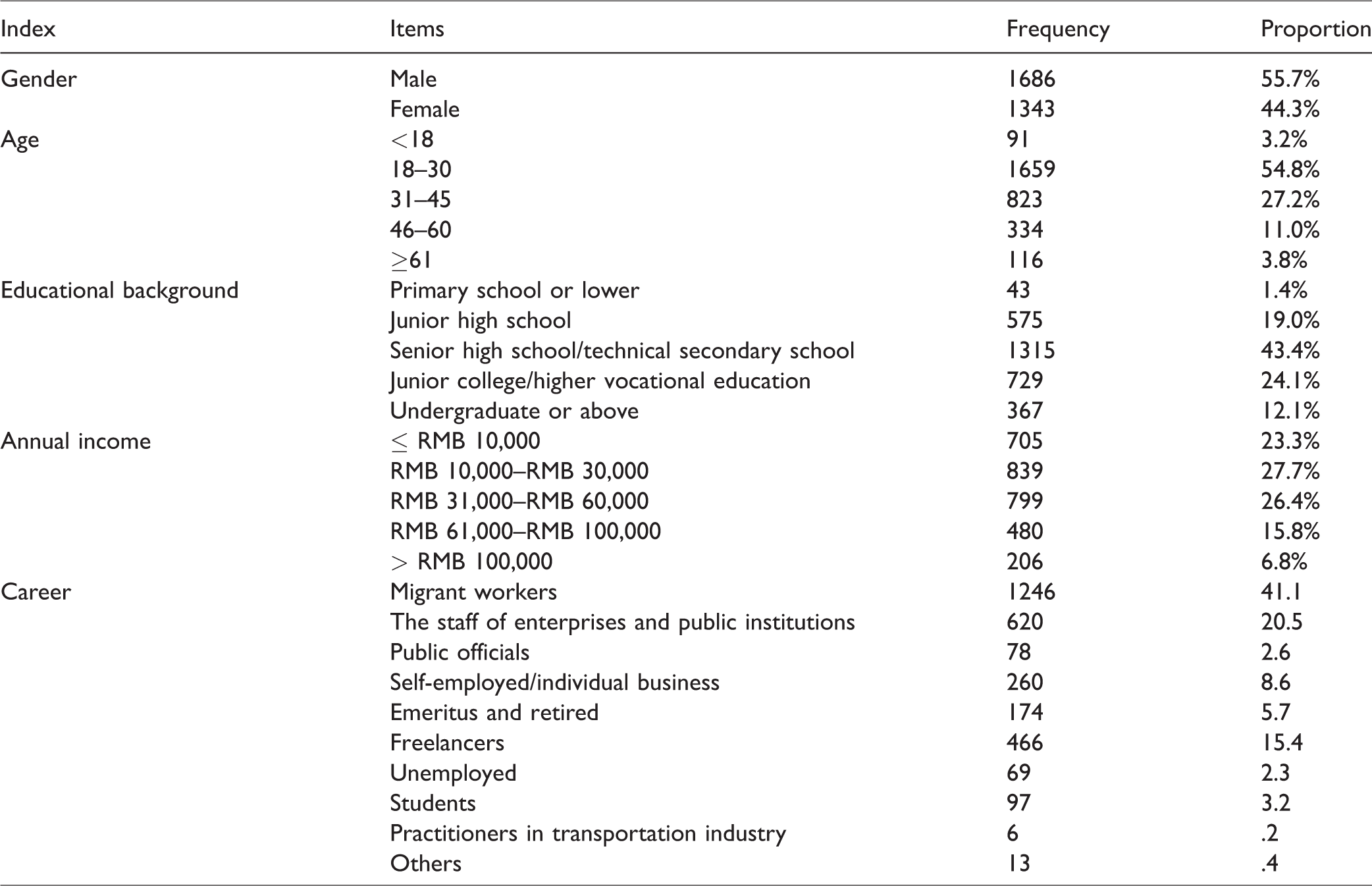
Descriptive statistics on the background information of respondents are provided in Table 2. Judging from Table 2, samples in this questionnaire survey: (a) showed an almost balanced gender distribution (55.7% male and 44.3% female); (b) had a large proportion of the young and the middle-aged (18–45 years old), who could quickly respond to meteorological disasters, represented the major group of self-rescue and rescue work, and played essential roles in disaster prevention and reduction; (c) indicated higher meteorological cognition, because 98.6% of the respondents had an educational background of above primary school; (d) represented all income groups, with 6.8% of the respondents as high-income groups and 93.2% as low-income and middle-income groups, which was consistent with the actual situation; (e) exhibited consistent population distribution characteristics of Shenzhen. This questionnaire involved a large proportion of migrant workers (41.1%), which was in agreement with the frequent mobility of talents in Shenzhen because of its rapid economic development. In sum, this questionnaire survey covered all social classes via mass sample data, thereby representing the real public evaluation of and demand for meteorological service.
Description of the Background Information of Respondents.
In the questionnaire survey, 14 indices and three latent variables were evaluated using the popular 5-point Likert-type scale. A scale of 5 represented great satisfaction, 4 represented satisfaction, 3 represented normal, 2 represented dissatisfaction, and 1 represented strong dissatisfaction. All of the responses to other questions were converted to a 5-point Likert-type scale.
The mean value and standard deviation of observational variables in SEM are listed in Table 3.
Mean and Standard Deviation of Observational Variables.
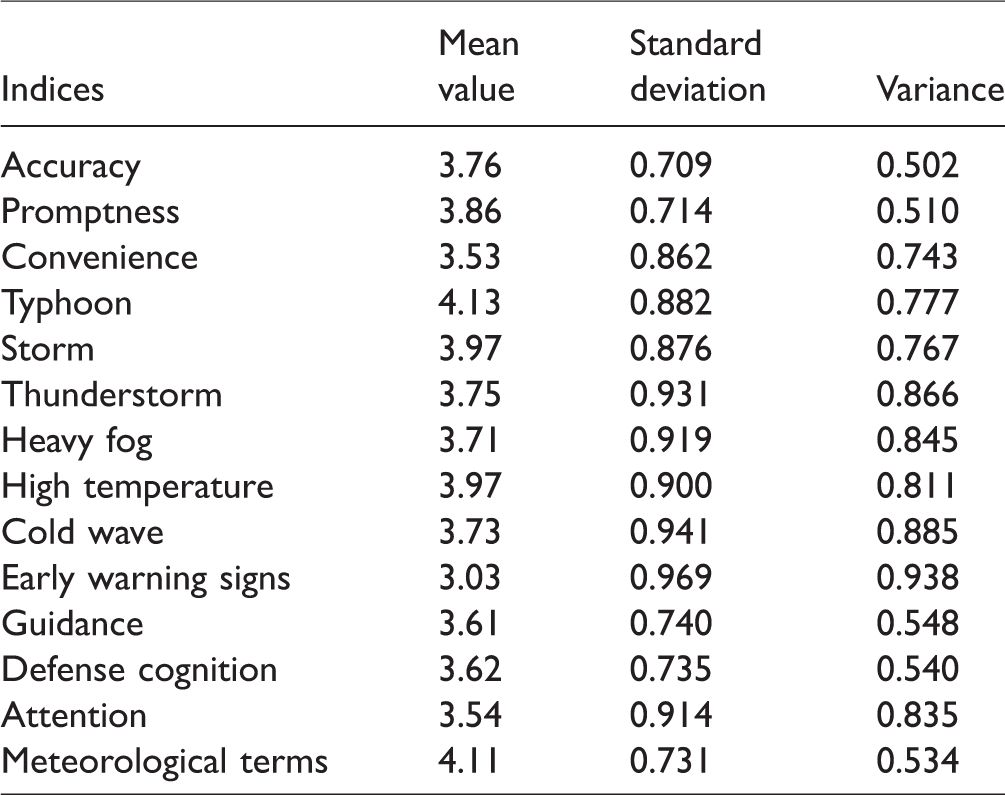
As could be seen from Table 3, public satisfaction with the promptness of disaster warning reached as high as 3.86, indicating that the public had adequate time to adopt preventive measures against meteorological disasters to reduce unnecessary losses and casualties. Public satisfaction with the accuracy of disaster forecast reached 3.76. This result was related to the significant improvement in early-warning techniques against meteorological disasters as China has focused substantial attention and investment on public meteorological service. However, the public was not satisfied with the convenience in accessing the meteorological disaster warning information because meteorological disasters (e.g., typhoon, storm, and thunderstorm) caused electricity and communication service outages. The early warnings against meteorological disasters became inaccessible to citizens in remote regions and in regions that experienced power and communication outages since these early warnings were mainly released through Television broadcast, the Internet, newspaper, telephone, and short messaging service (SMS) in China.
From the perspective of public meteorological cognition, the public could understand meteorological terms. This view was closely related to the popularization of weather forecast in China. However, the public was less aware of early warnings against meteorological disasters. They were unaware of the severity of disasters based on the blue, yellow, orange, and red alarms. The public also had limited knowledge of defense skills. However, the public gradually became aware of the importance of defensive measures because of frequent meteorological disasters. Most people believed that the knowledge of defensive measures against meteorological disasters could provide self-protection guidance during disasters, thereby significantly decreasing the casualties and economic losses. Currently, the Republic in China still lacked knowledge of specific defensive measures to protect themselves against disasters.
According to the satisfaction evaluation during disasters, the public was highly satisfied with meteorological service during typhoons, relatively satisfied with the service during storms and high temperatures, but strongly dissatisfied with the service during heavy fogs, thunderstorms, and cold waves. This finding resulted from the frequent occurrence of typhoons and the deep impression of typhoons on Shenzhen citizens, which implied that public cognition might affect the satisfaction evaluation of the public.
Reliability and Validity Tests of the Questionnaire
The reliability and validity of samples were tested before the exploratory factor analysis using SPSS and AMOS. Reliability refers to the stability and consistency of the questionnaire results when the same objects are investigated using the same method and indicates whether the measuring tool (questionnaire or scale) can contribute a stable measurement to the test objects or variables. This study used Cronbach’s alpha to test the reliability of the questionnaire. Observational variables with Cronbach’s α < .35 were deleted. The data reliability test results are listed in Table 4. Cronbach’s α for public meteorological cognition, perceived value, and satisfaction value were .579, .635, and .908, respectively (all variables were within the acceptable range). Moreover, the Cronbach’s α of the total scale reached .859, indicating the higher stability and reliability of the selected variables, as well as higher data reliability. The reliability and validity results are shown in Table 4.
Reliability Test.

Validity refers to the measurement accuracy of the measuring tools or means. The SPSS results are listed in Table 5. The Kaiser-Meyer-Olkin (KMO) test result was 0.903. The approximate chi-square value of Bartlett test of sphericity was 16,893.659 and the degree of freedom was 91, passing the significance test. This result demonstrated the existence of potential factor structure among variables, which was appropriate for factor analysis. Table 5 indicates the validity test result.
Validity Test.

Note. KMO = Kaiser-Meyer-Olkin.
Results
Like other statistical models, SEM also required overall test and evaluation after the parameter estimation. For the comprehensive evaluation of the goodness-of-fit of a model, the evaluation of model fitness also involved the fit indices of the model except the significance of estimated parameters. Table 6 suggests the results.
Fit Indices of Model.

Note. RMR = root mean residual; GFI = goodness of fit; AGFI = adjusted goodness of fit; NFI = normed fit index; CFI = comparative fit index; RFI = relative fit index; IFI = incremental fit index; PGFI = parsimony goodness of fit index; CN = critical N; AIC = Akaike’s information criterion; CAIC = consistent Akaike’s information criterion.
These goodness-of-fit indices demonstrated the preferable goodness-of-fit of the established SEM that had considerable practical significance to evaluate satisfaction and its influencing factors. The path coefficients are shown in Figure 3.

Results of the SEM.
In this article, the SEM was tested mainly through absolute fit index, relative fit index, and parsimony fit index and found good fit indices for the model. In the parsimony fit index,
The three hypotheses were all confirmed valid. First, the path coefficient of “public meteorological cognition-satisfaction” was 0.11, with a CR of 2.74 and p smaller than .01. This result indicated the significant positive effect of public meteorological cognition on satisfaction. Generally, higher public meteorological cognition led to better public understanding about the importance of meteorological disaster forecast service and higher satisfaction.
Second, the path coefficient of “public meteorological cognition-perceived value” was 0.69, with a CR of 10.587 and p smaller than .01. This result indicated the significant impact of public meteorological cognition on the perceived value.
Third, the path coefficient of “perceived value-satisfaction” was 0.66, with a CR of 12.716 and p smaller than .01. This result indicated that satisfaction was greater when the perceived value was higher.
Fourth, “public meteorological cognition” affected the “satisfaction” through “perceived value.” Higher public meteorological cognition implied that the public understudied the necessity and significance of meteorological service and presented higher perceived value during the objective evaluation, thereby increasing the satisfaction correspondingly.
Discussion
Meteorological service plays an important role in the prevention and reduction of losses and casualties because of natural disasters that occur in China. Apart from the efforts of the meteorological department, disaster prevention and reduction also require public support and assistance (Meng & Xiong, 2018; Wu, Xu, Liu, Guo, & Zhou, 2019). Therefore, this article has proposed an innovative concept called public meteorological cognition. Public meteorological cognition has been tested by public cognition of early warnings, meteorological terms, defense security knowledge and guidance of defense knowledge in daily life, as well as by public attention to meteorological information.
Based on a questionnaire survey, SEM involving three latent variables and 14 observational variables has been established for the influencing factor analysis of public satisfaction with meteorological service. Data analysis using SPSS 25 and AMOS 25 has indicated that the observational variables in the measurement model significantly affect the latent variables, suggesting the higher target reliability of the measurement model. Path coefficients between latent variables in the structural model support the hypotheses, demonstrating the good overall degree of fit of the model. The model evaluation has confirmed the validity of hypotheses and tests, indicating the good evaluation effect of the SEM.
According to the established SEM, the following conclusions can be made:
Public meteorological cognition significantly affects satisfaction. Higher public meteorological cognition implies higher attention and sensitivity to meteorological early warning service, which ensures sufficient time and energy to avoid disaster risks. Therefore, to highlight the significance of meteorological service and increase meteorological service benefit, we suggest that the meteorological department should reinforce management, optimize service, and enhance public cognition of meteorological knowledge and disaster risks. Public meteorological cognition positively affects the perceived value. Public meteorological cognition includes defense skills against disasters. Good defense skills enable the public to take appropriate self-protection measures calmly during disasters to significantly decrease casualties as well as economic losses. During the sudden onset of disasters, prompt and accurate early warning and good defensive skills may contribute to higher perceived value and objective evaluation of the meteorological service. Higher public meteorological cognition favors the increasing efficiency of meteorological service in China (Mi et al., 2016, 2019). The path coefficient of “perceived value-satisfaction” is 0.66, which indicates a proportional relationship between perceived value and satisfaction. Therefore, the meteorological department should improve its service continuously to increase public satisfaction. For example, electronic screens should be used to provide more humanized and easy-to-understand meteorological information.
Further research could be conducted from the following aspects:
From the perspective of data resources, large data technology and methods could be used in the future to accurately define the public’s demand and correspondingly provide excellent meteorological service. The development of communication technology and social media has facilitated the increasingly high accessibility to data. In addition to the traditional survey data mentioned in this article, considerable information on public demand for meteorological service could also be collected by virtue of online social media including video image information, WeChat and Weibo. These multi-source heterogeneous data are typical “big data.” If such data could be obtained and processed using data mining, semantic analysis, statistical correlation analysis, and other methods, the precise demands of the public from differed regions and income groups for meteorological service under various climate conditions will be gained. This could make valuable contributions to the improved service content and mode to be provided by meteorological departments. In terms of the analysis method, this article mainly employed the SEM model to quantitatively analyze the relationship between multiple variables. Besides, the association rules mining method could also be used to investigate the difference existing in the demands of people with differed backgrounds for meteorological service; the neural network method be adopted to study the correlation between attribute variables (input variables) and assessment variables (output indicators) among multiple groups; and the spatial econometric model be employed to evaluate the correlation effect and spillover effect among the demands of people from different regions in Shenzhen. Undoubtedly, differential research methods can contribute greatly to the mining of more information from various aspects, thereby better facilitating the decision-making.
Implications for Conservation
The following are suggestions for meteorological service improvement:
The research conclusion showed that improving the public awareness of disaster meteorological service is an immediate priority for meteorological departments. Our previous studies revealed that the public knew little about the hazards of disastrous weather and the importance of meteorological service, which is a vital cause of casualties and property losses. However, on the basis of the public’s enhanced meteorological awareness, losses could only be avoided as a result of their further understanding of the scientific laws of meteorological disasters. A case in point is the forest fire that broke out at 17:00 on March 30, 2019 in Muli county, Liangshan Yi autonomous prefecture, Sichuan province. Thirty firefighters died in total. One of the reasons for the tragedy is the insufficient knowledge regarding the development rules and the harmfulness of fire under complex meteorological conditions. Therefore, both the public and the professionals including firefighters are in dire need of heightening their awareness concerning disasters. Enhance cooperation with broadcast, communication, urban construction, and important Web portals (Schattel & Bunge, 2008) to deliver disaster warnings and important weather information to the public on time. Electronic billboards located in major urban areas are also excellent platforms for free and prompt meteorological warnings. Overcome existing technical and system bottlenecks in meteorological warning release and establish effective platforms to deliver warnings to the public in the coastal, remote, rural, as well as pasture areas (Sun, Wang, & Li, 2018). To provide better service to the public, as well as to minimize disaster losses, the meteorological department should continue to cooperate with units concerned, provide full access to primary-level organizations and media, enhance accessibility of weather forecast and early warning information, and ensure that information reaches the whole country (Guo, Jin, Tang, & Wu, 2019).
Footnotes
Declaration of Conflicting Interests
The author(s) declared no potential conflicts of interest with respect to the research, authorship, and/or publication of this article.
Funding
The author(s) disclosed receipt of the following financial support for the research, authorship, and/or publication of this article: This research was supported by National Social and Scientific Fund Program (18ZDA052, 17BGL142), the Natural Science Foundation of China (91546117, 71373131), and the Ministry of Education Scientific Research Foundation for the returned overseas students (No. 2013–693, Ji Guo).