




Abstract
The island of Borneo suffers from one of the highest deforestation rates in the world, primarily due to agriculture, logging, and other human activities. This habitat loss may be partly mitigated by reforestation programs in degraded landscapes, especially anthropogenic grasslands that have little conservation or economic value. By monitoring native bird communities, we evaluated the success of two small (<20 ha) community reforestation projects in Gunung Palung National Park in Indonesian Borneo. Birds responded rapidly following reforestation, with species richness doubling over 7 years at one site, and increasing by 29% in just 3 years at the other. Final tallies (63–70 species per site) were comparable to those obtained in older secondary forests elsewhere in Borneo. Anthropogenic fire is the primary threat to reforestation success, but intensive fire prevention allows bird communities to recover from temporary setbacks. Absence of fire was thus the most important factor in recovery, and we detected no effect of replanted area on bird species richness. Our results suggest that by engaging local communities and ensuring long-term maintenance, even small reforestation sites in Borneo can provide immediate benefits for native biodiversity.
Keywords
Introduction
The island of Borneo suffers from some of the world's highest deforestation rates (Damayanti & Prasetyo, 2015; Margono, Potapov, Turubanova, Stolle, & Hansen, 2014), imperiling its thousands of endemic species and ranking it among the world's biodiversity hotspots (Corlett, 2014; Myers, Mittermeier, Mittermeier, da Fonseca, & Kent, 2000). Over half the island's forests have been converted to other land uses, including oil palm plantations and croplands (Fitzherbert et al., 2008; Zamzani, Onda, Yoshino, & Masuda, 2009), and forest loss is rampant even within protected areas (Curran et al., 2004; Margono et al., 2014). The long-term survival of Borneo's biodiversity thus depends on reforestation as a supplement to the creation of protected areas (Chazdon, 2008; International Tropical Timber Organization [ITTO], 1990; Kettle et al., 2011; Normile, 2009).
Much of Borneo's land area is potentially available for reforestation. Following widespread forest clearing and subsequent wildfires, hundreds of thousands of square kilometers of the island have become dominated by alang-alang (Imperata cylindrica) grassland (Garrity et al., 1997; ITTO, 1990; Kuusipalo et al., 1995). These areas have little value for native species and are unused economically (Garrity et al., 1997; Kuusipalo et al., 1995; Ohta, 1990), but if protected from fire can revert to natural forest (Yassir, van der Kamp, & Buurman, 2010). They thereby offer substantial reforestation opportunities with few costs to local communities. Tropical reforestation projects, however, may not replicate natural conditions or may fail altogether (Chazdon, 2008; Wuethrich, 2007). Our knowledge of Bornean reforestation progress, and how it benefits native species, remains especially limited (Kettle et al., 2011).
Here, we evaluate two community reforestation projects in Gunung Palung National Park in Indonesian Borneo. The park is a 108,000-ha protected area in West Kalimantan, consisting mostly of lowland dipterocarp rainforest (∼3,000 mm annual precipitation). The buffer zones around the park have lost nearly all their forest cover, and at least 10% of the park itself has been deforested due to illegal logging and conversion to agriculture (Curran et al., 2004; Zamzani et al., 2009). Open lands continue to encroach into the park, aided by frequent wildfires. In partnership with the park administration, the conservation and human health NGO Yayasan Alam Sehat Lestari (ASRI) has worked with local communities to reforest two areas on the park border (Pohnan, Ompusunggu, & Webb, 2015). We evaluate the success of those efforts using bird communities as indicators of restoration progress. Borneo is home to over 400 bird species, many of which play vital roles in ecological processes like seed dispersal, and their diversity is a useful indicator of forest quality (Edwards, Ansell, Ahmad, Nilus, & Hamer, 2009; Lambert & Collar, 2002; Maas et al., 2016). Bird species respond predictably to disturbance and vegetation structure (Lack, 1933), and their species richness increases as degraded areas are restored to natural vegetation (Edwards et al., 2009; Pei et al., 2018). Moreover, the small size of the reforestation sites (<20 ha) allows us to investigate impacts at a scale relevant to the conservation capacity of local communities and nonprofit organizations. Our results highlight the conservation value of secondary rainforest (Chazdon et al., 2009; Takano et al., 2014) and suggest that even small reforestation projects can provide rapid benefits for Borneo's native biodiversity.
Methods
Reforestation Sites
We monitored bird communities at two reforestation sites within Gunung Palung National Park (Figure 1(a)). The first site (1°22′15′′S, 110°13′31′′E, elevation 27 m) is a 23-ha area near the village of Laman Satong that was clearcut in the 1990s (Figure 1(b)). It lies on the park border, surrounded by selectively logged forest within the park and a road and agricultural land outside. After clearcutting, repeated wildfires destroyed the soil seed bank and remaining woody vegetation. By 2009, it was dominated by alang-alang grass and bracken ferns (Pteridium aquilinum), fire-tolerant natives that colonize disturbed areas and slow forest succession (Kuusipalo et al., 1995; Yassir et al., 2010). The land was then targeted for reforestation by ASRI and the national park. Each year from 2009 to 2015, at the beginning of the wet season from November to December, 2 to 7.5 ha were planted with a mix of ∼30 native tree species at a density of 1,300 to 4,000 seedlings per hectare. Seeds and seedlings were collected from forests in the national park or from community-owned forests, or from local citizens in exchange for health care subsidies at ASRI's private clinic. Replanted areas were weeded 3 to 4 times per year until seedlings were tall enough to overtop competing grass and ferns, and firebreaks were constructed to protect the site from fire. Site preparation, planting, and maintenance were conducted by over 400 local employees and community members, sometimes through outreach events aimed at informing communities about forest loss (Pohnan et al., 2015). The replanted area reached a peak of 19.8 ha (out of the 23 ha available) before being burned by a wildfire in 2013, leaving only 0.9 unburned hectares that had been planted in 2009. Planting efforts continued, with intensified fire prevention, and by 2015, the replanted area had recovered to 8.2 ha.
(a) Our reforestation sites were in Gunung Palung National Park in West Kalimantan, Indonesia. (b) Aerial view of Laman Satong in 2009 before planting and (c) the same for Sedahan Jaya in 2012.
The second site (1°13′7.26′′S, 110°2′2.00′′E, elevation 15 m), ∼27 km away from the first and near the village of Sedahan Jaya, is a 6.5-ha freshwater swamp and peat forest (Figure 1(c)). It is surrounded by a mixture of rice paddies, fallow farmland, slash-and-burn gardens dominated by bananas and fruit trees, and selectively logged forest within the park. The site was cleared by farmers in 2010 for conversion to rice paddies. Parts of it were burned and farmed for 1 year, but then abandoned and left fallow. The soil seed bank was still partly intact in some areas and natural secondary succession began immediately, driven primarily by fast-growing Macaranga species. Other areas remained dominated by bracken ferns. ASRI and the national park then targeted the site for reforestation as part of a dispersal corridor for Bornean orangutans (Pongo pygmaeus). In 2013, they planted the understory of all 6.5 ha using a mix of ∼20 species at a density of ∼1,000 seedlings per hectare, followed by targeted enrichment plantings in 2014. Labor and maintenance were conducted by several dozen local employees and community members.
Bird Surveys
We surveyed bird species at the Laman Satong site in 2011, 2012, 2013, 2014, and 2016. We also conducted a preliminary survey just before planting began in 2009. For the preliminary survey, we conducted point counts of 3 minutes each at 10 randomly selected locations in the reforestation area between 0510 and 0630. We identified and counted all birds seen or heard within a 40 × 40 meter square centered on the point, thereby covering four reforestation treatment plots (each of 20 × 20 m). We surveyed each point once per day for 10 days between 30 October and November 11, for a total of 100 point surveys, all conducted by the same individual. All 100 point counts were compiled to produce a species list for 2009. For subsequent surveys, we monitored the entire reforestation site for ∼8 hours per day for 5 days during the first half of November, between 0600 and 1800, noting any birds seen or heard within the property, and recording unidentified calls using a Sony hand recorder or PCM-D50 linear recorder. Recorded calls were later identified to species using audio references (Niklasson, 2013; Scharringa, 2005; selected recordings from the Cornell Lab of Ornithology). Field guides were used for visual identifications (Meyers, 2009; Phillips & Phillips, 2009; Shi, 2012).
We first surveyed the Sedahan Jaya site in early November 2013, seven months after completing planting, then again in 2014 and 2016, using the same methods as the later Laman Satong surveys.
Data Analysis
Because the 2009 preliminary survey at Laman Satong differed in methods (timed point counts vs. comprehensive surveys with audio recordings), we excluded it from year-to-year comparisons. We did, however, include it in the total species list. To better categorize the bird communities, for each species, we also determined its feeding guild (13 guilds adapted from Edwards et al., 2009; Lambert, 1992) and conservation status (International Union for Conservation of Nature [IUCN], 2017). Finally, we tested for relationships between species richness and reforested area and site age using ordinary least squares regression. Variables were tested for normality using the Shapiro–Wilk test. Analysis was done in R (R Core Team, 2012). This work complied with the laws of the countries in which it was performed.
Results
Birds Observed at Two Reforestation Sites in Gunung Palung National Park, West Kalimantan, Indonesian Borneo.

Feeding guilds: AeI = aerial insectivore; ArF = arboreal frugivore; ArI = arboreal gleaning insectivore; ArIF = arboreal gleaning insectivore/frugivore; BSI = bark-searching insectivore; NI = nectarivore/insectivore; NIF = nectarivore/insectivore/frugivore; P = piscivore; R = raptor; SGI = sallying gleaning insectivore; SI = sallying insectivore; TF = terrestrial frugivore; TI = terrestrial insectivore.

Vegetation recovery at Laman Satong. (a) Before planting, the site was dominated by fire-tolerant grasses and ferns that impeded forest succession. (b) After several years of planting and fire prevention, unburnt areas were covered in young secondary forest.
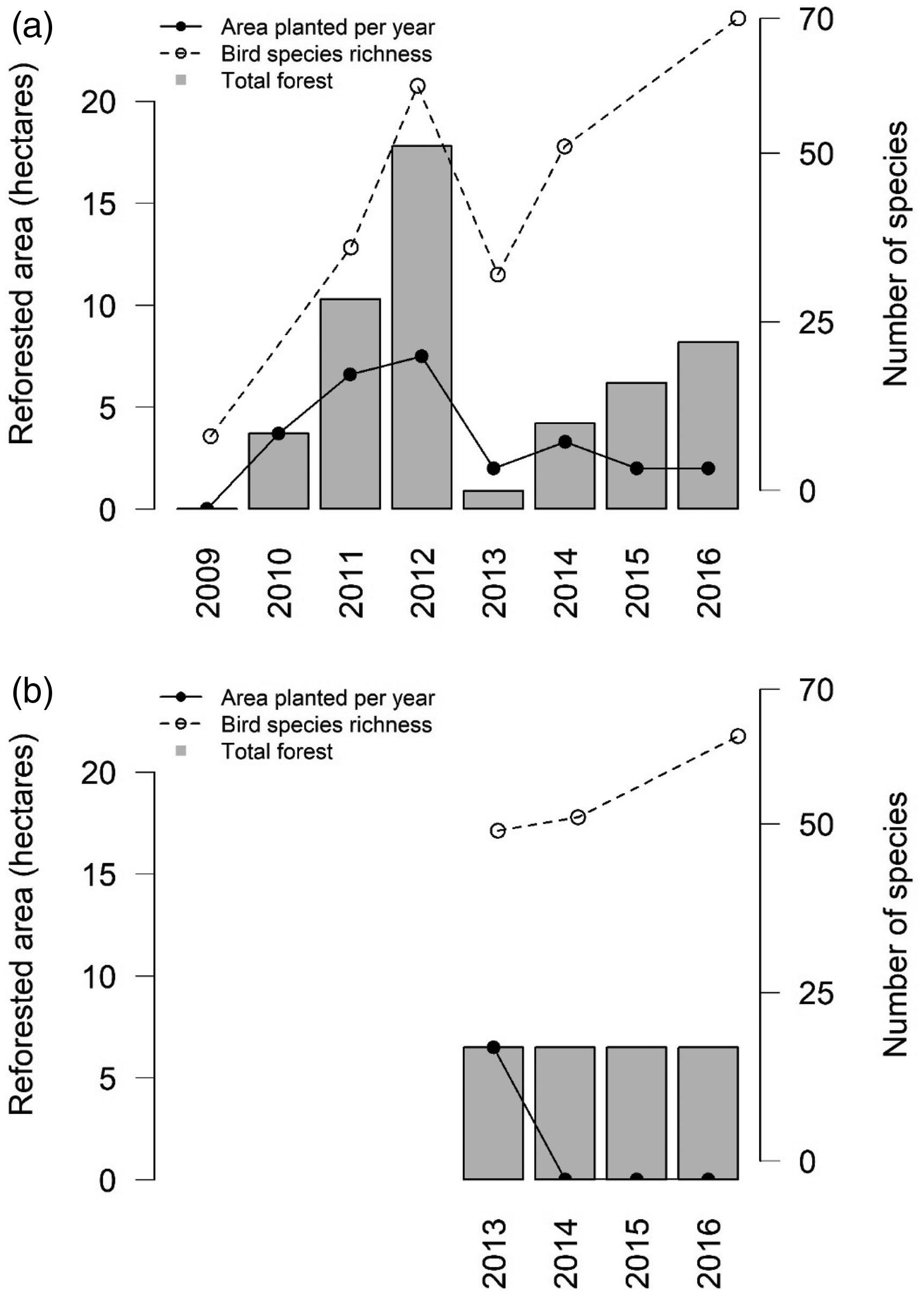
Bird species richness increased following reforestation efforts at (a) Laman Satong and (b) Sedahan Jaya. Open circles and dotted line show species richness. Solid circles and line show the area planted with native seedlings over the preceding year, and bars show cumulative reforested area at the time of the bird surveys. The 2013 dip in (a) is from a wildfire that burned most of the site.
The fire in 2013 at Laman Satong interrupted recovery and resulted in the disappearance of nearly half the observed bird species. The bird community recovered quickly, however, as unburnt forest continued to mature, surviving trees regrew, and new areas were planted. Just 3 years after the fire, species richness had surpassed its prefire peak in 2012 by 17% (70 vs. 60 species). Bird species richness initially tracked reforested area but then continued to rise despite lower planting rates and reforested area in postfire years. There was thus no relationship between species richness and reforested area (p = .42, r 2 = .22, n = 5) or site age (p = .24, r 2 = .42, n = 5), even when combining surveys from both sites (reforested area p = .33, r 2 = .16, n = 8; site age p = .28, r 2 = .19, n = 8). Recovery was instead a function of fire incidence and the resulting successional stage of the site.
Discussion
Reforestation can provide rapid benefits to native bird communities in Borneo. Our reforestation sites saw rises in bird species richness of up to 94% within a few years, with average annual increases of 27% in nonfire years. Final species richness estimates were comparable to those in 20-year-old secondary forests elsewhere in Borneo (Edwards et al., 2009), despite our sites being three orders of magnitude smaller (<20 vs. >10,000 ha). The rise in species richness is accompanied by other indicators of restoration success. Older trees at the sites regularly flower and produce fruits, and seedlings now germinate naturally from seeds dispersed by birds or primates. Feeding guild composition of the most recent surveys approached that of forest or mixed forest/agricultural bird communities at other tropical sites, with a predominance of insectivores and frugivores (Maas et al., 2016). Finally, in addition to birds, several mammals have been photographed at the sites, including orangutans at Sedahan Jaya. These positive responses were maintained despite temporary setbacks from a fire at one site, thanks to the protection of unburnt patches, regrowth of surviving trees, intensified fire prevention, and regular planting. Degraded and unused landscapes in Borneo can thus be restored to habitat for many native species, provided they receive appropriate long-term maintenance and protection from fire.
While rapid recovery of the bird community is heartening, it is worth noting that our sites contained fewer than the >200 species expected from intact primary rainforest (Edwards et al., 2009; Lambert & Collar, 2002), and not all the birds were forest specialists. We detected only two Borneo endemics (blue-headed Pitta Hydrornis baudii and the abundant generalist Dusky Munia Lonchura fuscans, compared to > 50 endemics across the island, Phillips & Phillips, 2009), and only two species of conservation concern (blue-headed Pitta and Greater Green Leafbird Chloropsis sonnerati, both listed as vulnerable). The sites also benefited from being in a nationally protected area and from bordering primary forest that served as a source of dispersing migrants. Our results may not hold for sites that are located far from natural forest remnants or are not strictly protected, or for threatened or endemic birds. Likewise, our failure to detect area effects on species richness may be an artifact of small size, lack of isolation, or presence of fire at our sites. Area effects may be more apparent at regional or landscape scales (Pei et al., 2018), in more isolated sites (Stratford & Stouffer, 2015), or in areas less impacted by fire. We thus emphasize the importance of protecting Borneo's remnant primary forests and suggest that reforestation is best viewed as a valuable supplement to the creation of protected areas.
Footnotes
Acknowledgments
We thank the Republic of Indonesia and local communities for allowing us to work in Gunung Palung National Park. T. Bishop at the Cornell Lab of Ornithology provided access to audio files and other resources for bird identification. E. Besozzi, M. Dantzler-Kyer, and one anonymous reviewer provided helpful comments that improved the manuscript.
Declaration of Conflicting Interests
The author(s) declared no potential conflicts of interest with respect to the research, authorship, and/or publication of this article.
Funding
The author(s) disclosed receipt of the following financial support for the research, authorship, and/or publication of this article: This project was conducted as part of a reforestation program by Yayasan Alam Sehat Lestari (ASRI), with financial assistance from Health In Harmony, the Arcus Foundation, Disney Conservation Fund, Ford Foundation, USAID, U.S. Fish and Wildlife Service, and WWF.