



Abstract
Despite significant knowledge of tiger ecology, information on hunting behavior is limited because tigers hunt in habitats where they are difficult to observe. From May 2013 to June 2015, we visited kill sites of eight female radio-collared tigers (Panthera tigris) to identify prey species of this species in Huai Kha Khaeng Wildlife Sanctuary, Thailand. At 150 kill sites, 11 mammalian species were identified from skeletal remains or hair samples. Sambar (Rusa unicolor), banteng (Bos javanicus), and gaur (Bos gaurus) composed 95.1% of tiger prey biomass. A subset of 87 kill sites was paired with 87 randomly selected sites within the home ranges of five of the eight radio-collared tigers to determine the influence of prey abundance and other ecological variables on hunting success. At each site, geomorphic and ecological covariates were sampled in 900 m2 square plots. A generalized linear model was used to investigate differences between kill sites and random sites. Mean relative prey abundance at kill sites was significantly lower than relative prey abundance at random sites (77.8 and 139.3 tracks/ha, respectively) indicating tigers did not kill in areas of higher relative prey abundance. Model selection was used to examine 12 landscape features that potentially influence kill site location. In the best model, low shrub cover and high crown cover were highly significant; tree density was included in this model but was not significant. This is the first study to demonstrate that kill location requires a combination of landscape features to first detect and then successfully stalk prey.
Keywords
Animals should seek habitat with adequate food, cover, nest/den sites, or other resources critical for survival (Manly, McDonald, Thomas, McDonald, & Erickson, 2002). For female felids, sufficient food to raise young is often their primary resource need, and natural selection is expected to drive foraging decisions to optimize food intake and minimize energy expenditure (Krebs & Davies, 1993). Food demands of female tigers increase rapidly as cubs mature and mothers continue to be the primary provider until their young are approximately 1.5 years old; at this time, male offspring are often larger than their mothers (Smith, McDougal, & Miquelle, 1989). Johnson (1980) proposed a hierarchical model as a framework by which animals efficiently meet their resource needs. Simcharoen et al. (2014) studied second order habitat selection which focuses on where female tigers settle and the relationship of prey abundance to their territory size. These authors found an inverse relationship between female territory size and the abundance of large prey. Within a female’s territory, third and fourth order resource selection includes selection of denning, resting, and hunting sites. Here, we focus on kill site selection.
Many studies have shown that high prey abundance is the primary factor that predicts hunting success (Litvaitis, Sherburne, & Bissonette, 1986; Murray, Boutin, O’Donoghue, & Nams, 1995; Palomares, Delibes, Revilla, Calzada, & Fedriani, 2001; Spong, 2002). Alternatively, Hebblewhite, Merrill, and McDonald (2005) propose a landscape hypothesis that predators prefer habitat where it is easier to kill their primary prey. Following Hollings (1959), Hebblewhite et al. simplify predation into the instantaneous probability of encounter followed by the conditional probability of successfully killing prey. This landscape hypothesis suggests that landscape features such as slope, ruggedness, and various aspects of horizontal cover first favor prey detection and once prey is detected, catchability will be favored (Hebblewhite et al., 2005). Our study examines resource selection by hunting female tigers to evaluate the importance of prey abundance and landscape attributes that affect hunting success (Stephens & Krebs, 1986).
Once a prey animal is detected, felids typically approach it using available vegetative cover (Elliott, Cowan, & Hollings, 1977). Concealment allows them to hunt by ambushing prey by stalking and then chasing prey for a short distance (Kruuk, 1986; Caro & Fitzgibbon, 1992; Sunquist & Sunquist, 1989). Tigers (Panthera tigris) employ this strategy, stalking or ambushing prey from cover (Schaller, 1967; Sunquist & Sunquist, 1989). Cover, however, conceals predators so that hunting success is improved and also reduces prey detection by predators (Balme, Hunter, & Slotow, 2007). Thus, the landscape hypothesis must balance first detection of prey and then stalking success. Both of these factors are components of Holling’s (1959) theoretical framework; predators should select habitats to maximize both aspects of hunting success (Hayward & Kerley, 2005). The objectives of our study were as follows: (a) identify the main prey species consumed by tigers and (b) determine relative importance of prey abundance and the ecological variables that influence hunting success of tigers in Huai Kha Khaeng Wildlife Sanctuary, Thailand.
Method
Study Area
The study was conducted between May 2013 to June 2015 in Huai Kha Khaeng Wildlife Sanctuary, Thailand (∼15° 31′ N, ∼99° 16′ E) which is located in the eastern portion of the Western Forest Complex (WEFCOM). The study was concentrated in the northern part of the Sanctuary (Figure 1) which is characterized by mixed deciduous, dry dipterocarp, and dry evergreen forest. The average annual rainfall (1375 mm) is divided into a wet season (May–October), with a mean of 1088 mm of rain and a dry season (November to April) with a mean of 298 mm. The temperature reaches 40° C in April at the end of the dry season. The tiger is the largest carnivore in this ecosystem and its density ranges from 1.25 to 2.01 tigers/km2 (Duangchantrasiri et al., 2016). Phetdee (2000) identified 16 prey species consumed by tigers but the primary prey were animals ≥ 100 kg, represented by large ungulates including sambar (Rusa unicolor), banteng (Bos javanicus), gaur (B. gaurus), and water buffalo (Bubalus bubalis), which characterize 89.8% of tiger diet in this region.
Map of Huai Kha Khaeng Wildlife Sanctuary showing the locations of 150 sites where tiger-killed prey were found and identified and 87 kill and 87 random sites where ecological correlate data were measured to investigate tiger kill site characteristics.
Data Collection and Analysis
Kill site data
Potential kill sites were identified using cluster analysis of hourly location data from eight female satellite radio-collared tigers (Vectronic Aerospace GmbH, Germany; radio collaring was in accordance with the University of Minnesota IACUC protocol 0906A67489). If we obtained >2 locations with consecutive movement distances < 100 m within 48 h, sites were identified as locations where a tiger had potentially killed a prey animal (Figure 2; Miller et al., 2013). We investigated these sites on foot and if a kill was located, species, sex, and age class of prey were identified from skeletal material, hair, and hoofs (Lekagul & McNeely, 1977; Phetdee, 2000). We used Phetdee’s (2000) pelage and skeletal size criteria to classify juvenile versus adult. Gaur, banteng, and sambar were classified as adult when > 9 months old, and wild boar were classified as adult when 6 months old. Kills were found at 150 sites but only 87 of these, used by 5 female satellite radio-collared tigers, were investigated to study kill site characteristics. At kill sites, we identified the actual kill site, which could be identified from the drag marks or the presence of the rumen, which is usually removed before the animal is dragged. Kill sites were compared with 87 randomly sampled sites (excluding kill sites) from the home ranges of the five female collared tigers.
(a) We found this sambar kill by visiting sites where a tiger was located three or more times in consecutive 1 hr GPS fixes. (b) We occasionally placed camera traps at kill sites to obtain additional information on a tiger’s condition and, for females, their reproductive status (photo: Thailand Tiger Project).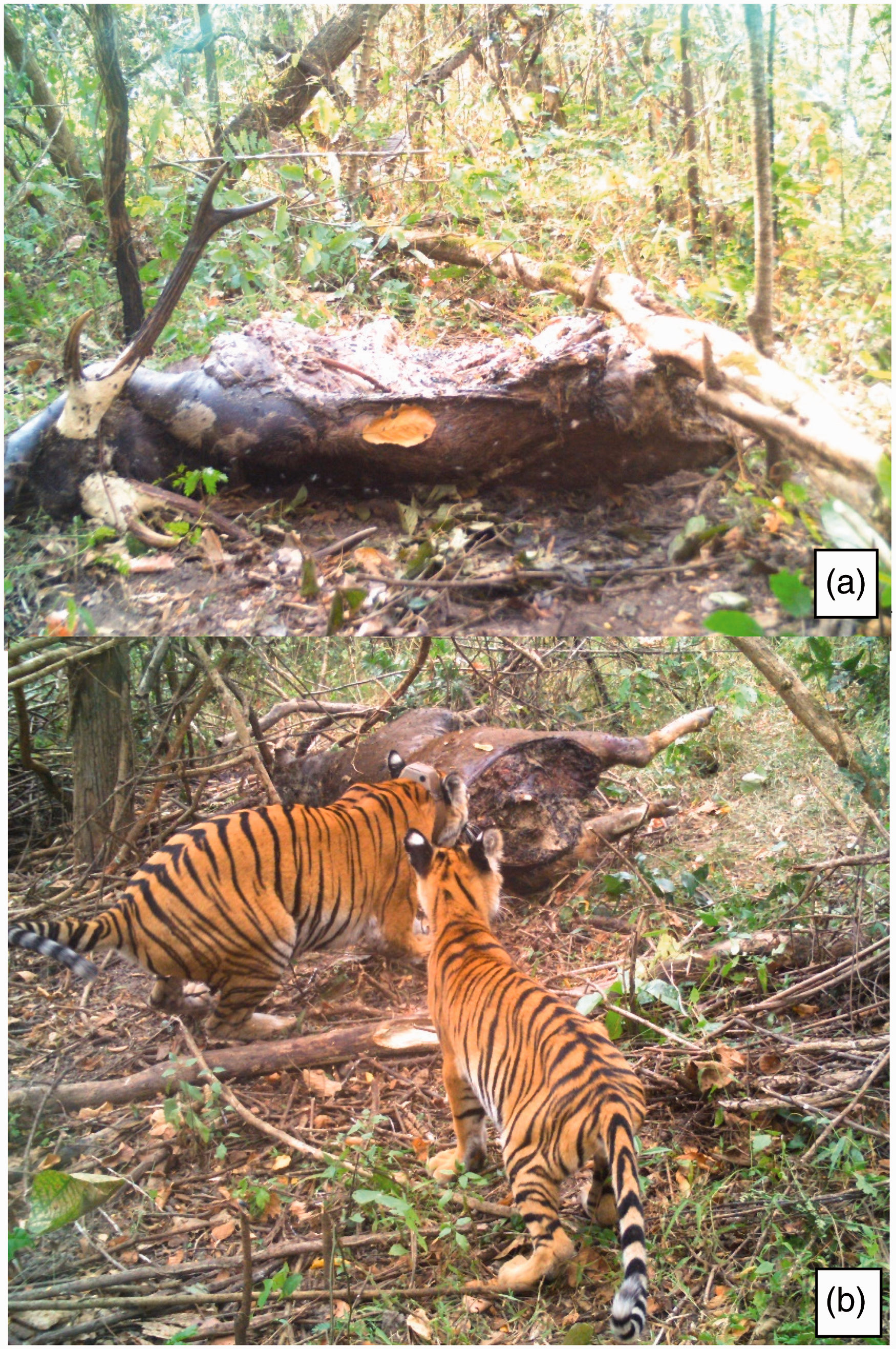
Prey abundance data
To test the hypothesis that tigers kill prey in areas of high prey abundance, we assessed relative prey abundance at both kill and random sites. At each site, we searched for tracks and dung of sambar, banteng, gaur, water buffalo, wild boar (Sus scrofa), and muntjac (Muntiacus muntjac) within four 10 -m radius subplots which were oriented in cardinal directions 30 m from the site center. An independent sample t-test was used to compare the relative prey abundance at kill and random sites.
Ecological covariate data
Description of the 12 Ecological Covariates That Were Used for Comparison of Kill and Random Sites.

Note. We identify potential impact of each variable on kill site selection.
Results
Prey Species and Prey Abundance
The Number of Tiger’s Kills and Biomass of Species in 150 Kills in Huai Kha Khaeng Wildlife Sanctuary, Thailand.
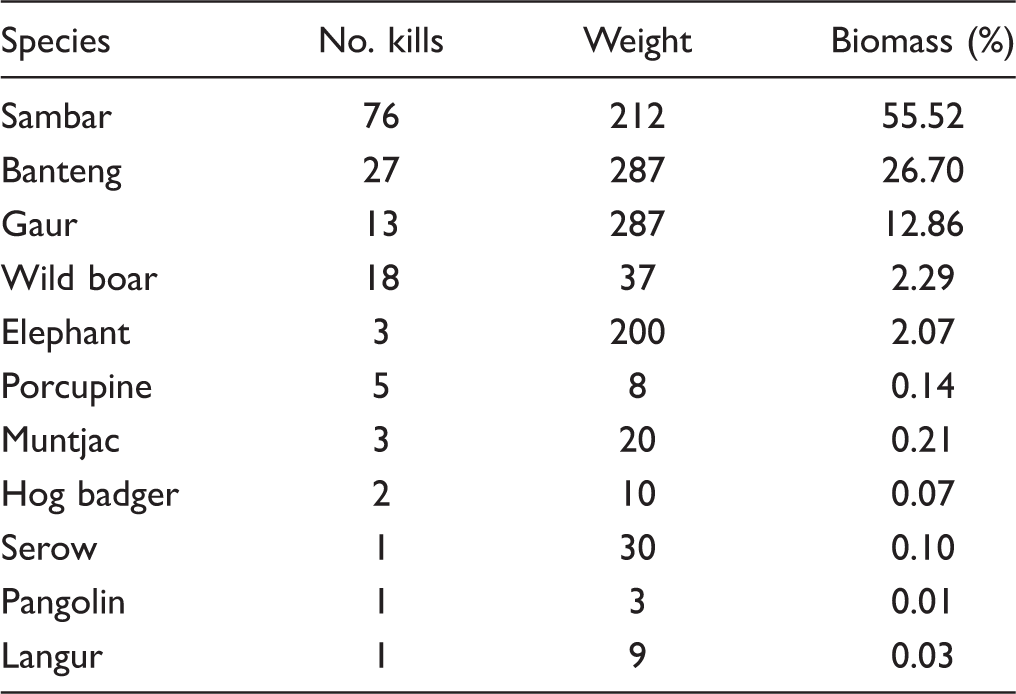
Note. Mean weight of animals killed by tiger are from Karanth and Sunquist (1995).
Ecological Covariates
Summary Statistics for the Top Four Models of Kill Site Characteristics With an Accumulative Weight of 0.90 for Tigers in Huai Kha Khaeng Wildlife Sanctuary, Thailand.

Note. AIC: Akaike information criteria; cv: Crown cover; tr: Tree density; sh: Shrub cover; br: Barrier feature. Resource use was estimated from tiger kill sites and resource availability was estimated from random locations that were chosen from tiger locations within their home range.
Discussion
Identification of Prey at Kill Sites
We identified only 11 mammalian prey species at kill sites as compared with 16 species reported in an analysis of scats (Phetdee, 2000) from the same area. Larger prey in our study (sambar, gaur, and banteng) composed 95.1% of the biomass of kills we identified, which was higher than the 88% biomass of these prey reported by Phetdee (2000). It is not surprising that prey identified from kill sites are biased toward larger prey species because we identified kill sites by noting a sequence of clumped 1-hr interval locations. Small kills could be processed before we noticed a clump. Also we visited kill sites a mean of 8 days after a kill and the scattering of small kills made them more difficult to find. However, identifying smaller prey is less important to understanding kill site selection because, as shown by scat surveys, these animals compose 8.5% of the tiger’s diet Phetdee (2000).
Three of our 87 kills were elephants (Elephas maximus) < 1 year in age, which is an observation not reported in the previous scat study (Phetdee, 2000). We speculate that young elephants were not found in the past because, prior to the mid-1990s, elephant poaching was widespread. With improved management beginning in the 1990s, elephant numbers and recruitment have increased (Kanchanasaka, 2010).
We initially thought that high prey abundance would be a good predictor of kill sites because several studies on kill site habitat selection by large carnivores support the hypothesis that kill site location within an animal’s home range is largely influenced by prey abundance (Davidson et al., 2012). Furthermore, a strategy to hunt in areas of high prey abundance, especially by adult females that need to meet the energetic demands of feeding their offspring, should optimize energy gained at the lowest risk cost (Heurich et al., 2016). Our study, however, did not support the prey abundance-hypothesis that killing success, and thus energy, are maximized by hunting in areas of high prey abundance. On the contrary, we found that kill sites had a significantly lower prey abundance than random sites located along a tiger’s route of travel. We do not know the extent to which prey may have avoided kill sites, but found no literature indicating prey shift their range.
Thus, our findings led us to evaluate an alternative set of landscape hypotheses that certain habitat attributes are more important to killing success than prey abundance. Several previous studies also support landscape hypotheses that carnivores select habitats where prey are more susceptible to predation (Balme et al., 2007; Belotti et al., 2013; Davidson et al., 2012; Hopcraft, Sinclair, & Packer, 2005).
Of the 12 ecological correlates we examined to explain tiger hunting location, low cover was the most important variable in all of the top-ranked models. This was surprising because tigers, lions (Panthera leo), and other felids favor stalking to within a short distance followed by a relatively short chase. Thus, adequate cover is essential. Lions and tigers accelerate faster than many of their prey, but their top speed peaks much below that of their prey so they must initiate an attack at a close distance (Elliott et al., 1977). Furthermore, their large, muscular body makes it energetically costly to maintain high speed over a long chase.
However, large cats must first detect their prey, thus they need an optimal combination of habitat structure to first locate, and then successfully stalk and ambush their prey (Lamprecht, 1978; Murphy & Ruth, 2010). To understand the role of different ecological covariates in large carnivore hunting success, Hebblewhite et al. (2005) suggest using Holling’s (1959) theoretical framework to decompose hunting success into two components: first, the instantaneous probability of encounter followed by the conditional probability of a successful stalk leading to a kill. In this context, less cover at a site with generally high cover would be favored to increase the initial probability of detection. The median cover at kill sites was 10,410 shrubs/ha. Given that kills are made at sites with considerably less cover than random sites (median = 14,190 shrubs/ha), areas with lower cover have adequate cover for tigers to successfully hunt.
The second most important ecological correlate was crown cover. It is unclear what advantage crown cover offers hunting tigers. Mysterud (1996) hypothesized that crown cover provides shade which is sought by deer for sites to rest and ruminate. He reported that roe deer (Capreolus capreolus) prefers to bed down below dense canopy to seek shade: similarly, in Thailand, sambar and muntjac also bed at sites with high over story cover (Brodie & Brockelman, 2009). If indeed, crown cover creates preferred resting sites, it may have a consequence of reducing vigilance in resting and ruminating ungulates (Blanchard & Fritz, 2007).
The Beta Coefficients for the Best Model Which Included Low Shrub Cover, High Crown Cover and Low Tree Density.

Note. The z-values for shrub cover and crown cover were highly significant (p < 0.001).
Implications for conservation
Globally, significant remaining tiger habitat is fragmented into small units, and as a result, most tiger populations are critically small (Kenny, Allendori, McDougal, & Smith, 2014; Walston et al., 2010). Managers have only three options for increasing the viability of tiger populations. They can increase the land base that supports tigers, increase connectivity between populations or increase prey abundance, especially where human activities have resulted in prey depletion (Karanth & Stith, 1999). Fire management has been widely used to reduce shrub cover in Huai Kha Khaeng, especially of less nutritious species and to provide young, more nutritious high-protein grasses (Sunquist & Sunquist, 1989) for ungulates and ultimately tiger prey. Although we found tigers kill more often in areas of low shrub cover, if cover is reduced too much, adequate cover for stalking prey will be limited. We suggest that altering fire management to create smaller burns will potentially create a mosaic between burned and nonburned areas which may optimize cover for prey detection, but also produce adequate cover for tigers.
Footnotes
Author Contributions
Field research and analysis: SP, AS, SD; Research design: SP, AS, VC, NP, Advice on statistical analysis: NP; Manuscript preparation: SP, AS, JS.
Acknowledgments
The authors would like to thank Chorpaka Vichittrakulchai, Ekaphol Plaidaeng, Kittisak Thongvichit, Supawat Khaewphakdee, Onsa Norrasarn, and Zack Beach for assistance in the field. Saksit Simcharoen provided advice throughout the study. The authors also thank Oranuch Mahaphant for supporting this project. The authors appreciate comments from Francie Cuthbert on an earlier version of the manuscript.
Declaration of conflicting interests
The author(s) declared no potential conflicts of interest with respect to the research, authorship, and/or publication of this article.
Funding
The author(s) disclosed receipt of the following financial support for the research, authorship, and/or publication of this article: Funding was provided by USFWS, PTTEP, and the Department of National Parks, Wildlife and Plant Conservation, Thailand.