



Abstract
Drawing on semi-structured interviews with and journal writing from 16 international academic workers working at universities in Ontario, Canada, the purpose of this article is to sound out these workers to explore how they sound out the particularities of sounding professional in the context of higher education. Paying special attention to their telling of small stories, which encompass less-structured narrations of everyday perspectives, activities, and so forth, the article explores how the workers defined professionalism in three vocal domains. These included pronunciation, which could seemingly affect intelligibility and perceptions of competence, tone, which pertained to displaying approachability and authority, and ordered speech for the purposes of transactional communication and representing advertised services. Rather than objective conceptualizations, these domains were products of ideologies pertaining to such constructs as (non)nativeness in English, patriarchy, and race. The article concludes with recommendations for undoing the oppressive functions of vocal professionalism. Such recommendations mostly relate to individual and collective workplace learning that involves the interrogation of listening practices, developing ethical communication practices, and revising/dismantling structures of oppressive listening within (higher education) organizations.
Introduction
In the context of higher education, what does professionalism sound like? The purpose of this article is to answer this question through stories told by 16 international academic workers about the vocal dimensions of their work in Canadian universities. The article specifically seeks to sound out these workers to explore the connections between professionalism and voice. My use of “sounding out” serves multiple meanings and is also a play on words. Beyond the idea of discovering a person’s opinion in an indirect manner, “sounding out” plays on the idea that just as a person may sound out individual sounds in a word when learning to pronounce said word, this person can also “sound out” the meaning of professionalism itself by identifying/dissecting its sonic components. The article is thus a micro-level examination of how international academic workers conceptualize specific vocal features needed to sound professional.
Being concerned about the vocal components of professionalism can certainly be prevalent among these workers. Indeed, especially in the context of English-medium universities located in the Global North, the voices of international academic workers can be perceived as professional liabilities. Whether they work as research and teaching assistants, course instructors and faculty members, or other types of (educational) staff, the spoken Englishes of these workers are often assessed from a deficit perspective in that they are allegedly tied to negative traits ranging from unintelligibility to professional incompetence (e.g., Ramjattan, 2025; Śliwa & Johansson, 2014; Yep, 2014). What is important to note here is that these alleged issues are the result of the label of “international” being placed upon these workers. Instead of operating as a technical category describing an academic worker who has travelled from one country to another (for a limited period of time), “international” often acts as an ideological label to describe the marginalized other, whether that concerns individuals classified as “nonnative English speakers,” those racialized as nonwhite, or citizens from non-western nations (Merabet, 2025; Ramjattan, 2024; Surtees, 2019). The “international” label is used as a marker of deficiency, and when it comes to the topic of the vocal aspects of professionalism, international academic workers’ attempts to sound professional can simultaneously act as attempts to lessen the salience of their international status. In this regard, it is vital to acknowledge that aspiring to professionalism is not a neutral task, but rather a means to conform to systems of oppression that create notions of deficiency (Goodridge, 2022; Mizzi, 2024). Sounding out professionalism, then, entails encountering and negotiating with institutionalized expectations of what one should sound like.
The remainder of this article expands on the various points made thus far. After critically interrogating the notion of professionalism (and its connections to voice) as well as providing further background information on the deficit framing of international-academic-worker voices, I offer an overview of the methodology of the study used to generate the stories of the 16 academic workers mentioned above. Following this overview, I present representative small stories from these workers on how they define professionalism vocally. These stories, which encompass less-structured narratives of everyday activities, opinions, and so forth (Georgakopoulou, 2006), tell how professionalism could be dissected into three vocal components: pronunciation, tone, and ordered speech, all of which can be understood as ideological constructs. As a conclusion, I offer some reflections on how disrupting the oppressive functions of vocal professionalism requires reconceptualizing workplace communication learning in (higher education) organizations.
Conceptual and Empirical Background
Interrogating Professionalism
Professionalism can be understood “as a discursive and behavioural system, comprised of knowledge practices, tangible skills, cultural norms, and social expectations that reinforce what it means to ‘be professional’, or a member of a profession” (Nyawaga & Mitra, 2024, p. 120). This definition highlights how professionalism not only encompasses actual competence in performing work, but also an adherence to sociocultural norms associated with a particular profession. While notions of professionalism can be defined in accordance with particular professional fields, Nyawaga and Mitra (2024) argue that, especially in an era of late capitalism, professionalism is not confined to specific occupational boundaries as it has become a general expectation placed upon workers in various sectors. Therefore, “being professional” is just as important for a retail worker as it is for a lawyer. With regard to its specific components, employers and workers typically conceptualize professionalism as the following: “(1) communication style, (2) interpersonal skills, (3) appearance, (4) how well a person adheres to the standards of their field and employer, and (5) efficacy at the job” (Goodridge, 2022, p. 41). While communication style may involve speaking or writing in a clear, concise manner, for instance, interpersonal skills, also popularly known as “soft skills,” can consist of working well in teams and having a positive work ethic.
Although professionalism is often dissected into these very specific qualities, this is not to say that it should be understood as an objective, apolitical construct. On the contrary, the notion of professionalism has to be examined as a construct of workplace oppression. Indeed, how professionalism comes to be defined has long been critiqued for perpetuating discrimination against minoritized workers and jobseekers on the basis of race, gender, class, sexuality, and other social locations (see Nyawaga & Mitra, 2024). For instance, Goodridge (2022) emphasizes professionalism as a product of white supremacy in that it is frequently used to police the actions of Black and other racially minoritized workers. This is evidenced by how these workers might be reprimanded when they call out the racist behaviour of a colleague because such a retort can be classified as a failure to develop interpersonal skills (Goodridge, 2022). Focusing on the institutional perpetuation of cisheteropatriarchy as another example, Mizzi (2013, 2024) introduced the term heteroprofessionalism to describe how queer and trans workers are expected to embody and communicate gender- and heteronormative ideals in organizations. Such an expectation can instil fear and shame in these workers and consequently force them to engage in practices like wearing gender-conforming attire or not using/disclosing one’s pronouns (Davies & Neustifter, 2021; Mizzi, 2013, 2024). Even though the above examples of the oppressive function of professionalism are discussed separately for ease of reading, it is important to remember that they all operate in tandem in various workplaces (Davies & Neustifter, 2021; Goodridge, 2022; Mizzi, 2024; Nyawaga & Mitra, 2024).
Certainly, professionalism does negatively impact the professional experiences of a range of minoritized workers, especially in terms of how they can express themselves on the job. Yet, although professionalism acts as one source of their alienation at work, these workers may nevertheless draw on aspects of it to suit themselves as well as navigate their everyday working conditions (Nyawaga & Mitra, 2024; Ray, 2024). That is, professionalism should not simply be understood as a force imposed upon a passive workforce, but also a means to cope in and resist harsh work environments. From this perspective, then, displaying a positive attitude or changing one’s body language can work in the service of worker adaptation and agency.
In this article, I explore this tension of professionalism acting as both an oppressive and agentic tool through a narrow focus on worker voice. The voices of workers are frequent sites where notions of professionalism oppress workers themselves. In the context of journalism, Powers (2021) details how the conceptualization of a professional journalistic voice relies on ableist ideas of speech clarity, thereby barring workers with speech disabilities from job opportunities in the field. Teacher education programs also reproduce oppressive notions of vocal professionalism as exemplified by how the “non-standard” speech of student-teachers from working-class and racially minoritized backgrounds is often used as evidence of poor pedagogical competence (Baratta, 2017; Cushing, 2023). To challenge this deficit framing of their voices, minoritized workers may engage in practices like “code-switching,” which involves adopting standardized ways of speaking for select periods of time (Ferguson & Dougherty, 2022; Ray, 2024). However, it is important to recognize that this type of vocal resistance is not necessarily liberatory. Indeed, the main problem with code-switching concerns how it does not disrupt the vocal status quo since individuals are temporarily conforming to institutionalized expectations of their speech rather than defying them altogether (e.g., Baker-Bell, 2020). In the end, then, changing one’s voice to garner respect as a professional is not an inherently subversive practice. This issue is further explored in the next section.
Hearing Deficiency from International Academic Workers
As mentioned earlier, when the label of “international” is placed upon an academic worker, this becomes a marker of linguistic deficiency rather than a technical category. It is important to note that this perception of deficiency is a consequence of institutionalized listening practices in higher education institutions that position white-coded varieties of English from the Global North as the communicative norm (e.g., Piller & Bodis, 2024; Sterzuk, 2015). In terms of vocal professionalism, then, the voices of academic workers labelled as international are subject to increased scrutiny and criticism on their “unprofessional” nature simply due to this labelling. But what constitutes “unprofessional” in the first place?
Answering this question first requires an exploration of the types of labour that these workers perform, which is mostly pedagogical. Indeed, the primary way that they are deemed “vocally unprofessional” is through perceptions of their teaching capabilities. This is largely evidenced by student critique of international teaching assistants and instructors on account of their verbal instruction. The primary complaint pertains to the matter of intelligibility: whether it is their use of “unconventional” grammar or vocabulary, their alleged inability to use particular discourse patterns in specific communicative encounters, or their allegedly poor English pronunciation, these teaching assistants and instructors vocally fail to help students understand course material (Alberts, 2008; Chiang, 2011; Looney & Bhalla, 2019).
While it can be argued that international teaching assistants and instructors are subject to heightened critique of their voices because they are precarious workers who can be replaced if they are perceived to be “vocally deficient” (Ramjattan, 2025), the concern over international voices persists in elite positions as well. When it comes to promotion and tenure, the “foreign-accented” English of international faculty can be used as justification to deny them advancement in these areas as it allegedly signals inadequacy in teaching (Curkovic, 2000; Park & Jeong, 2024). The “foreignness” of one’s English can also be deemed problematic in leadership positions within universities, where it can be associated with a lack of credibility and authority (Park & Jeong, 2024). In everyday oral communication, international faculty classified as nonnative speakers of English may be deemed professionally inept during meetings as they are perceived to lack dynamism in their speech (Śliwa & Johansson, 2014). Yet, there are potential caveats to mention in the above discussion of hearing deficiency.
To begin, while these workers can be collectively maligned over how they sound, it is important to note that hierarchies exist among those labelled as international, which can heighten or temper the amount of criticism they receive. In terms of race, those racialized as nonwhite may receive harsher critique on their voices than their counterparts racialized as white due to global systems of white supremacy and colonialism (see Ramjattan, 2024). Thus, one glaring gap in existing literature concerns how racialization can shape the extent to which one must vocally navigate expectations for professionalism. Another caveat relates to the lack of exploration of the salience of vocal professionalism in an array of academic work. Indeed, while this sub-section has mostly discussed the notion of sounding (un)professional in relation to teaching-focused labour, not enough attention has been paid to how professionalism can be vocally defined in other occupations within universities ranging from clerical work to research positions. Finally, with the exception of literature on international teaching assistants and instructors, scholarly examinations of the vocal nature of professionalism do not always offer a micro-level analysis of the specific vocal qualities needed to be considered professional-sounding. The usefulness of the current article is that it addresses these limitations in the existing literature on international academic workers by explicitly dissecting the vocal components of professionalism in a range of academic occupations.
Methodology
To dissect vocal professionalism in various types of academic work, I draw on a qualitative study done with 16 international academic workers in universities located in the Canadian province of Ontario. The remainder of this article answers the following research questions:
According to these workers, what are the vocal components of sounding professional in Canadian higher education spaces?
What types of ideologies inform their identification of these vocal components?
I focus on how the workers told small stories in their answering of these questions. While stories are typically understood as uninterrupted and coherent narrations of a particular noteworthy event happening in the past, this understanding limits what can be identified as a story. Stories can also take on sporadic forms and do not necessarily have to offer a detailed account of a past event. This point is emphasized in the conceptualization of small stories, which operate “as an umbrella-term that covers a gamut of under-represented narrative activities, such as tellings of ongoing events, future or hypothetical events, shared (known) events, but also allusions to tellings, deferrals of tellings, and refusals to tell” (Georgakopoulou, 2006, p. 123). Moreover, small stories are distinct from grand life stories in that they detail everyday life or a general perspective rather than a significant event in one’s life (Bamberg & Georgakopoulou, 2008; Georgakopoulou, 2006). Given that professionalism is something that workers are expected to uphold on a daily basis, analyzing small stories about this topic is useful as professionalism cannot be confined to a singular event.
Another purpose of drawing on small stories in relation to professionalism concerns ideology. As discussed above, professionalism is an ideological construct, and it is important to explore how its ideological nature is communicated through storytelling. Indeed, even though they are mundane in nature, small stories have the potential to echo societal narratives that reproduce an array of hegemonic ideologies (Bamberg & Georgakopoulou, 2008). At the same time, however, they do not necessarily have to completely conform to these majoritarian narratives as they may express a storyteller’s opposition to some elements of an ideology or simply reflect their own personal priorities (Lundholt et al., 2018). Because workers may not solely perceive of professionalism as an oppressive construct but also a means to survive in the workplace, appreciating how small stories can both uphold and resist the status quo is important in the context of the current article.
Research Context and Participants
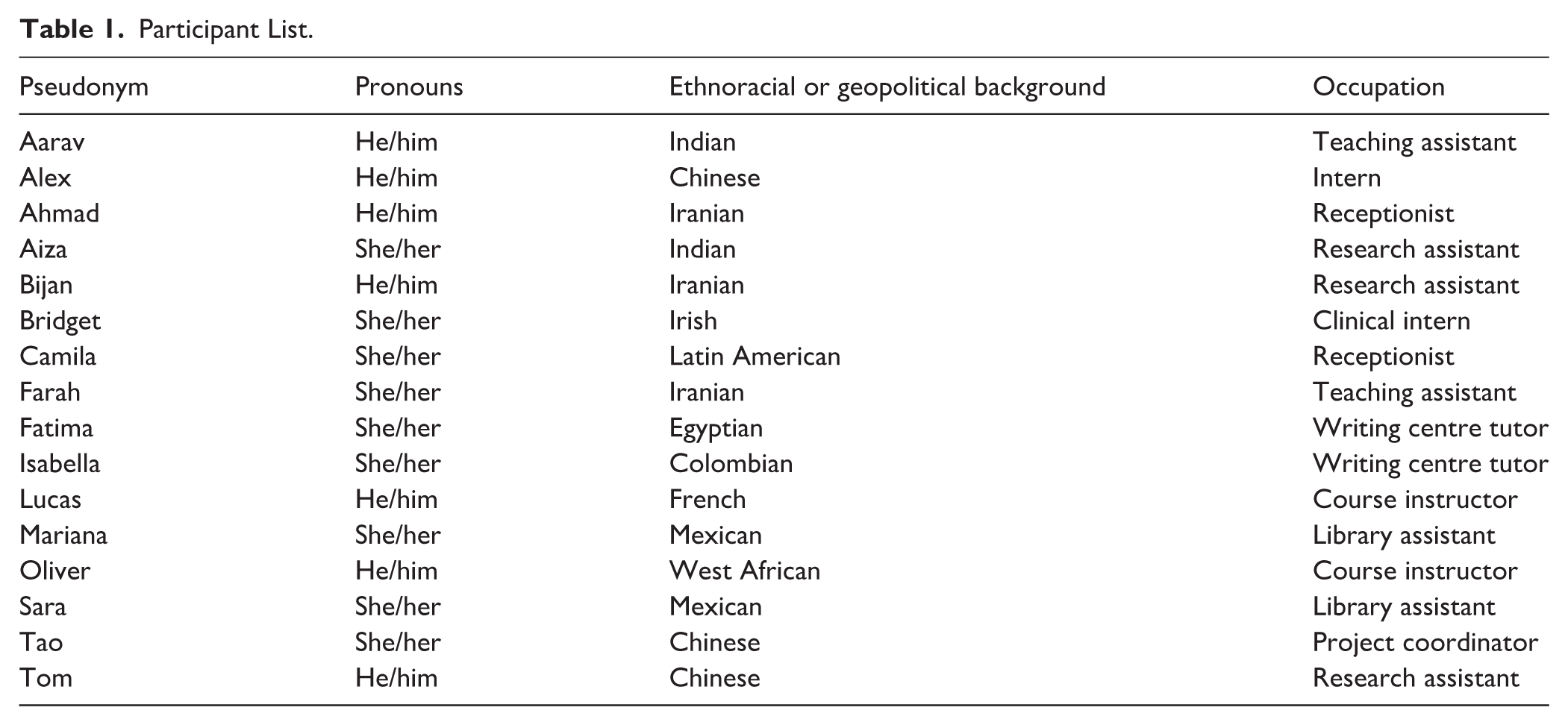
This article is based on a pilot (2 participants) and larger study (14 participants) exploring how international teaching assistants in Ontario universities conceptualize and vocalize a professional accent in order to fulfil various components of their academic labour. Upon receiving ethics approval from my university, I recruited a total of 16 teaching assistants through an electronic flyer sent to different academic departments and student associations throughout the province. The flyer had asked for participants who identified as international students, worked as teaching assistants, and thought extensively about the role of accent in their work, and the 16 participants identified with these criteria and subsequently provided written consent to participate. While these studies had a very specific research objective, the participants often discussed the importance of other aspects of voice beyond accent in reference to teaching-assistant professionalism and, furthermore, detailed how vocal professionalism was needed in a range of academic occupations beyond teaching assistantships. Here, the use of “academic” did not only refer to teaching and research positions, but also occupations that they simply held in academic spaces. Therefore, beyond teaching assistant, the participants discussed vocal professionalism in other roles ranging from intern to receptionist. Table 1 outlines these other positions as well as the pseudonym and some demographic information for each participant.
Participant List.
Data Creation and Analysis
Because most types of narrative research posit that stories are not simply located in data, but rather created through the interaction between researchers and participants (Clandinin & Connelly, 2000), it is more appropriate to conceive of data collection as actually a matter of data creation. Thus, in the context of the current article, the participants’ stories of professionalism were not solely a product of their own sensemaking, but also a result of how I engaged with their spoken and written remarks. As a critical scholar interested in the intersections of spoken language and work, I encouraged participants to think about the ideological connections between voice and professionalism through my (follow-up) questioning about what they communicated during the research process. Moreover, when determining the salience of the data that I created with each participant for further analysis, I did so in accordance with my knowledge of critical literature on such areas as accent and labour.
With regard to data creation, it consisted of semi-structured interviews and participant journaling, two common methods used to encourage storytelling (Clandinin & Connelly, 2000). First, each participant and I engaged in a roughly 30-minute interview that had them share details about their professional and language backgrounds as well as initial ideas of how accent/voice related to their academic work. Upon completion of this first interview, the participants took part in 1 month of journal writing, which provided them the opportunity to engage in further reflection of specific topics brought up during the interview. For instance, if spoken grammar was discussed as a major component of their doing their job, then a participant would write journal entries elaborating on this point at their own leisure. Once these journals, which were either electronic or handwritten, were given to me, I then engaged in a 60-minute interview with each participant in order to clarify and elaborate on entries. Every interview was audio recorded and then transcribed verbatim in Microsoft Word documents.
In order to answer the research questions for this article, I engaged in a separate type of narrative data analysis when answering each question. For the first research question asking how the participants defined the vocal components of professionalism, I relied on semantic analysis, which involved paying attention to the surface meaning of storyteller utterances, or, in other words, what these storytellers actually communicated through written and spoken text (Braun & Clarke, 2006). This analysis first started with my multiple readings of interview transcripts and participant journals and subsequent descriptive coding of these data at the level of sentences and paragraphs. Descriptive codes dealing with the general topics of voice and professionalism were grouped into repeating themes, which are presented in the following section: pronunciation, tone, and ordered speech. The text excerpts within these major themes were all considered small stories in terms of including descriptions of habitual actions or general topics as discussed above. In answering the second research question pertaining to the ideologies that informed the participants’ definitions of vocal professionalism, I used latent analysis to identify underlying assumptions that supported their spoken/written stories (Bamberg & Georgakopoulou, 2008; Braun & Clarke, 2006). Drawing on relevant scholarly literature on aspects of voice and/or professionalism, my latent analysis entailed examining how specific elements of stories, such as the use of particular words/phrases or plot details, echoed and/or (partially) contested oppressive ideologies and the occupational cultures in which the storytellers were situated. This analysis appears as supporting details for the small stories presented below.
Researcher Positionality and Limitations
It is worth repeating that the small stories created for this article are partly a product of my own interpretations of participant experiences, which are shaped by critical scholarly perspectives on language and labour. As the author of this article, these interpretations become dominant in the remainder of this text. Therefore, it is important to consider that my interpretations of participant experiences may not match participants’ own interpretations, especially if these interpretations are not based on critical scholarship. Another dimension of my researcher positionality pertinent for the current study concerns my own voice. Being born and raised in the settler colonial context of Canada, which has made me speak “Canadian English” in my academic work, my professional voice sounded different to those of the international academic workers of this study. This vocal difference is potentially salient because, first of all, it may have prevented participants from sharing all of their understandings of vocal professionalism, as they could have thought that I was unable to fully empathize with their perspectives, experiences, etc. Furthermore, having a more privileged voice in the Canadian context prevents me from offering an emic perspective on vocal professionalism and inequality, thereby limiting the depth of analysis offered in this article.
Beyond my positionality, other limitations of the current study relate to sample size and research context. Given that there were only 16 participants, this study cannot offer a comprehensive and representative analysis of how all international academic workers conceptualize the vocal dimensions of professionalism. Moreover, since the research is situated in the context of the English language and specific disciplines/occupations, it does not consider how different spoken languages and occupational contexts can possibly change what it means to sound professional. These are points to keep in mind while reading the remainder of this text.
Findings and Initial Analysis
In terms of how they identified the vocal aspects of sounding professional, the international academic workers of this study stressed the importance of pronunciation, tone, and ordered speech. Also, each of these vocal qualities were not apolitical traits, but rather products of how these workers ideologically grappled with the alleged significance of these qualities. Due to page limitations and the desire to avoid repetition, representative stories for each vocal quality are presented in the following sub-sections. Moreover, because the presentation and interpretation of findings in narrative research cannot be easily separated since, as mentioned earlier, the creation of stories is partly constructed by researcher analysis (Clandinin & Connelly, 2000), I situate the representative stories in my own analysis based on relevant scholarly literature in order to better explain and contextualize the details of each story, especially as they relate to ideology.
Pronunciation
For the majority of the participants, who identified themselves as nonnative speakers of English on account of learning the language at school, their English pronunciation was something that they perceived as affecting their ability to sound professional. More specifically, retaining nonnative pronunciation had the potential to make one sound less professional and thus spurred the need to vocally remove this nonnativeness as much as possible. One connection between nonnativeness and a lack of professionalism concerns the idea of a professional needing to be taken seriously at work (Davies & Neustifter, 2021). Especially in the context of media, nonnative English speakers are often portrayed as objects of mockery and ridicule in television and movies, thereby contributing to the idea that speaking with a nonnative accent makes one less likely to be heard as a legitimate speaker of English (e.g., Dragojevic et al., 2016). In workplace contexts, then, maintaining aspects of nonnative English pronunciation can make a worker less respected by their colleagues. For participants working as research assistants, which included Aiza, Bijan, and Tom, they all noted that the lack of respect caused by a nonnative-sounding voice could threaten the intellectual work that they had to perform.
This point was particularly articulated by Aiza, who was working as a research assistant in an engineering lab at the time of data creation. Given that she considered engineering to be a field that required serious conversations about important real-world issues, Aiza believed that her Urdu-influenced English pronunciation could lessen the validity of her utterances as her fellow lab members might ridicule her speech. In order to justify this belief, she shared a story about a comedic moment about a lab member’s pronunciation of a particular word:
This is a funny experience from one of my lab mates. Farsi is his primary language; pronouncing complicated English words are difficult for him. Once our supervisor emailed telling us he got pneumonia and is taking the week off. So my friend wanted to tell our friends from the other lab about the email. He tried very hard to remember the word and ending up saying very seriously that our supervisor is down with “nunuma.” We couldn’t appreciate what he was saying because of his pronunciation….[Besides not understanding] my friend, I would think there was a new disease that I don’t know about.
The overall message of Aiza’s small story is that nonnative English pronunciation has the ability to transform a serious matter into a comedic one. As Aiza jokingly noted at the end, her lab mate’s pronunciation of “pneumonia” would make her think that there was a brand-new disease, thereby lessening her perception of him as a professional. To avoid such diminished perceptions of her as a research assistant, Aiza thus felt it necessary to ensure that her own English accent did not interfere with the clarity of what she said.
In terms of its ideological framing, Aiza’s story relies on a native-speakerist ideology positing that cases of miscommunication are entirely the result of the “phonologically-flawed” speech of a nonnative speaker (Shuck, 2006). That is, the reason why Aiza and the rest of her colleagues could not understand the lab mate was allegedly due to a single word that was mispronounced rather than any other aspect of his utterances. Indeed, even though she confirmed that she understood the basic message that their supervisor was away due to sickness, as evidenced by her joking comment about learning about a brand-new disease, Aiza placed blame on the utterance of “nunuma” for why her lab mate could not be initially understood and thus taken seriously as a professional.
It is important to recognize that Aiza’s ridicule of her colleague’s pronunciation as well as her concern over her own speech could be attributed to their location in a Canadian university setting, where the white, native-English-speaking settler was positioned as the figure to which to aspire in any form of professional communication (Ramjattan, 2024; Sterzuk, 2015). Because Aiza and her lab mate did not physically or vocally embody this idealized figure, their ability to vocally display professionalism could be limited by their potential difficulty in pronouncing English words in a white-coded manner. While it may be assumed that international academic workers who have a closer proximity to a Canadian whiteness may escape critique of their pronunciation, this is not always the case in certain disciplinary/occupational cultures.
Such an argument was articulated by Bridget, a self-identified speaker of Irish English who was pursuing a doctoral degree in a speech language pathology (SLP) program. As she was racialized as white in Canada and spoke a fairly legitimized variety of English when compared to other global Englishes, Bridget did not experience much scrutiny and criticism over her English pronunciation and accent in general. However, since she wanted to become a respected speech language pathologist, it was seemingly necessary to consider how she sounded to future clients. Part of the professional purview of SLP involves accent modification for nonnative-speaking clients who wish to enhance their spoken intelligibility, which speaks to how professionals in the field often have specialized training, in areas like articulatory phonetics, that can be applied to pronunciation instruction (Nagle & Pilkington, 2024). An implicit assumption in the provision of accent modification is that a provider should have an accent that a client could emulate, thereby connecting notions of SLP professionalism with the ability to speak intelligibly and in a particular manner (Yu et al., 2022). In the following small story told during an interview, Bridget elucidated this assumption through talking about an interaction with the supervisor for one of the clinical placements she had done during her studies:
[Although] Irish accents are not heard as problematic in places like Canada, there’s still this perception that they are less intelligible than like British accents and that might be an issue in the SLP field….[I remember] one of my clinical supervisors…[saying] to me that I should really take into consideration how my accent would affect younger children who I treat. If I’m treating them for an articulatory difficulty or something, they might pick up my accent. And I think I really internalized that. And since then, my accent has become more neutral.
The beginning of Bridget’s story is commentary on how there are hierarchies of foreignness when it comes to perceptions of the intelligibility of different accents. While they occupy a high position in the global hierarchy of English accents, Irish accents are apparently less intelligible than British accents, for example, which speaks to a lack of listener familiarity with these accents rather than some intrinsic unintelligibility (e.g., Matsuura et al., 1999). But what is even more noteworthy in this story concerns how ideas of professionalism in SLP can rely on very medicalized and technical understandings of accent.
First, as even evidenced by its very name, SLP can often subscribe to ideologies of pathology as they relate to accent (Nagle & Pilkington, 2024). When Bridget’s supervisor stated that there could be a risk of a younger client picking up her Irish accent during treatment, this statement implies that a “foreign accent” is some type of figurative illness that a client can catch upon interacting with the foreign-accented speaker. If Bridget is tasked with helping a child become more intelligible yet has an accent perceived to lack intelligibility, then she is not a vocal role model and thus not speaking professionally. As she noted, Bridget’s internalization of the idea that her accent was a professional liability led her to adopt a more “neutral-sounding” accent, which leads to another ideological component of her story. While the field of linguistics rightly notes that a “neutral accent” is a myth, that is, any accent can be placed somewhere (Lippi-Green, 2012), the idea of a neutral accent is seductive for marginalized speakers who wish to make listeners aurally forget their social difference (e.g., Aneesh, 2015). Whether or not Bridget was actually able to neutralize various pronunciation features of her Irish accent is not as important as her willingness to believe that doing so would make those in the SLP field aurally neglect her Irish background and consequently recognize her professional expertise.
Tone
In addition to matters of accent and pronunciation, the professionalism of the participants was also judged on the basis of their tone of voice. This connection between tone and professionalism was especially prevalent for those international academic workers engaged in teaching-focused labour, which included Aarav, Farah, Lucas, and Oliver. Working as a course instructor in a health sciences department, Oliver noted that during a teaching observation, his supervisor advised him to be careful about his tone, especially in terms of its perceived pitch and forcefulness:
So when we debriefed [after my observation], [my supervisor] said, “Okay Oliver, there is one particular area that you need to work on. People will think you’re yelling at them. But I know you and I understand you. And I understand the enthusiasm and zeal you have. I love it. But because you’re going to be teaching people, the loudness and harshness of your voice is something that students might be sensitive about.” It was kind of fascinating because I need to show passion for teaching but the way I sound might show the opposite feeling.
What is interesting about Oliver’s small story concerns the apparent double bind to which he had to contend: while he should display passion while teaching, he should not display too much of it through his voice. Indeed, Oliver’s retelling of this interaction upholds an ideology of teaching positing that, especially in western contexts, teacher professionalism involves showing enthusiasm for teaching in the form of (non)verbal expressiveness, thereby contributing to students’ motivation and excitement for learning (Keller et al., 2016; Yan et al., 2023). But once again, Oliver’s alleged issue was that his over-expressiveness of enthusiasm could communicate the opposite message to his students. Understanding this apparent paradox involves examining Oliver’s social positioning in relation to his supervisor and students.
Coming from a country in West Africa where he noted that speaking loudly was a cultural component of everyday communication and thus not a sign of anger or hostility, Oliver recounted many instances of his mostly white, Canadian-born students and colleagues being taken aback by his tone on account of their own cultural schema. Although his white Canadian supervisor was able to decode Oliver’s tone as another vocal manifestation of enthusiasm, she nevertheless advised him to vocally assimilate to the auditory sensibilities of his students rather than consider how they might need to develop their intercultural understandings about oral communication. Unless these students had developed a long professional relationship with Oliver and became very familiar with this communication style, just as his supervisor was able to do, Oliver’s professional obligation was not to vocally threaten their comfort in class.
The tone of a university educator could be important for maintaining a positive rapport with students, but it could also be deemed a mechanism to establish authority. This point was raised by Farah, an Iranian teaching assistant working in a social science department. Being a Muslim woman who wears a hijab, Farah felt that she could be subject to the stereotype of Muslim women being particularly meek and passive (Karaman & Christian, 2020). Such a stereotype posed a problem when having to manage the classroom as told below:
I feel like my students, even like my female Canadian students, don’t respect me as much because I’m Muslim. Like they don’t take me seriously and don’t always follow my instructions in class….I do notice that when I’m giving them warnings or asking them not to do something, the tone of my voice gets lower, gets more serious….I guess I’m using my tone to establish my authority as a teacher.
As exemplified in this small story, professionalism for Farah entailed vocally countering the Orientalist sexism that she perceived to infiltrate her interactions with students. If her students could not respect her on account of her allegedly embodying the figure of the meek Muslim woman, then this required vocally moving away from this figure through adopting a lower, serious tone of voice, which is often labelled as a masculine trait. Indeed, Farah’s change of tone speaks to a patriarchal ideology stating that women must “masculinize” themselves if they wish to garner the same authority as their male counterparts in the workplace (Adisa et al., 2024). Rather than actually attempting to “sound like a man,” Farah’s deepening of her voice should be understood as a method to gain the authority of a male educator. In this regard, her vocal choices at work are not solely an instance of how professionalism oppresses individual workers, but also a reminder that professionalism can be used as a tool for professional survival (Nyawaga & Mitra, 2024). If her students do not listen to her, then Farah must make them do so.
Ordered Speech
A final dimension of vocal professionalism for the participants involved how their speech had to be ordered, meaning that their utterances should be arranged in a precise and almost methodical manner. The apparent need for this type of ordered speech was especially pronounced for those workers situated in the field of engineering, which included Aarav, Aiza, Bijan, Fatima, Lucas, and Tao. In terms of its ideological conceptualization of oral communication, engineering upholds the idea that such communication should only involve the transmission of objective information in an exact, clean-cut, and concise manner (Darling & Dannels, 2003; Paretti et al., 2014). Any communicative practice that deviates from this occupational expectation can lead to negative perceptions of an engineer’s professionalism. Tao, who was working as a project coordinator in an engineering research team, stressed this point when outlining her job duties as they relate to communication:
Engineers like for you to get to your point, and they want things to be clearly explained. So in my role [as a project coordinator], I have to communicate with the research team in a way that allows them to follow what I’m saying…So like when I’m giving instructions to students on the team or explaining an engineering formula, I make sure that I sequence my words carefully, and I also make sure that my sentences are logical…like it’s clear how one idea in one sentence relates to the next sentence I’m saying. If I don’t do [these things], they will think I’m not doing my job well.
Once again, Tao reinforced the ideology that communication between engineers has to be precise and concise. The specific way in which she could adhere to this communicative ideology was through the careful ordering of her words as well as the ideas connected to her every utterance. As she noted at the end of her story, failing to engage in these communicative practices would result in potential accusations about her incompetence and thus her professionalism.
While producing ordered speech was particularly prevalent for doing engineering work in universities, it could apparently be needed in other types of work as well. For instance, working as a receptionist at an international student centre on campus, Ahmad recounted how the syntax and overall grammaticality of his utterances were important in interacting with fellow international students entering the centre:
The students [who come to the centre] are typically looking for stuff like English support and where to find resources. So when I greet them at the front desk and provide them with some information, I pay close attention to the grammatical structures of my sentences because I don’t want to give them confusing information that is not easy to follow. Also, if they’re looking for English language support and they’re listening to me as a nonnative [English] speaker, then I would feel embarrassed telling them where to go if I’m making mistakes in my speech.
Ahmad’s small story exemplifies how professionalism also involves upholding the standards of an occupation (Goodridge, 2022). That is, if the job of a receptionist is to provide readily understandable information to visitors, then it is the receptionist’s duty to project speech that can fulfil this job requirement. In the specific case of Ahmad, paying attention to the grammar of his speech was especially important if he had to offer information on English language support. The style of his professional utterances had to match their content.
Understanding why this is the case once again entails examining how an ideology of native-speakerism can inform notions of vocal professionalism. By positioning himself as a nonnative speaker of English who would feel embarrassed giving advice about English language support in ungrammatical English, Ahmad adopted the idea that his nonnative speech is inherently inferior without constant monitoring (Lippi-Green, 2012; Shuck, 2006). For the students with whom he interacts, there might be an apparent irony in Ahmad notifying them about linguistic support when he himself should seek out this support as well. In a sense, then, Ahmad perceived himself as needing to vocally embody what students should sound like when they do receive English language support.
General Discussion and Implications
This article has sounded out international academic workers to understand how they sound out the particularities of vocal professionalism in Ontario universities. As detailed above, these workers noted how aspects of their pronunciation, tone of voice, and organization of speech were intertwined with such things as being taken seriously, displaying professional competence, and showing the right amount of warmth or authority. What must be emphasized here is how these vocal dimensions of professionalism were not objective observations, but rather ideological constructs. Along with ideologies of native-speakerism, which position the nonnative-English-speaking worker as deficient, the workers of this article had to grapple with other ideologies related to the pathologization of accent, patriarchy, occupational communicative norms, and so on. In short, vocal professionalism should not be understood as vocally neutral.
Even though the “foreignness” of international academic workers is cited as the source of their alleged inability to immediately adhere to standards of professionalism, it is important to consider the capaciousness of foreignness. That is, rather than simply on account of their ethnoracial, linguistic, and national backgrounds, these workers can be positioned as foreign in relation to the specific communicative context in which they are situated. For example, in the context of needing to establish authority in the classroom, it was not Farah’s Iranian accent that proved inadequate to attain this goal, but rather her current tone of voice tied to her positioning as a Muslim woman teaching Canadian-born students. Also, as evidenced with Tao, who needed to formulate sequenced and logical utterances to satisfy engineering communication norms, international academic workers can be positioned as foreign to disciplinary communicative cultures unless they assimilate to these cultures as much as possible.
What is further important to note here concerns how being labelled as an international academic worker can involve fluctuating experiences of alienation at work (Cantwell & Lee, 2010). This point was especially exemplified by a worker like Bridget. Unlike other participants who came from countries in the Global South and faced racist perceptions of their English pronunciation, Bridget was relatively immune from any criticism of her accent in the Canadian context. Yet, when preparing to be a professional in the SLP field through her clinical placements, it was then that her international accent became an apparent issue as it did not occupy as high a spot in the global hierarchy of English accents. As a result, Bridget felt compelled to neutralize the Irish character of her voice in order to accentuate her professional competence for future clients.
While it would be simple to criticize Bridget and other international academic workers for vocally conforming to the status quo in their work environments, it is necessary to appreciate that professionalism, while a source of workplace oppression, is what minoritized workers utilize to cope with and partially resist this oppression (Nyawaga & Mitra, 2024). Farah, for instance, focused on changing her tone not because she found it inherently deficient, but rather, it could become a means to get students to listen to her while teaching. In this regard, the vocal aspects of professionalism may help minoritized workers to get their work accomplished. It may even be the case that an adherence to professionalism is born out of an intrinsic desire to do well at one’s job. For example, while Ahmad’s desire to formulate grammatical utterances can be interpreted as reinforcing a deficit perspective of nonnative English speakers, it can simultaneously represent his genuine wanting to be a helpful service provider for fellow international students. Similarly, even Oliver’s apparent need to monitor his tone may be understood as his desire to be a caring and approachable instructor in the university classroom.
However, romanticizing professionalism in this regard presents the danger of ignoring how the vocalized nature of professionalism is a product of oppressive institutionalized listening. Indeed, even though this article has focused on how international academic workers individually understand how they should sound at work, it is important to recognize that this type of workplace learning can involve having to listen to themselves in relation to how their work environments figuratively listen to them (Garbes, 2024). Therefore, Bridget’s hearing of her Irish accent as professionally inappropriate in the context of SLP has to be juxtaposed with how the profession, as represented by her supervisor, requires accent modification providers to be “blank aural canvases” for prospective clients (Yu et al., 2022). In the context of engineering as another example, Tao’s monitoring of her utterances to ensure that they are properly sequenced and logical speaks to how engineering communicative culture will deem these utterances as unprofessional if they are not structured as such.
In terms of recommendations for change, then, what can adult educators and workplace learning specialists do to help international academic workers and other marginalized workers not hear themselves as deficient in (higher education) organizations? First, given that aural conceptions of vocal professionalism are greatly informed by various ideologies of oppression, it is important for workers to interrogate their own listening practices. This might take the form of critical communication education programming within organizations where workers, through such tasks as reading and discussing pertinent sociolinguistic literature, could explore how their own insecurities of their voices are socially produced (e.g., Ramjattan, 2025). Because professionalism often gets invoked in the very real need for workers to orally communicate with one another to get work done, such programming must also provide opportunities for workers to develop ethical communication practices that do not require any one party to completely change the way they sound. Drawing on terminology from Henner and Robinson (2023), ethical communication practices have to involve linguistic care work, which partly consists of taking the time, showing patience, and expanding semiotic resources to ensure that successful communication takes place. One may think of Aiza’s misunderstanding of her colleague’s utterance of “nunuma,” for instance, and how the situation could have been resolved if she had asked clarification questions or the colleague had the opportunity to perhaps write out “pneumonia” on a piece of paper, thus using written communication to facilitate his oral communication. Professionalism makes communication an individual responsibility whereas linguistic care work makes it collective.
The learning of linguistic care work is certainly a worthwhile endeavour to combat the oppressive functions of professionalism as it pertains to voice, but if workers are organizationally conditioned to speak and listen in particular ways, the practice of speaking and listening otherwise will be limited to some degree. What is needed here, then, is a reform or even dismantling of organizational architectures of listening, which encompass cultures, policies, practices, and resources that either help or hinder listening to diverse voices in an ethical manner (Macnamara, 2018). In the context of SLP, for example, in order for a professional like Bridget to be heard as already competent in spite of her Irish accent, SLP training and curricula must actively promote that “foreign accents” are neither pathological nor a marker of professional worth. For other fields like engineering, there could be a collective attempt at reformulating communication guidelines so that the conveying of information can be done through multiple styles of speaking rather than in a singular, mechanical manner of speech. With particular regard to universities in such countries as Canada, because international academic workers typically work in academic environments that rely on English modelled after an imagined white settler as the standard for professional communication, new language policies must be implemented to allow for a range of spoken Englishes and communicative practices to be used in teaching, research, and other academic work (e.g., Sterzuk, 2015). By creating new architectures of listening that do not enforce vocal homogeneity, the need to vocally subscribe to oppressive notions of professionalism will ideally diminish even further.
Conclusion
As previously highlighted in the literature, professionalism is less of a means to help individuals present their best selves in the workplace and more of a mechanism to police a minoritized workforce (e.g., Davies & Neustifter, 2021; Goodridge, 2022; Mizzi, 2024). While the international academic workers of this article discussed the vocal dimensions of professionalism in terms of their choices about how to sound at work, these choices can be interpreted as everyday instantiations of self-policing in accordance with harmful institutional logics. Future research may explore whether their universities continue to enforce these logics through policy documents, curricula, etc., as well as whether other aspects of these workers’ self-presentation, such as their clothing and appearance, pose as obstacles to being perceived as a professional. In the meantime, however, we must continue to question why notions of being a competent and respected worker need to be located in the voice.
Footnotes
Acknowledgements
I would like to thank the 16 academic workers of this study for sharing their stories.

Ethical Considerations
This study was approved by the University of Toronto’s Human Research Ethics Unit (approval #34368) on April 11, 2017.
Consent to Participate
Participants provided informed consent through writing.
Funding
The author disclosed receipt of the following financial support for the research, authorship, and/or publication of this article: This research was supported by an Ontario Graduate Scholarship.
Declaration of Conflicting Interests
The author declared no potential conflicts of interest with respect to the research, authorship, and/or publication of this article.