




Abstract
The teaching of epistemology to graduate students can be a daunting task because of its complex and evolutive nature. Yet, the development of an epistemological posture by graduate students is associated with higher rates of academic success. In this article, we share a reflection on our perspectives and experiences with teaching epistemology in two study programs at the Faculty of Education of a Canadian university. This object of inquiry is approached through a collaborative autoethnographic methodology involving us (the authors) in dyadic interviews. The authentic exchanges between Mariette (full professor teaching epistemology to doctoral students) and Catherine (former doctoral student teaching epistemology to master’s students) reveal similarities in pedagogical practices, but differing goals in knowledge transmission. Based on the transformative learning cycle, insights discovered in our capacity of teachers and researchers are discussed to illustrate individual and shared transformations. These insights forge links between the transformative autoethnography model and the teaching of epistemology. They also highlight the importance of context when teaching this subject and awareness of its personal and professional meanings. In particular, we remain sensitive to issues of justice and equity, considering that we are involved in the development of emerging scholars in a francophone minority context. In addition to contributing to the scientific literature related to teaching epistemology in higher education, we highlight the benefits of a collaborative autoethnography to study the object of inquiry and foster a dialog within the academic community to develop pedagogical practices.
Introduction
In the Canadian university context, doctoral programs aim to ensure that students, who are on their way to becoming scholars, acquire knowledge and develop competencies that foster their autonomy in the design and implementation of research projects (Maymon et al., 2019). Among these required notions and skills, the development of an epistemological posture by students has long been associated with higher rates of academic success (Perry, 1970) and, more recently, with better insertion into coveted scientific communities (Dayer, 2009). As the scientific literature shows, the teaching of epistemology is critical for novice researchers because they are expected to create new knowledge; thus, they need to understand how knowledge is conceptualized and developed. In this regard, Phelps (2021) stipulates that: “Epistemology derives from the Attic Greek epistēmē, or ‘knowledge’ and -logy, or ‘logic/logical discourse.’ Epistemology is what we know of knowing; it can be both a productive and restrictive tenet that is foundational to how researchers understand theory/ies of knowledge and knowledge making” (p. 209). Therefore, the teaching of epistemology can help doctoral students make coherent decisions when designing and implementing research methodologies, by better understanding knowledge production through their interactions with participants and communities (Dayer, 2009).
However, the conceptualization of epistemology is influenced by several factors, such as academic disciplines and regional perspectives. For instance, in the field of Medicine, Motte et al. (2020) pay specific attention to training that fosters the development of a personal epistemology in future doctors. In the same vein, American researchers in psychology, sociology, and education are focusing on epistemological paradigms and visions (Baxter Magolda, 1999; Creswell & Poth, 2025; Hofer, 2001; Mertens, 2017; Schommer-Aikins & Easter, 2006). In contrast, relationships to knowledge continue to be explored in French-speaking European countries by highlighting the importance of reflexivity in research design and implementation (Avenier, 2019; Charmillot, 2017). Despite these varying approaches, the importance of teaching epistemology to graduate students as fundamental knowledge has been established (Carle, 2015; Lison & Bédard, 2014; Paulin & Charlat, 2020; Théberge & Déri, in press), while still recognizing the challenges that it presents to educators in the context of training emerging scholars. For instance, teaching epistemology addresses the ethical issues that underlie the transmission of this knowledge (Lapadat, 2017; Wittmayer et al., 2024) and allows for the exploration of paradigms that have become essential to reflect on issues of justice and equity, that are of particular importance for researchers collaborating with vulnerable populations or communities (Ellington, 2019; Mertens, 2021).
Considering our own personal and professional interest for epistemology, as well as our teaching experiences, we decided to engage in a collaborative autoethnographic study (Bourguignon & Boeck, 2022; H. Chang et al., 2013; Hernandez et al., 2017, 2023; Lassiter, 2005; Norris et al., 2012) to explore this object of inquiry. This article aims to articulate a meta-reflection on experiences of teaching epistemology in graduate programs by both authors, including a full professor (Mariette) and her former doctoral student (Catherine). While we contribute to the development of emerging researchers in a francophone minority environment, we want to deepen this object of inquiry because we have observed that there is a gap in the scientific literature about what and how epistemology is taught in higher education. To do this, we address the following two research questions: (1) Which personal and professional motivations drove us to teach epistemology when we started our academic journey? and (2) How does this teaching contribute to our individual and shared transformation? These questions reflect our desire for open and authentic exchanges on perspectives, experiences, and insights related to learning and teaching epistemology in higher education. In the first part of this article, we put into perspective the sociocultural specificities of our teaching environment, that is a doctoral program in education delivered in French at a bilingual university in Canada. Then, we describe our lived experiences in our respective journeys leading to teaching epistemology. Finally, we provide an overview of insights discovered while doing our collaborative autoethnographic research regarding our individual and common transformations, in our teaching and research practices.
Teaching Epistemology in French in a Bilingual University in Canada
Post-secondary institutions consider research as fundamental to fulfill their mission of developing new knowledge for the prosperity of scientific communities and the advancement of society. Therefore, it is imperative that information be disseminated in a language that other researchers, practitioners, and citizens can understand. We recognize that to make research findings accessible worldwide, using a common language such as English can be useful. Whereas English was the language of 83% and 85% of articles in the Natural and Health Sciences in 1980, by 2015 this number had risen to 98% and 99% respectively” (Larivière & Sugimoto, 2018, p. 57). Even though there is a greater linguistic diversity in the Humanities and Social Sciences, the dominant reliance on the English language may “transform the objects of research,” that is, those on local community issues, and “prevent the sharing of knowledge with local actors” (St-Onge et al., 2021, p. 10). It is thus important to continue working on research projects in the language of minority groups and environments, so that those who are most concerned with or influenced by the subjects of study are able to engage in the conversations and decisions made about their future. To do this, certain conditions must be put into place, to recognize the contributions of scholars who work in languages other than English and ensure their exposure in scientific publications that is often associated with career progression.
When considering research conducted in French, Larivière et al. (2006) established that international collaboration between scholars materialize based on linguistic affinities, rather than geographical proximity. For example, scholars from Quebec, the only majority French-speaking province in Canada, will often network with researchers in France that is considered the epicenter of scientific studies in this language. As for scholars coming from smaller francophone communities in other Canadian provinces, their research interests have a greater focus on issues related to their minority context, such as immigration, even though it means that they may benefit from lesser funding, resources or recognition than their counterparts (Cartsen, 2008; Landry et al., 2008). Given the fragility of the research ecosystem, in Canadian provinces where francophone scholars represent a minority, it is even more important to develop competent novice scholars with their own research identity and vision to ensure succession in the future. This is why we are particularly interested in teaching critical knowledge, such as epistemology, in doctoral programs delivered by our university located in the province of Ontario.
Taking into account the above francophone minority context, in which there is a constant possibility of linguistic assimilation, the University of Ottawa has the mission to offer education in Canada’s two official languages (English and French). Therefore, our university makes graduate education accessible to all French-speaking Canadians coming from any province or territory across the country. If the French language characterizes the singularity of our teaching and learning environment, it raises the issue of documentary sources that are primarily published in English. This represents a limitation for the diversity of international or migrant students in our classrooms, for whom English is sometimes their third or even fourth language. In this regard, there is an abundance of recent literature highlighting the challenges faced by international students who must search for references in a language other than the one of their study programs or the one they speak at home (Houlihan et al., 2017; Tavares, 2021; Zip, 2019). These roadblocks are observed in the graduate programs in which we teach because our student population includes a majority of international students or newcomers from French-speaking countries of the African continent. These students are usually admitted in graduate programs to improve their career opportunities, after being employed as primary or high school teachers, where they contributed to the preservation of the French language in Ontario.
Although there now exist digital tools facilitating the translation of course material from English to French, the uneven results may impact the understanding of subtleties and nuances of theoretical content. Moreover, the essence of the texts may be altered in the transition from one language to another, due to the abstract nature of epistemology as a topic of study. The amalgam of sociocultural and linguistic characteristics inherent to our teaching and research context leads us to recognize the importance of knowledge accessibility for minority groups. Therefore, it puts a heavier onus on professors to select tailored teaching strategies and material to best meet the needs of a diverse student population. While there is a requirement to adapt to virtual learning environments, we consider that the singular nature of knowledge in epistemology must receive equal pedagogical considerations. This description of our teaching and research context provides an ethnological foundation on which our transformative experiences can be anchored when teaching epistemology at the graduate levels.
Crafting Our Transformative Learning Cycle
Our collaborative autoethnographic study involved both authors of this article, a full professor (Mariette) who teaches epistemology to PhD students, and her former doctoral student (Catherine) who now teaches epistemology to master’s students. To make this research process tangible and initiate our dialog, we relied on our shared interest in reflecting and writing about our teaching practices. It is therefore in this spirit of conviviality and mutual respect that we specified our object of inquiry as the teaching of epistemology in graduate study programs, mindful of our engagement in a first transformative learning cycle, including the iterative phases of preparation, exploration, and discovery defined by Hernandez et al. (2023):
The preparation actional phase is to select the focus of the autoethnographic inquiry, suggest an initial transformational intent, and design the Transformative Autoethnographic Model process for the entire learning cycle. At the exploration actional phase, autoethnographers engage various strategies to gather materials individually and/or collectively that assist them to broaden and deepen their understanding of self, associated others, and relevant contexts in which their lived experiences took place. At the final actional phase of this cycle, autoethnographers analyze and interpret the meaning of their lived experiences as they emerged through the gathering of their autobiographical and related materials as well as the initial transformation experienced through the process of discovery (p. 85).
According to the theoretical framework, at Figure 1, the transformative learning cycle is followed by a transformative application cycle. The latter is designed around the discoveries and insights that emerge from the transformative learning cycle and includes “three action phases: (a) planning; (b) implementing; and (c) evaluating” (Hernandez et al., 2023, p. 92). In this article, we mainly focus on the transformative learning cycle of the model because we are at the beginning of our research project where we are interested in learning from our respective experiences. Therefore, our transformative intent is to articulate a meta-reflection on our experiences of teaching epistemology to generate insights. This learning will instill changes conducive to the pursuit of an eventual application cycle to put into practice our individual and shared transformations.
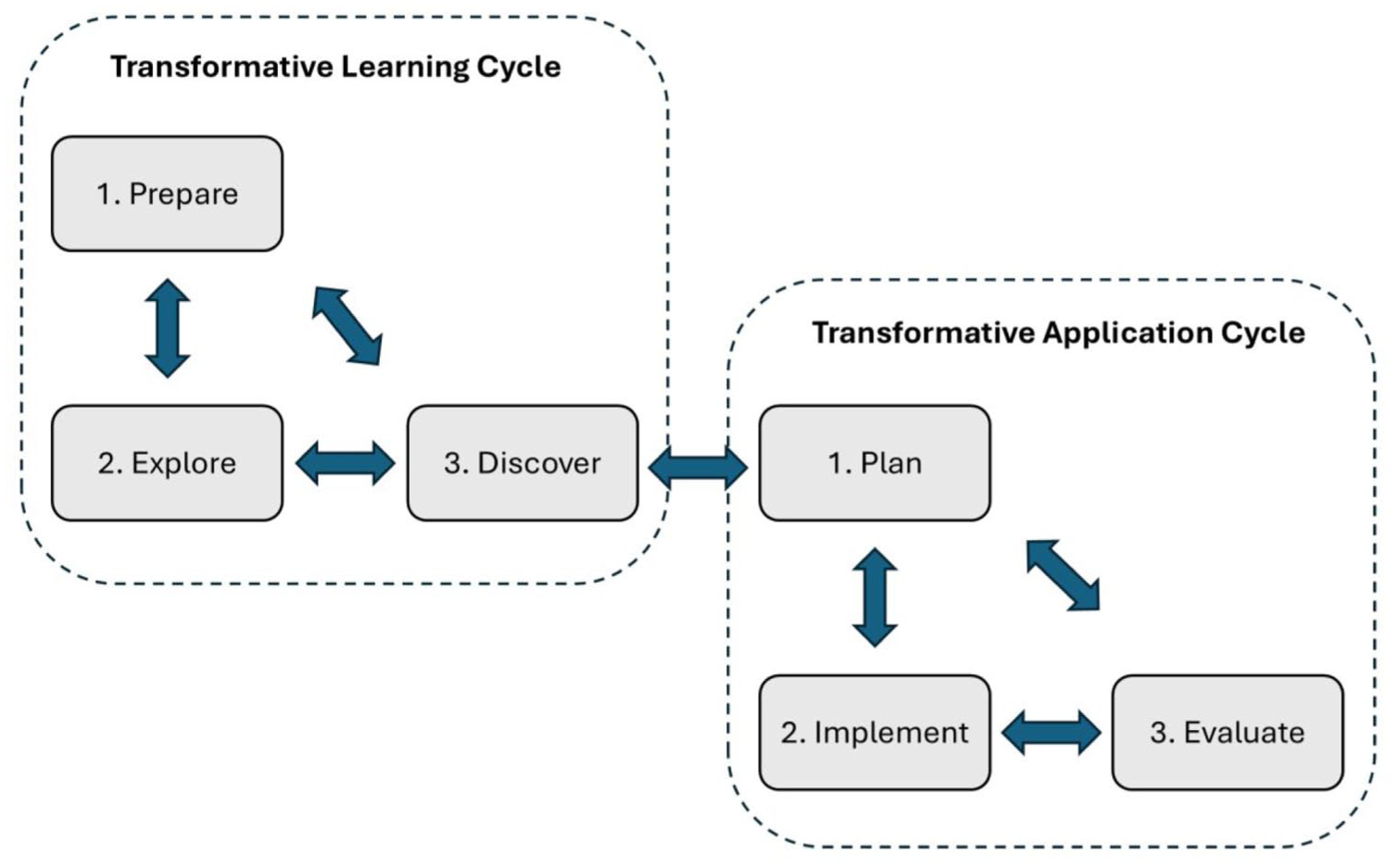
Transformative autoethnographic model (TAM; Hernandez et al., 2023). 1
In
Prior to the analysis of our lived experiences, we initiated the
In between our meetings, we committed to analyzing data individually by conducting a thorough reading of the interview transcripts to
Our Goals, Motivations, and Commitment to Teach Epistemology
To answer our first research question, we started not only by scheduling meetings to share our experiences, but we also reflected on what it meant to write using a collaborative autoethnographic approach. Understanding the meaning of this methodology involved grasping how important it is to reveal a part of oneself in the “auto” dimension of this type of research. According to Adams and Herrmann (2023), personal experiences should offer “unique insights about social life about a specific topic” and be constructed through the authors’ “emotional integrity” (p. 2). Therefore, in this section, we craft our goals, motivations, and commitment to teach epistemology, which also puts into perspective our shared values and the emergence of this “we” that we are forming in the elaboration and undertaking of our research project.
Mariette: Deepening a Sense of Research Epistemology by Teaching It
Mariette has been teaching at the Faculty of Education of University of Ottawa in arts education since 1990 and in epistemology and research since 2011. With a background in drama and music education, the creative arts experiences she had with theater groups before completing her doctoral studies continue to influence her teaching. The words that come to her mind when she thinks of these experiences are creativity, identity, confrontation of ideas and values, dialog, evolution. These experiences helped her to understand why creativity is valuable for our society and could be considered as meta knowledge. In research as in the arts, she has always been interested in questions of identity and the life transitions that occur in our personal and professional lives. In her role of researcher, she wonders what methodologies she prefers, but also what relationships she intends to establish with participants and communities while conducting projects. This questioning ties in with issues raised by the teaching of epistemology when she addresses and explores different research visions with doctoral students.
When she started to teach the course Epistemology and Research, she maintained the same attitude as when working on artistic projects: a quest for information by total immersion in scientific literature (books, dissertations, articles,…). This allowed her to find valuable study material for students, both from a form and content perspective. Among others, the following goals have almost become her daily fixations: understanding visions and relations underlying research orientations, grasping their distinctions, clarifying and synthesizing their characteristics to highlight their specificity. As she explored ways to communicate with doctoral students about these visions and their meanings, she found herself in a state of excitement and vulnerability. She was both building and co-constructing an understanding of what this knowledge means not only in research, but also for our personal and professional growth. The literature provided little indication of teaching strategies that she should be using to facilitate learning in this epistemology course that she has taught for almost 15 years. This gap remains one of her concerns, which is why this autoethnographic research is valuable to her inquiry.
Catherine: Developing Her Research Capabilities and Those of Graduate Students
Before working in academia, Catherine completed a first career as a Logistics Officer in the Canadian Armed Forces. In 2013, when she was assigned to work at a military college, she discovered a keen interest in teaching graduate students. That is when she decided to complete a master’s degree in education, then she applied for a doctoral program and was admitted into the Faculty of Education at the University of Ottawa. When it came time to choose her research supervisor, the professor she had contacted told her that her epistemological posture was rooted in the socio-constructivist paradigm and that she had to adopt the same posture. At that moment, she did not really understand what that meant, but she accepted anyway, thinking that this requirement would only be a formality. During the first term of her doctoral program, when she realized that she had to complete a mandatory course in epistemology, she was curious to find out more about the posture in question. Although sometimes complex and often theoretical, the epistemology course was of great interest to her. Mariette taught the course and used metaphors to help students understand abstract concepts. Catherine came away with a global vision of the diversity of epistemological postures that researchers can adopt during their careers, but above all she gained a better understanding of socio-constructivism!
Throughout her doctoral studies, Catherine developed a passion for all aspects of the scientific research process. She had the opportunity to teach an Introduction to research course and acted as Teaching Assistant for the Epistemology and Research course, which motivated her to delve deeper into several methods that she was not necessarily using for her doctoral project. It also helped her reinforce the research decisions she was making as a novice researcher, to improve the quality of her dissertation that was eventually recognized by a prize of excellence. She attributes this, by and large, to the alignment of her epistemological posture with her research orientations. Since graduating, she has continued teaching Introduction to research at the undergraduate and graduate levels, as well as Research Methodology at the graduate level. In this respect, she pursues the exploration of ever-evolving research paradigms, while getting involved in research teams that use different orientations from the one initially imposed by her advisor.
We: Sharing a Mutual Commitment to Teach Epistemology
Although we (Mariette and Catherine) met in a teaching and learning context, in which an asymmetric relationship existed, we quickly developed a mutual respect. Over the past 6 years, we have been involved in several projects within our faculty, such as setting up and examining academic writing groups to support graduate students. We also share a common interest in research and place a high priority on educating graduate students. We therefore take these teaching and learning experiences as a starting point and now explore their meaning as colleagues. We are committed to developing new knowledge and encouraging others to reflect on teaching practices, but also research methods to explore our object of inquiry.
First and foremost, we want to promote reciprocity in our exchanges, so that integrity is part of the equation. Our status prior to this research, as professor and student, might have worked against such a premise by preserving an implicit hierarchy in our dialogs. However, the level of trust established between us contributes to our desire to act together respectfully and as democratically as possible. Furthermore, our respective professional experiences, with Mariette’s appointment as Director of graduate programs for 3 years, and Catherine’s roles as a Canadian Army Officer, have placed us both in leadership positions. These professional experiences resulted in a more equal partnership, although one of us is a seasoned professor and the other one is a recent graduate. In this sense, where mentorship would usually occur based on our differing academic status, we found ourselves supporting each other’s growth, development, and success in a reciprocal manner (Khayatt & Iskander, 2020). By joining forces, we share the desire to act as interlocutors capable of exercising freedom of thought, and the necessary curiosity that can only be satisfied if we exchange in an authentic and vulnerable fashion. We recognize our respective strengths, and we know that we can speak frankly and honestly.
As for ethical considerations, we also ensured to reach mutual agreements on the information that is disseminated and respected the levels of confidentiality that each party requires. For example, during our exchanges we would explicitly state if we had mentioned or were about to share something that we did not want to be included when publishing or communicating our findings. Moreover, we were careful in not disclosing the names of students, when sharing experiences related to teaching or learning epistemology, especially when it involved individuals that Mariette had as students (power dynamic), but that Catherine would consider peers (horizontal interactions) prior to completing her doctoral program. This commitment is part of the methodological approach we are advocating in this project.
The Insights Ensuing From Our Transformative Learning Cycle
To answer our second research question, we identified several insights discovered (individually and together) that we then prioritized at the end of our transformative learning cycle. The first insight below addresses differing learning contexts that distinctively impact our respective teaching of epistemology. The second insight highlights our independent and shared transformations, in relation to the object of inquiry, since the start of our collaborative autoethnographic journey. The third insight relates to our common vision of teaching epistemology for the transformation of graduate students.
Insight #1: The Impact of Learning Contexts on Teaching Epistemology
The first insight that surfaced during our data analysis is the impact of learning contexts on teaching epistemology, including language and study programs. These ethnological elements are related to the importance of “examining the self in relation to others within their contexts” (Hernandez et al., 2023, p. 11). Using the term “contexts” in the plural form is more appropriate when examining the teaching of epistemology in graduate studies. This gaze on oneself, on others and from others is exercised by considering the representations that students have of themselves, of us and of their peers, and that we have of them. It also includes the way in which each of us looks at epistemology in research, while being influenced by the diversity of contexts from which we originate and in which we evolve over the course of our lives. Moreover, this outlook is subject to transformation by teaching and learning epistemology during specific study programs delivered in person or online.
As mentioned earlier in this article, we recognize the francophone minority context of our doctoral and master’s students who are originating from various countries where English is not recognized as an official language. This influences Mariette’s course preparation, in the following manner: “When selecting reading material, I must be careful with the language of publication, but also with varying cultural perspectives, since there are important cultural distinctions in understanding the same information” (D6, 14:12). Indeed, the impact of language on our teaching and learning context is multidimensional, given that it is tied to other influences that are closely linked to linguistic affiliations. In this respect, Catherine highlights how historical dynamics between countries of origin may influence the learning experience of students: “In a group of students coming from colonizers and colonized countries, it is important to remain sensitive to potential frictions within the group” (D6, 16:33). This consideration may also apply to students originating from majority or minority francophone communities in various Canadian provinces or territories. Altogether, when teaching epistemology, it is particularly important to take linguistic challenges into account, but also cultural diversity even inside a cohort composed of students who all speak French. This diversity not only influences the way that students envision how to conduct research, but also how teaching is done at university, which impacts their views on our pedagogical strategies.
Overall, we remain sensitive to issues of justice and equity, considering that we are involved in the development of emerging scholars in a francophone minority context. Most of the students we address are education professionals who pursue graduate studies primarily to fuel their practice. Faced with problems that are often highly complex, teachers and principals are under pressure to act in solution mode, often with unrealistic deadlines. In this context, epistemological knowledge is not necessarily prized by all those involved in the teaching profession or in school management, as it implies self-reflection that goes beyond procedural knowledge. To do this, Catherine asks master’s students to think of a problem statement supported by scientific references. Since their object of inquiry may be directly linked to the students’ professional experiences, the epistemological knowledge addressed in class offers the opportunity to grasp the foundations that underpin their practice. It also differentiates the development of knowledge fostered in educative milieus and in research projects. As for the doctoral students, they are focused on research by securing the support of an advisor from the outset. In our view, this context is more conducive to the transformation of both the student and us in relation to the epistemological knowledge taught and acquired. In our roles as supervisors and members of thesis committees, we are bound to question ourselves when making decisions affecting more than just students’ research projects. This addresses the ethical issues that underlie the teaching of this knowledge (Lapadat, 2017; Wittmayer et al., 2024) to explore visions that have become essential to reflect on when educating of emerging researchers.
Insight #2: Independent and Shared Transformation Related to Teaching Epistemology
In this second insight, we share discoveries related to key characteristics of autoethnography developed by Hernandez et al. (2023): “making honest and transparent efforts to discover new insights about the self in deeper levels; and motivating self-improvement and actionable change” (p. 11). Therefore, the insights below refer to our teaching of epistemology in graduate programs, but also to our experience of carrying out this research project. We then start by presenting common insights from our ongoing dialog, after which each of us specifies their most meaningful insight from our respective meta-reflection. This sharing contributes to raising our awareness regarding the representations that we have developed toward teaching epistemology and how we represent ourselves as educators and researchers.
We: Optimizing the Student Experience
When we started our journey, we did not anticipate the extent of the contribution of autoethnography to our thinking process. During this autoethnographic or duoethnographic study, we had the opportunity to verbalize, describe, question, and deepen the meanings we attributed to the teaching of epistemology in research. This methodological approach required us to hold a series of encounters during which we took the time to exchange ideas, the opportunity to express and articulate our singular and shared visions. In our exchanges, we not only talked about the ways we teach and the actions we take in the classroom, but we also described the relationships we developed and want to have with our students. We even questioned each other about these relationships. The established collaboration served as an anchor for the expression of our own representations, intentions, and concerns about our teaching.
The importance of prioritizing the student experience in teaching epistemology in graduate studies is a common insight that appeared to be meaningful to both of us in the current context, in which worldviews intersect or clash within research communities. It seems to us that access to a multitude of possibilities, including a diversity of paradigms, requires at the very least informing students about them, offering them the opportunity to reflect and become aware of their significance in terms of the decisions they make when developing and carrying out their research projects (D7, 17:46). The students we address are emerging researchers; thus, they are in search of expertise. They are starting their own journey, that will inevitably be transformative, and we take our role of accompanying them in this epistemological discovery seriously, so that they are best equipped to undergo their transformation.
Mariette: Learning My Own Vision of Teaching Epistemology
Before discussing her teaching of epistemology, Mariette had not realized how important it is for her that students share common reference points, as she does when she teaches art education (Théberge, 1998, 2021). For example, in music education, she asks students in teacher training or professional development programs to put together a playlist, which becomes a shared repertoire. It is a way, among others, to introduce students to songs from different languages and artists from French-speaking communities. When teaching epistemology, as common reference points, she tackles the question of metalanguage in research during the first class, insisting on the importance of learning this concept.
What she discovered in our dyadic interviews is that she sees the teaching and learning of epistemology as a metalanguage that allows us to look at ourselves and at others, and others to look at us (D7, 00:54). Epistemology is an accessible metalanguage, as long as we know its meaning attributed by scientific communities. This insight is all the more important to her, because her father was functionally illiterate. He started reading at the same time as her, when she was six and he was 54. As a child, she sometimes saw in his eyes the shame he felt when faced with signatures on documents he was unable to decipher. She was also aware of the way others looked at him, which helped her understand the power of words in our society. When she teaches, she can easily imagine that being able to use appropriate terms that designate the epistemological knowledge not only offers students the opportunity to enter into dialogs with researchers from various scientific fields but can help them identify implicit premises in their groupings and workings. According to Mariette, her teaching involves more than just a theoretical understanding of epistemology; it offers the possibility of transforming the way we perceive ourselves and others as researchers—a way of seeing that is intrinsically linked to the power to make decisions with an awareness of their meaning as emerging researchers.
Catherine: Learning by Realizing Past Gains and Future Requirements
When we started our research project, Catherine had some apprehensions about the potential for asymmetric contributions between Mariette (who is a seasoned scholar) and herself (a novice scholar). This was mostly because lived experiences are at the center of autoethnographies, thus she wondered how the difference in the “volume” of experiences would be reconciled between the two researchers (D7, 06:54). She now recognizes that she was able to equally contribute by sharing a diversity of meaningful experiences, which made her realize her own evolution as a researcher since the end of her doctoral program (only 3 years ago). All in all, she feels that our collaboration will result in greater scientific and social contributions than if we had decided to examine our object of inquiry through individual journeys.
Looking at the future, our exchanges confirmed that Catherine still has a lot of work in front of her to effectively teach epistemology to the three university levels. She had the opportunity to teach this subject to undergraduate and master’s students, over the past years, but she just started supervising doctoral students. This new responsibility requires a more individual take on the teaching of epistemology to guide decisions made for the progression of a doctoral dissertation. However, her current involvement in our study allows her to examine epistemology under different theoretical and practical lenses, as well as reflect on novel approaches to communicate research findings. This transformation that she is going through will clearly improve her teaching and research practices, which in turn will enrich the learning experience of her future students in their development as emerging scholars.
Insight #3: Teaching Epistemology to Inspire Students to Transform
During our first dyadic interview, we quickly realized that we shared a common vision of developing our students’ scholarly identities through the teaching of epistemology. To initiate their transformation, we invest time to
In regard to
When it comes to
Discussion
This article presented findings resulting from the first of four data collections that will take place, over the next 3 years, in our research program focusing on the teaching of epistemology in graduate programs. It was of the utmost importance that we started by self-reflecting on our respective conceptualization of epistemology and its teaching, as well as our common perspectives and practices within the learning environment that is a Canadian university in a francophone minority context. In this last section, we discuss the benefits and challenges of collaborative autoethnography conducted between colleagues of varying experiences. We also broach the usage of the TAM, as a theoretical framework to guide a research process, but also to facilitate the learning of graduate students in a practical sense, both of which leading to transformative outcomes. These reflections are put into perspective with the limitations of our methodology and the next steps expected in our continued examination of the object of inquiry.
The Benefits and Challenges of Collaborative Autoethnography Between Colleagues
In collaborative autoethnography, when the experiences of each participant present significative variances, which is the case in our study, we believe that conducting dyadic interviews between colleagues is particularly interesting. According to Bourguignon and Boeck (2022), the relation between researchers-participants allows to produce new knowledge through interactive extrospection going beyond individual introspection. Moreover, the “multivocality” nature of collaborative autoethnography provides occasions for researchers-participants to “complement, contradict, and probe each other as critical peers” (Hernandez et al., 2017, p. 252). Considering that our duo was composed of a seasoned scholar and a novice scholar, there was a risk of one voice being favored over the other, which could have impacted negatively on our relationship. However, since Catherine had cumulated broad life experiences prior to completing her doctoral program; she was perceived by Mariette as a research collaborator with complementary perspectives. We still wondered if there would have been a greater power imbalance, if we did not identify to the same gender, even though in our academic discipline (education sciences), gender parity is not an issue that prevails as much as in hard sciences (Cafley, 2021; Larivière, 2021). In any case, we made a concerted effort to equally value our lived experiences, both during our dyadic interviews and the selection of relevant transcript excerpts to share in this article. This triangulation of data collection and analysis between the two of us enhanced the scientific rigor of our study (Bourguignon & Boeck, 2022).
Furthermore, it is not only the depth of experiences with the object of inquiry that differed between us, but also our points of departure. Considering that the teaching of epistemology is closely tied to the development of a scholarly identity (Castanelli, 2024; P. Chang & Tsai, 2014), it is important to discuss the evolution of reflecting on epistemological postures for Mariette and Catherine. On the one hand, Mariette has been a university professor for 35 years, starting her academic career during a time when research in the field of education was greatly influenced by quantitative methods associated with a positivist posture. It is only at the start of the 21st century that qualitative methods were equally represented in publications of scientific journals in this discipline (Deschenaux & Laflamme, 2007), resulting in a diversification of epistemological postures being accessible to novice scholars. On the other hand, Catherine is joining the scholar profession at a time of major societal changes, when global movements advocating for social justice of minority groups influence the recognition and inclusion of diversified “race, class, disability, and gender” identities (Khayatt & Iskander, 2020). When starting her doctoral studies, she was exposed to a myriad of epistemological postures to choose from, even though her research advisor was imposing her own paradigm. These two points of departure that are diametrically different influenced how we conceptualize epistemology and how we perceive the importance of its teaching in graduate programs. Ultimately, this joint action of “sharing and valuing [our] experiences [as] colleagues” (Lapadat, 2017) carries more weight than our individual voices, to instill the desired changes in the academic environment by representing more than one generation of professors teaching epistemology.
The Use of the TAM in a Collaborative Autoethnography and in Graduate Studies
To better structure our research process, we selected the TAM (Hernandez et al., 2023) that facilitated our choice to collaborate in a dyad, while maintaining an autoethnographic perspective. Since we already specialize in education, it is our second nature to reflect on pedagogical issues. Therefore, we had not set an explicit self-transformation goal at the start of our research project, instead we were aiming for tangible changes by encouraging other educators to reflect on their own teaching practices. However, the TAM provided a sequence by which we evolved according to defined steps guiding a common approach to support each other in our discovery that definitely led to self-transformation. In that regard, Alhadad et al. (2021) propose that collaborative autoethnography is a valuable tool to “learning, unlearning, and relearning together” (p. 38). We certainly learned a lot from each other, as mentioned above, but we did have to unlearn certain ways of collaborating with previous research colleagues and relearn how to effectively function as a research team (i.e., co-planning, co-writing, co-deciding). Therefore, we could say that transformation was a “positive by-product” (Stafford, 2022, p. 201) of our reflective process, as researchers, even though the autoethnographic experts who developed the TAM advocate for a more explicit approach to transformative learning.
As a theoretical framework, the TAM proved its usefulness beyond our scientific inquiry, when we realized its practical application to our teaching of epistemology. We therefore consider it possible, and even desirable, to establish links between the teaching of epistemology and this methodological approach to encourage the co-construction of knowledge in our teaching with and between students. The transformative learning cycle is fostered by interacting with others, through collective exchanges, reflection, and writing (Hernandez et al., 2023). We believe that this would be beneficial for graduate students in both master’s and doctoral programs to enhance their learning of epistemology. It is even possible to imagine that the transformation learning cycle completed during a research methodology course could be followed by a transformative application cycle taking shape while students develop and conduct their own research projects. It is with this in mind that we will engage in the next phases of our own study that will involve surveying graduate curriculum to identify which Canadian universities include epistemology as a subject taught in master’s and doctoral programs, as well as interviewing graduate students and professors who learned or taught epistemology. Now that we have developed a better understanding of the TAM, it would also be possible to consider how this framework could be expanded to include professors who are from disciplines other than education sciences or diverse linguistic minority or majority contexts as learning environments.
Practical Implications for Teaching Epistemology to Graduate Students
For educators, teaching epistemology to graduate students contributes to the professionalization of emerging scholars (Théberge & Déri, in press). In that respect, it is relevant to explain key milestones that doctoral, or master’s students, must reach over the course of their academic journey. Once they have a better idea of what will be required of them and how they can expect to be evaluated, they can engage with their peers to answer the question: “Why is learning epistemology important for us?” Then, based on the answers that the students share, it is possible to introduce some of the transformative experiences that occur during a graduate program, which can assist in their identity transition toward the one of novice researcher (Duchesne et al., 2022; Faggianelli & Carra, 2024). To do this, our research findings highlighted several teaching strategies that can be put into practice, such as peer teaching and reflective journals, so that students learn through introspection and extrospection. This is also true for university professors who can reflect on their own practices, as well as engage in communities of practice with their peers. In doing so, they can share resources related to the teaching of epistemology to improve curriculum and enhance student learning (Gayle et al., 2013).
For graduate students, learning epistemology helps to identify the values they wish to promote as emerging scholars (Hofer, 2001; Mertens, 2017, 2021; Motte et al., 2020). In that regard, it is useful to provide students with the opportunity to reflect on their initial motivations to engage in graduate programs (Skakni, 2019), even though these reasons can change during the course of their academic journey. The development of their epistemological posture will directly impact decisions made in the development of research proposals and the relationships established with research participants during their graduate level project. However, it will also influence their socialization to the academic environment and insertion into a coveted research community as novice researchers (Déri, 2022). It is therefore essential to support students through their discovery of research paradigms, for them to gain a profound understanding of how new knowledge can be developed and make the most appropriate choices for their own transformation.
Research Limitations and Mitigating Strategies
In terms of research limitations, as previously mentioned, we are at the start of our research project, therefore, the findings that are presented in this article will be further investigated as we progress in the next phases of our study. In that sense, the content of this article pertains to a single data collection instrument that was used (dyadic interviews), when a collaborative autoethnographic process may also involve the survey of documentary sources, in addition to exchanges between researchers. To overcome this limitation, we plan to review course syllabi and teaching evaluations from students to analyze some of their comments on course content or pedagogical strategies. This additional information will be useful to triangulate with the content of our dyadic interviews to establish similarities or differences with our own shared experiences to enhance the scientific rigor of our study. Moreover, it will enrich individual narratives to better establish commonalities and differences of perspectives in shared narratives.
Conclusion
In this article, we presented the findings of our collaborative autoethnography with teaching epistemology to graduate students as an object of inquiry. While providing a description of the context in which we teach, and specifying the different phases of our research, each of us engaged through individual and collaborative reflection. Based on the Transformative Autoethnographic Model (TAM), we embarked on a transformative learning cycle during which we discovered insights from dyadic exchanges. As a key insight, we raised the possibility of drawing inspiration from the TAM to teach epistemology by involving our students in a similar transformative learning cycle. In doing so, we felt it essential to consider not only our teaching context, but also the environments from which students originate and where they are studying. Finally, we shared insights about the teaching of epistemology and the importance of student experience in learning this knowledge, while discovering new research methodologies to further examine our object of inquiry.
As a whole, we have deepened our understanding of teaching epistemology but also initiated the transformation of our own perspectives as teachers and researchers. Our common goal remains the same, understand our personal and professional motivations that drove us to teach epistemology in graduate programs, and how this teaching contributes to our individual and shared transformation in a francophone minority context. This collaborative autoethnography revealed the importance that we place on teaching epistemology; thus, we consider that it is paramount to reflect on this object of inquiry to pass on knowledge and experience to the next generations of students and professors, in a sense of generativity or filiation. The desired transmission will be done by Mariette who is reaching the end of her academic career, while Catherine is starting hers. Therefore, our respective motivations may vary slightly, as we work toward the next phases of our research program.
Footnotes

Funding
The authors received no financial support for the research, authorship, and/or publication of this article.
Declaration of Conflicting Interests
The authors declared no potential conflicts of interest with respect to the research, authorship, and/or publication of this article.