



Abstract
Black women represent a small percentage of full-time faculty, and their academic trajectory is often fraught with oppression, discrimination, and marginalization. Few studies examine the lived experiences of Black women faculty (BWF) in counselor education programs at predominately White institutions (PWIs). Therefore, this descriptive phenomenological study aimed to explore the perceived and lived experiences of six BWF counselor educators. Black feminist theory (BFT) and organizational justice framed the study. Braun and Clark’s six-phase thematic analysis approach was utilized. Professional life roles, work-life balance, trusted relationships, freedom of faith expression, student perceptions, and the space of patriarchy, to name a few, were emerging themes. Forms of oppression were examined through organizational justice. Findings from the study have implications for faculty, administrators, policymakers, human resource professionals, and adult and health educators. Self-care strategies for BWF counselor educators were also recommended.
Keywords
Although it has been more than 100 years since the first Black woman, Georgiana Simpson, earned a doctoral degree, the underrepresentation of Black women faculty (BWF) continues to be ubiquitous across predominantly white institutions (PWIs) and academic disciplines (Howard-Baptiste & Harris, 2014). According to the National Science Foundation, National Center for Science and Engineering Statistics (2017), Black women make up approximately 4.4% of the population with doctoral degrees earned. When considering faculty positions at bachelor’s degree-granting institutions, in 2016, Black women made up less than 3% of the faculty population (Priddie et al., 2022). When making the comparison between Black and White women faculty (WWF) at predominately White institutions (PWI), the number of BWF nearly doubled within the past 40 years. This increase may be due to institutions possessing a solid commitment to diversity, being intentional in their recruitment by developing a well-thought-out plan, sending a positive message to incoming faculty, successful mentoring relationships, and opportunities for career development and advancement (Gardner et al., 2014). While the number of BWF increased, the research indicates that Historically Black Colleges and Universities and community colleges continue to be the primary employer for BWF in higher education (Gregory, 2001; Pittman, 2012). Of the 238,350 faculty employed at universities and 4-year colleges, only 6,000 were Black women (National Center for Education Statistics, 2018). White women accounted for over 70% of the female faculty population, whereas BWF accounted for only 5% among PWIs (National Center for Science and Engineering Statistics [NCSES], 2018). When considering tenure and promotion, nearly 80% of WWF held tenured positions, while only 5% of BWF were tenured (NCSES, 2018). Furthermore, only 6% of BWF were on tenure track compared to 67% of WWF (NCSES, 2018).
For decades, several authors (e.g., Johnson-Bailey & Cervero, 2008; Merriweather, 2019) have called attention to Black women’s academic trajectory, which has been encumbered by oppression, discrimination, and marginalization. The perpetual exploration of Black women’s academic experiences is essential due to their multiple identities. Priddie et al. (2022) noted that Black women faculty are pivotal to the academic environment, making it essential for academic stakeholders to develop strategies to recruit, develop, and retain this populace of women. Moreover, integrating BWF’s perspectives into processes and practices contributes to an institution’s student engagement and overall long-term success. Given the experiences of Black women faculty across PWIs, the lead author’s (i.e., an African American woman) aspiration of becoming a faculty member in a counselor education program at a PWI and the notion that counselor education is guided by the American Counseling Association (ACA) Code of Ethics, which espouses equity and inclusion (American Counseling Association, 2014), the research team became interested in exploring the lived experiences of BWF in counselor education programs.
Lester et al. (2021) reported that while the number of BWF in counselor education programs is increasing, there continues to be an underrepresentation of this populace of women, making up only 10.4% of faculty (Bradley, 2005; Council for Accreditation of Counseling and Related Educational Programs [CACREP], 2018). A dearth of research examines the recruitment and advancement of BWF in counselor education programs at predominately.
White institutions (PWIs; Gamble & Turner, 2015). Even less is known about BWF counselor educators’ persistence. By excluding the lived experiences of Black women counselor educators, the field perpetuates the invisibility Black women often face in the academy, which is counter to its commitment to inclusivity and respect for human dignity (Crumb, 2015). Therefore, this descriptive phenomenological study aimed to explore the lived experiences of BWF who teach in counselor education programs. The research question and subsidiary questions that guided our inquiry were: How do Black women faculty counselor educators at a PWI institution describe their lived experiences?
What perceived experiences motivated Black women to accept faculty positions in a counselor education program at a PWI?
What perceived factors enabled Black women faculty counselor educators to persist?
What is the role of organizational justice for BWF in counselor educator programs?
This article presents the conceptual and contextual framing, methodology, findings, and discussion of the findings, followed by the implications, recommendations, and future directions of research.
Conceptual Framing
Theories, including Black feminist theory (BFT) and organizational justice theory, were used to frame the study.
Black Feminist Theory
More specifically, BFT is an analytical tool for exploring the intersections of oppression (e.g., racism, sexism, classism) that create unique lived experiences for individuals and groups occupying such spaces (P. H. Collins & Bilge, 2020). Furthermore, given the heterogeneity of Black women’s experiences, BFT helps to make sense of these unique experiences and diverse responses in the academic arena and beyond (P. H. Collins, 2000). Furthermore, BFT provides a vantage point for Black women as their knowledge is often discounted. Several authors would agree that Black women faculty have intersecting identities that shape their experiences (Crenshaw, 1991; Johnson-Bailey & Cervero, 2008; Merriweather, 2019). As a result, BFT can offer a constructive lens to contextualize the experiences of BWF in counselor education programs and to bridge theory and practice in an attempt to improve their experiences often intersecting racism and sexism (P. H. Collins, 1990). Organizational justice theory will also serve as a framework for research to help explore social injustices BWF counselor educators often face.
Organizational Justice
According to Byrd (2018), social injustice is a violation that often prevents individuals from maximizing their potential in the workplace. Byrd further noted that injustices within organizations can disrupt workplace harmony, which can lead to stressful working conditions, especially for those of a marginalized societal location (Byrd, 2017). In the literature J. Collins (2021), outlines organizational justice, which comprises four components (i.e., distributive, procedural, interpersonal, and informational justice), which can be identified as a framework for contextualizing social injustice within organizations. For example, distributive justice can be described as fairness in resource distribution and decision-making outcomes within an organization. Fairness in organizational processes can be associated with procedural justice. Collins further noted that dignity and respect extended to colleagues are related to interpersonal justice. At the same time, fairness in how information is disseminated within an organization can be identified as informational justice. Moreover, organizational justice in the contexts of distributive, procedural, interpersonal, and informational injustices was used to frame the research and support the exploration of BWF in counselor education programs at a PWI. By addressing organizational injustices creates a vision of equity, dignity, and fairness within the workplace (Byrd, 2014).
Contextual Framing
Researchers (e.g., K. A. Griffin & Reddick, 2011; Moore & Toliver, 2010) would agree that the climate at many PWIs presents unique challenges for Black faculty rooted in racist ideologies, creating an environment adverse to the recruitment of Black faculty (Killough et al., 2017). R. A. Griffin (2016) warns that while Black faculty choose to remain in these problematic and repressive professional environments, it does not imply that the environment is hospitable. Given the underrepresentation of Black women faculty across disciplines in higher education, there has been a need to focus on the recruitment of Black women faculty (Kelly & Winkle-Wagner, 2017).
Recruitment
Historically, employment has been a place of subjugation and marginalization for Black women, from working in captivity to serving as faculty in the academy, which necessitates the exploration of their experiences from an intersectional lens (i.e., racism and sexism; P. H. Collins, 2002; Grant & Ghee, 2015). Authors like Fields and Cunningham-Williams (2021) indicated that BWF often find themselves in the minority when recruited at many PWIs. They are often faced with challenges of negative workplace norms that lead to highly problematic experiences in these settings. Such challenges can be associated with cultural differences and biases at the institutional and personal levels (L. D. Patton & Haynes, 2018; Settles et al., 2020). Lamentably, BWF face multiple facets of discrimination often influenced by the stereotypical views (e.g., quick tempered, argumentative, tough, and strong) of Black women (Kim et al., 2014; Settles et al., 2020). A lack of representation results in fewer role models for women of color and limited peer support from those with a shared experience. K. T. Edwards (2012) found that the representation of other Black faculty members was significant to the development and promotion of BWF. Also interwoven in the literature were the benefits of recruiting BWF faculty, including positive influence on the Black student population and overall student body (Jones et al., 2015; Priddie et al., 2022) and on other BWF through mentoring (Alston & Hansman, 2020) and social networks (Albertini, 2009; Alfred, 2010; Nanton, 2009). In a study conducted by M. A. L. Smith (2003), it was discovered that when Black women faculty were hired at PWIs, the campus climate improved noticeably, and the cultural nuances of African American experiences were centered in research. However, the lack of support systems and networks and unwelcome, insensitive, isolative environments impede BWF’s success in academia (Grant & Ghee, 2015) even when Black women are recruited in critical mass. Similarly, BWF in counselor education programs in academia experience discrimination, devaluation, epistemic exclusion, and issues with promotion, to name a few which further articulates the social injustices in the context of organizational justice among BWF counselor educators in academe.
Organizational Justice and Black Women Faculty Counselor Educators
Issues of distributive, procedural, and interpersonal injustices seemed to be the most salient among BWF counselor educators in the literature. For BWF in counselor education, based on the research (e.g., Trepal & Stinchfield, 2012), their rewards (e.g., pay, promotion, and tenure) were often disproportional to their excessive inputs compared to the rewards received by their White counterparts, which leads to distributive injustice within an organization. Findings from research (e.g., Lester et al., 2021) also indicated that BWF in counselor education admitted to experiencing unfair treatment in organizational decision-making processes (i.e., procedural injustice), and racist and sexist views held by faculty and students influenced Black women faculty interactions. Regarding interpersonal injustice, research (e.g., Haskins et al., 2013) indicated that Black women in counselor education master’s programs felt invisible and lacked interaction from their leadership, which was predominately White.
While much of the findings regarding BWF counselor educators echoed other research around BWF, the most striking finding was discordant behaviors in patriarchal spaces. The BWF indicated that “White male dominance of power ” was operationalized, and the negative normative behaviors that were experienced were often viewed by administrators as “tack-on” issues (i.e., issues added to the agenda in a careless manner) rather than significant (Green et al., 2018). Other research (e.g., Trepal & Stinchfield, 2012) highlighted the institutional barriers that BWF faced as working mothers in counselor education programs. Having children limited their access to opportunities in the academy. Ann Shillingford et al. (2021) explored the professional needs of 10 faculty of color (4 were BWF) in counselor education programs at PWIs, and it was discovered that for BWF, culturally responsive mentoring and support toward tenure and promotion were lacking in their professional experiences. In another study, Foxx et al. (2018) explored the recruitment and retention experiences of BWF, and it was discovered that enrollment in counselor education Ph.D. programs were primarily due to the emphasis on inclusion, location, financial assistance, and relationships with faculty. Conversely, in a study conducted by Haskins et al. (2013), invisibility seemed to be the most salient among the findings, indicating that when Black student participants (i.e., seven females) enrolled in a counselor education master’s program, they felt invisible in the classroom and the graduate counseling curricula. Despite the omnipresent forces of oppression, Black women find ways to persist in academia (J. Johnson-Bailey, 2021). The experiences of BWF in counselor education programs forced researchers to examine the organizational justice operationalized in PWIs. While some studies highlight the experiences of BWF in counselor education programs, research remains limited (Gamble & Turner, 2015). The current study will expand the conversation on BWF and their nuanced experiences at PWIs. The findings from this study can also inform higher education programs seeking to make their organizations more just.
Methodology
For this study, a phenomenological research design was utilized, which focuses on the individual’s lived experiences (Haskins et al., 2013; Moustakas, 1994). According to Kuchinke (2023), phenomenology research can be descriptive or hermeneutic. Hermeneutic phenomenology emphasizes researcher subjectivity, while descriptive phenomenology focuses on the lived experiences at a deeper level through reflective and descriptive processes for exploration purposes. Jones et al. (2015) noted that a descriptive phenomenological design was appropriate for capturing the essence of BWF’s lived experiences at PWIs. Similarly, Kuchinke added that descriptive phenomenology can be useful for educators, as it offers a unique approach to addressing workplace challenges. As a result, a descriptive phenomenological design was employed to capture the lived experiences of BWF counselor educators at a PWI.
Descriptive Phenomenological Design
According to Moustakas (1994), a descriptive phenomenological design does not rely on quantitative representation. Instead, in a descriptive phenomenological design, the researcher seeks to remain authentic in the research process to capture the essence of the participants’ experiences (i.e., BWF counselor educators) through self-disclosure and researcher reflexivity or epoche (i.e., bracketing; Moustakas, 1994). The participants for this study were Black women. Similarly, the researchers for the study identified as a Black woman. There was an assumption of a cultural connection. Although the study consisted of two researchers, only one conducted the interviews. A bracketing process was executed to remove any presuppositions the researcher may have toward the study participants. For example, the researcher monitored any verbal and nonverbal cues (e.g., facial expressions, communication, word emphasis, and language significant to Black culture (Etter-Lewis, 1993; Tarone, 1973) that could influence participants’ responses. Additionally, the researcher documented any cues that could affect data collection efforts for subsequent interviews. In this descriptive phenomenological study, participants provided perspectives about their lived experiences as BWF in counselor education programs at a PWI.
BWF counselor educators’ perspectives were explored to gain knowledge of their lived experiences regarding recruitment and persistence. To solicit participants for the study, a six-question online survey was sent to a professional organization (i.e., counseling education) listserv to gather both demographic and program information of faculty and their master’s program. As part of the survey, we asked respondents who may be interested in a follow-up discussion to provide their contact information. When potential participants responded, they were emailed information about the study. Those who agreed to participate were asked to return an email with the following statement—the return of email is an agreement to participate in the study. We used a purposeful sampling technique to select participants who could “purposefully inform an understanding of the research problem and central phenomenon of the study” (Creswell, 2007, p. 125). Criteria for inclusion comprised women, full-time faculty (i.e., assistant, associate, or full professor), teaching in a counselor education program at a PWI, and who self-identified as African American.
Participants Selection
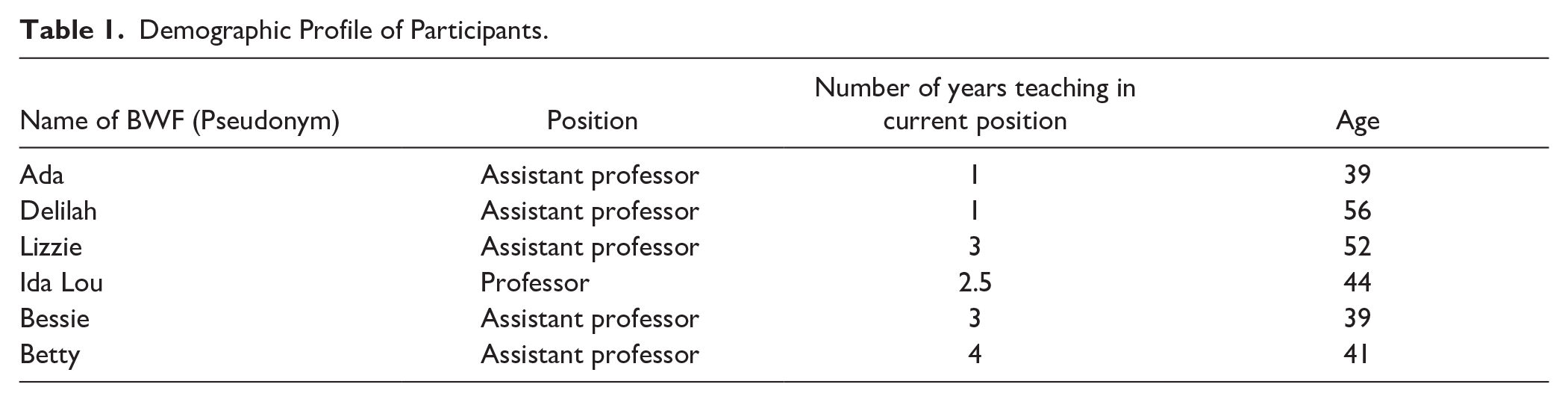
According to Creswell (2007), the selection of 10 participants aligned with the range for a phenomenological design, so 10 participants were chosen for the study. We placed 12 participants’ names in a drawing to reduce bias, and the first 10 pulled names were selected. Then, we sent an email to each of these participants. During the search, we acquired participants from multiple institutions; however, four individuals from other universities could not participate due to personal reasons. Due to time constraints, we decided to move forward with the remaining participants. The remaining six individuals who agreed to participate in the study were all full-time faculty. The participants for this study were from Croom University (pseudonym), a faith-based university in the northeast region of the United States. Their age range was between 39 and 56. The participants served as either assistant (n = 5) or full (n = 1) professors in a master’s counseling education program. Notably, while the university is not an online institution, the master’s degree program is entirely online accredited. For the participants, teaching at the current university ranged from 1 to 4 years. Concentrations in their programs included clinical mental health, school counseling, and marriage and family counseling. Table 1 illustrates the demographics of the study participants.
Demographic Profile of Participants.
Data Collection
A semi-structured interview process was utilized for the data collection effort. Although the study consisted of two researchers, only one of the authors conducted the interviews for consistency. Each interview occurred via Zoom and lasted for approximately 60 min. The participants were asked to respond to 20 open-ended questions during the interview process, which aligned with the research questions. More specifically, five questions were designed to garner background information, five were related to motivation, four questions were related to persistence, and six were related to organizational justice. Interviews were digitally recorded and transcribed with the permission of the participants.
Data Analysis
During the data analysis process, data were coded and analyzed using Braun and Clarke’s (2006) six-phase thematic analysis approach. The process began by reading transcribed data multiple times for clarification purposes. Afterward, we examined the data line-by-line to identify units of analysis. Next, code words and comparable phrases were defined and placed into categories. As the categories crystallized, those most aligned with the research questions were branded. Then, a thematic coding method was utilized across categories to identify themes and subcategories that help to explore the experiences of BWF regarding recruitment, persistence, and organizational justice at PWIs (e.g., the scope, analysis, and what message was being told through each theme was examined.). Afterward, a report was developed that reflected the data across all themes. Member checking was used to establish trustworthiness (M. Q. Patton, 2002). During member checking, we were able to clarify points with participants rather than make assumptions. For example, we asked participants to clarify points about their classroom experiences related to competence and differences in treatment when compared to colleagues.
Findings
This section reports the research findings. The data provided important insights about the experiences of BWF in counselor education programs. The themes that emerged during the analysis included professional life roles, work-life balance, trusted relationships, freedom of faith expression, student perceptions, performance evaluations, space of patriarchy, performative behaviors, systems of support, and subthemes. Notably, the findings will be organized according to the research questions. In this section, we attempted to answer what perceived experiences motivated Black women to accept faculty positions in a counselor education program at a PWI.
Professional Life Roles
Participants described professional life roles (e.g., full-time employment and professional development activities) that influenced them to accept a faculty position at their PWI.
Full-time Employment
Most participants reported that securing full-time employment was significant to their personal life role. Lizzie indicated, “It was important to have a full-time position to be the change I wanted to see in the profession.” Delilah indicated, “A full-time position as a counselor educator can lead to bigger leadership positions, which require you to be a full-time counselor educator.” Professional development was also a significant part of professional life roles.
Professional Development
Some participants described the academic structure at the PWI as well organized, and because of this, the participants were afforded more time to engage in professional development engagements. Delilah stated, “At [current institution], it is very much structured in terms of how the class was to go. Everything is pretty much laid out, and you spend more time engaging with students and other professional development (e.g., student engagement and peer mentoring within the university) activities rather than prepping for the course.” Bessie indicated, “Having time to participate in professional development was a selling point for me. We have online opportunities for faculty to engage in PD to help with teaching and tenure and promotion [e.g., access to online PD that can be accessed at any time].” The following section outlines work-life balance experiences that influenced participants’ decision to accept positions as counselor educators at a PWI.
Work Life Balance
Many of the women highlighted the importance of family and how much they desired to be in a position that offered a work-life balance, and as a result, chose a PWI that offered an online format. Ada described the professional–personal tension experienced between needing to be on campus every day versus her desire to be at home with her children, noting, “I really wanted something that was completely online and to have the flexibility to be at home with my younger children, and to kind of navigate around whatever their needs would be.” For (Betty), remote work provided flexibility in her schedule while managing personal life tasks. She indicated, “I did some research to find programs at Black institutions that had clinical counseling, but they did not really have online programs. So, for me, online teaching was just the best fit because of the life I’m in right now.” Lizzie remarked, “One of the unique things about this particular program is being able to have student interaction as an assistant professor without the obligation of leaving home and working in the evening as most graduate programs are in the evenings….another incentive.” Moreover, remote work catalyzed women to meld their familial and personal life tasks and work-related duties. Next, trusted relationships that influenced BWF’s choice to teach at a PWI are outlined in the following section.
Trusted Relationships
Some participants had established trusted relationships with colleagues, friends, and former faculty members who were knowledgeable about the hiring processes for job opportunities, believed in the participants’ credentials, and encouraged participants to apply for the vacancy. Bessie stated, I had several faculty [members] at the university I’m currently at who asked me to apply. I don’t think I ever really considered PWI or predominately Black. It was never a consideration. So, I went where others thought I would be a good fit.
Other faculty who knew the inner workings of the department culture encouraged participants to apply to the counselor education program. Ada stated, “I was in connection with another counselor educator, and he said, ‘Hey, you should think about doing this.’ I said, “Okay, cool.” So, I did put in an application, got hired, and began the following spring.” Some participants admitted that they had not considered applying for the available positions in counselor education at their PWI until multiple people (e.g., friends, colleagues, and former professors) associated with the program suggested that they apply. Delilah noted, “It wasn’t really on my radar. But then, when I had the director of the Ph.D. program, and two other professors asked if I had considered [applying]. It most certainly made me think twice about applying…I trusted them.” The freedom of faith expression also influenced participants’ decision to choose a PWI.
Freedom of Faith Expression
The university where the women were employed was identified as faith-based, enabling them to live consistently with and express their faith or religious beliefs with colleagues and students without inhibitions. Some participants made such expressions as “I think because it’s a [faith-based] institution … I have the opportunity to send them scriptures daily…weekly (Ada),” “I have gotten so many prayer requests. I know that my students know I care (Delilah), ” or, “I think the faith was more important to me than whether or not it was a PWI or other … because I’m online faculty and I think that’s a hugely different animal than being residential or in-seat (Lizzie).” In sum, the benefits of securing full-time employment, establishing a work-life balance through remote teaching, and freedom of faith expression helped inform the women’s decision to accept a counselor education position at a PWI. While the women described experiences influencing their decision to accept a position at a PWI, some incidents forced them to question their longevity. Subsequently, challenges often faced by BWF counselor educators were identified. The themes that emerged were student perceptions, performance evaluations, and space of patriarchy.
Student Perceptions
Because of stereotypes, biases, and prejudices from students, many participants discussed managing expectations of being Black and a counselor educator rather than being viewed as a counselor educator. There is an expectancy of students of how BWF is supposed to be identified. Ida stated, “Students here have a particular perception of you even before you speak with them. I need to create an awareness and help them unlearn some myths and stereotypes that they have been exposed to from time to time.” Betty said, “They begin the course by calling you by your first name. Then, you have to correct them. They do not want to be corrected.” Compared to their White colleagues, the participants are not afforded similar assumptions of competence.
Delilah indicated, “The students often ask about my ranking to determine if I am a qualified faculty member. They go as far as to ask about my degrees and the schools I attended.” Participants also discussed how others [students] had low expectations of them because of their race and gender, often questioning their level of competence. Bessie indicated, There is the automatic assumption that I am not competent, so the immediate need or desire to fact-check what I have given as instruction, question a directive, or blatantly choose not to respond to an email message or a phone call from an instructor is common.
In another example, a participant discussed an incident between her and a White student and how the outcome was quite different when a similar situation occurred between a White faculty member and the same student. According to Seawright (2018), whiteness is “an organizing principle that conditions normative ways of being in and understanding society that is fundamentally predicated upon the raced body as social signifier” (p. 911). Several authors would agree that whiteness can be associated with white supremacy and the way in which it is operationalized in higher education can be isolating, dehumanizing, and can have physical effects on faculty of color (W. J. Edwards & Ross, 2018; Pittman, 2012; W. A. Smith et al., 2016). Ida indicated, A White female faculty member and I had similar experiences with a student … who was just very disrespectful and challenged us … The student [filed a complaint, which was dismissed]. They were told that they had to stay in my class. And then they asked, “How could they be assured that my grading and review of their work would not be biased?” My grading was evaluated for the rest of our time together. My White female colleague, the entire staff kind of rallied around her and apologized for the student’s behavior.
The findings indicate that both faculty members experienced similar challenges with the student. For the white female faculty member, colleagues offered support and suggested that the student be reprimanded for her behavior. Conversely, colleagues did not provide support for the Black female faculty member. Instead, she was placed under surveillance. The participants also described how the question of their competency forced them into a state of hyper productivity, which was often met with criticism.
Delilah indicated, “As a [Black woman] counselor educator, you have to put your best foot forward…it is not received, it is not…student evaluations…interaction with students in class…some of the utter disrespect that would not otherwise occur if I was not a Black female.” Lizzie stated, “You find yourself overworking to prove yourself as a Black woman. You are working out of fear to try to please the students.” Performance evaluations also reflected negative attitudes toward Black faculty.
Performance Evaluations
Lizzie indicated, “No matter what you do for them, the first time you tell them no, they will give you a bad performance evaluation.” Bessie stated, “You can explain the instructions repeatedly [to the students], meet with them [students], or baby them [students]; they [students] will find fault in your teaching, especially if they do not get the grade, they think they deserve.” When BWF in this study addressed topics of racism, institutional oppression, and privilege, it also impacted participants’ student evaluations. Betty stated, “Maybe once a semester, at least, once a school year, [a student will comment on an evaluation that] I can’t talk too much about race, lay off the race stuff … Never got those in class, ever. Only on evaluations.” Patriarchal power of dominance was also described as being operationalized in the counselor education space, further marginalizing Black women faculty.
Space of Patriarchy
According to Lester et al. (2021), the longstanding acceptance of patriarchal ideologies in academia often placed Black women at the margins. Operating in a dominant patriarchal space has been challenging for Black women counselor educators. Ida indicated, “We would have meetings, and a Black female colleague would make a statement or recommendation, it would be overlooked…. A White male colleague would make the same statement and recommendation…people are like, ‘Oh my gosh, that’s great.’” Lizzie stated, “Your (Black women) ideas are just that, ideas. Your (Black women) ideas are stolen right before your eyes by a White male faculty member. They will restate your idea as if they made it up. Wow!” Despite having similar credentials, White male faculty’s views were highly regarded. Ada stated, “Being a Black female counselor educator is much different. There are ways in which things are handled. Even how students perceive Black female educators is completely different from how they are perceived [in comparison to] other female educators, especially white male educators.” Bessie stated, “They [White men] get to come to the meetings and laugh, be outspoken and arrogant; me, on the other hand, I have to be perfect.” Next, we attempted to answer what perceived factors enabled Black women faculty counselor educators to persist in their careers. Performativity, identifying support systems, and becoming a system of support were themes described to counter the negative normative behavior experienced in their program, which enabled the participants to persist.
Performativity
Performativity is a collection of behaviors that individuals produce based on a constructed social view (Sommerfeldt et al., 2014). Furthermore, the observable act or behavior can be identified as performance. Many participants admitted to their inability to express themselves authentically as Black women and how important it was to be cautious of their behaviors around others. As a result, they engage in performativity for persistence. Ida indicated, “Everything I do, I have to decide which personality I bring to the table…. corporate structure. Do I? Do I not? How do I wear my hair…piercing in my nose? The earrings I wear…the shirt…the pants I wear.” Lizzie noted, “I think of this as a comedy show … just explaining how Black women have to switch … she has to decide how Black she will be today. Because in everything I do, I have to decide [what character I will play today].” Ada indicated, “And here it is, I am shrinking myself down to conform to what society says. I’m supposed to be this little girl…sit in the corner…speak when I am spoken to.” Systems of support were also described as essential to Black women counselor educators’ ability to persist in the academy.
Systems of Support
Upon accepting the position of faculty of counselor education at a PWI, the participants were able to establish systems of support. The participants sometimes felt a sense of community in their interactions and were recipients of support.
Recipients of Support
Delilah noted, “Being online. The first two or three times with the staff meeting, a dozen people knew me more from an academic perspective. They just reached out and said, ‘Hey, I see you, congratulations. Welcome aboard.’” Lizzie also received a welcoming reception, indicating, “People I hadn’t seen in years, they would send a chat on Microsoft teams…. I knew you were here. Congratulations and welcome and that kind of thing. It was very heartfelt and warm.” The findings also revealed that not only were BWF recipients of support but also offered support for Black women students and acknowledged how building community was significant in their ability to persist.
Providing Support
Ida commented, “If I crossed paths with students [of color] in higher ed., I was going to make sure that they knew I was there to support them. And if they needed a listening ear, I could be here for them.” For many Black women students at PWIs, the academic journey can be lonely, and students may require some support. Betty indicated, “I’ve put forth a lot of effort to engage my students that way.… If they don’t have something created for students of color, I hope I can be one of those people to help build it in. You gotta build your community.” It was also important for participants to support emerging Black women counselors and counselor educators through mentoring, professional development, and advocacy. Participants made such comments as, “What I can do is train up the next generation [counselor educators] (Lizzie),” “One of the reasons for going to this PWI…is to show up for minority students (Bessie),” “I advise my students about the realities of working in the field that Black females underrepresent (Ada),” or “Our job is fortifying. I fortify those Black female students who stand up for themselves (Delilah).”
The findings emphasized the importance of understanding not only the contemptuous spaces of academia, which often place Black women counselor educators in precarious positions and cause them to question their longevity, but also what attracted them to this position (i.e., professional life roles, work-life balance, freedom of faith expression, and recognizing trusted relationships). Moreover, the findings indicated that identifying support systems helped Black women faculty in counselor education programs to persist in these contemptuous spaces.
Discussion
This study intentionally focuses on BWF counselor educators to make their experiences relevant. Findings from this study corroborate similar research on BWF that highlights faculty recruitment, intersections of oppression, injustices often experienced in the academy, and strategies for persistence.
Faculty Recruitment
For this study, each participant was able to secure a full-time tenure track position, which was essential for them to accept the position at their PWI. Personal relationships with employees at the institution also influenced the women’s decision to work at a PWI. Established relationships with individuals privy to information regarding program vacancies afforded the participants a unique advantage in securing employment at their university. The current study’s findings confirmed other research, which indicates that when Black women become attached to networking systems for social capital building, this can lead to upward mobility (Alfred, 2010). Moreover, when women become attached to social networks, their chances of becoming economically self-sufficient increase (Alfred, 2010; Nanton, 2009).
The participants in this study taught in an entirely online master’s program, which can impact faculty interaction between students and other faculty members (Major & Sumner, 2018). Although teaching in online environments can impact faculty-to-faculty interactions, for BWF in the current study, being able to work remotely influenced their decision to accept a faculty position in the counselor education program at a PWI. The flexibility of teaching remotely enabled the participants to engage in familial or personal tasks while meeting the demands of the workplace, thus creating a work-life balance. For example, a participant indicated, “I really wanted something completely online…flexibility… to be at home with my younger children…navigate around their needs.” The current study’s findings seem to align with other research suggesting that women’s caretaking responsibilities can create work-life conflict. Several authors would agree that care responsibilities often become the responsibility of women, and because of this, work-life conflict becomes a major stressor for women, especially women of color (Blithe & Elliott, 2020; Long et al., 2018). In a study, Trepal and Stintchfield (2012) found that in the past, working mothers in counselor education programs had limited opportunities in the academy due to their caretaking responsibilities. More specifically, mothers were being punished for caring for their children. Similarly, Stephens and Coryell (2020) conducted a study and discovered that teaching online offered the flexibility for a work-life balance, which aligns with the current study’s findings.
Lastly, freedom of faith expression also influenced participants’ decision to teach at their PWI. Many participants would discuss scriptures and respond to prayer requests during interactions with other faculty members. Lester et al. (2021) found that when spirituality was inspired in the workplace, employees felt more satisfied with their environment, were committed to workplace tasks, had lower absenteeism rates, and increased productivity. Hiring these counselor educators is a step in the right direction, given the underrepresentation of BWF across PWIs and academic disciplines (Howard-Baptiste & Harris, 2014). Notably, while the findings from the current study are significant, more research is needed to increase the visibility of BWF in counselor education programs. While the respondents described characteristics that influenced their decision to teach at a PWI, the women also described experiences (i.e., intersections of oppression) that caused them to question their longevity.
Intersections of Oppression
Notably, Black women faculty across PWIs and disciplines face challenges in the academy. In alignment with the ACA code of ethics, CACREP standards are designed to prohibit the intersections of oppression that Black women in counselor education programs often face in higher education. CACREP standards require higher education institutions to attract and retain diverse students and faculty. Moreover, CACREP standards insist that counselor educators dismantle these systems of oppression. Although the participants did not express the dichotomy, it was evident in the current research. What CACREP espouses starkly contrasts with what participants face as BWF in counselor education. Despite the code of ethics, participants faced multiple forms of oppression in sociocultural and interpersonal contexts in higher education, which can be examined through the lenses of organizational justice (i.e., distributive, procedural, informational, and interpersonal injustices).
For example, participants were often viewed as incompetent by both faculty and students (interpersonal injustice), placed under surveillance by the administration to appease White students who were problematic (procedural injustice), received evaluations with malicious comments, which can impact tenure and promotions (interpersonal injustice), and received harsher punishments than their White colleagues for similar incidents (distributive injustice), and their ideas were usually ignored or stolen by their White male counterparts and repackaged and were well received (information injustice), all of which are rooted in racism and sexism. Figure 1 illustrates the components of organizational justice in relation to the injustices BWF counselor educators often face. Perceptions of Black women faculty are evident in the literature (L. D. Patton & Haynes, 2018; Settles et al., 2020). The negative feelings toward BWF can influence student-teacher interactions and how students respond to teacher evaluations. Such responses can impact tenure and promotion (Dade et al., 2015). However, if there are areas of opportunity noted on teacher evaluations, Gardner et al. (2014) suggested that successful mentoring relationships can help BWF counselor educators address possible deficiencies. Given that the current study’s participants teach in fully online programs, which may interfere with their face-to-face interactions with other faculty, they may consider unique strategies for mentoring in an online environment. Seemingly, the only time that BWF in counselor education took center stage was when they were being criticized or reprimanded. Moreover, the participants’ perceptions of workplace discrimination and organizational injustice reflect a criticism of the university’s human resources policy or work culture. Participants also described experiences of working in the space of patriarchy where White male dominance was often practiced, and BWF were treated as if they were invisible (procedural and interactional injustices).
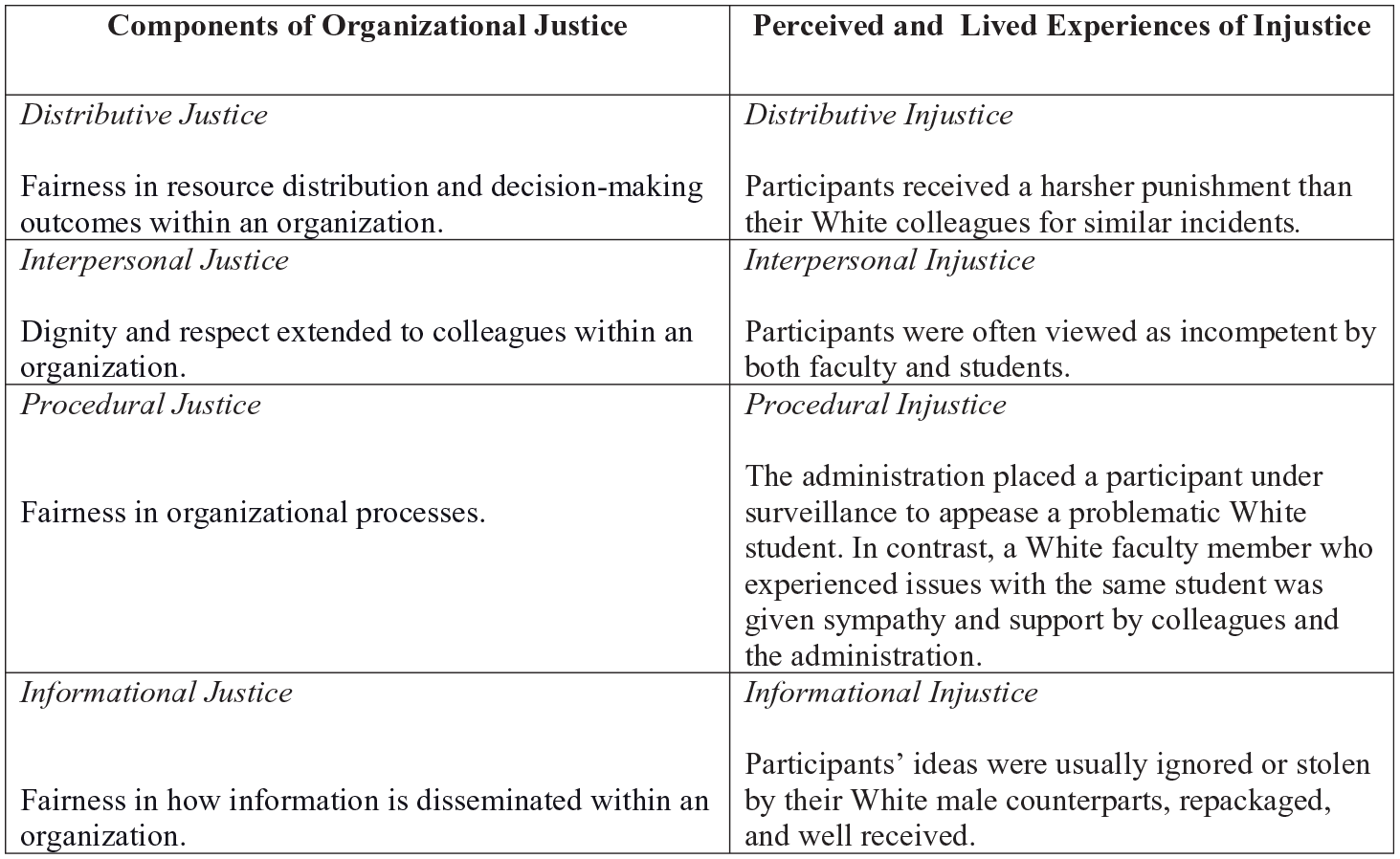
Perceived and lived experiences of organizational injustices among Black women faculty at a Predominately White Institution.
The White male patriarchal power of dominance was confirmed in the literature (Lester et al., 2021). These findings seem to align with the research of Hooks (2015) that highlights the subjugation of Black women through White male patriarchal power in the academy. She also acknowledges the Black male oppression of Black women, calling attention to the sexism practiced in the academy but seldom discussed (Hooks, 2015), which was not revealed in the current research but is a noteworthy point of discussion. According to Leva et al. (2021), it can be traumatizing when higher education markets create systematically unjust environments for BWF counselor educators. Based on the research findings, the participants’ university did not offer any social support systems or care plans to help them cope with the injustices they often experienced. Instead, the women were left to their devices to learn strategies for persistence in order to navigate the unjust academic environment.
Strategies for Persistence
Baumgartner (2012) indicated that Black women often engage in informal learning to manage chronic illnesses. Still, such learning can also be applied to BWF counselor educators when navigating their environment’s chronic injustices for persistence. Although participants acknowledged White allies, they indicated that their primary support systems were BWF in their counselor education program, across the university, and in counselor education programs outside the university, who offered strategies for learning to navigate the hostile academic environment. According to the literature, when Black women engage in informal learning during challenging times, it fosters hope and empowerment (Johnson-Bailey, 2021). The participants recognized networking systems (Albertini, 2009; Alfred, 2010; Nanton, 2009) as catalysts for learning. The findings also revealed that BWF counselor educators received support, offered support to Black women students, and acknowledged the significance of building community. The current study’s findings align with Bush's (2013) research, which indicated that when BWF build community and offer mentorship to other BWF and other African American students, it helps them persist in their environment. The current research findings also align with the work of Alston and Hansman (2020), who state that mentoring among women is essential in any learning process. The participants were not only reaching up, but they too were reaching out to support other Black female counselor educators. BWF counselor educators in the current study also learned to assume a different persona to persist in the oppressive academic environment, which can be labor-intensive over time. The findings seem to align with the research of Jones et al. (2015), which suggests that BWF learn to put on a “happy face” as a strategy for persistence in the academy. Moreover, participants had to play multiple roles to navigate the unpredictable and oppressive environment, which can be noted as performance labor (Killough et al., 2017). Systems of oppression manifest through various forms of injustice, which can be traumatizing. Therefore, it is essential for BWF counselor educators to be self-directed in their learning for self-care and to address their traumatic experiences. In subsequent paragraphs, implications and recommendations for promoting the success of BWF counselor educators in higher education using BFT, organizational justice, and informal learning as the roadmap are outlined.
Implications and Recommendations
The findings from the current study highlight the need for systemic change to ensure that BWF in counselor education programs feel valued among faculty, students, administrators, and policymakers. Using a top-down approach, BWF in counselor education programs should begin to challenge policies and policymakers constructing the ACA code of ethics and CACREP standards and reveal their contradictions. The standards give the impression that BWF in counselor education programs is a protected class. However, the organizational injustices these women often experience are the opposite of the security these standards promise to uphold. Instead, the CACREP standards should read that BWF counselor educators choose to work at their PWI because the position offers full-time employment, a work-life balance, trusted relationships, and religious freedom. However, once BWF counselor educators accept the job, they may face intersections of injustices within the organization and patriarchal oppression. Because of this, they may have to change into character or look for systems of support to manage their environment. The standards were constructed based on normative ideals using a one-size-fits-all model of professionalism, suggesting that all employees are treated fairly. BWF counselor educators can serve in leadership roles in faculty communities to dismantle these systems of oppression from inside the academy that maintains the status quo. Narrowing the scope, the administration is responsible for addressing oppressive behaviors in higher education.
It is also essential for the administration to engage in informal learning to fully understand the historical context of race and racism in higher education and its impact on BWF counselor educators. The administration must also be reflective to determine how much they perpetuate the marginalization and subjugation of BWF counselor educators and encourage other colleagues to do the same. When individuals engage in incidental learning as informal learning, they develop skills and abilities to interact, work with others, and create a sense of connectedness to those they serve (e.g., Ross-Gordon & Dowling, 1995), like BWF counselor educators. Additionally, hooks (2015) indicated that while White male dominance is deeply rooted in the academy, White men do not act alone in the maltreatment of Black women. Therefore, it is essential for Black male faculty counselor educators to engage in critical reflection to understand their contributions to the oppression of BWF counselor educators and collaborate with White allies to confront the practices that hurt these women both professionally and personally. Although Black females are touted as overcoming organizational injustices of ridicule, marginalization, sabotage, alienation, isolation, and lack of information from department colleagues (Ferguson et al., 2021; Jones et al., 2015), the experiences can be traumatizing. BWF counselor educators can develop a trauma care plan (TCP) for self-care to manage such traumatic events.
When considering developing a TCP, it is essential for BWF counselor educators to collaborate with adult and health educators. The TCP can be guided by adult learning principles (e.g., immediate application, life-centered and goal-oriented, self-directed, and motivation, Knowles et al., 2020) and be specific to the needs of the counselor educator while considering the discrimination and organizational injustices they often face in the academy. This sample plan may provide new directions to policymakers and human resource departments of universities and higher education departments. The TCP must be easily accessible so counselor educators can reference the plan whenever they experience a triggering event. Borrowing from the work of Moss (2020), in the first step, the counselor educator can identify strategies for coping (at least two) and methods for engaging in meaningful work within their traumatic experiences. Writing realistic and measurable plans is essential. In the second step, the counselor educator should explore obstacles that may prevent them from implementing their strategies for addressing trauma. In the third step, using “I will” statements, the counselor educator can develop strategies to overcome barriers that may prevent them from managing their trauma. In the fourth step, using “I will” statements, the counselor educator can identify support systems (e.g., spouse/partner, other BWF counselor educators, other Black women faculty, White allies, and student counselor educators) and their specific helping roles. Lastly, it is essential for BWF counselor educators to feel empowered to put the plan into practice. When BWF counselor educators learn to develop a TCP, it is a step toward healing (Johnson-Bailey, 2021) and self-care, given the inescapable organizational injustices they often face.
Conclusion
BWF’s marginalized experiences remain at the bottom of the higher education agenda. In this research, we wanted to capture and share the lived experiences regarding recruitment, persistence, and organizational injustice among BWF counselor educators at a PWI to expand the conversation. The current study threaded distributive, procedural, and interactional injustices throughout BWF counselor educators’ experiences. We also offered implications and recommendations for faculty, administrators, policymakers, human resource professionals, adult, health, and counselor educators. Self-care strategies for BWF counselor educators were also recommended.
As with any study, there were some noticeable limitations. For example, the findings are not generalizable to all BWF counselor educators. Also, although these findings add fresh insights, only six participants were selected for the study. Electing to conduct studies with larger cohorts of BWF counselor educators would offer nuanced experiences. These findings from this study can benefit faculty, staff, and administrators in counselor education programs at PWIs, HBCUs, and other higher education institutions. The self-care strategy offered can help BWF counselor educators across universities manage traumatic experiences. Adult and health educators and human resource development professionals can benefit from the findings when planning interventions in the workplace. Future research may focus on Black men and their contribution to the subjugation and domination of BWF in counselor education programs at PWIs and other academic spaces and recommendations for addressing behaviors of dominance. Research focusing on the experiences of BWF counselor educators at HBCUs is also worth pursuing.
Footnotes
Declaration of Conflicting Interests
The author(s) declared no potential conflicts of interest with respect to the research, authorship, and/or publication of this article.
Funding
The author(s) received no financial support for the research, authorship, and/or publication of this article.
