




Abstract
With gendered organization theory and n = 201 Historically Black Colleges and Universities women faculty, the following is addressed:
Keywords
Overview of Workplace Bullying
“My university encourages bullying from the top down, especially against female employees. They also are punitive if anyone tries to speak out against bullying.” Respondent #150- March, 2020
Since the mid-1990s, researchers have studied the organizational and leadership factors that enable workplace bullying (Bassman, 1992; Einarsen et al., 1994; Rayner, 1997; Yamada, 1999). Workplace bullying occurs when someone with more organizational, expert, or reverent power abuses that power to consistently relegate the target to an inferior position (Zabrodska et al., 2016). The target of such abuse often is given last-minute tasks, maliciously insulted in open meetings, or embarrassed via group emails (Namie & Namie, 2009). In higher education, workplace bullying includes threatening professional status or denying vital resources the target needs for career advancement (Keashly & Neuman, 2010; Twale, 2017). Many targets reported being subjected to cursing, yelling, hostility, and other rude communication problems (Hollis, 2015; Johnson & Indvik, 2001). In higher education, bullies also engage in passive-aggressive behaviors such as denying travel funds, the silent treatment, moving lab equipment, assigning overloaded classes, and assigning unfavorable class time (Heffernan & Bosetti, 2021; Twale, 2017). These behaviors are not an exhaustive list; nonetheless, workplace bullies can destroy one’s health.
Workplace bullying also precipitates higher turnover rates. In their study of 373 employees, Coetzee and van Dyk (2018) found a strong association between workplace bullying and faculty departing the university. Salin and Notelaers (2017) studied 1148 employees who considered workplace bullying as a psychological and humanitarian contract violation. Though the targets’ organizational positions were not related to turnover, kind-hearted employees with a cordial and gracious persona were more traumatized by aggressive behavior. They reacted with their plans to leave the organization (Salin & Notelaers, 2017). Their departure only entrenched aberrant employees who fortified workplace toxicity.
Additionally, research confirms that workplace bullying leads to health-harming problems. Those affected by workplace bullying and the resulting toxic work environment have reported insomnia, depression, anxiety, stress, self-medicating behaviors, post-traumatic stress, and suicidal ideation (Hollis, 2021; Leach et al., 2017; Islamoska et al., 2018; Rodriguez-Munoz et al., 2011; White, 2004). The deleterious organizational impact explains why Scandinavia, France, Turkey, Canada, and Australia have banned workplace bullying, making it legally actionable (Cobb, 2017).
Workplace Bullying and Higher Education Women Faculty
Regardless of how it manifests, workplace bullying for academic faculty often deters career advancement (Frazier, 2011). As Frazier (2011) also noted by citing Thompson (2008), workplace bullying jeopardizes the academic socialization often needed for a successful bid for tenure. Stated otherwise, while bullied colleagues are consumed with surviving workplace abuse, that same faculty member may lose the laser focus required to compete effectively for tenure and promotion (Matthiesen & Einarsen, 2010; Salin, 2011). Additionally, one can reflect on exacerbated work-related dissatisfaction and chronic health problems (Wang, 2006).
To further explore the impact of workplace bullying on tenure and subsequent career ascensions, studies confirm that the subjective tenure review process can hurt marginalized faculty (Kelly & Winkle-Wagner, 2017). Frazier (2011), along with Patitu and Hinton (2003), note the inconsistent messages given to candidates (Bertand et al., 2020; Smooth, 2016). For example, inaccurate mentoring hurts a candidate crafting her tenure dossier.
Within maleficent institutional dynamics, women faculty do not ascend in their faculty careers as quickly as men at HBCUs; therefore, they are denied faculty rank and corresponding power to influence structural changes in policy or procedure that could support women. This slow ascendence for women is not only associated with pay inequity practices. With tenure and promotion committees are disproportionately composed of men, but these committees often do also not appreciate feminist and womanist approaches with the same enthusiasm for men’s scholarship (Hanasono et al., 2019; Smith et al., 2004; Weisshaar, 2017).
Ironically, the legislation already is in place to change structures that deny women equity and access. The 1963 Equal Pay Act was updated in 2009 with the Lilly Ledbetter Equal Pay Act (Siniscalco et al., 2014). Since that time, several states have strengthened unequal pay laws. Nonetheless, unequal pay remains a stubborn and often unaddressed problem at many universities (Li et al., 2019; Monroe, 2015). In 1972, Title IX was passed to establish educational parity for women. Though women are now earning terminal degrees faster than men, women are still predominantly locked out of cabinet-level positions.
The 1964 Civil Rights Laws, which prohibit gender bias, were updated in 1978 to prohibit pregnancy discrimination (Siegel & Siegel, 2010). In the late 1980s, the court finally recognized sexual harassment as a form of gender bias (Hollis, 2015; Crawford, 1994). However, as demonstrated by the #MeToo Movement, career women still face gender-based harassment. Plausibly, if more women could rightfully ascend through their careers, higher education could be more compliant with federally mandated equity standards.
Additionally, many institutions have instituted anti-bullying policies for their campuses. However, numerous targets of workplace bullying do not trust the organizational response (D’Cruz & Noronha, 2010; Harrington et al., 2012). Cowan (2011) stated that policies fall short of offering protection because, in the United States, workplace bullying is not strictly prohibited and actionable alone. In contrast, when an employee files a Title VII complaint, civil rights laws require institutions to conduct investigations.
The few states that have instituted some policies have not established institutional responsibility for workplace bullying complaints. California, Maryland, Tennessee, Minnesota, and Utah have state policies, yet typically the laws offer guidelines for how institutions can avoid culpability for workplace bullying instead of intervening to stop such abuse. A few colleges such as the University of South Carolina, University of Wisconsin, and the University of California- Berkeley have strong policies which include informal and formal dispute resolution options, and the outline for investigations (Keashly & Hollis, 2022, in press).In short, a solid policy needs to articulate the issue it addresses clearly; sound policy clarifies the personnel accountable for responding and those responsible for monitoring the policy’s effectiveness (Ferris et al., 2021; Gardner & Cooper-Thomas, 2021). Without the federal mandate to prohibit workplace bullying, the organization typically fails to address bullying. At the time of this writing, only Puerto Rico has instituted a policy with territory-wide mandated processes to eradicate workplace bullying (Government of Puerto Rico, 2020; Keashly & Hollis, 2022, in press).
Additionally, studies show that workplace bullying is often, though not exclusively, a gendered phenomenon (Carrera-Fernández et al., 2018; Hollis, 2018; Salin & Hoel, 2013). Women in higher education normally have less powerful positions, which translates to less self-determination in their careers. When coupled with the escalating nature of workplace bullying, the sexist dynamics in higher education can precipitate career disruptions (Hollis, 2018). Such disruptions occur when bullying successfully eliminates the target who flees the institution. The bully also can deny the target access to resources such as research funds, or graduate assistants. (O’Meara et al., 2017). When bullying behaviors intensify, the culmination of bullying can repeatedly manifest in the denial of tenure and promotion.
Theory: Gendered Organization
Though Title IX was passed in 1972, Title VII in 1964, and the Pay Equity Act of 1963, women still operate in what Hanasono et al. (2019) deem as gendered organizations in higher education. Hence, regardless of the institutional type, women do not experience the same rights and privileges in access, salary, tenure, promotion, and leadership as their male counterparts (Blackshear & Hollis, 2021). Just as the Constitution was flawed at its inception by excluding women’s rights, American higher education generally embraces the same fundamental deficiency of excluding women.
Historically, higher education has limited women’s access; however, Snyder et al. (2019) confirm that women outpace men in degree attainment. Though women have earned more than 50% of the doctoral degrees since 2006, as of 2015, women are only 32% of full professors (Johnson, 2017). In addition, as of 2016, women hold only 30% of higher education presidencies and only 38% of all chief academic officers (Johnson, 2017). Though degree attainment for women has improved, women faculty endure discrimination in all divisions of higher education (Connelly & Ghodsee, 2011). The suppression of women faculty manifests through unequal pay, minimal mentorship, disproportionate service obligations, and workplace harassment (Connelly & Ghodsee, 2011; Kaatz & Carnes, 2014; Nadler et al., 2013). Consequently, merely one in four women serves as higher education presidents (Eddy & Ward, 2017; O’Connor, 2019).
Acker’s (1990) work on gendered organizations provides a natural theoretical application. To declare that an organization is “gendered” recognizes that the structures, communication, and power revolve around masculine processes. The executives in most organizations are men, whereas men in the hierarchical structure dominate many. Therefore, the policies governing work and productivity are delivered through power-driven directives, not egalitarian humanitarianism (Ackers, 1990).
As previously noted, higher education remains a male-dominated structure, as it has been since its inception. Men created the pursuit of a baccalaureate degree for men, hence the title, bachelor’s degree. An advanced degree is a master’s degree to designate a man with control or advanced power. Other policies and structures fortify the male perspective. For example, historically, doctoral programs have required an in-person residency. Ford (2016) notes that this traditional model for doctoral degree attainment assumed that the doctoral candidate had personal support to leave his job for at least a year, earn no money, and potentially sustain a family. The wife, who also served as babysitter, cook, maid, and typist, shouldered the task of providing personal, financial, and familial support for male doctoral students. However, inverted examples seldom exist; a woman typically does not have a selfless help partner in caring for the house, finances, and family while she blithely immerses herself in her library’s private office.
Women in the academy are still navigating the patriarchal structures of unequal pay, gender-based harassment, and inadequate leadership opportunities. Instead of offering flextime, which is proven to enhance employee commitment (McNall et al., 2009), most bureaucracies maintain a strict 9:00 a.m. to 5:00 p.m. schedule that creates tremendous stress for employees juggling a work–life balance (Steier, 2013). In just the past 20 years, provosts have begun to extend the tenure clock to accommodate women’s childbearing years, though research has confirmed that the ticking tenure clock and ticking biological clock results in female faculty being overwhelmed in both her professional and family domains (Armenti, 2004; Ward & Wolf-Wendel, 2004).
To balance the power along gender lines, more women need to advance to full professorship, the gateway to executive administration (Tunguz, 2016). Park (2020) commented that the unsuccessful tenure bid is not exclusively the faculty member’s failure. The denial stems from years of improper mentoring from the academic department. While men have the built-in “ole boy’s network,” women who are comparatively new to the 400-plus year exclusionary and male-dominated higher education space find that meritocracy is only part of the tenure process (Park, 2020). The hegemonic masculinity woven through higher education culture eclipses women’s achievement through the subjectively capricious human factors routinely infused into the tenure and promotion process (Hao, 2003). Amorphous terms like “collegiality” and “fit” are used tirelessly to deny tenure, despite the candidate receiving positive feedback in various tenure-track reviews; then, she is blind-sided with a tenure denial (Glausiusz, 2019; Mawdsley, 1999). The dynamic is notably precarious if the vulnerable junior faculty does not have the department chair’s or dean’s favor (Haviland et al., 2017).
Women’s disproportionate service responsibilities include advising and mentoring students in the academy (Hanasono et al., 2019; Misra et al., 2021). Such service is often considered women’s work and assigned less significance in the tenure and promotion process. The irony of women’s service and the evaluation of such service emerges from students who often have traditional perspectives about the professoriate; accordingly, students often view women as second-rate scholars (Deo, 2017). Too often, teaching evaluations criticize women scholars, especially if she is the first woman or woman of color that students experience (Bavishi et al., 2010; Cothran, 2016). Women faculty in any higher education environment do not fit the traditional paradigm of white male praxis. The evidentiary point of view acknowledges that women’s work in higher education commands less status, less pay, and less consideration (Sayce & Acker, 2012).The historical dynamics, patriarchal expectations, and questionable support for women’s scholarship create an environment ripe for abuse of power at the organizational and individual levels (Hollis, 2021; Kelly et al., 2018). At the organizational level, when the culture still expects scholarship, teaching, and service informed by masculine conventions, women are afforded little power in reconciling such conflicts. On the individual level, if full professors, department chairs, and deans do not make a concerted effort for all candidates, regardless of gender, to have equitable access to research resources and plum committee assignments, women, regardless of merit, will continuously be subjected to the myth of meritocracy (Alvarado, 2010). In addition, this spirit murdering tenure process leaves many women tenure candidates grappling with self-deprecating thoughts that they are inadequate, when in fact, denials can represent failing to be white enough or male enough to fit in that department (Alvarado, 2010; Freire, 1970).
HBCUs and Gender
As derivatives of white institutions, HBCUs were frequently founded and sustained by white men. Religious groups and white philanthropists founded these schools to train formerly enslaved people. Hence, many HBCUs needed white philanthropists like Rockefeller, Standard Oil founder, and Rosendale, Sears Roebuck partner to train emancipated (Lovett, 2011; Le Melle, 2002),
As Hague (2018) noted, HBCUs have relied on women for over 100 years to develop and fight for racial equality despite the injustices that HBCU women weathered. For example, HBCU administrations usually did not pay women equally as similarly qualified men. Women who arrived with their husbands, or were recruited from the local area, did not have the same bargaining power for equitable salaries (Thompson, 1973). In addition, white HBCU presidents continued the patriarchal dismissal of women by ignoring their academic titles and instead of invoking inappropriately familiar terms like “auntie” or “gal” (Gasman, 2007).
Nonetheless, women at HBCUs remained committed to the mission of educating Black students, even within the institutional milieu of sexist animus (Moses, 1989). In fact, Spencer (2018) opines that HBCUs have become “a de facto segregated community wherein the bourgeoisie…have established status power and dominance purveyors and practitioners of individualism, class-based elitism, colorism, sexism, and paternalism” (p. 52). In the past decade, HBCU women operating from their minoritized positions have documented their isolating experiences (Files-Thompson & Byrd, 2020). HBCUs may provide safe spaces from racism but simultaneously leave sexist ideologies intact (Elliott et al., 2018).
Regarding faculty development, women still typically devise career strategies without mentoring and pay equity (Bonner, 2001). Bonner also noted that many women were fearful of exposing the sexism; the experiences are particularly extreme, leaving some women faculty members “vowing never to work at another Black school” (Bonner, 2001, p. 178). With such dynamics still operating, HBCUs continue to exclude women from executive positions (Gasman, 2007).
Nevertheless, this literature review is not meant to only criticize HBCUs for endemic sexism. Like predominantly white institutions (PWIs) and other employment sectors of government, medicine, and business, HBCUs are steeped in and a product of centuries of patriarchal and gender-based dogma. Sexism remains an indelible societal issue that represses women. As the derivative of PWIs and the rich white men who graduated from elite collegiate institutions, HBCUs remain an understudied sector in education (Hague, 2018; Mobley, 2015). Consequently, gender equity issues at HBCUs also warrant further investigation.
Methods
Research Questions
To analyze women faculty’s experiences with workplace bullying at HBCUs, I used a sample of 201 women faculty from 45 HBCUs across 15 states to address the following:
This research question was addressed with a chi-square analysis.
This research question was addressed with a multiple regression analysis. As the question relies on respondents to totally complete the survey to yield the composite variables, this question was based on n = 162, the number of women who answered all required survey questions for this analysis.
Procedures
To answer the research questions, I collected data in the spring of 2020 from HBCU faculty, lecturers, assistant professors, associate professors, and full professors from 45 HBCUs. One thousand HBCU faculty members were invited to participate in the study via email, resulting in n = 351, a 35% response rate engaging the survey. Of that n = 351, n = 201 of the respondents were women.
Since 1997, social media has proliferated along with researchers using the Internet to distribute Qualtrics, Google Forms, and SurveyMonkey-based surveys. With this flood of surveys, potential respondents seldom consider participation as a novel experience and instead are relatively desensitized within the flurry of requests. Dillman et al. (2014) use data from the Pew Research Center in an analysis of declined response rates over the past two decades. In 1997, the Pew Center, a nationally recognized research group, typically garnered a 90% response rate, yet in 2012, the response rates dropped to 62%. Cooperation rates (completion of the instrument) dropped from 43% to 14% in the same period (Kohut et al., 2012). Therefore, this study's 35% response rate and the 31% cooperation rate are acceptable.
From February 2020 through April 2020, I circulated the SurveyMonkeyTM instrument to the HBCU faculty members. These HBCUs were in Maryland, Virginia, North Carolina, South Carolina, Ohio, Florida, Texas, Oklahoma, Arkansas, Tennessee, Georgia, Kentucky, Mississippi, Alabama, and Louisiana. I used the following definition to confirm workplace bullying as: harassing, offending, socially excluding someone or negatively affecting someone’s work tasks. It occurs repeatedly and regularly, over a period. With the escalating process, the person confronted [is] in an inferior position and becomes the target of systematic negative social acts (Einarsen et al., 2011, p. 22).
The Sample
This sample represents various HBCUs types, from small liberal arts colleges to research institutions. However, just as I did not ask respondents to name their HBCU to protect their anonymity, I did not ask about the state because some states have only one or two HBCUs Asking the institution’s state could result in personally identifiable data. Therefore, I could not measure the skewness for state location or region.
The respondents’ ages range was between 23 and 71, with the median age range at 51–60. Sixty-two percent were Black/African American; 27% were White/Caucasian; six percent claimed mix-race status; three percent were Asian; two percent were Hispanic/Latinx. Ninety-five percent reported being straight/heterosexual; two percent chose “other.” Further, 81% were doctorly trained, the remaining held a master’s degree. The respondents were asked about workplace bullying experiences in the 2 years before the study.
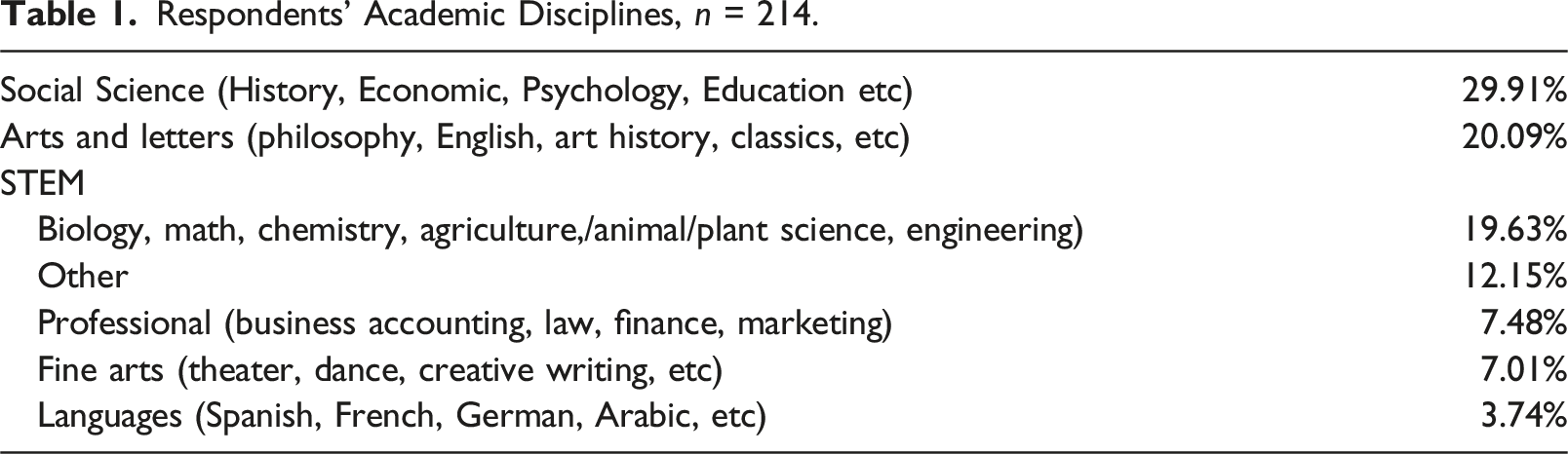
Respondents’ Academic Disciplines, n = 214.
Validity and Reliability
Consistent with Creswell’s recommendation for beta-testing (2014), the survey for this study was validated by a rigorous beta-testing process in which seven HBCU faculty reviewed the instrument. I also conducted a Cronbach Alpha using Excel for each variable using n = 19 completed sample responses. Nineteen is an appropriate number as it is just above 10% of the sample of n = 162. Following guidance from the National Institute of Health, I considered a variable to be reliable with a Cronbach’s alpha coefficient of .7 or higher for each composite score, all of which were built with Likert scale questions (Bujang et al., 2018). As with many studies on provocative topics, the response rate was diminished (Kohut et al., 2012). Most survey research that addresses abuse, sex, illness, corruption, and controversial political positions attain few responses (Ruel et al., 2015). With smaller sample sizes, one might reflect on possible threats to validity. However, Hendra and Hill (2019) dispel the traditional notion that nonresponse bias negatively influences the findings. A study of 12,000 respondents found a “scant relationship between survey nonresponse bias and response rates” (p. 308).
On the contrary, Hendra and Hill (2019) found that extending the data collection window to achieve a larger sample yields other problems such as the expense in extending the study for a response rate that does not further enhance the study. Other researchers note no established standard about the reasonable response rates across different academic disciplines (Sataloff & Vontela, 2021). Bennett et al. (2011) analyzed top journals representing 33 specialties to find that acceptable response rates have been as high as 75% to not being reported. When coupled with Hendra and Hill (2019), Bennett et al. (2011) provide an alternative view on response rates and potential questions about low rates and validity. Further, the study is limited to those with an affinity to complete a provocative online survey. Ruel et al. (2015) note that respondents may feel apprehensive about reporting their work experiences when they are contacted through their work emails.
Please see the coefficient for each of the variables, bullying intensity, built on seven questions, α = .90; time, built on five items, α = .78; health, built on two items α = .65 and trust, built on five items, α = .87. The coefficient of α = .65 for health is the weakest of the four variables but in the acceptable range when rounding to the next number. Also, note that the health variable was built with only two scores to develop the composite score.
Limitation
As with many studies on provocative topics, the response rate was diminished (Kohut et al., 2012). Most survey research that addresses abuse, sex, illness, corruption, and controversial political positions garner few responses (Ruel et al., 2015). With smaller sample sizes, one might reflect on possible threats to validity. However, Hendra and Hill (2019) dispel the traditional notion that nonresponse bias negatively influences the findings. A study of 12,000 respondents found a “scant relationship between survey nonresponse bias and response rates” (p. 308).
On the contrary, Hendra and Hill (2019) found that extending the data collection window to achieve a larger sample yields other problems such as the expense in extending the study for a response rate that does not further enhance the study. Other researchers note no established standard about the reasonable response rates across different academic disciplines (Sataloff & Vontela, 2021). Bennett et al. (2011) analyzed top journals representing 33 specialties to find that acceptable response rates have been as high as 75% to not being reported. When coupled with Hendra and Hill (2019), Bennett et al. (2011) provide an alternative view on response rates and potential questions about low rates and validity. Further, the study is limited to those with an affinity to complete a provocative online survey. Ruel et al. (2015) note that respondents may feel apprehensive about reporting their work experiences when they are contacted through their work emails.
Findings
Reflecting on the gendered environment at HBCUs, which leads to bullying, 66% of women respondents from this sample reported that they feel minimally valued or not valued. From the same sample, 49% of respondents stated that they have minimal to absolutely no trust for their HBCU. In congruence with Bonner (2001), 25% of the respondents from this study stated they would never work at or prefer not to work at an HBCU. Consistent with other studies on workplace bullying, the HBCU women respondents reported panic and anxiety attacks, insomnia, depression, and weight issues (Nielsen et al., 2014). Others reported problems that included hair loss, Grand Mal seizures, and premature childbirth.
To produce a comprehensive analysis of women’s experiences at HBCUs, I used a chi-square analysis, a multiple regression analysis, and a qualitative content analysis to examine the data. This mixed method approach collected three types of data, nominal, ordinal, and narrative (Plowright, 2011). The nominal data in the chi-square test produces a yes/no answers; for a more comprehensive statistical analysis, I used an ordinal Likert scale signifying a continuing quality for the multiple regression data. Though the statistical tests confirm significance, the narrative data for the qualitative content analysis provides the respondents’ perceptions. Thus, the findings should be considered in tandem regarding the intensity of workplace bullying, the resulting health problems, organizational trust, and the personal impact on the respondents.
Chi-Square Findings
Chi-Square Analysis of Workplace Bullying at HBCUs for Women in Presence of Policy N = 201.
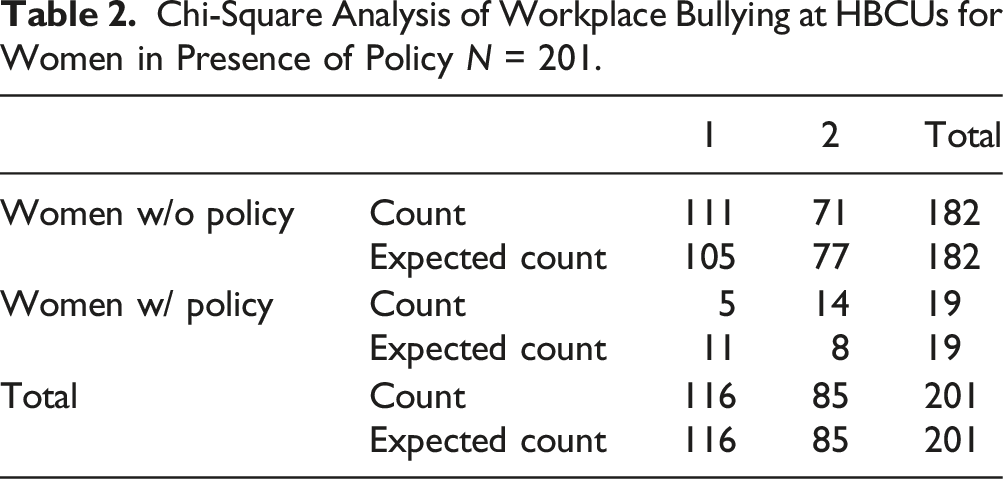
The chi-square test of independence showed there is a statistically significant difference in reporting workplace bullying when a bullying policy is present at the HBCU (χ2 (1, N = 201) = 8.475, p = 0.003601). Therefore,
Multiple Regression Findings
The number of women who completed the survey was n = 162; the number is lower than n = 201 used in the chi-square analysis because fewer women completed all of the questions required for all of the multiple regression variables. This difference occurred because the two questions required to calculate the chi-square opened the survey. Therefore, the breadth of 19 questions required for the multiple regression was the remainder of the survey. This means 43 respondents did not complete those 19 questions resulting in a smaller sample for the multiple regression.
I addressed a second research question,
I compiled a composite score for each variable for this second research question. The independent variable (IV) intensity of workplace bullying relied on eight questions. Each of these eight questions was a 5-point Likert scale question, leading to a composite score up to 40. Next, I calculated the dependent variable of time spent (DV1) from five questions. The composite score is based on the number of years one faces bullying, the number of hours one spends per week, the number of sick days a month, and the number of hours weekly spent consoling someone and being consoled. The possible composite score for DV1 is 35. The second dependent variable about health (DV2) emerged from two questions. Participants were asked to report health issues and coping strategies (i.e., have increased alcohol use, over-the-counter medicine, and tobacco products). The possible composite score for the second dependent variable was 16. Finally, I calculated the third dependent variable (DV3), organizational trust, from five five-point Likert scale questions with a possible score up to 25. Please see the appendix for the instrument.
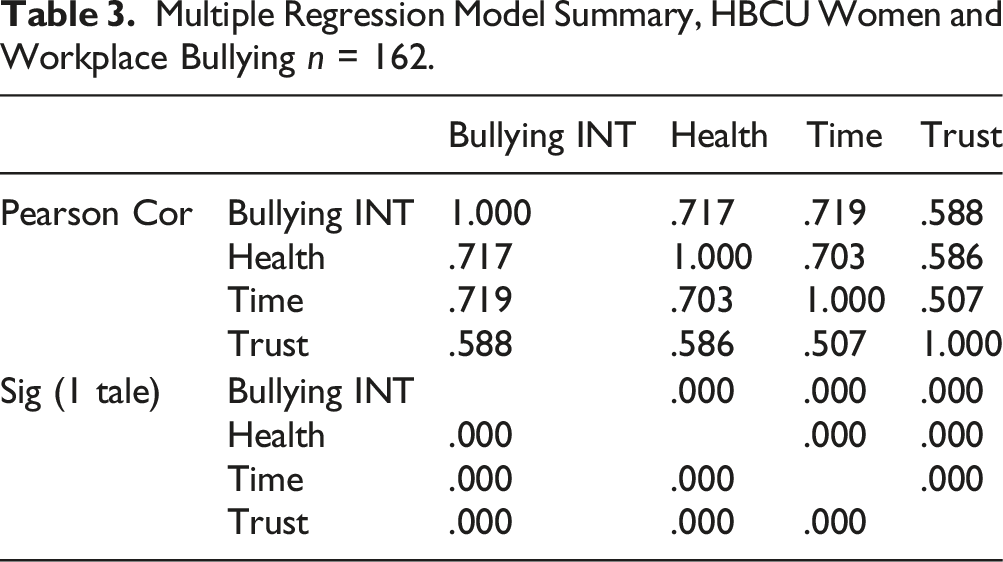
Multiple Regression Model Summary, HBCU Women and Workplace Bullying n = 162.
Multiple Regression Coefficients n = 162.
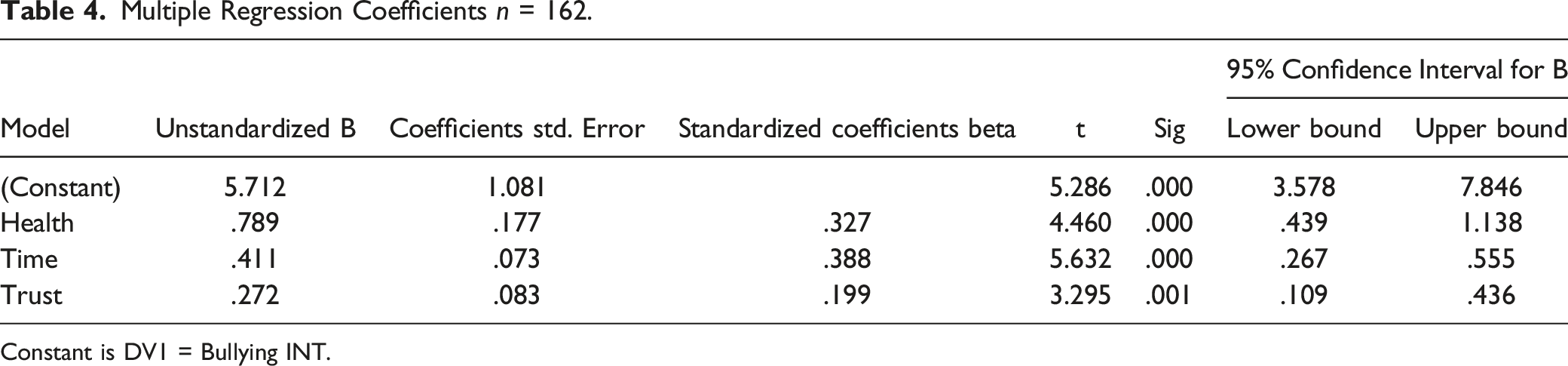
Constant is DV1 = Bullying INT.
I used a one-tailed test because it is more powerful than a two-tailed test. A two-tailed approach would split the effect and measure significance in two directions (UCLA, 2006). However, no studies in workplace bullying research suggest workplace bullying is inversely or negatively related to health, trust, or time spent. Because the literature does not support the possibility of an inverse relationship, I choose the added power in the one-tail option for the multiple regression (UCLA, 2006).
Qualitative Content Analysis Findings
My HBCU is a slave ship with masters governing by force, who lack abilities to recognize people as human beings... Respondent # 317- April 2020
The quote above is emblematic of most respondents’ comments about HBCU women faculty experiences. A male-dominated, authoritarian leadership approach, which is what many respondents conveyed, enables workplace bullying. Further, a notable trend in the data was a bait-and-switch experience in which women specifically chose HBCUs because of their positive HBCU undergraduate experience, only to find that they were overworked, underappreciated, and poorly paid as faculty.
I used Krippendorf’s (1989) qualitative content analysis procedures. The first step was data reduction, identifying repetitive comments and issues. For example, respondents offered five comments in which they imagined the HBCU space to be welcoming, almost a “magical Wakanda experience”; instead, they were horrified to be the target of constant demoralizing incivility. From respondents’ common phrases, I continued with Krippendorf’s process with open coding as the second phase of data analysis (Creswell, 2014). Once I coded the data, I could cluster the codes to determine the most prominent themes from open-ended responses from surveys were ideal data for qualitative content analysis to answer the third research question:
Theme: Avoidance Behavior
The women faculty, regardless of rank, consistently engaged in avoidance behaviors to avoid the bully. Their data confirm the level of calculation that faculty use to elude bullies. The time bullied colleagues wasted in avoidance behavior coincides with the multiple regression findings, which included time wasted as a statically significant predictor of intense workplace bullying. The avoidance behaviors also confirm that women scholars are purposely removing themselves and their expertise from HBCUs. In an emotionally and psychologically unsafe environment, abused colleagues understandably prioritized these avoidance behaviors over scholastic collaboration with peers or career advancement.
“I minimize my time on campus and work remotely.” “Generally, I avoid them if possible and will not engage in activities that involve some.” “I walk a different way to avoid them and park in different places.” “Do not leave my office unless I absolutely must.”
Theme: No Accountability
The study respondents clearly remarked that the organization does not hold bullies accountable. In many instances, the leadership not only enabled bullies but were the bullies themselves. Consequently, bullies sustain their power positions in the organization. Without interventions, bullies receive the tacit message that the university accepts the abusive behavior.
“The bullying occurs by individuals who [believe] that no one will intercede.” “Reporting issues does not help; administration covers up evidence of misbehavior and turns a blind eye.” “Administration is not helpful. There's no support system. There aren't any effective solutions. Nothing changes and nothing improves.” “Colleagues have invited me to collaborate on grants, took my ideas, then submitted them without including me as a co-PI. There is no process to address such issues.” “There is no one to speak to because somehow whatever you discuss with higher authorities seemingly gets back to your direct supervisor and that is where the bullying and retaliation comes into play.”
Theme: Sexism
Regardless of race, women respondents confirmed sexism as a salient component, especially as it applies to tenure and career advancement. Sexism is also manifested in pay disparities and hostile work conditions. These findings confirm the minoritized status women hold within the gendered HBCU academic environment.
Theme: Sexism Comments
“I assume that the radical underpayment of women at this HBCU is why so many cannot afford to sue and adapt to placating racist bullies.” “I am a white female, and the bullies are white males. I have been issued a notice of non-renewal of contract for next academic year in retaliation for my complaining about said harassment, bullying, pay issues.” “I have worked at PWIs and HBCUs for 30 years. I believe that at PWIs, the majority tries to be inclusive often in ineffective ways- but tries and believes in diversity. My experience at HBCUs is that sexism is terrible. Black women are shamed if they don't support the ascendancy of Black men and white women are exploited.” “I am a white female working at an HBCU as an Adjunct Faculty. The Department Chair is overtly sexist and lays the groundwork for a hostile working environment.”
Theme: Racism
Black, white, and multi-racial women commented that they were subjected to racism embedded in bullying. With 45 HBCUs in the sample, I found the reported racism is a function of difference comparable to Allport’s (1954) discussion about the nature of prejudice. For example, a white woman respondent commented about being white and harassed; yet a Black woman respondent reflected on how colorism led to bullying. Further, several Black women commented that white men specifically targeted them.
Theme: Racism Comments
“As a Black person, I thought this would be a Wakanda paradise, but Black people are treated worse than the white faculty here for sure.” “I am a Caucasian female predominantly working with individuals of color. I believe I am excluded from opportunities and/or overlooked or treated differently because of my race.” “Workplace bullying can take place through cultural beliefs with foreign supervisors, which includes their personal beliefs and views.” “There is a very real racial element at my HBCU. The white tenured faculty outnumber the faculty of color and there seems to be a double standard when it comes to getting tenure.”
Discussion: Balancing the Power
Workplace bullying occurs in higher education at increased levels compared to the general workforce (Hollis, 2015; Namie & Namie, 2009). Research also shows that more vulnerable groups such as women and women of color experience are disproportionately targeted (Hollis, 2017; Salin, 2021; Stone, 2009). One of the ways to mitigate the power differentials in higher education is through tenure and promotion. When tenure status is achieved, any faculty member is afforded more power in higher education. Also, promotion to full professor is the gateway to additional educational leadership positions such as dean, associate provost, and vice president; nonetheless, this career ascension starts with tenure.
As Ford (2016) noted, women comprised only 26% of all full professors and 44% of all tenured professors. With workplace bullying explicitly derived from power differentials and women denied tenure and promotion, women’s thwarted tenure and limited career advancement sustain the vulnerable position that women reported in this study. Without tenure and promotion to full professor, women are not positioned to influence the structural changes needed in higher education policies and procedures. Instead, workplace bullying crystallizes the male-dominated environment and perpetuates legally questionable gender-biased practices.
The social engineering to rebalance the power differentials in higher education can be yeoman’s task (King, 2007). Higher education and its hierarchal structure lend itself to fierce competition and top-down processes (Kezar, 2012; Schwier, 2012). However, though a mixed methods study has limited generalizability because qualitative data does not yield generalizability, the analysis yields plausible actions for HBCUs (Sykes et al., 2018).
The chi-square analysis confirmed statistical significance that a proper policy prohibiting workplace bullying disrupts this abuse. When considered in conjunction with the multiple regression findings, workplace bullying policies can minimize the threat to health, the waste of time, and the erosion of trust. Traditional thinking would reflect that the lower response rate plausibly threatened validity in this study. However, as noted previously, Hendra and Hill’s (2019) study illustrates that lower response rates probably do not threaten validity as once thought. Regarding the institutional cost in sustaining bullies, previous research has confirmed that the target of workplace bullying in higher education can spend on average 3.9 hours a week strategizing on how to cope with the bully (Hollis, 2015).
This translates to five weeks annually that the target is disengaged from the education environment. Nonetheless, this data does not capture the time exhausted by witnesses and bystanders who are also traumatized by watching the bullying; nor does the documented cost capture the time bystanders and witnesses spend consoling a bullied target (Hollis, 2015; Madden & Loh, 2020).
McManus and Mosca (2015) confirmed that a trusting culture must evolve from leadership. Similarly, leaders must charge the organization and human resources to develop anti-workplace bullying policies that indeed hold bullies accountable. When organizations promote themselves as bastions of inclusion, equity, and social justice, then leaders behave like duplicitous phonies, and the organization destroys faculty morale. ”Nothing destroys trust faster than hypocrisy from management” (McManus & Mosca, 2015, p. 38). The compromised trust reported in the multiple regression analysis aligns with the qualitative theme regarding lacking accountability. Based on the mixed methods findings, when organizations do not create emotionally and psychosocial safe working spaces and fail to hold bullies and discriminatory people accountable, faculty do not trust the organization and instead adopt avoidance and disengagement behaviors (Meier et al., 2016; Muthusamy et al., 2007).
As one reviews the chi-square analysis, the multiple regression analysis, and the qualitative content analysis, these data confirm that women faculty’s experiences at HBCUs reflect an institutional and cultural betrayal (Smith & Freyd, 2014). An organization can address these problems and minimize the disproportionate impact on women by implementing a policy that prohibits harassment, as discussed in Civil Rights laws and workplace bullying scenarios (Hollis, 2021). Nonetheless, these findings confirm that HBCUs need to institute comprehensive efforts to address the structural policies and processes that inhibit women from earning the power found in tenure and promotion. Findings also confirm that in addition to being granted more power through tenure and promotion, the leadership must be directly involved in sustaining a work culture that matches the stated values of inclusion and diversity embodied in institutional mission statements.
As previously noted, tenure and then promotion are the gateway to academic leadership. Those with tenure and then advanced rank have access to more organizational power at the university. In turn, they are better positioned to change policy and support women’s advancement. However, subjectivity and amorphous standards in the tenure and promotion process allow personal bias to infiltrate such processes.
HBCUs can take proactive measures in the tenure process to balance the power dynamics between men and women faculty. The respondents of this study confirmed that policy could curtail bullying behaviors. Given the confirmed expense created by workplace bullies (Hoel et al., 2020; Hollis, 2015; Rayner & Cooper, 1997). HBCUs could view sound anti-bullying policy as a cost-saving measure. By disrupting workplace bullying, campuses can minimize the historical bias woven into higher education. In addition, prohibiting bullying would further clear the pathways for women to advance and change the culture to be more inclusive of women.
To address the power differentials found in bullying, more deserving women need access to tenure. The path to tenure is also the path to academic leadership who establishes the tone for the culture, yet the qualitative findings for this study chronicle a mercurial pathway to tenure. Because the women in the study commented on bait-and-switch issues in their careers, the findings align with the literature about inaccurate advice and substandard mentoring for women faculty (Tollefson-Hall et al., 2013).
Further, department chairs and deans should be held accountable for the guidance they provide to tenure-track junior faculty. For example, suppose the department chair or dean approve of a journal during a candidate’s annual faculty review. In that case, that same journal should not be marked against a candidate who followed instruction from her department chair and dean.
Another dynamic that hurts women is found in the male-dominated departments with no women serving on tenure review committees. HBCUs could consider a mandate to have at least two women on tenure and promotion committees. Plausibly, women reviewers would understand the work–life balance challenges and the obstacles women address in the gendered higher education space (Acker, 1990; Solomon, 2011).
In the context of tenure and promotion processes, HBCUs need to maintain the integrity and equity of such committees. When reflecting on workplace bullying and those who perpetrate injustice, Susan Bon, Professor and Faculty Civility Advocate at the University of South Carolina, recommends removing those found responsible for bullying from tenure and promotion reviews for five years (personal communication March 11, 2022). If a bully is willing to abuse a junior faculty member ascending to tenure, this same bully plausibly will use that power differential to deny a rightful candidate tenure. Once an institution finds a faculty member responsible for bullying, Bon suggests that institutions note the problem in that faculty member’s file and then restore that faculty member’s privilege to review tenure dossiers after 5 years with no additional reports (personal communication March 11, 2022).
Health Considerations
The findings also confirm the association between workplace bullying and stress-related health problems. Workplace stress can lead to hypertension, cancer, panic attacks, PTSD, and suicide ideation (Leach et al., 2017; Rodríguez-Muñoz et al., 2011; Spence Laschinger & Nosko, 2015). With HBCU respondents commenting on stress-related health problems, HBCUs can mitigate the problem by developing wellness programs. Groppel (2013) noted that organizations lose millions of dollars through mismanagement of human resources. Amaya et al. (2019) recommend a grassroots approach to policy development to create wellness programs. In addition to wellness programs serving the campus community, such programs are a sound business practice (Amaya et al., 2019; Groppel, 2013). Consequently, Binghamton University, Case Western Reserve, Illinois State, and Ohio State were highlighted for developing viable wellness programs. HBCUs could also follow suit to cultivate and sustain healthy work environments for their faculty.
Conclusion
Workplace bullying is an insidious thief that robs any campus of its valuable human resources (Hollis, 2021; Frazier, 2011). If we knew someone was stealing from petty cash, that thief would be reprimanded. However, when bullies steal the human capital by demoralizing faculty or staff, such damage often goes unaddressed. Turnover and disengagement are costly (Hollis, 2015), costing up to $9600 annually per person. Bullied faculty trying to protect their mental and physical health can withdraw their passion and commitment from the university, only to arrive on campus as a burnt-out automaton going through the motions.
With their historically limited resources, HBCUs can ill-afford to waste women’s talent because of bullying, racism, and sexism. Consequently, the call to action is not just to create policies to prevent workplace bullying but also to reexamine the structures, policies, and procedures that deny women access to organizational power. Closing this gap in organizational power can not only help women ascend their respective career ladders at HBCUs, but it can also construct a pathway for more inclusive campus cultures.
Footnotes
Declaration of Conflicting Interests
The author(s) declared no potential conflicts of interest with respect to the research, authorship, and/or publication of this article.
Funding
The author(s) received no financial support for the research, authorship, and/or publication of this article.
Appendix
1. Does your campus have an explicit anti-bullying policy that specifically uses the term WORKPLACE BULLYING? 2. In regard to workplace bullying at your job... a. I have been bullied in the last two years b. I have witness bullying in the last two years c. I have NOT witnessed or experienced bullying in the last two years 3. What is the intensity of workplace bullying for you at your HBCU? 4. How many bullies are you subjected to at your school? 5. Has workplace bullying HURT YOUR JOB PERFORMANCE? 6. Has the Bully broken or ignored laws, regulations procedures such as (but not limited to): Title VII civil rights laws, Title IX women’s rights laws, University policy and regulations, Accreditation Standards? 7. Think of your career at HBCUs. Have you left an HBCU to avoid the toxic behavior or effect of a bully on staff? 8. Think of your HBCU. How likely are you to recommend your college or university to a friend for work? 9. Have your friends of family encouraged you to leave your HBCU position? 10. For your next career move, will you consider an HBCU? 11. How much do you trust your HBCU to treat you with respect and integrity? 12. Do you feel valued at your HBCU job? 13. Think of your HBCU. How likely are you to recommend your college or university to your child or other family to an HBCU for college? 14. Think of your career at HBCUs. Has workplace bullying created health issues? (List of health issues) 15. What behaviors have you engaged to deal with workplace bullying? 16. How much time a week do you spend strategizing on the job to avoid bullying? 17. How many days a month do you miss work to avoid the bully? 18. What is the DURATION of workplace bullying for you? 19. How much 20. How much time a week do YOU RELY upon OR NEED another colleague to support you because YOU have been bullied at your HBCU?