



Abstract
AI-powered devices, for example, service robots, are expected to revolutionize hospitality. As a result, research on service robots has surged in the context of hospitality. While prior studies have explored customer and employee attitudes toward using or abandoning robots in different contexts, for example, health care, there is a dearth of research into strategic decision-makers’ views on deciding to continue using or abandoning service robots in hospitality settings after their introduction. To that end, we adopt the Technology-Organization-Environment (TOE) framework through a phenomenon-driven bottom-up approach to explore why strategic decision-makers plan to (dis)continue using service robots in hospitality after their introduction. In practice, semistructured interviews were conducted with robot suppliers (n = 8) and strategic decision-makers (n = 10) to explore the planned (dis)continuance of service robot usage. Six key factors related to planned (dis)continuance of service robots in hospitality settings were found, revolving around drivers and barriers of robot adoption (e.g., availability of off-the-shelf robot solutions; operational complexity), the strategic focus of the company (e.g., vision and mission), the user experience (e.g., robots’ persona), technical aspects (e.g., sensors and interoperability), and economic aspects (e.g., managing cashflow). Extending the Technology-Organization-Environment framework, we derive implications for hospitality management theory and practice by developing a novel model for planned (dis)continuance of service robot usage, thus adding to the broader body of work on robot usage continuance in operational settings.
Keywords
Introduction
Recent years have seen an increase in academic and practical interest in commercial robotic applications in operational business-to-business and business-to-consumer settings, both in general and in the context of hospitality (Gursoy & Cai, 2025). Service robots, defined by Wirtz et al. (2018) as “system-based autonomous and adaptable interfaces that interact, communicate and deliver service to an organization’s customers,” combine multiple areas of artificial intelligence (AI), for example, computer vision, object manipulation, and autonomous decision-making, to bring physical-digital (i.e., phygital, Batat, 2024) devices into service settings, thus transforming customer expectations and experiences (Larivière et al., 2025). According to Tuomi et al. (2020), hospitality companies adopt service robots to support or substitute labor, to differentiate service offerings from competition, and to optimize and improve the allocation and use of organizational resources, exemplified by more time being allocated for customer contact, or reduced food waste through more precise inventory management. Integrating service robots as part of hospitality operations has implications in various facets of management such as customer and employee experience (Huang et al., 2021; Lu et al., 2019), marketing (Murphy et al., 2021), leadership (Xu et al., 2020), automated decision-making (Ivanov & Webster, 2024), employees’ required skills (Tuomi et al., 2020), human-AI interaction (Wang & Uysal, 2024), and human–robot task distribution, that is, the design of jobs that make the most of both humans and robots and improve worker well-being (Phillips et al., 2023; Tuomi & Ascenção, 2023).
Despite the apparent excitement and “hype” that surrounds service robotics in hospitality settings (Phillips et al., 2025), there is a lack of deep understanding of the long-term managerial impacts of using service robots (Fu et al., 2022). Highlighted by the world’s first robot hotel Henn-na’s decision to discontinue using some of its frontline service robots (Gale & Mochizuki, 2019), high-profile robotic restaurants Creator and Spyce closing down (Maffei, 2022), or the failure of automated pizza delivery company Zume (Hawley, 2023), the hospitality management literature has not yet adequately explored the managerial reasons behind why some service robot implementations in hospitality fail to reach long-term success (Fu et al., 2022). Contrarily, there are ample examples of service robot implementations that have scaled up successfully; for example White Castle is expanding its robot collaboration with Miso Robotics’ Flippy 2 and Chippy robots to 350 locations (Castrodale, 2023), while Pudu Robotics, maker of waiter robots such as BellaBot, has cumulatively shipped around 70,000 robots since its launch, with over 10,000 robots sold in 2023 alone (Nikkei Asia, 2023).
Illustrating the hype around service robot adoption, in 2020 the global technology management consultancy company Gartner (2020) noted that “autonomous mobile robots” had entered what the company calls “the peak of inflated expectations.” However, the Gartner consultants also argued that the technology would need another five to 10 years to reach maturity. A few years after the prediction, the jury seems to still be out, with some hospitality companies expanding their use of service robots and some discontinuing pilot projects (Fu et al., 2022).
Previous research on service robot usage and discontinuance in human environments has primarily focused on the viewpoints of customers or employees (Chi et al., 2023; Fu et al., 2022; Gursoy et al., 2019; Lu et al., 2019; Sadangharn, 2022) and spanned multiple contextual settings, for example, construction (You et al., 2018) and health care (Rojas & Tuomi, 2024). For example, Fu et al. (2022) have developed the Robot Usage Resistance model to explain employees’ reasons for resisting the use of service robots, while Lu et al. (2019) have put forward the Service Robot Integration Willingness (SRIW) scale and Gursoy et al. (2019) the Artificially Intelligent Device Use Acceptance (AIDUA) model to measure customers’ long-term willingness to use AI and robots as part of service delivery. More recently, Phillips et al. (2023) put forward the Robotic-Human Service Trilemma, emphasizing the relatively strong impacts service robot integration has on employees as opposed to customers or managers. While scholars have made significant efforts in trying to map out the general adoption or “diffusion” of innovation (Robertson, 1967; Rogers, 2010; Tornatzky & Fleischer, 1990), including technological innovation such as service robots (You & Robert, 2024), there is a knowledge gap regarding the management reasons for planned continued use of service robots after their introduction.
To that end, this exploratory qualitative study draws on seminal organizational innovation adoption theories, primarily Tornatzky and Fleischer’s (1990) Technology-Organization-Environment (TOE) framework, as well as more recent human–robot interaction theories, that is, Fu et al.’s (2022) Robot Usage Resistance (RUR) model, Lu et al.’s (2019) Service Robot Integration Willingness (SRIW) scale and Gursoy et al.’s (2019) Artificially Intelligent Device Use Acceptance (AIDUA) model to understand the management reasons underpinning successful long-term service robot adoption in hospitality operations. Specifically, the study aims to address the following research question (RQ):
RQ: Why are strategic decision-makers planning to (dis)continue using service robots in hospitality after their introduction?
By exploring the factors influencing hospitality companies’ strategic decision to (dis)continue to use service robots after the initial “hype” generated by pilot projects has settled, this study makes significant contributions to hospitality management, innovation, and information systems literature by developing a new use (dis)continuance model for service robots. Frontline hospitality operations are inherently people-centric, illustrated by the complexity of different types of social interactions within the so-called service triad, for example, worker–worker, worker–customer, customer–customer, customer–business interaction (Phillips et al., 2025). This social complexity makes studying robot integration and usage (dis)continuance in hospitality settings particularly important, as the high-context nature of the industry exacerbates topics such as organizational citizenship behavior, change management, or psychological contract. In addition to theoretical implications, the study provides practical guidance for both service robot system providers (i.e., developers and suppliers) and their users by evaluating the long-term applicability of service robot systems to ultimately achieve a good return on investment and a successful long-term business-to-business relationship.
Service Robots in Hospitality Settings
Reflecting the “hype” around service robots, the management literature has explored the use of service robots in hospitality contexts from different points of view: customer and employee experience (Huang et al., 2021; Lu et al., 2019), consumer behavior (Tussyadiah & Miller, 2019), marketing (Murphy et al., 2021), leadership (Xu et al., 2020), robot-job fit (Tuomi et al., 2021), and task distribution between humans and robots (Chen et al., 2022), among others. Providing a strategic framework for why companies adopt service robots in the first place, Tussyadiah et al. (2022) highlight labor shortage, customer demand and expectation, technological progress and the desire to appear innovative in relation to competition as key drivers for adoption. Tuomi et al. (2020) looked at operations management, asserting that service robots assume five different roles in hospitality operations: robots either support or substitute hospitality employees; differentiate the service offering from competition; improve resource allocation by allowing employees to focus on tasks that require domain expertise; creative thinking and problem-solving; and upskilling hospitality employees by changing their required skillsets, from chef to “chef technician” for example.
Offering one of the only empirical studies in the context of service robot use discontinuance, Fu et al. (2022) have put forward the Robot Usage Resistance (RUR) model, which qualitatively explored and subsequently explained hotel employees’ reasons for resisting the use of service robots. Fu et al. (2022) highlight low usability, lack of authentic anthropomorphic features, extra workload due to service robot adoption, along with employees’ technological uncertainty and insecurity as key factors influencing resistance to the long-term usage of service robots. From a management perspective, they further postulate that low usability is related to what Tuomi et al. (2021) refer to as poor “robot-task” fit, and that extra work and technological uncertainty and insecurity are linked with employees’ feelings of exhaustion and anxiety. Phillips et al. (2025) concur, emphasizing the importance of worker agency, whereby having employees control when and how the robot should be utilized may promote well-being. This resonates with recent operations and human resources management literature on the positive impacts of job crafting, that is, employees actively changing the characteristics of their jobs (Rudolph et al., 2017). In a similar vein, You and Robert (2024) applied relational demography theory to study workplace integration of robots, concluding that managers can promote the acceptance of robots by emphasizing similarities between robots and humans. They postulate that for instance in workplaces where the majority of staff are female, an anthropomorphic robot representing female features might be more readily accepted among workers.
Besides considering employee perspectives, studies have explored the willingness to use service robots in hospitality contexts from a customer point of view. For instance, Lu et al.’s (2019) Service Robot Integration Willingness (SRIW) scale quantitatively studied the key dimensions characterizing customers’ long-term willingness to accept service robots in hotel, restaurant, airline and retail contexts. Drawing inspiration from several well-established technology acceptance theories, for example, TAM and UTAUT, the final SRIW scale includes six variables: performance expectancy, intrinsic motivation, anthropomorphism, social influence, facilitating conditions and emotions (Lu et al., 2019). Gursoy et al.’s (2019) Artificially Intelligent Device Use Acceptance (AIDUA) model adds hedonic motivation and perceived effort expectancy to this, while Chi et al. (2023) also add trust as a key factor influencing willingness to use robots in their extended version of the AIDUA model. You et al. (2018) found similar results, whereby trust played a key role in the user perception of safety and subsequent willingness to use robots, while El Halabi and Trendel (2025) found that simply giving a robot a name increases acceptance, thus highlighting the impact of anthropomorphism on robot adoption.
Despite a fast-growing body of literature on service robots in hospitality in general and in the context of service robot usage discontinuance in particular, research has thus far mostly focused on customer and employee perspectives on technology acceptance or adoption. There is a lack of understanding as to why hospitality companies, that is, senior decision-makers, make the strategic decision of continuing or discontinuing to use service robots after the initial “hype” surrounding robot adoption settles. Studying this is important, as due to the hectic and socially intensive nature of many hospitality work environments, particularly in frontline services, the pre-existing social bonds between workers and customers might be particularly strong. Integrating embodied AI, that is, robots, into such environments by disrupting trusted relations might exacerbate fears of robots replacing workers (You & Robert, 2024) in service delivery, leading to customer or employee resistance. More research is needed to better understand technology adoption and continuance usage in hospitality.
Technology Adoption and Continuance Usage in Hospitality
Numerous theoretical frameworks have been developed to investigate the adoption and diffusion of technological innovation. These include the Technology Acceptance Model (TAM) (Davis, 1989), the Theory of Planned Behavior (Ajzen, 1991), the Expectation-Confirmation Theory (ECT) (Oliver, 1980), the Diffusion of Innovations theory (Rogers, 2010), and integrated models such as the Unified Theory of Acceptance and Use of Technology (UTAUT) (Venkatesh et al., 2003). They also include extensions to these models, for example, TAM2 or UTAUT2. For instance, in terms of continuance usage, Bhattacherjee (2001) developed an information systems (IS) continuance usage model by adapting Oliver’s (1980) ECT. Bhattacherjee’s (2001) model has gained significant traction in marketing research, and it has been used to investigate the impact of consumers’ satisfaction on their inclination to sustain the use of a technology that they have adopted. Bhattacherjee (2001) modified ECT into a framework for understanding the continued use of technology, with satisfaction and perceived usefulness serving as crucial determinants. The model stresses the direct and indirect effects of perceived usefulness on the intention to continue utilizing a technology by eliminating pre-adoption expectations and focusing on post-adoption perceptions. The adaptation posits that the continued inclination to utilize a technology is contingent upon the degree of satisfaction and utility derived post-adoption.
While these contributions have been valuable, it has also been acknowledged that a substantial portion of literature on IS use continuance has generated fragmented findings. Researchers have often focused on investigating the impact of a limited number of variables or have selectively chosen from a list of factors that have been empirically tested and validated as elements that influence the adoption and diffusion of technologies (Jeyaraj et al., 2006). However, the majority of existing technology continuance usage theories are focused on individual users rather than the organizational adoption of technology. According to Oliveira et al. (2014), the adoption of innovation is influenced by three factors: individual (leadership attitude toward change), internal organizational structure (centralization, complexity, interconnectedness, the number of employees, and slack resources), and external characteristics (system openness) of the organization. Following this logic, it is argued that user acceptance theories such as TAM, UTAUT, or the ECT are inadequate for studying factors influencing long-term enterprise-level adoption of technological innovation such as service robots. To complement user-focused theories, the TOE framework has been found to provide new interorganizational practical and theoretical insight (Baker, 2012).
Based on a review of existing studies building on the TOE framework, Baker (2012) advocates for continued empirical work as one future direction for TOE research to explore the acceptance and diffusion of new technological innovation at the organization level. Based on their review of innovation in organizations, Wolfe (1994) argues that there is no one (i.e., superior) theory to understand innovation on an organizational level: “there can be no one theory of innovation, as the more we learn, the more we realize that ‘the whole’ remains beyond our grasp”; (p. 406). Following Wolfe’s classification of three research streams, that is, process theory research (what processes do organizations go through in diffusing innovation), organizational innovativeness research (what determines organizational innovativeness), diffusion of innovation research (addressing the diffusion of innovation over time and space), our present study contributes to the latter research stream. Hence, we build on the TOE framework to guide our exploratory study.
The TOE Framework
The TOE framework, originally developed by Tornatzky and Fleischer (1990), focuses on the process of innovation from an organizational perspective and is seen as an integrative paradigm that provides a comprehensive and guiding theoretical basis for understanding organizational change. The TOE framework is one of the most widely applied theories for explaining the adoption and implementation of technological innovations in organizations (Depietro et al., 1990; Huang et al., 2021). TOE explains how an organization makes its decision to adopt a given technology across three facets: technology, organization, and environment. An organization’s relevant internal (existing technologies applicable to an organization) and external technologies (technologies to be adopted by an organization) are alluded to as technological factors. The organization’s size, scope, structure, top management support, quality of human resources, and internal resources are examples of organizational factors. Finally, industry characteristics, including pressure from competitors, technology supporting infrastructure, and governmental regulations are examples of environmental factors.
The TOE framework attempts to exhaustively describe the aspects that influence technology adoption and can explain not only technological and organizational aspects but also external factors that include social and environmental considerations (Hossain & Quaddus, 2011; Wang et al., 2010). This is especially relevant given that research on the adoption and diffusion of technologies often entails the examination of a variety of technological, organizational, and environmental factors that either help or inhibit the adoption and diffusion processes. The TOE framework has been extensively used to explain the adoption of numerous technological innovations, such as interorganizational systems (Mishra et al., 2007), e-commerce (Zhu et al., 2006), data interchange (Kuan & Chau, 2001), open systems (Chau & Tam, 1997), and cloud computing (Yang et al., 2015). Overall, the TOE framework has been hailed as a “generic” theory of technology adoption and diffusion (Zhu et al., 2003). However, despite many previous hospitality studies using TOE and its widespread adoption in information systems management research across different technologies, the TOE framework has thus far been barely investigated in the context of service robotics in hospitality (Zhong et al., 2022). We argue that TOE is particularly well-suited for studying service robot usage (dis)continuance because it provides a comprehensive view of the factors influencing sustained adoption. The technological dimension assesses robot attributes such as ease-of-use and reliability, the organizational dimension examines internal readiness and resource support, for example, change management and task allocation, while the environmental dimension considers external pressures such as competition and customer demands, which previous studies have established as key drivers of automation in hospitality and tourism (Tussyadiah et al., 2022). This holistic approach captures the interplay of key factors driving long-term success in service robot implementation and thus offers fresh contributions at the intersection of hospitality management, innovation, and information systems research.
Method
Soliman and Rinta-Kahila (2020) identified that the information system (IS) discontinuance phenomenon is a fertile ground for theory development and requires more qualitative and contextual research to be able to convey “untold stories” to a wider audience. Therefore, to understand why hospitality companies decide to continue using or choose to abandon mobile service robots after the initial “hype” has settled, this study adopts an exploratory qualitative research design.
Data for this study was collected between July and November 2023 through 18 semistructured interviews that were conducted with service robot providers (developers and suppliers, n = 8) and hospitality decision-makers including general managers and innovation managers, but also operational level managers to gain a more rounded perspective (n = 10), from six countries (see Table 1). The selection of interview participants was made using purposive sampling. This type of sampling allows a deliberate search for participants with certain desired characteristics. In this study, so-called “elite informants” (Aguinis & Solarino, 2019) were identified as an appropriate target group, given the study’s focus on senior decision-makers and strategic perspectives. To that end, participants that were either developing/supplying service robots for hospitality companies, or companies that directly operate or have recently operated service robots in hospitality servicescapes were sought. Participants were found through internet searches, public media releases and news articles relating to robot adoption in hospitality businesses and then approached through the professional social media platform LinkedIn. Invitation messages briefly detailed the nature of the study and the likely time required for interviews. Prior to interviews, we researched the job and decision capacity of the respondents and verified at the beginning of the interview whether the respondents can report on behalf of the respective organization. Only when this evaluation was positive, we continued with our interview. At the end of each interview, participants were also asked to introduce other qualified participants at the end of each interview; thus, snowball sampling was also used in recruitment.
Profile of Participants.
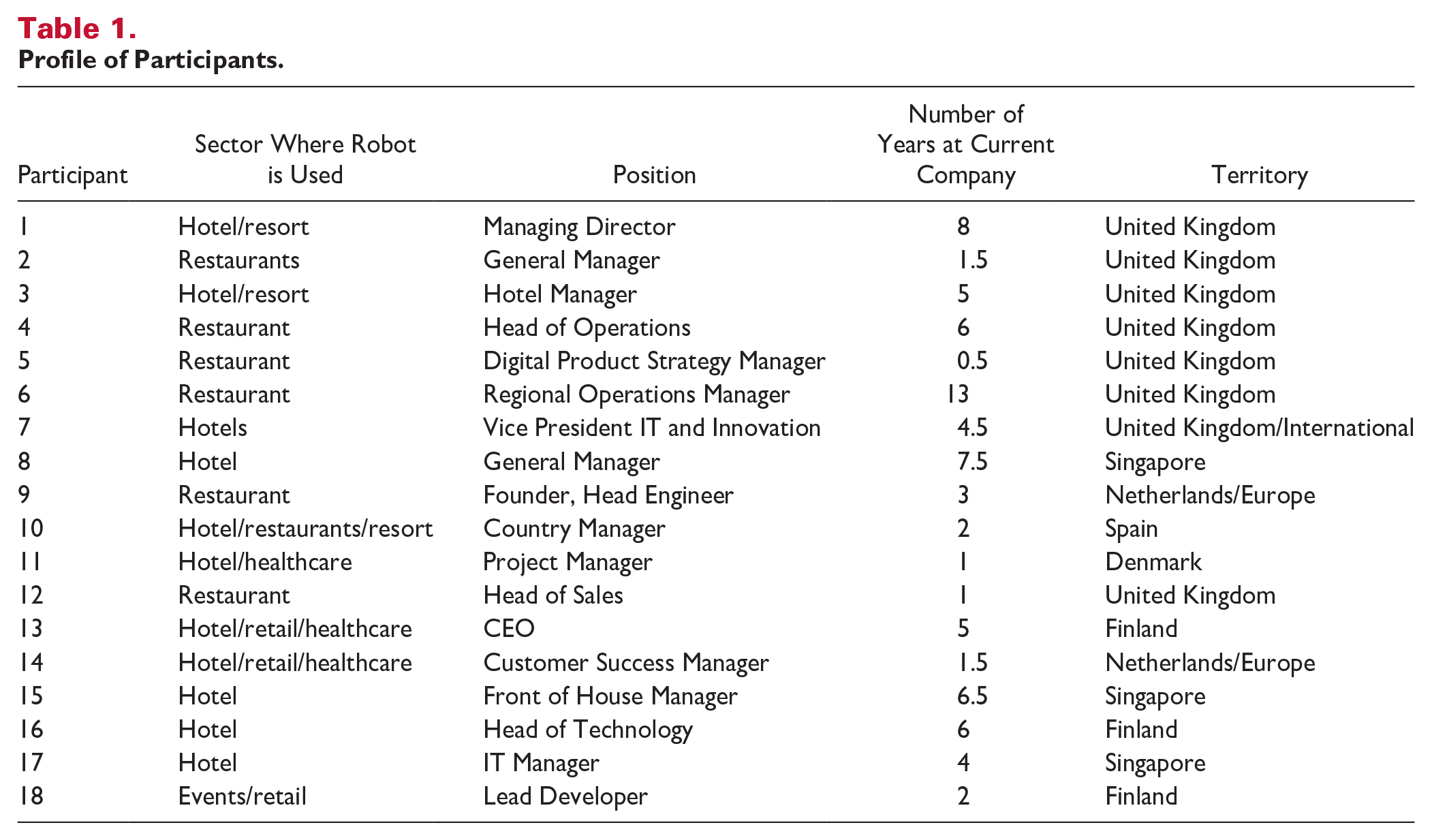
Interviews lasted between 30 and 60 minutes. Using the TOE framework as a theoretical foundation, each interviewee was asked about why and how their organizations have integrated service robots into their operations; the nature of their organization, its culture, innovativeness and processes; and the influences and pressures the external environment has had on the use of service robots. The discussion was based on the research question and interview protocol, noting separate questions were posed to service robot providers and hospitality operators (Appendix). While the overall narrative of the interviews remained similar, each interview was slightly adjusted depending on the participant’s background and expertise. All interviews were conducted online using Microsoft Teams, they were recorded, automatically transcribed and manually anonymized. Interviews were conducted until saturation was deemed to have been reached.
Following Braun and Clarke (2006), data was analyzed in three sequential rounds through an abductive process leveraging template analysis, a variation of thematic analysis. First, an initial coding template was established by one author through open and axial coding based on a subset of data (P1–8). The initial coding template had six major themes/primary codes, including 23 secondary codes and 19 tertiary codes. The initial coding template was then discussed with the rest of the research team and refined together, with 11 new tertiary codes added. After this, a second round of template analysis was conducted, whereby the existing template was applied to the rest of the data set (P9–18). This resulted in four new secondary codes and 10 new tertiary codes. At this stage, theoretical coding was also conducted, whereby the full coding template was compared to the TOE framework, the RUR model, the SRIW scale and the AIDUA model to check for similarities and differences.
To validate the full code book, an internal intercoder reliability check was conducted. The code book, along with 36 randomly selected excerpts from the interview transcripts (two from each of the 18 transcripts), were circulated among the research team for intercoding. Intercoding was conducted by four researchers, whereby each coder independently coded the 36 excerpts using the same code book.
To resolve instances where an agreement was not reached through the first round of intercoding, a meeting was organized with three authors to discuss the disagreed codes (5 out of 36). For two of the five disagreed instances, consensus was reached through discussion. For the remaining three, changes to the code book were suggested, whereby one new secondary code (B6) and two new tertiary codes (A1.3 and C1.2) were added and one secondary code (C2) was split into two tertiary codes (C2.1 and C2.2). After this, a fourth author independently checked the newly suggested codes to confirm consensus. Finally, intercoder reliability was measured using two methods: Percent Agreement (PA) and Fleiss’ Kappa (Table 2). Both tests indicated a good agreement between coders, demonstrating adequate overall consensus between independent coders.
Intercoder Reliability Check Results.
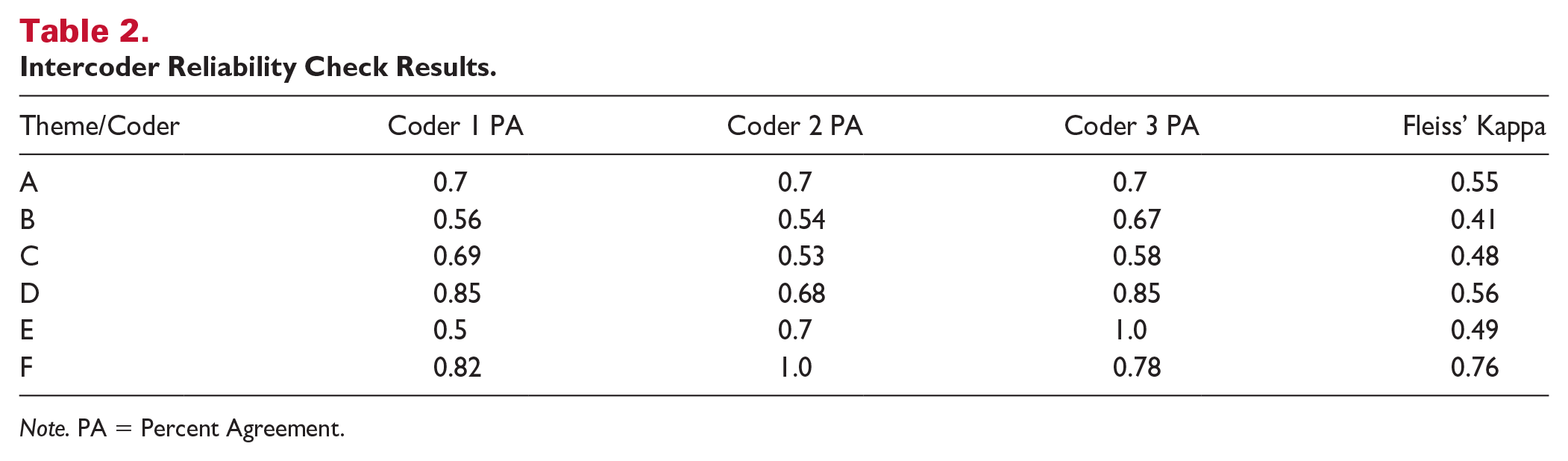
Note. PA = Percent Agreement.
Findings
Six conceptually distinct major themes emerged from data: (a) Operational drivers of robot adoption, that is, factors relating to supply and demand of robot solutions as well as the internal capabilities and market positioning of the robot-adopting company, (b) Operational barriers to robot adoption, that is, factors relating to costs, reliability and operational complexity of robot integration, (c) Strategic focus, that is, factors relating to the company’s vision and mission, the company’s life cycle, size and structure as well as the measurable outcome of robot adoption, (d) User experience design, that is, factors relating to robots’ persona and its interaction with customers and employees, (e) Technical aspects, that is, factors relating to sensors, connectivity and interoperability, success rate and retrofitting, and (f) Economic aspects, that is, factors relating to return-on-investment, managing cashflow and the value depreciation of the robot.
Operational Drivers of Robot Adoption
Participants highlighted several key drivers of robot adoption, from factors relating to increased availability of off-the-shelf robot solutions, to the internal capabilities and market positioning of the company considering adopting robots as part of their service production process. In terms of increased availability of robot solutions, participants discussed pricing structure, for example, robot-as-a-service and flexible trial periods. For instance, one mobile robot provider advertised that they offer one-year contracts where the first six months come at a significantly reduced price. Participants saw that this, coupled with warranties and the availability of technical support, led to flexibility and ease in experimenting with new technology. As put by participants, With the RaaS (robot-as-a-service) model, we do not do contracts of less than 12 months to give the client company time to properly use the robot. Also, the supplier does not allow shorter contracts. After 12 months, we offer the customer the possibility to redeem the robot at a lower price. (P16) Robots have exploded, even in the hotel industry, there’s a whole slew of new providers who are entering the market. (P7)
Besides price, participants noted the increasing pressure from both labor and customer expectation points of view, whereby on one hand many operators had experienced difficulties in recruiting and retaining a capable workforce, while simultaneously customers increasingly expected novel experiences and appreciated self-service more and more. To that end, both hospitality decision-makers and robot providers highlighted the importance of identifying and appointing an internal “robot ambassador”—a role akin to a “product owner” in a traditional software business—to take ownership of the integration period when a new robotic solution is installed. This facilitated communication between the provider and user of the robot, allowing for fast iteration and expediting problem-solving. Particularly important was managing both employees and customers’ expectations with regards to the robotic service provision, whereby in best case exemplar situations the robot acted as a key point of differentiation from competition and offered a unique way to drive inbound marketing efforts: The amount of hits we that we got on Twitter and TikTok was over was over 2.3 million so there was a lot of buzz in the community. People were coming in, and even now people do say, oh, you got robots, and that novelty hasn’t worn off. (P4) The restaurant became the robots. The robots are acting as your promotional, you know, agents without doing anything, and the restaurant didn’t have to spend anything. (P5) We’ll have 40 to 50 requests per day for the robots we send water to rooms that people don’t want and we send towels to rooms that people don’t need because they want the robot to deliver them. (P8)
Operational Barriers to Robot Adoption
Contrasting the drivers of robot adoption, participants also noted several barriers of adoption, most notably factors relating to costs, reliability and the perceived operational complexity of robot integration. In terms of costs, participants highlighted the impact of market conditions, for example, level of inflation and its impacts on companies’ cost structure and planned new investments. There were also differing opinions on who should be responsible for investment in robots, whereby in cases where the hospitality service operator did not directly own the properties they were using, participants saw that it should be the landlord’s responsibility to invest in the building, not the operator’s. Some participants also saw that the price of robot solutions was likely to decrease over time, so they had made the decision to wait rather than invest now: Let’s say 10 years ago, the sensors you’re using inside this thing cost €10,000 and now it’s €1,000, let’s say, so this is a bit like what you can see in the sector, hardware wise I think. (P9)
When it came to the reliability of robot solutions, participants noted operational issues, for example, handling robot-caused service failures or “saving” the robot if it got stuck. Participants also noted the lack of internal expertise in relation to new technology, whereby some felt the over-reliance on external technical support is an additional risk to manage. Interestingly, some participants also reported that even though the robots had been introduced as a means to ease employees’ workload (and save labor costs), the robot integration had actually resulted in a new extra layer of tasks. As put by participants, We need to clean up the robot as well at the end of the day. So actually it’s more work to do. (P6) Initially, the biggest hurdle is probably technical. In that you’ve got to fine tune some complicated robotics and you’ve got to work with the manufacturers who own those robotics, to help them resolve the fail rates. One end of the spectrum we use a machine that in 12 weeks hasn’t failed once. Other end of the spectrum we have a new machine that’s, you know, failing 3-4 times a day. So there’s really quite a wide range of outcomes there. (P12)
Strategic Focus
As illustrated by our findings thus far, adopting service robots in hospitality contexts is still considered a novel strategy with potential to disrupt existing business operations. To that end, several factors relating to robot-adopting companies’ visions and missions, their current stage in the organizational life cycle, the company’s size and structure as well as the measurable outcome of robot adoption, that is, what both the robot-provider and the robot-adopting hospitality companies considered as the key performance indicators (KPIs) of success, were discussed.
In terms of visions and missions, several of the hospitality decision-makers highlighted their companies as thought-leaders and innovators in the sector. The companies they currently represented were also relatively young, with most having been in business for less than 10 years. The agility and autonomy of decision-making was highlighted as an important factor when it came to digitalization strategy, whereby participants noted that embracing new technologies requires a willingness to test new things and to keep innovating. To support this, participants stressed the importance of leadership focused on change management, as well as defining and tracking the right KPIs to demonstrate success. Interestingly, further contrasting the idea of adopting robots as a pure labor cost-saving strategy, one participant emphasized how using robots allowed the business to reallocate human labor to other tasks: The way that our business works, we’ll have two kitchens open, in different floors, over a lunch service. So, the food run is, we might have had two runners, we now only need one food runner plus the robot. So, there’s an element in terms of cost saving with that. But the other food runner was moved to a different station within the restaurant. So, we’re not necessarily saving the cost, but we’re just utilizing the payroll in a different way. (P3)
Besides this, hospitality decision-makers emphasized that robots should be considered as part of a broader long-term digitalization roadmap. However, while other technologies, such as a new point-of-sale system might streamline service and management, for customer-facing robots, the service offering itself should be repackaged to capitalize on the new technology. As put by one hotelier, We became known as the Robot Hotel. We’d have kids writing letters to the robots. We ended up doing some plushy toys that we would then give away. We had stays called Robocations. We had these days where you got these extras if you got a photo with the robot. You know, it was all built around that. (P8)
User Experience Design
In addition to operational drivers and barriers of robot adoption and the strategic focus of the hospitality company adopting robots, specific factors related to the user experience design of human–robot interaction (both customer–robot interaction and employee–robot interaction) was also noted, although to a much lesser extent. In terms of employee and customer-facing interaction, a key discussion point was the difficulty of managing user expectations and the lack of internal technical know-how to resolve system malfunctions. As put by one participant, It’s like, I came here for the robot, but your robot is not working just now. It’s not in our hands to fix it, and at that point you just have to, you know, apologise to the customers and hope they will not write a negative review. These are things that happen on a daily basis and there is nothing you can do about it. (P5)
Besides such frustrations, other factors related to robot design were also discussed, for example, robot size. As put by another participant, Because it’s a small robot, it looks harmless. But the other robot we had is like the height of an adult. It looks more like, dangerous, because it can fall down. So customers were worried about that. (P11)
Technical Aspects
Besides managing user expectations regarding the robots, participants highlighted technical aspects which, if left without adequate attention, could become bottlenecks to robot adoption. Specifically, participants discussed factors relating to sensors, connectivity, interoperability, success rate and retrofitting. Various issues with technology were discussed, from the reliability of (open or closed) wi-fi networks to openness and cybersecurity of robots. For instance, on one hand, participants emphasized the importance of integrating the robots with other digital systems through application programming interfaces (APIs), but contrasting this, participants also expressed concern for increased cybersecurity risks. Robot providers also commented on sensor fusion, that is, fine-tuning which sensor data the robot should take in and which to ignore, based on contextual factors such as complexity and predictability of the robot’s navigation environment. Given the seemingly high amount of potential technical issues that could occur, participants reported countering views on robot performance: If the guest orders it [the robot] and then they don’t wait for it or they don’t hear it. So it goes to the room. The room’s ringing. No one answers. Those jobs are recorded as job fails, but they’re actually not a technology fail. They’re a process fail for whatever reason. [. . .] Overall I think we had a 95% success rate. And we thought that was good. (P8) When it [the robot] broke down and the thing was down for six months, that was not great. We had to get it fixed and the mechanical components that were required to get this thing working again were manufactured again bespoke. There’s not that many luggage robots around in the world, most of them are bespoke built and designed, and so literally we had, you know, bolts and components being manufactured solely for us because the last time they sold one was probably us. (P7)
Economic Aspects
Integrating robots as part of hospitality operations poses inevitable changes to the service processes and operational logic of the company, ultimately impacting commercial aspects. To that end, participants discussed factors relating to return-on-investment (ROI) of robot adoption, finding the right product-market fit, and managing the value depreciation of the robot, that is, the fact that as robots are a novel technology, there is still a lack of an established secondary market for them, making an upfront investment risky. In terms of ROI, participants highlighted the importance of having a clear measure on the volume of the tasks the robot(s) are meant to automate while striking the right balance between human and robot labor. As put by one robot provider, I have one client that operates fast moving restaurants inside military bases, so they have a huge turnover of people and for example, he’s operating in one of these venues, five robots, a fleet of five robots. Each robot can move around 40 to 50 kilos, so they are setting up all the buffet with the robots, making the service, like filling up trays, with people, and then cleaning everything up again with robots. (P11)
Another participant highlighted how the business case for robots might emerge from external pressure, such as regulation or policies related to employee health and well-being: The National Health Service have a recent guideline passed saying that all NHS staff need to have access to hot foods 24/7. Now, for our automated food court, that provides a baseline of sales from 8:00 PM to 8:00 AM, which is at the moment about 35% of all our sales in that location. It creates, if you like, the business case because for the NHS to do that with their own staff is very expensive. Whereas if we go to, let’s say, the university market, there isn’t that requirement, but there’s probably a higher spend per head. So then you’ve got a different business model that you need to get to work. So working out those different business models for each channel and getting them to pilot and to scale, that I think is where the challenge is at now. (P12)
Discussion
The findings from our exploratory study with decision-makers from robot providers and hospitality businesses provide novel insights for understanding the impacts of long-term service robot use from a management perspective and contribute to both theory and practice.
Theoretical Contributions
The current study presents one of the first studies to apply Tornatzky and Fleischer’s (1990) TOE framework to study the long-term adoption of service robots in a real-world hospitality context, thus highlighting the usefulness of TOE as an integrative framework for understanding enterprise-level technology adoption and diffusion due to its ability to offer a holistic assessment of different factors. To that end, our findings extend and refine the key elements of TOE, offering much-needed nuance to the understanding of the continued adoption of service robots in general and in hospitality settings in particular.
In terms of technology-related factors, we highlight the importance of reliability, cybersecurity, compatibility, and success rate of robot-completed tasks, along with considerations regarding retrofitting new technology into a physical space and the physical design of the robot itself. This is in line with previous studies, which have found that successful robot integration requires high reliability of robot-mediated service (Tuomi et al., 2020) and the interoperability of systems such as point-of-sale, reservations management or property management (Tuomi & Ascenção, 2023). This also reflects the complexity of service robot customer experience (Larivière et al., 2025), whereby concrete elements of the servicescape surrounding the robot or the design of the robot itself, for example, anthropomorphism of the robot (El Halabi & Trendel, 2025), may strongly influence use continuance.
As for organization-related factors, we note the importance of getting top management support in overseeing the operational changes brought about by the adoption of robots, for example, new layers of tasks or allocating a robot “ambassador” to spearhead the change management process internally. Extending the work of You and Robert (2024), our findings support the notion that work tasks should be designed (and redesigned) around robot coworkers in a way that does not minimize social engagement but rather frees up resources for more social interactions, both worker–worker and worker–customer. Moreover, our research confirms that an organization’s size, decision-making structure and organizational life cycle play a key role in technology adoption in general. However, our findings also highlight the difficulty of assessing the ROI of robot adoption, in particular due to the current lack of an established secondary market for used robots.
In contrast to prior studies (cf. Wang et al., 2010), regarding the environment-related factors, our findings did not report pressure from competitors, the technology supporting infrastructure, or governmental regulations as key drivers of technology adoption. For instance, while automation was found to be incentivized by Singaporean government and implied by recently updated guidelines by the National Health Service (NHS) in the United Kingdom, governmental regulations or technology supporting infrastructure were not reported elsewhere in our sample to the same degree. This might be due to the still relatively nascent nature of service robot usage in hospitality settings, that is, the technology adoption has not yet reached maturity, so pressure from competitors is low and the macro-level structural support mechanisms for fostering automation in specific industries are still being developed.
In addition to making contributions to the applicability of the TOE framework in the context of service robot adoption in hospitality, the current study expands the body of knowledge on long-term service robot adoption in operational contexts more broadly. Most importantly, while previous studies have looked at robot adoption from a customer or employee point of view (Chi et al., 2023; Fu et al., 2022; Gursoy et al., 2019; Lu et al., 2019; Sadangharn, 2022), the current study takes a strategic management perspective by looking at elite informants’ (Aguinis & Solarino, 2019), that is, senior decision-makers’ and robot suppliers’ views on long-term robot adoption, thus providing a novel contribution to current literature. We posit our findings as a continuation to Fu et al.’s (2022) RUR model, Lu et al.’s (2019) SRIW scale and Gursoy et al.’s (2019) AIDUA model, bringing novel empirical evidence in terms of strategic management considerations related to robot adoption. Specifically, we find that the strategic decision to keep using service robots in the long-term (i.e., after an initial test period and the “hype” surrounding robots has settled) is driven by several factors relating to, for example, the availability of off-the-shelf robot solutions in a specific market, the internal capabilities, market positioning, vision and mission of the robot-adopting company, the costs, reliability and operational complexity of robot integration, the company’s size and structure, the projected return-on-investment of robot adoption, and the value depreciation of the robot due to a lack of an established secondary market for service robots. Apart from these factors, we also highlight the importance of considering the technical complexity of the robot integration itself, including sensor information management and the connectivity and interoperability of the company’s overall technology stack.
In general, previous studies have highlighted the importance of carefully considering where to apply robots in hospitality operations (Chen et al., 2022), given that the current iteration of service robots is particularly good for high volume, repetitive, predictable tasks (Ivanov & Webster, 2017). For example, Tuomi et al. (2021) highlight the importance of identifying appropriate robot-task fit to ensure the right robotic solution is applied to the right hospitality operations use-case. To extend these previous findings, our empirical study highlights that rather than trying to automate part(s) of an existing service production and provision process with a robotic solution, the entire operational management should ideally be redesigned around the robotic service for best results in the long-term (Tuomi & Ascenção, 2023).
Linked to changes in operational management, previous research has also strongly asserted labor shortage as a key driver of automation in hospitality contexts, along with customer demand and expectation of technological progress and the desire to appear innovative in relation to competitors (Tussyadiah et al., 2022). However, while labor shortage was found to be a driver for adopting robots in this study as well, automation as a pure labor-saving strategy seemed to have backfired on multiple occasions, whereby adopting robots as part of hospitality service had actually added an additional layer of tasks rather than streamline existing operations per se. This is in line with Fu et al.’s (2022) finding which emphasizes current iteration of robots’ limited functionality and low work efficiency. Furthermore, contrasting the findings from Tuomi et al. (2020), participants in our study did not see potential for current iteration of service robots to completely substitute human labor in the long-term across a sequence of service encounters. Instead, robot implementations with long-term success seemed to have the robot adopt a supporting role vis-a-vis employees, simply changing how existing human resource is distributed across a company. However, unlike Tuomi et al. (2020), we did not find much evidence of robot integration leading to upskilling of employees, such as through a move from operations-level tasks to supervisory tasks.
Drawing our discussion together, a novel conceptual model for planned (dis)continuance of service robot usage is developed (Figure 1), drawing on the TOE framework Tornatzky and Fleischer (1990), Fu et al.’s (2022) RUR model, Lu et al.’s (2019) SRIW scale, and Gursoy et al.’s (2019) and Chi et al.’s (2023) AIDUA model.
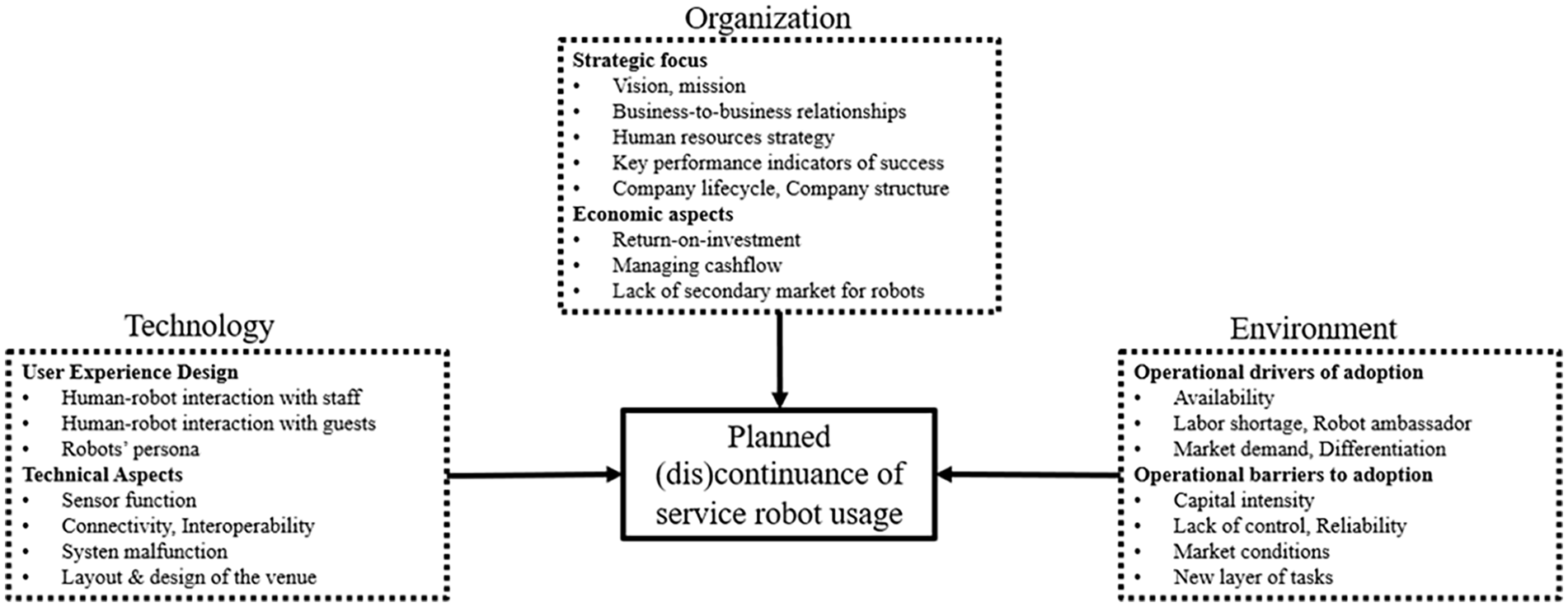
Model for Planned (Dis)continuance of Service Robot Usage.
Practical Implications
Hospitality leaders are choosing to adopt robots to primarily support and, in some cases, substitute human employees due to both the rising cost of labor and its scarcity in the post-COVID employment market; to help differentiate their offering from their competitors as customers are increasingly seeking novel experiences; and to better allocate human resources across their operating models (Tuomi et al., 2020; Tussyadiah et al., 2022). Drawing on our empirical findings, where discontinuance of robots’ use is planned, it is related to costs, reliability and the perceived complexity of robot integration. Conversely, robot providers are engineering off-the-shelf robot solutions, providing attractive initial pricing structures and offering ongoing technical support. This study highlights the practical considerations that both robot system providers (i.e., developers and suppliers) and their hospitality end-users need to assess to ensure successful implementation of the technology.
Hospitality operators are urged to carefully redesign customer journeys to effectively integrate service robots at appropriate touchpoints taking into consideration differing customer segments’ willingness to be served by or interact with such technology (Chen et al., 2022). The need to carefully manage guest expectations with regards to service provided by robots should also be considered both through the provision of additional services by robots to some customer groups such as families with children, and through managing technical failures where robot service needs to be withdrawn.
Hospitality leaders will need to carefully involve staff members in the adoption process of robots considering the balance between the roles of service robots and human employees in the guest experience. It would also be beneficial to appoint an internal “ambassador” for the robots to ensure their successful adoption and integration (Xu et al., 2020) because of the need for ongoing (technical) management of service robots. The physical design and spatial layout of the servicescape will also require consideration to aide accessibility and ease the navigation of service robots, especially where the layout may not be static, for example, changing table configurations in a restaurant (Tuomi & Ascenção, 2023). Both the robot providers and the hospitality operators should have this as a high priority when mapping premises and redesigning their facilities (Ivanov & Webster, 2017). The reliability and ease of integration of the service robots with other existing technology such as wi-fi networks, point-of-sale systems or property management systems should also be considered.
Finally, to ultimately achieve a good return on investment and form long-term business-to-business relationships, both the robot providers and hospitality operators should set out clear objectives for the adoption and implementation of the robot system that aligns with their strategic focus and define a broad range of metrics to evaluate its success and long-term applicability.
Conclusion, Limitations, and Future Research
Service robots offer hospitality companies new ways to serve customers and automate operational tasks (Tuomi et al., 2020). Despite a surge in research interest in service robots in hospitality contexts, there is a lack of understanding of the actual long-term applicability of robots in hospitality operations. To that end, a qualitative exploratory study was conducted to understand the strategic management reasons behind successful service robot adoption in hospitality operations. In total, six major themes were established and discussed, based on our empirical findings: (a) Operational drivers of robot adoption, for example, factors relating to supply and demand of robot solutions as well as the internal capabilities and market positioning of the robot-adopting company, (b) Operational barriers to robot adoption, for example, factors relating to costs, reliability and operational complexity of robot integration, (c) Strategic focus, that is, factors relating to company’s vision and mission, company’s life cycle, size and structure as well as the measurable outcome of robot adoption, (d) User experience design, that is, factors relating to robots’ persona and its interaction with customers and employees, (e) Technical aspects, that is, factors relating to sensors, connectivity and interoperability, success rate and retrofitting, and (f) Economic aspects, that is, factors relating to return-on-investment, managing cashflow and the value depreciation of the robot.
Despite collecting qualitative data from both service robot provider and user perspectives in multiple countries and across industries, the research presented here has limitations that should be noted. First, as is typical for exploratory qualitative studies, the sample size of our research is relatively small. Further research should aim to test and refine our findings through quantitative approaches. Moreover, most of our data is from Europe, which might reduce the global generalizability of our findings. Further research is required to extend our findings with data from more diverse samples, such as China, as previous research has demonstrated that customer attitudes toward technology may differ between cultural contexts (Dinev et al., 2009).
Second, to capture long-term experiences of real-world usage of service robots, we have purposefully chosen to focus our research to early adopters of technology. Future studies should extend this to also take into account those businesses who adopt robots later, by exploring factors of why laggards have not yet adopted robots, for example, in cases where their direct competitors have.
Finally, by choosing the TOE framework as the theoretical basis of our study and thus focusing on technology experts and senior hospitality management decision-makers, our study looks at technology adoption at the strategic management or enterprise level. Future studies should aim to integrate multiple perspectives (management, employee, customer; micro-meso-macro) to study the successful long-term use of service robots in specific companies, industries, or economic areas.
Footnotes
Appendix
Declaration of Conflicting Interests
The author(s) declared no potential conflicts of interest with respect to the research, authorship, or publication of this article.
Funding
The author(s) disclosed receipt of the following financial support for the research, authorship, and/or publication of this article: The lead author received financial support (a mobility grant) for the preparation of this article, funder: Finnish Foundation For Economic Education, project: Superteam.
