



Abstract
Dyadic leader–follower relationships play a significant role in sustainable development of labor-intensive and service-oriented organizations. The purpose of this study is to assess employees’ motivation and outcomes of developing and maintaining high-quality supervisor–subordinate guanxi in Chinese hotels. A survey was undertaken in four- or five-star hotels, with a total of 318 matched employees-supervisor completed responses used for data analysis, which was conducted using SPSS Statistics and SmartPLS. The study’s results show that affection and obligation significantly motivate employees to develop and maintain supervisor–subordinate guanxi, which in turn contributes to the desirable task performance delivery and supervisor autonomy support. Furthermore, the study confirms the mediating roles of supervisor–subordinate guanxi and task performance. This work extends guanxi research and is among the first to identify why hotel employees are motivated to develop and maintain high-quality supervisor–subordinate guanxi based on the contextualization of self-determination theory and Chinese cultural elements.
Keywords
Introduction
The significant role of interpersonal dynamics in hotel operations has been widely acknowledged, due to the labor-intensive and service-oriented nature of the hotel industry (Jones-Carmack & Criscione-Naylor, 2022; Lv et al., 2022). Despite the fact that dyadic leader–follower relationships play an important role in explaining interpersonal dynamics, how leaders influence followers has received much more academic and practical attention than leader–follower relationships (Hofmans et al., 2019). In order to achieve sustainable development, it is time to shift the focus to dyadic leader–follower relationships. Leader–follower relationships have been explained as leader–member exchange in the Western culture, and a lot of existing research has contributed to our understanding (C. J. Wang, 2016). However, most of this research has not been conducted beyond the Western cultural context. Leader–follower relationships have different characteristics under the cross-cultural influence (Luo et al., 2021; Lv et al., 2022; Ren & Chadee, 2020). Therefore, the contextualization of leader–follower relationships in non-Western culture should be considered. Within the Chinese culture, leader–follower relationships are represented as supervisor–subordinate (S-S) guanxi. Guanxi, a Chinese term, is analogous to relationship (P. Q. Wang et al., 2020). Specifically, guanxi consists of two Chinese characters (“guan” and “xi”): “guan” means “gateway,” while “xi” is translated as “to connect with each other”; taken together, guanxi is explained as a metaphor of how people are connected with each other in a closed social network (Taormina & Gao, 2010). S-S guanxi is a manifestation of workplace guanxi, which is used to explain the private relationship between supervisors and subordinates (Cheung et al., 2009).
As S-S guanxi significantly influences employees’ job performance and career development in practice, it is increasingly attracting the attention of researchers in tourism and hospitality (Li et al., 2018; Lv et al., 2022; P. Q. Wang et al., 2020). However, a review of relevant literature indicates that current research focuses on the outcomes of S-S guanxi rather than analyzing its antecedents from the perspective of subordinates (please see Table 1). More specifically, relatively little is known about why subordinates are motivated to develop and maintain high-quality guanxi with their supervisors (L. Zhang et al., 2016).
Key Literature on Guanxi.
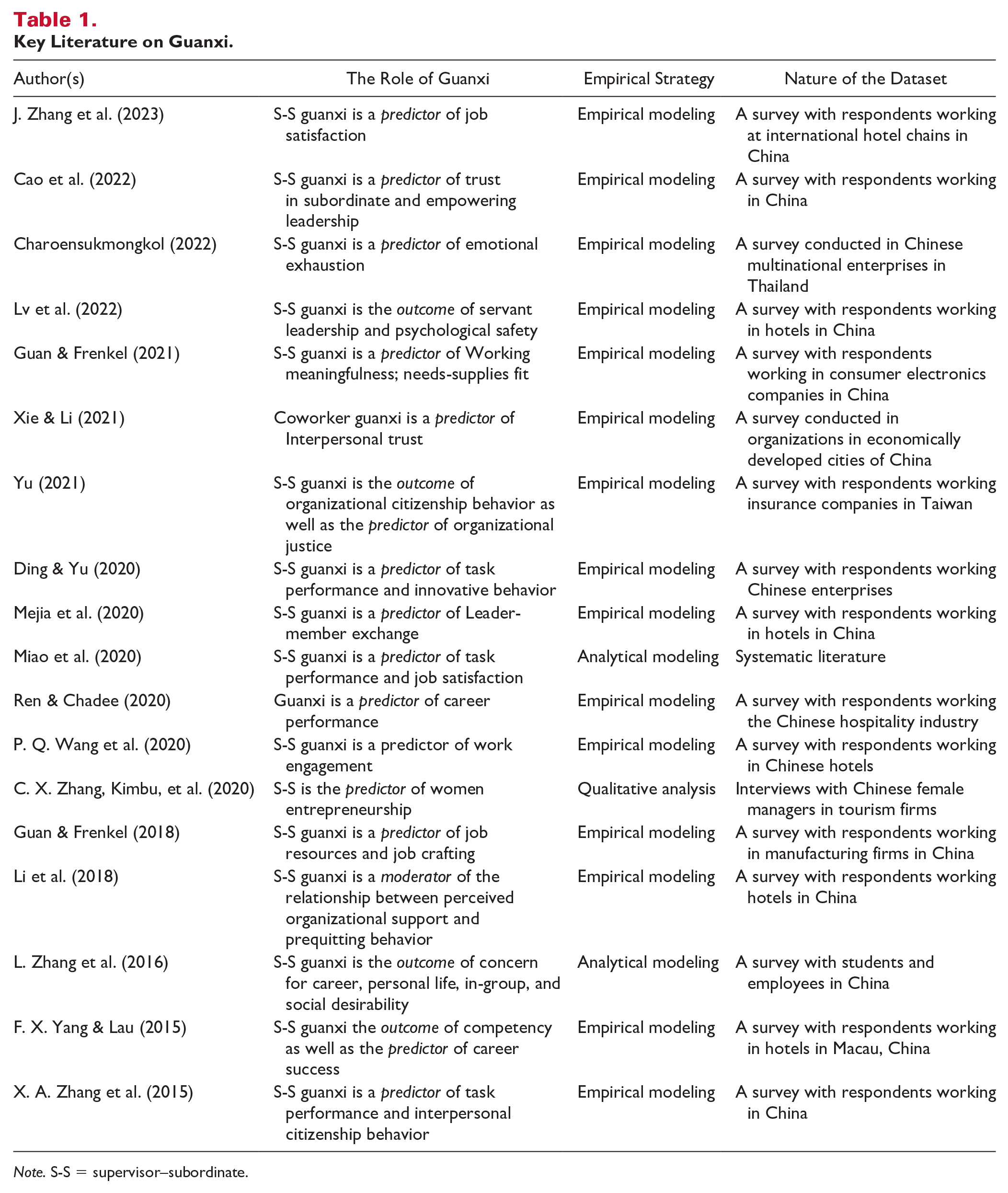
Note. S-S = supervisor–subordinate.
Self-determination theory (SDT) proposes that motivation determines why an individual engages in a particular behavior and varies at the time of the cultural values involved (Deci & Ryan, 1985, 2008; J. Zhang, Xie, et al., 2020). As S-S guanxi is characterized by Chinese culture, cultural elements should be considered in motivation. In addition, employees who actively build a high-quality guanxi with their supervisors are expected to pursue their personal goals (e.g., job performance and career development); therefore, identifying employees’ motivations to develop and maintain S-S guanxi helps to rationally explain the outcomes of S-S guanxi (L. Zhang et al., 2016). In the existing research, employee motivation is widely used to promote job performance in the hotel industry, such as task performance (M. Chen et al., 2017) and innovation (C. J. Wang, 2016). Task performance, as a type of job performance, is a primary element to keep competitive advantages in the market, and poor performance has become a challenging issue for human resource (HR) in the Chinese hotel industry (Li et al., 2018; Luo et al., 2021; P. Q. Wang et al., 2020). Therefore, it is worthwhile to link the relationships between employee motivation, S-S guanxi, and task performance. Furthermore, there are some empirical studies (e.g., Ding & Yu, 2020; Guan & Frenkel, 2018; Miao et al., 2020; X. A. Zhang et al., 2015) that make an attempt to test the direct relationship between S-S guanxi and task performance; however, their inconsistent findings (significant or insignificant results) allow this study to further investigate the relationships between the two constructs.
In the Chinese hotel industry, high turnover and low job satisfaction are two major challenges for HR (Li et al., 2018; Lv et al., 2022; Mejia et al., 2020; P. Q. Wang et al., 2020). Supervisor autonomy support is derived from SDT, and previous literature shows that supervisor autonomy support has a significant impact on employee turnover intention (D. Liu et al., 2011; Mustafa & Ali, 2019) and job satisfaction (Gillet et al., 2012). Supervisor autonomy support is prevalently considered as an antecedent which in turn contributes to a desirable outcome in the previous research. In this regard, it remains a research gap how to obtain supervisor autonomy support in a favorable manner. According to Guan and Frenkel (2018), high-quality guanxi with supervisors is an important way to obtain desirable resources in relation to work (e.g., supervisor support and job autonomy). Therefore, the relationship between S-S guanxi and supervisor autonomy support should be considered.
To address the above research gaps and comprehensively explain S-S guanxi, the purpose of this study is to assess Chinese hotel employees’ motivation to develop and maintain high-quality S-S guanxi, which in turn facilitates task performance and supervisor autonomy support. This study makes several significant contributions to the existing literature. First, this study is among the first to contextualize SDT (Deci & Ryan, 1985, 2008) to identify why hotel employees are motivated to develop and maintain high-quality S-S guanxi in accordance with Chinese cultural elements. Second, the study extends the hospitality literature on supervisor autonomy support. Third, the study creates a perspective (employee motivation–S-S guanxi–task performance/supervisor autonomy support) to explicate the implicit framework in social exchange theory, which is antecedent–exchange behavior–exchange outcome (Zhang & Lau, 2015). The theoretical model is shown in Figure 1.
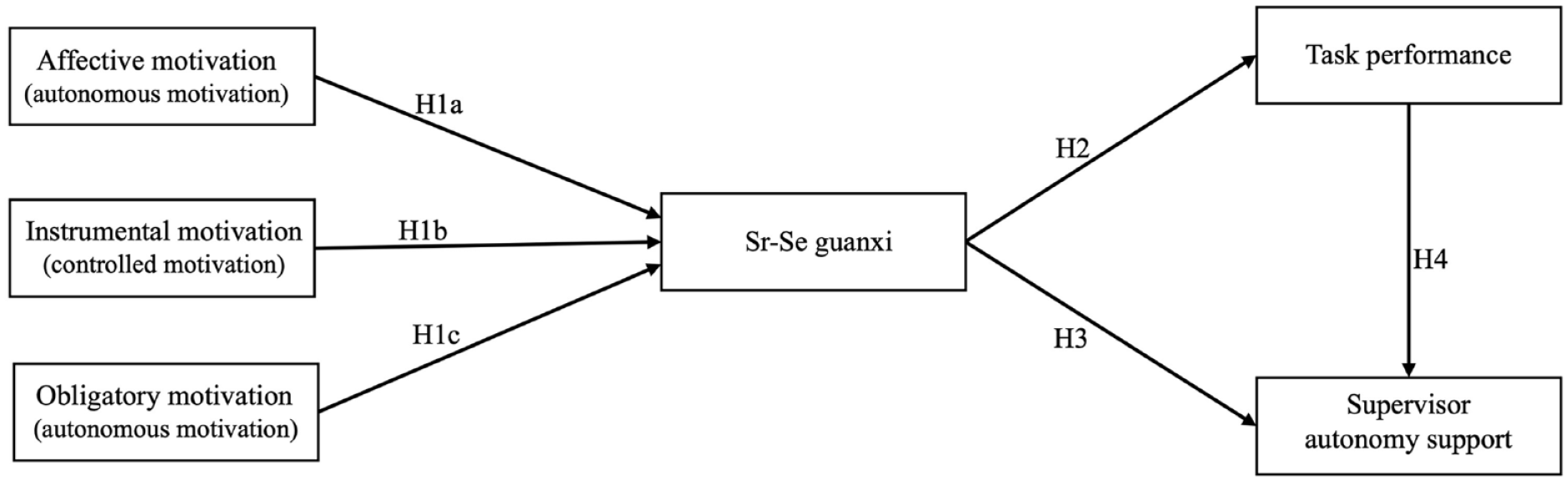
The Theoretical Model.
Theoretical Background and Hypotheses Development
Supervisor–Subordinate Guanxi
In the previous literature, some researchers have pointed out that Chinese-characteristic guanxi is characterized by three elements: affection, instrumentality, and obligation (Guo & Li, 2015; Xie & Li, 2021; C. F. Yang, 1999). In Chinese culture, guanxi is a manifestation of social-emotional philosophy (Lv et al., 2022). Specifically, high-quality guanxi leads to family-style interactions between the two sides, such as sharing feelings and thoughts, engaging in social activities, and being involved into the personal lives of the two sides (Y. Chen et al., 2009; L. Zhang et al., 2016). An individual tends to show partiality toward insiders with whom they have established high-quality guanxi (Miao et al., 2020). However, a specific type of guanxi presents different roles and behaviors (Ren & Chadee, 2020), and this study focuses on workplace guanxi. Compared with kinship-based guanxi, developing high-quality workplace guanxi is more complicated and challenging, because this type of guanxi is hardly pre-existent and requires employees to actively build familiarization (Ren & Chadee, 2020).
In the current research on workplace guanxi, S-S guanxi dominates the focus (Charoensukmongkol, 2022; Guan & Frenkel, 2018). S-S guanxi is primarily cultivated through non-work-related or off-work-centric social interactions, including both working and non-working hours (Cheung et al., 2009). S-S guanxi is based on social exchange theory (Blau, 1964), which highlights reciprocity and non-contractual obligations (Miao et al., 2020); specifically, employees are expected to obtain more privileges and resources, after establishing high-quality guanxi with their supervisors (Guan & Frenkel, 2018). Y. Chen et al. (2009) show that the development of high-quality S-S guanxi is made up of three dimensions: affective attachment (e.g., sharing feelings with one another), personal-life inclusion (e.g., having social activities together), and deference to the supervisor (e.g., obeying the supervisor). Leader–member exchange, which is similar to S-S guanxi but comes from Western culture, has been widely studied as an antecedent of positive outcomes in the workplace (C. J. Wang, 2016; Yoon & Yoon, 2019). However, differences between the two constructs have been identified in the relevant literature. Specifically, leader–member exchange is restricted to work-related interactions without the presence of affective attachment, whereas S-S guanxi emphasizes the private relationship between a subordinate and a supervisor that is developed and maintained through long-term reciprocity (Guan & Frenkel, 2021; Lv et al., 2022; Mejia et al., 2020; Miao et al., 2020; F. X. Yang & Lau, 2015).
The previous studies in tourism and hospitality have confirmed that S-S guanxi leads to positive outcomes in the Chinese hotel industry, such as work engagement (P. Q. Wang et al., 2020), career performance (Ren & Chadee, 2020; F. X. Yang & Lau, 2015), leader–member exchange (Mejia et al., 2020), and affective commitment (Li et al., 2018). In addition, C. X. Zhang, Kimbu, et al. (2020) find that S-S guanxi facilitates female intrapreneurship in the Chinese tourism industry. Table 1 presents some key literature on guanxi. According to Table 1, it is indicated that numerous studies have examined the role of S-S guanxi as an antecedent in recent years; however, there is limited research on S-S guanxi as an outcome. In other words, antecedents of developing and sustaining S-S guanxi in tourism and hospitality should be further explored.
Self-Determination Theory and Employees’ Motivation of Developing S-S Guanxi
Self-Determination Theory
SDT is a typical theory that explains human motivation through the two types of employee motivation: autonomous motivation and controlled motivation (Deci & Ryan, 1985). According to SDT (Deci et al., 2017), autonomous motivation (also known as self-determined motivation) is explained by an activity that individuals engage in with a high degree of willingness, volition, and choice, while controlled motivation is characterized by external outcomes (e.g., reward or punishment). One of the examples to explain the autonomously motivated individual is intrinsic motivation, such as finding the activity interesting (Gagné & Deci, 2005). Furthermore, as extrinsic motivation appears in various ways that represent different degrees of autonomy, identified regulation (personally identifying the significance of the activity) and integrated regulation (integrating different identifications) as the two forms of extrinsic motivation are used to explain individuals who are autonomously motivated (Deci et al., 2017). J. Zhang et al. (2023) conduct the research in the Chinese hotel industry to show that S-S guanxi contributes to employees’ autonomous motivation toward the work. However, there is little research on how employees are autonomously motivated to develop and maintain guanxi with their supervisors.
In contrast, external regulation, which represents the individual behavior controlled by others (e.g., reward and punishment), and introjected regulation, which seeks self-esteem or avoid guilt, are embedded into controlled motivation (Deci et al., 2017). Even though SDT suggests that autonomous motivation leads to more desirable outcomes and long-term maintenance of a behavior (Friederichs et al., 2015; Sandrin et al., 2022), previous literature in the hospitality area (e.g., Kim & Lee, 2022) suggests that both autonomous motivation and controlled motivation are determinants of individual behavior.
In general, since developing and maintaining S-S guanxi behavior is not mandatory in the job description, SDT is suitable for explaining employee motivation beyond job responsibilities (Kim & Lee, 2022). As noted previously, some researchers suggest that guanxi is characterized by affection, instrumentality, and obligation (Guo & Li, 2015; Xie & Li, 2021; C. F. Yang, 1999). To contextualize SDT in the guanxi situation, this study explains employees’ motivation for developing and maintaining S-S guanxi from these three factors.
Affective Motivation
Paying attention to affection is a manifestation of Chinese culture (Guo & Li, 2015). Affection concerns about emotional connection and reciprocal care, which is involved into each other’s personal lives (M. Chen & Bedford, 2022). Affection supports people’s motivational needs (Zhao & Zhu, 2014). McGrew (2022) proposes a framework for integrating contemporary motivation to show that affect is one of the core elements of motivation. According to Steg (2005), affective motivation refers to individual emotions aroused by an action. Even though the role of affection in motivation is ignored by previous motivation theories (e.g., goal-setting theory and expectancy theory), empirical studies find that affective motivation decides individual behavior (e.g., Ahmadi et al., 2022; Seo et al., 2010), because a positive affective state generates strong expectations of outcomes.
SDT proposes that the pursuit of relatedness is one of the principal reasons to explain employees’ intrinsic motivation (Gagné & Deci, 2005). Employees’ affective attachment is a manifestation of pursuing relatedness. Some previous research provides empirical evidence that affective motivation contributes to voluntary behavior (e.g., Dickert et al., 2011; Karanika-Murray et al., 2015); for example, Dickert et al. (2011) verify that affective motivation (e.g., empathic feelings) decides individual donation behavior. In the work of S. Yang et al. (2019), affection is involved into intrinsic motivation. Thus, affective motivation can be considered as a way to present autonomous/self-determined motivation.
Weiss and Cropanzano (1996) point out the critical role of positive affective state in the development of relationship/guanxi. The research of Y. Chen et al. (2009) and Mejia et al. (2020) indicates that affection is the basis for the development of trust and guanxi, which means that the higher affective attachment contributes to the high-quality S-S guanxi. In the research domain of tourism and hospitality, affection’s role in S-S guanxi is highlighted by F. X. Yang (2020). Thus, the study proposes that
Instrumental Motivation
According to the expectancy theory of motivation, instrumentality refers to an individual’s belief that the performance expectation met will lead to desired outcomes (Chiang & Jang, 2008). Deci et al. (2017) state that instrumental behaviors are explained by meeting individual extrinsic needs. Although instrumental motivation is not included into the original SDT’s classification of motivations, some studies (e.g., C. A. Chen et al., 2018; Xu, 2022) argue that instrumental motivation lies in the area between autonomous motivation and controlled motivation, indicating that a behavior is not fully in line with individual interests but is important for an individual. Y. Liu et al. (2020) highlight that instrumental motivation helps to improve the performance of an individual with low intrinsic motivation.
Furthermore, previous research points out that instrumental motivation is linked to social exchange (Barbuto & Story, 2011; Janssen et al., 2014). As S-S guanxi is based on social exchange theory, employees who are instrumentally motivated to develop a S-S guanxi tie with their supervisors can be explained by pursuing desired outcomes from their supervisors (Mejia et al., 2020). China is a country with a high power distance; therefore, supervisors have great privileges to decide the distributions of resources based on regulations and personal interests (Guo & Li, 2015). Employees who have a high-quality guanxi tie with their supervisors are prioritized for promotions and rewards, which may be difficult to achieve through the principle of fair distribution (Guan & Frenkel, 2021; Guo & Li, 2015). L. Zhang et al. (2016) verify that employees are motivated to establish and maintain high-quality guanxi with their supervisors to obtain career development support from their supervisors. Thus, the study proposes that
Obligatory Motivation
Perceiving obligation is defined as the extent to which individuals are committed to performing a behavior (Liang et al., 2012). Fuller et al. (2006) and Raza et al. (2021) emphasize that perceiving obligation experiences intrinsic motivation at work, which in turn leads employees themselves to deliver a desirable behavior. However, Van Petegem et al. (2021) indicate that obligation needs to be internalized to autonomously motivate individuals and avoid instrumental reasons.
Obligation in S-S guanxi concerns about subordinates’ role identification regarding dominance-submission and assesses the extent to which subordinates defer to their supervisors (Guo & Li, 2015). The research of Y. Chen et al. (2009) indicates that deference to the supervisor is a key dimension in establishing and maintaining S-S guanxi. This is closely related to traditional Chinese culture. The hierarchical Confucian culture of China means that subordinates are required to respect and obey their supervisors (L. Zhang et al., 2016). In addition, Chinese culture is characterized by high power distance, which may automatically lead to subordinates’ obligatory perception of deference (Guo & Li, 2015). In other words, the sense of obligation motivates employees to develop and maintain a positive guanxi tie with their supervisors, as obligation is internalized into individuals’ value of deferring to supervisors in the Chinese culture. Thus, the study proposes that
Task Performance
Job performance represents both behaviors and results, measuring what was done and how it was done (Armstrong & Taylor, 2017). Compared with S-S guanxi which emphasizes off-work-centric behaviors, job performance explains work-centric behaviors (F. X. Yang & Lau, 2015). Furthermore, job performance can be divided into four types: task performance, contextual performance, learning performance, and innovative performance (Han et al., 2007). Task performance, which represents the technical core, is defined as employees’ behaviors or results that facilitate the achievement of organizational goals based on the responsibilities of the job description (Aguiar-Quintana et al., 2021).
According to Ding and Yu (2020) and Miao et al. (2020), it is indicated that S-S guanxi contributes to task performance. In the field of hospitality, Ren and Chadee (2020) and F. X. Yang and Lau (2015) show that guanxi facilitates the performance of hotel employees. However, the results of the above studies suggest that S-S guanxi facilitates job performance because it facilitates access to valuable information and resources rather than because of characteristics of S-S guanxi itself.
Social exchange depends on long-term relationships; therefore, the development of S-S guanxi is long-term oriented (Hwang, 1987), and the behavior of developing S-S guanxi needs to be maintained with long-standing reciprocity (Lv et al., 2022; Miao et al., 2020). In short, employees need to continue to maintain S-S guanxi, even after they have developed guanxi with supervisors. The study of Guan and Frenkel (2018) proposes that to maintain high-quality S-S guanxi, employees need to provide desirable job performance. In Chinese culture, one of the dimensions of guanxi is obligation (Xie & Li, 2021; C. F. Yang, 1999); therefore, feeling obligatory to deliver the desirable task performance for maintaining developed high-quality S-S guanxi may provide a different explanation for the relationship between S-S guanxi and job performance. Thus, the study proposes that
Supervisor Autonomy Support
According to social exchange theory, high-quality guanxi with supervisors allows subordinates to be treated more favorably (Cheung et al., 2009; X. A. Zhang et al., 2015). Previous studies (Cao et al., 2022; Guan & Frenkel, 2018) have provided empirical evidence to present that S-S guanxi is significantly related to job autonomy and supervisor support. Specifically, job autonomy concerns about the extent to which individuals discretionarily decide when, where, and how to do their work (Charoensukmongkol, 2022). High-quality guanxi results in reciprocal trust between subordinates and supervisors (Xie & Li, 2021; Yu, 2021) and subordinates’ deference (Y. Chen et al., 2009), which, in turn, leads supervisors to provide subordinates with discretionary decision-making opportunities (Cao et al., 2022; Guan & Frenkel, 2018). Supervisor support includes work-related information, instrumentality, and emotion, which are useful in alleviating workplace issues (Quratulain & Al-Hawari, 2021). To obtain more favorable supervisor support, it is recommended that employees develop a high-quality guanxi tie with their supervisors (Guan & Frenkel, 2018).
Supervisor autonomy support is based on SDT, defined as “a supervisor’s tendency to acknowledge employees’ perspectives, offer choices within specific rules and limits, provide meaningful feedback, encourage initiation and provide a rational when employees undertake a particular task” (Y. Zhang et al., 2022, p. 274). The scale of supervisor autonomy support by Hagger et al. (2007) indicates that both job autonomy and supervisor support are components of supervisor autonomy support. Supervisor support serves to meet external needs (e.g., reward); however, supervisor autonomy support promotes an internal perceived locus of causality and provides long-term benefits to employees (Kanat-Maymon & Reizer, 2017). SDT highlights that the interpersonal communication is the fundamental element to provide autonomy support to employees in the work environment (Kanat-Maymon & Reizer, 2017). Guanxi is cultivated based on interpersonal communication, and empirical studies present that guanxi contributes to interpersonal trust (Bedford, 2021; Xie & Li, 2021) and interpersonal facilitation (X. A. Zhang et al., 2015). Thus, the study proposes that
The previous literature mainly focuses on how supervisor support or autonomy support influences subordinates’ job performance (Quratulain & Al-Hawari, 2021; Y. Zhang et al., 2022). However, the role-based view of the followership theory provides a framework to explain the influence of subordinates’ job performance on supervisors’ behaviors, such as empowering leadership (Cheong et al., 2019). Specifically, subordinates’ behaviors, characteristics, and styles are considered as antecedents, while supervisors’ behaviors and attitudes are outcomes (Uhl-Bien et al., 2014). When subordinates complete tasks with distinction or deliver excellent performance, supervisors feel obligatory to value their contributions with positive behaviors, such as empowering or providing more autonomy and support (Cheong et al., 2019). The empirical study of Cao et al. (2022) verifies that subordinates’ performance is positively related to empowering leadership. Thus, the study proposes that
The Mediating Effect of S-S Guanxi and Task Performance
SDT denotes that motivation decides the individual behavior (Deci & Ryan, 1985, 2008). However, S-S guanxi is based on social exchange theory, which means that developing high-quality S-S guanxi is not the final outcome that employees pursue; instead, employees seek their personal goals through guanxi (F. X. Yang & Lau, 2015). L. Zhang et al. (2016) indicate that explaining employees’ motivation to develop S-S guanxi needs to link with their personal goals. Implicitly, employees are affectively, instrumentally, and obligatorily motivated to develop the positive guanxi tie with their supervisors for the benefits of social exchange. Once the S-S guanxi is developed, interpersonal trust and interpersonal facilitation will be strengthened (Bedford, 2021; Xie & Li, 2021; X. A. Zhang et al., 2015), which then contributes to autonomy support given by supervisors. In addition, S-S guanxi needs to be maintained with long-standing reciprocity, even though a positive S-S guanxi tie is developed (Lv et al., 2022; Miao et al., 2020). Desirable task performance delivered by employees is necessary to maintain S-S guanxi (Guan & Frenkel, 2018). Overall, the perspective of motivation–S-S guanxi–task performance/supervisor autonomy support implies a significant framework in social exchange theory: the antecedent (affective/instrumental/obligatory motivation), the exchange behavior (S-S guanxi developing and maintaining), and the exchange outcome (task performance/ supervisor autonomy support). Thus, the study proposes that
S-S outcome is based on social exchange (F. X. Yang & Lau, 2015). To maintain S-S guanxi, employees need to deliver quality task performance (Guan & Frenkel, 2018), while supervisors tend to provide more support and autonomy to employees who have a more favorable guanxi with them (Cao et al., 2022; Guan & Frenkel, 2018). Therefore, task performance and supervisor autonomy support are two potential social exchange outcomes of S-S guanxi.
The role-based view of the followership theory indicates that the quality task performance delivered by employees contributes to supervisors’ favorable behaviors toward employees (Cheong et al., 2019). Cao et al. (2022) show that supervisors are more likely to empower employees with quality performance, as trust is established. Integrating the role-based view of the followership theory and social exchange theory, the study proposes that S-S guanxi can indirectly influence supervisor autonomy support by improving employees’ task performance. Since social exchange theory emphasizes long-term reciprocity, supervisors are willing to provide subordinates with more support and autonomy, after developing high-quality guanxi with supervisors contributes to subordinates’ job performance improvement (Blau, 1964; Lv et al., 2022). Therefore, the study proposes that
Method
Sample and Procedure
All scale items of the questionnaire were initially developed in English, before being translated into simplified Chinese, with the adoption of Brislin’s (1976) back-translation method. To ensure that the meaning between Chinese and English was not changed, this study invited a bilingual expert to translate all scale items from English to Chinese, followed by another bilingual scholar who back-translated the questionnaire. The questionnaire was slightly modified, after a pilot testing was conducted, with the participation of seven non-supervisory and four supervisory employees in the Chinese hotel industry.
This research was conducted in Beijing, Shanghai, and Xi’an, which are as national central cities (P. Chen, 2020) and initially rated as the best tourist destinations in China (Song, 2003). As four- or five-star hotels have a larger scale with more employees and a greater contribution to the hotel industry, this research focused on four- or five-star hotels. One of our authors, who was based in China, used the personal networks to contact general managers or HR directors at four- or five-star hotels in the three cities for the permission of research participation. After confirming the hotels that participated in this research, the HR department helped the authors distribute online questionnaires to employees and their corresponding supervisors, and each employee was allocated a three-digit code for the identification. The informed consent was presented at the beginning of the questionnaire to explain the purpose of this research and to guarantee the voluntary participation and the confidentiality of the respondents’ information.
Data were collected in two times. At Time 1, motivation to develop and maintain S-S guanxi was measured based on employees’ responses, and employees were required to input a unique three-digit code in their online questionnaires. A total of 402 questionnaires were collected. The second round took place after 4 weeks, and employees who participated in the first round provided the measures of S-S guanxi and supervisor autonomy support. Meanwhile, the participants’ corresponding supervisors were provided with employees’ unique three-digit codes and invited to rate employees’ task performance. The employees and their corresponding supervisors input the employees’ unique three-digit codes into the online questionnaires so that responses between the employee and his or her supervisor were matched. In the second round, 390 employees continued to participate in the research, with 372 employees’ task performance rated by their corresponding supervisors. After removing missing data, incomplete pairs, and inaccurately completed questionnaires, a total of 318 matched employee–supervisor completed responses were used for data analysis. Respondents (employees and their corresponding supervisors) received 10 yuan (CNY) as a reward after submission in the second round.
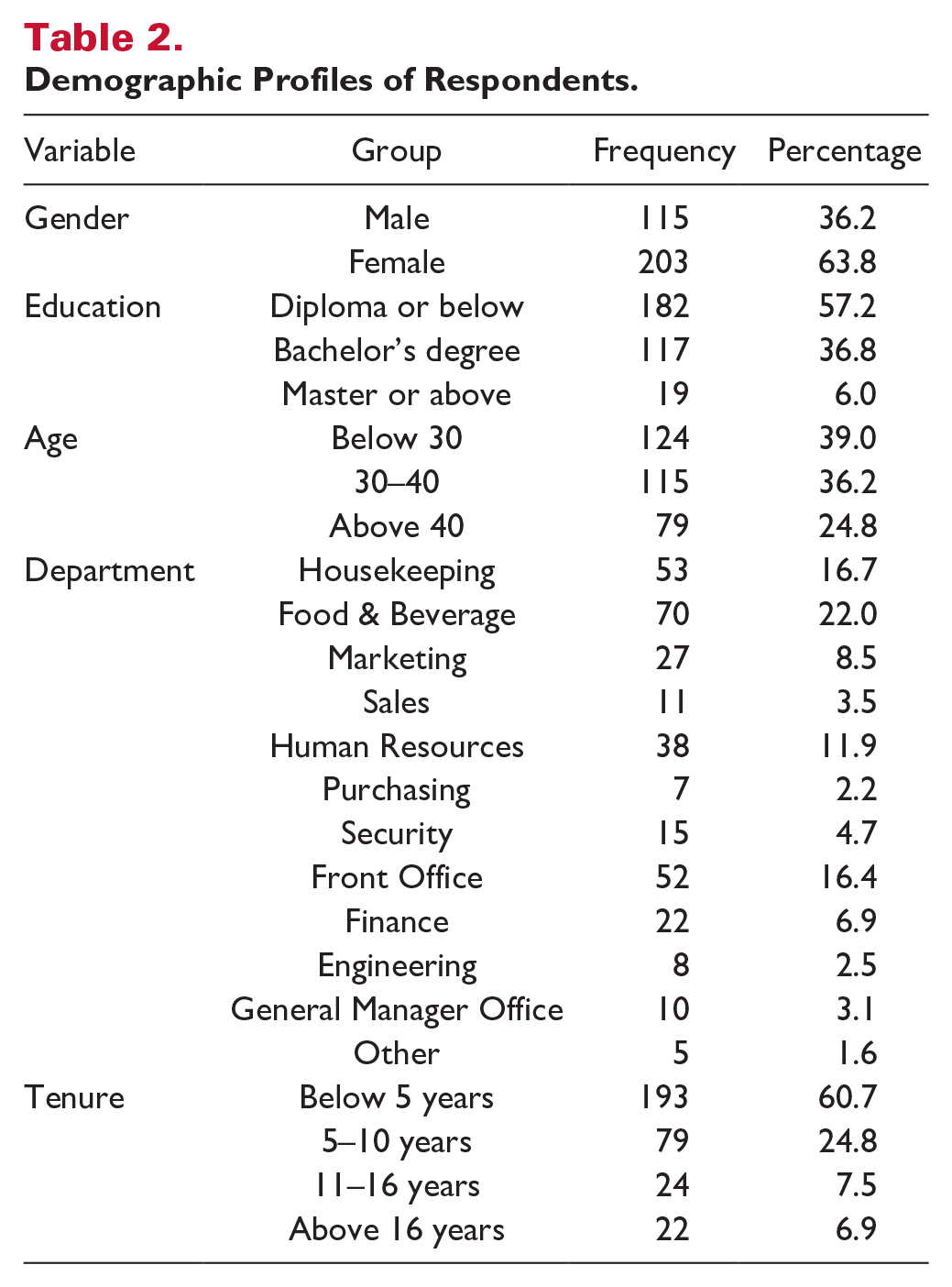
The employees’ demographical profiles are presented in Table 2, which indicated that 63.8% of employees were female, and 39.0% were under 30 years old. 42.8% of employees had a Bachelor or higher degree; employees from Food & Beverage took up the highest proportion (22.0%), followed by Housekeeping (16.7%).
Demographic Profiles of Respondents.
Measures
All items of constructs were measured on a 7-point Likert-type scale, ranging from 1 (strongly disagree/poor performance) to 7 (strongly agree/superior performance).
Statistical Analysis
SPSS Statistics was used for descriptive analysis of demographical profiles and initial screening of data. Partial least squares structural equation modeling (PLS-SEM), which estimates path models with latent variables and their relationships, was employed in this research, as the strength of this approach is to handle complicated models with small sample sizes (Supanti & Butcher, 2019). PLS-SEM is also a non-parametric statistical method, in which the data were not required to be normally allocated (Hair et al., 2021). PLS-SEM has been widely employed in the research domain of tourism and hospitality (Li et al., 2021; Supanti & Butcher, 2019).
The software program SmartPLS 4.0 was used to undertake data analysis. In the process of PLS-SEM testing, the assessment of measurement model should be completed before assessing the structural model. Referring to Chandra et al. (2012), structural models in this study consisted of a hypothesized model (Model 3) and two competing models (Models 1 and 2). This study assessed the applicability of Model 3 against two competing models. According to Sharma et al. (2019), two groups of model selection criteria were employed in this study. First, to choose a suitable model that is very similar to an unknown true model taking a responsibility of developing observed data which in turn creates the correlation patterns between significant variables, Akaike’s final prediction error (FPE), Akaike information criteria (AIC), corrected AIC (AICc), and unbiased AIC (AICu) (Gutierrez et al., 2024). Second, the highest likelihood of being an appropriate model based on the available data requires asymptotical consistency; thus, Schwarz’s Bayesian information criteria (BIC), Hannan and Quinn’s criteria (HQ), and corrected HQ (HQc) were tested (Gutierrez et al., 2024). For two groups of criteria, the model with the lowest values is suggested to be selected (Sharma et al., 2019).
Results
Assessment of Measurement Models
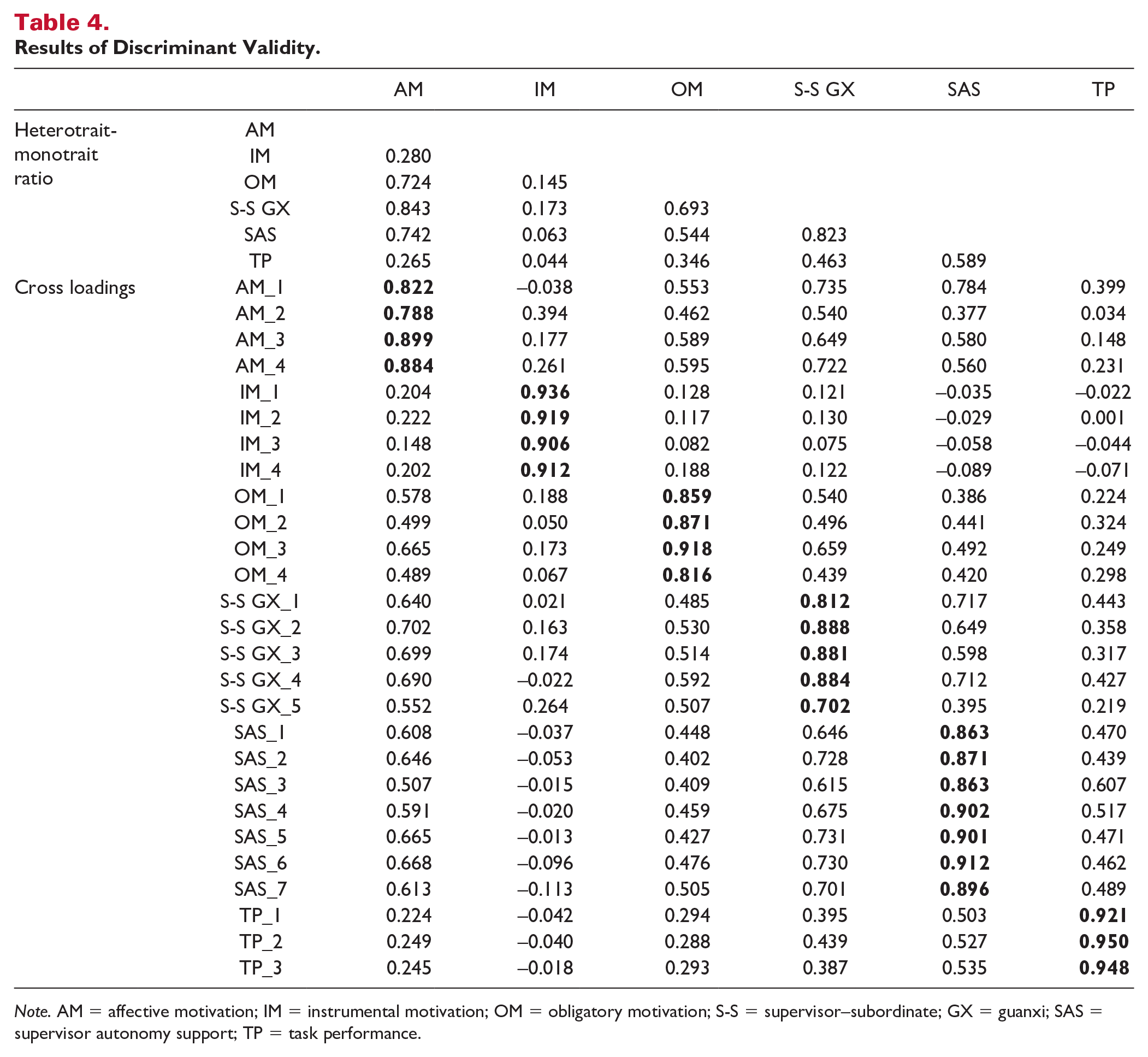
The model of this study includes seven reflective constructs which are recommended to be assessed through the testing of internal consistency reliability, convergent validity, indicator reliability, and discriminant validity (Hair et al., 2021). Table 3 presented results of measurement model assessment. First, internal consistency reliability was confirmed, as all values of Cronbach’s alpha and composite reliability (CR) were greater than the threshold of 0.70. Second, all values of average variance extracted (AVE) were higher than 0.50, which confirmed convergent validity. Third, outer loadings were above 0.70, so indicator reliability was confirmed. Finally, heterotrait-monotrait ratio (HTMT) and cross loadings were prevalently used to assess discriminant validity (Hair et al., 2021). Table 4 presented that all values of HTMT were below the threshold of 0.90, and all indicators load greatest on their linked constructs, so there was no discriminant validity issue (Henseler et al., 2015).
Assessment of Measurement Model.
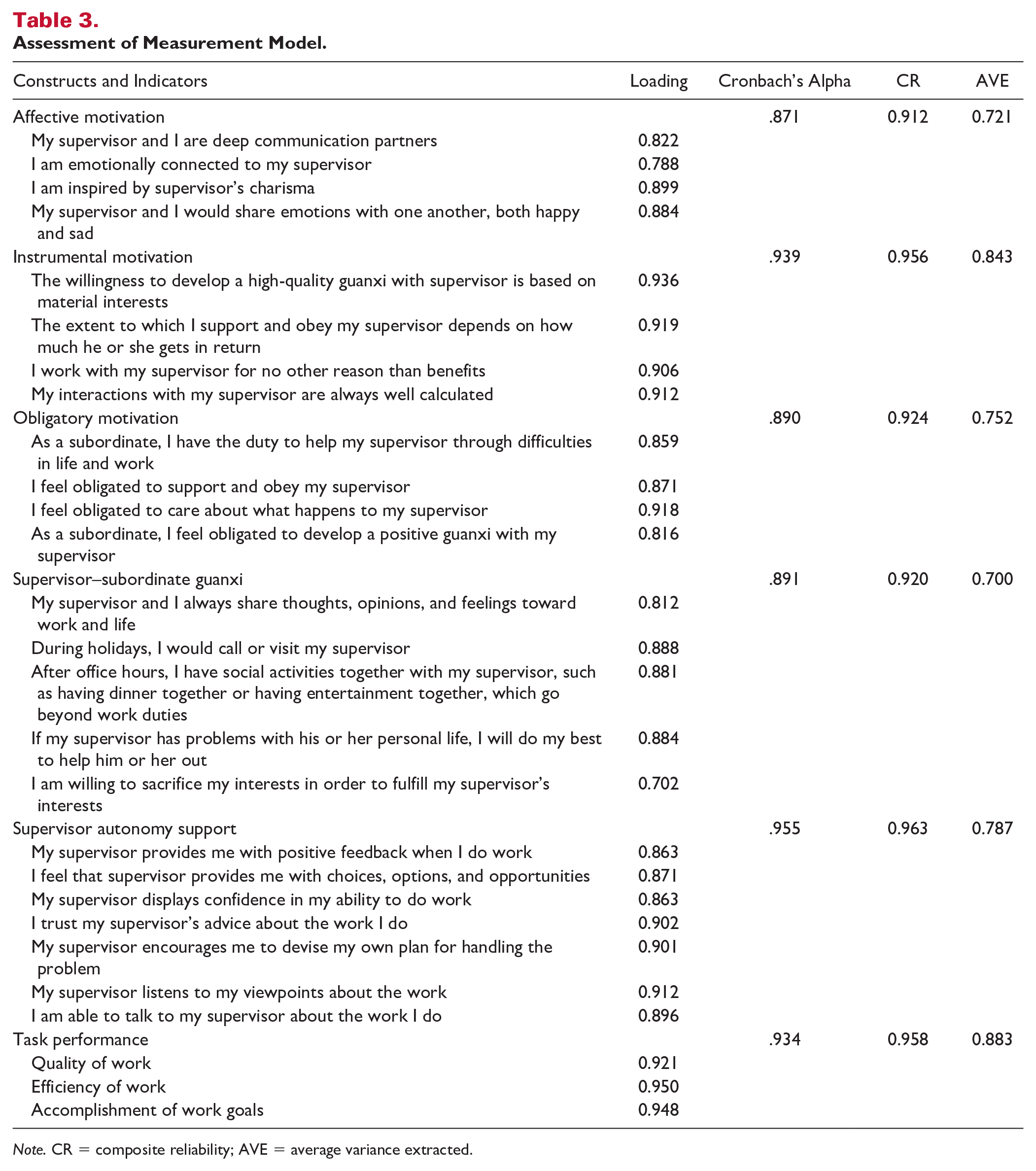
Note. CR = composite reliability; AVE = average variance extracted.
Results of Discriminant Validity.
Note. AM = affective motivation; IM = instrumental motivation; OM = obligatory motivation; S-S = supervisor–subordinate; GX = guanxi; SAS = supervisor autonomy support; TP = task performance.
Assessment of Structural Models
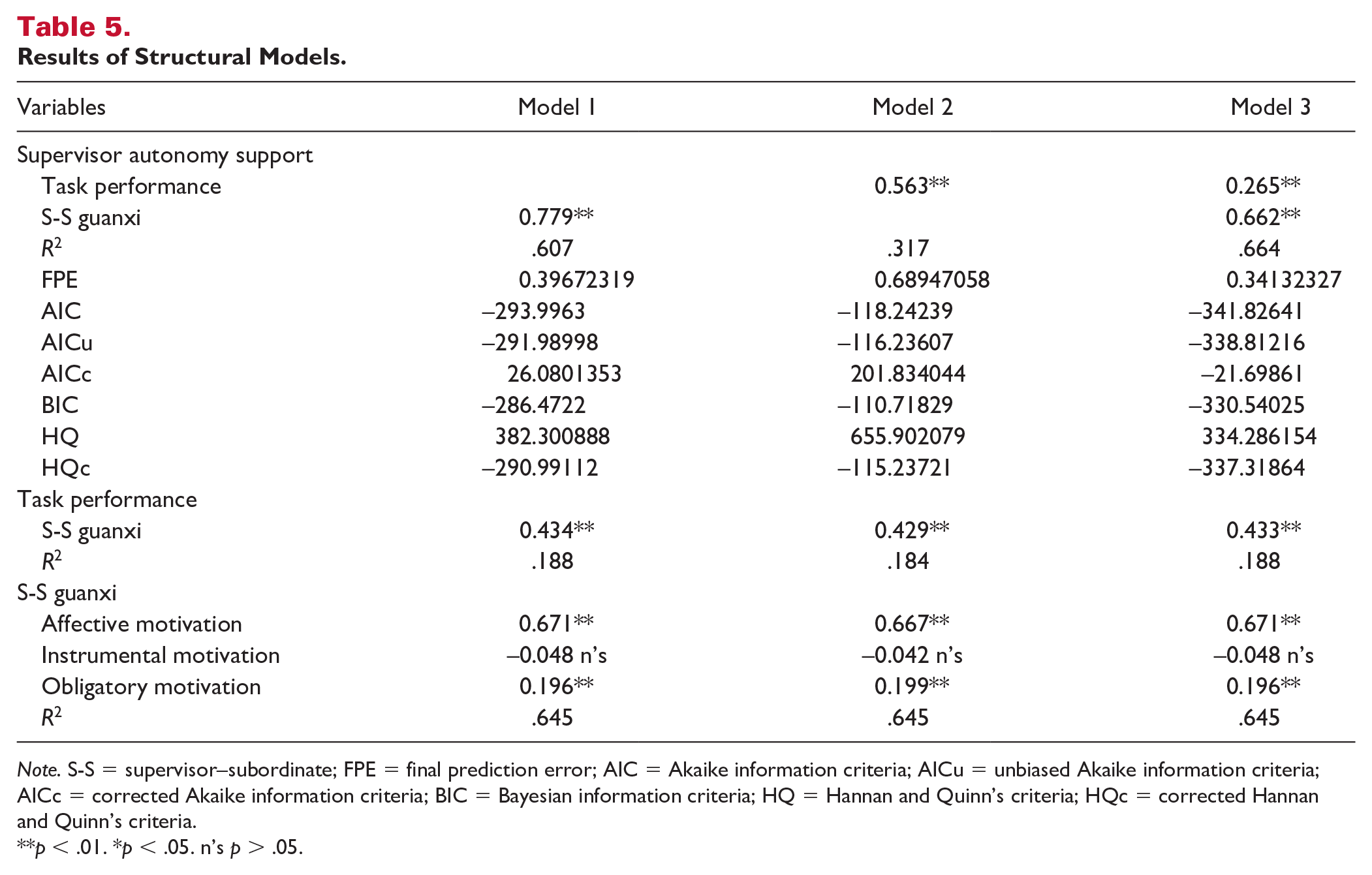
The assessment of structural models was reported in Table 5. Based on Model 3, the study completed the testing of hypotheses. First, collinearity was not an issue in this structural model, as all constructs’ values of variance inflation factor (VIF) ranged between 1.050 and 1.888, which were below 3 (Hair et al., 2019). Second, model’s predictive accuracy was measured by coefficient of determinant R2, and the results of R2 are reported in Table 5, which indicated appropriate predictive power (Hair et al., 2021).
Results of Structural Models.
Note. S-S = supervisor–subordinate; FPE = final prediction error; AIC = Akaike information criteria; AICu = unbiased Akaike information criteria; AICc = corrected Akaike information criteria; BIC = Bayesian information criteria; HQ = Hannan and Quinn’s criteria; HQc = corrected Hannan and Quinn’s criteria.
p < .01. *p < .05. n’s p > .05.
Finally, the significance and relevance of the path coefficients were tested by Bootstrapping. H1a and H1c were supported, suggesting that affective motivation (β = 0.671, p = .000 < .01) and obligatory motivation (β = 0.196, p = .001 < .01) were positively related to S-S guanxi; however, H1b was rejected, as the significant relationship between instrumental motivation and S-S guanxi (β = −0.048, p = .141 > .05) was not found in the study’s results. In support of H2, S-S guanxi had a positive relationship with task performance (β = 0.433, p = .000 < .01). Furthermore, the study also verified that both S-S guanxi (β = 0.662, p = .000 < .01) and task performance (β = 0.265, p = .000 < .01) were positively related to supervisor autonomy support. Thus, H3 and H4 were supported.
Assessment of Mediating Effect
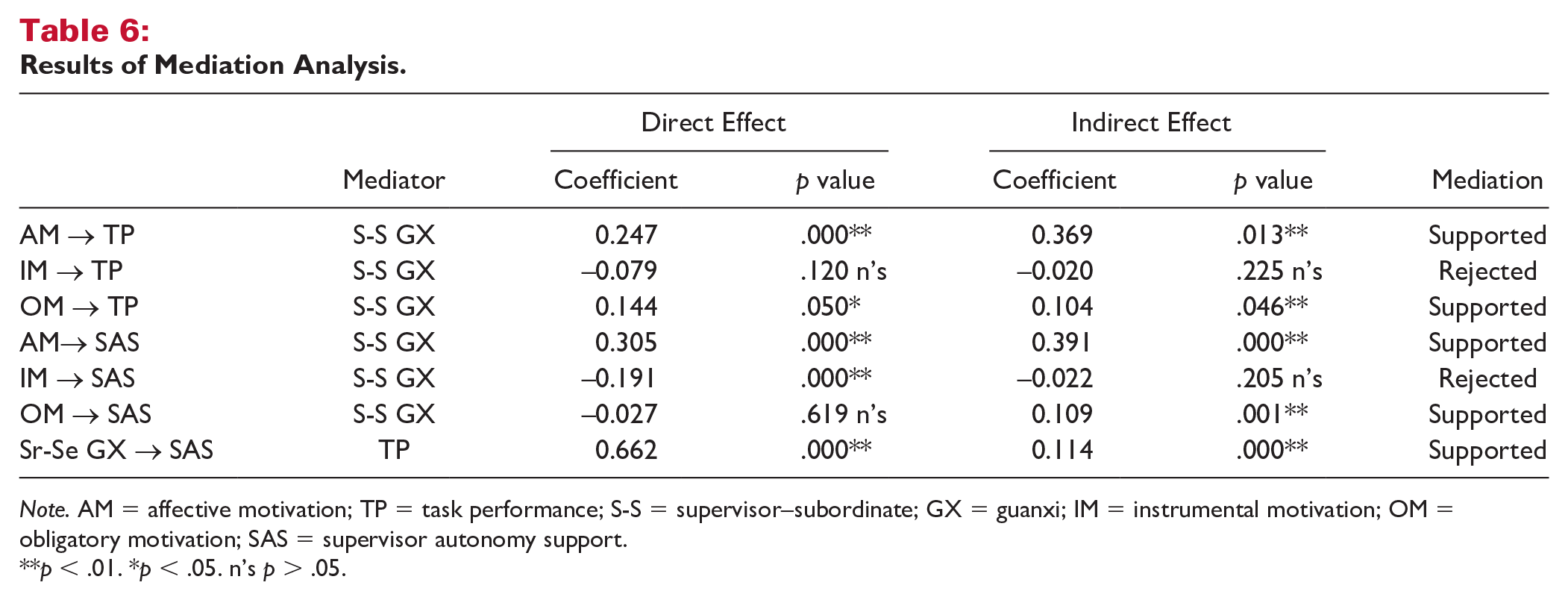
According to Hair et al. (2021), mediation occurs, when both direct and indirect effects are significant, or indirect effect is significant but there is no direct effect. The mediation analysis was run by Bootstrapping, and the result was reported in Table 6. The testing results confirm that S-S guanxi mediates the relationship between affective motivation and task performance, the relationship between obligatory motivation and task performance, the relationship between affective motivation and supervisor autonomy support, and the relationship between obligatory motivation and supervisor autonomy support. In addition, task performance is found to play a mediating role in the relationship between S-S guanxi and supervisor autonomy support.
Results of Mediation Analysis.
Note. AM = affective motivation; TP = task performance; S-S = supervisor–subordinate; GX = guanxi; IM = instrumental motivation; OM = obligatory motivation; SAS = supervisor autonomy support.
p < .01. *p < .05. n’s p > .05.
Discussion and Implications
The study’s results reveal the two factors that autonomously motivate employees to develop and maintain guanxi with their supervisors in the hotel industry. Affection is the strongest motivator for developing and maintaining S-S guanxi. It reflects the Chinese culture that individuals take affection seriously (Guo & Li, 2015). It also resonates with the research of Y. Chen et al. (2009) and Mejia et al. (2020) denoting that the higher affective attachment contributes to the high-quality S-S guanxi. Obligation is another motivator of developing and maintaining S-S guanxi. This finding can be explained by the hierarchical Confucian culture in China, in which respecting and deferring to supervisors are internalized into personal value of subordinates (Guo & Li, 2015; L. Zhang et al., 2016). However, the relationship between instrumental motivation and S-S guanxi is rejected in this study, which seems to be inconsistent with the view that instrumentality is a dimension of guanxi (Guo & Li, 2015; Mejia et al., 2020; Xie & Li, 2021; C. P. Yang, 1999; L. Zhang et al., 2016). This result means that hotel employees are not effectively motivated by instrumental needs, even though high-quality S-S guanxi developed leads to more privileges and resources for employees. This is primarily because instrumental motivation is not included into autonomous motivation, which leads to the incompatibility with the characteristics of S-S guanxi’s long-term orientation and stability (Hwang, 1987).
Based on previous work which has confirmed S-S guanxi’s positive relationships with job autonomy and supervisor support (e.g., Cao et al., 2022; Guan & Frenkel, 2018), this study demonstrates that S-S guanxi is positively related to supervisor autonomy support in the Chinese hotel industry. It is consistent with the research of Kanat-Maymon and Reizer (2017), which highlights that interpersonal communication poses the foundation of favorably obtaining supervisor autonomy support. Drawing on the role-based view of the followership theory (Uhl-Bien et al., 2014), the study finds that desirable task performance is positively related to supervisor autonomy support in the Chinese hotel industry, which seems to be consistent with the findings of the research of Cao et al. (2022).
The S-S guanxi’s mediating role in the relationship between affective/obligatory motivation and task performance/supervisor autonomy support is supported, which explicates a comprehensive framework in social exchange theory: the antecedent, exchange behavior, and exchange outcome. Furthermore, the mediating role of task performance is confirmed, indicating that subordinates who have high-quality guanxi with their supervisors obtain more supervisor autonomy support after these subordinates deliver desirable task performance in hotel operations, which reflects the long-term reciprocity characteristic of guanxi in social exchange theory (Blau, 1964; Lv et al., 2022). The theoretical and practical implications are discussed below.
Theoretical Implications
This study makes several theoretical contributions. First, it extends guanxi literature by identifying employees’ motivation of developing and maintaining S-S guanxi, as current research primarily focuses on the assessment of S-S guanxi’s role as a predictor rather than an outcome (Lv et al., 2022; Miao et al., 2020). Based on the contextualization of SDT in Chinese traditional culture, the study assessed and confirmed that affective motivation and obligatory motivation are the drivers of developing and maintaining S-S guanxi. Because both affective motivation and obligatory motivation are embedded into autonomous motivation and instrumental motivation is not significantly related to S-S guanxi, the study sheds light on the sustainable role of autonomous motivation (Friederichs et al., 2015; Ryan & Deci, 2000; Sandrin et al., 2022) in a long-term behavior, such as maintaining a developed S-S guanxi tie (Hwang, 1987).
Second, the study widens the hospitality literature on supervisor autonomy support. In the previous literature, supervisor autonomy support is commonly used as an antecedent and there is devoid of research on supervisor autonomy support in the field of hospitality. To fill the research gap, this study provides empirical evidence to demonstrate that supervisor autonomy support is the significant outcome of S-S guanxi and task performance in the Chinese hotel industry. According to confirming the mediating role of task performance, the more robust rationale of how developing high-quality S-S guanxi leads to supervisor autonomy support in the hotel industry is presented, and it also supports the integration of the role-based view of the followership theory and social exchange theory (Blau, 1964; Lv et al., 2022).
Third, the study explicates the implicit framework in social exchange theory (antecedent–exchange behavior–exchange outcome) through verifying the perspective of motivation–S-S guanxi–task performance/supervisor autonomy support. According to the confirmation of the direct relationship between S-S guanxi and task performance and the mediating role of S-S guanxi in the relationship between affective/obligatory motivation and task performance, it is indicated that employees who feel obliged and affectively motivated to deliver the desirable task performance for the maintenance of high-quality S-S guanxi which has been developed. If employees’ task performance is not high-quality, the developed S-S guanxi may be gradually weakened. Compared to previous research denoting that the more accessible resources and privileges employees obtain from supervisors explain the positive relationship between S-S and hotel employees’ performance, this study’s results emphasize that quality task performance is a way to maintain S-S guanxi, as S-S guanxi is long-term oriented and reciprocal (Hwang, 1987; Lv et al., 2022; Miao et al., 2020). Furthermore, the mediating role of S-S guanxi in the relationship between affective/obligatory motivation and supervisor autonomy support confirmed provides the new explanation for why employees are motivated to develop S-S guanxi.
Practical Implications
The study also provides practical implications for hotel management operations and employee behavior. To take advantage of guanxi mechanism, the hotel management team should be fully aware of the importance of affective motivation and obligatory motivation in developing and maintaining S-S guanxi. On one hand, as affective motivation shows a strongest relationship with S-S guanxi in the study’s results, affective connection is expected to be emphasized in organizational culture. Specifically, the atmosphere of mutual care and sympathy is encouraged to be created to reinforce the sense of belonging and emotional attachment (Xie & Li, 2021). It is also recommended that Hotel’s HR department organize leadership training and symposium to discuss and learn about affective support. Supervisors can actively establish a personal relationship with their subordinates and reduce the feeling of distance through leisure activities outside the working hours. A leisure activity outside the working hours (e.g., dinner gathering) is a desirable way to promote the mutual understanding, which in turn strengthens affective connection (Guan & Frenkel, 2018). On the other hand, to promote employees’ obligatory motivation, the hotel management team or HR department can organize some training in relation to Chinese traditional culture (e.g., Confucian values) and add relevant content to the employee handbook (P. Q. Wang et al., 2020; Xie & Li, 2021). Therefore, employees can learn and recognize the significance of obligation in the workplace. Even though S-S guanxi provides employees with favorable privileges and resources (Guan & Frenkel, 2018), the confirmation of the insignificant relationship between instrumental motivation and S-S guanxi in this study suggests that material temptations should not be overemphasized.
From the employees’ perspective, they need to recognize the significance of interpersonal relationship in labor-intensive and service-focused organizations, such as hotels. First, to receive more autonomy support from supervisors, hotel employees are recommended to autonomously develop high-quality guanxi with their supervisors during both working and non-working hours. Obtaining supervisors’ autonomy support is based on whether subordinates are trusted by supervisors, and high-quality S-S guanxi plays a crucial role in cultivating interpersonal trust (Bedford, 2021; Cao et al., 2022; Xie & Li, 2021). However, employees need to be aware that developing S-S guanxi is not the end of the road; instead, maintaining the high-quality S-S guanxi should be considered in the long term. Thus, employees are expected to keep the high-quality task performance as a result of S-S guanxi’s long-term reciprocity (Lv et al., 2022; Miao et al., 2020). Furthermore, the mediating role of task performance confirmed in the study reveals that delivering the high-quality task performance also strengthens supervisors’ willingness to provide autonomy support to subordinates, as supervisors trust in subordinates’ competence. Therefore, both work-centric behaviors (e.g., developing and maintaining S-S guanxi) and non-work-centric behaviors (e.g., performing the task well) are important for employees to obtain supervisor autonomy support.
Limitations and Directions for Future Research
This research also has several limitations, which provide avenues for future research. First, this study’s data were collected from Chinese national central cities; therefore, the future research can be conducted in small and medium-sized cities and then compare the differences of guanxi behavior within the different cities. Second, some previous literature (e.g., Miao et al., 2020) suggests that S-S guanxi is applicable to non-Chinese culture, but there is rare empirical evidence. Therefore, it is worthwhile to conduct the research of S-S guanxi in other countries. Third, the study’s results reject the relationship between instrumental motivation and S-S guanxi in the hotel industry; however, more empirical research is necessary to confirm this result. Fourth, as there is little research on affective motivation, instrumental motivation, and obligatory motivation for developing and maintaining S-S guanxi, the indicators to measure these three variables need to be more rigorous. Thus, using interview approach to develop indicators of affective motivation, instrumental motivation, and obligatory motivation in the Chinese context and to create separate dimensions of affection, instrumentality, and obligation in the variable of S-S guanxi should be considered in the near future.
Footnotes
Declaration of Conflicting Interests
The author(s) declared no potential conflicts of interest with respect to the research, authorship, or publication of this article.
Funding
The author(s) received no financial support for the research, authorship, or publication of this article.
