




Abstract
Despite the agreement on the importance of internal marketing, the central dogma that it creates value for employees which will incite employees to in turn create value for their organization and customers lacks empirical verification and remains a contentious issue. Two separate multisource-multilevel datasets are used to illuminate the effects of hotel property department-level internal marketing (process-focused) climate on a positive, key organizationally relevant psychological outcome (i.e., perceived organizational support) and a positive, key organizationally relevant behavioral outcome (i.e., organizational citizenship behavior), which in turn engender hotel property department effectiveness and competitive excellence, respectively. Moreover, the results suggest that organizational citizenship behavior is a linchpin in the explication and illustration of the effects of hotel property department/unit internal marketing climate on hotel property department/unit effectiveness and competitive excellence. By doing so, we provide a comprehensive model that underscores the impacts of internal marketing climate on crucial employee, organization/unit, and customer outcomes in the hospitality industry. Implications, limitations of the current inquiry, and avenues for future research are discussed.
Keywords
Introduction
Internal marketing entails treating employees as internal customers and viewing their jobs as internal products that meet their needs and desires (Huang & Rundle-Thiele, 2014; To et al., 2015). By satisfying the needs and desires of employees in the way in which they seek to satisfy those of their customers, hospitality organizations can elevate their strategic and competitive success (Kotler et al., 2017). Because it purportedly addresses how an organization can engender value for its employees as well as for the organization and its customers, internal marketing has received attention from multiple disciplines (management, business, and marketing) including hospitality management (e.g., Chow et al., 2015; Frye et al., 2020; Huang & Rundle-Thiele, 2015; Kim et al., 2016; To et al., 2015).
Despite the widespread conceptual agreement on its importance, the value creation chain of internal marketing from employees to their organizations and customers (Kotler et al., 2017; Vieira-dos Santos & Gonçalves, 2018) lacks empirical verification and hence remains a contentious issue (Yu et al., 2019). The lack of confirmatory (or falsifying) evidence represents a critical theoretical gap across these various literatures by undermining efforts to discern the effects of internal marketing on those employee outcomes that contribute to crucial strategic and competitive outcomes (Yu et al., 2019). It also represents a substantial practical gap in the management of people, as it leaves unclear the ways in which hospitality organizations may enhance the value that they derive from their employees.
Theory about the effects of internal marketing and the processes by which it operates—from the unit level, to the individual level, and back to the unit level—are underspecified (see Wong, 2016). For instance, by conceptualizing and measuring internal marketing at the organizational level (see Huang & Rundle-Thiele, 2015; Varey, 1995 for reviews of the literature), past research has deemed internal marketing as universally consistent within an organization (Gilmore & Carson, 1995); however, management and multilevel scholars have elucidated that, in practice, an organization often treats its units differently for strategic and operational reasons (Takeuchi et al., 2018). Ultimately, although, it is homogeneity in the way an organization manages unit members that will foster similar psychological or individual-level organizational climate perceptions among unit members. This research, as well as ongoing discourse in the literature concerning focused organizational climate research (see Ehrhart et al., 2014; Jiang et al., 2016; Schneider et al.,2011, 2013; Schneider et al., 2017) and research based on social exchange theory (Blau, 1964), organizational support theory (e.g., Eisenberger et al., 1986; Kurtessis et al., 2017), and the norm of reciprocity (e.g., Eisenberger et al., 2001; Gouldner, 1960), offers valuable insights into the way in which a hotel property department-level, process-focused organizational climate (i.e., department internal marketing climate) fosters those department member psychological and department behavioral outcomes that contribute to crucial organization and customer outcomes; that is, hotel property department effectiveness and customer satisfaction and retention, respectively.
The purpose of this study is to address the above theoretical and methodological gaps in the literature. We utilize multisource-multilevel data obtained from two distinct hotel property department/unit samples to examine whether and how the hotel property department’s internal marketing climate engenders positive employee, hotel property department, and customer outcomes. With both samples, we investigate the tenet that hotel property department internal marketing climate generates a positive department/unit member psychological outcome (i.e., department/unit member perceived organizational support) that elicits a positive, discretionary unit member behavior (i.e., organizational citizenship behavior), which in the aggregate enables the hotel property department to meet its objectives (i.e., department effectiveness) and achieve customer satisfaction and retention (see Mackenzie et al., 2017; Podsakoff et al., 2014), respectively. Moreover, the findings enrich theory and empirical evidence of the process through which constructs prevalent in multidisciplinary research such as perceived organizational support and organizational citizenship behavior impact important strategic (hotel property department effectiveness) and competitive (customer satisfaction and retention) outcomes for hospitality organizations. It also addresses the recent calls for more research on the effects of hospitality human resources and organizational climates on the capacity of hospitality organizations to obtain and retain talent (Johnson, 2020).
Hypothesis Development and Conceptual Model
Internal Marketing Climate
Organizational climate is “the shared perceptions of and the meaning attached to the policies, practices, and procedures employees experience and the behaviors they observe getting rewarded and that are supported and expected” (Schneider et al., 2013, p. 362). The emphasis of contemporary organizational climate research has been on group/unit-level process-focused (see Fu & Deshpande, 2014; Jiang et al., 2016; Peng et al., 2022) and/or outcome-focused organizational climates (see Aarons et al., 2018; Jiang et al., 2016; Schneider et al., 2017). Contemporary research contends that rather than there being a generalized perception of climate in an organization, there exist forms of organizational climate that possess different and distinct foci (Aarons et al., 2018; Fu & Deshpande, 2014; Jiang et al., 2016). The focus of the current study is on one distinct process-focused climate (see Schneider et al., 2011, 2013): internal marketing climate.
In the current study, we conceptualize internal marketing climate as a hotel property department/unit-level, process-focused organizational climate construct. The construct focuses on unit members’ shared beliefs concerning their organization’s effort to impart and promote a vision that brings meaning and purpose to the workplace (vision), equips members with the competencies and resources they need to successfully perform their jobs and contribute to their organization’s vision (development), and recognizes and rewards members for their contributions to the organization’s vision (rewards) to manage their unit (Chow et al., 2015; Foreman & Money, 1995). Management and multilevel research scholars suggest that there are differences across units as well as homogeneity within departments/units in the way the organization manages department/unit members (see Hong et al., 2013; Jiang et al., 2013; Takeuchi et al., 2018), which will be manifested through the emergence of both psychological or individual-level (see Lin et al., 2021) and unit-level (see Jiang et al., 2016) organizational climate constructs. Hence, we contend that the members from the same hotel property department will share more similar internal marketing climate perceptions than members from different hotel property departments and that there will be distinct hotel property department-level internal marketing climates.
Although contentious, a central dogma in the extant internal marketing research is that internal marketing engenders value for employees who in turn generate value for their organizations and customers (Kotler et al., 2017). The effects of the internal marketing climate on hotel property department effectiveness and customer satisfaction and retention, however, are not expected to be direct (Kotler et al., 2017). Rather, grounded in social exchange theory (Blau, 1964), organizational support theory (Eisenberger et al., 1986; Kurtessis et al., 2017), the norm of reciprocity (Eisenberger et al., 2001; Gouldner, 1960), and congruent with the work of others (e.g., Kotler et al., 2017), we postulate that hotel property department/unit internal marketing climate through the positive treatment that department/unit members perceive from their organization’s use of the vision, development, and reward aspects of internal marketing to manage them. Specifically, the successful use of internal marketing should establish a high-quality social exchange relationship and thus engender department members’ perceived organizational support (POS), which obligates department members to display behaviors that benefit the organization as part of the exchange (see Kurtessis et al., 2017). Hence, department members reciprocate the positive treatment they receive from the organization (POS) via an internal marketing climate by displaying positive, discretionary behaviors such as organizational citizenship behavior (OCB) that contribute to hotel property department effectiveness and customer satisfaction and retention. Figure 1, depicts this study’s conceptual model.
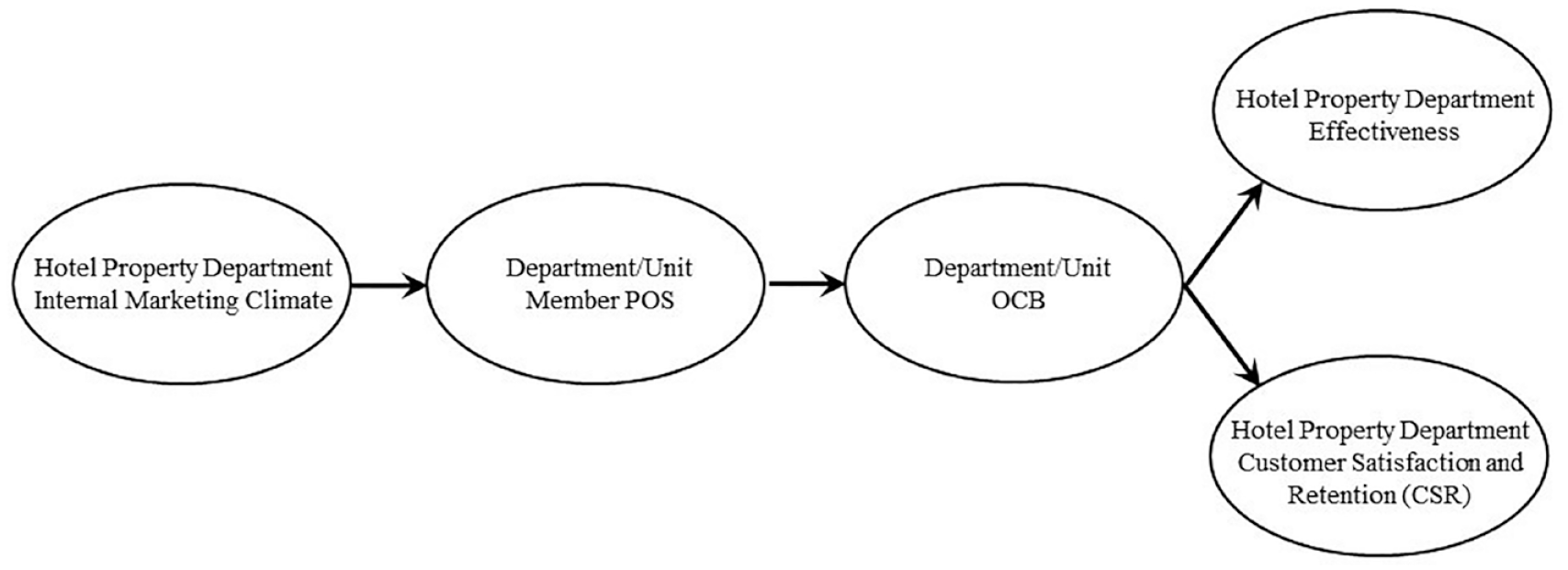
Conceptual Model.
Internal Marketing Climate, POS, and OCB
Given that internal marketing climate involves the shared beliefs of department/unit members concerning their organization’s efforts to manage their department via the vision, development, and rewards aspects of internal marketing, consistent with the extant research, internal marketing climate is expected to be a proximal precursor of a key positive department/unit member psychological outcome: POS (Vieira-dos Santos & Gonçalves, 2018). POS reflects the extent to which an individual unit member believes that their employing organization values and recognizes their contributions, cares about their well-being, and supports them in effectively discharging their assigned work-related responsibilities (e.g., Eisenberger et al., 1986; Kurtessis et al., 2017; Vieira-dos Santos & Gonçalves, 2018). That is, we conceptualize POS as a psychological or individual-level process-focused organizational climate perception (e.g., Kurtessis et al., 2017). Correspondingly, internal marketing emphasizes the fulfillment of unit members’ needs and desires by imparting to unit members that the organization cares about their needs and well-being and values their contributions (Ozuem et al., 2018; Vieira-dos Santos & Gonçalves, 2018). Based on organizational support theory (Eisenberger et al., 1986; Kurtessis et al., 2017) and given that a hotel property department internal marketing climate concerns department members’ shared perceptions of their organization’s use of the vision, development, and rewards aspects of internal marketing to meet department members’ needs and desires (cf. Chow et al., 2015; Foreman & Money, 1995), we postulate that internal marketing climate will have a positive, direct effect on hotel property department/unit member POS.
Organizational citizenship behavior (OCB) refers to individual discretionary behavior that is “not directly or explicitly recognized by the formal reward system” that “in the aggregate promotes the efficient and effective functioning of the organization” (Organ, 1988, p. 4). Consistent with social exchange theory (Blau, 1964), organizational support theory (Eisenberger et al., 1986; Kurtessis et al., 2017), and the norm of reciprocity (Eisenberger et al., 2001; Gouldner, 1960), we postulate that POS should increase department members’ willingness (feelings of obligation) to engage in OCB. As such, the internal marketing climate should impact hotel property department OCB through its positive effect on hotel property department member POS. Hence, we postulate that hotel property department internal marketing has a positive, indirect effect on department OCB via department member POS. Thus, we hypothesize:
Internal Marketing Climate, POS, OCB, and Unit Effectiveness
Synthesizing the extant literature (e.g., Kotler et al., 2017; Kurtessis et al., 2017; Mackenzie et al., 2017; Podsakoff et al., 2009), hotel property department member POS, and ultimately department members’ collective OCB is sine qua non in illuminating the influence of hotel property department internal marketing climate on hotel property department effectiveness. Subsequently, hotel property department internal marketing climate should have positive and indirect effects on department effectiveness via department member POS and department OCB. As we describe earlier, hotel property department internal marketing climate is hypothesized to foster department member POS (Vieira-dos Santos & Gonçalves, 2018); subsequently, department member POS (Kurtessis et al., 2017) should encourage (obligate) department members to engage in positive, discretionary behavior that benefits the organization such as OCB. Hence, congruent with the definition OCB and the central doctrine that in the aggregate department/unit members’ OCB supports and facilitates the effective functioning of units and organizations (Mackenzie et al., 2017; Organ, 1988; Podsakoff et al., 2014), we posit that hotel property department OCB serves as a linchpin in the explication of internal marketing climate’s influence on hotel property department effectiveness (Podsakoff et al., 2009). In sum, we contend that hotel property department internal marketing climate will indirectly augment hotel property department effectiveness via department/unit member POS and department/unit OCB. Thus, we hypothesize:
Internal Marketing Climate, POS, OCB, and Customer Satisfaction and Retention
Likewise, we assert that hotel property department/unit OCB will have a direct, positive effect on hotel property department/unit customer outcomes (see Awan et al., 2015; Bell & Mengüç, 2002; Mackenzie et al., 2017; Podsakoff et al., 2009; Setyaningrum, 2017). Congruent with this assertion, Podsakoff et al.’s (2009, p. 130) meta-analytic examination revealed that units “characterized by higher [vs. lower] levels of OCB generally had more satisfied customers.” Similarly, Van Dick et al. (2006) found that travel agency outlet-level OCB was positively related to customer service encounter evaluations. Then again, SeyedJavadin et al. (2012) and Awan et al. (2015) found that individual employee-level OCB was positively related to individual employee customer service quality and customer loyalty, respectively. Finally, Podsakoff et al.’s (2000) review of prior studies indicated that unit OCB accounted for about 38% of the variance in unit-level customer outcomes. In sum, we contend that hotel property department internal marketing climate will indirectly augment hotel property department customer satisfaction and retention via hotel property department member POS and department OCB. Thus, we hypothesize:
Method
Samples and Procedures
Multisource-multilevel data were obtained from two independent hotel samples to test the current study’s hypotheses. Sample 1, is comprised of 17 upscale hotel properties located in China that were managed by a single multinational hotel management company. On the contrary, completely independent of Sample 1, Sample 2 is comprised of 35 upscale hotel properties located across Asia that were owned and managed by an Asian-based, multinational hotel chain.
Sample 1 data were obtained from 365 individual front-line supervisors/managers (258 Source 1-1 respondents and 107 Source 1-2 respondents) from 107 hotel property departments (e.g., sales and marketing, front office, housekeeping, food and beverage, etc.), and their corresponding 107 department heads (Source 1-3) from 17 upscale hotel properties located in China. In Sample 1, internal marketing climate and POS data were obtained from front-line supervisors/managers from each hotel property department (an average of 3.41 Source 1-1 and Source 1-2 respondents per hotel property department). Hotel property department OCB was evaluated by each unit’s most senior (based on job title and company records) front-line manager (one Source 1-2 respondent per hotel property department). Finally, unit effectiveness was evaluated by the head of each hotel property department (one Source 1-3 respondent per hotel property department).
Sample 2 data were obtained from two different sources (Source 2-1 and Source 2-2). Sample 2 is completely independent of Sample 1 and consists of 530 individuals from 35 hotel property food and beverage (F&B) departments (Source 2-1) and their corresponding 35 general managers (Source 2-2) from 35 upscale hotel properties located across Asia. In Sample 2, internal marketing climate, POS, and OCB were evaluated by the 530 individual members from each hotel property F&B department (an average of 15.14 Source 2-1 respondents per hotel property F&B department/unit). Each hotel property’s general manager (one Source 2-2 respondent per hotel property F&B department/unit) provided hotel property F&B department-level customer information. To alleviate potential common source/method variance concerns, in both samples, the focal independent (hotel property department/unit internal marketing climate) and dependent variables (hotel property department effectiveness and customer satisfaction and retention, respectively) were generated from data collected from different (separate) informants.
Measures
The nature of each measure follows. Unless otherwise reported, response options for each item ranged from 1 (strongly disagree) to 5 (strongly agree). Because of the nested nature of the data and the direct relevance of the measures’ construct validity to the hypotheses—and in particular, discriminant validity—empirical information concerning the study’s measures are provided below in the analyses and results section.
Consistent with prior hospitality management research (e.g., Chow et al., 2015), we assess internal marketing climate with 12 items taken from Foreman and Money’s (1995) internal marketing scale. These items cover the vision, development, and reward aspects of internal marketing and unit member shared beliefs about their use to manage them. A sample item is, “Our organization offers my unit a vision we can believe in.”
A five-item version of Eisenberger et al.’s (1986) “survey of perceived organizational support” was used to assess POS. A sample item is, “This organization really cares about my well-being.” Congruent with our conceptualization of POS as an individual-level process-focused organizational climate perception, we retained an individual-level referent for these five POS items. Analyses, however, focused on predicting hotel property department/unit-level outcomes, and thus the nested nature of the data would need to be addressed to prevent potentially biased parameter estimates (Antonakis et al., 2019). By keeping the analyses focused on examining department/unit-level outcomes, though, this approach reflects emergent POS levels among hotel property department/unit members (Beus et al., 2020).
In Sample 1, each department’s/unit’s most senior manager (based on job title and company records) respondent (Source 1-2; one per department/unit) assessed their hotel property department’s/unit’s OCB with Williams and Anderson’s 14-item instrument. 1 A sample item is, “Overall, my unit’s members help others who have been absent.” Then again, in Sample 2, each individual respondent (Source 2-1) assessed their own OCB with the Williams and Anderson (1991) 14-item measure. A sample item is, “I help others who have been absent.” In Sample 2, we retained an individual-level referent for these 14 OCB items and hence, considering effects as the department/unit-level again reflects emergent OCB levels among hotel property department/unit members.
In Sample 1, department effectiveness was conceptualized as the extent to which the department/unit met the strategic performance targets set by senior management (Steers, 1975). Given that the actual performance targets and metrics vary by department function (e.g., sales and marketing, front office, housekeeping, and food and beverage) and property, we assessed hotel property department effectiveness with each department head’s (Source 1-3) response to a single item which, for example, for a hotel property’s sales and marketing department was, “My hotel property’s sales and marketing department always meets its strategic performance targets (the targets set by senior management).” The respondent (Source 1-3; the department head of each hotel property department) was a knowledgeable informant about the actual strategic performance targets set by their hotel property’s senior management for their department as well as the extent to which their department met these strategic performance targets.
In Sample 2, we collected information on hotel property F&B department customer satisfaction and retention. The hotel chain’s F&B director informed the study’s first author that each hotel property’s general manager (Source 2-2) actively tracked customer satisfaction and retention data for their hotel property’s F&B department, and thus was a knowledgeable informant of their hotel property F&B department’s customer outcomes. Hence, in Sample 2, based on their hotel property’s F&B department customer satisfaction and retention data, each hotel property general manager was asked to assess their hotel property’s F&B department’s performance (whether they were dissatisfied/satisfied that their F&B department was meeting expectations) in relation to hotel property F&B department/unit-level (a) customer satisfaction and (b) customer retention. Response options ranged from 1 (very dissatisfied—well below expectations) to 5 (very satisfied—well above expectations).
Analyses and Results
Tests of Multilevel Properties and Aggregation
Before testing our hypotheses, models, or even our measures, it is necessary to assess the nature of each sample’s data. Specifically, our theory and hypotheses assert that unit-level climate is the appropriate focus; nonetheless, our data from Sample 1 captures assessments from 365 individuals, nested within 107 departments/units, nested within 17 hotel properties. If there does exist significant variance at the hotel property-level, then failure to include the hotel property-level average of independent variables would potentially bias parameters estimated at lower levels of analysis (Antonakis et al., 2019). Similarly, because our focus in both samples involves the examination of aggregated data, we ran several analyses to verify the appropriateness of our aggregated measures and analytic approach.
First, we began by considering the three-level nature of our Sample 1 data. We argue that the department level of analysis (Level 2) was the appropriate level of analysis for our investigation. To test this assumption, we used Mplus version 8.10 (Muthén & Muthén, 2017) to test a model in which the 12 internal marketing items loaded on a single latent factor, which existed at the individual, department, and hotel property levels of analysis. In this analysis, the average ICC(1) of the items at the hotel property level was .06 and the hotel property level (Level 3) variance of internal marketing was not significant (p = .17). Thus, modeling hotel property-level variance was not necessary for Sample 1.
Second, we tested a two-level model, with individuals nested within hotel property departments. In this model, the Level 2 variance was significant (p < .05). The average department-level ICC(1) of the internal marketing items was .26 and the ICC(1) of the summed measure was .35. Using R (R Core Team, 2022), we calculated a number of other measures of aggregation including Rwg, Rwg.j, and Awg (see Tables 1 and 2). In addition, as we report in Tables 1 and 2, Omega (Level-1) and Omega (Level-2) values were also calculated following the procedures of Geldhof et al. (2014). These analyses indicate that using the two-level model was appropriate and the aggregation statistics indicate that the Sample 1 internal marketing climate measure has high reliability.
Summary Statistics (Sample 1).
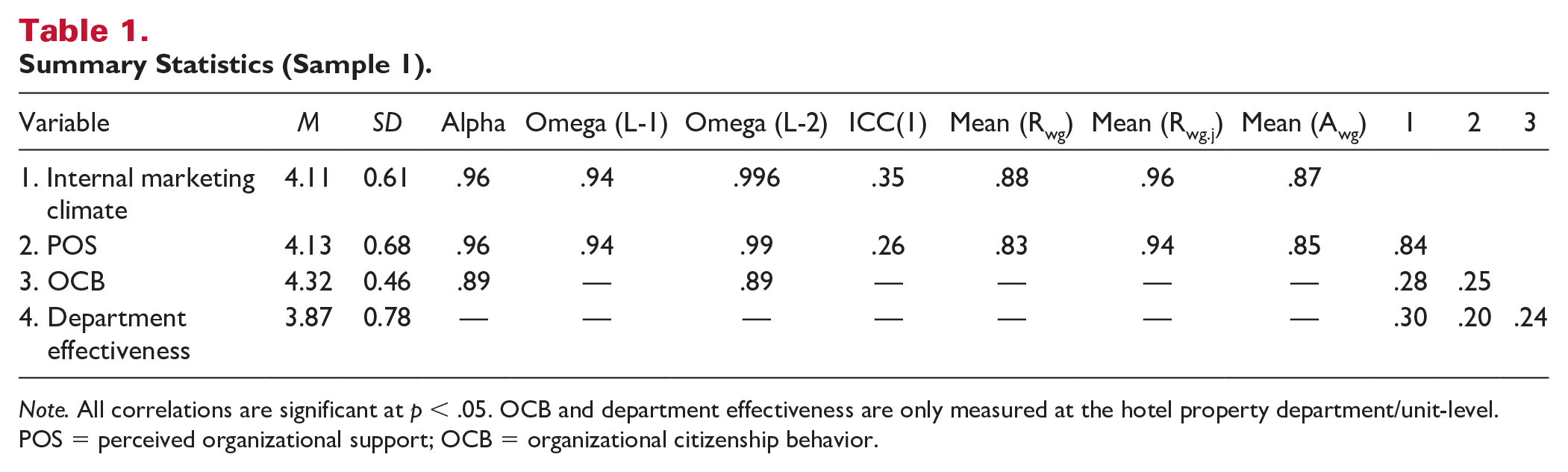
Note. All correlations are significant at p < .05. OCB and department effectiveness are only measured at the hotel property department/unit-level. POS = perceived organizational support; OCB = organizational citizenship behavior.
Summary Statistics (Sample 2).
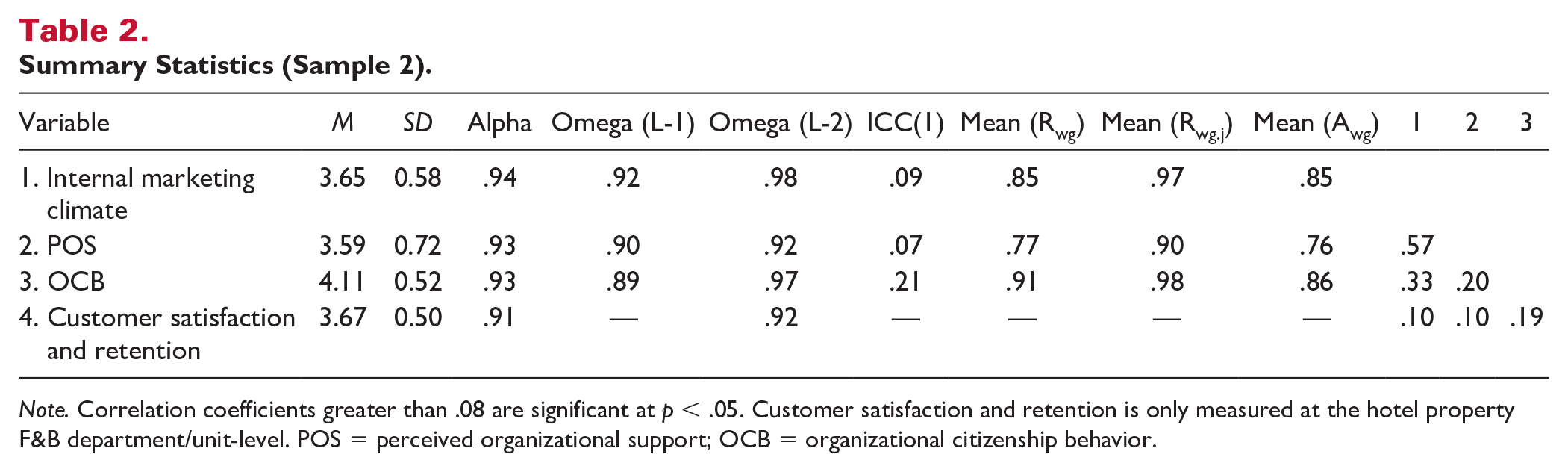
Note. Correlation coefficients greater than .08 are significant at p < .05. Customer satisfaction and retention is only measured at the hotel property F&B department/unit-level. POS = perceived organizational support; OCB = organizational citizenship behavior.
Third, our data from Sample 2 captures assessments from 530 individuals, nested within 35 hotel property F&B departments. We thus ran several analyses to verify the appropriateness of our aggregated measure. For internal marketing, the Level 2 variance in the two-level model was significant (p < .001). The ICC(1) value was not very high, with the average unit-level ICC(1) of internal marketing items being .07 and the summed measure being .09; however, as shown in Table 2, the other aggregation statistics for internal marketing climate including Rwg, Rwg.j, Awg Omega (Level 1), and Omega (Level 2) were more acceptable. The preponderance of evidence from these analyses indicates that using the aggregated internal marketing climate measure in Sample 2 was appropriate, and the aggregation statistics presented in Table 2 indicate that this measure has high reliability.
Descriptive Statistics
Tables 1 and 2 presents the summary statistics among Sample 1 and Sample 2 variables.
Testing Two Key Assumptions
A key assumption of the current study is that hotel property department members share perceptions about the internal marketing climate in which they work. The testing of the construct described above provide support for this assumption. To make more specific tests of the ICC(1) of the internal marketing climate measure, ICC(1) = .35 in Sample 1; ICC(1) = .09 in Sample 2, we computed the 95% confidence intervals (CIs) for the measures. The resultant CIs ([.24, .47] and [.04, .18], for Samples 1 and 2, respectively) did not contain zero. Thus, this empirical evidence provides support for the assumption that members from the same hotel property department share more similar internal marketing climate perceptions than members from different hotel property departments.
A second fundamental premise of the current study concerns the discriminant validity of hotel property department internal marketing climate and unit member POS, we compared (for both samples) the fit of a one-factor model (where the 12 internal marketing climate and five POS items all loaded on a single factor) to a two-factor model (where internal marketing climate and POS items loaded on their hypothesized latent constructs). Because our hypotheses are specific to hotel property department/unit-level outcomes, we employed population-averaged methods (PAMs) to appropriately address the multilevel nature of the data (McNeish et al., 2017). PAMs models require fewer assumptions than random-effects models and thus are more parsimonious and potentially more accurate (McNeish et al., 2017). Confirmatory factor analyses were performed using Mplus version 8.10 (Muthén & Muthén, 2017).
In Samples 1 and 2, the confirmatory factor analysis (CFA) of the one-factor model demonstrated a marginal fit with the data (n = 365 individuals from 107 units): χ2109 = 508.72; comparative fit index (CFI) = .88; Tucker–Lewis index (TLI) = .87; root mean square error of approximation (RMSEA) = .10, and a poor fit with the data (n = 530 individuals from 35 units): χ2119 = 819.45; CFI = .80; TLI = .77; RMSEA= .11, respectively. On the contrary, in Samples 1 and 2, the CFA of the two-factor model demonstrated a good fit with the data (n = 365 individuals from 107 units): χ2118= 342.20; CFI = .93; TLI = .92; SRMR = .04, and a better fit with the data (n = 530 individuals from 35 units): χ2118 = 251.08; CFI = .96; TLI = .96; RMSEA = .05, respectively, and the Satorra-Benter scaled χ2 difference tests indicate that the two-factor models were significantly better than the one-factor models (Satirra-Bentler scaled χ2 difference: Δχ21 = 193.84, p < .0001 and Δχ21 = 503.59, p < .0001, respectively). Therefore, the abovementioned results for Samples 1 and 2 indicate that although this study’s hotel property department internal marketing climate and unit member POS measures were highly correlated (standardized association between the two latent constructs was .89, p < .001 and .62, p < .001, respectively), they do represent two distinct constructs. Thus, although members from the same hotel property department shared more similar internal marketing climate perceptions than members from different hotel property departments, the empirical evidence indicates there were distinct hotel property department-level internal marketing climates.
Tests of the Hypotheses
Our data is clearly non-independent, with individual responses nested within departments/hotel properties. That said, our analyses are focused on effects at the hotel property department/unit level of analysis. As such, we employed PAMs, which address issues of non-independence in data but with fewer methodological assumptions than those required by hierarchical linear modeling or multilevel structural equation modeling (McNeish et al., 2017). Therefore, we employed PAMs via Mplus version 8.10 (Muthén & Muthén, 2017) with analyses conducted at the level of analysis of the ultimate performance variable (i.e., hotel property department effectiveness in Sample 1; hotel property F&B department customer satisfaction and retention in Sample 2) to test our hypotheses.
To test H1 and H2, we ran the model with two direct paths: internal marketing climate to POS (IMC→POS) and POS to OCB (POS→OCB). As shown in Table 3, in support of H1, in both Sample 1 and Sample 2, the IMC→POS path was positive (p < .001). Furthermore, to test H2, we examined the indirect effect of internal marketing climate on OCB by generating 95% bias-corrected bootstrapped CIs (using 10,000 bootstrap samples) of the conditional indirect effect (Edwards & Lambert, 2007). As shown in Table 3, in support of H2, the 95% CI for the indirect effect of the hotel property department internal marketing climate on hotel property department OCB via department member POS (IMC→POS→OCB) within Samples 1 and 2 did not include zero. Thus, H2 was supported.
Posited Effects on OCB.
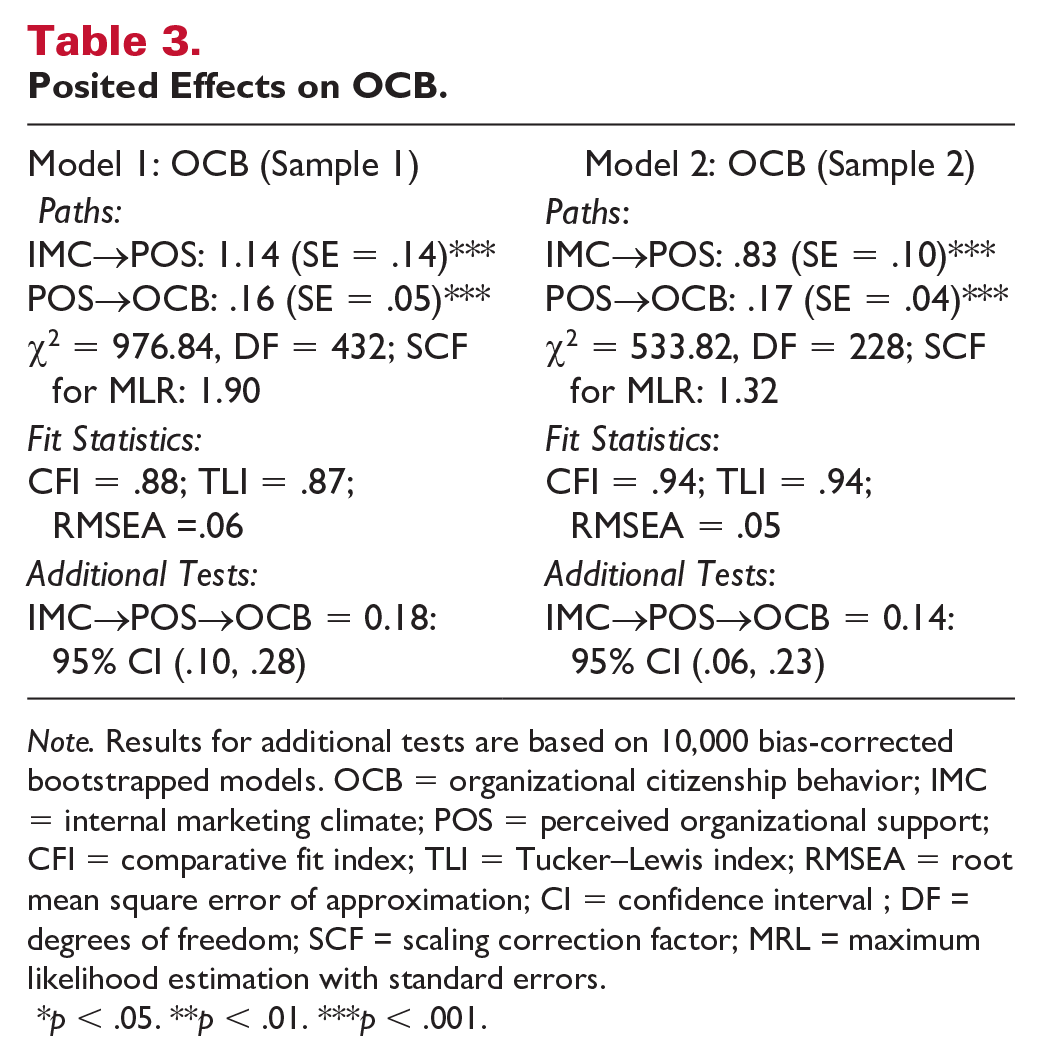
Note. Results for additional tests are based on 10,000 bias-corrected bootstrapped models. OCB = organizational citizenship behavior; IMC = internal marketing climate; POS = perceived organizational support; CFI = comparative fit index; TLI = Tucker–Lewis index; RMSEA = root mean square error of approximation; CI = confidence interval ; DF = degrees of freedom; SCF = scaling correction factor; MRL = maximum likelihood estimation with standard errors.
*p < .05. **p < .01. ***p < .001.
Test of Hypothesized Structural Model for Department Effectiveness (Sample 1): H3
H3 (Sample 1) states that the hotel property department internal marketing climate (IMC) will have a positive, indirect effect on the hotel property department effectiveness via department member POS and department OCB. As H3 concerns the indirect effect of the hotel property department’s internal marketing climate on department effectiveness, we used PAMs and assessed the indirect effect of the hotel property department internal marketing climate on department effectiveness using 10,000 bias-corrected bootstrapped samples and examining the resultant 95% CI. The results, shown in Figure 2, support the hypothesized structural model for Sample 1, all three of the hypothesized structural model’s posited (positive) direct paths (IMC→POS; POS→OCB; OCB→DE) were significant at p < .05 or better, and the 95% CI for the posited positive indirect effect of department internal marketing climate on department effectiveness (IMC→POS→OCB→DE) did not contain zero. Thus, H3 was supported.

Results for Hotel Property Department Effectiveness (Sample 1) via PAMs.
Test of Hypothesized Structural Model for Department Customer Outcomes (Sample 2): H4
H4 (Sample 2) states that hotel property department IMC will have a positive, indirect effect on hotel property department customer satisfaction and retention (CSR) via department member POS and department OCB. As shown in Figure 3, the results support the hypothesized structural model for Sample 2, the hypothesized structural model’s three posited (positive) direct paths (IMC→POS; POS→OCB; OCB→CSR) were significant at p < .05 or better, and the 95% CI for the posited positive indirect effect of hotel property department IMC on department CSR (IMC→POS→OCB→CSR) did not contain zero. Thus, H4 was supported.

Results for Hotel Property Department Customer Satisfaction and Retention (Sample 2) via PAMs.
Supplemental Results for Customer Satisfaction and Retention (Sample 2)
To check the robustness of this study’s hypothesized structural model for Sample 2 (shown in Figure 3), in addition to the structural model’s three direct paths (IMC→POS; POS→OCB; OCB→CSR), we added department member job satisfaction (JS) and the following two direct paths: IMC→JS; JS→OCB (see Figure 4). We again used PAMs and assessed the indirect effects of hotel property department internal marketing climate on department customer satisfaction and retention using 10,000 bias-corrected bootstrapped samples and examining the resultant 95% CIs.
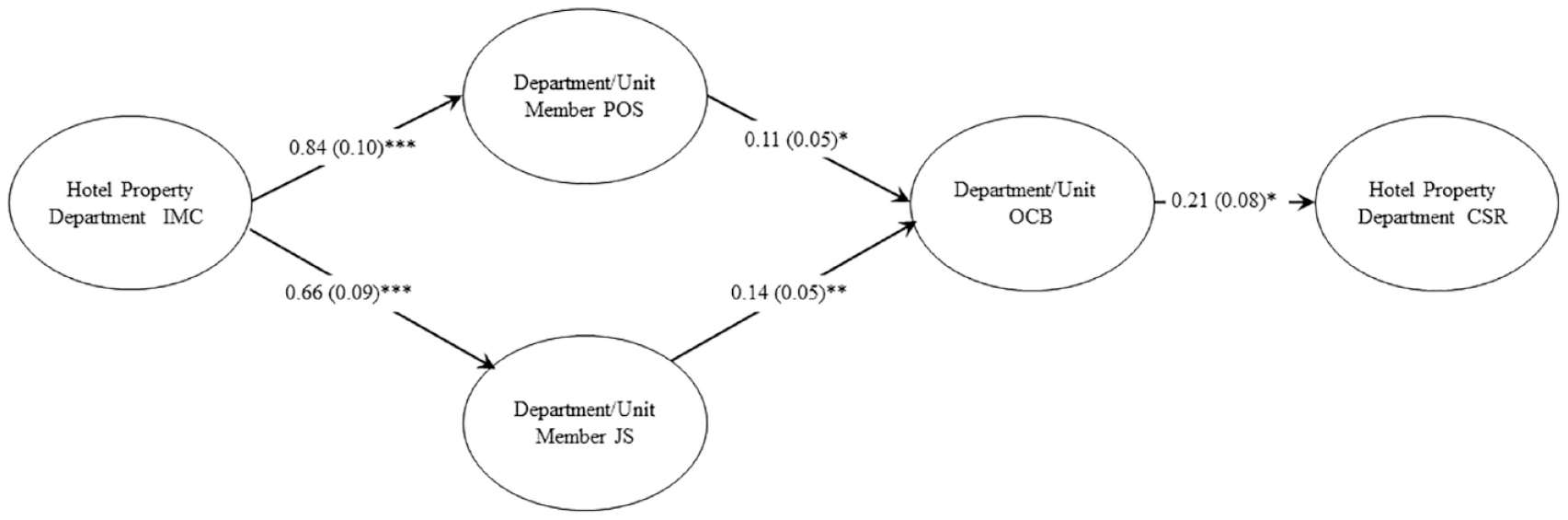
Supplemental Results for Hotel Property Department CSR (Sample 2) via PAMs.
As shown in Figure 4, all five direct paths included in the supplementary structural model for Sample 2 were significant at p < .05 or better, the 95% CI for both indirect effects (IMC→POS→OCB→CSR; IMC→JS→OCB→CSR) did not contain zero, and the 95% CI for the total effect of hotel property department IMC on department CSR also did not contain zero. These results (see Figure 4) provide further support for the underlying premise of this study that hotel property department internal marketing climate positively affects hotel property department performance and customer outcomes through its positive influence on hotel property department member psychological outcomes and department OCB. Furthermore, the results provide further support for the assertion that the hotel property department/unit OCB may be the linchpin in the explication of the effects of hotel property department internal marketing climate on department customer satisfaction and retention.
Discussion
Human resources are one of the most important assets of hospitality organizations (Frye et al., 2020). Scholars in hospitality research have called for more attention to examining human resources and organizational climate/culture as they pertain to the hospitality industry (Johnson, 2020). Spanning the hospitality management, marketing, management, and business literatures, the current study explains the multifaceted causal processes through which internal marketing climate is theorized to operate—from climate, to psychological outcome, to behavior, to strategic success, and competitive excellence. We use two separate multisource-multilevel datasets to test our proposed process models. Results support our hypotheses and reveal that internal marketing climate can trigger a chain of positive effects on constructs prevalent in multidisciplinary and hospitality management: namely, POS and OCB.
Theoretical Implications
Our research contributes to the literature in several ways. First, this study examines the internal marketing climate at the hotel property department level to complement previous studies that looked at the construct at the individual level (e.g., Chow et al., 2015; Frye et al., 2020; Huang & Rundle-Thiele, 2014; Kim et al., 2016; To et al., 2015). As theorized, internal marketing climate is a unit-level construct that yields novel insights into the ways through which internal marketing can enhance department effectiveness and customer performance for hotels. Hospitality management researchers have typically investigated internal marketing as a psychological or individual-level organizational climate perception. For example, (a) Huang and Rundle-Thiele (2014), among a sample composed of respondents born in Australia and Taiwan with hospitality and tourism work experience, examined the effects of individual-level perceived internal marketing practice and individual job satisfaction, (b) Chow et al. (2015), among a sample of Hong Kong travel agents, examined at the individual-level of analysis the effects of internal marketing orientation and leader-member exchange on travel agent OCB and customer service behavior, and (c) Kim et al (2016), among a sample composed of employees working for a South Korean casino company, examined the effects of individual-level corporate social responsibility and perceived internal marketing on individual-level employee organizational commitment and turnover intentions. Our results extend upon these prior studies’ findings and illuminate that a hotel property department/unit-level, process-focused climate (internal marketing climate) engendered the organizationally relevant psychological outcome and behavior that lead to hotel property department-level effectiveness and customer satisfaction and retention; that is, department/unit strategic success and competitive excellence, respectively. Thus, the current study provides empirical evidence that supports the contentious dogma that the value that employees gain through their organization’s use of internal marketing is reciprocated by employees who in turn create value for their organization and their customers.
Second, this is the first study to illustrate that hotel property department internal marketing climate enhances department member POS (a positive organizationally relevant psychological outcome in addition to job satisfaction). Because internal marketing is concerned with treating employees as internal customers and viewing their jobs as internal products that meet their needs and desires and address organization objectives, researchers have established job satisfaction as a significant benefit (Frye et al., 2020; Huang & Rundle-Thiele, 2014). It is also interesting to note that our supplemental analyses suggest that other organizationally relevant attitudes or psychological outcomes may simultaneously be affected by internal marketing climate, yet even with this, its positive indirect effect on department OCB and customer outcomes through POS remained significant. These supplemental analyses, however, do suggest that future research may want to consider multiple psychological outcome constructs to better understand the ways through which internal marketing climate influences positive hotel employee behavior and customer outcomes.
Finally, in support of a widely accepted but contentious dogma, this study affords an extended model of internal marketing climate to detail how it creates value for department members, the organization, as well as customers in the hospitality business. The findings identify hotel property department OCB as the linchpin of the effects of hotel property department internal marketing climate on hotel property department effectiveness and customer satisfaction and retention, complementing the extant research on the links between internal marketing and customer outcomes (e.g., Chow et al., 2015; SeyedJavadin et al., 2012) and between OCB and unit effectiveness and customer outcomes (Mackenzie et al., 2017; Podsakoff et al., 2014). For example, prior research indicates that individual employee-level internal marketing climate perceptions advance individual employee OCB which in turn advance individual employee customers’ perceptions of customer loyal (e.g., Awan et al., 2015) and service quality (e.g., SeyedJavadin et al., 2012). Then again, prior research (Bell & Mengüç, 2002) indicates that individual employee-level organizational support perceptions advance individual employee organizational identification and OCB, and individual employee OCB has a positive direct effect on individual employee customers’ perceptions of service quality. However, as Mackenzie et al. (2017) and Podsakoff et al. (2014, p. S91) state, although OCB may be exhibited at the individual level, it is only when OCB is aggregated to the unit level that it has a meaningful effect on unit effectiveness and unit customer outcomes. Thus, in the current study, we build upon the extant literature and postulate and present empirical evidence that hotel property department internal marketing climate enhances the value that hotel property department members gain from the employment relationship through increased department member POS which in turn leads to greater department OCB. Taken together, extant research and this study offer a more complete framework for how internal marketing at the organization level (see Gilmore & Carson, 1995) and the more granular hotel property department level can engender positive, organizationally relevant psychological and behavioral outcomes, which contribute to hospitality organization effectiveness and competitive excellence.
Managerial Implications
Researchers have conceptualized and operationalized internal marketing as universally consistent within an organization (an organization-level climate construct) or as a psychological or individual-level process-focused organizational climate perception. In contrast, our decision to operationalize and measure internal marketing climate at the department/unit-level was prompted by the realization that organizations, especially hotels, do not treat all units the same, and these differences will be manifested by the emergence of a hotel property department-level internal marketing climate. In this regard, results indicate that there were indeed distinct hotel property department-level internal marketing (process-focused) climates. Hence, this study confirmed that hotel properties do deploy process-focused (vision, development, and reward) policies, practices, and procedures to their units to advance a hotel property department-level internal marketing climate. From a practical perspective, this further suggests that to maximize the effects of internal marketing, a hotel property should foster department-level internal marketing climates across the entire property to fully reap its benefits. In addition, because our results show that department internal marketing climate increases customer satisfaction and retention, we further expect that internal marketing climate that is cultivated in boundary-spanning (frontline) units would be the most beneficial for hotels and perhaps other high-contact service organizations.
Moreover, the results indicate that hotel property department internal marketing climate impacts OCB which in turn in the aggregate improves hotel property department effectiveness and customer satisfaction and retention (Mackenzie et al., 2017). This is notable because, in both theory and practice, it is expected that internal marketing encourages OCB in a reciprocal fashion, whereby well-treated hotel employees who feel positively treated by the organization (i.e., have high POS) would in turn treat the organization and others in the organization well. This is confirmed by the indirect effects that we observed. We assert that this evidence of a positive indirect impact of internal marketing climate on hotel employees, properties, and customers provides strong evidence of its important role in hospitality management practice.
Furthermore, our results indicate that members of a hotel property department shared perceptions of process-focused (internal marketing) organizational efforts to impart and promote a vision that they believe in and that brings meaning and purpose to the workplace, equip them with the competencies and resources they need to successfully perform their jobs and contribute to the organization’s vision, and recognize and reward their contributions to the organization’s vision generated positive psychological outcomes (e.g., department member POS and job satisfaction) and behavior (department OCB) that ultimately enhanced hotel property department strategic and customer outcomes. Thus, hospitality organizations should detail how (i.e., the process through which) they will support department member success and nurture their contributions to organization goals.
Limitations and Avenues for Future Research
As with all empirical studies, our results should be viewed considering its limitations. One of the strengths of this study is that it used multisource-multilevel hotel datasets, analyzed with modern sophisticated methods, to investigate the hypotheses. Furthermore, the fact that these tests were conducted on two unique samples provides evidence of replication. Of course, although multilevel and multi-sample, our access to the studied workplaces did require the data to be collected simultaneously. Thus, while there are many methodological advantages to our data and the use of replication, the cross-sectional nature of these data prevents us from strong inferences of causality. Hence, we encourage future research to utilize a longitudinal research design to further replicate our findings.
While the current study included a process-focused organizational climate construct (internal marketing climate), there are other process-focused climate constructs (see Schneider et al.,2011, 2013) such as justice, learning, and caring climates (see Fu & Deshpande, 2014; Gong et al., 2022; Lee et al., 2023; Peng et al., 2022) as well as outcome-focused climate constructs (see Schneider et al., 2011, 2013) such as safety, corporate social responsibility, and service climates (see Kim et al., 2023; Lin et al., 2021; Schneider et al., 2017; Vashdi et al., 2022) that future research may also consider. Of course, the models tested in this study are only a subset of potential specified mechanisms. That is, for example, the current study’s models do not include other potential psychological outcome mediators such as organizational commitment (To et al., 2015), organizational identification (Kim et al., 2016), and felt obligation to the organization (Kurtessis et al., 2017) or other potential behavioral outcome mediators such as customer-focused OCB (Bowen & Schneider, 2014), service-adaptive behavior (Peng et al., 2022), and service-related behavior (Vashdi et al., 2022). Thus, there is ample need for future research to delve further into the causal processes through which various process- and/or outcome-focused climates influence hotel and customer performance. Even with these limitations, this study offers novel insight into the ways in which hotel property department internal marketing climate may contribute to hotel property department effectiveness and competitive excellence. Nonetheless, we encourage future studies to consider and include other hotel property department-level focused organizational climate constructs and other potential mediator constructs.
Finally, our two multisource-multilevel samples were from hotel properties in China and across Asia, respectively. Thus, a fruitful and important avenue for future research would be to collect data from other Eastern and Western settings to assess the generalizability of our results across cultures and settings.
Conclusion
This study illustrates that the organizationally relevant psychological and behavioral outcomes associated with hotel property department internal marketing climate augment the value that hotel employees generate for their departments/organizations and customers. We hope our findings foster research that adds to the continuing discourse concerning focused climates and further illuminates the black box in internal marketing research that seeks to link the value that hospitality employees derive from internal marketing to the value that they in turn generate for their organizations and customers.
Footnotes
Appendix
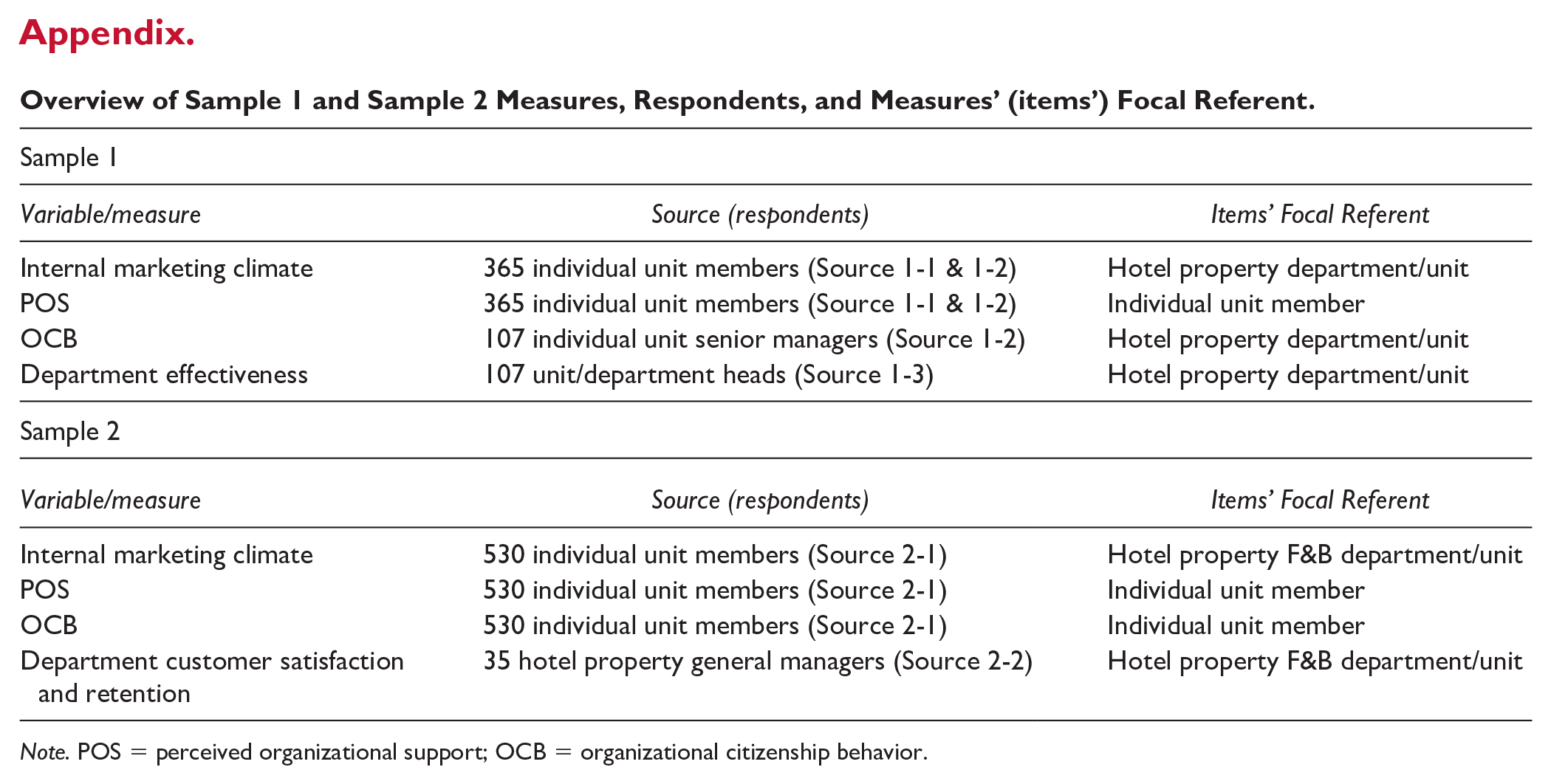
Overview of Sample 1 and Sample 2 Measures, Respondents, and Measures’ (items’) Focal Referent.
| Sample 1 | ||
|---|---|---|
| Variable/measure | Source (respondents) | Items’ Focal Referent |
| Internal marketing climate | 365 individual unit members (Source 1-1 & 1-2) | Hotel property department/unit |
| POS | 365 individual unit members (Source 1-1 & 1-2) | Individual unit member |
| OCB | 107 individual unit senior managers (Source 1-2) | Hotel property department/unit |
| Department effectiveness | 107 unit/department heads (Source 1-3) | Hotel property department/unit |
| Sample 2 | ||
| Variable/measure | Source (respondents) | Items’ Focal Referent |
| Internal marketing climate | 530 individual unit members (Source 2-1) | Hotel property F&B department/unit |
| POS | 530 individual unit members (Source 2-1) | Individual unit member |
| OCB | 530 individual unit members (Source 2-1) | Individual unit member |
| Department customer satisfaction and retention | 35 hotel property general managers (Source 2-2) | Hotel property F&B department/unit |
Note. POS = perceived organizational support; OCB = organizational citizenship behavior.
Declaration of Conflicting Interests
The author(s) declared no potential conflicts of interest with respect to the research, authorship, or publication of this article.
Funding
The author(s) received no financial support for the research, authorship, or publication of this article.
