




Abstract
This article seeks to explain and understand how the strength of a human resource management (HRM) system and perceived organizational support (POS) determine employment relationships (ERs) in organizations and the behaviors they generate in terms of organizational citizenship behavior (OCB) and intentions to remain (IR). A typology of ERs is proposed, considering perceptions about the HRM system (Ability, Motivation, and Opportunity [AMO] model), its strength, and POS. An analysis was adopted, looking into organizations in two separate studies in service sectors (hospitality and financial services), taking as informants to 130 and 87 HRM managers and 30 workers’ representatives as proxies of organizations and employees, respectively. Cluster analysis and analysis of variance (ANOVA) were conducted, and results are congruent with theoretical frameworks such as Attribution Theory and Social Exchange Theory. Depending on how stakeholders understand the way in which the HRM system is implemented and the level of POS, certain ERs are developed and explain employees’ responses in terms of OCB and IR behaviors.
Keywords
Introduction
The analysis of employment relationships (ERs) at an organizational level has been examined from two different points of view: employee versus employer. The first perspective, that of employees, has focused mainly—in terms of published papers—on the psychological contract and the responses developed by employees as a consequence of the organization’s failure to fulfill some of its promises, frustrating employees’ expectations about career prospects or compensation, for example (Birtch et al., 2016; Conway & Coyle-Shapiro, 2012; Guest, 2004). The second perspective—of the employer—is much more limited in the literature and has focused previously on analyzing the relationships between inducements offered by the organization and its expectations about employees’ behavior or the effects of Leader-Member Exchange (LMX) and the development of sustainable strategies on ERs (Audenaert et al., 2017; Bornay-Barrachina et al., 2012; Lopez-Cabrales & Valle-Cabrera, 2020; Tsui et al., 1997). The employer’s perspective on the ER is distinct from the employee’s perspective, focusing on exchange between the organization and jobholders, instead of on individual perceptions of exchange (Shore et al., 2004; Tsui et al., 1997). Therefore, when examining the employee’s perspective, the focus is on knowing the consequences and reactions from employees when they perceive a breach in the commitments and promises they expect from the firm. In a different way, analysis of the employer’s perspective studies what the organization expects from employees in accordance with the offers made by managers, management systems, and/or firm strategy. Both approaches contribute to the literature with interesting but partial results. The question we ask here is whether it is possible to understand ERs between the two parties when we only have information from one side.
This article considers that the study of ER should include the two main groups of stakeholders, employees and employers, and that their reactions must be understood as a consequence of their perceptions of the entire human resource management (HRM) system (content of the HRM System) offered by a firm to its employees and how it is applied (HRM process). For example, a manager may expect and understand that an employee’s intention to remain in his or her firm will be lower than at other firms that are able to pay higher salaries and offer better development prospects to their employees. Moreover, both perceptions (employees vs employer) may differ, as what is high for managers may be perceived as low for employees. Hence, we believe all perceptions are necessary and useful to gain a better understanding of behavior in organizations (Liao et al., 2009; Nishii & Lepak, 2008). Hence, the two broad research questions we attempt to answer are as follows: first, how do employers and employees perceive the HRM system? What is the degree of employer/employee agreement? Where do disagreements in perceptions occur? And second, what are the effects of such perceptions on employee behavior?
To address the research questions proposed, we must take into account the way ERs are analyzed. In this regard, in this article, not only do we consider a partial aspect of these working relationships (compensation, career management, type of contract, etc.) as analyzed mainly in the literature (Conway & Coyle-Shapiro, 2012; Guest, 2004), but we also consider the whole HRM system, as it affords us a more comprehensive understanding than if practices are studied in isolation or individually (Combs et al., 2006). We have chosen the Ability, Motivation, and Opportunity (AMO) model (Appelbaum et al., 2000; Jiang et al., 2012; Paauwe & Boselie, 2005) as it covers the whole HRM system. However, in line with Bowen and Ostroff (2004), we also believe that perceptions about the strength (process) of such a system, in other words, how that HRM system is applied or implemented (Bowen and Ostroff, 2004; Ostroff & Bowen, 2016), can explain behaviors and the nature of ERs. Attribution Theory indicates individual perceptions about the intentions pursued by the HRM system, the applied procedures, and relationships among variables condition behaviors (Hewett et al., 2018; Nishii & Lepak, 2008). In other words, the way in which the development and application of the HRM system (process) is perceived directly explains employee behaviors.
As well as HRM Strength, a second variable related to ERs studied here is perceived organizational support (POS). This variable contains aspects not included in the strength of the HRM system, such as the degree to which a firm values employees’ contributions and pays attention to aspects related to their well-being, which also affects employees’ behavior (Edwards, 2009; Eisenberger et al., 1986; Lee & Peccei, 2007). In this case, Social Exchange Theory (Blau, 1964) and the norm of reciprocity (Gouldner, 1960) indicate that employee behaviors will reflect the degree to which they perceive that the firm pays attention to and supports aspects that go beyond just the issues set out in their formal employment contract. Therefore, HRM system strength and POS, as we will detail further, have been related to certain employee behaviors, specifically, their intention to remain (IR) and organizational citizenship behavior (OCB), both of which have received attention from researchers due to their impact on organizations (Kehoe & Wright, 2013).
The conceptual development of both explanatory variables allows us to identify four different types of ER and to offer different hypotheses regarding how each one of the ER models is associated not only with different employee behaviors in terms of IR and OCB but also with different levels within the AMO systems that emphasize different HRM practices.
A last issue to be highlighted is our choice of informants for analyzing ERs. First, HRM managers in our sample as organizational representatives and managers with the most qualified knowledge in the object of our study. And second, workers’ representatives. We decided to ask them as informants because it was impossible to get a representative sample of employees in all the sample firms and workers’ representatives are democratically elected by all employees to be their proxies in the collective bargaining processes. We consider that both informants (HRM managers and workers’ representatives) are quite qualified and well-known of issues that we analyze in this article, so they can provide a global vision in each sector (Arthur & Boyles, 2007; Bou-Llusar et al., 2016; Spanish Law 36/2011, articles 62, 63, and 88).
Overall, we believe this article, based on Social Exchange Theory and Attribution Theory, makes four contributions to the literature on ERs and HRM. First, by proposing a novel analytical framework of ERs based on the strength of the HRM system and POS, setting out four different employment models. This would be a contribution from the strand of research initiated by Tsui et al. (1997), because our proposal assesses the ER considering managers’ and employees’ perceptions about HRM system strength and POS, instead of Tsui’s interests in inducements versus expectations from a managerial perspective only. Second, by highlighting the effects of each ER model on employees’ extra role behaviors and intention to remain in the organization, instead of considering firm performance as the main outcome of ER, as Wang et al. (2003) did. Third, we identify the values of each dimension of the AMO model for each of the four employment models. This is a contribution as it is a way of analyzing the content of the ER itself. And fourth, we contrast perceptions from two different stakeholders in ER: HRM Managers and union representatives, thereby seeking to enrich the individual and the organizational perspective of ER.
The structure of this article is as follows: the next section is dedicated to the development of the theoretical framework that supports our proposed ER typology and specific hypotheses regarding ERs and employee behaviors. The third section contains the empirical analyses, and the article ends with conclusions and implications in the fourth and last section.
Theoretical background and hypotheses
As Shore et al. (2014) pointed out, the term “Employment Relationship” (ER) is vague, encompassing many issues, and it has been studied from several theoretical frameworks. This article adopts a firm-level perspective, to understand and explain the behaviors displayed by the main stakeholders involved in ERs, as the internal factors that determine such behaviors. Therefore, the theoretical frameworks that support our analyses are Attribution Theory (Kelley, 1967; Kelley & Michela, 1980) and Social Exchange Theory (Blau, 1964), as both of them explain that behavior is a form of response to the assumptions and interpretations made about organizational actions and decisions.
Analysis of some of the definitions provided for ERs shows that these definitions refer to an exchange agreement between employer and employee whereby the employer hires people to contribute to the production of goods and services that generate benefits by means of their manual/intellectual work in exchange for compensation (Bosch, 2004; Torka et al., 2005). Boxall (2013) notes that the quality of ERs is good when employer and employee achieve an alignment or fit in terms of capacities, commitments, and contributions, with such a balance providing benefits for both parties.
The above clearly highlights two aspects that should be considered: first, the content of the exchange and, second, the players within the relationship. An analysis of exchange requires the specification of which aspects endow it with content, while the second aspect establishes the perspective from which the analysis is performed: employee or employer. Given that this latter aspect—the perspective adopted—can condition the analysis of the former, we will start by looking at this point and highlighting its most relevant features.
ER perspectives: employer or employee
A review of the existing literature on the subject reveals a clear imbalance in the attention paid to the players within ERs, with a major focus on the employees’ perspective and the predominant use of Social Exchange Theory (Blau, 1964) and the Psychological Contract (Coyle-Shapiro & Kessler, 2002 ; Guest, 2004) as the frameworks used for analysis.
As Guest and Conway (2002) pointed out, the Psychological Contract attempts to capture the employers’ or employees’ perceptions of their ERs in terms of their reciprocal obligations. The focus of the Contract is on the fulfillment of expectations, obligations, and promises, considering the effects of such compliance on employee satisfaction, well-being, commitment to the organization, and performance.
In addition, a key concept in the analysis of ERs is reciprocity (Gouldner, 1960). Reciprocity means that one party (the employee) will behave in the same way and with the same intensity as the other (the employer) to compensate for the behavior and/or decisions of the latter (Social Exchange Theory: Blau, 1964), and this would explain the development of extra role behaviors by the employee. However, as pointed out by Coyle-Shapiro and Shore (2007), it is interesting to take into account that the rule of reciprocity has some limitations when applied to ER analysis, since it does not work in the same way for economic and social exchanges, and also because the value attached to the content of the exchange is different, depending on the parties involved.
On the contrary, when ERs have been studied from the employers’ point of view, they have been analyzed according to the inducement-contribution model of March and Simon (1958). One example of this approach is the study carried out by Tsui et al. (1997) and other subsequent papers based on her proposed ER (Hom et al., 2009; Tsui & Wu, 2005; Wang et al., 2003). Tsui et al. (1997) defined ERs as the managers’ expectations regarding employees’ contributions to the firm in response to organizational inducements. Tsui’s proposal has been further developed in other studies linking ER to other variables such as company strategy and ownership structure (Wang et al., 2003), staff turnover and commitment (Hom et al., 2009), flexibility and learning (Lopez-Cabrales et al., 2011), as well as human capital and business innovation (Bornay-Barrachina et al., 2012).
In contrast to the two approaches mentioned above—separate analyses from either the employees’ or employers’ point of view—a third path may be taken, which aims to capture the perspectives of the employer and the employee regarding the dimensions that characterize the ER. Empirical studies show that employees’ perceptions regarding these practices vary significantly from the reports compiled by managers (Liao et al., 2009; Nishii & Lepak, 2008). This article aims to fill this gap by suggesting that the analysis of ERs should include the perceptions of both the employer and the employee in terms of what the business organization offers, thereby setting it apart from existing studies. Coyle-Shapiro and Kessler (2002) examine the content of the Psychological Contract from the perspective of the employer and the employee, giving consideration to their mutual obligations and the effects of a perceived rupture or breach of the contract on commitment and OCB, as well as on subsequent behavior. Taylor and Tekleab (2004) also lean toward this tendency, considering both the employer and employee in their analysis, albeit the authors focus on agreements governing reciprocal obligations between the two parties as well as the consequences of breaking those agreements on job satisfaction, staff turnover, OCB, and performance. Atkinson (2007) demonstrates, based on interviews carried out with employers and employees, the consequences of breaching the obligations established between the parties on the development of extra role behaviors.
Content of the ER
The literature seems to suggest that ERs can be linked to development and training opportunities, the abilities and knowledge of individuals, the involvement of employees in decision-making processes, job security, and fair pay systems, among others (Roehling et al., 2000). All the elements mentioned above are linked to the management processes that share the firm’s human resource system, which allows us to consider the necessity of studying all of them in an integrated manner.
Taking into account the content of ERs, this article proposes focusing on the HRM system and, more specifically, on human resource management practices that act in relation to the competences, abilities, and capacities of people (ability-enhancing), which affect motivation through the establishment of reward systems linked to individual or group performance, or to promotion (motivation-enhancing), and those linked to the opportunities open to employees to participate in the organization’s formal processes (opportunity-enhancing) (Kehoe & Wright, 2013). These practices determine the “What” of the HRM system. The AMO framework (Appelbaum et al., 2000) focuses on the importance of taking into account variables at the individual level, such as employees’ skills and competences, their motivation, and their opportunity to participate. Paauwe and Boselie (2005: 69) have pointed out that the AMO framework is a key element when explaining the effect of HRM practices on both firm and employee performance (Appelbaum et al., 2000; Boselie et al., 2005).
The literature has widely demonstrated the relationships between the AMO model and OCB, turnover intentions, employee affective commitment, and individual performance (Gardner et al., 2011; Knies & Leisink, 2014). However, analysis of employee and employer perceptions of such relationships (AMO-individual behaviors) has been scarce. This fact is interesting, since the employees’ perception of their ERs could be a determinant when explaining their behavior.
Strength of the HRM system and POS as dimensions of the ER: a typology of ERs
The contradictory results obtained when analyzing the effects of HRM systems within organizations justify the need for researchers to pay attention not only to the content of HRM systems but also their processes (Heffernan et al., 2016; Katou et al., 2014; Sanders et al., 2014). In doing so, we propose to study employees’ and employers’ perceptions, taking into account two dimensions: “strength of the HRM system” (Bowen & Ostroff, 2004) and “Perceived Organizational Support (POS)” (Eisenberger et al., 1986). The reason for this choice of variables is that both of them exert an influence on employees’ behavior (Delmotte et al., 2012; Lee & Peccei, 2007).
As Ostroff and Bowen (2016) suggest, HRM system strength has implications with regard to the way employees perceive the exchange agreement they have with their employer. What is distinctive about the strength concept is that it is focused on the HRM process, that is, how the HRM system is distributed, implemented, and how it sends messages to employees and generates a climate within the organization. Different studies have found the positive impact of a strong HRM system on commitment (Cafferkey et al., 2019) or work engagement and OCB (Katou et al., 2014).
POS was chosen as a second explanatory variable for ER because it also aims to capture employees’ behaviors, since POS is defined as perceptions regarding the extent to which the firm values employees’ contributions and pays attention to aspects related to their well-being (Allen et al., 2003; Eisenberger et al., 1986; Lee & Peccei, 2007). As Baran et al. (2012) pointed out, POS explains the relationships between employer and employee, based on social exchange and its effects on relevant outcomes such as citizenship behavior and turnover. Furthermore, POS is used as a mediator to explain the relationship between HRM practices and employee behaviors such as improved commitment, job satisfaction, organizational citizenship, customer-oriented behaviors, and reduced employee turnover (Gavino et al., 2012; Meyer & Smith, 2000; Rhoades et al., 2001).
Following Bowen and Ostroff (2004) and Ostroff and Bowen (2016), HRM system strength is defined by its distinctiveness, consistency and consensus, variables that positively affect a psychological and organizational climate that produces individual and firm performance. The distinctiveness of an HRM system would be defined as the extent to which it stands out and captures employees’ attention, arousing their interest. It has four dimensions (Delmotte et al., 2012): Visibility, the degree to which employees have a clear idea of HR practices, know which HR programs are implemented and what can and cannot be expected of the HR department; Understandability, the degree to which employees understand how HR practices work. Based on Attribution Theory and research from Kelley (1967) and Feldman (1981), if employees perceive that stimuli are unclear or ambiguous, they cannot understand how they work. Legitimacy means that the HR function is perceived as a high-status and high-credibility function; and finally, Relevance is defined as the degree to which HR initiatives and practices are perceived as useful, significant, and relevant for employees’ daily work.
A second feature of a strong HRM system is its consistency. For employees to make accurate attributions about what behaviors are expected and rewarded, attributional principles of causation must be present. These notions are related to Kelley’s (1967) concept of consistency. Consistency generally refers to establishing an effect over time whereby the effect occurs each time the entity is present, regardless of the form of the interactions.
Thus, consistency focuses on features such as instrumentality, validity, and consistent HRM messages. Instrumentality can be defined as the degree to which HR practices and programs positively influence levels of motivation, competence, and empowerment and are thus able to steer the behavior of employees in the desired direction. Validity refers to the degree to which there is an agreement between what HR practices purport to do and what they actually do. Finally, the continuity and stability of HR practices over time are considered consistent HRM messages.
A strong HRM system implies consensus or agreement among employees and managers with regard to the even-effect relationship. In this case, procedural justice—the degree to which the process whereby decisions are reached or outcomes are allocated is fair (Folger & Cropanzano, 1998)—and distributive justice—the degree to which the allocation of benefits and resources (the result of a decision) is fair—are the main drivers of this consensus.
Although HRM system strength could be a powerful dimension for information about how managers and employees perceive the ER, a second dimension to explore to understand employee behaviors is POS, as analyzed by both managers and workers. POS is the employee’s belief that organizational practices help to fulfill his or her socio-emotional needs and that the firm also values his or her contributions and is even concerned about his or her well-being (Eisenberger et al., 1986). The literature has pointed out that HRM practices that contribute to employees’ development, favor their participation in decision making, and are fair in rewarding workers are an antecedent to POS, having a positive impact on satisfaction at work, employee commitment, and intention to remain (IR) (Allen et al., 2003; Shore & Wayne, 1993). Rhoades et al. (2001) found that favorable working conditions and rewards increase POS and minimize quit intentions. HRM systems can be perceived as practices that invest in employees, meaning organizational inducements and commitments to workers, favoring their identification with the firm and enhancing their intention to remain and display extra role behaviors (Edwards, 2009). Research also shows that the effects of POS are not always produced directly on employees’ behaviors but rather are mediated by other variables such as, for example, affective commitment, and they can even be reduced by the perception of the support that supervisors give to employees (Lee & Peccei, 2007; Maertz et al., 2007; Wayne et al., 1997). Some research demonstrates that POS activates socio-emotional aspects that buffer the negative effects of some job aspects on employee well-being (Babalola, 2010; Byrne & Hochwarter, 2008). In this regard, Armeli et al. (1998) pointed out that reciprocity may drive improvements in employee performance and involvement. Baran et al. (2012) detail papers that demonstrate the relationships between affective commitment and POS in non-US contexts, thus explaining employee behaviors.
In this article, we propose that, depending on the perceived high or low strength of the HRM system and high or low POS, four different ERs can be deduced (Figure 1). We think that this approach takes a step further than other ER typologies, proposed as relational versus transactional, and which are based on the specification and duration of relationships, or other types suggested by Tsui et al. (1997, 2005) which are focused on inducements from the organization to employees and managers’ expectations regarding workers’ behaviors.
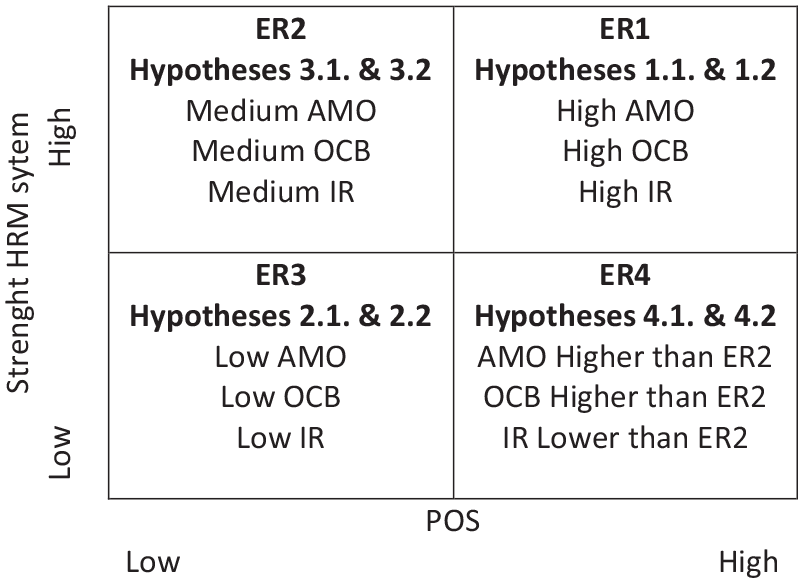
Theoretical model.
The case of ER1 supposes ERs that are high in both aspects: Strength of HRM system and POS. As mentioned earlier, previous research (Allen et al., 2003; Shore & Wayne, 1993; Wayne et al., 1997) suggests that a high level of POS is due to the perception that the HRM system (antecedent to POS) contains HRM practices associated with the three dimensions that define the AMO model (Abilities-, Motivation-, and Opportunities-enhancing practices); hence, these practices should also have a high assessment. Moreover, considering that POS is positively and directly associated with satisfaction at work, employee commitment, and IR (Allen et al., 2003; Eisenberger et al., 1990), and taking into account that developmental HRM practices that contribute to employee motivation also positively affect IR and activate OCB (Shaw et al., 1998), we might think that these employee behaviors should be present in this type of ER. Studies indicate that high POS and strong HRM systems are important for extra role behaviors and commitment (Allen et al., 2003; Kim et al., 2016). Furthermore, when HRM practices clearly set out desirable behaviors, individual outcomes such as OCB and lower turnover and absenteeism (proxies of intention to remain) are reinforced (Jackson et al., 2014).
The arguments set out above have led us to label this ER an “Efficient and Productive ER” and to propose our first hypotheses:
H1.1. Employment Relationship ER1, defined by high values in both perceptions about HRM Strength and POS, will be characterized by AMO systems with high values in Abilities-, Motivation-, and Opportunity-Enhancing Practices.
H1.2. Employment Relationship ER1, defined by high values in both perceptions about HRM Strength and POS, will be characterized by a high level of OCB and a high level of IR.
The opposite model would be ER3, characterized by a weak, deficient, and ambiguous HRM system. Based on the above reasoning, one might expect that a low level of POS not only translates into a weak HRM system (AMO) in terms of its content, but also that ambiguity in the way it is defined, low level of consensus and lack of consistency (weak HRM system) will provoke employee behaviors associated with intentions to leave the organization and an absence of OCB (Jackson et al., 2014; Jiang et al., 2012). This ER is inconsistent, and we might label it an “Unproductive and Inefficient ER.” Consequently, our second hypotheses are as follows:
H2.1. Employment Relationship ER3, defined by low values in both perceptions about HRM Strength and POS, will be characterized by AMO systems with low values in Abilities-, Motivation-, and Opportunity-Enhancing Practices.
H2.2. Employment Relationship ER3, defined by low values in both perceptions about HRM Strength and POS, will be characterized by a low level of OCB and a low level of IR.
Whereas these cases provide a certain equilibrium (both high and both low) in terms of Strength and POS, that is not the case with the other ERs, which can be understood differently. Situation ER2 shows a clear imbalance, since the HRM system is perceived to be strong, that is, clearly defined, well structured, and fair, but it is perceived as supporting only organizational requirements, but not employees’ needs—suggesting a low assessment on POS. In such a case, employees will look to improve support from the organization, showing their dissatisfaction through absenteeism and a lack of extra role behaviors. Employees simply comply with organizational standards and procedures. The low value in POS suggests that HRM practices are mainly focused on the job instead of the employee. Therefore, the values associated with HRM system will be lower than ER1. These relationships will generate low commitment and work satisfaction (Allen et al., 2003), so OCB is not expected (Shore & Wayne, 1993). However, the value obtained in Strength of the HRM system, that is, the positive assessment made of the system’s distinctiveness, consistency in application, and procedural justice may explain an employee’s willingness to remain in the organization, because the working climate can be positive (Bowen & Ostroff, 2004). As DeNisi and Smith (2014) suggested, strong HRM systems send clearer messages about behaviors required at work and how they can be leveraged by HRM practices (AMO systems in our case). Disagreement or dissatisfaction with this type of ER is not because of the “process” of the HRM system (attribution theory), but rather because of the lack of support to personal issues that are extra job-oriented (exchange theory). Therefore, this ER is clearly organization-oriented, and we have labeled it “Organization-Oriented and Highly-Structured ER,” suggesting our third hypotheses:
H3.1. Employment Relationship ER2, defined by high values in perceptions about HRM Strength and low POS, will be characterized by AMO systems with values in Abilities-, Motivation-, and Opportunity-Enhancing Practices, lower than ER1.
H3.2. Employment Relationship ER2, defined by high values in perceptions about HRM Strength and low POS, will be characterized by a low level of OCB and a moderate level of IR.
Finally, ER4 implies a low perception of HRM strength but a high level of POS. Based on the theoretical arguments explained previously, the high value in POS could be explained by perceptions about HRM practices that cover individual needs but they fail in the administration, implementation, formalization, and clarity of the HRM system itself, as it can be observed from their low values in Strength. Taking into account reasonings from Social Exchange Theory, OCB in employees will be moderated, as if employees perceive that the organization cares about their well-being and values their contribution (POS) they have a motivation to improve their outcomes (Gavino et al., 2012). Also, the low values in Strength of HRM system, suggesting the lack of formalization and presence of discretionality following the Attribution Theory, make us expect low values in IR. The lack of either clear or formal performance appraisal mechanisms that assess and reward employees’ results define this type of ER as inefficient (DeNisi & Smith, 2014). This model could be called the “Employee-Oriented and Poorly-Structured ER.” Therefore, we can set out our final hypotheses:
H4.1. Employment Relationship ER4, defined by low values in perceptions about HRM Strength and high POS, will be characterized by AMO systems with moderate values in Abilities-, Motivation-, and Opportunity-Enhancing Practices, higher than ER2.
H4.2. Employment Relationship ER4, defined by low values in perceptions about HRM Strength and high POS, will be characterized by a moderate level of OCB and a low level of IR, lower than ER2.
Methods
This article combines perceptions from two ER stakeholders, HR managers and employees’ representatives. The research focused on two different sectors, Hospitality and Financial Services, for the purpose of studying how the different variables behave in each sector. The first sector—hospitality—has the highest impact on Spanish gross domestic product (GDP); the second—financial services—has experienced dramatic changes in recent years during the financial crisis. In 2017, the hospitality sector’s contribution to the country’s GDP was 13.7%, whereas the financial services sector’s contribution was 14.2% (INE, 2017). In addition, during the last decade, both activity sectors have overcome different challenges and difficulties. Financial services firms, on the other hand, have drastically downsized their networks of branches and offices. Whereas, in 2008, there were 45,662 financial service offices and branches in Spain, by 2018, this number had fallen to 27,706. Financial services firms have also had to deal with new information technologies (IT). IT developments have changed the relationships between financial services firms and their customers (Banco de España, 2018; INE, 2017).
We performed two different and separate studies focused on hotels and financial services firms, respectively, namely “Study 1: hotels” and “Study 2: financial services firms.” We studied 4-star hotels and financial services firms with more than 50 employees. We chose this size of firm because Spanish labor regulations require such firms to comply with the obligation to have trade union representatives. Our two populations, applying these requirements, included 392 hotels and 295 financial firms.
Respondents
To gather information from the employers’ point of view, we called the HR Managers who represented the organization and who were experts in the topic of our research. Our decision to consider the expectations of HR managers is justified because they are ultimately responsible for designing and implementing the HRM system, in terms of the distinctiveness of the messages it sends out, consistency in the way HR practices work, and the degree of consensus they generate. This choice of managerial perceptions is similar to the one made by Tsui in her research (Tsui et al., 1997; Wang et al., 2003). Therefore, this article introduces the perceptions and beliefs of such managers regarding the content of HRM systems, their strength, and the impact they believe such variables have on the behaviors of the employees for whom they are responsible.
We sent a questionnaire to each HR manager in both populations, that is, we sent a questionnaire to HR managers in each hotel and financial services firm. We received 130 valid questionnaires from hotels and 87 from financial firms, representing a 33.16% and 29.49% response rate, respectively.
To obtain information from the employees’ point of view, we decided to call their trade union representatives, and we contacted the largest unions in the Spanish hospitality and financial service sectors. These unions—which have participated in collective bargaining processes in their respective sectors, negotiating employees’ working conditions—were in charge of sending the questionnaire to workers’ representatives in the hotels and financial services firms surveyed. In this case, we obtained data from 30 valid questionnaires in each sector from workers’ representatives who participated in the last collective bargaining in each sector. They are representatives of all the employees in both samples we are analyzing (Law 36/2011, article 88 point 4). Collective bargaining agreements are agreements between union representatives and firm representatives and they set out the rights and responsibilities of all employees. (Specifically, collective bargaining agreements standardize the following issues: work schedule and productivity, training, career, salaries and compensations, overtime remuneration, holidays, and work–life balance; Estatuto de los Trabajadores, articles 62 and 63, Law 36/2011.)
Measurements
All the items included in the questionnaire assess the variables through a 5-point Likert-type scale, ranging from 1 (Totally disagree) to 5 (Totally agree). They are detailed below. All HR managers and workers’ representatives answered the same questionnaire.
HRM
To analyze HRM practices, we considered the AMO system. We measured the AMO system using the scales proposed by Gardner et al. (2011). The scale identifies three different sets of HRM practices: HRM practices that reinforce abilities. Examples of items are as follows: applicants undergo structured interviews before being hired; applicants for this job take formal tests (paper and pencil or work sample) before being hired; on average how many hours of formal training do employees in this job receive each year?; HRM related to motivation, for example: Pay raises for employees in this job are based on job performance; employees in this job have the opportunity to earn individual bonuses (or commissions) for productivity, performance, or other individual-performance outcomes; qualified employees have the opportunity to be promoted to positions of greater pay and/or responsibility within the company; and HRM practices that favor opportunity, for example: How often do employees receive formal company communication regarding company goals (objectives, actions, and so on)?; how often do employees receive formal company communication regarding operating performance (productivity, quality, customer, satisfaction, and so on)?; how often do employees receive formal company communication regarding financial performance (profitability, stock price, and so on)?
Strength of the HRM system
We measured the strength of HRM systems using the scale proposed by Delmotte et al. (2012). These authors measured the three dimensions of HRM strength referred to as distinctiveness, consistency, and consensus, as proposed by Bowen and Ostroff (2004). The scale includes items such as: In this organization, rewards are clearly related to performance; In this organization, the results of the yearly appraisals are generally considered to be fair; HR staff have enough authority to get their ideas accepted; In this organization, HRM is synonymous with excellent work; The HR practices implemented in this organization sound good in theory, but do not work in practice; The appraisal procedure developed by the HR department has in practice other effects than the intended ones (Reverse coded); Top management and HR management clearly share the same vision; and Management unanimously supports HR policy in this organization.
POS
We measured POS using the scale proposed by Rhoades et al. (2001). These authors identify only one dimension for POS. This scale includes items such as: The organization really cares about my well-being; the organization values my contributions to its well-being; the organization strongly considers my goals and values; the organization shows little concern for me; and the organization is willing to help me if I need a special favor.
Extra role behaviors
We considered organizational citizen behavior (OCB) and intention to remain (IR) as extra role employee behaviors. In this study, we used the scale from Kehoe and Wright (2013) to measure OCB and IR. Specifically, Kehoe and Wright (2013) identify two dimensions, one dimension for OCB and another for IR. The OCB scale includes items such as: I provide constructive suggestions about how my department can improve its effectiveness; for issues that may have serious consequences, I express my opinions honestly even when others may disagree; I “touch-base” with my coworkers before initiating actions that might affect them; I encourage others to try new and effective ways of doing their job; and I help others who have large amounts of work. The IR scale includes items such as: I would turn down a job with more pay to stay with this organization; I plan to spend my career at this organization; I intend to stay at this organization for at least the next 12 months; and I do not plan to look for a job outside of this company in the next 6 months.
Data analyses and results
We performed two different studies in two different sectors. First, we analyzed the reliability and validity of each construct and then we separately tested the proposed hypotheses in both studies, Study 1: hotels and Study 2: financial services firms.
We performed confirmatory factor analysis (CFA) to assess the internal reliability and validity of each construct. Furthermore, discriminant validity was guaranteed for both studies. Then, we performed a two-step cluster analysis and an analysis of variance (ANOVA) to identify different types of ER and test the proposed hypotheses in each study.
To perform CFA on our sample (Goodness of fit: χ2: 2,362.008; p: .02251; Bentler–Bonnet normed fit index [BB-NFI]: 0.896; Bentler–Bonnet non-normed fit index [BB-NNFI]: 0.0.952; comparative fit index [CFI]: 0.967; root mean square error of approximation [RMSEA]: 0.036), we considered all of the information obtained from 247 questionnaires completed by 130 HR managers and 30 workers’ representatives from hotels, along with 87 HR managers and 30 workers’ representatives from financial firms. We obtained three factors for the AMO model, namely ability, motivation, and opportunity (t = 2.670, t = 3.230, and t = 4.445, respectively). Three factors related to the strength of HRM systems were found: consensus, distinctiveness, and consistency (t = 2.955, t = 3.169, t = 3.466, respectively). In addition, we obtained a second-order factor as a measure of the strength of the HRM system (t = 3.22; goodness of fit: χ2 = 152.2521, p = .02640, BB-NFI = 812, BB-NNFI = 0.949, CFI = 0.952, and RMSEA = 0.042). For POS, OCB, and IR, we found one factor for each one, namely POS (t = 6.86), OCB (t = 3.53), and IR (t = 4.12), respectively. Table 1 shows the results of discriminant validity, and Table 2 includes descriptive statistics and correlations. We concluded from Table 1 that the scales were reliable and that convergent and discriminant validities were confirmed. The reliability of the scales was measured by the composite reliability value, which in all cases was greater than or equal to 0.7. Convergent validity was confirmed by the average variance extracted, which in all cases was greater than 0.5. Discriminant validity was also confirmed, as the average variance extracted (principal diagonal in Table 1) was higher than the square of the correlations between factors.
Results from discriminant validity.
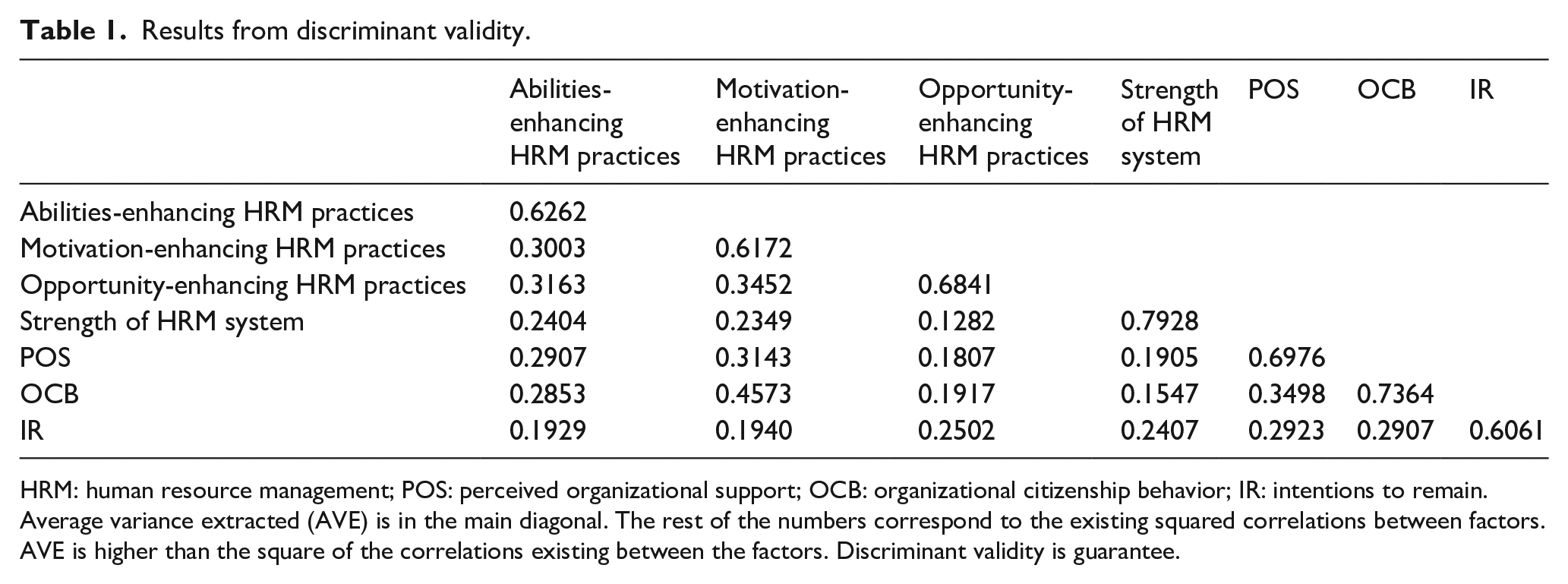
HRM: human resource management; POS: perceived organizational support; OCB: organizational citizenship behavior; IR: intentions to remain.
Average variance extracted (AVE) is in the main diagonal. The rest of the numbers correspond to the existing squared correlations between factors.
AVE is higher than the square of the correlations existing between the factors. Discriminant validity is guarantee.
Correlations and descriptive statistics.
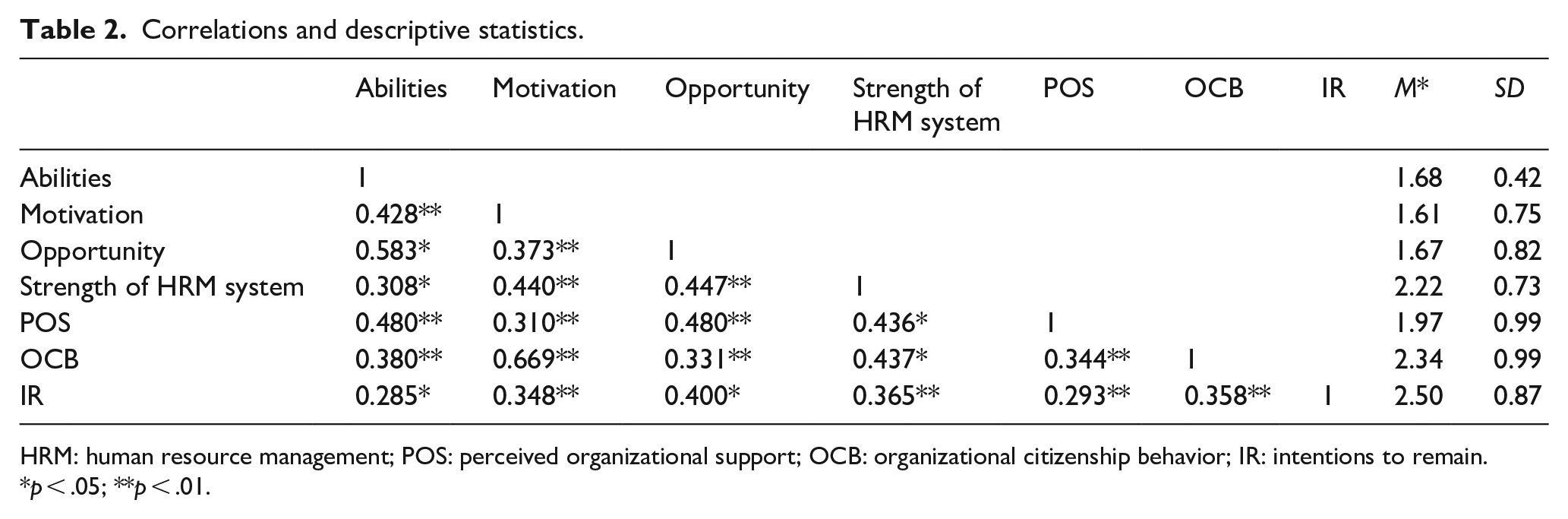
HRM: human resource management; POS: perceived organizational support; OCB: organizational citizenship behavior; IR: intentions to remain.
p < .05; **p < .01.
Next, we tested the proposed hypotheses on our two sub-samples: hotels and financial firms.
Study 1: hotels
To identify different types of ER, cluster analysis was employed as a classic technique of explorative research. In this study, we followed a two-step cluster analysis. Two-step cluster analysis is an adequate way to determine the number of clusters (Chiu et al., 2001). Using this technique, methodical concerns regarding the determination of the adequate number of clusters are addressed and overcome (Ketchen & Shook, 1996): two-step cluster analysis identifies groupings by running pre-clustering first and then applying hierarchical methods. Since it uses a quick cluster algorithm upfront, it can handle large data sets that would take a long time to compute using hierarchical cluster methods. Furthermore, two-step cluster analysis also automatically selects the number of clusters, a task normally assigned to the researcher in other cluster methods.
To identify and classify groups of homogeneous responses, we conducted a cluster analysis for the total number of cases in our hotel population (160 questionnaires, 130 from HR manager and 30 from workers’ representatives). We found three different clusters: two of them included 80 and 50 firms that grouped answers only from HR managers and a third cluster was composed of 30 employees’ representatives, exclusively. We also conducted ANOVA to assess differences between clusters in terms of the type of ER (measured by the Strength of the HRM system and POS), assessment of the AMO system, and employees’ behaviors.
The strength of the HRM system and POS were considered as variables to classify firms into clusters, as mentioned above. Our results show three different clusters. Specifically, Clusters 1 and 2 contained answers from HR managers and Cluster 3 from workers’ representatives. Figure 2 shows the different clusters and how they are placed within our proposed theoretical architecture.
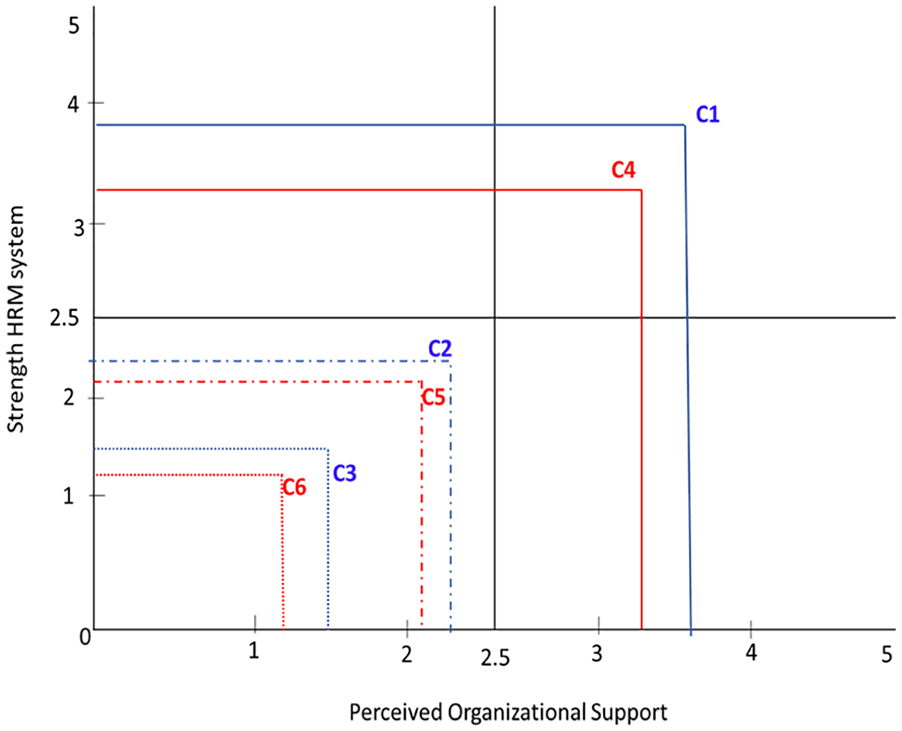
Clusters location in theoretical framework.
The means of the clustering variables for each of the three clusters obtained are shown in Table 3. An ANOVA was performed to evaluate the quality of variable means across the clusters and thus assess the distinctiveness of each cluster. An F-test confirms that these means differ significantly across the three clusters for all clustering variables.
Cluster analysis and ANOVA: ER configurations.
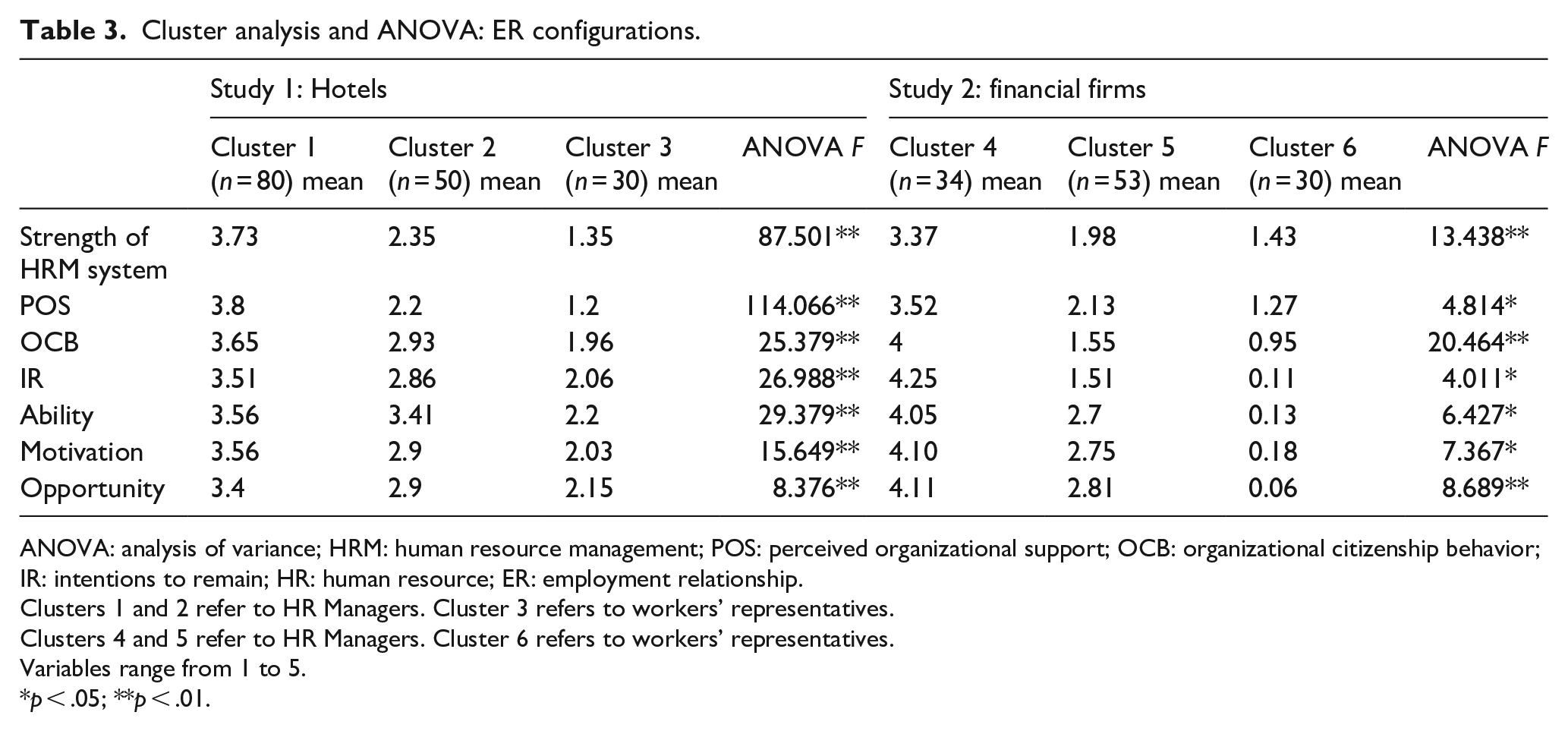
ANOVA: analysis of variance; HRM: human resource management; POS: perceived organizational support; OCB: organizational citizenship behavior; IR: intentions to remain; HR: human resource; ER: employment relationship.
Clusters 1 and 2 refer to HR Managers. Cluster 3 refers to workers’ representatives.
Clusters 4 and 5 refer to HR Managers. Cluster 6 refers to workers’ representatives.
Variables range from 1 to 5.
p < .05; **p < .01.
Specifically, in our first cluster, C1 (80 firms), the values for both strength of HRM system and POS are the highest. This cluster is also characterized by being the one with the highest means for each one of the AMO practices for the HRM system. Means obtained by our outcomes (OCB and IR) are also the highest in our population. These results support hypotheses 1.1 and 1.2.
In the second cluster, C2, composed of 50 firms, assessments made by HR managers demonstrate a moderate degree of Strength of the HRM system (2.35), a value that is below the mean in the Likert-type scale. The same respondents, HR managers, also consider that support given by the organization to its employees (POS) has even a lower score (2.2). According to these values, the ER model contained in this cluster can be placed above the upper limit of the ER3 model that we have called “Inefficient and Unproductive,” and it is closer to the most efficient ER1 model. The assessment made by these managers of the content of the HRM system (AMO practices) is closer to the average in our scale for opportunity- and motivation-enhancing practices (2.9) but higher for skill-enhancing practices (3.41). Therefore, it could be said that in this cluster, the weaknesses of ERs are not found on the side of the AMO practices (HRM content), which are close to or above the average. The problems are due to the application of the HRM system, as the value of the HRM System Strength found was below average. The perception of HR managers regarding the emergence of extra role behaviors (OCB) is moderate (2.93) but slightly higher with respect to employees’ intention to remain (2.86). These results are more optimistic in relation to our hypothesis 2.2, since this cluster is closer to the most efficient ER defined here. In terms of the assessment of the AMO system, this second cluster does not support hypothesis 2.1, although this requires specific comment, which we will set out in detail in the “Discussion” section.
Finally, for our third cluster, in which we collected answers from workers’ representatives, values for both strength of the HRM system (1.35) and POS (1.2) are the lowest. In this case, values obtained by HRM practices are also the lowest, clearly below the average in our scale. In terms of behaviors, workers’ representatives state that their unwillingness to display OCB (1.96) and their desire to remain in the organization is also at the lowest level (2.06). These results support hypotheses 2.1 and 2.2.
We were unable to test hypotheses 3 and 4, as we did not find cases fulfilling the conditions laid down for type 2 and 4 ERs in the hotel sector.
Study 2: financial firms
We replicated the statistical analysis performed in the previous study in the financial sector. We performed a cluster analysis to identify similar groups in our sample from the financial services sector. We considered the 117 responses from financial organizations (87 HR managers and 30 workers’ representatives) and we obtained three different clusters (Table 3).
As in Study 1, we performed a two-step cluster analysis. We found three different clusters using strength of the HRM system and POS as classifying variables. Specifically, clusters 4 and 5 included answers from HR managers, and cluster 6 from workers’ representatives (Figure 2). Cluster 4 and cluster 5 included 34 and 53 financial firms, respectively. In both cases, the answers came from HR managers. The last cluster, cluster 6, includes 30 responses from employees’ representatives only. We carried out an ANOVA to identify differences in the strength of the HRM system and POS, that is, differences in terms of ERs.
The results of the ANOVA are shown in Table 3. Statistical differences of the three clusters obtained are guaranteed by the F-test values.
In the financial sector sample, cluster 4 (C4, 34 firms) is characterized by the highest values for both strength of the HRM system (3.37) and POS (3.52). This cluster could be labeled ER 1. Also, in C4 we found the highest values for each of the AMO practices, above 4 points in all the cases and individual behaviors (OCB, 4 and IR, 4.25). Hypotheses H.1.1 and H.1.2 are therefore supported.
Cluster 5, C5, includes 53 financial firms. In this case, the values obtained for strength of HRM (1.98) and POS (2.13) are below the average, so it is an ER3, although they are higher than C6. In C5, OCB (1.55) and IR (1.51) values are below the mean in the Likert-type scale, although the AMO values are closer to the mean in the Likert-type scale (3 points), but lower than those obtained in cluster 2 (hotels). Therefore, we can say that hypothesis 2.1 is not supported but—as in the case of study 1—hypothesis 2.2 is supported. This result deserves further explanation, which can be found in the “Discussion” section.
Finally, cluster 6, C6, is made up of the 30 employees’ representatives from financial firms. In cluster 6, both strength of the HRM system and POS are the lowest in Study 2, again named ER3. Furthermore, the values of all the variables considered in this study, that is, AMO, OCB, and POS, are the lowest. Hypotheses H.2.1 and H.2.2 are therefore supported.
Discussion
This article explores how the different stakeholders in the ER, employees’/workers’ representatives and employers, perceive the content and process of HRM and the consequences of such ERs in terms of individual behaviors. Several issues can be highlighted from the theoretical and empirical analysis.
The first aspect that can be deemed a novel contribution of this article is that, in contrast to proposals based on the Psychological Contract that take as a reference time and performance requirements (transactional, relational, transitional and balanced, see Rousseau, 1989) or even the proposals made by Tsui et al. (1997), based on inducements and expected contributions, we argue that there is a possibility of defining and identifying different ER models taking into account perceptions from employers and employees about the two variables proposed in this study: the Strength of the HRM system and POS. We believe that studying both aspects (“How” HRM is implemented—strength—and POS) as explanatory factors of ERs will help to improve understanding of these relationships. This article has identified four different models of ERs, taking into consideration the perceptions of HR managers and workers’ representatives, obtaining a valid methodology to study ERs within organizations.
A second contribution is related to the way in which the diverse models of ERs that we identify are different in terms of perceptions surrounding the content of the HRM system itself. It seems that to the extent that the ER is better defined in terms of the content (the “What”), that is, regarding skills, motivations, and opportunities that could be enhanced (AMO Practices), the perception of the Strength of the HRM system (the “How”) is also higher. We might consider the possibility of a certain relationship between these variables (“content” and “process”), thereby opening up the “black box” (Guest, 2004) that conceals the way in which HRM is applied in firms.
This pattern relating content and strength of the HRM system was obtained in both studies—hotels and financial services firms—although they yielded a few differences that are worthy of specific comment. It was found that the financial sector is always higher in its assessment of AMO practices than the hospitality sector, from a managerial perspective. This difference may be understood from a contextual approach as consequence of the specific characteristics of these sectors, such as the educational background of employees or the characteristics of the specific work they perform (contingent approach). If we observe the assessments made by workers’ representatives, they consistently score lower and have a more critical attitude in the financial sector than in the hospitality sector. This could be explained by the higher educational profile and qualifications in financial service firms, having a more questioning attitude toward management. In all cases, unions in both sectors have a very pessimistic perception of both content (AMO practices) and process (strength). These results highlight the need to consider both approaches in the study of ERs, including new contextual variables (Martín-Alcázar et al., 2005).
It is also interesting to note that, in both studies, it was possible to identify a cluster of firms whose HR managers do not rate their HRM systems very highly, that is, below or close to the mean in the assessment scale for AMO-Enhancing practices, with some specific exceptions. Overall, the conclusion we can draw from these results is that it is possible to find different ER models within a sector, each one of which is characterized by different HRM systems.
As a third contribution, we would like to highlight the association established between the ER model and employees’ behaviors, both in terms of the propensity to develop extra role behaviors (OCB) and the intention to remain in the organization (IR) (Wright & Nishii, 2013). This result offers a better explanation and understanding of how employees react to different organizational decisions. From the point of view of HR managers, in cases where ERs are based on strong HRM systems and high levels of POS, managers expect high extra role behaviors and intention to remain and, more importantly, when the ER changes, managerial perceptions of employees’ behaviors also change. This relationship between the model of ER and employees’ behaviors is observed in both sectors analyzed in this article.
From the perspective of the union or workers’ representatives, the low scores they predict for OCB and IR are coherent with the type of ER they perceive. These results are clearly supported and congruent with theoretical frameworks such as Attribution Theory and Social Exchange Theory, from both sides, HR Managers and unions. The interpretation and assessment made by each one of the stakeholders in the ER also explain the behaviors that they perceive. Depending on the way they understand the signals being sent out, by the way in which HRM is implemented (Attribution Theory) and how the organization supports employees’ needs (Social Exchange Theory), employees’ responses in terms of behaviors also vary.
Finally, as mentioned above, it is interesting to note the different perceptions that give rise to the identification of the diverse models of ERs between companies within the same sector. Such differences not only exist between the perceptions of managers and workers’ representatives, as the literature highlights, but also between managers themselves. The results obtained in both studies confirm our theoretical argument regarding the need for knowledge about the perceptions of both sides of the ER to provide a better understanding and explanation for the reasons behind their behaviors (Liao et al., 2009; Nishii & Lepak, 2008; Wright & Nishii, 2013). This gap or disagreement is coherent with Ostroff and Bowen (2016), who stated that relationships between line managers’ reports of the practices in place in their unit and employees’ reports of their experiences with the practices are relatively weak, typically within a .20 correlation range.
From a practical point of view, we think that this article makes a relevant contribution as it allows us to identify both stakeholders in ERs, their main differences in perception, and which practical actions can be taken to reduce their disagreements. Organizations themselves would also benefit from information about the content of their HRM system, the process followed to implement such practices, and the effects or outcomes being generated. Undoubtedly, an interesting question for both managers and employees would be to study the effects of both crises—the 2008 financial crisis and the Covid pandemic—on ERs and specially regarding the loss of employee benefits and advantages in working conditions.
We cannot bring this article to a close without first reflecting on its limitations. The first limitation is the fact that we were unable to identify firms that apply two of the four models of ERs defined in our theoretical framework. The reason for this might be related to our second limitation: the sample. It would be desirable to have not only a higher response rate from firms but also a direct answer from employees. It might be possible to undertake case studies, interviewing employees, who could be members of unions or not, to identify differences in perceptions among employees themselves, between employees and workers’ representatives, and between the union representatives and management. The low level of union membership among Spanish workers could cast doubt on the degree of concordance between the perceptions of workers’ representatives and those of employees. The comparison between such perceptions would be interesting to analyze. We see in this a potential future strand of research, which would allow us to ascertain whether employees and managers from different departments in the organization perceive the ER differently, and the extent to which their perceptions and level of disagreement might affect and explain different outcomes such as OCB and IR. Furthermore, in a similar way to Audenaert et al. (2018), another potential area of research would be to measure the level of agreement between managers and unions, and to consider it as a moderator between ERs and POS/IR would also be interesting.
In summary, we believe that the research questions posed at the beginning of the article have been answered, contributing to new proposals to be considered in the analysis of ERs: the identification of new models of ERs through the consideration of new variables, the effects of such models on employees’ behaviors, the study of the perspectives held by the two main stakeholders in ERs, namely, employers (HR managers) and employees (workers’ representatives), so we could contrast perceptions from both of them, and also the existence of different ER models within the same sector.
Footnotes
Declaration of conflicting interests
The author(s) declared no potential conflicts of interest with respect to the research, authorship, and/or publication of this article.
Funding
The author(s) disclosed receipt of the following financial support for the research, authorship, and/or publication of this article: Financial support for this article was provided by the Spanish Ministry of Economy and Competitiveness, R&D Plan (ECO2013-44274-P).
