




Abstract
The COVID-19 pandemic brought into sharp focus the important role public policy, including tourism policy, plays in improving economic and social welfare. This paper advocates consideration of the potential value of hubristic leadership theories when seeking to explain tourism policy failure (though it might also be used to contribute to examinations of policy innovation). In doing so, it seeks to complement existing literature by introducing ‘lower-level’ frameworks to show how more localized crises may occur. The flavour of a growing body of theoretical work in this field is provided alongside a truncated illustrative case study of policy failure in a British regional tourism policy context.
Introduction
This special issue is timely. It follows an unprecedented period of concentrated global public policy interest in the tourism and hospitality sectors. This was, of course, inevitable once the potential ramifications of the COVID-19 pandemic became known. As has been widely documented, at one point, 96% of the world’s destinations were closed by policymakers (United Nations World Tourism Organization [UNWTO], 2020), threatening the livelihoods of the small, medium, and micro businesses that typify the sector and severely testing the resilience of large corporations. Even a year later, 32% of global destinations remained closed, with a further 34% closed partially (UNWTO, 2021). Such a shock to the tourism system heightened public policymaker interest.
The forms of public health policy interventions devised in response to COVID-19 varied significantly. Wealthier countries not only facilitated mass testing, vaccination, and various other measures designed to control the spread of the virus but also introduced financial instruments to soften the economic consequences of the pandemic (Organization for Economic Cooperation and Development, 2020). In the United Kingdom, for example, the government’s response included substantial spending to safeguard employment and reduce levels of business failure. Indeed, the hospitality industry had the highest number of furloughed jobs of any sector of the British economy (DCMS, 2021; Her Majesty’s Revenues and Customs, 2021; Hutton, 2022).
Public policymakers in poorer countries had fewer options and often little scope to mitigate the effects of the pandemic, even though many have been particularly adversely affected by it socially and economically. Not only has COVID-19 illuminated the inequalities that exist between countries but it has also exacerbated them within societies (see, for example, Rastegar et al., 2021).
This backdrop has reinvigorated debates about the role tourism might play in improving economic and social welfare, with some academic researchers arguing that policymakers should take the opportunity of, for example, “re-thinking tourism for a just recovery” (Rastegar et al., 2021, p. 2). Its apparent lack of appeal among policymakers, manifest most obviously in a continued emphasis on regaining lost markets, has also prompted greater academic interest in questions of power and the politics of tourism policymaking (Fletcher et al., 2020; Higgins-Desbiolles, 2020). The related literature, with good reason, usually locates tourism within analyses of neoliberal capitalism and explains crises, and reactions to them, using associated frameworks.
The aim of this article is to advocate consideration of the potential value of mid-range theories and hubristic leadership theories when seeking to explain tourism policy failure (though it might also be used to contribute to examinations of policy innovation). To that extent, it seeks to complement existing literature by introducing “lower-level” frameworks to show how more localized crises may occur. It does so by outlining the flavor of a growing body of theoretical work in this field and providing a truncated case study of policy failure in a British regional tourism policy context.
Hubristic Leadership
Hubristic leadership has attracted growing attention among “mainstream” management researchers but has not yet gained traction with tourism scholars. It sits alongside and overlaps notions of charismatic leadership and narcissistic leadership, though it is distinctively different from them. It has inspired disciplinary (mainly psychology), inter- and multidisciplinary research (Sadler-Smith, 2019). The generally negative connotations of hubristic leadership, with its attendant undesirable behaviors, usually lodge it within studies of the “dark side of management” (Akstinaite et al., 2022; Hanlon, 2016)
The lack of attention to hubristic leadership among those interested in tourism and hospitality organizations is surprising. These sectors have a substantial number of historical and contemporary luminaries whose personalities and behavior have been central to their brands. This applies less obviously to tourism policymakers because their areas of influence are limited; if nothing else, they are circumscribed by local, regional, or national political boundaries. Tourism agencies that transcend these lines of demarcation (e.g., the UNWTO or Organisation for Economic Co-operation and Development [OECD]) are less prominent because they do not wield substantial power; they advocate and influence. There is widespread anecdotal evidence, nevertheless, of influential leaders shaping policy and “driving through policy change,” especially at local levels. This article is concerned with such policymakers.
Sundermeier et al. (2020) summarize the concept of hubristic leadership as follows: “Hubristic leaders are biased by a grandiose belief in their talents and abilities, which they express through high levels of self-confidence, exaggerated pride, overinflated positive self-evaluations, and arrogance” (p. 1038). In contrast with concepts such as narcissism or overconfidence, which are usually perpetual, hubris is temporary and associated with power. Indeed, Owen and Davidson (2009) suggest that hubris is a “syndrome” triggered by power. As they argue, Charisma, charm, the ability to inspire, persuasiveness, breadth of vision, willingness to take risks, grandiose aspirations, and bold self-confidence—these qualities are often associated with successful leadership. Yet there is another side to this profile, for these very same qualities can be marked by impetuosity, a refusal to listen to or take advice, and a particular form of incompetence when impulsivity, recklessness, and frequent inattention to detail predominate. This can result in disastrous leadership and cause damage on a large scale . . . (pp. 1396–1397)
The framework contained in Table 1 provides an accessible summary of the main features of the most prominent attempts at conceptualizing hubris in chief executive officer (CEO) decision-making. Other commentators add nuance and differences of emphasis, but for the purposes of this article, Petit and Bollaert’s (2012) work is instructive for its highlighting of core components.
An Early Framework Depicting CEO Hubris.
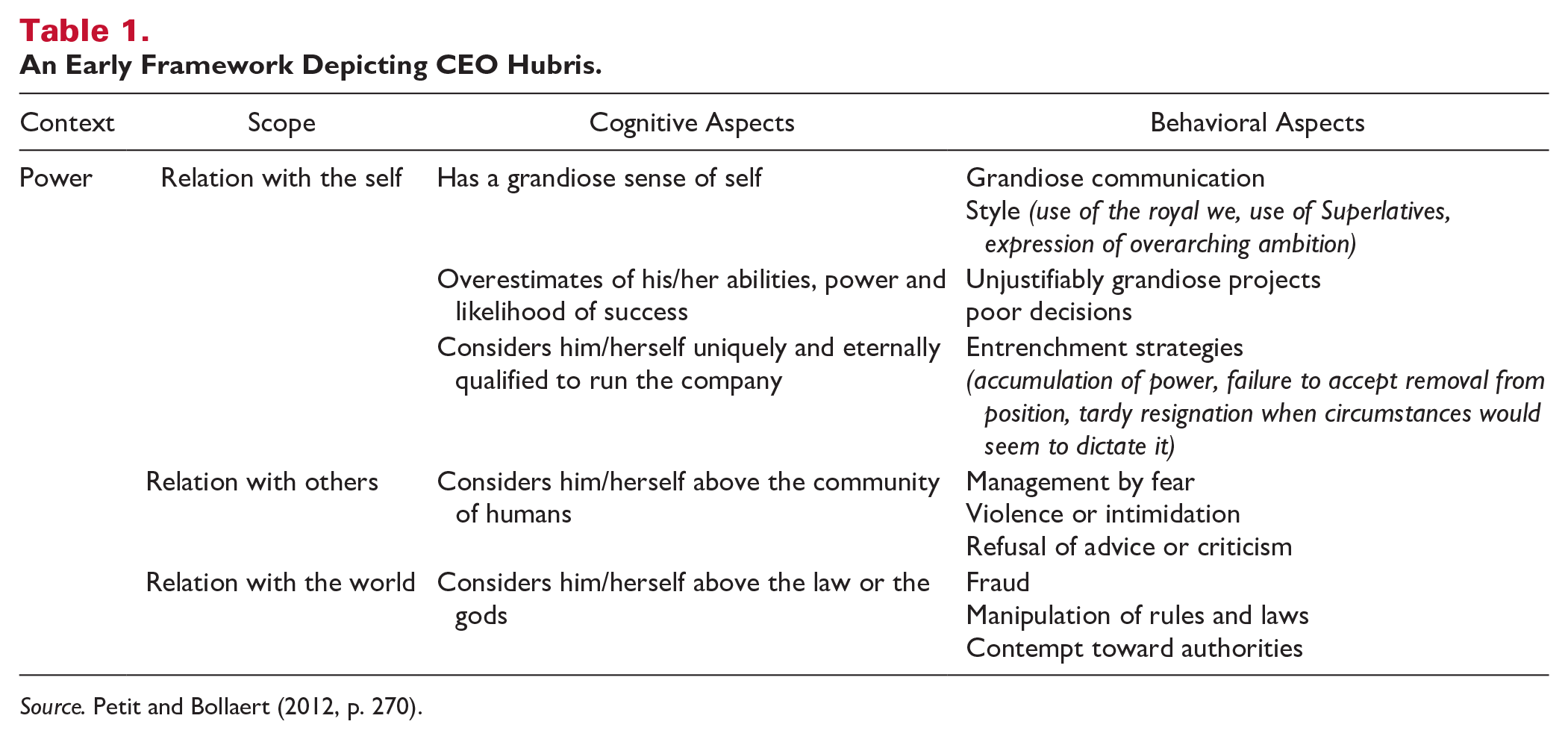
Source. Petit and Bollaert (2012, p. 270).
The central feature of all major works on hubristic leadership is the connection between leaders’ cognition and behavior and their possession of significant organizational power. The dangers inherent in managerial or policymaker hubris are said to emerge where there are minimal constraints to the application of power. Scholars usually suggest that the behaviors often become more pronounced (or extreme) following periods of success. The sociocultural, economic, and environmental consequences of such leadership will vary according to the context and the scale of organizational activity. The most celebrated cases are those that have gained international media attention, such as Enron or led to calamitous political regimes (e.g., Eckhaus & Sheaffer, 2018).
A complementary approach to understanding managerial hubris is provided by Picone et al. (2014). Following a systematic review of the literature, they provide a conceptual map of relevant research. Two of the important dimensions they highlight relate to hubris-driven strategic choices and organizational feedback. These are valuable because they move the analysis on from hitherto predominant concerns with antecedents (or conditions) and the symptoms of managerial hubris.
The potential importance of hubris in shaping strategic decision-making in commercial contexts often revolves around such matters as an overconfidence in research and development outcomes, overambitious international strategies, misguided diversification strategies, overreliance on acquisition-led growth, and excessive debt financing (see Picone et al., 2014). The principles underpinning these observations are easily transferable to the tourism policy sphere, but their character would differ. Managerial hubris in this context might manifest itself, for example, in misguided investment in major events that are attractive to the leaders as ways of gaining access to sports or cultural icons or overspending on “flagship” initiatives on the basis that will yield substantial returns to the destination.
The final pillar of Picone et al.’s (2014) conceptual map revolves around organizational performance feedback. The proposition is that CEO hubris tends to exaggerate levels of success, personalize success, overlook poor performance, and discount inconvenient reasons for poor performance. These observations are easily transferred to tourism policy contexts. Again, managerial hubris might encompass the selective use of evaluation studies for comparable events, the adoption of methodologically weak approaches to measuring outcomes, and reporting costs in a way that conceals total costs or misleads by the way costs are classified.
More recent reviews of hubristic leadership and allied theorizing provide further refinement. Sundermeier (2021) examines three interdisciplinary perspectives on hubristic leadership that utilize contrasting theories. The first labeled the innovation perspective, associates potentially positive outcomes with hubristic leaders. This is explained by such individuals considering themselves, among other things, as having sufficient knowledge and understanding to make radical strategic decisions. Some empirical evidence is available to support this perspective, but there are also significant gaps.
The second approach, as categorized by Sundermeier (2021), is entitled the internal coordination and commercialization perspective. Here, the focus of attention is on the negative consequences of hubristic decision-making. Thus, research on corporate takeovers by hubristic leaders reveals the irrational ignoring of easily available market data in favor of a leader’s overestimation of their own ability to add value. Related examples from the literature on new venture creation are cited in support. The application of this perspective to tourism policy public policy research offers significantly new avenues for research.
Advocates of the third perspective consider hubristic leadership as primarily about dispositions to the management of risk associated with novel business opportunities. The suggestion is that hubristic leaders draw upon all available means, even those that are unlawful, to succeed. In a similar vein to the first two, researchers adopting this perspective utilize existing theories as well as novel advances related specifically to hubris.
Based on the kind of studies undertaken about other economic sectors, it becomes possible to theorize hubristic leadership in the context of tourism public policymaking and to design research projects to capture the insights required. In so doing, it is important to acknowledge the dangers of conceptual “fuzziness” and to recognize the challenges of operationalizing hubristic leadership in research. The preponderance of quantitative studies confirms that several researchers have made inroads in this respect. The potential value of qualitative research and detailed case studies has yet to be fulfilled. These issues are not addressed in this paper, but for a useful review, see Sadler-Smith (2019).
A Briefcase Illustration of the Application of Hubristic Leadership Theories
What follows illustrates how hubristic leadership theories might inform our understanding of a well-documented case of Destination Management Organization (DMO) innovation, crisis, and failure. A more sophisticated study would be required before observations could be made with confidence. What follows is about the potential of the theoretical framing and approach rather than insights into the specific case. It draws on evidence in the public domain.
During the early 2000s, government-funded regional development agencies (RDAs) played a prominent role in British economic development. They adopted the neoliberal discourse of private–public partnership and created governance structures whereby private sector actors played an active strategic role in public policy, including major financial decision-making. Entrepreneurial dispositions and business experience legitimized participation rather than community representation (Thomas & Thomas, 1998).
In Yorkshire, the RDA invested significant resources in developing a strategic framework for the visitor economy. Its delivery mechanism was principally via the regional tourist board. Although responsible for spending hitherto unprecedented amounts of public money promoting tourism and hosting events, the “official” regional tourist board was an arms-length private company. For much of the period, its Board of Directors consisted of 12 nonexecutive directors, three-quarters of whom were employed in the private sector (from tourism businesses to senior personnel employed by supermarket chains, financial services, and utilities). As Thomas (2011) notes, “even a cursory review of . . . published minutes confirms that, at least at Board level, a relatively narrow range of issues were discussed, almost all of which were about advancing business interests” (p. 496).
In 2009, a new Chief Executive Officer was appointed. His commercial background (gained outside tourism) was seen as part of a project for modernizing public sector involvement in tourism. The name of the organization was changed from Yorkshire Tourist Board to Welcome to Yorkshire reflecting the entrepreneurial and the boosterism discourse that pervaded policy circles at the time (Thomas & Morpeth, 2009).
The leader of this new ambitious tourism agency, in the form of its Chief Executive Officer, also gained a higher profile and became synonymous with the Welcome to Yorkshire brand. As part of this profile raising, much more attention was paid to promoting the work of the agency in areas that would be prominent for tourism stakeholders, for example, in railway stations within the region as well as outside and on regional (and later national) television as campaigns became newsworthy. Grand claims to the DMO’s national and sometimes international pre-eminence prevailed. Thus, for several years, its annual conference was declared to be the country’s biggest tourism event (e.g., https://old.yorkshire.com/industry-events/y14). This grandiosity played well with a well-resourced RDA and local authorities keen to see Yorkshire “punch its weight” as an internationally significant tourist destination. The resources at its disposal grew.
Much of the DMO’s activity centered on attracting and hosting sports events, including the start of the Tour de France cycle race in 2014. Many of these events gained popularity among the community as well as tourism stakeholders. The Tour de France, particularly, led to widespread community and small business activity such as adding bunting to buildings. Few would reject the suggestion that (a) tourism had become (politically) prominent regionally and (b) that it was reported almost universally in an uncritical manner in the media. Asking questions about the cost of staging events or evidence of legacy tended to fall on deaf ears.
The prominent role-played by the DMO’s CEO led to his being recognized and rewarded. His salary increased to the extent that it became almost twice as much as the person who was to replace him. In addition, he was awarded a knighthood, which allows the holder to use the prefix “Sir” thereafter. This quintessentially English accolade has high status not least because it is granted and presented by the Head of State, then her Majesty the Queen, or a nominee from her family.
The following report of his gaining an honorary doctorate from Leeds Beckett University illustrates how the CEO’s leadership was widely presented at the time: Gary joined Welcome to Yorkshire (WTY) in 2008 and has been instrumental in creating a world-leading tourism marketing service for Leeds and the region, bringing the 2014 Grand Départ of the Tour de France to Yorkshire. He has led the company to receive international recognition at the World Travel Awards, where it won World’s Leading Marketing Campaign in 2010, 2011 and 2012. In addition to Gary’s inspirational leadership, a key part of WTY’s success has been the engagement in a number of cultural partnerships including Yorkshire’s medal—winning entries to the Chelsea Flower Show, the Railway Children Tour and the Yorkshire Sculpture Triangle—the largest initiative of its kind in Europe. Leeds-born Gary is a passionate Yorkshireman, spending his time outside of WTY running a sheep farm in Coverdale. He . . . attended Leeds Grammar School before becoming a management trainee in a Yorkshire bank. He then spent 18 years working at Royal Insurance, including three years in Hong Kong where he set up and ran the Hong Kong office. His next role was running Bradford and Bingley’s Retail Property Services, where he turned a £1million a month loss into a £1million a month profit. He has been the Group Managing Director of Prontaprint and Kall Kwik, and Johnsons Cleaners UK, before joining WTY in 2008. (July 2015, https://www.leedsbeckett.ac.uk/news/0715-welcome-to-yorkshire-chief-awarded-honorary-degree/).
He had already received a similar award from York University.
A little later, stories that were critical of the CEO’s management style and the culture of the organization started to emerge in the local and then national media (e.g., https://www.bbc.co.uk/news/uk-england-49978439). Claims of bullying and speculation about excessive expense claims among senior staff raised political concerns which intensified as media coverage grew. The CEO resigned in 2019 on grounds of ill health having paid back some of the expenses he had previously claimed. The Chair of the Board resigned some weeks later.
The Board of Welcome of Yorkshire commissioned two independent reports as a response to public (or media) disquiet. The first examined expense claims over a 3-year period and was conducted by the consulting firm BDO. Among other things, it reported a lack of transparency, instances of inappropriate claims, and the need for clearer financial guidelines (https://industry.yorkshire.com/media/69542/bdo-report-july-2019.pdf).
A second investigation into the culture, governance, and management of Welcome to Yorkshire was undertaken by Clarion. It painted a picture of an organization where the CEO fell short of the highest performance and leadership standards . . . Most (employees) have become adept at not challenging colleagues’ behavior or raising any concerns . . . or constructive criticism . . . (p5) . . . the Board was not, overall, a highly engaged group that would question or challenge decisions as much as they could (p6) (https://industry.yorkshire.com/media/69539/clarion-report-july-2019.pdf).
Media coverage of these reports led some influential actors to call for the Board to resign https://www.bbc.co.uk/news/uk-england-leeds-49018752.
Welcome to Yorkshire went into administration in 2022 when it became clear that local authorities would not extend the support given already by offering additional funding (https://yorkmix.com/welcome-to-yorkshire-put-into-administration-after-losing-backing-of-council-leaders/).
As is often the case with charismatic leaders, perspectives can become polarized. Notwithstanding highly critical media coverage, a letter published in The Yorkshire Post (26th March 2019), illustrates an alternative view: ‘. . . It took Gary’s (the CEO) incredible powers of charm and persuasion to convince Christian Prudhomme and his French masters to take a huge leap of faith and risk their reputations to host the Tour here. Not content with merely that, Gary went on to sprinkle his magic dust and deliver, in Christian’s words, the “greatest of Grand Departs” . . . With great genius usually comes fundamental flaws (Churchill is one example) and Gary is far from perfect . . . One thing is absolutely certain . . . Sir Gary will be back—bigger and better than ever before. He’s a fighter and will forever be a genius’
National newspapers were less generous. The Guardian (2019) wrote of his “cult-like” leadership, The Sunday Times (2019) was critical of his leadership practices and the BBC (2019, 2021) focused on leadership shortcomings.
Concluding Comment: Do Hubristic Leadership Theories Help Explain the Failure of This DMO?
To answer that question fully, a research project that extended beyond information published in mainstream media would be required. Nevertheless, the case presented illustrates how these mid-range theories open potentially valuable new ways of examining policymaking processes in certain circumstances. Indeed, it offers a critical counterpoint to those studies where the role of individuals in leadership positions is emphasized positively and sometimes couched in the language of “charismatic leadership” (for recent reviews see, for example, Bavik & Ali, 2022; Hoang et al., 2021).
Some of the new research directions related to hubristic leadership among tourism policymakers have been identified in the preceding discussion. Specific topics would be extensive and diverse, ranging from the lexical choices of CEOs as outward manifestations of hubristic leadership (Akstinaite et al., 2022) to the hubristic leadership of new initiatives (Sundermeier et al., 2021). Examination of policy formation, especially at subnational levels, in a range of tourism related areas—from marketing initiatives to those relating to skills supply and utilization—could benefit from this new perspective. Indeed, further reflection and organization of these topics could then constitute a valuable new research agenda.
An alertness to hubristic leadership probably increases the likelihood of devising measures to limit its incidence and impact. Sadler-Smith (2019) suggests an approach consisting of five dimensions. The first is the identification of linguistic markers via an analysis of the language used by protagonists. An extensive literature generally applied to politicians, shows that the growing use of keywords can be associated with symptoms of “hubris syndrome,” for example, increased use of “certain,” “sure,” and “confident” as a symptom of excessive confidence and contempt for advice from others. Second, the application of “high-reliability organizing” (HRO) principles. This includes adopting practices that, for example, reveal and learn from failures rather than hiding them and communicating rather than concealing big-picture plans.
The third dimension is to improve governance, so that (un)acceptable practices are understood widely, and discrepancies dealt with. This would extend to clarity of individual responsibilities and procedures. Fourth, the avoidance of a hubristic culture where, for example, excessive claims are routinely made about products or organizational performance. Finally, constraining executive remuneration. This would act as a countervailing influence on the self-importance associated with hubristic leadership (see also Sundermeier, 2021).
This special issue is concerned with new directions in public policy research related to tourism and the hospitality sector. This article has offered a novel approach to the examination of leadership in public bodies. The case study has illustrated its potential value, but more work is required to add theoretical sophistication and methodological rrrrr. Detailed empirical research may then enhance understanding of hubristic leadership and its consequences and gauge the extent to which it is prevalent in tourism policy formation and change.
Footnotes
Declaration of Conflicting Interests
The author(s) declared no potential conflicts of interest with respect to the research, authorship, or publication of this article.
Funding
The author(s) received no financial support for the research, authorship, or publication of this article.
