



Abstract
Significant shifts in policy agenda and priorities may occur when exogenous and discontinuous macro-level events such as disease outbreaks, political transformations, and abrupt developments in visitor markets transpire. Such swings can be considerably challenging not only for policy-makers and decision-makers but also for stakeholders, especially when policy areas like employment, quality of life, housing, health, and education are weighed against growth and development considerations for hospitality, tourism, or other sectors. In extreme cases, policy swings can exacerbate social conflicts and cause commensurate disruption. Using the Hong Kong and Macao Special Administrative Regions of China as pooled comparative cases of policy-making, this study examines the content and structure of tourism-related and general policies across a 20-year pre-COVID period, how the different policy areas evolved and shifted in priorities, and the temporal correspondence of policy swings with factors, context, and conditions that likely precipitated them. The study adopts a mixed-methods approach combining large-scale text mining and content analysis of a large corpus of policy documents with qualitatively matching emergent macro policy shifts with relevant co-occurring events, aided by a theoretical framework generated from past studies. By unveiling the complicity of governance, social, and environmental conditions as well as external events with fluctuating policy priorities, the study dispels the static nature and fixed-planning perspectives of policy-setting, thereby advancing (a) a nascent framework by which policy-makers and decision-makers can adopt contingent and adaptable approaches to policy-making and (b) concrete principles for grasping the significance of tourism vis-à-vis public policies.
Introduction
For economies and communities dependent on hospitality tourism, public policy-making is largely influenced and contingent on external and highly variable factors (Croes et al., 2018). This is understandable considering that tourism activity is heavily influenced by externalities and global conditions that cannot be influenced easily by such local policies. Tourism-dependent communities are, therefore, generally vulnerable to factors and forces beyond their control and often forced to craft responsive or reactive (as opposed to proactive) policies.
This vulnerability is not usually problematic during stable economic conditions and incremental, albeit sometimes fluctuating, rate of tourism development and visitor arrivals. During such stable periods, established and proposed policies can remain integral, predictable, and consistent. But when exogenous and discontinuous macro-level events such as disease outbreaks, political tensions, and abrupt developments in visitor source markets occur, significant shifts in policy agenda and priorities may be necessary. Such priority shifts can be considerable and challenging not only for policy-makers and decision-makers but also for hospitality-tourism stakeholders (Steinberg, 2012). This is especially applicable in cases when traditional policy areas like employment, quality of life, housing, health, and education, among others, are weighed against growth and development considerations for hospitality and tourism sectors, upon which tourism economies are dependent. In extreme cases, policy changes and shifts can exacerbate social conflicts, as Andriotis (2001) highlights, and cause commensurate disruption among hospitality-tourism sectors.
Public policies, by nature, are not static and are of course subject to change and transformation over time. Pforr (2005) described how different models of tourism public policy inherently characterize its changeable nature: Tourism public policy, for example, can be regarded as a feedback system of inputs and outcomes driven principally by environmental and social variables whereby change in any one input or condition can exert pressure to alter expected outcomes. Similarly, policy can also be conceived of as a constant cycle of initiation, implementation, evaluation, and reformulation/termination.
In addition, policies can be conceived of as a complex network of various actors, their vested interests, and their interactions in pursuing and advancing those interests, a network that Hall (2010) labels as competing “advocacy coalitions,” which altogether create a web of constantly fluctuating set of policies (p. 14). Seen through these “lenses” (Pforr, 2005), tourism public policy and policy-making are, therefore, highly mutable and, occasionally, susceptible to sudden and unexpected discontinuities that necessitate an abrupt change of direction in tourism policies.
Nevertheless, policies and policy-setting cannot be too inconsistent or frequently changing. Once priorities are set, policies have to be translated into concrete action across several years, during which limited resources, time, administrative attention and oversight, as well as institutional commitments have to be invested (Hall, 2009). Policies are, therefore, only as good as their steadiness and predictability, to facilitate their implementation. In addition, policies need to yield tangible outcomes and results for different stakeholders whose divergent aims and interest drive policy formation.
Between these two extremes of policy continuity and change, tourism planners, decision-makers, and agents of tourism governance enact policies and in so doing commit resources, time, and attention. For example, the concept of sustainability has formed a substantial core and content of many tourism development policies (Castellani & Sala, 2010; Tyrrell & Johnston, 2008). But its primacy, centrality, and significance over time may be compromised or superseded, sometimes swiftly. In Australia, Moyle et al. (2014) tracked the frequency of occurrence of sustainability as a policy concept, noting how it became more increasingly used in national, regional, and local tourism policy-making over time, but also how its meaning shifted as its importance changed.
Other policy areas often subject to priority flux include tourism industry diversification or dependence (Benur & Bramwell, 2015), tourism de-growth (Valdivielso & Moranta, 2019), and poverty alleviation (Truong, 2013). Accounting for shifts or the absence of change in the priority of these, and other socially relevant tourism policies, is important because once set, significant amounts of public resources are invested, and alternative opportunities lost. Every policy alteration entails substantial costs and policy turnarounds bear political risks for those involved. This is, quite possibly, one of the reasons why Becken et al. (2020) found that climate change has yet to become a priority for tourism policy in many countries.
Understanding the dynamics of policy content and priority is often difficult because, as Markwick’s (2000) astute observation of policy debates and discourses surrounding the use of limited land in Malta for golf tourism revealed, there is a need to go beyond to explicitly recognise and link these [policies] to the importance of locational politics and to consider the wider contexts in which the local political economy is embedded, not only at national but also at international level. (p. 522)
It is not merely enough, therefore, to generate inventories of impact, interests, or cost-benefit analyses which, all too often, form the main and dominant framework of policy setting in literature. It is necessary to understand the interrelatedness of subtle driving forces, external factors, and internal context that generate certain policy outcomes.
In support of this point, Airey (2015) underscored how studies should differentiate policy outcomes from policy outputs, the latter being made up of the decision, plans, and statements made by policy-makers, and often markedly distinct from policy results that can sometimes be unintended and removed from the rationality of policy outputs. Airey (2015) further lamented the “real absence of work on the nature, content or efficacy of the tourism policy outputs or instruments or how these might relate to the policies themselves” (p. 252).
It is not surprising, therefore, that one hugely understudied aspect of tourism policy development centers on the content of tourism policies and the interrelationship, or structure, between the contents of policies, how they mutate over time—for example, whether they are cyclical (Pforr, 2005) or directional, and what propels some policy contents to be prioritized or underplayed. To understand tourism policy development, therefore, requires understanding the context, conditions, and situations that impel policy changes. Dredge and Jamal (2015) took issue with this matter, lamenting the lack of reflexive approaches toward how tourism policies are “problematized” and the “social regularities” that determine them.
The foregoing review of continuity and change in tourism and general policy underscore the major premises of this study: (a) that public policy in general and tourism policy in particular composed of similar, recurrent, and interrelated content, (b) that some policy areas are more compatible than others (and, conversely, more conflicting), and that (c) explicating shifts in the relative priority of some policy areas and what trigger such shifts may be more consequential, in contrast to studies which generally revolve around the interactive processes and dealings between different interests involved in policy-making and formation. Hence, models that illuminate policy swings—rather than the formation and substance of policy—may be more expedient for both theory generation and practice, a point underscored by Hall (2009) and Airey (2015).
Extant theories already richly enumerate the various factors, processes, and patterns that undergird on tourism policy development. But they are largely presumptive in two ways and deficient in one aspect. First, many studies presume a linear approach toward tourism policy-making and development (Dredge & Jamal, 2015) whereby policies developed or adopted are framed in a singular narrative that largely ignores the complex interweaving and influence of broader context and factors. Although conceptualizations such as network theory (Pforr, 2002; Tyler & Dinan, 2001) account significantly for the multifarious interests and groups driving tourism policy, many studies cannot adequately cover all relevant issues due to the limitations of case methods and designs.
Second, tourism policy-making often follows a general planning and rational strategic approach that is largely deterministic, goal-driven, and prescriptive, ignoring volatilities of sudden situational and contingent changes in environmental conditions. This shortcoming in strategy and policy adoption was underscored by Stokes (2008) regarding the emergence of event planning and policies in Australia.
Finally, extant studies on tourism policies largely ignore the role of time and the temporal dimension, with many inquiries presenting a largely static snapshot of singular circumstances and factors relevant at the time of the study. Confronting these deficiencies in the scholarship of tourism policies requires addressing the following research questions:
Tackling the RQ1 and RQ2 may potentially yield universal and general principles regarding the content and structure of public policies (and tourism policy’s locus within) while the third may identify locally relevant causes for influencing policy changes in tourism.
Literature Review
Drivers of Policy Change
Hall’s (2010) theory of policy processes posits three models by which tourism public policies can be shaped. These include (a) a rational stage model by which policy is shaped based on evidence, problem-solving, solution testing and evaluation, (b) an advocacy coalition framework by which the amalgamation of powerful interests serve to direct and effect policies, and (c) an “argumentative turn” model, by which policies can be shaped by debates and democratic deliberation seeking to forge a common understanding of policy problems and goals. But knowing how or which process dominates in shaping tourism public policy is not as consequential as identifying what drives policies to change.
Parallel therefore to Hall’s (2010) posited model of policy change are three potential drivers that trigger change: the formation of advocacy coalitions, “changes external to the subsystem” (p. 15), and the political and legal culture, resources, rules, and constraints that currently prevail. Several studies validate Hall’s posited drivers of policy change and are briefly reviewed in the following paragraphs.
External Factors
One of the key drivers of policy change is economic boom and bust cycles, as Jóhannesson and Huijbens (2010) empirically observed in Iceland, where apparently “interest in tourism in public debates and policy seems to become prominent in times of economic crisis while it wanes during years of economic growth” (p. 419). The same was detected by Dodds (2007) in Calvia, Spain where a sustainable tourism policy was implemented when economic, social and environmental decline was felt in the region, but after 10 years the government changed and all sustainability policy considerations were stopped. This was because of a clash of political parties and because the economic conditions are once again favourable . . . (p. 318)
General public interest and levels of sectoral concern regarding tourism policies thus wanes and waxes depending on social, political, and economic transitions. In addition to economic cycles, Airey (2015) identified external factors, such as constantly changing government ideology and political culture (e.g., the adoption of deregulation and neoliberalism), that alter tourism policy-making and prioritization, while Dredge and Jenkins (2003b) found a plethora of highly changeable political situations that can de-stabilize tourism-related policies. Among these are the nature of federal-state relations, political personalities, political cycles, and power structures.
In other instances, the onset of sudden external change can bear a dramatic shift in the underlying political economy for public policies toward tourism enterprises. Evidence for this was forwarded by Amore and Hall (2017) who observed a marked transition toward “hyper-neoliberalism” in Christchurch, New Zealand, following the 2009 global financial crisis.
Stakeholder and Group Influence
Bramwell (2004) identified several major contextual influences on policy setting (and, by extension, policy change). These include economic interests, public opinion, and special interest groups, such as those advocating protection of the environment. Varying levels of government, which promote different policy interests, also figure in shifting policies. State-level governments, for example, often prioritizing job creation and boosting incomes or revenues while local governments focus more on community welfare, needs, and sustainable issues.
Discourses on tourism policy often begin with Easton’s (1965) early model that regarded policy-making as a system approach, with inputs and outputs driven not only by the environment but also by the demands of the political system. But stakeholders’ interests and group influences tend to continuously override this “systems” perspectives. Thus, Pforr (2005) argues, it is important to see policy change in terms of being constrained and directed by a network of actors in addition to being a cyclical process. Network theory and the interaction of diverse actors have frequently been characterized as common features of tourism policy evolution (Pforr, 2005), albeit more as descriptive rather than explanatory factors.
Tourism policies shift not only because of the interplay of local interests and stakeholder groups. Tourism policies are often equally shaped by supranational entities to which communities are members and obliged to align or integrate their tourism development. This was evident, as Church et al. (2000) describe, in the case of the United Kingdom and its tourism policies during its early relationship with the European Union. This factor also somewhat affirms the observations of Dredge and Jenkins (2003b) regarding the interplay between federal and state tourism policies in Australia. Because the core of tourism activity involves managing visitors and their effects upon the local community, policies are often developed and transform in lockstep with changing national and supranational conditions.
This feature of tourism policy development may frustrate local tourism planners and stakeholders because it forces them at times to respond reactively rather than proactively in a strategic, goal-directed manner.
Stability of Tourism Policies
The bulk of scholarly studies on tourism policy presupposes that policy-making and development are dynamic and highly mutable. Major theories such as network and stakeholder theories (Tyler & Dinan, 2001; Wray, 2009), the cyclicality of tourism policies (Airey, 2015; Dredge & Jenkins, 2007), and systems theory (Joppe, 2018; Pforr, 2002) incorporate the frequently changing nature of tourism policies. This presumption is understandable given that tourism planning and development issues are rife with conflict and tension among diverse and competing interests (Dredge & Jenkins, 2003a).
But complementing the notion that tourism policies are dynamic and frequently mutable is the contrary thesis that opposing forces and factors also act to inhibit change and development. Regardless of whether tourism policies arise from compromise, conflict, or cooperation, there exist currently entrenched institutional arrangements, frameworks, and organizations that act to protect and maintain the status quo. In a vivid retelling of how tourism policies evolved in Australia over different periods, Dredge and Jenkins (2003b) describe the complex and intricate web of pressures that effect change in tourism policies. But inherent in every narrative of policy change is the presence of countervailing forces that dampen, re-direct, or stifle it. This is because investments in certain institutions, establishment of programs, organizations, and strategic direction, made and committed in pursuit of prior policies tend to “lock” current and subsequent administrations and tourism planning agencies into specific policy directions, at least until policy goals and strategy objectives are visibly achieved. Of course, policy directions are neither set in stone nor “inevitable” as ascendant administrations and policy executives may elect to alter or adopt radically opposing policy directions altogether—thereby ushering an abrupt, rather than gradual, policy redirection. When they do transpire, sudden and precipitous changes in policy directions should be evident and detectable in documentary data.
The prevailing assumption of continuous dynamism and change in tourism policies should, therefore, be questioned. Indeed, it may be necessary to adopt a “dialectical” framework or viewpoint, as Bramwell and Meyer (2007) illustrate regarding actor relations in tourism policy-making, whereby forces of change are counterbalanced by “institutionalized” forces of the status quo.
The stability and constancy of tourism policies should be as germane in our understanding of policy frameworks, just as much as complex policy processes, change, and interactions are. Indeed, while policy-makers, actors, and networked relationships may transform over time, the essential content of policies may exhibit constancy over time —if not wholly, perhaps facets thereof. For example, Getz (2009) described how changes in policies to incorporate sustainable and responsible events may be “institutionalized” or incorporated in new paradigms of events management and organization. The countervailing weight of institutionalization and constancy of tourism policies are also suggested in Hall’s (2009) posited “top-down archetype” of policy implementation, whereby established governing organs, authorities, elites, and regulations exercise control or central influence in policy outcomes, exerting a dialectical ballast. Finally, while the cyclical nature of tourism policies suggests continuous changes in the relative priority and importance of various policy areas over time, cyclicality also implies that the content of policies (e.g., economic, social, environmental issues) nevertheless remains stable and constant, as Dodds (2007) concluded in her study of tourism policy evolution in Calvia, Spain.
Although stability is not equivalent to permanence, certain aspects and features of tourism policy content can thus be expected to exhibit constancy over time, even as other aspects and features exhibit change and dynamism.
Structural and Temporal Facets of Tourism Policy Content
The literature on tourism policy development is replete with case histories and analyses of policy dynamism and change, primarily shedding light on general processes and influences driving policy evolution and development. But training analytical focus on the content of tourism policies—and how they evolve over time—can yield significant new insights and supplement our understanding of policy change and processes, especially when viewed through a temporal lens. More crucially, analyzing relevant features of policy content and its structure allows us to associate factors that prompt changes, departures, and shifts in tourism policy.
But how can policy stability or change be characterized? Stability or changeability of policies can be considered in several ways. To detect and identify instructive features such as the degree of stability or change in the content of tourism policies, studies can interrogate the facets of policy content that can be drawn a priori from literature. A facet is “a set of attributes (variables) that together represent underlying conceptual and semantic components within a content universe” (Guttman & Greenbaum, 1998, p. 17). In this study, the content universe consists of written policy statements, text documents, or archives. A facet is different from an aspect, which refers largely to how an object appears when observed. Thus, an observed object or subject may be viewed in several different aspects depending on the angle or perspective adopted by an observer. In contrast, capturing and understanding an object’s facet is rooted in the object or subject itself rather than the observer. Facet theory has been an instrumental method for analyzing, classifying, and mapping systematic observations of social-psychological concepts and behavioral research (Borg, 2005) and most often used for facilitating theory construction (Guttman & Greenbaum, 1998; Shye et al., 1994).
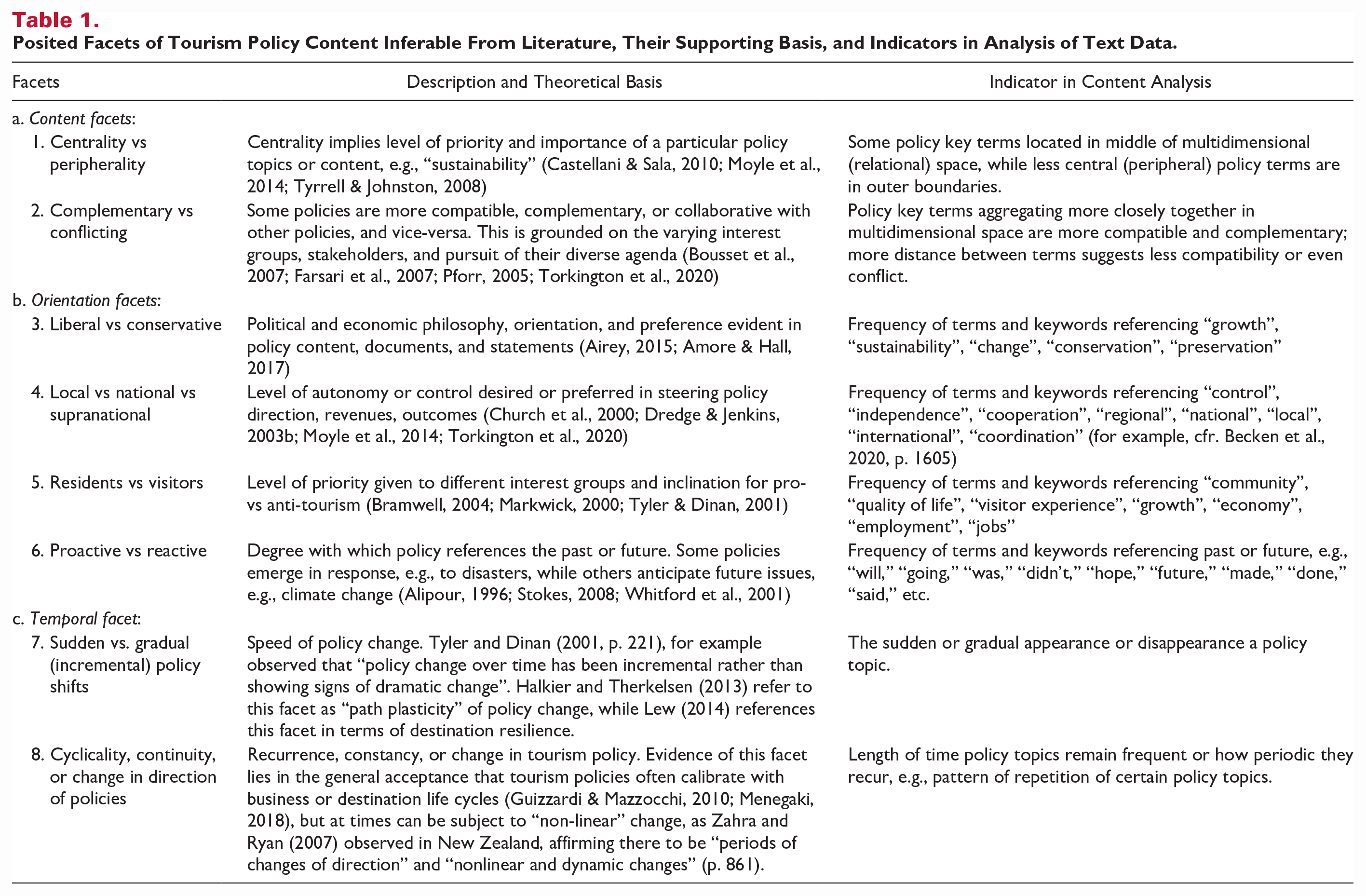
Based on the foregoing review of literature on tourism policy development, and referencing other studies characterizing the adoption, evolution, and transformation of policies and policy-making, various facets for characterizing tourism policy content can be proposed. These are enumerated in Table 1, which also references past studies on which the posited facets are grounded.
Posited Facets of Tourism Policy Content Inferable From Literature, Their Supporting Basis, and Indicators in Analysis of Text Data.
Synthesis
Figure 1 synthesizes the preceding discussions into a framework centered on detecting and understanding change in tourism, public policies, and their structural interrelationship. The framework relies on (a) advancing a method for detecting change in policy focus, emphasis, or priority over time, (b) characterizing observed changes in terms of a priori facets of content and time, drawn from or suggested by past studies, and (c) associating likely explanatory factors that elicit policy shifts and changes over time, theorized by past studies in this field.
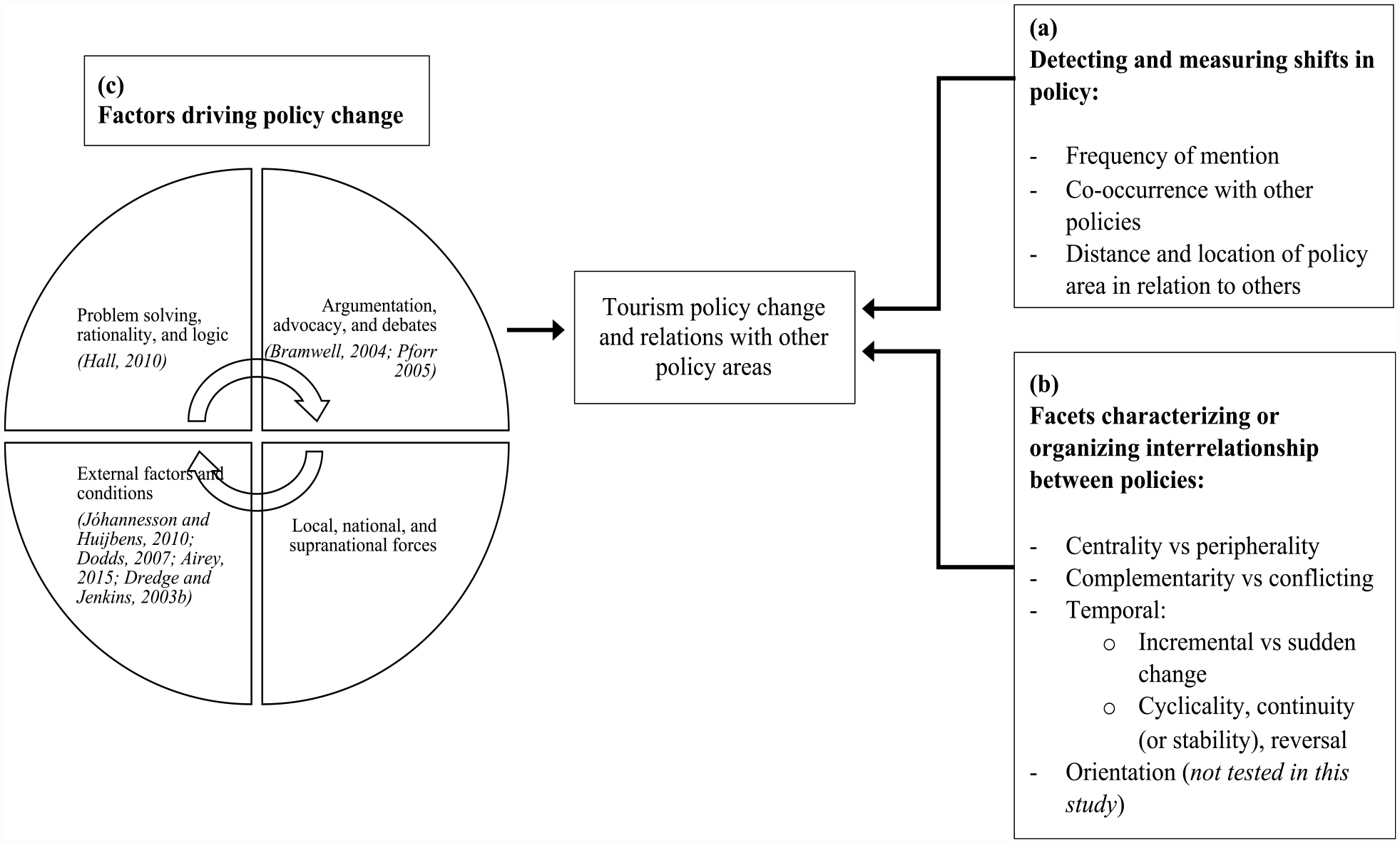
Framework for (A) Detecting, (B) Characterizing, and (C) Hypothesizing Drivers of Change in Tourism and General Policies, and Their Interrelationships.
Method
To understand the dynamics of tourism policy shifts, priorities, conflicts, and compatibilities, this study examines a voluminous corpus of government policies over a multi-decade span issued by Hong Kong and Macao, two special administrative regions of China in which tourism plays a significant economic, social, and political role. The study employs a pooled case comparative design (which allows identification of contextual differences between the two cities) to overcome the limitations of the single-case study that often handicaps policy analyses. The study takes advantage of modern computer-aided text mining methods to quantify the usage and appearance of natural language used and embedded in policy documents, a method that has seen more recent usage in studies of tourism policy (Moyle et al., 2014; Torkington et al., 2020; Yüksel et al., 2012).
In addition to quantifying policy content, which may be information-rich and descriptive but not illuminating, this study also attempts to contextualize observed changes in policy content and compare them across the two cities over a substantial period of observation (20 years of annual policy documents in the case of Macao and 23 for Hong Kong), undertaken using a more qualitative perspective or lens for analysis. The study’s focus is, therefore, on the content and context of tourism policy change, that is, the change in content and priority of tourism policy over time and the broader contexts precipitating such change, rather than the process of policy development.
Data
Data for the study were obtained from publicly available archives of policy address documents, annually published by the Hong Kong and Macao regional governments, and delivered in a public speech by the Special Administrative Regions’ (SARs) respective Chief Executives addressed to the legislative assemblies. The annual policy address is publicly distributed and contains the major policy plans and decisions of both regions.
A total of 23 documents containing the annual policy addresses for Hong Kong and 20 for Macao were sourced and downloaded from official government online archives. Hong Kong’s corpus of documents spanned from 1997 to 2019, except for 2002, when no policy document was made available, and 2017, which had two policy documents issued. Macao’s corpus of policy documents spanned from 2000 to 2019.
Case Context
Both Hong Kong and Macao are governed as SARs of Mainland China, operating under the latter’s “one-country-two systems” principle which accords a wide level of executive, legislative, and administrative autonomy to both regions’ social, economic, and administrative development. Since returning to Mainland China in 1997 and 1999, Hong Kong and Macao regions, respectively, have rapidly developed and prospered economically as cosmopolitan and modern cities, enabled in great measure by their close coordination with the Mainland with which both have become highly integrated in social, commercial, infrastructure, and industrial ways. Both Hong Kong and Macao’s tourism industries get the dominant share of their visitors from the Mainland.
Although both regions maintain similar political and administrative characteristics, their economic structures, in particular the significance of tourism, have stark differences. Hong Kong, the bigger of the two regions in terms of geography and population, received as many as 65 million visitors in 2018 (see Figure 2), majority of which come from Mainland China. Despite the substantial number of visitors it attracts annually, Hong Kong’s tourism constitutes only a minor part of its sizable and diverse economic base (Yeung et al., 2008), which are dominated mainly by trading and logistics, financial, and other services. In sharp contrast, as much as 50% of Macao’s economy is attributable to tourism (World Travel & Tourism Council [WTTC], 2019), which, together with gaming, leisure, and entertainment comprise a great share of its employment, revenues, and service exports.
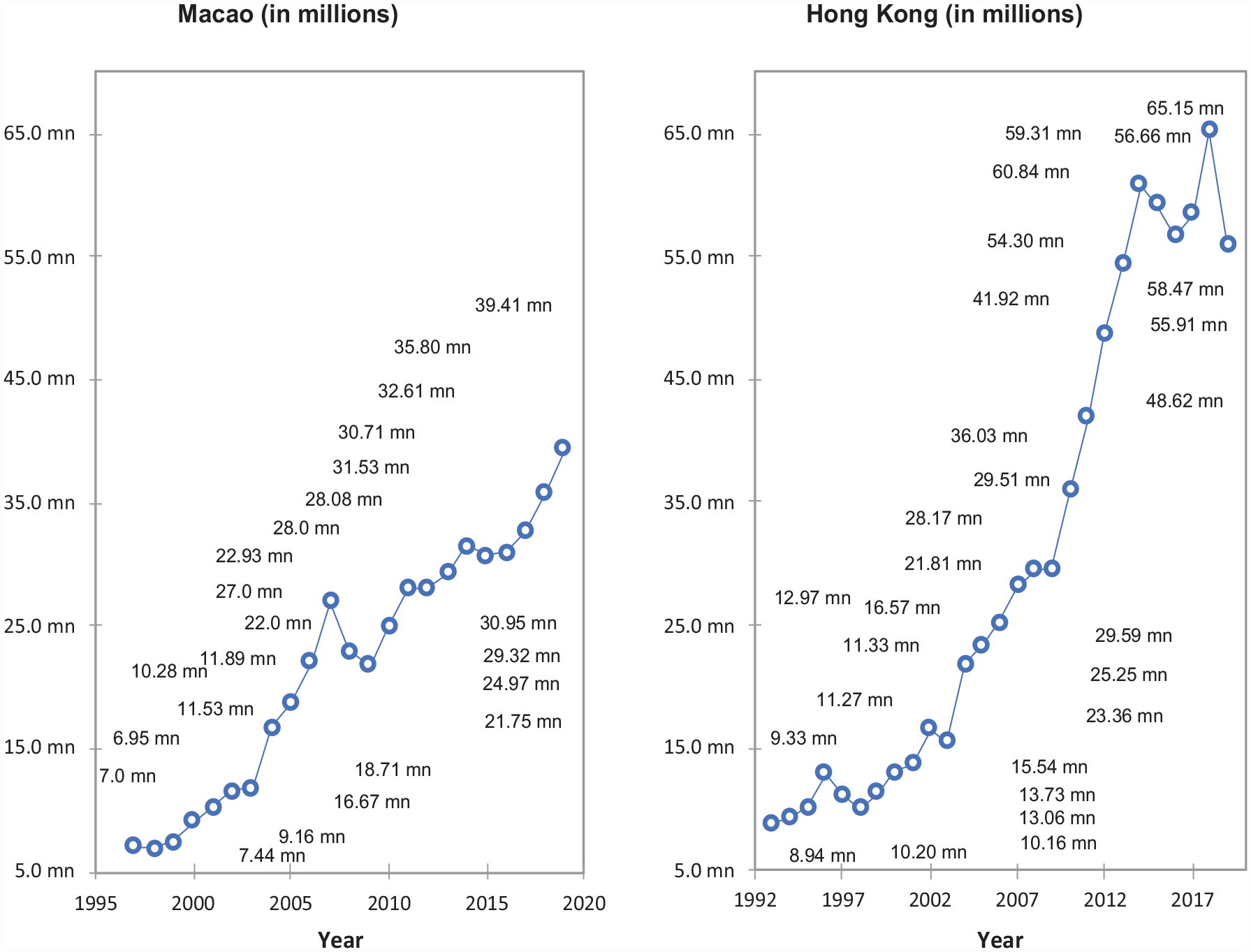
Visitor Arrivals, in Millions, Hong Kong (1993-2019) and Macao (1997-2019).
Ethics Review
Since this study utilizes secondary data and does not involve human subjects, no ethics review was required. Although the author conducting this study is employed by a government-funded higher educational institution in one of the two Regions that is the subject of the research, the author undertook the study freely and independently with no restrictions whatsoever imposed.
Analysis
The principal analytical approach was to identify policy concepts embedded in the textual content of tourism policies annually published in official policy documents by the Hong Kong and Macao SAR governments. Identification of concepts is contingent on calculating the frequency of keywords and phrases and the co-occurrences between the concepts, a measure of their relationship via their distances in text corpora. Frequency of keywords or phrases is the simple count of their occurrences. Co-occurrence, however, measures not only the frequency of keywords or phrases but their concordance (Bourgeois et al., 2015), which suggest context and semantic structure (or even meaning). Keywords and phrases co-occur when they appear in the same sentence, paragraph, or document (i.e., the “window” of analysis). Finally, based on an index of their similarity (or distance), co-occurring terms or phrases are clustered together to suggest broader themes or meaning. To capture change in policy direction or emphasis, the frequency of concepts over time is used as a proxy measure. To measure the degree of centrality-peripherality or complementarity-conflict, the relative location of a policy in the clusters of concepts of multidimensional concept space can be interpreted.
All words and terms were lemmatized following Natural Language Processing (NLP) text preparation procedures and a dictionary of the most common “stop” words was applied to the text corpus to exclude uninformative text. Although content analytic studies utilize individual words as the key input, this study used phrases (of at least two words or terms up to five) as the basic unit of analysis as they provide broader context for interpretation. The two corpora of Hong Kong and Macao policy documents were pooled together for analysis. All procedures were undertaken using Wordstat 9.0 software (https://provalisresearch.com), which implements machine-learning algorithms for automated text mining and content analysis.
By capturing the lexical substance—or content—of keywords and phrases relating to tourism in policy documents, their frequency of mention and relative closeness—or co-occurrence, a structured relational framework may be observed. This approach is akin to steps undertaken by Bramwell and Meyer (2007) in structuring the relationship of actors and agents in tourism policy development and implementation. The difference lies in that the current study uses secondary textual data rather than qualitative actor relations interview data to ground the observations. Observing and mapping concept structure and interrelationships in a domain such as tourism policy, and interpretation thereof using facet analysis (Shye et al., 1994) may yield higher-order insights and fertile ground for theory building.
For this study, the most important aspect of analyzing the entire policy content of Hong Kong and Macao is to relate the role and relationship of tourism (e.g., as an industry, if referred to as “tourism industry” in documents, or as an area of concern or goal, e.g., in terms such as “tourism stakeholders”) in both cities with other areas or topics of policy-making with which it is simultaneously considered and determined. This particular feature confronts the shortcoming of many studies that focus solely on tourism policy per se, a point Airey (2015) acknowledged in undertaking his broad review of the field: . . .the focus is mainly on public policies designed specifically to influence tourism itself rather than on policies designed for other sectors and activities which in turn influence tourism, although it is recognised that it is not always possible to separate the two. (p. 247)
To capture the posited facets of policy content such as the degree of centrality-peripherality or complementarity-conflicting relative to others, the relative location and structured organization of frequent terms and phrases in multidimensional “concept” space can be interpreted, based on the comparative distances and organization of terms and keywords with each other. Complementary policy themes and keywords, for example, can be expected to be in concept space close to each other (or vice-versa), being indicative of their compatibility (or conflict), while more central policies can be expected to be situated in the middle of the concept space (and vice-versa for peripheral policies) to indicate their centrality-peripherality. Because this relative structuring of policy content is quantitatively undertaken and computer-aided, chances of coding error is reduced, as Moyle et al. (2014) advocated (p. 1042) when undertaking manual qualitative coding.
To identify contextual factors correlating with or possibly accounting for observed temporal changes in policy content, the study implements case or event history analysis, similar to the steps employed by Dredge and Jenkins (2003b) when analyzing federal-state relations in tourism policy development, whereby a variety of secondary information sources (public news, statistical sources, documents and reports, public pronouncements, etc.) are used to correlate relevant events with temporal changes in policy content.
Results
The 43 documents included in the corpus containing the policy addresses for Hong Kong (23) and Macao (20) comprised a total of 476,851 words, averaging 11,090 words per document. After lemmatization and exclusion of irrelevant “stop” words, the remaining corpus inputted for subsequent analysis comprised 52.5% of the total.
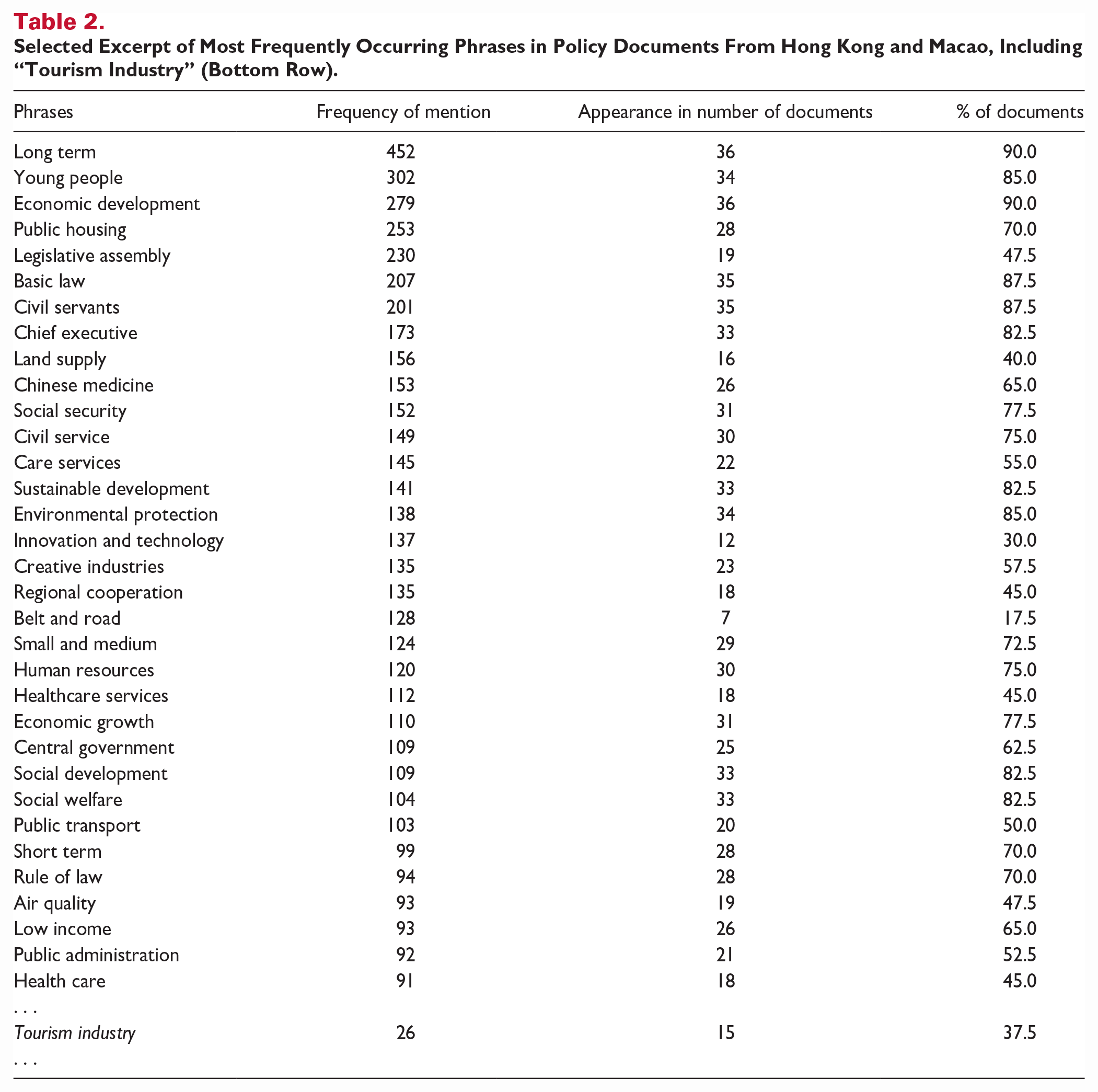
Table 2 lists a select few of the most frequently mentioned phrases in the corpus of policy documents for both Hong Kong and Macao. The term “tourism industry” appears only 26 times across 15 out of 43, or 37.5% of all documents (policy-year). In contrast, “economic development” appears in 90% of all documents, “social security” in 77.5%, “sustainable development” and “social welfare” in 82.5%, “environmental protection” in 85%, and “health care” in 45% of all documents. In terms of frequency of mention, therefore, tourism does not seem to figure strategically nor significantly in overall policy-making. This is somewhat paradoxical given the huge impact rapid and massive tourism growth has had on both regional governments, particularly via cross-border visitation (Zhang et al., 2018) of Chinese outbound visitors, which comprise the dominant majority of all visitors to both territories.
Selected Excerpt of Most Frequently Occurring Phrases in Policy Documents From Hong Kong and Macao, Including “Tourism Industry” (Bottom Row).
This anomaly might not be so incongruous, given that governments generally adopt policies toward desirable societal end-goals represented by terms such as “economic development,” “sustainable development,” and “social security”—and therefore infuse policy documents liberally with such language. However, “tourism” might be considered more as an area of economic activity supporting such societal end-goals, that is, a means toward achieving the ends, as Hammer and Berman (1995) observed long ago in the domain of health care policy. Between Hong Kong and Macao, data suggests that Macao has invoked the term “tourism industry” in its policies over the years more often than Hong Kong has, as depicted in Figure 3. This difference in mention is statistically significant, Chi-square = 6.223, p = .013. Macao policy documents mention tourism regularly or periodically whereas Hong Kong includes it only from 2011 and only figures prominently in a few years during the decade.
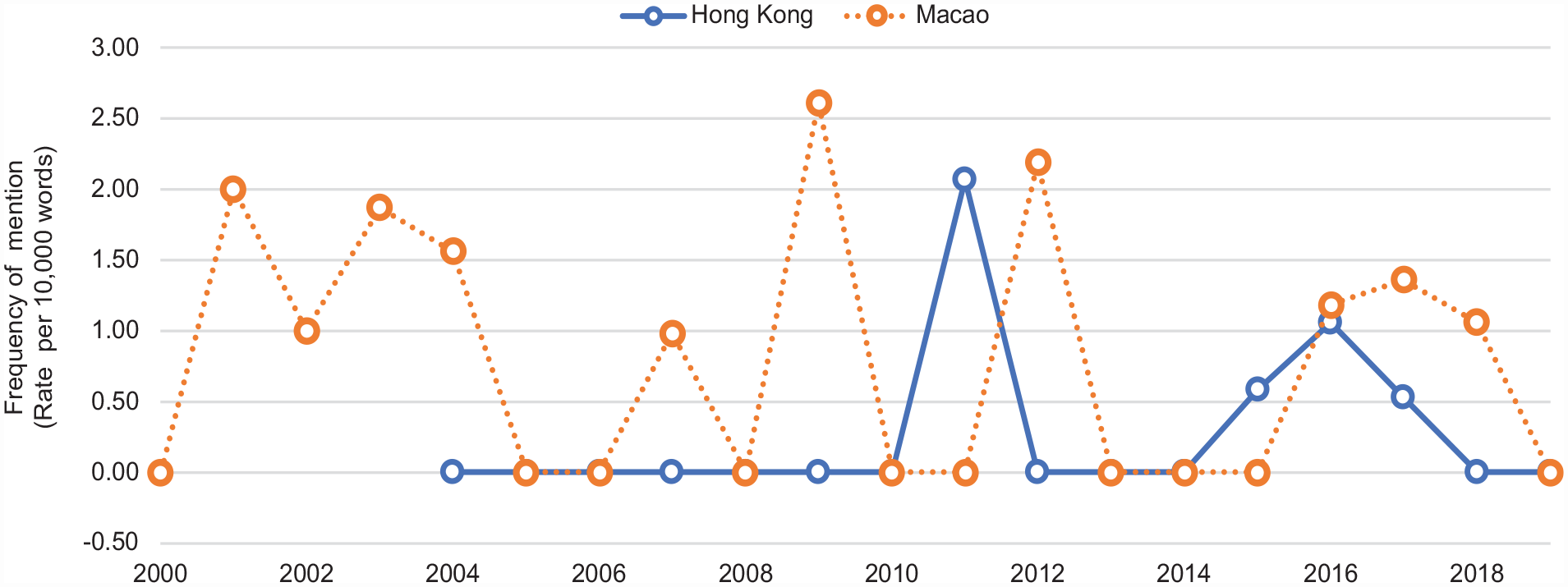
Comparison of Frequency of Mention of the Phrase “Tourism Industry” in Government Policies Between Hong Kong and Macao, 2000 to 2019.
Co-occurrence of Policy Phrases
Although the nominal frequency of a word, phrase, or topic may indicate the representativeness of a corpus of documents or facilitate their summarization (Firoozeh et al., 2020), it does not necessarily indicate importance or relevance. A frequently occurring phrase across many documents, for example, suggests commonality of the phrase and not necessarily informativeness. For this reason, other measures of term co-occurrence (such as term frequency-inverse document frequency, or tf-idf) are more often useful in evaluating keywords and terms and instructive in evaluating and extracting higher-order themes or topics, and their relevance, in analyzing large corpora of text (Ramos, 2003; Wu et al., 2008).
Figure 4 shows the 12 most evident clusters of co-occurring phrases, arising from analysis of the text corpus, mapped in multidimensional concept space, with each cluster comprising of dots, each dot representing a phrase extracted from the corpus of policy documents. A list of the policy phrases comprising each cluster is listed in Table 3, with suggested nominal theme labels included for each cluster. Cluster 1, for example, comprising of phrases such as “neighboring regions,” “border crossing,” “cross-border,” and “regional cooperation” conveys a broader theme of regionalism and internationalization emanating from the corpus of policy documents. For this reason, the label “regional and international external integration” has been proposed for this cluster of policy phrases. An extract of the full similarity matrix on which the visual mapping is based is reported in Appendix.
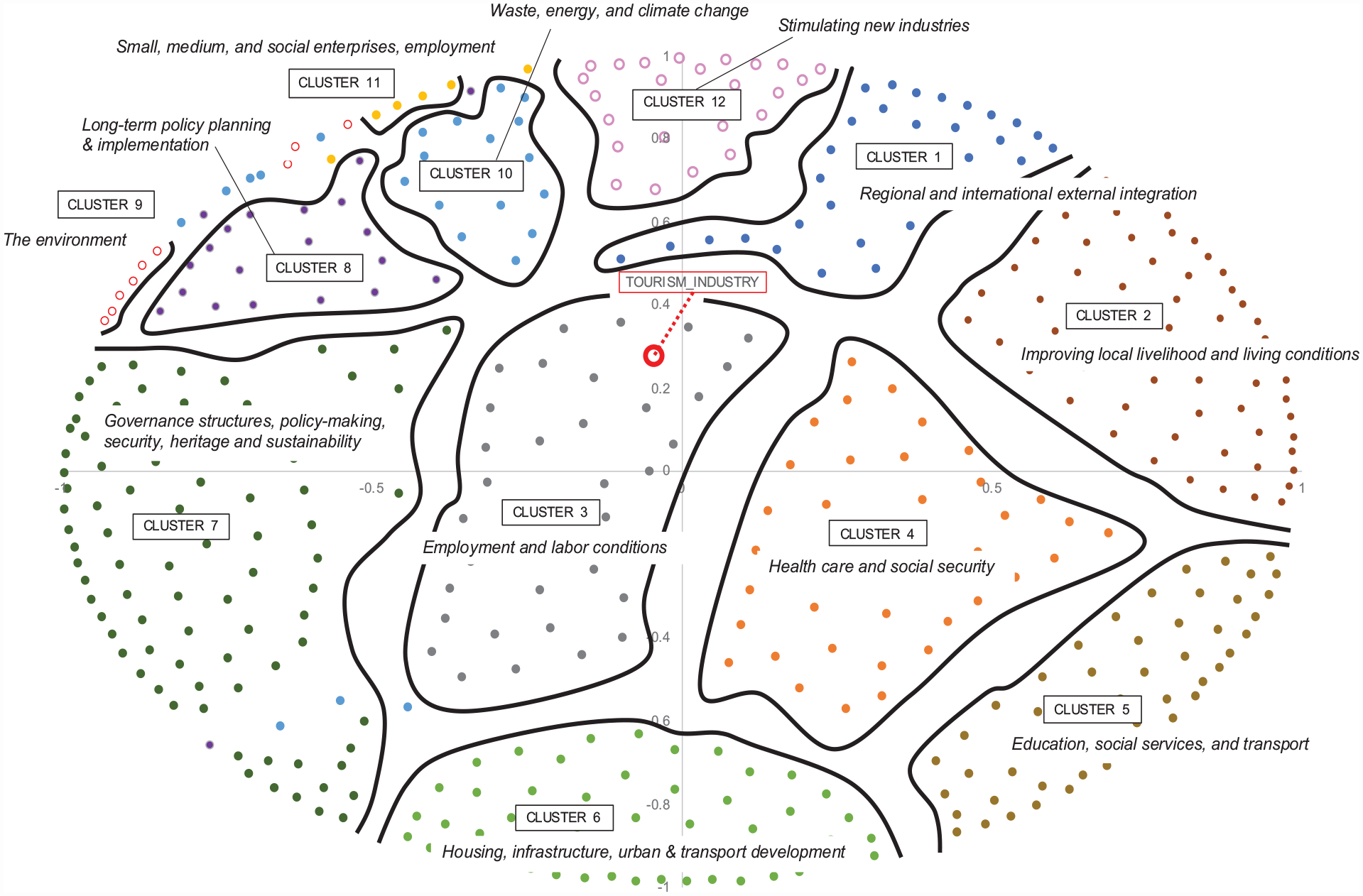
Map and Organization of Clusters of Most Frequent and Co-occurring Phrases Drawn From Hong Kong and Macao Governments’ Policy Addresses 1997 to 2019, Projected in Multidimensional Concept Space.
Selected Policy Phrases Comprising the Different Clusters in the Concept Map Depicted in Figure 4 Above, With Suggested Labels.
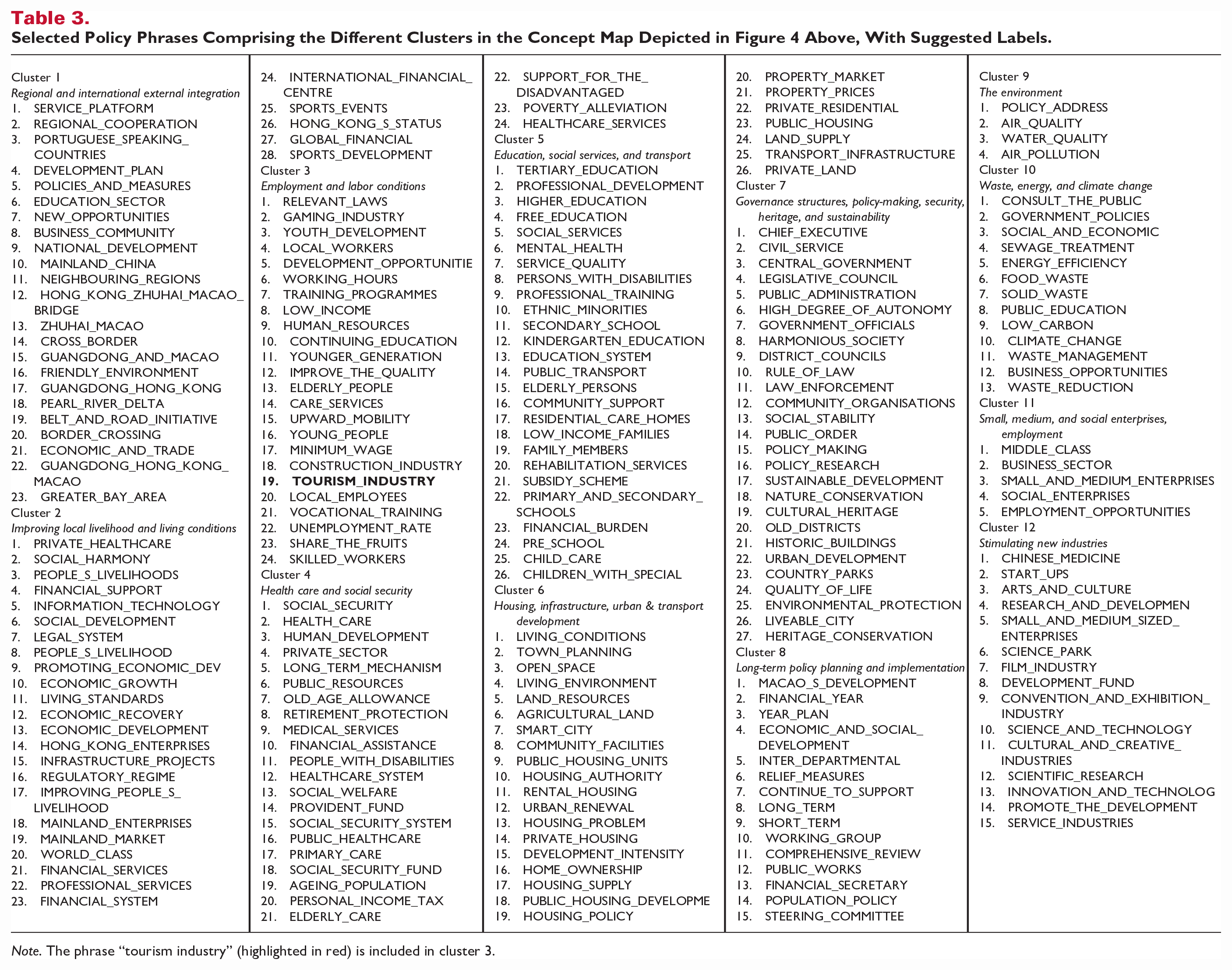
Note. The phrase “tourism industry” (highlighted in red) is included in cluster 3.
The map of policy clusters in Figure 4 reveals not only the size and composition of each cluster but also their relative distance from other clusters and the overall organization of the concept domain. Interestingly, the phrase “tourism industry” forms part of Cluster 3 topic or theme, a cluster of policy phrases with a suggested nominal label of “employment and labor conditions.” Other phrases comprising this cluster includes “youth development,” “low income,” “human resources,” “young people,” “upward mobility,” and “working hours.”
Centrality versus Peripherality
Even more intriguing is that Cluster 3, which incorporates the policy phrase “tourism industry,” is located relatively in the center of the overall map of Figure 4, alongside Cluster 4, with a suggested label of “health care and social security” as it is comprised of policy-related phrases such as “social welfare” and “public health care” as well as “social security” and “aging population.” Relative to other policy clusters, therefore, both Clusters 3 and 4 tend to exhibit a high degree of centrality—which suggests these policy areas to be highly “central” or connected and related to all other topics. (It matters not whether the projected map is rotated toward different vectors in multidimensional space, the centrality and relative location of Clusters 3 and 4 will be maintained, as each item (phrase) and its grouping [or proximal distance with others forming a cluster] is determined by the inter-item correlation measuring their co-occurrence and partially shown in Appendix).
It is puzzling therefore that “tourism industry,” despite not figuring prominently in terms of frequency of mention in policy-making across 43 years of documents issued by the Hong Kong and Macao regional governments, exhibits a high degree of centrality as a policy topic, being embedded in a cluster emphasizing employment, manpower, labor, and human development (Cluster 3) located in the center of the concept space (or map). Its adjacent location with the policy area represented by Cluster 4 (“health care and social security”) implies both Clusters 3 and 4 could thus be characterized as policies central to policy-making in Hong Kong and Macao. The same implication can be argued to be the case for “tourism industry” as well, being subsumed under or integrated into Cluster 3.
All other policy areas represented by clusters surrounding Clusters 3 and 4 are located at the periphery of the concept space and therefore could be characterized as peripheral policies. This interpretation is depicted in Figure 5, highlighting the centrality of Clusters 3 and 4 relative to other “peripheral” policy clusters.
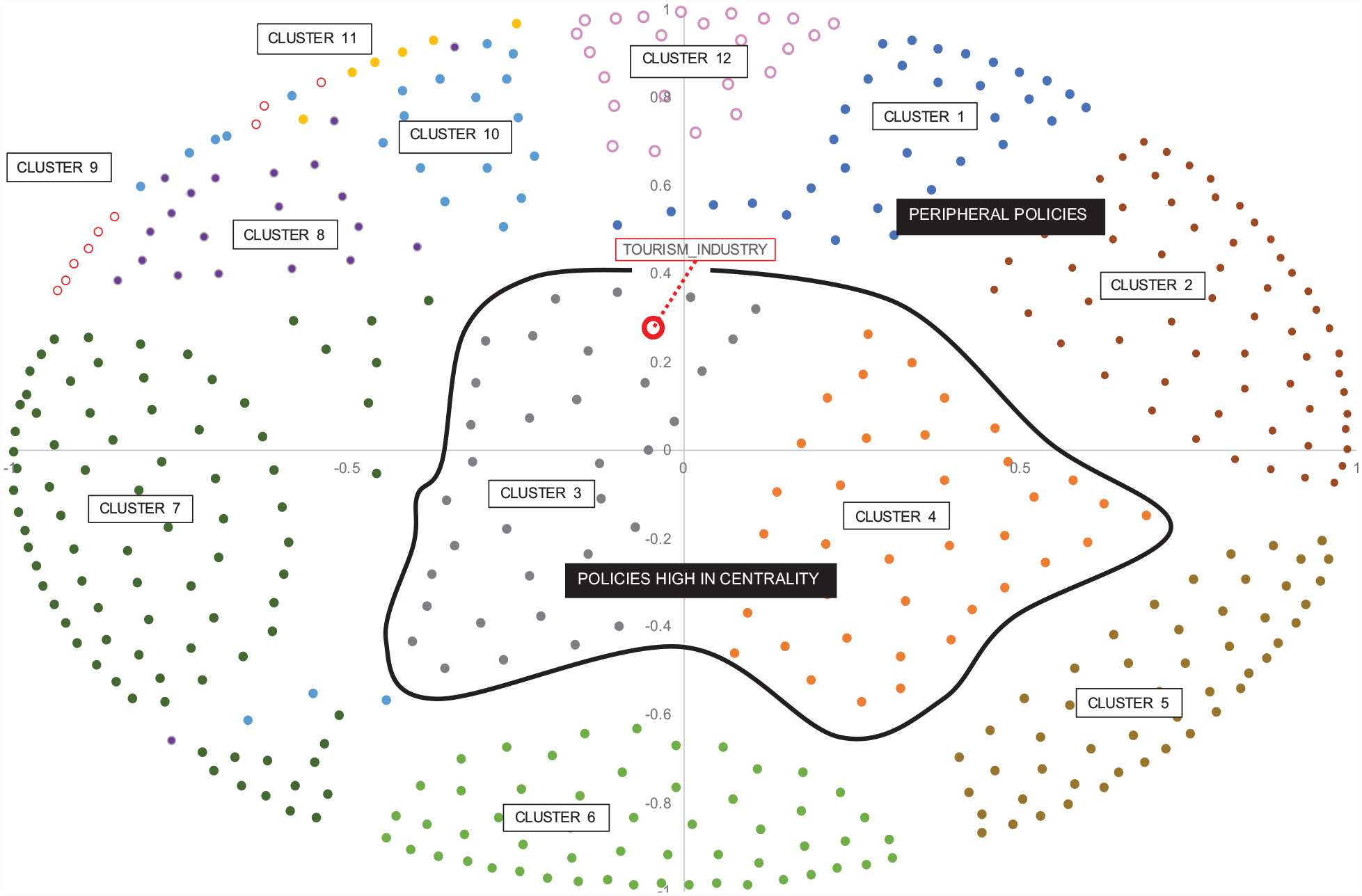
Highlighted Location of Policy Clusters 3 (“Employment and Labor Conditions”) and 4 (“Health care and Social Security”) Exhibiting High Centrality Relative to Other “Peripheral” Policy Clusters.
Complementary Versus Conflicting Policy Areas
The resulting empirical projection of the different clusters in concept space can also be interpreted to substantiate another posited facet of policy-making, that is, the degree of complementarity or conflict between policy areas. This may be indicated by the adjacency or remoteness of one policy cluster relative to another. Two highlighted pairs of policy clusters in Figure 6 demonstrate this facet. Cluster 1, for example, labeled “Regional and international external integration” and composed of policy phrases relating to cross-border collaboration and cooperation is located remotely from, on an opposite vector to, Cluster 6, a policy cluster labeled “Housing, infrastructure, urban & transport development” and comprising of policy phrases such as “living conditions,” “land resources,” “open space,” “housing problem,” “home ownership,” “transport infrastructure,” and “property prices.” The distant and opposite location of both clusters relative to each other in concept space suggests that they are policies that are conflicting and divergent, that pursuing one would be incompatible with the other.
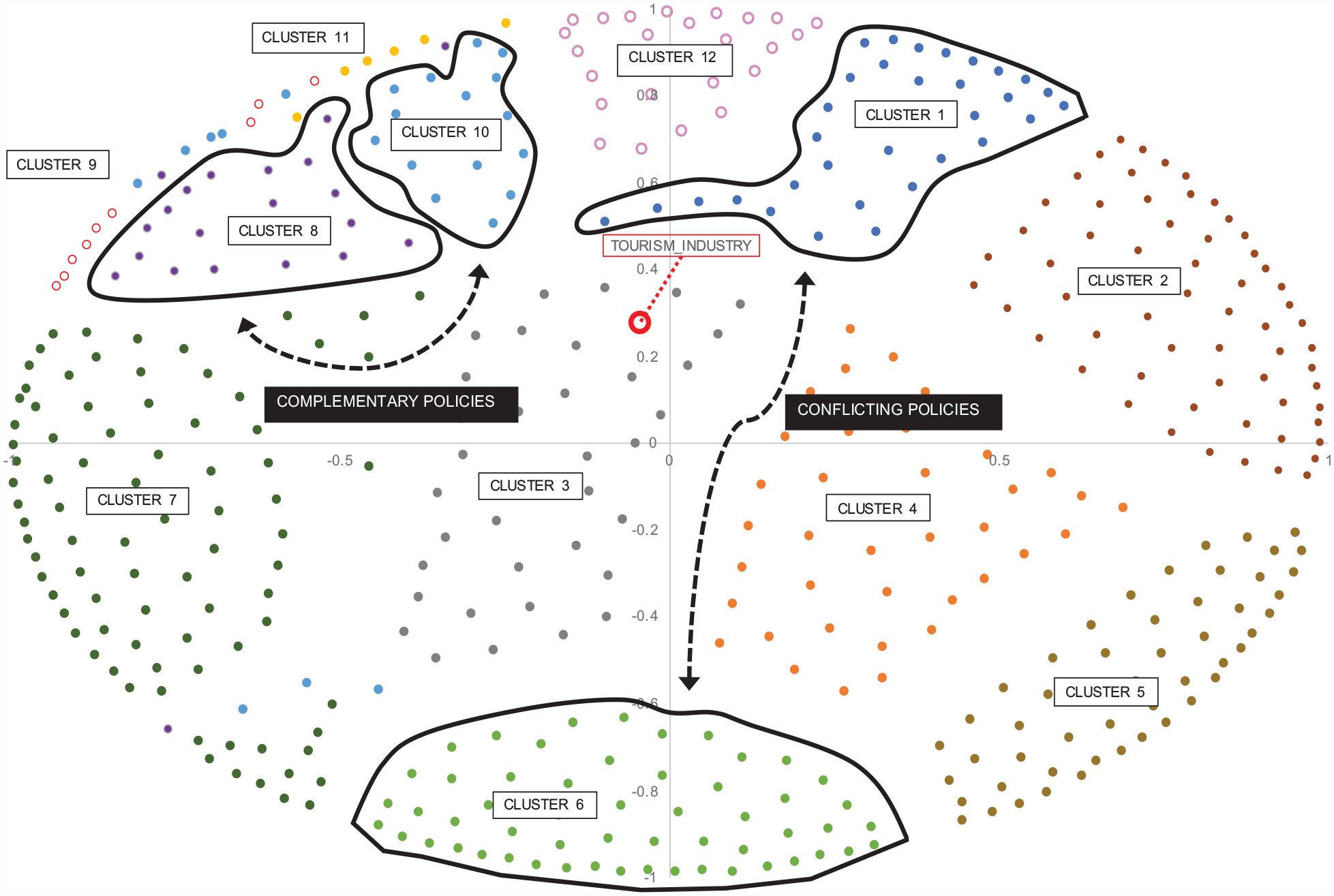
Highlighted Location of Policy Clusters 1 (“Regional and International External Integration”) and 6 (“Housing, Infrastructure, Urban & Transport Development”) Exhibiting Distance and Location on Opposite Vectors Suggest Them to Be Conflicting.
In contrast, Cluster 8 “Long-term policy planning and implementation” is located close to and adjacent on the same vector in concept space as Cluster 10 “Waste, energy, and climate change,” which implies both policy areas to be more compatible, complementary, and consistent with each other.
Examining specifically the compatibility or incompatibility of tourism policy in relation to other policy areas, because the specific policy content “tourism industry” is embedded in Cluster 3 “Employment and labor conditions,” which is in turn is situated somewhere in the center of all policy clusters, this suggests that tourism policies appear to be neither too conflicting nor compatible with other policy areas, a feature owed to the “centrality” of its location in the overall concept space.
Temporal Stability and Change of Policies
The findings thus far suggest that—across a long multi-decade period of observation—there appears to be a stable and relatively constant structural relation and organization among different policy areas of government and that tourism-related policies are somehow not only integral to overall public policy but also rather central, complementary, and highly interconnected to different policy areas and topics.
The stability and constancy of policies, however, do not mean stagnancy or permanence. Within the stable interrelationship between different policy and their overall organization, however, it is reasonable to expect some degree of dynamism and change, especially over time. As highlighted in previous literature, tourism (and other) policies are dialectic in nature and subject to forces and factors that drive them to change or evolve over time during “transitional” periods (Bramwell & Meyer, 2007). Hence, capturing temporal facets such as sudden versus incremental change in policy emphasis or continuity versus cyclicality or directional change are important in understanding influential or causal factors affecting policy development.
This study finds such temporal facets to be detectable in and characteristic of many specific policy areas. Figure 7, for example, tracks several instances of policy phrases whose emphasis or prominence changed over time, based on their frequency of mention in the corpus of policy documents for Hong Kong and Macao. An example of continuity is on the policy phrase “urban development” (Figure 7A), which exhibited sustained emphasis from 2010 onwards, prior to which it didn’t figure very prominently in policy documents. An example of a “short burst” of policy adoption, followed by reversal or abandonment could be observed regarding the phrase “economic and trade” (Figure 7C), which became initially stressed beginning 2007, peaked in prominence in 2009, and declined in standing thereafter.
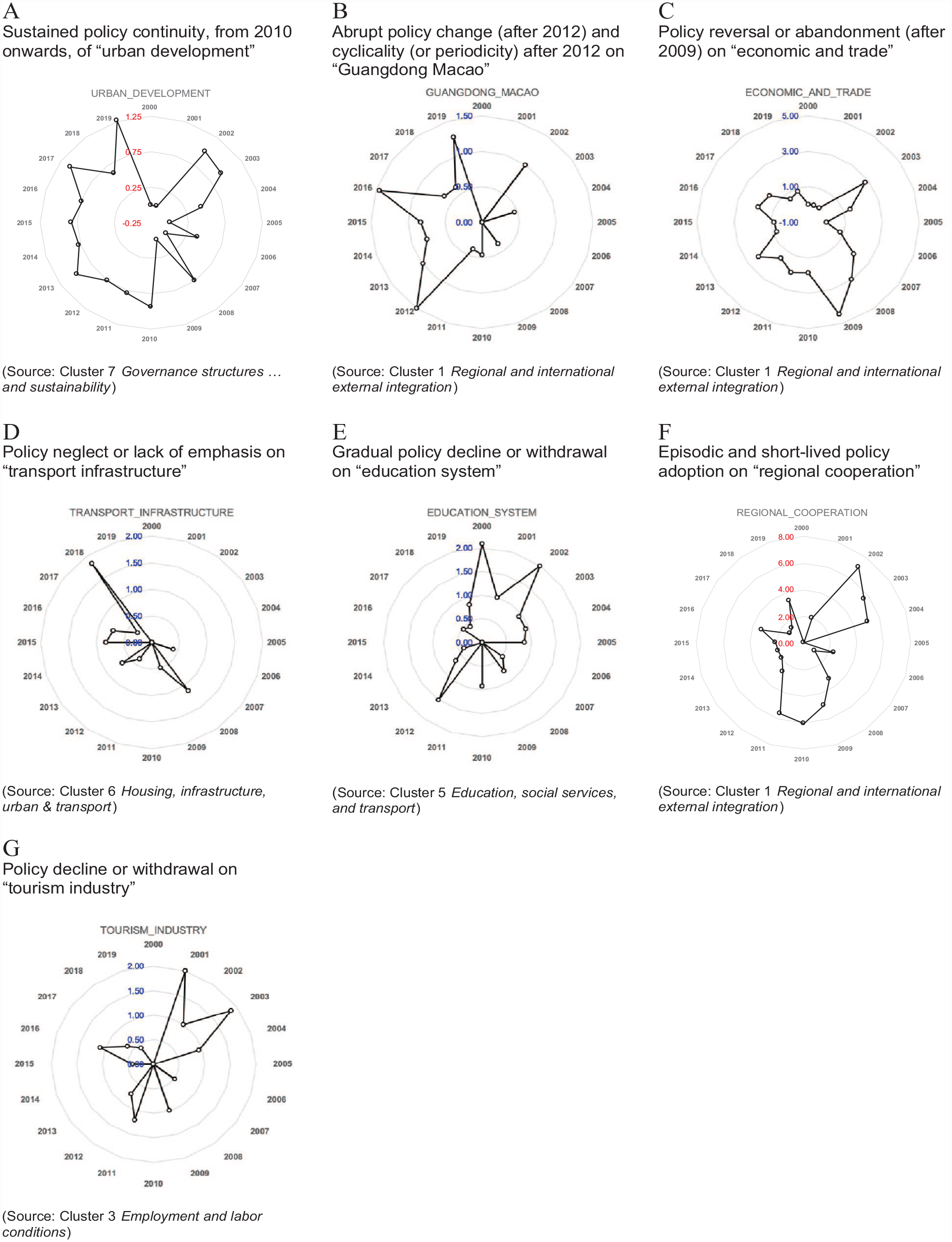
Temporal Changes in Certain Policy Phrases, 2000 to 2019, Hong Kong and Macao Measure Is Based on Frequency of Mention (Rate per 10,000 Words).
Other areas, like “transport infrastructure,” which figure regularly as a policy theme in public policy-making, were relatively hardly underscored in the case of Hong Kong and Macao throughout many years (Figure 7D). Finally, the relative standing of “tourism industry” as a policy area for Hong Kong and Macao became only accentuated in the early few years of 2000s, after which it became less prominent relative to other policy areas.
These selected examples and the foregoing discussion appear to substantiate the posited temporal facet of public policies—that the relative emphasis of different policy areas exhibit regularity in change such as continuity, stability, or reversal. They may also exhibit abrupt and sudden, though sometimes also incremental change. These findings tend to corroborate the “cyclicality” of tourism policies and policy-making (Pforr, 2005) such as the cyclicality (or periodicity) of the policy phrase “Guangdong Macao” evident in Figure 7B. But, in addition, the findings suggest other temporal patterns of policy shifts and change. In Figure 7F, for example, the prominence of “regional cooperation” as a policy area arguably exhibits an “episodic” temporal feature.
Drivers of Policy Continuity and Change
The select findings above lend credence to the detectability of temporal features of policies over time. This procedure can now be extended and generalized to a larger corpus of policy phrases, previously mined from the large database of multi-decade policies from Hong Kong and Macao. This enables the study to observe not just the pattern of clusters of the most frequently appearing policy phrases, earlier mapped in Figure 4, which only comprises a summary snapshot of policy content across 23 years of data. A macro-temporal angle, however, encompassing multiple years of policy content for both Hong Kong and Macao governments can expedite the identification and exploration of factors that drove policy stability or shifts. When explored alongside the framework of content facets such as centrality-peripherality, complementarity-conflicting policies, as well as temporal facets like that of incremental-sudden appearances or the cyclicality-constancy of policies, relevant factors, conditions, and context propelling such changes can be hypothesized, theorized, and measured. This may overcome deficiencies inherent in many policy studies whose conclusions are limited by a rather narrow temporal view such as that undertaken by Jin (2011) who found tourism to generate favorable short-term economic outcomes for Hong Kong but not for the long-term.
Figure 8 shows this macro-temporal perspective, which charts a more extensive list of policy phrases listed on the rows (spread across four pages) and sorted into clusters based on their co-occurrences. Each column depicts a year between 2000 and 2019, with each shaded cell representing the frequency with which each policy phrase is mentioned per year, relative to other policies; the more frequently mentioned a phrase, the brighter the cell color.
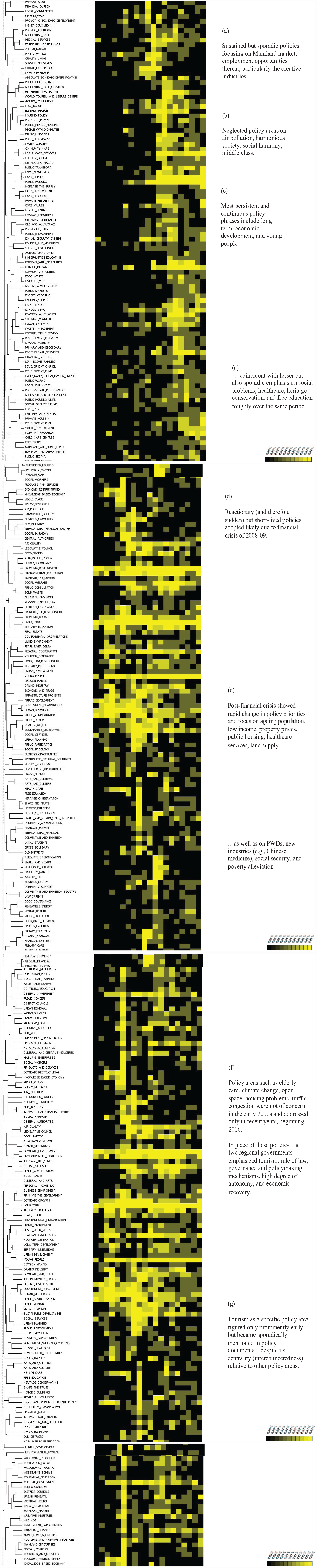
Heat Map Showing Frequency of Various Policy Topics for Hong Kong and Macau, 2000 to 2019, With Annotations.
Interpreting the pattern of data and hypothesizing the factors, conditions, and context, that generate the variations of frequency patterns involves qualitatively applying the framework earlier proposed in Figure 8. This means relying on factors previously identified by past studies (Airey, 2015; Bramwell, 2004; Dodds, 2007; Hall, 2010; Pforr, 2005) but also incorporating the faceted interrelationships between different policy areas emergent in this study, such as cyclicality (vs stability), centrality (vs peripherality), complementarity (vs conflicting), and incremental (vs abrupt) facets.
Visual inspection of Figure 8 suggests several potential drivers of policy shifts. Temporal cyclicality of policies is evident in chart region (a) whereby policies related to developing new industries, employment, and integration with the Mainland China market were intermittently mentioned with policy areas such as health care, education, and conservation, and social issues, from 2009 onwards. This cyclicality is likely driven by the divergent and competing nature of these policy areas, requiring a series of negotiation and evaluation that propel such cycle (Pforr, 2005), as well as by the tendency for these policies to be adopted and implemented in “overlapping or parallel” (p. 333) sequences rather than in well-defined discrete phases. It might also be reasonable to associate the cyclical pattern of emphasis for these policy areas as the result of a vigorous process of debate and advocacy, “the argumentative turn” and “advocacy coalition” that Hall (2010) posited.
Some lexical evidence from the corpus of policy documents appear to substantiate this. For example, in Macao’s case:
(Macao 2011 Chief Executive Policy Address, par. 126)
Similar text appears for Hong Kong: In striving to enhance our policy making capabilities, we are determined to involve different sectors of the community in the policy making process. We will take steps to better gauge the general mood of the people and strengthen our advisory and statutory bodies. (Hong Kong 2004 Chief Executive Policy Address, par. 218)
In contrast with the above policy areas periodically alternating in emphasis, certain policies during the same period seem to have been neglected, as evidenced by their general absence or lack of emphasis in chart region (b), which appears demonstrably as a void. In stands to reason that these areas were not stimulated adequately by representative sectors and stakeholders to attract the focal attention of policy-makers.
Data appear to support Hall’s (2010) contention that much of policy-making is characterized by problem-solving, rationality, and logic but also by external and uncontrollable forces (Airey, 2015; Dredge & Jenkins, 2003b). This is evident in a cluster of short-lived but intensely mentioned policy areas coinciding during or just after the global financial crisis of 2008 to 2009. See chart region (d). These policies mention “wealth gap,” “good governance,” “financial burden,” “financial system,” and “promoting economic development.” The fleeting and short-term policies depicted by the data in this chart region (d) suggest the sometimes-reactive nature of policy decision-making and adoption that sometimes can be precipitated hurriedly and unexpectedly by sudden changes in environmental conditions, something that past studies on tourism and general policy-making have yet to acknowledge.
Policies adopted to address immediate changes in conditions, while needed, imparts a cost on other policy areas requiring attention and resources. This appears to be the case in a slew of policy clusters that became more eminent about 3 years after the financial crisis. See chart region (e). These policies include areas related to “aging population,” “low income,” “property prices,” “public housing,” “health care services,” “land supply,” “social security,” “persons with disabilities,” and “poverty alleviation.” These are, arguably, issues that are central to public administration and governance, but presumably had to be sidelined in favor of policies hastily adopted to address the financial crisis. It, thus, appears that rapid changes in environmental factors and external forces precipitate considerable shifts in policy-making and evolution.
Chart region (f) highlights contrasting emphasis on policy areas that, in the early years (i.e., 2000-2006) of the two-decade analysis window, hardly figured. Policy topics such as “elderly care,” “climate change,” “open space,” “housing problems,” and “traffic congestion” were not of concern during this period and were addressed only in recent years, beginning 2016. Interestingly, this cluster of policies principally references increased integration with Mainland China, aligning with Central Government directives, and with national policies such as the “Belt and Road” initiative. It also includes policy areas promoting greater coordination with neighboring “Guangdong Province” and the “Greater Bay Area”—policies advanced by the National Government. Because these policies were conceived and became more pronounced only from 2016, they tend to confirm not only the considerable influence of local, national, and supranational forces that previous studies have found to be crucial (Church et al., 2000; Dredge & Jenkins, 2003b) but also the abrupt manner in which they can steer policies emphatically toward new directions and alter priorities: Macao should fully leverage its advantages during the national strategic process of developing the Guangdong-Hong Kong-Macao Greater Bay Area, in terms of system, location and cultural-historical heritage. We shall focus at [sic] our national positioning, and leverage our advantages to actively, effectively and flexibly participate in the overall development of the Greater Bay Area. (Macao 2018 Chief Executive Policy Address, par. 715)
And in Hong Kong’s case:
“…the Chief Executives of Hong Kong and Macao Special Administrative Regions (SARs) have attended a meeting at central leadership level as members, highlighting the importance the Central Government attaches to the role of the two SARs in the Greater Bay Area and its continued support for their integration into the overall national development.” (Hong Kong 2018 Chief Executive Policy Address, par. 216)
Policy-making for tourism is never undertaken in a vacuum and evolves in concert with public policies and broader societal issues (Hall & Jenkins, 2004). It is ironic therefore that the study’s findings show tourism policy (as indicated by the phrase “tourism industry”) became less eminent as a policy area for Hong Kong and Macao after a short period between 2001 and 2003 during which it figured prominently in policy documents. The decline of tourism’s significance as a policy item is peculiar given its highly interrelated and central locus relative to other policies for Hong Kong and Macao, as evidently emerged in the theoretically derived concept space shown in Figures 4 and 5. The lessened emphasis on tourism is also intriguing because it corresponds with the period during which visitor arrivals began to grow spectacularly for both regions.
The fleeting period (2001-2003) during which tourism did figure notably in policy documents might be attributable to two factors previously identified by literature—the recent return of Hong Kong (1997) and Macao (1999) to Mainland China, which finally opened the door for more Mainland Chinese to visit both former colonies as tourists, something that was erstwhile not largely possible. But the appearance of SARS in 2003—and its severe impact on the tourism-dependent economies of both regions—may have necessitated both regions to address and shift their attention toward tourism, especially in response to the Central Government of China instituting the free independent traveler (FIT) mechanism (Lim et al., 2020) to aid the economic recovery of Hong Kong and Macao. Once again, therefore, consistent with theorized factors that cause dynamic changes in tourism (as well as general) policies, external and unpredictable forces such as SARS and cross-border integration with (as against autonomy from) regional, national, and supranational institutions, namely with neighboring Guangdong Province and Mainland China, cast a radiant, albeit momentary, spotlight on tourism policy for both regions.
These observations converge on the possibility that tourism, as a focus of policy, receded almost imperceptibly over time toward the background of policy-making and decision-making for both Hong Kong and Macao, and drew lesser attention from policy-makers, despite oral and written pronouncements of its importance in policy documents. Ostensibly, this might seem reasonable, but is it defensible? After all, on one hand, tourism began to boom at a sustained pace after SARS and no longer became a topic of concern with the implementation of the FIT policy, alongside the vital support extended by the Central Government of China which sought to ensure the economies of both SARs did not suffer so soon after their return to the Motherland. Arguably, policy-makers in both territories shifted their attention to other policy areas once they felt assured of the industry’s continued success given the closer cross-border integration with Mainland China. This was evident in at least two references in Macao, to wit: . . . the Government will devote more effort to tourism research and to harnessing the power of the tourism and gaming industries to drive the wholesome development of other related industries. (Macao 2003 Chief Executive Policy Address, par. 131)
and It should be recognised that a good number of entrepreneurs are exploring and seizing opportunities in the booming tourism industry. We will encourage and support enterprises and business associations to blaze new trails, so as to allow themselves to develop in parallel with flagship industries and share the fruits of Macao’s growth. (Macao 2007 Chief Executive Policy Address, par. 251)
But, on the other hand, this decision (if indeed a deliberate one) or omission also alludes to a kind of dereliction in terms of policy-making duty, planning, and foresight on the part of policy-makers, which would be remarkable, considering how tourism affects all other areas of policies of both regions, with its high level of interconnectedness. In their defense, policy-makers for Hong Kong and Macao may then have concluded that tourism was a policy area for which they admittedly have diminished bearing once the Central Government instituted policies (such as the FIT) at the national level. Though this assertion is neither explicit nor evident in any part of the huge corpus of text data, such a possibility is belied by the pattern of frequency of mention across time and relative to all other policy areas exhibited in Figure 8.
Consistent with Hall’s (2010) contention that policy-making involves problem-solving, logic, and rationality, once tourism became an area of lesser priority for both Hong Kong and Macao, it seemed attention was focused elsewhere toward peripheral (or new) policy initiatives. But the key lesson here appears to be that diminishing the lexical prominence of a policy area with high degree of centrality, such as tourism, does not make its influence on other public policies wane. Although direct evidence is tenuous, some of the key policy issues that became more pronounced from 2016 onwards (see Figure 8 chart region (f)), such as housing, health care, traffic congestion, and open spaces, may have arisen because attention was diverted early on from tourism policy-making.
Discussion
Altogether, the foregoing findings impart an appreciable degree of affirmation to the RQ1 to RQ3 posed earlier. First, there appears to be an observable consistency in the content and structure of policy topics and areas over time, in the sense that some policies are more central (vs peripheral) compared to others and that some policies are more compatible with each other (vs conflicting). Within this structure and content, tourism-related policies were found to be a highly central and interconnected topic in relation to broader social areas of concern.
Second, characterizing policies in terms of facets (such as centrality-peripherality and complementarity-conflicting) has enabled the study to identify topical clusters of policies extracted from a large textual corpus of policies spanning across a multi-decade period of observation for two autonomous but similar regional territories of Hong Kong and Macao. Based on this, the study was able to identify and characterize policy contents, including tourism-related ones, as exhibiting temporal stability and constancy over time in contrast to others that are short-lived and temporary. Analysis also enabled characterizing the temporal evolution of policy clusters, with some appearing (or diminishing) abruptly or gradually.
Third, having characterized the facets of policy content, the study was able to connect situational conditions, context, and factors—suggested by prior theories and general knowledge of regional as well as international events—that appeared to correlate temporally with changes in policy content, thereby confirming prior theories but also hypothesized the possibility of new ones, specifically in relation to how tourism-policies developed within the general pattern of changes occurring in all policy areas of Hong Kong and Macao.
Heretofore, literature on tourism policy have generally centered on the process of policy-making and influences thereto, such as that of stakeholders (Airey, 2015) and other sectoral representation. In-depth analysis of case studies (e.g., Dodds, 2007) has been the primary method of research delving into tourism policy development. More recent studies, taking advantage of modern data mining techniques, analyze policy documents and focus on content rather than processes. They employ newer methods such as discourse (Torkington et al., 2020) and content analysis similar to that utilized in this study. However, the scope and aims of these studies have narrowly focused on policy themes such as sustainability or climate change (Becken et al., 2020; Moyle et al., 2014; Torkington et al., 2020; Yüksel et al., 2012). But considering specific policy areas in a vacuum fails to account for the intricate connections between different—even seemingly unrelated—policies thereby limiting the origination of universal principles governing policy evolution.
Because the findings of this study situate tourism policy as but one in a constellation of public policy areas that policy-makers and interest groups wrestle to advance, advocate, or compromise, they provide a more comprehensive assessment of tourism’s relative significance and position within the broad and varied spectrum of policies and priorities of public governance. More crucially, the findings establish the centrality of tourism as a policy area—independent of whether policy-makers assert its importance in policy documents—because of tourism’s stable interrelatedness relative to other policy areas, thereby making it also more complementary or conflicting therewith. As a result, the study advances a method as well as a nascent framework (see Figure 1) by which shifts and changes in policy and policy topic clusters can be detected, tracked over time, and more thoroughly contextualized, allowing further theorization of tourism policy development and evolution.
Finally, and in terms of praxis, public policy- and decision-makers can enhance the likelihood of “policy packages” or plans they wish to further in the political sphere by drawing from the study’s depiction of specific policy areas as being more compatible or not vis-à-vis other policies, thereby expediting the often-arduous process of negotiation, consultation, and compromise different sectors undergo in pursuing certain policy agendas. Public administrators, special interest groups, and diverse community sectors can identify potential allies and parties they can align with more precisely and generate greater mutual sympathy and common ground (and, of course, vice-versa).
The implications of these findings for tourism policy-making are arguably grave because they suggest tourism policies to be not only central to overall policy-making but also elaborately connected to many policy areas. It is therefore telling that in a historical review of pre-European Union integration and its effects on tourism, Åkerhielm et al. (2003) underscored the urgent necessity of tackling numerous tourism policy issues at the highest levels (i.e., at the European Commission level) before unification.
These findings also imply that policy-makers, advocates, and lobbyists with non-tourism-related agenda or background should be better attuned and informed of tourism’s far-reaching and manifold influence in public policy development. Likewise, tourism policy advocates should be more widely aware and knowledgeable, if not cautious, of the intricate and extensive web of effects that tourism policy can impinge upon, especially regarding broader societal issues. It was hardly surprising therefore when Brewton and Withiam (1998) bemoaned the myopic focus of pre-millennium U.S. travel and tourism policies on mere marketing, promoting private-sector involvement, and data gathering. Not only did this narrow-mindedness ignore the broader context involved but because tourism policy in the United States was then largely devolved to state and local governments (Brewton and Withiam, 1998), it belied the central and pivotal significance of tourism in relation to larger societal and national issues.
Conclusion
Thus far, tourism has largely been relegated to the periphery of overall policy-making domain (Baum, 1994). But evidence from this study, based on lexical, content, and thematic analysis of written policies across a long period of observation and two autonomous yet closely related destinations, calls into question the sensibleness of this relegation and alludes instead to the central and cardinal nature of tourism as a policy area.
Evidence further suggests that tourism is not only situated in a pivotal area of overall public policy but also deeply embedded in and coupled to traditionally preeminent policy areas of labor, employment, health care, as well as social security. This appears incongruous to numerous studies that show tourism and tourism policies independently causing a host of social, cultural, and economic impacts on society. Conceiving tourism as a separate and independent causal factor from its impacts may be flawed because analysis herein suggests these policy areas to be altogether intricately collusive. The implication for policy-makers is considerable: Tourism policies should not be formulated or advanced in isolation from other public policy areas with which it is interlinked.
Finally, compelling evidence based on lexical and discursive analysis of the faceted interrelationships between tourism policies and other public policy areas suggests that tourism is not just a commercial industrial activity aimed at advancing economic and investment interests. It points to tourism as a force driving profound societal change. This diverges from field dominant pro-growth theories (Torkington et al., 2020) and underscores the fuzzy (Joppe, 2018), ambiguous, and boundary spanning nature of tourism policies. It is unsurprising therefore that in places where tourism has been over-prioritized and anti-tourism sentiments incited (Dodds & Butler, 2019), the underlying issues spawning social conflicts are complex and multifaceted.
Principal Contribution
Although much of the study’s apparent value lies in its use of contemporary text analysis and big data-driven methods to distill the essence of and interrelationships among different spheres of public policies, we contend its principal contribution to be conceptual. Based on mining a sizable archive of secondary data in the form of policy addresses, the study derived an enduring multi-decade inventory and classification (or content) of relevant public policy topics, including tourism, and mapped the structure of their relationship and how stable this structure remains over time. The study was, therefore, able to detect and observe patterns and shifts or changes in policy content and structure allowing potential hypotheses formulation regarding conflicting and cooperative forces, actors, and events inciting such changes—thus attending to the imperative of explaining the dynamics of policy change that Peters and Zittoun (2016, p. 7) resoundingly advocated. To date, majority of policy-related studies in tourism and the broader public sphere are confined to methods that Dunn (2015) characterized as “productively eclectic” (p. 3). Adding therefore to traditional methods of inquiries in public policy such as actor analysis (Hermans & Thissen, 2009), comparative method (Gupta, 2012), historical evaluation, and systematic reviews, the current study cultivates a novel and practical framework for subsequent exploration and testing explanatory elements or causal attributions accounting for policy adoption and change.
Suggestions for Future Research
Having advanced both a conceptual (Figure 1) and methodological (Table 1) framework for analyzing the content and structure of tourism policies across time, the findings of this study can be validated further and extended across other policy jurisdictions (e.g., non-tourism-led destinations or communities). Endogenous contextual features (e.g., income and education levels, development state, etc.) as well as exogenous factors (e.g., rising economy of neighboring countries, disease outbreaks, and unplanned events such as geo-political conflicts) that may drive policy changes and shifts in priorities can be examined using the framework introduced herein. For example, Tang and Tan (2018) concluded that since tourism-led economic growth is contingent on income levels and on the institutional qualities of host countries, policies that enhance institutions these factors should be undertaken. It remains unclear, however, how to identify such policies. The method demonstrated in this study can serve to advance this question and address other novel hypotheses related to policy-making and change over time.
Limitations
The generalizability of the reported findings is somewhat limited by inclusion only of policy documents for the two autonomous regions of Hong Kong and Macao. This weakness is somewhat assuaged by the long-term and multi-decade coverage of text data and comparative insights ascertainable via between-region comparisons. Nevertheless, it must also be borne that Hong Kong and Macao SARs are highly integrated and connected to Mainland China (Chou, 2013) and the Greater China context politically, geographically, economically, and socially. Thus, the findings reported may reflect the traditionally centralized nature of governance practiced in both regions.
Finally, barring logistical, time, and resource constraints, a more extensive and complete study could be designed to be more global and multi-jurisdiction in scope to reveal the stability and consistency of the policy facets at a more universal scale. Achieving such would vastly improve the identification and postulation of more contexts, conditions, and factors provoking and altering public policies and policy priorities, and hence, the enrichment of current theories, their constituent components, and range. But such sizable task remains in the pipeline for future contribution.
Footnotes
Appendix
Extract of Raw Matrix Showing Between-Phrase Similarity Measure Used for Clustering and Mapping Distances Between Policy Phrases in the Heatmap Shown in Figure 8.
Declaration of Conflicting Interests
The author(s) declared no potential conflicts of interest with respect to the research, authorship, or publication of this article.
Funding
The author(s) received no financial support for the research, authorship, or publication of this article.
