




Abstract
With the increasingly diverse workforce in the hospitality and tourism industry, it is imperative to identify strategies to reduce biases in the workplace. Across two studies, we examined the utility of providing individual-level positive individuating information as a strategy to combat customers’ stereotypes in service encounters. In Study 1, we explored the effectiveness of providing either positive stereotypical or counter-stereotypical individuating information to remediate negative perceptions toward older workers in an experimental vignette study using a hypothetical customer service encounter. In Study 2, we demonstrated the robustness of this technique with a group that has opposing stereotypes compared with older workers (Asian adults). Across these two studies, we found that providing positive counter-stereotypical individuating information most strongly affected customers’ satisfaction ratings of employees by boosting positive counter-stereotypical perceptions of both older and Asian targets. We discuss the implications of our study along with possible future research related to individual-level strategies to reduce workplace discrimination.
Introduction
In a globalized business environment, diversity and effective diversity management has become a strategic endeavor for hospitality organizations to enhance customer satisfaction (Manoharan & Singal, 2017). However, stereotypes exist and customers may form perceptions and make judgments of the service providers based on their age, race, physical attractiveness, and other characteristics not related to job performance (Grandey et al., 2019; Madera et al., 2020). For better or worse (and whether individually endorsed or not), stereotypes about different groups of people are ubiquitous (Cuddy et al., 2009) and can bias organizational decision-making (e.g., Koch et al., 2015; Posthuma & Campion, 2009). In particular, past research has shown that the stereotypes about the groups to which people belong can influence how such individuals are evaluated by others in workplace contexts (see Fiske & Lee, 2008). For example, Schein and colleagues’ work (e.g., Schein, 1973, 1975; Schein et al., 1996) highlights the pervasiveness of the fact that when people “think manager” they typically “think male.” Similarly, other researchers have also considered the impact that stereotypes about one’s gender (Heilman, 2012), race (Avery et al., 2018), disability (Stone & Colella, 1996), sexual orientation (Salter & Liberman, 2016), and age (Posthuma & Campion, 2009) can have on perceptions of how well certain groups of employees may perform in the workplace.
From a practical standpoint, the hospitality industry is as prone to biases as other industries. For example, several hotels based in Richmond, Virginia; Nashville, Tennessee; Williamston, North Carolina; and Portland, Oregon have recently attracted negative media attention and costly litigation for scrutinizing Black guests as potential trespassers (Brice-Saddler, 2019; Woodyard & Oliver, 2020). With respect to discrimination claims against hospitality employees, a few recent examples include the boutique Kimberly Hotel in Midtown Manhattan, who currently faces a proposed class action lawsuit for failing to recall older employees, unlike their younger colleagues, upon reopening after their COVID-19 shutdown (Weissner, 2021). Similarly, Hotel Equities Group, LLC, of St. Louis, Missouri, faces up to US$74,999 in damages for discrimination against a Black employee (Heath, 2022). The Spotted Pig, a well-known New York West Village restaurant, has closed, owing US$240,000 to female employees who were routinely targeted by customers and the establishment’s owners for sexual harassment (Moskin & Severson, 2020). Finally, in December 2021, Carrabbas’s Italian Grill reached a settlement with the Equal Employment Opportunity Commission to pay US$690,000 to female employees at one of its restaurants in Florida who experienced sexual harassment on the basis of their gender (U.S. Equal Employment Opportunity Commission, 2021). Brand degradation, financial losses, and the risk of closure are potential consequences in the contemporary hospitality industry when stereotypes are allowed to undermine principles related to optimal organizational functioning and social justice.
In addition, the existing hospitality research literature supports the notion that stereotypes about employees can result in negatively biased consequences for individuals and the organizations in which they are employed. For example, Luoh and Tsaur (2011) found that servers’ age influences customers’ perception of service quality. Tews and Stafford (2020) demonstrated that employees with more tattoos received greater unfavorable treatment experienced by employees. In addition, Xu et al. (2020) found that the attractiveness of the servers is positively related to participants’ tipping behavior. However, what is lacking is an examination of individual-level strategies that stereotyped hospitality employees can use to attempt to reduce the extent to which others draw on group-level stereotypes and discriminate against them in workplace settings. In the work described here, we investigate one such strategy for front-line hospitality employees in a service encounter context: actively providing positive information that individuates, or personifies, the employee beyond group-based stereotypes. To do so, we draw upon the stereotype content model (SCM; Fiske et al., 2002) and the behaviors from intergroup affect and stereotypes map (BIAS map; Cuddy et al., 2007) to establish the link between the application of universal stereotypes of competence and warmth on customer discrimination toward service providers. We then employ the continuum model (Fiske & Neuberg, 1990) to show that service providers can individuate themselves from these group-level stereotypes, thus resulting in more positive customer perceptions.
Some past research has established that individuals providing positive individuating information about themselves in workplace contexts can result in reduced discrimination (e.g., Botsford Morgan et al., 2013; King & Ahmad, 2010; King et al., 2006; Singletary & Hebl, 2009). Although this work is invaluable, we extend it in the hospitality literature in several important ways. First, the work on providing positive individuating information has almost exclusively focused on perceptions of applicants (cf., Lyons et al., 2018, Study 3) and we instead focus on perceptions of individuals who are already employed in the hospitality context. This is important as stereotypes about current employees are likely different from applicants because one can reasonably assume that they have already been vetted in some way. Furthermore, a great deal of research has shown that perceptions of employees differ as a function of the perspective one has (see Hebl et al., 2007; Motowidlo et al., 1997). Second and relatedly, although past research has examined the reactions of hiring managers or hypothetical coworkers, we take the approach of examining reactions of prospective customers in a hypothetical service encounter context. This is important because customer perceptions represent an important metric by which individual and organizational success is evaluated and customer perceptions can influence bottom-line consequences (King et al., 2006; Pizam et al., 2016). In our article, we focus on one important customer perception as our outcome of interest, satisfaction perceptions after a theoretical service encounter, as satisfaction is related to repurchase intentions and positive word-of-mouth (de Matos & Rossi, 2008), both of which contribute to organizational bottom lines. Third, although most past research has been characterized by high-fidelity experimental field studies with actual managers (e.g., Botsford Morgan et al., 2013; King & Ahmad, 2010; King et al., 2006), these environmental constraints preclude the ability to directly examine the underlying psychological mechanisms (i.e., mediators) responsible for differential reactions. We complement this prior work by using a controlled experimental paradigm in which we directly test the theoretical assumptions. Fourth and relatedly, we developed our study to be highly theory-driven and we examine the relative impact of both perceived warmth and competence, whereas most past research has not considered both simultaneously (Botsford Morgan et al., 2013; King & Ahmad, 2010) or has examined group-specific stereotypes that may not generalize to other groups (Botsford Morgan et al., 2013). In addition, we found no other work that explicitly tested the impact of efforts designed to alter relatively universal dimensions of person perception (e.g., perceived warmth and competence) as explanatory mechanisms. This is important as we show that providing the same type of individuating information (e.g., highlighting either warmth or competence) can have a differential impact as a function of which underlying dimension of the SCM is activated by employee demographic characteristics. Fifth and finally, we examine our theoretical assumptions using two groups that have received relatively little attention in the hospitality literature (older and Asian employees). When referring to older workers, we believe it important to note that although no perfect answer exists in defining at what age a worker becomes an “older worker,” for the purposes of this investigation we adopt a common chronological boundary of age 50 and over (e.g., Desmette & Gaillard, 2008; Kooij et al., 2014; Loretto & White, 2006). This operationalization is in line with studies considering age-based stereotypes of employees (Van Dalen et al., 2015) including work examining customer perceptions in the hospitality industry (Yu et al., 2021).
In the following sections, we first discuss the SCM, the BIAS map, and the continuum model in detail. Then, in Study 1, we test the utility of providing positive individuating information in eliciting more positive evaluations (compared with a control condition in which this information is not provided) of older workers in a service encounter. Finally, in Study 2, we further establish the robustness of this strategy by examining its utility using Asian employees as targets because stereotypes about Asians are directly contrary to those of older individuals in the SCM.
The SCM and BIAS Map
The SCM (Fiske et al., 2002) posits that individuals categorize others along two broad dimensions: warmth and competence. Those who are judged as warm are thought of as friendly and sincere, and perceptions of warmth are formed to determine whether the intentions of others are positive or negative (i.e., “Do others wish to help me or do me harm?”). Those who are judged as competent are thought of as confident and independent, and perceptions of competence are formed to determine whether or not others are actually capable of carrying out specific intentions (i.e., “Do others have the capability to help me or do me harm?”; Cuddy et al., 2008; Fiske et al., 2002).
These judgments of warmth and competence of others are based on socio-structural assumptions such that others who are non-competitive are judged as warm and those who are high-status are judged as competent (Cuddy et al., 2008). As such, perceptions of warmth and competence related to a specific group can be predicted by the culturally perceived competitiveness and status of members of the group. These perceptions of warmth and competence occur together, intersecting to form four possible combinations: high in both warmth and competence; low in both warmth and competence; low in warmth and high in competence; and high in warmth and low in competence. These combinations then elicit specific emotional responses, in which those who are high in both warmth and competence elicit admiration, low in both warmth and competence elicit contempt, high in warmth and low in competence elicit pity, and low in warmth and high in competence elicit envy (Fiske et al., 2002). Bufquin et al. (2017) conducted a study with restaurant employees and found that coworkers’ perceived warmth and competence impact employee job satisfaction and organizational commitment, which in turn, reduces employee turnover intentions.
The BIAS map (Cuddy et al., 2007) extends the SCM by considering behavioral outcomes of evaluations of warmth and competence and forming an intergroup stereotype-behavioral trend system model. Specifically, perceived high warmth elicits active helping behaviors and perceived low warmth elicits active harming behaviors because warmth is purported to be more salient than competence. Similarly, perceived high competence elicits passive helping behaviors and perceived low competence elicits passive harming behaviors.
The Continuum Model
Fiske and Neuberg’s (1990) continuum model provides a framework with which to understand the impact of providing individuating information about a stigmatized group by outlining the ways in which people form impressions of others. Initially (particularly with a lack of additional information), individuals are categorized at the group level, based on a social category that the individual fits into (i.e., group-level stereotypes are often elicited and the individual is thought of in terms of the social group of which they are a member). However, when additional information is provided, the individual can be re-categorized into a new social category. Therefore, not only is the amount of provided information important (Avolio & Barrett, 1987; Finkelstein et al., 1995; Gordon & Arvey, 2004) but also the content of the information. Specifically, although Fiske and Neuberg’s (1990) continuum model suggests that any form of positive individuating information should theoretically result in improved perceptions of a stigmatized target, providing positive counter-stereotypical information about oneself should more effectively differentiate individuals from stereotypes about their group. In addition, if the information contrasts with negative stereotypes, attitudes and behaviors should be even more drastically improved (Sabat et al., 2016). This is somewhat intuitive, as counter-stereotypical information can assuage job-related concerns that may be motivated by common stereotypes (e.g., low likelihood of being competent at completing work tasks). In addition, past research has shown that negative attitudes can be somewhat ameliorated or reversed following intensive counter-stereotype training (e.g., repeatedly and quickly pairing counter-stereotypical attributes with exemplars from stereotyped groups; Kawakami et al., 2005). This suggests that providing counter-stereotypical information, under the right circumstances, can elicit more positive perceptions about certain groups and should thus be more effective at reducing discrimination in work contexts than merely providing individuating information that does not address negative stereotypes.
Prior research focused on targets providing counter-stereotypical information has primarily focused on stereotypes of job applicants. This work has shown that providing positive information that directly addresses or remediates stereotypical concerns is effective at reducing hiring discrimination. For instance, Botsford Morgan and colleagues (2013) found that pregnant job applicants who addressed potential concerns related to scheduling flexibility and commitment to working (common stereotypes associated with working while pregnant/as a parent) were more likely to receive interview callbacks than those who did not provide such information.
Together, the SCM and the continuum model can be considered in conjunction to inform the processes by which one may be able to improve perceptions others have of them (Fiske, 2012). Indeed, addressing negative stereotypes that align with the SCM provides a potentially more generalizable and theoretically grounded individual-level strategy to reduce discrimination that is not dependent upon idiosyncratic stereotypes of any individual group (e.g., pregnant women). Therefore, individuals who can provide individuating information that highlights positive aspects of themselves in line with the dominant dimensions of warmth and competence should be able to positively individuate themselves from group-level stereotypes, thus resulting in more positive evaluations. Although this line of reasoning makes sense theoretically, past research that examines this possibility in workplace contexts yields mixed results. For example, in one field experiment, King and Ahmad (2010) found that confederates who acted as Muslim job applicants (who they argue are stereotyped as low warmth and high competence) and provided purportedly warmth-related positive individuating information (i.e., that the applicant volunteered at a charitable organization) received less interpersonal discrimination from store hiring managers than those who did not provide such information. However, in another field experiment, Botsford Morgan and colleagues (2013) found that confederates acting as pregnant job applicants (thought to be stereotyped as high warmth and low competence) who provided competence-related information (i.e., described the previous experience in the industry, detailed their attendance at a prestigious university, asserted their belief that they would excel in the position) did not result in reduced discrimination from store hiring managers. Importantly, although both of these studies used the SCM as a theoretical framework, neither of them actually measured perceptions among hiring managers (so the psychological impact of these manipulations could not be examined directly). Therefore, although theory would suggest that providing positive individuating information based on warmth or competence should result in more positive outcomes for stigmatized targets, further empirical examination of both the impact and the mechanisms through which providing such positive individuating information is needed. To address this important limitation, we now discuss prior research that informs how the type of individuating information may elicit different perceptions toward individuals from two groups with opposing stereotypes based on the SCM: older and Asian workers.
The Workplace Impact of Stereotypes and Individuating Information for Age and Race
The SCM suggests that older adults in the United States are perceived with ambivalent stereotypes (i.e., relatively high in warmth and low in competence; Cuddy et al., 2005; Fiske et al., 2002). These stereotypes are reflected in work contexts as well, such that a review and meta-analysis by Posthuma and Campion (2009) demonstrates that older workers are (erroneously) stereotyped as being worse with respect to task performance (e.g., completing prescribed work duties) but more dependable (e.g., less likely to quit or miss work unexpectedly) than their younger counterparts. This phenomenon is also found in the hospitality industry (e.g., Yu et al., 2021).
As older adults are perceived to be relatively high in warmth and low in competence, they should elicit either active facilitation and/or passive harm. An example of active facilitation might include helping an older adult cross the street; an example of passive harm might be neglecting to notice good performance on the job, resulting in lower performance evaluations. This is particularly problematic because although perceptions of warmth may be primary in general situations (Cuddy et al., 2008), perceptions of competence may be more salient than warmth in workplace contexts (Cuddy et al., 2011). Thus, those stereotyped as high in warmth and low in competence should elicit passive harm behaviors in a workplace context and past experimental research supports this notion with respect to employees that can be characterized in this way (Martinez et al., 2016). Given these findings and our previous discussion, we propose that older workers who provide positive individuating information will elicit more favorable customer ratings, and that providing positive counter-stereotypical (competence-related) individuating information will elicit the most positive customer ratings for older workers:
Importantly, we also examine potential explanatory (indirect) effects in the relation between the type of information provided and customer satisfaction. We expect that providing positive competence related-information (versus no information or providing positive warmth-related information) will elicit higher perceptions of competence, which will in turn elicit higher satisfaction ratings. Similarly, although older workers are expected to be perceived as relatively warm in general, we expect that providing positive warmth-related information (vs. no information) will elicit higher perceptions of warmth, which will in turn elicit higher satisfaction ratings:
In contrast with older workers (stereotyped as relatively high in warmth and low in competence), Asian individuals are ambivalently stereotyped as relatively low in warmth and high in competence (Fiske et al., 2002). Groups stereotyped in this way (e.g., rich people) are typically higher in status and are thought to be effective competitors for resources. The SCM and BIAS map predict passive facilitation (e.g., cooperating with) behaviors in workplace contexts (Cuddy et al., 2007). Thus, it is unlikely that individuals in these groups would elicit blatant negativity from others. However, particularly in customer service contexts, warmth may be perceived as being an important component of task performance (Smith et al., 2016). Thus, Asian adults may be negatively stereotyped in these contexts due to their perceived lack of warmth and could benefit from providing counter-stereotypical (warmth) information. Indeed, Lin et al. (2005) found that Asian Americans were perceived with lower levels of likability and received less attention due to lower perceptions of sociability (warmth) but not due to higher perceptions of competence. Therefore, in accordance with our predictions for older workers, we hypothesize the following:
Study 1
Method
To confirm the appropriateness of our conceptualization of stereotypes of older workers in the service encounter, we conducted a pilot study examining Americans’ perceived warmth and competence of older workers. Specifically, we obtained a sample of 162 valid responses via MTurk from U.S. adults and asked participants to rate the perceptions of warmth (a = .81) and competence (a = .88) using Fiske et al.’s (2002) items. MTurk is a crowdsourcing platform that allows “workers” to complete tasks from “requesters” and has been gaining popularity for use in organizational research contexts (particularly for randomized experimentation) due, in part, to the similarities that MTurk samples have with organizational samples (Highhouse & Zhang, 2015) and due to the fact that meta-analytic evidence has demonstrated that MTurk responses are similar in quality (including psychometric and criterion validity characteristics) to conventionally sourced data (Walter et al., 2019). As expected, older workers were viewed as relatively more warm (M = 3.56, SD = 0.64) than competent (M = 3.12, SD = 0.80), t(161) = 7.07, p < .001.
Participants
We obtained a sample of 349 valid responses from U.S. adults via MTurk. We took care to sample from only workers in the United States, as responses from U.S. MTurk workers on popular psychological scales have been found to demonstrate measurement equivalence with both U.S. employee and student samples (Feitosa et al., 2015). The majority of participants indicated as female (64%), and their average age was 36.33 (SD = 12.66) years old. The majority (73%) of participants indicated as White/Caucasian, followed by Black/African American (8%), Hispanic/Latino (7%), Asian (7%), “Other” (2%), Native American (1%), Pacific Islander (1%), or Indian/South Asian (1%). Participants indicated that they had been employed for an average of 15.97 (SD = 12.79) years, and 96% of participants indicated that they stayed in hotels at least one to two times per year.
Procedure
We used a between-subjects design in which each participant was randomly assigned to respond to one of three hypothetical hotel front-desk service encounters, in which the type of individuating information provided was manipulated (Individuating Information: control, stereotypical, counter-stereotypical) along with a photograph of a purported hotel front desk agent. The control scenario with no individuating information provided (shown below) was previously constructed with a series of both positive and negative statements so as to avoid priming the warmth or competence of the front desk agent and to enhance variability in responses (as developed by Smith et al., 2016): You are staying at a relatively nice hotel. Overall, you had an enjoyable time. The property was nice and your room was clean. However, you did notice the behavior of the front desk agent (pictured below). The agent did an adequate job answering your questions, however, the room you had booked online was not available and it took considerable time to accommodate the reservation you had made. However, you were able to get the room you reserved eventually.
To manipulate the type of individuating information provided, we added the stereotypical individuating information and counter-stereotypical individuating information manipulations to the end of this control scenario. Specifically, in the stereotypical condition, participants read that “the agent said: ‘I love working here because I’m really good at interacting with people every day and making new friends. I’ve got your room ready and I am printing your room cards right now,’” and in the counter-stereotypical condition they read that “the agent said: ‘I love working here because I’m really good at thinking on my feet and solving problems. I’ve got your room ready and I am printing your room cards right now’” (italics added here for emphasis).
For the photographic stimuli, we selected faces of men and women of the same age from a database categorized by age group and standardized for expression, lighting, background, and facial angle (Minear & Park, 2004). These pictures had been previously pilot tested to ensure there were no differences in perceived facial attractiveness (in all cases, p > .05; see [redacted for blind review]). To keep targets standardized, we used Age Booth and Adobe Photoshop to manipulate each photograph to appear the same age and to be wearing professional attire. In all, this resulted in participants viewing one of two photographs of either a man or a woman, which allowed us to avoid the potential of our findings being due to the idiosyncratic features of any one person by collapsing across these similar conditions.
To confirm the veracity of our manipulations, we conducted a pilot study of these altered photos in a manner similar to that used by Marcus and Fritzsche (2014). To do so, we randomly assigned 130 adults from MTurk with similar demographic characteristics as our other studies to view one of the four photographs and they responded to the following three questions regarding how old they perceived the pictured employee to be: a forced-choice question (1 = young; 2 = old); a 6-point interval scale (1 = very young; 6 = very old); and an open-ended question asking participants to provide their perceived age of the employee (in years). We found that 95% of the participants correctly rated the purportedly older employees as “old.” Also, older targets were viewed as somewhat older on our 6-point scale (4.51-5.16), and in terms of perceived age (50.07-60.84 years). As such, we believe our manipulations appropriately capture this group.
After viewing the scenario, participants then rated their perceptions of the front desk agents with respect to warmth, competence, and satisfaction. We used Fiske et al.’s (2002) measures of warmth and competence. Specifically, to measure warmth we asked participants to rate how “tolerant,” “warm,” “good natured,” and “sincere” (a = .89) the front desk agent was, and to measure competence we asked participants to rate how “competent,” “confident,” “independent,” “competitive,” and “intelligent” (a = .82) the front desk agent was on a 5-point scale (1 = not at all, 5 = completely). We measured satisfaction ratings with a four-item 7-point scale (1 = not at all agree, 7 = completely agree) adapted from Ryu et al. (2008) to fit the front desk context (a = .95). Specifically, participants were asked to rate their agreement with the following statements: “I was pleased with the front desk agent,” “The overall feeling I got from the front desk agent was satisfied,” “The overall feeling I got from the front desk agent put me in a good mood,” and “I really enjoyed my interaction with the front desk agent.” Descriptive statistics, reliabilities, and correlations of all study variables are presented in Table 1, and means and standard deviations for our three strategy conditions are provided in Table 2.
Study 1 and 2 Descriptive Statistics, Reliabilities, and Intercorrelations.
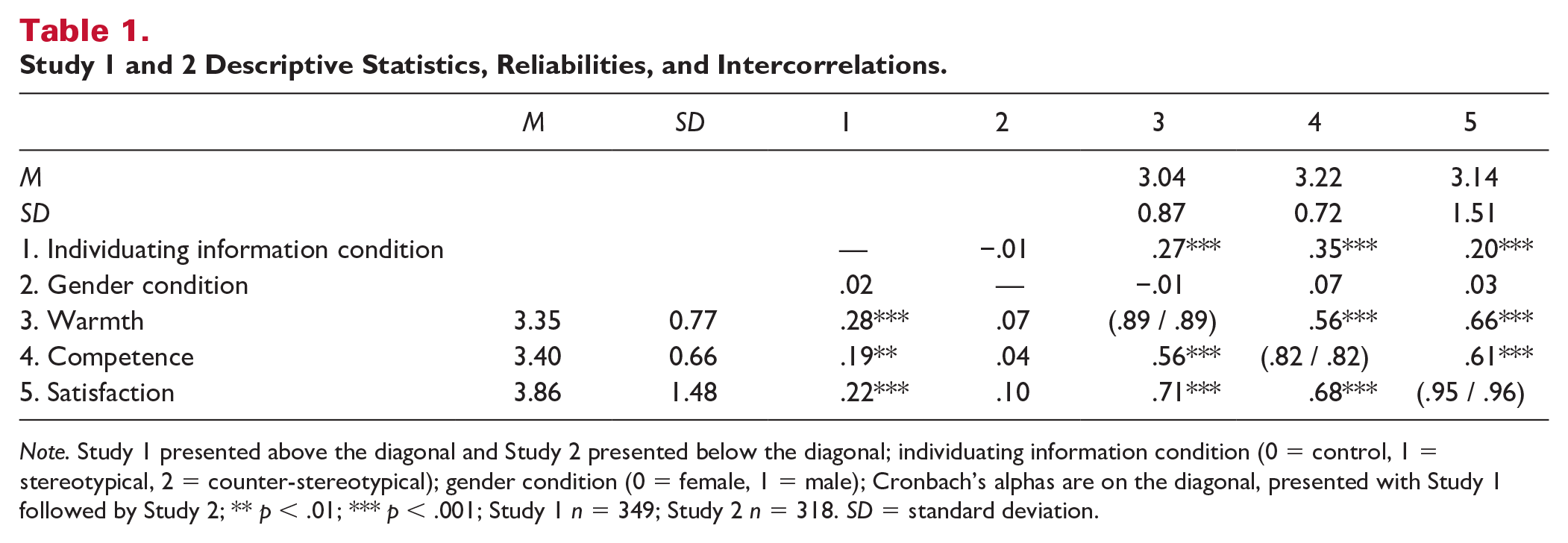
Note. Study 1 presented above the diagonal and Study 2 presented below the diagonal; individuating information condition (0 = control, 1 = stereotypical, 2 = counter-stereotypical); gender condition (0 = female, 1 = male); Cronbach’s alphas are on the diagonal, presented with Study 1 followed by Study 2; ** p < .01; *** p < .001; Study 1 n = 349; Study 2 n = 318. SD = standard deviation.
Table of Means and Standard Deviations.
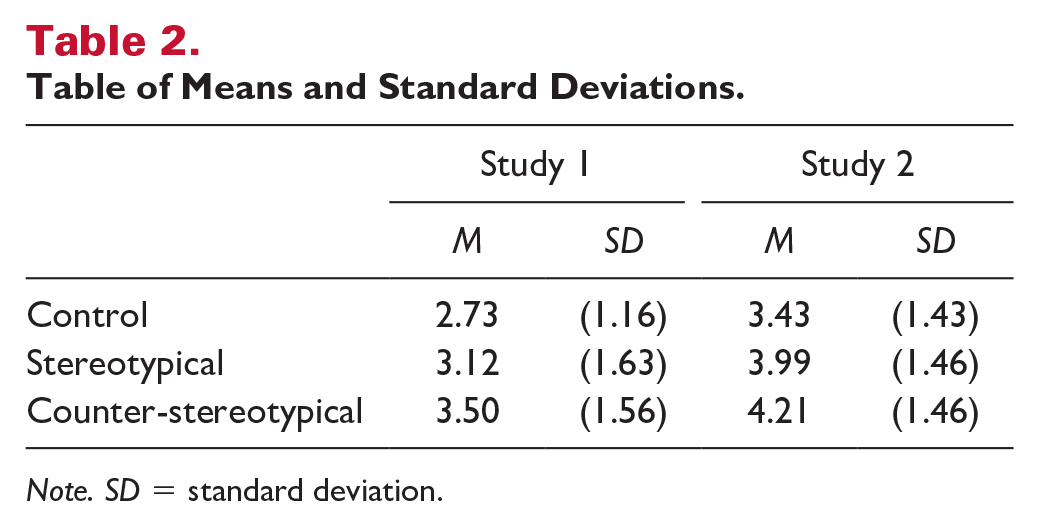
Note. SD = standard deviation.
Results and Discussion
A between-subjects ANOVA (see Table 3) revealed a main effect of the type of individuating information provided, F(2, 343) = 7.67, p < .001, η2 = .04. In support of H1a and H1b, planned contrast tests showed that satisfaction ratings in the counter-stereotypical (suggesting competence) condition, M = 3.50, SD = 1.56, were significantly higher than either the control condition, M = 2.73, SD = 1.16; F(1, 343) = 15.29, p < 001, η2 = .04, or the stereotypical (suggesting warmth) condition, M = 3.12, SD = 1.63; F(1, 343) = 4.33, p < 05, η2 = .01. In addition, in support of H1c, satisfaction ratings in the stereotypical (suggesting warmth) condition were significantly higher than in the control condition, F(1, 343) = 3.79, p = .05, η2 = .01.
ANOVA Tests.
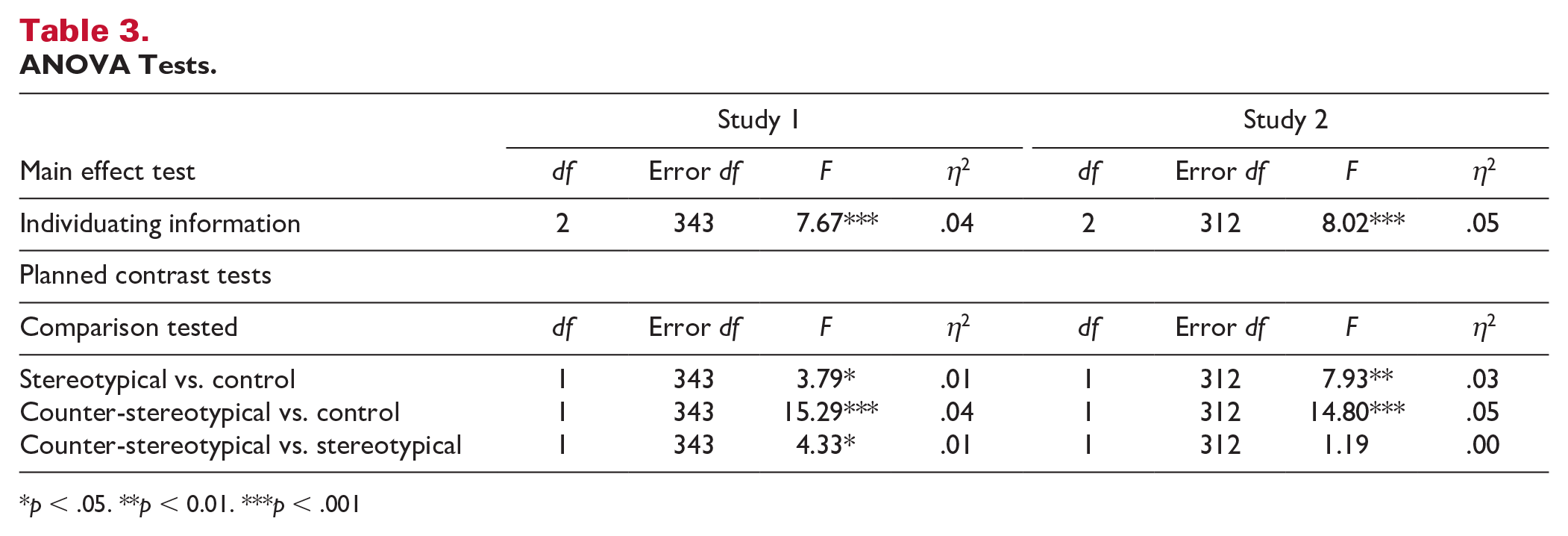
p < .05. **p < 0.01. ***p < .001
We tested our mediation hypotheses using Hayes’ (2013) PROCESS macro (Model 4) with the type of individuating information provided as the independent variable, satisfaction as the dependent variable, and warmth and competence as parallel mediators (as displayed in Figure 1), and interpret indirect effects to establish evidence of mediation (Hayes, 2013; Zhao et al., 2010). The results of these analyses revealed that there was an indirect effect of competence when comparing the counter-stereotypical (suggesting competence) and control conditions, b = 0.48, 95% CI = [0.31, 0.69], in support of H2a. There was a similar indirect effect of competence when comparing the counter-stereotypical (suggesting competence) and stereotypical (suggesting warmth) conditions, b = 0.24, 95% CI = [0.10, 0.41], in support of H2b. Finally, in support of H2c, we also found an indirect effect of warmth when comparing the stereotypical (suggesting warmth) and control conditions, b = 0.45, 95% CI = [0.27, 0.65] (see Table 4). Although not hypothesized, interested readers may wish to know we also ran a series of exploratory moderated mediation analyses with target gender, participant gender, and participant age as potential moderators and did not find evidence that these factors influenced the results.
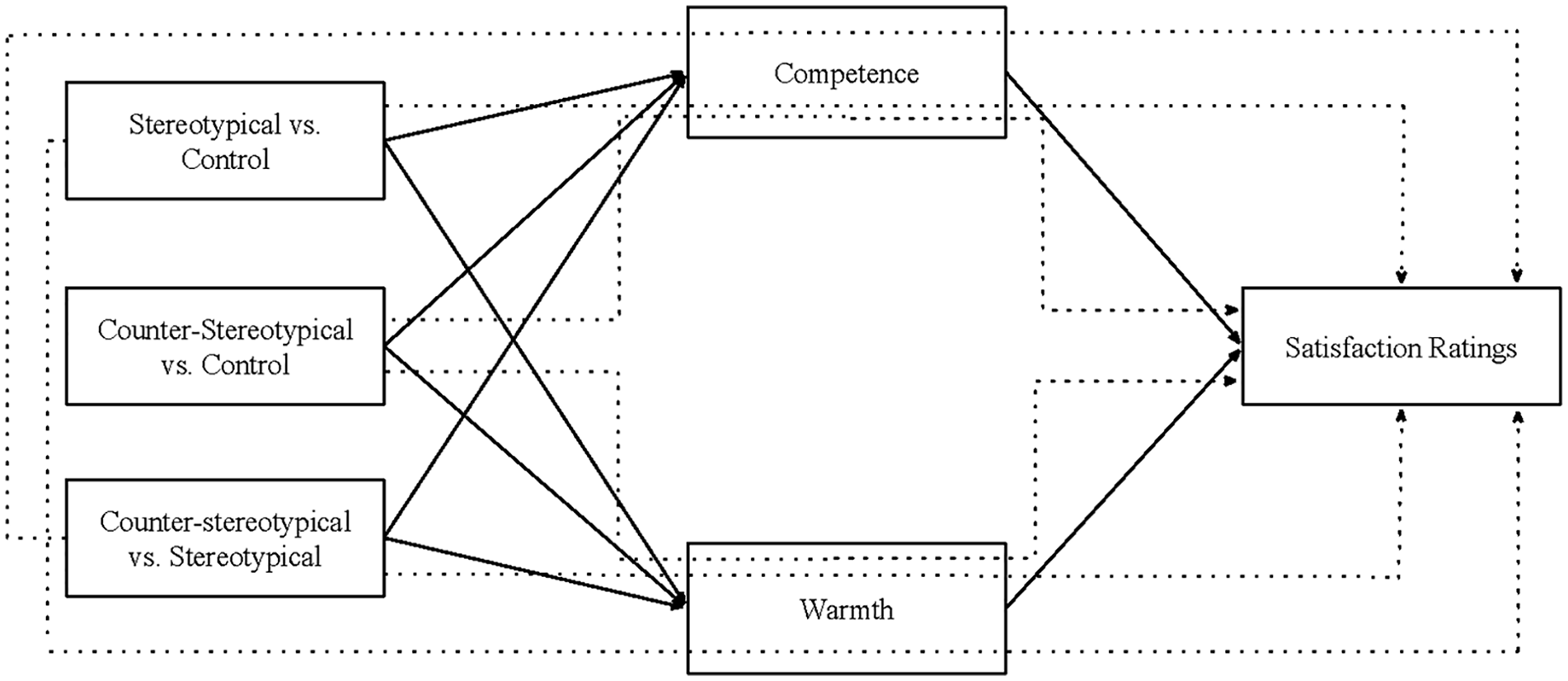
Graphical Representation of Hypotheses.
Study 1 Indirect Effect Analyses for the Effect of Individuating Information on Satisfaction Through Warmth and Competence.
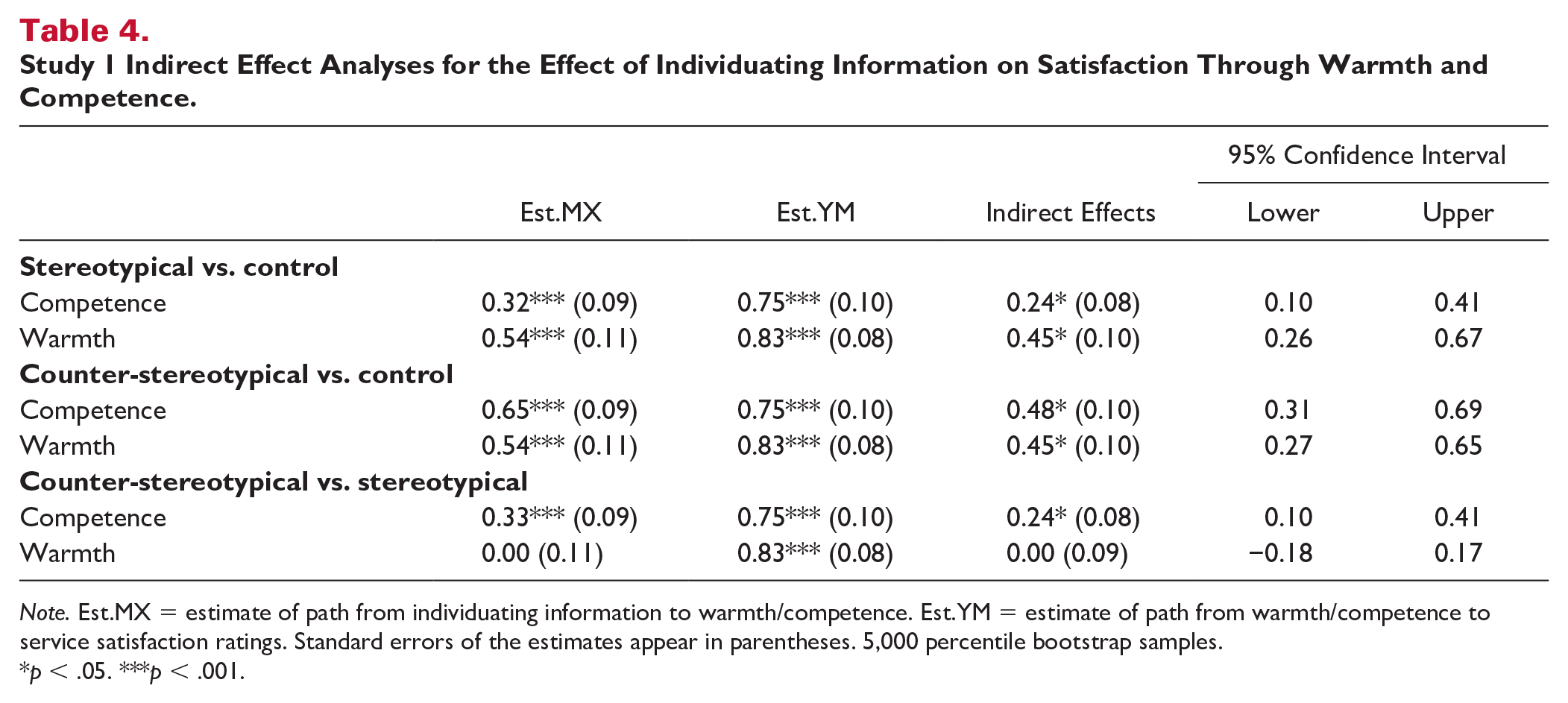
Note. Est.MX = estimate of path from individuating information to warmth/competence. Est.YM = estimate of path from warmth/competence to service satisfaction ratings. Standard errors of the estimates appear in parentheses. 5,000 percentile bootstrap samples.
p < .05. ***p < .001.
These results suggest that although providing any sort of positive individuating information is beneficial, providing positive counter-stereotypical information may elicit more positive perceptions of employees over and above providing positive stereotypical information. In addition, our findings suggest that by providing specific types of information, targets of discrimination can affect others’ stereotypic perceptions thereby altering ratings of satisfaction. This pattern of results is in line with findings in previous research (Botsford Morgan et al., 2013; King & Ahmad, 2010; King et al., 2006; Singletary & Hebl, 2009) and extends this literature by examining both positive stereotypical and counter-stereotypical individuating information in a single experimental design. In addition, this study represents the first attempt at examining how providing specific types of individuating information could influence customers’ application of group-level stereotypes (i.e., warmth and competence) on evaluations of individual service providers.
Although these results are encouraging, older workers are stereotyped as low in competence, and competence has been argued to be particularly important in workplace domains (Cuddy et al., 2011; Lyons et al., 2018; Martinez et al., 2016) and in hospitality settings (Bufquin et al., 2017). Therefore, it is possible that such a technique was effective for older workers only because they were able to elicit higher perceptions of competence in a domain in which competence was particularly important (the workplace), rather than because the content of the individuating information was counter-stereotypical. We examine this possibility directly in Study 2 by exploring providing individuating information in a service encounter with Asian adults, a group that has opposing stereotypes compared with older workers.
Study 2
Method
As in Study 1, we first examined the perceptions of warmth and competence for Asian adults from an MTurk sample of 44 U.S. adults and confirmed that Asian adults were viewed relatively less warm, M = 3.15, SD = 0.93, than competent, M = 4.13, SD = 0.60; t(43) = 7.25, p < .001.
Participants and procedure
We obtained a sample of 318 valid responses from U.S. participants from MTurk. The majority of participants indicated that they were female (60%), and their average age was 37.80 (SD = 11.90) years old. The majority (81%) of participants indicated as White/Caucasian, followed by Asian (6%), Black/African American (5%), Hispanic/Latino (5%), Other (2%), or Native American (1%). Participants indicated that they had been employed for an average of 15.58 (SD = 12.15) years, and 94% of participants indicated that they stayed in hotels at least one to two times per year.
We obtained the pictures of Asian individuals from yearbook photos that were standardized with respect to facial expression (neutral), lighting, and angle. We selected six pictures of male and six pictures of female Asian individuals and pretested them (within gender category) for perceived warmth, competence, friendliness, attractiveness, and intelligence among 48 MTurk participants with similar demographic characteristics as our other samples. This pilot test yielded two male and three female (as in Study 1, two of these photographs were used in each condition and then collapsed for analyses) exemplars that were rated similarly on these dimensions (all ps > .05) and used as stimuli in the subsequent study.
We utilized the same scenario and manipulations as in Study 1. However, in line with the stereotypes of Asian individuals discussed previously (Fiske et al., 2002), we used the manipulation that includes positive individuating information suggesting competence (e.g., solving problems) in the stereotypical condition and warmth (e.g., making friends) in the counter-stereotypical condition.
We also used the same measures of warmth (a = .89), competence (a = .82), and satisfaction ratings (a = .96) as in Study 1. Means, standard deviations, reliability coefficients, and correlations for our constructs are presented in Table 1, and means and standard deviations for the three manipulated strategies are in Table 2.
Results and Discussion
A between-subjects ANOVA (see Table 3) revealed a main effect of the type of individuating information provided, F(2, 312) = 8.02, p < .001, η2 = .05. In support of H3a, planned contrast tests showed that satisfaction ratings in the counter-stereotypical condition, M = 4.21, SD = 1.46, were significantly higher than the control condition, M = 3.43, SD = 1.43; F(1, 312) = 14.80, p < 001, η2 = .05. However, H3b was not supported, as the satisfaction ratings in the counter-stereotypical condition were not significantly higher than the stereotypical condition, M = 3.99, SD = 1.46; F(1, 312) = 1.19, p > .05, η2 = .00. In addition, supporting H3c, satisfaction ratings in the stereotypical condition (competence) were significantly higher than in the control condition, F(1, 312) = 7.93, p < 01, η2 = .03 (see Table 3).
As in Study 1, we examined indirect effects using Hayes’ (2013) PROCESS macro (Model 4). Results of these analyses revealed that there was an indirect effect of warmth when comparing the counter-stereotypical and control conditions, b = 0.48, 95% CI = [0.29, 0.70], in support of H4a. There was a similar indirect effect of warmth when comparing the counter-stereotypical to stereotypical conditions,b = 0.21, 95% CI = [0.02, 0.41], in support of H4b. With respect to competence, there was an indirect effect when comparing the stereotypical and control conditions, supporting H4c, b = 0.44, 95% CI = [0.27, 0.64] (see Table 5). Although not hypothesized, as in Study 1, we also ran a series of exploratory moderated mediation analyses with target gender, participant gender, and participant age as potential moderators and did not find evidence that these factors influenced the results.
Study 2 Indirect Effect Analyses for the Effect of Individuating Information on Satisfaction Through Warmth and Competence.
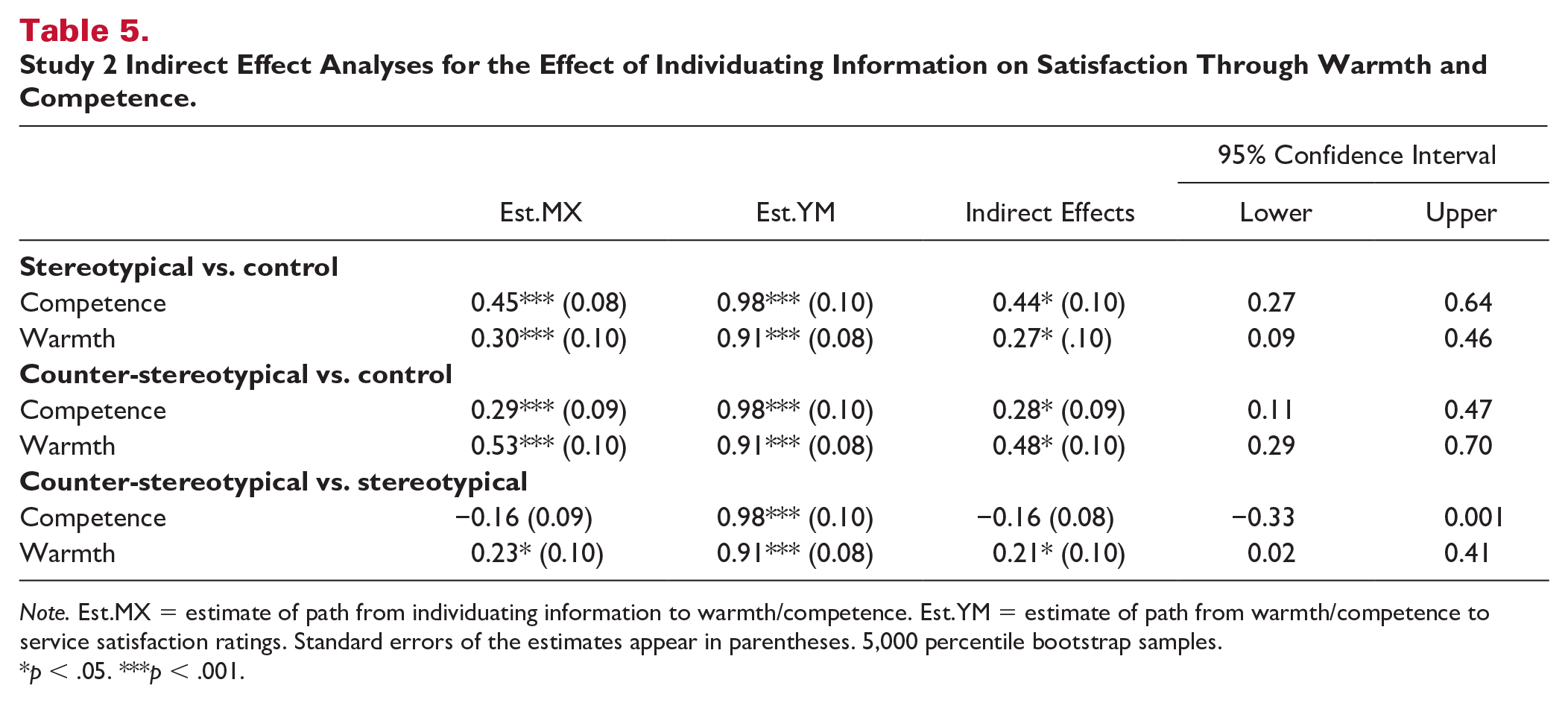
Note. Est.MX = estimate of path from individuating information to warmth/competence. Est.YM = estimate of path from warmth/competence to service satisfaction ratings. Standard errors of the estimates appear in parentheses. 5,000 percentile bootstrap samples.
p < .05. ***p < .001.
The results of this study extend prior work by providing a more robust test of the effectiveness of providing individuating information as an individual-level strategy to reduce workplace discrimination. In line with the continuum model (Fiske & Neuberg, 1990), we found that providing any type of positive individuating information elicited more positive perceptions compared with providing no individuating information at all. Although the difference in satisfaction ratings between providing positive stereotypical and counter-stereotypical individuating information was not significant, the trend was in the expected direction (with satisfaction ratings in the counter-stereotypical condition being higher). Also, in line with theory and our hypotheses, the difference in perceptions of warmth between the stereotypical and counter-stereotypical condition explained this trend.
Overall, this pattern of results is consistent with the results from Study 1 and suggests that providing counter-stereotypical information results in the most positive outcomes. Although the difference in satisfaction between the stereotypical and counter-stereotypical conditions was not significant, we believe that this may be more a function of the relatively high satisfaction ratings (i.e., ceiling effects related to being a “model minority” group; Wong et al., 1998) in both the control and the stereotypical condition. Supporting the notion that Asian adults will receive passive facilitation, satisfaction ratings among Asian individuals in the control condition (M = 3.43) were higher than those of the older workers in the control condition in Study 1 (M = 2.73), and nearly as high as the older workers in the counter-stereotypical condition (M = 3.50). Thus, the findings are also in line with theoretical expectations.
General Discussion
Stereotypes and discrimination can exist at every level of an organization’s operations in the hospitality industry. Organizational research has moved beyond merely identifying instances of discrimination to examining strategies to remediate discrimination across multiple levels of analysis. At the level of the target of discrimination, much of this research has focused on different individual-level strategies in which targets of discrimination can engage (e.g., acknowledgment, disclosure, positivity, providing positive individuating information; Griffith & Hebl, 2002; Hebl & Kleck, 2002; Singletary & Hebl, 2009). Taken together, our results suggest that providing positive counter-stereotypical individuating information is a particularly effective strategy in improving customer perceptions of service providers. However, the effectiveness of these strategies can depend on the characteristics of the target, the observer, the organization, the vocation, and the community/society in which targets live (Ragins, 2008). In our research, we take such issues into account; in exploratory analyses, we found that for both older workers and Asian adults (groups with opposing stereotypes), the effectiveness of providing individuating information was robust to gender of the target and characteristics of the observers (age and gender). In addition, we hold the vocation constant and do not provide specific details about the organization.
Theoretical Implications
Although the general pattern of results across Studies 1 and 2 suggest that positive counter-stereotypical individuating information is most effective in the service encounter, providing stereotypical information also elicited more positive evaluations of both older (Study 1) and Asian (Study 2) workers. In fact, although evaluations of Asian workers were slightly higher when positive counter-stereotypical individuating information was provided, the difference between positive stereotypical and counter-stereotypical individuating information was not significant. In general, satisfaction ratings for Asian workers were relatively high in all conditions. As such, even though the pattern of results remains, these findings suggest that only so much can be done to further boost generally positive employee evaluations.
Our mediational findings suggest that providing positive stereotypical or counter-stereotypical information may be effective because doing so allows others to re-categorize targets beyond stereotypes associated with their social group. Although this is in line with past theory (Fiske & Neuberg, 1990), this work is among the first empirical tests of the impact that ostensible employees themselves can have on influencing customers’ application of group-level stereotypes on evaluations. Our findings support the literature examining the provision of positive individuating information as an individual-level strategy to reduce discrimination and further suggest that providing positive counter-stereotypical individuating information results in beneficial employee outcomes. Our work extends this literature by detailing a more comprehensive account of the process that is theorized to explain the effectiveness of providing individuating information. Therefore, this article enhances the current literature, as related to the influence of social interaction in a service encounter setting, and more specifically to the impact of the front-line employee’s use of positive individuating information, and improves the understanding of providing positive counter-stereotypical individuating information in enhancing customer satisfaction ratings in the hospitality context.
Practical Implications
The results of this study also have practical significance. First, hospitality organizations are concerned about worker shortages in entry-level positions (Manoharan & Singal, 2017) and older workers may need to re-career given increasingly longer life expectancies (Johnson et al., 2009). However, stereotypes may prevent older workers from gaining access to these types of jobs (Posthuma & Campion, 2009). More generally, occupational- and group-based stereotypes can prevent equal access to certain jobs. Our results suggest that job applicants and employees can manage their work identities effectively by providing different types of information that highlight that they are competent or warm (or otherwise address potential concerns among employers, coworkers, or customers).
Second, in terms of customer-facing jobs in hospitality, providing positive individuating information may be particularly fruitful in increasing customers’ evaluations of employees, and thus, organizations may wish to provide training and opportunities for workers to engage in such information-sharing with customers, even in short-term encounters. For example, companies could suggest that employees feel empowered to talk about their interests and experiences related to their job. Any such training should be conducted with care as others may react to particularly overt attempts to influence their behavior (see Kawakami et al., 2005). Indeed, although Kawakami and colleagues (2000) found that extensive training focused on negating category–trait associations resulted in reducing automatic stereotype activation, the same training only resulted in reduced gender discrimination in selecting a candidate for a leadership role under specific conditions (when the training was dissociated from the selection choice or when they had reduced cognitive capacity; Kawakami et al., 2005). This work has implications for considering both automatic and deliberative processes that customers may engage in when responding to customer-facing employees.
Third, although we do believe that providing positive individuating information may be an effective strategy to boost customers’ satisfaction, our results also suggest that customers perceive the same level of performance differently across groups. Thus, we caution organizations against solely using customer satisfaction as an indicator of performance and suggest that organizations try to facilitate positive perceptions of their workforce through other initiatives, such as corporate social responsibility initiatives (which may suggest increased warmth and competence of the workforce) or through a strong company culture (such as at Apple, where workers are perceived as creative and inquisitive).
Limitations and Future Directions
As with any study, our results should be interpreted in light of some limitations. First, we utilized single time-point hypothetical scenarios across both studies. Although experimental lab studies examining workplace age bias have been found to result in larger effects compared with field studies (Gordon & Arvey, 2004), our examination of mediational processes necessitated a design that allowed us to measure mediators and outcomes directly from our participants. This is a particular strength of this design as past field research provided theoretical justifications for differential experiences but did not test the underlying psychological mechanisms directly. Future research might replicate our findings with actual workers in organizations utilizing customer evaluations obtained through satisfaction questionnaires and/or examine the impact of engaging in these strategies over time. We also acknowledge that our data were collected before the COVID-19 pandemic and stereotypical responses (particularly toward Asian employees) may be different as a result of COVID-related prejudice (see Litam, 2020).
Second, we only examined the impact of providing positive individuating information, in line with prior work focused on prejudice and discrimination remediation for a stigmatized target. Future researchers could explore the impact of providing both positive and negative individuating information as prior researchers have found that describing a group in both positive and negative terms can result in increased group-level prejudice reduction compared with when only describing positive aspects of a group (Brauer et al., 2012). Such a consideration may have important implications for the literature as information in which group-level heterogeneity is emphasized could result in more difficulty in categorization, thus allowing for more individuation.
Third, we only evaluated the effectiveness of providing individuating information in one type of job: hotel front desk agent. As such, future research should evaluate these biases in a wider range of occupations and better take into account contextual factors. For example, North and Fiske (2016) showed that older workers were discriminated against by younger generations under conditions of resource scarcity (i.e., reduced desire to engage in networking, reduced allocation of training resources). As such, it could be that the availability of jobs in the market affects treatment toward certain groups, which could influence how customers respond toward stigmatized targets. Furthermore, Reeves et al.’s (2021) findings suggest that job age-type (i.e., perceptions of suitability of older or younger workers for particular jobs) may be important to take into account when examining workplace ageism. Despite these reservations, we realized that the hotel front desk context likely allows group-based stereotypes to be activated differentially because both warmth and competence could reasonably be expected in this type of role. As such, future researchers should examine how stereotype activation differs as a function of job type. Similarly, our scenario was designed to demonstrate relatively average performance, but future research should consider how particularly exceptional or poor performance may interact with perceptions of employees who provide individuating information. In addition, future researchers could examine the employee’s perspective related to engaging in individual-level strategies for reducing discrimination, as it is possible that doing so could be burdensome for the employee (Grandey, 2000).
Footnotes
Declaration of Conflicting Interests
The author(s) declared no potential conflicts of interest with respect to the research, authorship, or publication of this article.
Funding
The author(s) disclosed receipt of the following financial support for the research, authorship, or publication of this article: Portions of this research were supported by the Grant number T03OH008435 awarded to Portland State University, funded by the Centers for Disease Control and Prevention, National Institute for Occupational Safety and Health.
