




Abstract
The increase of immigrant employees in services has made intercultural service encounters a commonplace phenomenon. In these encounters, customers frequently use service employees’ accent to infer their ethnic background, often eliciting cultural stereotypes. However, it is still unknown how accent-based stereotyping impacts customer participation (CP), that is, the degree to which customers engage in the service process by contributing effort, knowledge, and information to improve their service experience. Addressing this question in four experimental studies (Ntotal = 1,027), we find that (1) customers contribute less to the service encounter voluntarily when the employee has an unfavorable foreign (compared to a local) accent, (2) the negative effects of unfavorable accents on voluntary CP are stronger than the positive effects of favorable ones, (3) accent-based employee stereotypes (superiority, attractiveness, dynamism) mediate the impact of accents on CP, (4) unfavorable accents impede even participatory tasks mandatory for service completion, and (5) accent effects on CP are dampened for customers with a high need for interaction and can be managerially neutralized through self-service options that offer customers higher control over the service delivery. Our findings inform staffing and training decisions for frontline service roles commonly undertaken by immigrants and assist the design of intercultural service delivery systems.
Introduction
“Do you know what a foreign accent is? It’s a sign of bravery.”
– Amy Chua
In intercultural service encounters, customers use audiovisual cues to infer the employee’s ethnicity. However, while visual cues (e.g., physical appearance) are inherent and to a large extent unchangeable, audial cues such as a person’s accent are malleable with effort and training. Accents are also easily discernible, ultimately making people more likely to rely on accent than looks in the ethnic categorization of others (Rakić, Steffens, and Mummendey 2011). Accent-based inferences typically trigger cultural stereotypes (Rao Hill and Tombs 2011) that form social perceptions of others and determine cooperative or hostile attitudes toward them (Cuddy, Fiske, and Glick 2008). As customers form their overall impression of a service firm based on individual service encounter experiences (Parasuraman, Zeithaml, and Berry 1994) and on their attitude toward the frontline employees they interact with (Curran, Meuter, and Surprenant 2003), employees’ accents appear instrumental in shaping customers’ assessment of service providers and their willingness to cooperate with them to achieve satisfactory service outcomes. In this context, a concept that plays a key role is customer participation (CP), that is, the degree to which customers are involved in the service process by contributing effort, knowledge, information, and other resources (Dabholkar 1990). In many services, customers are increasingly required to take on more responsibility for service creation and delivery, even when this requires profound technical knowledge. Customers are asked to provide inputs and perform tasks with job-like traits that are characterized by high complexity, ambiguity, and uncertainty, particularly in expert services such as personal finance (Azzari et al. 2021). Service firms have recognized that enabling and encouraging customers to be co-producers of the service results in benefits for both parties. Research indicates that CP is an important driver of customer satisfaction (Gallan et al. 2013) and loyalty (Auh et al. 2007), and that participation-induced customer empowerment is positively related to firm profitability, sales growth, and customer retention (Auh et al. 2019). In contrast, when customers are reluctant to participate, employees become less engaged, thus decreasing the service provider’s productivity (Yoo, Chen, and Frankwick 2021).
Previous Studies on Foreign Accents in Employee-Customer Interactions.
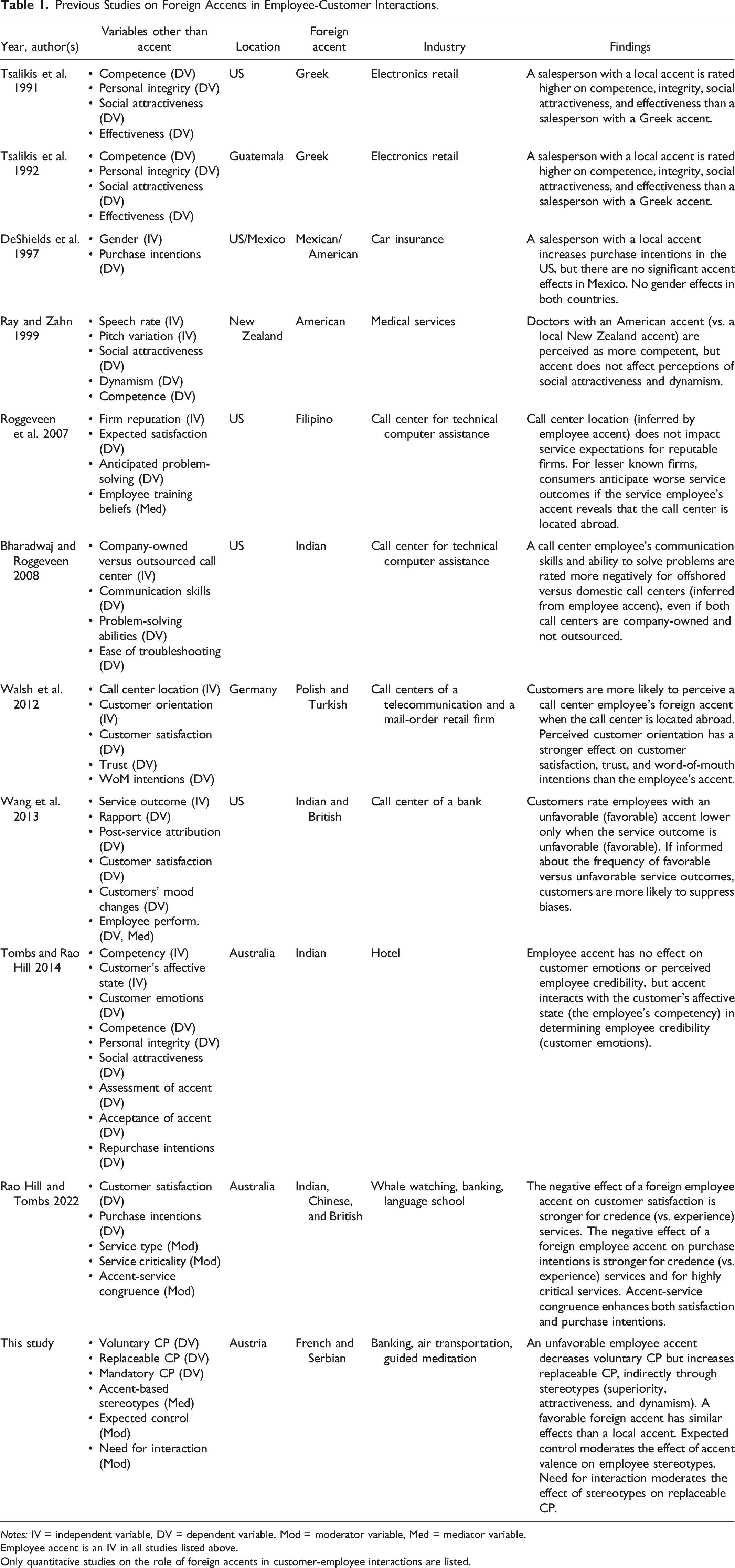
Notes: IV = independent variable, DV = dependent variable, Mod = moderator variable, Med = mediator variable.
Employee accent is an IV in all studies listed above.
Only quantitative studies on the role of foreign accents in customer-employee interactions are listed.
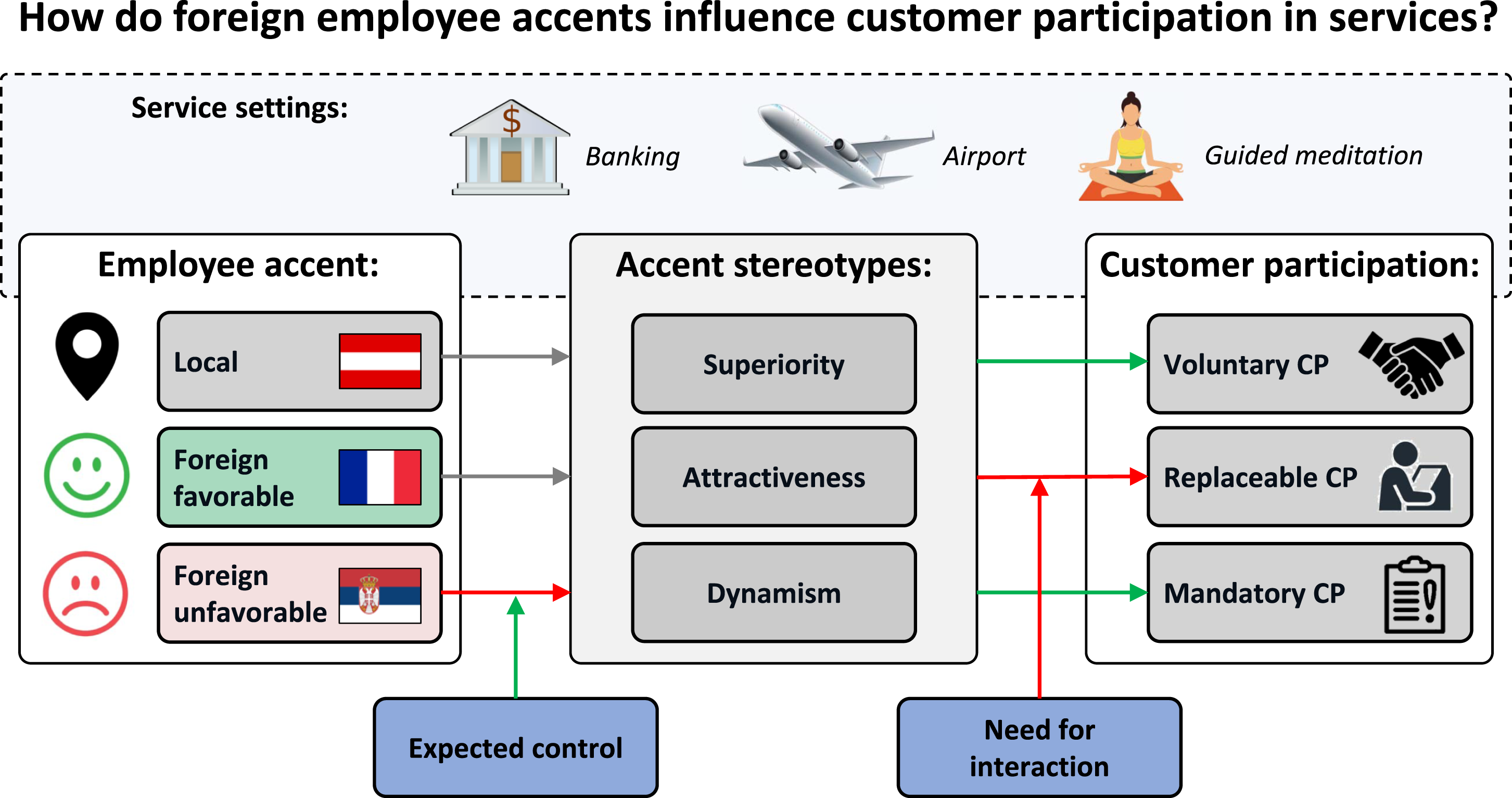
Against this background, we draw from research in linguistics (language attitude theory), social psychology (social identity and stereotyping theories), and services marketing (CP literature) to develop a conceptual model on the effects of service employee accent on CP, its underlying mechanisms, and its boundary conditions. In four experimental studies, we test our model in both hypothetical and real-world intercultural service encounters, across various service settings (financial services, air travel, guided meditation), and using both intentional and behavioral measures of CP. Our results show that an unfavorable foreign employee accent decreases customers’ willingness to participate in a service, while a positively connoted employee accent does not. Our findings indicate that accent-based stereotypes about the service employee’s attractiveness, superiority, and dynamism mediate the effect of foreign accents on CP. Subsequently, we find that a foreign employee accent influences not only voluntary CP, but also replaceable and mandatory CP. Finally, we provide evidence for the moderating role of customers’ need for interaction and expected control over the service process. We conclude by discussing our contributions to the literature on accents, intercultural service encounters, and CP, and offer actionable insights to service managers.
Conceptual Background and Hypotheses
Foreign Accents and Stereotyping
An accent is a specific manner of pronunciation, discernible even when other linguistic aspects (grammatical, syntactical, morphological, and lexical) remain comparable with the standard language (Giles 1970). Although foreign accents are influenced by the sound system of the speaker’s native language, accent strength is distinct from language competence (Gluszek and Dovidio 2010). Even immigrants who have become perfectly fluent in the local language still tend to speak with a discernible accent. Indeed, it appears virtually impossible to ever sound like a native speaker for people who began learning a language after the age of 15 years (Flege, Munro, and MacKay 1995). Experiments have shown that listeners could identify an accented speaker’s cultural background by just listening to 30 milliseconds of speech (Flege 1984) or the single word “hello” (Purnell, Idsardi, and Baugh 1999). Hence, accent inevitably offers itself as an informational cue that customers rely on to infer an employee’s ethnicity in intercultural service encounters.
Even when listeners do not recognize a specific accent, they still use it as a basis to make stereotypical inferences (Lindemann 2003). Such stereotypical inferences represent cognitive shortcuts enabling listeners to assess speakers along key dimensions of social perception such as their ability to achieve specific outcomes (competence) or their intentions toward others (warmth) (Fiske, Cuddy, and Glick 2007). Meta-analytic findings reveal that foreign-accented speakers are consistently rated more negatively (Fuertes et al. 2012). This effect is most pronounced for evaluations associated with status, such as how educated, intelligent, or successful a speaker is perceived to be. For example, Tsalikis, DeShields, and LaTour (1991) found that a salesperson with a foreign accent is perceived as less competent and credible.
Customer Participation in Services
CP refers to “the degree to which the customer is involved in producing and delivering the service” (Dabholkar 1990, p. 484) by contributing effort, knowledge, information, and other tangible and/or intangible inputs. Various terminologies have been used interchangeably to capture the concept of CP, including “co-production” (e.g., Auh et al. 2007), “consumer cooperation” (e.g., Tsai, Wu, and Huang 2017), and “customer value co-creation” (e.g., Yi and Gong 2013). Following Dong and Sivakumar’s (2017) recommendation, we adopt the term “customer participation” because of its conceptual inclusivity and flexibility. Relatedly, CP does not always lead to value creation. Although Vargo and Lusch (2004, p. 11) argue that “the consumer is always involved in the production of value,” opposing findings suggest that CP can also lead to counterproductive outcomes (Osei-Frimpong, Wilson, and Owusu-Frimpong 2015), as shown by a growing body of literature on value co-destruction (Plé and Chumpitaz Cáceres 2010). Furthermore, CP can cover both active and passive participation, as well as both labor-intensive and information-intensive participation. 1
tMost CP research has focused on the consequences of customers participating in the service process. The investigated outcomes of CP were either firm-related (e.g., service innovation, Chen, Tsou, and Ching 2011; employee workload, Hsieh, Yen, and Chin 2004) or customer-related (e.g., customer loyalty, Auh et al. 2007; customer satisfaction, Bendapudi and Leone 2003; role stress, Blut, Heirati, and Schoefer 2020). However, not much attention has been paid to the antecedents of CP, that is, the factors that motivate or hinder customers to participate. A review by Dong and Sivakumar (2017) revealed that only in seven out of 81 studies, CP has been investigated as an endogenous variable, thus limiting our knowledge of the reasons behind customers’ willingness and/or ability to participate in the service process. Three of these studies focused on customer engagement (Bettencourt 1997; Nambisan and Baron 2009; Zhao, Wang, and Fan 2015), three examined customers’ attitudes toward self-service technologies (Bhappu and Schultze 2006; Curran, Meuter, and Surprenant 2003; Meuter et al. 2005), and one examined self-production of a tangible good (Huynh and Olsen 2015). Importantly, none of these studies has examined interaction-specific factors such as the cultural divergence between customers and service workforce as determinants of CP.
Employee Accent and Customer Participation: The Role of Accent Valence
Social identity theory holds that individuals favor members of the culturally similar in-group and discriminate against members of culturally distant out-groups (Tajfel and Turner 1979). By extension, customers who perceive a service employee as culturally dissimilar (as signaled by a foreign accent) feel less comfortable interacting with them (Sharma, Tam, and Kim 2009). Evidence suggests that intercultural service encounters generally suffer from lower levels of customer rapport (Linzmajer et al. 2020) as well as a potential lack of trust (Hopkins, Hopkins, and Hoffman 2005). Trust, however, is an important determinant of customer interaction (Machado Nardi et al. 2020), cooperation (Morgan and Hunt 1994), and personal information disclosure (Bansal, Zahedi, and Gefen 2010), all of which are prerequisites for successful service delivery. If a customer does not trust a foreign-accented employee and experiences interaction discomfort, they might develop a strong need for self-reliance and a sense of emotional and cognitive distance, which likely translates into reduced cooperation and lower contribution of discretionary effort to the service interaction.
In addition to possibly being perceived as distant, accented speakers are often also negatively stereotyped (Fuertes et al. 2012). However, there is some evidence to the contrary. For example, DeShields et al. (1997) found that Mexican consumers’ purchase intentions were not affected by a salesperson’s accent. Cargile (2000) and Hosoda and Stone-Romero (2010) showed that job applicants with a Chinese/French accent were viewed as favorably as native speakers in the United States. Essentially, some accents seem to have negative connotations while others do not, which highlights the importance of explicitly differentiating between accents perceived favorably or unfavorably by listeners (i.e., accent valence). Different types of accents might even have opposite effects on consumer responses, yet the negative consequences (i.e., the effect magnitude) of unfavorable accents are expected to be more pronounced than the positive outcomes of favorable accents. As suggested by Mai and Hoffmann (2014, p. 149), “accents that are negatively connoted elicit negative country-of-origin effects, whereas those with a positive country image have no or weaker positive consequences.” This can be attributed to the negativity bias, which refers to people’s tendency to attach greater relevance to negative evaluative cues than to positive ones (Herr and Page 2004). In other words, there is evidence for a positive-negative asymmetry in accent-based evaluation because “bad” information about an entity often carries more weight and has a larger impact on first impressions than “good” information (Peeters and Czapinski 1990). In line with previous empirical and conceptual work, we expect that only an unfavorable foreign employee accent significantly reduces voluntary CP, whereas the impact of a favorable foreign accent is similar to that of a local accent.
An unfavorable foreign service employee accent negatively influences voluntary customer participation compared to a local and a favorable foreign accent.
The Mediating Role of Accent-Based Stereotypes
Drawing from language attitude theory and social psychology, we propose accent-based stereotypes as the underlying mechanism explaining the effects of an employee’s accent on customers’ participatory behaviors. Specifically, we assume that customers’ behavioral reactions to a service employee’s accent are determined by whether that accent evokes predominantly positive or negative associations, regardless of the perceived cultural distance between the customer and the employee 2 . Zahn and Hopper (1985) developed the Speech Evaluation Instrument (SEI) for the specific purpose of assessing accent-based stereotypes along the three dimensions of superiority, attractiveness, and dynamism. Superiority describes perceptions of the speaker’s social status, intelligence, and speaking competency. Attractiveness captures solidarity, trustworthiness, and likeability. Dynamism relates to a speaker’s activity level. Drawing from Zahn and Hopper (1985), we conceptualize accent-based stereotyping as a reflective second-order construct consisting of three first-order dimensions that correspond to a customer’s perception of the accented service employee’s superiority, attractiveness, and dynamism. In line with literature on multidimensional constructs (Law, Wong, and Mobley 1998), we approach accent-based stereotyping as an abstract representation capturing the common variance of the three dimensions that constitute “subcomponents of a higher order organizing concept” manifested at a lower level of abstraction (Bagozzi and Heatherton 1994, p. 42).
Although these three dimensions have been used in empirical research in linguistics, social psychology (Cargile 1997; Dixon, Mahoney, and Cocks 2002), and international business (Sliwa and Johansson 2014), and despite their profound fit with intercultural service encounters, the SEI has never been used to explain customer behavior in co-produced services. Research indicates that an employee’s friendliness (akin to the SEI’s attractiveness dimension) influences customers’ repurchase and word-of-mouth intentions (Tsai and Huang 2002). Similarly, perceptions of an employee’s warmth and competence—the main dimensions of the Stereotype Content Model intended to capture the formation, content, and impact of social stereotypes (Cuddy, Fiske, and Glick 2008)—are in direct parallel with attractiveness and superiority, and have been proposed as significant determinants of a customer’s service recovery cooperation (Huang et al. 2020). In a similar vein, we propose that the perceived superiority, attractiveness, and dynamism of an employee, formed on the basis of their accent valence assessment, mediate customers’ willingness to participate in the service process.
Customers’ accent-based service employee stereotypes (i.e., superiority, attractiveness, and dynamism) mediate the influence of foreign accent valence on voluntary customer participation.
Voluntary, Mandatory, and Replaceable Customer Participation
Our predictions so far focused on voluntary CP, that is, extra-role activities that are not essential for service provision. However, Dong and Sivakumar (2017) suggested a more fine-grained view of CP by distinguishing among different participation roles. The authors identified two additional types of CP, namely mandatory CP, which can only be performed by the customer and is essential for service completion (e.g., showing a boarding pass before a flight), and replaceable CP capturing activities which are also essential but can be performed either by the customer or an employee (e.g., use of self-service technologies such as grocery self-checkout machines). The three types of participation may occur either separately or simultaneously, depending on the service context. Distinguishing between these CP types helps clarifying how customers decide whether to invest effort into service participation upon hearing an employee’s accent and which goals they expect to achieve by (not) participating.
As previously argued, a customer might refrain from exerting discretionary effort in the service process (i.e., engaging in voluntary CP) and avoid cooperation with an employee whose accent triggers negative stereotypes. However, when essential activities can either be performed by the customer or an employee, customers’ negative predispositions toward an employee’s accent might lead them to adopt typical employee in-role behaviors. For the same reasons an unfavorable accent might negatively impact voluntary CP, that accent is expected to have a reverse (i.e., positive) effect on replaceable CP. In this case, the deliberate avoidance of personal interaction with the aim of achieving autonomy and control (e.g., by using a self-service technology) might entail additional cognitive and physical efforts, and thus increase replaceable CP. Indeed, Meuter et al. (2000) found that some customers prefer performing certain tasks themselves simply to avoid interacting with anyone. In many of these cases, customers perceive frontline employees as a nuisance or believe they themselves can provide the service more effectively than employees. In other words, customers sometimes deliberately adopt the role of “partial employees” (Mills and Morris 1986, p. 726) to avoid the potential negativity of a service interaction. Building on these findings, customers are particularly likely to take matters into their own hands when the alternative option requires direct interaction with a service employee who is negatively stereotyped due to their accent. In line with the negativity bias, we do not anticipate significant variation in replaceable CP in case of a favorable employee accent.
An unfavorable foreign service employee accent positively influences replaceable customer participation compared to a local and a favorable foreign accent.
Finally, mandatory CP is less likely to depend on a customer’s internal motivation or accent-based assessment of an employee. Even when interacting with an employee whose accent generates negative first impressions, customers frequently have no choice but to provide the necessary participatory input, because the service outcome cannot be delivered otherwise. In the most extreme cases, customers might ask for another employee, abort the service transaction completely, or switch to another service provider, but such decisions are unlikely to be provoked by an employee’s accent alone. Thus, we do not expect mandatory CP to be influenced by the valence of an employee’s accent (although we explicitly consider this possibility in Study 3 to check whether it can be empirically ruled out).
The Moderating Role of Customers’ Expected Control and Need for Interaction
Despite the importance of accents in intercultural service encounters, we propose two constructs expected to regulate the intensity of accent effects through influencing customers’ ability to participate (i.e., expected control over the service process) and/or customers’ willingness to participate (i.e., need for interaction). Both constructs are expected to moderate accent effects by diminishing accent-based stereotyping. This diminishing effect should manifest either by attenuating customers’ reliance on accent-based stereotyping or by surpassing the impact of such stereotyping to achieve positive service outcomes.
Expected control
Customer control is defined as a customer’s “degree of power and influence on the service specification, realization, and outcome” (Van Raaij and Pruyn 1998, p. 816). Research shows that customers’ perceived control over the service experience leads to higher service quality expectations (Dabholkar 1996), higher perceived efficiency of the transaction (Collier and Barnes 2015), and increased pleasure (Collier and Barnes 2015; Hui and Bateson 1991). On the contrary, feelings of powerlessness in self-service situations lead to negative attitudes toward the service provider (Cao et al. 2022). By extension, the feeling of being in control (e.g., by having the option of performing certain tasks autonomously without relying on an employee) might dampen or override customers’ negative stereotypes of an employee with an unfavorable accent. When customers do not feel overly dependent on the employee to achieve a satisfactory service outcome, they might attach less importance to the employee’s cultural background and view even negatively connoted foreign accents as less relevant for the successful delivery of the service. Indeed, increased perceptions of service control using a self-service technology reduce the value placed on human interaction by customers (Immonen, Sintonen, and Koivuniemi 2018), implying that customers might not hold employees to the same standards in such cases compared to situations where no or limited control over the service outcome is transferred to customers.
Expected control moderates the impact of foreign accent valence on customer participation by attenuating the negative effect of unfavorable accents on service employee stereotypes.
Need for interaction
Consumers have different attitudes toward self-service alternatives based on how much they value and strive for personal contact (Forman and Sriram 1991). Some customers attach great importance to autonomy, purposefully try to avoid personal interaction in service contexts (Oh, Jeong, and Baloglu 2013), and are more motivated to participate in ways that support self-determination, such as by using a self-service technology if given the option (Leung and Matanda 2013). In contrast, other customers prefer to deal with employees, because they feel that the use of machines dehumanizes the service transaction (Zeithaml and Gilly 1987). Indeed, research shows that customers’ need for interaction reduces their quality expectations and usage intentions of self-service options (Dabholkar 1996; Meuter et al. 2005). Situational factors might also drive customers’ need for interaction. As self-service options are often technology-based, they may cause anxiety and stress for some customers (e.g., elders) who do not feel comfortable with the use of machines (Mick and Fournier 1998). Customers may also refrain from engaging in replaceable CP for social risk considerations (e.g., fear of looking foolish as they struggle using the self-service option). Finally, customers may believe that human employees (even those with an unfavorable accent) are better equipped to resolve unexpected issues, to provide a higher degree of service customization, and to offer increased privacy, data protection, and empathy in comparison to self-service technologies.
In short, the effect of positive accent-based stereotypes on a customer’s willingness to let an employee handle the service process (rather than engaging in replaceable CP) will be reinforced when the customer has a strong need for interaction.
Need for interaction moderates the impact of accent valence on customer participation by reinforcing the negative effect of accent-based stereotypes on customers’ willingness to engage in replaceable customer participation.
An overview of the overall conceptual framework guiding our studies is provided in Figure 1. Conceptual framework.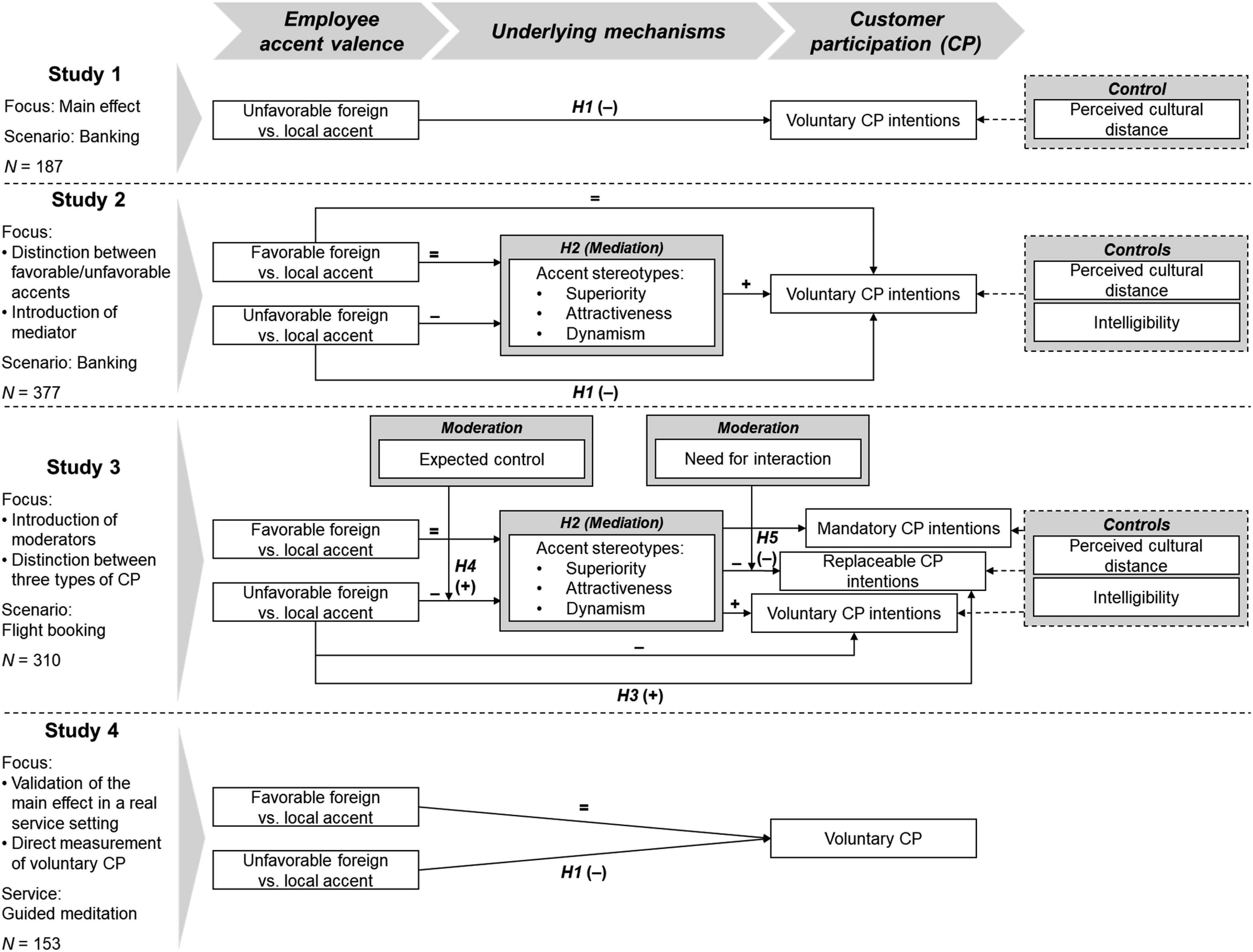
Study 1
Method
We collected data from 187 Austrian consumers (53.5% male, M AGE = 34.8, SD AGE = 13.9) using a quota sampling approach based on gender and age. In an online experiment, participants were asked to imagine that they need a mortgage loan and to picture themselves at an appointment with a financial advisor to discuss the next steps. Then, they were randomly assigned between subjects to one of two conditions with different audio scenarios as stimuli. In the control condition, the employee had a local (Austrian-German) accent, in contrast to a foreign (Serbian) accent in the treatment condition. The Serbian accent was chosen because immigrants from former Yugoslavia represent the second-largest group of foreign-born residents in Austria after Germans (Statistics Austria 2019). Manipulation checks on accent foreignness (“The employee speaks with a foreign accent”, anchored at 1 = “strongly disagree” and 7 = “strongly agree”) and accent liking (“How much do you like the employee’s accent?”, anchored at 1 = “do not like at all” and 7 = “like very much”) indicated that the Serbian accent was perceived as more foreign (M LOCAL = 1.76, M SRB = 5.97, t = 18.17, p < .01) and less liked (M LOCAL = 4.55, M SRB = 2.85, t = 8.18, p < .01) than the local accent.
We used audio recordings to control for confounding factors (e.g., physical appearance, body language). Speaker-specific variables (e.g., speech rate, voice pitch, and loudness) were held constant by using the same speaker (a multilingual professional stage actor and radio announcer capable of imitating the most common foreign accents authentically) in both recordings. In the audio script, the employee informs the customer that some inputs including information, calculations, and documents are required before a loan offer can be drafted (see Web Appendix A1). To ensure that the scenario was realistic, we conducted an extensive Internet search to identify the requirements of Austrian banks for mortgage applications.
Prior to the main study, we conducted a pretest with 81 participants to assess the stimulus materials’ suitability. We checked if the used scenario was sufficiently realistic, credible, understandable and imaginable with four questions. We also used two attention checks to ensure that the length (1 minute) was adequate. Results gave no grounds for concern (see Web Appendix A4). In the main study, voluntary CP was measured by three items adapted from Mende and van Doorn (2015) and perceived cultural distance (control variable) was captured by four items (Ang, Liou, and Wei 2018). Means, standard deviations, and correlations are reported in Web Appendix A5. Items are reported in Web Appendix A9.
Results
We performed an analysis of covariance (ANCOVA) to examine the effects of accent valence on voluntary CP, controlling for cultural distance. In support of H1, participants were less willing to engage in voluntary CP when the service employee had an unfavorable foreign accent (M LOCAL = 5.91, M SRB = 5.17, F(1, 183) = 4.40, p = .04, ηp2 = .02) (see Web Appendix A6). Cultural distance had a significant effect on voluntary CP (F(1, 183) = 4.94, p = .03).
Discussion
Our findings suggest that customers’ willingness to voluntarily contribute effort to the service process is influenced by the employee’s accent. Customers are less likely to participate when the service is delivered by an employee speaking with an unfavorable foreign accent. This effect persists after controlling for perceived cultural distance, hinting at reasons beyond employee-customer cultural dissimilarity as explanatory factors. Building on Study 1, Study 2 aims at replicating the effect and establishing its underlying mechanism.
Study 2
Method
We recruited 377 Austrian consumers using a quota sample based on gender and age (50.4% female, M AGE = 35.3, SD AGE = 12.9). We used the same experimental setting and voice actor as in Study 1. However, we introduced an additional condition in which the bank employee had a French accent. This accent was chosen as an easily discernible Western European counterpart to the Serbian accent because France has the second highest population in the European Union and French is among the most spoken languages globally. Furthermore, we wanted to ensure that one accent is seen more favorably by the local population than the other despite both being comparably familiar. The French accent was assumed to be more admired because it is positively stereotyped in the media and “Frenchness” is commonly associated with “aesthetic sensitivity, refined taste and sensory pleasure and, in some instances, elegance, flair, and sophistication” (Leclerc, Schmitt, and Dubé 1994, p. 264). The French accent is also both easy to recognize (Flege 1984) and perceived as attractive (Ball 1983).
We used the same scale as in Study 1 to capture voluntary CP (M LOCAL = 5.80, SD LOCAL = 1.18; M SRB = 5.02, SD SRB = 1.45; M FR = 5.93, SD FR = 1.12). Accent-based employee stereotypes were measured with 15 items from the SEI (Zahn and Hopper 1985) on semantic differential scales (presented in a randomized order) to capture listeners’ evaluation of speakers in terms of superiority (e.g., “educated/uneducated”), attractiveness (e.g., “likeable/unlikeable”), and dynamism (e.g., “enthusiastic/hesitant”). We operationalized accent-based stereotypes as a superordinate second-order reflective construct with attractiveness, superiority, and dynamism as subordinate first-order dimensions (Law, Wong, and Mobley 1998). Conceptually, we are interested in the shared variance of accent-based stereotype dimensions as in service encounters, attractiveness, superiority, and dynamism tap into interconnected aspects of the service experience. For example, customers expect a certain degree of dynamism, because high levels of confidence fit the preconceived image of a well-performing service employee. Empirically, although discriminant validity among the three dimensions could be established in this study, the dimensions were not found discriminant in the follow-up study, suggesting the presence of substantial shared variance among them. Treating the three highly correlated dimensions as separate in a parallel mediation model would inevitably create multicollinearity issues, threatening the validity of indirect effect estimates (Preacher and Hayes 2008). 3
We measured intelligibility as a second covariate (“The employee expressed himself in an acoustically understandable way”; 1 = “strongly disagree”, 7 = “strongly agree”). Past research on accents shows that difficulty in understanding a speaker affects listeners’ evaluations above and beyond stereotypes (Bresnahan et al. 2002; Dragojevic and Giles 2016; White and Li 1991). See Web Appendix A2 for means, SDs, and correlations.
Results
Manipulation checks
Perceived accent foreignness was higher in the Serbian and French conditions than in the local one (M LOCAL = 1.73, M SRB = 5.93, M FR = 6.46, F(2, 374) = 406.75, p < .01; post hoc tests: Serbian versus Local p < .01, French versus Local p < .01). The Serbian accent was liked less than the local and the French accent; the differences between the French and the local accent was not significant (M LOCAL = 4.38, M SRB = 3.07, M FR = 4.59, F(2, 369) = 34.51, p < .01; post hoc tests: Serbian versus Local p < .01, French versus Local p = .54, French versus Serbian p < .01).
Measurement model
We conducted a confirmatory factor analysis (CFA) to assess the psychometric properties of multi-item measures. The measurement model achieved a satisfactory fit (χ2 = 537.250, df = 199, RMSEA = .067, GFI = .886, CFI = .934, SRMR = .050). Factor loadings, Cronbach’s alphas (α), composite reliabilities (CR), and average variances extracted (AVE) indicated high levels of reliability and convergent validity (see Web Appendix A9).
Direct and indirect effects
We tested our hypotheses using covariance-based structural equation modeling in AMOS environment. Model fit was satisfactory (χ2 = 860.762, df = 262, RMSEA = .078, GFI = .841, CFI = .895, SRMR = .093). Employee stereotypes triggered by a French (compared to a local) accent do not significantly differ (β = .06, p = .27), and the French accent has neither direct (β = –.04, p = .55) nor indirect (βa×b = .03, SE = .03, CI [–.02, .09]) effects on voluntary CP. The unfavorable Serbian accent, on the other hand, leads to negative service employee stereotypes (β = –.41, p < .01), which have a significant effect on voluntary CP (β = .42, p < .01). This results in and indirect negative effect of the Serbian accent on voluntary CP through accent-based stereotypes (βa×b = –.17, SE = .04, CI [–.27, –.09]), in support of H2. The Serbian accent also directly affects voluntary CP (β = –.16, p = .02), leading to a negative total effect (β = –.33, p < .01), further supporting H1. Accent effects are observed controlling for cultural distance (β = .19, p < .01) and intelligibility (β = .26, p < .01) (Table 2).
Discussion
Our results suggest that an unfavorable service employee accent leads to reduced voluntary CP compared to a local accent, whereas a favorable accent does not. This finding suggests the existence of an accent negativity bias. Our findings also show that stereotypes triggered by an employee’s foreign accent represent the underlying mechanism explaining the effect of foreign accents on CP. The more positive the accent-based stereotyping of an employee along the dimensions of superiority, attractiveness, and dynamism, the more cooperative customers become. Having replicated the main effect and established its mediating mechanism, in Study 3, we test (1) the effect of foreign accents in service contexts which also incorporate mandatory and replaceable CP elements and (2) the moderating effects of customers’ expected control over the service delivery and their personal need for interaction.
Study 3
Method
We recruited 310 Austrian participants (50.0% male, M AGE = 34.0, SD AGE = 11.7) using the same quota sampling approach as in previous studies. We developed a new scenario with a service setting that allows for all three forms of CP. Respondents were asked to picture themselves on their way to a vacation, waiting for their onward flight at a layover airport and receiving a phone call about their home being affected by water damage. Solving the problem requires their presence, so they are forced to cancel their trip. Therefore, they proceed to the airline’s booking desk to inquire about the next possible return flight. After reading this scenario, participants were randomly assigned between-subjects to one of three conditions (local, Serbian, or French employee accent). In the audio scenario, spoken by the same voice actor as in the previous studies, an employee explains that several flight options are available, but that some information and tangible inputs are required from the customer before booking a flight. Finally, the employee informs the customer that, alternatively, all steps can be performed autonomously by using a self-service machine (see Web Appendix A3). We conducted a pretest with 131 participants prior to running the main study to ensure that the stimulus materials were appropriate. Results were satisfactory (see Web Appendix A4).
In the main experiment, voluntary CP (M LOCAL = 5.90, SD LOCAL = 1.04; M SRB = 5.45, SD SRB = 1.46; M FR = 6.00, SD FR = 1.05) and accent-based stereotypes were captured by the same scales as in Studies 1 and 2. Mandatory CP was measured with two items adapted from Bettencourt (1997) and Yi and Gong (2013) (M LOCAL = 5.96, SD LOCAL = 1.13; M SRB = 5.90, SD SRB = 1.12; M FR = 5.84, SD FR = 1.34). Replaceable CP was assessed with a four-item scale adapted from Dabholkar (1996) and Zhu et al. (2013) (M LOCAL = 3.07, SD LOCAL = 1.68; M SRB = 3.25, SD SRB = 1.43; M FR = 3.30, SD FR = 1.36). The hypothesized moderators, that is, expected control (Dabholkar 1996) and need for interaction (Meuter et al. 2005), were measured with existing multi-item scales (see Web Appendix A7 for means, SDs, and correlations). Given the large number of multi-item scales in this study, we took several ex-ante precautions to reduce common method variance (CMV) when designing the questionnaire. We also employed two different ex-post statistical tests (Harman’s single-factor test and a partial correlation technique) to assess whether CMV might be a source of bias in our dataset. Results indicate a clear lack of CMV issues. Details are provided in Web Appendix A8.
Results
Manipulation checks
Accent manipulations were successful for both foreignness (M LOCAL = 2.28, M SRB = 5.48, M FR = 5.65, F(2, 307) = 120.12, p < .01; Serbian versus Local p < .01, French versus Local p < .01, French versus Serbian p = .51) and liking (M LOCAL = 4.81, M SRB = 4.08, M FR = 4.51, F(2, 307) = 6.89, p < .01; Serbian versus Local p < .01, French versus Local p = .12, French versus Serbian p = .03).
Measurement model
We conducted a CFA with all included multi-item measures. The fit of the measurement model was satisfactory (χ2 = 975.250, df = 459, RMSEA = .060, GFI = .830, CFI = .926, SRMR = .059). Psychometric indices show high reliability and validity (Web Appendix A9).
Direct and indirect effects
Estimation Results (Study 2 and 3).
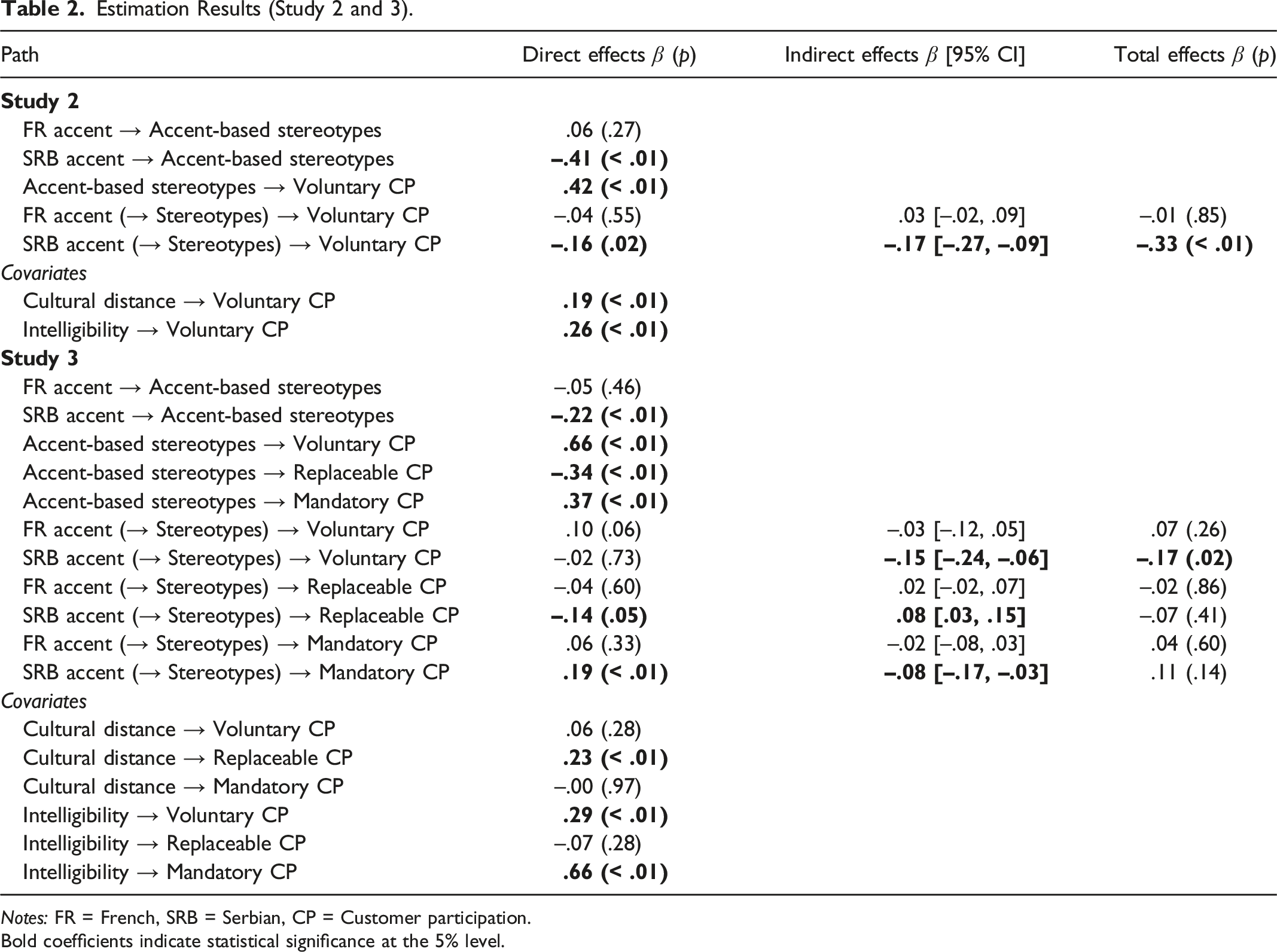
Notes: FR = French, SRB = Serbian, CP = Customer participation.
Bold coefficients indicate statistical significance at the 5% level.
Moderation effects
We conducted moderation analysis using item parceling and residual-centering. Following Lance (1988), we computed the products of the interacting variables, and then orthogonalized each of these products after regressing them on the composite variables originally used to construct them, and retained the derived unstandardized residuals. We then used these residuals as indicators of the latent interactive variables after setting their error variances at levels determined by the original variables’ reliabilities (Ping 1995).
As predicted in H4, customers’ perception of having control over the service process moderates the effect of foreign accent valence on service employee stereotyping, that is, the a-path in the model (binteraction = .19, p = .02). When customers expect that they have more control over the service outcome through using the self-service option (i.e., for values greater than 5.57 on the 7-point scale), the unfavorable accent has a non-significant effect on employee stereotyping. In contrast, when customers do not perceive the self-service option as giving them high control over the service outcome, the effect of the unfavorable accent on employee stereotyping remains negative and significant (see Web Appendix A10).
Consistent with H5, we find that the negative effect of favorable accent-based employee stereotypes on replaceable CP (i.e., the b-path in the model) is accentuated when customers have a high need for interaction (binteraction = –.24, p = .02). When customers prefer interacting with the human employee to complete the service delivery, the consequences of positive stereotyping become stronger and decrease customers’ willingness to use the self-service (i.e., replaceable) participatory option (Web Appendix A10). On the contrary, when customers do not have a high need for interaction (i.e., for values smaller than 3.75 on the 7-point scale), the negative effect of stereotypes on replaceable CP becomes non-significant.
Discussion
Study 3 corroborates the findings of Studies 1 and 2 by showing that when customers interact with an employee whose foreign accent they do not like, they judge the employee as less superior, attractive, and dynamic. Such judgments impede their voluntary and mandatory CP intentions and increase their desire to “take matters into their own hands” (e.g., by using self-service options). When the service employee has a favorable foreign accent, though, consumers’ willingness to contribute to the service process does not significantly differ from situations in which the employee has a native local accent. Counterintuitively, an unfavorable accent also decreases mandatory CP (e.g., following the service provider’s policies or providing essential information required for service delivery). This finding highlights the severe consequences that accent-based stereotypes have in intercultural service encounters, even for activities necessary for the fulfillment of service provision, and which would normally be expected to make customers overcome their stereotypical service employee assessment toward the purpose of fulfilling their service demands.
Customers’ perceived control over the service delivery mitigates the stereotyping of a service employee whose accent they do not like. When customers feel they have a self-service alternative to shape the service outcome autonomously, the “discomfort” of relying on an employee with an unfavorable accent is alleviated. In such cases, customers do not place emphasis on the employee’s accent because they do not depend on them to achieve a satisfactory service outcome, to enjoy the service experience, or to customize the service offer. Relatedly, the more positive associations an employee’s accent elicits, the safer customers feel letting them handle the service process and the less likely they are to complete service activities by themselves. This relationship is reinforced when customers strive for personal contact, consistent with prior research suggesting that a high need for personal interaction decreases motivation to use self-service alternatives (Meuter et al. 2005).
Study 4
Focusing on internal validity, Studies 1 to 3 followed an experimental approach with hypothetical service scenarios to causally link employee accent valence with CP and identify the effect’s underlying mechanisms and boundary conditions. Study 4 aims at replicating the main accent effect in a more realistic and ecologically valid setting. To this end, in this study, we provide a real service to customers and use a behavioral operationalization of CP that goes beyond self-reported intentions by using a direct measure of actual participation.
Method
We collected data from 153 Austrian participants (66.7% female, M AGE = 37.4, SD AGE = 12.8) using a quota sampling approach based on age. We designed a “guided meditation” service with an outcome (i.e., stress reduction) that is a direct function of participants’ willingness to share information about their emotional well-being for the purpose of achieving superior service customization. This service was deemed appropriate for the following reasons. First, the study was conducted following the outbreak of the COVID-19 pandemic which caused a 25% increase in prevalence of anxiety and depression worldwide (World Health Organization 2022) and a global spike in demand for counseling and mindfulness-related services including smartphone-based meditation applications (Washington Post 2020). Second, this service is relevant to a diverse range of consumers, is easily administered, and can be conveniently incorporated into a busy life schedule. Third, it offers a realistic setting for assessing voluntary participation as the quality of meditation service outcomes (e.g., customized relaxation guidance) is improved through active participation (e.g., offering more information on one's emotional state). Fourth, the online nature of the service reflects the boost in remote services following social distancing restrictions due to COVID-19. Finally, this service context respects respondents’ anonymity and data protection regulations.
At the beginning of the study, the benefits of meditation were described in a short text. Subsequently, participants listened to a 30-second audio message from a meditation trainer introducing herself. Similar to Studies 2 and 3, there were three experimental conditions that participants were randomly assigned to (local, Serbian, or French accent). All three accents were delivered by the same professional voice actor to hold speaker-specific variables constant. In this study, we used a different (i.e., a female) speaker because we explicitly opted for someone with a very soothing and comforting voice to make the service experience realistic and enjoyable. Then, respondents were asked to fill out multi-item scales about their personality, mindfulness, and perceived stress so that they are offered the most appropriate type of guided meditation based on their answers. This way, participants were implicitly made to believe that the aim of the study was to test the effectiveness of different types of guided meditations and that providing as much personal information as possible would help generate the most well-suited form of meditation for them (i.e., lead to a more customized service experience). This approach was used to disguise the true purpose of our investigation and avoid priming effects. After completing these scales (that were not directly related to our research model), participants were asked to describe their current emotional state in a text field using keywords separated by commas. The number of characters each participant wrote to answer this open-ended question was used as an operational measure of voluntary CP, in line with the notion that voluntary CP is not essential for service delivery but is performed at customers’ discretion to improve their service experience (Dong and Sivakumar 2017).
Afterward, participants took part in a three-minute guided meditation narrated by the trainer speaking with the same accent as in the audio introduction that participants had listened to at the beginning of the study (see Web Appendix A11 for transcripts). Finally, participants completed a short questionnaire including manipulation check items and demographic data, were debriefed, and thanked.
Results
Manipulation checks
ANOVA results showed that there were significant differences in perceived accent foreignness (M LOCAL = 1.90, M SRB = 6.13, M FR = 6.47, F(2, 150) = 214.37, p < .01; Serbian versus Local p < .01, French versus Local p < .01, French versus Serbian p = .18) and liking (M LOCAL = 5.42, M SRB = 3.69, M FR = 4.86, F(2, 150) = 16.58, p < .01; Serbian versus Local p < .01, French versus Local p = .07, French versus Serbian p < .01) in the intended direction across conditions.
Direct effects
We found that the average text length (i.e., the number of characters typed – a proxy of voluntary CP) that participants typed to describe their emotional state significantly differs depending on the meditation trainer’s accent (M LOCAL = 38.88, M SRB = 27.00, M FR = 42.65, F(2, 150) = 6.69, p < .01), as shown in Web Appendix A12. Consistent with our previous findings, participants were less willing to provide discretionary personal information to co-produce the service when the service provider had an unfavorable foreign accent compared to a more positively connoted foreign accent or a local accent. LSD post hoc tests confirmed that respondents participated significantly less when the trainer had a Serbian accent compared to a French or local accent (Serbian vs. Local p < .01, French vs. Serbian p < .01). Notably, the number of characters typed was not statistically different between the French and local accent conditions (French vs. Local p = .40), further attesting to an accent negativity bias. The effect magnitude can be considered medium (η2 = .08, Cohen’s d = .70).
Discussion
Study 4 found that even after communicating to customers that voluntarily participating in service delivery would lead to a more customized service experience, customers contributed less information about themselves when the service provider had an unfavorable accent than when she had a favorable or a local accent. Thus, Study 4 offers additional support for H1 by showing that the negativity bias is not limited to hypothetical service scenarios but replicates for a relevant, real-world service with a salient and desirable service outcome. Using a consequential measure of CP, this study thus shows that customers may “sacrifice” a certain degree of service quality (e.g., opportunities for customization or enhanced service experience) that would otherwise be achieved by voluntary participation.
Conclusion and Implications
The globalization of the labor market, the unprecedented growth in immigration flows, and the removal of barriers in the movement of global workforce have left service managers across various industries (retailing, banking, transport, etc.) with large numbers of immigrant employees in their ranks. As the interaction between customers and service personnel is critical for service quality, customer satisfaction, and the development of service provider-customer relationships (Curran, Meuter, and Surprenant 2003; Parasuraman, Zeithaml, and Berry 1994), service practitioners are increasingly called to design and manage intercultural service delivery systems which entail the risk of ethnic stereotyping. Considering the role of a prominent audial cue in intercultural service encounters and unveiling the factors that govern such stereotyping, our research offers several contributions to the literature on accents, stereotyping, and service participation and yields actionable advice for service practitioners.
Theoretical Contributions
Accent as an antecedent of participation in intercultural service encounters
Acknowledging the importance of CP for successful service delivery, service scholars have long called for research aimed at identifying what stimulates or hinders service co-creation (Oertzen et al. 2018) and exploring how situational factors facilitate or impede customers’ participatory efforts in service contexts (Dong and Sivakumar 2017). Addressing these calls, our research integrates theoretical frameworks and empirical insights from research fields that have previously only existed independently. Our theorizing contributes to various disciplines including linguistics (speech evaluation, language attitude relationships), social psychology (social identity theory, social stereotyping), and service research (customer participation, self-service systems) by showing that a service employee’s accent is an important determinant of service value co-production. In contrast to virtually all existing studies on CP predominantly focusing on the consequences of participation 5 , we contribute by identifying a factor that drives participation. Additionally, unlike most previous research on accents focusing on self-reported perceptions (e.g., Tsalikis, DeShields, and LaTour 1991), expectations (e.g., Roggeveen, Bharadwaj, and Hoyer 2007), feelings (e.g., Rao Hill and Tombs 2011) or intentions (e.g., DeShields et al. 1997), we show that this new factor is strong enough to impact real-world participatory behaviors. Notably, our findings are enlightening for the literature on intercultural service encounters by offering one explanation on why such encounters often lead to lower service outcomes compared to service encounters where customers and service employees share the same national or cultural origin.
Accent negativity bias: “Not all foreign accents are created equal”
Our findings challenge the conventional wisdom that all foreign accents act as communication and cooperation barriers (see Fuertes et al. 2012). Although we find that unfavorably stereotyped foreign accents might be hurtful in participatory service contexts, our results indicate that a foreign, yet favorable, employee accent has a similar impact on participatory outcomes to that of a local accent. We call this distinction “accent negativity bias” and define it as the asymmetric dominance of unfavorable versus favorable employee accents in shaping accent-based stereotypes. Such bias corroborates Mai and Hoffmann’s (2014, p. 152) suggestion that “under certain conditions, accents may also be advantageous in business communication.” Our findings thus warn that the negative effects of foreign accents might have been overstated or overgeneralized in extant accent literature. Despite research suggesting a hierarchy of preferences among different accents (Hosoda and Stone-Romero 2010), most previous studies were conducted in English-speaking countries and/or contrasted local accents with stigmatized accents such as Filipino (Roggeveen, Bharadwaj, and Hoyer 2007), Indian (Boussebaa, Sinha, and Gabriel 2014; Tombs and Rao Hill 2014), or Polish and Turkish (Walsh et al. 2012), rather than with less discriminated accents such as Scandinavian, Dutch, German, Italian, or French. This implies that a wider range of accents and cultural contexts (i.e., non-English speaking countries) must be included in future accent studies.
Stereotyping explains accent effects in service participation
Our work further contributes by addressing Mai and Hoffmann’s (2014, p. 138) concerns that “prior research does not help to disentangle the contradictory findings because extant studies have mainly applied stimulus-response experiments in such a way that they contrasted certain accents with the standard language, but did not model the intervening variables” and that “accent research requires more sophisticated research designs, including a deeper exploration of the mediating and moderating effects involved in accent processing” (p. 151). Our findings show that stereotypical judgments of superiority, attractiveness, and dynamism triggered by a service employee’s accent represent the underlying reason why customers are less willing to participate in co-producing the service. Importantly, we show that the role of accent-based stereotypes is manifested above and beyond factors typically considered in intercultural service interactions (such as intelligibility) and observed regardless of how culturally close the customer’s and the service employee’s ethnic origins are perceived to be.
The dark side of accent-based stereotyping: Service experience sacrifices
Although CP has mostly been investigated as a voluntary behavior, more fine-grained conceptualizations have recently highlighted that CP may also have mandatory (i.e., CP as prerequisite for service completion) or replaceable (i.e., CP as substitute of service provider’s input) character (Asokan Ajitha et al. 2019; Dong and Sivakumar 2017; Pham, Sweeney, and Soutar 2019). Our findings lend credibility to this distinction by showing that beyond impeding voluntary participation, negative accent-based employee stereotyping has opposite effects on mandatory and replaceable participatory behavior. This paradox occurs because customers seem to prefer putting more personal effort in a service delivery process (i.e., complete tasks they would otherwise delegate to the service employee) or refrain altogether from engaging in participatory activities even when these are necessary for service fulfillment (i.e., service deferral) just to avoid interacting with employees whose accent they dislike. Thus, accent-based stereotypes have unintended consequences strong enough to make customers tolerate inferior service experiences or sacrifice service convenience.
Control and motivation to co-produce with stereotyped service employees
Despite finding that unfavorable accents are value-destructive in intercultural service encounters, we contribute by finding two important psychological determinants that override accent-based stereotyping. The first refers to one’s ability to overcome negatively stereotyped employees through having a sense of control over the service process. Feelings of being in control over the service outcome empower customers to take the service delivery into their own hands, ultimately neutralizing the negative consequences of an unfavorable accent. The second refers to one’s willingness to interact with service employees captured through customers’ need for human interaction. Customers’ desire to personally interact with frontline personnel partly eliminates the accent barrier by decreasing customers’ preference for humanless self-service alternatives. Customers who generally value human contact are less likely to perform key activities of the service process themselves, even when this entails communicating and cooperating with a negatively stereotyped, foreign-accented employee.
Managerial Implications
Assign, train, and support foreign-accented employees in service posts
A seemingly effortless suggestion emerging from our findings would be that service practitioners can overcome threatening stereotyping by carefully allocating non-native employees to service posts. At face value, one could mistakenly interpret our findings as suggesting that foreign-accented employees whose accent is positively perceived by customers are better suited for frontline service posts, while employees with negatively stereotyped accents are better suited for back-office roles or service posts that entail limited interaction with customers. We cannot distance ourselves enough from such interpretation and we cannot overstate that service employees should not be discriminated against based on their ethnic origin or accent. By extension, we do not suggest that frontline service posts should be staffed exclusively with locals or favorably stereotyped accented employees. Deeply ingrained cultural stereotypes that are shaped by the host country’s society and/or customers’ personal experiences are expected to play a far more important role than whether a service employee speaks with an accent. Although service managers cannot directly counteract these stereotypes, firms should bear in mind that counterproductive behaviors by customers are the result of their perceptions rather than an accent. Often, customers use an employee’s accent as a surrogate explanation for underlying problems associated with a company or their own pre-existing emotions and expectations (Rao Hill and Tombs 2011). Due to its discriminatory implications, this distinction should be internalized by practitioners when deciding on staff allocation to service posts and supporting immigrant workforce.
Counter to such discriminating proposals, we advise service practitioners to consider inclusive policies such as mixing unfavorably accented employees with favorably accented and native-speaking ones in service delivery posts or rotating them in frontline versus back-office service posts, as such policies would limit the impact of negative stereotyping in service delivery. Additionally, we recommend service employee training aimed at improving language skills. Despite being treated as a statistical control, acoustical intelligibility had a significant influence on voluntary CP in our studies, suggesting that firms should offer training that focuses on general speech quality (i.e., volume, hesitations, enunciation, and clarity of arguments) to both native- and foreign-born employees, as oral skills enhance communication effectiveness and customers’ task clarity. However, considering language command as the only criterion for frontline employee hiring or staffing decisions might still be insufficient in resolving participatory deficits in intercultural service encounters. Training aimed at fostering service delivery skills (e.g., service quality seminars, training in dealing with “challenging” customers, conversational and observational skills) or customer relationship management competencies (e.g., customer orientation training) would prepare employees to overcome the negative stereotyping triggered by their foreign accents or handle it professionally if it occurs. Such training also boosts customers’ confidence in the staff’s capabilities and enhances customer-employee interaction (Machado Nardi et al. 2020).
Offer self-service delivery alternatives
When customers believe that the service outcome depends entirely on the employee’s performance, the process through which customers form their expectations might be more elaborate and certain employee- or interaction-specific attributes (e.g., cultural cues such as accent) might be weighted more heavily by customers. In contrast, when the service setting allows customers to take charge of key steps in the service process, customers are not influenced by the employee’s accent to a threatening extent because they feel self-reliant and empowered to achieve a satisfactory service outcome through their own efforts. We thus advise service managers with a substantial share of stereotyped immigrant employees in their workforce to complement their service delivery systems with self-service alternatives. Such interaction-minimizing options offer customers who stereotype service personnel based on their accent an alternative route to service delivery by handing them over the control needed to fulfill their service needs without involving human interaction. Similarly, providers of services relying on self-service technologies or where such technologies represent the “default” service delivery mode should consider allocating immigrant employees to supporting service posts operating in parallel to self-service systems.
Balance mandatory and replaceable participatory activities
A threatening consequence of unfavorable service employee accents observed in our studies is customers’ unwillingness to participate in service delivery tasks even when those are necessary for successful service provision. Although we do not expect that this finding generalizes in all mandatory participatory services (e.g., standardized services such as applying for a passport renewal, undergoing an eye vision test, or showing a ticket to a train conductor), there is always a risk that some aspects of the service experience might be negatively affected if those services demand employee-customer interaction. In such cases, managers are advised to consider balancing replaceable and mandatory participatory service activities. This can be achieved by (1) transforming some interactive tasks to self-service ones, (2) informing customers on activities that can be performed without the need for employee interaction (e.g., preparation before showing up at service points), and (3) redesigning service delivery systems in ways that eliminate unnecessary interactive steps. Beyond minimizing threatening intercultural contacts, such practices should make service delivery more efficient, empower customers, and offer them a higher degree of autonomy and control, increased opportunities for service customization, temporal flexibility, quicker service delivery, and feelings of self-accomplishment. Finally, increasing the replaceability of certain service components through service gamification (Ciuchita et al. 2022) might offer hedonic benefits (e.g., taking on challenging yet entertaining tasks, sparking curiosity, etc.).
Enrich interactive components in service delivery processes
We offer evidence that the negative effects of unfavorable accents diminish for customers exhibiting a high need for interaction. Although such need generally represents a stable customer trait caused by one’s inability to engage with “dehumanized” service systems (e.g., older or digitally illiterate customers) or their appreciation of service aspects that are safeguarded by human interaction (e.g., privacy concerns, empathy seeking), it is plausible that service systems can situationally prime customers’ need for interaction through the incorporation of interactive elements or the elimination of impersonal service processes. For instance, service providers often use scripted responses to consumer inquiries which are beneficial for maintaining a certain degree of efficiency and standardization. However, these tools limit the potential for human interaction and often backfire by signaling apathy, lack of service authenticity, and causing customers’ emotional exhaustion (Shin and Hur 2022). Acknowledging the uniqueness of each service encounter, service providers are advised to authorize employees to adapt or deviate from scripts. Moreover, as the impact of stereotyping subsides with increasing personal contact between out-group members (Dovidio, Gaertner, and Kawakami 2003), the development of long-term relationships between service employees and customers (e.g., assigning customers to a dedicated “personal” service employee over their lifecycle, developing service employee champions for stereotyping-prone customers) represents a promising intervention for service providers relying on immigrant workforce.
Limitations and Future Research
Our studies have limitations that warrant future research. First, our findings cannot be generalized across all service contexts, especially in cases of low-involvement, low-risk services (e.g., a taxi ride, or fast-food restaurants). For low-involvement decisions, consumers tend to unconsciously form their judgments with a minimum effort, and the accent cue offers a basis for doing so. Therefore, the influence of an employee’s accent on CP may be even stronger in those service encounters. Similarly, in services where interacting with immigrants is the default condition, accent effects might be minimized due to customers’ habituation. Additionally, although our scenario experiments touched upon the distinction between voluntary, mandatory, and replaceable CP, future research could investigate accent effects that our guided meditation study could not capture by conducting field studies in service contexts with a more balanced combination of different types of participatory tasks.
Second, we focused explicitly on accent effects and therefore used audio recordings as stimuli. Although many service encounters occur over the phone and are devoid of visual cues, future studies could examine the simultaneous effect of employees’ accent, their physical appearance, and even their name, in influencing CP. For instance, a favorable accent might compensate for an unfavorable appearance in shaping customers’ ethnic biases, or vice versa. Similarly, Mai and Hoffmann (2014) call for additional multi-cue experiments, arguing that the magnitude of accent effects in extant studies may be inflated.
Third, in our studies, accent favorability was established on empirical grounds (pre-tests and manipulation checks) and in the context of the country where the studies were conducted. However, accent favorability is affected by multiple factors and likely varies across countries and service contexts. For example, an Indian accent might be negatively connoted in a call center setting due to customers’ negative views of outsourcing (Roggeveen, Bharadwaj, and Hoyer 2007), but the same accent might be perceived as authentic in an Indian restaurant. Similarly, an accent might be positively perceived in one country, yet negatively stereotyped in another. For instance, a Spanish accent may be appreciated in European service contexts but negatively stereotyped by some consumers in the US due to its association with illegal immigration. Future studies could investigate the impact of the fit between accents and service contexts or country-specific characteristics that make an accent seen (un)favorably.
Finally, customers’ reliance on accent-based stereotyping is likely influenced by state characteristics such as their attitude toward globalization, their political orientation, or their values. Investigating these variables would allow a deeper understanding of accent-based stereotyping and offer a more fine-grained profiling of customer segments susceptible to it.
Supplemental Material
Supplemental Material - The Influence of Employee Accent on Customer Participation in Services
Supplemental Material for The Influence of Employee Accent on Customer Participation in Services by David Bourdin, Christina Sichtmann, and Vasileios Davvetas in Journal of Service Research
Supplemental Material
Supplemental Material - The Influence of Employee Accent on Customer Participation in Services
Supplemental Material for The Influence of Employee Accent on Customer Participation in Services by David Bourdin, Christina Sichtmann, and Vasileios Davvetas in Journal of Service Research
Footnotes
Declaration of Conflicting Interests
The author(s) declared no potential conflicts of interest with respect to the research, authorship, and/or publication of this article.
Funding
The author(s) received no financial support for the research, authorship, and/or publication of this article.

Supplemental Material
Supplemental material for this article is available online.
Notes
Author Biographies
References
Supplementary Material
Please find the following supplemental material available below.
For Open Access articles published under a Creative Commons License, all supplemental material carries the same license as the article it is associated with.
For non-Open Access articles published, all supplemental material carries a non-exclusive license, and permission requests for re-use of supplemental material or any part of supplemental material shall be sent directly to the copyright owner as specified in the copyright notice associated with the article.
