




Abstract
Introduction:
When a seriously ill and dying parent is hospitalized, the families are at risk of developing problems. Only sparse evidence is available on the effects of creating family-friendly rooms in hospitals.
Aim:
This study investigates how a seriously ill parent to children aged 0–18 experiences staying in a hospital room with family-friendly furnishing.
Methods:
From September 2012 to September 2015, seriously ill and dying patients with children ages 0–18 were offered the opportunity to stay in a family-friendly room at the North Denmark Regional Hospital. The sick parents were interviewed about how the changed room impacted themselves, their children, and their family.
Results:
The analysis led to three themes: (1) The ability to visit a sick parent, (2) maintaining family functions and relationships, and (3) room for children and adults.
Conclusion:
By offering the families a hospital room with cozy furniture and a big TV screen, seriously ill parents see that their children are more comfortable when visiting the hospital. A family-friendly hospital is not just an idealistic thought, it is a real opportunity to improve the final period of a dying parent’s life.
Introduction
Even though many patients prefer to die at home, a significant proportion of dying patients receive end-of-life care in hospitals or hospices. There is a growing focus on the importance of the physical environment in healthcare facilities, and the concept of healing architecture has gained attention (Fancourt & Finn, 2019; Miller et al., 2022). While it is well-known that children of parents in the palliative phase are at risk of developing problems, research on families’ reactions to hospitalization and how this situation affects the family is limited (Andes & Shattell, 2006; Chowns, 2008; Krattenmacher et al., 2012).
When a parent is seriously ill and dying, it impacts the entire family. The situation may also alter family dynamics and relationships as both parents are grieving. One parent will be absent in the future, leaving the surviving parent to care for the children (Yang & Rosenblatt, 2007).
Studies suggest that extended hospital visits can stifle the parent–child attachment bond, leading the child to avoid contact with their ill parent (Kaplow et al., 2014; Saldinger et al., 1999). Parents and children are stressed, struggling to find their place in the hospital system, and trying to spend as much time as possible with their loved ones (Mossin & Landmark, 2011). Therefore, interventions to create a positive relationship between parents and children during hospitalization are critical for a family’s positive outcome.
Limited evidence is available on the effects of creating family-friendly spaces in hospitals where patients can stay in a homelike hospital environment and spend time with their children (Giesbrecht et al., 2018; Timmermann et al., 2015). Studies on the vulnerable positions of patients and family caregivers during hospitalization have explored the impact of these spaces. Research on the children of parents hospitalized and parents with a mental illness suggests that providing the opportunity to visit can help dispel a child’s fear about what is happening to their parent (Isobel et al., 2015; Poehlmann et al., 2010). A family-friendly environment is already a part of the specialized palliative care in hospices but has yet to integrate into basic palliative care in hospitals in Denmark.
Materials and Methods
From September 2012 to September 2015, 39 seriously ill and dying patients with children aged 0–18 years were offered the opportunity to stay in a family-friendly room at the North Denmark Regional Hospital.
The idea to furnish family-friendly hospital rooms is based on interviews with children of dying parents (Buchwald et al., 2012).
The family-friendly rooms are placed in acute wards and are furnished with a sofa, a relaxing chair, a small bookcase, colored cushions, and carpets (Figure 1). The room differs from other hospital rooms, constituting a small living room area with comfort and coziness. Additionally, entertainment facilities, including items like AV consoles, a TV, video, Nintendo Vii (WII), PlayStation, and so on, are installed. All patients who were asked if they wanted these facilities accepted these changes to the room.
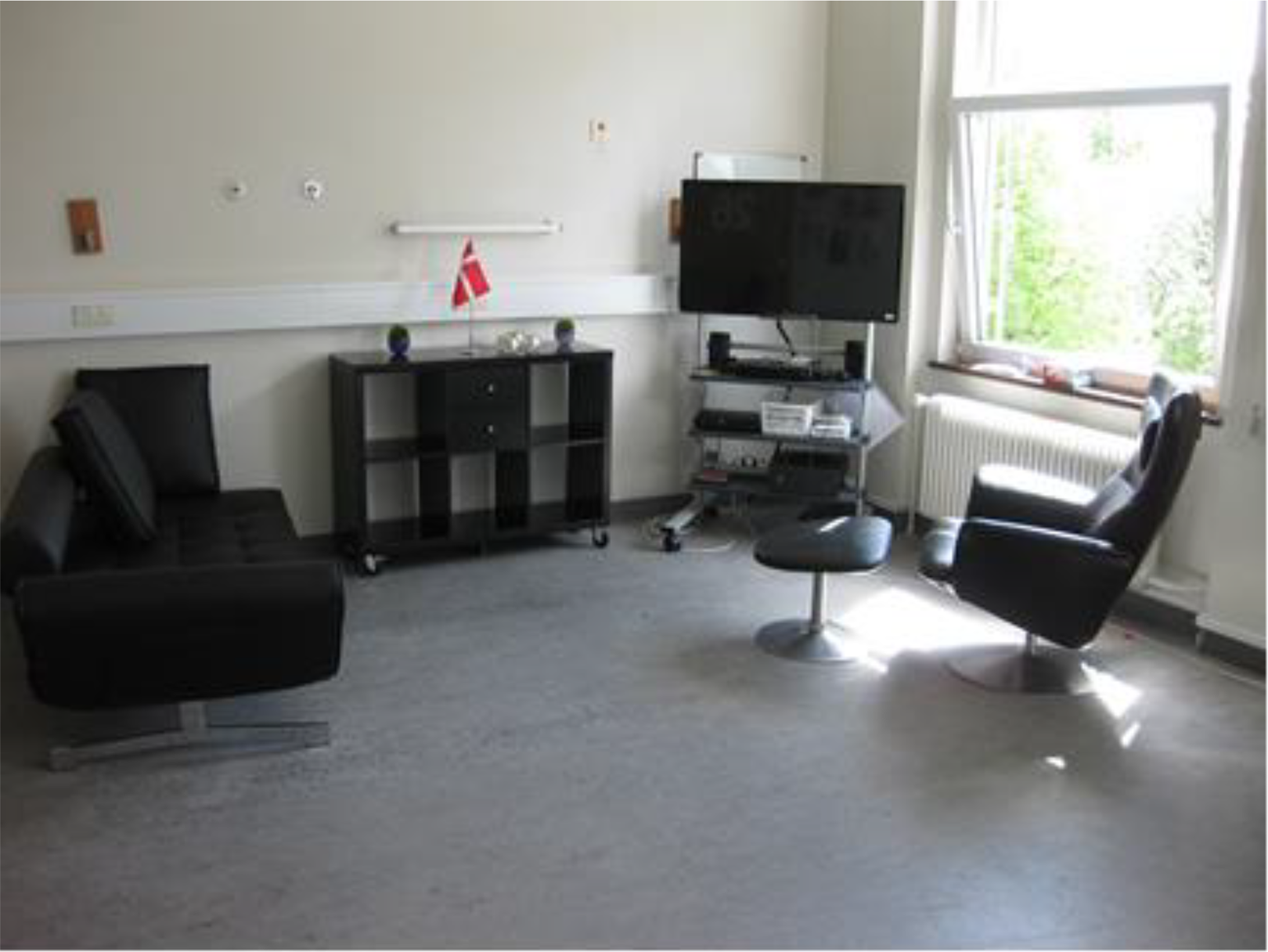
Picture of a family-friendly room with cozy furniture and entertainment facilities.
Method
The descriptive phenomenological approach of Reflective Lifeworld Research (RLR) was applied (Dahlberg et al., 2001). The purpose of RLR is to describe the phenomenon studied as the participants experience it. RLR also focuses on openness which is important in describing or interpreting the phenomenon in context, with a commitment to an open attitude throughout the whole process. The characteristics of the phenomenological analysis applied were flexibility, pliability, and movement back and forth between the whole and the parts in an attempt to understand the meaning of the various parts of the whole and vice versa. Therefore, researchers try to uncover the phenomenon while remaining open to the participants’ expressions of the meaning of their lifeworld (Dahlberg et al., 2001).
Openness is an essential concept in phenomenological philosophy. The importance of remaining open as a researcher and holding back your preconceived understanding of the phenomenon is, therefore, an important ability that Husserl introduced (Dahlberg et al., 2001). The key principle of this phenomenological approach is openness to the phenomenon. In this case, the focus is on hospitalized parents and their children as expressed in their own words. Because this approach focuses on people’s lifeworld, it creates a basis for understanding how people live their lives, health, well-being, and suffering (Dahlberg et al., 2001).
To ensure transparency, the study used consolidated criteria for reporting the qualitative research (Consolidated criteria for reporting qualitative research) as a reporting guideline (Tong et al., 2007).
Participants and Samples
The criteria for participation involved patients in palliative care with cancer, parenting one or more children under age 18, and being able to take part in face-to-face, in-depth interviews. The research sample included 39 participants, 11 men, and 28 women, with a mean age of 42, ranging from 29 to 52. We ceased participant inclusion when our interview analysis did not contribute to any new critical input. Therefore, we could conclude that the point of theoretical saturation had been reached.
Data Collection
The author of this article (D.B.), a palliative care nurse and PhD, interviewed hospitalized parents. The patients were connected to the palliative team but not necessarily to the nurse who conducted the interviews.
Because the patients were very sick, the interviews were limited to three open-ended questions. These questions focused on the sick parent’s experiences of the significance of changing a normal hospital room to a child-friendly living room and the impact on themselves, their children, and their family. The following questions were asked: How did you experience staying in the refurnished room? Can you tell me how your children experienced the changes? What did the new room mean for you as a family?
Procedure
Participants were included in the study if they were in a palliative state with a cancerous disease, accepting a family-friendly hospital room, speaking Danish, and were cognitively and linguistically capable of participating in the interview.
The staff identified potential participants. They were then contacted by the researcher (D.B.) and received verbal and written information about the project. If they agreed to participate in the project, written consent was obtained. This first contact was essential to inform the participants and establish an initial relationship. A time was set for the interview. The interviews were as short as possible by the participants’ serious illness. In general, the duration was approximately 30 min. All interviews were recorded and transcribed verbatim by the interviewer. Because of the health positions of the participants, the transcripts were not returned to them for comment afterward.
Analysis of the Findings
The interviews were analyzed within the interdisciplinary research group, consisting of a RN, an occupational therapist, and both experienced researchers and a psychologist. Interpretations were continuously challenged and discussed. The research group conducted the analysis in four phases (Dahlberg et al., 2001). Phase 1: Listening to the taped interviews, transcribing the text, and repeatedly reading the text to gain a comprehensive understanding. Phase 2: Breaking the text into smaller sections of meaning. These sections were based on the statements made by participants in the interviews and words or phrases that captured the phenomenon’s different meanings. Phase 3: Dividing the units into groups according to their meaning. Phase 4: Designing new groups that form the basis of the constituents. The constituents and their interrelationship then formed the essence of the phenomenon.
Ethical Considerations
This study was performed in compliance with the Declaration of Helsinki. The patients were verbally informed about the project, and informed consent was obtained prior to participation in the interview. Due to Danish law, the regional ethical committee of Northern Denmark reviewed the study protocol but waived the need for approval. All documents, such as signed consent forms and interview transcriptions, are stored according to the General Data Protection Regulation.
Because the purpose of the study was to collect information from seriously ill patients, ethical considerations were based on interdependent ethics, which meant that consideration for individuals was the main priority (Løgstrup, 1997). This consideration involved asking only a few questions in quiet surroundings, with the opportunity to end the interview if the participant became too tired.
Because of this unique phenomenon, the narratives were very personal, but personal details such as names, ages, and diagnoses were changed to preserve confidentiality.
Results
The analysis led to three themes: (1) the ability to visit a sick parent, (2) maintaining family functions and relationships, and (3) room for children and adults. The themes were found after we analyzed the interviews with 39 informants. The patient cases presented below are chosen as representative of the group of informants.
The Ability to Visit a Sick Parent
Sick parents report that some children avoid visiting them in the hospital and prefer to stay at home or with family members. The seriously ill and dying parent misses the child, but at the same time, parents do not want to put any pressure on a grieving child.
This avoidance happened to Peter, a young man aged 45 with lung cancer. His 12-year-old son had been very attached to his father, but when Peter became extremely sick and in hospital, his son refused to visit him. He told his mother he had seen enough of hospitals and being there was boring. We talked to Peter and changed the furniture and equipment in his hospital room to enable a child-friendly setup. The mother told her 12-year-old son about the changes and about the different games he could play, and the son agreed to visit his father. They had a nice evening together. His son was lying on the sofa, playing games on the PlayStation, and he and his father watched a football match on TV. Peter said: Spending time with my son is the most important thing in my life right now.
We met Christian, a 39-year-old man diagnosed with pancreatic cancer. Christian had two daughters, aged 12 and 14, but he did not want them to come and see him in the hospital. He thought it would be best if they remembered him as he used to be. He was also afraid that the hospital and using an oxygen mask might scare his daughters. The healthcare professionals talked to him about his daughters, their need to know what was happening, and their need to be with him. After a few days, he agreed to see them. We changed the room to a family-friendly setup, and the daughters came to visit. At first, it was awkward for all three of them, but after a while, they decided to watch a film together, and they were later heard talking and laughing. I am very tired but also very happy to see my daughters again.
Maintaining Family Functions and Relationships
Seriously ill and dying parents often find it difficult to maintain their family function during a long hospital stay. Small daily routines like watching television and preparing for Christmas can be difficult. We experienced these exact circumstances with Jesper, a 41-year-old man diagnosed with malignant melanoma. Jesper was married and had four children aged 10, 12, 17, and 20. They had a very strong family relationship, and the children often visited Jesper at the hospital. Jesper was offered family-friendly furniture, and in his interview afterward, he almost cried when he explained how much of a difference this had made to him and his family. For this family, a part of being together in December was watching the Christmas Calendar on television. With the living room and a big-screen TV, they could continue this tradition:
Now we can watch the Christmas calendar just as we have always done.
For Niels, a 42 year-old diagnosed with sarcoma, his spouse, and their two children aged 10 and 13, it was important just to be together. The staff at the department had set up a family-friendly living room, and, on the day of our interview, Niels was in bed watching sports on a big TV screen; his spouse was sitting in a chair reading a magazine. Niels told us that because he was tired, he enjoyed watching TV while his wife was relaxing in the chair, and when the children were visiting, they were happy to play games on the PlayStation and enjoy themselves on the sofa. I just enjoy having them around me, even if I am resting and just listening to them.
Space for Children and Adults
Seriously ill and dying patients want to be with their families. As well they need peace. It can be difficult if children get bored and impatient. By ensuring that there are opportunities for the children to be engaged and not bored, the sick parent has the chance to be with their family while also getting the peace they need. We found this circumstance was the case for Mona.
Mona was a 37-year-old woman diagnosed with malignant melanoma. She was very tired and had no energy to care for her small children, aged 5 and 7. A family-friendly room was arranged for the family. Mona told us that even though she could not participate in her children’s activities, she enjoyed their visit and just listened to them. The room was divided into sections using the furniture to create spaces for the two small children and their sick mother.
Setting up living rooms to be family-friendly meant more peace in the room during the visit because the children are not bored when they are there. They are relaxed and do not constantly ask when they are going home. We observed that some of the children brought games and toys from home and enjoyed playing on the sofa.
Discussion
We wanted to explore how a seriously ill parent to children aged 0–18 experienced staying in a hospital room with family-friendly furnishings. The findings showed that seriously ill and dying parents enjoyed being with their family when the hospital room was more family-friendly. The findings provided new knowledge about the importance of focusing on these families. Knowing how much it means for a seriously ill and dying parent to change the room and create a family-friendly environment in the hospital must give staff members, leaders, and politicians reasons to explore whether similar actions could be implemented in other hospitals. A family facing death experiences great instability, and there is need for specialized care.
The families find it difficult to maintain close relationships, especially since it is hard and strange for children to visit a seriously ill mother or father in a hospital (Buchwald et al., 2012). A hospitalized sick parent has a natural place in the hospital, while their family may find it hard and uncomfortable. Some children even ask for guidelines on what they can and cannot do in the hospital (Buchwald et al., 2012). The whole family experiences insecurity and anxiety during hospitalization, especially regarding a sick parent’s risk of dying. This topic fills the whole family’s life with insecurities (Husserl, 1997).
Death is visible in hospital settings; it is easier to suppress fear at home in a normal environment without the hospital environment as a threat. This fact does not mean that families are unable to talk about death. They can talk about it, but not all the time. Facing death is like looking at the sun. You can only stand so much of it (Yalom, 2007). Knowing that a beloved family member is sick and dying makes people realize that death is a basic human condition, affecting the relationship between children and parents.
When a seriously ill and dying parent is hospitalized, it impacts the family relationships. They are physically separated for many hours a day, which may lead to anxiety, especially because the relationship is so infinitely important for a person’s lifeworld. Breaking this relationship, in this case, changes the family’s lifeworld with great anguish. It is important to remember that we all depend on each other (Løgstrup, 1997). Quality family time is important for the dignity in patients and families (Guo et al., 2022), and therefore, providing opportunities to facilitate interactions with family and maintain family relationships and functions is extremely important (Wong et al., 2023). It is significant in how the family adapts to the new situation (Thastum, 2005). An important finding in this study is that family relationships can be maintained by changing a few routines and altering the hospital room setup.
Strengths and Limitations
The qualitative method was chosen because we found this approach best suited to a study focusing on understanding phenomena that cannot be quantified and reduced to operational values. We found several strengths and limitations based on this choice. Because we wanted to explore the sick parent’s experiences of the refurnished room, one of the study’s strengths was that we included a relatively large number of varied participants. They were of different genders and ages. Another strength was that the patients were interviewed in a calm and cozy environment. A weakness of the study was that, in some cases, the interviewer was the contact nurse in the palliative care team, which might confuse patients in their relationships with their caregivers. Another weakness was that we could not verify their statements because of the patients’ severe and progressive disease.
Possible Follow-Up Studies
This study focuses on the sick and dying person’s perceptions of the family-friendly concept. Future studies could advantageously focus on broader perspectives by including spouses and children.
Conclusion
A seriously ill and dying mother or father finds their children feeling insecure, scared, and even reluctant to visit them in the hospital. By offering the families a family room with cozy furniture and a big TV screen, seriously ill parents see that their children are more comfortable when visiting the hospital. The parents report that the changes allowed them to participate in family life, such as watching Christmas TV together.
A family-friendly hospital is not just an idealistic thought; it is an opportunity to improve the final period of a seriously ill and dying parent’s life, therefore, the whole family’s life.
Implications for Practice
It is important for parents who are in end of life that space is created for their children in the hospital. Patient rooms should be furnished with, for example, couch and TVs to create space for the children. Hospitals should have a special focus on children as relatives of the seriously ill.
Footnotes
Acknowledgments
We would like to thank the families who participated in this project and the North Denmark Regional Hospital for providing time for the project.
Declaration of Conflicting Interests
The authors declared no potential conflicts of interest with respect to the research, authorship, and/or publication of this article.
Funding
The authors disclosed receipt of the following financial support for the research, authorship, and/or publication of this article: Inner Wheel, Hjoerring and Spar Nord Fonden.