




Abstract
Research solidly documents the victim-offender overlap in various crimes, including human trafficking. Given the hidden nature of this exploitative crime, increasing the identification of victims is crucial. One way to do this is through the creation and implementation of screening tools. To date, most screening tools for human trafficking victims are created by and implemented in the field of health care or with youth or young adults, particularly those who have experienced housing instability. However, the use of these tools to identify victims of human trafficking in correctional settings—where victims are often misidentified as offenders—is limited. To address this deficiency, a victim-centered, trauma-informed screening tool was implemented in a local detention center to identify human trafficking victims, with the purpose of offering them resources to facilitate their exit from trafficking situations. This article outlines the creation and implementation of the tool and discusses its successes, challenges, lessons learned, and recommendations for replication.
Keywords
Introduction
Human trafficking is often referred to as a hidden crime (U.S. Department of Justice 2019) because of its immense under-identification. Experts have noted that the inability to properly identify victims of human trafficking is one of the biggest challenges to antitrafficking efforts (Okech, Morreau, and Benson 2012). Thus, increasing the identification of these cases and the victims and offenders involved in them is imperative. One way to do this is through the creation and implementation of screening tools. Researchers have documented that unidentified victims of human trafficking most likely exist in local jails (Connell et al. 2015; Villacampa and Torres 2015). To that point, Rizo and colleagues (Forthcoming) found that correctional staff have encountered human trafficking victims in their work. Despite this, the use of screening tools to identify human trafficking victims in correctional settings—and corresponding guidance and recommendations—is extremely limited (Macy and Graham 2012; Rizo et al. Forthcoming).
To address this deficiency, this paper discusses a victim-centered, trauma-informed screening tool that was implemented in a local detention center to identify victims of human trafficking with the purpose of offering services to facilitate their exit from trafficking. This article presents information on the purpose, creation, and implementation of the screening tool, as well as a discussion of the successes, challenges, and lessons learned from this endeavor and recommendations for replication.
Literature Review
Human Trafficking
In 2000, the Trafficking Victims Protection Act (subsequently referred to as the TVPA) was passed as the first U.S. federal law to address human trafficking. The law defines two severe forms of trafficking: sex and labor (Department of Justice 2023). Under the TVPA, both forms of trafficking include the “recruitment, harboring, transportation, provision, or obtaining of a person” (and patronizing for sex trafficking) “for either commercial sex or labor through the use of force, fraud or coercion” (22 U.S.C. § 7102(11)(A) and (B)). However, for sex trafficking, if the victim is under 18 years, force, fraud, and coercion are not necessary. Accurate estimates of human trafficking victims are extremely difficult to acquire due to difficulties identifying victims and differences in the data sources and methodologies used (Gibbs et al. 2015; Okech et al. 2012). However, according to the National Human Trafficking Hotline (2021), 10,360 unique incidents of potential human trafficking were reported in the United States in 2021. Of these reports, 72 percent were sex trafficking, 10 percent were labor trafficking, and 4 percent were both sex and labor trafficking (National Human Trafficking Hotline 2021).
At its core, human trafficking relies on exploiting a person’s vulnerabilities (U.S. Department of State 2022). As a result, several vulnerabilities or risk factors exist among victims including, experiencing physical, sexual, and/or emotional trauma/abuse (Clawson et al. 2009; Fedina, Williamson, and Perdue 2019; Roe-Sepowitz 2012), child welfare involvement (Fedina et al. 2019; Rafferty 2013), housing instability (Greeson et al. 2019), running away from home as a youth (Fong and Cardoso 2010), and having had interactions with law enforcement or involvement in the juvenile justice system (Varma et al. 2015). But these risk factors also make identifying human trafficking victims difficult because, not only do they also increase one’s likelihood of criminal offending (Cohen, Krugel, and Land 1981; Finn, Muftic, and Marsh 2015; Lauritsen, Sampson, and Laub 1991), but they challenge the widespread narrative of the “ideal victim” (Christie 1986; Wilson and O’Brien 2016).
Ideal Victim Narrative
A significant barrier to identifying human trafficking victims is the concept of the “ideal victim” narrative, which often taints judgment about who is considered a victim. Ideal victims are often perceived as weak, helpless, and vulnerable and are of morally sound character; implicit in this is the idea that they were not involved in crime as offenders (Christie 1986; Lewis, Hamilton, and Elmore 2021). This type of characterization is common in cases of human trafficking (Wilson and O’Brien 2016) despite the fact that few human trafficking victims actually fit this stereotype (Austin and Farrell 2017), as illustrated above in the list of risk factors.
This characterization was examined by Wilson and O’Brien (2016)’s content analysis of Trafficking in Persons Reports published between 2001 and 2012. The authors argue that through these reports, the U.S. government presents an idealized conception of human trafficking victimization consistent with Christie’s (1986) ideal victim. The reports depict the prototypical victim as weak and helpless due to their status as young women or girls, foreign born from a developing country, and emigrating from their country for morally sound reasons (as opposed to seeking work in the commercial sex industry). This conceptualization reinforces the pervasive idea that human trafficking victims are solely victimized and do not engage in criminal activity. While this image increases public support for assistance, funding, and resources for human trafficking, conceptions consistent with the ideal victim narrative conceal the majority of victims, particularly those involved in criminal activity as offenders.
Victim-Offender Overlap
A false dichotomy often exists in which individuals are categorized as either victims or offenders. When people are viewed solely as offenders, little room exists to also view and treat them as victims. Research firmly documents the victim-offender overlap, which describes individuals’ involvement in crime as both victims and offenders (Iratzoqui 2018). Research indicates that the victim-offender overlap exists for many types of crimes (Jennings, Piquero, and Reingle 2012) such as intimate partner violence (Iratzoqui 2018; Muftic and Hunt 2013; Spivey and Nodeland 2021; Tillyer and Wright 2014), child abuse (Miley et al. 2020; Oei et al. 2021; Rivera and Widom 1990), and violent crimes, including homicide (Hiltz, Bland, and Barnes 2020; Jennings et al. 2010; Muftić, Finn, and Marsh 2015; Pyrooz, Moule, and Decker 2014). The victim-offender overlap has also been documented in cases of sex trafficking (Baxter 2020; Finn et al. 2015), because human trafficking victims are often forced by their traffickers to commit crimes. For example, it is not uncommon for sex trafficking victims to be arrested for prostitution (Polaris 2019; Soohoo 2015). In addition, traffickers may force or coerce their victims to commit theft, drug dealing, or assault, which can result in criminal charges if they are arrested (Einbond, Zedalis, and Stoklosa 2023; Polaris 2019). The Polaris Project identified labor trafficking by forced criminality as one of the top 25 types of trafficking (Einbond, Zedalis, and Stoklosa 2023). Therefore, human trafficking victims can be misidentified as offenders and, thus, arrested and processed through the criminal justice system (Polaris 2019).
Failing to identify human trafficking victims creates challenges for victims, the criminal justice system, and society as a whole for myriad reasons. For example, research indicates that being arrested further traumatizes victims (Love et al. 2018) and often leads to their increased distrust of the criminal justice system (Richard 2016). Relatedly, arresting and processing human trafficking victims through the legal system may lead to a subsequent lack of cooperation with criminal justice officials, thus hindering the system’s ability to identify, investigate, and prosecute those responsible for these exploitative crimes. As a result, many of these exploitative situations will continue to go undetected if victims are misidentified as offenders and subsequently treated as such. Furthermore, labeling victims as criminals can influence their self-identities and lead to secondary deviance (Becker 1963; Lemert 1967). Misidentifying human trafficking victims as criminals not only limits their access to justice, but also restricts their eligibility for resources and services needed to exit trafficking situations (Logan, Walker, and Hunt 2009; Soohoo 2015).
Human Trafficking Screening Tools
While human trafficking screening tools have been created and assessed, most have been created for and implemented by health care professionals (e.g., see Chisolm-Straker et al. 2020; Egyud et al. 2017; Greenbaum, Dodd, and McCracken 2018; Hainaut et al. 2022; Kaltiso et al. 2021; McDow and Dols 2021), victim service providers (Simich et al. 2014), or with youth or young adults, particularly those who have experienced housing instability (e.g., see Chisolm-Straker et al. 2019; Dank et al. 2017; Panlilio et al. 2022). Importantly, these screening tools are intended for these populations exclusively and cannot be used reliably for different groups of people. Only a few of these tools have been empirically validated (Chisolm-Straker et al. 2019, 2020, 2021; Simich et al. 2014). For example, Simich and colleagues (2014) worked with 11 victim service providers to administer a screening tool during their intake process. The screening tool was administered by a social worker or attorney as a semistructured interview and took approximately 40 to 60 minutes to complete. The interviewer subsequently determined the likelihood that the individual was a victim of trafficking using the options “certainly not,” “likely not,” “uncertain either way,” “ikely,” or “certainly.” Factor analyses and other statistical procedures were then used to determine which questions were most likely to predict trafficking based on the service providers’ determinations leading to the tool’s validation.
A growing body of evidence indicates that human trafficking victims are in correctional settings as offenders (Rizo et al. Forthcoming; Connell et al. 2015; Villacampa and Torres 2015). For instance, Rizo and colleagues (Forthcoming) had noted that victims of trafficking are frequently arrested for crimes correlated with their victimization, such as drug crimes, prostitution, property crimes, fraud, and weapons possession (Geist 2012; Ravi et al. 2017; Serita 2012). As a result, a push for correctional facilities to screen for potential human trafficking victims in their facilities exists (Ringler 2019; Stelter 2014). As an example, the National Institute of Corrections created the Correctional Anti-Human Trafficking Initiative (CAHTI) with the aim of preventing and responding to sex trafficking in correctional settings, with a focus on incarcerated female victims (Rizo et al. Forthcoming; National Institute of Corrections N.d.).
Rizo and colleagues (Forthcoming) conducted the only research to date that provides information about the extent of antitrafficking efforts in correctional facilities. They surveyed correctional and antitrafficking leaders (n = 46) in the United States and found that only 16 percent (n = 7) of their correctional facilities screen for human trafficking victims. Most of the screenings occurred during intake were conducted by correctional staff or other personnel (such as investigators or trained professionals), and were specific to juveniles. In addition, most institutions developed their own screening questions with the help of antitrafficking alliances (e.g., Colorado’s High-Risk Victim Identification Tool) or other organizations (e.g., West Coast Children’s Clinic). As an important note, of the screening tools identified by Rizo and colleagues (Forthcoming), only the West Coast Children’s Clinic screening tool (Commercial Sexual Exploitation Identification Tool) was validated (Basson 2017). In addition, Rizo and colleagues identified one leader who noted that their screening process was two-tiered, meaning the presence of red flags at intake leads to a subsequent interview by a trained professional to confirm victimization. Finally, once a victim was identified, most tools notified law enforcement or attorneys. While the development of these tools is a necessary step in identifying victims in correctional settings, the lack of uniformity among the tools makes systematic comparisons difficult.
The Current Study
The objectives of this study are to present a detailed description of a victim-centered, trauma-informed screening tool implemented in a local detention center and examine the successes and challenges of its implementation. In this section, we elucidate the purpose, creation, and implementation of the screening tool. A discussion of the findings, ways in which the tool has been successful, and challenges faced, solutions used, and recommendations for future implementation of a human trafficking screening tool in an adult, short-term correctional setting follow.
Purpose and Creation of the Screening Tool
Research notes that many victims do not self-identify (Einbond et al. 2023), because they are unfamiliar with the legal nuances of trafficking and do not recognize that their experience qualifies as human trafficking (Rodriguez-Lopez 2020). As a part of this, victims often do not recognize that resources for trafficking survivors exist (Logan et al. 2009; Macy and Graham 2012). Therefore, service providers or other professionals must actively intervene or victims will continue to be under-identified and offered services needed to exit exploitative situations (Macy and Graham 2012).
Given this and the dearth of human trafficking screening tools in correctional settings, in early 2021, a regional human trafficking task force collaborated with college faculty, a survivor-led, nonprofit organization that serves victims of human trafficking, and the sheriff and officials at a local detention center to create and implement a victim-centered, trauma-informed screening tool. The purpose of the tool is to identify victims who are misidentified and processed as offenders and to offer resources and services to facilitate their exit out of trafficking situations. As an important note, the tool is not intended to provide information to law enforcement regarding any criminal activity or open/pending investigations, including those related to human trafficking.
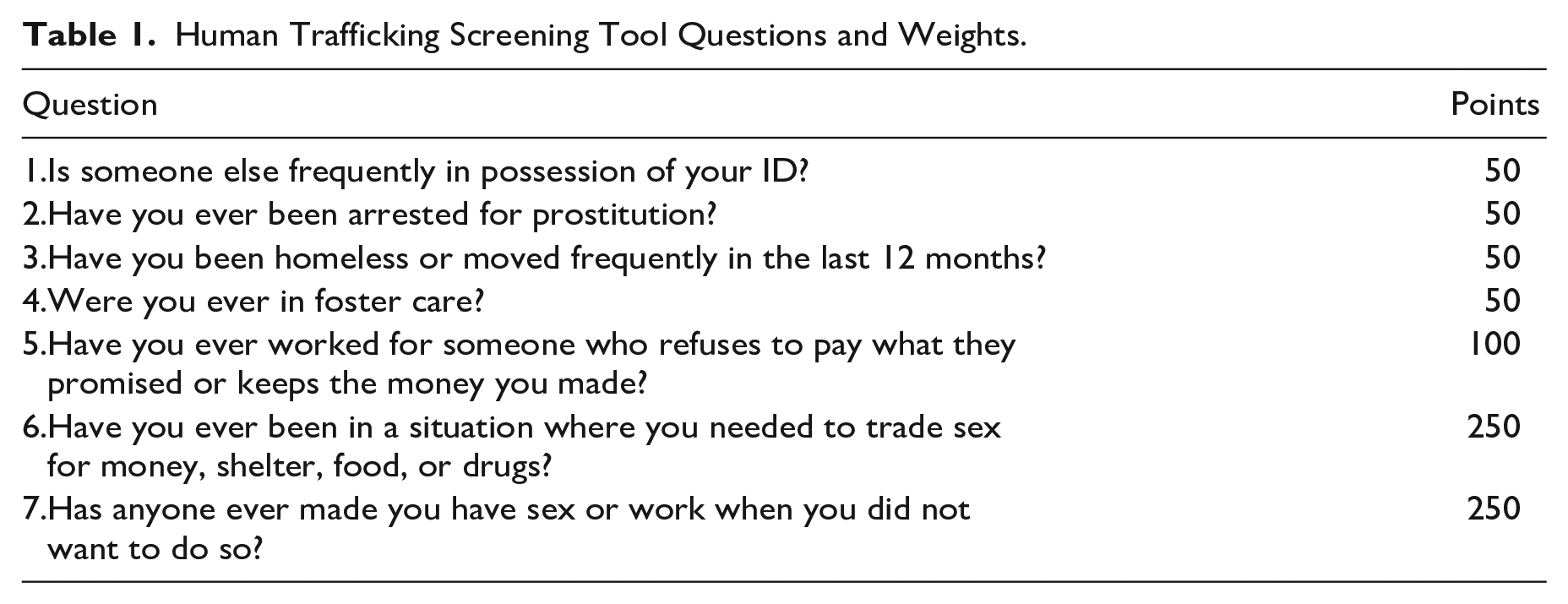
The screening tool uses a data-informed approach to identifying human trafficking victims by grounding the screening questions in research on risk factors for and indicators of human trafficking, as well as using questions from previously validated tools (Basson 2017; Chisolm-Straker et al. 2021; Simich et al. 2014) with slight modifications to make them relevant to adults in correctional settings. For example, the screening tool begins with questions relating to housing instability, previous involvement in the child welfare system, having been arrested for prostitution, and having a lack of control over one’s identification documents, all of which are common risk factors for or indicators of human trafficking (Administration for Children, Youth and Families 2017; Polaris 2018; U.S. Department of State 2004, N.d.). The remaining three questions were modified from screening tools that were validated for similar—but not identical—populations. They are, in and of themselves, more directly indicative of human trafficking victimization. The questions address trading sex for money, shelter, food, or drugs (Basson 2017; Chisolm-Straker et al. 2021); working for someone who refuses to pay what they promised or kept the money (Simich et al. 2014); and being made to have sex or work when the individual did not want to (Simich et al. 2014). In total, the tool consists of seven questions, which are weighted based on the extent to which prior research suggests they accurately indicate human trafficking and the researchers’ assessment of data from the first month of the tool’s implementation. During the initial month, none of the questions were weighted to avoid unnecessary restrictions that would miss potential victims. In addition, a relatively large sample size was needed to determine the proper weighting of the questions. The data gathered during this first month corroborated prior research on questions indicative of trafficking as opposed to simply a risk factor for this type of victimization. For example, while being involved in the child welfare system and experiencing housing instability are risk factors for trafficking victimization, they are not indicative of trafficking in and of themselves. They are much stronger indicators of human trafficking, however, when combined with other risk factors and/or indicators. The screening tool questions and their respective weights are illustrated in Table 1. An individual is flagged by the tool if their answers total at least 250 points. More specifically, a person is flagged if, at a minimum, they answer “yes” to Question No. 6 or 7 or “yes” to Question No. 5 and at least three questions from Question Nos. 1 to 4.
Human Trafficking Screening Tool Questions and Weights.
Given the purpose of the tool, the nonprofit organization was involved in the creation of the tool from its inception. The nonprofit organization is survivor-led and is the primary organization in our area that provides direct services to adult victims of human trafficking (sex or labor), including case management, emergency shelter, employment assistance, rental assistance, and counseling/therapy for substance use concerns and trauma, and includes a robust survivor support network. Before implementing the tool, the nonprofit organization’s capacity to provide services to the identified victims was confirmed. Research notes that one of the failings of similar tools is the inability of practitioners to serve and address the complex needs of human trafficking survivors (Donahue, Schwien, and LaVallee 2019; Okech et al. 2012). In addition, the input of the case managers was necessary to ensure that both the tool and the protocol were victim-centered and trauma-informed. The case managers suggested a two-tiered system (as discussed in Rizo et al. Forthcoming), in which the individuals flagged by the tool were interviewed to confirm trafficking victimization and discuss services, as applicable. 1
Screening Tool Protocol and Implementation
The protocol described below was approved by our college’s Institutional Review Board prior to implementation. The screening tool was implemented in a local detention center in South Carolina on April 6, 2021. The facility is one of the largest detention centers in the state, housing an average of 957 inmates per day (SACDC, 2023) and admitted approximately 30 inmates each day during the dates listed above (L. Green, personal communication, 2023). Prior to implementing the tool, the regional human trafficking task force (of which the nonprofit organization is a part) conducted training for the detention center staff. The training included information on indicators of human trafficking, state and federal human trafficking laws, victim-centered, trauma-informed approaches to working with victims, and the screening tool protocol.
The screening questions were integrated into the detention center’s automated intake process that are asked of all inmates when they are booked into the facility. Prior to asking the questions, the detention officer explains that the screening questions are asked solely to determine one’s eligibility for a referral for services. Per the detention center’s policy, all intake questions are read out loud to avoid literacy concerns, and translators are provided if needed. No informed consent is needed, because this is standard protocol for service referral at this detention center, and inmates are not required to answer the questions.
When an individual’s answers meet or exceed the threshold (i.e., 250 points), an e-mail alert is automatically generated and sent to the researchers, pertinent detention center staff, and case managers from the nonprofit organization. The e-mail alert includes the individual’s answers to the screening questions, in addition to their gender, race, 2 date of birth, arresting offense(s), and the arresting officer’s name. To maintain confidentiality of those flagged, the e-mail alert does not contain the inmate’s name; only their inmate ID and booking ID are included. While the inmate ID is unique to each individual, the booking ID changes with each admission, allowing the researchers and case managers to determine if an individual has been flagged more than once. The case managers from the nonprofit organization only collect the names if the individual agrees to begin receiving services. In addition, the data are password protected on the researcher’s computer.
Once an alert is received, when possible, a case manager from the nonprofit organization coordinates with detention center staff to interview the inmate prior to their release to determine their victim status and, thus, their eligibility for services. The semistructured interviews center on the questions the individual answered affirmatively. The case manager gently engages in conversation about the questions, confirms their answers, and confirms whether force, fraud, or coercion was present; this information is used to determine their victim status. If the individual is identified as a victim and thus eligible for services, the case manager provides information about their organization and the services offered. This approach is ideal; as Okech and colleagues (2012) had noted, when possible, survivors should be involved in the identification process. As mentioned previously, this organization is survivor-led and the case managers are experts in identifying and working with victims of human trafficking, thus validating their determination of the flagged individuals as victims.
When possible, the interview takes place in a private booth at the detention center. If a private booth is not available, the case manager emphasizes the limits of confidentiality and privacy to the inmate prior to speaking with them. Importantly, due to defendants’ constitutional protections, the case managers must not ask about the inmate’s arresting charge and should stop the discussion if the inmate mentions it. The importance of this cannot be overstated; since service providers are not often provided client privilege like attorneys, the information discussed in the interview could be subpoenaed during court proceedings. In addition, all case managers conducting the interviews are trained in interacting with and responding to human trafficking victims in a victim-centered and trauma-informed manner; as such, the interviews are voluntary. Furthermore, when possible, the gender of the case manager is matched to the flagged individual for interview to increase rapport.
Interviews by the nonprofit organizations’ staff are not always possible prior to the inmate’s release, however. Due to the constitutional protections afforded to inmates, bond hearings need to occur within 24 hours of their arrest, although most occur within 8 to 12 hours. Given that interviews are not always possible, each individual flagged by the tool is provided an inconspicuous artifact upon their release from the facility with the nonprofit organization’s phone number should they wish to contact them in the future. The correctional officers who return inmates’ personal belongings upon their release have been instructed to explain the artifact. The first artifact used for the current tool was a plain, black wristband that was changed to a hair tie approximately two years after the tool was first implemented. These artifacts were chosen because they would most likely not be noticed as out of the ordinary by a trafficker, thus not putting the potential victim at risk for retaliation and further victimization.
Findings
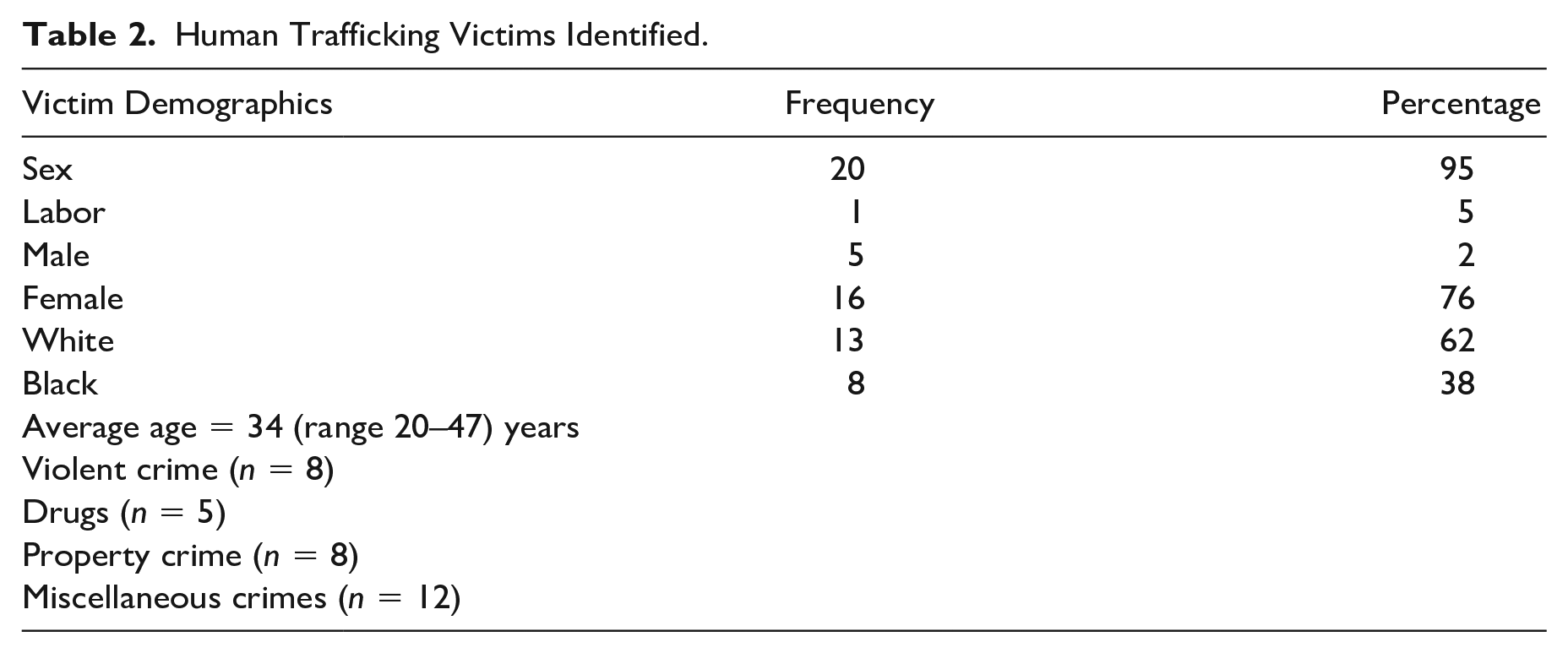
This article presents data from April 6, 2021 to July 7, 2023. Since the tool’s implementation, just under 25,000 individuals have been admitted to the detention center, 199 individuals have been flagged, and 43 (22 percent) of the flagged individuals have been interviewed by a case manager from the local nonprofit organization. Case managers made every effort to interview all flagged individuals; however, this was not always possible. Thus, the completion of interviews with individuals flagged by the tool was only a function of case manager availability. Table 2 illustrates that 21 of the 43 (49 percent) individuals who were interviewed were confirmed as victims and offered services. As also illustrated in Table 2, most of the identified victims experienced sex trafficking (95 percent, n = 20), while 5 percent (n = 1) experienced labor trafficking. In addition, most of the identified victims were female (76 percent; n = 16) and white (62 percent; n = 13); 23 percent were male (n = 5) and 38 percent were black (n = 8). The average age of the victims was 34 years with a range of 20 to 47 years. The victims committed myriad offenses including violent (n = 8), drug (n = 5), property (n = 8), and miscellaneous offenses (n = 12). As is common with trafficking victims, most (66 percent, n = 14) had not reached out for help. However, since being identified by the screening tool, seven victims (33 percent) have actively worked with the nonprofit organization in various capacities. Four of the victims began receiving services from the organization, including receiving case management, emergency shelter, mental health support, and attending peer support groups. The case managers worked with the other three identified victims in an advocacy/outreach capacity, including visiting them in jail, attending court hearings, coordinating with their parole or probation officers, and making referrals to victims’ rights attorneys.
Human Trafficking Victims Identified.
Importantly, 22 of the 43 (51 percent) interviewed individuals were determined not to be victims of human trafficking due to several factors, including (1) overlap between human trafficking and other instances of sexual victimization (n = 10 were victims of sexual assault and n = 2 were victims of domestic violence), (2) engaging in survival sex (n = 4) or consensual sex work (n = 2), (3) clerical or comprehension issues with the tool’s questions (n = 5 denied answering “yes” to the questions or believed their answers were entered by mistake; n = 1 misunderstood the screening questions), and (4) denying experiencing human trafficking victimization and/or needing services (n = 5).
Discussion
While there were many strengths and successes of the current screening tool, several challenges and lessons learned emerged, many specific to implementing a screening tool of this type in a correctional setting. Due to the specific setting in which the tool was implemented, many of the successes also posed challenges; therefore, they are discussed separately and, in more detail, below.
Strengths and Successes
The first strength of the screening tool is its success in terms of fulfilling its purpose, which is to identify victims of human trafficking and offer them services to facilitate their exit from these exploitative situations. Given the under-identification of human trafficking victims broadly, this tool identified victims who had not previously been identified and offered them services to exit trafficking. As noted above, the screening tool was able to identify 21 individuals as victims, in a setting where they would otherwise be viewed exclusively as offenders. Since their interviews, one-third of the victims identified have started working with case managers at the local nonprofit organization. Research notes that many victims do not realize they are victims of human trafficking and that services exist (Rodriguez-Lopez 2020); therefore, the tool was successful in achieving its purpose of identifying victims and connecting them to services. Although the other identified victims have not yet reached out for help, they are now aware that help is available when they are ready and able to leave their trafficking situation. The reluctance to leave trafficking and start receiving services is common for trafficking victims; service providers estimate that it takes some trafficking victims six to seven attempts to leave their exploitative situation (Powell 2018).
An additional strength of the screening tool was the collaborative nature of the tool. Collaboration with the nonprofit organization in the early planning stages of the project to ensure the protocol was victim-centered and trauma-informed was imperative. For one, it allowed the project to have beneficence from the start; the screening tool was not implemented until services for the identified victims were available. Second, as noted, the sole purpose of this screening tool is to identify victims and offer services to facilitate their exit from trafficking; the tool is not used to assist law enforcement. Macy and Graham (2012) noted that most screening tools lead to a notification to either the National Human Trafficking Resource Center’s hotline or law enforcement once a victim is identified. However, they and others (Kaufman and Crawford 2011) note that this should not be done without the survivor’s consent and before they are in a safe place; doing so could not only put them in danger but also limit the power and control they have over their lives. Thus, the current tool employs a victim-centered and trauma-informed approach to identifying victims (Elliot et al. 2005).
Next, an important aspect of the victim-centered and trauma-informed nature of the screening tool is the two-tiered identification process that allows for face-to-face communication between the identified victim and the case manager, once an individual has been flagged by the tool. This was an important aspect of the protocol because the face-to-face communication increases rapport and the likelihood that the victims will use the available services offered. Research has noted the importance of connection (Elliot et al. 2005) and establishing rapport (McGuire 2019) in helping survivors of complex trauma participate in their own recovery. In fact, Dewan (2014) found that victims of sex trafficking were eight times more likely to seek services if they were referred by a nonprofit service provider as opposed to law enforcement; it is widely noted that trafficking victims generally do not trust law enforcement and are fearful of reprisals from their trafficker for cooperating with the police (Gallagher and Holmes 2008; UNDOC 2006).
Another strength of the screening tool involves the automatic transfer of data to the relevant parties involved. An information technology specialist with the sheriff’s office embedded the screening questions directly into the detention center’s intake question bank. They also set up a scoring system that sent an automated e-mail to the nonprofit’s case managers, relevant detention staff, and the researchers when an individual is flagged. This technological ingenuity allowed for relevant parties to have real-time information about individuals flagged by the screening tool. The importance of this cannot be overstated in a detention center setting where inmates are often only in the facility for a few hours. The real-time notifications allow for case managers to quickly mobilize and interview the flagged individuals. In addition, the information technology specialist sends an excel spreadsheet to the researcher team weekly that includes additional information about the individuals flagged the previous week, including prior charges from the detention center, 3 citizenship status, ethnicity, and arresting agency information.
Relatedly, using researchers allows for real-time assessment of the data to increase the reliability of the tool. For example, as mentioned above, during the first month of implementation, the researchers were able to provide frequencies of the questions that flagged individuals, categorized by victim status and demographic information. Upon analyzing the data, it was apparent that most people were flagged exclusively for the housing instability question, most of whom were determined not to be victims of human trafficking after their interview. The team decided to weight the questions and assigned a lower weight to those that focused on risk factors (Question Nos. 1–4), thus reducing the number of individuals who were flagged but were not victims of trafficking, as determined by the interviews. Another strength of having researchers is the expertise provided; detention staff and case managers do not have the time or training to house a sophisticated deidentified data set, to provide statistics upon request and at regular intervals, or to use the statistical analyses needed for eventual validation. Thus, using researchers is imperative to the overall success of the tool.
Challenges and Lessons Learned
One of the biggest challenges of implementing this screening tool was the ability of case managers to consistently interview the flagged individuals before they were released from the detention center. As mentioned previously, in the first two years of the tool’s implementation, 199 individuals were flagged, but only 43 (22 percent) were interviewed by a case manager. Several issues contributed to the lack of consistent interviews. First, as mentioned previously, inmates are often released on bond within hours of their arrest. In addition, the case managers conduct interviews during traditional working hours and many people are often arrested during nontraditional work hours, such as overnight, on weekends, and on holidays. Furthermore, case managers’ varying caseload sizes, time-sensitive complexities of clients’ care, and staff turnover impacted their ability to interview all flagged inmates before they were released. Thus, myriad factors impacted the number of individuals interviewed and, thus, most likely the number of victims identified. However, regardless of interview status, all flagged individuals are given a discrete artifact with the contact information for the nonprofit organization, upon release; the correctional officers returning their property are instructed to explain the purpose of the artifact. Many victims do not use services because they are unaware they are available (Nixon et al. 2002). The artifact ensures that those who are not interviewed are informed that services are available and those who are interviewed are able to get into contact with the nonprofit organization when ready. The decision to give all flagged individuals the artifact is consistent with a victim-centered, trauma-informed approach, because as discussed above, many victims are reluctant to come forward (even during a face-to-face conversation) and may not be aware they are a victim of human trafficking.
A related challenge is that the interviews cannot be conducted by correctional or law enforcement officers, because this is considered a custodial interview which invokes constitutional protections. When this occurs, arrested individuals are entitled to an attorney. While important, this constitutional protection limits who can conduct the interviews. Along these lines, the protocol explicitly outlines the information the case managers can legally collect and discuss during the interviews; specifically, the inmates’ current charges or arrests may not be discussed. Thus, finding noncustodial detention staff to conduct the interviews when the case managers were not available and limiting the interview discussions to legally permissible information were both challenges of the screening tool’s implementation.
In addition, while initially institutional buy-in was not an issue for the detention center or the nonprofit organization, it eroded with time. The high turnover of detention center staff led to a rotating cadre of newly hired correctional officers and staff that were not properly trained on or informed about the screening tool. Correctional officer and staff’s buy-in is immensely important for the success of any program in a correctional setting (Hill and Wright 2019); without consistent training of detention staff, it is difficult for them to see the importance of the tool. This created additional difficulties for case managers to interview inmates that had been flagged without delays. In addition, as case managers’ caseloads increased in size and new staff were hired at the nonprofit organization, their initial buy-in also seemed to wane in the form of reduced interviews as they focused their efforts on direct service provision.
The inability to consistently interview individuals flagged by the screening tool hindered the ability to both refine the individual screening questions and validate the tool. Regarding the former, the low sample size (n = 43) impeded the ability to assess the questions beyond percentages, frequencies, and measures of central tendency. As discussed previously, 22 flagged individuals were determined not to be victims after the interview. Therefore, refinement of the individual questions is imperative to increasing the accuracy of the tool. However, small sample sizes are not recommended for the statistical procedures required for validation or individual question assessment, such as factor analyses, correlations, regressions, or area under curve analyses.
Another challenge was the timing of the screening tool questions. The questions were embedded into the detention center’s intake process to ensure that all individuals being booked into the detention center were screened. However, booking is also done when individuals are experiencing the stress of an arrest and impending incarceration, and many may be unable to think clearly due to the stress or the influence of drugs or alcohol. Therefore, it is possible that inmates disregarded, were untruthful, or did not fully comprehend the screening questions due the timing. As discussed beforehand, the interviews revealed that a few individuals asserted during the interview that they misunderstood or did not recall answering the screening questions. However, given the intake protocol at this detention center, an alternative time to screen the inmates was not possible that did not overly burden the correctional staff or impede other protocols at the detention center.
Finally, while informal discussions and agreements existed between relevant parties throughout the creation and implementation of the screening tool, a formal Memorandum of Understanding (MOU) was not initially created. This caused some difficulty and ambiguity throughout. For example, various media outlets requested information about the tool; however, without a formal agreement, uncertainties existed regarding who would authorize and disseminate this information. Having a formal MOU that addressed these issues would have expedited and streamlined this process.
Recommendations
Given the successes and challenges experienced during the implementation of this screening tool, several recommendations and suggestions for future implementation are warranted.
Intraagency Collaboration
A MOU should be created and signed by each relevant party prior to the tool’s implementation. The MOU should clearly outline the roles and responsibilities of each entity to avoid ambiguity and facilitate the tool’s execution.
Victim Identification and Offer of Services
During the planning stages, it is imperative to collaborate with service providers (preferably ones who serve human trafficking victims) to confirm their capacity not only to conduct interviews but also to provide services to the victims identified.
Once an individual is flagged, face-to-face interviews with a service provider should be used to (1) confirm their victim status and (2) offer services, as appropriate. For consistent interviewing, the service provider must have the capacity to conduct several interviews a week, on short notice, seven days a week (including weekends, evenings, and holidays). This can be accomplished by employing several case managers and creating an on-call schedule for continuous coverage.
Given defendants’ constitutional protections and the possibility that the case managers could be subpoenaed to testify about what was discussed with the flagged individuals, interviewers must be thoroughly trained on the interview protocol, emphasizing the information that is prohibited from discussion. Consulting with the public defender’s office on these issues is recommended to ensure that individuals’ constitutional rights are being fully respected.
Detention Center Setting
Strategize with the detention center to determine the appropriate time to screen the inmates (e.g., booking or during a medical or psychiatric intake), taking into account institutional protocols and other relevant information.
Incorporate training about the screening tool and related protocol into the standard training for all new hires, and schedule recurrent training for existing staff to help facilitate and expedite the implementation of the tool.
Work closely with the detention center’s information technology team to create a data sharing plan prior to implementation to help expedite the identification process given the time constraints in detention center settings.
Screening Tool Validation
1. If no validated tool for the adult correctional populations exists, consult with human trafficking service providers to determine the best way to confirm trafficking victimization. For instance, use a two-step process that includes initial screening questions followed by an interview to confirm victim status, similar to Simich et al. (2014) discussed above. Statistical analyses including factor analyses, regression, and area under the curve are then used to determine which questions are valid.
2. If a validated tool for the adult correctional population exists, use the tool to validate a newly developed screening tool consistent with Chisolm-Straker et al. (2019). In an attempt to create a more concise human trafficking screening tool, the researchers took questions from two previously validated screening tools for identical populations for comparison: five screening questions from the Human Trafficking Interview and Assessment Measure-14 (HTIAM-14; Bigelsen and Vuotto 2013) that also appeared on the Trafficking Victim Identification Tool (Simich et al. 2014). The abridged questions were administered to youth who entered a homeless shelter. Two weeks later the full HTIAM-14 was administered to the youth. The answers between the two tools were compared to assess validity. Regression and area under the curve analyses were used to determine which of the first questions were valid for identifying a trafficking victim.
3. While both strategies require large sample sizes to conduct the statistical analyses required for validation, using an existing validated tool with which to compare a newly developed tool may not be feasible in a correctional setting due to the time constraints and the constitutional protections that limit the information to be gathered without an attorney present. Therefore, in most cases, a validated tool for adult correctional populations may not exist. In this case, to increase the sample size (i.e., number of interviews), either create an on-call schedule for service providers or coordinate with the detention center prior to implementation to appoint a staff member to conduct the interviews.
a. Regarding the latter, as noted above, this person cannot be an officer in the detention center due to inmates’ constitutional protections. Potential staff to fill this role include a reentry counselor or victim advocate. This appointee should have additional training (beyond other detention staff) that focuses on victim-centered, trauma-informed interviewing, victim identification, and information that cannot be discussed in the interviews due to constitutional protections of inmates in custody. Once a victim is identified, a service provider who works with victim survivors of human trafficking should speak to them to offer services.
Conclusion
Despite the dire need, few documented human trafficking screening tools exist in correctional settings. The current screening tool has experienced significant strengths and successes, including the robust intraagency collaboration that was imperative to the implementation of a tool of this type. The collaborative effort facilitated the identification of over 20 victims who likely would not have otherwise been identified and offered services. Despite the many successes, challenges and lessons learned also emerged, such as the ability to consistently interview flagged individuals given the time constraints and constitutional protections in a detention setting. The experiences and recommendations discussed in this article are valuable for criminal justice agencies and community organizations seeking to create and implement a screening tool in a detention center setting.
Footnotes
Declaration of Conflicting Interests
The author(s) declared no potential conflicts of interest with respect to the research, authorship, and/or publication of this article.
Funding
The author(s) disclosed receipt of the following financial support for the research, authorship, and/or publication of this article: This work was supported by the U.S. Department of Justice Office for Victims of Crime under Grant 2019-VT-BX-0112. Any opinions, findings and conclusions or recommendations expressed in this material are those of the authors and do not necessarily reflect the views of the U.S. Department of Justice.