




Abstract
Maslow’s theoretical hierarchy of needs suggests need fulfillment is ordered, where basic needs are at least partially satiated before more advanced needs may be pursued. The implication, then, is that an individual is motivated to fulfill their physiological needs before they can seek higher-level needs. Using interview data from 32 single mothers, this paper examines whether mothers—who need to fulfill their children’s basic needs—follow or deviate from the ordered direction of Maslow’s hierarchy. Findings show mothers’ motivations are social, not individual, as they strategically pursue higher education as a way to provide housing, food, and safety to their children—which inverts Maslow’s hierarchy. Mothers participate in The House of Educational Attainment (THEA), an organization that provides unilateral support, including apartments, to single parents as they pursue baccalaureate degrees. Support for more programs like THEA is needed if our national goal is for single mothers to achieve self-sufficiency.
Introduction
Our cultural acceptance that “all college students are poor” leads to a form of oppression blindness (Ferber 2017) that equates poverty in higher education to a “typical life experience”—which, consequently, ignores the magnitude of material deprivation some students endure while pursuing higher education (Hallett and Crutchfield 2017:14). A survey of more than 195,000 college students shows that “38 percent of students in two-year colleges and 29 percent of students at four-year colleges” are food insecure and nearly half are housing insecure or homeless—meaning many students’ educational pursuits are embedded within significant precarity (Baker-Smith et al. 2021:3). Importantly, these statistics are drawn from college students enrolled during the Fall 2020 semester and, therefore, may not include the most disadvantaged students who dropped or stopped out as a result of the pandemic; thus, basic needs insecurity among college-aged individuals is likely underestimated (Baker-Smith et al. 2021). Research shows that “attending college is situated within many other issues that affect how students experience both higher education access and retention” (Hallett and Crutchfield 2017:17). Not only do students contend with increased costs associated with college and stagnant resources like financial aid (Goldrick-Rab 2017), but some also juggle low-wage work and single parenthood.
There are 3.8 million student parents pursuing a college education in the United States, of whom 43 percent are single mothers and 12 percent are single fathers (Reichlin Cruse et al. 2019). Indeed, “student mothers are 1.6 times more likely to be single than married,” whereas the inverse is true for student fathers (Reichlin Cruse et al. 2019:1). Furthermore, nearly 90 percent of single mothers pursuing higher education are impoverished, with many experiencing both housing and food insecurity (Reichlin Cruse, Lindsey, and Holtzman 2020). Many single mothers face additional hurdles because child care is woefully underfunded and inaccessible in the vast majority of U.S. states (Eckerson et al. 2016). The lack of child care is a real concern, as more than half (53 percent) of single mothers in college have children younger than six and arguably have child care needs—needs that were unfulfilled for much of the pandemic (Reichlin Cruse et al. 2019, 2020). Accordingly, the need to evaluate how successful student parents pursue their educational goals has never been more urgent.
This paper analyzes interview data from 32 single mother participants of The House of Educational Attainment (THEA) (a pseudonym), a nonprofit organization designed to facilitate educational success among single parents pursuing baccalaureate degrees. We examine whether materially disadvantaged mothers pursue higher education as a strategy to meet their families’ basic needs. Using maternal testimonies, we test the direction of Maslow’s theoretical “hierarchy of needs”—questioning whether education is a survival strategy that allows mothers to fulfill lower-level needs. Like other social groups, single mothers are not homogenous. Social organizations that seek to equitably serve single parents may find potential solutions from our findings. This study highlights the importance of holistically meeting the needs of single mothers to allow them to persist toward degree completion.
Literature Review and Theoretical Framework
Maslow’s Hierarchy of Needs
Maslow’s theoretical “hierarchy of needs” suggests that human needs range from basic to advanced. In order to achieve advanced needs, lower-level needs must be partially satiated. Indeed, Maslow (1954) argues “physiological needs are the most prepotent of all needs . . . a person who is lacking food, safety, love, and esteem would most probably hunger for food more strongly than for anything else” (Maslow 1954:82). Maslow’s mid-twentieth-century writing was individualistic and androcentric (e.g., for “the man who is extremely and dangerously hungry, no other interests exist but food” [82]). However, when applying Maslow’s theory of motivation on a family or system level, it becomes clear that a parent’s motivation is often social. In fact, by limiting the analysis of needs satiation to an individual, Maslow does not take into account parental responsibility. Perhaps, Maslow limited his analyses to individual men because “the male mind has always been haunted by the force of the idea of dependence on a woman for life itself, the son’s constant effort to assimilate, compensate for, or deny the fact that he is ‘of woman born’”; thus, self-sufficiency ensures freedom from women (Rich 1976:11). However, what do poor mothers have to endure to achieve self-sufficiency?
Research on higher education also challenges Maslow’s theory, indicating that need insecurity is pervasive. In particular, homelessness among college students is increasing (Hallett and Crutchfield 2017); yet because “a romanticized notion has emerged that ‘all college students are poor,’” poverty among college students is often considered part of the “collegiate experience,” or a temporal or typical life stage event that is likely buffered by parental resources, especially in cases of emergency—which means the magnitude of many students’ deprivation, particularly those without a safety net of resources, goes largely unexamined (Hallett and Crutchfield 2017:14).
Researchers note that “a policy specifically defining homelessness and housing insecurity in higher education has yet to be developed” (Hallett and Crutchfield 2017:58). When higher education is lauded as the single pathway to success, students—even those who can least afford it—may attempt to access it. Indeed, Broton and Goldrick-Rab (2018) find that college students are struggling to make ends meet, while simultaneously expanding their financial precarity via student loans. More than just tuition and fees, it is the “living costs, transportation, books and supplies, and personal expenses” that are responsible for much of the increased expense associated with college—costs that are often overlooked because “they aren’t really educational expenses” (Goldrick-Rab 2017:40–41). Arguing that indirect costs of education are not educational reinforces Maslow’s theory, as only those students whose basic needs are satiated may ascend into the higher-level need stratum—an argument that will only widen, not attenuate, the educational gaps between poor and more affluent students. Tuition and fees are blunt measures of college costs, which exacerbate inequality as it disregards, for example, the parent who skips class in order to pick up an extra shift to buy diapers or pay for their children’s school field trips. More to the point, these blunt measures likely overlook the additional needs of student parents who raise and care for children. Even organizations and agencies designed to aid the homeless are “often focused on basic needs such as food, physical and mental health care, housing and shelter, employment, and independent living,” with the goal of “rapid rehousing” (Hallett and Crutchfield 2017:31). Although these efforts are necessary to meet individuals’ basic needs, they do not offer resources that promote self-sufficiency, particularly through educational attainment. Therefore, these efforts maintain wealth disparities that keep families in poverty and/or reliant on systems that do not offer advancement.
Not only do student parents need money to stay in school, but they also need time to focus on school (Wladis, Hachey, and Conway 2018). Student parents experience “time poverty,” meaning they have significantly less discretionary time to devote to their education compared with their non-parental counterparts (Wladis et al. 2018). This discrepancy is attributed to both child care and paid work, which negatively influences their ability to persist in college and complete their degrees (Zarifa et al. 2018). Indeed, among the 2015 to 2016 cohort, the median number of months for independent students (e.g., students with dependent children) to complete their bachelor’s degrees was nearly twice that of dependent students, 84 and 45 months, respectively (https://nces.ed.gov/fastfacts/display.asp?id=569). Research shows that, due to the rising cost of college, low-income students face economic hardships that often require them to work (Engle and Tinto 2008) and sometimes coreside with relatives to make ends meet (Bozick 2007)—both of which are likely more common among student parents. Furthermore, college students from lower socioeconomic backgrounds are at another disadvantage—their parents are more likely to perform as “college outsiders,” indicating that they take a more laissez-faire approach to their children’s education (Hamilton, Roksa, and Nielsen 2018). This parental approach may not be intended but may be the result of performing other social roles (e.g., grandparental care) that limit their ability to monitor their children’s academic success. Regardless, their laissez-faire attitude may discourage their children from completing their degrees for at least two reasons: first, as “outsiders,” they may see the costs of education outweighing the benefits or second, they may experience “network fatigue” and, therefore, place more emphasis on their children’s paid work (Harknett and Knab 2007).
Our study highlights an organizational approach that holistically meets participants’ needs. THEA offers unilateral support to single parents with dependent children that satiate needs from basic to self-actualization—particularly for women who view motherhood as their life’s work. Efforts focused on providing resources that meet an array of needs for student parents are necessary, as any expense may be the fatal blow that dashes their hopes of earning a college degree. The pandemic illustrated the financial precarity of college students and demonstrated the need for programs similar to THEA. Shortly after the pandemic began, nearly 60 percent of students did not have sufficient funds to meet their basic needs (Goldrick-Rab 2020).
This study also focuses on maternal attempts to meet their children’s needs, rather than centralizing their own needs. This research, then, challenges Maslow’s theory that individual needs are superior and take precedence over the needs of others—a theory that is better aligned with airplane safety than parenting. Maslow (1954) states, “it is quite true that man lives by bread alone—when there is no bread” (p. 83). We ask what happens when there is not enough bread, but a mother still needs to feed, clothe, and house her children. Does she attempt to secure only her needs, or does she ascend the ladder before meeting basic needs? We argue that children’s needs become the focus of mothers’ attention, their purpose—and in doing so, mothers’ needs are subordinated to their children’s. We demonstrate that mothers pursue higher-order needs to fulfill lower-level needs, thereby inverting Maslow’s hierarchy of needs. More specifically, mothers strategically pursue higher education as a mechanism to meet their parenting needs (though this does not mean that they do not truly desire to earn degrees). Maslow cites children in the “belongingness and love needs” category and argues that the need for children emerges only after basic needs, including safety, are met. However, many studies refute the claim that children are born to only materially stable parents (Edin and Kefalas 2011; Hays 2000). Indeed, Edin and Kefalas (2011) show that low-income women engage in childbearing—a practice that (often) gives their lives meaning and purpose. Addressing their needs is crucial to ensure single mothers persist toward degree completion and, subsequently, self-sufficiency.
The House of Educational Attainment
For nearly 30 years, THEA’s mission has been to facilitate long-term self-sufficiency among low-income, single parents through educational attainment. To accomplish this goal, THEA offers unilateral support to single parents, ranging from access to computer labs to subsidized housing, to increase the likelihood that they will persist toward baccalaureate degree completion. To date, THEA has housed more than 900 families, with more than 600 degrees completed. While the most coveted component of THEA is residency, preresidential single parents have access to many of the additional resources (e.g., school supplies, access to educational workshops, etc.) as they await residency. Accordingly, the number of single parents who have benefited from THEA’s services is likely underestimated. THEA is financed through Section 8 vouchers, rent, private donations, and grant monies. Importantly, student parents’ rent is based on their incomes and does not exceed 30 percent of their income.
THEA currently operates 5 campuses in the Midwest, with a total of 279 apartments. Eligible single parents—those who have a high school diploma or equivalency and are currently or soon-to-be matriculated at a college or university—complete a preresidential program before being identified for housing. The preresidential program introduces student parents to the organization, eliminates those who do not qualify, and highlights those who are most tenacious. Indeed, during the interview process, many participants noted that THEA is not a “first come, first serve” organization. Olivia Keats (a pseudonym), a white mother of one son, states: I think that’s why I liked it so much, because you didn’t just get on a list and wait until your turn. You had to prove to them that you wanted to do this. And, so it’s nice to know, you know my neighbor did the same thing I did. She didn’t just sit on a list and wait. You know, on her butt doing whatever she wanted until she just got in . . . you have to work toward it.
THEA tracks parents’ progress toward residency by using a point system. Applicants earn points for each of the required preresidential components, including an orientation, four academic and four financial workshops, as well as elective components (e.g., social events). Importantly, one academic workshop focuses on the necessity of accreditation and the predatory practices of for-profit institutions of higher education—where nearly half of all student parents matriculate (Sallee et al. 2023), as these institutions prey on students’ “pain points” (O’Neil 2022). The more points a parent earns, the more likely they will be identified for residency. Regardless of how many points a parent earns, they must wait until a unit is available—there is no official timeline. Residency occurs when student parents graduate or leave the program. THEA does not reveal how many points a parent must earn before being identified for residency—a tactic that encourages continued participation.
Residents receive Section 8 housing vouchers for their own apartments. These are up-to-date units, equipped with new appliances, including washers and dryers. Each campus operates under 24-hour surveillance and is a secure facility, requiring gate access. Residents also have access to food, clothing, and furniture pantries. Additionally, residents receive monthly academic coaching, access to monthly workshops that focus on cooking and stress management, and engagement with a peer network through social gatherings. Most residents receive state funding to access the Early Education Centers housed at each campus. THEA does not actively recruit participants, as there is significant interest in the program—nearly 800 people are on the waitlist. Residency is competitive and reserved for those who eagerly pursue it.
Methodology
Williams conducted a program evaluation of THEA to determine why the program was perceived by potential participants as a residential, rather than educational program. As part of the evaluation, interview data were collected to qualitatively investigate perceptions of the program before and during participation. Preresident participants were recruited at preresidential events, encouraged by THEA staff to participate, and identified through snowball sampling. As an incentive to participate in this study, preresidents earned points toward residency. Resident participants were recruited through convenience sampling. To begin the recruitment process, a THEA staff member circulated an email blast, which included contact information for Williams. Interested participants were instructed to contact Williams to take part in the study. Other participants were recruited via snowball sampling. To incentivize residents to participate, each was offered a $10 Kroger gift card.
From January to April 2015, Williams conducted semi-structured interviews with 32 single mothers who were both preresidents (n = 7) and residents (n = 25) across THEA’s campuses. Interviews, which lasted between 30 and 45 minutes, were conducted in private spaces on THEA’s campuses and participants’ homes. In addition to asking questions related to THEA (e.g., are/were the requirements to become a resident easily understood), Williams also collected data related to their family history, including questions about their childhoods, their own children, and the challenges of juggling education and single parenthood. At the time of data collection, THEA offered residency to 215 student parents. Of those 215 parents, 211 or 98 percent were single mothers. Due to the limited number of single father participants, THEA restricted our access to fathers to protect their anonymity.
To build rapport, Williams often discussed being a student, too—which generally led to brief discussions about our majors, the courses we were taking, and how best to manage our time. All interviews were recorded and transcribed verbatim. Using a grounded theory approach (Charmaz 2006), field notes and interview data were coded line-by-line to identify themes and patterns that are either consistent with, or distinct from, those in the extant literature (Charmaz 2006). Themes related to needs satiation occurred without direct questioning. For example, all mothers discussed their residential status prior to THEA, often in response to the question: “will you discuss the circumstances that led to your becoming a single parent?” To ensure reliability, all transcripts were reviewed three times for mistakes and coded for consistency. All participants were assigned a pseudonym to protect their anonymity.
Results
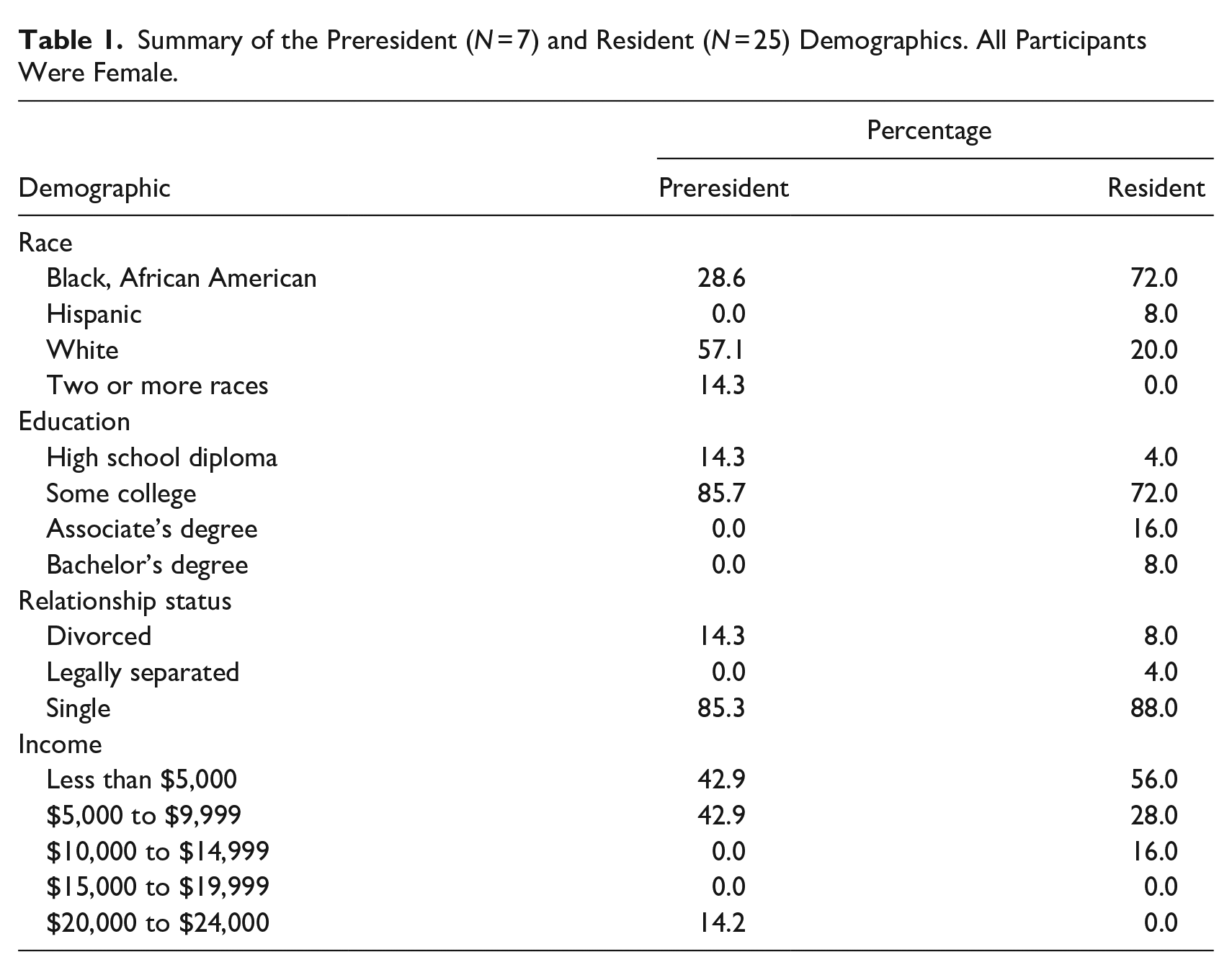
Demographic characteristics (Table 1) of participants suggest that THEA is recruiting their target demographic. Preresidents and residents were most likely to have less than a bachelor’s degree (there were a few recent graduates), were predominantly single, and fell below the 2015 (the year the data were collected) federal poverty line ($15,930) for a family of 2 (http://aspe.hhs.gov/poverty/15poverty.cfm). Preresidents were more likely to be white (57 percent), whereas resident scholars were more likely to be black (72 percent). This percentage point difference may reflect the smaller sample size of the preresident (n = 7) versus resident groups (n = 25).
Summary of the Preresident (N = 7) and Resident (N = 25) Demographics. All Participants Were Female.
Housing was a salient factor in their decision to apply to THEA. All 32 participants experienced housing insecurity, homelessness, or were at risk of becoming homeless prior to their involvement with THEA. More specifically, 15 were living in multigenerational households to make ends meet; 7 were living in transitional housing, on the street, in their cars fleeing domestic violence, or shelters; and 10 were facing eviction as a result of non-payment or relationship dissolution.
Dismantling Maslow’s Theoretical Hierarchy of Needs
Maslow’s theoretical hierarchy of needs rests on the assumption that needs satiation is ordered, which requires the fulfillment of basic needs before pursuing more advanced needs. Indeed, he argues that when hungry, Life itself tends to be defined in terms of eating. Anything else will be defined as unimportant. Freedom, love, community feeling, respect, philosophy, may all be waved aside as fripperies that are useless, since they fail to fill the stomach. Such a man may fairly be said to live by bread alone (1954:82–83).
A man may be driven by bread alone when hungry, but the 32 single mothers in this study were motivated by their children. Indeed, their motivation to participate in THEA was to meet their children’s needs while concurrently pursuing education to become self-sufficient.
Mothers discussed their motivation to earn residency at THEA to satiate their physiological needs. Housing was the most identified basic need among the mothers. Odessa Watt (white mother of two sons and one daughter) states, My biggest challenge was my living situation when I lost my home and lost my job. We were living with family. It’s not easy to live with anyone. I had me and three kids in one bedroom. So, I think that was my biggest challenge was not being able to give structure and stability to my kids for almost seven months.
Similarly, Katrice Jones (black mother of two children) states, Housing’s number one. When I was at my mom’s, I was pretty much in one room with both kids. I had a crib, but only one kid could sleep in the crib. So, one kid may try to sleep with my mom. The other already tryin’ to get in my bed . . . I had to stay with my mom. I couldn’t afford child care, you know? I couldn’t afford anything. I was working [for a shipping company] too, but couldn’t afford anything off that check except diapers and whatever formula I could get from it.
Prior to earning residency at THEA, both Odessa and Katrice engaged in “doubling up”—the practice of living with extended family to make ends meet (Pilkauskas, Garfinkel, and McLanahan 2014). While “doubling up” may meet financial needs, it can lead to “network fatigue” among family members (Harknett and Knab 2007)—which can weaken mothers’ ability to rely on kin over time and increase their risk of residential instability. Single mothers are more likely to “double up” when their children are young (Oh et al. 2021) and more likely to live “elsewhere” (e.g., in homeless shelters) by the time their children are nine years of age (Williams 2023). Residential instability not only limits mothers’ ability to meet their families’ basic needs but also increases mothers’ risk of experiencing a major depressive episode (Oh et al. 2021). The cascading effects of residential instability are evidenced by Chelsea James’s (black mother of four children) experience: I never would have thought about, to be honest, goin’ back to school until I became homeless. I had to have some kind of way to have something for my kids. And, then on this road of being homeless and getting in this process . . . in this pre-resident process . . . it was hard for me, because I lost a lot being homeless. I got sick. It, it was just a number of things. I lost friends. I had to stay house from house to house, house to house, house to house. Caught in-between states. And, it was just hard. And, it was like, I had some support here, with [THEA] helping me here.
When asked how long she was homeless prior to THEA, she says, Over a year and, uh, one of my childrens was poisoned while I was stayin’ with someone. Um, stuff taken from us. Half the time when we stayin’ there, we didn’t eat. Um, I would get, you know, I got stamps and stuff and I would put food in the house. By the time I got home from school, or one of my kids got home from school, they’d a cooked and ate, wadn’ nothin’ for us. So, it, it was pretty hard. It was real hard.
Chelsea experienced an extended wait time for residency because she had to wait for a three-bedroom apartment to become available. She noted that the preresidential process is more arduous when “you have more than one child. And, they’re not small. They’re teenagers.”
Satiating their physiological needs also facilitated the fulfillment of families’ safety needs. Samantha Howard (black mother of one daughter) describes a conversation she had with her case worker, who ultimately pointed her to THEA: [My] marriage was abusive in every way, shape and form. By the time my daughter was three, she started to become protective of me. I grew up like that, so I was not about to expose her to that. So, um, I had a house and cars and this good payin’ job, but it became [toxic]. So, I had to make a decision. All of this and be dead, or my life? So, I packed me and my daughter up in that green Kia Sorento and drove back here. Stayed with my parents and whoever and wherever we could lay our head. It was off and on. It was a mess coming back here. Literally goin’ from having a house to being homeless, having a job to being jobless, having an income to government assistance and all that comes with. People treatin’ [me] like crap. They judging. Don’t know a thing about you. All of that. I mentally . . . I was survivin,’ but mentally I was gone. I ended up needing to be hospitalized because of my mental illness. I was about ready to end it. I could not keep livin’ from bed to bed, in my car. I did the right thing. I left, but what’s my reward? This? The only last option for me to find housin’ for my child, for me and my child is for me to enroll [at the local university] and apply for campus housing.
Samantha’s account highlights both the physiological and psychological strains of housing instability, particularly while parenting. Indeed, Harvey (2020) notes that when mothers cannot serve as heads of their own households, their identities as “good mothers” may be fractured “if they believe it signals an inability to provide for their children” (p. 264). Samantha experienced multiple transitions—relationship, geographic location, and residential—that stripped her of her ability to be self-sufficient. While she recognized that she “did the right thing,” her social standing as a “good mother” was threatened (Edin and Kefalas 2011).
Interestingly, very few of the mothers directly discussed their own safety needs. Rather, they discussed domestic violence as an endemic problem among participants. Frances Lewis (black mother of one daughter) notes, When people come to this program, everybody’s runnin’ from a situation. They are tryin’ to get in this program to make their situation better. Probably nine out of 10 is runnin’ from a current situation. I’m sayin’ they’re from domestic violence and stuff like ‘at.
By noting that “everybody’s runnin’,” Frances is alluding to her own experiences with violence. The mothers may not have discussed their own histories of violence because they did not want to relive the trauma, or perhaps they felt safe living in the secured, surveilled THEA campus.
THEA fulfills mothers’ love and belonging needs. Lee Wise (black mother of two daughters) says that THEA “feels like a family, like the milieu is more like family-centered”—which is in direct opposition to other bureaucratic institutions. She says, “I mean it was hard for me to go to the food stamp office. It’s like almost sitting in a bread line like I’m a homeless bum or something.” The fact that mothers’ sense of belonging is derived from an institutional relationship is not unexpected. The mothers in this study expressed feeling fully responsible for their children; thus, THEA may be the only entity the mothers feel supports them. For example, Nicole Davis (black mother of one daughter) comments that her biggest challenge as a single parent is “just being completely responsible for somebody else. Nobody else is going to step up unless they want to. It’s on me at the end of the day to make sure her needs are being met. The emotional needs, the financial, physical needs, all of that.” Michelle Jarvis (black mother of one son) concurs, “being a single parent and being as active as I am, requires a ridiculous amount of emotional maturity. I can’t just shutdown. Because I have to function for myself and I have to be present for my child.” Or, as Roselyn Jones (black mother of one daughter) says, Because she’s looking at me for guidance, direction, and new learning, you know, morals and stuff like that. So, um, just taking the time to putting in. You know? And, um, sometimes it’s a load. Like, you want to just like take and pack her up a bag and make sure she has everything she needs and say, “Ok, I’ll be gone for a day.” And, I’d be back the next day to get her. Just take a break. Those are the things that I kind of like struggle with. And, my mother, she tries to help. But, it’s only like if I get sick. Just to go out and have like a glass a wine or even just to sit and listen to some jazz music to clear my thoughts. I can’t do that.
The mothers in this study embraced the concept of “being there” for their children (Edin and Kefalas 2011)—an indication that mothers are not only dedicated to raising their children but embody practices of good mothering. Roselyn’s comment that her mother will help in an emergency signifies that mothers feel alone in parenting. Some mothers explicitly discussed their children’s fathers’ involvement. Coretta Marshall (black mother of a daughter and a son) says that she does not receive child support from her children’s father, but does benefit from instrumental support—which is contingent on his well-being. She states, “if [he’s] not having a good life right now, [he] can’t be a parent.” Coretta’s statement confirms an earlier discussion of Maslow’s theory—perhaps men struggle to think beyond their own immediate needs. Other mothers appear to make excuses for fathers—perhaps this harkens back to Maslow’s day when men are understood to meet their needs before those of others. Amy Toler (white mother of a daughter and a son) remembers that she and the father of her children Dated for like four or five years before I ever got pregnant. I mean, after having [our daughter], we broke up probably like whenever she was six months. It was just, he didn’t want to be like tied down. We were both so young and stuff. And he just had better things he wanted to go do than be home with the babies.
They dissolved their relationship before she found out she was pregnant with their second child. When asked how he received the news, she says, He already had enough with babies and stuff. I mean he wasn’t like happy about it. I mean a woman has a baby, so like automatically that woman has to take responsibility for that child. But a dad can almost not be there. Not have a care.
Amy argues that “a dad can almost not be there” for their children—which is in direct opposition to mothers’ insistence on “being there”.
One mother points out that women do not have much negotiating power with fathers. Sunni Dawson (black mother of one daughter) says her daughter’s father “does help me the best he can, when he can.” Although she appears to excuse his lack of parenting due to his ability, she recognizes that fathers do not have to be committed to individual children. She states, A lot of mothers is just angry and don’t want their fathers in their child’s life. They think it hurts them, but at the end of the day, if a man can’t see their child, that don’t hurt [the men]. They go on about their life and make more.
Fathers, too, are supported in their decisions not to provide for their children. Nickie Harrison (black mother of one daughter) discusses the reaction of others when she attempted to procure child support from her daughter’s father. Going to the Child Support Enforcement Agency means Everybody look at you bad. You’ve got to hear side conversations from [his] family. And that’s the time they want to call you, make you feel like you’ve done something wrong. It’s just a lot. And then when they want to make you feel bad because you went down there, “you puttin” them people in our business. “Dude, I done been doin” it for a year. Like, where you been?’
Mothers, then, not only want to “be there” for their children but also learn through experience that they are the parent that has to be there.
Mothers’ institutional relationships with THEA facilitated the satiation of lower-level needs that created pathways to fulfill their esteem needs—meaning access to child care allowed mothers to attend school. THEA provides on-site early education facilities that are paid for through state funding. Importantly, then, mothers did not have to vie for access to child care or navigate multiple sites on their college/university campus (Sallee et al. 2023); rather, mothers could simply walk their children to their residential facility and then head to class. Michelle says child care is THEA’s way of “making sure that there’s adequate care for your kids” while you are studying. Michelle lived with her mother, stepfather, and two half-siblings before earning residency at THEA. She says, Right before I moved in, I was working two jobs and I was in school full-time and had my son. And, I was working like crazy and I had unstable child care. So, there were several times where I had to choose work over school, because it’s like, “Alright, I got to have money coming in. And, I know that I only have someone to watch my son from this time to this time. Am I gonna go to class or am I gonna go make some money? I’m gonna go make some money.”
Michelle’s quote highlights the lack of choice single mothers experience. Her financial needs took precedence over her education, as making money is more urgent than earning a degree. But, as Frances Lewis states, THEA rectifies this issue for mothers. In fact, when asked how THEA supported women to reach their educational goals, Frances says, Childcare. I didn’t have nobody to help me with [my daughter] while I was studying and stuff. [THEA] ensures me that I’m going to finish school, that I will get a degree. I think that’s why most moms are in this program, because they know this is going to keep a roof over their head in order to finish school. In order to keep a house over your child’s head, you got to finish school.
THEA not only provides the resources that allow single mothers to pursue their educational dreams but also requires students to stay on track if they want to maintain residency. Debbie Warren (white mother of three children) says, The whole point is that little extra push to get me through school, get me finished with school so that I don’t perpetually keep taking time off. To help me not stress out about “oh well, how am I going to pay this bill?” Or, you know, calling trying to find somebody to let me, you know, let me borrow this until I can pay you back. Um, just to help, help me get back on my feet and get to where I need to be.
THEA eliminates mothers’ need to negotiate between meeting their familial obligations or educational pursuits. THEA also assists mothers in evading the incessant rhetoric that they need to focus exclusively on raising their children. For example, Michelle Jarvis’ parents told her to defer her educational dreams because she needed to focus on providing for her child. She said, “naturally I went up against that. Because you just can’t tell me that I’m puttin’ school off to the side.” She recognizes that her decision to dismiss her family’s advice was the right thing to do, stating: This is temporary. And, um, seeing my baby every day, ‘cause he’s so happy. And, you know, even if I’m frustrated or whatever I have going on in my personal life, like, I know that my kid is ok. And, he’s fed, he’s clean, he has clothes, he has a bed. He’s taken care of. And, um, that gives me peace. Oh, also, the fact that other people can see, just based on how he is, his personality, that he is being taken care of and that I’m taking care of him, um, that gives me peace at the end of the day. Because, it’s like, I’d much rather be worrying about a paper being due, than whether my child is ok or not. So, at the end of the night, he’s safe in bed, I don’t mind pulling an all-nighter. I know it’s not . . . this is not going to stay this way. Like, I’m working toward something and it’s, um . . . it’s like a beautiful struggle [laughs]. Because, it’s, it’s so grueling and nerve-wracking, but when I graduate and I start teaching and I have my own classroom and I have a salary and I have a summer vacation where he and I can go wherever we want to go, like that’s what I’m working toward. That’s stability. We’re ok.
Even though Michelle’s quote highlights how student parents experience time poverty (Wladis et al. 2018), it is important to note that her son’s needs are met as she continues her education. Perhaps she will have to pull several “all-nighters” but she sees this effort leading to a stable future.
Children’s needs served as the impetus for mothers’ pursuit of higher education. Participants often expressed they had achieved self-actualization through motherhood. Odessa states that her children are: My life. I’m a single parent, but every day I get up and I do everything that I do for my [three] kids. I’m not just going to leave them with my mom. I’m not, you know? These are . . . they’re my life. I think a lot of time, men can easily walk away from their kids and don’t think twice about it. A mother, I don’t think they can. Not a good mother. My kids, they bring me joy, you know? I’m tired. I’m wore out. I’m frustrated. There’s days when I just can’t, I can’t deal with it. But, I do it, because at the end of the day, I’m all they have. And, the love that I give them, they give back a thousand times. It’s amazing. I don’t have to share their love with anyone. I don’t. I mean, that probably sounds a little corny, but I love it! I love it, because they count on me. And, they reward me. You know? I don’t know how to explain it. You can have a job that pays really well and be really happy with it, but you can’t put a price on, like, the relationship with your kids. You just can’t. Your children are the only ones that can make you laugh, cry, and be angry all in the same five seconds.
Even though Odessa is tired and worn out, her children continue to provide her life meaning. Devon Richards (white mother of one daughter and one son) agrees with Odessa, by stating that her children are “my purpose in life. Children is a bond, a forever bond. It is a marriage because even if you’re not together, you are still attached to each other, still connected.” Lee Cook (black mother of two daughters) echoes this sentiment by stating that she tells her children, “I’m placed on this earth specifically to be your mother. I don’t have any other purpose for being here at this time than to be their mom.” Mothers in this study recognize that their children fill the “relational poverty” they felt prior to becoming mothers (Edin and Kefalas 2011:174).
Importantly, Devon and Lee are preresidents. Their experiences highlight the struggles mothers face prior to earning residency at THEA. Devon works full-time at a restaurant while pursuing a psychology degree. She lives with her paternal grandmother, father, uncle, and two children. Earning residency would mean she could escape her “completely hostile environment,” where she endures daily “verbal abuse.” The example below illustrates how an independent living space and access to child care would ameliorate many of her daily struggles. Child care would address Devon’s time poverty and would allow her to complete coursework without interruption. Although Devon is the only person working in her household, she is still expected to spend all her time at home with her children. She states: I had went to school, I had gotten off work, I took the kids to the park, I had got them something to eat, had just came home, opened up my laptop, trying to like figure out my school stuff . . . trying to get started on my school work. I’m fifteen minutes in when [a fight ensued]. Ok? And, um, I go downstairs, get the kids, bring “em upstairs, sit back down at the laptop and my grandma walks by and says, ‘you need to watch your kids.” Because they’re all upset, because they’d been watching the kids all day. But I just got off work, I just got back from taking them to the park. You know, I just spent time with them? I have school stuff. If I don’t do my school stuff now, when can I do it?
Juggling work, parenthood, and school is an arduous task, especially when enduring hurtful rhetoric that she continues to fail (e.g., “you need to watch your kids”). This narrative centralizes her maternal role and allows no room for improving her life chances. Furthermore, it corroborates Edin and Shaefer’s (2015) argument that the kin of low-wage employees “pull them down as often as they lift them up” (p. 60). Her grandmother is likely fatigued from caregiving. However, placing prominence on Devon’s maternal role may also be detrimental to her grandmother if Devon cannot eventually establish an independent household.
Turning to Lee, she works and takes courses at the local community college. She worries that her job may interfere with school, as her work schedule is “as needed.” She asked her employer if she can split her shift into two separate days so that she can attend class, but was told “oh, we’re not going to be able to do that.” Her employer’s insistence that she be flexible exemplifies the “on-call” employment practice of low-wage work (Edin and Shaefer 2015:61). Hours are not guaranteed; thus, if an employee needs money, they are expected to drop everything—including class—to make it to work when beckoned. This practice denies employees the ability to plan their days and essentially eliminates parents who cannot access on-demand child care. Understanding the struggles mothers like Devon and Lee face, it becomes increasingly evident why a spot at THEA is coveted. Earning residency at THEA would mean not sacrificing their children’s well-being to earn a dollar. THEA would provide these single mothers with an unfettered opportunity to go to school without juggling inflexible jobs, inaccessible or hostile child care, and incessant reminders that they need to do better.
Discussion
Maslow’s theoretical hierarchy of needs focuses on individual motivation. Findings from this study demonstrate that poor single mothers invert and challenge Maslow’s theory as they enroll in an educational program (an esteem need) before their housing, food, clothing, safety, child care, and belonging needs are satiated—which demonstrates that mothers’ motivations are social. Indeed, mothers in this study are often significantly disadvantaged as they apply to college. Mothers place themselves at significant risk by seeking residency at THEA, as THEA requires matriculation at a college or university before they provide housing. Thus, mothers’ matriculation is embedded in and enhances their financial precarity, as most relied on federal student loans. Furthermore, mothers’ matriculation means that they submit to multiple forms of authority—the state, THEA, and institutions of higher education—in order to procure stable housing.
In many cases, the risk is worth it. THEA allows mothers to “be there” for their children (Edin and Kefalas 2011). Low-wage work (and lack of transportation) often equates to long parental absences from home, which may mean mothers and children become pseudo-strangers (Hays 2003). Poor mothers often face “pushes toward work and pulls toward home,” where they have to make a choice between low-wage work and their children (Hays 2003:146). THEA not only means that women do not have to make this impossible choice but can truly focus on their exclusive roles as students and parents without interference—the result is “time richness.” By meeting their needs, THEA provides hope to mothers who are, subsequently, able to articulate bright futures.
Why do mothers appear permissive of father non-involvement? It may be that mothers contend with several bureaucracies to provide for their children. They submit to the state for resources, such as child care subsidies and federal student aid, and to THEA to procure support that will bridge the gap between poverty and education. Therefore, they may be too fatigued from negotiating with multiple, obstinate institutions to also confront fathers for support. Despite their institutional fatigue, the resources they receive from bureaucracies are consistent—consistency they do not (often) gain from father involvement.
Women framed their children’s fathers’ absences as choices—he was “just done with babies.” The fact that men wanted something else for their lives was permissible in ways that women did not allow for themselves—a consequence of a gendered way of understanding parenthood and one that reinforces the notion that Maslow theorized his hierarchy for men. The ways in which gender operates matters for mothers and fathers. Women’s socialization as the parent who cares for and raises children leads to divergent outcomes for women and men. Women strategize to find pathways that allow them to raise their children in optimal ways, while they view fathers as fulfilling their own needs before they can be parents. By framing parenthood in these gendered terms, women’s motivations appear social, while men’s remain individual. For women, parenthood is compulsory. Women who raise children are at least partially fulfilling their traditional roles. For men, parenthood is perceived as optional. Edin and Kefalas (2011) demonstrate that children are protective factors for women, meaning children incentivize women to make positive changes in their lives. Men do not benefit from the same social protections. Parenthood, then, is simply out of reach for some fathers. The ways in which hegemonic masculinity constructs manhood limit fathers’ ability to parent. Indeed, gender scripts for men often restrict fatherhood to breadwinning; thus, if fathers are incapable of actuating their financial roles, they may feel discouraged from being involved in their children’s lives—which is a societal imposition, not necessarily a paternal choice. Men are often precluded from parenthood based on societal assumptions that fathers will “hit and run”—even though research shows that fathers’ desire to be involved fathers is quite high (Edin et al. 2009:150). Evidence from this study shows that only 2 percent of THEA participants were single fathers. Fathers’ low participation rate may signal to interested fathers that they are not welcome at THEA. Efforts to bolster father involvement will only be successful if society begins to accept that few men are capable of adhering to the hegemonic ideal; thus, masculinity must be redefined before children may serve as protective factors for their fathers. Redefining masculinity will not only allow men to be actively engaged and involved with their children, but it may also mean greater opportunities for women. Perhaps THEA’s perceived focus on mothers has contributed to what Adler (2023) refers to as a “‘suppressor effect’ on father involvement” (p. 1191). Whereas Adler was referring to family leave policies that allowed mothers to focus on parenting and not work during their children’s earliest years, THEA’s unilateral supports may provoke a “suppressor effect” on father involvement as mothers may view access to these resources as enough.
THEA provides support that motivates, rather than discourages, academic momentum, which may mean that residents are more likely to persist and attain baccalaureate degrees. Wladis et al. (2018) argue that interventions that help student parents with childcare and allow them to work fewer hours have the potential to close the discretionary time gap between parents and nonparents so that students with children can spend just as much time on their education as their childless peers (Pp. 819–20).
Listening to these mothers’ experiences, it becomes clear that, prior to THEA, they could not juggle their parental, work, and educational roles. THEA not only provides resources but requires mothers to use their on-site early education centers and strongly encourages them to quit their jobs to focus on their education. The early education centers and subsidized housing mean that mothers’ “time poverty” was not as extensive as single mothers without support—which ultimately means that THEA participants have greater access to self-sufficiency.
Without assistance, the cost of tuition and fees, coupled with low-wage work, homelessness, food insecurity, and child care costs that often exceed tuition/fees (Schulte and Durana 2016), may mean college is out of reach for student parents. Programs similar to THEA are not a panacea, but they may create pathways toward success for single parents. As evidenced by maternal data, mothers are motivated to pursue higher education as a way to provide for their children. However, mothers do not simply want to provide for their children but want to create a better future for their families. Their testimonies also demonstrate that relying on fathers and/or government programs is often futile and not sustainable. Folbre (2002) argues that children should be considered “social goods,” as investments in their futures will secure our nation’s future. Findings from this study demonstrate that limiting investments to children is not enough, as this method implies investments will end as childhood does; thus, we call on our nation to make an intentional decision to substantially invest in families, including fathers. Hearing the resilience and hope that emerged as a result of mothers’ participation in THEA makes clear that opportunities, not need, will allow families to prosper. Men must also have equal opportunities to participate in programs that foster development toward self-sufficiency and fatherhood. Progress is an outcome of efforts toward success, not mere survival. When we recognize the difference between need and opportunity, perhaps we will find our way forward as a nation.
Our study is not without limitations. Our sample was identified by THEA staff and through snowball sampling, rather than through random sampling—which may mean that our results are biased in favor of the organization. We were prevented from talking with any single mother who was not eligible for the program or mothers who left THEA before graduation.
Furthermore, our sample is likely a more advantaged sample of single mothers pursuing education. The preresidential component required a significant time commitment from mothers. The more mothers participated the more THEA staff interacted with them. Increased exposure to the staff meant these mothers were perceived as devoted to THEA. Rather than viewing these mothers’ efforts as dedication, we should consider that these mothers were likely the most capable of engaging with the organization to ensure they were identified for residency. They were mothers who had a high school diploma or equivalency, transportation, likely jobs that accommodated THEA’s schedule, and in some cases, had access to child care. Our findings, then, likely underestimate the struggles many mothers faced—hardships that either precluded them from earning residency or prevented their success as student parents. As a result, it is likely that THEA did not recruit and/or retain the most disadvantaged mothers.
Our sample sites are urban, with a rather robust mass transit system and multiple two- and four-year institutions of higher learning—which, again, likely means that these mothers had more opportunities than their rural counterparts to pursue education. Even so, our analyses reveal that mothers’ hardships and worries do not cease simply because they benefit from organizations; however, their renewed hope for the future reveals the need for more programs similar to THEA. Finally, we made every attempt to protect the confidentiality of our participants to reduce the likelihood that THEA staff could associate our findings with particular mothers.
Implications for Practice and Future Research
This study demonstrates that single mothers are motivated to pursue higher education to meet their familial needs. Understanding that mothers risk further economic precarity through their acquisition of student loans also highlights their desire to earn an education to become self-sufficient. This research, then, demonstrates a need for more organizations similar to THEA—an organization that provides unilateral supports to single parents as they pursue baccalaureate degrees. Specifically, THEA offers student parents educational supports, child care, apartments, and other resources (e.g., food and clothing pantries) within a gated residential campus. What this means is that single student parents can easily access child care centers before they leave their housing complex for the day. Student parents do not have to apply for or negotiate a space within these child care centers, as they are designated for THEA participants. Furthermore, student parents do not have to navigate to multiple spaces on their academic campuses to ensure their children are cared for when they attend class (Sallee et al. 2023). On-site child care removes an unnecessary barrier to single mothers’ educational attainment.
THEA’s holistic approach to meeting the needs of student parents also diminishes the stigma associated with need. Participants at THEA can access the food pantry without searching for parking, traversing a campus, or encountering a potential peer who may be staffing the pantry (Sallee et al. 2023). All THEA participants receive assistance; thus, they do not feel judged when they need to rely on the pantries at times.
While it may not be feasible to replicate THEA in its entirety at every institution, it is possible to offer some components. If child care and food security allow students to persist through college, then institutions need to consider how to expand services to student parents. Ensuring child care spaces for student parents is a start. It is also possible to merge and centralize child care and food needs. Institutions of higher learning could offer a Backpack Program to families in need (https://www.feedingamerica.org/our-work/hunger-relief-programs/backpack-program). Parents could indicate their needs (perhaps weekly or monthly). Much like in K-12 programs, children would receive a backpack of food. This could potentially decrease the amount of perceived stigma student parents face on campus. And, this would eliminate the need for student parents to have to visit one more place on campus.
Importantly, THEA is not a panacea—which is especially true for single parents who have not earned a high school degree. In order to reach the most disadvantaged single parents, organizations should consider how to help single parents earn a high school degree or equivalency. Without a high school education, single parents have no hope of accessing colleges, universities, or programs like THEA.
In terms of future research, studies could investigate whether and how institutions of higher education might offer Section 8 on-campus (or near campus) family housing. THEA’s most coveted resource—housing—is one of the reasons why student parents persist in graduation. Subsidized housing offers shelter, but in THEA’s context, it also offers a safe and secure residence—which means parents and children may escape violence through educational attainment. Furthermore, future research should also examine ways to offer support specifically to single fathers as they pursue education. Offering child care, food security, and safety can offer both mothers and fathers a chance to earn higher education and, subsequently, self-sufficiency.
Footnotes
Declaration of Conflicting Interests
The author(s) declared no potential conflicts of interest with respect to the research, authorship, and/or publication of this article.
Funding
The author(s) received no financial support for the research, authorship, and/or publication of this article.