




Abstract
Seattle Pacific University brought a “tent city” to campus to help students engage with and better understand the challenges facing homeless populations.
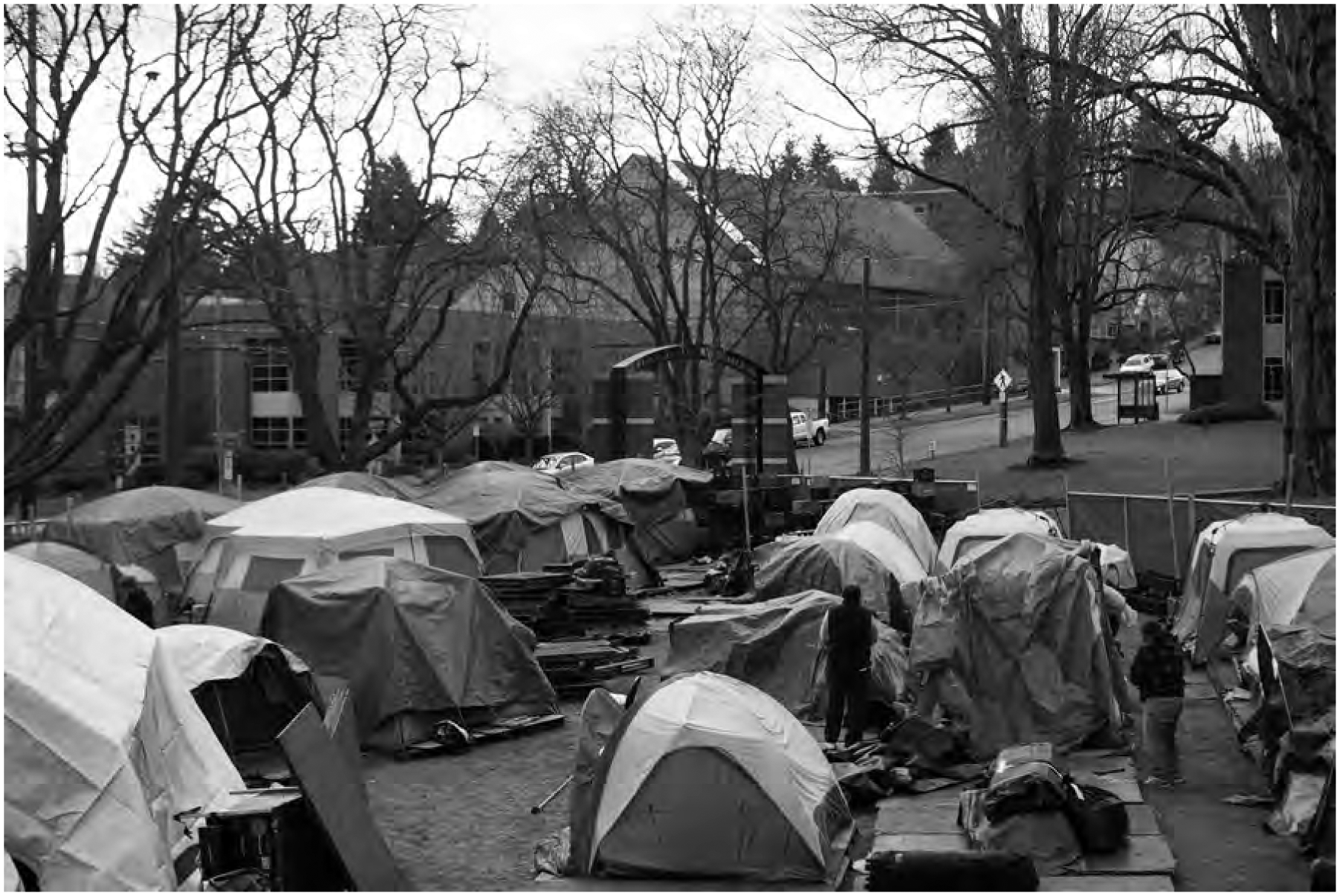
One Saturday morning in December 2014 the 18,000 square foot main lawn of our university campus was transformed from a lush, open area into a bustling, organized, and densely packed tent city community. Seattle Pacific University is not the first university to house a homeless encampment, but such endeavors are still rare on American college campuses. Even more remarkably, the same space had recently served as a spontaneous gathering place for the university community after a deadly campus shooting just six months earlier.
Why did Seattle Pacific University take the bold step of hosting a homeless encampment? Homelessness is a growing problem in Seattle and King County, where the annual point-in-time count (One Night Count) for 2015 found 3,772 men, women, and children without any kind of shelter—a staggering 21% increase from 2014. The increasing presence of those who are homeless and the emergence of homeless encampments within our city represent a social problem that our university community felt obliged to engage. Less than 10 months after our hosting a tent encampment, the City of Seattle declared a state of emergency on homelessness. A declaration of this magnitude is unusual outside of natural disasters.
Our university’s hosting of a homeless encampment gave our students a better understanding of a vulnerable population, research methods, and social change.
It is common to hold negative stereotypes regarding people who are homeless. Many of these stereotypes center on a narrative of individual moral weakness—that those who are homeless are lazy, dirty, irresponsible, drunk, or dangerous. We found this narrative to be present in our university community, as well. In a randomly sampled survey conducted prior to the arrival of tent city, 38% of our community responded that the encampment would negatively impact the university. Respondents cited violence, crime, substance abuse, and mental illness as reasons for their concerns. One university member characterized the “random people” in the encampment as “those who pose a threat to [the university] such as predators or those prone to being violent because of mental problems.” Another said, “The people who utilize the tent city… survive by means of coercion, manipulation, guilt, and so forth.” Similar sentiments were made by parents of students, as well as local community members, who contacted university officials with their concerns.
While some of these characteristics may describe individuals who are homeless, homelessness is a social problem linked to broader social trends. Pathways leading to homelessness include job loss, low wages, lack of health care, domestic violence, and the high cost of housing. These same factors impede a person’s ability to exit homelessness. In fact, personal vulnerabilities such as mental illness and addiction can be triggered or magnified by homelessness. Without adequate social support people can be “just one paycheck away” from becoming homeless. The university’s hosting of tent city afforded us the opportunity to challenge negative stereotypes, creating conversations about the causes and solutions to homelessness, and providing a unique and positive learning experience for our students.
University and tent city leadership collaborated to provide a variety of educational programs around homelessness. Tent city residents led tours of their camp for the university community to understand their self-governing organization. The university sponsored multiple forums, films, and events. Campus and community groups provided meals each evening in the encampment’s dining tent. Tent city residents were given access to resources including the library, computers, campus free spaces and programs created by students like weekly poetry slams, art nights, and foot care clinics. During these times of fellowship, both structured and spontaneous, residents and university members socialized with and learned from each other. As one tent city resident said, “It’s cool that we’re right up next to the college because the college kids—they’re allowing the homeless culture to intermingle with the college culture and then the college kids come in and…try to make us a part of their community, and I think it’s pretty cool.”
SPU’s tent city.
Courtesy Seattle Pacific University
The university’s hosting of a homeless encampment allowed us to create a unique pedagogical experience for our students, who often view homelessness as an overwhelming and intractable problem. Having tent city on campus mitigated several of the liabilities that can accompany traditional service learning courses. With provisions for tent city’s stay on campus developed nearly a year in advance, we were able to devise coursework to prepare students to engage with tent city residents. In the term prior to tent city’s visit, we offered a course on homelessness coupled with our research methods course. The former provided a necessary theoretical and substantive understanding of homelessness, debunking stereotypes. The latter offered practical skills for ethical interactions between students and residents and armed students with skills to collect field observations and interviews with residents. Thus our students were better prepared to confront issues related to homelessness, preventing offensive or hurtful behaviors that organizations who partner with service learning courses may sometimes experience.
Beyond personal transformations and linking classroom knowledge to real life events and people, we witnessed students so impacted by the experience that everyday conversations with their friends, family members, and coworkers changed.
The combination of coursework and engagement was a necessary component of a compelling educational endeavor that prepared students to think more comprehensively about homelessness. However, even after completing the coursework, students expressed surprise and discomfort when they began to visit tent city and found only a few residents in camp; they had unconsciously assumed that residents didn’t work and would simply be hanging around. The data suggest that a majority of the residents we interviewed were employed or actively seeking employment (60% were working or actively seeking employment; 15% were either on disability or retired). In the research seminar coinciding with tent city’s presence on campus, students shared these and other biases that changed through interaction and dialog with tent city residents.
Through face-to-face conversations around campus, in the tent city common areas, and in local coffee shops, students listened and asked questions. These exchanges provided a practical way to bridge social distance: “In that moment there were no stereotypes; I was just having conversations with lovely human beings and I forgot about my label as a student and their label as ‘homeless’.” Together, coursework and interaction created comprehension: “[It’s] necessary… to have some sort of that foundation. If we were to dive into this… without any of that background, it would have been really overwhelming. But I think that without the physical experience of diving [in] and building those relationships and having [the residents] here, it would have just stayed as head knowledge.” Students came to partner with tent city residents, traveling to local protests, and attending city council meetings to advocate for those who are homeless.
A tent city resident told a student, “The first time you host it is charity, the second time is to break down stereotypes, and the third time is for social change.”
Beyond personal transformations and linking classroom knowledge to real life events and people, we also witnessed a surprising outcome. Students were so impacted by their experience that everyday conversations with friends, family members, and coworkers changed: “Not only did [this experience] impact you as an individual, but it impacted everyone you talked to. Now my family knows more about homelessness, my friends, my roommates—they’re all having their eyes opened to this social cause.” One student related a story about how her business-oriented father had not been open to more complex ways of thinking about homelessness. Because he supported her, however, he asked if he could help with the encampment’s move to campus. After interacting with tent city residents and reading the books from his daughter’s class, he created an initiative at his business to address issues of homelessness. Our students’ experiences also impressed upon their friends how institutions can engage in these issues: “I was in constant conversation with friends at other universities and they were amazed at the work SPU was doing, and challenged to consider how their own institution is addressing homelessness.” It is by way of student impact and educational programming that another local university is considering hosting tent city.
Many residents of tent city expressed to us that they were impressed with our students’ knowledge and engagement: “From everybody that I’ve talked to, I think everyone’s really appreciated…having [and] seeing [the students] on campus, and like being able to be a part of [the experience].” Another resident identified the long-term potential of projects like this, stating, “I like people to come in and get a tour and see what we are about, talk to people… I like having people come in and maybe possibly change the idea of who they think are homeless.”
The reaction to our students and community was not all positive. Comments from some tent city residents help us to better understand the challenges of hosting a homeless encampment, the limits of our educational reach, and the nature of our privilege: “I don’t want to indict—you guys are showing love, but you’re getting a certain kick out of that too… [the university community] all get to say ‘we fed the homeless.’ And I don’t have any problem with that, but there’s a certain amount of ‘We like it this way’… ‘We hope there’s homeless next year so we can do the same thing.’’’ Another resident simply said, “I don’t want their pity.”
Our university’s hosting of a homeless encampment gave our students a better understanding of a vulnerable population, research methods, and social change. Overall, tent city residents were positive about student interactions, the research project, and being at the university. One resident told us, “SPU, man, they spoil us… I love it there. It’s always a sad fact that we have to leave after three months.” Another resident was comparing this site to others in the city and felt that “I couldn’t possibly have gone to another, a better place. It restored a little faith in humanity. It is so much different—they’ll say ‘hello’ to you.” Amidst the positive reaction, one resident expressed caution, telling a student, “The first time you host it is charity, the second time is to break down stereotypes, and the third time is for social change.” It is not enough to host a homelessness encampment or engage one-on-one with people who are homeless; that is charity. Moving toward a collaborative model to alter how we think about homelessness and interact with people who are homeless through this kind of education, however, is a positive start on the journey from charity to social change.