




Abstract
The study assesses the effect of capital flight in the nexus between foreign aid and renewable energy consumption in 20 countries in sub-Saharan Africa using data for the period 1996 to 2018. The empirical technique employed is interactive quantile regressions, and the following findings are established. Foreign aid increases renewable energy consumption, while capital flight dampens the favorable effect of foreign aid on renewable energy consumption. The underlying significance and corresponding mitigating effect are exclusively relevant to the bottom (i.e., 10th) quantile of the conditional distribution of renewable energy consumption. The findings are robust to simultaneity and unobserved heterogeneity. Policy implications are discussed.
Introduction
The positioning of the present study on how capital flight crowds out the incidence of foreign aid on renewable energy consumption is motivated by three main factors in the extant policy and scholarly literature, notably (1) debates on the importance of foreign aid in development outcomes, (2) increasing importance of capital flight, and (3) gaps in the attendant renewable energy literature. These points are expanded in chronological order.
First, consistent with recent literature synthesizing studies on foreign aid (Asatullaeva et al. 2021; Asongu 2015), the extant studies on the relevance of development assistance in economic development have largely been focused on three main dimensions, among others: (1) the linkage between foreign aid and economic prosperity, (2) examination of the issue as to how development assistance can be leveraged upon to improve institutions in recipient countries, and (3) the importance of foreign aid allocation strategies such as donor agencies allocating more or less foreign aid to countries with better or worse institutions. The present study is concerned with the first strand, not least because it focuses on how foreign aid affects renewable energy consumption, contingent on capital flight.
Second, in accordance with the scholarly and policy literature on capital flight, capital flight from Africa now exceeds foreign aid, foreign direct investment, and external debt combined (Agyeman, Sakyi, and Oteng-Abayie 2022; Ainembabazi 2022; Asongu, Nnanna, and Nting 2022; Ngono 2022). According to the attendant literature, capital flight represents a crucial policy syndrome because it prevents poor countries such as those in sub-Saharan Africa from investing in education, health, and the much-needed infrastructure, inter alia, that are relevant for economic development. According to Asongu and Nnanna (2020), capital flight can be defined as a situation when a country and/or group of countries experience a loss of demand for substantial capital, especially in situations where investors or holders of assets take the decision to move their assets out of the country and/or group of countries. To put the concern about capital flight in Africa in more perspective, according to the United Nations Conference on Trade and Development (United Nations Conference on Trade and Development 2022), since 1970, capital flight from the African continent has amounted to about $2 trillion. According to the narrative, these corresponding outflows exceed the external inflows into the continent in terms of foreign direct investment and foreign aid. Moreover, by 2018, the total income resulting from capital flight was about $2.4 trillion if interest on capital outflows was taken into account. The underlying amount with potential interest payments was thrice the debt stock of the continent for the year 2018, ironically implying that the continent is a “net credit to the rest of the world.”
Among investment options for economic development is also investment in the attainment of global objectives, especially as it pertains to the United Nations’ sustainable development goals (SDGs). The present study focuses on SDG7 or “affordable, reliable, sustainable and modern energy for all” by assessing how the interaction between foreign aid and capital flight influences the consumption of renewable energy, not least, because of an apparent scholarly gap in the external flows and the renewable energy literature.
Third, the extant foreign flows and renewable energy literature on which this study is positioned can be discussed in three main strands, notably (1) theoretical premises of the nexuses between external flows and development outcomes, including renewable energy; (2) empirical studies on the nexus between financial flows and economic development prospects such as renewable energy; and (3) drivers of renewable energy consumption.
With respect to the theoretical underpinnings on the linkage between foreign flows and outcomes of economic development that engender renewable energy, in accordance with Fotio, Nchofoung, and Asongu (2022), from a neoclassical perspective, financial opportunities for openness entail capital flow which can enhance the catch-up process in economic development between nations, not least, because such have been documented to be associated with better capital allocation, enhanced sharing of risk and more optimal specialization (Acemoglu and Zilibotti 1997; Edison et al. 2002; Obstfeld 1994). According to the narrative, the consumption of renewable energy is also linked to innovations driven by increased openness to external flows, though innovation in energy can embody a time lag for efficiency to be more apparent (Alvarez-Herranz et al. 2017). On the other hand, three main drivers of renewable energy have been documented in the literature (Fotio et al. 2022; Pitelis, Vasilakos, and Chalvatzis 2020), namely technology-push, demand-pull, and systemic policy instruments. Systemic policy instruments are relevant in facilitating the implementation of the demand-pull and technology-push instruments. Technology-push instruments are contingent on the supposition that supply-side features that are more relevant from investors drive renewable energy innovation, while demand-pull instruments are premised on features like taxes associated with novel technologies that are competitive and influence the tendency of innovation in renewable energy.
The empirical research on the linkage between financial flows and economic development prospects has largely been concerned with the nexus between financial globalization and economic prosperity. The attendant literature has fundamentally focused on the manner in which financial globalization influences the economy through a plethora of channels, entailing, financial development (Aluko and Opoku 2022; Asongu 2017; Asongu and De Moor 2017), economic growth (Asongu and Nwachukwu 2017; Edison et al. 2002; Kristi, Sulistiyono, and Asrori 2022; Osei and Kim 2020; Prasad et al. 2003), the transformation of the economy (Gui-Diby and Renard 2015; Idode and Sanusi 2019; Mamba, Gniniguè, and Ali 2020), the sustainability of the environment (Acheampong, Adams, and Boateng 2019; Akadiri and Adebayo 2021; Kihombo et al. 2021; Mahalik et al. 2021; Miao et al. 2022), and efficiency in energy (Paramati, Shahzad, and Doğan 2022). It is also relevant to note that financial openness is not exclusively associated with positive externalities of economic development, as documented by Tille (2008) on apparent negative shocks that are likely to boost economic and exchange rate uncertainties. In the same vein, it is posited by Kihombo et al. (2021) that financial openness’ effect on sustainability depends on economic prosperity as well as on the density of the population.
Determinants of renewable energy that have been documented in the extant literature include: Aguirre and Ibikunle (2014), who have established on a global scale that policies of energy within the public sector mitigate renewable energy investments, reduce renewable energy commitments from countries experiencing issues with energy and issues related to the degradation of the environment. According to Omri and Nguyen (2014), emissions in carbon dioxide as well as trade openness are essential promoters of renewable energy, whereas financial development and financial openness are fundamental in driving renewable energy consumption according to Koengkan, Fuinhas, and Vieira (2020) and Shahbaz et al. (2021). This is in line with Paramati, Apergis, and Ummalla (2017), who have shown that renewable energy financing depends on stock market development and foreign investment. Mixed views are provided by Papież, Śmiech, and Frodyma (2018), whereas in the light of Villanthenkodath and Velan (2022) and Zhao et al. (2022), renewable energy is contingent on education, foreign investment, economic prosperity, and local realities, inter alia.
Contrary to existing papers, the present study complements the underlying literature above by focusing on how foreign aid promotes renewable energy consumption, contingent on the nefarious effect of capital flight, not least because the problem statement has not been covered in the extant literature. To the best of my knowledge, this study is the first study to assess how capital flight influences the linkage between foreign aid and renewable energy consumption. Hence, the corresponding research question being considered in this study is the following: how does capital flight affect the nexus between foreign aid and energy consumption in sub-Saharan Africa? It focuses on 20 countries in sub-Saharan Africa using data for the period 1996-2018. The empirical technique employed is interactive quantile regressions, and the following findings are established. Foreign aid increases renewable energy consumption while capital flight dampens the favorable effect of foreign aid on renewable energy consumption. The underlying significance and corresponding mitigating effect are exclusively relevant to the bottom (i.e., 10th) quantile of the conditional distribution of renewable energy consumption.
The rest of the study is organized in the following manner. The second section deals with complementary stylized facts and the theoretical underpinnings and develops the testable hypotheses while the data and methodology are covered in the third section. The empirical findings are disclosed in the fourth section, while the study concludes in the fifth section with implications and future research directions.
Stylized Facts, Theoretical Underpinnings, and Hypotheses Development
Further Stylized Facts
Consistent with the extant literature (Fotio et al. 2022), the demand for energy in Africa, which stood at 91 terawatt-hours in 2010, 163 terawatt-hours in 2020, and is estimated to be 463 terawatt-hours in 2040, shows that energy remains a crucial policy concern in the continent. Hence, unless renewable forms of energy consumption are considered for the continent, the continent’s contribution to the emission of greenhouse gases will continue to rise. It follows that the consumption of renewable energy is a fundamental strategy with which to tackle the underlying concern of present and future energy needs of the continent. Considering these new forms of energy would require, inter alia, both domestic and foreign sources of funding, of which, foreign aid, considered within the remit of this study is situated. Moreover, capital flight reduces the possibilities of domestic funding (Dachraoui and Sebri 2022; Effiom, Uche, and Otei 2022). In summary, the attendant financing of renewable energy necessitates a proper understanding of interactions between capital flight and foreign aid, as motivated by the present exposition, not least, because finance represents an important concern in prospects of renewable energy (Mazzucato and Semieniuk 2018). Accordingly, successfully funding projects that are related to renewable energy necessitates a proper understanding of the nexus between various forms of financing modalities as well as the readiness of attendant financing bodies to invest in projects that pertain to the production and consumption of renewable energy (Mazzucato and Semieniuk 2018). Within this perspective, according to the narrative, investment in renewable energy on a global scale stood at $322 billion in 2018 and is projected to attain by 2050 about $800 billion. Moreover, according to the narrative, public spending represented approximately about 14 percent of the total funding, whereas a huge bulk of the finance is related to private stock. With respect to global renewable energy investment, on average about 32 percent of renewable energy investment was attracted by East Asia and the Pacific between 2013 and 2018, countries in Latin America and the Caribbean, Eastern Europe, Central Asia, South Asia, the Middle East and North Africa and sub-Saharan Africa, only attracted about 15 percent (representing about $45 billion in the same period).
As substantiated by Nchofoung and Asongu (2022b), in the 1980s, energy consumption stood at about 7.323 billion kilowatt-hours, and it was projected to reach about 23.398 billion kilowatt-hours in 2018. Nonetheless, according to the narrative, choosing the form of energy has been an issue, not least because energy that is used in both corporations and households has equally represented a major source of greenhouse gas emissions in the contemporary époque. This translates into a glaring policy syndrome for the governments of both developed and developing countries, not least because while the consequences of climate change are projected to be most felt by poor countries such as those in sub-Saharan Africa, the region has contributed marginally to the underlying climate change for which it is the victim in terms of unfavorable externalities. It follows that the position of this study on the nexuses between foreign aid, capital flight, and renewable energy consumption speaks at large to both developed and developing countries, especially as it pertains to strategies that can be used to address the common policy syndromes of environmental pollution and climate change. Beyond the underlying global concerns, the issues being addressed in this study are also consistent with, inter alia, the African Unions’ Agenda 2063, which has a dimension of sustainability, Agenda 2050 of achieving zero carbon emissions as well as the United Nations’ SDG7 on the importance of providing “affordable, reliable, sustainable and modern energy for all.”
More Theoretical Underpinnings
The theoretical underpinnings on nexuses between foreign aid, capital flight, and renewable energy consumption are consistent with those provided by Nchofoung, Kengdo, et al. (2022), who have recently assessed linkages between foreign aid and employment in Africa. As posited by the authors, the theoretical underpinnings dictating the linkage between foreign aid and development outcomes (i.e., whether contingent on capital flight as in the current study or not), fundamentally build on the complementarity existing between foreign aid and prospects of economic development (Milgrom and Roberts 1995), which entail, sustainable development initiatives such as renewable energy consumption as posited in the present exposition. The narrative maintains that, in the light of the complementarity theory, there is some derivation from the contingency theory as well as a tacit acknowledgment of the premise that financial and organizational variables are relevant in understanding how foreign aid affects economic outcomes in recipient countries, especially when avenues of funding are substantially limited by the scourge of capital flight (Adeosun and Popogbe 2021; Salisu and Isah 2021). In essence, the principle of complementarity builds on neoclassical economic development models which are premised on the foundation that a complementarity is apparent between capital and labor.
Building on the insights provided above, it is disputed in the extant literature that foreign aid is crucial in helping poor countries achieve economic development prospects and catch up with their more technically advanced counterparts (Ruben 2012). The narrative maintains that the harmonization and consistency of practices with policies fundamentally depends on factors that boost foreign aid effectiveness, especially as it pertains to reaching development targets that are set at the domestic level as well as more global prospects such as the achievement of SDGs which is the focus of the present exposition. Furthermore, it is posited that funding agencies largely motivate their decision on foreign aid recipients by assessing various developing and poor countries along several comparative criteria, which include, existing levels of funding for development projects. Looking at it from a political angle, issues related to public administration, public accountability as well as domestic resource mobilization are largely contingent on the abilities of recipient nations to effectively manage the financial resources that are received (Nchofoung, Kengdo, et al. 2022; Ohno and Niiya 2004; Ruben 2012), especially when concerns about capital flight that limit funding opportunities are very apparent (Asongu et al. 2022; Mawutor et al. 2022). By analogy, whether foreign aid is provided to a given country or not, also rests on existing development of renewable energy prospects in the light of global targets such as SDGs and existing levels of funding that are contingent on attendant levels of capital flight. This motivates the next section on the development of testable hypotheses linking foreign aid, capital flight and renewable energy consumption in sub-Saharan Africa.
Hypotheses Development
The effectiveness of foreign aid is fundamentally contingent on trial and error as well as specific interventions of humanitarian nature that are worthwhile to respond to urgent needs in both developed and developing countries (Asongu 2016; Nchofoung, Kengdo, et al. 2022; Njamen, Nchofoung, and Ntang 2020). According to the narrative, foreign aid is theoretically and practically designed to fill an identified financial gap in developing and poor countries. This financial gap originates from illicit financial flows such as capital flight: this justifies the nexus between capital flight and foreign aid as considered within the remit of the present exposition (Ngono 2022; Uche and Effiom 2021). As argued by Milgrom and Roberts (1995), there are some practices and activities at the level of the organization that are adopted by recipient countries within the framework of complementarity in the light of the theoretical underpinnings discussed in the previous section.
The discussed theoretical and empirical literature in this section can be summarized in the following: the lack of capital for economic development projects such as sustainable development projects constrains poor countries to somewhat rely on development assistance in view of filling the financing gap. In other words, the decision to allocate foreign aid or not is also contingent on available funds, which are influenced by existing capital flight levels in the country. This confirms the linkage between capital flight and progress in sustainable development outcomes in countries such as sub-Saharan Africa that are less technologically advanced (Usman et al. 2022). Hence, the motivation for interacting capital flight with foreign aid within the remit of sustainable development is captured by the following hypothesis:
It is important to note that consistent with the theoretical underpinnings and hypothesis development narrative, there is an acknowledgment that foreign aid is not used exclusively for renewable energy consumption. The narrative consistently maintains that foreign aid can be used to promote sustainable development, which entails renewable energy consumption. Moreover, the narrative also maintains that capital flight reduces present and potential funding opportunities that could have been used for sustainable development purposes, including renewable energy consumption.
The present study also argues that the nexus between foreign aid and capital flight on renewable energy consumption is not blanket but contingent on initial levels of renewable energy consumption such that countries with low initial levels of renewable consumption respond differently to countries with intermediate and high initial levels of renewable energy consumption. It follows that there is an assumption that blanket policy implications surrounding the linkages are unlikely to succeed unless they are contingent on initial levels of renewable energy consumption and tailored differently across countries with various initial levels of renewable energy consumption. This leads to the following testable hypothesis.
It is also worthwhile to emphasize that Hypothesis 2 is based on prior studies substantiating the perspective that the consumption of renewable energy varies across African countries (Fotio et al. 2022; Mukoro, Sharmina, and Gallego-Schmid 2022), which obviously motivates the assessment of corresponding linkages through the conditional distribution of renewable energy consumption.
Beyond the elements discussed in “Further Stylized Facts” and “More Theoretical Underpinnings” sections to motivate the testable hypotheses in “Hypotheses Development” section, foreign aid has been established to affect environmental quality, not least because Mahalik et al. (2021) have concluded that in the light of the potential of development assistance in boosting environmental quality, it could be argued that enhancement of foreign aid can be channeled toward long-term environmental sustainability investments that are destined to promote green economy projects in developing countries. This position is consistent with Hoa et al. (2023), who have also concluded that development assistance transmits shocks to the utilization of renewable sources of energy. Moreover, the response of renewable energy consumption to foreign aid and capital flight can be contingent on initial levels of renewable energy consumption because renewable energy consumption has been documented to be heterogeneous across countries (Chen and Yao 2021; Khan, Khan, and Binh 2020).
Data and Methodology
Data
The research focuses on 20 countries in sub-Saharan Africa with data for the period 1996-2018. 1 The choice of countries and the relevant data are dictated by constraints in the availability of data at the time of the study. The data are obtained from three main sources, notably (1) World Development Indicators (WDI) of the World Bank, (2) the International Monetary Fund’s (IMF) Findex database, and (3) the Political Economy Research Institute (PERI) of the University of Massachusetts.
Consistent with the motivation and corresponding hypotheses being tested, the dependent variable is renewable energy consumption (percent of total final energy), consistent with Nyiwul (2017), while the independent variables of interest are (1) capital flight which is considered as the moderating variable and (2) foreign aid used as the main channel or mechanism. The choice of foreign aid in terms of net official development assistance (percent of GDP) is in line with extant literature on foreign aid (Asongu and Nnanna 2019). In accordance with contemporary literature on the subject (Asongu et al. 2022), for the interest of rendering the capital flight measurement comparable in terms of average values with other variables employed in the study, the capital flight measurement is transformed by adding 20,000 to all corresponding values and taking their natural logarithms. The choice of 20,000 is motivated by the fact that negative values are apparent. Moreover, the highest negative value is −20,000, and negative values cannot be taken for logarithms. The measurement of capital flight is consistent with Ndikumana and Boyce (2010): “Our methodology calculates capital flight as the residual difference between inflows and outflows of foreign exchange recorded in the balance of payments, with corrections for the magnitude of external borrowing, trade misinvoicing, and unrecorded remittances” (p. 471).
The study takes into account the concern of variable omission bias in order to make the estimation more robust by controlling for elements in the conditioning information set that have been documented to influence renewable energy consumption, notably: remittances, foreign investment, inflation, trade openness, and financial development (Aguirre and Ibikunle 2014; Asongu and Odhiambo 2021; Koengkan et al. 2020; Omri and Nguyen 2014; Papież et al. 2018; Paramati et al. 2017; Shahbaz et al. 2021; Villanthenkodath and Velan 2022; Zhao et al. 2022). With respect to the signs that could be anticipated from the control variables, it is worth mentioning that, consistent with the attendant literature on the pitfalls of interactive regressions (Brambor, Clark, and Golder 2006; Nchofoung, Achuo, and Asongu 2021; Tchamyou 2019), the interactive terms can affect the signs of the control variables, and hence, we expect significance of the control variables though their signs cannot be established with certainty.
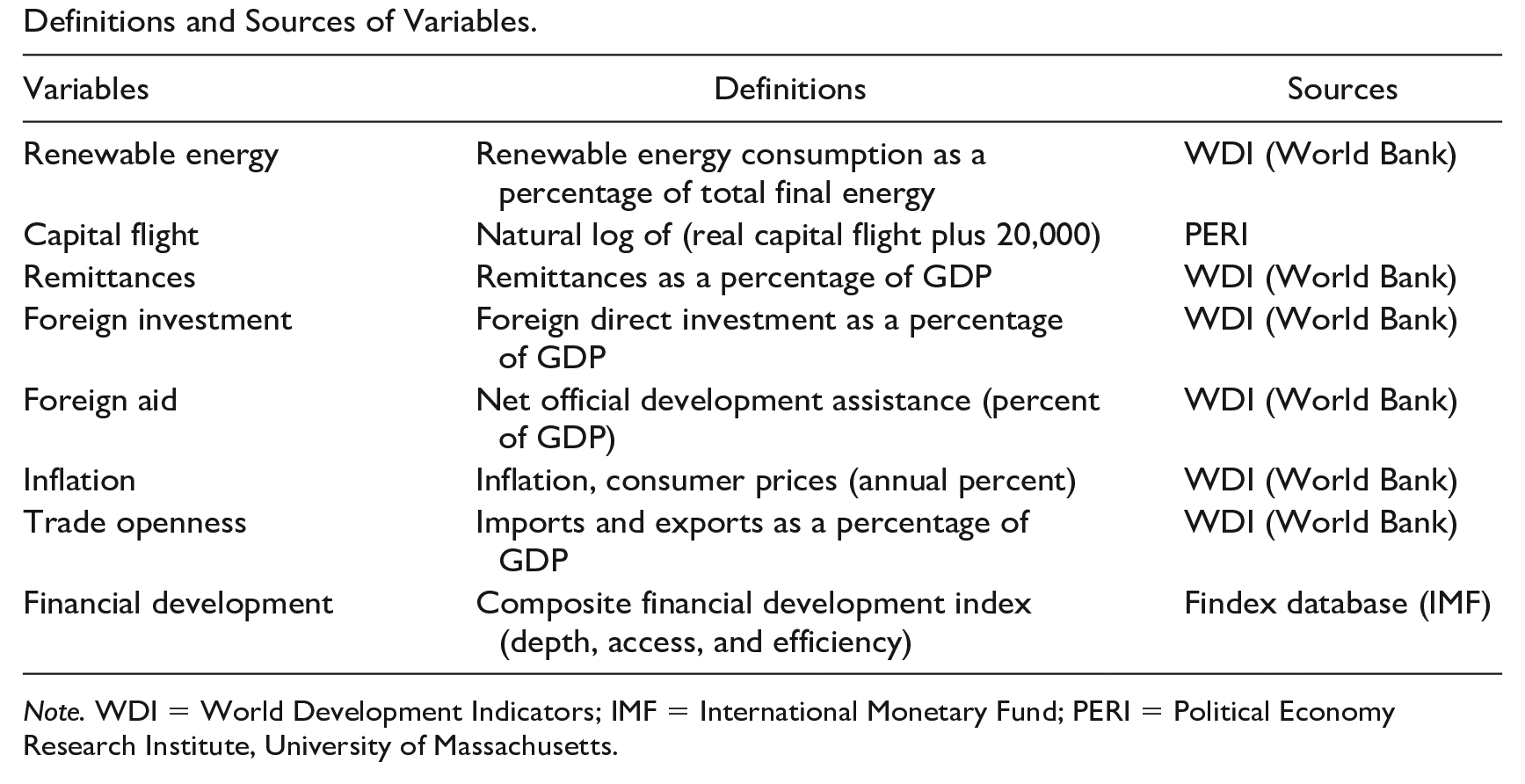
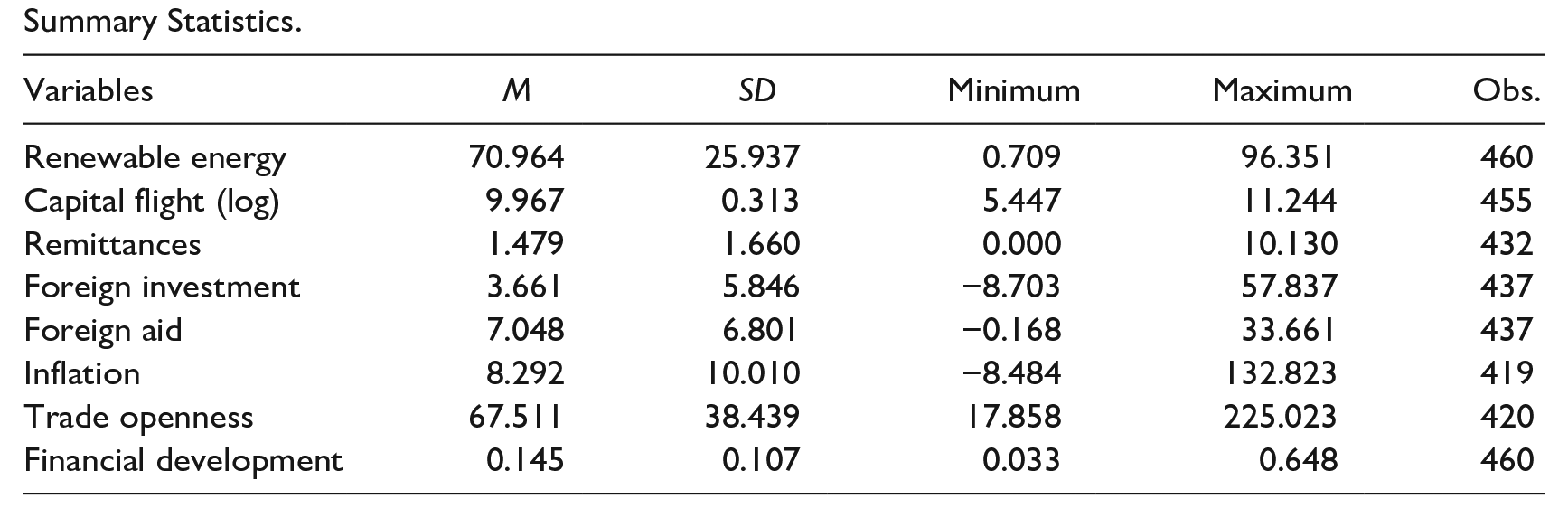
Further insights into the data are apparent in the Appendix section in which the definitions of variables and corresponding sources are provided in Appendix A while the summary statistics are disclosed in Appendix B. The correlation matrix is provided in Appendix C.
Methodology
Consistent with the elements of the motivation in the introduction and the corresponding testable hypotheses outlined in the second section, the methodology employed in the present study is an interactive quantile regression estimation approach because (1) it interacts foreign aid with capital flight in order to assess the incidence of capital flight in the role of foreign aid on renewable energy consumption (i.e., examination of Hypothesis 1) and (2) assesses the considered nexuses throughout the conditional distribution the renewable energy outcome variable (i.e., investigation of Hypothesis 2). It is important to articulate Hypothesis 2 further by stating that assessing the nexuses throughout the conditional distribution of renewable energy consumption involves, articulating low, intermediate, and high initial levels of renewable energy consumption, in accordance with contemporary extant literature on the relevance of the estimation technique in taking into account initial levels of renewable energy consumption (Asongu and Simo-Kengne 2022).
In light of the above, the potential asymmetric linkages are not consistent with the assumption of normality pertaining to estimation techniques such as ordinary least squares (OLS), not least because the estimations are done throughout the conditional distribution of renewable energy consumption. These assumptions underlying the quantile regressions are consistent with both non-contemporary (Koenker and Bassett 1978; Koenker and Hallock 2001) and contemporary (Asongu 2017; Powell 2014, 2015) quantile regressions literature.
Building on the above and acknowledging that the error terms are identically distributed for the entire distribution and considering that distinct slopes are apparent for unique quantiles of the conditional distribution, in the light of Koenker and Bassett (1978), the considered quantile regression approach can be provided as follows:

where y represents renewable energy consumption, X is the vector of covariates,
The quantile regression is employed on the following renewable energy equation:

where i = country
Empirical Results
Presentation of Results
The empirical findings are presented in this section in Table 1, which is divided into seven main columns. The first provides the variables and the corresponding information criteria, whereas the second discloses the attendant OLS regressions. The remaining columns articulate regressions focusing on the 10th, 25th, 50th, 75th, and 90th quantiles, respectively, corresponding to the third, fourth, fifth, sixth, and seventh columns.
Foreign Aid, Capital Flight, and Renewable Energy.
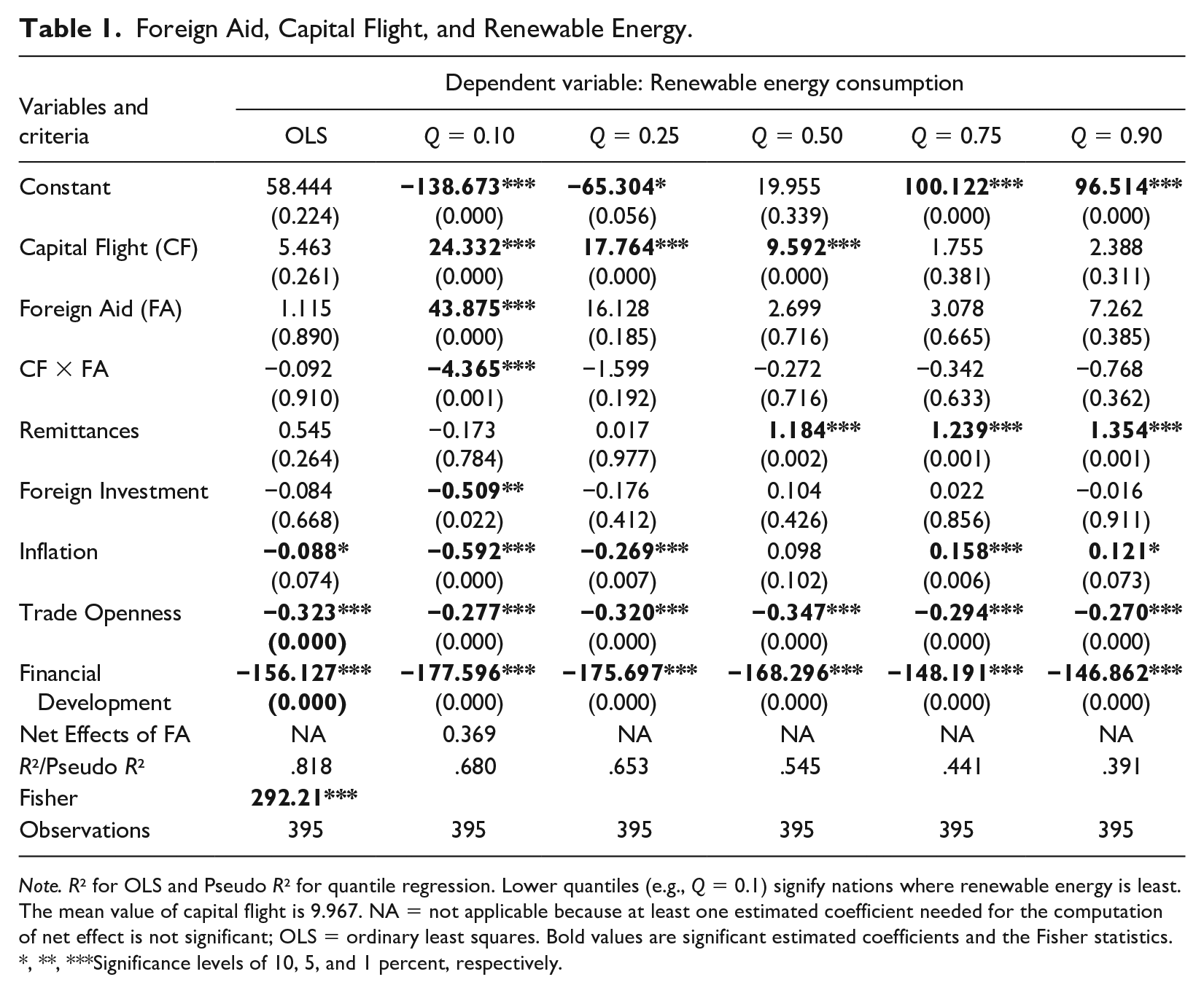
Note. R² for OLS and Pseudo R² for quantile regression. Lower quantiles (e.g., Q = 0.1) signify nations where renewable energy is least. The mean value of capital flight is 9.967. NA = not applicable because at least one estimated coefficient needed for the computation of net effect is not significant; OLS = ordinary least squares. Bold values are significant estimated coefficients and the Fisher statistics.
, **, ***Significance levels of 10, 5, and 1 percent, respectively.
In order to assess the investigated hypotheses, Hypothesis 1 is valid if the unconditional effect of foreign aid on renewable energy consumption is positive while the corresponding conditional or interactive effect is negative. This implies that foreign aid unconditionally promotes renewable energy consumption while capital flight dampens the favorable unconditional effect of foreign aid on renewable energy consumption. Moreover, a net effect is computed in order to assess if the overall incidence (i.e., based on the conditional and unconditional effects) is positive or not. As concerns Hypothesis 2, it is valid if Hypothesis 1 is not valid throughout the conditional distribution of renewable energy consumption. In other words, Hypothesis 2 is valid if Hypothesis 1 is not valid in at least one of the quantiles.
Further to the assessment of Hypothesis 1, the study is consistent with extant literature on interactive regressions by computing the net effect of foreign aid on renewable energy consumption, contingent on capital flight. In the third column of Table 1, related to the 10th quantile, the net effect of foreign aid is 0.369 = ([9.967 × −4.365] + [43.875]). In the attendant computation, 9.967 is the mean value of capital flight, 43.875 is the unconditional effect of foreign aid, while −4.365 is the interactive or conditional effect of foreign aid. This computation is consistent with contemporary studies on interactive regressions (Nchofoung and Asongu 2022a, 2022b; Nchofoung et al. 2021; Nchofoung, Asongu, and Kengdo 2022; Tchamyou 2019).
It is important to note that higher levels of capital flight will engender an overall negative effect on renewable energy consumption. Hence, the validity of Hypothesis 1 is unaffected by the slight positive net effect. Moreover, Hypothesis 2 is also valid because significant unconditional and conditional effects are exclusively apparent in the 10th quantile of the conditional distribution of renewable energy consumption. It follows that “na” (i.e., “not applicable”) is assigned to specifications for which both the unconditional and conditional effects cannot be computed. The significance of foreign aid and the corresponding moderating incidence of capital flight exclusively at the 10th quantile of the conditional distribution of energy consumption can be explained from two main perspectives. On the one hand, foreign aid has been documented to be allocated more to countries with less initial levels in a given economic development prospect that is targeted by the corresponding foreign aid (Chong and Gradstein 2008; Kim and Oh 2012). For instance, in the case of renewable energy, it might be that comparatively more foreign aid is allocated to countries in which extant consumption of renewable is least. On the other hand, as documented in “Hypotheses Development” section, the incidences of capital flight and foreign aid on renewable energy consumption can depend on initial levels of renewable consumption because developing countries have been established to exhibit heterogeneity in renewable energy consumption (Chen and Yao 2021; Khan et al. 2020).
Most of the control variables are significant, though the signs are contingent, as discussed in the data section. First, the positive effect of remittances, though in the top quantiles of the conditional distribution of renewable energy consumption, is consistent with the extant literature on the relevance of remittances in promoting inclusive development outcomes (Barajas et al. 2009; Selaya and Thiele 2010). Second, the negative effect of foreign investment is significant exclusively in the 10th quantile, which translates to the perspective that such an external flow is exclusively significant in countries in which renewable energy is the least. The negative incidence of foreign investment in environmental sustainability is consistent with Sarkodie, Adams, and Leirvik (2020). Third, the incidence of inflation depends on the height and volatility of inflation. Accordingly, while low and stable inflation has been documented to promote inclusive development outcomes (Asongu 2013), high and unstable inflation dynamics are associated with poor inclusive and sustainable development prospects because of apparent ambiguity and uncertainty (Kelsey and le Roux 2017, 2018). It follows that in the light of the findings, high levels of inflation are likely to be apparent in bottom quantiles (i.e., given the negative effect) while low levels of inflation are correspondingly apparent in the top quantiles (i.e., given the positive effect). Fourth, the incidence of trade can be positive depending on whether the corresponding operations associated with trade rely on renewable or non-renewable sources of energy. In Africa, trade for the most part, depends on non-renewable sources of energy (United Nations Economic Commission for Africa 2021). Fifth, while credit access is intuitively expected to boost inclusive development, the opposite effect can still be apparent if banking institutions are characterized by surplus liquidity issues, owing to mobilized savings not effectively transformed into credit for households and economic operators (Tchamyou, Erreygers, and Cassimon 2019).
Robustness Checks (Controlling for Simultaneity and the Unobserved Heterogeneity)
This section controls for some dimensions of endogeneity, especially as it pertains to simultaneity or reverse causality on the one hand and on the other, the unobserved heterogeneity. The highlighted problem of simultaneity is addressed by using lagged independent variables of interest. Furthermore, the concern of the unobserved heterogeneity in terms of time-fixed effects is considered by introducing time-fixed effects in the regression model. Accordingly, the regressions in Table 2 are tailored such that contemporary renewable energy consumption is regressed on non-contemporary foreign aid, capital flight as well as the other control variables. The procedure of lagging the independent variables of interest by 1 year to account for simultaneity is consistent with Mlachila, Tapsoba, and Tapsoba (2017).
Foreign Aid, Capital Flight, and Renewable Energy (Robustness).
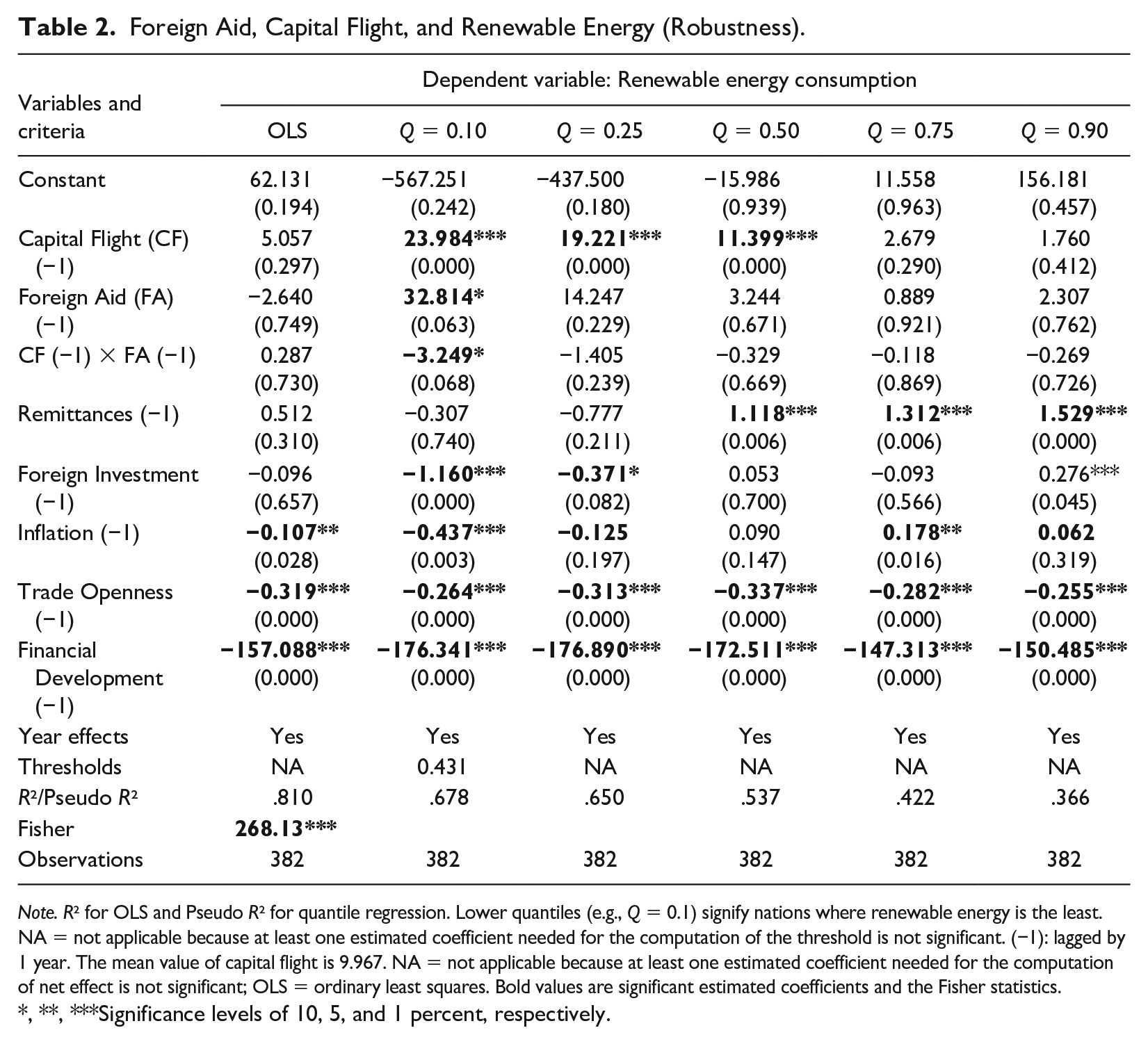
Note. R² for OLS and Pseudo R² for quantile regression. Lower quantiles (e.g., Q = 0.1) signify nations where renewable energy is the least. NA = not applicable because at least one estimated coefficient needed for the computation of the threshold is not significant. (−1): lagged by 1 year. The mean value of capital flight is 9.967. NA = not applicable because at least one estimated coefficient needed for the computation of net effect is not significant; OLS = ordinary least squares. Bold values are significant estimated coefficients and the Fisher statistics.
, **, ***Significance levels of 10, 5, and 1 percent, respectively.
It is also worthwhile to note that when country-fixed effects are further introduced in the models, significant estimates are not apparent. Hence, the control for the unobserved heterogeneity is limited to time-fixed effects. The findings in Table 2 are consistent with those in Table 1, especially in the light of inter alia: (1) net effects apparent exclusively in the 10th quantile, (2) the narrative on tested hypotheses, and (3) significance of control variables.
It is also relevant to discuss the findings within the remit of extant development assistance literature, especially as it pertains to non-African-centric literature, not least because African-centric literature has been covered in the previous sections. In essence, the findings are in accordance with some non-African-centric studies which have concluded that foreign aid can engender positive development outcomes, such as employment and German exports (Martínez-Zarzoso et al. 2016), employment avenues in Pakistan (Tanveer, Latif, and Ziafat 2019), employment diversification in the agricultural, industrial and service sectors of countries receiving foreign aid (Gnangnon 2018), though such favorable externalities can depend on exchange rate and value-added in the manufacturing sector (Gnangnon 2018).
Before concluding, it is important to articulate that the established findings are particularly relevant to sub-Saharan Africa (SSA) for three main reasons: first, the sub-region least emits greenhouse gases in the world, though it is experiencing an economic growth prospect that is comparatively higher relative to other regions of the world. Hence, as argued by Nchofoung and Asongu (2022b), before the turn of the century, inter alia, owing to population growth and industrialization, the sub-region is projected to be one of the main polluters of the world. Second, SSA countries are currently engaging in policies that drive renewable energy consumption in order to limit their present and potential footprints in greenhouse gas emissions. Third, improving the quality of life in Africa by means of providing the population with alternative forms of energy is also a priority of multilateral development institutions such as the African Development Bank in the post-2015 development agenda (Afful-Koomson 2015).
Concluding Implications and Future Research Directions
The study has assessed the effect of capital flight in the nexus between foreign aid and renewable energy consumption in 20 countries in sub-Saharan Africa using data for the period 1996 to 2018. The empirical technique employed is interactive quantile regressions, and the following findings are established. Foreign aid increases renewable energy consumption, while capital flight dampens the favorable effect of foreign aid on renewable energy consumption. The underlying significance and corresponding mitigating effect are exclusively relevant to the bottom (i.e., 10th) quantile of the conditional distribution of renewable energy consumption. The findings are robust to simultaneity and unobserved heterogeneity. The corresponding countries in the 10th quantile of the conditional distribution of renewable energy are Botswana, Congo Republic, Côte d’Ivoire, Ghana, Sudan, Seychelles, and South Africa. In what follows, policy implications are discussed, which are broadly consistent with Ainembabazi (2022) on the fighting of capital flight in Africa.
First, as shown in the findings, the African continent is significantly losing financial resources from capital flight compared to development aid, external borrowing, and foreign investment that are flowing into the continent (Ainembabazi 2022). This is evidence of the perspective that more inflows of foreign aid, foreign investment, and external debt should not be exclusively understood as mechanisms of helping Africa, not least because in the light of the attendant narrative, Africa is a net creditor to the rest of the world. It follows that the policy narrative of foreign aid should be improved in both domestic and international remits where foreign aid is considered as generosity by Western nations toward African countries. Accordingly, the attendant foreign aid should be considered as a form of economic justice that has far-reaching consequences like promoting the consumption of renewable energy, which is also beneficial to the world at large in the global agenda for more sustainable development, especially as it pertains to the United Nations’ SDGs.
Second, the fight against capital flight should be viewed within the remit of a global framework involving attorneys, accountants, bankers, and African politico-economic leaders, inter alia, such that common policies are formulated and implemented to oversee money from poor countries ending up in secret jurisdictions that are offshore. Accordingly, whereas some countries in Africa could be in a position to fight the menacing capital flight by improving extant institutions and severely punishing those who fail to abide by the rules, a worthwhile and long-term remedy should involve all stakeholders at the national and international levels, especially as it pertains to addressing concerns related to the enablers’ role as well as financial secrecy. In essence, these comprehensive partnerships can be fundamental when it comes to the exchange of financial information in view of mitigating financial crime and illicit financial flows.
Third, scholars and policymakers should more globally articulate the perspective that illicit capital flows that leave the African continent render domestic funding programs such as investing in food security, education, agriculture, and health services difficult. Moreover, illicit financial flows from poor countries are also connected to global problems such as economic immigration to developed countries owing to less economic development as well as climatic immigration owing the lack to funds for environmental sustainability and renewable energy consumption projects.
The above policy prescriptions are contingent on the initial levels of renewable energy consumption, not least, because the examined nexus is largely significant in the bottom quantile of the conditional distribution of renewable energy consumption. This is an indication that the policy implication largely speaks to countries in which the consumption of renewable energy is the least. By extension, policies for the promotion of renewable energy consumption based on the linkage between foreign aid and capital flight are not likely to succeed unless such policies are contingent on initial levels of renewable energy consumption and, hence, tailored differently across countries with high, intermediate, and low existing levels of renewable energy consumption.
The study obviously leaves space for further research, especially as it concerns, assessing how the established findings are relevant to other developing countries. Moreover, country-specific studies in the light of the relevant country-specific techniques can engender more focused policy implications. While the current exposition is exclusively focused on renewable energy consumption, it is worthwhile to consider other SDGs in view of providing complementary policy recommendations for the achievement of other SDGs. Moreover, future studies within the remit of quantile regressions should consider controlling for fixed effects in order to account for the unobserved heterogeneity.
Footnotes
Appendix A
Definitions and Sources of Variables.
| Variables | Definitions | Sources |
|---|---|---|
| Renewable energy | Renewable energy consumption as a percentage of total final energy | WDI (World Bank) |
| Capital flight | Natural log of (real capital flight plus 20,000) | PERI |
| Remittances | Remittances as a percentage of GDP | WDI (World Bank) |
| Foreign investment | Foreign direct investment as a percentage of GDP | WDI (World Bank) |
| Foreign aid | Net official development assistance (percent of GDP) | WDI (World Bank) |
| Inflation | Inflation, consumer prices (annual percent) | WDI (World Bank) |
| Trade openness | Imports and exports as a percentage of GDP | WDI (World Bank) |
| Financial development | Composite financial development index (depth, access, and efficiency) | Findex database (IMF) |
Note. WDI = World Development Indicators; IMF = International Monetary Fund; PERI = Political Economy Research Institute, University of Massachusetts.
Appendix B
Summary Statistics.
| Variables | M | SD | Minimum | Maximum | Obs. |
|---|---|---|---|---|---|
| Renewable energy | 70.964 | 25.937 | 0.709 | 96.351 | 460 |
| Capital flight (log) | 9.967 | 0.313 | 5.447 | 11.244 | 455 |
| Remittances | 1.479 | 1.660 | 0.000 | 10.130 | 432 |
| Foreign investment | 3.661 | 5.846 | −8.703 | 57.837 | 437 |
| Foreign aid | 7.048 | 6.801 | −0.168 | 33.661 | 437 |
| Inflation | 8.292 | 10.010 | −8.484 | 132.823 | 419 |
| Trade openness | 67.511 | 38.439 | 17.858 | 225.023 | 420 |
| Financial development | 0.145 | 0.107 | 0.033 | 0.648 | 460 |
Appendix C
Correlation Matrix (Uniform Sample Size: 395).
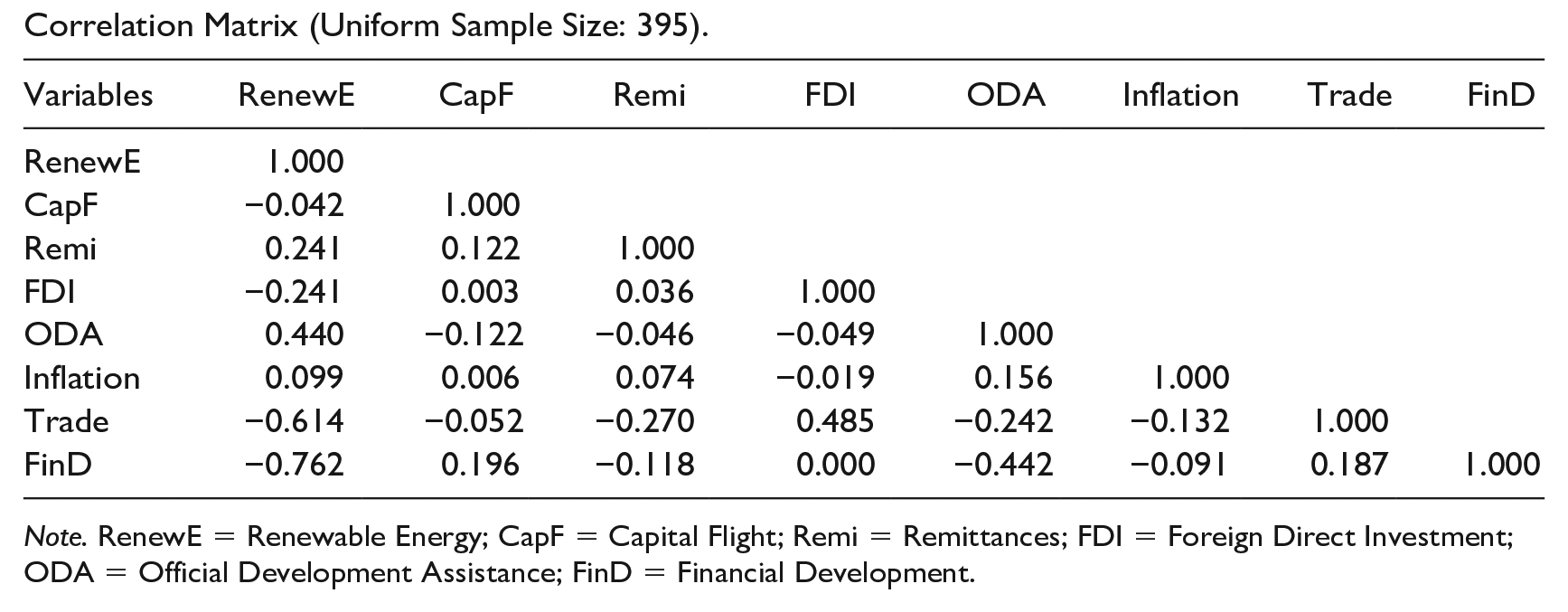
| Variables | RenewE | CapF | Remi | FDI | ODA | Inflation | Trade | FinD |
|---|---|---|---|---|---|---|---|---|
| RenewE | 1.000 | |||||||
| CapF | −0.042 | 1.000 | ||||||
| Remi | 0.241 | 0.122 | 1.000 | |||||
| FDI | −0.241 | 0.003 | 0.036 | 1.000 | ||||
| ODA | 0.440 | −0.122 | −0.046 | −0.049 | 1.000 | |||
| Inflation | 0.099 | 0.006 | 0.074 | −0.019 | 0.156 | 1.000 | ||
| Trade | −0.614 | −0.052 | −0.270 | 0.485 | −0.242 | −0.132 | 1.000 | |
| FinD | −0.762 | 0.196 | −0.118 | 0.000 | −0.442 | −0.091 | 0.187 | 1.000 |
Note. RenewE = Renewable Energy; CapF = Capital Flight; Remi = Remittances; FDI = Foreign Direct Investment; ODA = Official Development Assistance; FinD = Financial Development.
Acknowledgements
The authors are indebted to the editor and reviewers for constructive comments.
Data Availability
The data for this research are available upon request.
Declaration of Conflicting Interests
The author(s) declared no potential conflicts of interest with respect to the research, authorship, and/or publication of this article.
Funding
The author(s) received no financial support for the research, authorship, and/or publication of this article.
Ethical Approval
This article does not contain any studies with human participants or animals performed by the authors.
