




Abstract
Through the lens of the conservation of resources (COR) theory and gender-role perspective, this research investigates the effect of work-family conflict (WFC) on positive discipline parenting (PDP) via well-being among working mothers in Indonesian public organizations. A total of 218 mothers who worked in public organizations such as schools and hospitals were selected as participants. All participants had children attending schools from elementary to senior high school. Data were collected online with a three-wave data collection technique and analyzed using IBM SPSS AMOS ver. 26 and Hayes’ PROCESS macro on SPSS ver. 26. The results showed that WFC directly reduced the mothers’ PDP or indirectly lowered their well-being. In Indonesia, mothers are responsible for child-rearing and working in public organizations can cause resource imbalance. Scholars and practitioners should consider the existence of WFC and how it influences working mothers in public organizations. This study is among a few studies investigating WFC’s impact on working mothers’ well-being and parenting.
Introduction
Work-family conflict (WFC) is a failure to balance work and family demands and responsibilities (Soomro et al. 2017). Work and family are two different domains, but they can interfere with each other. Individuals aim to balance these two domains (Clark 2000), but often they cannot avoid WFC. Consequently, WFC negatively affects their well-being and job satisfaction (Obrenovic et al. 2020; Selvarajan et al. 2020; Terry, Woo, and Terry 2020).
The conservation of resources (COR) theory explains that conflict requires large cognitive resources, and individuals must allocate their resources and energy to execute cognitive tasks related to the conflict (Hobfoll 1989, 2011; Hobfoll and Freedy 2017; Hobfoll and Lilly 1993). Research has shown that workload and family often interfere with each other (Cerrato and Cifre 2018; Dhingra and Keswani 2019; Welsh and Kaciak 2019). Employees must manage potential conflicts between work and family to avoid unprecedented consequences to their well-being. Well-being is people’s cognitive and affective evaluation of their overall life experience (Diener, Diener, and Diener 1995), and this evaluation can be categorized into financial, physical, social, eudaimonic, and hedonic (Lui and Fernando 2018).
Drawing from gender-role perspectives, this study provides some new insight, particularly about WFC in Indonesian culture, where women and men share different roles at home and how their roles impact their work-life balance (Daraba et al. 2021). From a traditional gender view, men are the providers of family needs, while women provide childcare (Bird, Bird, and Scruggs 1984; Eagly and Wood 2003). In this situation, mothers are expected to do child-rearing regardless of their work demands. Conflicts between work and family can occur to anyone across various organizations. However, in a traditional gender culture, working mothers are more vulnerable than male workers because they are responsible for nurturing the family while they provide additional income to the family (Boehnke 2011; Niehof 2013). Therefore, working mothers are more vulnerable than traditional male workers to experiencing WFC as they have to balance resources for the workplace and family.
Working mothers have high WFC because they are more responsible for taking care of the house and children (Frank et al. 2021; Spagnoli, Lo Presti, and Buono 2020; Zurlo, Vallone, and Smith 2020). Therefore, workplace and family demands can bring about stress and WFC (Asbari et al. 2019; Rajgariah et al. 2021). Gharaibeh and Gharaibeh (2021), Greaves et al. (2017), and Rajgariah et al. (2021) state that working mothers tend to have higher stress levels than nonworking ones. This phenomenon occurs in all organizations, including public service organizations.
Apart from this theory, women’s career advancement can be seen in Indonesia, where many important roles in public services were led by female leaders (Abdul Ghani Azmi, Syed Ismail, and Basir 2014; Aspinall, White, and Savirani 2021). The emancipation movement, education, and gender equality in Indonesia have encouraged women to work and provide financial support for the family (Hussin, Mohamad, and Ghanad 2017; Maftuhah 2022; Niehof 2013). In addition, in low-income families, there is a tendency for mothers to receive support in entering the workforce, causing more challenges to child-rearing and parenting (Bell 2016; Siegel 1984; Weiss et al. 2003). However, spouse restriction, family responsibility, and lack of gender-friendly career options could halt women from advancing their career (Kholis 2012, 2017).
Parenting plays a significant role in a child’s development (Konok, Bunford, and Miklósi 2020; Panula et al. 2020). Unfortunately, working mothers might have less time to communicate with their children, increasing their children’s behavioral and psychological problems such as game addiction, poor self-control, and decreased well-being (Rajan et al. 2021; Singh, Kumar, and Kumari 2020; Yang and Kim 2021). As they struggle to build effective communication due to workload, some Indonesian mothers tend to use a permissive, submissive, and emotionally uninvolved parenting style in which they are more effortless, tolerant of misbehaviours, and implement fewer rules to allow a friendly environment for the young children (Riany, Meredith, and Cuskelly 2017; Spera 2005).
Unlike parenting styles that have negative consequences on children, such as autocratic, submission, and permissive parenting (Pinquart 2016; Spera 2005), positive discipline parenting (PDP) emphasizes the balance between firmness and kindness (Nelsen, Lott, and Glenn 2007). Parents who implement this parenting style engage in respectful communication with their children and implement positive reinforcement (Nelsen et al. 2007). In implementing this parenting, parents must set clear boundaries and expectations via effective communication (Okorn, Verhoeven, and Van Baar 2022). This parenting style aims to help children develop problem-solving skills and learn about the consequences of their behaviors which also foster children’s self-control and responsibility (van IJzendoorn et al. 2023).
Implementing PDP requires cognitive resources and energy, as mothers must think thoroughly to reinforce desired and positive behaviors without sacrificing their respect for their children. PDP is carried out based on an approach that gives children confidence (Carroll and Hamilton 2016; Durrant 2019; Nelsen et al. 2007). Unfortunately, as the mothers are exhausted, and resources are scarce, PDP becomes more difficult to execute, and a permissive parenting style becomes an immediate alternative.
Working mothers must maintain their well-being as it is necessary to implement positive discipline (Chen, Ayoun, and Eyoun 2018; Obrenovic et al. 2020). Mothers’ well-being plays an important element that links WFC and PDP. According to Connell and Strambler (2021), Lemmons et al. (2021), and Lawrence et al. (2019), effective parenting is influenced by stress, self-efficacy, and life satisfaction. This shows that well-being is essential to support mothers’ effective parenting (Harpaz, Grinshtain, and Yaffe 2021; Penjor et al. 2019). Conflicts can cause emotional exhaustion and deteriorate well-being, while well-being is necessary to ensure the availability of resources in performing PDP (Bergs et al. 2018; Brenning, Mabbe, and Soenens 2022; Chen et al. 2018; Hardy et al. 2016; Obrenovic et al. 2020; Selvarajan et al. 2020; Terry et al. 2020; Yang and Kim 2021). Thus, mothers with positive mental states and well-being have more cognitive resources to perform PDP at home.
Another critical question is whether or not working in public organizations could also bring extra challenges to working mothers. In Indonesia, the central government manages public service organizations and policies related to the management are centralized. Delivering public services to the citizens requires extra effort because all procedures have been arranged according to the national standard (Daswati et al. 2022; Hattab et al. 2022). With this demand, working mothers in public organizations are expected to deliver a national standard of service. Unfortunately, employee management (e.g., selection, termination) could be complex as it requires approval from the central government. Given the traditional gender view, working mothers are encouraged to balance their resources to ensure public and family services.
Based on the above argument, this study aims to investigate the influence of mothers’ WFC on their well-being and their PDP at home. Investigating the cascading effect of WFC on mothers’ PDP in a traditional gender-role culture like Indonesia can enrich our understanding of the role of gender in managing human resources. Some previous studies have documented the application of PDP, such as Diana et al. (2021), Kurniasih and Hastuti (2017), and Ruiz-Casares et al. (2019, 2022). Still, they have not explained the link between WFC and PDP.
Literature Review and Hypotheses
This research employs the COR theory principles (Hobfoll 1989) to explain the effect of WFC on the well-being and PDP of working mothers. According to the COR theory, individuals conserve their resources by preventing threats (Hobfoll 1989, 2011). Individuals always try to obtain and maintain their cognitive resources as they are essential for executing cognitive tasks. Stress occurs when individuals fail to conserve or are unable to find new resources. People always try to avoid stress by conserving and preventing the loss of resources in the future (Hobfoll 1989, 2011; Hobfoll and Freedy 2017; Hobfoll and Lilly 1993).
To explain the mechanism by which WFC reduces well-being and PDP, this study also applies the gender-role theory. The traditional gender-role view (Bird et al. 1984; Boehnke 2011) postulated that women are responsible for caring for the children and the family. This can cause a demanding situation for the mothers because they must distribute their resources to the family and the workplace. Considering work and family demands, women in public organizations need more resources than their male counterparts, especially in a country with a traditional gender orientation (Daraba et al. 2021). Working mothers are expected to provide care for the family while simultaneously fulfilling their demands as employees in public services. This challenging situation causes working mothers to be more prone to stress than those who only focus on family care (Gharaibeh and Gharaibeh 2021; Rajgariah et al. 2021).
Balancing roles as both public service personnel and mothers can exhaust their resources, leaving mothers with depleted resources which consequently causes poor well-being. Furthermore, there are several roles and responsibilities of individuals that cause conflict. Adisa, Gbadamosi, and Osabutey (2016), Cerrato and Cifre (2018), and Dillip et al. (2018) emphasized that mothers have more roles to perform, including chores and raising children. Working mothers who experience WFC feel they do not have the resources to deal with the conflict. Therefore, they invest more resources such as energy, time, money, or knowledge in overcoming the issue (Asbari et al. 2019). However, in line with Frank et al. (2021), Spagnoli et al. (2020), and Zurlo et al. (2020), WFC can cause stress for working mothers because they allocate resources in the process of resolving conflicts. As their resources are depleted, and they cannot gain new resources, they will experience a decrease in well-being (Hobfoll 1989). The decreased well-being can lead to stress, depression, anxiety, and others (Bergs et al. 2018; Obrenovic et al. 2020; Selvarajan et al. 2020). Therefore, the WFC of working mothers negatively affects their well-being.
On the other hand, Hobfoll (1989) proposed that individuals need resources to execute demanding cognitive tasks. Conflicts between work and family need cognitive resources to resolve WFC. Working mothers who experience the WFC tend to use more resources to fulfill work and family demands. In a traditional gender culture like Indonesia, working mothers cannot easily ignore their family demands and fulfilling the need of family and work requires extra effort and resources. The traditional gender-role demands female workers to spare some resources and energy to care for and nurture children, which causes potential resource depletion and minimum energy to execute cognitive tasks.
The application of PDP requires cognitive energy because it focuses on problem-solving and child development (Durrant 2019). PDP requires mutual and respectful communication between mothers and their children. At the same time, the mothers should implement positive reinforcement and actively improve their children’s behaviors (Nelsen et al. 2007). This PDP demands parents to plan, execute, monitor, and evaluate their children’s behaviors as their children must actively learn the consequences of their behaviors (van IJzendoorn et al. 2023). Mothers cannot fulfill their roles as caregivers and implement the PDP for their children as their resources have been used to resolve their WFC. Therefore, the existence of WFC tends to reduce working mothers’ ability to execute PDP. Based on the explanation above, the first hypothesis is:
Some recent empirical findings have found that mothers’ mental health is positively associated with their parenting styles (Harpaz et al. 2021; Negraia, Yavorsky, and Dukhovnov 2021). Low well-being leads to hostile parenting, while high well-being brings about positive parenting (Carroll and Brown 2020; Penjor et al. 2019). Drawing from the COR theory, when mothers are exhausted due to the loss of resources, they will experience stress. This psychological condition causes poor well-being, in which they need new resources to replace the lost ones.
Unfortunately, in traditional gender culture, working mothers are more susceptible to stress than their male counterparts as they need to distribute limited resources to both work and family (Zhou, Meier, and Spector 2019). Consequently, working mothers use less energy to care for, help, and raise children (Rajgariah et al. 2021), while PDP needs more energy to implement than just a permissive parenting style (Durrant 2019). Implementing PDP requires cognitive resources because mothers need to execute complex tasks involving emotional control, consistency, and discipline. This leads to the following hypothesis:
COR explained that individuals attempt not only to prevent the loss of resources but also to conserve, maintain, or seek new ones (Hobfoll 1989). Individuals are motivated to conserve their resources by preventing threats to their existing resources. However, when they involve in a demanding situation, they also sense a threat to their resources. Resolving WFC demands the distribution of resources between family and work, and putting more resources on one side means resource depletion on the other side (Grandey and Cropanzano 1999). As working mothers invest more resources into their work and resolve all challenges at work, resources for the family will be scarce. This situation can transform into psychological distress and lower working mothers’ well-being.
Furthermore, as working mothers suffer from low well-being, they can also find it challenging to perform PDP in their families. Exercising PDP demands cognitive resources. However, if the cognitive resources have been invested in the workplace, working mothers will experience resource depletion when they attempt to execute PDP tasks. Therefore, WFC can cause resource depletion, stress, and lower well-being. As well-being decreases, the remaining resources must be invested to recover from stress, leaving fewer cognitive resources to execute PDP tasks. This mechanism leads to the following hypothesis:
Method
Participants and Procedure
This study applied a quantitative method to examine the indirect effect of WFC on well-being and PDP among working mothers who work in Indonesian public organizations. Participants were mothers who worked and had children attending elementary to senior high schools in Indonesia. Recruitment was performed through schools and the research assistants’ social media networks (e.g., friends on Facebook). In the schools, the research advertisement was sent to parents after being approved by the school principal. Moreover, six assistants were recruited to advertise the research on social media (e.g., Facebook) and various public service offices (e.g., hospitals and government offices). Participants were directed to an online survey platform where they read the informed consent form.
Common method bias (CMB) is a potential issue in a survey in which variables are correlated due to common method variances, including collecting data simultaneously (Podsakoff et al. 2003). To prevent this issue, this study implemented a three-wave data collection technique where data collection was separated into three phases with a one-week time gap. To match responses throughout the phases, participants received a five-digit identification code (e.g., 01234) and were asked to type this code in every survey. Participants filled out demographic information and the WFC scale in the first phase, while in the second, they completed the Well-being Scale (WeBs). Last, participants were asked to complete a PDP scale.
Four hundred twenty-seven mothers participated in the first wave from May 12, 2022 to June 2, 2022. Only those who reported their identification code in three different surveys were included in the analysis. Seventy-six participants were excluded because they did not participate in all phases or failed the attention check question. Finally, 218 participants were included in the data analysis. The average age of the respondents was M= 44.37 (SD= 9.28), with about 41.74 percent working as professionals such as teachers, doctors, and engineers in public service offices; 20.64 percent working in the state government offices as administration or customer service staff; and 37.62 percent of them were staff in the regional offices. Regarding education, most participants had college degrees (62.84 percent), 16.06 percent completed postgraduate schools, and the rest (21.10 percent) had high school diplomas. A low-risk human research ethics clearance for this study was approved by the research ethics committee from the Faculty of Social and Political Sciences, Halu Oleo University, Indonesia.
Measures
All measures in this study underwent a systematic translation and back-translation procedure to ensure adequate cultural adaptation of the measures (Sousa and Rojjanasrirat 2011). The item adaptation was performed by a team that consisted of a psychometrician, psychologist, and researchers. The procedure involved translation, back-translation, item analysis, and psychometric testing. During the process, some words were adapted to fit Indonesian culture. For example, the word “meeting” in one of the PDP items was adapted to “kumpul (gathering)” instead of “rapat (meeting)” because “rapat” sounds formal and less common among Indonesian families. The following is a description of each measure.
Work-Family Conflict Scale (WAFCS)
The WAFCS was used to measure WFC developed by Haslam et al. (2015). WAFCS consists of five items with two dimensions (i.e., work-to-family and family-to-work conflict). This scale was administered using a seven-point Likert-type scale ranging from 1 (strongly disagree) to 7 (strongly agree). The inter-item correlations indicated a highly reliable scale with Cronbach’s alpha of .90. One of the items was “My work prevents me from spending sufficient quality time with my family.”
WeBs
The WeBs was developed by Lui and Fernando (2018) to measure parents’ well-being. WeBs consisted of 29 items with five dimensions, including financial, physical, social, eudaimonic, and hedonic. This scale was administered using a six-point Likert-type scale with options ranging from 1 (strongly disagree) to 6 (strongly agree). Cronbach’s alpha was .93, indicating a highly reliable measure. The items included “I have someone who knows me well that I talk to when having problems.”
Positive Discipline Parenting (PDP) Scale
The Positive Discipline Parenting (PDP) Scale was used to measure parents’ positive discipline behaviors in parenting. This scale was initially developed by Carroll and Hamilton (2016). This measuring instrument consists of seven items and uses a five-point Likert-type scale ranging from 1 (never) to 5 (always). Cronbach’s alpha internal consistency was .82, indicating that the scale was reliable. The items included “I calm down before solving the problem with my children.”
Demographic questions and attention check items
This study collected some demographic information related to the participants, including gender (e.g., male), age, education (e.g., high school), occupation (e.g., teacher), and the number of children at home. Also, to reduce careless responding (Huang et al. 2012; Meade and Craig 2012) when collecting data via an online platform, this study randomly inserted an attention check item (i.e., if you read and understand this item, please select disagree).
Results
Bivariate Correlation Analysis
Table 1 shows some significant relationships between variables. For example, education level was negatively related to occupation and the number of children. WFC was negatively related to well-being and PDP. Meanwhile, well-being was positively associated with PDP. In summary, all predictors were significantly correlated with PDP, with correlation coefficients ranging from −.53 (p< .001) to .49 (p< .001).
Descriptive Statistics and Bivariate Correlations (N = 218).
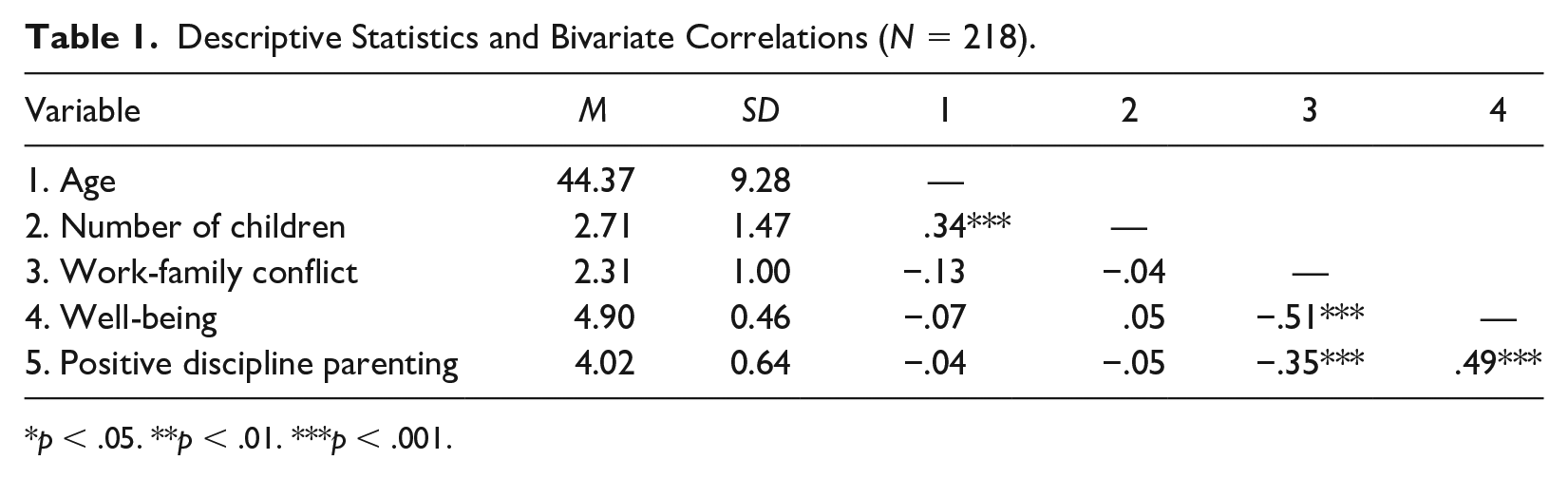
p < .05. **p < .01. ***p < .001.
Measurement Model Analysis
Before performing the hypothesis testing, the validity of the measurement model was tested using confirmatory factor analysis (CFA) technique, where the theoretical model was compared with two alternative models. The measurement model consisted of three proposed variables (i.e., WFC, well-being, and PDP), while the first alternative model consisted of WFC and a combination of well-being and PDP and the second alternative model was formed by combining all items in a single factor. The results confirmed that the measurement model had a better fit (CMIN/DF= 2.10, comparative fit index [CFI]= .76, Tucker-Lewis index [TLI] = .74, and root mean square error of approximation [RMSEA] = .07) than all alternative models (please see Table 2 for more details). For each variable in the model, the proposed measurement model yielded an average variance extracted (AVE) of 50 percent or above with discriminant validity of .62 or higher, suggesting that the model was valid and hypothesis testing could be performed. This analysis was performed using IBM SPSS AMOS ver. 26.
Measurement Model Analysis.
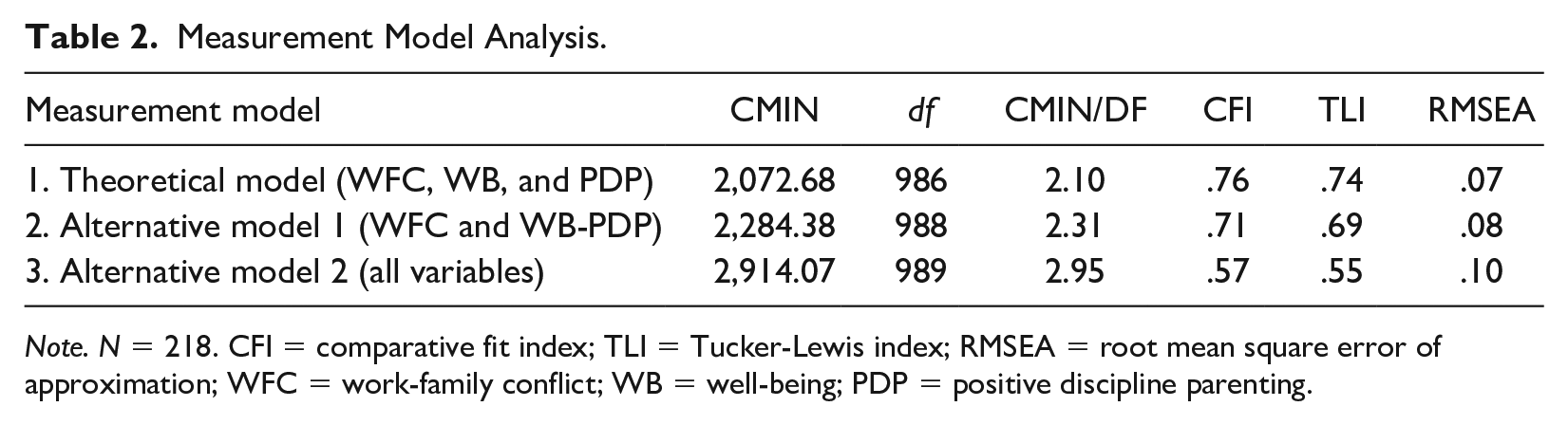
Note. N = 218. CFI = comparative fit index; TLI = Tucker-Lewis index; RMSEA = root mean square error of approximation; WFC = work-family conflict; WB = well-being; PDP = positive discipline parenting.
Hypothesis Testing
A one-way analysis of variance (ANOVA) was performed to explore significant differences in WFC between jobs (e.g., teachers and staff). The results showed no significant differences between job groups (F= 1.91, p> .05), indicating similar WFC levels across jobs. Next, a mediated regression analysis technique model 4 with PROCESS macro (see Hayes 2013) on IBM SPSS ver. 26 was used to test the hypotheses. This study tested the direct and indirect effects of WFC on parents’ PDP through the mediating role of well-being. Table 3 shows the results of the hypothesis testing.
Mediation Model 4 Using PROCESS by Hayes.
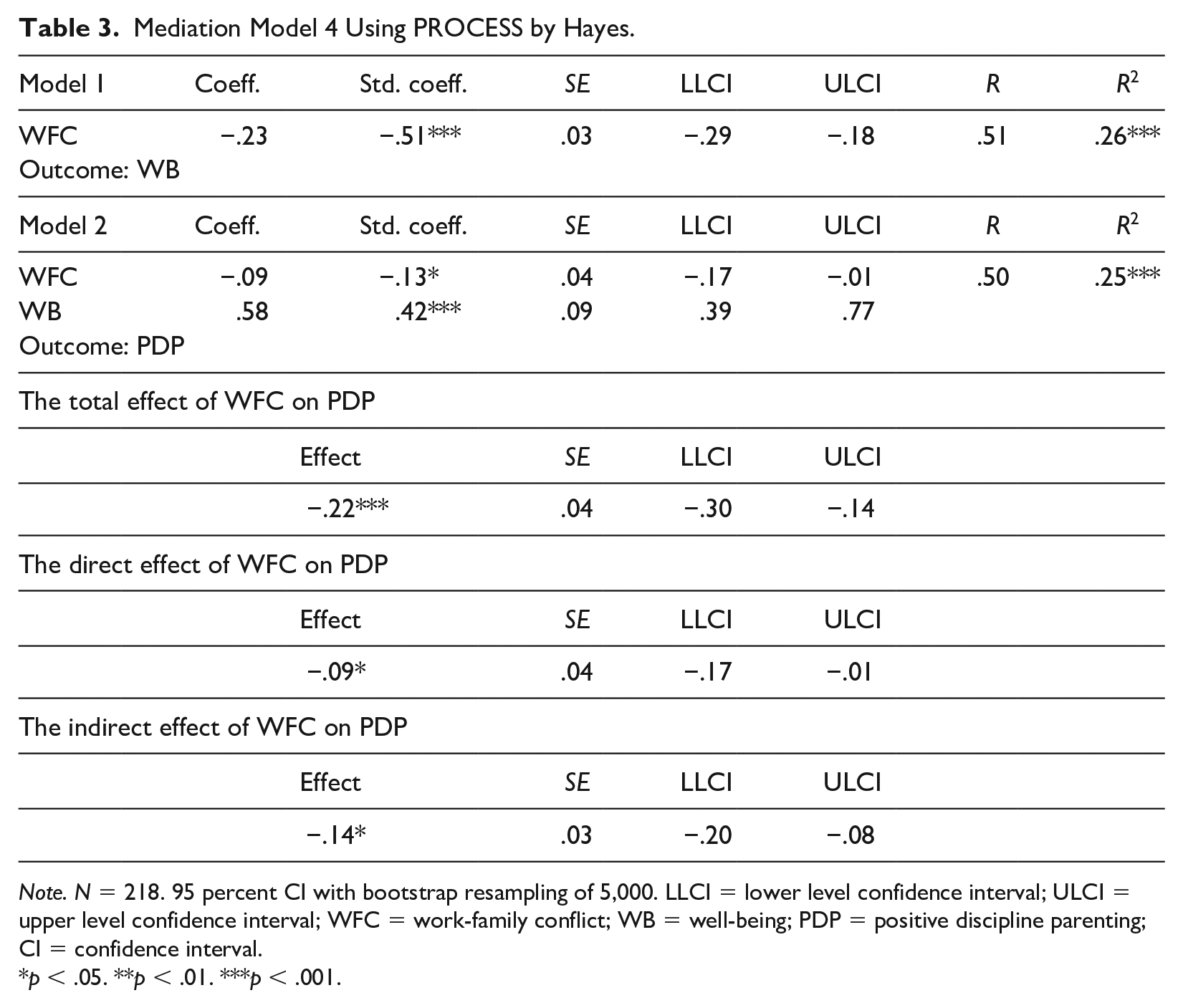
Note. N = 218. 95 percent CI with bootstrap resampling of 5,000. LLCI = lower level confidence interval; ULCI = upper level confidence interval; WFC = work-family conflict; WB = well-being; PDP = positive discipline parenting; CI = confidence interval.
p < .05. **p < .01. ***p < .001.
The results indicated a significant direct effect of WFC on PDP (b = −.09, p < .05), suggesting a direct relationship between WFC and PDP. Similarly, the direct effect of WFC on well-being was also observed (b = −.23, p< .001), supporting Hypothesis 1. Furthermore, mothers’ well-being was positively associated with PDP (b = .58, p< .001), indicating support for Hypothesis 2. The mediation analysis revealed a significant indirect effect of WFC on PDP via well-being (b = .14, 95 percent confidence interval [CI] = [−.20, −.08]). The 95 percent CI for this test did not include zero, suggesting statistical significance and support for Hypothesis 3. The mediation analysis also confirmed a significant direct effect of WFC on PDP (b = .09, 95 percent CI = [−.17, −.01]), suggesting well-being partially mediated the relationship between WFC and PDP. The overall model accounted for a significant proportion variance in PDP (R2 = .25, p < .001), suggesting that the model reasonably fits the data. Figure 1 depicts the empirical model of this study.
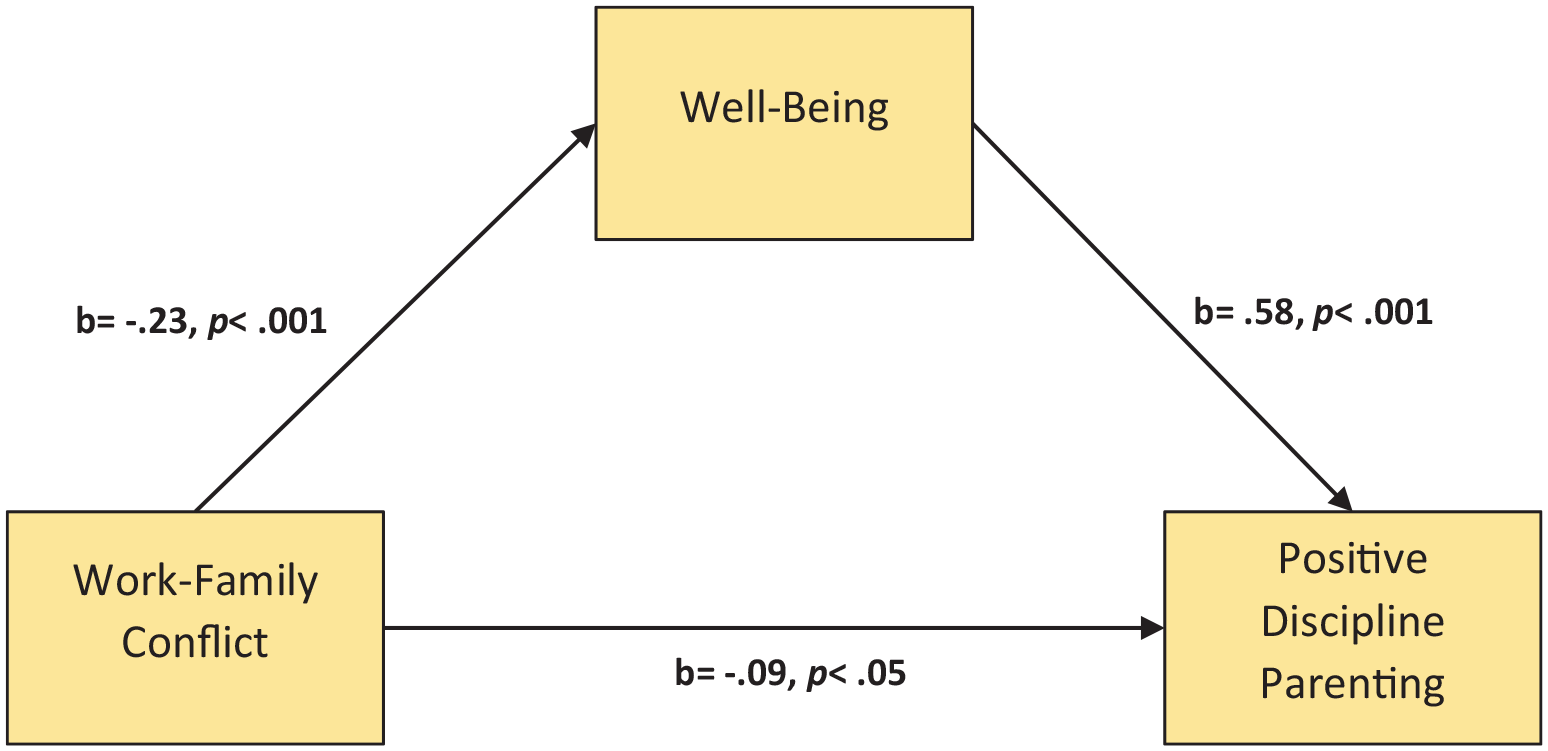
Empirical model.
Discussion
This study found that mothers’ WFC negatively impacted the implementation of PDP at home by lowering their well-being. Through the lens of COR theory (Hobfoll 1989, 2011; Hobfoll and Freedy 2017; Hobfoll and Lilly 1993), this study has confirmed that working mothers in public services who suffered from WFC could have limited resources to execute some family demands. As the resources are scarce, they will experience distress, leading to poor well-being. Following the traditional gender-role perspective (Bird et al. 1984; Boehnke 2011), working mothers in Indonesia are still expected to be responsible for family care, including child-rearing and parenting. As WFC occurs, they might have limited cognitive resources to execute PDP tasks. If they experience resource depletion at work, they are less likely to secure resources to execute parenting tasks at home. Managing work and family demands extra resources, and resource imbalance between these two realms (i.e., workplace vs. family) causes disturbance to work-life balance.
This study is consistent with Dugan and Barnes-Farrell (2020), Greaves et al. (2017), Hess and Pollmann-Schult (2020), and Yang and Kim (2021), who suggested that WFC could reduce parents’ well-being. Similarly, Ng and Lau (2020) and Rajgariah et al. (2021) also indicated that the well-being of working mothers influenced parenting styles. Nevertheless, this study has advanced our understanding of the link between WFC and ineffective role as mothers at home. The link between work demands and poor performance has been introduced by some scholars using various theories, such as the job demand-resource (JDR) model (Demerouti et al. 2001). Unfortunately, the application of this theory only centered around the consequences of the work demands on employees in the workplace.
The gender-role perspectives offer new insight into applying the COR theory across genders and its impacts in different areas. Gender roles neither determine the number of resources male or female employees have nor conflicts at work and family, but some roles could be more demanding than others in one aspect of life. In the Indonesian public organization context, for example, the demand to balance between work and family is more accentuated for female than male employees. WFC can drain employee resources, and in this situation, working mothers in Indonesian public organizations can directly feel the disadvantages of losing resources. This causes greater work-family interferences for working mothers who are also expected to provide care and parenting for their children.
Parenting with positive discipline is beyond just providing effective child-rearing or positive parenting. PDP requires a balance between kindness and firmness and respecting children’s perspectives. Evidence has confirmed that PDP provides trust and understanding to children (Carroll and Hamilton 2016). This aligns with Durrant and Stewart-Tufescu (2017) that discipline does not lead to punishment or obedience but refers to knowledge and understanding. Excessive punishment, violence, and coercion failed to have a good influence on children. Research showed that overly controlling parenting can lead to behavioral problems (Amran and Basri 2020; Crandell et al. 2018; Masud et al. 2019; Perez-Gramaje et al. 2020; Pinquart 2017).
All these principles make PDP challenging to apply without full attention, effort, and resources from the parents. Managing PDP at home requires extra cognitive and emotional resources for mothers to deal with demanding tasks such as explaining things to children, observing behaviors, and providing a warm connection. These tasks have a similar degree of demand to those in mothers’ workplaces. Meaning, resource conflicts in these two spheres can cause disturbance for working mothers.
In the family, if sufficient resources are available, working mothers can seek the root of the problem and set rules and boundaries. This decision-making is strongly influenced by well-being (Hengen and Alpers 2021). However, unstable well-being leads to wrong decisions in solving children’s problems and impedes their development (Augustijn 2021), causing an inability to implement PDP. Parents may not have all the knowledge about positive discipline. However, enough resources and well-being allow them to focus on some, if not all, PDP principles.
In public service sectors, the central government systematically controls and manages employee careers. For most public service personnel, the job provides security and stable income. Mothers can also provide extra income to their families by working in public services. Unfortunately, the WFC can negate the implementation of PDP directly or indirectly by lowering well-being. Following the COR and gender-role theory, people of culture behave according to the values and norms they hold in society, which also influences public service personnel’s behaviors. Poor work-life balance and resource depletion potentially influence how mothers function, not only as a member of public service organizations but also as key figure in the family.
Practical Implications
This research proposes three important implications. Firstly, the application of the COR theory should not be understood in a vacuum. Scholars and practitioners should view the COR theory as a typical stress theory that needs other perspectives. From a gender-role perspective, scholars and practitioners should accept that resource imbalance exists and influence how female and male employees solve their problems. To restore this balance, working mothers should be able to gauge the imbalance between demands and resources in their work life. They need to initiate communication about their struggle with other family members (e.g., husband) and their workplace (e.g., supervisor) to restore a demand-resource balance.
Secondly, according to Dhingra and Keswani (2019), Fan and Potočnik (2021), Newland (2015), and Welsh and Kaciak (2019), conflict resolution involves financial ability, family environment, and others. Stress is avoided when working mothers have sufficient resources to resolve WFC. A support system is a must for all working mothers. For public organizations in Indonesia, working mothers should easily access support for their mental health and well-being to ensure they are mentally healthy to implement PDP at home. In addition, leaders can provide supportive supervision and a positive work climate to reduce the occurrence of WFC.
Last, working mothers can improve their knowledge and skills in implementing PDP at home to provide extra resources for dealing with parenting demands. As working mothers master their tactics and strategy to implement PDP, they can optimize their cognitive resources to execute the PDP tasks. However, working mothers with high work demands must ensure their well-being to properly implement PDP. The central government or other nongovernmental organizations can develop this training program.
Limitations and Future Research Directions
Although the results have illuminated our understanding of the link between WFC and PDP among working mothers, demographic characteristics could have influenced this study’s findings. For instance, some female workers are also mothers with caregiver responsibility (e.g., taking care of their parents) and single working mothers potentially experience more challenges and struggles than those who receive additional support from husbands or other family members. Future studies should consider these demographic differences and explore how working mothers cope with demanding work and family responsibilities.
This study has informed public administration and management scholars regarding gender roles and their impacts on employees’ well-being and their families. Unfortunately, exploring children and the family’s well-being was out of this study’s scope and researchers’ expertise. Thus, future studies should collect data from children and other family members to reveal some underexplored consequences of WFC. On the contrary, some workplaces and families experience the so-called work-family enrichment (e.g., Welsh and Kaciak 2019). This is perhaps a new avenue to advance our understanding of how gender roles might influence work-family enrichment.
Last, this study eliminated bias by performing bootstrapping technique and collected enough sample size to rule out the type II error. However, the generalization of this study should be done with caution as participants were not recruited using a random sampling technique, and they did not fully represent the Indonesian population. Thus, future studies should replicate this study using a more robust sampling technique to generalize the findings.
Conclusion
COR theory has been applied to study various stressors in the public organizational context. However, individual differences and culture are rarely used to understand the mechanism of the COR theory. In this study, working mothers in Indonesian public organizations could suffer from WFC as they had to balance their resource allocation between work and family. Furthermore, WFC indirectly affected their well-being, causing limited resources available to execute PDP-related tasks. This study supported that working mothers who experienced WFC also had lower well-being, subsequently impacting their PDP at home. Indonesian public service organizations employ female personnel who are also expected to provide childcare for the family. Working mothers must have enough resources to juggle work and family demands, and public organizations should consider some strategies to ensure support for their female employees, particularly those with family responsibilities. Balancing between public and family services is a tremendous challenge that needs to be addressed by scholars and practitioners in the area of management, gender, and psychology.
Footnotes
Declaration of Conflicting Interests
The author(s) declared no potential conflicts of interest with respect to the research, authorship, and/or publication of this article.
Funding
The author(s) received no financial support for the research, authorship, and/or publication of this article.
Ethical Approval
All procedures performed in studies involving human participants were in accordance with the ethical standards of the institutional research committee (the ethical clearance was approved by the first author’s affiliation) and with the 1964 Helsinki Declaration and its later amendments or comparable ethical standards.
Informed Consent
Informed consent was obtained from all participants in the study.
Data Availability
The data sets generated during and/or analyzed during the current study are not publicly available due to some restrictions but are available from the corresponding author on reasonable request.