




Abstract
Mental health apps (MHApps) present a significant change to the field of mental health and represent a major shift in the way people manage and understand their mental health. MHApps are a new strand of apps available on a smartphone or tablet to support people with their psychological health and wellbeing. In these apps, users can record their mood, self-esteem, or other psychological factors via the app and then take part in psychological exercises to help positively impact their data. The data are stored in the app and presented in visual and textual form—acting as an indicator of current mental health. The current article takes a socio-materialist perspective and aims to provide insights into the context and experience of using MHApps. Drawing on qualitative semi-structured interview data with nine active users, this article identifies the following: (1) how MHApps provide a space for releasing distress “in the present,” in a way that is distinct from the punctuated nature of formal mental health provision; (2) how MHApps use “streaks” and other social media functions to incentivize attention to one’s mental health; and (3) how the collective presentation of data in MHApps affords a personal impression of the present, which provides an opportunity to take stock of the current status of one’s mental health. This article provides valuable insight regarding people’s experiences of using MHApps, which is important given the continued expansion of the field of apps and provides knowledge that can potentially feed into clinical practice and future app design.
Introduction
Digital mental health is a rapidly growing area that has the potential to revolutionize health care delivery (Bucci et al. 2019). Digital tools provide a way of conducting existing psychological interventions via a screen and present the potential for cost-effective opportunities to respond to the global mental health crisis. The introduction of apps in mental health care provides immediate access to support, which is a significant shift from traditional in-person support. The widespread availability of mental health apps (MHApps) means that a broad range of populations download and use them. The current article focuses on gaining insight regarding people’s experiences of using MHApps in terms of the ways that people visualize the process of making changes to their mental health via an app.
MHApps can include a range of exercises, activities, and information relating to mental health support, for example, breathing exercises, meditation, and Cognitive Behavioural Therapy (CBT) activities. There is typically a space within the apps to conduct these exercises, and users are encouraged to keep in close contact with the app and regularly rate their mood or other factors, including before undertaking activities in the app. The apps utilize a range of tools for incentivizing the use of the apps and will typically “unlock” content at regular intervals. In 2019, it was estimated that there were between 165,000 and 325,000 common health and wellbeing apps, with over 10,000 of these being specifically designed for mental health (Carlo et al. 2019). Existing research has investigated the impact of MHApps on general self-management of emotional wellbeing (Alqahtani and Orji 2020; Rickard et al. 2016), supporting specific mental health issues such as depression (Arean et al. 2016) and increasing care for vulnerable and “hard-to-reach groups” (Hategan, Giroux, and Bourgeois 2019). In this context, hard-to-reach groups typically refer to people who have inadequate access to primary care, such as members of marginalized communities and vulnerable individuals, for example, homeless people, asylum seekers, the elderly, and those at risk of long-term sickness. There is a growing body of literature that supports the potential for MHApps to assist with a range of psychological forms of distress and improve everyday health and wellbeing for those who may not be able to access other formal health care services (Neary and Schueller 2018). This includes support for existing forms of mental ill-health (e.g., depression, anxiety), as well as general wellbeing-focused support (Eisenstadt et al. 2021; Szinay et al. 2021).
What is largely missed from existing studies is in-depth qualitative insight of the “user experience” of those engaging with MHApps. A focus on lived experience is important because (1) it provides valuable insight regarding user experience and consequently whether an MHApp will be used, and (2) it highlights how MHApp use is situated among a range of individual, social, and technological relations in people’s lives (e.g., with digital devices, friends, family, employment, mental health services). The bulk of research into MHApps takes a focus on controlled measures in clinical studies (Neary and Schueller 2018; Tucker and Goodings 2017; Tucker and Lavis 2019). While a clinical approach might look at the efficacy of an app in relation to a specific set of criteria (e.g., a randomized controlled trial of the use of MHApp in reducing depression), the current article’s focus on the lived experience of MHApp use investigates the way people feel about being able to track their health and wellbeing via an app. The approach in the current article aims to provide significant insight as to people’s daily routines and experiences with MHApps, which is important in terms of highlighting their impact on users’ mental health. The value of including lived experience in mental health research is now well recognized (Byrne and Wykes 2020; Cromby, Harper, and Reavey 2013; Robertson et al. 2020). This article aims to make a valuable contribution to knowledge valued by several disciplines, including health and social psychology, health policy, sociology of mental health, and public health, thus exploring the material, affective, and embodied practices that mediate our experiences of digital technology.
A Socio-Material Approach to Studying MHApps
The field of “digital health” is growing fast, focusing on the myriad ways that practices of health care and support operate through connections and entanglements with digital technologies (Lupton 2015, 2016). A range of socio-material approaches to understanding digital health is emerging, which involve direct attention to relations between digital technologies and bodies in health-related experiences (Lupton 2020a; Trnka 2016; Tucker and Goodings 2015). The socio-material focus of emerging digital health literature can be traced back to broader material approaches, such as sociology of the body (Adelman and Ruggi 2016), affect studies (Gregg and Seigworth 2009), and non-representational theories (Thrift 2007). Key concepts such as atmospheres and assemblages have featured heavily in socio-material work as they offer nonreductionist theories on the interrelations of bodies and materialities such as technologies (DeLanda 2016). Key to this work is the idea that to understand the operation of embodied social life, one needs to consider life as emerging as relations between human and nonhuman objects (so called “more than human”), rather than being reducible to the operation of the individualized inherent properties of objects. Such approaches attribute notions of vitality and agency to health-related digital devices and technologies (e.g., wearables)—rather than adopt a medicalized view of health solely in terms of biological factors. In doing so, they emphasize how the emotional, sensory, and affective operation of health-related experiences and behaviors cannot be fully understood by focusing on the body purely through a biological framework and health as purely “individual.” This relates to the sensory and felt experiences of being embodied in a particular relational, spatial, and material world (Pink 2011).
In this study, we explore the experiences elicited by engagement with MHApps. People engage when in need of support, although the specific nature of support is not necessarily clear cut, nor consistent over time. Our approach frames the impact of MHApps on users’ mental health as grounded in the relations that constitute their engagement with MHApps as digital objects. This is not about a specific embodied experience, for example, the way a fitness watch tracks the length and physical intensity of exercise, but rather as grounding mental health experience in the socio-material relations of people’s interactions with MHApps. This is the point that much of the socio-material theory rests upon, namely that nonhuman objects play a vital and agential role in the constitution of human life (Lupton 2019b).
Experiences of using MHApps are shaped by the requirement to “track” the psychological status of the body (e.g., mood, self-esteem) and consequently to be monitored and embedded in a network of other relations (e.g., big data processes). Lupton and Jutel (2015) explore the use of digital diagnosis in apps, and they identify the power of a big data ecology at work in the way that people make sense of their health decisions. Fullagar et al. (2017:7) continue that it is necessary for “dutiful biocitizens” to acclimatize to the practices of “seeing” the data in MHApps and other technologies. This requires the development of the digitization of self-care practices and the recognition of how to input and understand personal digital data in the MHApps, each having its own style and way of delivering information on the self. Thus, there is a level of “digital sense-making” that is inherent in MHApps and, most importantly, a need to recognize what one must do with the “knowledge” that is produced in the apps in terms of subsequent actions such as further monitoring of specific health behaviors.
Lupton (2020b) identifies how individual and social experiences are shaped by the “data assemblages” that individuals are immersed in. For MHApps, this means that not only does users shape the data that appear on the screen but they are also shaped by the way the information is processed and presented by the app. Relations between bodies and MHApps are multidimensional, operating through dynamic spatial and temporal contexts that are populated with both human and nonhuman actors. MHApps feature in a network of relations individuals have with themselves (i.e., their mental health/distress), their personal technological objects (i.e., smartphone), and relations developed via MHApps (i.e., those they interact with through apps).
In the following analysis, we focus on three aspects of the experience of using MHApps that emerged throughout interviews with users. First, we explore the ways that apps suggest individuals’ support and manage their mental health. Second, we examine how apps facilitate an externalization of distress that creates a distance between an individual and distress. Finally, we focus on the temporalities of MHApps use that emerge through the externalizing of distress, making it possible to connect past and future in the present. These address the research question as to understanding the impact of using MHApps on mental health.
Research Question: How do everyday users of MHApps experience their psychological health and wellbeing via the app?
Method
Semi-structured interviews were conducted with people who had prior experience of using MHApps. This approach was used as it provides a flexible space for interviewer and participant to explore in detail participants’ experience of using MHApps. Given the personal and individual relations that people have with mobile apps, and because our research question focused on mental health, semi-structured interviews were deemed more appropriate than other qualitative approaches, such as focus groups. There were no restrictions placed on the number or type of MHApps that participants used. The participants were not required to disclose any formal diagnosis of their mental health conditions as this study wanted to assess the everyday relationships with mental health support and did want to presuppose or encourage clinical interpretations of the use of MHApps.
Participants
Nine semi-structured interviews were conducted, which were designed to gain insight as to the everyday use of MHApps to support mental health. Participants used a range of different MHApps (listed in Table 1) and were recruited to understand the experiences of engaging with their mental health via one or more MHApps. Questions included “how do you feel that the app helps you?” and “how does the app compare to face-to-face therapy?”
Participant Demographics and MHApps Usage.
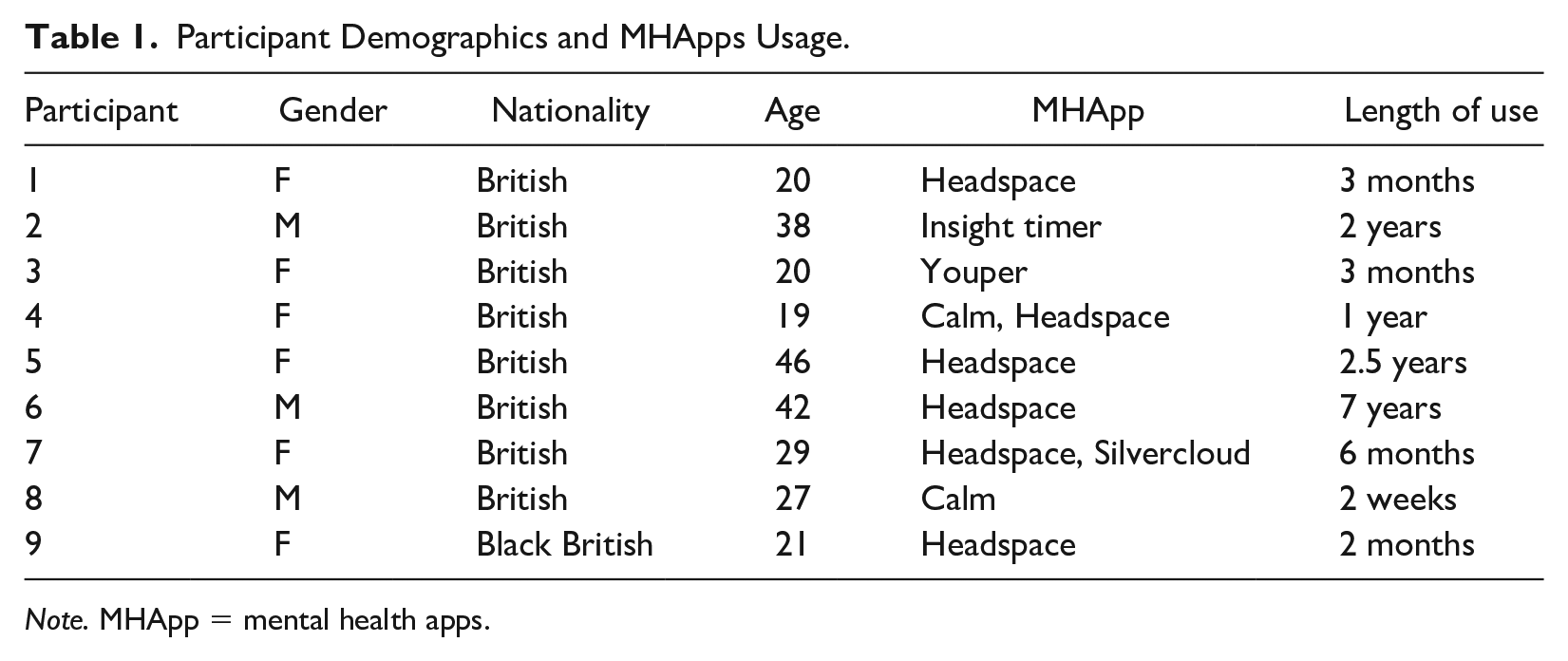
Note. MHApp = mental health apps.
As shown in Table 1, participants’ age ranged from 19 to 46 years, and the majority were female (n = 6; 67%), still currently using the app (n = 6, 67%), and predominantly white British (n = 8; 89%). The most common reason for choosing the app was a friend or family recommendation (n = 4). Two participants were encouraged by a medical professional to download the app, one being their general practitioner (community-based doctor in the UK’s National Health Service), and the other a therapist. However, the participants were not directly recruited based on any formal mental health diagnosis and were invited to take part in the study based on their openness to discuss their experience of using an app. Likewise, we did not collect outcome measure data on the use of the apps as this would contradict the qualitative, material-discursive analysis that is at the heart of this study.
Procedure
Participants were invited to a one-to-one interview over Skype or Facebook Messenger, with interviews taking place between February and April 2019. Participants were informed that they would be asked questions relating to their attitudes and experiences with MHApps. The study was approved by the School Research Ethics Panel in the School of Psychology and Sport Science at Anglia Ruskin University, UK, with all participants providing written informed consent prior to enrollment in the study. The participants were debriefed on potential sources for support with any issues that might have arisen from discussing mental health issues in relation to app use. This process involved ensuring participants that interviews would be anonymized and that their data would be secure. Byron, Albury, and Pym (2021) used the same method of interviewing users of apps when exploring the role of LGBTQ+ apps and feelings of safety.
Data Analysis
The interviews were transcribed verbatim and subjected to thematic decomposition analysis (Reavey et al. 2017; Stenner, McFarquhar, and Bowling 2011; Ussher 2003). This form of analysis is sensitive to participant subjectivity and is based on identifying themes in the data. The approach is inductive and is focused on the data as opposed to being directed by a pre-existing set of theoretical principles. First-order coding or open coding was applied on a line-by-line basis to the entirety of the transcripts by each of the members of the research team. These codes were then clustered together into themes that spanned all the interviews. Each coded set was then summarized and discussed in terms of a theme. Through the process of coding and summarizing, we were able to identify commonalities across the account of MHApp usage. This approach allows for an inductive analysis via a focus on the data, but it is also sympathetic to theoretical application of the findings—in this case, literature relating to MHApps and socio-materialist approaches to the study of people’s interactions with technologies. Hawkey et al. (2017) recognize how thematic decomposition analysis is akin to a critical realist epistemology and ontology, given how the approach recognizes the materiality of everyday experience, and endorses the material-discursive analysis of interview data. Thus, the data are considered in terms of the specifics of participants’ responses, while also attending to the theoretical debates that arise out of their comments.
Findings
This section presents three inductively developed themes, each of which represents a distinct aspect of the experience, while also highlighting how themes are entangled and intertwined in the everyday routine of engaging with MHApps. The first theme highlights how the use of MHApps elicits a specific temporal immediacy to the release of emotion in relation to participants’ experiences of distress.
MHApps Facilitating an Immediate Release of Emotion
The 24/7 availability of MHApps provides access to support outside of the scheduled structure of mainstream services and was frequently framed as a benefit of using MHApps. This meant that participants did not have to store or collect up their feelings and concerns ready for the next meeting with a mental health practitioner. This can be seen in the way Sally compares her experiences of face-to-face therapy versus the use of an MHApp: . . . because you’re speaking with someone once a week or once every two weeks, you feel like you have to store everything up for that conversation which wasn’t always a helpful behavior for me, so I think, I think it can be useful to do both, so I did have a brief stint of some CBT whilst using headspace as well and I found that much more productive than previously when I’ve had counselling and CBT alone because it meant that I had something kind of, that I could tap into as and when I needed it, it wasn’t somebody else’s schedule . . .. (Sally, aged 29)
For Sally, accessing formal support operates in punctuated form, on a weekly or fortnightly basis with a trained professional, which offers a concentrated form of support for which it is necessary to plan and “store everything up.” In contrast, the app facilitates an immediate release of emotion and management of distress over time, with no specific temporal limits on when support can be activated. Sally can “tap into” the support whenever she needs it, which relates to wider research that recognizes the ability for apps to offer personal agency over support (Trnka 2016). This is positively received as, for Sally, the practice of storing this up has caused her issues in the past (“wasn’t always a helpful behavior for me”). Sally does not claim a preference for either in-person or app-based support but applauds the value of the multi-dimensional temporality of support that using both provides. It is likely that neither provides a model of support that works all the time, but having the app operates as an additional layer of support that is always available. The 24/7 availability of apps contributed to a transformation in participants’ relationship with their mental health, as discussed by the following participant in terms of finding a “quick fix” for their issues: [the app has] definitely made me calmer, I do accept that it’s not a quick fix I think, I do really like (the) phrase of it’s a vitamin not an aspirin. That makes a lot of sense to me, in a world where we all want instant relief and instant results and it’s made me, it’s made me realize I still have a long way to go but it has improved how I look at, you know, just certain things in my personal life it has improved things a bit, I wouldn’t say that the things I thought were bad have suddenly gone away its just I think about some of them less badly, as it were. (David, aged 42)
For David, Headspace provides a calming presence, rather than a “quick fix.” Its support is ever present but needs to be engaged with over a period of time, rather than being “short term”—which helped to create a sense that the journey of recovery can be a long and patient one. David does not experience this negatively, but rather as helping to develop a more positive relationship with his mental health (“it’s made me realize I still have a long way to go”). As a result of this slowing down, David discusses how the app has facilitated an “improved” perception of his mental health, stating that some parts of his personal life have become more manageable because of this process.
David’s extract shows how being able to have a release “in the moment of need” via the app means that individuals do not need to hold onto negative emotions, as the app allows for a space to embody these feelings and disperse them into a network of relations. This offers the opportunity to externalize feelings—a process of visualizing one’s body and mental health changing. For example, a user could take part in some of the in-app exercises and activities contained within the app to see if they enact a positive change in feeling. This is further shown in the following example in which the participant describes how they use a meditation exercise in an MHApp to achieve this: Erm, I find it very helpful, so mainly, its er, mainly it’s a meditation app, so it’s, it gives me the techniques to think, how I can do it myself and it gives me techniques to listen obviously, to other people doing the meditation for you, so it’s like listening, er, I find erm, that because my brain in particular, goes a million miles an hour, it can’t slow it down, I need something there to help me slow it down. (Todd, aged 38)
Todd uses the Insight app to interact with his mental health and reduce the feelings associated with “[moving at a] million miles an hour.” Todd describes how he needs assistance from the app to reach a desired state of relaxation—a strategy that has proven successful in the past. As a result, Todd can engage with his own mental health in such a way that facilitates positive changes via the app, that is, by slowing down his thought processes. In the case of Insight, this demonstrates the value in understanding the relationship between the app as a technology and the specific intervention it delivers. The meditation exercises are beneficial for Todd despite being delivered via an app rather than in-person. Todd’s experience is shaped by the fact Insight offers meditation, which is a specific feature of that particular app. Highlighting the specific impact of different types of MHApps is important as it evidences the elements of individual apps that are most beneficial in terms of interacting with his perceived mental health challenges. With Todd, we see that taking part in exercises in the app and by regularly tapping into the app, users can shape the way they feel about their mental health.
Incentivizing Engagement with the App
Another common element of the interviews was the streak function: A feature of social media that gamifies participation through introducing rewards for remaining active within the app. So-called streaks incentivize continued use of apps, creating a desire to continue the streak, potentially due to ending a streak feeling like a form of failure: I quite like (the streak) because I think that can be a really helpful motivator on the days when you’re like oh I’m shattered you know, I can’t be bothered and you go “If I don’t meditate I’m gonna lose my streak” you know, so when there’s no other motivation it can be like that, that one final thing that makes you go yeah, I’m gonna do it, cos I know I will benefit from it and I’ll kick myself if I lose my streak now. (Sally, aged 29)
The streak’s encouragement works to form a temporal habit of using Headspace for Sally. Streaking originates from Snapchat, which rewarded regular sharing of “snaps” through a streak system. It became a currency used to engage users, and it creates a relationship that allows the users to achieve rewards the longer it persists.
So I would have, I would definitely have the streak, the streak that Headspace had that when you use it everyday, it shows you that you got a streak, so I would definitely have that cos that was really good it was actually motivating cos you didn’t want to lose the streak. (Stacey, aged 21)
The important thing here is continuing the streak, which provides a way of motivating Stacey to engage with the app. The quantification of user engagement works to gamify her experience and keeps her taking part in different exercises that are designed to improve their mental health. The power of streaks has been found in the context of other social media platforms to operate as an incentivizing force, for example, to keep remembering through the use of the “Timehop” app (Jacobsen and Beer 2021). In the context of an ecosystem of apps operating as part of the attention economy of the smartphone, streaks act to incentivize the use of Headspace, above any other MHApp the user might have. The higher the number of users, the more valuable the app is deemed to be, which is important when it comes to attempts to sell MHApps to formal mental health services. The use of streaks acts to incentivize not only the use of Headspace rather than other apps but also other forms of support in people’s life spaces more broadly. The perceived value of the app to developers is directly related to how effective it is deemed to be in relation to a range of other forms of support. If the use of MHApps leads to a reduction in access to formal mental health services, this is strong evidence of their value. Hence, there are strong incentives to design the app to be as attractive as possible and in ways that draw users into repeated and continued use. However, this is not to say that the use of streaks to incentivize use will always be a positive experience for users. While it supports Sally’s use in terms of motivation, others could find the streak function as pressure to continue engagement, and therefore to elicit feelings of not being in control of one’s engagement with the app. The balance between incentivizing use and not pressuring engagement is a key consideration for future app developers.
The Temporal Present in MHApps
The temporal aspects of MHApps are further shown in the way through which users talk about the ability to externalize their distress in a particular time frame.
I think it sort of like, makes you think a bit more about like how you’re feeling, and if you’re feeling a bit stressed out maybe take a step back, and sort of, I think even just I found even like after putting into the app, like, how I felt, was sort of like, it made you think “oh this is why I’m feeling that way” and just, instead of it just being all in your head, putting it down onto a bit of paper, like I used to keep a diary, that used to help so I suppose it’s a bit like that in a way, because it like tracks, and it keeps all the information on there so you can look back and think “oh, well on this date I was not feeling very, I was not feeling great!” (Emma, aged 20)
Here, Emma discusses how she can “take a step back” to review her past feelings in Youper. For Emma, this is a positive experience that gives the opportunity to identify the context of her distress and identify how the information in the app relates to a difficult period. Emma likens this with diary writing and states how she “looks back” over the information in the app. Being able to reflect on her mental health in the past provides a visual history of her feelings that can track fluctuations over time. This can be valuable as it can help to identify moments of improvement and understanding which circumstances enacted periods of improved mental health. This is a unique part of the MHApp experience in terms of being accessible by users at any time and would not be part of the punctuated nature of professional mental health support. The tracking of mental health over time can help users to understand their mental health in the present and in terms of planning for the future (Tucker, Easton, and Prestwood 2023). This is further shown in the following extract: yeah, but what’s nice is that, you know, it’s not obligatory to enter all of that detail, you can go as far into it as you want, like I said if you wanted to just literally go yeah I felt great that day, sunshine, leave it at that, you can, but the more you put into it the more you’ll get out of it in the long run, you can kind of see “oh I felt great that day why did I feel great? Oh I had a really positive day at work, my boss praised me, I felt appreciated by my partner, I called my mum, I had a good yoga class, I had a really good meditation” you know and then you can kind of start to add up all those factors and go oh actually I slept really well that night, why did I sleep well? Okay the day before I only had one cup of coffee and I meditated before bed and I did some exercise, so maybe those things helped me sleep better. So it helps you to kind of build up a picture of your overall behaviors and how they affect your mood, if that makes sense. (Sally, aged 29)
In this extract, Sally describes the process by which the app allows her to “build a picture” of her mental health and be able to locate the changes that have enabled her to feel positive in the past (e.g., meditation, exercise). The app makes it possible to visualize the temporal changes to her mental health detail. Lupton (2017) provided valuable insight regarding the ways that people look to these types of technologies to review their feelings, and these data illustrate a similar relationship between the way users can reflect on the interactions with other bodies in the app and feel positive considering these changes. Feelings are mediated through the continual use of the app and are embodied in a network or temporarily distinct instances of contact. Coleman (2018) argues that social media creates a “temporal present” in which affectivity is formed in relation to “the now.” This temporal present is characterized with “life” and “aliveness” (following Back and Puwar 2012). In the aforementioned extracts, when participants take stock of the actions and look at their MHApp’s home screen, they can see all the data from across the app. This feels “alive” and invokes specific feelings related to “seeing” their mental health “in motion,” particularly if the changes match the users’ desires for change (e.g., to be happier).
Coleman’s work on the “temporal present” recognizes how social media temporality includes other forms of temporality and within “the now” as there is a sense of the ways the past, present, and future all combine in the aliveness of digital data. Therefore, even if the app does not explicitly show the desired improvement in mental health (e.g., in their mood score), the fact that the app is imbued with a sense of possibility and change means that the user is able to feel uplifted. The temporal present, “the now,” can include a sense of sources of possible affectivity in the future. Furthermore, the temporal reflection facilitated by the app draws in other areas of Emma’s life. She can situate a set of connected activities in relation to her mental health, in the form of a temporal continuum. For instance, the positive sense of having a “good day at work” emerges through the way the app draws in several relations from other parts of her life that day; “my boss praised me, I felt appreciated by my partner, I called my mum, I had a good yoga class.” The impact of the app is not only what happens “within” it but also how it connects to potentially all aspects of Emma’s life and allows her to connect them in positive ways. This shows how the continual flow of information results in an embodied experience of her feelings moving and changing within the network of activities in the app. As the users of MHApps are mediating the current state of their mental health in the app (e.g., by looking at the collective data home screen), they are presented with a temporal present that is imbued with life and vitality. This is not a completed process, nor one firmly located in the past: Instead, it involves an embodied experience of being in a temporal present that is alive to future, past, and present possibilities.
Discussion and Conclusion
In this article, we have examined interview data with users of MHApps to provide further understanding of the entangled nature of human and nonhuman actors in the use of MHApps. In a similar vein to Lupton (2019a), this research has sought to explore the material, affective, and embodied practices that situate our experiences of digital technology. It is important that a socio-material perspective is included in the analysis of MHApps given the insight it can provide regarding the lived experiences of MHApp use. This provides an alternative to the wealth of clinical findings that are gathering pace in relation to the efficacy of MHApps in terms of specific dimensions (e.g., quantifying a reduction in depression). The findings in this article supplement clinical studies of MHApps by providing significant insight regarding how individuals describe their use of these technologies and offer further conceptualization of how MHApps are embedded in data assemblages that include the “more than human.”
We identified the following findings, and while these directly relate to the MHApps discussed here, it is possible that they may extend into other apps or digital health technologies. First, the interview data identified how the users of MHApps did not need to “store up” their feelings and concerns until the next meeting with their mental health professional. For example, one participant commented on being able to use the app at a moment’s notice which enabled them to release their feelings through MHApps when needed, “in the present,” rather than having to wait until formal engagement with mental health services—this afforded a new way to feel about their mental health. The participants described the benefits of being immersed in a network of relations that offers this potential for alternative ways of feeling and acting. Brown and Reavey (2015) describe this as a “feeling of affordance”: the sense of the possible sources of affectivity that result from being immersed in a network of objects, things, people, and places.
Second, these data showed that MHApps encouraged a continual engagement with networked affect in MHApps using streaks and other functions that incentivize use of the app. This is like other digital affective meaning-making processes such as those identified in the ways memories are quantified and metricized in social media sites (Jacobsen and Beer 2021). The impact of these functions forms part of the way through which MHApps manage to externalize distress and shows how the experiences of distress are combined with social media activities such as streaks. These processes act to keep the individual connected to their feelings in the app.
Third, these data showed how users of MHApps form a “temporal present” in the app that relates to the moments where the users stop to appreciate the collective data in the app (e.g., via the home screen which typically collates the information in textual and visual form). This is akin to the way Brown and Reavey (2015:220) describe the experience of dancing, linked to the feelings of affordance previously mentioned: The feeling of affordance has an anticipatory character: it stretches out and expands our sense of what we can do. Think perhaps of the experience of dancing . . . This involves a range of feelings and sensations that are bound in the collective movement of dancers. So long as the dance continues, these feelings oscillate in tone, without perhaps settling on a particular emotion. However, once the dance stops, the possibilities for movement cease, and we have to take ownership of our feelings.
When the users of MHApps stop to review the general information via the home screen, they are presented with a moment in which they must take “ownership” of their feelings. This is the temporal “now” and one which is ripe with affective possibilities and a sense of how they could shape their mental health in and through the app. This moment of reflection can be a challenge as it makes visible any potential difficulties an individual user is experiencing—the MHApp may help to an extent but is not necessarily a cure, so a tension can exist between continuing to use the MHApp and experiencing any benefits it elicits and stopping to face the difficulties “in full.” It is for this reason that the users tend to keep moving and resisting staying in one position in relation to engaging with MHApps. This requirement to keep communication alive is a common feature of digital social media more widely (Goodings and Brown 2011). This temporal “now” is laden with opportunities in MHApps, as Brown and Reavey (2015) say, keep the body moving and keep the “dance” alive.
A key feature of MHApp experience was the ongoing attempts to “make sense of” the current state of mental health in the app through continued attention to the impact of other data in the app. The act of frequently revisiting the app, in part due to the way that apps incentivize repeat activity through streaks and other functions, means that participants’ mental health can be felt in terms of a fluid state of movement and transformation. Thus, we can advance Lupton’s (2017) view on the role of apps: as a tool not only for enabling users to see and understand how they are feeling but also for providing information about possible actions that are needed to keep their body “on track” and moving forward. Given the vast range of MHApps available, there will be considerable variety in experiences of using MHApps. This will also depend on people’s mental health and the extent and severity of any distress experienced. In this article, the MHApps under focus offered several modes of support, including meditation exercises, CBT-style activities, and sleep exercises—which are designed to support conditions such as anxiety, stress, and depression. The MHApps under focus are not designed for forms of distress related to psychosis (e.g., hallucinations, delusions), and therefore should not be seen as necessarily supportive for all forms of mental distress. Furthermore, the findings provide insight regarding a tension that exists with MHApps, namely how designers encourage and incentivize use (which is the standard business model for mobile apps), while not pressurizing people to engage. For instance, in the current article, the role of streaks, a common incentivizing tool for apps, was experienced positively. However, other people may find such a tool pressurizing to engage and therefore work against the sense that the use of MHApps is largely within one’s control.
Studying and using MHApps involves a focus on how personal information can be quantified and turned into individual metrics. These metrics are then collated and tracked via MHApps and function to keep people perpetually engaged in their mental health. Beer (2016) explores the role of metric power in terms of “measurement,” “circulation,” and “possibility.” Each of these terms recognizes how new technologies collect information and transform these data into metrics that shape and govern our experiences. Further studies should be conducted to explore the role of this metric power in MHApps.
We conclude by advancing the following recommendations based on our findings:
Further research on the lived experience of using MHApps should be undertaken. This is important as studying lived experience can highlight how specific impacts of MHApp use on mental health can fluctuate over time and therefore require ongoing monitoring from users.
The immediacy of MHApps should be seen as a unique part of their impact on mental health. This differentiates them from the availability of formal support and, as such, evidences how they can supplement, rather than replace, formal support.
MHApp developers should be encouraged to use social media functions, such as “likes,” which can help users engage with MHApps due to offering a familiar mode of operation.
MHApp developers should consider offering flexibility modes of engagement that allow users to personalize their experience. For instance, while some users appreciate incentives to engage, such as streaks, others can find these pressuring, so having a range of functions that users can choose from would be beneficial.
Given the unrelenting digitization of mental health support, it is vital that we continue to analyze the impacts on experiences of mental health and distress. Keeping up with the pace of technological development presents challenges but is of paramount importance given the demonstrable impact of emerging forms of digital support such as MHApps. From this research, there is evidence for the power of MHApps to positively impact psychological health and wellbeing, but this needs to be continually explored in terms of the affective, material, and discursive aspects of everyday engagement with apps.
Footnotes
Declaration of Conflicting Interests
The author(s) declared no potential conflicts of interest with respect to the research, authorship, and/or publication of this article.
Funding
The author(s) received no financial support for the research, authorship, and/or publication of this article.
