




Abstract
This study explored workplace barriers, psychosocial resources, and experiences of combining work and family roles among persons with disabilities in Ghana. Using a qualitative description approach, semi-structured interviews were conducted with 20 individuals with physical disabilities who are engaged in paid work. Thematic analysis of the data showed that discrimination was a common experience among participants in the study. Challenges with transport and infrastructure undermined the capacity of persons with disabilities to thrive in the workplace. In addition, limited time and financial resources were major sources of stress for persons with disabilities who combine work and family roles. Participants found social support important for juggling work and family roles. Participants also experienced satisfaction characterized by a strong sense of self-efficacy in fulfilling personal and family needs and meeting workplace expectations. The findings underscore the need for initiatives that foster positive attitudes toward persons with disabilities. In particular, employers should be sensitized to both the individual and organizational benefits of engaging persons with disabilities in the labor market.
Introduction
According to the World Health Organization (WHO), disability represents “the umbrella term for impairments, activity limitations and participation restrictions, referring to the negative aspects of the interaction between an individual (with a health condition) and that individual’s contextual factors (environmental and personal factors)” (WHO & World Bank 2011:4). It is estimated that about 1 billion (15 percent) of the global population have some kind of disability with approximately 190 million (3.8 percent) having significant functional limitations (WHO and World Bank 2011). These figures are expected to increase with the increasing population age and prevalence of chronic health conditions. In terms of gender, women have a higher prevalence of disability than men globally (WHO & World Bank 2011). The prevalence of disability is higher in lower-income countries than in higher-income countries, with Asia and Africa estimated to have the highest proportion of individuals with disabilities (WHO & World Bank 2011). In Ghana, it is estimated that approximately 3 percent of the population has a disability, with visual impairment and physical disability being the most common forms of disability (Ghana Statistical Service 2014).
In many countries, persons with disabilities (PWD) are under-represented in the labor market. For instance, it is estimated that about 80 to 90 percent of PWD of working age in developing countries are unemployed (UN 2007). Although the rate of unemployment among PWD is lower in industrialized nations, the estimated figure is between 50 and 70 percent (UN 2007). Several factors including stigma and discrimination, prejudicial attitudes, unfair employment practices, and physical barriers such as spatial and transport challenges have been implicated in the low employment rate of PWD (Araten-Bergman 2016; Gupta, Sukhai, and Wittich 2021; Naami, Hayashi, and Liese 2012; Van Laer, Jammaers, and Hoeven 2022). Low involvement of PWD in the labor market negatively impacts their well-being (Konrad et al. 2012) and has adverse economic implications due to reduced productivity (Farrell and Krahn 2014; Vornholt et al. 2018).
The social and structural barriers that keep many individuals with disabilities out of the labor market also have implications for their experiences at the workplace and in other life domains. While much is known about conventional metrics such as the labor force participation or unemployment rate of PWD, relatively less is known about their workplace experiences (Sundar et al. 2018). In addition, with a few exceptions (Jammaers and Williams 2021; Skinner and Macgill 2015), extant research has conspicuously ignored experiences of PWD in combining work and family roles. Moreover, the few studies on PWD’s workplace and family experiences were mostly done outside Africa. Therefore, there is a need for more research to be done in African settings to help improve the quality of life of PWD in these contexts. Accordingly, this study explored barriers to thriving at the workplace, experiences of combining work and family responsibilities, and resources that facilitate integration of work and family roles among PWD in Ghana.
The study contributes to the literature in three significant ways. First, our study extends a growing body of literature that highlights both negative and positive experiences of PWD in the workplace. Previous studies have mainly focused on the experiences of PWD employed in formal organizational settings. In Ghana, the majority of persons with disability who have paid work are based in the informal sector, where employment tends to be precarious (Naami 2015; Naami et al. 2012). By focusing on both employed PWD and those who are self-employed, our study highlights how the different modes of employment potentially impact their experiences of the workplace and their experiences of combining work and family roles.
Second, the study contributes to the literature on the work-family interface, which has largely ignored the experiences of PWD. Having a disability not only affects individuals in their work life but also has the potential to influence their personal and family life. While people with and without disabilities both have family responsibilities, meeting family demands may be more challenging for workers with disabilities. PWD may have peculiar personal needs that require support from others, especially family members. Depending on the nature and extent of functional limitation, PWD may have constraints in performing household chores and child-caring duties. In contexts where access to support services is limited or unavailable, fulfilling family responsibilities may be a source of burden for PWD. Given that both work and family roles present unique challenges to PWD, balancing the two life domains may be even more challenging.
Finally, our study contributes to extending extant research on work and family experiences of PWD to the African context. In Ghana, despite the increasing recognition of PWD and the enactment of the Persons with Disability Act (Act 715, 2006), PWD continue to experience discrimination and social exclusion (Dogbe et al. 2016; Ocran 2019; Opoku et al. 2019), with many resorting to begging for survival (Kassah 2008; Naami 2015; Opoku et al. 2019). Consequently, research on PWD in Ghana has tended to focus on issues such as unemployment and barriers to employment and paid little attention to the experiences of PWD involved in paid work. Knowledge on the work-family experiences of PWD could inform policies to facilitate their inclusion in society and enhance workplace diversity.
Theoretical Framework and Literature Review
The study is guided by the ecological systems theory (Brofenbrenner 1979), which emphasizes the influence of environmental settings on individuals’ development. Brofenbrenner (1979) conceived of the environment as a heterogeneous space consisting of a nested system of layers that interact with the individual and with each other. These nested systems of layers, which move from the most proximal to the individual to the most distal, include microsystem, mesosystem, exosystem, and macrosystem. Most proximal to the individual is the microsystem, which represents “a pattern of activities, roles, and interpersonal relations experienced by the developing person in a given setting with particular physical and material characteristics” (Brofenbrenner 1979:22). In the context of this study, work and family environments represent microsystems with each presenting diverse challenges and resources that can affect the well-being of PWD.
Focusing mainly on the work domain, extant research highlights the extent to which social oppression, in the form of socially-imposed restrictions and actions that undermine well-being, makes it more difficult for PWD to thrive in the workplace (Zhu et al. 2019). For instance, compared with persons without disabilities, PWD tend to earn less regardless of job characteristics, performance, and educational level (Gunderson and Lee 2016; Kruse et al. 2018; Schur et al. 2009). This wage penalty is more strongly linked to discriminatory workplace practices rather than functional limitations associated with disability (Kruse et al. 2018; Schur et al. 2009). Fueled by negative expectations about the work-related abilities of PWD (Beatty et al. 2019; Bonaccio et al. 2020; Jammaers, Zanoni, and Hardonk 2016), employees with disabilities are often assigned to lower occupational positions accompanied by lower wages (Brown and Moloney 2019; Santuzzi and Waltz 2016; Sundar et al. 2018). Studies focusing on employment outcomes suggest that PWD have fewer promotion opportunities, are more likely to suffer unfair termination, and report lower job satisfaction and high turnover (Graham et al. 2019; Schur et al. 2009). Based on data from South Korea, Eissenstat et al. (2022) found that a disability-friendly environment was a facilitator of job satisfaction whereas job discrimination was a barrier to job satisfaction among PWD.
As microsystems, the work and family domains have permeable borders, “allowing events, behaviors, stressors, and psychological aspects of one microsystem to pass to the other microsystem” (Marshall and Tracy 2009:382). Interconnections between the work and family microsystems constitute a mesosystem (Bone 2015; Grzywacz and Marks 2000; Yang and Sanborn 2021), which can be characterized as negative (e.g., work-family conflict) or positive (e.g., work-family enrichment). To date, only a few studies have explored the experiences of PWD in balancing work and family responsibilities. Focusing on women with dyslexia, Skinner and MacGill (2015) highlighted diverse ways in which disability influenced juggling of mothering and paid work. In particular, for most women with dyslexia, motherhood undermined personal resources that are usually employed to manage paid work. Jammaers and Williams (2021) reported intersectionality between disability and gender, wherein the combination of work and life was found to be particularly challenging for women with disabilities due to demands associated with impairment-related self-care and caring for multiple family members.
The work and family microsystems are also embedded within specific local contexts (exosystems) that exert influence on individuals’ experiences within each microsystem and the interaction between them. For PWD, exosystemic influences could emanate from policies, institutions, and community-level processes that either facilitate or constrain their participation in work and family roles. For instance, Van Laer et al. (2022) highlighted how ableist work spaces may disable employees with impairment “through disabling productivity, social inclusion, independence, and physical comfort and safety” (p. 1018). Experiences within the microsystem, mesosystem, and exosystem are shaped by the macrosystem, which reflects the influences of legal, economic, social, educational, political systems, and cultural systems within which a person is embedded (Yang and Sanborn 2021). For example, previous studies in Ghana have linked experiences of discrimination and social exclusion among PWD to weaknesses in legal framework and implementation structures (Dogbe et al. 2016; Ocran 2019; Opoku et al. 2019). Such weaknesses often find expressions in disabling community and environmental spaces that serve to disadvantage individuals with disabilities. In a recent study in Ghana by Tudzi, Bugri, and Danso (2017), PWD narrated difficulties with accessing communication systems, transport, and the physical environment.
Methods
Design and Participants
A qualitative description approach was adopted in this study. The qualitative description provides a “comprehensive summary of an event in the everyday terms of those events” (Sandelowski 2000:336). The qualitative description approach is underpinned by naturalistic inquiry, which focuses on the meanings people assign to their experiences (Bradshaw, Atkinson, and Doody 2017). Thus, this qualitative approach is suitable for studies that focus on exploring individuals’ subjective experiences of phenomena and their reasons for doing so (Colorafi and Evans 2016). This study sought to explore in-depth the experiences of PWD in their employment pursuits as well as their family lives. In qualitative descriptive studies, low-inference descriptions are employed, which increases the likelihood of consensus among several researchers (Colorafi and Evans 2016).
The study was carried out in Accra, the capital city of Ghana. Using a purposive sampling approach, we selected individuals with physical disabilities who were either employees of an organization or self-employed. For ease of communication, we excluded individuals with speech and hearing impairments. The sample included 20 individuals with physical disabilities consisting of 9 males and 11 females. The participants were aged between 26 and 49 with an average age of 36 years. In terms of the level of education, most of the participants had up to secondary level education and six had tertiary level education. About half (n = 11) of the participants were married, 7 were single and 2 were divorced. In terms of dependents, most of the participants had a least 1 child, with the number of children ranging from 1 to 4. The biographical details of the participants are presented in Table 1.
Participants’ Biographical Information.
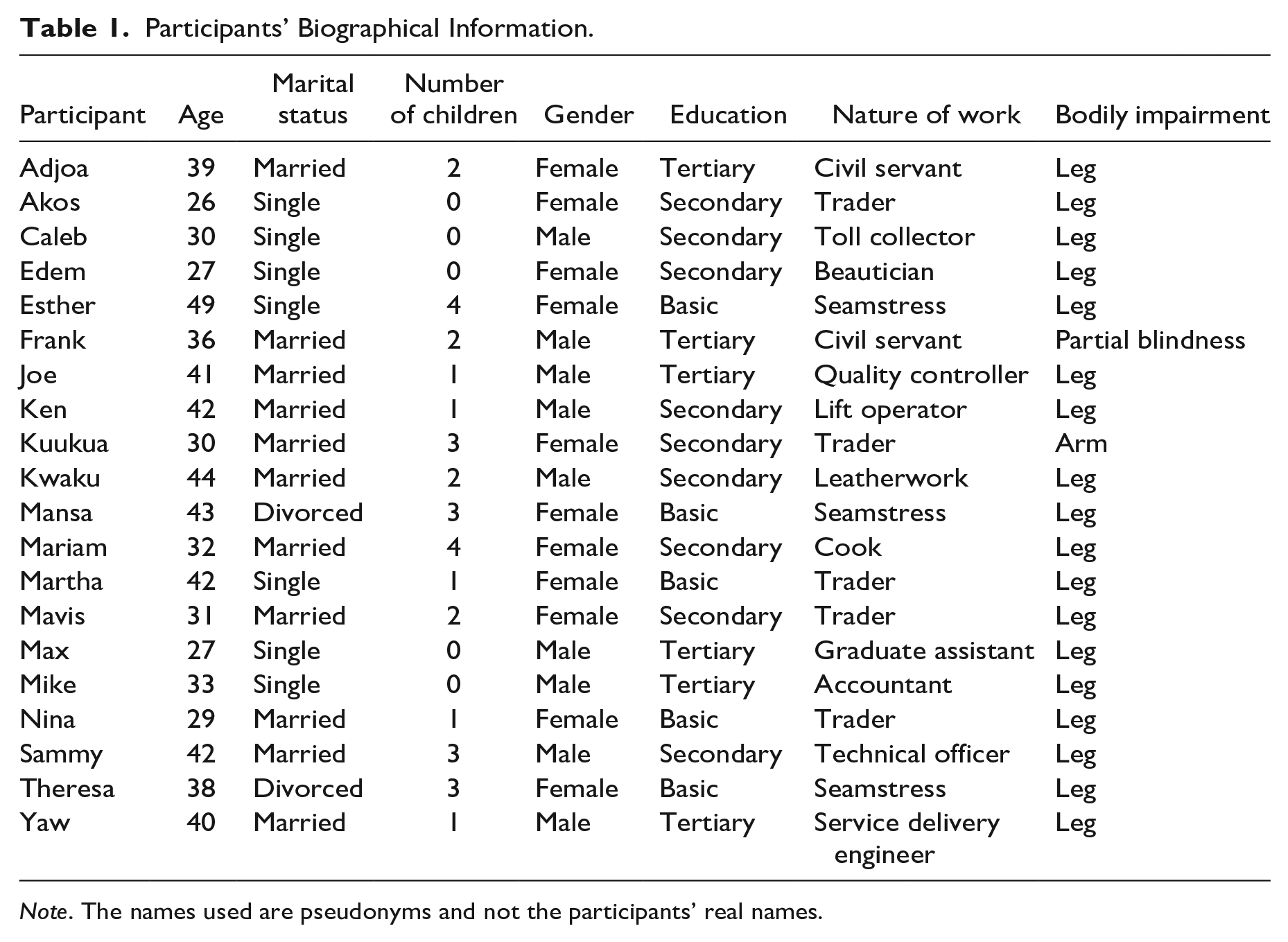
Note. The names used are pseudonyms and not the participants’ real names.
Data Collection Procedure
Individuals who met the inclusion criteria were invited to participate in the study after explaining the nature of the study. Informed consent was obtained from each participant in the study. Participants were assured that their identity would be kept anonymous and that information shared with the researchers would be kept confidential. The participants were made to understand that they had the right to withdraw from the research at any point. An interview was scheduled with each individual who agreed to participate in the study. The interviews were semi-structured to ensure that similar issues were explored in all interviews while giving room for unanticipated issues to be explored.
Due to the COVID-19 pandemic, the interviews were conducted primarily on phone, except in a few cases, where participants preferred to have face-to-face interviews. In such cases, necessary COVID-19 protocols were observed to ensure the safety of both the interviewers and participants. The interviews were conducted by the second and third authors under the supervision of the first author. The interviews were conducted with the aid of an interview guide, which consisted largely of open-ended questions that focused on participants’ employment and family experiences. Probing and relevant follow-up questions were used to obtain detailed responses from the participants. The interviews lasted from 15 to 40 min with an average interview length of approximately 30 min. The interviews were digitally recorded after seeking the participants’ consent. For participants who could not speak English, the interviews were conducted in a local language (Twi or Ga) and, then after, transcribed into English. No form of financial inducement was offered to the participants.
Data Analysis
The data were analyzed using thematic analysis, a “method of identifying, analyzing and reporting patterns of meaning (themes) within data” (Braun and Clarke 2006:79). Thematic analysis helps identify essential recurring points within a particular data set, ensures the comparison of several responses, and also gives insights that were not preconceived (Braun and Clarke 2006, 2019). We followed the six steps to thematic analysis suggested by Braun and Clarke (2006). First, the interviews were transcribed verbatim and repeatedly cross-checked with the audio recordings for accuracy. Following initial reading and familiarization with the data, the transcripts were coded utilizing a combination of data-driven coding and researcher-derived coding approaches. The co-authors initially coded each transcript separately, after which the outcome of the coding was discussed together with the first author. Any inconsistencies were discussed until an agreement was reached. Next, the codes, alongside their extracts, were collated and organized to identify similarities and overlaps within them. Preliminary themes were generated based on the patterns identified in the data. The themes were subsequently reviewed and refined for interpretation in relation to the research objectives.
Findings
Four main themes were generated in the thematic analysis process: workplace barriers, juggling work and family responsibilities, available and desired resources, and psychological well-being. The succeeding subsections elaborate on these themes, with relevant illustrative quotes from the participants’ narratives. To anonymize participants’ responses, we refer to participants by pseudonyms.
Workplace Barriers
Participants narrated key employment-related challenges, which were categorized under employment discrimination and environmental constraints. Although these largely reflect their current experiences at work, some reflect past experiences they had in the course of job search. These challenges served as barriers to entering employment and thriving in the workplace for PWD.
Discrimination: Discrimination was a common narrative in participants’ descriptions of their employment experiences. For many participants, stereotypes about disability and negative attitudes toward PWD were key social barriers to employment. Some participants shared experiences that reflect a lack of acceptance at workplaces because they were perceived as unable to navigate the work environment, perform optimally, or meet work demands. For example, Frank, a civil servant, shared the following experience in his search for a job: It wasn’t easy, . . . I completed school in 2011 and I got a job in 2016. Since I am partially blind, anytime I go to an interview for a job, they use my disability to judge me and not give me the work. So in 2016, persons with disabilities protested to the Flagstaff House [Office of the President in Ghana] before our cries were heard and some of us were recruited for a job. (Frank, employee)
In some cases, participants felt pressured to distinguish themselves to stand a chance of being employed, compared with their counterparts without disabilities, as reflected in the following quote: I have worked at two places in the past 15 years. Where an abled person is expected to gain 100%, a person with a disability would have to gain 150% before they would be expected to get the job. Because people don’t readily accept you, you have to do extra to be accepted. (Joe, employee)
Akos also recounted how she decided to work on her own after several unsuccessful attempts at securing a job. She associated her lack of success at getting employed with negative attitudes toward her disability. She noted, It was very tedious. Anywhere I went, they said; “you go, we shall call you, because of your disability we don’t think you can be doing this job” then I tell them I can do it, they say “oh no,” and I see that they just don’t want to accept me. So, I decided to work on my own. (Akos, self-employed)
At the workplace, a few participants shared experiences of unfair treatment by their employers and colleagues. For instance, Adjoa narrated how her employer forced her to take early maternity leave during her pregnancy after which her contract was terminated. She said, . . . Along the line, I met my husband and we got married and after the marriage I got pregnant. So, during my pregnancy, which was not close to my due date, they asked me to start my maternity leave. I told them; “oh, my time is not due yet so I can still work for some weeks,” but they insisted I should go. I did and after I gave birth, they came to visit and all. Then one day, an email was sent to me stating they can no longer work with me . . . (Adjoa, employee)
In Ghana, employed women are legally entitled to 12 weeks of paid maternity leave upon childbirth, after which they are expected to return to their job. The essence of this provision is to guarantee job protection and income security for employed women when they take a break from work after childbirth. Thus, the termination of Adjoa’s appointment is unfair and represents an abuse of her rights.
A few participants who indicated they had not experienced employment discrimination attributed their situation to their ability to convince potential employers of what they were capable of, support from employers and colleagues, or luck. For instance, Max mentioned that, although there were concerns about his ability to work, he persuaded his employers by positioning himself as an individual capable of contributing meaningfully to productivity.
I have never been discriminated against because of my disability . . . I went through the process laid down by the organization for everyone and I got selected. Mostly, I had questions in the direction of my disability, “can you move?” “Can you do this?” “Are you able to stand for quite a while?” But I convinced them enough and I think I have not been discriminated against. (Max, employee)
Although Max did not interpret such concerns as discriminatory, the narrative seems to confirm the view that employers tend to have reservations about hiring PWD due to doubts about their abilities.
Environmental constraints: The spatial environment was the most common source of difficulty encountered by PWD at various workplaces. Many participants, especially those employed in the formal sector, complained that the designs of buildings and office spaces often fail to serve their needs. Specifically, the location of office spaces in multi-storey buildings, coupled with the absence of elevators in these buildings, restricted accessibility and movement and made it difficult for employees with disabilities to function effectively at the workplace. The following quote illustrates the disabling effects of workspaces on PWD: The environment is not 100% friendly; you can’t have everything set and organized to your will only. The work ergonomics in terms of tools and co are sometimes challenging. This challenge doesn’t help to deliver better. For example, they organize a conference on the 4th floor and nobody considers that anybody among the attendees could be persons with disabilities. (Mike, employee)
In addition, some participants mentioned difficulties with transport as a constraint to commuting to and from work. Most participants relied on public (commercial) vehicles, especially taxis and minibuses, for their daily commuting. In Ghana, however, public vehicles designed to accommodate PWD are nearly non-existent, which restricts accessibility, especially for those with mobility impairment. For example, Kwaku who uses a wheelchair described the difficulty he encounters in accessing public transport to and from work: public transport is also a problem I face a lot. Since I use wheelchair and I can’t take ‘tro-tro’ (commercial minibus), I have to take taxi. Given that taxis typically charge higher than ‘tro-tro’ in Ghana, this mode of commuting could increase Kwaku’s cost of living. In a few cases, participants indicated they had to endure the discomfort of walking because they could not afford the additional cost of taking taxis from their homes to the nearest bus station where they could access an affordable means of transportation. Such was the situation for Mariam, an employee with mobility impairment: . . . if you see the distance that I walk from my house to the station every day that I have to go to work, in fact, it’s not a small journey but I have to do it. If I don’t do it then, I have to take a dropping [chartered taxi], and that one too is another cost.
Juggling Work and Family Responsibilities
This theme reflects participants’ experiences in fulfilling work and family responsibilities. Three sub-themes are subsumed under this theme: schedule flexibility, conflict between work and family roles, and synergies between work and family roles.
Schedule flexibility: Several participants, especially those who are self-employed, described their work schedules as flexible, allowing them to easily navigate daily routines and attend to responsibilities in other life domains. For instance, Martha, who sells mobile phone recharge vouchers, narrated how the flexibility of her work allows her to perform household chores in the afternoons when there are fewer customers. This way, her business is not adversely affected by household demands: With the job that I do (sale of mobile phone recharge cards), people normally walk in, in the morning and evening, so I make sure in the afternoon around 12 pm, I go back home to do my chores, then return to work after 3 pm. That’s how I can combine work and family roles. (Martha, self-employed)
Conflict between work and family roles: Many participants complained that they barely have enough time with their families due to work, and they find themselves spending most of their time fulfilling their work responsibilities. For example, I barely spent time with my family. So, most of it is about time and you wish you had more time because sometimes I get home somewhere around 8 pm and because you will leave very early the following day, it doesn’t give you a lot of time for you to spend with your family. (Joe, employee)
Some participants described their work and family lives as stressful. The stress associated with meeting demands in one domain made it difficult to fulfill other responsibilities. For example, It hasn’t been easy. I have a one-year-old child in the house. Just imagine, I started this work in February, then, he was about 8 months and I had to be there at 6 am. Because I live far from my place of work I have to leave home at 4:30 am every day, leaving my baby at home. And the kitchen job is not easy. Cooking for 100 people, cleaning among others. That aside, I have to sit in the car back home. So, it’s very stressful but I don’t have anything so it is better than sitting in the house doing nothing. (Mariam, employee) It is a difficulty, very difficult. Just imagine a disabled washing and cooking. Most of the time I get tired after cooking. After that, I need to sell too. So, it is not easy. (Mavis, self-employed)
A few participants indicated that they earned less from their jobs, making it difficult to meet the financial and material needs of their families. For example, Mariam explained how the need to allocate a significant portion of her salary to transportation costs limits her ability to cater for her family’s needs. She noted: “Yes, it is about the money issues. You have to pay school fees, but when you take your salary, transportation will take half. So financial issues too are a problem”.
Synergies between work and family roles: Participants reflected on the positive side of their involvement in work and family roles. Some indicated that combining work and family roles enhanced their self-esteem and mental health. Reflecting on the positive experiences inherent in involvement in work and family activities, Ken (employed) noted: I feel mentally strong because most disabled don’t even have jobs or families. Others indicated that their involvement in work and family activities enhanced their self-efficacy by making them more responsible, time-conscious, and role models to others, as captured in the following quote: It has made me develop a behaviour that any least chance I get I deal with the backlog and whatever is expected of me, so I work ahead of time and I also make time for family. (Mike, employee)
Some participants indicated that income earned from work not only made them independent but also made them better family members in terms of providing for their needs. For example, What I can say is that, because of this job, I can provide for myself anything I need without asking anyone. That’s the positive experience I’ve had. (Martha, self-employed)
Available and Desired Resources
This theme reflects the support received by participants and how it enabled them to meet their work and family obligations. This theme incorporates two sub-themes: resources for combining work and family roles and recommended resources.
Resources for combining work and family roles: Most of the participants indicated they do not receive any organizational support in combining work and family duties. However, one participant indicated that his supervisor was very supportive in terms of giving space to attend to personal problems when they arise. He said, “One of the things I like about my boss is that whenever you have a personal problem and inform him about it, he will give you some time to deal with it” (Mike, employee).
The family was the main source of physical, financial, and emotional support for most participants. Married participants, in particular, identified their spouses as their main source of support in terms of household activities, as captured in the following quotes: My husband is very supportive in many ways, even with house chores. My parents also come around with foodstuff and help us for some time before they leave again. (Adjoa, employee) My wife has been very supportive . . . My wife is one of the very few women I know who wash their husband’s cars. When you come to my home, there is a lot of work you may think they are a man’s job, but my wife does them comfortably. (Joe, employee)
Desired resources: Participants also suggested several resources they thought could help them meet their obligations at work and home. Some participants indicated that access to reliable means of transportation would make it easier to combine work and family roles. For example, a participant said: “I wish my organization will help by providing a transport system” (Ken, employee). Some participants, especially, those employed in the formal sector indicated access to accommodation, improved salary, and flexible working arrangement would enhance their ability to meet their work and family needs, as captured in the following quotes: Well if I’m given accommodation close to my workplace it would be easier. I don’t have to travel far to go to work. (Mike, employee) Adopting working from home policy because some work can be done at home and not necessarily workplace. (Yaw, employee)
A few participants recommended resources that would empower them to be independent. They expressed a strong desire for support from both governmental and non-governmental agencies to enable them to meet their personal needs and those of their families. For example, . . . We are Ghanaians, so the government should realize that we exist and put policies in place so that we can also benefit. Some of us are trying very hard, so if we get a little support from the government and NGOs, we would get somewhere. (Mariam, employee)
Psychological Well-Being
This theme reflects the experiences that marked improvements in the lives of workers with disabilities. The theme also reflects the level of contentment that PWD experience in their work roles and life as a whole.
Confidence in self: A common pattern across participants’ responses relates to positive changes in their self-esteem and abilities to function. Several participants expressed a sense of pride in themselves and a belief that they can perform their daily work tasks, despite the challenges they experience. Others also narrated how their work gained them social recognition, mental stability, and independence. Engagement in paid work enabled these participants to focus on what they could achieve rather than focusing on their physical conditions. The following quotes depict such experiences: Yes, I am now stronger. I feel confident and I see myself as a better person. I don’t think too much about what I can’t do because of my condition; I focus on my potential and do them well. (Sammy, employee) I am a determined woman who wants to build my family and wants my family to look at me and say, “we have a great woman in the house.” So, for that matter, I have established my own business. I feel very okay that I work because I am determined and hardworking. (Adjoa, employee)
However, one participant strongly expressed that she did not feel good about herself. She attributed her negative feeling about herself to stagnation in life. She shared her experience as follows: Well, my feelings don’t matter because I have no choice. I have to accept the way things are. There is no help, no progress; everything is static. Things are not okay at my end. I have put up a little structure in front of my house, that’s where I place my items to sell. So, I don’t feel good about myself, truth be told. (Mavis, self-employed)
Satisfaction: Many participants expressed a sense of satisfaction about their work. Some attributed their satisfaction to being able to meet job demands and customer needs. To these participants, helping to address clients’ needs or problems gave them a sense of accomplishment.
The biggest part of my job is when I’m able to fix their problems and they say “thank you so much that I didn’t believe this problem could be solved but you did it.” So, seeing someone happy because I could solve their problem, makes me happy and satisfied. (Joe, employee)
To some participants, their involvement in paid work not only helped them to avoid boredom and enable them to structure their day but also served as a source of income for themselves and their families. Their satisfaction derives from being financially independent and having an opportunity to do what they enjoy.
I would say I enjoy every little bit of it because it makes me happy. I’d say my work gives me happiness because . . . I’m not married, I don’t have a husband, I don’t have kids, so from work to house, from house to work. . . . I’d say this is my life. So, my work truly makes me happy because it keeps me busy. Every blessed day when I wake up, I know I have a place to go, that’s my workplace, to come and work for money. (Edem, self-employed) Well, I’m happy selling. I love it. So as soon as someone calls me to buy something, I give a good impression of myself and that makes them buy at all costs. You know how it feels to get money, right. I am always happy if someone buys something from me. (Kuukua, self-employed)
Many participants also shared how they feel about their lives in general. Some indicated they were highly satisfied, while others expressed that they were just okay with their accomplishments. For instance, Akos noted that her religious faith gave her reason to be excited about her life, despite the difficulties she encounters. She said, Oh, with Christ in the vessel, I always smile at the storm. Just that women with disabilities are not accepted in society as marriage material, and I have put it upon myself that, marriage or no marriage, life must go on. So that side, as a human being, you may think of it but not too much. (Akos, self-employed)
However, a few participants expressed dissatisfaction with their life. For instance, one participant expressed disappointment in how God has failed to rescue her from her challenges. Noting her unhappiness with her life in general, she thought God may have forgotten about her: . . . but still, I think God has forsaken me somewhere, because of what I’m going through now. When I think about it, I feel like maybe God has forgotten about me. . . . So, in all, I can say my life hasn’t been so well at all, but I’m still praying. I know it shall be well. (Mariam, employee)
Discussion
Although the experiences shared by participants are mostly situated within the work and family microsystems, they are shaped by more distal, exo-level, and macro-level factors associated with policy implementation and cultural perceptions. From our study, discrimination was not only a barrier to employment for PWD, but it also undermined their ability to thrive at the workplace. Lack of acceptance and unfair human resource practices against employees with disabilities were commonly shared by participants. These experiences are underpinned by superstitious beliefs and cultural stereotypes about disability in Ghana (Naami et al. 2012; Ocran 2019). Such beliefs and stereotypes feed into discourses that project disability as an inability and serve as barriers to entry into employment and thriving in the workplace (Beatty et al. 2019; Bonaccio et al. 2020; Jammaers et al. 2016). Perceptions of PWD as less productive and less valuable also seemed to orchestrate a tendency of employees with disabilities to overcompensate to facilitate their acceptance at the workplace (see Jammaers and Williams 2021). Thus, experiences of workplace discrimination could be a source of stress and burnout for workers with disabilities, though further research is needed to explore this possibility.
In addition, participants narrated challenges with the built environment, specifically transport and infrastructure, that undermined thriving and effective functioning in the workplace. In Ghana, contrary to requirements of the Persons with Disability Act, workplaces, public spaces, and transport services are mostly not disability-friendly. For instance, the unavailability of elevators in multi-storey buildings limits movement, particularly for persons with mobility impairment. Likewise, vehicles modified to provide public transport services to PWD are not common in Ghana (Tudzi et al. 2017). Lack of accessible transportation coupled with long commuting distances likely makes commuting stressful for PWD. Stressful commuting has adverse implications for individuals’ well-being and work outcomes (e.g., Amponsah-Tawiah, Annor, and Arthur 2016). Reflecting an exosystemic influence, this finding further highlights the disabling role of the built environment and work spaces (Van Laer et al. 2022), which further disadvantage PWD through social exclusion.
Our study echoes extant research highlighting complex interdependencies between work and family roles (Grzywacz and Marks 2000). In this study, work-family balance emerged as a mesosystemic phenomenon that reflects, on the one hand, difficulties in meeting demands across multiple life domains, and, on the other hand, positive influences of one life domain on another. Inadequate time for family responsibilities and limited financial resources for family needs were sources of stress for workers with disabilities in this study. While excessive work time demands have been widely researched antecedents of work-family conflict (see Michel et al. 2011), little is known about how financial constraints influence work-family conflict. Conversely, positive experiences such as the acquisition of time management skills, increased sense of empowerment, and respect for the family are evidence that participation in work and family activities may be enriching for PWD (cf. Grzywacz and Marks 2000). By documenting experiences of work-family conflict and work-family enrichment among workers with disability in the Ghanaian context, this study adds to an emerging line of research (Jammaers and Williams 2021; Skinner and Macgill 2015) that links disability to the work-family interface.
We found social support as an important resource that fosters positive work-family experiences. The family was identified as a vital source of support for meeting the physical, emotional, and financial needs of PWD. In particular, family support was found to be important in facilitating progress in work-related activities among PWD. This finding highlights the importance of micro-level resources in enhancing meso-level experiences in terms of balancing work and family responsibilities. This corroborates past research on the role of family support in reducing work-family conflict and enhancing work-family enrichment (e.g., Mauno and Ruokolainen 2017). This finding, however, contrasts with those from Alcover et al. (2018), which suggested that high family support could make workers with disabilities more vulnerable to strain when faced with stressful situations at work. In the Ghanaian context, where formal support services are limited, healthy familial relationships constitute a key source of strength for individuals in situations of vulnerability including PWD.
The study also highlights the psychological benefit of work in the lives of PWD. Confidence in their abilities to perform, independence, and social recognition were the most common experiences participants associated with their engagement in work-related activities. Participants admitted feeling happy and proud about meeting workplace targets and being valued for their contribution to production. Such experiences underscore the intrinsic value of work to PWD (Carmichael and Clarke 2022). This study further sheds light on the subjective meanings of work and general life satisfaction for PWD. Specifically, PWD reported feeling satisfied when they succeed in fulfilling job demands and earning income for tasks performed. In line with previous research (e.g., Andrews and Rose 2010; Gaymard 2014), monetary reward was a major work motivation for PWD, as payment they received for their services enabled them to provide for their families. Narratives on the psychological benefits of work shed light on the positive aspects of participation in the labor market for PWD despite the myriad challenges they encounter.
Limitations and Directions for Future Research
It is worth mentioning that this study is not devoid of limitations. One of the limitations is the exclusion of people with speech and hearing impairments. Also, the study’s small sample size, the recruitment of only participants with physical disabilities, and the fact that the research was conducted in one region (Greater Accra Region) may affect the extent to which the findings may be generalized. Indeed, as typical of qualitative studies, generalization of the findings was not a primary focus of the study, though some of the key findings may be applicable in other contexts. Although the adverse experiences reported in this study could have a negative impact on the mental health of PWD, we could not directly explore this possibility. Moreover, our sample was dominated by individuals with mobility impairment; hence, their experiences may not entirely apply to individuals with other forms of disability. Studies adopting quantitative approaches with larger and representative samples would make it possible to explore such relationships and the extent to which they can be generalized. It is also recommended that future studies explore possible gender-based differences in employment and family responsibilities among PWD.
Practical Implications
This study highlights several barriers that undermine thriving at work for PWD. To a large extent, these barriers are rooted in weak legal and regulatory frameworks and negative cultural perceptions. For instance, although the Persons with Disabilities Act was passed in Ghana over a decade ago to address issues of discrimination against PWD, the lack of implementation drive has meant that challenges faced by PWD remain largely unaddressed. The study’s findings call for efforts toward facilitating the implementation of existing policies to enhance inclusion. These efforts could be led by state institutions such as the Ministry of Gender and Social Protection and its affiliated agencies.
In addition, employers need to ascertain the skills and potentials of PWD and adopt strategies to tap into such potentials. In particular, the creation of work environments that are accommodating of the needs of PWD could foster workplace diversity and inclusion and contribute to positive workplace experiences for employees with disabilities. Organizations could further provide leadership development training for line managers to identify the specific needs of employees with disabilities to provide more appropriate support. Employers could also support the efforts of employees with disabilities in balancing work and family responsibilities through the provision of flexible working arrangements and reliable means of transport.
Furthermore, given the cultural underpinnings of discrimination experienced by PWD, public education about disability and the rights of PWD is necessary. This would help dispel superstitious beliefs and stereotypes about disability, which could facilitate the acceptance and inclusion of PWD in society. Efforts toward strengthening the self-advocacy of PWD and encouraging family members of PWDs to support employment-related activities would also be vital in advancing inclusion.
Finally, narratives from some participants in this study suggest that some PWD may be unaware of existing support services provided by the state. Although these services may be limited, they could help manage some of the challenges encountered by PWD. For instance, PWD could benefit from tax reliefs, which could minimize financial difficulties. PWD who are self-employed could also be encouraged and supported to access funds to support and expand their businesses.
Conclusion
This study has provided insights into the employment and family experiences of PWD. It reveals challenges encountered by PWD in employment and their responses to such challenges, the support they receive from families and people at their workplaces, and how they balance work and family duties. The study has shown that despite the challenges they experience, PWD derived several material and psychological benefits through participation in work and family roles. The findings suggest government agencies and other stakeholders need to raise awareness among employers, workers, and community members about the importance of accepting PWD in society to foster equality, diversity, and inclusion.
Footnotes
Declaration of Conflicting Interests
The author(s) declared no potential conflicts of interest with respect to the research, authorship, and/or publication of this article.
Funding
The author(s) received no financial support for the research, authorship, and/or publication of this article.
