




Abstract
This study examines the relationship between tourism development, governance, and income inequality in 31 sub-Saharan African (SSA) countries. In the main, the study aims at examining whether tourism inflows ameliorate or exacerbate income inequality in the studied countries. The study also aims to examine whether institutional governance modulates the impact of tourism development on income inequality. For robustness, four proxies of governance indicators have been used, namely, the rule of law, voice and accountability, political stability, and government effectiveness, thereby leading to four separate specifications with four interaction variables. The Generalized Method of Moments (GMM), which accounts for endogeneity, has been used to examine this linkage. Contrary to some of the previous studies, the results of our study show that an increase in tourist arrivals leads to a decrease in income inequality in the studied SSA countries. The results also show that the favorable negative impact of tourism on income inequality could switch to an unfavorable positive impact if the following levels of governance are exceeded: 1.6842, 3.1429, and 0.7436 for voice and accountability, political stability, and government effectiveness, respectively. Policy implications are discussed.
Introduction
The relationship between tourism development and income inequality has been a subject of contention in recent years. Previous studies have shown that tourism development can affect income distribution through various channels, namely, price channel, earnings channel, and tax revenue channel (Blake et al. 2008; Incera and Fernández 2015). 1 In terms of “price channel,” studies have shown that tourism spending may lead to changes in prices for goods and services. However, the poor will only be affected when there is an increase in the prices of food products. When the prices of domestic trips, restaurant meals, and so on increase owing to tourism, the direct impact of such price increases on the poor will be minimal as such products are mainly consumed by higher income households (see Blake et al. 2008). Even though the price channel may affect poor households through food products, the direct effect will be minimal as tourists tend to purchase a different set of foods from those consumed by poor households (see Blake et al. 2008).
In terms of the “earnings effect,” poor households may benefit from tourism due to higher wages and increases in production in tourism-related industries—although such benefits might be limited if poor households lack the requisite skills required for employment in such industries (Blake et al. 2008). In terms of “tax revenue channel,” studies have shown that tourism activities could increase the tax revenue generated by governments, which could be used as investment in tourism-related activities (Blake et al. 2008; Incera and Fernández 2015). Hence, tourism consumption could be redistributive through the increased tax revenue generated from tourism-related activities—although it will largely depend on the tax collected from tourism products and the expenditures made with the new tax revenues by the government (Incera and Fernández 2015). According to Incera and Fernández (2015), the distributional effects of tourism depend on a number of factors, such as the backward and forward linkages of tourism activities with the rest of the economy, and the characteristics of the labor market or how government transfers and taxes affect households and firms. Studies have also shown that if poor households are not actively involved in tourism, tourism activities may lead to an increase in social inequalities by enlarging the gap between those with access to capital and those who do not have access to such capital (Blake et al. 2008; Cleverdon and Kalisch 2000). On the whole, tourism may increase income inequality through “earnings” and “tax revenue” effects, but it may also decrease income inequality through the “price effect.” Hence, the overall net effect of tourism development on income inequality will largely depend on the relative effects of the two opposing effects (see Fang et al. 2020).
Recent studies have also found that governance plays a pivotal role in income inequality. In particular, government can reduce income inequality by implementing inclusive growth and pro-poor policies. Glaeser, Scheinkman, and Shleifer (2003), for example, use a model to demonstrate that inequality is bad for growth, but only in those countries where the rule of law is poor; consequently, political institutions are weak and institutional breakdown is common. According to Husain (1999), good governance is essential for the effective allocation of resources and the equitable distribution of the benefits of growth in any society. Other studies, such as those by Johnston (1989); Jain (2001), Gupta, Davoodi, and Alonso-Terme (2002); Gyimah-Brempong (2002); and Dincer and Gunalp (2011), have maintained that bad governance, which manifests itself through corruption, can, inter alia, lead to a decline in economic growth and can widen existing income inequality. Other studies, such as Li, Xu, and Zou (2000), have, however, found that the relationship between some of the governance variables, such as corruption and income inequality, exhibits an “inverted-U”-shaped curve.
The tourism sector in Africa has grown phenomenally in recent years. In 2016, for example, the continent recorded 62.9 million international tourism arrivals, which represented approximately 5.1 percent of the world’s tourism arrivals (African Development Bank, 2018). Although international arrivals only represent a 0.64 percent increase from Africa’s total number of tourism arrivals in 2015, in the sub-Saharan African (SSA) region, the number of arrivals actually increased by 8.9 percent. In terms of tourism receipts, Africa received US$36.2 billion in 2016, which represents approximately 3.0 percent share of worldwide tourism receipts in 2016. As of 2017, the top African countries that had between 2 and 10 million arrivals include Morocco, South Africa, Tunisia, Egypt, and Zimbabwe. Similarly, the sector has contributed significantly to job creation in Africa. In 2017, for example, the total number of jobs created through direct travel and tourism was 9.3 million, which represented an increase of 11.2 percent from 2016. Of these jobs, about 6.8 million were in SSA (African Development Bank 2018). The top SSA countries in terms of direct tourism employment in 2017 included Nigeria, South Africa, Ethiopia, Tanzania, Kenya, Ghana, and Madagascar, while in terms of total tourism employment (direct, indirect, and induced), the top SSA countries were Nigeria, Ethiopia, South Africa, Kenya, Tanzania, Madagascar, Mozambique, and Ghana (African Development Bank, 2018).
Despite the undeniable impact of tourism on income inequality, very few studies have fully explored the linkage between these two variables. In addition, studies on how various institutions affect the impact of tourism on income inequality are scant. Previous studies that have directly or indirectly examined the relationship between tourism and income inequality have mainly concentrated on Asian and Latin American countries (Blake et al. 2008; Wen and Tisdell 1997), thereby giving SSA countries very little coverage.
The main aim of this study is, therefore, twofold. First, the study aims to examine the unconditional impact of tourism on income inequality in 31 SSA countries during the period from 2005 to 2014. Second, the study aims to investigate whether institutional governance plays any significant role in the tourism-inequality nexus. Put slightly differently, the study aims to examine whether institutional governance modulates the impact of tourism on income inequality. In addition, the study aims to estimate the threshold level of governance that must be maintained in order for the favorable impact of good governance on income inequality to be maintained. The current study differs fundamentally in various ways from previous studies on the nexus between tourism and income inequality. First, in this study, not only is the impact of tourism on income inequality examined but also whether governance modulates the effect of tourism on income inequality. For this purpose, four governance indicators have been used in a stepwise fashion, thereby leading to four income inequality specifications with four interaction terms. These include the rule of law, voice and accountability (VAC), political stability (PS), and government effectiveness (Govef). These governance indicators are scaled in a such a way that higher values indicate better governance. Second, the study employs the Generalized Method of Moments (GMM), which accounts for endogeneity in a panel data setting. Specifically, the GMM strategy used in the study is an extension by Roodman (2009a, 2009b); of Arellano and Bover (1995). The motivation for using this approach is consistent with contemporary literature, which has found that the approach takes into account cross-sectional dependence and instrument proliferation (Asongu and Odhiambo 2019a; Tchamyou, Asongu, and Odhiambo 2019). Third, this may be the first study of its kind to examine in detail the relationship between tourism and income inequality in SSA countries and whether good governance modulates the tourism-inequality nexus. Moreover, previous studies have argued that good governance is instrumental in reducing inequality, especially in developing countries (see Shafique and Haq 2006). Likewise, some previous studies have shown that low-quality institutions are generally associated with a high level of inequality as they may lead to wasteful redistribution of resources toward the rich instead of the poor, thereby widening the gap between the poor and the rich. Hence, good institutions could result in a more equal distribution of income within a country (see Chong and Gradstein 2004). The findings of this study will, therefore, shed some light on whether (1) tourism development ameliorates or aggravates income inequality in the selected SSA countries; (2) governance plays a significant in the tourism-income inequality nexus; and (3) there is a threshold level of governance that must be maintained in order for tourism development to successfully reduce income inequality in SSA.
The rest of the paper is structured as follows: In the “Literature Review” section, an overview is given of some of the previous studies on the relationship between tourism, governance, and income inequality in developed and developing countries. The “Methodology” section deals with estimation techniques and empirical model specification, while the “Empirical Analysis” section presents the empirical analysis and the discussion of the results. The “Conclusion” section concludes the study.
Literature Review
Very few studies have empirically examined the relationship between tourism, income inequality, and governance. Some of the studies that have directly or indirectly examined the relationship between tourism and income inequality include studies conducted by Wen and Tisdell (1997); Lee and Kang (1998); Gupta et al. (2002); Gyimah-Brempong (2002); Shafique and Haq (2006); Blake et al. (2008); Lee and O’Leary (2008); Scheyvens and Momsen (2008); Lee (2009); Gatti (2013); Haddad et al. (2013); Incera and Fernández (2015); Iqbal and Meha (2015); Li et al. (2015, 2016); Alam and Paramati (2016); Mahadevan, Amir, and Nugroho (2017); Raza and Shah (2017), Fauzel (2019), Lv (2019), Mahadevan and Suardi (2019); Fang et al. (2020), Kunawotor et al. (2020); Nguyen et al. (2020), Sarkodie and Adams (2020); Phan (2021); Tucki and Pylak (2021), and Ullah et al. (2021), amongst others.
While examining whether international tourism has added or ameliorated regional inequality in China using the demand-side and supply-side indicators, Wen and Tisdell (1997) found that tourism increases regional inequality in different provinces in China. Found a similar finding that tourism has increased income inequality in the regions of Turkey. While examining the impact of tourism on different income levels of Brazil using the Computable General Equilibrium Model, Blake et al. (2008) found that the influence of tourism is positive—although the high-income group enjoys more benefits than the low-income group.
Lee and O’Leary (2008) also examined the determinants of income inequality in the non-metropolitan communities of the United States using data from 1990 to 2000. In their study, they found that tourism is one of the factors that contribute to income inequality in the region. In an attempt to analyze the association between tourism and income inequality in small island developing states, Scheyvens and Momsen (2008) found that tourism does not play a significant role in reducing income inequality. Moreover, in some states, it even increases income inequality. While investigating the effect of tourism on income inequality in tourism service-dependent regions in the United States during the period 1990–2000, S. Lee (2009) found that the regions that are dependent on tourism services tend to have more income inequality than those that are non-tourism service dependent. While using the social accounting matrix (SAM) model of Galicia for the year 2008, Incera and Fernández (2015) found that tourism activities benefit different income groups of Galicia. However, the high-income group tends to benefit more than the low-income group, thereby contributing to a slight increase in income inequality in the region. While using panel data of 49 developing economies from 1991 to 2012, Alam and Paramati (2016) found that although tourism increases income inequality, it reduces income inequality in economies if it doubles. While examining the role of tourism taxation policies in reducing income equality in Indonesia, Mahadevan et al. (2017) found that taxing tourism-related sectors does not reduce income inequality. While evaluating the impact of tourism growth on poverty, the poverty gap, and income inequality using a panel dataset of 13 leading tourism countries during the period 1995–2012, Mahadevan and Suardi (2019) found that tourism development (measured by the contribution of tourism receipts to gross domestic product [GDP]) has no significant impact on income inequality in the countries under study.
Apart from the above studies that argue that tourism does not reduce income inequality, the findings of other studies show that tourism inflows reduce rather than increase income inequality. Lee and Kang (1998), for example, while examining the degree of earnings inequality in tourism employees in South Korea using the Gini coefficient and the Lorenz curve, found that tourism generates a moderately equal distribution of earnings and performs earnings distribution better than secondary and tertiary industries. The study also found that tourism is more likely to improve living standards for the lower income class than secondary and tertiary industries. Gatti (2013), while assessing how a change in inbound tourism demand affects disposable income and household consumption in Croatia, found that the expansion of tourism had a positive impact on household welfare—although the impact was less than expected. While examining the relationship between domestic tourism and regional inequality association in Brazil, Haddad et al. (2013) found that domestic tourism plays a crucial role in reducing inequality in different regions. Li et al. (2015) used a dynamic panel data analysis to examine the effect of tourism in minimizing income inequalities in the various regions of China. Their findings show that tourism improves the economic condition in less-developed regions than in developed regions, which suggests that tourism inflows reduce (have the potential to reduce) inequality in the regions of China. In a separate study, while examining the nexus between tourism and regional income inequality in China using data from 30 provinces during the period 1997–2010, Li et al. (2016) found that tourism reduces income inequality in the region, but that domestic tourism plays a more significant role than international tourism. Raza and Shah (2017) examined the relationship between tourism and income inequality using data from the top 43 tourist arrival countries during the period 1995–2015. Using various econometric techniques, the authors found that if the examined countries increased their tourism revenue, it would help them to reduce their income inequality. In addition, the authors found that the Kuznets curve hypothesis exists in the studied countries. Fauzel (2019) examined the link between tourism development and income inequality in Mauritius during the period 1983–2016. Using a dynamic vector error correction model catering for dynamic, endogeneity, and causality issues, it was found that tourism expansion has contributed to reducing inequality in the short run and in the long run. While examining the impact of tourism on regional inequality in 113 countries during the period 1995–2012, Lv (2019) found that tourism development has a negative long-run effect on regional inequality in the countries under study, which suggests that tourism development is an effective tool for achieving more balanced regional development. Fang et al. (2020) examined the impact of tourism on income inequality in a sample of 102 countries, divided into 71 developing and 31 advanced economies. Using annual data for the period 1995–2014, they found that tourism indicators have a significant negative impact on income inequality in developing economies—although the impact was insignificant in developed economies. C. P. Nguyen et al. (2020) examined the influence of tourism on income inequality in a global sample for the period 2002–2014. The study used a panel dataset of 97 countries, which were clustered into three subsamples, namely, (1) 30 low- and lower-middle-income economies (LMEs); (2) 25 upper-middle-income economies (UMEs); and (3) 42 high-income economies (HIEs). The findings of their study show that both domestic and international tourism reduce income inequality. While examining the relationship between tourism and economic inequality in the peripheral region of north-eastern Poland during the period 2009–2018, Tucki and Pylak (2021) found that collective accommodation-based tourism started to reduce inequality during a financial crisis. The study also found that individual accommodation-based tourism started to reduce inequality after 2014 when sanctions hit local agriculture and businesses. The authors, therefore, concluded that the role of accommodation types is time-varying.
The impact of good governance on income inequality has also been researched by various studies. Some of the studies that have explored this link include studies, such as those by Gupta, Davoodi, and Alonso-Terme (2002), Gyimah-Brempong (2002); Shafique and Haq (2006); Iqbal and Meha (2015); Dwiputri, Arsyad, and Pradiptyo (2018); Kunawotor, Bokpin, and Barnor (2020); Sarkodie and Adams (2020); Phan (2021); and Ullah et al. (2021), amongst others. Gupta et al. (2002), for example, while examining whether corruption affects income inequality and poverty using cross-country data, found that high and rising corruption increases income inequality. Specifically, the study found that an increase of one standard deviation in corruption leads to an increase in the Gini coefficient of income inequality by about 11 points. Gyimah-Brempong (2002), while using panel data on African countries to examine the relationship between corruption, economic growth, and income inequality in Africa, found that increased corruption is positively correlated with income inequality. Shafique and Haq (2006), while examining the effects of good governance on economic welfare using data from four South Asian Association for Regional Cooperation (SAARC) countries during the period from 1995 to 2005, found that, contrary to some studies, it is possible for the government to achieve the objective of output growth without necessarily sacrificing the welfare aspect by making income distribution worse off. In the main, the study found, among others, that whenever government increases its expenditure in a productive and efficient way, it increases the welfare of the society. Iqbal and Meha (2015), while examining the relationship between governance issues in Pakistan and their impact on income inequality, found that there is a significant negative relationship between governance indicators and income inequality. The study concludes that bad governance has a deep impact on the economy of Pakistan. Dwiputri et al. (2018), in investigating the corruption-income inequality trap in Asian countries, found a reciprocal influence between corruption and income inequality in the studied countries, and that a higher level of corruption can aggravate income inequality. Likewise, the study found that a higher level of income inequality can also affect the level of corruption in the studied countries. Kunawotor et al. (2020) examine the role that institutional quality plays among the empirical drivers of income inequality in Africa during the period from 1990 to 2017, using a dynamic two-step difference GMM technique. Although the study found no statistically significant effect of institutions in general on income inequality, the study found that institutional quality indicators, such as control of corruption and the strict enforcement of the rule of law significantly reduce income inequality. The study, therefore, recommends that more effort be placed on corruption control and that stringent adherence to the rule of law be implemented to ensure that the distribution of income is equitable in Africa. Sarkodie and Adams (2020), while using data from SSA countries during the period from 1990 to 2017, found that a good governance environment in SSA reduces income inequality in the studied countries. Phan (2021), while investigating the extent to which the quality of local governance affects inequality in Vietnam using data from 2006 to 2016, found that although there is a positive link between inequality and corruption, there is no statistically significant correlation between the overall level of governance and income disparity. More recently, Ullah et al. (2021), while examining the relationship between sustainable utilization of financial and institutional resources in reducing income inequality and poverty in One Belt, One Road countries, found inter alia that institutional quality, which was used as a moderating variable, has a positive impact on income inequality. The authors concluded that this is an indication that the institutional quality in the studied countries is weak and needs to be improved.
The overall literature review shows that, while the impact of tourism on income inequality remains inconclusive, the impact of governance on income inequality tends to lean in a negative direction. In other words, the majority of the attendant literature on the governance-income inequality nexus tends to support the inverse relationship between the two variables. This means that good governance is likely to lead to a decrease in income inequality in the majority of the countries reviewed.
Methodology
GMM Specification
In this study, the GMM strategy based on Roodman (2009a, 2009b), which is an extension of the Arellano and Bover (1995), has been used to examine the relationship between tourism, governance, and income inequality in the studied countries. As reported in previous studies, the GMM technique has numerous advantages (see Odhiambo 2020; Tchamyou 2019). The GMM approach limits the proliferation of instruments, thereby leading to robust estimates (see Asongu and Odhiambo 2020). Moreover, as reported in the attendant literature, the GMM approach is suitable when the number of cross-sections is significantly higher than the time periods (see also Asongu and Odhiambo 2020; Odhiambo 2020). In this study, the number of cross-sections is 31, 2 while the number of time periods is 10, which makes the GMM approach the most suitable estimation technique. Following Odhiambo (2020) and Tchamyou et al. (2019), the GMM model used in the current study can be parameterized as follows:
Variables in levels:

Variables in first difference:
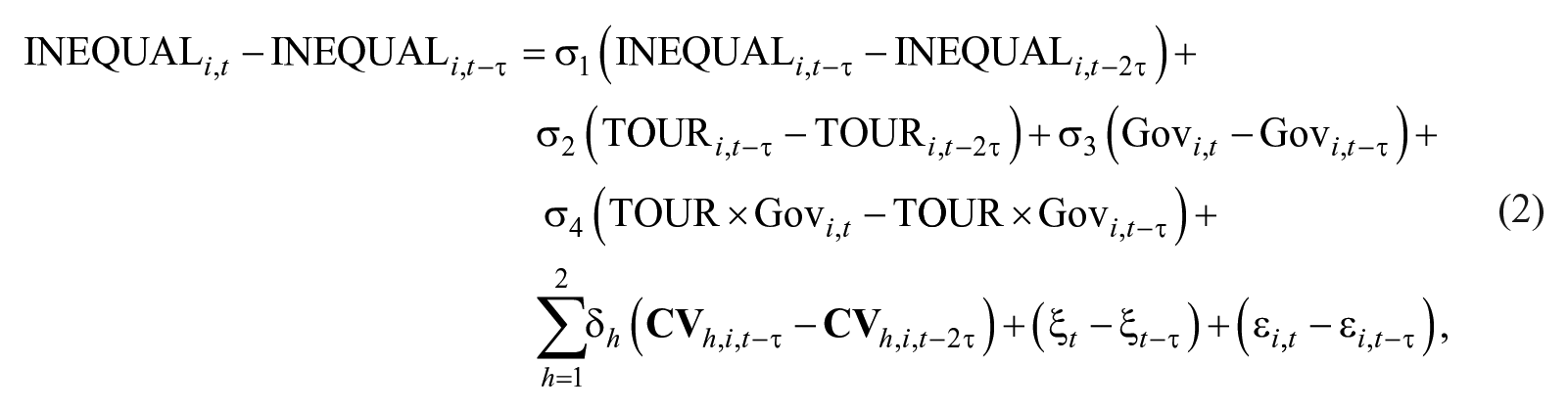
where,
Identification and Exclusion Restrictions
Based on previous empirical studies, the gmmstyle procedure has been used in this study to estimate the predetermined variables suspected to be endogenous, while the “ivstyle” – “iv (years, eq (diff))” procedure is used for treating time-invariant omitted variables (see Asongu and Nwachukwu 2016; Asongu and Odhiambo 2019b). This is mainly because it is unlikely for years or time-invariant omitted variables to become endogenous in difference (see Roodman 2009b). To address the endogeneity problem associated with panel data, lagged regressors are used in the model as instruments for forward-differenced variables (see also Asongu and Odhiambo 2021). This implies that the fixed effects are now removed and can no longer have any influence on the investigated nexuses.
Following Arellano and Bover (1995) and Love and Zicchino (2006), Helmert transformation, which involves forward mean-differencing of the variables, has been performed to remove any fixed effects that could be associated with error terms and which may lead to biasness in the empirical model (see also Asongu and De Moor 2017; Asongu and Nwachukwu 2016). As documented in Roodman (2009a), the Helmert (forward-orthogonal) transformation approach requires that the mean of future observations is subtracted from variables instead of the previous observations being subtracted from the current observations. This, therefore, ensures that there are parallel or orthogonal conditions between forward-differenced variables and the lagged values (Asongu and De Moor 2017; Roodman 2009a). Such a transformation also helps to prevent data loss for all observations, except the last value for each cross-section. Moreover, because lagged observations do not enter into the formulae, they remain valid as instruments (Roodman 2009b). 3
Regarding the exclusion restrictions, years are treated as strictly exogenous in this study. This means that they are expected to influence the outcome variable exclusively (see also Asongu and Odhiambo 2019c). Consequently, the study uses the Difference in Hansen Test (DHT) to test the validity of the exclusion restriction (see Asongu and Nwachukwu 2016). In accordance with this test, the alternative hypothesis must be rejected in order for the instruments to explain the dependent variable exclusively via suspected endogenous variables (see Odhiambo 2020; Tchamyou 2020; Tchamyou and Asongu 2017).
Empirical Analysis
The results reported in Table 1 show that the impact of tourism on income inequality is consistently negative in all the income inequality specifications used in this study. This has been confirmed by the coefficient of tourism in the rule of law (Law), VAC, PS, and Govef, which have been found to be negative and statistically significant at the 1 percent level of significance. This shows that an increase in tourism development leads to a decrease in income inequality in the countries under study. This finding is consistent with some of the previous studies, such as Haddad et al. (2013) for the case of Brazil, Raza and Shah (2017) for the case of 43 top tourist arrival countries, Fauzel (2019) for the case of Mauritius, and C. P. Nguyen et al. (2020) for the case of 97 countries, among others. The results also show that only one proxy of governance quality (VAC) helps to reduce inequality. This implies that an increase in the VAC helps to lower the income distribution of the residents of the countries under study. The results also show that the interaction between governance and tourism development is statistically significant in three of the four specifications used, namely, VAC, PS, and Govef.
Tourism, Governance and Income Inequality.
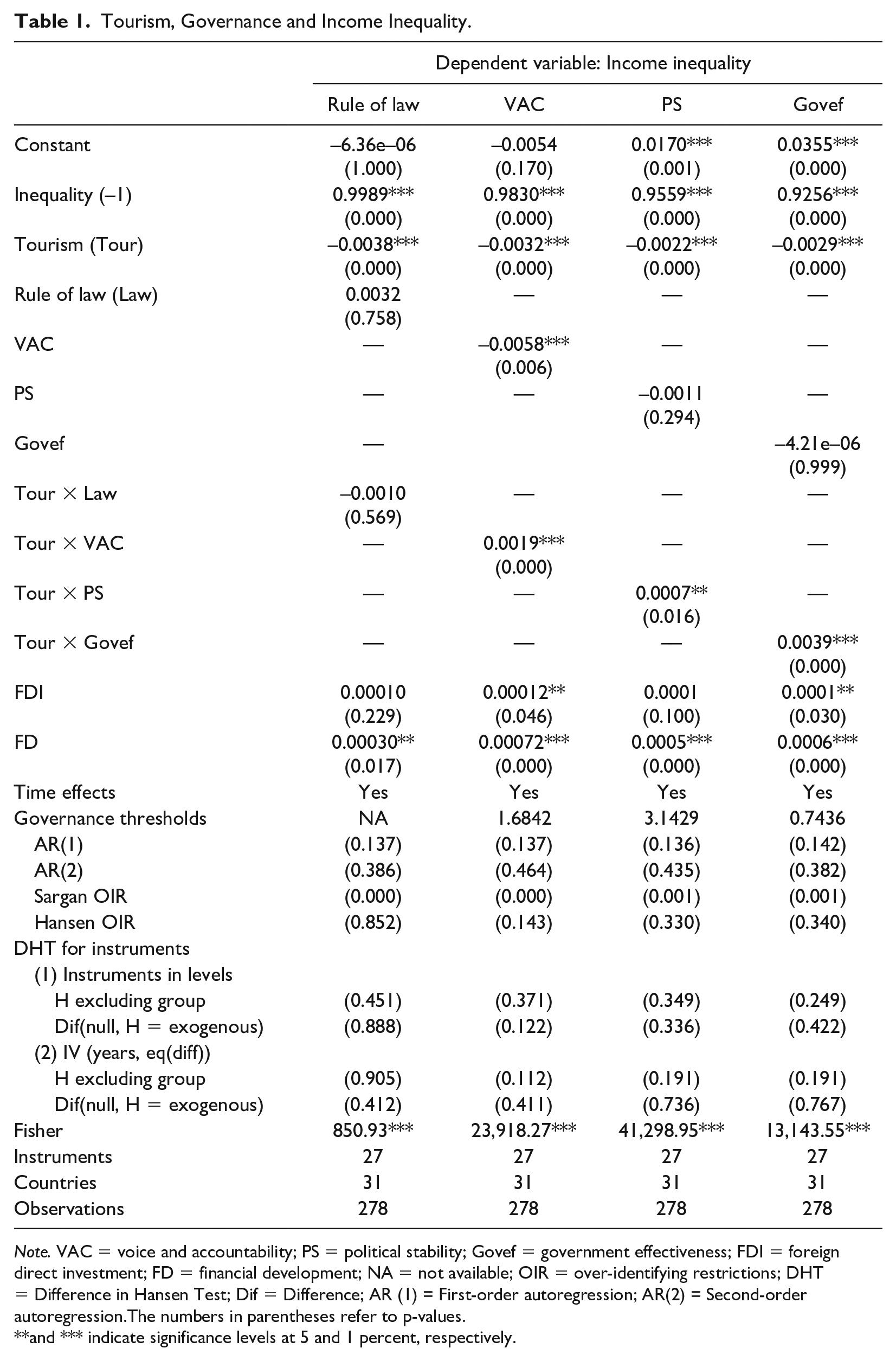
Note. VAC = voice and accountability; PS = political stability; Govef = government effectiveness; FDI = foreign direct investment; FD = financial development; NA = not available; OIR = over-identifying restrictions; DHT = Difference in Hansen Test; Dif = Difference; AR (1) = First-order autoregression; AR(2) = Second-order autoregression.The numbers in parentheses refer to p-values.
and *** indicate significance levels at 5 and 1 percent, respectively.
In addition, the results also show that while FDI has no impact on income inequality in two specifications—namely, rule of law and PS—it has a positive impact on income inequality in the other two specifications, namely, VAC, and Govef. This finding is confirmed by the coefficient of the FDI, which has been found to be insignificant in the first two specifications, but positive and statistically significant in the last two specifications. The results of the second control variable, namely, FD, however, show that there is a distinct positive relationship between FD and income inequality in all four specifications. This finding has been confirmed by the coefficient of FD, which has been found to be statistically significant in all four equations. This implies that an increase in FD generally leads to an increase in income inequality in the countries under study. This finding is consistent with some of the previous studies, such as Adams and Klobod (2016) for the case of 21 SSA countries, Jauch and Watzka (2016) for the case of 138 developed and developing countries, and de Haan and Sturm (2017) for the case of 121 countries, among others.
To examine the threshold level at which governance quality must be maintained to ensure that the favorable impact of tourism on income inequality is maintained, the threshold value for each governance proxy was computed. The study found that three of the four interaction variables between governance and tourism are statistically significant. Overall, the results show that the favorable (negative) impact of tourism on income inequality is likely to change to unfavourable (positive) impact if the following governance levels are exceeded: 1.6842 (0.0032/0.0019) for the case of VAC, 3.1429 (0.0022/0.0007) for the case of PS, and 0.7436 (0.0029/0.0039) for the case of Govef. This implies that policymakers should ensure that these levels of governance quality are not exceeded in the countries under study for an increase in tourism arrivals to have a sustained favorable impact on income distribution.
These results have been supported by the various information criteria used in this study. Specifically, four information criteria have been used to ascertain the validity of the estimated GMM models, namely, (1) the second-order Arellano and Bond autocorrelation test (AR(2)) in difference for the absence of autocorrelation in the residuals; (2) the Sargan and Hansen over-identifying restrictions (OIR) tests; (3) the DHT for exogeneity of instruments, and (4) the Fisher test for the joint validity of the estimated coefficients. The results reported in Table 1 show that, on the whole, the validity of the results reported in this study has been supported by these criteria.
Conclusion
In this study, the dynamic relationship between tourism development, governance, and income inequality is examined using panel data from 31 SSA countries during the period 2005–2014. The study uses the General Methods of Moments (GMM) panel data analysis, which accounts for endogeneity to examine this linkage. The study first examines the impact of tourist arrivals on income inequality measured by the Gini coefficient in the countries under study. Thereafter, it examines the minimum threshold levels of governance quality that must be reached to ensure that the effect of tourism on income inequality is maintained. For this purpose, four interaction variables between tourism and governance proxies are used, thereby leading to four separate specifications. The governance proxies used in the study include (1) the rule of law, (2) VAC, (3) PS, and (4) Govef. Contrary to some of the previous studies, the results of this study show that there is a negative relationship between tourism and income inequality in the countries under study. This implies that an increase in tourist arrivals leads to a decrease in income inequality in SSA countries. These results apply consistently across all the governance specifications used in the study. The results also show that there is a threshold level of governance which must not be exceeded for the favorable impact of tourism on income inequality to be maintained. Specifically, the results show that the favorable negative impact of tourism on income inequality could switch to an unfavorable positive impact if the following levels of governance are exceeded: 1.6842 (0.0032/0.0019) for the case of VAC, 3.1429 (0.0022/0.0007) for the case of PS, and 0.7436 (0.0029/0.0039) for the case of Govef. The study, therefore, recommends that SSA countries should continue to implement the requisite policies aimed at attracting international tourists while ensuring that the desired levels of good governance are adhered to at all times, without which the cumulative benefits that accrue as a result of increased tourist arrivals may not reduce the embedded structural income inequality currently prevalent in many SSA countries. This high-income inequality has been perpetuated in part by the legacy of economic exclusion and jobless growth, which is not pro-poor and does not speak to the cyclical unemployment facing many SSA countries. The study further recommends that the thresholds of the following three basic principles of good governance, which have been found to modulate the tourism-income inequality nexus in the studied SSA countries, should be observed: (1) VAC, which relates to the ability of a country to participate in selecting its own government, freedom of expression, freedom of association, as well as free media; (2) PS, which relates to the absence of political instability or politically motivated violence; and (3) Govef, which mainly includes high quality of public services, civil service, policy formulation and implementation, as well as the credibility of the government’s commitment to these policies.
Footnotes
Appendices
Correlation Matrix.
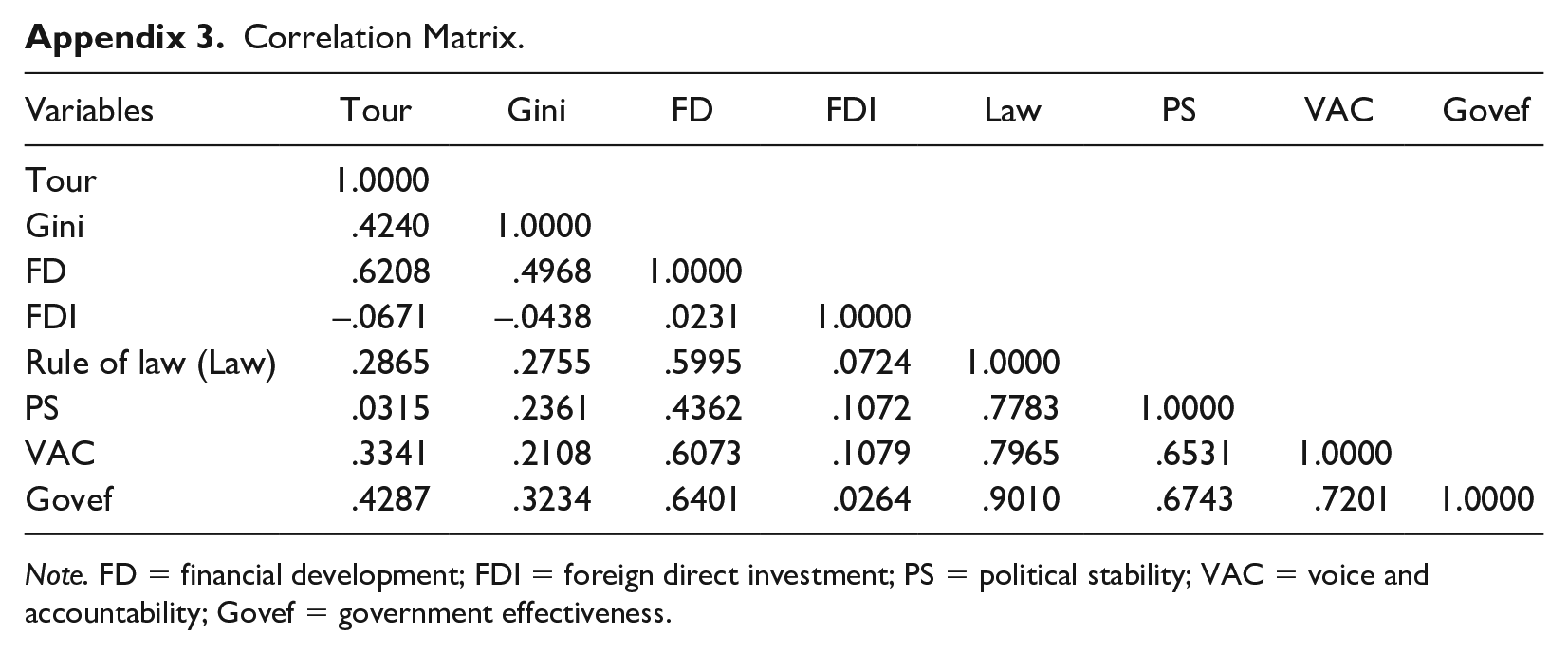
| Variables | Tour | Gini | FD | FDI | Law | PS | VAC | Govef |
|---|---|---|---|---|---|---|---|---|
| Tour | 1.0000 | |||||||
| Gini | .4240 | 1.0000 | ||||||
| FD | .6208 | .4968 | 1.0000 | |||||
| FDI | –.0671 | –.0438 | .0231 | 1.0000 | ||||
| Rule of law (Law) | .2865 | .2755 | .5995 | .0724 | 1.0000 | |||
| PS | .0315 | .2361 | .4362 | .1072 | .7783 | 1.0000 | ||
| VAC | .3341 | .2108 | .6073 | .1079 | .7965 | .6531 | 1.0000 | |
| Govef | .4287 | .3234 | .6401 | .0264 | .9010 | .6743 | .7201 | 1.0000 |
Note. FD = financial development; FDI = foreign direct investment; PS = political stability; VAC = voice and accountability; Govef = government effectiveness.
Declaration of Conflicting Interests
The author(s) declared no potential conflicts of interest with respect to the research, authorship, and/or publication of this article.
Funding
The author(s) received no financial support for the research, authorship, and/or publication of this article.
Notes
Author Biography
 ). He is currently working as a professor of economics and head of macroeconomic policy analysis research flagship programme at the University of South Africa (UNISA)—a programme that he developed in 2012/2013.