



Abstract
The ICT-income inequality relationship and the governance quality-income inequality nexus have been investigated in recent years. However, the moderating effect of ICT on the governance quality-income inequality linkage has been largely ignored. To fill this gap in the literature, this study examines the moderating effect of ICT on the relationship between governance quality and income inequality for a panel of 42 sub-Saharan African economies over the period 1996–2020. To achieve this goal, the generalized method of moments (GMM) estimation technique has been adopted. The results reveal that while ICT contributes to the improvement of income distribution, governance quality contributes to the exacerbation of income inequality. Interestingly, the results unveil that the promotion of E-governance could contribute to improve social welfare and reduce income inequality. Policy implications are given based on the findings of this study. For instance, institutional reforms must be conducted by considering ICT as an important factor to improve income distribution.
Introduction
Income inequality, as documented by Shi et al. (2020), Dossou et al. (2023), Muinelo-gallo (2022) and Sehrawat and Singh (2021), is an important socio-economic factor, which concerns both developed and developing countries. Income inequality has been always used to show how income has been distributed among the population, society or within region (Ofori et al., 2022a). Recently, income inequality has been increasing both in developed and developing economies (Dossou et al., 2021; Fang et al., 2020; Song et al., 2021; Xu et al., 2021). This has been corroborated by the recent rise in income inequality due to the COVID-19 pandemic. For example, as reported by the International Monetary Fund, extreme poverty and billionaire wealth have been on the rise during the ongoing pandemic since the year 2020 (MF, 2021). Another report of the World Bank has concluded that the ongoing COVID-19 pandemic has increased global inequality and undermined previous efforts during the last two decades (Adarov, 2022). The surge in income inequality could negatively affect economic growth and economic development (Grossman and Helpman, 2018). For instance, Lankisch et al. (2019) argued that an increase in income inequality could limit economic growth and undermine social cohesion and economic development. This has been forwarded by Ofori et al. (2022b) who posited that rising income inequality has undermined social cohesion in Africa. Likewise, income inequality, as noticed by Ajide and Alimi (2021) could undermine human development and increase terrorism, which by extension, could retard economic growth in developing countries, especially in Africa. This has been substantiated by Okafor and Chikalipah (2021) who argued that agriculture development in Nigeria has been negatively damaged by the rise in terrorism, which results from high levels of income inequality. In the same spirit, Xu et al. (2021) have pointed out the detrimental effect of income inequality on international investment in developing countries, especially those in Africa.
Meanwhile, recent studies have argued that the improvement of income distribution depends on the quality of institutions or governance (Dossou et al., 2021; Ofori et al., 2021). However, institutional economists have theoretically and empirically pointed out the dual effect of the quality of institutions on income inequality (Acemoglu et al., 2003; Acemoglu and Johnson, 2005; North and Douglass, 1989). To begin with the negative effect of governance quality on income distribution, Huynh (2021) posited that poor governance could limit economic growth or economic development through increasing level of corruption. As argued by Gupta et al. (2002), increasing corruption could undermine tax administration through tax evasion, which by extension, could contribute to the exacerbation of income inequality. Likewise, the authors documented that the rise in corruption could negatively affect policy towards poverty reduction and thereby worsen income inequality. In the same account, Keneck-Massil et al. (2021) posited that an increase in corruption could reduce resources for social policies for health and education. Further, the authors continue by arguing that a high level of corruption could be in favour of wealthy people at the expense of marginalized people. As such, it will exacerbate income inequality. In the same vein, Policardo et al. (2019) postulated that a high level of corruption could negatively affect the redistribution of income by increasing child mortality rate and primary student dropout rate. Moreover, increasing corruption could engender macroeconomic instability, namely inflation. As part of the quality of institutions or governance, Pedauga et al. (2017) argued that inefficient regulation might contribute to the exacerbation of income inequality. Furthermore, it has been documented that poor governance could undermine property right and market competition and thus increase income inequality (Asamoah, 2021). Unlike to the underlying arguments, the improvement of governance quality seems to promote sustained growth and reduce income inequality (Acemoglu et al., 2004). According to Asamoah (2021), reducing corruption seems to have a decreasing impact on income inequality. It has been noticed that good institutions or governance could contribute to the market efficiency which seems to improve income distribution. Countries with good institutions appear to well manage tax revenue comparatively more efficiently by investing more in education and health, which by extension could contribute to improve wages, social welfare and income distribution. Although the literature on governance and economic development is well documented (Acemoglu et al., 2003; Acemoglu and Johnson, 2005; Nguyen et al., 2018; North & Douglass, 1989), the study regarding the relationship between governance and income inequality is very scanty (Nguyen et al., 2021). Moreover, the influence of governance quality on income inequality in developing countries, especially Africa is very scarce (Ofori et al., 2022a).
Meanwhile, the fulcrum in which good governance can improve income distribution is information and communication technology (ICT). It has been documented that the proliferation of mobile phones has improved communication among rural and urban localities (Wantchekon and Riaz, 2019). Indeed, the authors argued that increasing mobile phones could contribute to enhancing government accountability, which could in turn, improve wages and income distribution through the promotion of small businesses and entrepreneurships. For example, it has been noticed that an increase in mobile phones could contribute to lessening corruption by reporting acts of corruption and boosting the speed of information, which by extension, could contribute to improve income distribution (Sami et al., 2017). Similarly, recent studies have argued that the increased in mobile phone could contribute to the betterment of democracy, which in turn could contribute to improve wages, social welfare and income distribution (Sami et al., 2017; Setor et al., 2021). This has been corroborated by Sassi and Ben Ali (2017) who documented that the involvement of mobile phone on the ‘Arab Spring’ movements through promoting democracy which by extension, can improve wellbeing through reducing corruption. This has recently been corroborated by the use of mobile phones and internet by the Sudanese to fight against autocracy in their country and promote democracy, which by extension could contribute to improve wellbeing and income distribution (Reuters, 2021). Mobile phones, as documented by the authors, can be used to record and document conversation. Likewise, Adam (2020) argued that increased mobile phones and internet levels could contribute to reduce bureaucracy, which by extension, can mitigate income inequality (Schopf, 2019). Furthermore, an increase in internet penetration could promote governance efficiency and improve income distribution (Kossow and Kukutschka, 2017). Although many studies have investigated the governance quality-income inequality nexus (Asamoah, 2021; Nguyen et al., 2021; Ofori et al., 2021) and the ICT-income inequality relationship (Asongu and Odhiambo, 2019; Canh et al., 2020a), the study that assesses the moderation of ICT on the relationship between governance quality and income inequality is quite inexistent. That said, the research seeks to explore the potential of ICT as an income distribution strategy through improving governance quality. Further, the objective of this study is to investigate whether improving governance quality contingent on ICT enhancement in Africa can improve income distribution.
In the present study, Sub-Saharan African countries have been chosen as a panel from which to assess the moderating of ICT on the linkage between governance quality and income inequality at least for three reasons. First, Africa has been rated as the most unequal continent across the globe (Ofori et al., 2022a, 2022b; Ujunwa et al., 2021; Xu et al., 2021). For example, Ujunwa et al. (2021) have documented that among 19 most unequal countries across the globe, ten are found in sub-Saharan Africa. Very recently, the income inequality has been exacerbated by the ongoing COVID-19 pandemic, which has negatively affected the African economy, according to the World Bank (2022). Second, over the last two decades, sub-Saharan African countries has witnessed the growing ICT infrastructure (Ofori et al., 2022c; Ofori and Asongu, 2021). This has led to an extensive investigation of the effect of ICT on economic growth in Africa (Adeleye et al., 2020; Adeleye and Eboagu, 2019; Awad and Albaity, 2022). As pointed out by these studies, ICT positively contributes to sub-Saharan African economies. Therefore, the positive contribution of ICT to African economies can be translated into socio-economic development. Very recently, the literature has been extended. For example, as the literature in Africa is very sparse on the ICT-income inequality nexus, Asamoah (2021) has investigated the linkage between governance quality and income inequality in sub-Saharan Africa without considering the transmitting channel, namely ICT in which governance quality could exert its positive effect to improve income distribution. Therefore, this study considers the failure of these studies by investigating the moderation of ICT on governance quality-income inequality nexus in sub-Saharan Africa. Third, African continent is internationally known in terms of poor institutions which are characterised by corruption, government inefficiency, and insecurity (Acemoglu and Robinson, 2010; Kunawotor et al., 2020). As shown in Figure 1, the mean value of all governance indicators, namely control of corruption, governance effectiveness, rule of law, and regulatory quality is negative (Ouedraogo et al., 2021).
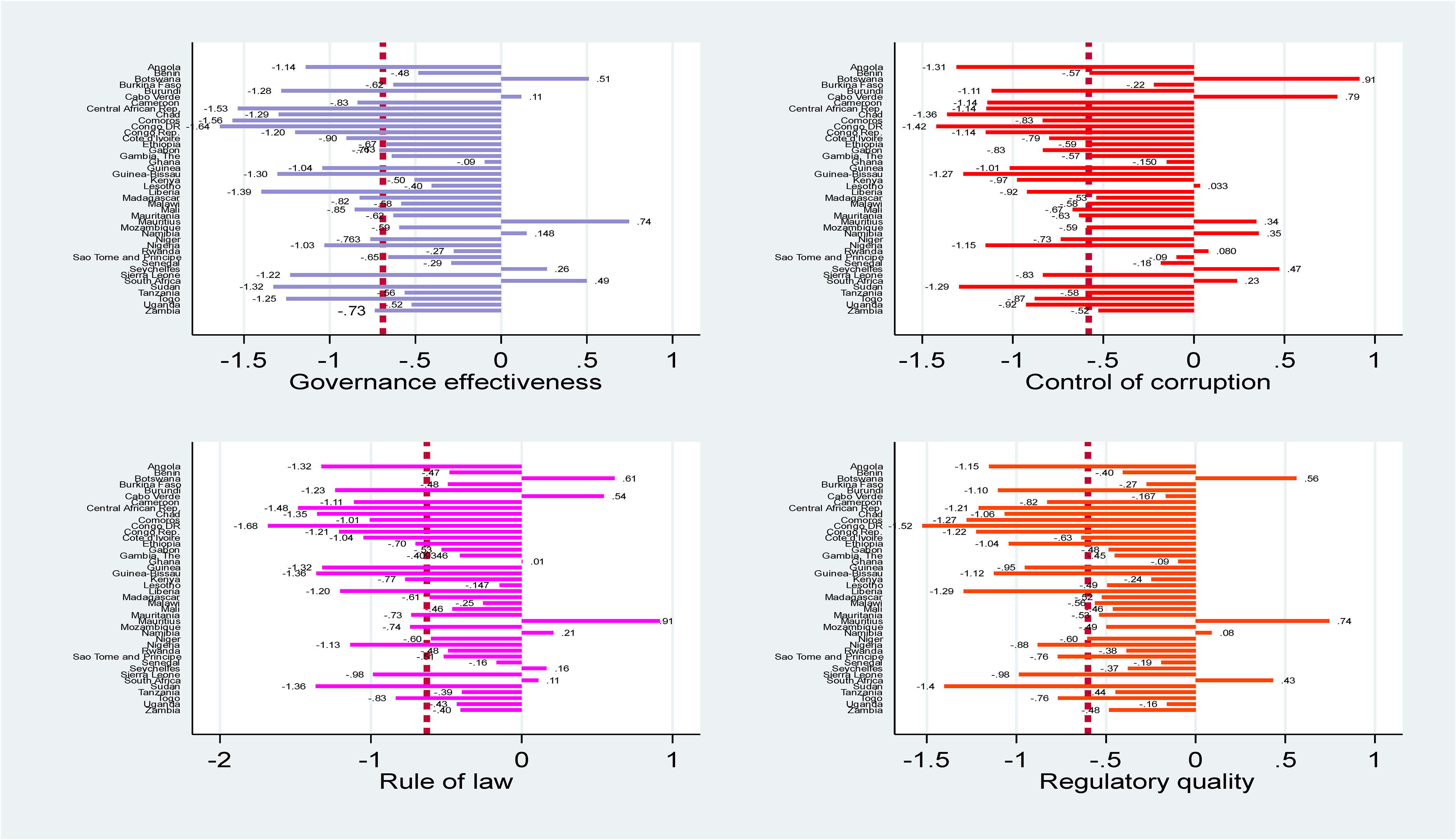
Average within-country governance quality in sub-Saharan countries, 1996–2020.
This study makes two contributions to the economic development literature. First, to the best of knowledge, this is the first study to empirically investigate the moderation of ICT on the relationship between governance quality and income inequality. As discussed earlier most previous studies have investigated the ICT-income inequality nexus and the governance quality-income inequality relationship. However, these studies have failed to examine the joint effect of ICT and governance quality on income inequality. Therefore, the present study contributes to the economic development literature by assessing the moderating effect of ICT on the governance quality-income inequality nexus. It is important to note that our study departs from Adams and Akobeng (2021) in many ways. (i) Adams and Akobeng (2021) investigated the moderation of governance quality on the ICT-income inequality nexus while this study examines the moderating effect of ICT on the governance quality-income inequality nexus. This study investigates the moderating effect of ICT on the governance quality-income inequality nexus because the use of information technology seems to improve the quality of institutions in sub-Saharan African countries where her institutions are relatively poor (Pan et al., 2022). (ii) Authors of the underlying study have used the Gini index as a proxy of income inequality, as it has failed to account for non-income inequality such as education inequality and health inequality, which appear to negatively impact the quality of life in Africa (Tan and Uprasen, 2021). Therefore, the study has considered this limitation by using the Palma ratio and Atkinson index as proxies for income inequality which have been used in the economic development literature in recent years (Ofori et al., 2022a, 2022b; Tan and Uprasen, 2021). (iii) They computed the net effect of ICT on income inequality while our study determines the net effect of governance quality on income inequality. (iv) Their study focused on 1984–2018 while this study considers a period starting from 1996 to 2020. (v) Their study focused on 48 sub-Saharan African economies our study uses a panel of 42 sub-Saharan African countries. As a second contribution of the study, the findings hold the promise of informing policy makers on measures that could be taken in terms of moderating governance quality dynamics with ICT in order to Sustainable Development Goals (SDGs) by the year 2030, especially as it pertains to mitigating income inequality or achieving SDG10 of reducing income inequality within countries and regions.
The remaining part of this study is organized as follows. The next section reviews previous studies. Section 3 provides the model specification data and methodology. While Section 4 presents the empirical results and discussion, Section 5 provides a conclusion with policy implications.
Literature review
The theoretical link between ICT and income inequality
The neoclassical theory of economic development has been found as an appropriate theory that explains the relationship between ICT and income inequality (Awad, 2022; Ofori et al., 2021). According to this theory, the redistribution of economic prosperity could be enhanced by ICT. Moreover, it has been argued that agricultural productivity could be promoted by ICT. The neoclassical theory has been recently corroborated by Ofori et al. (2021) who have documented that ICT has been used in China, Hong Kong and Japan to alleviate poverty, improve income distribution, social welfare and wages.
The theoretical link between governance quality and income inequality
Theoretically, good governance has been found to play an important role in promoting economic development (Acemoglu et al., 2004; Acemoglu and Robinson, 2010; North & Douglass, 1989). According to Acemoglu et al. (2004), economic prosperity can be achieved if good economic, political and institituional governance have been considered. As economic freedom occurs from good governance, Acemoglu and Robinson (2010) argued that economic freedom can improve income distribution. Moreover, it has been documented that good governance can promote economic development through efficient resource allocation (Ofori et al., 2022a). The authors continue by arguing that political stability and rule of law have to be considered as important factors to improve income distribution (Dossou et al., 2023).
Empirical studies
Empirical studies on ICT and income inequality
There are several channels in which information technology can improve income distribution. For example, income distribution can be improved by increasing the productivity of ICT which has the power to promote economic growth (Appiah-Otoo and Song, 2021; Awad and Albaity, 2022). According to Awad and Albaity (2022), ICT can promote economic growth, improve social welfare and income distribution as it has the power to increase the productivity of the entire economy. Confirming this fact, Ofori et al. (2021) argued that increasing ICT infrastructure in Africa could contribute to improve the efficiency of an economy and thereby reduce poverty and income inequality. Similarly, it has been noticed that ICT can affect per capita GDP through generating revenue, reducing transaction costs and attracting foreign direct investment. According to Rodríguez-crespo and Martínez-zarzoso (2019), ICT could internationally contribute to firms ‘expansion through reduced transaction costs as it could be related to uncertainty. As such, it can contribute to expedite economic growth and job opportunities and reduce income inequality. Moreover, the authors argued that increasing ICT could contribute to enhance the efficiency of the logistics process. Moreover, knowledge creation can be accelerated via increasing ICT infrastructure, which in turn can promote economic growth and improve income distribution.
Furthermore, it has been argued that ICT can have a positive impact on economic growth and income distribution through reducing corruption and promoting economic freedom (Awad and Albaity, 2022). ICT has the power to lessen corruption which can positively affect the government's ability to craft a policy toward the poor people in equitable manner. This fact has been recommended by Xu et al. (2021) who documented that reducing corruption could contribute to reduce income inequality and achieve the Sustainable Development Goals (SDGs) by 2030. Moreover, improving the interaction between public administration and citizens through ICT can increase accountability which appears to play a crucial role in promoting economic growth and improving income distribution (Ben Ali, 2020).
ICT can contribute to the improvement of income distribution by promoting financial development. As argued by Alshubiri et al. (2019), the improvement of ICT infrastructure could contribute to the reduction of costs related to financial intermediation, in microfinance and commercial institutions, which could be accessible for the poor and therefore contribute to lessening income inequality. Another channel through which ICT can improve income distribution is education. As elucidated by Asongu and Nwachukwu (2018) and Erer and Erer (2022), inequality in education can be reduced by ICT which contributes to promoting income distribution and inclusive development. Also, as documented by UNESCO (2010), ICT can reduce inequality in education by helping persons with disabilities to receive equitable education, which by extension, could contribute to the improvement of wages and income distribution.
Foreign direct investment is another channel in which ICT can contribute to improve income distribution. For example, Gholami et al. (2005) argued that ICT could lower the transaction and production costs related to foreign direct investment, which by extension, could contribute to improve job opportunities, wages, social welfare and reduce income inequality. It has been argued in Yazdan and Hossein (2013) and Ahmad et al. (2021) who documented that ICT could contribute to attracting foreign direct investment flows and increase productivity, which could in turn contribute to improve income distribution.
Empirical studies on governance quality and income inequality
As labelled by the former United Nations Secretary Kofi Annan, good governance has been singled out as the most important factor that could help to eradicate poverty, reduce income inequality and promote economic development (Ofori and Asongu, 2021). It has been documented that good governance could contribute to securing property rights, which seem to attract foreign direct investment (Acemoglu et al., 2001). As result, it can contribute to generating job opportunities. Furthermore, the authors argued that good governance seems to minimize distortionary policy toward physical and human capital, which in turn could help to reduce income inequality. According to Ofori and Asongu (2021), good governance has been found to promote accountability which seems to enhance socio-economic development. Moreover, good governance has been documented to promote a business environment which plays an important role in improving income distribution. According to Appiah-Otoo et al. (2022), improved institutions or governance can contribute to reduce uncertainties and risk, which could help to attract foreign direct investment. As such, it might contribute improve social welfare, provide job opportunities and improve income distribution. Similarly, good governance has been found as a prerequisite for infrastructural development, which plays a significant role in income disribution (Appiah et al., 2022). In the same vein, it has been recently documented that better planning and efficiency can be spurred by good governance (Aluko et al., 2023). In the same account, Ofori and Asongu (2021) posited that good governance has been found to improve social welfare, which in turn could comtribute to reduce income inequality. It has been argued that the ability of poor to participate in economic activities can be improved by the control of corruption (Dossou et al., 2023).
However, poor governance has been documented to worsen income inequality (Xu et al., 2021). As cooruption occurs from poor governance, its increase could retard economic growth and undermine income distribution. According to Xu et al. (2022), corruption seems to reduce the government's ability to provide good policy toward allocating public service. According to Epstein and Gang (2019), poor governance through tax administration is expected to increase tax evasion, which by extension could, for example, contribute to worsening income inequality.
Data specification, data and methodology
Model specification
To unearth the moderating effect of information technology on the governance quality-income inequality, we followed a study by Canh et al. (2020b) and Asamoah (2021). However, our model is different from these two studies. The first study assesses the influence of ICT on income inequality whereas the second study investigates the impact of governance quality on income inequality. To fill the gap in the economic development literature, the present study examines the moderating role of ICT on the governance quality-income inequality nexus. Theoretically, economic growth and income inequality seem to have an inverted U-shaped relationship, according to Kuznets (1955). Following the underlying theory, the equation can be written as follows:

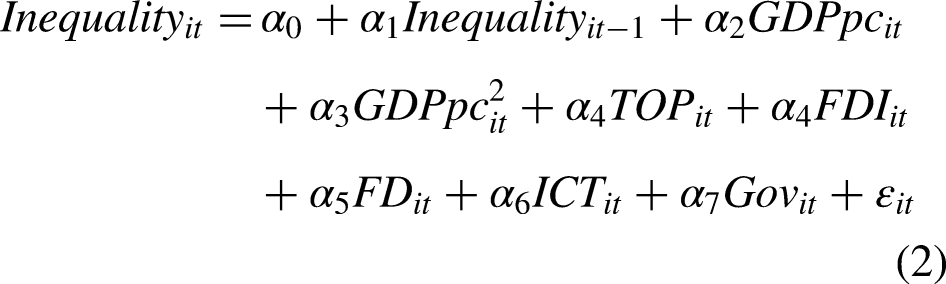
Further, the second objective of this study is to investigate the joint effect of ICT and governance quality on income inequality. Therefore, equation 1 can be extended as follows:
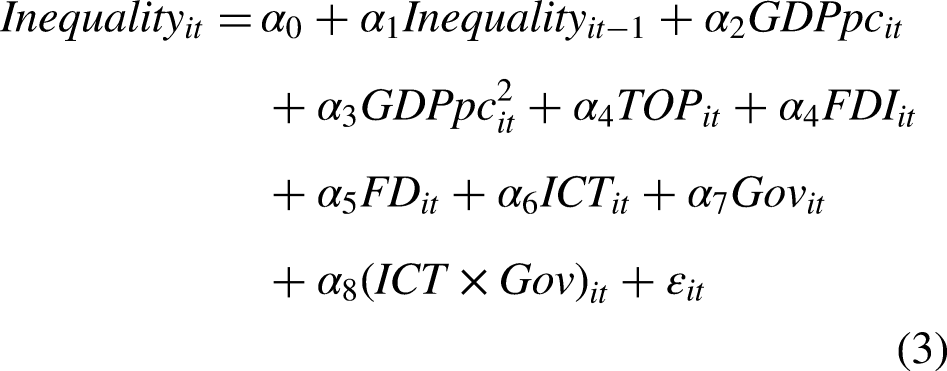
Considering the equation 2, the net effect of governance quality on income inequality can be computed as follows:

Data
To investigate the moderating effect of ICT on the governance quality-income inequality nexus, 42 sub-Saharan African economies have been considered during the period 1996–2020. While sub-Saharan Africa contains 48 African countries, this study focuses on 42 countries due to data availability constraints. While data on income inequality (Palma ratio and Atkinson index) emanate from the Global Consumption and Income Project, the data on ICT (internet penetration and mobile penetration) and governance quality (control of corruption, governance effectiveness, regulatory quality and rule of law) were obtained from the World Development Indicators (WDIs) and World Governance Indicators (WGIs), respectively. It is important to note that governance quality indicators value range from −2.5 to 2.5, with −2.5 means poor quality of governance and 2.5 reflects good quality of governance. Moreover, Palma ratio value range from 1 to 10, whit 1 denotes low income inequality and 10 means high income inequality. According to Lorente-Bayona et al. (2021), internet penetration has been considered as an important tool to promote e-business which seems to provide job opportunities. Further, Adeleye et al. (2020) argued that the internet and mobile phones have a particular relationship as the internet enables mobile phone users to engage in economic activity. Therefore, following the ICT literature (Adeleye et al., 2020; Lorente-Bayona et al., 2021), we use internet penetration (the number of individuals using the internet per 100 people) and mobile penetration (the number of fixed telephone subscribers per 100 people) as proxies for ICT. Furthermore, this study uses four governance quality indicators, namely: control of corruption, rule of law, regulatory quality and governance effectiveness, which have been used in ICT literature (Adams and Akobeng, 2021).
Control variables
Economic growth
During his seminal work, Kuznets (1955) theoretically showed that economic growth and income inequality appear to have an inverted U-shaped relationship. According to the author, income inequality increases at the early stage of economic development but later decreases due to the promotion of industrialization, democracy social welfare. The data on economic growth were extracted from the World Development Indicators (WDIs) of the World Bank.
Trade openness
Theoretically, trade has been considered as an important factor to enhance economic growth (Anderson, 2005). Recently, the positive contribution of trade openness to economic growth has been extended to socio-economic development. As argued by Xu et al. (2021), an increase in openness could contribute to improve living standard, wages and income distribution. Hence, as trade openness increases, income inequality could decrease. The data on economic growth were retrieved from the World Development Indicators (WDIs) of the World Bank.
Foreign direct investment
Theoretically, foreign direct investment has been considered as major catalyst for economic development (Xu et al., 2021). As it can contribute to promote economic growth through providing job opportunities, Khan and Nawaz (2019) stated that it can contribute to the improvement of income distribution. Thus, increasing foreign direct investment could propel economic growth and reduce income inequality. The data on economic growth were collected from the World Development Indicators (WDIs) of the World Bank.
Financial development
It has been argued that having access to financial services, namely credit facilities could contribute to the improvement of productive capacities of the poor and therefore could contribute to improve income distribution (Olaniyi et al., 2022). Addressing the high cost of borrowing and asymmetric information could contribute to improve income distribution (Ofori et al., 2022d). Thus, an increase in financial development could lower income inequality. The data on financial development were gleaned from the World Development Indicators (WDIs) of the World Bank.
Estimation strategy
To estimate the above model, the study adopted a dynamic system Generalized Method of Moments (GMM) estimation method. System GMM models are more efficient than fixed-effects models when endogeneity concerns are apparent in the data. According to Abid (2017), the efficiency has been proven by the GMM system than the difference GMM estimator. Moreover, the inclusion of lagged outcome variables into the model generates a bias given the correlation between these variables and individual fixed effects that cannot effectively be addressed by time averaging. Furthermore, in the presence of a small time dimension, System GMM models are preferred to difference GMM techniques, which is consistent with the present study. According to Blundell and Bond (1998), the system GMM has the power to account for the dynamic nature of the model. Moreover, the autocorrelation induced by
The use of system GMM in the above model can ensure that there is no second order correlation in the error term:
It also confirms that there is no autocorrelation of country-specific effects with their differences by adding additional moment conditions:
Empirical results and discussion
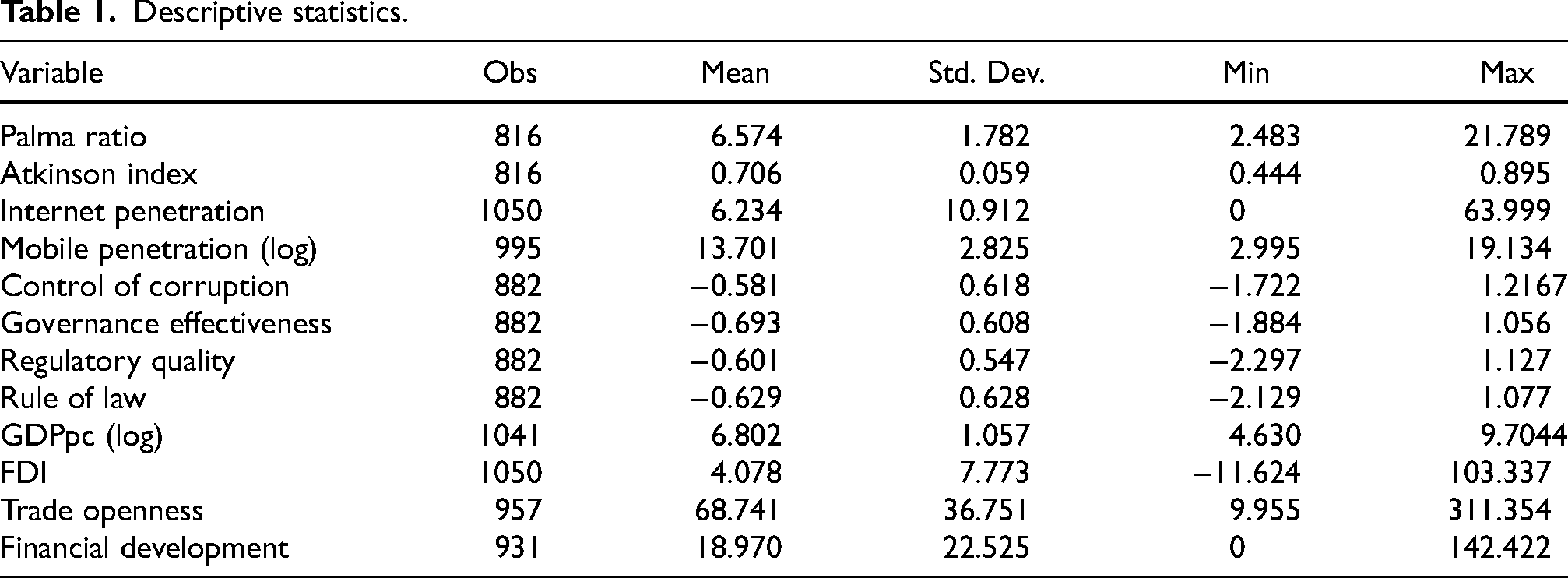
Tables 1 and 2 disclose respectively the descriptive statistics and correlation matrix. As shown in Table 1, the mean value of the Palma ratio and Atkinson index are 6.574 and 0.706, respectively. This implies that income inequality still remains high in Africa. This corroborates the arguments of Asongu and Odhiambo (2019) who argued that reducing income inequality remains important for developing countries to achieve the Sustainable Development Goals by the year 2030. Moreover, 6.234% and 13.701% are the average value of internet penetration and mobile penetration. Furthermore, −0.581, −0.693, −0.601 and −0.629 are respectively the mean value of control of corruption, governance effectiveness, regulatory quality and rule of law.
Descriptive statistics.
Correlation matrix.
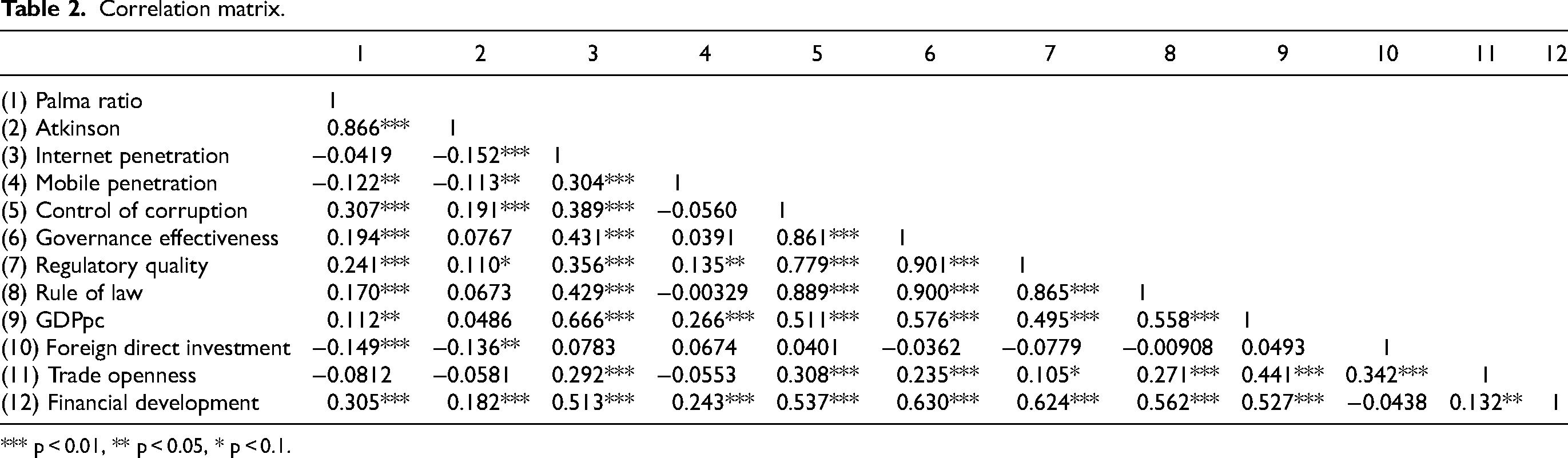
*** p < 0.01, ** p < 0.05, * p < 0.1.
As shown by Figure 2, Mauritius and Seychelles register comparatively the highest values in terms of internet and mobile penetration rates, while Burundi registers the lowest value. Considering income inequality, South Africa, Burkina Faso, Lesotho, Botswana and Zambia comparatively record the highest values while Ethiopia register the lowest value (see Figures 2 and 3).
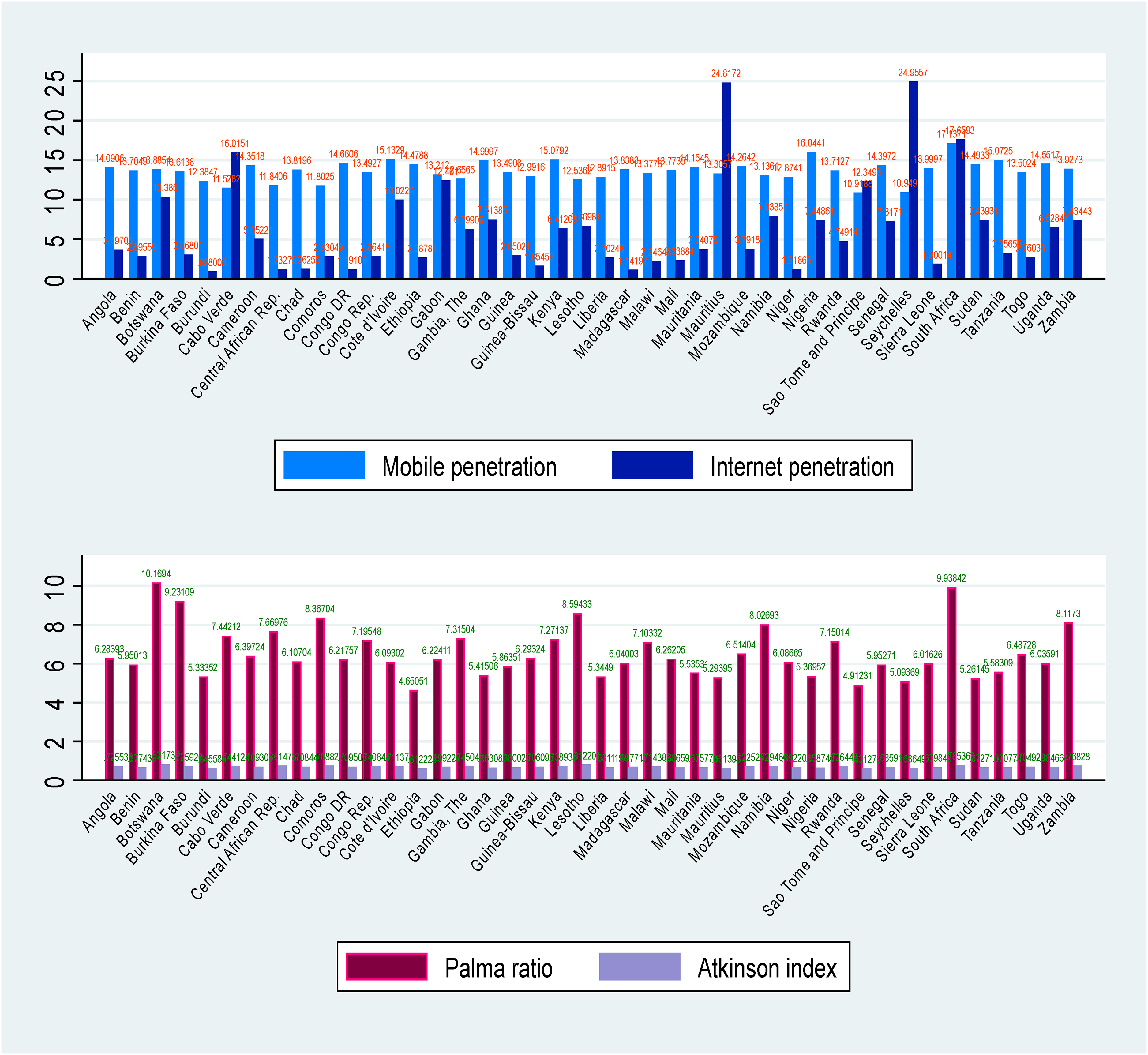
Average within-country information technology (mobile penetration, internet penetration) and income inequality (Palma ratio and Atkinson index) in sub-Saharan African, 1996–2020.
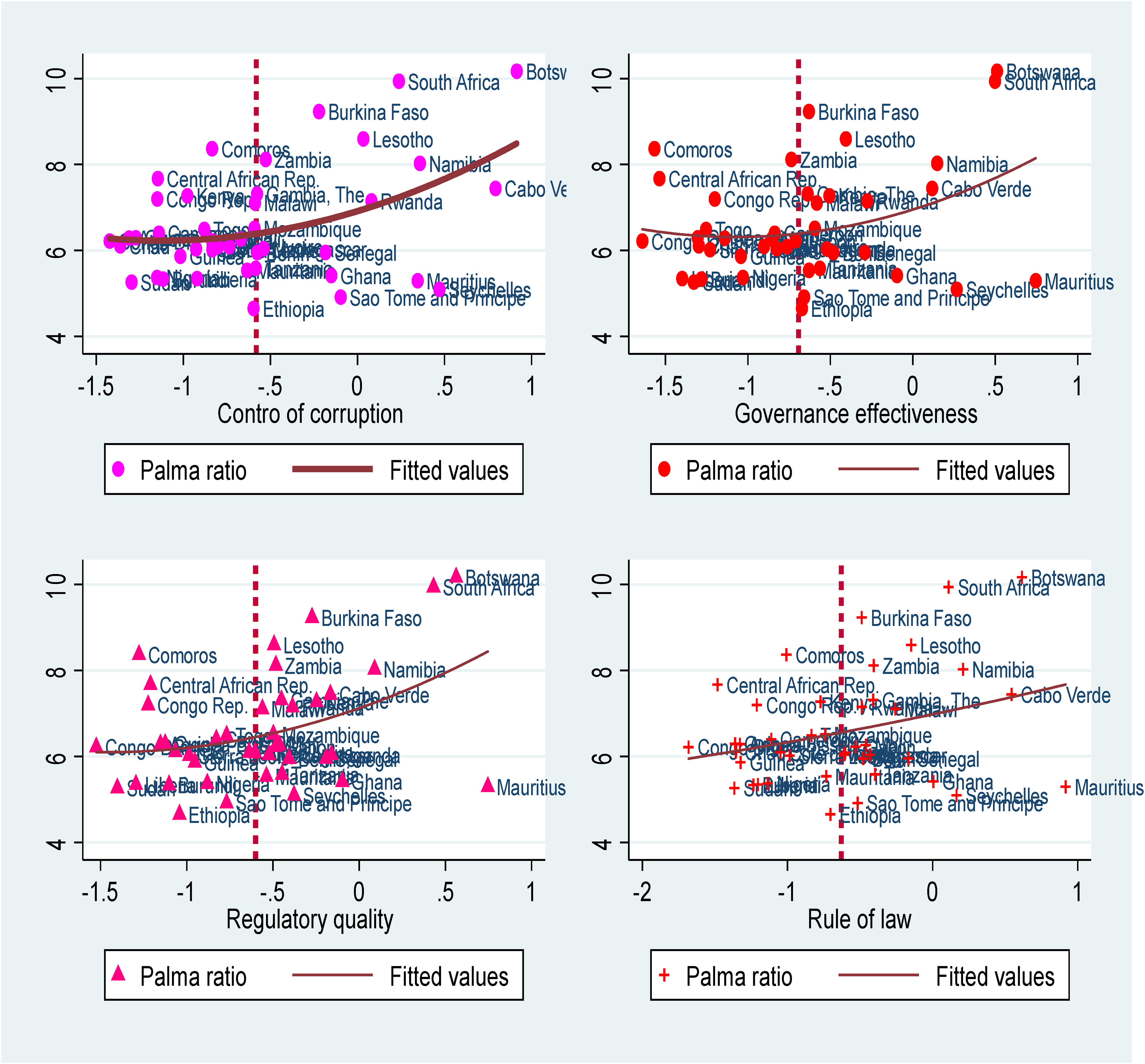
The relationship between income inequality (Palma ratio) and governance quality in sub-Saharan African countries, 1996–2020.
From the correlation analysis disclosed in Table 2, the results unveil that while information technology and income inequality have a negative correlation, governance quality has a positive correlation with income inequality.
GMM results on the combined effect of governance quality and ICT on income inequality in sub-Saharan African economies
The combined effects of ICT and governance quality on income inequality are disclosed in Table 3. The results in Column 1 indicate that economic growth and its squared term have significant positive and negative effects, respectively. This revealed an inverted U-shaped relationship between economic growth and income inequality. This supports the theory of Kuznets (1955) who postulated that income inequality worsens at the early stage of economic development, but later it lessens due to the promote of democracy, industrialization and urbanization which contribute to improve welfare. Our result is consistent with Meniago and Asongu (2018) who investigated the influence of economic growth on income inequality using Kuznets theory in 48 African economies.
GMM results on the combined effect of ICT and governance quality on income inequality (Dependent variable: Palma ratio).
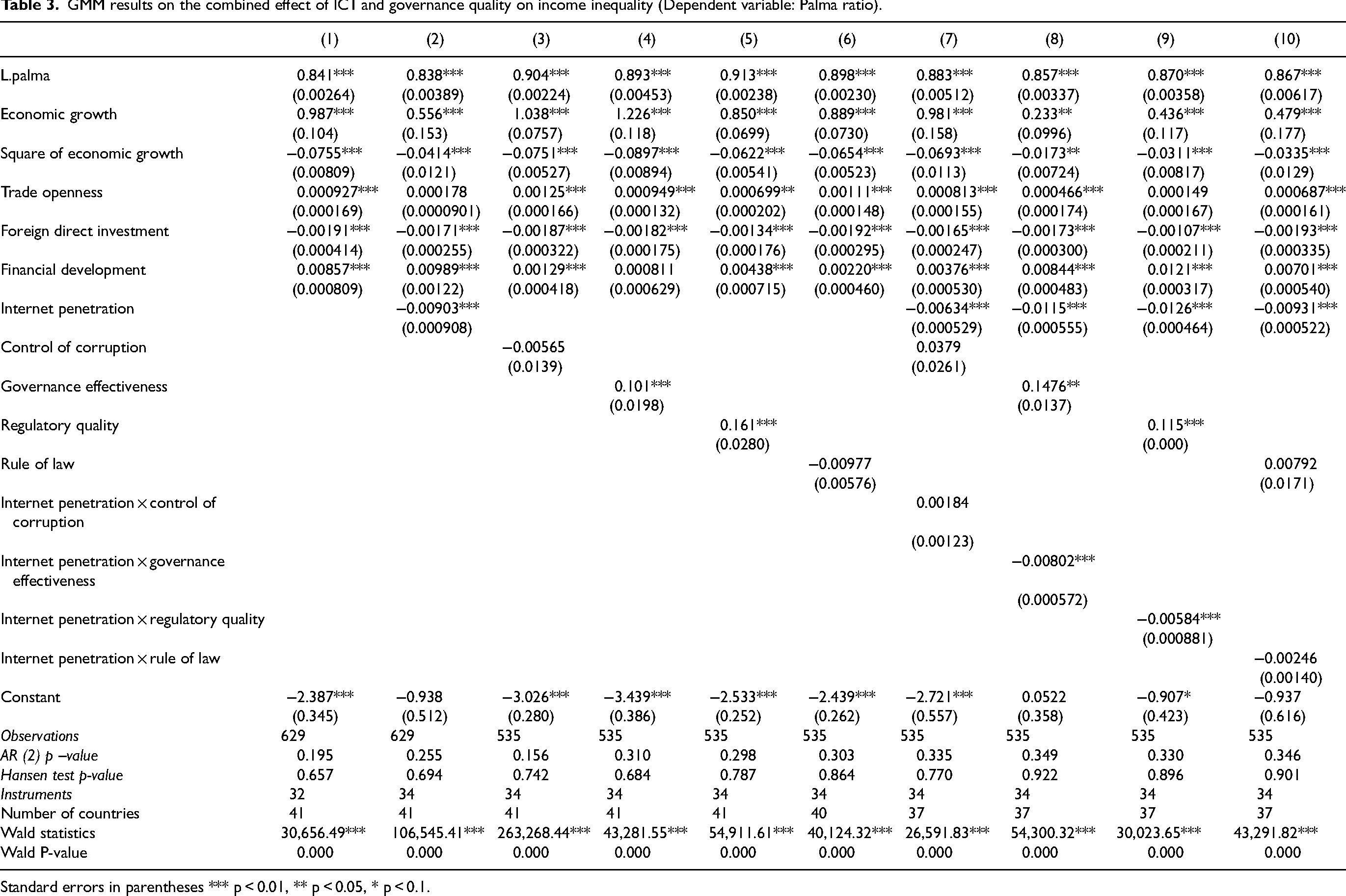
Standard errors in parentheses *** p < 0.01, ** p < 0.05, * p < 0.1.
Trade significantly and positively influences income inequality. This indicates that as trade increases, income inequality also increases. The implication of this results is that trade in Africa undermines economic growth which by extension, undermines income distribution in the continent. This is evidence of the non-diversification of African trade which continues to hamper income distribution in the continent. This corroborates the findings of Xu et al. (2021) who examined the influence of foreign direct investment and trade openness on income inequality in 38 sub-Saharan African countries. This results also are inconsistent with the argument of Acheampong et al. (2022) who posit that trade liberalization could spur economic growth by promoting technology transfer and creating job opportunities.
The results also show that financial development significantly undermines income distribution in Africa. This means that increasing financial development could contribute to the exacerbation of income inequality. This is not surprising given thefact that the rich benefit more from financial development compared to the poor. As such, it may lead to the increase of income inequality in Africa. As the quality of institutions remains poor, financial development could benefit the rich and elites who have strong political connections. Hence, it may contribute to the exacerbation of income inequality. Moreover, our finding can be corroborated by Aslan et al. (2017) who have argued that financial imperfection can lead to more capital outflows which could increase income inequality. Similarly, the authors have argued that financial imperfection can lead to the increase of information and transaction costs which could contribute to worsening income inequality.
However, the results reveal that foreign direct investment improves wages and income distribution in the continent. The implication of this result is that foreign direct investment could play a significant role in improving economic growth and reducing income inequality through jobs opportunities. Similarly, our result is consistent with Huynh (2021) who argued that foreign direct investment could contribute to the promotion economic integration which will to propel trade liberalization and improve income distribution. Similar results were found by Xu et al. (2021) who argued that foreign direct investment has the potential to promote export diversification which could play a significant role in promoting economic growth and improving income distribution.
Further, we embark with the first objective of this study (see Columns 2–5). First, we found that ICT (internet penetration) significantly improves income distribution. This supports the original work of Solow (1957) who documented that the promotion of technology could contribute to the enhancement of economic growth and productivity which by extension, could contribute to improve income distribution. Also, our results support the argument of Awad and Albaity (2022) who posited that increasing ICT could contribute to promote economic growth by improving the efficiency of markets, stimulating investment, and improving wages and income distribution. Our results also support the argument of Tchamyou et al. (2019) who maintained that the promotion of ICT in the education sector could contribute to improve wages, social welfare and income distribution. Similarly, our results support the view of Njangang et al. (2021) who postulated that the intervention of ICT in the financial sector could contribute to improve the quality of life of the poor as they can easily have access to financial services. Moreover, the authors argued that ICT can reduce asymmetric information and allow the poor to have access to better information.
However, the coefficient of governance quality, namely governance effectiveness and control of corruption are positive and significant, signifying as governance quality increases in Africa, income inequality also increases. This is not surprising given the fact that the quality of institutions in Africa still remains poor (Kunawotor et al., 2020). Our results have been corroborated by the argument of Xu et al. (2021) who argued that increasing corruption in the African continent has undermined the policy towards reducing income inequality and improving social welfare and income distribution. This results support the view of Xu et al. (2022) who posited that the failure of African governments to control corruption has limited the flow of foreign direct investment and retarded economic growth which by extension, could undermine the improvement of income distribution.
Most interestingly, the coefficients of the interaction of governance quality and ICT enter with positive and significant impacts. It means that ICT could exert a significant influence on governance quality to minimize income inequality. Our result is consistent with Awad and Albaity (2022) who noticed that ICT could promote economic freedom which by extension, could contribute to improve wages, social welfare and income distribution in developing countries. As argued by Sami et al. (2017), the promotion of ICT in developing nations could contribute to reducing corruption which could enhance economic growth and lessen income inequality. As corruption is more related to tax evasion, the improvement of ICT infrastructure and its involvement in governance could efficiently improve tax collection which by extension, could contribute to addressing and lessening income inequality. This results support the idea of Ben Ali (2020) who argued that the interaction of ICT and governance could increase accountability from politicians which could enhance income distribution. As reported by the World Bank, ICT use is expected to solve certain problems, namely low technical quality which has been created by the promotion of corruption. These results have been corroborated by the Brooking Institutions, which documented that the advent of ICT in recent years and its effect on government have contributed to the betterment of democracy which plays a significant role in promoting income distribution (Ingram and Dooley, 2021). Following this result, the net effect of governance quality on income inequality can be computed as follows:
Considering Column 8, the net effect of governance quality on income inequality is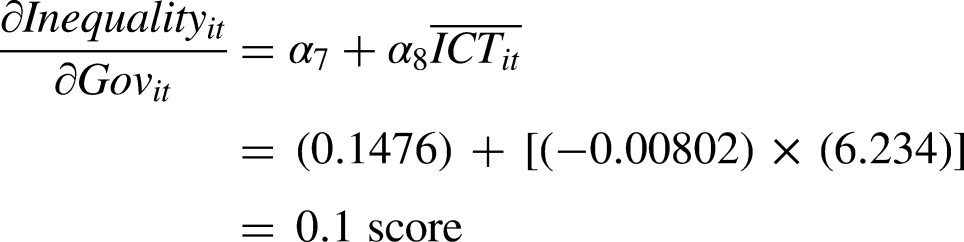
Considering Column 9, the net effect of governance quality on income inequality is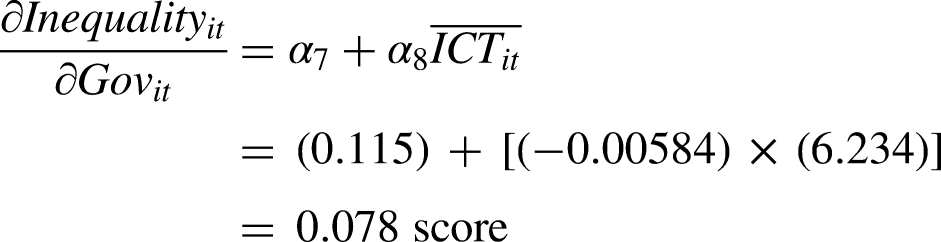
Given that the net effects are positive. We compute ICT thresholds at which the positive incidence of governance on income inequality is completely mitigated. Threshold for internet penetration (Column 8) = Threshold for internet penetration (Column 9) =
In the light of the above, internet penetration thresholds of respectively 18.4 and 19.7 per 100 people are needed to completely dampen the unfavourable effects of the corresponding governance dynamics on income inequality. It follows that above the computed thresholds, the internet can effectively moderate governance for favourable income redistribution outcomes.
Robustness check
Robustness check1
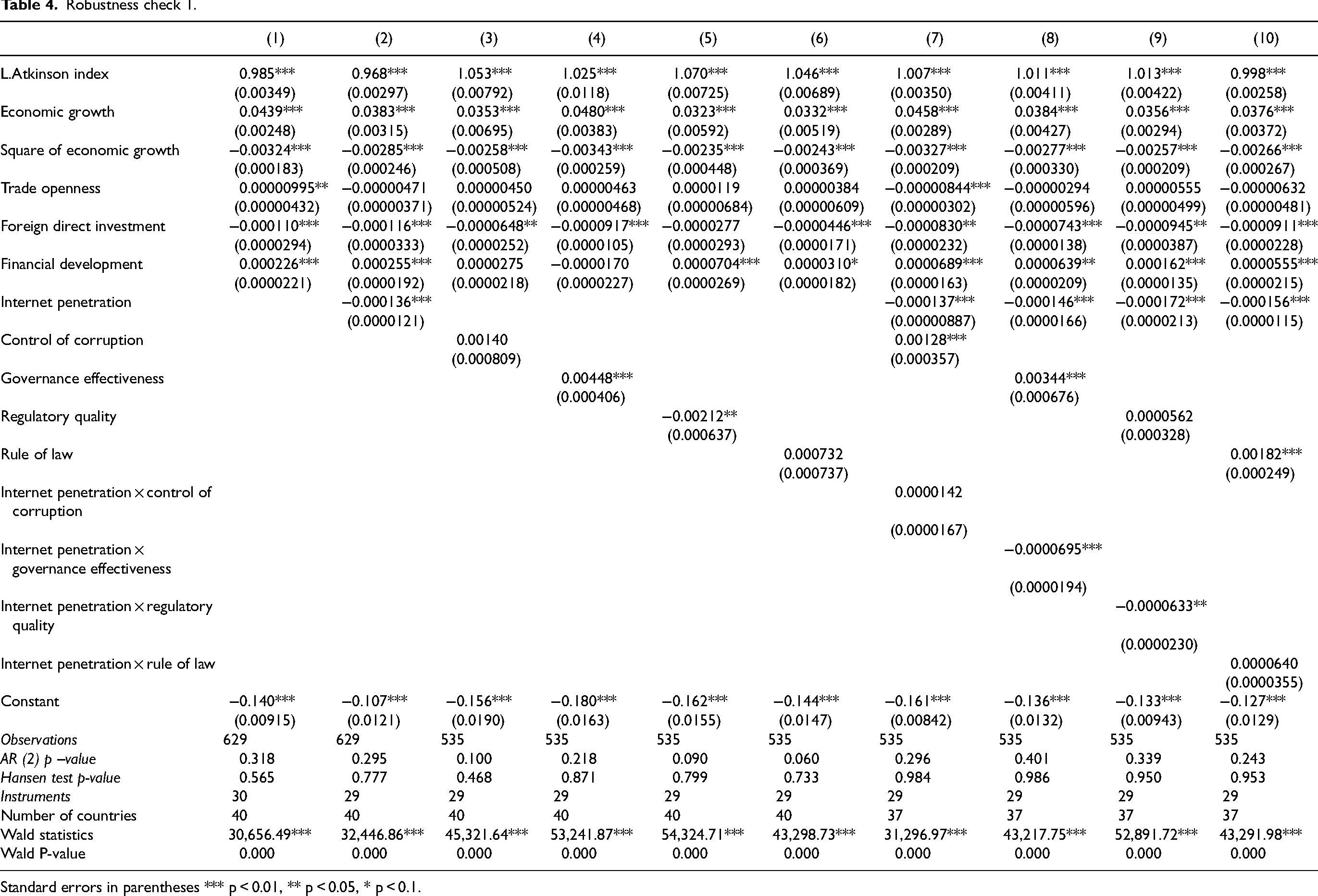
In order to evaluate the robustness of this study, we used an alternative income inequality measure, namely Atkinson index. The results, as disclosed in Table 4, are similar to the estimation results when we use Palma as a proxy for income inequality. Therefore, the threshold can be computed as follows. Threshold for internet penetration (Column 8) =
Robustness check 1.
Standard errors in parentheses *** p < 0.01, ** p < 0.05, * p < 0.1.
In the light of the above, internet penetration thresholds of 4.96 per 100 people are needed to completely dampen the unfavourable effects of the corresponding governance dynamics on income inequality. It follows that above the computed thresholds, the internet can effectively moderate governance for favourable income redistribution outcomes.
Robustness check2
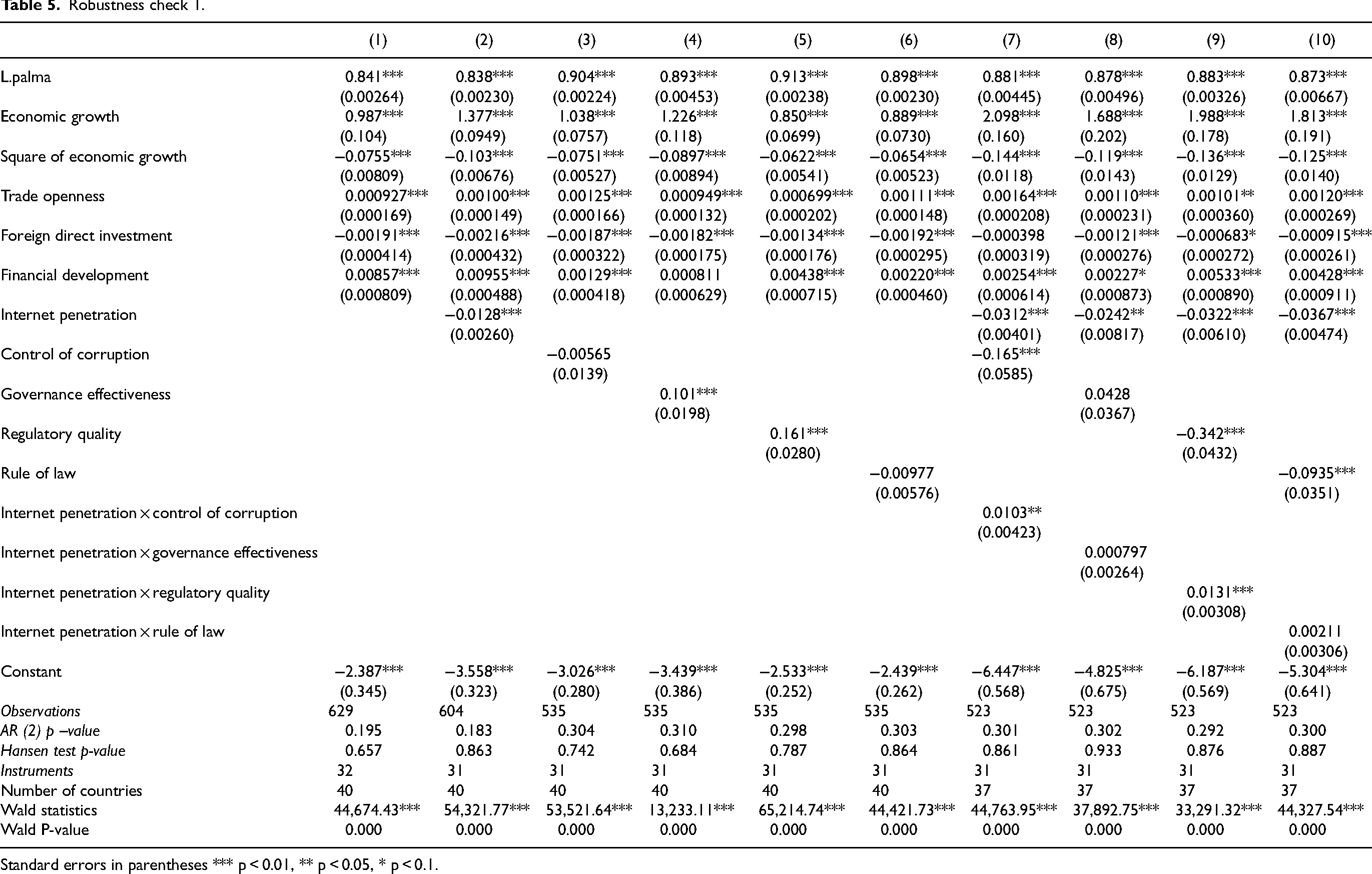
The robustness of this study has been checked by using another ICT indicator, namely mobile penetration. As shown in Table 5, the results remained unchanged compared to previous results. Hence, the threshold can be computed as follows Threshold for mobile penetration (Column 7) = Threshold for mobile penetration (Column 9) =
Robustness check 1.
Standard errors in parentheses *** p < 0.01, ** p < 0.05, * p < 0.1.
In the light of the above, mobile penetration thresholds of respectively 16.01 and 26.11 per 100 people are needed to completely dampen the unfavourable effects of the corresponding governance dynamics on income inequality. It follows that above the computed thresholds, the mobile can effectively moderate governance for favourable income redistribution outcomes.
Conclusion and policy implications
This study investigates the moderating effect of ICT on the governance quality-income inequality nexus for a panel of 42 sub-Saharan African countries over the period 1996–2020. To account for the issue of endogeneity, the generalized method of moments (GMM) estimation technique has been used. The results reveal that while governance quality has an increasing impact on income inequality, information technology has a decreasing influence on income inequality. Interestingly, the results show that ICT exerts a positive influence on governance quality which mitigates income inequality.
Based on these findings, some policy implications have been provided. First, as ICT development is critical for overall economic development and income distribution, governments and policy makers in Africa need to expand ICT infrastructure in the continent. Provisions of basic ICT services for majority of the population will enable the better access to information, demands better services from the government and also creates job opportunities. In this case, promotion of private sector involvement in the ICT service industry is critical to expand and improve ICT quality.
Second, achieving sustainable economic development and fair distribution of income in Africa demands improvements of governance standards. This is critical because as shown in the study, poor governance and higher levels of corruption exacerbate income inequality in Africa. Hence, it is important to control corruption and promote good governance in order to attract foreign direct investments, achieve economic growth and income distributions. Institutional reform and strong commitment to fighting corruption are critical in order to promote both economic development and income distribution. Additionally, governments and policymakers should adopt sounds macroeconomic policies which promote pro-poor economic growth, and attract foreign direct investment in the continent. These are key factors in providing job opportunities and reducing income inequality.
Finally, given that this study solely focuses on developing countries of Africa, future research should consider comparative analyses with other developing nations from Asia or Latin America. Additionally, country-specific studies using long time series data are necessary to demonstrate the locational level of determinants and magnitude of ICT impacts on income inequality.
