




Abstract
The growth of precarious employment across Canada prompted sociologists and community researchers to understand the causes and consequences of insecure work. However, structural context often leads research organizations’ goals to conflict with those of its members. According to organizational theory, external pressures influence organizational goals and their approaches to problem solving. Thus, the purpose of this article is to illuminate some of the concrete ways that such pressures, known as embeddedness, help to shape research output. We draw on written reflective analyses of our experiences with embeddedness while working in the research organization Poverty and Employment Precarity in Niagara (PEPiN) to highlight the external factors which constrained our data analysis and our final report’s legislative and workplace policy recommendations for relieving the economic and family stresses associated with precarious work. We argue that embeddedness under neoliberal conditions limits the extent of structural critique that research organizations make of working conditions.
Since the 1990s, manufacturing companies have moved jobs out of Niagara, and seasonal agricultural and tourism jobs have become more common. This makes Niagara an ideal setting for identifying and addressing the problems associated with precarious work in Canada. Poverty and Employment Precarity in Niagara (PEPiN) brought together academic and nonprofit researchers to survey workers and produce a report detailing the extent of precarious work in Niagara as well as recommend policies in response to its social consequences. In doing so, we used applied sociology, broadly conceived of as an approach to sociology which aims to address nonacademic concerns and effect social change (Petersen, Dukes, and Van Valey 2008), to understand the impact of precarious labor in Niagara.
Based on informal discussions and written reflections on the project, we found limitations to addressing the root causes of precarity. The purpose of this article is to identify the sources of these limitations, especially considering organizational embeddedness, or the way networks and market contexts influence organizational behavior (e.g., Uzzi 1996). We argue that in Canada, the embeddedness of academic and community researchers in neoliberal organizational contexts constrains their ability to practice applied sociology in all its potential variation, particularly because it prevents them from suggesting solutions outside the conventional and permissible range of market-oriented ideas. We begin by reviewing research on precarious work, applied labor research, and organizational embeddedness. Following this, we present an analysis of our individually written and collectively analyzed reflections on the institutional and network constraints we experienced but also perhaps reproduced throughout our work in PEPiN to highlight the ways in which embeddedness influenced our findings.
Background
Growth of Precarious Employment
Recently, scholars of work turned their attention to precarious employment; such work features limited job security, economic benefits, and/or legal protections (Kalleberg 2018). Precarious work is typically contrasted with a Standard Employment Relationship (SER), wherein one works long term for a single employer full-time with benefits (Lewchuk et al. 2018). According to Davis (2017), corporations with large workforces provided these working conditions during the 1940s to 1970s. Harvey (1990) describes the growth of precarious work in North America in the 1970s when employers began to rely more on flexible production and contract-based employment. This resulted in a split between a primary labor market and a secondary precarious labor market (Harvey 1990).
Whereas Harvey was writing about the time up to 1990, Davis (2017) describes the multidecade cultural shift in corporate structure since the 1990s. He notes that larger firms still have large financial assets but rely on a smaller primary labor market as outsourcing to the secondary labor market. In turn, the expansion of a more fragmented secondary labor market makes regulating employment precarity more difficult (Davis 2017). As a result of these emerging flexible standards, entire sectors of the economy have transitioned to using precarious labor (Lewchuk et al. 2014).
Precarious employment and the SER are not necessarily a binary. Rather, scholars typically envision precarity on a spectrum. For Vosko (2006), precarious work involves some combination of insufficient pay, employment insecurity, and a lack of benefits and/or legislative protection. Lewchuk et al. (2014) further specify the definition of precarity by using an Employment Precarity Index (EPI) to score employees’ precarity level based on their working conditions, including the extent to which their income varies and whether they feel comfortable talking to their employer about health and safety concerns, among others.
There are some limitations to focusing on precarious work in this manner. Positioning precarious work as a newly emergent problem ignores the reality that employment has always been somewhat precarious (Palmer 2013). Jonna and Foster (2016) argue that some portion of the working class has always had to contend with being disposable. Furthermore, according to Choonora (2020), the increasing focus on precarity not only represents a retreat from class analyses but also positions workers as being incapable of resisting structural changes. Concern with precarious work and the idealization of the SER may indicate that researchers, and thus research organizations, approach working conditions with assumptions which potentially influence how they attempt to understand labor structures. Returning to a past ideal may not be possible or even necessarily desirable.
Applied Sociology and Labor Markets in Journal of Applied Social Science (JASS)
Applied labor market researchers have written little specifically about precarious employment. For example, searching for “precarious employment” in JASS returns no results. However, searching for “labor markets” reveals that researchers have examined precarious work without using that specific term. Most directly, three studies (Kim 2010; Letterman, Clifford, and Brown 2018; Wilson 2013) examine labor markets in U.S. states after the decline of the SER and the rise of a dual labor market of the sort Harvey (1990) describes.
These works also noted a frequently racialized and gendered division of employment relations. Indirectly, the works of D’Apolito (2012), Latimer and Plein (2013), Pizmony-Levy et al. (2010), and Tolbert, Blanchard, and Irwin (2009) deal with social problems exacerbated by the decline of the SER. In some cases, these studies were explicitly conceptualized within the larger transition between the archetypes of Fordism and post-Fordism, including flexible specialization (D’Apolito 2012; Kim 2010). Another subset of these papers was professional (Finkelstein 2012; Hirsch 2012) or pedagogical reflections (Bills 2008; Lehnerer and Perlstadt 2018) taking for granted the rise of precarious employment in the applied social sciences. Thus, while precarious employment has not been addressed by applied social scientists using this term, the concept and its material manifestations have been considered.
Precarious Labor Markets in Canada
Arguably, it is imperative that applied sociology address precarious work, as in the Canadian context researchers find precarious employment is increasingly common (Cranford, Vosko, and Zukewich 2003; Lewchuk et al. 2014). Along with employers’ increased general preference for flexible employment, labor law also allows for precarious employment. For example, beginning in 1965, the Canadian Labor Code allowed employers to average a worker’s hours across weeks to avoid overtime pay (Thomas 2009). In Ontario, increasing deregulation of employment standards represents a fiscal opportunity for governments (Thomas 2009). Both market and state logic have laid groundwork for growing employment precariousness.
Notably, not everyone is equally likely to face precarious work; women work more often in the most precarious forms of employment (Cranford et al. 2003), and immigrant men are more likely to be in contract employment than nonimmigrant men (Fuller and Vosko 2008). Lewchuk et al. (2014) found that low-income workers were most likely to also be precarious, although workers at all income levels were at some risk. Given the various consequences associated with precarious work such as reproductive insecurity (Chan and Tweedie 2015), difficulty with financial planning (Boggs et al. 2018), and increased occupational health hazards (Underhill and Quinlan 2011), labor insecurity potentially does great harm.
Theoretical Framework
Organizational Theory and Embeddedness
How applied research organizations conceptualize precarious work can be attributed to their organizational structure. Organizations may be thought of as groupings of social relations aiming to achieve similar goals (Stinchcombe 1965). Typically, they share motivations (Pfeffer and Salanick 1978). Organizational researchers usually focus on workplaces as organizations (e.g., Acker 1990; Dacin, Ventresca, and Beal 1999), but research on project-based work (e.g., Vinodrai 2013) suggests this scholarship is transferable to applied research organizations as well. Open systems organizational research that investigates the extent to which organizations rely on or react to one another demonstrates why organizations do not make choices with complete independence. Organizations that are interdependent on others may not have full control of the way they pursue their goals (Pfeffer and Salanick 1978). Two foundational concepts are central to demonstrating organizational interdependence: embeddedness and isomorphism.
Isomorphism is the process through which organizations come to resemble one another in terms of practices over time, and generally occurs in three forms: coercive isomorphism, where organizations adapt in response to external pressures, especially those from the state; mimetic isomorphism, where an organization imitates another’s practices to resolve uncertainty; and normative isomorphism, in which members with similar education and training join organizations, typically to form professions (DiMaggio and Powell 1983). Many processes driving isomorphism stem from organizational embeddedness.
Embeddedness explains how business relations in markets come to be tied up in social relations, especially personal networks (Granovetter 1985). For Granovetter (1985), behavior is neither entirely dependent on culture nor is it entirely individual. Embeddedness is also not only about individuals’ networks. Block and Evans (2005) describe the market as embedded in civil society because although market actors may make their own individual decisions, they rely on particular types of legislation to be successful. Thus, organizations have embedded agency in that they may make changes, but those changes depend on constraints from the field (Kluttz and Fligstein 2016). Embeddedness thus implies some degree of conflict between individual and broader social goals.
Embeddedness is relevant to applied research organizations. Pfeffer and Salanick (1978) argue that the behavior and the outcomes of organizational action are partly determined by the economic and cultural context in which they are embedded, which we believe was true for PEPiN. Uzzi (1996) found strong evidence that organizational networks rely on information exchange and cooperation, making it necessary for organizations to maintain relationships based on trust. Furthermore, embeddedness limits the effectiveness of political change through civil associations. Block and Evans (2005) argue that deep embeddedness of the market and civil society means that market problems may not be solvable through political associations because new ideas are up against entrenched ideas about how markets should operate, which may help explain how applied research organizations approach social issues.
Organizational Embeddedness in Research
If we consider embeddedness broadly as “the contextualization of economic activity in on-going patterns of social relations” (Dacin et al. 1999:319), we can identify sources of embeddedness affecting Canadian research. Dacin et al. (1999) identify several mechanisms of embeddedness, including cognitive, cultural, and political sources. On the cultural level, individuals in North America follow a market logic, which emphasizes individualism, free-time productivity, and other self-actualizing qualities stemming from the development of capitalism (DiMaggio 1994). In its contemporary form, this market logic is known as neoliberalism. According to Harvey (2005:2), neoliberalism is in the first instance a theory of political economic practices that proposes that human well-being can best be advanced by liberating individual entrepreneurial freedoms and skills within an institutional framework characterized by strong private property rights, free markets, and free trade. The role of the state is to create and preserve an institutional framework appropriate to such practices.
Thus, neoliberal market logic affects not just individuals but organizations embedded in this logic. Neoliberalism is apparent in universities due to universities’ use of precarious labor and focus on publication as a quantitative measure of productivity (Brienza 2016; Luka et al. 2015). This motivates researchers to publish peer-reviewed manuscripts as quickly as possible. Canadian nongovernmental organizations (NGOs), including nonprofits, are also subject to neoliberal embeddedness, particularly given that many rely on government funding (Baines 2013). Baines (2013) argues neoliberal governance restricts the social service sector from taking social justice–oriented approaches as these are difficult to measure in terms of efficiency.
Thus, while sharing the same socioeconomic context, academic researchers and nonprofit researchers are embedded in somewhat different local contexts. In a neoliberal context, academics strive to disseminate knowledge quickly, while NGOs typically aim to serve diverse populations using specific metrics of success. While embeddedness operates effectively for the goals of the individual organizations, it can create tensions between the broader organization’s goals and researchers’ personal convictions. Furthermore, individuals who are aware of their embedded agency (Kluttz and Fligstein 2016) may resent embedded restrictions but have no framework for resisting them. These conflicts, in turn, potentially influence how applied researchers engage in labor market research.
Reflective Practice in Sociology
Reflection in sociological research can take various forms. Bourdieu encourages a reflexive sociology, which addresses how conventions and traditions of the academic field of sociology influence research methodologies and interpretation (Kenway and McLeod 2004). He argues for the need to analyze “the sociological institution, conceived not as an end in itself but as the condition of scientific progress” (Wacquant 1989:35). We aim to reflect on how the institutional embeddedness of PEPiN actors, including in our academic fields, informed our goals and approaches. In particular, we consider how embeddedness limits the practices of applied sociologists.
Reflective research helps sociologists understand the most effective ways to achieve their goals. For example, the journal Teaching Sociology features conversation submissions, which include reflections on the utility of various teaching practices (e.g., Smith-Tran 2020), and Merenstein (2015) similarly reflects on the outcomes of a community-based methods course. Community-engaged applied sociology research can incorporate a reflective component (e.g., Hern 2016; Morton et al. 2012). Hern (2016) reflects on their experience as a scholar activist by describing how their research inspired them to activism and how their work shaped public dialogue around health care reform. Morton et al. (2012) reflect on their experiences in community-engagement projects in downtown Indianapolis, southwestern Ontario, and New England from their positions as public sociologists. They note public sociologists at the more numerous schools outside the orbit of elite U.S. sociology departments (e.g., Madison, Berkeley) are often the ones conducting sustained, community-engaged research. While not couched explicitly in terms of organizational embeddedness, they reflect on the scholarly incentive system that causes this differentiation (Morton et al. 2012). Similarly, we wish to reflect on PEPiN’s contribution to public discourse on precarious labor.
Looking at labor markets sociologically can potentially unearth how organizational embeddedness both constrains and enables how scholars engage with nonprofits and civil society. We have emphasized the importance of applied sociological practices for researching labor market conditions and addressed some of the ways in which embeddedness shapes how researchers behave. In the remainder of the article, we reflect on our recent applied sociology project and the organizational context in which it occurred.
Our Reflective Approach
The Case
PEPiN consisted of eight members in its initial form: a staff member of a local nonprofit, a university staff member, two antipoverty activists, two research assistants (including the first author), and two faculty (the second and third authors). It began in 2016 when the staff member contacted members of Brock University’s Social Justice Research Institute and enrolled Jeff and Jonah in the project. Although the composition of PEPiN changed due to NGO restructuring or contract/staff changes within the university, two of the authors and three NGO members participated throughout the life of the project. Grace joined in 2017 after data collection.
Funded by a Trillium Grant in 2017, the anticipated deliverables in the contract were to produce a final report, deliver up to three speaking engagements in 2018, and create an Excel file containing anonymized raw data from the telephone survey. Our active involvement in PEPiN was between 2016 and 2019. The most active research phase was between March 2017 and June 2018, during which we completed quantitative analysis.
When framed in terms of organizational embeddedness, PEPiN brought together NGO and academic actors. These two groups operate with different logics and motivations as discussed earlier, as well as consisting of members with different skills. Those from NGOs brought experiences around grant-writing, messaging, community outreach, policy formulation, and outreach to politicians. They had also experienced failed and successful past interventions while positioned within a larger network of NGO and government personalities. As scholars, we brought research skills and a “neutral” and professional veneer which make findings more believable to skeptics.
Reflective Process
While there are a range of reflective practices (e.g., autoethnography, phenomenology), we opted for a less formally structured approach. Our methodology is guided by Tracey (2010), who provides criteria for ensuring high-quality qualitative research, including ensuring that (1) we have a “worthy topic,” insomuch as our case study can provide insights that might be useful by other applied sociologists; (2) we develop “rich rigor,” insomuch as we draw an appropriate sample and analyze our findings in terms of organizational embeddedness; and (3) we exercise “sincerity,” insomuch as we are self-reflexive about our own motivations, biases, and positionality, and make clear our methodology, among other criteria.
Our coding process is informed loosely by the work of Saldaña (2016). We first drafted and revised seven questions for understanding our experience in PEPiN, shown in Figure 1. These questions focused on our experiences as members of a research organization and were preceded by numerous informal discussions since 2017 about our experiences. We answered the questions individually, providing one or more written paragraphs per question.
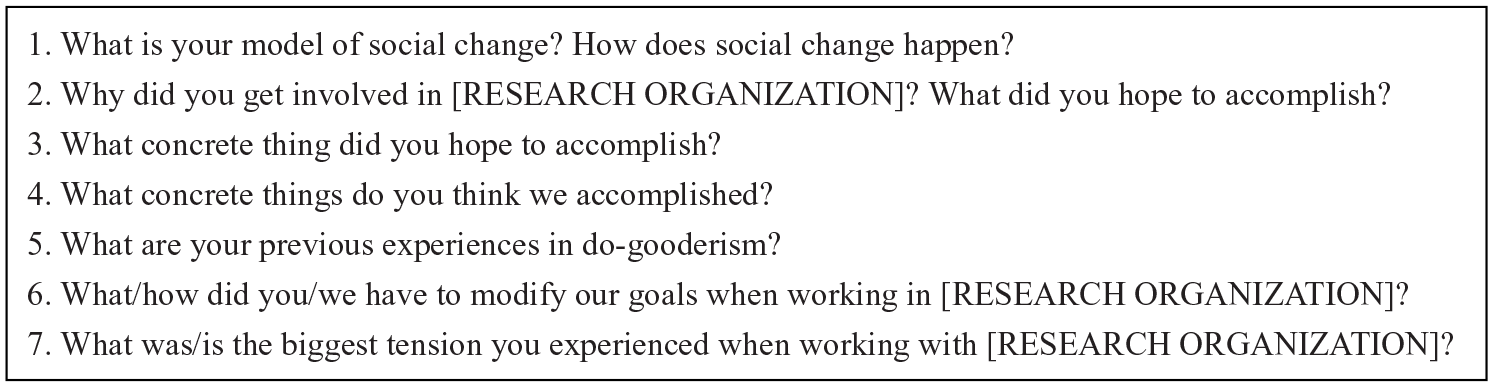
Open-ended reflection questions.
Each author then coded the other two authors’ answers for themes using an inductive coding scheme (Saldaña 2016). Based on these codes, we synthesized the reflections to highlight commonalities and distinctions among the three authors, which we discuss in the following section with illustrative quotations.
Findings
Researcher Backgrounds
We first discussed our personal and theoretical conceptions of social change to understand the individual context from which we were approaching the PEPiN project. Conceptually, all of us have a broad understanding of social change rooted in political economy. We all felt that social change is conditioned by the distribution of power and other resources among groups. Jeff wrote, Dominant groups retard or advance social change in light of what those groups think of is in their best interest, given the lack of perfect information.
Although we acknowledged that we could use data to raise awareness about a social problem, awareness does not always contribute to social change. We all believed that mobilizing coalitions of people and/or extra-parliamentary action is central to social change.
Our positions were informed by our previous experiences in volunteering and activism. We all had experience in progressive politics as volunteers, activists, and researchers. At some point, we acknowledged how this affected our outlook on social change and the effectiveness of various strategies. Jeff wrote, [A former employer]’s crew were an object lesson in how universities can support activist causes, either by providing them research expertise or channeling graduates into the non-profits championing those causes.
This demonstrates that positive experiences in activism shaped the author’s experience in particular ways. Negative experiences also inform researcher inclinations, as Grace reflected: I volunteered with [a branch of a political party] for several years on election campaigns . . . I didn’t continue to do this work because I ultimately felt disillusioned.
Researcher Motivations, Goals, and Accomplishments
We also probed our motivations for participating in an applied sociology project. All three of us had personal and professional reasons for becoming involved, broadly consistent with Uzzi (1996). We often identified a personal desire to make direct social changes which academic work often does not result in. For example, Jonah wrote, One of the motivations was to feel like I was giving something to the broader community. My interest in this was driven by the idea that I have internalized to some degree that we are “ivory tower” types who work on their research with very little awareness or interest in the outside world.
The other authors shared similar internal motivations. Likewise, all three of us had professional reasons for our involvement in PEPiN, ranging from allowing us to participate in our university’s mission of public outreach in Niagara to deepening our research skills.
Networks also brought us into PEPiN. While Jonah and Jeff were invited by other academic colleagues who vouched for the credentials and dedication of the NGO members, other colleagues and Jonah vouched for Grace ‘s interest and familiarity with the topic. Of relevance to the importance of networks, Grace states, . . . I got involved as a graduate student for practical reasons in order to get research experience—to a certain extent, my work is limited to that which is available to me.
In Grace’s case, implicit in her response of “my work is limited to that which is available to me” is the role of referral networks and her own network embeddedness.
We then identified, retrospectively, what concrete things we had hoped to accomplish. Much like our answers to the previous question, we had a mix of concrete professional and personal hopes and goals. Jeff noted, . . . I wanted to be able to show that I did something tangible with my time. In a crassly careerist way, I wanted to be able to add a line to my CV indicating with justification that I did meaningful community engagement or community service.
When asked what he hoped to accomplish in PEPiN, Jonah likewise expressed, . . . I was hoping that the research could provide specific data that could be used to promote some type of progressive reform. I thought that perhaps a sympathetic local politician could use the research to make the point that serious reform to the labor market is required.
In response to this same question, Grace replied, The first [goal] was more practical; I wanted research experience to put on my CV for grad school applications as well as experience working in a group research setting. Secondly, although I don’t personally believe individual policy changes are sufficient for making broader social change, I had hoped that the final results of the project could be used to inform policy changes that could at the very least reduce harm.
In these responses, we reveal our aspirations for opportunities to not just make a change but to learn while doing so.
Perhaps the best example of our hopeful skepticism was imagining that our study could provide a baseline for what we viewed as a natural experiment. Premier Kathleen Wynne’s Bill 148, the Fair Workplaces, Better Jobs Act passed in November 2017 to, in part, reduce precarious employment. We had imagined completing another round of the survey to gauge the effectiveness of Wynne’s labor market reforms. However, when Doug Ford’s Progressive Conservative Party was elected in June 2018, the labor reforms were rolled back via Bill 47: The Making Ontario Open for Business Act, which was passed in November 2018.
When we consider what we accomplished: news media made mention of our findings on precarity (LeFleche 2018) and we held presentations and met with provincial politicians, so we sustained some public discourse about precarious employment in Niagara. We also produced a study broadly comparable with others carried out in Ontario. That said, we learned that despite the report and our attempt to influence public discourse, it ultimately had limited ability to make an impact given provincial legislative changes following an election. Grace says this best: I’m not convinced the project contributed to any major change like would have ideally happened. In part, I think this is because election cycles in Canada occur so rapidly that it tends to conflict with any ability to make real, lasting changes.
Organizational Tensions
We modified our personal goals while working in PEPiN. At times, external political processes interfered with members’ desire to study certain aspects of the labor market. For example, Jeff writes, At that point [after the election], I felt like the utility of our project was greatly reduced, as we now essentially had just produced another report that told us what we already suspected . . .
We had expected an opportunity to study how legislative change affected the precarious labor market in Canada, but later circumstances made that impossible.
Other modifications were related to recognizing that regardless of Wynne’s reforms, what the report advocated for was largely to ameliorate the effects of precarious employment without critiquing the larger system in which it takes place. We removed references to the ultimate, structural causes of precarious employment in the PEPiN report and instead focused on the more immediate, proximate causes. This in turn constrained our policy recommendations. Grace reflected, Final policy recommendations seemed to assume cooperation from business owners or politicians, despite research showing employers in Ontario can successfully violate employment standards.
She further notes that her agency was restricted as a research assistant who had limited input into how her tasks unfolded. Upon reflection, Jonah and Jeff’s agency was also restricted insomuch as we became part of a team dedicated to adopting a procedure developed by someone else. At the same time, that allowed us to produce findings that were translatable into a larger discourse about precarious employment in Ontario.
Often, we observed tensions within PEPiN between, on one hand, how extensive our structural critique of precarity should be and, on the other hand, crafting a message to attempt to secure buy-in by those employers and their representatives who benefit from precarious employment. In Niagara, this was a big ask, meaning we avoided making policy suggestions these groups might oppose. Jonah reflected, I think that one tension was between those that would want to mitigate the worst effects of precarious work and those that seek to create a labor market where precarious work doesn’t exist at all.
Although he acknowledges that these tensions do not only exist between academics and members of NGOs, he reflects that in this case these tensions were related to the organizational influence of business interests. This also meant that we had to modify our findings to avoid singling out specific provincial and federal political parties who implemented legislation enabling the growth of precarious employment.
Discussion
Overall, our reflections on the applied sociology process revealed that although we each came to the project with predetermined backgrounds, ideologies, and motivations, our individual goals did not necessarily manifest in the final project. We do not wish to suggest animosity among organization members. Rather, in the following section, we put these experiences in the context of organizational literature, particularly those on embeddedness and isomorphism, to demonstrate how PEPiN’s embeddedness in both the academic and nonprofit realms limited its research outcomes and proposed solutions. We begin by exploring the embedded constraints originating, as we perceive it, from first the nonprofit side and then the academic side, and conclude by speaking to this special issue’s topic regarding the demand for applied sociology in Canada.
Embedded Constraints—Nonprofit Side
Employees in social services agencies face the task of satisfying various constituents, often with diverging and even contradictory interests. The mission of the United Way is to “improve lives and build community by engaging individuals and mobilizing collective action” (United Way 2019). Looking deeper, the United Way tries to build a grand consensus of business, organized labor, and community agencies to address social issues. The United Way touts its strong links with the local labor movement by listing dozens of unions as their labor partners besides the hundreds of businesses that are associated with them (United Way 2019). They are a coalition-type organization. Of course, many of the businesses on the list of donors belong to associations which actively campaigned against a rise in the minimum wage (Jones 2017) and engaged these unions in contentious collective bargaining. Recognizing these tensions, the United Way has motivations to maintain a neutral position in labor-management relations.
The research grant that supported PEPiN was from the Trillium Foundation. The Foundation, which is an agency of the Ontario Government, funds hundreds of projects each year which seek to “build healthy and vibrant communities in Ontario.” The stated purpose of these grants is to support several laudable goals: “building inclusive and engaged communities,” “encouraging people to support a healthy and sustainable environment,” and, most relevant for us, “enhancing people’s economic well-being.” Organizations like the United Way often receive a series of grants from the Trillium Foundation on a single project; a “Seed Grant” is followed by a “Grow Grant.” We would suggest that the likelihood of receiving a subsequent grant would depend to some degree on whether the product—our report and outreach activities—of the initial grant matched with the general aims of the funding agency. As partners in this project, we were aware that success in this project would likewise influence the success of future grant applications by all parties. Not only did this drive us to be particularly attentive to how we deployed our academic freedom, but it also made us more amenable to following the lead of the NGO researchers when it came to policy formulations.
Embedded Constraints—Academic Side
Given that we entered PEPiN from academia, it was easier for us to perceive constraints placed on the organizational project by the NGO and other actors. However, our reflections provide some grounds for arguing the academic context constrained both our methodology and dissemination strategies.
PEPiN’s organizational embeddedness informed our methodology. We aimed to reproduce an already existing study designed by a team, including academic and nonprofit researchers. This gave us an opportunity to meet certain research goals, such as replication, which is lauded if not often practiced. However, using an already established set of questions meant our potential findings were limited to identifying issues which were already framed by previous researchers’ conceptions of work and precarity. This is not to suggest empirical faultiness in the methods, but only to point out that here our replication research was an example of what DiMaggio and Powell (1983) call normative isomorphism as we followed an established data collection and analysis procedure, which was already considered a sound procedure in our profession. Isomorphism had the effect of ultimately narrowing our perspective, making it more difficult to address the “critical analysis of current trends in the neoliberal economy” that many precarity scholars are concerned with (Arnold and Bongiovi 2013:299).
An example of how this embeddedness shaped our final product was the focus of the method and policy recommendations on largely promoting the SER. The SER is often held up as the solution for precarious employment, despite being a highly gendered and racialized employment relation predicated on an idealized traditional family in which the husband acts as breadwinner in the public and productive sphere and the wife is relegated to the household and reproductive sphere (cf. Acker 1990). In some ways, calling for an SER as a solution to precarious employment is a step backward, despite its apparent advantages.
The context of academic research also largely influenced our involvement in and implementation of the project. Although all authors felt some form of internal motivation for joining the project (e.g., a desire to improve working people’s lives) and all believed to some degree that the work might result in important policy change, external motivation in the form of career goals was also somewhat present. We mentioned hoping the project would bolster our curriculum vitae or provide new skills. These reflections demonstrate that even with internal motivation present, the potential pressure toward publication and academic skill building that exist for all academics employed in public universities (Brienza 2016; Luka et al. 2015) affected how we designed and used the research.
An example involves our pursuit of replication, and specifically, identifying our sampling frame as employed persons ages 25 to 64. This meant excluding workers over the age of 65 under the assumption they would be retired, despite Standing’s (2011) point that the youngest and oldest workers are most subject to precarious labor. Another practice we imported was the use of employed/unemployed as a binary, even though some persons who identify as unemployed still work in the informal sector; this practice simplifies rather complex labor market mechanisms. Thus, despite us individually wanting to help communities to the greatest extent possible, doing applied research in the academic context meant making methodological sacrifices like excluding older workers or adopting a binary understanding of employment.
Overall, the authors primarily perceived embedded constraints from the nonprofit agents in the organization. However, our reflections also reveal the constraints that applied sociology brought to the project which originated from our own embeddedness in a neoliberal academic environment as well as in the organizational networks which resulted in our joining PEPiN.
The Utility of Applied Sociology in Canada
These structured reflections suggest three observations about the state of applied sociology in Canada. The first claim, an affirmation of Hirsch (2012), is that conducting applied sociology involves being invited into an existing network of private, public, and nonprofit organizations. As reported in our “Findings” section, without our networks, we likely would not have been involved. We also benefited directly from Wayne Lewchuk’s work on Poverty and Employment Precarity in Southern Ontario, the project we replicated. His team shaped the discourse about precarious employment and how to measure it. In other words, applied sociology does not happen in a vacuum and is always embedded in a network.
Our second claim is that engaging in applied sociology can provide scholars a window into how activists mobilize policy-relevant knowledge. This might be read as an extension of Lehnerer and Perlstadt (2018) when they call for a more interventionist sociology. In our case, we gave presentations to a range of organizations and their representatives. However, there are limitations to this approach. Political outreach includes reaching out to and meeting with not only elected officials likely to champion legislation but also those likely to block it. Thus, we can bring attention to issues of our choosing but not guarantee any particular outcome, highlighting our embedded agency (Kluttz and Fligstein 2016).
Our final claim is that nonprofits engaged in activist work and fact-finding welcome applied researchers. Primarily, sociologists are sought after for their trained skills—for us, it was our general understanding of quantitative analysis, sampling design, and survey design. Furthermore, all three authors studied labor markets. Collectively, we possessed the skills needed to conduct research in Niagara. However, our reflections highlight the need to consider not only the skills that applied researchers might use but also how they apply these tools and for what purpose. Research that appears objective is informed by social contexts, which limit the potential utility of applied sociology. If applied sociologists desire to make social change, as Petersen et al. (2008) suggest, it is vital to examine the embedded assumptions informing research approaches, else risk reproducing the same structures we desire to change.
Conclusion
The empirical element of this paper is our own reflections on the tensions that existed between the academic and NGO elements in the project. Following the work of Saldaña (2016), we recognize that our reflections may be shaped by our memories, which are fluid and imperfect; nonetheless, we believe that they accurately capture some of the challenges of working together with a diverse group. One way to address the issue of recall would be to capture our reflections during the research process in a similar future project. An ongoing reflexive approach might mitigate some of the tensions and pitfalls that face multiresearcher applied sociology projects.
We entered PEPiN with the goal of using empirical social science to understand and address a pressing social problem. However, we learned that as a diverse research team, we had a shared understanding of the perils of precarious work but differing views on how to address them. In this paper, we turned the sociological lens on ourselves to show how organizational embeddedness shaped our participation in the project. As academics, we subscribe to the principle of academic freedom and to disciplinary practices. We are also typically members of the professional class and somewhat detached from the lives of precarious workers. Conversely, nonprofit researchers are closer to the action and may be more familiar with the details of the lives of precarious workers. However, they tend to be embedded in networks that make them vulnerable to changes in organizational priorities or the government in power.
Footnotes
Acknowledgements
We would like to thank Dr. June Corman, Dr. Rachel Hirsch, and Natalie Chaumont for inviting us into this project. We would also like to thank our peer reviewers for thoughtful feedback.
Declaration of Conflicting Interests
The author(s) declared no potential conflicts of interest with respect to the research, authorship, and/or publication of this article.
Funding
The author(s) disclosed receipt of the following financial support for research, authorship, and/or publication of this article: The research project enabling our reflections was funded by Trillium Grant #SD97245.
