



Abstract
Background
Clerodendrum infortunatum L., a member of the Lamiaceae family, is an important ethnopharmacologically relevant plant that is widely used in the traditional management of infectious, inflammatory, metabolic, and parasitic diseases in South and Southeast Asia. Although this plant is widely used in traditional medicine, scientific evidence is still in an unorganized state.
Objective
The purpose of this review is to present consolidated information on ethnomedicinal uses, phytoconstituents, and pharmacological properties of Clerodendrum infortunatum.
Methods
Appropriate keywords were used in the search for relevant literature from Google Scholar and PubMed databases regarding the phytochemical, ethnomedicinal, and pharmacological effects of Clerodendrum infortunatum.
Results
Ethnomedical research shows that stems, roots, leaves, and flowers can be used as treatments for fever, helminthiasis, wound healing, inflammation, respiratory issues, skin problems, and envenomation. In secondary metabolite studies, research found elements such as flavonoids, phenolic acids, clerodane diterpenoids, phenolic acids, steroids, saponins, fatty acids, and nitrogen compounds. Preclinical research, mostly in vitro and in vivo studies, reports evidence of a wide range of biological activities such as inflammation, anti-infection, anti-helminth, liver protection, anti-diabetic, pain relief, anti-epileptic, wound healing, and anticancer activities.
Conclusion
The available evidence is mainly preclinical and has little to no mechanistic explanation, varies in extraction procedures, lacks standardization in plant matter, and has underdeveloped toxicity and pharmacokinetic studies. There are no clinical trials in humans, and some parts of plants, especially the fruits and flowers, are still understudied. Clerodendrum infortunatum is an ethnopharmacologically relevant species with some hopeful preclinical data, but the rigorous phytochemical standardisation, mechanistic study, thorough clinical trial design are critical to prove the potential of this plant in evidence-based therapeutics.
Keywords
Introduction
Indigenous medicinal plants are essential to modern health care systems. The World Health Organization estimates about 80% of the world population, especially in low- and middle-income countries, depends on traditional herbal medicine to address their health care needs. 1 These plant-based medicines are offered to patients to address a range of common problems like infections, inflammation, metabolic syndromes, digestive issues, respiratory problems, and fever. 2 Traditional medicine is an integral part of community health practices in all regions of Asia and Africa. The continued reliance on indigenous medicinal resources can be attributed to multiple factors. 3 Herbal therapies are generally easy to obtain and inexpensive, particularly in rural and resource-poor areas where the modern healthcare system is underdeveloped. 4 They are integrated into the culture of the people and therefore, are more accepted, and trusted, by the community. 5 Traditional remedies usually take a holistic approach to therapy where multiple symptoms are addressed at once. 6 Additionally, medicinal plants are important sources of bioactive molecules which are, in fact, founding sources of modern medicinal drugs. 7 With increasing antimicrobial resistance and the growing burden of chronic diseases, ethnomedicinal practices are invaluable in the search for novel pharmacologically active compounds to add to or replace conventional medicine. 8 Clerodendrum infortunatum Linn. is a medicinal shrub in the family Lamiaceae and has a significant amount of ethnobotanical value in South and Southeast Asia because of its long history of use in traditional medicine. 9 This species is found in India, Bangladesh, Sri Lanka, and adjacent areas under a number of local names, such as Bhat, Ghentu, Bhania, Bhantaka, and Saraswaty leaf. 10 The leaves, roots, stems, and flowers of C. Infortunatum have multiple therapeutic properties. These include anti-inflammatory, analgesic, and, antimicrobial properties, and treatment of fever, digestion-related problems, inflammatory disease, skin problems, and snakebites. These properties have been documented among many different cultural and traditional uses of C. Infortunatum, particularly across the Khumis of the Chittagong Hill Tracts, the Rabha and Rajbanshi of North Bengal, and the Kuki and Rongmai Naga of Northeast India. C. Infortunatum is believed to have been used and empirically tested for healing and wound care. In Traditional medicine, C. Infortunatum is considered as a validated therapeutic plant, which gave it a lot of use among the people. 11 It is also believed that when compared with other synthetic medications, herbal medications are relatively less adverse and cause fewer severe side effects, especially when they are used in conventional dosages and forms. On the other hand, though synthetic medications are effective in providing quick and targeted relief, they also cause a number of severe side effects, and this is why herbal medications still remain popular with many.
There are several reasons C. Infortunatum received recent scientific focus. First, it has a wide geographical distribution. Second, there is documented use of C. Infortunatum among several different ethnic groups, 12 which suggests prevailing fragmentation of information. Lastly, for the first time there has been scientific attention directed to C. Infortunatum. Despite the recent documentation or study of C. Infortunatum, there is still a scientific focus on ethnobotany and phytochemistry. This shows there is a lack of consolidation of data in relation to C. Infortunatum and this data has to be used to explain the therapeutic use of C. Infortunatum, the scientific gaps in relation to C. Infortunatum, and the guidance for future pharmacological study of C. Infortunatum. 13 Therefore, the review aimed to present consolidated information on ethnomedicinal uses, phytoconstituents, and pharmacological properties of Clerodendrum infortunatum.
Geographical Distribution
Clerodendrum infortunatum, the hill glory bower, is a multipurpose medicinal and attractive plant. This species lives in tropical and warm temperate areas in East Asia, including India, Sri Lanka, Bangladesh, the Andaman Islands, Thailand, Malaysia, and Indonesia (Figure 1). It occupies thickets, village groves, and dense undergrowth, sometimes with bamboo.
14
It grows as a weed on roadsides, in fallow fields, surrounding industrial installations, developing residential areas, and along railway tracks. Narayanganj, Munshiganj, Cumilla, Chittagong, Bandarba, Rajshahi have it. Clerodendrum infortunatum grows from sea level to 500 meters. This plant grows well in full sun and mild shade in cultivation.
15
It grows well in damp, well-drained, humus-rich soils. Since the blooms are attractive but smell bad, pruning during dormancy is advised to induce blossoming.
8
Clerodendrum infortunatum’s medicinal and aesthetic properties support local ecosystems and cultural practices across its range.
16
Geographical availability of Clerodendrum infortunatum L. The green region in the map shows the area of Clerodendrum infortunatum L. (https://powo.science.kew.org/taxon/urn:lsid:ipni.org:names:862159-1)
Morphological Description
Clerodendrum infortunatum is a distinctive perennial shrub widely recognized for its striking morphology and dense thicket-forming habit. It typically attains a height ranging from 0.5 to 4 meters and possesses an erect, hollow, grayish stem marked with lenticels and swollen nodes that often generate gregarious growth. The stem is either unbranched or supported by slender, obtusely quadrangular branchlets that contribute to the plant’s bushy architecture. 17 The bark appears gray and corky, while the branches and petioles are densely pubescent. Its leaves are simple, opposite, and variable in shape which are broadly cordate, orbicular, elliptic, or ovate with dimensions extending from 6 to 28 cm in length and 3.5 to 25 cm in width. 18 Leaf bases may be truncate, rounded, or cordate, and the margins range from entire to dentate or subentire. The upper surface is typically dark green and tomentose, whereas the lower surface is paler and villous or pubescent, supported by 6–9 prominent lateral veins on either side of the midrib. 19 The petiole is long, slender, cylindrical, exstipulate, and thickly pubescent, measuring approximately 3–15 cm.
The reproductive structures of C. infortunatum are equally characteristic. Inflorescences occur as large terminal panicles composed of 6–14 cymes borne on obtusely quadrangular, pubescent peduncles about 5 cm in length. Each inflorescence includes elliptic foliaceous bracts and deciduous bractlets. The flowers are bisexual, zygomorphic, lightly fragrant, and tubular, borne on thin pedicels 1–2 cm long. 20 The calyx is deeply five-lobed, pubescent, and lanceolate, expanding markedly during fruiting. The corolla is hypocrateriform with five lobes where is one slightly larger upper lobe opposite four other lobes and displays white petals with a pinkish or purplish throat. The corolla tube is narrow, cylindrical, hairy, and typically 1.5–3 cm long depending on developmental stage. The androecium consists of four didynamous to subequal stamens with filiform, creamish-white filaments and bilobed elliptic anthers. The gynoecium contains a rectangular to oblong, four-lobed, four-loculed ovary, a filiform style, and a slightly bifid stigma. 21 Following pollination, the plant produces drupaceous fruits approximately 1–1.5 cm in diameter, which transition from metallic blue to purplish-black upon ripening and remain enclosed within an accrescent, shallow cupular pinkish calyx. The species flowers mainly from April to August but may continue year-round under favorable conditions, contributing to both its ecological prominence and traditional ethnomedicinal value. 22
Ethnomedicinal Uses
Clerodendrum infortunatum, a widely distributed medicinal shrub across the tropical and subtropical regions of Asia and beyond, holds a long-standing position in traditional healing systems owing to its diverse therapeutic properties. 23 Known by several vernacular names that is called Bhargi, Bharangi, Bhania, and Ghentu and also the plant is valued in Ayurveda, Unani, and indigenous folk medicine for treating a wide spectrum of human and veterinary ailments. 24 In traditions such as Ayurveda and Unani, therapeutic preparations are obtained through the use of decoction, maceration, infusion, or solvent extraction of leaves, roots, stems, flowers, or seeds. 25 Across India, Bangladesh, and several tribal communities of the Indo-Malaysian region, leaf paste, juice, decoctions, and warm poultices prepared from the plant are frequently used for wound healing, inflammation, skin eruptions, boils, sprains, tumors, venereal complications, and post-natal care. 26 Leaf juice is traditionally introduced rectally to expel ascarids, while fresh preparations are applied externally to treat scorpion stings, snakebite, and painful swellings. In Assam, roots are specifically valued for bronchitis and asthma, whereas in Kerala and Arunachal Pradesh, leaf preparations serve as wound remedies, headache relievers, ingredients of medicated postpartum baths, and even components of ethnic salads. Communities in Bangladesh rely on the plant for helminthiasis, fever, fracture management, joint displacement, and diabetic symptoms. Reports also highlight its use as a mosquito repellent when dry leaves are burned with cow dung. 27 The plant’s therapeutic value is attributed to its rich phytochemical constituents, including diterpenoids like clerodin, triterpenes, flavonoids, sterols such as clerosterol, and various sugars. 28 These compounds align with its documented antimicrobial, antifungal, antimalarial, anthelmintic, analgesic, and hepatoprotective activities. 29 Phytochemical-based traditions must be clearly distinguished from Homeopathy. Ayurveda and Unani are based on plant extracts that have measurable active principles, whereas homeopathic remedies are prepared by repeated dilution and shaking - a process that goes beyond the point of having any measurable phytoconstituents. Thus, the traditional medicine practices the review refers to are extract-based, as opposed to ultra-diluted homeopathic remedies, and the mentioned pharmacological activities are based on experimental assays conducted in-vitro or in-vivo. Although widely practiced in traditional medicine, modern pharmacognostic evidence has only recently begun validating these uses, reinforcing the plant’s significance and the need for comprehensive phytochemical standardization to support its expanding ethnopharmacological relevance.30,31
Phytochemicals
Extensive phytochemical investigations on Clerodendrum infortunatum have established the plant as a rich reservoir of structurally diverse secondary metabolites that underpin its long-standing ethnomedicinal applications.32-35 Early chemical studies identified major groups such as triterpenes, flavonoids, saponins, steroids, alkaloids, glycosides, benzoic acid derivatives, lupeol, β-sitosterol, clerodolone, clerodone, cholesterol and various proteins (Figure 2).
36
A comprehensive review of the genus by Wang and colleagues documented more than 280 phytochemicals that is including diterpenoids, flavonoids and their glycosides, phenylethanoid glycosides, steroids and triterpenoids which is reflecting the metabolic complexity characteristic of Clerodendrum species.
37
Chemical structures of plant metabolites (1–93) of Clerodendrum infortunatum. (Source of chemical structure: https://pubchem.ncbi.nlm.nih.gov/)
Flavonoids
Plant Metabolites Reported From Various Parts of C. Infortunatum

Phenolics
Phenolic compounds represent a chemically diverse and functionally significant group in C. infortunatum, distributed throughout aerial and underground plant parts. Identified phenolics include simple phenols (catechol, guaiacol, phenolic acids (Gallic acid, hydrocinnamic acid, acetoside, fumaric acid, vanillic acid), and substituted phenylpropanoids such as 2-methoxy-4-vinylphenol and 4-((1E)-3-hydroxy-1-propenyl)-2-methoxyphenol (Table 1). Both free phenolics and esterified forms of caffeic acid have been reported, particularly in leaves and flowers.44,45,54 The presence of hydrolysable tannins and tannin-rich extracts further underscores the polyphenolic abundance of the plant. These compounds are known to modulate oxidative stress, inflammation, and cellular signaling pathways, thereby supporting the protective and therapeutic claims associated with C. infortunatum. Their widespread distribution across tissues indicates a central role in plant defense and pharmacological activity. 23
Terpenoids
Terpenoids form a dominant bioactive class in C. infortunatum, with representatives spanning mono-, di-, and triterpenoid subclasses. Leaves and flowers are particularly rich in clerodane diterpenoids such as clerodin, clerodinin A, 15-methoxy-14,15-dihydroclerodin, and 15-hydroxy-14,15-dihydroclerodin, compounds historically associated with bitterness and insecticidal activity. Roots and aerial parts contain triterpenoids including oleanolic acid, botulin, betulinic acid, lupeol, clerodolone, and clerodone, many of which possess documented anticancer and anti-inflammatory properties. Additionally, volatile terpenes such as R-limonene, squalene, trans-β-ocimene, β-cubebene, and phytol have been detected by GC-MS analysis46,49 (Table 1). The structural diversity and broad tissue distribution of terpenoids highlight their importance as multitarget bioactive agents contributing to the plant’s therapeutic versatility. 23
Sterols
Phytosterols and related steroidal compounds are consistently reported from multiple parts of C. infortunatum, particularly roots, leaves, flowers, seeds, and the whole plant. Identified sterols include β-sitosterol, poriferasterol, clerosterol (5,25-sigmastadien-3β-ol), stigmasterol, and ergosta-5,22-dien-3-ol acetate, along with structurally modified sterol derivatives such as (22E,24S)-stigmasta-5,22,25-trien-3β-ol41,44 (Table 1). Steroidal glycosides have also been isolated from root extracts.45,54 The abundance of phytosterols suggests roles in membrane stabilization, modulation of lipid metabolism, and regulation of inflammatory and proliferative pathways. 46 These properties, combined with their frequent co-occurrence with triterpenoids, reinforce the relevance of sterols in the pharmacological profile of C. infortunatum. 23
Fatty Acids (Fixed Oils)
Fixed oils constitute an important chemical fraction of C. infortunatum, particularly in leaves, flowers, roots, seeds, and stems. The lipid profile is dominated by glycerides and free forms of saturated and unsaturated fatty acids, including linoleic acid, oleic, stearic, lignoceric, palmitic, vaccenic, and eicosatrienoic acids, (Table 1) along with several methyl-esterified and acetylenic derivatives.45,54 These fatty acids were repeatedly identified through solvent extraction and GC-MS analyses. The prevalence of polyunsaturated fatty acids suggests potential roles in membrane fluidity, inflammatory modulation, and oxidative balance. 46 Beyond nutritional significance, such lipid constituents may synergize with polyphenols and terpenoids to enhance biological activity and extract potency. 23
Amino Acids and Nitrogenous Compounds
Amino acids and nitrogen-containing metabolites, though quantitatively less abundant than polyphenols or terpenoids, represent a chemically diverse group in C. infortunatum. Compounds such as 4-amino-1,5-pentanedioic acid (glutamic acid derivative), octadecenamide, glucosamine derivatives, purine nucleoside analogs, and various amides have been identified from leaves, roots, and stems.45,54 In addition, sulfur-containing metabolites such as desulphosinigrin, pantetheine derivatives, and dithiocarbamate related compounds have been reported (Table 1). These constituents may contribute to metabolic regulation, redox balance, and defense mechanisms, complementing the activity of major secondary metabolites.46,49 Their detection across multiple plant parts further reflects the biochemical complexity underlying the medicinal potential of C. infortunatum. 23
Pharmacological Activity
A number of studies have revealed a wide range of pharmacological activities displayed by various parts of C. infortunatum. Biological activities (in vitro and in vivo) such as antimicrobial, anthelmintic, insecticidal, analgesic, antipyretic, insecticidal, hepatoprotective, wound healing, thrombolytic, antidiabetic, cytotoxic and anti-inflammatory activity have been displayed by C. infortunatum. A brief detail on the biological activities displayed by the plant is discussed below (Figure 3). Phytochemicals, Ethnopharmaceutical significance & pharmacological activity of Clerodendrum infortunatum
55

Antioxidant Activity
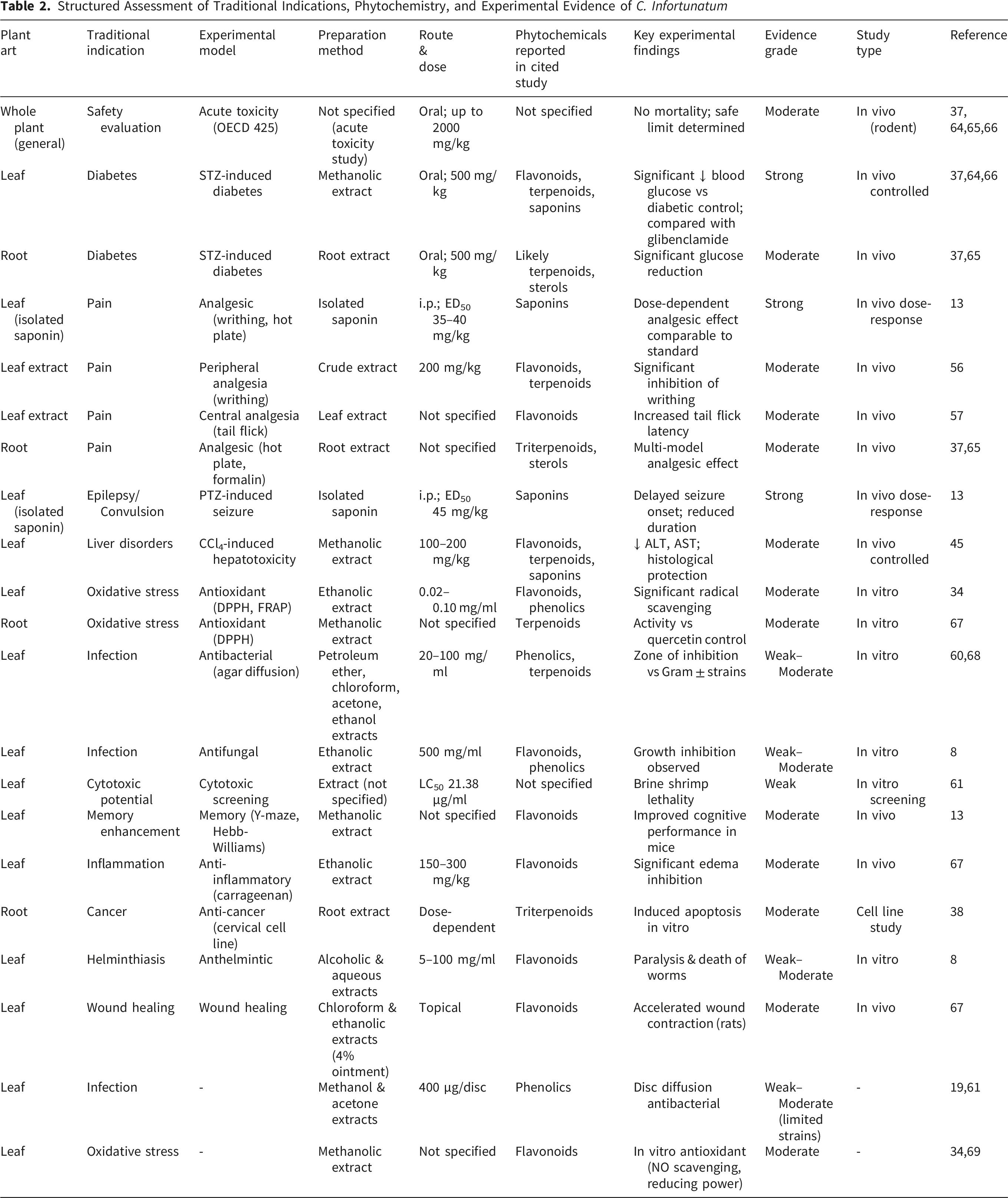
Structured Assessment of Traditional Indications, Phytochemistry, and Experimental Evidence of C. Infortunatum
Anticancer Activity
The long-standing use of Clerodendrum infortunatum in traditional medicine, together with its rich and chemically diverse phytochemical profile, has positioned this plant as a promising candidate in contemporary anticancer research. Ethnomedicinal claims surrounding its use for the management and prevention of tumors have stimulated systematic investigations into the anticancer potential of its leaves, roots, stems, flowers, and seeds.
70
Numerous experimental studies employing different solvent extracts have demonstrated notable cytotoxic and antiproliferative effects, thereby lending scientific credence to traditional knowledge. In particular, the presence of bioactive triterpenoids such as betulin and betulinic acid, along with other phenolic and glycosidic constituents, has been strongly associated with the anticancer efficacy of C. infortunatum. Traditional healers have long advocated the use of root decoctions as preventive remedies against various cancers, and historical accounts report that aqueous root extracts were patented and applied clinically by renowned practitioners. These observations underscore the therapeutic relevance of the plant, although mechanistic validation and standardization remain essential
71
(Figure 4). Anticancer effect of bioactive compounds from Clerodendrum infortunatum
Cancer progression is a multistep and multifactorial process characterized by the acquisition of specific biological capabilities, often referred to as the hallmarks of cancer. These include sustained proliferative signaling, resistance to growth suppressors, evasion of apoptosis, limitless replicative potential, induction of angiogenesis, tissue invasion and metastasis, immune evasion, genomic instability, and metabolic reprogramming. Understanding how natural products interfere with these hallmarks is central to anticancer drug discovery. Phytochemicals derived from C. infortunatum are increasingly being evaluated through this conceptual framework, as many natural compounds exert multitargeted actions rather than single-pathway inhibition. 72 Extracts of Clerodendrum obtained using polar and non-polar solvents have been subjected to extensive scrutiny for their ability to modulate these oncogenic traits, highlighting the plant’s potential as a source of lead molecules for anticancer therapy. One of the critical mechanisms through which C. infortunatum–derived compounds exert anticancer effects is the inhibition of aberrant growth signaling and immune evasion. Many tumor cells exhibit constitutive activation of nuclear factor kappa B (NF-κB), a transcription factor complex that regulates genes involved in cell proliferation, survival, inflammation, angiogenesis, and metastasis. Persistent NF-κB signaling contributes to tumor maintenance and resistance to apoptosis. Betulinic acid, a prominent triterpenoid identified in C. infortunatum, has been shown to suppress NF-κB activation, particularly by inhibiting tumor necrosis factor (TNF)–induced signaling cascades. By attenuating NF-κB–mediated transcription, betulinic acid disrupts the expression of anti-apoptotic and pro-survival genes, thereby sensitizing cancer cells to programmed cell death and immune-mediated clearance. Regulation of tumor invasion and metastasis represents another crucial dimension of the anticancer activity of C. infortunatum. Metastasis is initiated by epithelial–mesenchymal transition (EMT), a process during which epithelial cells lose polarity and adhesion properties while acquiring migratory and invasive characteristics. Betulinic acid has been reported to interfere with EMT by modulating the expression of key adhesion molecules. Experimental studies have demonstrated downregulation of N-cadherin accompanied by upregulation of E-cadherin in carcinoma cells treated with betulinic acid, effectively reversing the mesenchymal phenotype. Such modulation restricts cell motility, invasion, and metastatic dissemination, indicating that C. infortunatum constituents may act not only as cytotoxic agents but also as suppressors of cancer progression. 73
The induction of apoptosis is a central mechanism underlying the cytotoxic action of many plant-derived anticancer agents, and C. infortunatum is no exception. Apoptosis is an evolutionarily conserved process essential for tissue homeostasis, and its dysregulation is a hallmark of cancer. Multiple studies have demonstrated that extracts from the leaves and roots of C. infortunatum induce apoptosis in diverse cancer cell lines and animal models. Betulin and betulinic acid have been extensively characterized as potent inducers of apoptosis, primarily through activation of the intrinsic (mitochondrial) pathway. 74 Treatment with these compounds results in classical apoptotic features, including cell shrinkage, membrane blebbing, chromatin condensation, nuclear fragmentation, and apoptotic body formation. Mechanistically, betulin-induced apoptosis involves mitochondrial outer membrane permeabilization, translocation of pro-apoptotic proteins such as Bax and Bak, release of cytochrome c and Smac/DIABLO, and subsequent activation of caspase-9 followed by executioner caspases-3 and -7. This cascade culminates in cleavage of poly(ADP-ribose) polymerase (PARP), a biochemical hallmark of apoptosis. Notably, caspase-8, which mediates the extrinsic death receptor pathway, remains largely inactive, underscoring the specificity of mitochondrial pathway engagement. Importantly, betulinic acid–mediated apoptosis has been reported to occur independently of CD95 (Cluster of Differentiation 95) signaling and TP53 (Tumor Protein p53) mutation status, suggesting efficacy even in tumors harboring defective p53 pathways, such as cervical and breast cancers. 75
Experimental validation of the anticancer potential of C. infortunatum has been achieved through a wide array of in vitro and in vivo assays. Cytotoxicity has been demonstrated using MTT, SRB, brine shrimp lethality assays, and colony formation inhibition studies. Leaf, root, stem, and bark extracts exhibit concentration-dependent cytotoxic effects, with root extracts often displaying the highest potency. Aqueous and organic solvent fractions have shown pronounced activity against cancer cell lines including cervical (SiHa, C-33A), breast (MCF-7, MDA-MB-231, T47D), lung (A549), colon (HCT-116), leukemia (K-562), melanoma (A375), and hepatocellular carcinoma (HepG2). Among various solvent systems, ethyl acetate fractions frequently demonstrate superior cytotoxicity, indicating enrichment of active constituents. In vivo studies further corroborate these findings. Methanolic and ethanolic extracts have significantly reduced tumor volume and prolonged survival in Ehrlich’s ascites carcinoma–bearing Swiss albino mice. Improvements in hematological parameters, restoration of antioxidant enzyme activity, and suppression of lipid peroxidation suggest that the anticancer effects are mediated not only by direct cytotoxicity but also by modulation of oxidative stress and host defense mechanisms. Acute toxicity studies conducted according to OECD (Organisation for Economic Co-operation and Development) guidelines indicate that C. infortunatum extracts are relatively safe up to high doses, supporting their therapeutic feasibility. 76 At the molecular level, specific compounds such as oleanolic acid, clerodinin A, tannins, and glycoproteins have been implicated in anticancer activity. Glycoproteins isolated from root extracts exhibit pro-apoptotic, antiproliferative, and anti-migratory effects against cervical cancer cells, highlighting the contribution of macromolecular constituents alongside small-molecule phytochemicals. Collectively, these data demonstrate that Clerodendrum infortunatum exerts multifaceted anticancer effects by targeting key hallmarks of cancer, including uncontrolled proliferation, apoptosis resistance, metastasis, and oxidative imbalance. While existing evidence strongly supports its anticancer potential, further studies focusing on molecular targets, bioavailability, pharmacokinetics, and clinical validation are required to translate these findings into effective anticancer therapeutics.
Antibacterial Activity
The antimicrobial potential of Clerodendrum infortunatum has been extensively investigated using different plant parts, solvent systems, and bioassay techniques, demonstrating broad-spectrum antibacterial and antifungal properties. 77 Ethanolic extracts have consistently shown pronounced activity against clinically relevant bacterial strains, including Staphylococcus aureus, Bacillus subtilis, Proteus vulgaris, and Escherichia coli, with tetracycline commonly used as the reference standard. 60 At a concentration of 500 µg/mL, ethanolic extracts also exhibited significant antifungal efficacy against Aspergillus niger, Aspergillus flavus, and Candida albicans (Table 2). Comparative solvent extraction studies revealed that petroleum ether, chloroform, acetone, and ethanol fractions displayed varying degrees of antibacterial activity depending on the pathogen, whereas benzene extracts were largely inactive. 78 Ethanol and chloroform extracts were particularly effective against both Gram-positive and Gram-negative bacteria, including Pseudomonas aeruginosa, Klebsiella pneumoniae, Shigella spp., and Vibrio cholerae, as evidenced by agar well diffusion and disc diffusion assays. 79 Several studies reported higher susceptibility of Gram-positive bacteria compared to Gram-negative counterparts. Methanolic and acetone extracts demonstrated selective antibacterial effects, while antifungal activity was generally weak or absent at lower disc concentrations. 68 Additional investigations confirmed that leaf, root, and stem extracts, especially in chloroform and ethanol, produced significant zones of inhibition against Bacillus megaterium, Salmonella typhi, and Klebsiella pneumoniae. 80 Notably, isolated compounds such as viscosin from aerial parts further substantiated the antibacterial basis of the plant. Collectively, these findings validate the strong antimicrobial profile of C. infortunatum and support its traditional use as a therapeutic agent against infectious diseases. 81
Antifungal Activity
In addition to its well-documented antibacterial properties, Clerodendrum infortunatum has been extensively reported to exhibit significant antifungal activity. Several studies have demonstrated that different plant parts, including leaves, roots, and stems, are effective against a broad spectrum of human, plant pathogenic, and storage fungi. These findings highlight the ethnopharmacological relevance of C. infortunatum and support its traditional use in managing fungal infections. A consolidated overview of the antifungal potential of various plant parts has been previously documented, emphasizing its broad-spectrum efficacy. 56
Experimental investigations further substantiate these observations, showing that chloroform and ethanolic extracts prepared from the root, leaf, and stem of C. infortunatum Linn. Exhibit notable inhibitory activity against clinically important fungi such as Aspergillus niger and Candida albicans. 82 Comparative analyses reveal that leaf extracts consistently demonstrate higher antifungal potency than those derived from roots and stems, suggesting a higher concentration or greater diversity of bioactive antifungal constituents in the leaves. These results indicate that the leaf of C. infortunatum may serve as a promising source of antifungal compounds for further phytochemical and pharmacological exploration. 83
Analgesic Activity
The analgesic potential of Clerodendrum infortunatum has been extensively investigated using both peripheral and central nociceptive models in experimental animals. Saponin fractions isolated from the leaves demonstrated significant protection against acetic acid–induced writhing in adult Swiss albino mice following intraperitoneal administration, indicating pronounced peripheral analgesic activity. 84 The effect was dose dependent, with effective doses ranging from approximately 30 to 100 mg/kg, and an ED50 value around 40 mg/kg i.p., along with a favorable therapeutic index (Table 2). Standard analgesics such as acetylsalicylic acid, paracetamol, and morphine sulphate were employed as reference drugs. 85 In addition, evaluation using the hot plate method revealed that the isolated saponin significantly prolonged reaction time, suggesting central analgesic action. 78 Notably, the saponin not only produced analgesia on its own but also potentiated the effects of standard analgesics, including pentazocine and aspirin. Further studies reported differential analgesic responses depending on the experimental model and plant part used, with leaf extracts exhibiting marked central analgesic activity in tail flick assays, while root extracts showed broad-spectrum analgesic effects across hot plate, tail immersion, acetic acid–induced writhing, and formalin tests. 79 Collectively, these findings substantiate the dual peripheral and central analgesic properties of C. infortunatum, supporting its traditional use in pain management and highlighting saponins as key bioactive constituents. 68
Anthelmintic Activity
Anthelmintic activity of Clerodendrum infortunatum has been extensively evaluated using different solvent extracts against the earthworm Pheretima posthuma, a widely accepted in vitro model for helminth screening. Alcoholic, methanolic, benzene, and aqueous extracts prepared from the leaves were tested at graded concentrations, and activity was assessed by measuring the time to paralysis and time to death of the worms. 86 Across multiple studies, all extracts demonstrated dose-dependent anthelmintic effects, with higher concentrations producing significantly faster paralysis and mortality. Among the tested solvents, alcoholic, methanolic, benzene, and ethanol extracts consistently exhibited stronger anthelmintic potency compared to aqueous extracts. 81 In several cases, alcoholic and ethanol extracts induced paralysis and death of P. posthuma more rapidly than the standard anthelmintic drug piperazine citrate, particularly at higher concentrations. Aqueous extracts also showed comparable but relatively weaker activity. In addition to leaves, methanolic and aqueous root extracts were reported to possess notable anthelmintic effects, with methanolic root extracts showing superior efficacy. Collectively, these findings substantiate the traditional use of C. infortunatum as an anthelmintic agent and indicate that its activity is strongly influenced by the nature of the extracting solvent and extract concentration. 87
Hepatoprotective Activity
The hepatoprotective potential of Clerodendrum infortunatum has been extensively evaluated in experimental models of chemically induced liver injury, particularly carbon tetrachloride (CCl4)-mediated hepatotoxicity in rats. 3 Methanolic extracts of the leaves demonstrated significant protective effects, as evidenced by the normalization of elevated serum biochemical markers, including alanine aminotransferase (ALT/SGPT), aspartate aminotransferase (AST/SGOT), alkaline phosphatase (ALP), total bilirubin, and total protein levels. Oxidative stress parameters were also markedly improved, with reductions in malondialdehyde (MDA) levels and restoration of endogenous antioxidant defenses such as reduced glutathione (GSH), catalase (CAT), and superoxide dismutase (SOD). Histopathological examination of liver tissues consistently supported these biochemical findings, revealing preservation of hepatic architecture, 42 reduced fatty degeneration, and attenuation of hepatocellular necrosis following extract administration, comparable to the standard hepatoprotective agent silymarin. Dose-dependent studies (100 and 200 mg/kg body weight) further confirmed the moderate yet significant hepatoprotective efficacy of the extract (Table 2). Additionally, the extract exhibited ameliorative effects against arsenic-induced hepatotoxicity, indicated by decreased ALT, AST, and MDA levels alongside increased liver weight and antioxidant enzyme activity. Collectively, these findings suggest that the hepatoprotective activity of C. infortunatum is closely associated with its antioxidant properties, likely attributable to the presence of bioactive phytoconstituents such as flavonoids, terpenoids, and saponins, which contribute to membrane stabilization and mitigation of oxidative liver damage. 82
Antidiabetic Activity (Antihyperglycemic Activity)
Clerodendrum infortunatum has demonstrated pronounced antidiabetic (antihyperglycemic) activity in several experimental studies employing streptozotocin (STZ)-induced diabetic rat models. Methanolic extracts of different plant parts significantly reduced fasting blood glucose levels when administered in a dose- and time-dependent manner, with measurements recorded on days 0, 5, 10, and 15 of treatment using standard glucometric methods. In STZ-induced hyperglycemic Wistar albino rats, extract treatment not only produced a marked decline in blood glucose levels but also prevented diabetes-associated loss of body weight, indicating improved metabolic status.57,64 Root and leaf extracts have been reported to exert comparable antihyperglycemic effects, with methanolic root extract lowering elevated glucose levels and promoting weight gain in diabetic animals. Enzyme-based studies further revealed that ethanol and chloroform leaf extracts inhibit key carbohydrate-digesting enzymes, namely α-amylase and α-glucosidase, suggesting a mechanistic basis for postprandial glucose control. Additional investigations confirmed that methanolic leaf extracts significantly attenuated hyperglycemia at doses up to 400–500 mg/kg body weight (Table 2), with efficacy comparable to the standard antidiabetic drug glibenclamide.65,88 Beyond glycemic regulation, extract administration improved oxidative stress markers by reducing lipid peroxidation and restoring antioxidant defenses such as glutathione and catalase activity. 83 Notably, protective effects against diabetes-induced testicular damage were also observed, including improvements in sperm motility, viability, and count. Collectively, these findings provide strong preclinical evidence that Clerodendrum infortunatum possesses potent antihyperglycemic activity, mediated through glycemic control, enzyme inhibition, antioxidant protection, and restoration of diabetes-altered physiological parameters. 84
Nootropic (Memory Enhancing) Activity
The nootropic (memory-enhancing) potential of the methanolic leaf extract was evaluated in experimental mice using established interoceptive behavioral paradigms, including the rectangular maze, Y-maze, and Hebb–Williams maze models. The extract was administered orally at two dose levels (100 and 200 mg/kg body weight) to adult albino Wistar mice. Behavioral assessments demonstrated a dose-dependent improvement in learning and memory performance, with the higher dose (200 mg/kg) producing a marked reduction in transfer latency and enhanced spatial memory retention 80 (Table 2). Notably, the cognitive-enhancing effect observed at this dose was comparable to that of the standard nootropic drug, Brahmi. These findings indicate that the methanolic leaf extract possesses significant memory-enhancing activity and supports its potential application as a natural nootropic agent.
Anti-Inflammatory Activity
The anti-inflammatory potential of Clerodendrum infortunatum Linn. Has been extensively investigated using both in vivo and in vitro experimental models. Methanolic leaf extract demonstrated significant inhibition of carrageenan-induced acute inflammation in Wistar rats, with efficacy assessed against phlogistic mediators such as histamine and dextran, and showed comparable activity to the standard drug phenylbutazone. Concentration-dependent anti-inflammatory effects of whole plant extract were further confirmed using the carrageenan-induced paw edema model in rats, where extract administration resulted in a statistically significant reduction in paw volume. 57 Ethanolic root extract exhibited marked anti-inflammatory activity in mice at doses of 200 and 400 mg/kg, producing a significant decrease in edema relative to standard treatment. Similarly, ethanolic leaf extract showed significant and dose-dependent inhibition of carrageenan-induced paw edema in Wistar rats, while aqueous acetone extract of root bark displayed pronounced anti-inflammatory effects, with activity correlating positively with phenolic content. In vitro evaluation of leaf extract revealed inhibitory effects on protein denaturation in the egg albumin assay, with an IC50 value of 127.7 ± 0.5 µg/ml, supporting its anti-inflammatory mechanism at the molecular level (Table 2). Additionally, ethanolic leaf extract at doses of 150 and 300 mg/kg produced significant suppression of carrageenan-induced paw edema in Wistar albino rats. 35 Collectively, these findings substantiate the strong anti-inflammatory potential of C. infortunatum, attributed to its bioactive phytoconstituents acting through multiple inflammatory pathways. 89
Anticonvulsant Activity
The anticonvulsant potential of Clerodendrum infortunatum has been substantiated through multiple experimental investigations, primarily focusing on saponin isolated from its leaves. In leptazol-induced seizure models in mice, intraperitoneal administration of the isolated saponin at doses ranging from 20 to 100 mg/kg produced a significant reduction in seizure duration, onset, and incidence in a clear dose-dependent manner. The saponin-rich jelly-like fraction derived from fresh leaves similarly demonstrated marked protective effects against leptazol-induced convulsions, further confirming its anticonvulsant efficacy. Pal et al reported that leaf-derived saponin not only decreased seizure duration but also conferred substantial protection against leptazol-evoked convulsions, 82 while complementary studies by Das et al revealed significant anticonvulsant activity of the leaf extract in both pentylenetetrazole- and strychnine-induced seizure models, including delayed seizure onset, antagonism of convulsions, and prolongation of pentobarbitone-induced sleeping time in a dose-dependent fashion. 35 Pharmacological evaluation of leptazol-induced seizures further established that isolated saponin significantly inhibited both the onset and incidence of convulsions, with an ED50 value (Median Effective Dose) of 45 mg/kg (95% CI: 30.2–65.0 mg/kg, i.p.) and a therapeutic index of 8.3 (Table 2). Collectively, these findings indicate that saponins from C. infortunatum leaves possess significant anticonvulsant activity and support their potential as bioactive agents for seizure management.64,65
Wound Healing Activities
The wound-healing potential of Clerodendrum infortunatum has been demonstrated through several experimental studies using rat models. Chloroform and ethanolic extracts of the plant were formulated into 4% (w/w) topical ointment bases and evaluated for wound repair efficacy (Table 2). Animals treated with chloroform and ethanol extracts exhibited significantly enhanced wound healing compared with the control group, with outcomes comparable to the standard drug nitrofurazone. These effects were characterized by accelerated wound contraction and improved epithelialization, indicating effective tissue regeneration. The observed activity is attributed to the presence of bioactive phytoconstituents, particularly flavonoids and polyphenols, which are known to facilitate wound repair through their antioxidant and antimicrobial properties. In addition, studies on root extracts further confirmed the wound-healing efficacy of C. infortunatum using excision, incision, and dead-space wound models. Topical application of root extract ointments resulted in significant improvements in epithelialization area, wound contraction, skin-breaking strength, and granulation tissue formation, collectively supporting the therapeutic potential of C. infortunatum in wound management.
Other Activities
Beyond its widely reported pharmacological properties, Clerodendrum infortunatum Linn. Exhibits a broad spectrum of additional biological activities that underscore its multifaceted bioactivity. Clerodane diterpenoids isolated from the plant, notably clerodin, 15-methoxy-14,15-dihydroclerodin, and 15-hydroxy-14,15-dihydroclerodin, have demonstrated pronounced antifeedant and insecticidal activities against polyphagous agricultural pests such as Helicoverpa armigera, with efficacy surpassing or comparable to established botanical pesticides. 12 In parallel, methanolic extracts of the plant have shown nootropic potential, significantly enhancing memory in experimental murine models at higher doses. Thrombolytic and membrane-stabilizing activities have been reported for leaf and root extracts and their solvent fractions, evidenced by dose-dependent clot lysis and inhibition of erythrocyte hemolysis under heat- and hypotonic-induced stress conditions, with ethyl acetate and carbon tetrachloride fractions exhibiting notable efficacy. Extensive investigations further validate the insecticidal and larvicidal potential of different plant parts against a range of vectors and pests, including beetles, sand flies, mosquitoes, and lepidopteran larvae, indicating both mortality effects and adverse impacts on insect reproduction. Additionally, alcoholic root extracts have shown promising antivenom activity against Naja naja venom in vivo, possibly through interference with acetylcholine binding sites. Conversely, diuretic evaluations revealed negligible effects on urinary output and electrolyte excretion, suggesting a lack of natriuretic or carbonic anhydrase inhibitory properties. Ecologically, leaf extracts exert allelopathic effects, influencing seed germination and seedling growth in both crops and weeds, 63 with differential stimulatory or inhibitory outcomes depending on plant species and extract type. Collectively, these findings highlight the ecological, agricultural, and supportive therapeutic relevance of C. infortunatum, extending its importance beyond conventional medicinal applications.
Future Research Direction
A comprehensive search of major scientific databases reveals that, to date, no in vitro or in vivo studies have been conducted on the fruit of Clerodendrum infortunatum. While a limited number of studies have explored the leaves and roots, research focusing on the flowers and fruits remains extremely scarce. Despite the plant’s well-documented traditional medicinal uses and reported therapeutic potential, it has not yet been systematically investigated as a possible cytotoxic agent. This highlights a substantial research gap and underscores the strong potential of Clerodendrum infortunatum as a promising candidate for future drug discovery and cytotoxicity-based pharmacological studies.
Limitations
Regardless of the review’s synthesis of ethnomedicinal, phytochemical, and pharmacological information, there are some important constraints to consider. To begin, the review is limited geographically, as it only uses information from the English language, which cannot only leave out potential information from certain areas but also non-indexed papers and unpublished information. Also, the small number of studies available decreases the potential scope of the review, and is a reason why the review used 14 out of the 44 articles it obtained. In addition, a majority of the articles focus on preclinical studies and studies done on animals. There are no studies done on humans that test the safety, efficacy, or therapeutic value of Clerodendrum infortunatum. As a result, there is a lack of evidence to support the preclinical studies. Finally, a lack of uniformity across the studies is one of the greatest challenges. The differences in the type of plant used, the location from which the plant was obtained, the season in which the plant was harvested, and the use of certain extraction, fractionation, and assay methods, as well as differences in the doses given to the subjects, made it impossible to directly compare the findings of the studies and made the findings less reproducible. The same methods were not consistently used when preparing and standardizing the dried plant materials and the extracts in the studies.
The first issue is a lack of thorough mechanistic characterization. Though there are numerous reports of some biological activities that including antioxidant, anticancer, antidiabetic, hepatoprotective, and anti-inflammatory effects that most studies are based on arbitrary bioassays and do not specify molecular targets, cellular signaling, receptors, or structure–activity relationships. Another issue is the limited or underdeveloped toxicity profiling, dose–response studies, pharmacokinetic and bioavailability studies. There are no comprehensive studies on long-term toxicity, organ-specific toxicity, safety, herb-drug interactions, nor standardized therapeutic ranges. The other issue is there is a lack of exploration of some biological activities, such as anti-urolithic properties and the pharmacological properties of fruits, and some plant parts, such as fruits and flowers, are under-experimented. Lastly, due to the heterogeneity of study designs and how outcomes were reported, methods such as meta-analysis were not possible. As a narrative review, this study is inherently affected by selection bias and limited the author’s ability to interpret outcomes. These issues indicate that, even though there is likely pharmacological and preclinical potential for Clerodendrum infortunatum, in order to substantiate therapeutic claims for this plant, thorough phytochemical standardization, mechanistic validation, toxicological assessments, and clinical trials are necessary.
Conclusion
Findings of this literature review on Clerodendrum infortunatum underscore the extensive ethnomedicinal uses validated by the abundance of phytochemicals and their significant pharmacological potential, as evidenced by diverse activities including antioxidant, anti-inflammatory, antifungal, antibacterial, antidiabetic, anti-cancer, and more. These findings make C. infortunatum deemed as an avenue for the development of therapeutic agents against a multitude of disorders. Therefore, it emerges as a promising candidate for the development of new medicinal drugs, deserving greater attention from researchers to fully unlock its therapeutic potential. However, the fact that data were based on in vitro and in vivo (preclinical) studies highlights a need for further research work based on clinical tests to further validate medicinal properties in patients.
Search Procedure
Sources of information for this review was extracted from articles that were gathered from reputable the following databases, including PubMed and Google Scholar. A structured literature search was conducted to identify relevant scientific publications on Clerodendrum infortunatum up to December 2025.
Search Strategy
The search’s main focus was the keyword “Clerodendrum infortunatum.” Other relevant studies, logically, other relevant studies, synonymous scientific terms, and common names were also used with Boolean operators (AND/OR). These terms include:
“Clerodendrum infortunatum” OR “C. infortunatum” OR “Bhat” OR “Ghentu” OR “Bhania” OR “Bhantaka” OR “Saraswaty.” Using the terms above, other searches were conducted with the descriptors “phytochemistry,” “ethnomedicinal uses,” “traditional medicine,” “pharmacological activity,” “biological activity,” and “medicinal significance.” Out of the selected articles, reference lists were sifted through to find other pertinent studies.
Eligibility Criteria
Pre-defined inclusion and exclusion criteria were applied to the screening to maintain fairness and reproducibility.
Inclusion Criteria
Studies were included if they: • Provided botanical characterization, taxonomic description, or morphological information on C. infortunatum. • Reported phytochemical composition or isolation of bioactive constituents from C. infortunatum. • Described ethnomedicinal or traditional uses of C. infortunatum. • Evaluated pharmacological or biological activities (in vitro, in vivo, or clinical investigations) of C. infortunatum. • Discussed the Clerodendrum genus and provided specific, extractable data on C. infortunatum. • Were available as abstracts or full-text articles published in English. • Focused on the medicinal significance of C. infortunatum.
Exclusion Criteria
Studies were excluded if they: • Papers were not published in English. • Were unavailable as full-text articles or contained insufficient methodological details. • Did not specifically involve C. infortunatum or failed to provide extractable data on the target species. • Contained inadequate, irrelevant, or non-specific information outside the scope of medicinal, phytochemical, botanical, or pharmacological relevance. • Focused exclusively on other Clerodendrum species without providing data related to C. infortunatum.
Study Selection Process
From the first search of the databases, we retrieved a total of 44 articles. After the elimination of duplicates and the abstract relevance screening, we assessed all records in their entirety using our pre-defined eligibility assessment. From the 44 articles, 14 articles were included in the final review, and the other 30 were excluded for one or several of the following reasons that no specific data regarding C. infortunatum, no relevant data regarding a drug or pharmacological, publication not in English, or methodological description too poor or lacking, etc. This systematic, criteria-based screening process allows us to select relevant studies for the scope of our review and ensures our study can be reproduced.90-93
Footnotes
ORCID iDs

Author Contributions
Funding
The authors received no financial support for the research, authorship, and/or publication of this article.
Declaration of Conflicting Interests
The authors declared no potential conflicts of interest with respect to the research, authorship, and/or publication of this article.
AI Declaration
For removing grammar error, modification of sentence and beautify the figure.