



Abstract
The genus Siparuna Aubl. (Siparunaceae) comprises aromatic species widely distributed in the Neotropics and traditionally used in folk medicine to treat fever, inflammation, malaria, gastrointestinal and respiratory disorders, and as natural repellents. These plants are rich in essential oils (EOs), mainly composed of monoterpenes and sesquiterpenes, which exhibit a broad spectrum of biological properties. The present study analyzes the variability in the chemical composition and biological activities of EOS from species of the genus Siparuna. A review of the current literature revealed that the chemical composition of Siparuna essential oils (EOs) is characterized by a predominance of compounds, including bicyclogermacrene, germacrene D, β-myrcene, α-pinene, spathulenol, and curzerenone. It is evident that there is notable chemical variability among species and geographical locations. In contrast, despite the presence of chemical variability, antioxidant activity remained consistently low or absent. Significant antimicrobial, antifungal, insecticidal, antiparasitic, and anti-inflammatory activities were documented. Siparuna guianensis demonstrated notable synergistic antimicrobial properties in combination with antibiotics, a pronounced larvicidal effect against Aedes aegypti when nanoencapsulated, and acaricidal activity against Rhipicephalus microplus. Additionally, it exhibited ethnopharmacological relevance as an antimalarial agent. Other species, including Siparuna brasiliensis, Siparuna muricata, and Siparuna thecaphora, also demonstrated promising biological activities. The employment of technological strategies, including nanoemulsions and encapsulation, has been demonstrated to enhance the stability and efficacy of EOs, thereby reinforcing their potential as bioinsecticides and phytotherapeutics. However, significant knowledge gaps persist, particularly concerning standardization of extraction methods, toxicological safety, mechanisms of action, and conservation strategies for sustainable use. The evidence presented in this study underscores the significance of Siparuna as a promising reservoir of bioactive metabolites, offering substantial pharmaceutical, agricultural, and industrial applications. This analysis emphasizes the necessity for integrative approaches that integrate ethnobotanical knowledge with contemporary biotechnological tools to facilitate the exploration of this genus potential.
Introduction
Siparuna Aublet is a genus in the Siparunaceae (A.DCS) family of plants. Several species of this genus are used in traditional medicine to treat a variety of ailments, including fevers, influenza, migraines, malaria, muscle pain, edema, gastrointestinal problems, inflammation, and as a natural repellent.1–3 The distribution of species of this genus extends from South America to Central America. 4 In Brazil, the genus comprises 20 described species, distributed throughout the phytogeographic domain. Representatives of Siparuna are widely recognized for their economic and biotechnological potential.5,6
Species of this genus are distributed from Central America to South America. In Brazil, 20 species belonging to the genus are described, among which those of the genus Siparuna stand out, which are widely studied due to their economic and biotechnological importance. Siparuna Aubl is rich in essential oil, consisting mainly of monoterpene and sesquiterpene, bioactive molecules with pharmacological potential.7–10 Most essential oil extractions are carried out by hydrodistillation and steam distillation, one of the most conventional techniques for extracting volatile compounds.11–17 Several species of the genus have biological potential including antimicrobial activity, for example the essential oil of Siparuna guianensis Aublet.is rich in bicyclogermacrene (32.52%), germacrene D (21.60%) and germacrene B (6.84%), showing a synergistic effect when combined with ampicillin against resistant strains of Staphylococcus aureus and S. epidermidis, as well as potentiating the action of gentamicin against multi-resistant bacteria. 5
The essential oil of Siparuna Aubl has insecticidal potential for controlling both agricultural pests and disease vectors, with activity against Myzus persicae and Aedes aegypti. In addition, technological approaches such as encapsulation in chitosan nanoparticles and formulations in nanoemulsions have enhanced the larvicidal potential, providing greater stability of the essential oil. These advances reinforce the potential of the Siparuna genus as a source of bioinsecticide, contributing to integrated management and the reduction of synthetic pesticides.18,19
The extract from representatives of the group also has anti-inflammatory potential due to the presence of terpenoids, alkaloids, flavonoids and polyphenols7,20; antiparasitic, showing an effect Toxoplasma gondii, Strongyloides venezuelensis and Rhipicephalus microplus.21–23 In some tests, parasite and vector mortality reached 100%, especially in tests with essential oils from Siparuna species rich in oxygenated monoterpenes.21–23 In view of the biological activities presented, there is a clear need for further studies to understand the pharmacological and biotechnological potential of the group. In this context, the aim of this study is to compile the most recent information on Siparuna Aubl, covering its chemical composition and different types of biological activities, contributing to the advancement of scientific knowledge.
Literature Sources and Analytical Approach
A broad bibliographic survey was carried out using the databases PubMed, Web of Science, SciELO, and the CAPES Periodicals Portal, complemented by additional searches in Google Scholar to expand the coverage of publications related to the genus Siparuna. The search encompassed studies published up to 2025 and employed combinations of terms associated with essential oils, chemical composition, and reported biological activities, including antimicrobial, insecticidal, and antioxidant effects.
Priority was given to original research articles describing the volatile composition of Siparuna species, particularly those using Gas Chromatography-Mass Spectrometry (GC-MS) for compound identification, as well as studies reporting biological or ecological properties of these oils. Review papers and book chapters were consulted exclusively to support conceptual and taxonomic context.
Information reported in the literature, such as plant organ analyzed, geographic origin, extraction technique, major constituents, and biological activities, was compiled and organized to enable comparative interpretation. Attention was given to the clarity of botanical identification, description of experimental procedures, and consistency of chemical and bioactivity data, allowing a critical discussion of the reliability and limitations of the available reports.
The gathered information was structured into thematic sections to highlight patterns in chemical profiles across species and regions, recurrent bioactive constituents, and the main biological activities associated with Siparuna essential oils. This narrative and integrative organization also made it possible to identify methodological inconsistencies and gaps in current knowledge, providing a framework for future phytochemical and pharmacological investigations.
Botanical Characterization and Distribution
Siparuna is circumscribed in Siparunaceae (A.DC.) Schodde, which currently comprises around 61 species distributed in two genera: Glossocalyx Benth (monotypic), Glossocalyx longicuspis Benth, occurring only in West Africa and Siparuna Aubl with a neotropical occurrence.24,25
Siparunaceae was once part of a subdivision of Monimiaceae, but morphological and phylogenetic studies have confirmed morphological and genetic characteristics that are different from the other species of Monimiaceae.26,27 The genus Siparuna has around 60 species and is distributed in the following countries: Mexico, Central America, the Antilles and South America as far south as Brazil and Paraguay. 28
There are 20 species of the Siparuna genus in Brazil, Siparuna bifida (Poepp. & Endl.) A.DC., Siparuna brasiliensis (Spreng.) A.DC., Siparuna cervicornis Perkins, Siparuna cristata (Poepp. & Endl.) A.DC., Siparuna cuspidata (Tul.) A.DC., Siparuna cymosa Tolm., Siparuna decipiens (Tul.) A.DC., Siparuna ficoides Renner & Hausner, Siparuna glycycarpa (Ducke) Renner & Hausner, Siparuna grandiflora (Kunth et al) Perkins, Siparuna guianensis Aubl., Siparuna krukovii (A.C.Sm)., Siparuna obstipa J.F.Macbr., Siparuna pachyantha (A.C.Sm)., Siparuna petasiformis Jangoux, Siparuna poeppigii (Tul.) A.DC., Siparuna reginae (Tul.) A.DC., Siparuna sarmentosa Perkins, Siparuna sessiliflora (Kunth in Humb. & Bonpl). A.DC, Siparuna thecaphora (Poepp. & Endl.) A.DC. They are present in the Caatinga, Cerrado, Atlantic Forest and Pantanal phytogeographic domains, and the largest center of diversity is the Amazon.6,27,28
Siparuna can be easily recognized by their arboreal or shrubby habit, as well as by the combination of the following characteristics: monoecious or dioecious plants, simple, opposite, verticillate, petiolate, membranaceous, chartaceous to leathery leaves with the frequent presence of simple, stellate or scaly trichomes.28,29 The inflorescence is cymose, axillary or cauliflora, unisexual, radial flowers with well-developed hypanthium, green, yellowish, white or red in color, multiple fruit, globose, subglobose, pyriform or ovoid, fleshy, with a smooth, verrucose or tuberculated surface, with an irregular opening and two to twelve fruitlets, when ripe they are green, yellow, red or purple depending on the species.24,29–31
Siparuna species usually flower during the dry season and bear fruit during the rainy season.29,32 Siparuna flowers are usually pollinated by nocturnal flies, which visit the flowers to mate and oviposit.26,33 The fleshy fruits of Siparuna are attractive to frugivorous animals, especially birds such as Abre-asa (Mionectes oleagineus, M. striaticollis; Tyrannidae) and marmosets (Callithrix flaviceps; Cebidae) reported as primary dispersers.29,30
Siparuna species are classified as shade-tolerant clímax,34,35 light-demanding clímax, 36 secondary. 37 Some of them are fast-growing and have great environmental plasticity, which is why they are described as colonizers of clearings, thus configuring a possible use for the recovery of graded areas. 29 Species of the genus Siparuna have aromatic characteristics due to the production of secondary metabolism which is produced, stored and secreted by secretory cavities, ducts, gandular trichomes, idioblasts and others.38,39
Traditional Uses
Siparuna species are commonly used in the folk medicine of the native peoples of Central and South America in religious rituals, in the treatment of various diseases 27 A study on S. thecaphora, showed that the species has a moderate ability to neutralize the hemorrhagic effects of snake venom. 2
The species S. guianensis. is traditionally used by indigenous and riverside communities who use the leaves, fruit, and bark in the form of teas, baths, and infusions for therapeutic purposes. Among the main traditional uses are the treatment of fevers, flu, migraine, malaria, muscle pain, edema reduction, gastrointestinal problems, inflammation, and as a natural repellent.1,3,40,41 The most prominent ethnobotanical use is as an antimalarial, especially in Amazonian communities. 42
Ethnobotanical studies indicate that extracts obtained from this species contain bioactive secondary metabolites, such as monoterpenes, sesquiterpenes and phenolic compounds, which may justify its reported medicinal properties. 43 These characteristics make S. guianensis a plant of interest for pharmacological research and the development of phytotherapics, especially in programs aimed at valuing Amazonian biodiversity and traditional knowledge. Recognizing the importance of S. guianensis in traditional medicine reinforces the need for studies to validate its efficacy and safety, as well as stimulating policies for the conservation and sustainable use of natural resources associated with traditional knowledge.
Chemical Composition
The essential oils (EOs) of Siparuna species show marked chemical variability, with profiles generally dominated by monoterpenes and sesquiterpenes, as summarized in Table 1. Most studies employed hydrodistillation or steam distillation, indicating methodological consistency across reports and enabling comparative interpretation of chemotype patterns44,45,55 Rather than isolated compound occurrences, the available data reveal recurring chemotype trends within the genus. Three major compositional patterns can be recognized: (i) monoterpene-rich chemotypes, typically dominated by acyclic and monocyclic hydrocarbons, as observed in S. echinata and S. muricata4,63; (ii) sesquiterpene hydrocarbon, rich chemotypes, frequently characterized by germacrene and bicyclogermacrene derivatives, reported in several populations of S. guianensis50,56,59; and (iii) oxygenated sesquiterpene, rich chemotypes, such as those described for S. brasiliensis and S. cymosa.44,45 The recurrence of these patterns across independent studies supports structured metabolic differentiation within the genus. Geographical distribution appears to influence these chemotypes. Amazonian and equatorial collections frequently present sesquiterpene-dominant profiles,13,47,50 whereas some Cerrado and transitional-region samples show higher proportions of monoterpenes or aliphatic ketones.51,53,55 Such variation is consistent with ecological modulation of terpene biosynthesis and agrees with broader observations relating environmental drivers to terpene profile shifts.64,65
Major Constituents of Genus Siparuna Essential Oils According to Species, Geographic Origin, Extraction Method, and Yield.
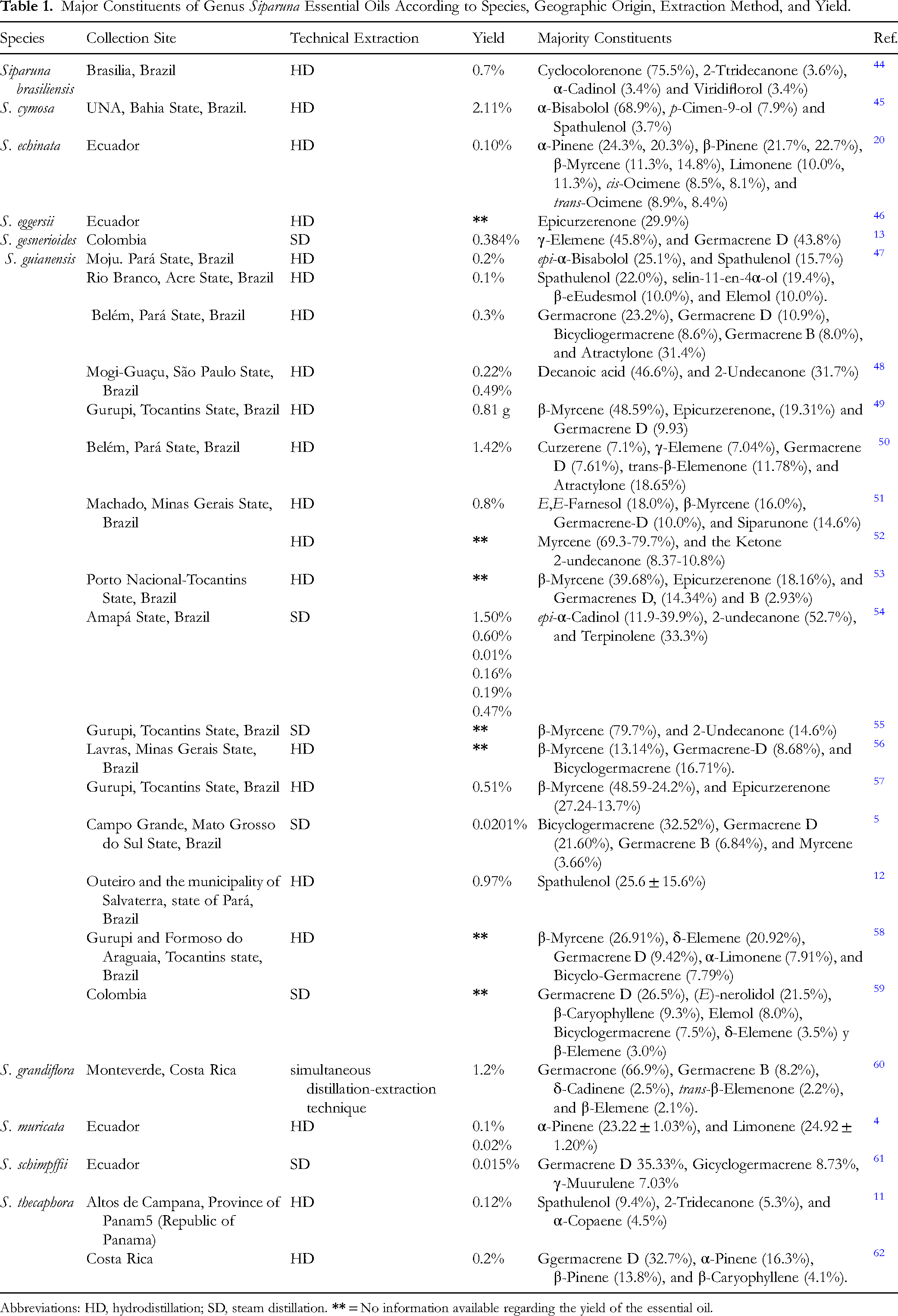
Abbreviations: HD, hydrodistillation; SD, steam distillation.
From a biosynthetic perspective, the predominance of terpene classes reflects coordinated activity of the plastidial DOXP/MEP and cytosolic MVA pathways.64–66 However, the observed diversity also indicates selective expression of terpene synthases and rearrangement mechanisms involving farnesyl-derived carbocation intermediates, explaining the frequent occurrence of germacrene-D, α, β, δ and γ-elemene, and bicyclogermacrene-type skeletons.67,68 The repeated detection of oxygenated derivatives such as bisabolol, eudesmol, and nerolidol further suggests oxidative tailoring steps mediated by cytochrome P450 enzymes. 69 Additionally, the occurrence of less common constituents such as siparunone and epicurzerenone in multiple reports (for example,46,49,51 indicates lineage-specific metabolic capabilities and reinforces the chemotaxonomic relevance of Siparuna. Together, these data support the existence of geographically and genetically structured chemotypes and help explain the functional diversity reported for Siparuna essential oils. The 2D chemical structures can be visualized in Figure 1.

Two-dimensional structures of the main terpenes identified in the essential oils of Siparuna Genus that showed insecticidal and repellent activity.
Antioxidant Activity
Antioxidant activity corresponds to the ability to inhibit or neutralize free radicals, preventing cell damage and chronic diseases, natural compounds, such as terpenes found in plants, have aroused scientific interest because of their potential to protect the body against the effects of oxidation.70–75 Several studies have investigated the antioxidant activity of Siparuna species,4,76,77 using different methods. These include the ABTS•+ assay, which evaluates the neutralization of the stable radical cation 2,2′-azinobis (3-ethylbenzthiazolin-6-sulfonic acid) 78 ; DPPH•, based on the donation of electrons or hydrogen to neutralize the free radical 2,2-diphenyl-1-picrylhydrazy; and the β-carotene/linoleic acid system, which measures the ability to inhibit free radicals formed during the peroxidation of linoleic acid. 78
Based on these methods, studies have evaluated the antioxidant capacity of essential oils from Siparuna species. Morocho et al 79 characterized the essential oil of S. muricata leaves and fruits, identifying α-pinene (23.22 ± 1.03%), β-acorenol (12.71%), β-pinene (9.47%), limonene (8.71%) and camphene (5.17%) as the main constituents. In the fruit, the highest concentrations of limonene (24.92 ± 1.20%) and α-pinene (10.90%) stood out. The antioxidant activity, assessed by the ABTS•+ and DPPH- tests, revealed a moderate effect by the ABTS-+ method (SC50 of 775.3 ± 1.3 µg/mL for leaves and 963.3 ± 1.6 µg/mL for fruit). As for DPPH•, the leaf oil showed weak activity, while the fruit oil showed no measurable IC50. 79
Barbosa et al 77 investigated the antioxidant activity of S. guianensis essential oil using the DPPH• and β-carotene/linoleic acid methods. The oil had a higher concentration of oxygenated sesquiterpenes, such as curzerenone (16.4 ± 1.5%), drimenol (13.7 ± 0.2%) and spatulenol (12.4 ± 0.8%), but showed low antioxidant capacity, with inhibition of only 11.1% in DPPH• (95.7 mg TE/g), a value ten times lower than the Trolox standard. By the β-carotene method, inhibition was 15.5%, also lower than Trolox (90.9%), characterizing moderate antioxidant activity. Similarly, Santos et al 80 observed low antioxidant potential in six specimens of S. guianensis, even though they had chemical profiles rich in spatulenol (25.6 ± 15.6%). Another study with essential oil from the same species, which was predominant in bicyclogermacrene (32.52%), germacrene D (21.60%), germacrene B (6.84%) and myrcene (3.66%), showed no antioxidant activity in the ABTS•+, and DPPH• assays. 81 Taken together, these results suggest that the essential oils of the Siparuna genus show low or no antioxidant activity, regardless of the differences in their chemical composition.
Biological Activity
Antimicrobial Activity
The escalating global prevalence of bacterial, fungal, and viral infections, compounded by the alarming rise in antimicrobial resistance among pathogens, underscores a critical need to discover novel therapeutic agents. 82 Natural products, including plant-derived essential oils (EOs), represent a potential promising reservoir for such discoveries due to their chemical diversity, favorable safety profiles, and mechanisms of action that may differ from conventional antimicrobials. 83 Essential oils are particularly notable for their role in plant defense and their documented capacity to inhibit microbial growth. 53 Within this context, species of the genus Siparuna Aubl. have emerged as compelling sources of bioactive molecules, with research indicating that their bioactivity is intrinsically linked to their distinct chemical compositions. The antimicrobial activity of essential oils from different Siparuna species, including their major constituents, target microorganisms, and reported activity parameters, is summarized in Table 2.
Antimicrobial Potential of Essential Oils from Siparuna species, Showing Plant Origin and Organ, Main Constituents, Tested Microorganisms, and Main Biological Responses, Including Antibacterial, Antifungal, and Synergistic Effects.

Recent investigations into S. guianensis illustrate how specific chemical profiles correlate with antimicrobial efficacy. The study by dos Santos et al 5 characterized the EO from fresh leaves collected in Campo Grande, Brazil, identifying a sesquiterpene-rich composition dominated by bicyclogermacrene (32.52%), germacrene D (21.60%), and germacrene B (6.84%). This specific chemical makeup was associated with notable bioactivity, as the EO demonstrated synergistic effects with ampicillin against clinically resistant strains of Staphylococcus aureus and Staphylococcus epidermidis. Furthermore, a formulated ointment combining this EO with gentamicin restored the antibiotic's efficacy against multidrug-resistant bacteria, highlighting a practical application for resistance modulation. The potent antibacterial activity of S. guianensis EO is further quantified by de Souza Moura et al, 53 who reported remarkably low Minimum Inhibitory Concentration (MIC) values of 0.87 µg/mL for Escherichia coli, Pseudomonas aeruginosa, and Streptococcus pyogenes, and 1.30 µg/mL for S. aureus. Growth curve analyses confirmed that even the lowest concentration (0.87 µg/mL) completely inhibited the growth of E. coli, P. aeruginosa, and S. pyogenes, and significantly retarded the growth of S. aureus.
Chemical variation, influenced by geographical origin, is a key factor in the bioactivity of S. guianensis EOs. Ramos-Calderón et al 84 analyzed EO from leaves collected in Caquetá, Colombia, finding a different major constituent profile: D-germacrene (26.5%), (E)-nerolidol (21.5%), β-caryophyllene (9.3%), elemol (8.0%), and bicyclogermacrene (7.5%). This EO exhibited potent antifungal activity against the cocoa pathogen Moniliophthora roreri, achieving 98% inhibition of mycelial growth in vitro at 1000 µg/mL and complete inhibition of disease development in vivo at the same concentration. This suggests that different chemotypes of S. guianensis may possess optimized activity against specific microbial targets, bacteria versus fungi. Andrade et al 56 reported a more moderate antibacterial profile for S. guianensis EO (MIC 125-500 µg/mL) but stronger antifungal effects against filamentous fungi like Aspergillus flavus (MIC 7.81 µg/mL), reinforcing the notion that the antifungal potency of these oils can be significant even when antibacterial activity is less pronounced.
Interspecific chemical diversity within the genus also dictates antimicrobial potential. Morocho et al 4 studied Siparuna muricata from Ecuador, revealing distinct compositions between plant organs. The leaf EO was rich in α-pinene (23.22%), β-acorenol (12.71%), and β-pinene (9.47%), while the fruit EO was dominated by β-pinene (23.22%). This chemical divergence translated into differing biological activities: the leaf EO showed greater antibacterial activity (MIC 500 µg/mL against Enterococcus faecium), whereas the fruit EO was more active against fungi like Candida albicans and Aspergillus niger (MIC 1000 µg/mL for both). These findings underscore that the antimicrobial profile is not only species-specific but also dependent on the plant part utilized, necessitating precise chemical characterization in any bioactivity study.
In this sense, the antimicrobial potential of Siparuna essential oils is strongly supported by quantitative data on inhibition levels and reduction rates. The efficacy observed against a range of bacteria and fungi, from low MIC values to high percent inhibition in vivo, is closely tied to the unique sesquiterpene and monoterpene compositions of each oil. The demonstrated synergistic effects with standard antibiotics further enhance their therapeutic relevance. However, the significant chemotypic variation observed across different Siparuna species and geographical origins highlights the importance of thorough phytochemical analysis as a prerequisite for reproducible antimicrobial studies and future development of standardized preparations.
Insecticidal and Repellent Activity
One of the most common ways of controlling disease vectors, such as mosquitoes, is the large-scale application of synthetic insecticides. However, overuse of this type of insecticide can cause serious problems for the environment, human health and result in insect strains that are more resistant to this type of chemical.49,85 The use and application of EOs to control pests, insects and mosquitoes is a reliable alternative and is considered environmentally safe, as well as being a possible alternative to synthetic insecticides.18,52
Despite the great diversity of species in the genus, studies on the insecticidal and repellent activities of both pure EOs and nano-encapsulated formulations and emulsions have focused on S. guianensis for which the EOs have been shown to be effective in controlling mites, 18 caterpillars, 52 bedbugs, 13 mosquitoes, 49 among others. Its main advantage is its low toxicity to other non-target organisms, 13 Lourenço et al 52 evaluated the insecticidal potential of S. guianensis EOs from specimens collected in Gurupi and Formoso do Araguaia, Tocantins, Brazil. The study reports on the potential of the EOs obtained from the leaves in the control and resistance management of lepidopteran pests (Spodoptera frugiperda, and Anticarsia gemmatalis). The activities were evaluated by means of mortality concentration bioassay, viability of cultured cells (cell culture of S. frugiperda, and A. gemmatalis), ovicidal activity (egg viability assay), deterrence bioassay, feeding inhibitory bioassays and locomotor bioassays. The main constituents identified in the EOs were the monoterpenes β-myrcene (69.3-79.7%) and ketone 2-undecanone (8.37-10.8%). The observed LC50 values were 2.45 µL of EO/mL for A. gemmatalis and 8.09 µL of EO/mL for S. frugiperda in the concentration-mortality bioassay. The results also indicated the induction of oviposition deterrence and repellency, as well as inhibition of feeding and reduced locomotion in populations of S. frugiperda and A. gemmatalis, indicating strong alterations in the sensory mechanisms related to taste, smell and locomotion of the insects.
Diniz et al 18 evaluated the acaricidal activity on Rhipicephalus microplus of EOs obtained from different chemotypes of S. guianensis. The EOs were obtained from the leaves of three species collected in São Miguel do Anta and Viçosa, located in the states of Minas Gerais and Tocantis, located in the northern region of Brazil, respectively. The acaricidal activity was evaluated using larval package tests and adult immersion tests. The major components of the EOs from São Miguel do Anta and Tocantis were the sesquiterpene α-bisabolol, at concentrations of 62.6 and 48.1%, respectively. Germancrene D (25%) was identified as the main constituent of the sample from the Viçosa region. In the larval package tests, the 20 mg/mL concentration of the Viçosa EO caused 81.1% mortality, while the São Miguel do Anta and Tocantis samples had 100% mortality rates. This study also assessed the activity of the pure terpene α-bisabolol, and the results obtained indicated 100% mortality at a concentration of 10 mg/mL. Thus, the authors emphasized that the chemotypes rich in this substance showed greater activity against R. microplus.
Montaño-Campaz et al 13 reported the activity of EOs obtained from S. gesnerioides and S. guianensis against Aedes aegypti larvae and Belostoma anurum nymphs (bedbugs). The EOs were obtained from the leaves (young and old) of specimens collected in the municipality of Norcasia, Colombia. The main constituents of the S. guianensis EO were the terpenes γ-elemene (45.8%), germancrene D (31.9%) and Δ-cadinene (7.5%), and that of S. gesnerioides was germancrene D (43.8%), Δ-cadinene (11.4%) and α-bergamotene (10.7%). In the toxicity tests on A. aegypti larvae, after 24 h of exposure, LC50mortality concentration values of 0.070 µg/mL were observed for S. gesnerioides and 0.078 µg/mL for S. guianensis. The research also highlights that both EOs tested were toxic to A. aegypti larvae, even though the larvae were resistant to insecticides. B. anurum nymphs were also harmed by the essential oils tested. S gesnerioides had the highest toxicity, with an LC50 of 0.070 μg/mL, causing 86.7% of B. anurum nymphs to die. The results observed for S. guianensis EO were similar to those observed for A. aegypti, with LC50 of 0.078 µg/mL resulting in mortality rates close to 75%. Based on the results, the author highlighted the larvicidal potential of both species analyzed, noting that the S. guianensis EO showed increased toxicity in relation to insecticide-resistant A. aegypti larvae.
Toledo et al 19 evaluated the effect of S. guianensis EO against the insect pest Myzus persicae (green aphid), and two non-target natural predator insects: Coleomegilla maculata (DeGeer) and Eriopis connexa (Germar). The EO was obtained from the leaves of a specimen from the state of Tocantis, Brazil and the main chemical constituents identified were β-myrcene (69.3%) and 2-undocanone (8.37%). Nymphs and adults of M. persicae and adults and third instar larvae of C. maculata and E. connexa were used in a mortality concentration test, repellency bioassay, susceptibility test and effect on predatory abilities. Among the most important results, the author highlights the mortality concentration LC95of 1.08 mg/cm2 against M. persicae aphids, and also significantly repelled aphids at concentrations below 0.14 mg/cm2. The author also highlights that, when exposed to S. guianensis EO, the predatory abilities of C. maculata were not affected, but the abilities of E. connexa to prey on M. persicae were increased.
The use of encapsulated EOs has gained prominence in studies involving insecticidal and repellent activity, as encapsulated materials have been shown to be more efficient in the controlled and prolonged release of EO components, protecting and facilitating the solubility and interaction of EO constituents in biological media. 49 Ferreira et al 49 evaluated the mosquitocidal activity of the EO of S. guianensis encapsulated in chitosan nanoparticles in different proportions, obtained from the leaves of a specimen collected in the municipality of Gurupi, Tocantins, Brazil, and the toxic activity on third instar larvae of A. aegypti mosquitoes was evaluated. Among the main constituents identified in the EO were the monoterpene β-myrcene (48.6%), and the sesquiterpenes epicurzerenone (19.3%) and Germacrene D (9.9%). The study also highlights that the most efficient ratio, which achieved 100% mortality of A. aegypti larvae, was obtained for the 1:2 composition of chitosan: essential oil.
In another study, Ferreira et al 57 evaluated the larvicidal activity against the A. aegypti mosquito of nanoemulsions obtained from the EO of S. guianensis, obtained from the leaves of a specimen collected in Macapá, Amapá, Brazil. The nanoemulsions were prepared containing water, EO and surfactant in different mass proportions. The main constituents identified were Curzerenone (18.87%), α-muurolol (11.75%) and curzerene (10.86%). The larvicidal activity was evaluated on A. aegypti 3 instar larvae, after 24 h of treatment the LC50 and LC90 values for the essential oil were 86.5 and 134.8 μg/mL, while for the treatment with the nanoemulsions the LC50, and LC90values observed were 24.7 and 75.2 μg/mL, respectively. The author highlights the more pronounced larvicidal potential for the nanoemulsion compared to pure EO.
Anti-Inflammatory Activity
Ethnopharmacological studies have confirmed the beneficial effects reported by the popular medicinal use of Siparuna for the treatment of inflammatory diseases.16,17 Such results may be related to the variety of secondary metabolites produced, which include terpenoids, alkaloids and flavonoids.7,20
Conegundes et al 43 analyzed the anti-inflammatory activity of the dichlomethane fraction of the methanolic extract of S. guianensis in in vitro tests, by measuring the inhibition of nitric oxide (NO) production in macrophages (J774A.1) stimulated by LPS + IFN-γ, and in vivo, in mice, by measuring croton oil-induced ear endema, LPS-induced peritonitis and zymosan-induced arthritis. The results of the in vitro test indicated significant inhibition of NO production at concentrations of 50, 20 and 10 μg.mL−1, suggesting the anti-inflammatory effect of the species, since NO is considered a pro-inflammatory mediator, whose production increases in inflamed neural and non-neural cells. 86 The results of the in vivo tests support this hypothesis; in the croton oil-induced ear endema test, all the concentrations tested (100, 200 and 300 mg/kg) reduced endema, with an effect statistically equal to that of the anti-inflammatory drug indomethacin, used as a standard. The extract of S. guianensis (100 mg/kg), administered orally, reduced the infiltration of leukocytes into the peritoneum with an effect statistically equal to that of the standard drug, dexamethasone (1 mg/Kg), and the application of the extract (100 mg/kg) led to a significant reduction in zymosan-induced endema in the inflamed área. 17
The aqueous extract of S. brasiliensis was evaluated in vitro for its anti-inflammatory effect on macrophages (J774A.1, RAW 264.7) using the MTT method, leading to a reduction in nitric oxide production at the highest concentrations analyzed, especially in J774A.1 cells, in which the inhibition of NO production reached 50%. Castro et al 16 also analyzed the in vivo anti-inflammatory effect of the aqueous extract of S. brasiliensis (500 mg/kg) on rat paw endema induced by carrageenan, and observed a significant reduction in endema compared to the anti-inflammatory substance used as a standard, dexamethasone. The authors emphasize the high concentration of polyphenols in the extract, substances that have shown high anti-inflammatory activity in vitro and in vivo. 22
Anti-Parasitic Activity
The search for natural products with anti-parasitic properties has gained increasing attention due to the emergence of parasite resistance to conventional drugs and the demand for safer alternatives. Species of the genus Siparuna have been investigated for their bioactive secondary metabolites, including phenolics, terpenoids, and essential oils, which may exert inhibitory effects against a variety of parasitic organisms. Several studies have reported promising results against protozoa, helminths, and ectoparasites, highlighting the potential of Siparuna extracts and essential oils as sources of novel anti-parasitic agents.8,21,23,87 To further elucidate this potential, the following studies evaluated the activity of different extracts and essential oils from S. guianensis against diverse parasitic species.
Souza et al 23 evaluated in vitro the anti-Toxoplasma gondii activity of the ethanolic extract, aqueous and ethyl acetate fractions, and the essential oil (EO) obtained from S. guianensis leaves. The inhibitory effect on intracellular parasite proliferation was assessed at concentrations that did not induce significant cytotoxicity. A substantial reduction in parasite proliferation was observed in fibroblasts treated with the ethanolic extract (125 μg/mL) and the ethyl acetate fraction (60 and 125 μg/mL), whereas the aqueous fraction and EO showed no inhibitory effect at the concentrations tested. In the direct exposure assay, the ethanolic extract (125 μg/mL), ethyl acetate fraction (125 μg/mL), and EO (500 μg/mL) significantly reduced parasite load compared to the negative control (DMSO 0.6%).
Carvalho et al 21 assessed the anthelmintic activity of the ethanolic extract, aqueous and ethyl acetate fractions, and the EO of S. guianensis against eggs and larvae of Strongyloides venezuelensis. At the concentrations evaluated, the inhibition of egg hatching by the extracts was lower than that achieved by the positive control, albendazole (0.025 mg/mL). Larvicidal activity varied with extract concentration but was not significantly influenced by exposure time. The ethanolic extract achieved 100% larval mortality at concentrations above 0.8 mg/mL, while the aqueous and ethyl acetate fractions produced mortality rates of 82.2% and 99.4%, respectively, at 0.8 mg/mL.
Diniz et al 8 investigated the acaricidal activity of essential oils from leaves of three S. guianensis chemotypes against Rhipicephalus microplus. At the highest tested concentration (20 mg/mL), EOs from two chemotypes rich in α-bisabolol, characterized by a predominance of oxygenated monoterpenes, induced 100% tick mortality. Conversely, the chemotype dominated by germacrene D, consisting mainly of sesquiterpene hydrocarbons and lacking α-bisabolol, produced 81.1% mortality. Despite these observations, the acaricidal effect cannot be ascribed to a single compound, as synergistic interactions among volatile constituents likely contribute significantly to the overall bioactivity of the essential oil. 87
Lack of Toxicological, Safety Perspective and Limitations
Despite the growing body of evidence demonstrating the biological activities of essential oils from Siparuna species, toxicological and safety-related aspects remain comparatively underexplored. The majority of available studies emphasize chemical composition and bioactivity endpoints, such as antimicrobial, insecticidal, antiparasitic, and anti-inflammatory effects, whereas structured toxicological evaluation is rarely addressed as a primary objective.10,18,23,43,52 Consequently, although some reports describe low toxicity toward target organisms or acceptable cellular responses under specific experimental conditions, these observations are not sufficient to establish a comprehensive safety profile.13,23,53
For Siparuna essential oils, toxicological data are generally limited to cytotoxicity assays conducted in parallel with pharmacological or vector-control studies, often using single cell models and short exposure periods. There is a lack of standardized evaluation of dermal irritation, sensitization potential, and repeated-dose exposure, which is particularly relevant considering the proposed topical and agricultural applications of these oils. Given the high content of monoterpenes and sesquiterpenes, classes of compounds known to present concentration-dependent irritant and cytotoxic effects, safety cannot be inferred solely from botanical origin or traditional use.
Another important limitation concerns compositional variability. As discussed throughout this review, Siparuna essential oils show marked chemical variation associated with species, chemotype, geographic origin, and extraction conditions. This variability directly influences not only biological efficacy but also toxicological behavior, making cross-extrapolation between samples unreliable in the absence of batch-specific safety assessment.
Similar considerations apply to nanoformulations incorporating Siparuna essential oils. Nanoemulsions and polymeric encapsulation systems have demonstrated improved stability and enhanced biological performance, particularly in larvicidal and insecticidal assays. However, formulation at the nanoscale may modify dispersion, cellular interaction, and release dynamics of volatile constituents. Current studies involving Siparuna, based nanoformulations are predominantly efficacy-driven, with limited investigation of nanotoxicological parameters such as effects on non-target cells, exposure duration dependence, and formulation-component toxicity.
Environmental safety also deserves attention, especially in the context of vector and pest control. While plant-derived products are often regarded as environmentally compatible alternatives to synthetic agents, essential oils and their nanoformulations may still affect non-target organisms depending on dose, exposure route, and environmental persistence. For Siparuna products, ecotoxicological data remain scarce, and broader assumptions of environmental safety should therefore be made cautiously.
In this context, and considering the limited toxicological literature specifically available for Siparuna, safety interpretations should be supported by general evidence from essential oil and nanoformulation research, while recognizing the need for genus,and formulation-specific studies. Future work should integrate standardized cytotoxicity panels, dermal safety assays, selectivity indices, and environmental risk endpoints alongside biological activity evaluation, in order to strengthen the translational basis of pharmaceutical and agricultural applications.
Conclusion
The evidence compiled in this review demonstrates that essential oils from the genus Siparuna constitute a chemically diverse reservoir of predominantly mono- and sesquiterpenes associated with relevant antimicrobial, antifungal, antiparasitic, anti-inflammatory, and insecticidal activities. In contrast, antioxidant performance is generally low or inconsistent across species and chemotypes. Among the investigated taxa, Siparuna guianensis stands out as the most extensively studied species, with reproducible reports of antimicrobial synergy, vector control activity, anti-inflammatory effects, and enhanced performance in nanoformulated systems. Other species, including S. brasiliensis, S. muricata, and S. thecaphora, also show promising but still fragmented pharmacological and biotechnological potential.
Despite these advances, the translation of current findings into practical pharmaceutical or agricultural applications remains constrained by several structural limitations in the available literature. One major research priority is the deeper elucidation of mechanisms of action. Most studies report biological endpoints without mechanistic resolution, and future work should incorporate membrane interaction studies, enzyme-target assays, omics-based response analysis, and validated in silico, in vitro integration to clarify molecular targets and pathways involved in antimicrobial, antiparasitic, and insecticidal effects.
A second critical priority concerns chemical and technological standardization. Strong compositional variability related to geography, seasonality, plant organ, and extraction method directly affects reproducibility of biological results. Future studies should adopt standardized extraction protocols, batch-level chemical profiling, and chemotype classification, combined with quantitative bioactivity metrics and selectivity indices. The establishment of reference chemotypes, particularly for S. guianensis, would significantly improve cross-study comparability and support development pipelines.
From a development perspective, some species emerge as more immediate candidates for targeted investigation. S. guianensis represents the leading candidate for agricultural bioinsecticide and antimicrobial adjuvant development, especially in view of consistent larvicidal and synergistic antibiotic data and successful nanoformulation approaches. S. brasiliensis shows relevant anti-inflammatory potential linked to polyphenol-rich extracts and oxygenated terpenoid profiles, supporting further pharmacological exploration. S. muricata and S. thecaphora present organ-dependent and chemotype-dependent antimicrobial and antifungal activities that justify expanded and standardized screening programs.
Methodological bottlenecks also limit progress and reproducibility in the field. Frequent constraints include small sample sets, absence of voucher-linked chemotype tracking, heterogeneous bioassay protocols, lack of dose, response modeling, and insufficient integration of toxicity and safety endpoints. Nanoformulation studies, although promising, are often efficacy-centered and should be expanded to include formulation stability, release kinetics, and comparative toxicological assessment. The routine inclusion of cytotoxicity panels, dermal safety assays, and non-target organism testing will be essential to support responsible application claims.
Finally, future progress in Siparuna research will benefit from integrative strategies combining ethnobotanical knowledge, chemotaxonomic mapping, standardized phytochemistry, mechanistic pharmacology, and safety evaluation. Such coordinated approaches are necessary to transform the currently promising but heterogeneous body of evidence into reproducible, scalable, and safe technological applications in both health and agricultural sectors.
Footnotes
Acknowledgements
The authors acknowledge the financial support of the Coordenação de Aperfeiçoamento de Pessoal de Nível Superior - Brazil (CAPES) - Funding Code 001. This research is part of the first author’s thesis and was supported by the Postgraduate Development Program - Legal Amazon (PDPG-AL), within the scope of the proposal: “Integrated studies of plant biodiversity for conservation and management of the Amazon” (CAPES/Process 88881.510208/2020-01, Grant 804/2020).

Funding
The authors disclosed receipt of the following financial support for the research, authorship, and/or publication of this article: This study was financed in part by the Amazon Foundation for Support of Studies and Research- Brazil (FAPESPA), Coordenação de Aperfeiçoamento de Pessoal de Nível Superior - Brazil (CAPES) - Finance Code 001.
Declaration of Conflicting Interests
The authors declared no potential conflicts of interest with respect to the research, authorship, and/or publication of this article.