



Abstract
Objective
This study evaluated the pre-emergence bioherbicidal potential of Cosmos sulphureus leaf extract against major weed species while assessing its selectivity toward common crop plants.
Methods
A methanolic extract of C. sulphureus leaves was tested at graded concentrations on three weed species (Cynodon dactylon, Ludwigia octovalvis, Eragrostis amabilis) and four crop species (Vigna radiata, Zea mays, Ipomoea aquatica, Brassica juncea). Germination and early growth responses were quantified, and EC50 values were calculated for both shoot and root inhibition. Qualitative phytochemical screening was performed to identify bioactive compound groups.
Results
Inhibitory effects were strongly concentration-dependent and varied among species. C. dactylon showed complete inhibition at ≥0.24 g/mL (EC50: 0.0009 g/mL for shoots; 0.0002 g/mL for roots), whereas E. amabilis reached total inhibition at 0.12 g/mL (EC50: 0.0600 g/mL). L. octovalvis exhibited higher sensitivity in the roots, with 88.19% inhibition at 0.12 g/mL and EC50 values ranging from 0.01 to 0.09 g/mL. Crop species varied in tolerance: V. radiata and Z. mays were least affected (maximum root inhibition 64.04% and 37.87%, respectively), while B. juncea showed complete inhibition at 0.48 g/mL. I. aquatica displayed moderate sensitivity with 76.36% root inhibition at 0.48 g/mL. Phytochemical screening confirmed the presence of alkaloids, flavonoids, tannins, and phenolics are compound groups known for allelopathic activity.
Conclusion
Cosmos sulphureus leaf extract demonstrates strong bioherbicidal potential, with marked selectivity across weed and crop species. Optimizing application concentrations will be crucial for maximizing weed suppression while minimizing adverse effects on crop plants. These results support the development of C. sulphureus–based eco-friendly bioherbicide systems for sustainable weed management.
Keywords
Introduction
Weeds are one of the main factors that significantly reduce crop productivity and agricultural system stability, especially under intensive cultivation of short-duration industrial crops. In the early stage of the growing season, when crop canopy coverage is still limited, weeds have favorable conditions to grow rapidly and compete strongly with crops for light, water, nutrients, and space. 1 This situation not only leads to yield reduction but also increases weed management costs, particularly in large-scale farming or in areas with limited mechanization. 2 In addition, many weed species show high physiological adaptability, with strong growth even under drought or nutrient-poor soil conditions, indicating a substantial biological advantage in competitive environments. 3
Chemical herbicides have long played a central role in weed management. However, the prolonged overuse of synthetic active ingredients has led to a range of consequences, including soil and water contamination, ecological imbalance, biodiversity loss, and most notably, the increasing prevalence of herbicide-resistant weed species.4,5 According to Heap (2014), 4 more than 500 cases of herbicide resistance have been recorded worldwide, with a concerning rise in cross-resistant and multiple-resistant weed biotypes, reducing the effectiveness of most currently available herbicide groups. As a result, the reliance on chemical control has become increasingly unsustainable, urging the agricultural sector to explore alternative management strategies that are safer and more compatible with environmentally friendly farming systems.
One emerging approach gaining attention is the use of plant-derived secondary metabolites, particularly allelochemicals, for the development of pre-emergence bioherbicides. These compounds, produced as part of ecological interactions among plants, can suppress the germination or growth of competing plant species through biochemically mediated interference known as allelopathy.6-8 Allelochemicals affect target plants through various mechanisms, including disruption of cell membrane integrity, inhibition of enzyme synthesis and photosynthetic pigment production, interference with cell division, and induction of abiotic stress responses. 9 Due to their multi-target modes of action and lower risk of resistance development, allelochemicals are considered a promising alternative for reducing or replacing synthetic herbicides in weed management.
Cosmos sulphureus, a member of the Asteraceae family, has attracted increasing interest as a promising source of bioherbicidal compounds due to its richness in secondary metabolites such as flavonoids, phenolics, and terpenoids. 10 Multiple studies have confirmed that C. sulphureus extracts exert strong inhibitory effects on the germination and early growth of major weed species, including Echinochloa crus-galli, Cyperus rotundus, Bidens pilosa, and Amaranthus viridis. These phytotoxic effects are attributed primarily to allelopathic compounds, especially water-soluble metabolites and root-derived exudates. 11 In addition, the strong antioxidant properties of the extracts are thought to play a critical role in disrupting seed metabolism during the pre-germination phase.12,13 Despite this evident potential, most studies have focused on a limited number of target species and concentration levels. Key aspects such as biological selectivity, crop safety, and the broad-spectrum effectiveness of C. sulphureus leaf extract under field conditions remain insufficiently explored and warrant further investigation.
Building on this context, the present study was conducted to evaluate the pre-germination inhibitory effects of Cosmos sulphureus leaf extract on several common weed and crop species under laboratory conditions. The research aimed not only to determine concentration-dependent inhibition, but also to assess the extract's selectivity between weeds and crops-a key factor in developing bio-based formulations with strong practical applicability. The findings are expected to provide important scientific groundwork for the development of environmentally friendly bioherbicides, while promoting the effective use of locally available, easy-to-cultivate plant resources as part of an ecological and sustainable agricultural strategy.
Materials and Methods
Materials
The plant material used for extraction was Cosmos sulphureus leaves, collected from O Mon District, Can Tho City, at the flowering stage (approximately 60 days after germination). 14 After thorough washing and air-drying, the leaves were cut into 1-2 cm segments and subjected to methanol (MeOH) extraction. Fresh-leaf extracts were intentionally used because key allelochemicals in C. sulphureus degrade during drying, and fresh tissues better represent the natural allelopathic processes occurring in field conditions. At this exploratory screening stage, expressing extract strength as g fresh weight per mL is a standard and reproducible approach, with full chemical quantification planned for subsequent mechanistic analysis. The first extraction involved soaking 100 g of fresh leaves in 60% MeOH (v/v) for 48 h, followed by filtration and cold storage of the filtrate. The remaining plant residue was then re-extracted with cold 100% MeOH (v/v) for another 48 h. During both extraction phases, the mixtures were gently stirred every 4 h using a glass rod to enhance extraction efficiency. The filtrates from both extractions were combined to obtain a total crude extract. Methanol was subsequently removed by vacuum evaporation at 40 °C using a rotary evaporator (Biobase), yielding approximately 200 mL of aqueous extract containing bioactive compounds.
Test species included Cynodon dactylon (L.) Pers., Ludwigia octovalvis (Jacq.) P. H. Raven, and Eragrostis amabilis (L.) Wight & Arn., all of which were directly collected from active rice fields in Nguyen Van Thanh Commune, Binh Tan District, Vinh Long Province, representing dominant and recurrent weed species commonly infesting rice-based systems in the Mekong Delta. After collection, seeds were air-dried under ambient conditions to a stable moisture content of 14%–15%, and non-viable seeds were removed through flotation and visual inspection to ensure uniformity. Crop species (Vigna radiata, Zea mays, Ipomoea aquatica, and Brassica juncea) were obtained from a certified agricultural seed supplier. Vigna radiata, Zea mays, Ipomoea aquatica were selected because they are widely cultivated within the same agroecosystem and frequently occur in rotation or intercropping systems; Brassica juncea is a well-established sensitive indicator species commonly used in allelopathy research to detect subtle phytotoxic effects. All seeds were stored at 4–5 °C until use to maintain viability and physiological uniformity.
Methods
The experiment followed a completely randomized design (CRD) as described by Thi et al (2008), 15 with six treatments consisting of a control and five extract concentrations (0.03, 0.06, 0.12, 0.24, and 0.48 g fresh weight per mL; hereafter referred to as g/mL for simplicity). Each treatment included four independent replicates (r = 4), and each replicate comprised six Petri dishes (m = 6) containing ten pre-germinated seeds per dish (n = 10). Each Petri dish served as the experimental unit. The required volume of extract was evenly pipetted onto filter papers placed in 60 mm Petri dishes and allowed to evaporate completely under a fume hood at 25 °C. The papers were then moistened with 1 mL of 0.05% Tween 20 solution. For the control treatment, no plant extract was applied; Petri dishes received only 1 mL of 0.05% Tween 20 to ensure that all observed responses were attributable solely to the leaf extracts rather than the surfactant. The dishes were incubated at 25 °C in the dark at approximately 95% relative humidity inside a sealed container on UV-sterilized filter paper and monitored regularly for fungal contamination.
Qualitative Analysis of the Chemical Constituents in Cosmos sulphureus Leaf Extract
In this study, the leaf extract of C. sulphureus was subjected to qualitative screening to identify the presence of major classes of secondary metabolites. Biochemical assays were applied to detect coumarins – Alkaline reagent test 13 ; phenolics-Ferric chloride test, tannins-Alkaline reagent test, and cardiac glycosides-Keller Killiani test 16 ; alkaloids-Hager test 17 ; carbohydrates-Caramelisation, flavonoids-Lead acetate test, glycosides and quinones 18 ; chalcones; reducing sugars (Carbohydrates)-Barfoed's test, proteins/amino acids 19 ; oxalates 20 ; betacyanins. 21 The results were classified based on the degree of color change and the specific reaction of each compound.
Recorded Parameters
The lengths of the hypocotyls and radicles of the test seeds were recorded after 48 h of exposure to the Cosmos sulphureus leaf extract. The inhibitory effect of the extract was calculated using Abbott's formula (1925) 22 : I (%) = [(L1-L2)/L1] × 100, where: I is the inhibition percentage of C. sulphureus extract on the test species, L1 is the root or shoot length of the control seedlings (mm), L2 is the root or shoot length of the treated seedlings (mm).
Statistical Analysis
The data were first organized and processed using Microsoft Excel 2016. Statistical analyses were conducted in SPSS version 22, where treatment means were compared using Duncan's multiple range test at a 5% significance level.
The dose–response relationship was further examined using a four-parameter log-logistic (LL.4) non-linear regression model, following Pannacci et al (2020). 23 This modeling was performed in R (version 4.2.2) using the drc package. From each fitted curve, key inhibitory concentration values (EC10, EC50, EC70, and EC90) were estimated, and their corresponding 95% confidence intervals were obtained via the delta method.
To ensure model adequacy and transparency, several diagnostics were evaluated. Residual plots were visually inspected for randomness and homoscedasticity, pseudo-R2 values were calculated to assess goodness-of-fit, and 95% confidence intervals were examined for parameter stability. In addition, a formal lack-of-fit F-test was performed by comparing the residual sum of squares of the non-linear model with that of an ANOVA benchmark, following the approach of Ritz and Streibig. 24
Results and Discussion
Effect of Cosmos sulphureus Leaf Extract on Weed Species
The C. sulphureus leaf extract inhibited the growth of all three weed species in a clear and consistent concentration-dependent manner (Figures 1–3).
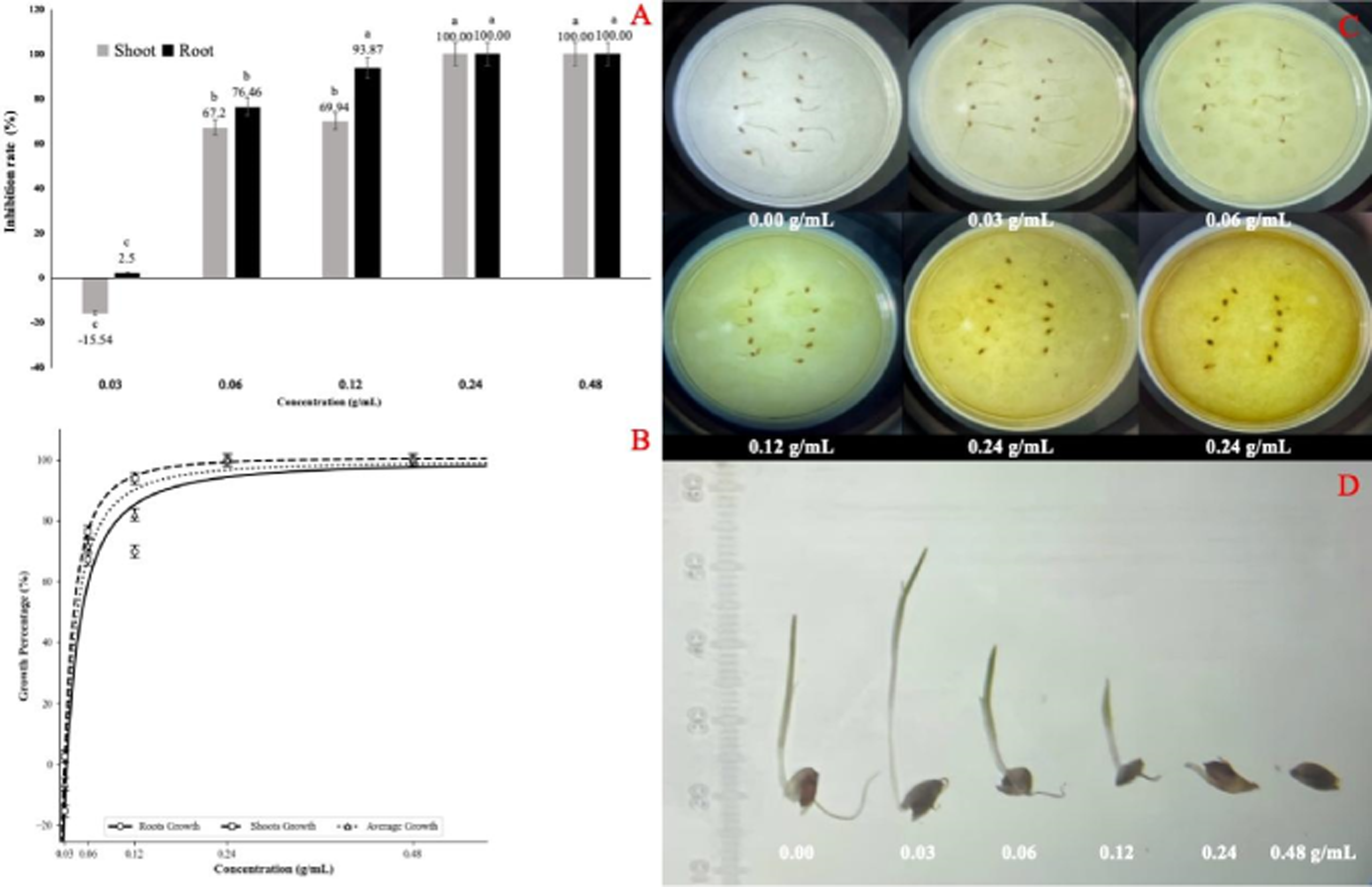
Effect of Cosmos sulphureus leaf extract concentrations on Cynodon dactylon and the dose-response curve representation.

Effect of Cosmos sulphureus leaf extract concentrations on Eragrostis amabilis and the dose-response curve representation.
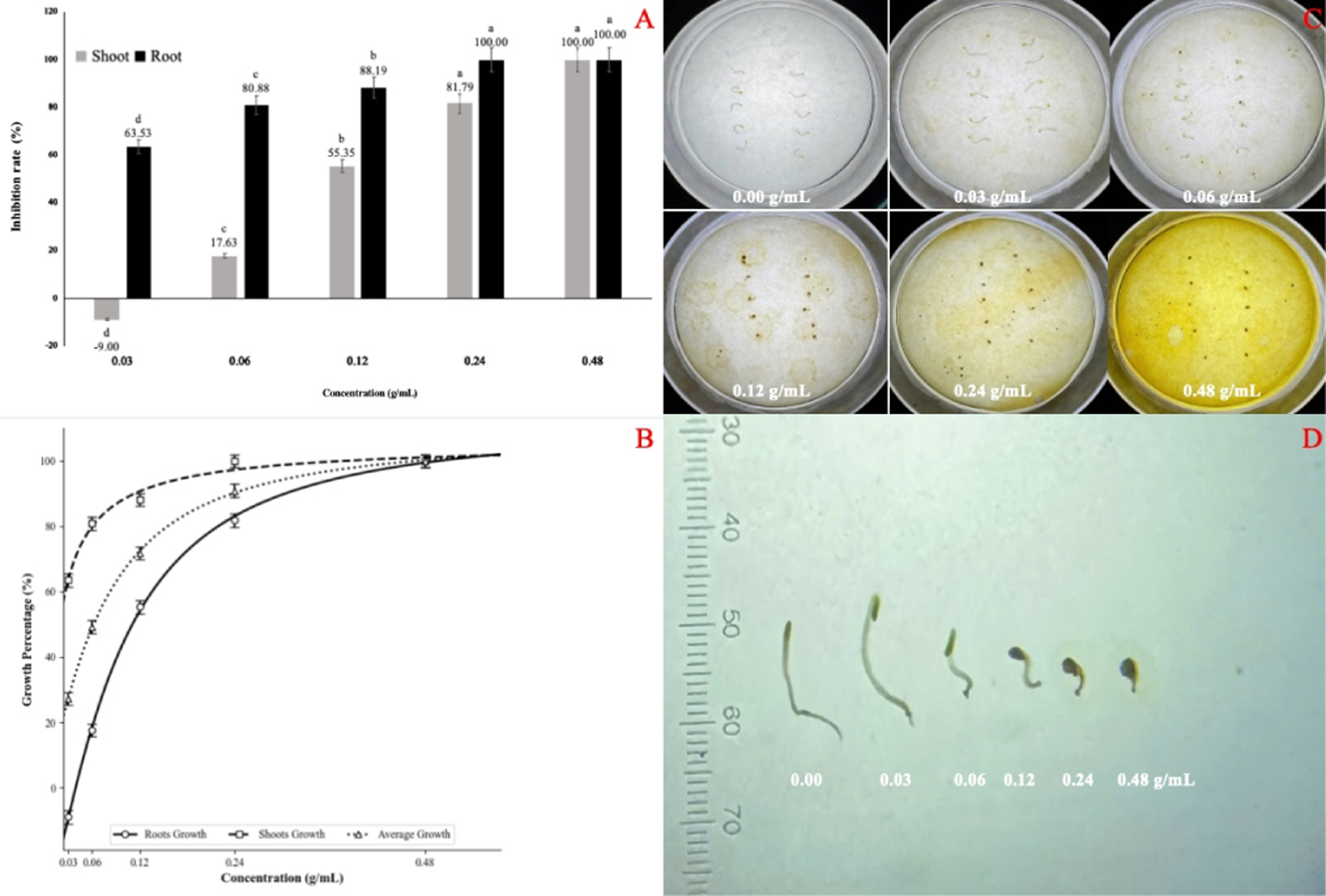
Effect of Cosmos sulphureus leaf extract concentrations on Ludwigia octovalvis and the dose-response curve representation.
In Cynodon dactylon, low-dose stimulation was observed at 0.03 g/mL, where shoot and root lengths increased by 15.54% and 2.50%, respectively. However, this hormetic effect disappeared at higher doses: inhibition became significant at 0.06 g/mL (67.20% for shoots and 76.46% for roots), and root growth was almost completely suppressed at 0.12 g/mL (93.87%). Total inhibition (100%) of both organs was achieved at ≥0.24 g/mL (Figure 1).
Eragrostis amabilis showed greater tolerance than C. dactylon. At 0.03 g/mL, shoot growth was still stimulated (16.46%), and root growth was only slightly reduced (13.33%). Marked inhibition first appeared at 0.06 g/mL, reaching 45.34% for shoots and 42.89% for roots. Complete suppression (100%) occurred at concentrations ≥0.12 g/mL (Figure 2).
In contrast, Ludwigia octovalvis displayed the highest sensitivity. Even at 0.03 g/mL, root inhibition reached 63.53%, while shoots were only mildly affected (9.00%). At 0.06–0.12 g/mL, root growth remained strongly inhibited (80.88%–88.19%). Complete suppression of both roots and shoots was observed at ≥0.24 g/mL (Figure 3).
Across species, roots were consistently more responsive to the extract than shoots, and maximum inhibition (100%) occurred at concentrations between 0.12–0.48 g/mL depending on the species. These results highlight clear species-specific responses linked to differences in root anatomy, membrane permeability, and the ability to absorb allelochemicals.
Effect of Cosmos sulphureus Leaf Extract on Crop species and Selectivity
The four crop species showed milder responses to the extract compared to weeds, with several cases of low-dose stimulation (Figures 4–7). In Vigna radiata, shoot inhibition was modest across all treatments (16.86%–31.45%), while root inhibition remained below 20% at lower concentrations and increased to 64.04% only at 0.48 g/mL, indicating strong crop tolerance (Figure 4). Zea mays exhibited the most pronounced hormesis among the crops. Root length increased substantially at 0.03 g/mL (−87.50%) and 0.06 g/mL (−74.87%), with inhibition appearing only at the highest dose (37.87% at 0.48 g/mL). Shoots followed a similar but less accentuated pattern (Figure 5).
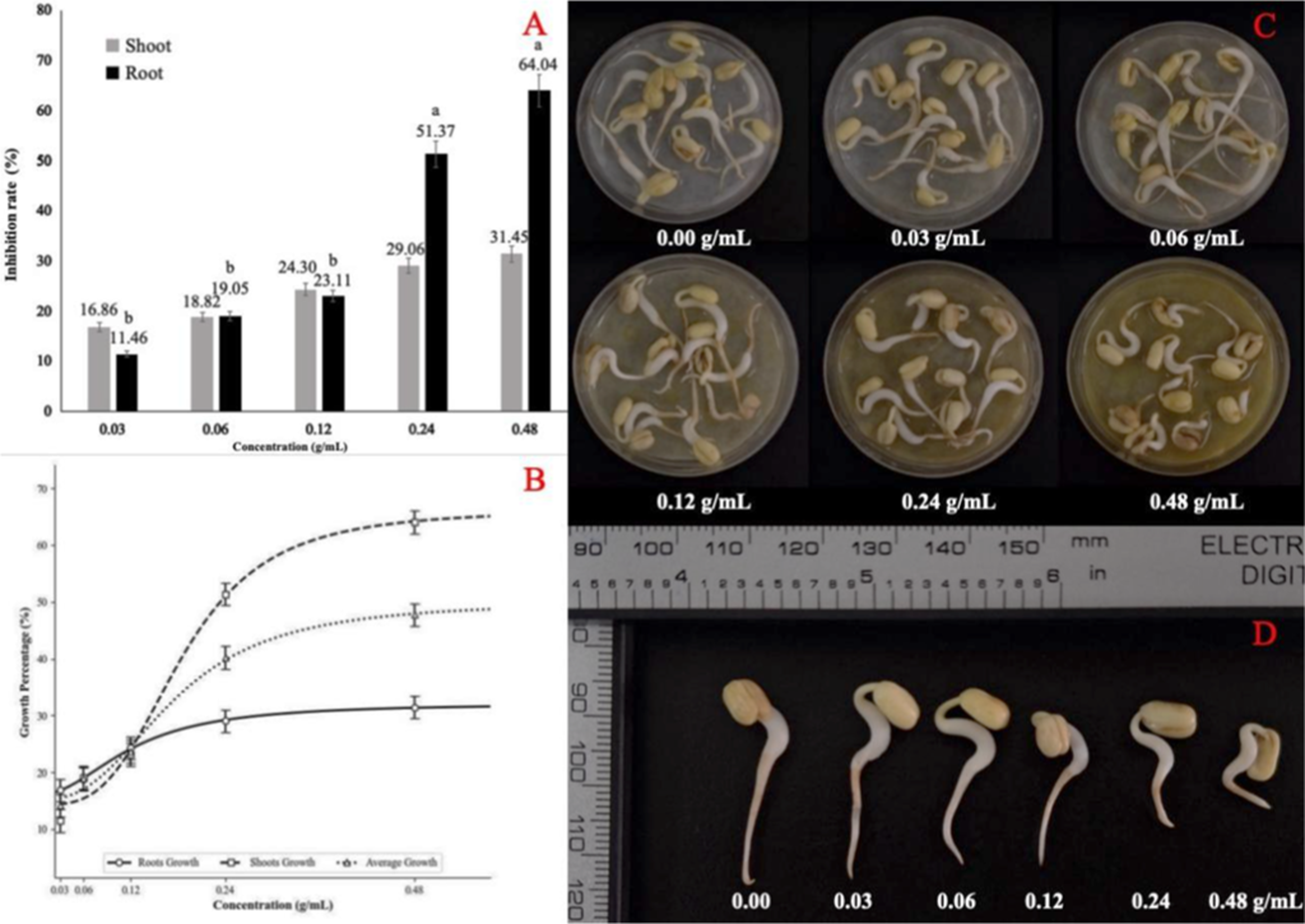
Effect of Cosmos sulphureus leaf extract concentrations on Vigna radiata and the dose-response curve representation.

Effect of Cosmos sulphureus leaf extract concentrations on Zea mays and the dose-response curve representation.
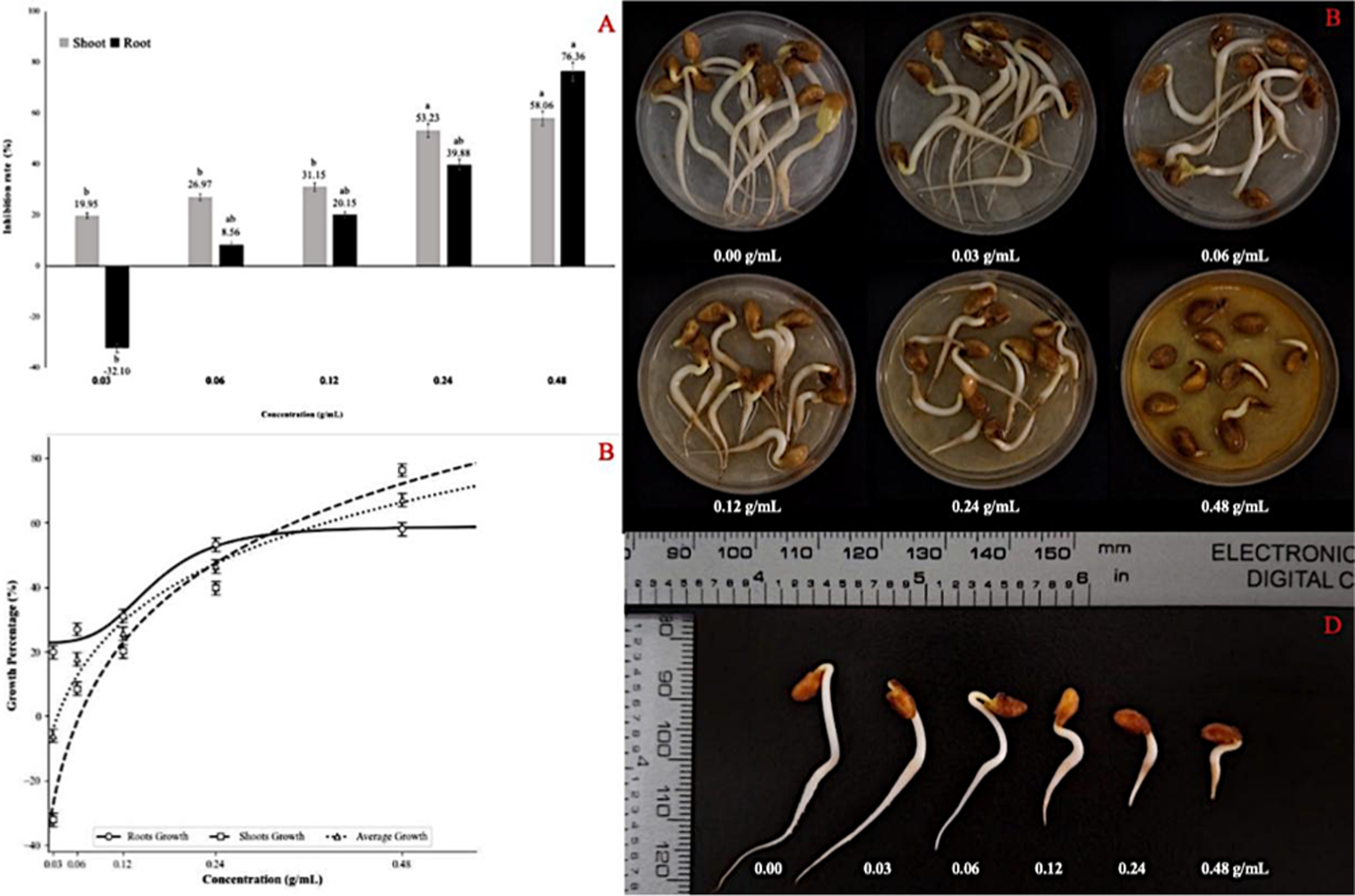
Effect of Cosmos sulphureus leaf extract concentrations on Ipomoea aquatica and the dose-response curve representation.
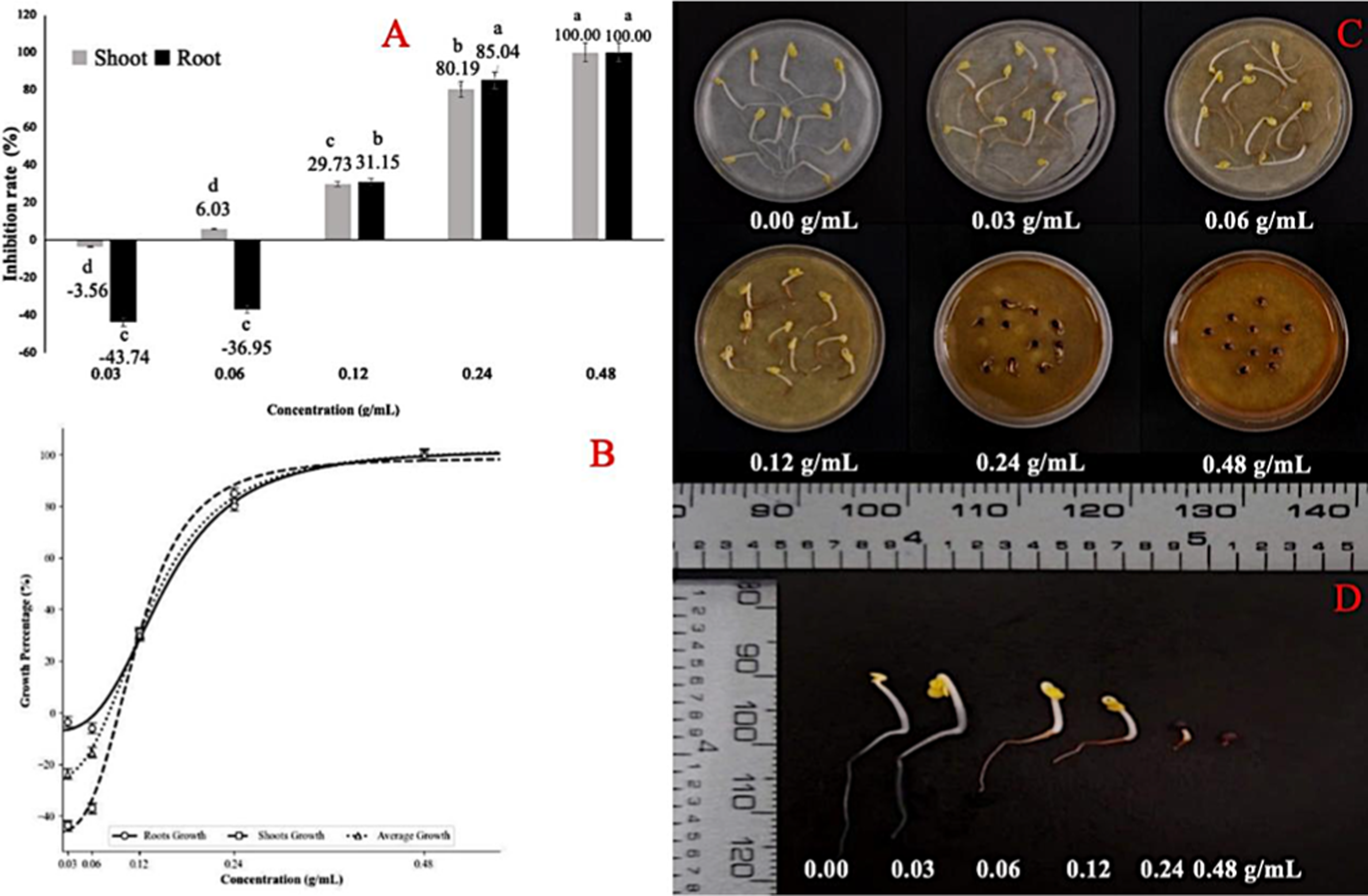
Effect of Cosmos sulphureus leaf extract concentrations on Brassica juncea and the dose-response curve representation.
In Ipomoea aquatica, both root and shoot growth were more sensitive. Roots showed slight stimulation at 0.03 g/mL (−32.10%) but shifted to inhibition at higher concentrations, reaching 76.36% at 0.48 g/mL. Shoot inhibition ranged from 19.95% to 58.06% (Figure 6).
Brassica juncea was the most sensitive crop, especially in its root system. Inhibition ranged from 43.74% at 0.03 g/mL to complete suppression (100%) at 0.48 g/mL. Shoots were less affected but still displayed progressive inhibition (Figure 7).
Overall, crop species demonstrated substantially lower inhibition than weeds at equivalent concentrations, confirming the extract's selectivity. This distinction is essential for developing pre-emergence bioherbicides that can suppress early-emerging weeds without severely impacting major crops.
Dose-Response Analysis of the Tested Plant Species
The growth inhibition values (EC10, EC50, EC70, EC90) revealed differential effects of C. sulphureus leaf extract across tested plant species and organs (shoots and roots) (Table 1). In C. dactylon, the extract exhibited strong inhibitory potency, with EC50 values of 0.0009 g/mL for shoots and 0.0002 g/mL for roots, indicating higher sensitivity in roots (Figure 1). E. amabilis required significantly higher concentrations to reach 50% inhibition (EC50 = 0.06 g/mL for both shoots and roots), reflecting a higher degree of tolerance (Figure 2). In L. octovalvis, EC50 values were 0.01 g/mL (shoots) and 0.09 g/mL (roots), suggesting that shoots were more sensitive (Figure 3). For crop species, V. radiata (Figure 4) and Z. mays (Figure 5) showed similar EC50 values-0.18 g/mL for shoots and 0.12 g/mL for roots-again indicating greater sensitivity in roots. I. aquatica (Figure 6) presented a contrasting pattern, with EC50 values of 0.10 g/mL for shoots and 0.21 g/mL for roots, whereas B. juncea (Figure 7) showed moderate inhibition levels (EC50 = 0.12 g/mL for shoots and 0.14 g/mL for roots). Overall, weed species such as C. dactylon exhibited strong sensitivity to the extract, while crop species like V. radiata and Z. mays were less affected, reflecting physiological differences in susceptibility between weed and crop groups.
EC10, EC50, EC70, and EC90 Values (g/mL) of Cosmos sulphureus Leaf Extract for Shoot and Root Growth Inhibition of Tested Weed Species.

Abbreviations: EC, effective concentration; FW, fresh weight.
Qualitative Analysis of Phytochemical Constituents in C. sulphureus Leaf Extract
Qualitative phytochemical screening of C. sulphureus leaf extract revealed a chemically rich profile dominated by compound classes commonly associated with allelopathic and phytotoxic activity. Strong positive reactions (“+++”) were obtained for phenolics, flavonoids, alkaloids, tannins, and reducing sugars (Table 2), indicating that these groups occur in high abundance. These metabolites—particularly phenolic acids, flavonoid derivatives, and condensed tannins—are well documented for their ability to inhibit seed germination, disrupt root elongation, and interfere with cellular redox balance in sensitive plant species.
Semi-Quantitative Summary of Phytochemical Screening Results for Cosmos sulphureus Leaf Extract.

Note. Results of classical colorimetric/precipitation tests are scored on a relative scale: “+” = low, “++” = moderate, “+++” = high presence of the phytoconstituent; blank = not detected. Scores were assigned from the intensity/clarity of the diagnostic reaction observed in Figure 8 (triplicate tests).
Moderate reactions (“++”) were detected for coumarins, carbohydrates, and proteins/amino acids, suggesting their supportive but less dominant contribution. Low-intensity reactions (“+”) for chalcones, quinones, glycosides, cardiac glycosides, oxalates, and betacyanins point to the presence of additional minor constituents that may act synergistically with the major groups.
The diagnostic color changes and precipitates illustrated in Figure 8 confirm the reliability of these results. Classical assays such as FeCl3 (phenolics), Mayer/Dragendorff (alkaloids), gelatin/lead acetate (tannins), and Shinoda (flavonoids) produced strong, unambiguous endpoints, reflecting both the consistency of the extract and the robustness of the analytical approach. Together, this complex phytochemical composition supports the potent and selective phytotoxic responses observed in the bioassays and provides a biochemical basis for further fractionation and quantitative profiling.

Qualitative phytochemical analysis of Cosmos sulphureus leaves extract.
Discussion
The findings of this study demonstrate that Cosmos sulphureus leaf extract exerts strong pre-emergence inhibitory effects on all three weed species tested, while its impact on crop species depends on the plant. This differential response indicates a degree of biological selectivity, an essential prerequisite for developing bioherbicides capable of suppressing weeds without causing significant crop injury. 25 Similar selective toxicity has been reported for allelopathic metabolites in Asteraceae species, 26 yet previous studies have rarely evaluated weed and crop species simultaneously within the same experimental framework. The present work therefore provides new evidence for selective phytotoxicity across both weed and crop groups relevant to tropical rice-based systems, a perspective largely absents in earlier allelopathy reports.
Across all three weed species, inhibition intensified markedly with increasing extract concentration, consistent with dose-dependent phytotoxic responses commonly associated with phenolics, flavonoids, and tannins.10,27 Slight stimulation observed at 0.03 g/mL in C. dactylon and E. amabilis reflects hormesis, a biphasic response where low doses of phytotoxic compounds stimulate early seedling growth before inhibition dominates at higher concentrations. At concentrations exceeding 0.12 g/mL, inhibition became substantial, and complete suppression was reached in highly sensitive species such as E. amabilis (Figure 2). These results reinforce earlier findings by Chaudhuri and Ray, 28 who emphasized the strong inhibitory role of phenolics and tannins on root development across diverse weed species.
A clear distinction emerged when comparing weed and crop responses: weeds, especially C. dactylon and L. octovalvis, experienced severe inhibition at relatively low concentrations (≥0.06 g/mL), while crop species showed milder responses and even stimulation at low doses. For example, roots of Z. mays and I. aquatica displayed notable stimulation at 0.03 g/mL (Figures 5 and 6), and V. radiata maintained low shoot inhibition across all concentrations (Figure 4). Although plant-based bioherbicide studies often report weed suppression, 29 few have systematically addressed crop safety within the same experimental design. This study therefore expands current knowledge by identifying threshold concentrations that allow selective inhibition, particularly for legume crops like V. radiata and aquatic vegetables such as I. aquatica, a novel insight compared with earlier work focused mainly on Echinochloa spp. 14
The qualitative phytochemical screening (Table 2; Figure 8) revealed a chemically diverse extract dominated by phenolics, flavonoids, alkaloids, and tannins, compound classes widely associated with allelopathic and phytotoxic effects.27,29 These findings are consistent with prior reports of chemically rich Asteraceae extracts,16-18 and provide a biochemical rationale for the observed dose-dependent inhibition. However, because the present study relied on classical colorimetric assays, the identities and relative abundances of specific allelochemicals cannot be confirmed without chromatographic or spectroscopic characterization. Thus, interpretations remain conservative and do not attribute activity to any single class or molecule.
The species-specific sensitivity observed may be attributed to structural and physiological differences between weeds and crops. Weeds often have finer root systems and thinner epidermal layers, increasing susceptibility to allelochemical penetration, whereas crop species, especially those undergoing breeding, tend to possess more robust tissues and effective detoxification pathways. 30 This mechanistic explanation is consistent with reported selectivity patterns in extracts from Parthenium hysterophorus 29 and Artemisia spp., 31 although prior studies did not incorporate multiple crop species within the same evaluation.
In comparison with earlier work, which primarily documented inhibitory effects at high extract concentrations,14,31 the present study contributes new information by identifying dose thresholds that separate weed suppression from crop safety, providing a more practical foundation for potential field application. Furthermore, the integration of EC10–EC90 values strengthens the quantitative understanding of phytotoxicity and helps define preliminary application windows relevant to cropping systems. 32
Despite these advances, limitations must be acknowledged. Petri-dish conditions may exaggerate inhibition relative to soil environments, where microbial degradation, adsorption, and environmental fluctuations reduce allelochemical bioavailability. 33 Additionally, the crude extract used here may contain synergistic or antagonistic interactions among constituents that remain uncharacterized, a common challenge in natural-product-based weed control research.34-36 Without chemical profiling (eg, LC–MS/MS), conclusions about active compounds remain preliminary.
Future work should therefore focus on chromatographic identification and quantification of active constituents, bioassay-guided fractionation, soil-based dose–response validations, and greenhouse or field trials to assess persistence, environmental stability, and crop safety. Such research will be essential for determining whether C. sulphureus can be developed into a practical, selective, and ecologically compatible bioherbicidal product.
Conclusions
The present study demonstrated that Cosmos sulphureus leaf extract exerts strong pre-emergence inhibitory effects on three ecologically important weed species, displaying a clear dose-dependent response with optimal suppression achieved from 0.12 g/mL onward. In contrast, crop species exhibited markedly different levels of sensitivity, revealing a distinct pattern of biological selectivity. This selective inhibition supported by EC10–EC90 thresholds generated from non-linear dose–response modeling provides an essential foundation for defining safe and effective application windows in early-season weed management. These findings therefore establish a scientifically robust basis for developing bioherbicidal formulations that are both effective against weeds and relatively safe for major crops.
Beyond confirming the allelopathic potential of C. sulphureus, the results highlight its value as a promising natural resource for environmentally friendly weed control, consistent with ongoing efforts to reduce reliance on synthetic herbicides and advance sustainable agricultural practices. However, translating these laboratory results into practical technologies will require additional research under soil-based and field-level cropping conditions. Future studies should elucidate the specific mechanisms of action, assess bioavailability and persistence in soil, and formulate stable, scalable products suitable for real-world agricultural production systems.
Supplemental Material
sj-docx-1-npx-10.1177_1934578X251413883 - Supplemental material for Eco-Friendly Pre-Emergence Weed Control from Cosmos sulphureus Leaf Extract: An Innovation for Sustainable Rice-Based Systems
Supplemental material, sj-docx-1-npx-10.1177_1934578X251413883 for Eco-Friendly Pre-Emergence Weed Control from Cosmos sulphureus Leaf Extract: An Innovation for Sustainable Rice-Based Systems by Thi Le Ho, Phuc Hoang Thien Nguyen, Huy Gia Nguyen, Vy Nguyen Thuy Ha and Truong Nhat Luong in Natural Product Communications
Footnotes

Ethical Approval
Ethical Approval is not applicable for this article.
Statement of Informed Consent
There are no human subjects in this article and informed consent is not applicable.
Author Contributions (CRediT)
Conceptualization of the manuscript and development of the methodology: THL and HNG; data collection and curation: VHNT and PNHT; data interpretation: THL; funding acquisition and resources: HNG; project administration: TLN; supervision: PNHT; writing the original draft of the manuscript: THL and PNHT; writing, review and editing: TLN and HNG; All authors read and agreed to the published version of the manuscript.
Funding
The authors received no financial support for the research, authorship, and/or publication of this article.
Declaration of Conflicting Interests
The authors declared no potential conflicts of interest with respect to the research, authorship, and/or publication of this article.
Data Availability
All data supporting the findings of this study are available within the article and its Supplemental Material.
Statement of Human and Animal Rights
This article does not contain any studies with human or animal subjects.
Supplemental Material
Supplemental material for this article is available online.
References
Supplementary Material
Please find the following supplemental material available below.
For Open Access articles published under a Creative Commons License, all supplemental material carries the same license as the article it is associated with.
For non-Open Access articles published, all supplemental material carries a non-exclusive license, and permission requests for re-use of supplemental material or any part of supplemental material shall be sent directly to the copyright owner as specified in the copyright notice associated with the article.
