



Abstract
Objectives
The objective of this study was to test the alleopathic effects of E. globulus leaves and litter fall aqueous extracts on germination and growth of Winter Wheat (Triticale hexaploide), Barley (Hordeum vulgare), and Maize (Zea mays) crops.
Methods
Allelopathic potential of Eucalyptus globulus on germination and seedling growth of Maize (Zea mays), Winter Wheat (Triticale hexaploide), and Barley (Hordeum vulgare) was studied under laboratory conditions. Aqueous extracts of young tree leaves, old tree leaves, and litter fall of E. globulus were prepared. Filtered extracts were used to treat germinating seeds of test crops. Open and undercanopy soils collected from different depths were also tested for allelopathic effects. ANOVA was used to analyze data in SAS software. Means were compared using Tukey's HSD test at the 5% level of significance.
Results
The result indicated that the extracts of E. globulus had a significant inhibitory effect on germination and seedling growth of the test crops. The highest effect of extracts was observed from old tree leaves, followed by young tree leaves, and the least from litter fall. Among the three crops, Z. mays found to be more sensitive than others. However, the undercanopy soils did not show any allelopathic effect on test crops.
Conclusion
We concluded that E. globulus allelochemicals do not accumulate in soils and the crops can develop adaptation through time. Thus, use of E. globulus for agro-forestry with removal of fallen leaves before cultivation is recommended.
Introduction
Allelopathy is any harmful or beneficial effect by one plant (including microorganisms) directly or indirectly on another through production of chemicals that escape into the environment. 1 It is an important factor in determining vegetation patterns, species diversity and vegetation dynamics. It plays a significant role in “plant – plant” and “plant – microbe” interactions, which are important in the management of one species by another mainly through biochemical interactions, affecting seed germination and seedling growth of existing species by the intruder species. It can alter the growth and development of nearby plants or microbes.2,3 The arrival of an exotic species in a new environment often substantially decreases the abundances of native species. 4
Allelochemicals can be released into the soil either as exudates from living plant tissues or by decomposition and leaching from plant residues (ie litter).,1,5,6 Although low concentrations of allelochemicals can have stimulatory effects on other species,3,5 they are generally inhibitory since divergence evolutionary histories limit the opportunity for tolerance to evolve.7,8 The leaves of Eucalyptus are considered as main source of toxic volatile and non-volatile compounds that are also considered as a threat to plant diversity. 9 The release of allelochemicals into the soil from roots or rotting litter can greatly affect the germination and growth of native species. 5 Allelopathy includes both inhibitory and stimulatory effects of plants on each other including micrrorganisms. 10
E. globulus also known as Tasmanian Blue Gum is an evergreen tree in the genus Eucalyptus, native to Australia. It is one of the most widely cultivated trees in the world and dominant plantation in the highlands of Ethiopia. There has been expansion of Eucalyptus Plantations in the highland of Ethiopia even in the yards of sacred groves. 11 Besids the continuing controversy regarding its ecological use and impact, Eucalyptus is a highly important tree in Ethiopia due to its fast growth, wider adaptability, high productivity and diverse uses. Eucalyptus has been planted near a farm and in forestry areas. 12
Some people blame E. globulus because of its allelochemicals, as it reduces the diversity of understorey plants and crop productivity. On the contrary, some highland farmers have voiced as it has nothing to do with crops. This could be due to the limited information on allelopathic effect of a century old (naturalized) E. globulus. Thus, this study was carried out to determine the allelopathic effects of aqueous extracts of young tree leaves, old tree leaves, and litter fall of E. globulus at different concentrations on seed germination and seedling growth of widely cultivated crops in the study area through bioassay experiments. This study was also aimed to evaluate the allelopathic effects of E. globulus under canopy soil (allelopathy longevity) on seed germination and early growth of studied crops. We hypothesized that: 1) Allelochemicals of E. globulus reduce the germination and seedling growth of test crops. 2) There will be significant difference between young tree leaves, old tree leaves, and litter fall of E. globulus on the impact of crops. 3) There will be significant difference between under canopy soils of E. globulus (where allelochemicals leached) and open canopy soils, on the effect of seed germination and seedling growth of the three crops. 4) The crops will respond differently to the allelopathic effects of E. globulus. To test these hypotheses, controlled laboratory experiments were conducted in Bahir Dar University Botanical laboratory.
Most biological assays assess the effects of potential allelochemicals on germination and seedling growth of crops.13,14 This study aimed to determine the allelopathic potential of leaves and litter fall extracts of E. globulus on seed germination and seedling growth of the three cereal crops Winter Wheat (Triticale hexaploide), Barley (Hordeum vulgare), and Maize (Zea mays). Thus, the objective of the study was to test the alleopathic effects of E. globulus leaves and litter fall aqueous extracts on germination and growth of the above three crops. The effect of the extract experiment was done in Petri dishes and the impact of under canopy and open canopy soils were done by pot experiments.
Materials and Methods
Description of Sampling Area
Sampling site, Kosober, was purposively selected based on high cultivation of E. globulus trees in forests and the potential application of this tree as agro-forestry of crops. The field collection of E. globulus old and young tree leaves, litter fall, under canopy and open canopy soil samples were collected around Kosober area. Experiments were conducted in Bahir Dar University Botanical laboratory. Kosober is located at 10°57′N 36°56′E, at an elevation of 2560 m.a.s.l. in Banja district, North Western Ethiopia (Figure 1). It has mean annual rainfall that ranges between 1700–2560 mm, with mean monthly minimum and maximum temperatures ranging from 7 C to 12 °C and 20 °C to 25 °C, respectively. The major types of crops cultivated in this area include barley, wheat, Winter Wheat, teff, pulses and rarely maize. 15

Location of the sampling area, Kosober is found in Banja District of Agew Awi Zone (c), in Amhara National Regional State (b), Ethiopia (a) 15 .
Sample Collection
Fresh young and old tree leaves of E. globulus and litter fall were collected separately from Kosober area (Figure 1). Young leaves are the leaves from the top branch and Old leaves are the lowest branched leaves of a tree. The age of E. globulus trees sampled for experiments were 3–4 years for young and 7–8 years for old trees. All samples of young leaves, old leaves, and litter fall of E. globulus were collected at ones in the midday. Soil samples were collected from eight random cores multiple samples to make one composite sample for each top soil (0-10 cm) and sub-soil (10 cm - 20 cm). The soil samples were collected from both E. globulus under canopy and open canopy areas. These separate soils were labeled as under canopy and open canopy soils. The top and sub-soils of open canopy soils were collected from 10 m away from plantation. Similarly, under canopy soils were collected from the under surface of E. globulus tree forests. The leaves, litter fall, and under canopy soil samples were collected using systematic random sampling from only E. globulus tree forests. The fresh plant materials (leaves and litter fall) were washed with distilled water, dried in open air at room temperature of 27 °C, and ground in to fine powder and stored in plastic bottles at room temperature until required.
Aqueous Extraction and Seeds Preparation
The aqueous extracts were prepared by soaking 5, 10, 20, 30, 50 and 75 g powder of E. globulus leaves and litter fall separately in a liter of distilled water, then hand shaken for about 10 s and kept at room temperature for 24 h in dark and room temperature conditions. 16 The aqueous solutions were filtered through double layers of muslin cloth and finally passed through a layer of Whatman No.1 filter paper with vacuum pump. 17
Seeds of the test crops Maize (Zea mays L.), Winter Wheat (Triticale hexaploide Lart.) and Barley (Hordeum vulgare L.) with nearly 100% certified viability were obtained from the Ethiopian Seed Enterprise. The test crop varieties were BH-660, Dilfeker and Holker respectively. Seeds were visually screened for size, shape and colour consistency, and then the crops were surface sterilized with15:1 water/bleach (sodium hypochlorite) solution for 5 min and then rinsed several times with distilled water. 18
Germination Test in Extracts and Soil Bioassays
The bioassays were conducted in sterile Petri dishes by placing seeds on filter paper moistened with three different extracts of E. globulus (young tree leaves, old tree leaves and litter fall), in seven different concentrations (0 g/l, 5 g/l, 10 g/l, 20 g/l, 30 g/l, 50 g/l and 75 g/l) and distilled water as control. 19
The germination of seeds was tested by planting the de-coated and washed seeds on Whatman No.1 filter paper in 12 cm diameter in sterilized Petri dishes. The Seeds were evenly distributed on filter paper. The experimental design was Complete Randomized Design (CRD) with three replications by putting 30 seeds of each crop in each separate Petri dishes.
Soils were tested for the leached allelopathic effect by adding 250 g of E. globulus under canopy and open canopy (control) soils inside Petri dish in triplicates. Then 30 seeds of each crop were added, within the soil, moistened with distilled water by observing the seed germination and seedling growth of the crops. 20 Then, 5 ml of each aqueous extract solution was added to each Petri dish of the three test crops. The control group was treated only with distilled water of the same amount that is 5 ml for each day.
Germinated seeds were judged as radical root is emerged. Germinated seeds were counted daily. The experiment was carried out until no new germination observed for few consecutive days and 11days, end of waiting period. The shoot and root length were measured on the 12th day, end of the experiment.
Data Analysis
All data were subjected to Analysis of Variance (ANOVA) using Statistical Analysis System (SAS) software version 9.2 (SAS Institute Inc., 2007) to identify statistically significant differences between parameters. Means were compared using Tukey's Honestly Significant Difference, 5% level of significance. Pearson correlation coefficient was also used to analyze the relationship between the rates of concentration verses germination and seedling growth.
Results and Discussion
Effects of Leaves and Litter Fall on Germination
The ANOVA of experimental results showed that, the seed germination of all of the three types of crops was found to be significantly affected by E. globulus leaves extract types, amount of concentrations, and type of crops (Table 1). The extract types and their concentrations were also showed significant differences in their effect on seed germination (P < 0.01).
ANOVA Table for Allelopathic Effect of E. globulus Leaf Extract on Germination of the Three Test Crops.

Level of significance is P < 0.05.
The allelopathic effects of leaves and litter fall extracts of E. globulus had inhibitory effect on germination of all test crops. The mean seed germination values also indicated that as the concentrations of the leaves and litter fall extract increased then the number of seeds germinated in each crop types decreased (Table 2). The results by Rassaeifar et al 24 revealed as leaves extract of E. globulus had great significant difference on the impacts of germination of the two weeds (Amaranthus blitoides and Cynodon dactylon). Likewise Gurmu, 25 also showed a significant decrease in germination efficiency of maize and haricot bean seed plants with concentration (10%) of leaf extract of E. camaldulensis. Germination rate were also significantly delayed as compared to the control group. These results also agree with the study of Mahdhi, 26 who found P. juliflora litter and leaf extracts strongly suppressed the germination of S. bicolor. Similarly, 27 found the leaf extract of E. camaldulensis had significant effect on germination and early seedling growth of both dicots and monocots crops.
Comparisons of the Effect of E. globulus extract types with their concentrations on Test Crops Germination by LS Means Differences (Tukey HSD).
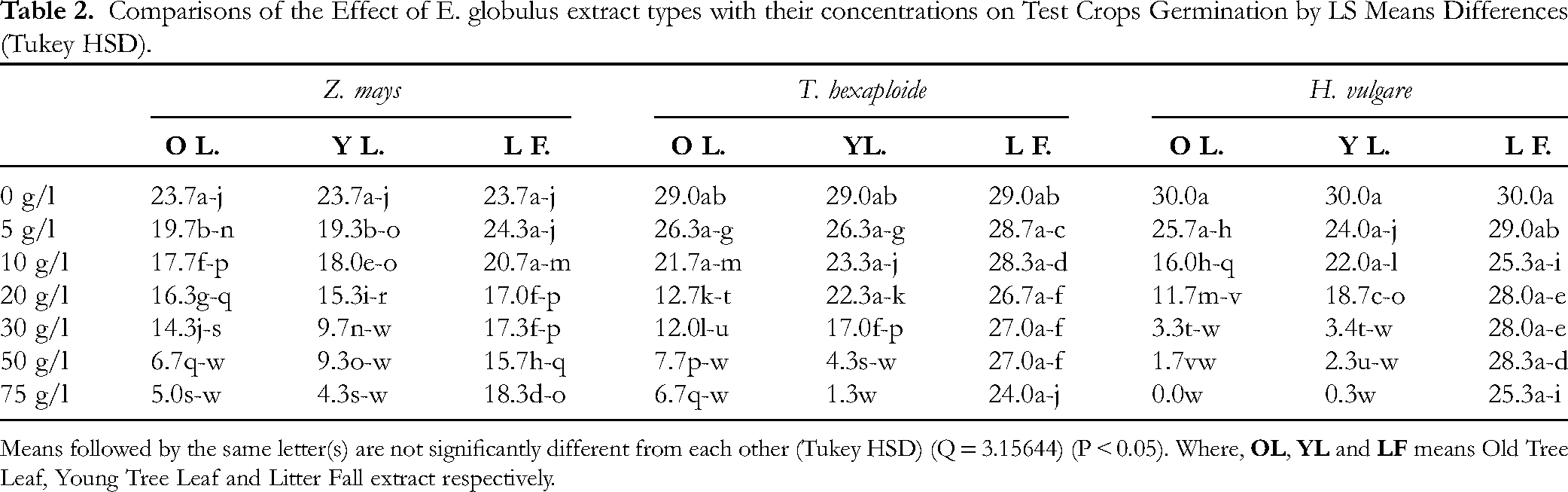
Means followed by the same letter(s) are not significantly different from each other (Tukey HSD) (Q = 3.15644) (P < 0.05). Where,
These results are in agreement with Djanaguiraman et al 28 The leaf leachates of E. globulus inhibited the seed germination of Black gram, Rice and Sorghum. The inhibitory effects were observed in all of the test crops however, among the concentrations the highest inhibition was observed in concentrated leaf leachates (20%). The magnitude of inhibition from leachates followed the order: Blackgram > Rice > Sorghum. Likewise, Djanaguiraman et al 29 observed that the aqueous extracts of E. globulus caused inhibition of seed germination in Greengram, Blackgram and cowpea. Previous bioassay studies showed that leaf extract concentration of Eucalyptus tree as low as 1% was sufficient to inhibit germination of test crops. 25
Total Germination Percentages (GP)
Different concentration of leaves and litter fall extracts of E. globulus found to have an inhibitory impact on Germination Percentages (GP) of the three test crops. The higher the concentration of the extract taken from old tree leaf, young tree leaf and litter fall of E. globulus plants, the lesser the percentage of seeds germinated in the petri dishes. The impacts of different extracts of E. globulus on germination of crops were not identical. Similar results were obtained by Wasihun, 8 who found the inhibitory effect of Eucalyptus on germination and early seedling growth performance of agricultural crops. The impacts of old and young tree leaves extracts appeared more or less similar. But, the impacts of litter fall extracts on the germination were not as serious as old and young tree leaves extracts. Very less impact on germination percentages was observed in litter fall compare to old and young tree leaves extract. The leaves and litter fall extracts of E. globulus were acting differently in affecting the germination percentages of the three crops (Figure 2).

The effect of old tree leaves, young tree leaves and litter fall extracts of E. globulus on total seed germination percentage of the three study crops.
Germination percentages of targeted seeds (Z. mays, T. hexaploide and H. vulgare) were negatively affected by different concentrations of aqueous extracts from foliage tissues of E. globulus. The maximum germination percentage was reached in distilled water (control) for all tested seeds. Germination was progressively inhibited with increasing concentration of foliar dry powder aqueous extract of E. globulus. However, the sensitivity of the different seed crops and characters to aqueous extract of E. globulus varied (Figure 2).
The inhibition of germination and shoot length by extracts of E. globulus may be due to the presence of higher amount of volatile chemicals (α-pinene, β-pinene, α-phellandrene and cineole) or phenols like ellagic, chlorogenic, p-coumarylquinic, gentistic and gallic acid. 30 These phenolic compounds thought to have interfered with the phosphorylation pathway or inhibit the activation of ATPase activity or decreased synthesis of total carbohydrates, proteins and nucleic acids (DNA and RNA) or interfere in cell division, mineral uptake and biosynthetic processes. 31
Mean Germination Time (MGT) and Germination Index (GI)
It was found that more and more time required for seeds to germinate as the concentration of E. globulus leaves and litter fall extracts increases (Figure 3).
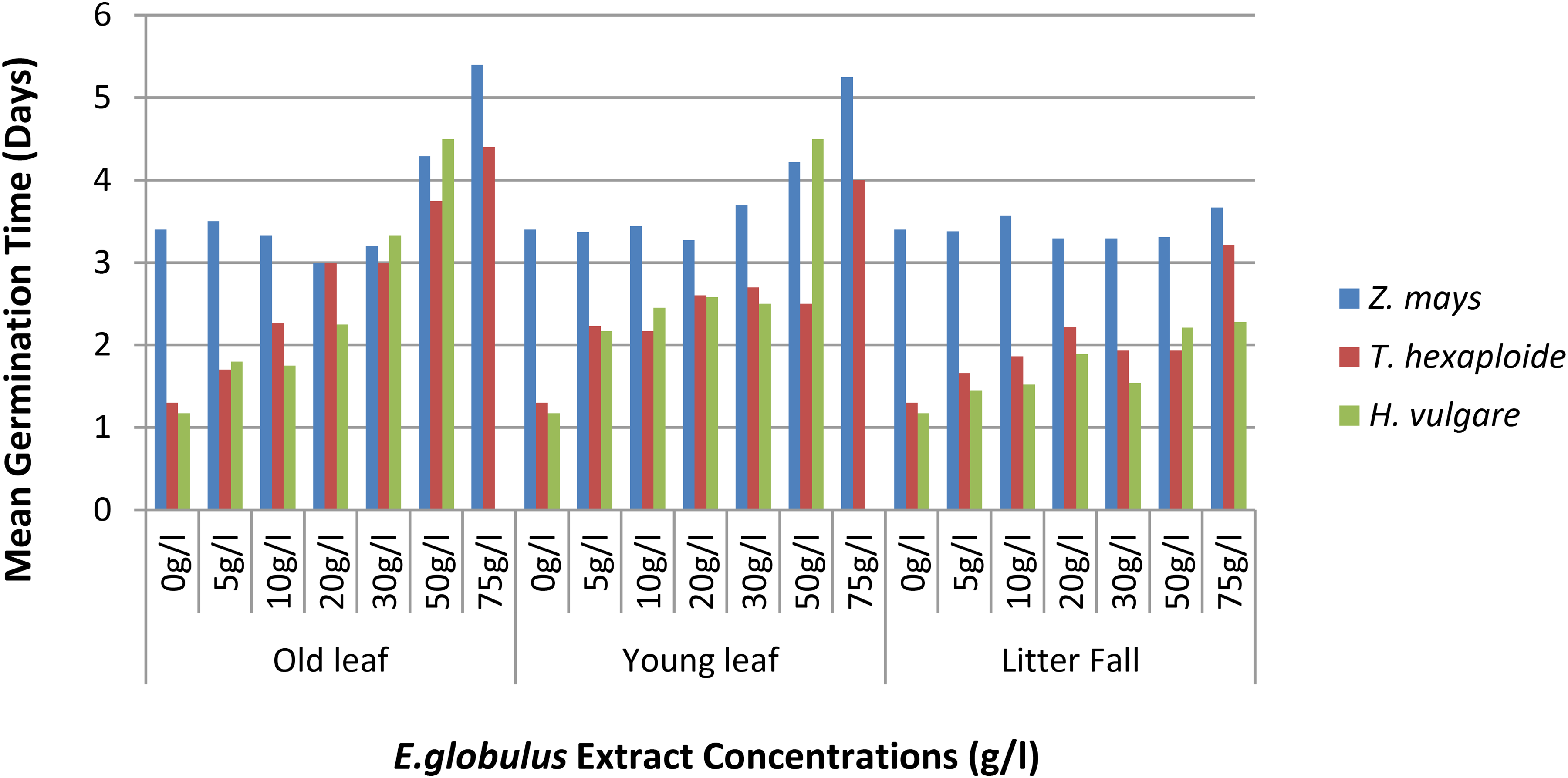
The effect of old tree leaves, young tree leaves and litter fall extracts of E. globulus on the Mean Germination Time (MGT) of the three crops seeds.
The impact of old tree leaves was also showed more inhibition effect than young tree leaves and litter fall extract. This showed that as the E. globulus plant gets older and older its allelopathic potential becomes more in delaying time of seed germination on nearby crops (Figure 3). This result is in line with the study of Morteza et al, 27 who reported as the effect of E. camaldulensis extract reduce the rate of germination of study species Vicia villosa, Onobrychis sativa, Festuca arundinacea and Trifolium rigidom. Similar result was obtained by Rassaeifar et al 24 on the impacts of E. globulus on weeds (Amaranthu sblitoides and Cynodon dactylon). Likewise, Gurmu, 25 stated that the mean germination time (MGT) of maize and haricot bean seeds was significantly prolonged (P < 0.01).
Germination Index (GI) measures the rate of seed germination or the number of new seeds that can be germinated per given time. The result found, the rate of germination was diminished as the concentration of E. globulus extract increased (Figure 4).

The effect of E. globulus extracts on GI of the three crop seeds.
These results were also in line with the works of Muhammad et al 32 who revealed that the extract of E. camaldulensis concentration inhibited the germination percentages, the rates of germination and dry weights of wheat seedlings. The presence of allelochemicals negatively affects the neighboring plants. 24 also revealed that the extracts of E. camandulensis delayed germination significantly in the receptor plant compared to the control.
Allelopathic Effects on Seedling Growth of Test Crops
The analysis of variance results showed that there were significant differences between the impacts of leaves and litter fall extract on shoot and root growth of all the test crop species (P < 0.01). Thus, we can say inhibitory effect of E. globulus extracts on early growth of crops were statistically significant (P < 0.05) and concentration dependant with high correlation coefficient (R2 = 0.93). Similar results were reported by Rassaeifar et al 24 as they reported E. globulus’ essential oil had significant effect on seedling growth of two weeds, Amaranthus blitoides and Cynodon dactylon. Their results also demonstrated that Amaranthus blitoides were more influenced than Cynodon dactylon. The result of Morteza et al 27 also indicated that there were significant differences among of root and shoot length of test plants treated with E. camaldulensis extracts and strong correlations with concentration.
The total germination, shoot and root growth of the three crops were highly inhibited by the rise in concentration of E. globulus leaves and litter fall extracts (Figure 5). Among the three parameters root growth of the three crops were more inhibited than shoot elongation. Similar result was stated by Djanaguiraman et al 29 that, the aqueous leaf extract of E. globulus inhibited the shoot and root growth of green-gram, black-gram and cowpea. The result of Gurmu, 25 on the effects of aqueous extracts of Eucalyptus on germination and radicle elongation indicated that root elongation was much more inhibited than shoot elongation of the two experimental crops. They also reported as root growth and lateral root development was more sensitive and responds more strongly to concentration of aqueous extract. According to, 32 comparatively root growth inhibition considered as more sensitive and better indicator of impacts.

Mean differences between the rates of the germination and seedling growth versus extract concentration. Similar letters do not show significant differences (LS Means DifferencesTukey HSD) (P < 0.05).
According to Tripathi et al 33 it was observed that the contents of chlorophyll in their study crops were also reduced significantly in all the treatments due to the allelopathic effect. The reduction in chlorophyll contents observed in all concentrations might be due to (a) degradation of chlorophyll pigments or reduction in synthesis and (b) the action of flavanoids, trepenoids or other phytochemicals present in leaf leachates. Reduction in chlorophylls may decrease the photosynthesis and thereby substantially decrease all the metabolites, total sugars, proteins and soluble amino acids. This could be one of the reasons for the decrease in seedling growth.
Extracts Effect on Seedling Vigour Index
The leaves and litter fall extract of E. globulus inhibit the Seedling Vigour Index of the three crop types. The seedling vigour index was reduced with corresponding increase in leaf and litter fall leachates concentration of E. globulus as compared to control (Table 3).
Comparing means difference between the allelopathic impacts of E. globulus extracts on seedling vigour index of the three crop types with the control.

Among the three studied crops, the inhibition impact of E. globulus leaves leachates on the Seedling vigour index of Z. mays was more serious and highly affected than others crops. The seedling viguor index of Z. mays, that shows the energy of crop seeds to germination and growth were highly inhibited. This might be due to the different in ecological adaptation. Z.mays is more of a hot climate crop and E. globulus is a cold zone tree, it needs more time to grow due to ecological adaptation problem. This means, Z. mays could have faced more difficulties to cope up with E. globulus leaf extract impact on seedling growth index (Table 3).
29 found a similar type of result, that E. globulus reduced the vigour index in greengram, blackgram and cowpea. A similar inhibitory effect of Digera muricata on sorghum was reported by Karthiyayini et al 34 The reduction in seedling vigour index in all the test crops was due to reduced germination and shoot length. The bioassay study of Sasikumar et al 35 on allelopathic effects of four Eucalyptus species on Redgram (Cajanus cajan L.) also revealed the significant reduction in germination over control, in all the cases, of 7 days after sowing. Lack of characterization and identification of the chemical composition of the leaf extract of E. globulus can be taken as the limitation of this study.
Means followed by the same letter(s) are not significantly different from each other LS Means Differences (Tukey HSD) (Q = 3.15644) (P < 0.05). For all mean values SE = ±0.65. Where,
This result was coinciding with the bioassay study of Djanaguiraman et al 28 on the leaf leachates of E. globulus caused significant reduction in seedlings growth and seedling vigour index as on blackgram, rice and sorghum. This study agreed with the study of Morteza et al 27 where different leaf extract concentrations of E. camaldulensis were significantly reduced seedling vigour index of Vicia villosa, Onobrychis sativa, Festuca arundinacea and Trifolium rigidom. The highest and lowest seed vigor was found in control and 100% extraction respectively. Djanaguiraman et al 29 also found the same type of result, that E. globulus reducing vigour index in greengram, blackgram and cowpea. A similar inhibitory effect of Digera muricata on sorghum was also reported by Karthiyayini et al 34 The reduction in seedling vigor index in all the test crops could due to reduced germination as well as shoot elongation.
Effect of E. globulus Under Canopy Soil on Germination of Crops
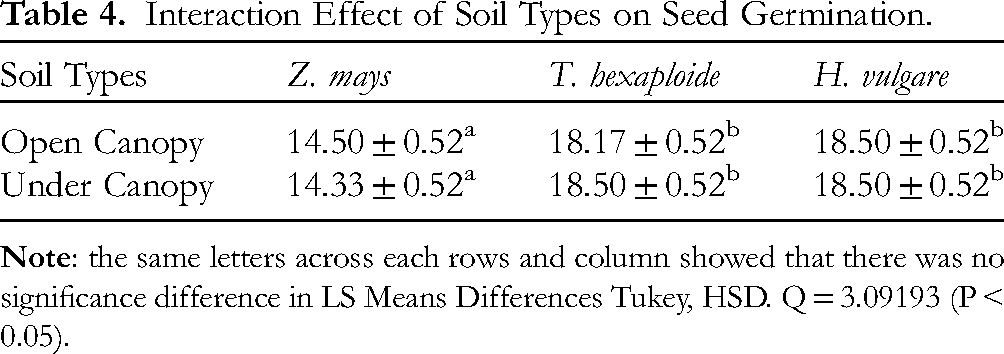
Soil under E. globulus Canopy has no effect on seed germination of Z. mays, T. hexaploide and H. vulgare. The Analysis of Variances results showed that there was no significant difference between the E. globulus under canopy soil from the control group on germination of crops. So, the type of soil (weather it is under canopy or open canopy of E. globulus trees) couldn’t be the factor for the absence of herbs in E. globulus plantations. There was significant difference between crops capacity on the rates of germination in the soil (P < 0.05) (Table 4).
Interaction Effect of Soil Types on Seed Germination.
This result is in agreement with the study of Selamyihun, 32 which revealed that, none of the treatment effect of soil farms from open and under canopy of E. globulus significantly influenced the percentages of seed germination of the test crops. The study showed that the percentages of seed germination of Teff and Chickpea in response to soil from open field and soil from under the tree canopy were not apparent and were not significantly different from each other.
From the above means comparison soil from under canopy showed no any effect on the seed germination of the three test crops as compared to open area (reference) soil. The number of germinated seeds of T. hexaploide and H. vulgare were almost the same and greater in number of seeds germinated than Z. mays. The difference between crops on the number of germinated seeds is because of ecological difference.
This result found to support the work of Feyera and Demel, 36 as regeneration of indigenous woody species under the canopies of exotic tree plantations. They reported as the highest number of naturally regenerated woody species (27 species) was recorded under the canopy of E. globulus and Juniperus procera plantations and the density of naturally regenerated woody species under E. globulus was also highest. Together with these findings the present study challenges the old notion of ‘Eucalyptus does not allow the regeneration of other plants under its canopy’. 8 As their field experiment reported the allelopathic potential showed no significant difference in survival and different growth parameters of tomato planted at varying distances from E. camaldulensis tree. Similarly, there were reports about the insignificant allelopathic effect of Eucalyptus under canopy soil on the survival of tomato seedling, 37 and on other agricultural crops. 8
Effect of E. globulus Canopy Soil on Seedling Growth of Crops
The result of data analysis showed that there was no significant difference between the impacts of Soil from under Canopy and open canopy of E. globulus on the seedling growth of the three types of crops (Figure 6). The Soil from under Canopy of E. globulus had no effect on the seedling growth of the three crops compared to the effect of soil from open canopy (P < 0.05). But, there is significant difference between crop types based on their genetic, ecology and seedling size variation without relating to soil type difference.

The effect of soil types on Shoot and Root growth of crops. Both soil depths and being open and under canopy soil of E. globulus trees had no significant effect on the shoot and root growth of the three crops. There was only shoot and root growth difference between crops (P < 0.05). For all mean values SE = ±0.25.
This result is coincided with the study of Selamyihun (2004), 32 which revealed that differences in seedling growth (shoots and roots length) due to the two locations of soils (soil from open field and under canopy of E. globulus trees) were not significant. In contrary to this study, soil collected from under canopies of Eucalyptus inhibited germination and early growth of associated plant species. 3
This suggested that the impact of allelochemicals present in E. globulus not only varied in the edges of the tree and extract concentrations, but also it has reduced or absent in the soil. The allelochemicals might have been leached out of the soil during rainy season or biochemically degraded by microbes. According to Kamal, 10 the soil microbial population and the soil physical and chemical interactions could make the allelochemicals rendered inactive, depending on the nature of the adsorbing surface. Soil samples taken in different seasons might have different concentrations of allelochemical compounds. According to Watson, 38 the allelochemicals accumulate in the soil until the first rains, then after the rainfall leaches the toxic compounds from the soil. Thus, soil after harvesting Eucalyptus plantation does not inhibit both germination and growth of crops.
Conclusion and Recommendation
Conclusion
Young tree leaves, old tree leaves and litter fall extract of E. globulus had allelopathic effect on cereals. The concentrations of those extract had an inhibitory impacts on seed germination percentages (GP); delayed rate of germination and germination index (GI).
The leaves and litter fall extracts of E. globulus affect different crops differently. Lowland crops like Z. mays were affected more seriously than highland crops, T. hexaploide and H. vulgare. Among the three crops, the native H. vulgare became more tolerant or relatively resist the impact. From this observed tested crops tolerance, it is possible to conclude that allelopathic effect of E. globulus can be adapted by crop species after longer period of time.
The allelochemicals found in E. globulus leaves and litter fall could be water soluble and cannot be accumulated in soil or broken down by soil microbes unable to have long term impacts on crops. Thus, we recommended that E. globulus to be used in integrated land use management and agro-forestry systems in the highlands controlling other effects.
Footnotes
Acknowledgements
We would like to acknowledge Bahir Dar University for financial supports.
Data Availability Statement
The data for all of analysis are available and can be provided when needed
Declaration of Conflicting Interests
The authors declared no potential conflicts of interest with respect to the research, authorship, and/or publication of this article.
Funding
The authors disclosed receipt of the following financial support for the research, authorship, and/or publication of this article: Bahir Dar University, Ethiopia covered the data collection expense (grant nos. 00124 and 2021).
