



Abstract
Introduction
Ginseng's bioactive components can cross the placental barrier and influence offspring through lactation; however, their effects on development remain unclear.
Methods
This study used specific pathogen-free (SPF) Sprague-Dawley rats, divided into four groups: control, 31.3 mg/kg·bw, 125 mg/kg·bw, and 500 mg/kg·bw. Ginseng extract was administered by gavage during gestation and lactation. Maternal body weight, offspring growth, developmental milestones, sensory-motor abilities, learning-memory performance, and tissue pathology were assessed.
Results
We found that female rats in the 500 mg/kg·bw group exhibited smoother, glossier fur from day 36 onward. Offspring in this group showed increased escape behavior and hyperactivity between postnatal days 5–11. Significant maternal weight loss occurred in the 125 mg/kg·bw and 500 mg/kg·bw groups. In the 500 mg/kg·bw group, female offspring exhibited delayed incisor eruption and temporary weight loss, which recovered post-weaning. Righting reflex times were shortened in the 31.3 mg/kg·bw group but prolonged in the 500 mg/kg·bw group. Female offspring in the 31.3 mg/kg·bw group displayed increased forelimb suspension time and greater running endurance. Male offspring in the 125 mg/kg·bw group demonstrated improved target quadrant latency and spatial exploration.
Conclusion
These results suggest that ginseng extract has dose-dependent and sex-specific effects on maternal physiology and offspring development.
Keywords
Introduction
Ginseng is a perennial herb that has held a significant place in traditional medicine due to its outstanding medicinal value. Modern research has shown that ginseng possesses a variety of pharmacological effects, including anti-inflammatory, antioxidant, and protective functions for the cardiovascular system and liver, among others. 1 Furthermore, studies have confirmed that ginseng has certain effects on weight loss. 2 Seul et al 3 found that after two weeks of gavaging rats with ginseng leaf extract, the number of adipocytes in the rats significantly decreased. Ning et al 4 observed that after three weeks of intraperitoneal injection of ginsenoside Rb1 in obese mice, their body weight significantly decreased. Leptin, a hormone secreted by adipocytes, primarily functions to regulate appetite and maintain energy homeostasis. 5 Research has shown that ginseng extract can lower leptin levels in mice fed a high-fat diet and reduce leptin resistance in obese mice. 6 Ginseng also has the ability to enhance physical performance and alleviate physical fatigue. Mice fed with red ginseng showed a significant improvement in swimming endurance after 28 days. 7 After four weeks of administration of Changbai Mountain ginseng in mice, glycogen levels in the liver and muscles increased, lactate content decreased, and both swimming and grip endurance were notably enhanced. 8 Ginseng can also improve exercise-induced fatigue by modulating the gut microbiota. Oral administration of ginseng extract has been shown to significantly improve abnormalities in energy metabolism, disturbances in fatty acid and lipid metabolism, and gut microbiota dysbiosis, demonstrating strong anti-fatigue effects. 9 Additionally, several studies have indicated that ginseng enhances learning and memory abilities. Alzheimer's disease (AD) is a progressive neurodegenerative disorder that often leads to declines in learning, memory, and cognitive functions. Junho et al 10 found that ginsenoside F1 is an effective candidate for developing therapeutic drugs for AD. Kezhu et al 11 demonstrated that ginsenosides not only improve learning and memory in rats but also effectively alleviate cognitive dysfunction induced by chronic restraint stress. Kyu et al, 12 by comparing wild ginseng to regular ginseng, found that wild ginseng contains more active ginsenosides, and its effects on improving learning and memory are superior to those of regular ginseng.
Currently, research on ginseng mainly focuses on its effects on direct consumers. However, it is important to note that the active components of ginseng can cross the placental barrier and potentially affect both the mother and the fetus. 13 With the improvement of living standards, the consumption of ginseng has been increasing year by year. In particular, the development of ginseng-containing health supplements has expanded the application prospects of ginseng. This has also increased the likelihood of inappropriate or excessive consumption, especially the potential effects of ginseng misuse by pregnant and postpartum women on their offspring, which remain unknown. Therefore, it is crucial to investigate the effects of ginseng on the mother and her offspring. While existing studies have demonstrated various physiological effects of ginseng on the mother, whether ginseng impacts offspring—especially in terms of development, motor abilities, and learning and memory—remains an urgent topic for further exploration. This study will use an animal model, continuously exposing SD rats to ginseng extract during the gestation and lactation periods, to further investigate the effects of ginseng consumption by maternal rats on their offspring, particularly in terms of weight management, growth and development, motor abilities, and learning and memory.
Materials and Methods
Experimental Materials and Equipment
The ginseng extract used in the experiment was a water extract, with the key active component, ginsenoside content, standardized at 5%. All health indicators met the required standards. The instruments used in the study included the BP20D electronic balance, YLS-13A grip strength measurement device, YLS-15A rat treadmill, and SLY-WMS 2.1 Morris water maze.
Experimental Animals and Environment
SPF-grade SD rats were selected for the experiment, including 100 female rats aged 8 weeks (weighing 180-210 g) and 50 male rats aged 11 weeks (weighing 300-340 g). Purchased from Beijing Weitong Lihua Experimental Animal Technology Co.Experimental Site: Animal Housing of the Chinese Center for Disease Control and Prevention.The environmental conditions were as follows: temperature (°C): 20–23 °C; humidity (%): 40–70%; light intensity (lx): 15–20 lx; ventilation rate: ≥ 15 times/h; noise level (dB(A)): ≤ 60 dB.
This study was approved by the Animal Experimental Ethics Committee of Institute of Nutrition and Health, Chinese Center for Disease Control and Prevention.(NHPF07–41–01)Confirms that all experiments were performed in accordance with relevant named guidelines and regulations.
Animal Grouping and Dosing
After a 3-day acclimatization period, F0 generation rats were paired at a 2:1 ratio. The presence of a vaginal plug was considered as a successful mating indicator, marking the start of gestation (GD) day 0. According to OECD TG426, female rats with confirmed pregnancies were randomly divided into four groups: control group, 31.3 mg/kg·bw, 125 mg/kg·bw, and 500 mg/kg·bw group, with 20 rats in each groups, the control group serving as a blank control. Dose selection was based on prior studies showing NOAEL > 2000 mg/kg·bw for similar ginseng extracts, ensuring safety margins for the highest dose. 14 Four days after offspring birth, the litter size was standardized to 8 pups per cage, with an equal male-to-female ratio. After weaning, the number of pups were standardized to 20 per group, by randomly selecting one pup from each cage and maintaining an equal male-to-female ratio. In order to control for confounding factors, the locations of the random cages were varied while keeping the observers fixed.The experimental design of this study and the determination of the sample size of experimental animals were based on OECD Test No. 426: Developmental Neurotoxicity Study, with individual experiments appropriately expanding the sample size. 15
Observation and Recording
Pregnant female rats were gavaged with the test substance from the time of successful mating (GD 0) until the end of the lactation period (PND 21). The body weight changes of the mother rats were observed and recorded. The body weight changes and growth development of the offspring were monitored, with developmental milestones such as ear canal opening, eruption of incisors, eye opening, vaginal opening, and descent of the testes used as indicators of offspring growth. Sensory-motor abilities of the offspring were assessed through the righting reflex test, auditory startle test, and hot plate test. Motor abilities were evaluated using the forelimb suspension test and exhaustion test. Learning and memory abilities in the offspring were measured using the Morris Water Maze (MWM) experiment. 16 The reporting of this study conforms to the ARRIVE 2.0 guidelines. 17
Histopathological Examination
Pathological sections were prepared for histopathological examination. First, a comparison was made between the 500 mg/kg·bw group and the control group. If no pathological changes were observed in the 500 mg/kg·bw group, no further analysis was conducted. However, if pathological changes were found in the 500 mg/kg·bw group, further comparative analysis was performed.
Statistical Analysis
The results were analyzed using the statistical software SPSS 26. First, the variables were tested for normality. When the data followed a normal distribution, the results were expressed as mean ± standard deviation (x̄ ± s), and homogeneity of variance was assessed using Levene's test. If Levene's test indicated no significant deviation, one-way analysis of variance (ANOVA) was used to compare group means, followed by LSD post-hoc tests for pairwise comparisons. For datasets with unequal variances, the Dunnett T3 test was applied. When the variables did not meet the normal distribution assumption, the median and interquartile range (M (P25∼P75)) were used, and the non-parametric Mann-Whitney U test was employed. Weight results were analyzed using repeated measures ANOVA. A P-value of < 0.05 was considered statistically significant.
Results
Effects of Ginseng Extract on Maternal Rats
Clinical Observation of F0 Generation
No mortality was observed during the dosing period. There were no signs of toxicity in any of the dose groups. Female rats that were given 500 mg/kg·bw dosage exhibited smoother and glossier fur from day 36 post-gavage until the end of the experiment. No abnormalities were observed in activity levels or daily behaviors across all dose groups.
Body Weight Changes in F0 Generation
During the gestation period, no significant differences were observed in the body weight of maternal rats across the ginseng extract dose groups compared to the control group. As shown in Figure 1, during the lactation period, compared to the control group, the 125 mg/kg·bw group exhibited a significant decrease in body weight (p = 0.038), and the 500 mg/kg·bw group also showed a significant weight reduction (p = 0.017) with the dose-response relationship.

F0 Generation Weight Changes During Pregnancy (GD 0-21) and Lactation (PND 0-21) [Data are Presented as Mean ± SD for Gestation Period (n = 20/Group) and Median (Q1-Q3) for Lactation Period (n = 20/Group).* Indicates a Significant Difference Compared to the Solvent Control Group, P < 0.05].
Effects of Ginseng Extract on Offspring
Clinical Observation of F1 Generation
No mortality was observed in any of the dose groups, and all animals maintained normal eating and drinking behaviors. In the 500 mg/kg·bw group, the offspring exhibited an escape preference between PND 5 and 11, making them difficult to catch, with a noticeable increase in activity levels. After day 11, their behavior returned to normal. No other abnormal changes were observed.
Body Weight Changes in F1 Generation
As shown in Figure 2, Before weaning, compared to the control group, the 500 mg/kg·bw group showed a significant decrease in body weight in female F1 offspring (P = 0.004). At all other time points, no significant differences in body weight were observed between the dose groups and the control group. After weaning, no statistically significant differences in body weight changes were observed between the dose groups and the control group.
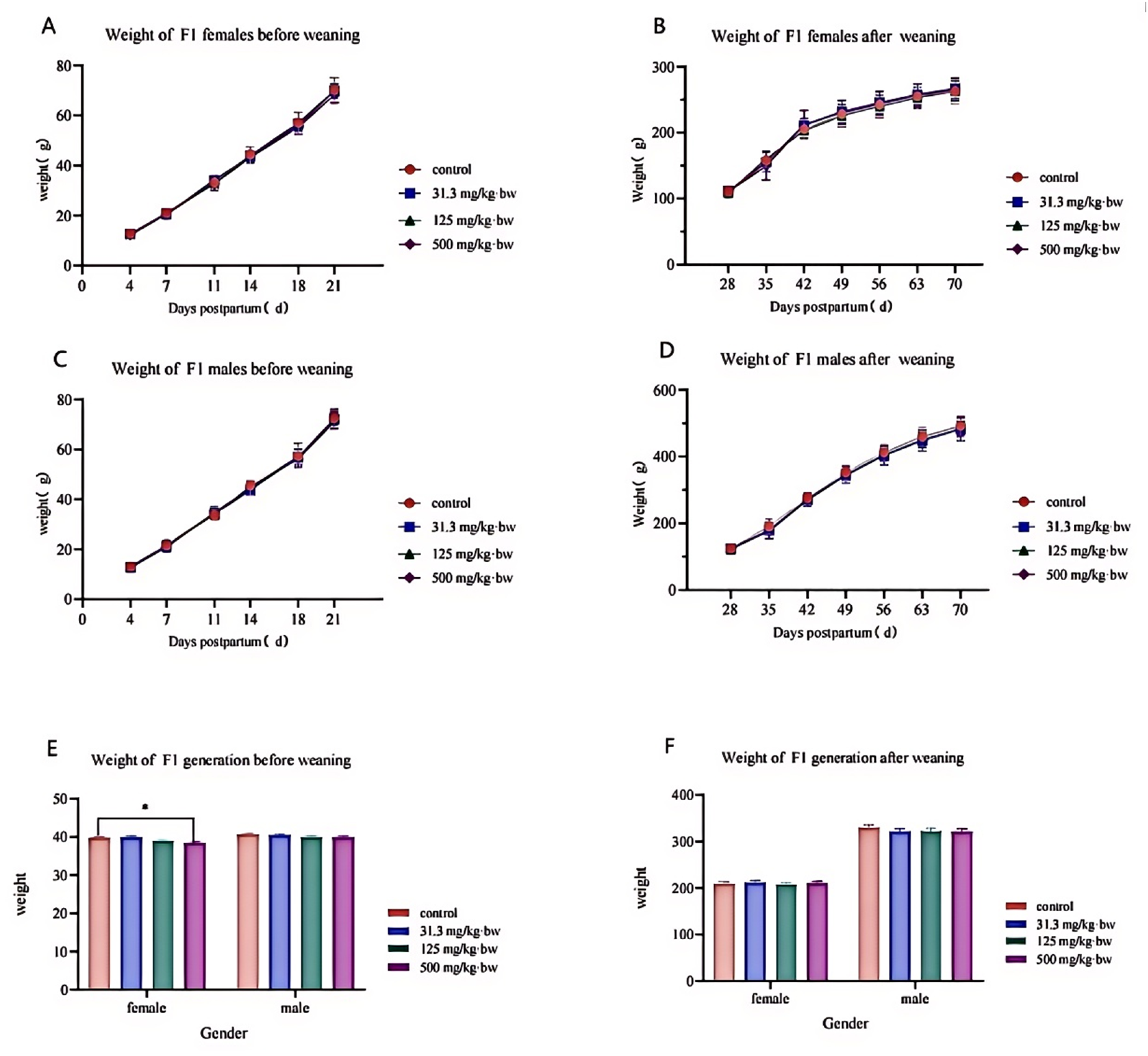
F1 Offspring Weight Changes during Pre-weaning (PND 0-21) and Post-Weaning periods [Data are Presented as Median (Q1-Q3) for female (n = 80) and Male (n = 80) Offspring during Pre-weaning Period, and Mean ± SD for Female (n = 10) and Male (n = 10) Offspring Post-weaning. * Indicates a Significant Difference Compared to the Control group, P < 0.05].
Development and Sensory-Motor Abilities of F1 Generation
As shown in Table 1, compared to the control group, the eruption time of incisors in the 500 mg/kg·bw group offspring was significantly delayed (P = 0.013). In the 31.3 mg/kg·bw group, the righting reflex time was shortened (P = 0.042). The righting reflex time was delayed in the 500 mg/kg·bw group of pups (P = 0.038). As shown in Figure 3, Female F1 offspring in the 31.3 mg/kg·bw group exhibited a significantly longer hot plate response time at PND 21 compared to the control group (P = 0.021). No other results were statistically significant.

Sex-Specific Effects of ginseng Extract on Thermal Pain Sensitivity in Offspring at PND 21 and PND 70 (hot Plate Test)[Data are Presented as Median (Q1-Q3) for Male and Female Offspring (n = 10/sex/Group/Time Point). * Indicates a Significant Difference Compared to the Solvent Control Group, P < 0.05].
Observational Results of Individual Development in F1 Generation Animals[Data are Presented as Mean ± SD for Vaginal Opening (n = 10) and Testicular Descent (n = 10), and Mean ± SD for Other Parameters (n = 160)].

Note: * indicates a significant difference compared to the solvent control group, P < 0.05.
Motor Abilities of F1 Generation
As shown in Table 2, compared to the control group, the forelimb suspension time in female offspring in the 31.3 mg/kg·bw group was significantly increased (P = 0.035). After weaning, the running distance of female offspring in the 31.3 mg/kg·bw group was significantly increased (P = 0.027). No other results were statistically significant.
Motor Ability Assessment in F1 Generation Offspring [Data Presented as Median (Q1-Q3) for Forelimb Suspension (n = 80/sex/Group) and Running Distance (n = 10/sex/Group)].

Note: * indicates a significant difference compared to the solvent control group, P < 0.05.
Learning and Memory Abilities of Rat Offspring
As shown in Figure 4,The results of the spatial exploration experiment in adult rat offspring showed that the number of platform crossings in male offspring in the 125 mg/kg·bw group was significantly increased compared to the control group (P = 0.029). The results of the hidden platform experiment in adult rat offspring, regarding the percentage of time spent in the target quadrant, showed a significant difference in the latency time to the target quadrant in male offspring in the 125 mg/kg·bw group compared to the control group (P = 0.049). No other results were statistically significant.

Sex-specific Effects of Ginseng Extract on Learning and Memory Abilities in Offspring (Morris Water Maze Test) [Data are Presented as Median (Q1-Q3) for Space Exploration (n = 10/sex/group) and Mean ± SD for Stealth Platform Target Quadrant Latency (n = 10/sex/group).* Indicates a Significant Difference Compared to the Solvent Control Group, P < 0.05].
Histopathological Examination Results
Paraffin-embedded sections of the heart, liver, kidney, and brain were prepared from post-weaning rats and stained with hematoxylin and eosin (H&E). As shown in Figure 5, The results showed that in all dose groups, the heart tissue of the rat offspring was intact, with myocardial fibers arranged neatly and normal interstitial space. Liver tissue was intact, with liver cords radiating from the central vein, and hepatic sinusoids showed even distribution of blood cells with no dilation or inflammatory cell infiltration. Kidney tissue had an intact capsule, with clear boundaries between the cortex and medulla, and the glomeruli were clearly structured and intact, with no edema. Brain cells had intact morphology and were neatly arranged, with normal tissue structure.

Representative H&E-Stained Sections of major Organs from Weaned Offspring. [From Left to Right: Heart; Liver; Kidney; Brain. Scale bar = 100 μm. No Significant Pathological Alterations Were Observed in any Groups].
Discussion
Ginseng has been shown to reduce the body weight of mice and rats, demonstrating certain anti-obesity effects. For instance, Li et al 18 reported that red ginseng extract reduced the body weight of obese mice induced by a high-fat diet. Yonglin et al 19 observed a significant decrease in body weight in mice after oral administration of 120 mg/kg·bw ginsenoside compound K for 26 weeks. According to the literature, the mechanism behind this effect may be the inhibition of pancreatic lipase activity by ginsenosides, which slows down intestinal fat absorption. 20 Zhang et al 21 further confirmed that ginseng could alter phospholipid and free fatty acid levels, thereby regulating lipid metabolism disorders and promoting lipolysis. Our study also confirmed that ginseng extract could reduce maternal body weight, which is consistent with the findings of the aforementioned studies. Additionally, we found that ginseng extract caused a reduction in the body weight of female offspring, which may be related to the transfer of active components of ginseng through the maternal milk. After weaning, the body weight of female offspring returned to normal, indicating that the effect of ginseng extract might be temporary and reversible.
Ginseng has been shown to promote bone formation and inhibit bone resorption. 22 Ma et al 23 confirmed that ginsenosides could alleviate osteoporosis in mice by inhibiting osteoclastogenesis. Clinical studies have found that after 12 weeks of continuous administration of 3 g of ginseng extract, bone formation in women with reduced bone mass improved significantly. 24 In our study, the 31.3 mg/kg·bw group
of rat offspring showed a slight advance in the eruption time of incisors, but it did not reach statistical significance, while the 500 mg/kg·bw group exhibited a significant delay in incisor eruption. This suggests that high-dose ginseng extract may have adverse effects on the skeletal development of offspring.
Ginseng has been shown to regulate pain perception and exhibit analgesic effects. 25 Mechanistic studies suggest that this may be related to ginseng's modulation of dopamine D2 receptors and anti-inflammatory cytokines. 26 Choi et al 27 confirmed that 100 and 200 mg/kg·bw ginsenoside Rf significantly enhanced the heat tolerance time in mice during the hot plate test. In our study, 31.3 mg/kg·bw ginseng extract increased the heat tolerance of female rat offspring, but this effect was not observed at the 125 mg/kg·bw or 500 mg/kg·bw. This suggests that the enhancement of heat tolerance in offspring by ginseng extract is a low-dose excitatory effect. After weaning, when offspring were no longer exposed to the ginseng extract, there was no difference in heat plate response time compared to the control group, indicating that the analgesic effect of ginseng extract in offspring is reversible.
Ginseng has been shown to enhance physical performance and alleviate fatigue. Animal studies have found that administering 400 mg/kg·bw ginseng extract for 30 days to mice increased their swimming duration. 28 The mechanism behind this phenomenon may be that ginseng regulates mitochondrial function, thereby enhancing physical performance. 29 Mitochondria in skeletal muscles experience a decline in ATP levels and an increase in reactive oxygen species with aging, which leads to mitochondrial dysfunction and impaired motor function. 30 Additionally, the small molecular peptides in ginseng, such as ginseng oligopeptides (QOPs and GOP), are also factors contributing to improved physical performance. These peptides increase lactic acid dehydrogenase activity and liver glycogen levels, inhibit oxidative stress, and alleviate fatigue.31‐32 Human studies have confirmed that supplementation with ginseng extract can reduce fasting blood triglycerides and oxygen consumption during aerobic exercise in male recreational athletes, thereby enhancing performance. 33 Our study similarly found that ginseng extract improved the physical performance of female rat offspring both before and after weaning, exhibiting a low-dose excitatory effect and gender differences.
Ginseng has been shown to enhance learning and memory. For example, mice that were continuously administered 100 mg/kg·bw red ginseng extract for 14 days, and rats that were orally given 20 mg/kg·bw ginsenosides for 70 days, demonstrated improved learning and memory in Morris water maze experiments.34,35 Research suggests that ginseng enhances learning and memory through its effects on the hippocampus. For instance, ginsenoside Rg1 down-regulates the expression of cell aging-related genes in the hippocampus of aging rats, thereby enhancing the hippocampal antioxidant and anti-inflammatory capacities to improve learning and memory. 36 Ginseng's effects on learning and memory may also be linked to Brain-Derived Neurotrophic Factor (BDNF), a neurotrophic protein mainly distributed in the central nervous system, which plays a crucial role in repairing neuronal damage and promoting neuronal growth. Songhee et al 37 found that wild ginseng root cultures could upregulate BDNF expression, improving memory deficits in mice. In this study, the Morris water maze results for adult offspring showed that ginseng extract improved rat offspring learning, memory, and spatial exploration abilities, with observed gender differences.
Limitations:This study has several limitations for clinical translation. First, ginsenoside metabolism differs between species - rodents show faster clearancethan humans, complicating dose extrapolation. Second, continuous exposure in our model may not reflect typical intermittent human use patterns during pregnancy. Third, while we identified clear behavioral changes in offspring, these rodent-specific endpoints require validation with human-relevant biomarkers. Finally, our high-dose findings exceed normal supplementation levels (1-3 mg/kg/day), warranting cautious interpretation. Future studies should examine placental transfer in pregnancy models and monitor developmental outcomes in clinical cohorts using standardized ginseng products.
Conclusion
Ginseng extract exhibits a certain role in the regulation of maternal rat body weight and the development of offspring, with notable gender differences observed. These findings demonstrate that ginseng extract exerts dose-dependent effects on offspring development, with particular clinical relevance in three key aspects: First, the observed low-dose enhancement of sensory-motor function (31.3 mg/kg) suggests potential benefits for neurodevelopment when used at appropriate doses, supporting further investigation of standardized ginseng supplements during pregnancy. Secondly, the high-dose effects (500 mg/kg) including delayed dental development and transient growth retardation highlight the importance of establishing safe upper intake limits for pregnant women. Most importantly, the sex-specific cognitive improvements in male offspring warrant careful consideration of ginseng's potential as a neurodevelopmental modulator, though this requires verification in human studies.
Footnotes

Ethical Approval Statement
This study was approved by the Animal Experimental Ethics Committee of Institute of Nutrition and Health, Chinese Center for Disease Control and Prevention.(NHPF07–41–01)The ethical approval number is 2021-NINH-IACUC-008. Confirms that all experiments were performed in accordance with relevant named guidelines and regulations.
Funding
The authors disclosed receipt of the following financial support for the research, authorship, and/or publication of this article: This study was supported by the Doctoral Research Start-Up Fund Project under grant X600100102.
Declaration of Conflicting Interests
The authors declared no potential conflicts of interest with respect to the research, authorship, and/or publication of this article.
Data Availability Statement
The data presented in this study are available on request from the corresponding author.