



Abstract
Introduction
Plants are vital to preserving our health and enhancing our standard of living. Many different natural plants were utilized medicinally by the original peoples of America. While people often use little doses of these herbs to self-treat a variety of common illnesses, it's interesting to know that they also contain phytochemicals, which are comparable to those found in fruits and vegetables and have health-promoting qualities. There are obvious botanical and chemical similarities among many of the commonly used herbs and vegetables by humans. 1 Celery, a plant in the Apiaceae family, has been used by people for many years as a food or medicine. The leaves, stems, roots, and seeds possess a unique taste and aroma that spreads throughout the whole plant. 2 These plant portions contain fragrant and therapeutic chemicals. The therapeutic properties of celery are ascribed to its flavonoids and essential oils, such as apigenin. Essential oils may be found in all sections of the plant, with seeds containing them up to 7% of the time and roots and leaves containing them up to 1%. The essential oils of celery have two main ingredients, D-limonene and selinene, which exist in both α- and β-forms. Additionally, santalol, apiol, myristicin, and α- or β-eudesmol are also present in celery's essential oils. 3 Celery's chemical composition includes carbohydrates and phenols such as flavonoids, alkali, and steroids. Celery is often used in traditional medicine due to its high content of selinene, flavonoids, furocoumarins glycosides, and limonene, as well as vitamins C and A.4–6
Celery is associated with a diverse array of living organism functions. These activities encompass the treatment of bronchitis, liver and lung debilitation, asthma, and chronic skin disorders like psoriasis, cardiovascular disease, diabetes, and high blood pressure. The treatments include antifungal, antibacterial, and antibiotic methods.4,7–10 Celery seeds include chemical components that possess anti-inflammatory and analgesic activities, as shown by Atta and Alkofahi. 11 The compound apigenin found in celery seeds has been shown to have anti-accumulation action in laboratory studies. 12 Furthermore, it prevents the thoracic aorta's isolated smooth muscle from contracting. 13 The sugar or amino acid side chains included in celery extract have a hypocholesterolemic action, largely via reducing total cholesterol levels through the promotion of bile acid excretion. 14 Furthermore, the phenolic chemicals found in different portions of celery include inherent antioxidant qualities that might serve as a substitute for synthetic antioxidants. Antioxidants are substances that are capable of delaying, inhibiting, or preventing oxidation processes. 15 However, manufactured antioxidants might possibly have harmful effects on living organisms. 16
Radiation preservation is a viable option for preserving celery, as is the well-known cold pasteurization technique.17,18 The directive 1999/3/EC included a wide range of minerals and food components that might be exposed to ionizing radiation. For dry aromatic spices, herbs, and vegetal excitements, the highest average absorbed dosage was 10 kGy. The FDA 19 states that the threshold for irradiation of herbs, spices, botanical extracts, and mixes, including these aromatic plants, has been set at 30 kGy. However, the effects of this treatment on changes in antioxidant capabilities, free radicals, and nutrient loss remain unclear. When subjected to radiation, the material's properties may change depending on the dose and particular components used. 20 This study looked at how gamma radiation affected the amount of bioactive ingredients, scavenging and antioxidant properties, and lipid peroxidation in celery seeds (Apium graveolens L.).
Materials and Methods
Materials
Celery Seeds
In Riyadh, Saudi Arabia, celery seeds were purchased at the neighbourhood market. Within the laboratory, then cleaned and dried in a heated air oven (Proctor and Schwartz Inc., Philadelphia, PA) for six hours at 50 °C. Dehydrated seeds were blended at high speed in a French Moulinex blender to produce a finely powdered material. In this experiment, only materials that cleared an 80-mesh filter were employed. The standardized powdered celery seeds were then exposed to radiation.
Chemicals
Sigma Chemical Co., situated in St. Louis, Missouri, provided the catechine (CA), α-tocopherol, trichloroacetic acid (TCA), potassium ferricyanide, thiobarbituric acid (TBA), DDPH (2,2-diphenyl-1-picrylhydrazyl), and butylated hydroxytoluene (BHT). The extra supplies, kits, and solvents that SOMATCO in Riyadh, Saudi Arabia.
Methods
Treatment with Gamma Irradiation
The King Abdulaziz City for Sciences and Technology in Riyadh used a γ-source (γ-Chamber 900) containing Cobalt 60 (60Co) to expose celery seed powder to radiation under normal environmental conditions. The levels of exposure were 0.0, 2.0, 4.0, 8.0, and 16.0 kGy at a rate of 1.9 kGy/h. A control group of celery seeds powder was not subjected to irradiation.
The Process of Creating an Extract from Celery Seeds Powder (Celery Seeds)
Abd Elalal et al 21 used celery seeds to create a methanol extract. A total of 20 grams of dehydrated celery seeds were mixed with 180 millilitres (80%) of methanol (MeOH) using a detour shaker (Heidolph GmbH, Germany). After that, the mixture was put in a tumbler and allowed to agitate for an hour at ambient temperature at a speed of 200 rpm. Whatman No. 1 sieve paper was used to filter the extract in order to remove any last bits of debris. Two further extractions were carried out on the remaining residue before the findings were combined. A rotary evaporator (Heidolph GmbH, Germany) was running at 45 °C and used to remove the leftover solvent.
Components with Biological Activity
The Overall Amount of Phenolic Compounds
The study conducted by Wolfe et al 22 employed the assay to measure the overall polyphenolic content in celery seeds using the Folin-Ciocalteu combination. A quantity of 200 mg of the chemical was isolated by using 2 mL of a solution consisting of 80% methanol (MeOH) and 1% hydrochloric acid (HCl). The separation process took place for two hours on a detour shaker, which was stationary at a speed of 200 rpm. Following centrifugation of the mixture with a force of 1000 times the acceleration due to gravity for 15 min., the upper phase was divided into containers with a volume of 4.0 mL each. The pellets were aggregated for investigation of total phenolics. After 90 min at a temperature of 22 °C, the mixture was combined with a concentration of 60 g/L of Na2CO3. The transmission density was measured at 725 nm. The extracts were combined with 0.75 mL of a diluted Folin-Ciocalteu blend (previously diluted 10 times with dH2O) in a ratio of 100 µL extract to 0.75 mL blend. The mixture was then kept for 5 min at 22 °C using a UV-160A instrument from Shimadzu Establishment in Tokyo, Japan. The findings are quantified at mg GAE/g DW of samples.
Flavonoides Content
The TFC of samples was assessed using the aluminium chloride colourimetric test technique, 23 with quercetin serving as the standard. 10.0 ml of 99.9% ethanol (EtOH), 1.0 ml of 1.0 M potassium acetate, 1.0 ml of 10.0% aluminium chloride, and 3.0 ml of distilled water were combined with an aliquot of 5.0 mg of samples. After giving the mixture a good shake, it was allowed to be kept at room temperature (in the dark). Following a 30-min room temperature incubation period, the resultant mixes’ corresponding absorbance at 415 nm was performed. By applying the quercetin standard, a standard calibration curve was created, and the calibration linear regression equation y = 0.0107x + 0.0051 was produced. The final findings were computed and represented as a mg QE/100 g of samples after the flavonoid concentration of each extract was ascertained from the curve.
Tannins Content
Price et al 24 modified vanillin-HCl methanol technique was used to determine the tannin concentration. Equal quantities of an 8% concentrated HCl solution and a 1% vanillin solution were combined in methanol to create the vanillin-HCl reagent. After pipetting, thoroughly mixing, and incubating at 30 °C for 20 min, a 5 mL trial tube containing the vanillin-HCl material and 1 mL of the upper phase was placed in the incubator. With a spectrophotometer, the mixture's absorbance was determined at a wavelength of 500 nm. The results were then compared to synthetic tannic acid standards, which produced a colour intensity comparable to tannin and were expressed in milligrams per millilitre. The result is shown for each gram of dry weight in milligrams.
Phenolics Identifications
High-performance liquid chromatography (HPLC) was used to isolate and identify the phenolic chemicals found in the celery seeds. An Agilent 1260 Infinity HPLC Successions system equipped with a Quaternary ticker and a C18 column (Agilent Technologies, USA) was used to analyze the phenolic chemicals. At thirty degrees Celsius, the system was in operation. A ternary linear elution gradient including (A) analytical grade H2O with 0.2% H3PO4 (v/v), (B) a particular method, and (C) acetonitrile was used to produce the separation. The VWD sensor was calibrated at a wavelength of 284 nanometers, and the injection volume was 20 l µLs. By comparing the spectrum data and retention durations with the defined standards, phenolic compounds have been identified.
Determination of Radical Inhibition % (DPPH)
Gulluce et al
25
evaluated the sample extracts’ capacity to remove radicals using the DPPH radicals, which have a wavelength of 517 nm. The following performa was applied to calculate the antioxidant inhibition activity:

Measurement of Lipid Peroxidation
Lipid peroxidation adducts were quantified by Haraguchi et al 26 utilizing malondialdehyde (MDA) after thiobarbituric acid reactive substances (TBARS) were produced. 200 mg of celery seeds were centrifuged at 12 000 g for 10 min, and then they were poured into 5 mL of a solution that included 0.1% (w/v) trichloroacetic acid (TCA). The resultant upper phase (1.25 mL) was mixed with an equal volume of TCA (10%) solution that contained either no TBARS at all or 0.5% (w/v) of TBARS as a blank. Following a cooling process using ice, the blend was agitated at 95 °C for thirty minutes. The finished product was centrifuged at a force of 12 000 times the acceleration caused by gravity (g) for 15 min. The absorbance of the upper phase was then measured at 532 and 600 nm wavelengths. Using a molar absorptivity coefficient of 155 mM−1 cm−1, the MDA concentration was calculated by deducting the inaccurate abs. at 600 nm (A600) from the abs. at 532 nm (A532). The units of measurement for the data are mol/g (dry weight).
Minimizing Power Consumption
Using Oyaizu's 27 methods, the identification of lowering power activity was successfully attained. 2.5 mL of sodium phosphate buffer (pH 6.6), and 2.5 mL of a 1% potassium ferricyanide solution were mixed with 0.5 mL of both the treated and untreated samples. Following this, the mixture was allowed to incubate for 20 min at 50 °C. 2.5 mL of a solution containing 10% trichloroacetic acid by weight/volume was added once the mixture had cooled to a lower temperature. Centrifugation was then applied to the mixture for 10 min at a speed of 2000 rpm. The top layer at 700 nm was performed using a spectrophotometer using a combination of 5 mL of dH2O and a blank. A higher degree of absorption indicates a better capability for decrease. Ascorbic acid served as the experiment's positive control.
Data Analysis
A one-way ANOVA was applied to statistically evaluate the data in order to find significant changes at a significance level of P < .05. Duncan's Multiple Range Test (DMRT) was used to evaluate the discrepancies between means using SPSS software.
Results and Discussion
Irradiation Effects on Bioactive Components of Celery Seeds
The data presented in Table 1 illustrate the impact of gamma irradiation on the phenol content, total flavonoids, and tannins in celery seeds powder at different dosage levels (0, 2, 4, 8, and 16 kGy). The findings demonstrate significant changes in the concentrations of these bioactive compounds as a function of the irradiation dose, reflecting both enhancements and reductions depending on the specific compound and irradiation level.
Impact of Gamma Irradiation on Phenol Content, Total Flavonoids, and Tannins (mg/g) in Celery Seeds Powder.
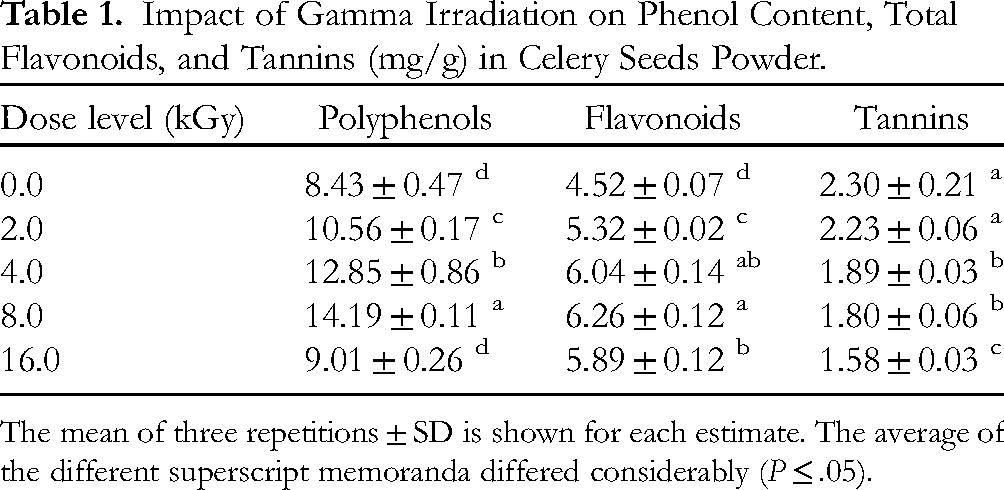
The mean of three repetitions ± SD is shown for each estimate. The average of the different superscript memoranda differed considerably (P ≤ .05).
Polyphenols Content
The polyphenol content in celery seeds shows a significant increase with increasing doses of gamma irradiation up to 8 kGy, followed by a decrease at 16 kGy. The non-irradiated seeds contain 8.43 mg/g of polyphenols. This content increases progressively with irradiation, reaching a maximum of 14.19 mg/g at 8 kGy. The increase in polyphenol content could be due to the breakdown of complex polyphenolic structures into simpler phenolic compounds that are more easily measured or due to the radiation-induced synthesis of new phenolic compounds. However, at the highest dose of 16 kGy, the polyphenol content decreases to 9.01 mg/g, which suggests that excessive radiation might lead to the degradation of polyphenolic compounds. The differences in polyphenol content across different doses are also statistically significant (P ≤ .05), indicating a clear dose-dependent effect of gamma irradiation on these compounds.
The findings of this study align with an earlier inquiry that showed an elevation in phenolic content in soybeans as a consequence of exposure to γ-rays. 28 The irradiation samples showed higher flavonoid contents than the non-irradiated sample, which had 4.52 mg/g. The irradiation samples had 5.32, 6.04, 6.26, and 5.89 mg/g, respectively. Because radiation releases phenolic and flavonoid chemicals from the cell structure, their total concentration may rise. This may lead to the breakdown of bigger molecules into smaller ones and increase the susceptibility of certain phenolic compounds.29,30 This study's results are consistent with earlier research that showed the positive impact of gamma irradiation doses ranging from 0 to 20 kGy on the generation of secondary adducts of certain phenolics and flavonoids in rosemary callus culture. 31 Moreover, it was noted that, in comparison to the control group, the total quantity of flavonoids in bitter gourd showed a significant increase with exposure to higher radiation levels. 32 An important enzyme involved in the production of phenolic compounds in plant tissue is phenylalanine ammonia-lyase. Its activity might potentially increase the total amount of flavonoids.
Flavonoid Content
The flavonoid content in celery seeds shows an overall increase with increasing irradiation doses up to 8 kGy, after which a slight reduction is observed at 16 kGy. Initially, the non-irradiated seeds contain 4.52 mg/g of flavonoids. Upon irradiation, the flavonoid content increases, peaking at 6.26 mg/g at 8 kGy. This enhancement is likely due to the release of flavonoid compounds from the cell structure as a result of radiation-induced stress, which can trigger the synthesis or release of these bioactive molecules. However, at 16 kGy, the flavonoid content slightly decreases to 5.89 mg/g, which might indicate that extremely high doses of irradiation could start to degrade these compounds or inhibit their further synthesis. The changes in flavonoid content across the different doses are statistically significant (P ≤ .05), underscoring the sensitivity of flavonoids to gamma irradiation.
Bioactive compounds found in celery seeds, such as flavonoids and phenolics, have been shown to play a major role in the prevention and treatment of a number of diseases, such as diabetes, osteoporosis, cancer, atherosclerosis, anaemia, obesity, and ageing. 33 The above results are mainly caused by the biological and antioxidant characteristics of these substances.
The data suggest that gamma irradiation can be a useful tool to enhance the concentration of certain bioactive compounds in celery seeds, particularly flavonoids and polyphenols, up to an optimal dose (8 kGy). Beyond this dose, the beneficial effects start to decline, likely due to the degradation of these compounds.
Tannins Content
The tannins content in celery seeds exhibits a decreasing trend with increasing doses of gamma irradiation. The highest concentration of tannins (2.30 mg/g) is observed in the non-irradiated sample (0 kGy). As the irradiation dose increases, the tannin content significantly decreases, reaching the lowest level (1.58 mg/g) at the highest dose of 16 kGy. This reduction could be attributed to the breakdown of tannin molecules due to the high-energy gamma rays, leading to their degradation or conversion into other forms. The significant difference in tannin content across different irradiation doses (P ≤ .05) suggests a strong influence of gamma radiation on these compounds.
The findings align with research conducted by Uma Pradeep et al 34 which revealed that cumin contains significant amounts of tannins. This research also found that the tannin level in irradiated celery was not substantially different from that of non-irradiated samples.
The decrease in tannin content with increasing irradiation doses could have implications for the use of celery seeds in various applications where tannins play a role, such as in their astringency or antioxidant activity. In conclusion, gamma irradiation significantly affects the bioactive compound profile of celery seeds. While it enhances the levels of flavonoids and polyphenols up to a certain dose, it reduces the tannin content consistently. These findings highlight the potential of gamma irradiation as a method to modify and potentially enhance the nutritional and functional properties of celery seeds, which could be beneficial for their use in food and nutraceutical applications. Further studies are needed to explore the mechanisms underlying these changes and to optimize irradiation conditions for desired outcomes.
Effect of Irradiation on the Content of Phenolic Compounds in Celery Seeds
The data in Table 2 present the concentrations of various phenolic acids in celery seeds powder subjected to different levels of gamma irradiation (0, 2, 4, 8, and 16 kGy). The findings illustrate significant variations in the levels of these phenolic components as a function of the irradiation dose, demonstrating both enhancements and reductions depending on the specific phenolic acid and the applied irradiation level.
The Concentration of Phenolics’ Components (mg/100 g DW) in the Celery Seeds Powder Exposed to Different Dose Levels of Gamma Radiation.

Each estimate represents the mean of 3 repeats ± SD. Different superscript memos mean significantly varied (P ≤ .05); ND not detected.
Gallic acid concentration is highest at 16 kGy (5.60 mg/100 g) and significantly decreases with lower irradiation doses, with the lowest concentration observed at 2 kGy (0.11 mg/100 g). The non-irradiated seeds have a relatively low concentration (0.25 mg/100 g). The increase in gallic acid content at higher doses may be due to the breakdown of complex phenolic compounds into simpler ones, such as gallic acid. Catechol is not detected (ND) in non-irradiated and 16 kGy samples. It shows the highest concentration at 4 kGy (2.01 mg/100 g) and remains relatively high at 2 kGy (1.55 mg/100 g) and 8 kGy (1.74 mg/100 g). This suggests that moderate doses of irradiation favour the formation or release of catechol from other phenolic compounds. P-hydroxy benzoic acid is only detected in samples exposed to 8 kGy and 16 kGy, with the highest concentration at 16 kGy (12.23 mg/100 g). This indicates that higher doses of gamma irradiation are necessary to induce the formation or release of this particular phenolic acid. Caffeine concentration shows a significant increase at 16 kGy (7.06 mg/100 g) compared to non-irradiated seeds (3.76 mg/100 g). Lower doses (2, 4, and 8 kGy) exhibit moderate levels, suggesting that high doses of irradiation can significantly enhance caffeine content in celery seeds. Vanillic acid is not detected in non-irradiated seeds and those exposed to 2 kGy. It shows the highest concentration at 16 kGy (5.09 mg/100 g), indicating a dose-dependent increase in its formation or release. Caffeic acid is present in all samples, with the highest concentration at 16 kGy (6.41 mg/100 g). Non-irradiated seeds and those exposed to 8 kGy also show moderate levels, suggesting that irradiation enhances caffeic acid content up to a certain dose. Syringic acid is detected at all doses except 2 kGy, with the highest concentration at 16 kGy (6.84 mg/100 g). This indicates a positive correlation between higher irradiation doses and syringic acid content. Vanillin is only detected in seeds exposed to 16 kGy (7.86 mg/100 g), suggesting that high doses of irradiation are required for its formation or release. P-Coumaric acid shows a significant increase at 16 kGy (6.37 mg/100 g) compared to non-irradiated seeds (1.37 mg/100 g) and other doses. This indicates a dose-dependent increase in its concentration. Ferulic acid is not detected in non-irradiated seeds and those exposed to 2 kGy. It shows the highest concentration at 16 kGy (8.38 mg/100 g), indicating that high doses of irradiation enhance its content. Ellagic acid shows the highest concentration in non-irradiated seeds (32.05 mg/100 g), with a significant decrease at 16 kGy (23.30 mg/100 g). This suggests that gamma irradiation reduces ellagic acid content, possibly due to its degradation or conversion into other compounds. Benzoic acid is only detected at 16 kGy (11.32 mg/100 g), suggesting that high doses of irradiation are required for its formation or release. o-Coumaric acid shows the highest concentration in non-irradiated seeds (15.71 mg/100 g), with a significant decrease at 16 kGy (10.92 mg/100 g). This indicates a reduction in its content with increasing irradiation doses. Salicylic acid levels remain relatively stable across all doses, with no significant changes observed, indicating that gamma irradiation does not significantly affect its content. Cinnamic acid is detected at all doses except 4 kGy, with the highest concentration at 16 kGy (6.17 mg/100 g). This suggests that gamma irradiation can enhance its content, particularly at higher doses.
The data suggest that gamma irradiation can significantly affect the phenolic acid profile of celery seeds. While some phenolic acids, such as gallic acid, caffeine, and p-hydroxy benzoic acid, show increased concentrations with higher irradiation doses, others, such as ellagic acid and o-coumaric acid, exhibit reduced levels. These variations highlight the complex and compound-specific effects of gamma irradiation on phenolic acids, which can be attributed to the differential stability, formation, and degradation of these compounds under irradiation stress. According to the results of this study, phenolic component amounts are significantly (P ≤ .05) altered by γ-radiation exposure at a dose of 16 kGy. Previous studies have also shown that irradiating Ginkgo biloba at a dose of 10 kGy increased the amount of some phenolic compounds. 35 The findings might be explained by radiation exposure-induced polymerization and release of the polysaccharide from the cell wall, which leads to an increased ability to separate molecules. The levels of lithospermic acid, caffeic acid trimer, rosmarinic acid hexoside, quercetin-o-glucuronide, caffeic acid adducts, and rosmarinic acid were all slightly lowered after radiation exposure at 10 kGy, although this drop was statistically significant (P ≤ .05). It seems from the changes in the polyphenolic compounds as a whole that they are unstable to γ-radiation and partially degrade at higher radiation doses. Therefore, radiation may accelerate molecular disintegration and cause fewer stable components to degrade. 30 In conclusion, gamma irradiation presents a viable method for modifying the phenolic acid profile of celery seeds, potentially enhancing the nutritional and functional properties of these seeds for various applications. However, the optimal irradiation dose must be carefully determined to maximize the beneficial effects while minimizing any adverse impacts on specific phenolic components. Further research is needed to elucidate the underlying mechanisms of these changes and to explore the potential health benefits and applications of irradiated celery seeds.
Impact of Radiation on Celery Seeds’ Ability to Scavenge DPPH Radicals
Several investigations have effectively used the DPPH approach to evaluate the oxidative stability and antioxidant characteristics of diverse materials, including fruits, algae, vegetables, and plant leftovers.36,37 Furthermore, studies by Mehram et al 38 and Pham-Huy et al 39 have demonstrated the critical importance of eliminating dangerous free radicals in order to prevent these radicals’ detrimental effects in a variety of diseases, including conditions related to diabetes, nephropathy, obesity, cancer, cardiovascular disease, and neurological disorders.
Figure (1) displays the alterations in DHHP radical scavenging activity between celery seeds that were not exposed to radiation and those that were exposed to radiation. The DPPH activity was enhanced by irradiation at doses of 2, 4, 8, and 16 kGy, resulting in percentages of 75.81, 78.48, 84.14, and 86.84%, respectively. In contrast, non-irradiated samples had a DPPH activity of 71.42 ± 1.50. The presence of flavonoids and phenolics produced by irradiation, which increase celery seeds’ capacity to scavenge DPPH, is probably what's responsible for the increase in scavenging activity.40,41 The results of this study are consistent with those of Jo et al, 42 who found that exposing green tea shoot EtOH extracts to radiation at doses of 10-20 kGy significantly increased the plant's capacity to scavenge free radicals (DPPH), which in turn increased antioxidant activity. Furthermore, Choi et al 43 found a little increase in latency after exposure to 5.3 KGy of radiation when compared to latency in the absence of radiation.
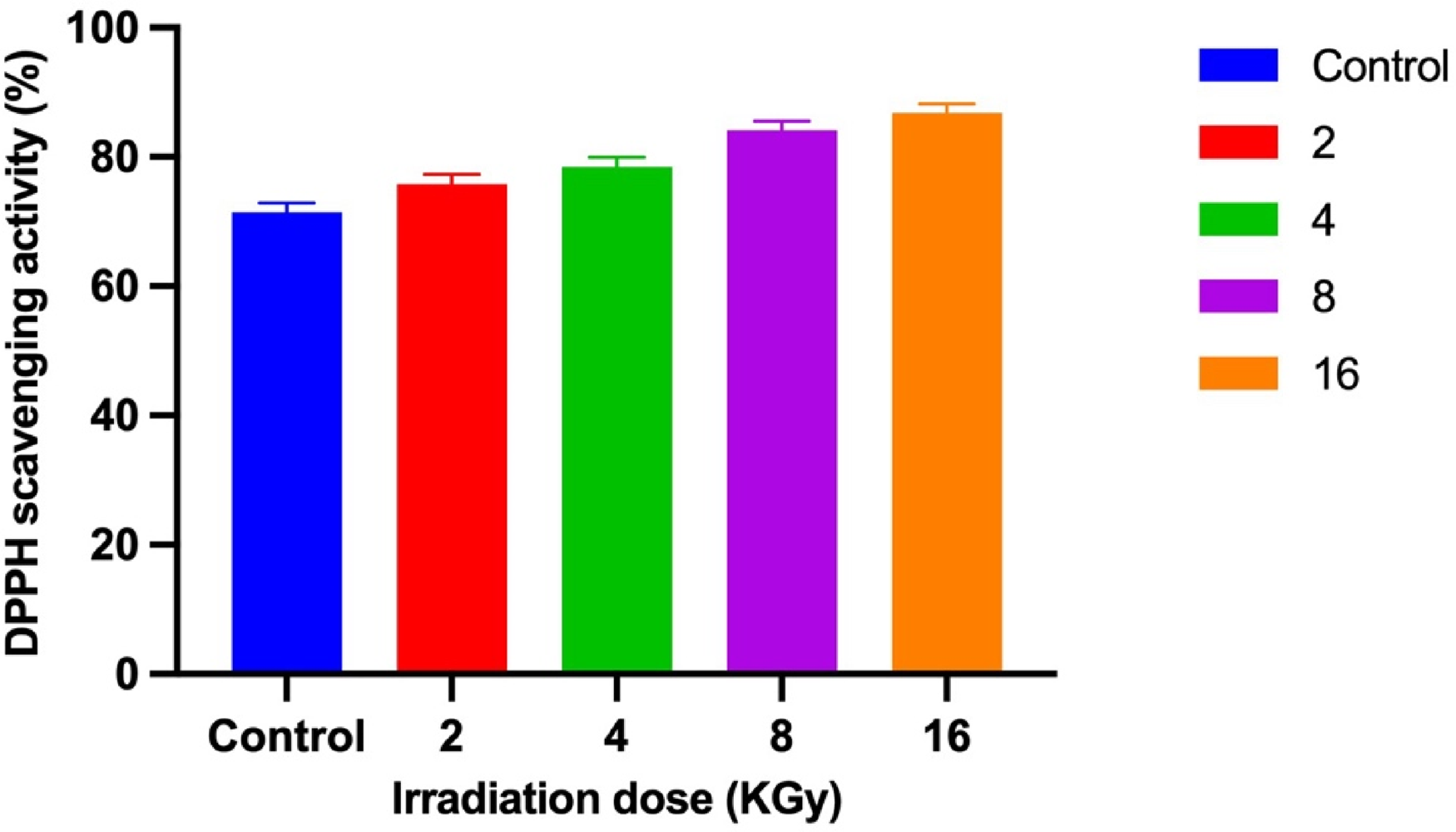
DPPH radical scavenging action of irradiated celery seed powder.
Another investigation found that there were no significant alterations in the scavenging properties of lyophilized mushrooms treated with radiation doses ranging from 2.5 to 20 KGy, as seen in their MeOH extracts. 44 Similarly, when exposed to irradiation dosages of 5-25 KGy, the antioxidant activity of cinnamon components remained unaffected. According to a paper by Lampart-Szczapa et al, 45 higher radiation exposures were shown to decrease the antioxidant effects of the majority of lupin extracts. In addition, Alothman et al 46 said that the plant's antioxidant activity is attributed to the heightened enzyme mobility, such as phenylalanine, ammonia lysase, and pyroxidero polyphenols oxidase activity, or the improved extractability of tissue resulting from irradiation. In addition, Calucci et al 25 found that 8 aromatic types (basil, black pepper, parsley, bird pepper, cinnamon, rosemary, thyme, nutmeg, sage) exhibited an increase in the number of free radicals when exposed to a radiation dose of 10 KGy.
Irradiation Effect on Lipid Peroxidation of Celery Seeds
Figure (2) shows that the amount of lipid peroxidation in celery seeds was significantly affected by irradiation at different doses (2, 4, 8, and 16 KGy). When compared to non-irradiated seeds (4.74 µmol/g), there was a statistically significant increase (P ≤ .05) in the generation of malonaldehyde, with observed values of 5.72, 6.51, 8.73, and 11.03 µmol/g for the different dosages. This result is consistent with the study of Kavitha et al, 47 which found that when pyre fruits were exposed to radiation levels between 0.25 and 1.0 KGy, there was a rise in lipid peroxidation in comparison to the fruit that was not exposed to radiation.
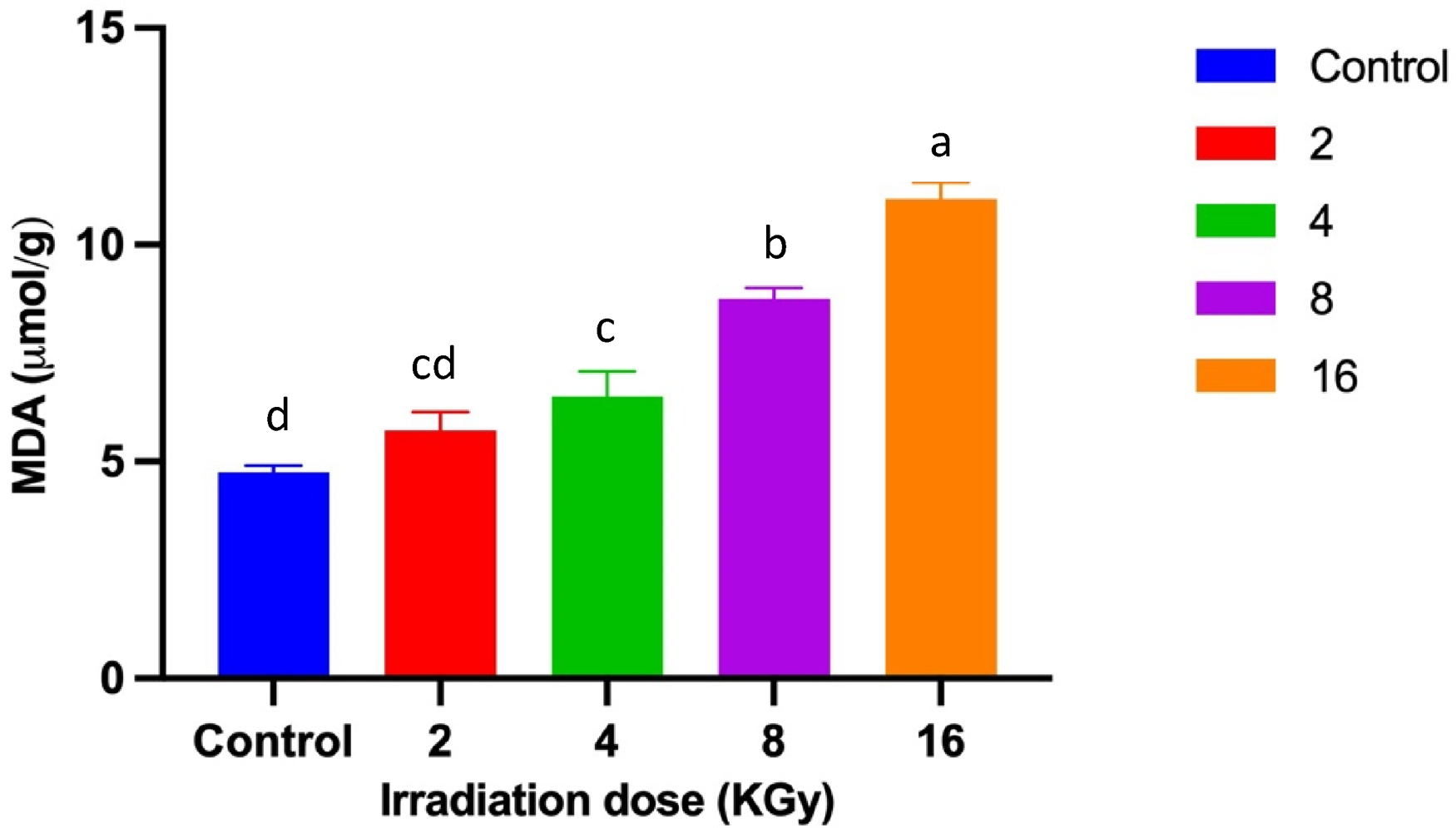
Lipid peroxidation of irradiated celery seed powder.
Irradiation Effect on the Antioxidant Activity of Celery Seeds
Figure (3) shows how radiation affects celery seeds’ ability to reduce power. When compared to the non-irradiated sample (0.16 Abs), the reduction levels in samples exposed to radiation at doses of 2 or 4 KGy (0.17 and 0.23, respectively) were not statistically significant. At radiation dosages of 8 or 16 kGy, respectively, there was a decline of 0.15 and 0.13 in the declining power activity. In earlier research, Suhaj et al 48 discovered that subjecting black pepper to γ-irradiation at 5 or 30 KGy decreased the spice's antioxidant qualities. However, the radiation did not affect Zanzibar or cloves. 49 It's possible that the impact of lowering power was lessened as a result of the ascorbic acid levels dropping. 50

Reducing power activity of irradiated celery seed powder.
Limitations, Future Prospectives and Challenges of the Study
One limitation of this study is the narrow range of gamma radiation doses tested. The study only examined doses from 0 to 16 kGy, which may not encompass the full spectrum of potential effects that higher doses could have on the bioactive compounds and antioxidant properties of celery seeds. This limited range restricts the ability to generalize findings across broader applications or to understand the complete dose-response relationship for gamma irradiation on these seeds. Future research could benefit from exploring a wider range of radiation doses to better elucidate these effects.
The study investigates the effects of gamma radiation on celery seeds to enhance their health benefits and culinary applications. The research involved exposing celery seeds to varying doses of gamma radiation (0, 2, 4, 8, and 16 kGy) at a rate of 1.9 kGy per hour. Results indicated that irradiation significantly increased antioxidant activity and lipid oxidation in the seeds, primarily due to elevated levels of bioactive compounds such as flavonoids and phenolics. Notably, while some phenolic components increased with higher doses, others decreased slightly, demonstrating a complex relationship between radiation exposure and compound concentration. 51 The study highlights the potential of gamma radiation as a method for enhancing the nutritional profile of celery seeds, which are already recognized for their medicinal properties, including anti-inflammatory and antioxidant effects. However, challenges such as regulatory approval and consumer acceptance of irradiated foods may hinder broader application in the food industry.
Conclusion
This study demonstrates that gamma irradiation significantly enhances the bioactive compounds in celery seeds, particularly phenolics and flavonoids, which increased from 8.43 mg/g to 14.19 mg/g with irradiation doses of 2 to 16 kGy. These findings suggest that irradiation can be a viable method to boost the nutritional profile of celery seeds, potentially enhancing their role in human health by providing greater antioxidant activity and supporting the prevention of various diseases. However, it is important to note that while the levels of beneficial flavonoids and phenolic compounds increased, there was a corresponding decrease in tannin content and an increase in lipid peroxidation, as well as, may be effect on sensory properties. Specifically, tannin levels decreased from 2.30 mg/g in non-irradiated samples to as low as 1.58 mg/g in irradiated samples. This dual effect indicates that while gamma irradiation can improve certain bioactive components, it may also have adverse effects on others, such as lipid stability. In summary, the application of gamma irradiation presents a promising avenue for enhancing the health benefits of celery seeds, although further research is necessary to fully understand the implications of these changes on human health and disease prevention.
Footnotes
Acknowledgements
I would like to express my gratitude to all cited references’ authors in my article for enriching this study. Also, I thank my family for their support to my work.
Declaration of Conflicting Interests
The author declared no potential conflicts of interest with respect to the research, authorship, and/or publication of this article.
Funding
The author received no financial support for the research, authorship, and/or publication of this article.
